×
Request Free Sample ×

Kindly complete the form below to receive a free sample of this Report

* Please use a valid business email

Leading companies partner with us for data-driven Insights

clients tt-cursor
Hero Background
English
Chinese
French
Japanese
Korean
German
Spanish

Second Generation Bio fuels Market Analysis

ID: MRFR/CnM/10272-CR
111 Pages
Chitranshi Jaiswal
April 2025

Second Generation Biofuels Market Research Report By Feedstock Type (Lignocellulosic Biomass, Agricultural Residues, Wood Residues, Algae, Industrial Waste), By Production Technology (Gasification, Fermentation, Transesterification, Hydrothermal Liquefaction), By Application (Transportation Fuels, Electricity Generation, Heating Oils, Aviation Fuels), By End Use (Commercial, Industrial, Residential) and By Regional (North America, Europe, South America, Asia Pacific, Middle East and Africa) - Forecast to 2035.

Share:
Download PDF ×

We do not share your information with anyone. However, we may send you emails based on your report interest from time to time. You may contact us at any time to opt-out.

Second Generation Bio fuels Market Infographic
×
Second Generation Bio fuels Market Infographic Full View
Purchase Options

Market Analysis

In-depth Analysis of Second Generation Bio fuels Market Industry Landscape

Second-generation biofuels are undergoing a major market change due to increased demand for affordable, environmentally friendly power. Horticultural waste, wood, and green growth are used to make second-generation biofuels like bioethanol and biodiesel. Due to their lack of food production and ability to use waste, these biofuels are safer for the environment than their predecessors. The growing global awareness of the need to reduce ozone-depleting substances and fight environmental change is driving the market. Second-generation biofuels are a viable option for legislatures and corporations seeking cleaner energy.

Technology and research have improved production cycles and cost efficiencies, affecting market factors. Advances in protein invention and maturation have made biomass-to-biofuel conversion more profitable. This mechanical improvement has attracted investors and companies, boosting corporate growth and flexibility. The administrative scene is also improving to support second-generation biofuels. States are encouraging the production and use of high-level biofuels, creating a large market for industry players.

Another factor is the availability of second-generation biofuel feedstocks, which keeps the market dynamic. Using maize stover, wheat straw, switchgrass, and miscanthus reduces feedstock dependence and increases adaptability. This variety ensures a more stable and flexible manufacturing network, reducing value change and accessibility risks. The market is seeing biofuel makers and horticultural partners collaborate more on feedstock sourcing and storage.

Despite progress, second-generation biofuels face market obstacles. Some investors are frustrated by the capital costs of biofuel creation offices. However, innovation and economies of scale should reduce these costs, making second-generation biofuels more competitive. The competition with regular petroleum derivatives, which dominate the energy market, is crucial. Market entry includes overcoming framework constraints and meeting customer perceptions of biofuels' presentation and compatibility with existing transportation frameworks.


Author
Chitranshi Jaiswal
Research Analyst Level I

In her 3 years of experience in the market research field, she has handled critical cross-domain projects. She has an in-depth knowledge of market estimation & analysis, problem-solving, primary as well as secondary research, and team management.She holds an engineering degree and is an MBA professional from a well-known university, capable of evaluating the market and competitive conditions. An exceptional strategist with excellent communication skills and a passion for delivering cutting-edge & practical insights for the market. Proficient in multi-tasking, and can successfully deal with competing demands, while maintaining complete confidentiality. Generated business through active client and project development, networking, and high-quality responses. Her knowledge and skills have helped in making solid business decisions, securing funding from investors, and avoiding business failures.

Leave a Comment

FAQs

What is the expected market size of the Second Generation Biofuels Market by 2024?

The Second Generation Biofuels Market is expected to be valued at 21.95 USD Billion by the year 2024.

What will be the market size of the Second Generation Biofuels Market in 2035?

The market is projected to reach 45.3 USD Billion by the year 2035.

What is the expected CAGR for the Second Generation Biofuels Market from 2025 to 2035?

The expected compound annual growth rate (CAGR) for the market is 6.81% from 2025 to 2035.

Which region is expected to dominate the Second Generation Biofuels Market by 2035?

North America is anticipated to dominate the market with a valuation of 17.8 USD Billion by 2035.

How much will the Lignocellulosic Biomass segment be valued in 2035?

The Lignocellulosic Biomass segment is projected to be valued at 16.5 USD Billion by the year 2035.

Who are the key players in the Second Generation Biofuels Market?

Major players in the market include BP, LanzaTech, , ADM, and Shell among others.

What will be the market size of the Agricultural Residues segment in 2035?

The Agricultural Residues segment is expected to reach a value of 9.0 USD Billion by 2035.

What is the market value of the Asia Pacific region in 2024?

The Asia Pacific region is valued at 3.0 USD Billion in the year 2024.

How much is the Industrial Waste segment projected to be worth in 2035?

The Industrial Waste segment is projected to be valued at 8.8 USD Billion by 2035.

What is the expected market value for the Wood Residues segment in 2024?

The Wood Residues segment is expected to be valued at 3.5 USD Billion in the year 2024.

Market Summary

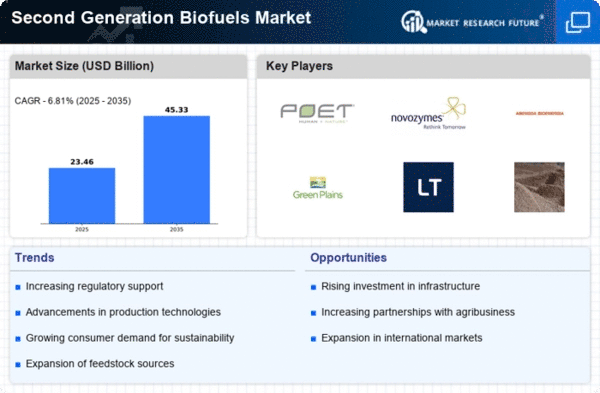
As per MRFR analysis, the Second Generation Biofuels Market Size was estimated at 21.96 USD Billion in 2024. The Second Generation Biofuels industry is projected to grow from 23.46 USD Billion in 2025 to 45.33 USD Billion by 2035, exhibiting a compound annual growth rate (CAGR) of 6.81 during the forecast period 2025 - 2035.

Key Market Trends & Highlights

The Second Generation Biofuels Market is poised for substantial growth driven by technological advancements and regulatory support.

  • Technological innovations are enhancing the efficiency of biofuel production processes.
  • Regulatory support is fostering a favorable environment for the adoption of second generation biofuels in North America.
  • The transportation segment remains the largest market, while power generation is emerging as the fastest-growing segment in Asia-Pacific.
  • Rising demand for renewable energy and supportive government policies are key drivers propelling market expansion.

Market Size & Forecast

2024 Market Size 21.96 (USD Billion)
2035 Market Size 45.33 (USD Billion)
CAGR (2025 - 2035) 6.81%
Largest Regional Market Share in 2024 North America

Major Players

POET LLC (US), Novozymes A/S (DK), Abengoa Bioenergy (ES), Green Plains Inc. (US), LanzaTech (US), Biomass Energy (US), Shell Global (GB), TotalEnergies SE (FR), Valero Energy Corporation (US)

Market Trends

The Second Generation Biofuels Market is currently experiencing a notable transformation, driven by a growing emphasis on sustainability and the need to reduce greenhouse gas emissions. This market encompasses biofuels produced from non-food feedstocks, such as agricultural residues, waste materials, and dedicated energy crops. As global energy demands continue to rise, the shift towards renewable energy sources becomes increasingly critical. The Second Generation Biofuels Market appears to be well-positioned to address these challenges, offering a viable alternative to traditional fossil fuels while promoting energy security and environmental stewardship. In December 2025, the landscape of the Second Generation Biofuels Market is characterized by technological advancements and increased investment in research and development. Stakeholders are focusing on improving production efficiency and reducing costs, which may enhance the competitiveness of biofuels against conventional fuels. Furthermore, regulatory frameworks and government incentives are likely to play a pivotal role in shaping market dynamics, encouraging the adoption of cleaner energy solutions. As the world moves towards a more sustainable future, the Second Generation Biofuels Market is poised for growth, potentially leading to a more diversified energy portfolio and reduced reliance on fossil fuels.

Technological Innovations

The Second Generation Biofuels Market is witnessing a surge in technological advancements that enhance production processes. Innovations in enzymatic hydrolysis and fermentation techniques are streamlining the conversion of biomass into biofuels. These developments not only improve yield but also reduce the overall environmental impact of biofuel production.

Regulatory Support

Government policies and regulations are increasingly favoring the Second Generation Biofuels Market. Incentives such as tax breaks and subsidies for biofuel production are encouraging investment in this sector. This regulatory support is crucial for fostering a favorable environment for the growth of sustainable energy solutions.

Market Diversification

The Second Generation Biofuels Market is likely to experience diversification in feedstock sources. As the demand for biofuels rises, stakeholders are exploring various non-food feedstocks, including agricultural waste and algae. This diversification may enhance supply chain resilience and reduce competition with food production.

Second Generation Bio fuels Market Market Drivers

Rising Demand for Renewable Energy

The Global Second Generation Biofuels Market Industry is experiencing a surge in demand for renewable energy sources. This trend is driven by increasing awareness of climate change and the need to reduce greenhouse gas emissions. Governments worldwide are implementing policies and incentives to promote the use of biofuels, which are seen as a cleaner alternative to fossil fuels. For instance, the market is projected to reach 21.9 USD Billion in 2024, reflecting a growing commitment to sustainable energy solutions. This shift not only supports environmental goals but also enhances energy security by diversifying energy sources.

Market Segment Insights

By Application: Transportation (Largest) vs. Power Generation (Fastest-Growing)

In the Second Generation Biofuels Market, the application segment is notably diverse, encompassing 'Transportation', 'Power Generation', 'Industrial', and 'Residential'. Transportation holds the largest share within this segment, driven by the growing demand for sustainable fuel alternatives in road and rail transport. Meanwhile, Power Generation is recognized as the fastest-growing application area, as energy producers increasingly seek renewable sources to meet global energy needs and reduce carbon footprints. Together, these segments significantly shape the biofuels landscape, addressing both mobility and energy generation.

Transportation (Dominant) vs. Power Generation (Emerging)

Transportation remains the dominant application of second-generation biofuels, primarily due to its essential role in reducing greenhouse gas emissions from vehicles. The segment encompasses various modes of transport including cars, trucks, and public transit, driving innovations in biofuel technologies such as advanced bioethanol and biodiesel. Conversely, Power Generation is an emerging segment characterized by rapid growth, reflecting an increasing shift towards renewable energy sources. This segment leverages biofuels to generate electricity, offering a sustainable alternative to fossil fuels, and is heavily influenced by governmental incentives and consumer preference for green energy solutions.

By Feedstock Type: Lignocellulosic Biomass (Largest) vs. Waste Oils (Fastest-Growing)

In the Second Generation Biofuels Market, the distribution of feedstock types showcases the dominant role of Lignocellulosic Biomass, which holds the largest share due to its abundant availability and cost-effectiveness. This feedstock type primarily includes materials like wood, straw, and other agricultural residues, allowing for efficient conversion into biofuels. Conversely, Waste Oils are emerging as a fast-growing segment, driven by increasing waste oil collection initiatives and technological advancements that enhance processing capabilities. Growing environmental concerns and the push for sustainable energy solutions are propelling the evolution of the biofuels sector. As regulations tighten around emissions and fossil fuel use, the Second Generation Biofuels Market is witnessing accelerated growth in varying feedstock types. Agricultural Residues and Energy Crops also continue to play a critical role, attributed to their potential for carbon-neutral energy production and the push for innovative agricultural practices.

Lignocellulosic Biomass (Dominant) vs. Agricultural Residues (Emerging)

Lignocellulosic Biomass, derived from non-food plant materials, remains the dominant feedstock in the Second Generation Biofuels Market due to its high availability and efficiency in biofuel production. It allows for significant reductions in greenhouse gas emissions, making it an attractive option for sustainable energy solutions. In contrast, Agricultural Residues, such as corn stalks and wheat straw, are emerging as an important feedstock due to their potential in waste reduction and resource optimization. With continuous advancements in pretreatment processes and enzymatic technology, the utilization of Agricultural Residues is gaining traction, thereby facilitating improved energy yields and fostering greater adoption of biofuels.

By Production Technology: Gasification (Largest) vs. Fermentation (Fastest-Growing)

In the Second Generation Biofuels Market, gasification stands out as the largest production technology segment, significantly contributing to overall market share. This process utilizes high temperatures to convert organic materials into syngas, which can be further transformed into biofuels, thereby ensuring efficient energy generation. Fermentation, on the other hand, is gaining momentum as the fastest-growing segment. This method, which involves converting sugars into ethanol through microbial processes, is increasingly being utilized by innovators seeking sustainable alternatives to fossil fuels.

Gasification: Dominant vs. Fermentation: Emerging

Gasification remains the dominant production technology in the Second Generation Biofuels Market due to its versatility and efficiency. It is particularly suited for a wide range of feedstocks, including agricultural residues and biomass, allowing for a broad application across different regions. Conversely, fermentation is an emerging technology characterized by its environmentally friendly processes and lower operational costs. As regulatory frameworks promote cleaner fuels and the demand for sustainable biofuels increases, fermentation is quickly gaining traction, especially in industries seeking renewable energy sources.

By End Use Sector: Automotive (Largest) vs. Aviation (Fastest-Growing)

In the Second Generation Biofuels Market, the End Use Sector is characterized by a diverse range of applications, prominently featuring Automotive, Aviation, Marine, and Heating. Among these, the Automotive sector holds the largest market share, driven by the increasing demand for sustainable fuels in personal and commercial vehicles. In contrast, the Aviation sector is rapidly emerging as a significant player, reflecting the aviation industry's commitment to achieving greener operations through the use of biofuels, thus increasing its share in the market.

Automotive (Dominant) vs. Aviation (Emerging)

The Automotive sector is established as the dominant segment within the Second Generation Biofuels Market, owing to the robust adoption of biofuels by vehicle manufacturers and governments promoting cleaner fuels. This sector benefits from a growing consumer preference for eco-friendly transportation options, leading to innovations in fuel technologies. On the other hand, the Aviation sector is an emerging segment with significant growth potential, driven by stringent regulatory pressures to reduce carbon emissions and enhance fuel efficiency in air travel. As airlines increasingly invest in sustainable aviation fuel initiatives, this sector demonstrates substantial promise for future expansion, highlighting a dynamic shift in energy sourcing across industries.

By Regulatory Framework: Renewable Fuel Standards (Largest) vs. Carbon Credits (Fastest-Growing)

In the Second Generation Biofuels Market, regulatory frameworks play a crucial role in shaping the industry landscape. Renewable Fuel Standards (RFS) hold the largest market share due to their established regulations that promote the use of biofuels and ensure a stable demand. Meanwhile, Carbon Credits are emerging as the fastest-growing segment, driven by increasing governmental and corporate initiatives that aim to offset carbon emissions and motivate biofuel production through market-based approaches. As the market evolves, incentives for biofuel production and sustainability certifications are expected to gain traction. The growth of RFS is attributed to their long-term commitment to renewable energy, while the rapid expansion of Carbon Credits aligns with global sustainability goals. The shift towards greener energy policies is a significant driver, enabling biofuels to play a vital part in the transition to a low-carbon economy.

Renewable Fuel Standards (Dominant) vs. Sustainability Certifications (Emerging)

Renewable Fuel Standards (RFS) remain the dominant force within the regulatory framework of the Second Generation Biofuels Market. They provide a reliable mechanism that incentivizes biofuel production and consumption by mandating a specific volume of renewable fuel to be blended into conventional fuels. This foundational support encourages investment and innovation within the sector. On the other hand, Sustainability Certifications are emerging as an important factor for producers seeking market differentiation. As consumer awareness and demand for sustainably produced fuels grow, these certifications provide a competitive edge, ensuring that products meet environmental and social standards. Together, these elements foster a conducive environment for the advancement and acceptance of second-generation biofuels.

Get more detailed insights about Second Generation Bio-fuels Market Research Report—Global Forecast till 2035

Regional Insights

North America : Innovation and Leadership Hub

North America is poised to maintain its dominance in the Second Generation Biofuels market, holding a market size of $10.98 billion in 2025. The region benefits from strong regulatory support, including incentives for renewable energy production and stringent emissions regulations. This has spurred innovation and investment in biofuel technologies, driving demand for sustainable energy solutions. The increasing focus on reducing carbon footprints and enhancing energy security further propels market growth. The United States stands out as a key player, with major companies like POET LLC, Green Plains Inc., and Valero Energy Corporation leading the charge. The competitive landscape is characterized by significant investments in R&D and partnerships aimed at advancing biofuel technologies. The presence of established firms and a robust supply chain enhances the region's market position, making it a global leader in biofuel production.

Europe : Sustainable Energy Transition Leader

Europe is rapidly advancing in the Second Generation Biofuels market, with a market size of €6.59 billion in 2025. The region's commitment to sustainability and climate goals drives demand for biofuels, supported by stringent EU regulations and incentives for renewable energy. The European Green Deal and Renewable Energy Directive are pivotal in shaping the market landscape, encouraging investments in innovative biofuel technologies and infrastructure. Countries like Germany, France, and the Netherlands are at the forefront, with significant contributions from companies such as Novozymes A/S and TotalEnergies SE. The competitive environment is marked by collaboration between public and private sectors, fostering innovation and enhancing production capabilities. The presence of leading firms and supportive policies positions Europe as a key player in The Second Generation Bio fuels.

Asia-Pacific : Emerging Market Potential

Asia-Pacific is emerging as a significant player in the Second Generation Biofuels market, with a market size of $3.84 billion in 2025. The region's growth is driven by increasing energy demands, government policies promoting renewable energy, and a shift towards sustainable practices. Countries are implementing regulations to reduce greenhouse gas emissions, which is catalyzing investments in biofuel technologies and infrastructure development. Leading countries such as China and India are focusing on biofuel production to meet their energy needs and reduce reliance on fossil fuels. The competitive landscape includes both local and international players, with companies like LanzaTech and Biomass Energy making strides in the market. The region's diverse agricultural base provides ample feedstock for biofuel production, enhancing its growth prospects.

Middle East and Africa : Resource-Rich Frontier

The Middle East and Africa represent an emerging frontier in the Second Generation Biofuels market, with a market size of $0.55 billion in 2025. The region is beginning to recognize the potential of biofuels as a sustainable energy source, driven by the need to diversify energy portfolios and reduce dependence on fossil fuels. Government initiatives are gradually promoting renewable energy investments, although the market is still in its nascent stages compared to other regions. Countries like South Africa and the UAE are exploring biofuel production, supported by local and international partnerships. The competitive landscape is characterized by a mix of established energy companies and new entrants focusing on biofuel technologies. As awareness and regulatory frameworks evolve, the region is poised for growth in the biofuels sector, leveraging its natural resources and agricultural potential.

Key Players and Competitive Insights

The Second Generation Biofuels Market is currently characterized by a dynamic competitive landscape, driven by the increasing demand for sustainable energy solutions and stringent regulatory frameworks aimed at reducing carbon emissions. Key players such as POET LLC (US), Novozymes A/S (DK), and Shell Global (GB) are strategically positioned to leverage their technological advancements and operational efficiencies. POET LLC (US) focuses on innovation in biofuel production processes, while Novozymes A/S (DK) emphasizes enzyme technology to enhance biofuel yield. Shell Global (GB) is actively pursuing partnerships to expand its biofuel portfolio, indicating a collective shift towards collaborative strategies that shape the competitive environment.The market structure appears moderately fragmented, with several players vying for market share through localized manufacturing and optimized supply chains. This fragmentation allows for diverse approaches to production and distribution, enabling companies to cater to regional demands effectively. The influence of key players is significant, as their strategic initiatives often set industry benchmarks, driving others to adapt and innovate in response.

In November POET LLC (US) announced a groundbreaking partnership with a leading agricultural technology firm to enhance the efficiency of feedstock conversion processes. This collaboration is poised to streamline production and reduce costs, thereby reinforcing POET's competitive edge in the biofuels sector. The strategic importance of this partnership lies in its potential to accelerate the adoption of advanced biofuel technologies, positioning POET as a frontrunner in sustainable energy solutions.

In October Novozymes A/S (DK) launched a new enzyme product specifically designed for second-generation biofuels, aimed at improving the conversion rates of lignocellulosic biomass. This innovation not only enhances the efficiency of biofuel production but also aligns with global sustainability goals. The introduction of this product underscores Novozymes' commitment to research and development, which is critical for maintaining its competitive position in a rapidly evolving market.

In September Shell Global (GB) expanded its biofuel production capacity by investing in a new facility in the Netherlands, focusing on the production of advanced biofuels from waste materials. This strategic move reflects Shell's long-term vision of transitioning towards a more sustainable energy portfolio. The facility is expected to significantly increase Shell's output, thereby enhancing its market presence and contributing to the overall growth of the biofuels sector.

As of December current trends in the Second Generation Biofuels Market indicate a strong emphasis on digitalization, sustainability, and the integration of artificial intelligence in production processes. Strategic alliances are increasingly shaping the competitive landscape, as companies recognize the value of collaboration in achieving innovation and efficiency. Looking ahead, competitive differentiation is likely to evolve from traditional price-based competition to a focus on technological advancements, supply chain reliability, and sustainable practices, reflecting the industry's shift towards a more environmentally conscious future.

Key Companies in the Second Generation Bio fuels Market include

Industry Developments

  • Q2 2024: BP Plans Foray into 2G Ethanol, Sustainable Jet Fuel with Brazil Base BP Plc announced it will evaluate expanding and diversifying its biofuel operation in Brazil, including new products such as second-generation ethanol and sustainable aviation fuel, after buying out Bunge from their joint venture BP Bunge Bioenergia.
  • Q2 2024: The Brazilian Behemoth: The Biggest, Baddest Advanced Biorefinery of Them All, Open for Business Raízen inaugurated its new $228 million second-generation ethanol plant at the Bonfim Bioenergy Complex in Guariba, São Paulo, Brazil, marking a significant expansion in cellulosic ethanol production capacity.

Future Outlook

Second Generation Bio fuels Market Future Outlook

The Second Generation Biofuels Market is projected to grow at a 6.81% CAGR from 2025 to 2035, driven by technological advancements, regulatory support, and increasing demand for sustainable energy solutions.

New opportunities lie in:

  • Development of advanced feedstock supply chains for cost-effective production.
  • Investment in biorefinery technologies to enhance yield and efficiency.
  • Partnerships with automotive manufacturers for biofuel-compatible engines.

By 2035, the market is expected to achieve substantial growth, positioning itself as a key player in the renewable energy sector.

Market Segmentation

Second Generation Bio fuels Market Application Outlook

  • Transportation
  • Power Generation
  • Industrial
  • Residential

Second Generation Bio fuels Market End Use Sector Outlook

  • Automotive
  • Aviation
  • Marine
  • Heating

Second Generation Bio fuels Market Feedstock Type Outlook

  • Lignocellulosic Biomass
  • Waste Oils
  • Agricultural Residues
  • Energy Crops

Second Generation Bio fuels Market Regulatory Framework Outlook

  • Renewable Fuel Standards
  • Carbon Credits
  • Incentives for Biofuel Production
  • Sustainability Certifications

Second Generation Bio fuels Market Production Technology Outlook

  • Gasification
  • Fermentation
  • Transesterification
  • Hydrothermal Liquefaction

Report Scope

MARKET SIZE 202421.96(USD Billion)
MARKET SIZE 202523.46(USD Billion)
MARKET SIZE 203545.33(USD Billion)
COMPOUND ANNUAL GROWTH RATE (CAGR)6.81% (2025 - 2035)
REPORT COVERAGERevenue Forecast, Competitive Landscape, Growth Factors, and Trends
BASE YEAR2024
Market Forecast Period2025 - 2035
Historical Data2019 - 2024
Market Forecast UnitsUSD Billion
Key Companies ProfiledPOET LLC (US), Novozymes A/S (DK), Abengoa Bioenergy (ES), Green Plains Inc. (US), LanzaTech (US), Biomass Energy (US), Shell Global (GB), TotalEnergies SE (FR), Valero Energy Corporation (US)
Segments CoveredApplication, Feedstock Type, Production Technology, End Use Sector, Regulatory Framework
Key Market OpportunitiesAdvancements in feedstock conversion technologies enhance sustainability in the Second Generation Bio fuels Market.
Key Market DynamicsTechnological advancements and regulatory support drive the growth of second generation biofuels in diverse energy markets.
Countries CoveredNorth America, Europe, APAC, South America, MEA

FAQs

What is the expected market size of the Second Generation Biofuels Market by 2024?

The Second Generation Biofuels Market is expected to be valued at 21.95 USD Billion by the year 2024.

What will be the market size of the Second Generation Biofuels Market in 2035?

The market is projected to reach 45.3 USD Billion by the year 2035.

What is the expected CAGR for the Second Generation Biofuels Market from 2025 to 2035?

The expected compound annual growth rate (CAGR) for the market is 6.81% from 2025 to 2035.

Which region is expected to dominate the Second Generation Biofuels Market by 2035?

North America is anticipated to dominate the market with a valuation of 17.8 USD Billion by 2035.

How much will the Lignocellulosic Biomass segment be valued in 2035?

The Lignocellulosic Biomass segment is projected to be valued at 16.5 USD Billion by the year 2035.

Who are the key players in the Second Generation Biofuels Market?

Major players in the market include BP, LanzaTech, , ADM, and Shell among others.

What will be the market size of the Agricultural Residues segment in 2035?

The Agricultural Residues segment is expected to reach a value of 9.0 USD Billion by 2035.

What is the market value of the Asia Pacific region in 2024?

The Asia Pacific region is valued at 3.0 USD Billion in the year 2024.

How much is the Industrial Waste segment projected to be worth in 2035?

The Industrial Waste segment is projected to be valued at 8.8 USD Billion by 2035.

What is the expected market value for the Wood Residues segment in 2024?

The Wood Residues segment is expected to be valued at 3.5 USD Billion in the year 2024.

  1. SECTION I: EXECUTIVE SUMMARY AND KEY HIGHLIGHTS
    1. | 1.1 EXECUTIVE SUMMARY
    2. | 1.1.1 Market Overview
    3. | 1.1.2 Key Findings
    4. | 1.1.3 Market Segmentation
    5. | 1.1.4 Competitive Landscape
    6. | 1.1.5 Challenges and Opportunities
    7. | 1.1.6 Future Outlook
  2. SECTION II: SCOPING, METHODOLOGY AND MARKET STRUCTURE
    1. | 2.1 MARKET INTRODUCTION
    2. | 2.1.1 Definition
    3. | 2.1.2 Scope of the study
    4. |-- 2.1.2.1 Research Objective
    5. |-- 2.1.2.2 Assumption
    6. |-- 2.1.2.3 Limitations
    7. | 2.2 RESEARCH METHODOLOGY
    8. | 2.2.1 Overview
    9. | 2.2.2 Data Mining
    10. | 2.2.3 Secondary Research
    11. | 2.2.4 Primary Research
    12. |-- 2.2.4.1 Primary Interviews and Information Gathering Process
    13. |-- 2.2.4.2 Breakdown of Primary Respondents
    14. | 2.2.5 Forecasting Model
    15. | 2.2.6 Market Size Estimation
    16. |-- 2.2.6.1 Bottom-Up Approach
    17. |-- 2.2.6.2 Top-Down Approach
    18. | 2.2.7 Data Triangulation
    19. | 2.2.8 Validation
  3. SECTION III: QUALITATIVE ANALYSIS
    1. | 3.1 MARKET DYNAMICS
    2. | 3.1.1 Overview
    3. | 3.1.2 Drivers
    4. | 3.1.3 Restraints
    5. | 3.1.4 Opportunities
    6. | 3.2 MARKET FACTOR ANALYSIS
    7. | 3.2.1 Value chain Analysis
    8. | 3.2.2 Porter's Five Forces Analysis
    9. |-- 3.2.2.1 Bargaining Power of Suppliers
    10. |-- 3.2.2.2 Bargaining Power of Buyers
    11. |-- 3.2.2.3 Threat of New Entrants
    12. |-- 3.2.2.4 Threat of Substitutes
    13. |-- 3.2.2.5 Intensity of Rivalry
    14. | 3.2.3 COVID-19 Impact Analysis
    15. |-- 3.2.3.1 Market Impact Analysis
    16. |-- 3.2.3.2 Regional Impact
    17. |-- 3.2.3.3 Opportunity and Threat Analysis
  4. SECTION IV: QUANTITATIVE ANALYSIS
    1. | 4.1 Chemicals and Materials, BY Application (USD Billion)
    2. | 4.1.1 Transportation
    3. | 4.1.2 Power Generation
    4. | 4.1.3 Industrial
    5. | 4.1.4 Residential
    6. | 4.2 Chemicals and Materials, BY Feedstock Type (USD Billion)
    7. | 4.2.1 Lignocellulosic Biomass
    8. | 4.2.2 Waste Oils
    9. | 4.2.3 Agricultural Residues
    10. | 4.2.4 Energy Crops
    11. | 4.3 Chemicals and Materials, BY Production Technology (USD Billion)
    12. | 4.3.1 Gasification
    13. | 4.3.2 Fermentation
    14. | 4.3.3 Transesterification
    15. | 4.3.4 Hydrothermal Liquefaction
    16. | 4.4 Chemicals and Materials, BY End Use Sector (USD Billion)
    17. | 4.4.1 Automotive
    18. | 4.4.2 Aviation
    19. | 4.4.3 Marine
    20. | 4.4.4 Heating
    21. | 4.5 Chemicals and Materials, BY Regulatory Framework (USD Billion)
    22. | 4.5.1 Renewable Fuel Standards
    23. | 4.5.2 Carbon Credits
    24. | 4.5.3 Incentives for Biofuel Production
    25. | 4.5.4 Sustainability Certifications
    26. | 4.6 Chemicals and Materials, BY Region (USD Billion)
    27. | 4.6.1 North America
    28. |-- 4.6.1.1 US
    29. |-- 4.6.1.2 Canada
    30. | 4.6.2 Europe
    31. |-- 4.6.2.1 Germany
    32. |-- 4.6.2.2 UK
    33. |-- 4.6.2.3 France
    34. |-- 4.6.2.4 Russia
    35. |-- 4.6.2.5 Italy
    36. |-- 4.6.2.6 Spain
    37. |-- 4.6.2.7 Rest of Europe
    38. | 4.6.3 APAC
    39. |-- 4.6.3.1 China
    40. |-- 4.6.3.2 India
    41. |-- 4.6.3.3 Japan
    42. |-- 4.6.3.4 South Korea
    43. |-- 4.6.3.5 Malaysia
    44. |-- 4.6.3.6 Thailand
    45. |-- 4.6.3.7 Indonesia
    46. |-- 4.6.3.8 Rest of APAC
    47. | 4.6.4 South America
    48. |-- 4.6.4.1 Brazil
    49. |-- 4.6.4.2 Mexico
    50. |-- 4.6.4.3 Argentina
    51. |-- 4.6.4.4 Rest of South America
    52. | 4.6.5 MEA
    53. |-- 4.6.5.1 GCC Countries
    54. |-- 4.6.5.2 South Africa
    55. |-- 4.6.5.3 Rest of MEA
  5. SECTION V: COMPETITIVE ANALYSIS
    1. | 5.1 Competitive Landscape
    2. | 5.1.1 Overview
    3. | 5.1.2 Competitive Analysis
    4. | 5.1.3 Market share Analysis
    5. | 5.1.4 Major Growth Strategy in the Chemicals and Materials
    6. | 5.1.5 Competitive Benchmarking
    7. | 5.1.6 Leading Players in Terms of Number of Developments in the Chemicals and Materials
    8. | 5.1.7 Key developments and growth strategies
    9. |-- 5.1.7.1 New Product Launch/Service Deployment
    10. |-- 5.1.7.2 Merger & Acquisitions
    11. |-- 5.1.7.3 Joint Ventures
    12. | 5.1.8 Major Players Financial Matrix
    13. |-- 5.1.8.1 Sales and Operating Income
    14. |-- 5.1.8.2 Major Players R&D Expenditure. 2023
    15. | 5.2 Company Profiles
    16. | 5.2.1 POET LLC (US)
    17. |-- 5.2.1.1 Financial Overview
    18. |-- 5.2.1.2 Products Offered
    19. |-- 5.2.1.3 Key Developments
    20. |-- 5.2.1.4 SWOT Analysis
    21. |-- 5.2.1.5 Key Strategies
    22. | 5.2.2 Novozymes A/S (DK)
    23. |-- 5.2.2.1 Financial Overview
    24. |-- 5.2.2.2 Products Offered
    25. |-- 5.2.2.3 Key Developments
    26. |-- 5.2.2.4 SWOT Analysis
    27. |-- 5.2.2.5 Key Strategies
    28. | 5.2.3 Abengoa Bioenergy (ES)
    29. |-- 5.2.3.1 Financial Overview
    30. |-- 5.2.3.2 Products Offered
    31. |-- 5.2.3.3 Key Developments
    32. |-- 5.2.3.4 SWOT Analysis
    33. |-- 5.2.3.5 Key Strategies
    34. | 5.2.4 Green Plains Inc. (US)
    35. |-- 5.2.4.1 Financial Overview
    36. |-- 5.2.4.2 Products Offered
    37. |-- 5.2.4.3 Key Developments
    38. |-- 5.2.4.4 SWOT Analysis
    39. |-- 5.2.4.5 Key Strategies
    40. | 5.2.5 LanzaTech (US)
    41. |-- 5.2.5.1 Financial Overview
    42. |-- 5.2.5.2 Products Offered
    43. |-- 5.2.5.3 Key Developments
    44. |-- 5.2.5.4 SWOT Analysis
    45. |-- 5.2.5.5 Key Strategies
    46. | 5.2.6 Biomass Energy (US)
    47. |-- 5.2.6.1 Financial Overview
    48. |-- 5.2.6.2 Products Offered
    49. |-- 5.2.6.3 Key Developments
    50. |-- 5.2.6.4 SWOT Analysis
    51. |-- 5.2.6.5 Key Strategies
    52. | 5.2.7 Shell Global (GB)
    53. |-- 5.2.7.1 Financial Overview
    54. |-- 5.2.7.2 Products Offered
    55. |-- 5.2.7.3 Key Developments
    56. |-- 5.2.7.4 SWOT Analysis
    57. |-- 5.2.7.5 Key Strategies
    58. | 5.2.8 TotalEnergies SE (FR)
    59. |-- 5.2.8.1 Financial Overview
    60. |-- 5.2.8.2 Products Offered
    61. |-- 5.2.8.3 Key Developments
    62. |-- 5.2.8.4 SWOT Analysis
    63. |-- 5.2.8.5 Key Strategies
    64. | 5.2.9 Valero Energy Corporation (US)
    65. |-- 5.2.9.1 Financial Overview
    66. |-- 5.2.9.2 Products Offered
    67. |-- 5.2.9.3 Key Developments
    68. |-- 5.2.9.4 SWOT Analysis
    69. |-- 5.2.9.5 Key Strategies
    70. | 5.3 Appendix
    71. | 5.3.1 References
    72. | 5.3.2 Related Reports

Chemicals and Materials Market Segmentation

Chemicals and Materials By Application (USD Billion, 2025-2035)

  • Transportation
  • Power Generation
  • Industrial
  • Residential

Chemicals and Materials By Feedstock Type (USD Billion, 2025-2035)

  • Lignocellulosic Biomass
  • Waste Oils
  • Agricultural Residues
  • Energy Crops

Chemicals and Materials By Production Technology (USD Billion, 2025-2035)

  • Gasification
  • Fermentation
  • Transesterification
  • Hydrothermal Liquefaction

Chemicals and Materials By End Use Sector (USD Billion, 2025-2035)

  • Automotive
  • Aviation
  • Marine
  • Heating

Chemicals and Materials By Regulatory Framework (USD Billion, 2025-2035)

  • Renewable Fuel Standards
  • Carbon Credits
  • Incentives for Biofuel Production
  • Sustainability Certifications
Infographic

Free Sample Request

Kindly complete the form below to receive a free sample of this Report

Get Free Sample

Customer Strories

Compare Licence

×
Features License Type
Single User Multiuser License Enterprise User
Price $4,950 $5,950 $7,250
Maximum User Access Limit 1 User Upto 10 Users Unrestricted Access Throughout the Organization
Free Customization
Direct Access to Analyst
Deliverable Format
Platform Access
Discount on Next Purchase 10% 15% 15%
Printable Versions