Request Free Sample ×

Kindly complete the form below to receive a free sample of this Report

* Please use a valid business email

Leading companies partner with us for data-driven Insights

clients tt-cursor
Hero Background
English
Chinese
French
Japanese
Korean
German
Spanish

Seafood Market Share

ID: MRFR/FnB/1439-HCR
110 Pages
Tejas Chaudhary
March 2026

Seafood Market Size, Share, Industry Trend & Analysis Research Report: By Product Type (Fish, Shellfish, Caviar, Seaweed), By Distribution Channel (Supermarkets, Online Retail, Fish Markets, Food Service), By Form (Fresh, Frozen, Canned, Processed), By End Use (Household, Commercial, Food Processing) andBy Regional (North America, Europe, South America, Asia Pacific, Middle East and Africa)- Forecast to 2035.

Share:
Download PDF ×

We do not share your information with anyone. However, we may send you emails based on your report interest from time to time. You may contact us at any time to opt-out.

Seafood Market Infographic
Purchase Options

Market Share

Seafood Market Share Analysis

Within the Seafood Market, companies employ various strategies to position themselves strategically and gain a competitive advantage. A fundamental approach is differentiation, where companies focus on offering unique and high-quality seafood products. This might involve showcasing sustainable fishing practices, providing traceability information, or offering a diverse range of seafood options. By standing out in terms of quality and ethical considerations, companies seek to attract consumers who prioritize these factors, ultimately aiming for a larger market share.

Cost leadership is a prevalent market share positioning strategy in the Seafood Market. Companies aim to streamline their operations, optimize supply chain logistics, and negotiate favorable deals with suppliers to reduce production costs. By becoming efficient producers, these companies can offer competitively priced seafood products, appealing to cost-conscious consumers and securing a larger share of the market.

Market segmentation is vital within the seafood industry. Companies analyze consumer preferences and behaviors to tailor their products to specific market segments. This might involve catering to health-conscious consumers by promoting the nutritional benefits of seafood or offering convenient, ready-to-cook options for busy households. Successful market segmentation allows companies to address diverse consumer needs and establish a stronger presence in specialized segments, contributing to increased market share.

Strategic partnerships and collaborations play a significant role in market share positioning within the Seafood Market. Companies often form alliances with sustainable fishing organizations, environmental groups, or retailers to enhance their credibility and broaden their reach. Partnering with trusted entities can not only improve a company's reputation but also contribute to increased market share by tapping into the partner's customer base.

Innovation is a driving force behind market share positioning strategies in the seafood industry. Companies invest in research and development to introduce new and appealing seafood products. This might involve creating unique flavor profiles, developing convenient packaging, or exploring alternative and sustainable seafood sources. Innovations in product offerings can capture consumer interest, foster brand loyalty, and contribute to a higher market share.

Building a strong brand is a critical aspect of market share positioning in the Seafood Market. Companies invest in marketing campaigns that highlight the freshness, quality, and sustainability of their seafood products. Establishing a positive and recognizable brand image not only helps in retaining existing customers but also attracts new consumers, contributing to an overall increase in market share.

Moreover, companies in the Seafood Market often emphasize sustainability as part of their market share positioning strategy. With increasing awareness of environmental concerns, consumers are more likely to choose seafood products from companies committed to sustainable fishing practices. Companies that prioritize responsible sourcing, minimize environmental impact, and promote ethical fishing methods can gain a competitive advantage and appeal to a growing segment of environmentally conscious consumers.


Author
Author Profile
Tejas Chaudhary
Research Analyst Level II

I have a degree in Engineering (Civil), with masters in Business Administration (Marketing). With more than 4 years of experience in market research and consulting, I am involved in end-to-end process of market research, proposals, project kickoffs and delivery. I have research knowledge and expertise in consumer goods/packaging domain. Also I have worked for various other domains like construction & equipment. Effectively managed and delivered more than 60 report studies for regional as well as global clientele.

Leave a Comment

FAQs

What is the current valuation of The Global Seafood?

<p>The Global Seafood was valued at 167.4 USD Billion in 2024.</p>

What is the projected market size for The Global Seafood by 2035?

The market is projected to reach 215.95 USD Billion by 2035.

What is the expected CAGR for The Global Seafood from 2025 to 2035?

The expected CAGR for The Global Seafood during the forecast period 2025 - 2035 is 2.34%.

Which companies are considered key players in The Global Seafood?

Key players include Maruha Nichiro Corporation, Mowi ASA, Nippon Suisan Kaisha Ltd., and Thai Union Group PCL.

How does the seafood market segment by type perform in terms of valuation?

In 2024, Fish was valued at 80.0 USD Billion, while Shellfish reached 50.0 USD Billion.

What are the projected valuations for different seafood types by 2035?

By 2035, Fish is expected to reach 105.0 USD Billion, and Shellfish may grow to 65.0 USD Billion.

What distribution channels are most significant in The Global Seafood?

Supermarkets accounted for 70.0 USD Billion in 2024, while Online Retail reached 20.0 USD Billion.

What is the expected growth in the online retail segment by 2035?

The Online Retail segment is projected to grow to 30.0 USD Billion by 2035.

How does the form of seafood impact market valuation?

In 2024, Frozen seafood was valued at 50.0 USD Billion, indicating its importance in the market.

What is the expected valuation for the household end-use segment by 2035?

The household end-use segment is projected to reach 105.0 USD Billion by 2035.

Market Summary

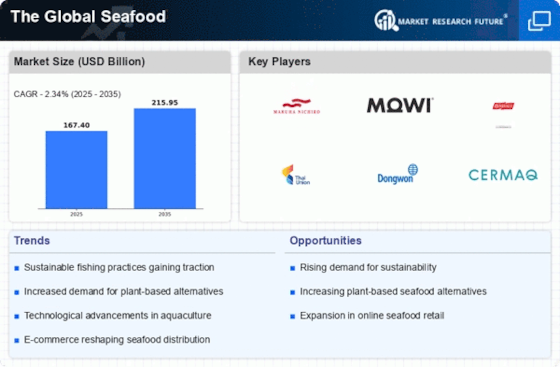
As per Market Research Future analysis, The Global Seafood Market Size was estimated at 167.4 USD Billion in 2024. The seafood industry is projected to grow from 171.32 USD Billion in 2025 to 215.95 USD Billion by 2035, exhibiting a compound annual growth rate (CAGR) of 2.34% during the forecast period 2025 - 2035

Key Market Trends & Highlights

The Global Seafood Market is experiencing a dynamic shift towards sustainability and technological innovation.

  • North America remains the largest market for seafood, driven by a strong consumer preference for high-quality products. The Asia-Pacific region is the fastest-growing market, reflecting increasing seafood consumption and expanding aquaculture practices. Fish continues to dominate the market as the largest segment, while shellfish is emerging as the fastest-growing category. Rising demand for seafood products and sustainability concerns are key drivers influencing market growth.

Market Size & Forecast

2024 Market Size 167.4 (USD Billion)
2035 Market Size 215.95 (USD Billion)
CAGR (2025 - 2035) 2.34%
Largest Regional Market Share in 2024 Asia Pacific

Major Players

<p>Maruha Nichiro Corporation (JP), Mowi ASA (NO), Nippon Suisan Kaisha Ltd. (JP), <a href="https://www.thaiunion.com/th/products-and-brands/our-products">Thai Union Group PCL</a> (TH), Dongwon Industries Co., Ltd. (KR), Cermaq Group AS (NO), SalMar ASA (NO), Bakkafrost (FO)</p>

Market Trends

The Global Seafood Market is currently experiencing a dynamic transformation, driven by evolving consumer preferences and increasing awareness regarding sustainability. As individuals become more health-conscious, the demand for seafood, recognized for its nutritional benefits, continues to rise. This shift is further influenced by a growing inclination towards environmentally friendly practices, prompting both consumers and producers to prioritize sustainable sourcing. Consequently, the market landscape is adapting, with a notable emphasis on traceability and responsible fishing methods. Moreover, technological advancements are reshaping the industry, enhancing supply chain efficiency and product quality. Innovations in aquaculture and fishing techniques are likely to play a pivotal role in meeting the rising demand while minimizing environmental impact. The integration of digital platforms for distribution and marketing is also becoming more prevalent, allowing for greater accessibility and consumer engagement. As The Global Seafood Market evolves, it appears poised to embrace a future characterized by sustainability, innovation, and a commitment to meeting the diverse needs of consumers.

Sustainability Initiatives

The focus on sustainability within The Global Seafood Market is intensifying, as stakeholders increasingly recognize the importance of responsible sourcing. This trend encompasses various practices, including the adoption of eco-labeling and certifications that assure consumers of environmentally friendly products. As awareness grows, companies are likely to invest in sustainable fishing methods and aquaculture practices, aiming to reduce overfishing and protect marine ecosystems.

Technological Advancements

Technological innovations are significantly influencing The Global Seafood Market, enhancing operational efficiency and product quality. Developments in aquaculture technology, such as improved breeding techniques and feed formulations, are expected to boost production while minimizing environmental footprints. Additionally, advancements in supply chain management, including blockchain for traceability, are likely to enhance transparency and consumer trust. The rise of digital storefronts has allowed your local fresh seafood market to offer same-day delivery, bringing the morning's catch directly to your kitchen.

Health and Wellness Trends

The rising emphasis on health and wellness is shaping consumer choices within The Global Seafood Market. Seafood Market is increasingly recognized for its nutritional benefits, including high protein content and omega-3 fatty acids. This trend suggests that consumers are gravitating towards seafood as a healthier alternative to red meat and processed foods, prompting retailers to expand their seafood offerings and promote its health benefits. 

Experience focused Culture

Many urban seafood markets have expanded their business models to include on-site oyster bars and "cook-your-catch" services to enhance the consumer experience. Seafood market reports indicate that fresh seafood markets are seeing a 15% increase in sales of "ready-to-sear" marinated fillets among busy millennial professionals.

Seafood Market Market Drivers

Health and Wellness Trends

The growing emphasis on health and wellness is significantly influencing The Global Seafood Industry. Seafood Market is recognized for its nutritional benefits, including high protein content and essential fatty acids. As consumers prioritize healthier eating habits, seafood is often viewed as a preferable alternative to red meat. Market Research Future indicates that the demand for seafood products, particularly those rich in omega-3 fatty acids, is expected to rise. This trend is particularly pronounced among millennials and health-conscious consumers who are willing to pay a premium for high-quality seafood. The industry's ability to market these health benefits effectively will be vital for capturing this expanding consumer base.

Expansion of Aquaculture Practices

Aquaculture is playing an increasingly vital role in The Global Seafood Industry, as it provides a sustainable solution to meet the rising demand for seafood. With wild fish stocks declining, aquaculture offers a viable alternative to traditional fishing methods. The global aquaculture production is projected to reach over 100 million metric tons by 2025, reflecting a significant shift towards farmed seafood. This expansion is driven by advancements in breeding techniques, feed efficiency, and disease management. Moreover, aquaculture can help alleviate pressure on wild fish populations, contributing to the sustainability of the seafood supply chain. As consumers become more aware of the benefits of farmed seafood, the industry is likely to see continued growth.

Rising Demand for Seafood Products

The increasing global population and changing dietary preferences are driving the demand for seafood products. As consumers become more health-conscious, they are seeking protein sources that are low in fat and high in omega-3 fatty acids. This trend is particularly evident in regions where seafood consumption has traditionally been lower. According to recent data, seafood consumption is projected to reach 20 kg per capita by 2025, indicating a robust growth trajectory for The Global Seafood Industry. Additionally, the rise of online grocery shopping has made seafood more accessible to consumers, further fueling demand. The industry's ability to adapt to these changing consumer preferences is crucial for sustaining growth.

Sustainability and Environmental Concerns

Sustainability has emerged as a pivotal driver in The Global Seafood Industry. Consumers are increasingly aware of the environmental impact of overfishing and unsustainable fishing practices. This awareness has led to a demand for sustainably sourced seafood, prompting companies to adopt eco-friendly practices. Certifications such as the Marine Stewardship Council (MSC) are gaining traction, as consumers seek assurance that their seafood is sourced responsibly. The market for certified sustainable seafood is expected to grow significantly, with estimates suggesting it could account for over 30% of total seafood sales by 2025. This shift not only benefits the environment but also enhances brand loyalty among consumers.

Technological Innovations in Seafood Processing

Technological advancements are revolutionizing The Global Seafood Industry, particularly in processing and distribution. Innovations such as automated processing lines, advanced freezing techniques, and improved supply chain logistics are enhancing efficiency and product quality. For instance, the use of blockchain technology is gaining popularity for traceability, allowing consumers to verify the origin of their seafood. This transparency is becoming increasingly important as consumers demand higher quality and safety standards. Furthermore, the integration of artificial intelligence in inventory management is optimizing stock levels and reducing waste, which is crucial for maintaining profitability in a competitive market.

Market Segment Insights

By Type: Fish (Largest) vs. Shellfish (Fastest-Growing)

<p>The Global Seafood comprises various segments, with fish dominating the landscape. Fish represents the largest share of the market, owing to its widespread consumption and established supply chains. Shellfish, on the other hand, is witnessing exciting growth due to changing consumer preferences, emphasizing protein-rich diets and gourmet food trends. The rise in exports also reflects positively on the shellfish segment, as consumers are willing to pay a premium for high-quality products.</p>

<p>Fish (Dominant) vs. Shellfish (Emerging)</p>

<p>Fish remains the dominant player in The Global Seafood, characterized by a variety of species that cater to diverse culinary preferences. This segment sees consistent demand across global markets, driven by traditional consumption patterns and a growing awareness of the health benefits associated with fish. In contrast, the shellfish segment is considered emerging, benefiting from innovative culinary trends and increasing demand for sustainable seafood options. This has led to more sophisticated supply chains, enhancing the availability of premium shellfish products to consumers. Both segments illustrate distinct consumer behaviors, with fish being a staple and shellfish appealing to niche markets.</p>

By Distribution Channel: Supermarkets (Largest) vs. Online Retail (Fastest-Growing)

<p>In The Global Seafood, supermarkets dominate the distribution channel segment, accounting for a significant portion of overall sales. Their expansive reach, coupled with established customer loyalty, makes them the preferred choice for seafood consumers. Following supermarkets, online retail is rapidly gaining traction, especially among younger consumers who prioritize convenience and accessibility in their shopping experience. The competitive pricing strategies and availability of a wide variety of seafood products online further enhance this segment's appeal.</p>

<p>Supermarkets (Dominant) vs. Online Retail (Emerging)</p>

<p>Supermarkets are the powerhouse in The Global Seafood, providing a reliable and extensive platform for consumers to access a diverse range of seafood products. Their physical presence across urban and suburban areas ensures high visibility and convenience. In contrast, online retail represents an emerging segment characterized by technological advancements and changing consumer behavior. As e-commerce continues to evolve, retailers are focusing on enhancing the digital shopping experience, offering home delivery and subscription services, which appeal particularly to health-conscious and eco-conscious consumers looking for sustainably sourced seafood. This trend towards online purchasing is expected to continue expanding in the coming years.</p>

By Form: Fresh (Largest) vs. Frozen (Fastest-Growing)

<p>The Global Seafood is notably divided into four distinct segments based on form: Fresh, Frozen, Canned, and Processed. Among these, Fresh seafood holds the largest market share, fueled by consumer preferences for quality and taste. Frozen seafood, however, is witnessing a significant surge in popularity, making it the fastest-growing segment as it offers convenience and extended shelf life, catering to changing consumer lifestyles. The growth trends in The Global Seafood are primarily driven by increasing health consciousness and the rising demand for seafood products. Frozen seafood is especially driven by the burgeoning online retail sector, where consumers seek quick and easy meal solutions. Moreover, advancements in freezing technology enhance the preservation of taste and nutritional value, bolstering its appeal across demographics.</p>

<p>Fresh (Dominant) vs. Processed (Emerging)</p>

<p>Fresh seafood is characterized by its superior quality, flavor, and nutritional benefits, thereby being the dominant form in the market. This segment appeals to health-conscious consumers and operates primarily through local markets and specialty retailers. On the other hand, processed seafood is an emerging trend that captures consumer interest through convenience and innovative packaging. It includes products like seafood snacks and ready-to-cook items, aligning with the fast-paced lifestyle of modern consumers. While still gaining traction, processed seafood shows promise by catering to diverse palates and offering competitive pricing.</p>

By End Use: Household (Largest) vs. Commercial (Fastest-Growing)

<p>In The Global Seafood, the 'Household' segment holds the largest market share, driven by increasing consumer preferences for fresh and convenient seafood options. This segment is primarily supported by rising health consciousness, which has led to a greater demand for nutritious food, with seafood being a popular choice among health-focused consumers. Conversely, the 'Commercial' segment is witnessing rapid growth, fueled by the expanding restaurant and hospitality industries, where seafood is increasingly featured on menus due to its perceived health benefits and versatility. The growth trends in The Global Seafood are significantly influenced by changing consumer behaviors and preferences. The demand for seafood in households continues to rise as people seek quick and healthy meal options, while the commercial segment is becoming a key growth driver as businesses look for quality seafood to enhance their offerings. Factors such as innovation in supply chain logistics, increasing seafood awareness campaigns, and sustainability concerns are further contributing to the expansion of these segments, making seafood more accessible to diverse audiences.</p>

<p>Household (Dominant) vs. Commercial (Emerging)</p>

<p>The 'Household' segment is characterized by its dominance in The Global Seafood, as it caters to consumers seeking nutritious and convenient meal solutions. Households increasingly prioritize freshness and quality, driving demand for various seafood products, including fish and shellfish. This segment has established a strong foothold in the market due to its ability to adapt to changing consumer preferences and the growth of online grocery shopping platforms. In contrast, the 'Commercial' segment, though emerging, shows significant potential as restaurants and <a href="https://www.marketresearchfuture.com/reports/catering-services-market-23311" target="_blank" rel="noopener">catering services</a> capitalize on the trend of providing healthier dining options. This segment thrives on the ability to offer diverse seafood dishes, thereby attracting health-conscious diners. As both segments evolve, they contribute uniquely to the overall dynamics of the seafood market.</p>

Get more detailed insights about Seafood Market Research Report - Forecast to 2035

Regional Insights

North America : Market Leader in Seafood Market

North America is the largest market for seafood, accounting for approximately 35% of the global share. The region's growth is driven by increasing consumer demand for healthy protein sources, sustainability initiatives, and advancements in aquaculture technology. Regulatory frameworks, such as the FDA's seafood safety standards, further bolster market growth by ensuring product quality and safety. The United States and Canada are the leading countries in this region, with the U.S. being the largest consumer of seafood. Key players like Maruha Nichiro Corporation and Mowi ASA have a significant presence, contributing to a competitive landscape that emphasizes innovation and sustainability. The market is characterized by a diverse range of seafood products, including fish, shellfish, and processed items.

Europe : Sustainable Seafood Market Practices

Europe is the second-largest seafood market, holding approximately 30% of the global share. The region's growth is fueled by rising health consciousness among consumers, increasing demand for sustainable seafood, and stringent regulations aimed at preserving marine ecosystems. The European Union's Common Fisheries Policy plays a crucial role in regulating fishing practices and ensuring sustainable sourcing. Leading countries include Norway and Spain, which are significant producers and exporters of seafood. The competitive landscape features major players like Mowi ASA and Cermaq Group AS, focusing on sustainable aquaculture and innovative practices. The market is characterized by a diverse range of seafood products, with a strong emphasis on traceability and quality assurance to meet consumer demands.

Asia-Pacific : Emerging Seafood Market Powerhouse

Asia-Pacific is an emerging powerhouse in The Global Seafood Market, accounting for approximately 25% of the total share. The region's growth is driven by increasing population, rising disposable incomes, and a growing preference for seafood as a protein source. Countries like China and India are leading the demand, supported by government initiatives to enhance aquaculture practices and improve food security. China is the largest producer and consumer of seafood globally, while countries like Thailand and Vietnam are significant exporters. The competitive landscape is marked by key players such as Thai Union Group PCL and Dongwon Industries Co., Ltd., focusing on innovation and sustainability. The market is characterized by a diverse range of seafood products, including both wild-caught and farmed varieties, catering to local and international markets.

Middle East and Africa : Untapped Seafood Market Potential

The Middle East and Africa region holds significant untapped potential in The Global Seafood Market, accounting for approximately 10% of the total share. The growth is driven by increasing urbanization, rising incomes, and a growing awareness of the health benefits of seafood. Regulatory frameworks are evolving to support sustainable fishing practices and enhance food safety standards. Leading countries include South Africa and Egypt, which are making strides in aquaculture and seafood processing. The competitive landscape features local players and international companies looking to expand their footprint. The market is characterized by a growing demand for both fresh and processed seafood products, with an emphasis on quality and sustainability to meet consumer expectations.

Key Players and Competitive Insights

The Global Seafood is currently characterized by a dynamic competitive landscape, driven by increasing consumer demand for sustainable and high-quality seafood products. Key players are actively engaging in various strategies to enhance their market positioning, including innovation in aquaculture practices, mergers and acquisitions, and regional expansions. Companies such as Mowi ASA (Norway) and Thai Union Group PCL (Thailand) are particularly notable for their commitment to sustainability and technological advancements, which not only bolster their operational efficiency but also align with evolving consumer preferences for environmentally responsible sourcing. This collective focus on sustainability and innovation among major players is reshaping the competitive environment, fostering a market that increasingly prioritizes quality and ethical practices over traditional price competition.In terms of business tactics, companies are localizing manufacturing and optimizing supply chains to enhance responsiveness to market demands. The Global Seafood appears moderately fragmented, with a mix of large multinational corporations and smaller regional players. The influence of key players is substantial, as they leverage their scale and resources to set industry standards, particularly in sustainability and product quality, which in turn pressures smaller competitors to adapt or innovate.


In August Mowi ASA (Norway) announced the launch of a new line of plant-based seafood alternatives, aiming to capture the growing market segment of health-conscious consumers. This strategic move not only diversifies Mowi's product offerings but also positions the company as a leader in the sustainable seafood sector, potentially attracting a broader customer base and enhancing brand loyalty. The introduction of these alternatives reflects a significant shift in consumer preferences and underscores Mowi's commitment to innovation in response to market trends.


In September Thai Union Group PCL (Thailand) revealed a partnership with a leading technology firm to develop an AI-driven supply chain management system. This initiative is expected to streamline operations and improve traceability in their seafood sourcing processes. By integrating advanced technology into their supply chain, Thai Union aims to enhance operational efficiency and ensure compliance with stringent sustainability standards, thereby reinforcing its competitive edge in the market.


In July Dongwon Industries Co., Ltd. (South Korea) expanded its operations by acquiring a local seafood processing company in Vietnam. This acquisition is strategically significant as it allows Dongwon to enhance its production capabilities and strengthen its presence in the rapidly growing Asian seafood market. The move is indicative of a broader trend where companies are seeking to consolidate their operations to achieve economies of scale and improve market access.


As of October the competitive trends in The Global Seafood are increasingly defined by digitalization, sustainability, and the integration of artificial intelligence. Strategic alliances are becoming more prevalent, as companies recognize the value of collaboration in enhancing innovation and operational efficiency. Looking ahead, competitive differentiation is likely to evolve, with a pronounced shift from price-based competition to a focus on innovation, technology adoption, and supply chain reliability. This transition suggests that companies that prioritize sustainable practices and technological advancements will be better positioned to thrive in an increasingly competitive landscape.

Key Companies in the Seafood Market include

Industry Developments

Recent developments in the Global Seafood Market include notable growth and changes in major industry players. Thai Union Group and Mowi ASA have been focusing on sustainability initiatives, impacting their market positions positively. Nissui is expanding its product range to cater to the rising demand for healthy seafood options. Bumble Bee Foods is actively addressing supply chain challenges exacerbated by the pandemic, while the Seafood Market Harvesters of America is advocating for better regulations in fisheries management.

In terms of mergers and acquisitions, Dongwon Industries completed the acquisition of a significant stake in a U.S.-based seafood company in February 2023, which has enhanced its footprint in the North American market. Additionally, Maruha Nichiro reported a strategic acquisition aimed at increasing its operational efficiencies in March 2023. The market valuation of major seafood companies has experienced a rise, driven by increased consumer demand for seafood, sustainability trends, and innovation in aquaculture practices. This growth reflects a shift towards healthier diets and environmental responsibility within the industry.

Overall, the Global Seafood Market is undergoing transformation, with key players adapting to meet evolving consumer preferences while striving for sustainability and efficiency.

  •  

Future Outlook

Seafood Market Future Outlook

<p>The Global Seafood Market is projected to grow at a 2.34% CAGR from 2025 to 2035, driven by rising consumer demand, sustainability initiatives, and technological advancements.</p>

New opportunities lie in:

  • <p>Expansion of aquaculture technologies for sustainable production</p>
  • <p> </p>
  • <p>Development of plant-based seafood alternatives</p>
  • <p>Implementation of blockchain for supply chain transparency</p>

<p>By 2035, the market is expected to achieve robust growth, reflecting evolving consumer preferences and sustainable practices.</p>

Market Segmentation

Seafood Market Form Outlook

  • Fresh
  • Frozen
  • Canned
  • Processed

Seafood Market Type Outlook

  • Fish
  • Shellfish
  • Caviar
  • Seaweed

Seafood Market End Use Outlook

  • Household
  • Commercial
  • Food Processing

Seafood Market Distribution Channel Outlook

  • Supermarkets
  • Online Retail
  • Fish Markets
  • Food Service

Report Scope

MARKET SIZE 2024 167.4(USD Billion)
MARKET SIZE 2025 171.32(USD Billion)
MARKET SIZE 2035 215.95(USD Billion)
COMPOUND ANNUAL GROWTH RATE (CAGR) 2.34% (2025 - 2035)
REPORT COVERAGE Revenue Forecast, Competitive Landscape, Growth Factors, and Trends
BASE YEAR 2024
Market Forecast Period 2025 - 2035
Historical Data 2019 - 2024
Market Forecast Units USD Billion
Key Companies Profiled Maruha Nichiro Corporation (JP), Mowi ASA (NO), Nippon Suisan Kaisha Ltd. (JP), Thai Union Group PCL (TH), Dongwon Industries Co., Ltd. (KR), Cermaq Group AS (NO), SalMar ASA (NO), Bakkafrost (FO)
Segments Covered Product Type, Distribution Channel, Form, End Use, Regional
Key Market Opportunities Adoption of sustainable aquaculture practices to meet rising consumer demand for eco-friendly seafood.
Key Market Dynamics Rising consumer demand for sustainable seafood drives innovation and regulatory changes across the industry.
Countries Covered North America, Europe, APAC, South America, MEA

FAQs

What is the current valuation of The Global Seafood?

<p>The Global Seafood was valued at 167.4 USD Billion in 2024.</p>

What is the projected market size for The Global Seafood by 2035?

The market is projected to reach 215.95 USD Billion by 2035.

What is the expected CAGR for The Global Seafood from 2025 to 2035?

The expected CAGR for The Global Seafood during the forecast period 2025 - 2035 is 2.34%.

Which companies are considered key players in The Global Seafood?

Key players include Maruha Nichiro Corporation, Mowi ASA, Nippon Suisan Kaisha Ltd., and Thai Union Group PCL.

How does the seafood market segment by type perform in terms of valuation?

In 2024, Fish was valued at 80.0 USD Billion, while Shellfish reached 50.0 USD Billion.

What are the projected valuations for different seafood types by 2035?

By 2035, Fish is expected to reach 105.0 USD Billion, and Shellfish may grow to 65.0 USD Billion.

What distribution channels are most significant in The Global Seafood?

Supermarkets accounted for 70.0 USD Billion in 2024, while Online Retail reached 20.0 USD Billion.

What is the expected growth in the online retail segment by 2035?

The Online Retail segment is projected to grow to 30.0 USD Billion by 2035.

How does the form of seafood impact market valuation?

In 2024, Frozen seafood was valued at 50.0 USD Billion, indicating its importance in the market.

What is the expected valuation for the household end-use segment by 2035?

The household end-use segment is projected to reach 105.0 USD Billion by 2035.

  1. SECTION I: EXECUTIVE SUMMARY AND KEY HIGHLIGHTS
    1. | 1.1 EXECUTIVE SUMMARY
    2. | | 1.1.1 Market Overview
    3. | | 1.1.2 Key Findings
    4. | | 1.1.3 Market Segmentation
    5. | | 1.1.4 Competitive Landscape
    6. | | 1.1.5 Challenges and Opportunities
    7. | | 1.1.6 Future Outlook
  2. SECTION II: SCOPING, METHODOLOGY AND MARKET STRUCTURE
    1. | 2.1 MARKET INTRODUCTION
    2. | | 2.1.1 Definition
    3. | | 2.1.2 Scope of the study
    4. | | | 2.1.2.1 Research Objective
    5. | | | 2.1.2.2 Assumption
    6. | | | 2.1.2.3 Limitations
    7. | 2.2 RESEARCH METHODOLOGY
    8. | | 2.2.1 Overview
    9. | | 2.2.2 Data Mining
    10. | | 2.2.3 Secondary Research
    11. | | 2.2.4 Primary Research
    12. | | | 2.2.4.1 Primary Interviews and Information Gathering Process
    13. | | | 2.2.4.2 Breakdown of Primary Respondents
    14. | | 2.2.5 Forecasting Model
    15. | | 2.2.6 Market Size Estimation
    16. | | | 2.2.6.1 Bottom-Up Approach
    17. | | | 2.2.6.2 Top-Down Approach
    18. | | 2.2.7 Data Triangulation
    19. | | 2.2.8 Validation
  3. SECTION III: QUALITATIVE ANALYSIS
    1. | 3.1 MARKET DYNAMICS
    2. | | 3.1.1 Overview
    3. | | 3.1.2 Drivers
    4. | | 3.1.3 Restraints
    5. | | 3.1.4 Opportunities
    6. | 3.2 MARKET FACTOR ANALYSIS
    7. | | 3.2.1 Value chain Analysis
    8. | | 3.2.2 Porter's Five Forces Analysis
    9. | | | 3.2.2.1 Bargaining Power of Suppliers
    10. | | | 3.2.2.2 Bargaining Power of Buyers
    11. | | | 3.2.2.3 Threat of New Entrants
    12. | | | 3.2.2.4 Threat of Substitutes
    13. | | | 3.2.2.5 Intensity of Rivalry
    14. | | 3.2.3 COVID-19 Impact Analysis
    15. | | | 3.2.3.1 Market Impact Analysis
    16. | | | 3.2.3.2 Regional Impact
    17. | | | 3.2.3.3 Opportunity and Threat Analysis
  4. SECTION IV: QUANTITATIVE ANALYSIS
    1. | 4.1 Food, Beverages & Nutrition, BY Type (USD Billion)
    2. | | 4.1.1 Fish
    3. | | 4.1.2 Shellfish
    4. | | 4.1.3 Caviar
    5. | | 4.1.4 Seaweed
    6. | 4.2 Food, Beverages & Nutrition, BY Distribution Channel (USD Billion)
    7. | | 4.2.1 Supermarkets
    8. | | 4.2.2 Online Retail
    9. | | 4.2.3 Fish Markets
    10. | | 4.2.4 Food Service
    11. | 4.3 Food, Beverages & Nutrition, BY Form (USD Billion)
    12. | | 4.3.1 Fresh
    13. | | 4.3.2 Frozen
    14. | | 4.3.3 Canned
    15. | | 4.3.4 Processed
    16. | 4.4 Food, Beverages & Nutrition, BY End Use (USD Billion)
    17. | | 4.4.1 Household
    18. | | 4.4.2 Commercial
    19. | | 4.4.3 Food Processing
    20. | 4.5 Food, Beverages & Nutrition, BY Region (USD Billion)
    21. | | 4.5.1 North America
    22. | | | 4.5.1.1 US
    23. | | | 4.5.1.2 Canada
    24. | | 4.5.2 Europe
    25. | | | 4.5.2.1 Germany
    26. | | | 4.5.2.2 UK
    27. | | | 4.5.2.3 France
    28. | | | 4.5.2.4 Russia
    29. | | | 4.5.2.5 Italy
    30. | | | 4.5.2.6 Spain
    31. | | | 4.5.2.7 Rest of Europe
    32. | | 4.5.3 APAC
    33. | | | 4.5.3.1 China
    34. | | | 4.5.3.2 India
    35. | | | 4.5.3.3 Japan
    36. | | | 4.5.3.4 South Korea
    37. | | | 4.5.3.5 Malaysia
    38. | | | 4.5.3.6 Thailand
    39. | | | 4.5.3.7 Indonesia
    40. | | | 4.5.3.8 Rest of APAC
    41. | | 4.5.4 South America
    42. | | | 4.5.4.1 Brazil
    43. | | | 4.5.4.2 Mexico
    44. | | | 4.5.4.3 Argentina
    45. | | | 4.5.4.4 Rest of South America
    46. | | 4.5.5 MEA
    47. | | | 4.5.5.1 GCC Countries
    48. | | | 4.5.5.2 South Africa
    49. | | | 4.5.5.3 Rest of MEA
  5. SECTION V: COMPETITIVE ANALYSIS
    1. | 5.1 Competitive Landscape
    2. | | 5.1.1 Overview
    3. | | 5.1.2 Competitive Analysis
    4. | | 5.1.3 Market share Analysis
    5. | | 5.1.4 Major Growth Strategy in the Food, Beverages & Nutrition
    6. | | 5.1.5 Competitive Benchmarking
    7. | | 5.1.6 Leading Players in Terms of Number of Developments in the Food, Beverages & Nutrition
    8. | | 5.1.7 Key developments and growth strategies
    9. | | | 5.1.7.1 New Product Launch/Service Deployment
    10. | | | 5.1.7.2 Merger & Acquisitions
    11. | | | 5.1.7.3 Joint Ventures
    12. | | 5.1.8 Major Players Financial Matrix
    13. | | | 5.1.8.1 Sales and Operating Income
    14. | | | 5.1.8.2 Major Players R&D Expenditure. 2023
    15. | 5.2 Company Profiles
    16. | | 5.2.1 Maruha Nichiro Corporation (JP)
    17. | | | 5.2.1.1 Financial Overview
    18. | | | 5.2.1.2 Products Offered
    19. | | | 5.2.1.3 Key Developments
    20. | | | 5.2.1.4 SWOT Analysis
    21. | | | 5.2.1.5 Key Strategies
    22. | | 5.2.2 Mowi ASA (NO)
    23. | | | 5.2.2.1 Financial Overview
    24. | | | 5.2.2.2 Products Offered
    25. | | | 5.2.2.3 Key Developments
    26. | | | 5.2.2.4 SWOT Analysis
    27. | | | 5.2.2.5 Key Strategies
    28. | | 5.2.3 Nippon Suisan Kaisha Ltd. (JP)
    29. | | | 5.2.3.1 Financial Overview
    30. | | | 5.2.3.2 Products Offered
    31. | | | 5.2.3.3 Key Developments
    32. | | | 5.2.3.4 SWOT Analysis
    33. | | | 5.2.3.5 Key Strategies
    34. | | 5.2.4 Thai Union Group PCL (TH)
    35. | | | 5.2.4.1 Financial Overview
    36. | | | 5.2.4.2 Products Offered
    37. | | | 5.2.4.3 Key Developments
    38. | | | 5.2.4.4 SWOT Analysis
    39. | | | 5.2.4.5 Key Strategies
    40. | | 5.2.5 Dongwon Industries Co., Ltd. (KR)
    41. | | | 5.2.5.1 Financial Overview
    42. | | | 5.2.5.2 Products Offered
    43. | | | 5.2.5.3 Key Developments
    44. | | | 5.2.5.4 SWOT Analysis
    45. | | | 5.2.5.5 Key Strategies
    46. | | 5.2.6 Cermaq Group AS (NO)
    47. | | | 5.2.6.1 Financial Overview
    48. | | | 5.2.6.2 Products Offered
    49. | | | 5.2.6.3 Key Developments
    50. | | | 5.2.6.4 SWOT Analysis
    51. | | | 5.2.6.5 Key Strategies
    52. | | 5.2.7 SalMar ASA (NO)
    53. | | | 5.2.7.1 Financial Overview
    54. | | | 5.2.7.2 Products Offered
    55. | | | 5.2.7.3 Key Developments
    56. | | | 5.2.7.4 SWOT Analysis
    57. | | | 5.2.7.5 Key Strategies
    58. | | 5.2.8 Bakkafrost (FO)
    59. | | | 5.2.8.1 Financial Overview
    60. | | | 5.2.8.2 Products Offered
    61. | | | 5.2.8.3 Key Developments
    62. | | | 5.2.8.4 SWOT Analysis
    63. | | | 5.2.8.5 Key Strategies
    64. | 5.3 Appendix
    65. | | 5.3.1 References
    66. | | 5.3.2 Related Reports
  6. LIST OF FIGURES
    1. | 6.1 MARKET SYNOPSIS
    2. | 6.2 NORTH AMERICA MARKET ANALYSIS
    3. | 6.3 US MARKET ANALYSIS BY TYPE
    4. | 6.4 US MARKET ANALYSIS BY DISTRIBUTION CHANNEL
    5. | 6.5 US MARKET ANALYSIS BY FORM
    6. | 6.6 US MARKET ANALYSIS BY END USE
    7. | 6.7 CANADA MARKET ANALYSIS BY TYPE
    8. | 6.8 CANADA MARKET ANALYSIS BY DISTRIBUTION CHANNEL
    9. | 6.9 CANADA MARKET ANALYSIS BY FORM
    10. | 6.10 CANADA MARKET ANALYSIS BY END USE
    11. | 6.11 EUROPE MARKET ANALYSIS
    12. | 6.12 GERMANY MARKET ANALYSIS BY TYPE
    13. | 6.13 GERMANY MARKET ANALYSIS BY DISTRIBUTION CHANNEL
    14. | 6.14 GERMANY MARKET ANALYSIS BY FORM
    15. | 6.15 GERMANY MARKET ANALYSIS BY END USE
    16. | 6.16 UK MARKET ANALYSIS BY TYPE
    17. | 6.17 UK MARKET ANALYSIS BY DISTRIBUTION CHANNEL
    18. | 6.18 UK MARKET ANALYSIS BY FORM
    19. | 6.19 UK MARKET ANALYSIS BY END USE
    20. | 6.20 FRANCE MARKET ANALYSIS BY TYPE
    21. | 6.21 FRANCE MARKET ANALYSIS BY DISTRIBUTION CHANNEL
    22. | 6.22 FRANCE MARKET ANALYSIS BY FORM
    23. | 6.23 FRANCE MARKET ANALYSIS BY END USE
    24. | 6.24 RUSSIA MARKET ANALYSIS BY TYPE
    25. | 6.25 RUSSIA MARKET ANALYSIS BY DISTRIBUTION CHANNEL
    26. | 6.26 RUSSIA MARKET ANALYSIS BY FORM
    27. | 6.27 RUSSIA MARKET ANALYSIS BY END USE
    28. | 6.28 ITALY MARKET ANALYSIS BY TYPE
    29. | 6.29 ITALY MARKET ANALYSIS BY DISTRIBUTION CHANNEL
    30. | 6.30 ITALY MARKET ANALYSIS BY FORM
    31. | 6.31 ITALY MARKET ANALYSIS BY END USE
    32. | 6.32 SPAIN MARKET ANALYSIS BY TYPE
    33. | 6.33 SPAIN MARKET ANALYSIS BY DISTRIBUTION CHANNEL
    34. | 6.34 SPAIN MARKET ANALYSIS BY FORM
    35. | 6.35 SPAIN MARKET ANALYSIS BY END USE
    36. | 6.36 REST OF EUROPE MARKET ANALYSIS BY TYPE
    37. | 6.37 REST OF EUROPE MARKET ANALYSIS BY DISTRIBUTION CHANNEL
    38. | 6.38 REST OF EUROPE MARKET ANALYSIS BY FORM
    39. | 6.39 REST OF EUROPE MARKET ANALYSIS BY END USE
    40. | 6.40 APAC MARKET ANALYSIS
    41. | 6.41 CHINA MARKET ANALYSIS BY TYPE
    42. | 6.42 CHINA MARKET ANALYSIS BY DISTRIBUTION CHANNEL
    43. | 6.43 CHINA MARKET ANALYSIS BY FORM
    44. | 6.44 CHINA MARKET ANALYSIS BY END USE
    45. | 6.45 INDIA MARKET ANALYSIS BY TYPE
    46. | 6.46 INDIA MARKET ANALYSIS BY DISTRIBUTION CHANNEL
    47. | 6.47 INDIA MARKET ANALYSIS BY FORM
    48. | 6.48 INDIA MARKET ANALYSIS BY END USE
    49. | 6.49 JAPAN MARKET ANALYSIS BY TYPE
    50. | 6.50 JAPAN MARKET ANALYSIS BY DISTRIBUTION CHANNEL
    51. | 6.51 JAPAN MARKET ANALYSIS BY FORM
    52. | 6.52 JAPAN MARKET ANALYSIS BY END USE
    53. | 6.53 SOUTH KOREA MARKET ANALYSIS BY TYPE
    54. | 6.54 SOUTH KOREA MARKET ANALYSIS BY DISTRIBUTION CHANNEL
    55. | 6.55 SOUTH KOREA MARKET ANALYSIS BY FORM
    56. | 6.56 SOUTH KOREA MARKET ANALYSIS BY END USE
    57. | 6.57 MALAYSIA MARKET ANALYSIS BY TYPE
    58. | 6.58 MALAYSIA MARKET ANALYSIS BY DISTRIBUTION CHANNEL
    59. | 6.59 MALAYSIA MARKET ANALYSIS BY FORM
    60. | 6.60 MALAYSIA MARKET ANALYSIS BY END USE
    61. | 6.61 THAILAND MARKET ANALYSIS BY TYPE
    62. | 6.62 THAILAND MARKET ANALYSIS BY DISTRIBUTION CHANNEL
    63. | 6.63 THAILAND MARKET ANALYSIS BY FORM
    64. | 6.64 THAILAND MARKET ANALYSIS BY END USE
    65. | 6.65 INDONESIA MARKET ANALYSIS BY TYPE
    66. | 6.66 INDONESIA MARKET ANALYSIS BY DISTRIBUTION CHANNEL
    67. | 6.67 INDONESIA MARKET ANALYSIS BY FORM
    68. | 6.68 INDONESIA MARKET ANALYSIS BY END USE
    69. | 6.69 REST OF APAC MARKET ANALYSIS BY TYPE
    70. | 6.70 REST OF APAC MARKET ANALYSIS BY DISTRIBUTION CHANNEL
    71. | 6.71 REST OF APAC MARKET ANALYSIS BY FORM
    72. | 6.72 REST OF APAC MARKET ANALYSIS BY END USE
    73. | 6.73 SOUTH AMERICA MARKET ANALYSIS
    74. | 6.74 BRAZIL MARKET ANALYSIS BY TYPE
    75. | 6.75 BRAZIL MARKET ANALYSIS BY DISTRIBUTION CHANNEL
    76. | 6.76 BRAZIL MARKET ANALYSIS BY FORM
    77. | 6.77 BRAZIL MARKET ANALYSIS BY END USE
    78. | 6.78 MEXICO MARKET ANALYSIS BY TYPE
    79. | 6.79 MEXICO MARKET ANALYSIS BY DISTRIBUTION CHANNEL
    80. | 6.80 MEXICO MARKET ANALYSIS BY FORM
    81. | 6.81 MEXICO MARKET ANALYSIS BY END USE
    82. | 6.82 ARGENTINA MARKET ANALYSIS BY TYPE
    83. | 6.83 ARGENTINA MARKET ANALYSIS BY DISTRIBUTION CHANNEL
    84. | 6.84 ARGENTINA MARKET ANALYSIS BY FORM
    85. | 6.85 ARGENTINA MARKET ANALYSIS BY END USE
    86. | 6.86 REST OF SOUTH AMERICA MARKET ANALYSIS BY TYPE
    87. | 6.87 REST OF SOUTH AMERICA MARKET ANALYSIS BY DISTRIBUTION CHANNEL
    88. | 6.88 REST OF SOUTH AMERICA MARKET ANALYSIS BY FORM
    89. | 6.89 REST OF SOUTH AMERICA MARKET ANALYSIS BY END USE
    90. | 6.90 MEA MARKET ANALYSIS
    91. | 6.91 GCC COUNTRIES MARKET ANALYSIS BY TYPE
    92. | 6.92 GCC COUNTRIES MARKET ANALYSIS BY DISTRIBUTION CHANNEL
    93. | 6.93 GCC COUNTRIES MARKET ANALYSIS BY FORM
    94. | 6.94 GCC COUNTRIES MARKET ANALYSIS BY END USE
    95. | 6.95 SOUTH AFRICA MARKET ANALYSIS BY TYPE
    96. | 6.96 SOUTH AFRICA MARKET ANALYSIS BY DISTRIBUTION CHANNEL
    97. | 6.97 SOUTH AFRICA MARKET ANALYSIS BY FORM
    98. | 6.98 SOUTH AFRICA MARKET ANALYSIS BY END USE
    99. | 6.99 REST OF MEA MARKET ANALYSIS BY TYPE
    100. | 6.100 REST OF MEA MARKET ANALYSIS BY DISTRIBUTION CHANNEL
    101. | 6.101 REST OF MEA MARKET ANALYSIS BY FORM
    102. | 6.102 REST OF MEA MARKET ANALYSIS BY END USE
    103. | 6.103 KEY BUYING CRITERIA OF FOOD, BEVERAGES & NUTRITION
    104. | 6.104 RESEARCH PROCESS OF MRFR
    105. | 6.105 DRO ANALYSIS OF FOOD, BEVERAGES & NUTRITION
    106. | 6.106 DRIVERS IMPACT ANALYSIS: FOOD, BEVERAGES & NUTRITION
    107. | 6.107 RESTRAINTS IMPACT ANALYSIS: FOOD, BEVERAGES & NUTRITION
    108. | 6.108 SUPPLY / VALUE CHAIN: FOOD, BEVERAGES & NUTRITION
    109. | 6.109 FOOD, BEVERAGES & NUTRITION, BY TYPE, 2024 (% SHARE)
    110. | 6.110 FOOD, BEVERAGES & NUTRITION, BY TYPE, 2024 TO 2035 (USD Billion)
    111. | 6.111 FOOD, BEVERAGES & NUTRITION, BY DISTRIBUTION CHANNEL, 2024 (% SHARE)
    112. | 6.112 FOOD, BEVERAGES & NUTRITION, BY DISTRIBUTION CHANNEL, 2024 TO 2035 (USD Billion)
    113. | 6.113 FOOD, BEVERAGES & NUTRITION, BY FORM, 2024 (% SHARE)
    114. | 6.114 FOOD, BEVERAGES & NUTRITION, BY FORM, 2024 TO 2035 (USD Billion)
    115. | 6.115 FOOD, BEVERAGES & NUTRITION, BY END USE, 2024 (% SHARE)
    116. | 6.116 FOOD, BEVERAGES & NUTRITION, BY END USE, 2024 TO 2035 (USD Billion)
    117. | 6.117 BENCHMARKING OF MAJOR COMPETITORS
  7. LIST OF TABLES
    1. | 7.1 LIST OF ASSUMPTIONS
    2. | | 7.1.1
    3. | 7.2 North America MARKET SIZE ESTIMATES; FORECAST
    4. | | 7.2.1 BY TYPE, 2025-2035 (USD Billion)
    5. | | 7.2.2 BY DISTRIBUTION CHANNEL, 2025-2035 (USD Billion)
    6. | | 7.2.3 BY FORM, 2025-2035 (USD Billion)
    7. | | 7.2.4 BY END USE, 2025-2035 (USD Billion)
    8. | 7.3 US MARKET SIZE ESTIMATES; FORECAST
    9. | | 7.3.1 BY TYPE, 2025-2035 (USD Billion)
    10. | | 7.3.2 BY DISTRIBUTION CHANNEL, 2025-2035 (USD Billion)
    11. | | 7.3.3 BY FORM, 2025-2035 (USD Billion)
    12. | | 7.3.4 BY END USE, 2025-2035 (USD Billion)
    13. | 7.4 Canada MARKET SIZE ESTIMATES; FORECAST
    14. | | 7.4.1 BY TYPE, 2025-2035 (USD Billion)
    15. | | 7.4.2 BY DISTRIBUTION CHANNEL, 2025-2035 (USD Billion)
    16. | | 7.4.3 BY FORM, 2025-2035 (USD Billion)
    17. | | 7.4.4 BY END USE, 2025-2035 (USD Billion)
    18. | 7.5 Europe MARKET SIZE ESTIMATES; FORECAST
    19. | | 7.5.1 BY TYPE, 2025-2035 (USD Billion)
    20. | | 7.5.2 BY DISTRIBUTION CHANNEL, 2025-2035 (USD Billion)
    21. | | 7.5.3 BY FORM, 2025-2035 (USD Billion)
    22. | | 7.5.4 BY END USE, 2025-2035 (USD Billion)
    23. | 7.6 Germany MARKET SIZE ESTIMATES; FORECAST
    24. | | 7.6.1 BY TYPE, 2025-2035 (USD Billion)
    25. | | 7.6.2 BY DISTRIBUTION CHANNEL, 2025-2035 (USD Billion)
    26. | | 7.6.3 BY FORM, 2025-2035 (USD Billion)
    27. | | 7.6.4 BY END USE, 2025-2035 (USD Billion)
    28. | 7.7 UK MARKET SIZE ESTIMATES; FORECAST
    29. | | 7.7.1 BY TYPE, 2025-2035 (USD Billion)
    30. | | 7.7.2 BY DISTRIBUTION CHANNEL, 2025-2035 (USD Billion)
    31. | | 7.7.3 BY FORM, 2025-2035 (USD Billion)
    32. | | 7.7.4 BY END USE, 2025-2035 (USD Billion)
    33. | 7.8 France MARKET SIZE ESTIMATES; FORECAST
    34. | | 7.8.1 BY TYPE, 2025-2035 (USD Billion)
    35. | | 7.8.2 BY DISTRIBUTION CHANNEL, 2025-2035 (USD Billion)
    36. | | 7.8.3 BY FORM, 2025-2035 (USD Billion)
    37. | | 7.8.4 BY END USE, 2025-2035 (USD Billion)
    38. | 7.9 Russia MARKET SIZE ESTIMATES; FORECAST
    39. | | 7.9.1 BY TYPE, 2025-2035 (USD Billion)
    40. | | 7.9.2 BY DISTRIBUTION CHANNEL, 2025-2035 (USD Billion)
    41. | | 7.9.3 BY FORM, 2025-2035 (USD Billion)
    42. | | 7.9.4 BY END USE, 2025-2035 (USD Billion)
    43. | 7.10 Italy MARKET SIZE ESTIMATES; FORECAST
    44. | | 7.10.1 BY TYPE, 2025-2035 (USD Billion)
    45. | | 7.10.2 BY DISTRIBUTION CHANNEL, 2025-2035 (USD Billion)
    46. | | 7.10.3 BY FORM, 2025-2035 (USD Billion)
    47. | | 7.10.4 BY END USE, 2025-2035 (USD Billion)
    48. | 7.11 Spain MARKET SIZE ESTIMATES; FORECAST
    49. | | 7.11.1 BY TYPE, 2025-2035 (USD Billion)
    50. | | 7.11.2 BY DISTRIBUTION CHANNEL, 2025-2035 (USD Billion)
    51. | | 7.11.3 BY FORM, 2025-2035 (USD Billion)
    52. | | 7.11.4 BY END USE, 2025-2035 (USD Billion)
    53. | 7.12 Rest of Europe MARKET SIZE ESTIMATES; FORECAST
    54. | | 7.12.1 BY TYPE, 2025-2035 (USD Billion)
    55. | | 7.12.2 BY DISTRIBUTION CHANNEL, 2025-2035 (USD Billion)
    56. | | 7.12.3 BY FORM, 2025-2035 (USD Billion)
    57. | | 7.12.4 BY END USE, 2025-2035 (USD Billion)
    58. | 7.13 APAC MARKET SIZE ESTIMATES; FORECAST
    59. | | 7.13.1 BY TYPE, 2025-2035 (USD Billion)
    60. | | 7.13.2 BY DISTRIBUTION CHANNEL, 2025-2035 (USD Billion)
    61. | | 7.13.3 BY FORM, 2025-2035 (USD Billion)
    62. | | 7.13.4 BY END USE, 2025-2035 (USD Billion)
    63. | 7.14 China MARKET SIZE ESTIMATES; FORECAST
    64. | | 7.14.1 BY TYPE, 2025-2035 (USD Billion)
    65. | | 7.14.2 BY DISTRIBUTION CHANNEL, 2025-2035 (USD Billion)
    66. | | 7.14.3 BY FORM, 2025-2035 (USD Billion)
    67. | | 7.14.4 BY END USE, 2025-2035 (USD Billion)
    68. | 7.15 India MARKET SIZE ESTIMATES; FORECAST
    69. | | 7.15.1 BY TYPE, 2025-2035 (USD Billion)
    70. | | 7.15.2 BY DISTRIBUTION CHANNEL, 2025-2035 (USD Billion)
    71. | | 7.15.3 BY FORM, 2025-2035 (USD Billion)
    72. | | 7.15.4 BY END USE, 2025-2035 (USD Billion)
    73. | 7.16 Japan MARKET SIZE ESTIMATES; FORECAST
    74. | | 7.16.1 BY TYPE, 2025-2035 (USD Billion)
    75. | | 7.16.2 BY DISTRIBUTION CHANNEL, 2025-2035 (USD Billion)
    76. | | 7.16.3 BY FORM, 2025-2035 (USD Billion)
    77. | | 7.16.4 BY END USE, 2025-2035 (USD Billion)
    78. | 7.17 South Korea MARKET SIZE ESTIMATES; FORECAST
    79. | | 7.17.1 BY TYPE, 2025-2035 (USD Billion)
    80. | | 7.17.2 BY DISTRIBUTION CHANNEL, 2025-2035 (USD Billion)
    81. | | 7.17.3 BY FORM, 2025-2035 (USD Billion)
    82. | | 7.17.4 BY END USE, 2025-2035 (USD Billion)
    83. | 7.18 Malaysia MARKET SIZE ESTIMATES; FORECAST
    84. | | 7.18.1 BY TYPE, 2025-2035 (USD Billion)
    85. | | 7.18.2 BY DISTRIBUTION CHANNEL, 2025-2035 (USD Billion)
    86. | | 7.18.3 BY FORM, 2025-2035 (USD Billion)
    87. | | 7.18.4 BY END USE, 2025-2035 (USD Billion)
    88. | 7.19 Thailand MARKET SIZE ESTIMATES; FORECAST
    89. | | 7.19.1 BY TYPE, 2025-2035 (USD Billion)
    90. | | 7.19.2 BY DISTRIBUTION CHANNEL, 2025-2035 (USD Billion)
    91. | | 7.19.3 BY FORM, 2025-2035 (USD Billion)
    92. | | 7.19.4 BY END USE, 2025-2035 (USD Billion)
    93. | 7.20 Indonesia MARKET SIZE ESTIMATES; FORECAST
    94. | | 7.20.1 BY TYPE, 2025-2035 (USD Billion)
    95. | | 7.20.2 BY DISTRIBUTION CHANNEL, 2025-2035 (USD Billion)
    96. | | 7.20.3 BY FORM, 2025-2035 (USD Billion)
    97. | | 7.20.4 BY END USE, 2025-2035 (USD Billion)
    98. | 7.21 Rest of APAC MARKET SIZE ESTIMATES; FORECAST
    99. | | 7.21.1 BY TYPE, 2025-2035 (USD Billion)
    100. | | 7.21.2 BY DISTRIBUTION CHANNEL, 2025-2035 (USD Billion)
    101. | | 7.21.3 BY FORM, 2025-2035 (USD Billion)
    102. | | 7.21.4 BY END USE, 2025-2035 (USD Billion)
    103. | 7.22 South America MARKET SIZE ESTIMATES; FORECAST
    104. | | 7.22.1 BY TYPE, 2025-2035 (USD Billion)
    105. | | 7.22.2 BY DISTRIBUTION CHANNEL, 2025-2035 (USD Billion)
    106. | | 7.22.3 BY FORM, 2025-2035 (USD Billion)
    107. | | 7.22.4 BY END USE, 2025-2035 (USD Billion)
    108. | 7.23 Brazil MARKET SIZE ESTIMATES; FORECAST
    109. | | 7.23.1 BY TYPE, 2025-2035 (USD Billion)
    110. | | 7.23.2 BY DISTRIBUTION CHANNEL, 2025-2035 (USD Billion)
    111. | | 7.23.3 BY FORM, 2025-2035 (USD Billion)
    112. | | 7.23.4 BY END USE, 2025-2035 (USD Billion)
    113. | 7.24 Mexico MARKET SIZE ESTIMATES; FORECAST
    114. | | 7.24.1 BY TYPE, 2025-2035 (USD Billion)
    115. | | 7.24.2 BY DISTRIBUTION CHANNEL, 2025-2035 (USD Billion)
    116. | | 7.24.3 BY FORM, 2025-2035 (USD Billion)
    117. | | 7.24.4 BY END USE, 2025-2035 (USD Billion)
    118. | 7.25 Argentina MARKET SIZE ESTIMATES; FORECAST
    119. | | 7.25.1 BY TYPE, 2025-2035 (USD Billion)
    120. | | 7.25.2 BY DISTRIBUTION CHANNEL, 2025-2035 (USD Billion)
    121. | | 7.25.3 BY FORM, 2025-2035 (USD Billion)
    122. | | 7.25.4 BY END USE, 2025-2035 (USD Billion)
    123. | 7.26 Rest of South America MARKET SIZE ESTIMATES; FORECAST
    124. | | 7.26.1 BY TYPE, 2025-2035 (USD Billion)
    125. | | 7.26.2 BY DISTRIBUTION CHANNEL, 2025-2035 (USD Billion)
    126. | | 7.26.3 BY FORM, 2025-2035 (USD Billion)
    127. | | 7.26.4 BY END USE, 2025-2035 (USD Billion)
    128. | 7.27 MEA MARKET SIZE ESTIMATES; FORECAST
    129. | | 7.27.1 BY TYPE, 2025-2035 (USD Billion)
    130. | | 7.27.2 BY DISTRIBUTION CHANNEL, 2025-2035 (USD Billion)
    131. | | 7.27.3 BY FORM, 2025-2035 (USD Billion)
    132. | | 7.27.4 BY END USE, 2025-2035 (USD Billion)
    133. | 7.28 GCC Countries MARKET SIZE ESTIMATES; FORECAST
    134. | | 7.28.1 BY TYPE, 2025-2035 (USD Billion)
    135. | | 7.28.2 BY DISTRIBUTION CHANNEL, 2025-2035 (USD Billion)
    136. | | 7.28.3 BY FORM, 2025-2035 (USD Billion)
    137. | | 7.28.4 BY END USE, 2025-2035 (USD Billion)
    138. | 7.29 South Africa MARKET SIZE ESTIMATES; FORECAST
    139. | | 7.29.1 BY TYPE, 2025-2035 (USD Billion)
    140. | | 7.29.2 BY DISTRIBUTION CHANNEL, 2025-2035 (USD Billion)
    141. | | 7.29.3 BY FORM, 2025-2035 (USD Billion)
    142. | | 7.29.4 BY END USE, 2025-2035 (USD Billion)
    143. | 7.30 Rest of MEA MARKET SIZE ESTIMATES; FORECAST
    144. | | 7.30.1 BY TYPE, 2025-2035 (USD Billion)
    145. | | 7.30.2 BY DISTRIBUTION CHANNEL, 2025-2035 (USD Billion)
    146. | | 7.30.3 BY FORM, 2025-2035 (USD Billion)
    147. | | 7.30.4 BY END USE, 2025-2035 (USD Billion)
    148. | 7.31 PRODUCT LAUNCH/PRODUCT DEVELOPMENT/APPROVAL
    149. | | 7.31.1
    150. | 7.32 ACQUISITION/PARTNERSHIP
    151. | | 7.32.1

Food, Beverages & Nutrition Market Segmentation

Food, Beverages & Nutrition By Type (USD Billion, 2025-2035)

  • Fish
  • Shellfish
  • Caviar
  • Seaweed

Food, Beverages & Nutrition By Distribution Channel (USD Billion, 2025-2035)

  • Supermarkets
  • Online Retail
  • Fish Markets
  • Food Service

Food, Beverages & Nutrition By Form (USD Billion, 2025-2035)

  • Fresh
  • Frozen
  • Canned
  • Processed

Food, Beverages & Nutrition By End Use (USD Billion, 2025-2035)

  • Household
  • Commercial
  • Food Processing
Infographic

Free Sample Request

Kindly complete the form below to receive a free sample of this Report

Get Free Sample

Customer Strories

Compare Licence

×
Features License Type
Single User Multiuser License Enterprise User
Price $4,950 $5,950 $7,250
Maximum User Access Limit 1 User Upto 10 Users Unrestricted Access Throughout the Organization
Free Customization
Direct Access to Analyst
Deliverable Format
Platform Access
Discount on Next Purchase 10% 15% 15%
Printable Versions