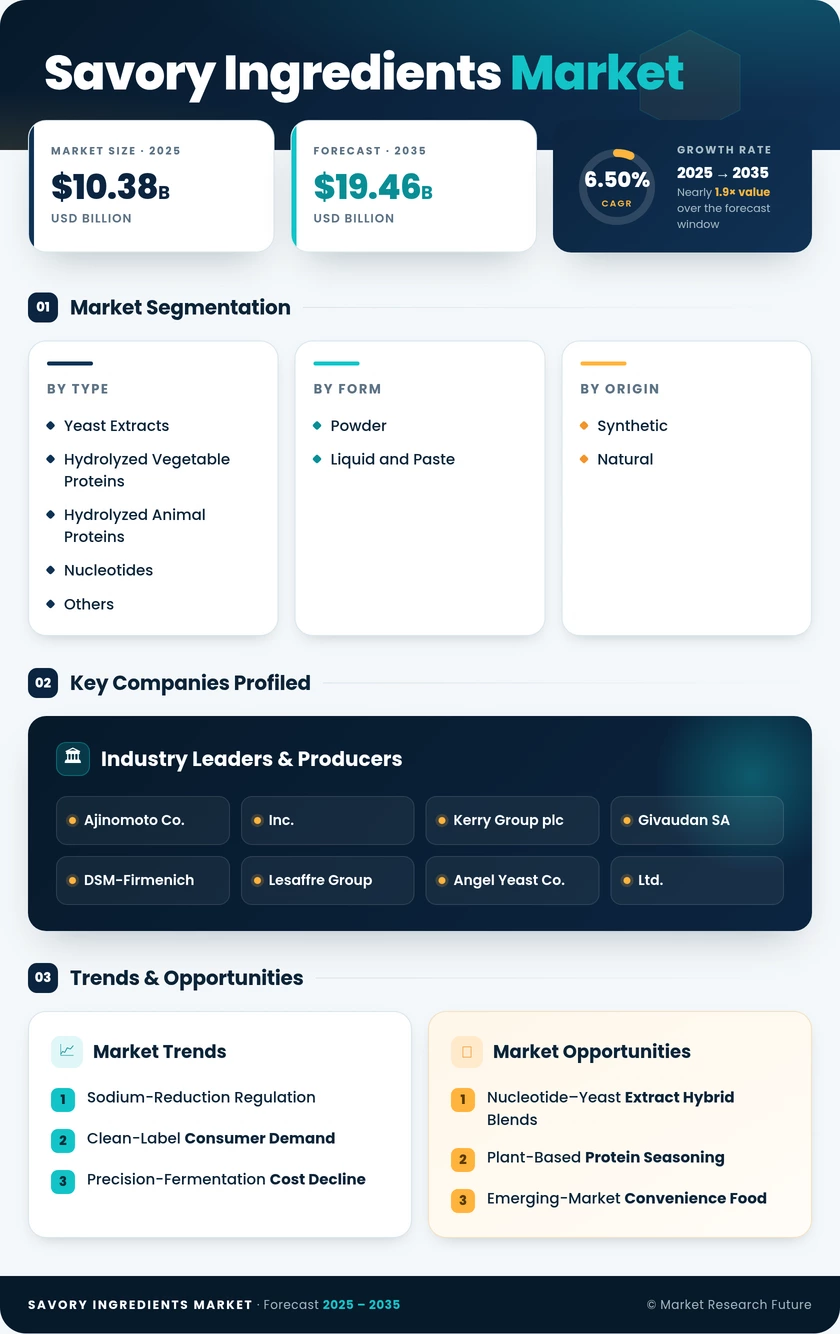
Savory Ingredients Market (2026 - 2035)

ID: MRFR/FnB/1286-HCR
110 Pages
Harshita Gorde
Last Updated: July 09, 2026
Savory Ingredients Market Size, Share, Industry Trend & Analysis Research Report Information By Type (Yeast Extracts, Hydrolyzed Vegetable Proteins, Hydrolyzed Animal Proteins, Nucleotides, Others), By Form (Powder, Liquid and Paste), By Origin (Natural, Synthetic), By Application (Snacks, Soups/Sauces/Dressings, Ready Meals, Others), By Geography (North America, Europe, Asia-Pacific, South America, Middle East & Africa) – Forecast Till 2035
Savory Ingredients Market
Market Size
Forecast Period2026-2035
CAGR (2026-2035)6.50%
2025 Market SizeUSD 10.38 Billion
2035 Market SizeUSD 19.46 Billion
Key Players
Ajinomoto Co., Inc.
Kerry Group plc
Givaudan SA
DSM-Firmenich
Lesaffre Group
Angel Yeast Co., Ltd.
Opportunities
  • Nucleotide–Yeast Extract Hybrid Blends
  • Plant-Based Protein Seasoning
  • Emerging-Market Convenience Food
  1. 1 Market Overview |
    1. 1.1 Study Assumptions & Market Definition |
    2. 1.2 Scope of the Study |
    3. 1.3 Research Methodology
  2. 2 Market Summary & Key Takeaways
  3. 3 Market Dynamics |
    1. 3.1 Market Drivers Analysis | |
      1. 3.1.1 Sodium-Reduction Regulation | |
      2. 3.1.2 Clean-Label Consumer Demand | |
      3. 3.1.3 Precision-Fermentation Cost Decline | |
      4. 3.1.4 Processed-Food Volume Growth in Asia-Pacific | |
      5. 3.1.5 Plant-Based Protein Expansion | |
      6. 3.1.6 Ready-Meal Penetration in Emerging Markets | |
      7. 3.1.7 Foodservice Recovery & Premiumization |
    2. 3.2 Market Restraints Analysis | |
      1. 3.2.1 Raw-Material Price Volatility (Molasses, Soy) | |
      2. 3.2.2 Regulatory Ambiguity on "Natural" Labeling | |
      3. 3.2.3 Consumer Backlash Against Processed Additives | |
      4. 3.2.4 Supply-Chain Concentration in Key Feedstocks | |
      5. 3.2.5 Currency Fluctuation in Emerging Markets |
    3. 3.3 Market Opportunity Analysis | |
      1. 3.3.1 Nucleotide–Yeast Extract Hybrid Blends | |
      2. 3.3.2 Plant-Based Protein Seasoning | |
      3. 3.3.3 Emerging-Market Convenience Food | |
      4. 3.3.4 Digital Flavor-Profiling Platforms | |
      5. 3.3.5 Clean-Label Premiumization in Foodservice |
    4. 3.4 Industry Value Chain Analysis |
    5. 3.5 Porter's Five Forces Analysis
  4. 4 Global Savory Ingredients Market Size & Forecast (2021–2035) |
    1. 4.1 Historical Market Size (2021–2025) |
    2. 4.2 Current & Forecast Market Size (2026–2035) |
    3. 4.3 Market Size by Revenue (USD Billion) |
    4. 4.4 Year-over-Year Growth Analysis
  5. 5 Segmentation Analysis |
    1. 5.1 By Type | |
      1. 5.1.1 Yeast Extracts | |
      2. 5.1.2 Hydrolyzed Vegetable Proteins | |
      3. 5.1.3 Hydrolyzed Animal Proteins | |
      4. 5.1.4 Nucleotides | |
      5. 5.1.5 Others |
    2. 5.2 By Form | |
      1. 5.2.1 Powder | |
      2. 5.2.2 Liquid and Paste |
    3. 5.3 By Origin | |
      1. 5.3.1 Natural | |
      2. 5.3.2 Synthetic |
    4. 5.4 By Application | |
      1. 5.4.1 Snacks | |
      2. 5.4.2 Soups/Sauces/Dressings | |
      3. 5.4.3 Ready Meals | |
      4. 5.4.4 Others
  6. 6 Regional Analysis |
    1. 6.1 North America | |
      1. 6.1.1 United States | |
      2. 6.1.2 Canada | |
      3. 6.1.3 Mexico |
    2. 6.2 Europe | |
      1. 6.2.1 Germany | |
      2. 6.2.2 United Kingdom | |
      3. 6.2.3 France | |
      4. 6.2.4 Italy | |
      5. 6.2.5 Spain | |
      6. 6.2.6 Nordic Countries | |
      7. 6.2.7 Russia | |
      8. 6.2.8 Rest of Europe |
    3. 6.3 Asia-Pacific | |
      1. 6.3.1 China | |
      2. 6.3.2 India | |
      3. 6.3.3 Japan | |
      4. 6.3.4 South Korea | |
      5. 6.3.5 ASEAN | |
      6. 6.3.6 Rest of Asia-Pacific |
    4. 6.4 South America | |
      1. 6.4.1 Brazil | |
      2. 6.4.2 Argentina | |
      3. 6.4.3 Rest of South America |
    5. 6.5 Middle East & Africa | |
      1. 6.5.1 Saudi Arabia | |
      2. 6.5.2 UAE | |
      3. 6.5.3 South Africa | |
      4. 6.5.4 Egypt | |
      5. 6.5.5 Rest of MEA
  7. 7 Competitive Landscape |
    1. 7.1 Market Share Analysis (2025) |
    2. 7.2 Competitive Benchmarking Matrix |
    3. 7.3 Company Profiles | |
      1. 7.3.1 Ajinomoto Co., Inc. | |
      2. 7.3.2 Kerry Group plc | |
      3. 7.3.3 Givaudan SA | |
      4. 7.3.4 DSM-Firmenich | |
      5. 7.3.5 Lesaffre Group | |
      6. 7.3.6 Angel Yeast Co., Ltd. | |
      7. 7.3.7 Sensient Technologies | |
      8. 7.3.8 Symrise AG | |
      9. 7.3.9 Tate & Lyle plc | |
      10. 7.3.10 Cargill, Incorporated
  8. 8 Future Outlook & Strategic Recommendations (2026–2035) |
    1. 8.1 Fermentation Economics and Bioprocess Innovation |
    2. 8.2 AI-Driven Flavor Design and Personalization |
    3. 8.3 Sustainability and Circular Feedstock Models |
    4. 8.4 Regulatory Convergence and Global Harmonization
  9. 9 Recent Developments & News
  10. 10 Frequently Asked Questions (FAQs)
  11. 11 Report Scope & Methodology |
    1. 11.1 Study Period & Base Year |
    2. 11.2 Data Sources & Citations |
    3. 11.3 Abbreviations
  12. 12 LIST OF TABLES |
  13. TABLE 1 Global Savory Ingredients Market Size & Forecast, by Revenue (USD Billion), 2021–2035 |
  14. TABLE 2 Global Savory Ingredients Market — Year-over-Year Growth Analysis, 2021–2035 |
  15. TABLE 3 Global Savory Ingredients Market — Driver Impact Analysis |
  16. TABLE 4 Global Savory Ingredients Market — Restraint Impact Analysis |
  17. TABLE 5 Global Savory Ingredients Market Size, by Type, 2021–2035 (USD Billion) |
  18. TABLE 6 Global Savory Ingredients Market Size, by Form, 2021–2035 (USD Billion) |
  19. TABLE 7 Global Savory Ingredients Market Size, by Origin, 2021–2035 (USD Billion) |
  20. TABLE 8 Global Savory Ingredients Market Size, by Application, 2021–2035 (USD Billion) |
  21. TABLE 9 Global Savory Ingredients Market Size, by Region, 2021–2035 (USD Billion) |
  22. TABLE 10 North America Savory Ingredients Market Size, by Country, 2021–2035 (USD Billion) |
  23. TABLE 11 Europe Savory Ingredients Market Size, by Country, 2021–2035 (USD Billion) |
  24. TABLE 12 Asia-Pacific Savory Ingredients Market Size, by Country, 2021–2035 (USD Billion) |
  25. TABLE 13 South America Savory Ingredients Market Size, by Country, 2021–2035 (USD Billion) |
  26. TABLE 14 Middle East & Africa Savory Ingredients Market Size, by Country, 2021–2035 (USD Billion) |
  27. TABLE 15 Competitive Benchmarking Matrix — Global Savory Ingredients Market, 2025 |
  28. TABLE 16 Company Profiles — Key Players, Global Savory Ingredients Market |
  29. TABLE 17 Recent Developments & Strategic Announcements, 2023–2025 |
  30. TABLE 18 Report Scope & Methodology Summary |
  31. TABLE 19 Detailed Sources and Citations
  32. 13 LIST OF FIGURES |
  33. FIGURE 1 Savory Ingredients Market Dynamics — Drivers, Restraints, and Opportunities |
  34. FIGURE 2 Value Chain Analysis — Global Savory Ingredients Market |
  35. FIGURE 3 Porter's Five Forces Analysis — Savory Ingredients Market |
  36. FIGURE 4 Global Savory Ingredients Market Size Trend (USD Billion), 2021–2035 |
  37. FIGURE 5 Savory Ingredients Market Share, by Type, 2025 |
  38. FIGURE 6 Savory Ingredients Market Share, by Form, 2025 |
  39. FIGURE 7 Savory Ingredients Market Share, by Origin, 2025 |
  40. FIGURE 8 Savory Ingredients Market Share, by Application, 2025 |
  41. FIGURE 9 Savory Ingredients Market Share, by Region, 2025 |
  42. FIGURE 10 Competitive Landscape — Market Share Distribution, 2025

Segmentation Quick Reference

DimensionSub-SegmentsDominant SegmentFastest Growing Segment
By TypeYeast Extracts, Hydrolyzed Vegetable Proteins, Hydrolyzed Animal Proteins, Nucleotides, OthersYeast ExtractsNucleotides
By FormPowder, Liquid and PastePowderLiquid and Paste
By OriginNatural, SyntheticSyntheticNatural
By ApplicationSnacks, Soups/Sauces/Dressings, Ready Meals, OthersSnacksReady Meals
By GeographyNorth America, Europe, Asia-Pacific, South America, Middle East & AfricaAsia-PacificEurope


Market Segmentation Overview

By Type

Sub-SegmentKey Trend
Yeast ExtractsClean-label reformulation backbone; strain-optimization for targeted flavor notes
Hydrolyzed Vegetable ProteinsCost-effective base for commodity snack and soup seasonings
Hydrolyzed Animal ProteinsMeat-flavor replication in processed-food applications
NucleotidesPrecision-fermentation scale-up driving cost parity with synthetic routes
OthersSpecialty ingredients including fermented soy and seaweed extracts


Yeast extracts continue to anchor the type segmentation, serving as the primary vehicle for sodium-reduction reformulation across multiple food categories. Nucleotides are the fastest-growing subsegment, supported by advancing fermentation yields and tightening regulatory constraints on conventional flavor enhancers.

By Form

Sub-SegmentKey Trend
PowderStandard delivery vehicle for dry-blending in snack and seasoning operations
Liquid and PasteGrowing adoption in automated sauce, marinade, and ready-meal production lines


Powder formats dominate on established infrastructure compatibility, while liquid and paste formats are gaining share as food manufacturers invest in pumpable-ingredient handling systems for higher-throughput production.

By Origin

Sub-SegmentKey Trend
NaturalClean-label regulation and consumer preference accelerating adoption
SyntheticCost advantage sustaining majority share in commodity applications


The natural segment's growth rate significantly outpaces synthetic, driven by regulatory tailwinds and retailer requirements. Synthetic ingredients maintain volume leadership through cost efficiency in large-scale commodity seasoning production.

By Application

Sub-SegmentKey Trend
SnacksLargest demand pool; high seasoning-inclusion rates driving volume
Soups/Sauces/DressingsActive sodium-reduction reformulation cycle
Ready MealsFastest growth via emerging-market urbanization and premiumization
OthersBakery, meat processing, and pet food applications expanding


Snacks lead on volume intensity, while ready meals capture the highest growth rate as convenience-food consumption scales across developing economies and premiumizes in mature markets.


 

Download PDF ×

We do not share your information with anyone. However, we may send you emails based on your report interest from time to time. You may contact us at any time to opt-out.