×
Request Free Sample ×

Kindly complete the form below to receive a free sample of this Report

* Please use a valid business email

Leading companies partner with us for data-driven Insights

clients tt-cursor
Hero Background
English
Chinese
French
Japanese
Korean
German
Spanish

Saudi Arabia Agricultural Chemicals Market Trends

ID: MRFR/Agri/12355-HCR
128 Pages
Chitranshi Jaiswal
October 2025

Saudi Arabia Agricultural Chemicals Market Size, Share, Industry Trend & Analysis Research Report Information By Crop Type (Cereals, Pulses and oilseeds, Fruits and vegetables, Lawns and turfs, and Others), By Mode of Application (Foliar, Fertigation, and Others), By Type (Pesticides and Fertilisers) - Forecast Till 2035

Share:
Download PDF ×

We do not share your information with anyone. However, we may send you emails based on your report interest from time to time. You may contact us at any time to opt-out.

Saudi Arabia Agricultural Chemicals Market Infographic
Purchase Options

Market Trends

Key Emerging Trends in the Saudi Arabia Agricultural Chemicals Market

The supermarket for agricultural chemicals in Saudi Arabia is manifesting remarkable figures in the last few years due to the coventry move of which the agricultural sector in the country is going through. One main trend is sustainable agriculture getting more and more serious focus. Farmers and related stakeholders are finding the fact of the availability of eco-friendly and effecient agricultural chemicals which minimize environmental impacts yet boost agricultural output so crucial. However, the change to green sustainable agriculture is a result of both global apprehension about the climate change and the local requirement to use water resources conservatively in aridSaudi Arabia.

To reinforce, an observable movement is seen in the application of advanced technology within the agricultural chemicals domain. Smart farming which utilizes internet of things technology, such as drones, sensors, and GPS guided equipment, is splitting the market strongly towards its side. These technology integration is pivotal especially in ensuring accurate chemicals application on farming land so that their effectiveness is enhanced and all the wastage minimized. Farmers are implementing digital technologies to enhance the management processes and to address the health of the crops. These technologies help farmers in easy management of resources, hence higher productivity rate.

The authorities in Saudi Arabia have also made it their priority to seek an alternative source of income other than oil, which in the end also bears its impact on the market of agrochemicals. The basic Kingdom’s Future 2030 strategy lays a great deal of emphasis on food security, which causes the channeling of funds into the agricultural sector. Consequently, people in agriculture encourage the application of various chemicals mainly as a way of increasing crop production and every individual accessing the readily available food. Beside the gov's support by means of subsidies and bonuses to farmers, the scope of money demand for agrichemicals has also been increased.

One among the important tendencies is the transition to the natural way of farming and at the same time the growing appeal to organic agricultural chemicals. Consumers practice more conscious eating and environmental conscription, there is a stronger desire and attraction for organic produce resulting in an increase in demand. So the tendency drove farmers to bring up organic farming and creates the demand for organic fertilizers, pesticides, and other agricultural products. This results in an increase in companies in the Saudi Arabian market that are looking to meet the demand of the customers by diversifying their product line options.

While there are many positives on the one hand, difficult situation on the other hand also comes with the trends. Water requirements go up significantly to improve productivity and sustainability, which create tension in a region already having water constricted resources. Some measures such as water efficient management coupled with chemical water saving plants are paramount for coping with this issue. Also, the continuing global anxiety about the ecological effect of particular chemical substances has caused more societal vigilance that in turn leads to regulations and legislations.

Author
Chitranshi Jaiswal
Research Analyst Level I

In her 3 years of experience in the market research field, she has handled critical cross-domain projects. She has an in-depth knowledge of market estimation & analysis, problem-solving, primary as well as secondary research, and team management.She holds an engineering degree and is an MBA professional from a well-known university, capable of evaluating the market and competitive conditions. An exceptional strategist with excellent communication skills and a passion for delivering cutting-edge & practical insights for the market. Proficient in multi-tasking, and can successfully deal with competing demands, while maintaining complete confidentiality. Generated business through active client and project development, networking, and high-quality responses. Her knowledge and skills have helped in making solid business decisions, securing funding from investors, and avoiding business failures.

Leave a Comment

FAQs

What is the current valuation of the GCC Agrochemicals Market?

As of 2024, the GCC Agrochemicals Market was valued at 5.48 USD Billion.

What is the projected market size for the GCC Agrochemicals Market by 2035?

The market is projected to reach 8.52 USD Billion by 2035.

What is the expected CAGR for the GCC Agrochemicals Market during the forecast period?

The expected CAGR for the GCC Agrochemicals Market from 2025 to 2035 is 4.08%.

Which companies are the key players in the GCC Agrochemicals Market?

Key players include BASF, Syngenta, Bayer, Dow, FMC Corporation, Nufarm, ADAMA, UPL, Arabian Agricultural Services Company, and Al-Falak.

How are fertilizers performing in the GCC Agrochemicals Market?

Fertilizers are projected to grow from 1.5 USD Billion in 2024 to 2.3 USD Billion by 2035.

What is the market outlook for pesticides in the GCC region?

Pesticides are expected to increase from 1.2 USD Billion in 2024 to 1.8 USD Billion by 2035.

What are the anticipated trends in herbicides within the GCC Agrochemicals Market?

Herbicides are likely to rise from 1.0 USD Billion in 2024 to 1.5 USD Billion by 2035.

What is the growth forecast for insecticides in the GCC Agrochemicals Market?

Insecticides are projected to grow from 0.78 USD Billion in 2024 to 1.2 USD Billion by 2035.

How is the distribution channel landscape evolving in the GCC Agrochemicals Market?

The distributors segment is expected to expand from 1.38 USD Billion in 2024 to 2.32 USD Billion by 2035.

What is the expected performance of the agricultural end-use segment in the GCC Agrochemicals Market?

The agricultural end-use segment is anticipated to grow from 2.19 USD Billion in 2024 to 3.45 USD Billion by 2035.

Market Summary

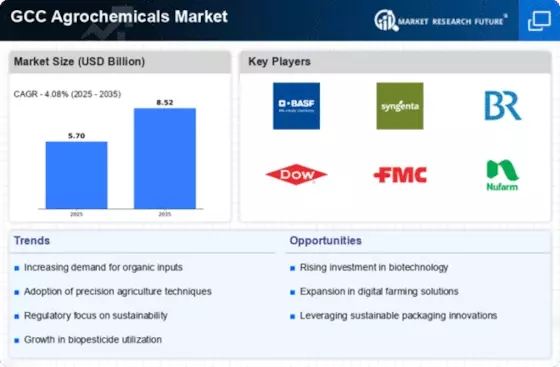
As per analysis, the GCC Agrochemicals Market is projected to grow from USD 5.73 Billion in 2025 to USD 8.52 Billion by 2035, exhibiting a compound annual growth rate (CAGR) of 4.08% during the forecast period (2025 - 2035).

Key Market Trends & Highlights

The GCC Agrochemicals Market is poised for growth driven by sustainability and technological advancements.

  • Sustainable agrochemical solutions are gaining traction as farmers seek environmentally friendly practices.
  • The fertilizers segment remains the largest, while the pesticides segment is experiencing the fastest growth in the market.
  • Liquid agrochemicals dominate the market, yet granular products are emerging as the fastest-growing category.
  • Increasing agricultural production and rising awareness of sustainable practices are key drivers propelling market expansion.

Market Size & Forecast

2024 Market Size 5.48 (USD Billion)
2035 Market Size 8.52 (USD Billion)
CAGR (2025 - 2035) 4.08%

Major Players

<p>BASF (DE), Syngenta (CH), Bayer (DE), Dow (US), FMC Corporation (US), Nufarm (AU), ADAMA (IL), UPL (IN), Arabian Agricultural Services Company (SA), Al-Falak (SA)</p>

Market Trends

The GCC Agrochemicals Market is currently experiencing a dynamic transformation, driven by various factors including population growth, urbanization, and the increasing demand for food security. As agricultural practices evolve, there is a noticeable shift towards sustainable and environmentally friendly agrochemical solutions. This trend is largely influenced by government initiatives aimed at promoting sustainable agriculture, which encourages the adoption of innovative technologies and practices. Furthermore, the region's unique climatic conditions necessitate the development of specialized agrochemical products tailored to local crops and farming methods. In addition, the GCC Agrochemicals Market is witnessing a rise in the integration of digital technologies within agricultural practices. Precision agriculture, which utilizes data analytics and IoT devices, is becoming more prevalent among farmers. This approach not only enhances crop yields but also optimizes resource usage, thereby contributing to sustainability goals. As the market continues to evolve, stakeholders are likely to focus on research and development to create advanced agrochemical solutions that align with both economic and environmental objectives. The interplay of these factors suggests a promising outlook for the GCC Agrochemicals Market in the coming years.

Sustainable Agrochemical Solutions

There is a growing emphasis on sustainable agrochemical products within the GCC Agrochemicals Market. This trend is driven by increasing awareness of environmental issues and the need for eco-friendly farming practices. Governments in the region are actively promoting initiatives that support the development and use of biodegradable and organic agrochemicals, which are perceived as safer alternatives to traditional chemicals.

Digital Transformation in Agriculture

The integration of digital technologies is reshaping the GCC Agrochemicals Market. Farmers are increasingly adopting precision agriculture techniques, which leverage data analytics and IoT devices to enhance productivity. This shift not only improves crop management but also optimizes the use of agrochemicals, leading to more efficient farming practices.

Customized Agrochemical Products

The unique climatic and agricultural conditions in the GCC region are driving the demand for customized agrochemical solutions. Manufacturers are focusing on developing products specifically designed for local crops and environmental conditions. This trend reflects a broader understanding of the need for tailored solutions that address the specific challenges faced by farmers in the region.

Saudi Arabia Agricultural Chemicals Market Market Drivers

Government Initiatives and Support

The GCC Agrochemicals Market benefits significantly from various government initiatives aimed at promoting agricultural sustainability and innovation. Countries like Saudi Arabia and Qatar have introduced subsidies and financial incentives for farmers to adopt modern agrochemical practices. The Saudi Vision 2030 plan emphasizes agricultural development, which includes enhancing the use of agrochemicals to improve crop yields. Additionally, the GCC governments are investing in research and development to create more effective and environmentally friendly agrochemical products. This supportive regulatory environment is expected to foster growth in the GCC Agrochemicals Market, as it encourages the adoption of advanced agrochemical solutions among farmers.

Increasing Agricultural Production

The GCC Agrochemicals Market is experiencing a surge in demand driven by the need to enhance agricultural productivity. With the region's growing population, which is projected to reach over 60 million by 2030, the pressure on food production systems intensifies. Governments in GCC countries are implementing policies to boost local food production, thereby increasing the adoption of agrochemicals. For instance, the UAE has set ambitious targets to increase its food security, leading to a projected growth rate of 5.5% in the agrochemicals sector by 2026. This focus on agricultural output is likely to propel the GCC Agrochemicals Market forward, as farmers seek effective solutions to maximize yields and ensure food supply stability.

Rising Awareness of Sustainable Practices

There is a growing awareness among farmers in the GCC region regarding sustainable agricultural practices, which is influencing the GCC Agrochemicals Market. As consumers increasingly demand organic and sustainably produced food, farmers are seeking agrochemical solutions that align with these preferences. The market for bio-based agrochemicals is projected to grow at a compound annual growth rate of 7% through 2026, reflecting this shift. Furthermore, initiatives promoting integrated pest management and reduced chemical usage are gaining traction, leading to a transformation in how agrochemicals are perceived and utilized. This trend towards sustainability is likely to reshape the GCC Agrochemicals Market, driving innovation and the development of eco-friendly products.

Technological Advancements in Agrochemicals

Technological advancements are playing a pivotal role in shaping the GCC Agrochemicals Market. Innovations such as precision agriculture, drone technology, and data analytics are enabling farmers to optimize the use of agrochemicals, thereby enhancing efficiency and reducing waste. The integration of smart technologies in farming practices is expected to increase the demand for specialized agrochemical products tailored to specific crop needs. For instance, the use of drones for targeted pesticide application can lead to a reduction in chemical usage by up to 30%. As these technologies become more accessible, they are likely to drive growth in the GCC Agrochemicals Market, as farmers seek to leverage these advancements for better crop management.

Expansion of Crop Varieties and Cultivation Areas

The expansion of crop varieties and cultivation areas in the GCC region is a significant driver for the GCC Agrochemicals Market. As farmers diversify their crops to include high-value fruits and vegetables, the demand for specific agrochemical products tailored to these crops increases. Additionally, the reclamation of arid lands for agricultural purposes is creating new opportunities for agrochemical applications. For example, the introduction of salt-tolerant crop varieties in Saudi Arabia is expected to boost the agrochemical market as these crops require specialized nutrients and pest control solutions. This diversification and expansion are likely to stimulate growth in the GCC Agrochemicals Market, as farmers seek effective agrochemical solutions to support their evolving agricultural practices.

Market Segment Insights

By Application: Fertilizers (Largest) vs. Pesticides (Fastest-Growing)

<p>In the GCC Agrochemicals Market, fertilizers hold the largest market share, reflecting their critical role in enhancing agricultural productivity across the region. Pesticides, while slightly behind fertilizers in total market share, are rapidly gaining ground due to heightened awareness about crop protection and pest management. The demand for fertilizers continues to be driven by the need to meet the food security challenges and improve soil quality, making them indispensable in farming practices.</p>

<p>Fertilizers (Dominant) vs. Pesticides (Emerging)</p>

<p>Fertilizers remain the dominant segment in the GCC Agrochemicals Market, primarily due to their essential role in promoting crop yields and supporting intensive agricultural practices. The GCC region's reliance on food imports emphasizes the necessity for efficient fertilizer use to enhance local production. Pesticides, on the other hand, are emerging rapidly, driven by increased crop loss due to pests and diseases, alongside a growing focus on sustainable agricultural methods. While fertilizers provide the foundational nutrients, pesticides ensure the protection of these crops, leading to a more integrated approach to agrochemical use in the GCC, appealing to both conventional and organic farming sectors.</p>

By Formulation Type: Liquid (Largest) vs. Granular (Fastest-Growing)

<p>In the GCC agrochemicals market, the formulation type segment delineates distinct preferences among stakeholders, with liquid formulations holding the largest market share. Liquid formulations are favored for their ease of application and effective dispersion, catering to various agricultural practices across the GCC region. Granular formulations, although currently smaller in market share, are emerging rapidly due to their convenience, reduced drift potential during application, and enhanced soil integration, aligning with modern agricultural trends. The growth trends in the formulation type segment are influenced by factors such as rising agricultural productivity needs and the increasing adoption of precision farming. Liquid formulations benefit from their applicability across diverse crops, while granular options gain traction amongst farmers seeking sustainable and efficient solutions. This dynamic is fueled by continuous R&D, addressing the challenges of pests and diseases in the region’s agricultural practices, enhancing overall crop yield and farmer profitability.</p>

<p>Liquid (Dominant) vs. Granular (Emerging)</p>

<p>In the GCC agrochemicals market, liquid formulations are considered the dominant choice among farmers and agribusinesses due to their versatile application methods and immediate effectiveness. They are characterized by their ability to provide quick results, seamlessly mixing with water for enhanced crop interaction. On the other hand, granular formulations represent an emerging segment, appealing especially to those looking for ease of use and longer persistence in the soil. They allow for precise application with minimal waste and less environmental impact, catering to a market increasingly concerned with sustainability. Together, both formulations showcase the progressive shift in agrochemical application preferences in the GCC region.</p>

By Crop Type: Cereals (Largest) vs. Fruits (Fastest-Growing)

<p>In the GCC Agrochemicals Market, the crop type segment showcases a diverse distribution with cereals leading the market share, primarily driven by staple crops essential for food security. Fruits, on the other hand, are emerging rapidly, reflecting growing consumer demand for fresh produce and organic options. This segment's composition indicates that as urbanization increases, the preference for fruits over traditional crops is changing the landscape of agrochemicals use.</p>

<p>Cereals: Dominant vs. Fruits: Emerging</p>

<p>Cereals remain the dominant crop type in the GCC Agrochemicals Market, primarily due to their significant role in food supply chains and agricultural policies promoting staple crops. These crops benefit from extensive agrochemical applications that enhance yield and pest resistance. Meanwhile, the fruits segment is categorized as emerging, marked by a robust increase in cultivation driven by changing dietary preferences and a shift towards healthier eating. This sector is attracting innovations in agrochemicals tailored for high-quality fruit production, thereby enhancing its growth trajectory in this competitive market.</p>

By Distribution Channel: Retail (Largest) vs. E-commerce (Fastest-Growing)

<p>In the GCC Agrochemicals Market, the distribution channels have shown a varied market share distribution. Retail stands as the largest segment, benefiting from established networks and strong customer relationships. This segment is well-integrated within local agricultural frameworks, allowing for consistent product availability and farmer access. Conversely, E-commerce is emerging rapidly, attracting attention for its convenience and reach, particularly in urban areas where farmers seek fast procurement solutions.</p>

<p>Retail (Dominant) vs. E-commerce (Emerging)</p>

<p>The retail distribution channel in the GCC Agrochemicals Market is characterized by its extensive presence and accessibility, serving as the dominant avenue for agrochemical sales. Retailers have established strong relationships with local farmers, providing personalized support and ensuring stock availability. In contrast, E-commerce represents an emerging channel that has gained momentum due to changing consumer preferences for online shopping. The growth of digital platforms in the GCC is driven by increasing internet penetration and the demand for quick delivery solutions, presenting opportunities for agrochemical suppliers to reach a broader audience.</p>

By End Use: Agricultural (Largest) vs. Horticultural (Fastest-Growing)

<p>In the GCC Agrochemicals Market, the end-use segment is primarily driven by agricultural applications, which hold the largest market share. Agricultural chemicals are crucial for enhancing crop yield and quality, making this segment a dominant force in the market. Following closely, horticultural agrochemicals are rapidly gaining prominence, reflecting a growing interest in landscaping, gardening, and specialty crops among consumers, contributing significantly to market dynamics. The growth trends in this segment are largely influenced by increasing agricultural productivity demands and shifting consumer preferences towards sustainable and organic horticultural products. Rapid urbanization and expansion of green spaces further fuel the demand for horticultural agrochemicals. Additionally, government initiatives promoting sustainable farming practices are expected to enhance market dynamics in both agricultural and horticultural segments.</p>

<p>Agricultural (Dominant) vs. Horticultural (Emerging)</p>

<p>The agricultural segment, characterized by its extensive use of fertilizers, pesticides, and herbicides, plays a critical role in the GCC's food security strategy. It assures optimal crop yields against the backdrop of arid climate conditions. Conversely, the horticultural segment is emerging rapidly, driven by lifestyle changes and urban gardening trends. This segment embraces innovations in botanical health and pest control methodologies that align with consumer preferences for environmentally friendly products. With increased investments in research and development, both segments demonstrate adaptable strategies to meet evolving market needs, positioning themselves favorably within the GCC Agrochemicals landscape.</p>

Get more detailed insights about Saudi Arabia Agricultural Chemicals Market Research Report - Forecast by 2035

Regional Insights

North America : Innovation and Sustainability Focus

The North American agricultural chemicals market is driven by increasing demand for sustainable farming practices and innovative technologies. Regulatory frameworks, such as the Environmental Protection Agency's initiatives, are catalyzing growth. The U.S. holds the largest market share at approximately 70%, followed by Canada at 20%. This focus on sustainability is reshaping product offerings and driving investment in research and development. Leading countries in this region include the United States and Canada, with major players like Dow and BASF actively participating in the market. The competitive landscape is characterized by a mix of established companies and emerging startups focusing on eco-friendly solutions. The presence of key players ensures a robust supply chain and innovation pipeline, catering to the evolving needs of farmers and agricultural businesses.

Europe : Regulatory Compliance and Innovation

The European agricultural chemicals market is characterized by stringent regulations aimed at promoting sustainable agriculture. The European Union's Green Deal and Farm to Fork Strategy are pivotal in shaping market dynamics, with a focus on reducing chemical usage. Germany and France are the largest markets, holding approximately 30% and 25% shares, respectively, driven by strong agricultural sectors and innovation in chemical formulations. Key players in Europe include BASF and Syngenta, which are investing heavily in research to develop environmentally friendly products. The competitive landscape is marked by collaboration between companies and research institutions to meet regulatory standards. This focus on compliance and innovation is expected to drive growth in the agricultural chemicals market across the region.

Asia-Pacific : Emerging Markets and Growth Potential

The Asia-Pacific agricultural chemicals market is witnessing rapid growth, driven by increasing agricultural productivity and the need for food security. Countries like China and India are the largest markets, accounting for approximately 40% and 25% of the region's share, respectively. The demand for crop protection products is rising due to changing dietary preferences and population growth, supported by government initiatives to enhance agricultural output. The competitive landscape is evolving, with both multinational corporations and local players like UPL and FMC Corporation vying for market share. The presence of key players is fostering innovation and improving access to advanced agricultural solutions. As the region continues to modernize its agricultural practices, the demand for agricultural chemicals is expected to surge, creating significant opportunities for growth.

Middle East and Africa : Resource-Rich and Growing Demand

The Middle East and Africa agricultural chemicals market is characterized by increasing demand for food security and sustainable farming practices. Countries like South Africa and Saudi Arabia are leading the market, holding approximately 30% and 25% shares, respectively. The region's growth is driven by government initiatives aimed at enhancing agricultural productivity and addressing food shortages, alongside a growing awareness of sustainable practices. The competitive landscape features both local and international players, including SABIC and ADAMA, which are focusing on innovative solutions tailored to regional needs. The presence of key players is crucial for driving advancements in agricultural chemicals, as they adapt to the unique challenges faced by farmers in the region. This dynamic environment presents significant opportunities for growth and investment in agricultural chemicals.

Key Players and Competitive Insights

The Agrochemicals Market is currently characterized by a dynamic competitive landscape, driven by increasing agricultural productivity demands and a growing emphasis on sustainable practices. Key players such as BASF (DE), Syngenta (CH), and Bayer (DE) are strategically positioned to leverage innovation and technological advancements. BASF (DE) focuses on developing environmentally friendly products, while Syngenta (CH) emphasizes digital agriculture solutions to enhance crop yields. Bayer (DE) is actively pursuing mergers and acquisitions to expand its product portfolio and market reach. Collectively, these strategies contribute to a competitive environment that is increasingly focused on sustainability and technological integration.

In terms of business tactics, companies are localizing manufacturing to reduce costs and enhance supply chain efficiency. The market structure appears moderately fragmented, with several key players exerting significant influence. This fragmentation allows for a diverse range of products and services, catering to various agricultural needs across the region. The collective actions of these major companies shape the competitive dynamics, as they strive to optimize their operations and respond to market demands.

In December 2025, BASF (DE) announced a partnership with a leading agricultural technology firm to develop precision farming solutions. This collaboration aims to integrate advanced data analytics into crop management practices, potentially revolutionizing how farmers approach yield optimization. The strategic importance of this partnership lies in its potential to enhance BASF's product offerings and position the company as a leader in the digital agriculture space.

In November 2025, Syngenta (CH) launched a new line of biopesticides designed to reduce chemical usage in farming. This initiative aligns with the growing trend towards sustainable agriculture and reflects Syngenta's commitment to environmental stewardship. The introduction of these biopesticides is likely to strengthen Syngenta's market position by appealing to environmentally conscious consumers and farmers.

In October 2025, Bayer (DE) completed the acquisition of a regional agrochemical company, enhancing its portfolio of crop protection products. This acquisition is strategically significant as it allows Bayer to expand its market presence and diversify its offerings. The integration of the acquired company's products is expected to provide Bayer with a competitive edge in addressing the evolving needs of farmers in the GCC region.

As of January 2026, current competitive trends in the Agrochemicals Market include a pronounced shift towards digitalization, sustainability, and the integration of artificial intelligence (AI) in product development. Strategic alliances are increasingly shaping the landscape, enabling companies to pool resources and expertise. Looking ahead, competitive differentiation is likely to evolve from traditional price-based competition to a focus on innovation, technology, and supply chain reliability. This shift underscores the importance of adapting to market changes and consumer preferences in a rapidly evolving industry.

Key Companies in the Saudi Arabia Agricultural Chemicals Market include

Industry Developments

February 2022: Adama released Timeline FX, a cutting-edge cross-spectrum spring foliar herbicide for cereals. With its three complimentary modes of action and integrated adjuvant, the product offers growers the widest treatment window of any herbicide for managing grass and broadleaf weeds in cereal crops.

January 2022: Yara and Lantmännen inked a contract to introduce fertilizers free of fossil fuels to the market. As a result of the firms' cooperation, Yara and Lantmännen have signed a commercial agreement for the production and marketing of green fertilizers in Sweden starting in 2023.

Future Outlook

Saudi Arabia Agricultural Chemicals Market Future Outlook

The GCC Agrochemicals Market is projected to grow at a 4.08% CAGR from 2025 to 2035, driven by increasing agricultural productivity, technological advancements, and sustainable farming practices.

New opportunities lie in:

  • Development of precision agriculture technologies for targeted agrochemical application.
  • Expansion of bio-based agrochemicals to meet rising environmental regulations.
  • Investment in digital platforms for real-time crop monitoring and agrochemical management.

By 2035, the GCC Agrochemicals Market is expected to be robust, driven by innovation and sustainability.

Market Segmentation

Saudi Arabia Agricultural Chemicals Market End Use Outlook

  • Agricultural
  • Horticultural
  • Forestry
  • Turf and Ornamental
  • Aquaculture

Saudi Arabia Agricultural Chemicals Market Crop Type Outlook

  • Cereals
  • Fruits
  • Vegetables
  • Oilseeds
  • Pulses

Saudi Arabia Agricultural Chemicals Market Application Outlook

  • Fertilizers
  • Pesticides
  • Herbicides
  • Insecticides
  • Fungicides

Saudi Arabia Agricultural Chemicals Market Formulation Type Outlook

  • Liquid
  • Granular
  • Powder
  • Suspension
  • Emulsifiable Concentrate

Saudi Arabia Agricultural Chemicals Market Distribution Channel Outlook

  • Direct Sales
  • Retail
  • E-commerce
  • Wholesale
  • Distributors

Report Scope

MARKET SIZE 20245.48(USD Billion)
MARKET SIZE 20255.73(USD Billion)
MARKET SIZE 20358.52(USD Billion)
COMPOUND ANNUAL GROWTH RATE (CAGR)4.08% (2024 - 2035)
REPORT COVERAGERevenue Forecast, Competitive Landscape, Growth Factors, and Trends
BASE YEAR2024
Market Forecast Period2025 - 2035
Historical Data2019 - 2024
Market Forecast UnitsUSD Billion
Key Companies ProfiledBASF (DE), Syngenta (CH), Bayer (DE), Dow (US), FMC Corporation (US), Nufarm (AU), ADAMA (IL), UPL (IN), Arabian Agricultural Services Company (SA), Al-Falak (SA)
Segments CoveredApplication, Formulation Type, Crop Type, Distribution Channel, End Use
Key Market OpportunitiesAdoption of precision agriculture technologies enhances efficiency in the GCC Agrochemicals Market.
Key Market DynamicsRising demand for sustainable agrochemicals drives innovation and regulatory shifts in the GCC Agrochemicals Market.
Countries CoveredGCC

FAQs

What is the current valuation of the GCC Agrochemicals Market?

As of 2024, the GCC Agrochemicals Market was valued at 5.48 USD Billion.

What is the projected market size for the GCC Agrochemicals Market by 2035?

The market is projected to reach 8.52 USD Billion by 2035.

What is the expected CAGR for the GCC Agrochemicals Market during the forecast period?

The expected CAGR for the GCC Agrochemicals Market from 2025 to 2035 is 4.08%.

Which companies are the key players in the GCC Agrochemicals Market?

Key players include BASF, Syngenta, Bayer, Dow, FMC Corporation, Nufarm, ADAMA, UPL, Arabian Agricultural Services Company, and Al-Falak.

How are fertilizers performing in the GCC Agrochemicals Market?

Fertilizers are projected to grow from 1.5 USD Billion in 2024 to 2.3 USD Billion by 2035.

What is the market outlook for pesticides in the GCC region?

Pesticides are expected to increase from 1.2 USD Billion in 2024 to 1.8 USD Billion by 2035.

What are the anticipated trends in herbicides within the GCC Agrochemicals Market?

Herbicides are likely to rise from 1.0 USD Billion in 2024 to 1.5 USD Billion by 2035.

What is the growth forecast for insecticides in the GCC Agrochemicals Market?

Insecticides are projected to grow from 0.78 USD Billion in 2024 to 1.2 USD Billion by 2035.

How is the distribution channel landscape evolving in the GCC Agrochemicals Market?

The distributors segment is expected to expand from 1.38 USD Billion in 2024 to 2.32 USD Billion by 2035.

What is the expected performance of the agricultural end-use segment in the GCC Agrochemicals Market?

The agricultural end-use segment is anticipated to grow from 2.19 USD Billion in 2024 to 3.45 USD Billion by 2035.

  1. SECTION I: EXECUTIVE SUMMARY AND KEY HIGHLIGHTS
    1. EXECUTIVE SUMMARY
  2. SECTION II: SCOPING, METHODOLOGY AND MARKET STRUCTURE
    1. MARKET INTRODUCTION
    2. RESEARCH METHODOLOGY
  3. SECTION III: QUALITATIVE ANALYSIS
    1. MARKET DYNAMICS
    2. MARKET FACTOR ANALYSIS
  4. SECTION IV: QUANTITATIVE ANALYSIS
    1. Construction, BY Application (USD Billion)
    2. Construction, BY Formulation Type (USD Billion)
    3. Construction, BY Crop Type (USD Billion)
    4. Construction, BY Distribution Channel (USD Billion)
    5. Construction, BY End Use (USD Billion)
  5. SECTION V: COMPETITIVE ANALYSIS
    1. Competitive Landscape
    2. Company Profiles
    3. Appendix

Saudi Arabia Agricultural Chemicals Market Segmentation

Market Segmentation Overview

  • Detailed segmentation data will be available in the full report
  • Comprehensive analysis by multiple parameters
  • Regional and country-level breakdowns
  • Market size forecasts by segment
Infographic

Free Sample Request

Kindly complete the form below to receive a free sample of this Report

Get Free Sample

Customer Strories

Compare Licence

×
Features License Type
Single User Multiuser License Enterprise User
Price $4,950 $5,950 $7,250
Maximum User Access Limit 1 User Upto 10 Users Unrestricted Access Throughout the Organization
Free Customization
Direct Access to Analyst
Deliverable Format
Platform Access
Discount on Next Purchase 10% 15% 15%
Printable Versions