
Request Free Sample ×

Kindly complete the form below to receive a free sample of this Report

* Please use a valid business email

Leading companies partner with us for data-driven Insights

clients tt-cursor
Hero Background
English
Chinese
French
Japanese
Korean
German
Spanish

Satellite Bus Market Share

ID: MRFR/AD/6621-CR
174 Pages
Abbas Raut
December 2021

Satellite Bus Market Size, Share, Industry Trend & Analysis Research Report Information by Satellite Type (Small Satellite, Medium Satellite, and Large Satellite), Subsystem (Electric Power System (EPS), Thermal Control, Attitude Control System, Flight Software, and Telemetry Tracking and Command (TT&C), and Others), Application (Earth Observation and Meteorology, Scientific Research & Exploration, Mapping & Navigation, Communication, and Surveillance & Security), and Region (North America, Europe, Asia-Pacific, Middle East & Africa, and Latin America) — Forecast till 2035

Share:
Download PDF ×

We do not share your information with anyone. However, we may send you emails based on your report interest from time to time. You may contact us at any time to opt-out.

Satellite Bus Market Infographic
Purchase Options

Market Share

Satellite Bus Market Share Analysis

The air passenger traffic has witnessed a substantial surge in recent years, propelled by various factors such as declining airfares, an increase in per capita disposable income, particularly in developing nations, and elevated living standards. These elements collectively contribute to the growth of the aviation industry. According to the International Air Transport Association (IATA), there is a projection that global air travel will double by 2035. Notably, China is anticipated to outpace the United States and emerge as the world's largest aviation market in terms of passenger traffic by 2024. A visual representation below illustrates the number of passengers carried by airlines, encompassing both domestic and international routes.

The escalating demand for air travel has resulted in a pressing need for new aircraft to accommodate the ever-growing passenger numbers. An exemplar of this demand is the monumental contract signed in 2017 between Airbus and Indigo Partners (U.S.) valued at USD 50 billion, signifying one of the most significant deals in the history of commercial aviation. This agreement underscores the urgency for airlines to bolster their fleets to meet the burgeoning demand. Moreover, the industry has witnessed the establishment of numerous new airlines across various regions to tap into the vast passenger demand. In 2017 alone, more than 70 new airlines were established globally. A visual representation below outlines the gross orders for aircraft from both Airbus and Boeing during the year 2017.

The growth trajectory in air passenger traffic is a testament to the dynamic nature of the aviation sector, driven by a confluence of economic factors and increasing consumer preferences for air travel. The decline in airfares has democratized air travel, making it more accessible to a broader segment of the population. This, coupled with rising per capita disposable income, especially in developing economies, has fueled the aspirations of individuals to explore air travel as a convenient and efficient mode of transportation.

The forecasts from IATA, indicating a doubling of global air travel by 2035, underscore the sustained momentum in the aviation industry. The shifting dynamics, with China poised to surpass the United States as the leading aviation market, indicate the evolving landscape of air transportation on a global scale. Such projections necessitate the readiness of the industry to meet the escalating demand with the procurement of new aircraft, as evident in landmark deals like the one between Airbus and Indigo Partners.

The establishment of over 70 new airlines worldwide in 2017 further amplifies the industry's response to the increasing passenger demand. This trend not only reflects the opportunities perceived by entrepreneurs in the aviation sector but also the recognition of the industry's growth potential. The establishment of new airlines contributes to the diversification of services, fostering competition, and enhancing the overall connectivity of air travel.


Author
Author Profile
Abbas Raut
Research Analyst

Abbas Raut is a Senior Research Analyst with 5+ years of experience delivering data-driven insights and strategic recommendations across the Automotive and Aerospace & Defense sectors. He specializes in emerging technologies, industry value chains, and global market dynamics shaping the future of mobility and defense. In automotive, Abbas has led studies on EVs, charging stations, BMS, superchargers, and more, guiding stakeholders through electrification and regulatory shifts. In Aerospace & Defense, he has analyzed markets for military electronics, drones, radars, and electronic warfare solutions, supporting procurement and investment strategies. With expertise in market sizing, forecasting, benchmarking, and technology adoption, Abbas is known for transforming complex datasets into actionable insights that drive strategy, innovation, and growth.

Leave a Comment

FAQs

What is the projected market valuation of the Satellite Bus Market by 2035?

<p>The Satellite Bus Market is projected to reach a valuation of 54.6 USD Billion by 2035.</p>

What was the market valuation of the Satellite Bus Market in 2024?

<p>In 2024, the Satellite Bus Market was valued at 28.8 USD Billion.</p>

What is the expected CAGR for the Satellite Bus Market during the forecast period 2025 - 2035?

<p>The expected CAGR for the Satellite Bus Market during the forecast period 2025 - 2035 is 6.0%.</p>

Which application segments are driving growth in the Satellite Bus Market?

<p>The application segments driving growth include Communication, Earth Observation, and Scientific Research, with valuations projected to reach 16.38, 11.16, and 8.38 USD Billion respectively by 2035.</p>

How does the end-use segmentation of the Satellite Bus Market appear?

The end-use segmentation indicates that the Commercial sector is expected to grow to 20.52 USD Billion by 2035, alongside Government and Military sectors.

What types of satellite buses are included in the market analysis?

The market analysis includes Small, Medium, Large, and Nano Satellite Buses, with projected valuations of 10.0, 20.0, 15.0, and 9.6 USD Billion respectively by 2035.

What orbit types are relevant to the Satellite Bus Market?

The relevant orbit types include Geostationary, Low Earth, and Medium Earth Orbits, with projected valuations of 18.0, 22.0, and 14.6 USD Billion respectively by 2035.

Who are the key players in the Satellite Bus Market?

Key players in the Satellite Bus Market include Lockheed Martin, Northrop Grumman, Airbus, and Boeing, among others.

What is the significance of the Military segment in the Satellite Bus Market?

The Military segment is projected to grow to 12.84 USD Billion by 2035, indicating its crucial role in the overall market dynamics.

How does the growth of the Satellite Bus Market compare across different segments?

The growth across segments appears varied, with the Commercial segment showing the highest potential, followed by Communication and Earth Observation applications.

Market Summary

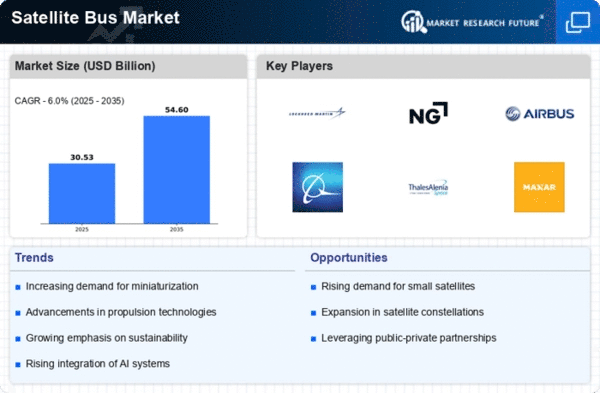
As per MRFR analysis, the Satellite Bus Market Size was estimated at 28.8 USD Billion in 2024. The Satellite Bus industry is projected to grow from 30.5 in 2025 to 54.6 by 2035, exhibiting a compound annual growth rate (CAGR) of 6.0% during the forecast period 2025 - 2035.

Key Market Trends & Highlights

The Satellite Bus Market is poised for robust growth driven by technological advancements and increasing demand across various segments.

  • Technological advancements are enhancing the capabilities and efficiency of satellite buses, leading to improved performance.
  • Miniaturization trends are enabling the development of smaller, more efficient satellite buses, particularly in the communication segment.
  • Sustainability initiatives are gaining traction, influencing the design and manufacturing processes of satellite buses in both government and commercial sectors.
  • The increased demand for communication satellites and government investments in space programs are key drivers propelling market growth.

Market Size & Forecast

2024 Market Size 28.8 (USD Billion)
2035 Market Size 54.6 (USD Billion)
CAGR (2025 - 2035) 6.0%
Largest Regional Market Share in 2024 North America

Major Players

Lockheed Martin (US), Northrop Grumman (US), Airbus (FR), Boeing (US), Thales Alenia Space (FR), Maxar Technologies (US), SSL (US), China Aerospace Science and Technology Corporation (CN), Indian Space Research Organisation (IN)

Market Trends

The Satellite Bus Market is currently experiencing a transformative phase, driven by advancements in technology and increasing demand for satellite applications. The integration of innovative materials and designs is enhancing the efficiency and performance of satellite buses, which serve as the foundational structure for various satellite missions. As nations and private entities invest in space exploration and communication, the market is likely to witness a surge in the development of next-generation satellite buses that cater to diverse operational needs. Furthermore, the growing emphasis on miniaturization and cost-effectiveness is reshaping the landscape, enabling smaller satellites to be deployed for a multitude of purposes, including Earth observation and telecommunications. In addition to technological advancements, the Satellite Bus Market is influenced by geopolitical factors and international collaborations. Countries are increasingly recognizing the strategic importance of satellite capabilities, leading to partnerships that enhance research and development efforts. This collaborative environment may foster innovation and accelerate the deployment of satellite systems. As the market evolves, it appears that sustainability will also play a crucial role, with stakeholders focusing on environmentally friendly practices in satellite design and manufacturing. Overall, the Satellite Bus Market is poised for growth, driven by a confluence of technological, economic, and environmental factors.

Technological Advancements

The Satellite Bus Market is witnessing rapid technological advancements that enhance satellite performance and capabilities. Innovations in materials, propulsion systems, and onboard systems are enabling the development of more efficient and reliable satellite buses. These advancements are likely to support a wider range of applications, from communication to scientific research.

Miniaturization Trends

There is a notable trend towards miniaturization within the Satellite Bus Market, as smaller satellites become increasingly viable for various missions. This shift allows for reduced launch costs and increased accessibility to space for a broader range of organizations. The demand for compact satellite buses is expected to grow as applications expand.

Sustainability Initiatives

Sustainability is emerging as a key focus in the Satellite Bus Market, with stakeholders prioritizing environmentally friendly practices. Efforts to reduce space debris and enhance the recyclability of satellite components are gaining traction. This trend reflects a growing awareness of the environmental impact of space activities and the need for responsible practices.

Satellite Bus Market Market Drivers

Market Growth Projections

The Global Satellite Bus Market Industry is poised for substantial growth, with projections indicating a market value of 12.4 USD Billion by 2035. This growth trajectory suggests a compound annual growth rate of 5.27% from 2025 to 2035. The increasing demand for satellite services across various sectors, including telecommunications, defense, and environmental monitoring, is expected to drive this expansion. As technology continues to advance and new applications for satellite buses emerge, the market is likely to witness a diversification of offerings, catering to a broader range of customer needs and preferences.

Emerging Commercial Space Sector

The emergence of the commercial space sector is reshaping the Global Satellite Bus Market Industry. Private companies are increasingly entering the satellite manufacturing and launch markets, driven by advancements in technology and decreasing launch costs. This influx of private investment is fostering innovation and competition, leading to the development of new satellite bus designs and services. Companies like SpaceX and OneWeb are pioneering satellite constellations that aim to provide global internet coverage, which could significantly alter the landscape of satellite communications. As the commercial sector continues to grow, it is likely to create new opportunities and challenges for traditional satellite bus manufacturers.

Advancements in Satellite Technology

Technological advancements play a pivotal role in shaping the Global Satellite Bus Market Industry. Innovations such as miniaturization, improved propulsion systems, and enhanced payload capabilities are transforming satellite design and functionality. These advancements not only reduce costs but also increase the operational efficiency of satellites. For instance, the development of small satellite buses enables the deployment of constellations that enhance global coverage and data collection capabilities. As technology continues to evolve, it is likely that the market will see a diversification of satellite applications, further driving growth and expanding the scope of satellite missions.

Government Investments in Space Programs

Government investments in space programs significantly influence the Global Satellite Bus Market Industry. Countries worldwide are recognizing the strategic importance of space capabilities, leading to increased funding for satellite development and launch initiatives. For example, nations such as the United States, China, and India are actively expanding their satellite fleets to enhance national security, scientific research, and commercial opportunities. This trend is likely to bolster the market, as government contracts often provide a stable revenue stream for satellite bus manufacturers. The emphasis on international collaboration in space exploration may also create new opportunities for growth in the industry.

Increasing Demand for Communication Satellites

The Global Satellite Bus Market Industry experiences a surge in demand for communication satellites, driven by the growing need for reliable communication infrastructure across various sectors. As of 2024, the market is valued at approximately 7.04 USD Billion, reflecting the increasing reliance on satellite technology for telecommunications, broadcasting, and internet services. The proliferation of mobile devices and the expansion of internet connectivity in remote areas further fuel this demand. This trend is expected to continue, with projections indicating a market growth to 12.4 USD Billion by 2035, suggesting a robust CAGR of 5.27% from 2025 to 2035.

Growing Demand for Earth Observation Satellites

The Global Satellite Bus Market Industry is witnessing a growing demand for Earth observation satellites, driven by the need for environmental monitoring, disaster management, and agricultural planning. These satellites provide critical data that supports decision-making in various sectors, including climate science, urban planning, and resource management. The increasing awareness of climate change and the need for sustainable practices further amplify this demand. As the market evolves, it is expected that the integration of advanced sensors and imaging technologies will enhance the capabilities of Earth observation satellites, thereby expanding their applications and driving market growth.

Market Segment Insights

By Application: Communication (Largest) vs. Earth Observation (Fastest-Growing)

In the Satellite Bus Market, the application segment is diverse, encompassing Communication, Earth Observation, Scientific Research, Navigation, and Remote Sensing. Among these, the Communication segment holds the largest market share due to the increasing demand for satellite communication systems across various sectors, including telecommunications and broadcasting. Earth Observation follows, fueled by advancements in technology and an increasing need for environmental monitoring and disaster management, contributing to its rapid growth.

Earth Observation (Dominant) vs. Navigation (Emerging)

The Earth Observation segment remains a dominant force in the Satellite Bus Market, driven by its ability to provide critical data for various applications such as climate change monitoring, resource management, and urban planning. This segment leverages advanced satellite technology to deliver high-resolution imagery and data analytics. In contrast, the Navigation segment is emerging, focusing on enhancing global positioning systems and providing accurate location services. While not as large as Earth Observation, its growth is propelled by the rising demand for location-based services in various industries, including automotive, aviation, and mobile applications.

By End Use: Government (Largest) vs. Commercial (Fastest-Growing)

In the Satellite Bus Market, the end use segment is characterized by distinct categories including Government, Commercial, Military, and Research Institutions. The Government sector holds the largest share, utilizing satellite buses primarily for national security, weather monitoring, and communication purposes. In contrast, the Commercial segment is experiencing rapid expansion, driven by increased demand for telecommunications, broadcasting, and internet services, which are crucial in today's connected world. Growth trends show that Government use continues to dominate, but the Commercial sector is quickly catching up. Factors fueling this growth include technological advancements enabling better satellite performance, increased investments in satellite infrastructure, and the rising need for broadband connectivity globally. Militaries worldwide are also expanding their satellite capabilities, further influencing the dynamics of the market.

Government (Dominant) vs. Commercial (Emerging)

The Government segment remains dominant in the Satellite Bus Market due to its essential contributions to security and communication. Governments leverage satellite buses for various applications, including surveillance, weather forecasting, and communication with remote regions. This segment is characterized by substantial investment and a focus on reliability and performance. On the other hand, the Commercial segment is labeled as emerging due to its rapid growth driven by the demand for satellite-based services. The advent of small satellites and innovations in satellite technologies allows commercial players to enter the market with cost-effective solutions. This segment is highly competitive, with an emphasis on scalability and flexibility to align with diverse customer needs for data transmission and connectivity.

By Type: Large Satellite Bus (Largest) vs. Medium Satellite Bus (Fastest-Growing)

<p>The Satellite Bus Market is primarily dominated by the Large Satellite Bus segment, which caters to heavy payloads and complex missions. This segment holds a substantial portion of the market share due to its capability to support advanced communication, earth observation, and scientific missions. In contrast, the Medium Satellite Bus segment is experiencing a significant rise in demand, increasingly making its presence felt in the market, primarily catering to missions that require a balance between cost and capability.</p>

<p>Large Satellite Bus (Dominant) vs. Medium Satellite Bus (Emerging)</p>

<p>The Large Satellite Bus is characterized by its ability to accommodate larger payloads and sophisticated technology, making it essential for high-profile governmental and commercial space projects. Its established position in the industry is further supported by advancements in propulsion and thermal control systems, allowing for extended operational lifetimes. Conversely, the Medium Satellite Bus is emerging as a cost-effective solution for a variety of applications, including small-scale scientific research and commercial endeavors. Its growing popularity can be attributed to its flexibility, shorter development timelines, and the ability to host multiple smaller satellites, positioning it well for future growth in the expanding satellite landscape.</p>

By Orbit Type: Geostationary Orbit (Largest) vs. Low Earth Orbit (Fastest-Growing)

In the Satellite Bus Market, the Orbit Type segment showcases significant diversity, with Geostationary Orbit taking the lead as the largest contributor. This orbit type dominates due to its advantages in communication and broadcasting services, offering continuous coverage to a specific area. Meanwhile, Low Earth Orbit is gaining traction, becoming the fastest-growing segment as more stakeholders explore its potential for various applications, including Earth observation and broadband internet services. The growth trends in orbit types reflect a broader shift in market demand. Geostationary Orbits benefit from established infrastructure and reliability, attracting investments in communication satellites. Conversely, the Low Earth Orbit segment is propelled by advancements in technology and the increasing deployment of satellite constellations, driving down costs and enhancing service offerings. This dynamic landscape is indicative of an evolving market prioritizing speed, accessibility, and versatility in satellite services.

Geostationary Orbit (Dominant) vs. Low Earth Orbit (Emerging)

Geostationary Orbit remains the dominant force in the Satellite Bus Market, primarily due to its strategic advantages for communications, broadcasting, and weather monitoring applications. Satellites in this orbit maintain a fixed position relative to the Earth's surface, providing consistent signals and high-quality connectivity. This stability makes Geostationary Orbit especially beneficial for direct-to-home services and commercial data transmissions. On the other hand, Low Earth Orbit is emerging rapidly, driven by innovations in technology and the need for high-speed internet connectivity. The deployment of satellite constellations in this orbital region facilitates low-latency communications and extensive coverage. This segment attracts attention for launching small satellites that support diverse applications, including remote sensing, scientific exploration, and Internet of Things (IoT) networks. As the market evolves, the competition between these orbit types is likely to intensify, challenging traditional models.

By Payload Capacity: 500 kg to 1000 kg (Largest) vs. More than 1000 kg (Fastest-Growing)

In the Satellite Bus Market, the payload capacity segments demonstrate varying market shares. The segment of 500 kg to 1000 kg holds the largest share, driven by the increasing demand for medium-sized satellites that offer a balance between capability and cost-effectiveness. Meanwhile, the segment for payload capacities exceeding 1000 kg is rapidly gaining traction, thanks to advancements in technology and the growing need for larger satellites to support complex missions and enhanced functionalities. As the market evolves, trends indicate a strong push towards larger payload capacities, driven by the increasing requirements of telecommunications, earth observation, and scientific missions. The growth of the more than 1000 kg segment is fueled by the need for high-throughput communication and expansive sensor payloads in various applications. The emphasis on miniaturization of technology also continues to influence these segments significantly, allowing for more capabilities within a larger capacity framework.

500 kg to 1000 kg (Dominant) vs. More than 1000 kg (Emerging)

The segment for payloads ranging from 500 kg to 1000 kg is currently dominant within the Satellite Bus Market. This segment caters to a significant portion of the satellite industry, particularly for applications that require substantial functionality without excessive costs, making it appealing for both commercial and governmental missions. These buses typically accommodate various instruments for communications, reconnaissance, and scientific research. In comparison, the more than 1000 kg segment represents an emerging segment, rapidly expanding due to rising demands for larger and more sophisticated satellite designs. This segment often involves advanced capabilities such as higher throughput satellite communications, earth observation with larger sensors, and enhanced power generation. The convergence of demands for larger payload capacities and innovation in satellite design continues to position this segment as a promising area of growth.

Get more detailed insights about Satellite Bus Market Research Report—Global Forecast till 2035

Regional Insights

North America : Market Leader in Satellite Technology

North America continues to lead the Satellite Bus Market, holding a significant share of 14.4 in 2024. The region's growth is driven by increasing demand for advanced satellite systems, government investments in space exploration, and a robust defense sector. Regulatory support from agencies like NASA and the FAA further catalyzes innovation and development in satellite technologies, ensuring a competitive edge in the global market. The competitive landscape is characterized by major players such as Lockheed Martin, Northrop Grumman, and Boeing, which dominate the market with their cutting-edge technologies and extensive experience. The U.S. remains the leading country, with substantial contributions from Canada as well. The presence of these key players fosters a dynamic environment, encouraging collaboration and advancements in satellite bus designs and functionalities.

Europe : Emerging Hub for Satellite Innovation

Europe's Satellite Bus Market is poised for growth, with a market size of 7.2 in 2024. The region benefits from strong governmental support and initiatives aimed at enhancing satellite capabilities, particularly through the European Space Agency (ESA). Increasing demand for communication and Earth observation satellites drives innovation, while regulatory frameworks promote sustainable practices in satellite manufacturing and deployment. Leading countries in this region include France, Germany, and the UK, with key players like Airbus and Thales Alenia Space at the forefront. The competitive landscape is marked by collaborations between private companies and governmental organizations, fostering a robust ecosystem for satellite development. The European market is increasingly focusing on dual-use technologies, enhancing both commercial and defense applications.

Asia-Pacific : Rapidly Growing Satellite Market

The Asia-Pacific region is witnessing rapid growth in the Satellite Bus Market, with a market size of 5.76 in 2024. This growth is fueled by increasing investments in space exploration and satellite communications, driven by both governmental and private sector initiatives. Countries in this region are focusing on enhancing their satellite capabilities to support various applications, including telecommunications and disaster management, supported by favorable regulatory environments. China and India are the leading countries in this market, with significant contributions from organizations like the China Aerospace Science and Technology Corporation and the Indian Space Research Organisation. The competitive landscape is evolving, with a mix of established players and emerging startups, fostering innovation and technological advancements in satellite bus designs and functionalities.

Middle East and Africa : Emerging Market with Growth Potential

The Middle East and Africa (MEA) region is an emerging player in the Satellite Bus Market, with a market size of 1.44 in 2024. The growth is driven by increasing investments in satellite technology and a rising demand for communication and surveillance capabilities. Governments in the region are recognizing the strategic importance of satellite systems, leading to supportive regulatory frameworks that encourage local manufacturing and innovation. Countries like the UAE and South Africa are at the forefront of this growth, with initiatives aimed at enhancing their satellite capabilities. The competitive landscape is characterized by collaborations between local firms and international players, fostering knowledge transfer and technological advancements. This region holds significant potential for future growth as investments in satellite infrastructure continue to rise.

Key Players and Competitive Insights

The Satellite Bus Market is currently characterized by a dynamic competitive landscape, driven by advancements in technology, increasing demand for satellite communications, and the growing need for Earth observation capabilities. Major players such as Lockheed Martin (US), Northrop Grumman (US), and Airbus (FR) are strategically positioning themselves through innovation and partnerships. Lockheed Martin (US) focuses on enhancing its satellite bus capabilities by investing in next-generation technologies, while Northrop Grumman (US) emphasizes its expertise in modular satellite designs, which allows for greater flexibility and efficiency. Airbus (FR) is actively pursuing collaborations with emerging space companies to expand its market reach and enhance its product offerings, collectively shaping a competitive environment that prioritizes technological advancement and strategic alliances.Key business tactics within the Satellite Bus Market include localizing manufacturing and optimizing supply chains to enhance operational efficiency. The market structure appears moderately fragmented, with several key players exerting influence over various segments. This fragmentation allows for niche players to emerge, while larger companies leverage their resources to maintain competitive advantages. The collective influence of these key players fosters an environment where innovation and strategic partnerships are paramount for success.

In November Lockheed Martin (US) announced a partnership with a leading telecommunications provider to develop a new satellite bus designed for high-throughput communications. This strategic move is likely to enhance Lockheed Martin's position in the market by addressing the increasing demand for advanced communication capabilities, thereby solidifying its competitive edge. The collaboration underscores the importance of aligning technological advancements with market needs, which could potentially lead to increased market share.

In October Northrop Grumman (US) unveiled its latest modular satellite bus, which is designed to be easily customizable for various missions. This innovation is significant as it allows for rapid deployment and adaptation to changing mission requirements, thereby enhancing Northrop Grumman's appeal to a broader range of customers. The introduction of this modular design may also set a new standard in the industry, prompting competitors to rethink their product offerings.

In September Airbus (FR) secured a contract with a European space agency to deliver a series of satellite buses for Earth observation missions. This contract not only reinforces Airbus's commitment to sustainability but also highlights its strategic focus on expanding its footprint in the Earth observation segment. The ability to provide tailored solutions for specific missions could enhance Airbus's competitive positioning in a market that increasingly values specialized capabilities.

As of December current competitive trends in the Satellite Bus Market are heavily influenced by digitalization, sustainability initiatives, and the integration of artificial intelligence (AI) into satellite operations. Strategic alliances are becoming increasingly vital, as companies seek to pool resources and expertise to navigate the complexities of modern satellite development. Looking ahead, competitive differentiation is likely to evolve from traditional price-based competition to a focus on innovation, technological advancements, and supply chain reliability. This shift suggests that companies that prioritize these aspects will be better positioned to thrive in an increasingly competitive landscape.

Key Companies in the Satellite Bus Market include

Industry Developments

March 2021 Maxar Technologies Ltd. signed a contract with NASA to deliver the Solar Electric Propulsion (SEP) Chassis to NASA's Jet Propulsion Laboratory (JPL) for the NASA Discovery Mission, Psyche.

February 2021 Thales Alenia Space signed an agreement with Telesat to be the prime contractor on the construction of Lightspeed, its advanced LEO network, a project initially comprised of a fleet of 298 satellites.

December 2020 Lockheed Martin Corporation signed a contract with the U.S. Space Force worth USD 511 million for two GPS 3F satellites.

December 2020 Thales Alenia Space signed a contract with the Italian Ministry of Defence and with the Italian Space Agency (ASI) to develop two additional satellites and upgrade the ground, logistic support, and operational segments to complete the COSMO-SkyMed Second Generation constellation (CSG).

September 2021 Northrop Grumman Corporation signed a contract with US Space Force worth USD 298 million to develop a jam-resistant military satellite.

Future Outlook

Satellite Bus Market Future Outlook

The Satellite Bus Market is projected to grow at a 6.0% CAGR from 2025 to 2035, driven by advancements in satellite technology, increasing demand for communication, and expanding space exploration initiatives.

New opportunities lie in:

  • Development of modular satellite bus designs for rapid deployment.
  • Integration of AI for predictive maintenance and operational efficiency.
  • Expansion into emerging markets with tailored satellite solutions.

By 2035, the Satellite Bus Market is expected to be robust, reflecting substantial growth and innovation.

Market Segmentation

Satellite Bus Market Type Outlook

  • Small Satellite Bus
  • Medium Satellite Bus
  • Large Satellite Bus
  • Nano Satellite Bus

Satellite Bus Market End Use Outlook

  • Government
  • Commercial
  • Military
  • Research Institutions

Satellite Bus Market Orbit Type Outlook

  • Geostationary Orbit
  • Low Earth Orbit
  • Medium Earth Orbit

Satellite Bus Market Application Outlook

  • Communication
  • Earth Observation
  • Scientific Research
  • Navigation
  • Remote Sensing

Satellite Bus Market Payload Capacity Outlook

  • Less than 100 kg
  • 100 kg to 500 kg
  • 500 kg to 1000 kg
  • More than 1000 kg

Report Scope

MARKET SIZE 2024 28.8(USD Billion)
MARKET SIZE 2025 30.5(USD Billion)
MARKET SIZE 2035 54.6(USD Billion)
COMPOUND ANNUAL GROWTH RATE (CAGR) 6.0% (2025 - 2035)
REPORT COVERAGE Revenue Forecast, Competitive Landscape, Growth Factors, and Trends
BASE YEAR 2024
Market Forecast Period 2025 - 2035
Historical Data 2019 - 2024
Market Forecast Units USD Billion
Key Companies Profiled Lockheed Martin (US), Northrop Grumman (US), Airbus (FR), Boeing (US), Thales Alenia Space (FR), Maxar Technologies (US), SSL (US), China Aerospace Science and Technology Corporation (CN), Indian Space Research Organisation (IN)
Segments Covered Application, End Use, Type, Orbit Type, Payload Capacity
Key Market Opportunities Integration of advanced propulsion systems enhances efficiency in the Satellite Bus Market.
Key Market Dynamics Technological advancements and increasing demand for satellite services drive competition in the Satellite Bus Market.
Countries Covered North America, Europe, APAC, South America, MEA

FAQs

What is the projected market valuation of the Satellite Bus Market by 2035?

<p>The Satellite Bus Market is projected to reach a valuation of 54.6 USD Billion by 2035.</p>

What was the market valuation of the Satellite Bus Market in 2024?

<p>In 2024, the Satellite Bus Market was valued at 28.8 USD Billion.</p>

What is the expected CAGR for the Satellite Bus Market during the forecast period 2025 - 2035?

<p>The expected CAGR for the Satellite Bus Market during the forecast period 2025 - 2035 is 6.0%.</p>

Which application segments are driving growth in the Satellite Bus Market?

<p>The application segments driving growth include Communication, Earth Observation, and Scientific Research, with valuations projected to reach 16.38, 11.16, and 8.38 USD Billion respectively by 2035.</p>

How does the end-use segmentation of the Satellite Bus Market appear?

The end-use segmentation indicates that the Commercial sector is expected to grow to 20.52 USD Billion by 2035, alongside Government and Military sectors.

What types of satellite buses are included in the market analysis?

The market analysis includes Small, Medium, Large, and Nano Satellite Buses, with projected valuations of 10.0, 20.0, 15.0, and 9.6 USD Billion respectively by 2035.

What orbit types are relevant to the Satellite Bus Market?

The relevant orbit types include Geostationary, Low Earth, and Medium Earth Orbits, with projected valuations of 18.0, 22.0, and 14.6 USD Billion respectively by 2035.

Who are the key players in the Satellite Bus Market?

Key players in the Satellite Bus Market include Lockheed Martin, Northrop Grumman, Airbus, and Boeing, among others.

What is the significance of the Military segment in the Satellite Bus Market?

The Military segment is projected to grow to 12.84 USD Billion by 2035, indicating its crucial role in the overall market dynamics.

How does the growth of the Satellite Bus Market compare across different segments?

The growth across segments appears varied, with the Commercial segment showing the highest potential, followed by Communication and Earth Observation applications.

  1. SECTION I: EXECUTIVE SUMMARY AND KEY HIGHLIGHTS
    1. | 1.1 EXECUTIVE SUMMARY
    2. | | 1.1.1 Market Overview
    3. | | 1.1.2 Key Findings
    4. | | 1.1.3 Market Segmentation
    5. | | 1.1.4 Competitive Landscape
    6. | | 1.1.5 Challenges and Opportunities
    7. | | 1.1.6 Future Outlook
  2. SECTION II: SCOPING, METHODOLOGY AND MARKET STRUCTURE
    1. | 2.1 MARKET INTRODUCTION
    2. | | 2.1.1 Definition
    3. | | 2.1.2 Scope of the study
    4. | | | 2.1.2.1 Research Objective
    5. | | | 2.1.2.2 Assumption
    6. | | | 2.1.2.3 Limitations
    7. | 2.2 RESEARCH METHODOLOGY
    8. | | 2.2.1 Overview
    9. | | 2.2.2 Data Mining
    10. | | 2.2.3 Secondary Research
    11. | | 2.2.4 Primary Research
    12. | | | 2.2.4.1 Primary Interviews and Information Gathering Process
    13. | | | 2.2.4.2 Breakdown of Primary Respondents
    14. | | 2.2.5 Forecasting Model
    15. | | 2.2.6 Market Size Estimation
    16. | | | 2.2.6.1 Bottom-Up Approach
    17. | | | 2.2.6.2 Top-Down Approach
    18. | | 2.2.7 Data Triangulation
    19. | | 2.2.8 Validation
  3. SECTION III: QUALITATIVE ANALYSIS
    1. | 3.1 MARKET DYNAMICS
    2. | | 3.1.1 Overview
    3. | | 3.1.2 Drivers
    4. | | 3.1.3 Restraints
    5. | | 3.1.4 Opportunities
    6. | 3.2 MARKET FACTOR ANALYSIS
    7. | | 3.2.1 Value chain Analysis
    8. | | 3.2.2 Porter's Five Forces Analysis
    9. | | | 3.2.2.1 Bargaining Power of Suppliers
    10. | | | 3.2.2.2 Bargaining Power of Buyers
    11. | | | 3.2.2.3 Threat of New Entrants
    12. | | | 3.2.2.4 Threat of Substitutes
    13. | | | 3.2.2.5 Intensity of Rivalry
    14. | | 3.2.3 COVID-19 Impact Analysis
    15. | | | 3.2.3.1 Market Impact Analysis
    16. | | | 3.2.3.2 Regional Impact
    17. | | | 3.2.3.3 Opportunity and Threat Analysis
  4. SECTION IV: QUANTITATIVE ANALYSIS
    1. | 4.1 Aerospace & Defense, BY Application (USD Billion)
    2. | | 4.1.1 Communication
    3. | | 4.1.2 Earth Observation
    4. | | 4.1.3 Scientific Research
    5. | | 4.1.4 Navigation
    6. | | 4.1.5 Remote Sensing
    7. | 4.2 Aerospace & Defense, BY End Use (USD Billion)
    8. | | 4.2.1 Government
    9. | | 4.2.2 Commercial
    10. | | 4.2.3 Military
    11. | | 4.2.4 Research Institutions
    12. | 4.3 Aerospace & Defense, BY Type (USD Billion)
    13. | | 4.3.1 Small Satellite Bus
    14. | | 4.3.2 Medium Satellite Bus
    15. | | 4.3.3 Large Satellite Bus
    16. | | 4.3.4 Nano Satellite Bus
    17. | 4.4 Aerospace & Defense, BY Orbit Type (USD Billion)
    18. | | 4.4.1 Geostationary Orbit
    19. | | 4.4.2 Low Earth Orbit
    20. | | 4.4.3 Medium Earth Orbit
    21. | 4.5 Aerospace & Defense, BY Region (USD Billion)
    22. | | 4.5.1 North America
    23. | | | 4.5.1.1 US
    24. | | | 4.5.1.2 Canada
    25. | | 4.5.2 Europe
    26. | | | 4.5.2.1 Germany
    27. | | | 4.5.2.2 UK
    28. | | | 4.5.2.3 France
    29. | | | 4.5.2.4 Russia
    30. | | | 4.5.2.5 Italy
    31. | | | 4.5.2.6 Spain
    32. | | | 4.5.2.7 Rest of Europe
    33. | | 4.5.3 APAC
    34. | | | 4.5.3.1 China
    35. | | | 4.5.3.2 India
    36. | | | 4.5.3.3 Japan
    37. | | | 4.5.3.4 South Korea
    38. | | | 4.5.3.5 Malaysia
    39. | | | 4.5.3.6 Thailand
    40. | | | 4.5.3.7 Indonesia
    41. | | | 4.5.3.8 Rest of APAC
    42. | | 4.5.4 South America
    43. | | | 4.5.4.1 Brazil
    44. | | | 4.5.4.2 Mexico
    45. | | | 4.5.4.3 Argentina
    46. | | | 4.5.4.4 Rest of South America
    47. | | 4.5.5 MEA
    48. | | | 4.5.5.1 GCC Countries
    49. | | | 4.5.5.2 South Africa
    50. | | | 4.5.5.3 Rest of MEA
  5. SECTION V: COMPETITIVE ANALYSIS
    1. | 5.1 Competitive Landscape
    2. | | 5.1.1 Overview
    3. | | 5.1.2 Competitive Analysis
    4. | | 5.1.3 Market share Analysis
    5. | | 5.1.4 Major Growth Strategy in the Aerospace & Defense
    6. | | 5.1.5 Competitive Benchmarking
    7. | | 5.1.6 Leading Players in Terms of Number of Developments in the Aerospace & Defense
    8. | | 5.1.7 Key developments and growth strategies
    9. | | | 5.1.7.1 New Product Launch/Service Deployment
    10. | | | 5.1.7.2 Merger & Acquisitions
    11. | | | 5.1.7.3 Joint Ventures
    12. | | 5.1.8 Major Players Financial Matrix
    13. | | | 5.1.8.1 Sales and Operating Income
    14. | | | 5.1.8.2 Major Players R&D Expenditure. 2023
    15. | 5.2 Company Profiles
    16. | | 5.2.1 Lockheed Martin (US)
    17. | | | 5.2.1.1 Financial Overview
    18. | | | 5.2.1.2 Products Offered
    19. | | | 5.2.1.3 Key Developments
    20. | | | 5.2.1.4 SWOT Analysis
    21. | | | 5.2.1.5 Key Strategies
    22. | | 5.2.2 Northrop Grumman (US)
    23. | | | 5.2.2.1 Financial Overview
    24. | | | 5.2.2.2 Products Offered
    25. | | | 5.2.2.3 Key Developments
    26. | | | 5.2.2.4 SWOT Analysis
    27. | | | 5.2.2.5 Key Strategies
    28. | | 5.2.3 Airbus (FR)
    29. | | | 5.2.3.1 Financial Overview
    30. | | | 5.2.3.2 Products Offered
    31. | | | 5.2.3.3 Key Developments
    32. | | | 5.2.3.4 SWOT Analysis
    33. | | | 5.2.3.5 Key Strategies
    34. | | 5.2.4 Boeing (US)
    35. | | | 5.2.4.1 Financial Overview
    36. | | | 5.2.4.2 Products Offered
    37. | | | 5.2.4.3 Key Developments
    38. | | | 5.2.4.4 SWOT Analysis
    39. | | | 5.2.4.5 Key Strategies
    40. | | 5.2.5 Thales Alenia Space (FR)
    41. | | | 5.2.5.1 Financial Overview
    42. | | | 5.2.5.2 Products Offered
    43. | | | 5.2.5.3 Key Developments
    44. | | | 5.2.5.4 SWOT Analysis
    45. | | | 5.2.5.5 Key Strategies
    46. | | 5.2.6 Maxar Technologies (US)
    47. | | | 5.2.6.1 Financial Overview
    48. | | | 5.2.6.2 Products Offered
    49. | | | 5.2.6.3 Key Developments
    50. | | | 5.2.6.4 SWOT Analysis
    51. | | | 5.2.6.5 Key Strategies
    52. | | 5.2.7 SSL (US)
    53. | | | 5.2.7.1 Financial Overview
    54. | | | 5.2.7.2 Products Offered
    55. | | | 5.2.7.3 Key Developments
    56. | | | 5.2.7.4 SWOT Analysis
    57. | | | 5.2.7.5 Key Strategies
    58. | | 5.2.8 China Aerospace Science and Technology Corporation (CN)
    59. | | | 5.2.8.1 Financial Overview
    60. | | | 5.2.8.2 Products Offered
    61. | | | 5.2.8.3 Key Developments
    62. | | | 5.2.8.4 SWOT Analysis
    63. | | | 5.2.8.5 Key Strategies
    64. | | 5.2.9 Indian Space Research Organisation (IN)
    65. | | | 5.2.9.1 Financial Overview
    66. | | | 5.2.9.2 Products Offered
    67. | | | 5.2.9.3 Key Developments
    68. | | | 5.2.9.4 SWOT Analysis
    69. | | | 5.2.9.5 Key Strategies
    70. | 5.3 Appendix
    71. | | 5.3.1 References
    72. | | 5.3.2 Related Reports
  6. LIST OF FIGURES
    1. | 6.1 MARKET SYNOPSIS
    2. | 6.2 NORTH AMERICA MARKET ANALYSIS
    3. | 6.3 US MARKET ANALYSIS BY APPLICATION
    4. | 6.4 US MARKET ANALYSIS BY END USE
    5. | 6.5 US MARKET ANALYSIS BY TYPE
    6. | 6.6 US MARKET ANALYSIS BY ORBIT TYPE
    7. | 6.7 CANADA MARKET ANALYSIS BY APPLICATION
    8. | 6.8 CANADA MARKET ANALYSIS BY END USE
    9. | 6.9 CANADA MARKET ANALYSIS BY TYPE
    10. | 6.10 CANADA MARKET ANALYSIS BY ORBIT TYPE
    11. | 6.11 EUROPE MARKET ANALYSIS
    12. | 6.12 GERMANY MARKET ANALYSIS BY APPLICATION
    13. | 6.13 GERMANY MARKET ANALYSIS BY END USE
    14. | 6.14 GERMANY MARKET ANALYSIS BY TYPE
    15. | 6.15 GERMANY MARKET ANALYSIS BY ORBIT TYPE
    16. | 6.16 UK MARKET ANALYSIS BY APPLICATION
    17. | 6.17 UK MARKET ANALYSIS BY END USE
    18. | 6.18 UK MARKET ANALYSIS BY TYPE
    19. | 6.19 UK MARKET ANALYSIS BY ORBIT TYPE
    20. | 6.20 FRANCE MARKET ANALYSIS BY APPLICATION
    21. | 6.21 FRANCE MARKET ANALYSIS BY END USE
    22. | 6.22 FRANCE MARKET ANALYSIS BY TYPE
    23. | 6.23 FRANCE MARKET ANALYSIS BY ORBIT TYPE
    24. | 6.24 RUSSIA MARKET ANALYSIS BY APPLICATION
    25. | 6.25 RUSSIA MARKET ANALYSIS BY END USE
    26. | 6.26 RUSSIA MARKET ANALYSIS BY TYPE
    27. | 6.27 RUSSIA MARKET ANALYSIS BY ORBIT TYPE
    28. | 6.28 ITALY MARKET ANALYSIS BY APPLICATION
    29. | 6.29 ITALY MARKET ANALYSIS BY END USE
    30. | 6.30 ITALY MARKET ANALYSIS BY TYPE
    31. | 6.31 ITALY MARKET ANALYSIS BY ORBIT TYPE
    32. | 6.32 SPAIN MARKET ANALYSIS BY APPLICATION
    33. | 6.33 SPAIN MARKET ANALYSIS BY END USE
    34. | 6.34 SPAIN MARKET ANALYSIS BY TYPE
    35. | 6.35 SPAIN MARKET ANALYSIS BY ORBIT TYPE
    36. | 6.36 REST OF EUROPE MARKET ANALYSIS BY APPLICATION
    37. | 6.37 REST OF EUROPE MARKET ANALYSIS BY END USE
    38. | 6.38 REST OF EUROPE MARKET ANALYSIS BY TYPE
    39. | 6.39 REST OF EUROPE MARKET ANALYSIS BY ORBIT TYPE
    40. | 6.40 APAC MARKET ANALYSIS
    41. | 6.41 CHINA MARKET ANALYSIS BY APPLICATION
    42. | 6.42 CHINA MARKET ANALYSIS BY END USE
    43. | 6.43 CHINA MARKET ANALYSIS BY TYPE
    44. | 6.44 CHINA MARKET ANALYSIS BY ORBIT TYPE
    45. | 6.45 INDIA MARKET ANALYSIS BY APPLICATION
    46. | 6.46 INDIA MARKET ANALYSIS BY END USE
    47. | 6.47 INDIA MARKET ANALYSIS BY TYPE
    48. | 6.48 INDIA MARKET ANALYSIS BY ORBIT TYPE
    49. | 6.49 JAPAN MARKET ANALYSIS BY APPLICATION
    50. | 6.50 JAPAN MARKET ANALYSIS BY END USE
    51. | 6.51 JAPAN MARKET ANALYSIS BY TYPE
    52. | 6.52 JAPAN MARKET ANALYSIS BY ORBIT TYPE
    53. | 6.53 SOUTH KOREA MARKET ANALYSIS BY APPLICATION
    54. | 6.54 SOUTH KOREA MARKET ANALYSIS BY END USE
    55. | 6.55 SOUTH KOREA MARKET ANALYSIS BY TYPE
    56. | 6.56 SOUTH KOREA MARKET ANALYSIS BY ORBIT TYPE
    57. | 6.57 MALAYSIA MARKET ANALYSIS BY APPLICATION
    58. | 6.58 MALAYSIA MARKET ANALYSIS BY END USE
    59. | 6.59 MALAYSIA MARKET ANALYSIS BY TYPE
    60. | 6.60 MALAYSIA MARKET ANALYSIS BY ORBIT TYPE
    61. | 6.61 THAILAND MARKET ANALYSIS BY APPLICATION
    62. | 6.62 THAILAND MARKET ANALYSIS BY END USE
    63. | 6.63 THAILAND MARKET ANALYSIS BY TYPE
    64. | 6.64 THAILAND MARKET ANALYSIS BY ORBIT TYPE
    65. | 6.65 INDONESIA MARKET ANALYSIS BY APPLICATION
    66. | 6.66 INDONESIA MARKET ANALYSIS BY END USE
    67. | 6.67 INDONESIA MARKET ANALYSIS BY TYPE
    68. | 6.68 INDONESIA MARKET ANALYSIS BY ORBIT TYPE
    69. | 6.69 REST OF APAC MARKET ANALYSIS BY APPLICATION
    70. | 6.70 REST OF APAC MARKET ANALYSIS BY END USE
    71. | 6.71 REST OF APAC MARKET ANALYSIS BY TYPE
    72. | 6.72 REST OF APAC MARKET ANALYSIS BY ORBIT TYPE
    73. | 6.73 SOUTH AMERICA MARKET ANALYSIS
    74. | 6.74 BRAZIL MARKET ANALYSIS BY APPLICATION
    75. | 6.75 BRAZIL MARKET ANALYSIS BY END USE
    76. | 6.76 BRAZIL MARKET ANALYSIS BY TYPE
    77. | 6.77 BRAZIL MARKET ANALYSIS BY ORBIT TYPE
    78. | 6.78 MEXICO MARKET ANALYSIS BY APPLICATION
    79. | 6.79 MEXICO MARKET ANALYSIS BY END USE
    80. | 6.80 MEXICO MARKET ANALYSIS BY TYPE
    81. | 6.81 MEXICO MARKET ANALYSIS BY ORBIT TYPE
    82. | 6.82 ARGENTINA MARKET ANALYSIS BY APPLICATION
    83. | 6.83 ARGENTINA MARKET ANALYSIS BY END USE
    84. | 6.84 ARGENTINA MARKET ANALYSIS BY TYPE
    85. | 6.85 ARGENTINA MARKET ANALYSIS BY ORBIT TYPE
    86. | 6.86 REST OF SOUTH AMERICA MARKET ANALYSIS BY APPLICATION
    87. | 6.87 REST OF SOUTH AMERICA MARKET ANALYSIS BY END USE
    88. | 6.88 REST OF SOUTH AMERICA MARKET ANALYSIS BY TYPE
    89. | 6.89 REST OF SOUTH AMERICA MARKET ANALYSIS BY ORBIT TYPE
    90. | 6.90 MEA MARKET ANALYSIS
    91. | 6.91 GCC COUNTRIES MARKET ANALYSIS BY APPLICATION
    92. | 6.92 GCC COUNTRIES MARKET ANALYSIS BY END USE
    93. | 6.93 GCC COUNTRIES MARKET ANALYSIS BY TYPE
    94. | 6.94 GCC COUNTRIES MARKET ANALYSIS BY ORBIT TYPE
    95. | 6.95 SOUTH AFRICA MARKET ANALYSIS BY APPLICATION
    96. | 6.96 SOUTH AFRICA MARKET ANALYSIS BY END USE
    97. | 6.97 SOUTH AFRICA MARKET ANALYSIS BY TYPE
    98. | 6.98 SOUTH AFRICA MARKET ANALYSIS BY ORBIT TYPE
    99. | 6.99 REST OF MEA MARKET ANALYSIS BY APPLICATION
    100. | 6.100 REST OF MEA MARKET ANALYSIS BY END USE
    101. | 6.101 REST OF MEA MARKET ANALYSIS BY TYPE
    102. | 6.102 REST OF MEA MARKET ANALYSIS BY ORBIT TYPE
    103. | 6.103 KEY BUYING CRITERIA OF AEROSPACE & DEFENSE
    104. | 6.104 RESEARCH PROCESS OF MRFR
    105. | 6.105 DRO ANALYSIS OF AEROSPACE & DEFENSE
    106. | 6.106 DRIVERS IMPACT ANALYSIS: AEROSPACE & DEFENSE
    107. | 6.107 RESTRAINTS IMPACT ANALYSIS: AEROSPACE & DEFENSE
    108. | 6.108 SUPPLY / VALUE CHAIN: AEROSPACE & DEFENSE
    109. | 6.109 AEROSPACE & DEFENSE, BY APPLICATION, 2024 (% SHARE)
    110. | 6.110 AEROSPACE & DEFENSE, BY APPLICATION, 2024 TO 2035 (USD Billion)
    111. | 6.111 AEROSPACE & DEFENSE, BY END USE, 2024 (% SHARE)
    112. | 6.112 AEROSPACE & DEFENSE, BY END USE, 2024 TO 2035 (USD Billion)
    113. | 6.113 AEROSPACE & DEFENSE, BY TYPE, 2024 (% SHARE)
    114. | 6.114 AEROSPACE & DEFENSE, BY TYPE, 2024 TO 2035 (USD Billion)
    115. | 6.115 AEROSPACE & DEFENSE, BY ORBIT TYPE, 2024 (% SHARE)
    116. | 6.116 AEROSPACE & DEFENSE, BY ORBIT TYPE, 2024 TO 2035 (USD Billion)
    117. | 6.117 BENCHMARKING OF MAJOR COMPETITORS
  7. LIST OF TABLES
    1. | 7.1 LIST OF ASSUMPTIONS
    2. | | 7.1.1
    3. | 7.2 North America MARKET SIZE ESTIMATES; FORECAST
    4. | | 7.2.1 BY APPLICATION, 2025-2035 (USD Billion)
    5. | | 7.2.2 BY END USE, 2025-2035 (USD Billion)
    6. | | 7.2.3 BY TYPE, 2025-2035 (USD Billion)
    7. | | 7.2.4 BY ORBIT TYPE, 2025-2035 (USD Billion)
    8. | 7.3 US MARKET SIZE ESTIMATES; FORECAST
    9. | | 7.3.1 BY APPLICATION, 2025-2035 (USD Billion)
    10. | | 7.3.2 BY END USE, 2025-2035 (USD Billion)
    11. | | 7.3.3 BY TYPE, 2025-2035 (USD Billion)
    12. | | 7.3.4 BY ORBIT TYPE, 2025-2035 (USD Billion)
    13. | 7.4 Canada MARKET SIZE ESTIMATES; FORECAST
    14. | | 7.4.1 BY APPLICATION, 2025-2035 (USD Billion)
    15. | | 7.4.2 BY END USE, 2025-2035 (USD Billion)
    16. | | 7.4.3 BY TYPE, 2025-2035 (USD Billion)
    17. | | 7.4.4 BY ORBIT TYPE, 2025-2035 (USD Billion)
    18. | 7.5 Europe MARKET SIZE ESTIMATES; FORECAST
    19. | | 7.5.1 BY APPLICATION, 2025-2035 (USD Billion)
    20. | | 7.5.2 BY END USE, 2025-2035 (USD Billion)
    21. | | 7.5.3 BY TYPE, 2025-2035 (USD Billion)
    22. | | 7.5.4 BY ORBIT TYPE, 2025-2035 (USD Billion)
    23. | 7.6 Germany MARKET SIZE ESTIMATES; FORECAST
    24. | | 7.6.1 BY APPLICATION, 2025-2035 (USD Billion)
    25. | | 7.6.2 BY END USE, 2025-2035 (USD Billion)
    26. | | 7.6.3 BY TYPE, 2025-2035 (USD Billion)
    27. | | 7.6.4 BY ORBIT TYPE, 2025-2035 (USD Billion)
    28. | 7.7 UK MARKET SIZE ESTIMATES; FORECAST
    29. | | 7.7.1 BY APPLICATION, 2025-2035 (USD Billion)
    30. | | 7.7.2 BY END USE, 2025-2035 (USD Billion)
    31. | | 7.7.3 BY TYPE, 2025-2035 (USD Billion)
    32. | | 7.7.4 BY ORBIT TYPE, 2025-2035 (USD Billion)
    33. | 7.8 France MARKET SIZE ESTIMATES; FORECAST
    34. | | 7.8.1 BY APPLICATION, 2025-2035 (USD Billion)
    35. | | 7.8.2 BY END USE, 2025-2035 (USD Billion)
    36. | | 7.8.3 BY TYPE, 2025-2035 (USD Billion)
    37. | | 7.8.4 BY ORBIT TYPE, 2025-2035 (USD Billion)
    38. | 7.9 Russia MARKET SIZE ESTIMATES; FORECAST
    39. | | 7.9.1 BY APPLICATION, 2025-2035 (USD Billion)
    40. | | 7.9.2 BY END USE, 2025-2035 (USD Billion)
    41. | | 7.9.3 BY TYPE, 2025-2035 (USD Billion)
    42. | | 7.9.4 BY ORBIT TYPE, 2025-2035 (USD Billion)
    43. | 7.10 Italy MARKET SIZE ESTIMATES; FORECAST
    44. | | 7.10.1 BY APPLICATION, 2025-2035 (USD Billion)
    45. | | 7.10.2 BY END USE, 2025-2035 (USD Billion)
    46. | | 7.10.3 BY TYPE, 2025-2035 (USD Billion)
    47. | | 7.10.4 BY ORBIT TYPE, 2025-2035 (USD Billion)
    48. | 7.11 Spain MARKET SIZE ESTIMATES; FORECAST
    49. | | 7.11.1 BY APPLICATION, 2025-2035 (USD Billion)
    50. | | 7.11.2 BY END USE, 2025-2035 (USD Billion)
    51. | | 7.11.3 BY TYPE, 2025-2035 (USD Billion)
    52. | | 7.11.4 BY ORBIT TYPE, 2025-2035 (USD Billion)
    53. | 7.12 Rest of Europe MARKET SIZE ESTIMATES; FORECAST
    54. | | 7.12.1 BY APPLICATION, 2025-2035 (USD Billion)
    55. | | 7.12.2 BY END USE, 2025-2035 (USD Billion)
    56. | | 7.12.3 BY TYPE, 2025-2035 (USD Billion)
    57. | | 7.12.4 BY ORBIT TYPE, 2025-2035 (USD Billion)
    58. | 7.13 APAC MARKET SIZE ESTIMATES; FORECAST
    59. | | 7.13.1 BY APPLICATION, 2025-2035 (USD Billion)
    60. | | 7.13.2 BY END USE, 2025-2035 (USD Billion)
    61. | | 7.13.3 BY TYPE, 2025-2035 (USD Billion)
    62. | | 7.13.4 BY ORBIT TYPE, 2025-2035 (USD Billion)
    63. | 7.14 China MARKET SIZE ESTIMATES; FORECAST
    64. | | 7.14.1 BY APPLICATION, 2025-2035 (USD Billion)
    65. | | 7.14.2 BY END USE, 2025-2035 (USD Billion)
    66. | | 7.14.3 BY TYPE, 2025-2035 (USD Billion)
    67. | | 7.14.4 BY ORBIT TYPE, 2025-2035 (USD Billion)
    68. | 7.15 India MARKET SIZE ESTIMATES; FORECAST
    69. | | 7.15.1 BY APPLICATION, 2025-2035 (USD Billion)
    70. | | 7.15.2 BY END USE, 2025-2035 (USD Billion)
    71. | | 7.15.3 BY TYPE, 2025-2035 (USD Billion)
    72. | | 7.15.4 BY ORBIT TYPE, 2025-2035 (USD Billion)
    73. | 7.16 Japan MARKET SIZE ESTIMATES; FORECAST
    74. | | 7.16.1 BY APPLICATION, 2025-2035 (USD Billion)
    75. | | 7.16.2 BY END USE, 2025-2035 (USD Billion)
    76. | | 7.16.3 BY TYPE, 2025-2035 (USD Billion)
    77. | | 7.16.4 BY ORBIT TYPE, 2025-2035 (USD Billion)
    78. | 7.17 South Korea MARKET SIZE ESTIMATES; FORECAST
    79. | | 7.17.1 BY APPLICATION, 2025-2035 (USD Billion)
    80. | | 7.17.2 BY END USE, 2025-2035 (USD Billion)
    81. | | 7.17.3 BY TYPE, 2025-2035 (USD Billion)
    82. | | 7.17.4 BY ORBIT TYPE, 2025-2035 (USD Billion)
    83. | 7.18 Malaysia MARKET SIZE ESTIMATES; FORECAST
    84. | | 7.18.1 BY APPLICATION, 2025-2035 (USD Billion)
    85. | | 7.18.2 BY END USE, 2025-2035 (USD Billion)
    86. | | 7.18.3 BY TYPE, 2025-2035 (USD Billion)
    87. | | 7.18.4 BY ORBIT TYPE, 2025-2035 (USD Billion)
    88. | 7.19 Thailand MARKET SIZE ESTIMATES; FORECAST
    89. | | 7.19.1 BY APPLICATION, 2025-2035 (USD Billion)
    90. | | 7.19.2 BY END USE, 2025-2035 (USD Billion)
    91. | | 7.19.3 BY TYPE, 2025-2035 (USD Billion)
    92. | | 7.19.4 BY ORBIT TYPE, 2025-2035 (USD Billion)
    93. | 7.20 Indonesia MARKET SIZE ESTIMATES; FORECAST
    94. | | 7.20.1 BY APPLICATION, 2025-2035 (USD Billion)
    95. | | 7.20.2 BY END USE, 2025-2035 (USD Billion)
    96. | | 7.20.3 BY TYPE, 2025-2035 (USD Billion)
    97. | | 7.20.4 BY ORBIT TYPE, 2025-2035 (USD Billion)
    98. | 7.21 Rest of APAC MARKET SIZE ESTIMATES; FORECAST
    99. | | 7.21.1 BY APPLICATION, 2025-2035 (USD Billion)
    100. | | 7.21.2 BY END USE, 2025-2035 (USD Billion)
    101. | | 7.21.3 BY TYPE, 2025-2035 (USD Billion)
    102. | | 7.21.4 BY ORBIT TYPE, 2025-2035 (USD Billion)
    103. | 7.22 South America MARKET SIZE ESTIMATES; FORECAST
    104. | | 7.22.1 BY APPLICATION, 2025-2035 (USD Billion)
    105. | | 7.22.2 BY END USE, 2025-2035 (USD Billion)
    106. | | 7.22.3 BY TYPE, 2025-2035 (USD Billion)
    107. | | 7.22.4 BY ORBIT TYPE, 2025-2035 (USD Billion)
    108. | 7.23 Brazil MARKET SIZE ESTIMATES; FORECAST
    109. | | 7.23.1 BY APPLICATION, 2025-2035 (USD Billion)
    110. | | 7.23.2 BY END USE, 2025-2035 (USD Billion)
    111. | | 7.23.3 BY TYPE, 2025-2035 (USD Billion)
    112. | | 7.23.4 BY ORBIT TYPE, 2025-2035 (USD Billion)
    113. | 7.24 Mexico MARKET SIZE ESTIMATES; FORECAST
    114. | | 7.24.1 BY APPLICATION, 2025-2035 (USD Billion)
    115. | | 7.24.2 BY END USE, 2025-2035 (USD Billion)
    116. | | 7.24.3 BY TYPE, 2025-2035 (USD Billion)
    117. | | 7.24.4 BY ORBIT TYPE, 2025-2035 (USD Billion)
    118. | 7.25 Argentina MARKET SIZE ESTIMATES; FORECAST
    119. | | 7.25.1 BY APPLICATION, 2025-2035 (USD Billion)
    120. | | 7.25.2 BY END USE, 2025-2035 (USD Billion)
    121. | | 7.25.3 BY TYPE, 2025-2035 (USD Billion)
    122. | | 7.25.4 BY ORBIT TYPE, 2025-2035 (USD Billion)
    123. | 7.26 Rest of South America MARKET SIZE ESTIMATES; FORECAST
    124. | | 7.26.1 BY APPLICATION, 2025-2035 (USD Billion)
    125. | | 7.26.2 BY END USE, 2025-2035 (USD Billion)
    126. | | 7.26.3 BY TYPE, 2025-2035 (USD Billion)
    127. | | 7.26.4 BY ORBIT TYPE, 2025-2035 (USD Billion)
    128. | 7.27 MEA MARKET SIZE ESTIMATES; FORECAST
    129. | | 7.27.1 BY APPLICATION, 2025-2035 (USD Billion)
    130. | | 7.27.2 BY END USE, 2025-2035 (USD Billion)
    131. | | 7.27.3 BY TYPE, 2025-2035 (USD Billion)
    132. | | 7.27.4 BY ORBIT TYPE, 2025-2035 (USD Billion)
    133. | 7.28 GCC Countries MARKET SIZE ESTIMATES; FORECAST
    134. | | 7.28.1 BY APPLICATION, 2025-2035 (USD Billion)
    135. | | 7.28.2 BY END USE, 2025-2035 (USD Billion)
    136. | | 7.28.3 BY TYPE, 2025-2035 (USD Billion)
    137. | | 7.28.4 BY ORBIT TYPE, 2025-2035 (USD Billion)
    138. | 7.29 South Africa MARKET SIZE ESTIMATES; FORECAST
    139. | | 7.29.1 BY APPLICATION, 2025-2035 (USD Billion)
    140. | | 7.29.2 BY END USE, 2025-2035 (USD Billion)
    141. | | 7.29.3 BY TYPE, 2025-2035 (USD Billion)
    142. | | 7.29.4 BY ORBIT TYPE, 2025-2035 (USD Billion)
    143. | 7.30 Rest of MEA MARKET SIZE ESTIMATES; FORECAST
    144. | | 7.30.1 BY APPLICATION, 2025-2035 (USD Billion)
    145. | | 7.30.2 BY END USE, 2025-2035 (USD Billion)
    146. | | 7.30.3 BY TYPE, 2025-2035 (USD Billion)
    147. | | 7.30.4 BY ORBIT TYPE, 2025-2035 (USD Billion)
    148. | 7.31 PRODUCT LAUNCH/PRODUCT DEVELOPMENT/APPROVAL
    149. | | 7.31.1
    150. | 7.32 ACQUISITION/PARTNERSHIP
    151. | | 7.32.1

Aerospace & Defense Market Segmentation

Aerospace & Defense By Application (USD Billion, 2025-2035)

  • Communication
  • Earth Observation
  • Scientific Research
  • Navigation
  • Remote Sensing

Aerospace & Defense By End Use (USD Billion, 2025-2035)

  • Government
  • Commercial
  • Military
  • Research Institutions

Aerospace & Defense By Type (USD Billion, 2025-2035)

  • Small Satellite Bus
  • Medium Satellite Bus
  • Large Satellite Bus
  • Nano Satellite Bus

Aerospace & Defense By Orbit Type (USD Billion, 2025-2035)

  • Geostationary Orbit
  • Low Earth Orbit
  • Medium Earth Orbit
Infographic

Free Sample Request

Kindly complete the form below to receive a free sample of this Report

Get Free Sample

Customer Strories

Compare Licence

×
Features License Type
Single User Multiuser License Enterprise User
Price $4,950 $5,950 $7,250
Maximum User Access Limit 1 User Upto 10 Users Unrestricted Access Throughout the Organization
Free Customization
Direct Access to Analyst
Deliverable Format
Platform Access
Discount on Next Purchase 10% 15% 15%
Printable Versions
%>