×
Request Free Sample ×

Kindly complete the form below to receive a free sample of this Report

* Please use a valid business email

Leading companies partner with us for data-driven Insights

clients tt-cursor
Hero Background
English
Chinese
French
Japanese
Korean
German
Spanish

Sand Control Systems Market Share

ID: MRFR/EnP/0498-HCR
120 Pages
Anshula Mandaokar
October 2025

Sand Control Systems Market Research Report Information by Technique (Gravel Pack, Frac Pack, Sand Screens, Inflow Control Devices and Others), Well Type (Cased Hole and Open Hole), Application (Onshore and Offshore) and By Region (North America, Europe, Asia-Pacific, and Rest of the World)-Market Forecast Till 2035

Share:
Download PDF ×

We do not share your information with anyone. However, we may send you emails based on your report interest from time to time. You may contact us at any time to opt-out.

Sand Control Systems Market Infographic
×
Sand Control Systems Market Infographic Full View
Purchase Options

Market Share

Sand Control Systems Market Share Analysis

There are different approaches for enhancing the function of a well to a lower level of sand production. The options extend from relatively low-cost measures including operational modifications to premium emendations including sand consolidation or gravel packing. The given sentence has been successfully humanized. The sand control method recommended depends on site-specific conditions, the entire operation process, and economic considerations.

The sand control systems market is dynamic and it is estimated that the market will have expected growth rate over the near future as well. Sands control systems market has become more desired by the biggest oil producers as a means of keeping output stable from the active oil fields in periods of unpredictable oil prices. Indeed, due to the constant technological advancements and growing demands within the oil and gas sector, sand control systems market is undergoing some profound transformations. Among the critical trends in this market relates to the evolution of complex sand control technology through which manufacturers innovate the technique and systems. The demand for more efficient and hardy sand control solutions with the prospect of rising drilling activities from challenging reservoirs that suffers from sand production acceleration is almost done. Specialized techniques such as sand screens, shale permeability reduction chemical injection, and downhole tools have joined forces with the main reliable methods of keeping sand out and safeguarding well integrity, thus allowing uninterrupted hydrocarbons production.

An integrated sand control solution is also being developed by the market as the trend is towards integrated sand control solution. Organizations are developing an integrated sand control units which is made up of different tools and technological advancements appropriate for distinct well performance as well as services. A case where joint solutions reduce operations, check efficiency, and offer targeted approaches to the sand production issues across the sand production regions that are alternated and tailored to sand control in the industry is presented.

These in addition to, the adoption of intelligent sand control systems has also become a substantial trend. These systems get on with sensor technology, data analytics, and automation to keep a close watch on the well status in real time and give the early warning of sand production problems and take autonomic actions under these circumstances. The ability of intelligent systems to implement preventive measures due to the change of downhole conditions, satisfying sand control and minimization of downtime, is an indication of the industry shift towards more installment of the "smart" systems with increased efficiency and effectiveness of the oil and gas operations.

Furthermore, there is a new wave of system that is giving the weight to environmentally conscientious and sustainable sand control options. Companies are on the mission to discover sustainably obtained materials and chemicals that have no impact on nature at the same time they are up to the task. Sustainable approaches of sand control systems intend to reduce environmental effect, elevate operational sustainability, and gain the industry leniency so as to reflect the industry’s commitment to ethical and environmental friendly operations.

Author
Anshula Mandaokar
Team Lead - Research

Anshula Mandaokar holds an academic degree in Chemical Engineering and has been contributing to the field for more than 5 years. She has expertise in Market Research and Business Consulting and serves as a Team Lead for a reputed Market Research firm under the Chemicals and Materials domain spectrum. She has worked on multiple projects, generating explicit results in a quick turnaround time. Her understanding of data interpretation justifies her role as a leader.

Leave a Comment

FAQs

How much is the Sand Control Systems market?

The Sand Control Systems Market size was valued at USD 3.25 Billion in 2024.

What is the growth rate of the Sand Control Systems market?

The global market is projected to grow at a CAGR of 6.63% during the forecast period, 2025-2034.

Which region held the largest market share in the Sand Control Systems market?

Asia-Pacific had the largest share in the global market

Who are the key players in the Sand Control Systems market?

The key players in the market are Schlumberger Limited (France), Halliburton Inc. (U.S.), Baker Hughes Incorporated (U.S.), Weatherford International (Switzerland), National Oilwell Varco (U.S.), Oil States International (U.S.), Tendeka (U.K), Welltec (Denmark), Packers Plus Energy Services Inc. (Canada), Superior Energy Services Inc. (U.S.).

Which Well Type led the Sand Control Systems market?

The cased Hole category dominated the market in 2022.

Which application had the largest market share in the Sand Control Systems market?

The Onshore had the largest share in the global market.

Market Summary

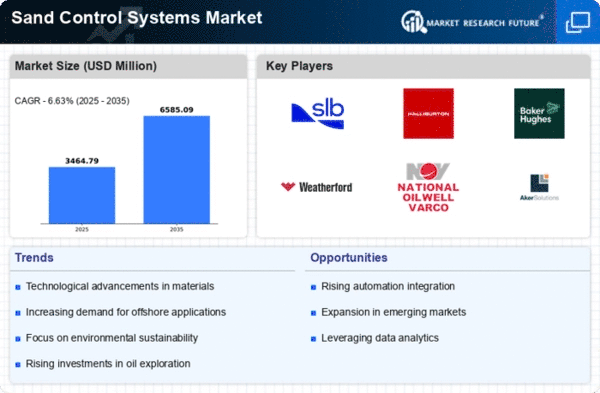
As per MRFR analysis, the Sand Control Systems Market Size was estimated at 3249.36 USD Million in 2024. The Sand Control Systems industry is projected to grow from 3464.86 in 2025 to 6585.09 by 2035, exhibiting a compound annual growth rate (CAGR) of 6.63 during the forecast period 2025 - 2035.

Key Market Trends & Highlights

The Sand Control Systems Market is poised for substantial growth driven by technological advancements and increasing demand for efficient oil recovery solutions.

  • North America remains the largest market for sand control systems, driven by extensive oil and gas exploration activities.
  • Asia-Pacific is emerging as the fastest-growing region, reflecting a surge in offshore oil and gas investments.
  • The well completion segment dominates the market, while the production enhancement segment is witnessing rapid growth due to evolving industry needs.
  • Key market drivers include rising demand for enhanced oil recovery techniques and regulatory compliance, which are shaping the future of sand control solutions.

Market Size & Forecast

2024 Market Size 3249.36 (USD Million)
2035 Market Size 6585.09 (USD Million)
CAGR (2025 - 2035) 6.63%
Largest Regional Market Share in 2024 North America

Major Players

<p>Schlumberger (US), Halliburton (US), Baker Hughes (US), Weatherford International (US), National Oilwell Varco (US), Aker Solutions (NO), Tenaris (AR), Cameron International (US), Superior Energy Services (US)</p>

Market Trends

The Sand Control Systems Market is currently experiencing a dynamic evolution, driven by the increasing demand for efficient extraction techniques in oil and gas operations. As exploration activities expand into more challenging environments, the necessity for robust sand control solutions becomes paramount. This market appears to be influenced by technological advancements that enhance the reliability and effectiveness of sand control methods. Moreover, the growing emphasis on environmental sustainability is prompting companies to adopt innovative practices that minimize ecological impact while maximizing resource recovery. In addition, the Sand Control Systems Market is likely to witness a shift towards integrated solutions that combine various technologies for improved performance. This trend suggests a movement away from traditional methods towards more sophisticated systems that can adapt to diverse geological conditions. As stakeholders seek to optimize production and reduce operational costs, the integration of digital technologies and automation may play a crucial role in shaping the future landscape of this market. Overall, the Sand Control Systems Market is poised for growth, driven by the interplay of technological innovation and evolving industry demands.

Technological Advancements

The Sand Control Systems Market is increasingly shaped by innovations in technology. Enhanced materials and methods are being developed to improve the efficiency and reliability of sand control solutions. These advancements may lead to more effective management of sand production, thereby reducing operational challenges in extraction processes.

Sustainability Focus

There is a growing trend towards sustainability within the Sand Control Systems Market. Companies are prioritizing environmentally friendly practices, which may involve the adoption of systems that minimize ecological disruption. This focus on sustainability could influence product development and operational strategies.

Integration of Digital Solutions

The integration of digital technologies is becoming more prevalent in the Sand Control Systems Market. This trend suggests that companies are increasingly utilizing data analytics and automation to enhance operational efficiency. Such integration may provide valuable insights for optimizing sand control strategies and improving overall performance.

Sand Control Systems Market Market Drivers

Market Growth Projections

The Global Sand Control Systems Market Industry is poised for substantial growth over the next decade. With a projected market value of 3.25 USD Billion in 2024, the industry is expected to expand significantly, reaching 6.59 USD Billion by 2035. This growth trajectory indicates a compound annual growth rate (CAGR) of 6.64% from 2025 to 2035. The increasing demand for efficient sand control solutions in oil and gas operations, coupled with technological advancements, is likely to drive this expansion. As the industry evolves, stakeholders must remain vigilant to capitalize on emerging opportunities and navigate potential challenges.

Market Dynamics and Competitive Landscape

The Global Sand Control Systems Market Industry is characterized by a dynamic competitive landscape, with numerous players vying for market share. This competition fosters innovation and drives the development of more efficient sand control solutions. Companies are increasingly collaborating with research institutions to enhance their product offerings and address emerging challenges in sand control. The interplay of supply and demand dynamics, coupled with technological advancements, shapes the market's trajectory. As firms strive to differentiate themselves, the industry is likely to witness a surge in new product introductions and strategic partnerships, further propelling market growth.

Increasing Oil and Gas Exploration Activities

The Global Sand Control Systems Market Industry is experiencing growth due to the rising exploration activities in the oil and gas sector. As companies seek to tap into untapped reserves, the demand for effective sand control solutions becomes paramount. In 2024, the market is projected to reach 3.25 USD Billion, driven by the need for enhanced production efficiency and reduced operational risks. Countries with significant oil reserves, such as the United States and Saudi Arabia, are investing heavily in advanced sand control technologies to mitigate sand production issues. This trend indicates a robust future for the industry as exploration intensifies.

Rising Demand for Enhanced Oil Recovery Techniques

The Global Sand Control Systems Market Industry is significantly influenced by the increasing demand for enhanced oil recovery (EOR) techniques. As conventional oil reserves deplete, operators are turning to EOR methods that often require effective sand control systems to maintain production levels. The integration of sand control technologies in EOR processes ensures that sand production does not hinder oil extraction efficiency. This trend is expected to contribute to the market's growth, with projections indicating a rise to 6.59 USD Billion by 2035. The synergy between EOR and sand control systems is likely to drive further investments in this sector.

Technological Advancements in Sand Control Solutions

Technological innovation plays a crucial role in the expansion of the Global Sand Control Systems Market Industry. The development of advanced materials and techniques, such as gravel packing and chemical consolidation, enhances the effectiveness of sand control measures. These innovations not only improve the longevity of production wells but also reduce maintenance costs. As a result, operators are increasingly adopting these technologies to optimize their operations. The anticipated growth from 2025 to 2035, with a CAGR of 6.64%, suggests that ongoing advancements will continue to shape the market landscape, making it more competitive and efficient.

Growing Environmental Regulations and Sustainability Initiatives

Environmental regulations and sustainability initiatives are becoming increasingly influential in the Global Sand Control Systems Market Industry. Governments worldwide are implementing stricter regulations to minimize the environmental impact of oil and gas operations. This has led to a heightened focus on sustainable sand control solutions that reduce waste and enhance resource efficiency. Companies are compelled to adopt innovative technologies that comply with these regulations while maintaining operational efficiency. The emphasis on sustainability is likely to drive market growth as firms seek to align their practices with global environmental standards, ensuring long-term viability in a competitive landscape.

Market Segment Insights

By Application: Well Completion (Largest) vs. Production Enhancement (Fastest-Growing)

<p>In the Sand Control Systems Market, the application segment is dominated by Well Completion, reflecting its critical role in establishing effective drilling and production operations. This segment constitutes the largest share, driven by the increasing demand for efficient well configuration and maintenance processes. Conversely, Production Enhancement is emerging as the fastest-growing application, capturing attention for its significance in maximizing oil and gas output from existing wells. The growth trends within this segment are fueled by several factors, including technological advancements in sand control techniques and the growing emphasis on optimizing production from existing reservoirs. Additionally, the rise in global energy consumption and the need for more efficient extraction methods contribute to the increasing uptake of sand control systems in production enhancement applications. Market players are focusing on innovative solutions that boost efficiency and reduce operational risks, making this segment increasingly attractive to operators.</p>

<p>Well Completion (Dominant) vs. Workover Operations (Emerging)</p>

<p>In the Sand Control Systems Market, Well Completion stands as the dominant application due to its essential function in the initial stages of oil and gas production, ensuring the optimal setup of wells to withstand sand production. This segment leverages advanced technologies to maintain well integrity while maximizing flow rates. On the other hand, Workover Operations is an emerging segment that focuses on revitalizing and modifying existing wells to improve production efficiency. As operators face challenges in sustaining output from aging wells, workover operations become vital, driven by the need for maintenance and enhancement activities. This dual character allows both segments to coexist, with Well Completion maintaining a robust position while Workover Operations increasingly gains traction as industry dynamics evolve.</p>

By Technology: Gravel Pack (Largest) vs. Fracturing (Fastest-Growing)

<p>In the Sand Control Systems Market, the technological segment is primarily led by Gravel Pack solutions, which hold the largest market share due to their proven effectiveness in preventing sand production in various oil and gas applications. Fracturing technology, while currently smaller in share, is rapidly gaining ground due to advancements in drilling techniques and increased demand for unconventional oil resources, showcasing significant growth potential in the coming years. The growth trends in this segment are influenced by several factors, including the rising exploration activities in shale formations and the need for enhanced recovery rates in mature fields. The increasing focus on environmentally friendly and efficient extraction methods also propels the adoption of Chemical Stabilization technologies, as operators seek to minimize environmental impact while maximizing output and production efficiency.</p>

<p>Technology: Gravel Pack (Dominant) vs. Chemical Stabilization (Emerging)</p>

<p>Gravel Pack technology remains the dominant force in the sand control systems market, consistently demonstrating its effectiveness in various drilling environments. Its ability to act as a barrier against the migration of sand while allowing fluid production plays a crucial role in ensuring operational efficiency and well integrity. Conversely, Chemical Stabilization is emerging as an innovative solution for sand control, focusing on utilizing chemical agents to enhance the natural bond of sand particles. This technology is attracting attention from operators seeking alternatives to traditional gravel packing and is particularly beneficial in challenging geological conditions where conventional methods may fail. As the market evolves, the synergy between established practices like Gravel Pack and new approaches such as Chemical Stabilization signifies a dynamic shift in strategies for effective sand control.</p>

By End Use: Onshore (Largest) vs. Offshore (Fastest-Growing)

<p>The Sand Control Systems Market exhibits a diverse distribution of end-use segments, with onshore operations dominating market share due to their significant prevalence and efficiency in oil extraction processes. Onshore applications have been widely adopted for their cost-effectiveness and established infrastructure, prompting a stronghold in market preferences. Conversely, offshore operations, although currently holding a smaller share, are rapidly expanding with the increasing necessity for alternative energy sources and technological advancements driving innovation in deep-water drilling and sand control methods.</p>

<p>Onshore (Dominant) vs. Offshore (Emerging)</p>

<p>Onshore sand control systems are characterized by their reliability and adaptability in various environments, making them the prevailing choice in conventional oil extraction. These systems benefit from a well-developed network of production and logistics, ensuring their dominance in the market. In contrast, offshore sand control systems are witnessing accelerated growth, driven by advancements in subsea technology and the rising demand for deeper offshore oil reserves. Emerging innovations aimed at addressing the unique challenges of offshore drilling and sand management position these systems as a crucial component of future energy strategies, fostering increased exploration activities in untapped marine areas.</p>

Get more detailed insights about Sand Control Systems Market Research Report – Forecast to 2035

Regional Insights

North America : Market Leader in Sand Control

North America is poised to maintain its leadership in the Sand Control Systems market, holding a significant share of 1620.0 million in 2024. The region's growth is driven by increasing oil and gas exploration activities, coupled with stringent regulations aimed at enhancing environmental safety. The demand for advanced sand control technologies is further fueled by the need for efficient resource extraction and management, ensuring compliance with regulatory standards. The United States stands out as the primary market, with major players like Schlumberger, Halliburton, and Baker Hughes leading the competitive landscape. These companies are investing heavily in R&D to innovate and improve sand control solutions. The presence of established firms and a robust supply chain enhances market dynamics, positioning North America as a hub for technological advancements in sand control systems.

Europe : Emerging Market with Growth Potential

Europe's Sand Control Systems market is projected to grow significantly, with a market size of 800.0 million. The region is witnessing increased investments in oil and gas projects, driven by the need for energy security and sustainability. Regulatory frameworks promoting cleaner extraction methods are also catalyzing demand for advanced sand control technologies, ensuring compliance with environmental standards. Leading countries such as Norway and the UK are at the forefront of this growth, with key players like Aker Solutions and Weatherford International actively participating in the market. The competitive landscape is characterized by collaborations and partnerships aimed at enhancing technological capabilities. As Europe transitions towards greener energy solutions, the sand control systems market is expected to play a crucial role in optimizing resource extraction.

Asia-Pacific : Rapid Growth in Emerging Economies

The Asia-Pacific region is experiencing rapid growth in the Sand Control Systems market, with a size of 600.0 million. This growth is primarily driven by increasing energy demands in emerging economies, coupled with rising investments in oil and gas exploration. Regulatory initiatives aimed at improving operational efficiency and environmental compliance are further propelling the demand for innovative sand control solutions. Countries like China and India are leading the charge, with significant contributions from local and international players. The competitive landscape is marked by the presence of companies such as Tenaris and Cameron International, which are focusing on expanding their market share through strategic partnerships and technological advancements. As the region continues to develop its energy sector, the sand control systems market is set to thrive.

Middle East and Africa : Resource-Rich Market Dynamics

The Middle East and Africa region, with a market size of 229.36 million, is witnessing a growing demand for Sand Control Systems driven by the region's rich oil and gas reserves. The increasing focus on efficient resource extraction and environmental sustainability is prompting investments in advanced sand control technologies. Regulatory frameworks are evolving to support these initiatives, ensuring compliance with international standards. Leading countries such as Saudi Arabia and the UAE are at the forefront of this market, with key players like National Oilwell Varco and Superior Energy Services actively involved. The competitive landscape is characterized by a mix of local and international firms, all vying for a share in this lucrative market. As the region continues to invest in its energy infrastructure, the sand control systems market is expected to expand significantly.

Key Players and Competitive Insights

The Sand Control Systems Market is currently characterized by a dynamic competitive landscape, driven by the increasing demand for efficient extraction techniques and the need to mitigate sand production in oil and gas operations. Key players such as Schlumberger (US), Halliburton (US), and Baker Hughes (US) are at the forefront, employing strategies that emphasize innovation, technological advancement, and strategic partnerships. These companies are not only focusing on enhancing their product offerings but are also investing in digital transformation initiatives to optimize operations and improve customer engagement. The collective efforts of these firms contribute to a moderately fragmented market structure, where competition is intense yet offers opportunities for differentiation through advanced solutions.

In terms of business tactics, companies are increasingly localizing manufacturing to reduce costs and enhance supply chain efficiency. This approach allows for quicker response times to market demands and fosters closer relationships with regional clients. The competitive structure of the Sand Control Systems Market appears to be moderately fragmented, with several key players exerting influence over market dynamics. The interplay between these companies shapes a landscape where innovation and operational excellence are paramount, as firms strive to maintain their competitive edge.

In November 2025, Schlumberger (US) announced the launch of a new digital platform aimed at enhancing real-time monitoring of sand control systems. This initiative is expected to significantly improve operational efficiency and reduce downtime for clients, thereby reinforcing Schlumberger's position as a leader in technological innovation within the market. The strategic importance of this move lies in its potential to provide clients with actionable insights, ultimately leading to more informed decision-making and optimized production processes.

In October 2025, Halliburton (US) entered into a strategic partnership with a leading technology firm to develop AI-driven solutions for sand control applications. This collaboration is poised to leverage advanced analytics and machine learning to predict sand production and optimize control measures. The significance of this partnership is underscored by the growing trend towards digitalization in the industry, which could enhance Halliburton's service offerings and improve client outcomes.

In September 2025, Baker Hughes (US) expanded its portfolio by acquiring a niche player specializing in advanced sand control technologies. This acquisition is likely to bolster Baker Hughes' capabilities in providing comprehensive solutions tailored to specific client needs. The strategic rationale behind this move reflects a broader trend of consolidation within the market, as companies seek to enhance their technological prowess and expand their service offerings.

As of December 2025, the Sand Control Systems Market is witnessing a shift towards digitalization, sustainability, and AI integration, which are defining the competitive trends. Strategic alliances are increasingly shaping the landscape, enabling companies to pool resources and expertise to drive innovation. Looking ahead, competitive differentiation is expected to evolve, with a pronounced shift from price-based competition to a focus on technological advancement, innovation, and supply chain reliability. This transition underscores the necessity for companies to adapt and innovate continuously to meet the changing demands of the market.

Key Companies in the Sand Control Systems Market include

Industry Developments

March 2020: Oil and gas company Mubadala Petroleum awarded Tendeka a contract to supply FloSure Autonomous Inflow Control Devices (AICDS) and FloElite sand screens to Mubadala Petroleum's Jasmine, Manora, and Nong Yao fields in the Gulf of Thailand. Two additional 1-year extensions to the agreement are possible.

Future Outlook

Sand Control Systems Market Future Outlook

<p>The Sand Control Systems Market is projected to grow at a 6.63% CAGR from 2024 to 2035, driven by increasing demand for efficient oil extraction and technological advancements.</p>

New opportunities lie in:

  • <p>Development of advanced gravel packing technologies for enhanced well integrity.</p>
  • <p>Integration of IoT solutions for real-time monitoring and predictive maintenance.</p>
  • <p>Expansion into emerging markets with tailored sand control solutions.</p>

<p>By 2035, the Sand Control Systems Market is expected to achieve robust growth, reflecting evolving industry needs.</p>

Market Segmentation

Sand Control Systems Market End Use Outlook

  • Onshore
  • Offshore
  • Shale Gas
  • Conventional Oil

Sand Control Systems Market Technology Outlook

  • Gravel Pack
  • Fracturing
  • Chemical Stabilization
  • Screening

Sand Control Systems Market Application Outlook

  • Well Completion
  • Production Enhancement
  • Reservoir Management
  • Workover Operations

Report Scope

MARKET SIZE 20243249.36(USD Million)
MARKET SIZE 20253464.86(USD Million)
MARKET SIZE 20356585.09(USD Million)
COMPOUND ANNUAL GROWTH RATE (CAGR)6.63% (2024 - 2035)
REPORT COVERAGERevenue Forecast, Competitive Landscape, Growth Factors, and Trends
BASE YEAR2024
Market Forecast Period2025 - 2035
Historical Data2019 - 2024
Market Forecast UnitsUSD Million
Key Companies ProfiledSchlumberger (US), Halliburton (US), Baker Hughes (US), Weatherford International (US), National Oilwell Varco (US), Aker Solutions (NO), Tenaris (AR), Cameron International (US), Superior Energy Services (US)
Segments CoveredApplication, Technology, End Use
Key Market OpportunitiesIntegration of advanced materials and technologies enhances efficiency in the Sand Control Systems Market.
Key Market DynamicsRising demand for efficient sand control solutions drives innovation and competition among key industry players.
Countries CoveredNorth America, Europe, APAC, South America, MEA

FAQs

How much is the Sand Control Systems market?

The Sand Control Systems Market size was valued at USD 3.25 Billion in 2024.

What is the growth rate of the Sand Control Systems market?

The global market is projected to grow at a CAGR of 6.63% during the forecast period, 2025-2034.

Which region held the largest market share in the Sand Control Systems market?

Asia-Pacific had the largest share in the global market

Who are the key players in the Sand Control Systems market?

The key players in the market are Schlumberger Limited (France), Halliburton Inc. (U.S.), Baker Hughes Incorporated (U.S.), Weatherford International (Switzerland), National Oilwell Varco (U.S.), Oil States International (U.S.), Tendeka (U.K), Welltec (Denmark), Packers Plus Energy Services Inc. (Canada), Superior Energy Services Inc. (U.S.).

Which Well Type led the Sand Control Systems market?

The cased Hole category dominated the market in 2022.

Which application had the largest market share in the Sand Control Systems market?

The Onshore had the largest share in the global market.

  1. SECTION I: EXECUTIVE SUMMARY AND KEY HIGHLIGHTS
    1. | 1.1 EXECUTIVE SUMMARY
  2. SECTION II: SCOPING, METHODOLOGY AND MARKET STRUCTURE
    1. | 2.1 MARKET INTRODUCTION
    2. | 2.2 RESEARCH METHODOLOGY
  3. SECTION III: QUALITATIVE ANALYSIS
    1. | 3.1 MARKET DYNAMICS
    2. | 3.2 MARKET FACTOR ANALYSIS
  4. SECTION IV: QUANTITATIVE ANALYSIS
    1. | 4.1 Energy & Power, BY Application (USD Million)
    2. | 4.2 Energy & Power, BY Technology (USD Million)
    3. | 4.3 Energy & Power, BY End Use (USD Million)
    4. | 4.4 Energy & Power, BY Region (USD Million)
  5. SECTION V: COMPETITIVE ANALYSIS
    1. | 5.1 Competitive Landscape
    2. | 5.2 Company Profiles
    3. | 5.3 Appendix

Sand Control Systems Market Segmentation

Market Segmentation Overview

  • Detailed segmentation data will be available in the full report
  • Comprehensive analysis by multiple parameters
  • Regional and country-level breakdowns
  • Market size forecasts by segment
Infographic

Free Sample Request

Kindly complete the form below to receive a free sample of this Report

Get Free Sample

Customer Strories

Compare Licence

×
Features License Type
Single User Multiuser License Enterprise User
Price $4,950 $5,950 $7,250
Maximum User Access Limit 1 User Upto 10 Users Unrestricted Access Throughout the Organization
Free Customization
Direct Access to Analyst
Deliverable Format
Platform Access
Discount on Next Purchase 10% 15% 15%
Printable Versions