Request Free Sample ×

Kindly complete the form below to receive a free sample of this Report

* Please use a valid business email

Leading companies partner with us for data-driven Insights

clients tt-cursor
Hero Background
English
Chinese
French
Japanese
Korean
German
Spanish

Safety Lancet Market Analysis

ID: MRFR/MED/0107-CR
87 Pages
Rahul Gotadki
May 2017

Safety Lancet Market Research Report Information, by Type (Push Button Safety Lancet, Pressure Activated Safety Lancet and Side Button Safety Lancet), by End User (Hospitals & Clinics, Diagnostic Centers and Pathology Laboratories, Home Diagnostics and Other End Users) - Growth & Industry Forecast 2025 To 2035

Share:
Download PDF ×

We do not share your information with anyone. However, we may send you emails based on your report interest from time to time. You may contact us at any time to opt-out.

Safety Lancet Market Infographic
Purchase Options

Market Analysis

In-depth Analysis of Safety Lancet Market Industry Landscape

Safety lancets' market dynamics concentrate upon their vital function in healthcare for safe and convenient blood collection. Safety lancets decrease needlestick injuries and improve patient and healthcare worker safety. Technological advances, point-of-care testing demand, regulatory issues, and infection control emphasis are key to understanding this business. Continuous technical improvements affect the safety lancet industry. Innovative lancet design, needle retraction mechanisms, and materials make devices safer and easier to operate. These advances push the market to embrace cutting-edge blood sampling methods that reduce needle injuries and increase efficiency. Demand for point-of-care testing drives safety lancet market dynamics. Blood collection must be efficient and safe as point-of-care diagnostics grow more popular for their speed and accessibility. Safety lancets aid point-of-care testing by making blood collection easy in healthcare settings. Home healthcare applications that need blood collection for chronic illnesses are affected by the safety lancet market. Patient self-care increases when the market offers user-friendly safety lancets that allow patients to draw blood samples at home securely and pleasantly. Safety lancet market trends depend on regulation. Product clearance and commercial adoption need compliance with regulatory requirements, including FDA and CE standards. The market adjusts to changing regulations to ensure safety lancets fulfill strict performance standards. Different lancet designs are available to fulfill clinical demands and patient preferences on the market. Lancets have different gauges, penetration depths, and activation methods, so doctors and patients may pick the optimal ones for blood collection for their circumstances. Healthcare worker safety affects the safety lancet market. Healthcare facilities are at danger of needlestick injuries, thus safety lancets are developed to limit unintentional needle exposures. Healthcare professional safety products are prioritized by the market. Safety lancet market dynamics are worldwide, addressing regional demands. Global healthcare systems differ, thus the industry adapts safety lancets to local cultural preferences, healthcare infrastructures, and regulatory norms. Market dynamics include medical application customisation. Safety lancets are used in hospitals, clinics, labs, and home healthcare for blood collection. Market competitors provide several choices to customize safety lancets for clinical applications. The safety lancet market has disposable and reusable alternatives. For their ease and infection prevention, disposable safety lancets are popular, although reusable ones are preferred in sustainable and cost-effective settings. Market participants give options for preferences and the environment. The safety lancet market is heavily influenced by competition. Innovations with better safety and usefulness result from intense competition and research & development. Market participants provide a wide range of safety lancets to satisfy the demands of healthcare professionals worldwide to build their presence. Safety lancet market challenges include meeting healthcare setting regulations, guaranteeing patient compliance, and promoting blood sampling safety. The market is expected to rise, however. Modern blood sample procedures include safety lancets due to technological advances, infection control knowledge, and a dedication to patient and healthcare worker safety.


Author
Author Profile
Rahul Gotadki
Research Manager

He holds an experience of about 9+ years in Market Research and Business Consulting, working under the spectrum of Life Sciences and Healthcare domains. Rahul conceptualizes and implements a scalable business strategy and provides strategic leadership to the clients. His expertise lies in market estimation, competitive intelligence, pipeline analysis, customer assessment, etc.

Leave a Comment

FAQs

What is the current valuation of the Safety Lancet Market as of 2024?

<p>The Safety Lancet Market was valued at 3.23 USD Billion in 2024.</p>

What is the projected market valuation for the Safety Lancet Market in 2035?

<p>The market is projected to reach 8.193 USD Billion by 2035.</p>

What is the expected CAGR for the Safety Lancet Market during the forecast period 2025 - 2035?

<p>The expected CAGR for the Safety Lancet Market during 2025 - 2035 is 8.83%.</p>

Which companies are considered key players in the Safety Lancet Market?

<p>Key players include Terumo Corporation, Becton Dickinson and Company, and F. Hoffmann-La Roche AG.</p>

What are the main types of safety lancets in the market?

<p>The main types include push-button safety lancets, pressure-activated safety lancets, and side button safety lancets.</p>

How did the push-button safety lancet segment perform in 2024?

The push-button safety lancet segment was valued at 1.5 USD Billion in 2024 and is projected to reach 3.8 USD Billion.

What is the market size for diagnostic centers in the Safety Lancet Market?

In 2024, the diagnostic centers segment was valued at 0.8 USD Billion, with a projection of 2.0 USD Billion.

What is the expected growth for the home diagnostics segment by 2035?

The home diagnostics segment is expected to grow from 0.3 USD Billion in 2024 to 0.9 USD Billion by 2035.

How does the performance of pathology laboratories compare to other end-users?

Pathology laboratories were valued at 0.5 USD Billion in 2024, with a potential increase to 1.5 USD Billion by 2035.

What trends are influencing the Safety Lancet Market's growth?

Trends include advancements in safety lancet technology and increasing demand from hospitals and clinics.

Market Summary

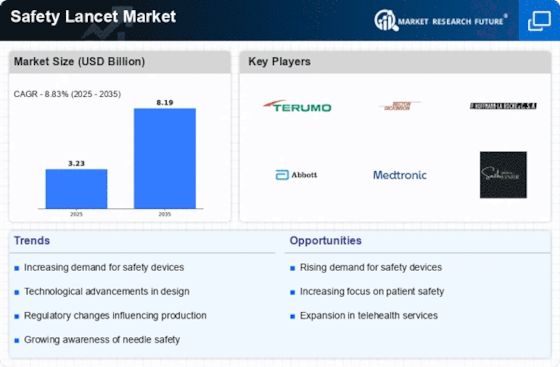
As per Market Research Future analysis, the Safety Lancet Market Size was estimated at 3.23 USD Billion in 2024. The Safety Lancet industry is projected to grow from 3.515 USD Billion in 2025 to 8.193 USD Billion by 2035, exhibiting a compound annual growth rate (CAGR) of 8.83% during the forecast period 2025 - 2035

Key Market Trends & Highlights

The Safety Lancet Market is experiencing robust growth driven by technological advancements and increasing demand for patient safety.

  • North America remains the largest market for safety lancets, driven by a well-established healthcare infrastructure. The Asia-Pacific region is emerging as the fastest-growing market, fueled by rising healthcare expenditures and increasing awareness of diabetes management. Push-button safety lancets dominate the market, while pressure-activated safety lancets are witnessing the fastest growth due to their user-friendly design. Key market drivers include the rising demand for point-of-care testing and an increased focus on patient safety, particularly in hospitals and home diagnostics.

Market Size & Forecast

2024 Market Size 3.23 (USD Billion)
2035 Market Size 8.193 (USD Billion)
CAGR (2025 - 2035) 8.83%
Largest Regional Market Share in 2024 Europe

Major Players

Terumo Corporation (JP), Becton Dickinson and Company (US), F. Hoffmann-La Roche AG (CH), Abbott Laboratories (US), Medtronic plc (IE), Smiths Medical (US), Nipro Corporation (JP), Greiner Bio-One International GmbH (AT), Sarstedt AG &amp; Co. (DE)

Market Trends

The Safety Lancet Market is currently experiencing a notable evolution, driven by advancements in medical technology and an increasing emphasis on patient safety. The demand for safety lancets is rising as healthcare providers seek to minimize the risk of needlestick injuries and enhance the overall safety of blood sampling procedures. This trend is further supported by regulatory bodies advocating for safer medical devices, which appears to be influencing manufacturers to innovate and improve their product offerings. As a result, the market landscape is becoming increasingly competitive, with various players striving to differentiate themselves through enhanced features and user-friendly designs. Moreover, the growing awareness of the importance of diabetes management is likely to propel the Safety Lancet Market forward. Patients and healthcare professionals alike are recognizing the necessity of effective blood glucose monitoring, which could lead to a higher adoption rate of safety lancets. Additionally, the expansion of home healthcare services may contribute to the market's growth, as more individuals prefer to manage their health conditions in the comfort of their homes. This shift in patient care dynamics suggests a promising future for the Safety Lancet Market, as it adapts to meet the evolving needs of consumers and healthcare providers alike.

Technological Advancements

The Safety Lancet Market is witnessing a surge in innovation, with manufacturers focusing on developing advanced devices that enhance user experience and safety. New designs may incorporate features such as automatic retraction and improved ergonomics, which could significantly reduce the risk of accidental injuries.

Regulatory Influence

Regulatory agencies are increasingly emphasizing the need for safer medical devices, which appears to be shaping the Safety Lancet Market. Compliance with stringent safety standards may drive manufacturers to invest in research and development, leading to the introduction of more effective and reliable products.

Home Healthcare Growth

The rise of home healthcare services is likely to impact the Safety Lancet Market positively. As patients seek to manage their health conditions at home, the demand for user-friendly and safe blood sampling devices may increase, prompting manufacturers to cater to this emerging segment.

Safety Lancet Market Market Drivers

Increased Focus on Patient Safety

Patient safety remains a paramount concern within the healthcare sector, influencing the Safety Lancet Market. The emphasis on minimizing the risk of needlestick injuries and ensuring safe blood sampling practices has led to a surge in the adoption of safety lancets. Healthcare facilities are increasingly implementing protocols that prioritize the use of safety-engineered devices to protect both patients and healthcare workers. Data indicates that needlestick injuries can lead to serious health complications, thus driving the demand for safer alternatives. The Safety Lancet Market is likely to benefit from this heightened focus on patient safety, as healthcare providers invest in innovative solutions that mitigate risks associated with traditional lancets.

Regulatory Support for Safety Devices

Regulatory bodies are increasingly advocating for the use of safety-engineered devices, which is positively influencing the Safety Lancet Market. Policies aimed at reducing needlestick injuries and promoting safer healthcare practices are being implemented across various regions. For instance, regulations mandating the use of safety lancets in healthcare settings are becoming more prevalent, encouraging manufacturers to innovate and comply with safety standards. This regulatory support not only enhances the credibility of safety lancets but also drives their adoption among healthcare providers. As compliance with these regulations becomes essential, the Safety Lancet Market is poised for growth, with an increasing number of facilities prioritizing the procurement of safety-engineered devices.

Growing Prevalence of Chronic Diseases

The rising prevalence of chronic diseases, such as diabetes and cardiovascular conditions, is significantly impacting the Safety Lancet Market. As the number of individuals requiring regular blood monitoring increases, the demand for safety lancets is expected to rise correspondingly. Data suggests that the global diabetes population is projected to reach 700 million by 2045, necessitating effective blood sampling solutions. This trend underscores the importance of safety lancets in managing chronic conditions, as they provide a safer alternative for routine blood tests. Consequently, the Safety Lancet Market is likely to expand as healthcare systems adapt to the growing need for reliable and safe blood sampling methods.

Rising Demand for Point-of-Care Testing

The Safety Lancet Market is experiencing a notable increase in demand for point-of-care testing solutions. This trend is driven by the need for rapid and accurate diagnostic tools that can be utilized in various healthcare settings. The convenience of point-of-care testing allows for immediate results, which is crucial in emergency situations. According to recent data, the point-of-care testing market is projected to grow at a compound annual growth rate of approximately 10% over the next five years. This growth is likely to enhance the Safety Lancet Market, as safety lancets are integral to blood sampling in these testing scenarios. As healthcare providers seek to improve patient outcomes through timely interventions, the adoption of safety lancets in point-of-care testing is expected to rise significantly.

Technological Innovations in Device Design

Technological advancements are reshaping the Safety Lancet Market, with innovations in device design enhancing usability and safety. Manufacturers are increasingly integrating features such as retractable needles and ergonomic designs to improve the user experience. These innovations not only reduce the risk of accidental needlestick injuries but also facilitate easier handling for patients and healthcare professionals alike. The introduction of smart safety lancets, which can provide real-time data on blood glucose levels, is also gaining traction. As the market evolves, these technological innovations are expected to drive growth in the Safety Lancet Market, appealing to a broader range of consumers and healthcare providers.

Market Segment Insights

By Type: Push-button safety lancet (Largest) vs. Pressure-activated safety lancet (Fastest-Growing)

In the Safety Lancet Market, the Push-button safety lancet segment holds the largest market share, capturing a significant portion due to its user-friendly design and reliable performance. This type is preferred by both healthcare professionals and patients for its simplicity and effectiveness in providing safe blood sampling. On the other hand, the Pressure-activated safety lancet is the fastest-growing segment, gaining traction in the market due to increasing awareness of safety and infection control, which has led to a shift towards more advanced technologies that maximize safety during blood collection.

Push-button safety lancet (Dominant) vs. Pressure-activated safety lancet (Emerging)

The Push-button safety lancet remains a dominant force in the market, characterized by its ease of use and intuitive mechanism that minimizes the risk of needle-stick injuries. Its popularity stems from a design that allows for a quick and safe sampling process, greatly appealing to diabetic patients managing their blood glucose levels. Conversely, the Pressure-activated safety lancet is an emerging player, notable for its innovative activation method which significantly reduces the risk of accidental pricking. This technology encourages adoption among healthcare providers who prioritize patient safety and efficiency, projecting strong growth as more institutions recognize its benefits.

By End-Users: Hospitals & Clinics (Largest) vs. Home Diagnostics (Fastest-Growing)

In the Safety Lancet Market, Hospitals and Clinics hold the largest market share, driven by their high demand for diagnostic tools in patient care. This segment significantly influences the overall market dynamics, comprising a substantial portion of sales due to the predictable patient flow and routine operations. <a href="https://www.marketresearchfuture.com/reports/diagnostic-imaging-services-market-7186">Diagnostic Centers </a>and Pathology Laboratories also contribute important shares, yet not at the same magnitude as hospitals. Home Diagnostics, however, is gaining traction, especially as healthcare shifts towards more personalized and at-home testing solutions. The growth trends in the Safety Lancet Market highlight the increasing adoption of home diagnostics as patients seek convenient testing options. Factors such as technological advancements and consumer willingness to engage in self-monitoring contribute to this emerging trend. Hospitals and Clinics continue to evolve, incorporating innovative diagnostic tools and aligning with regulatory changes, indicating a robust response to industry shifts. Overall, this segment is poised for growth as healthcare systems adapt to new patient demands and operational efficiencies.

Hospitals &amp; Clinics (Dominant) vs. Home Diagnostics (Emerging)

Hospitals and Clinics represent the dominant segment in the Safety Lancet Market, characterized by high-volume patient interactions and a substantial reliance on diagnostic tools for effective treatment plans. Their established infrastructure, investment in advanced technologies, and integration of safety measures enhance their market position significantly. In contrast, Home Diagnostics is emerging as a key player in the market, appealing to a growing demographic that values accessibility and convenience. The rise of telehealth and digital health monitoring solutions complements this growth, creating a favorable environment for the development of home-based diagnostic products. As both segments evolve, Hospitals and Clinics will continue to leverage their established status while Home Diagnostics is expected to capture a significant share driven by innovation and patient-centric approaches.

Get more detailed insights about Safety Lancet Market Research Report - Forecast to 2035

Regional Insights

North America : Market Leader in Safety Lancets

North America is the largest market for safety lancets, holding approximately 45% of the global market share. The region's growth is driven by increasing healthcare expenditures, a rising prevalence of diabetes, and stringent regulatory frameworks that promote the use of safety devices. The demand for innovative and user-friendly medical devices is also a significant catalyst for market expansion. The United States is the leading country in this region, supported by major players such as Becton Dickinson and Company, Abbott Laboratories, and Medtronic plc. The competitive landscape is characterized by continuous innovation and strategic partnerships among key players, ensuring a robust supply chain and distribution network. Canada also contributes significantly to the market, focusing on enhancing patient safety and compliance with health regulations.

Europe : Emerging Market with Growth Potential

Europe is witnessing a growing demand for safety lancets, accounting for approximately 30% of the global market share. The region's growth is fueled by increasing awareness of patient safety, government initiatives promoting the use of safety devices, and a rising incidence of chronic diseases. Regulatory bodies are actively encouraging the adoption of safety lancets to minimize needlestick injuries, which further propels market growth. Germany and France are the leading countries in this market, with a strong presence of key players like F. Hoffmann-La Roche AG and Greiner Bio-One International GmbH. The competitive landscape is marked by innovation and collaboration among manufacturers to meet regulatory standards and consumer needs. The European market is also characterized by a shift towards eco-friendly and sustainable medical devices, aligning with broader environmental goals.

Asia-Pacific : Rapid Growth in Emerging Markets

Asia-Pacific is rapidly emerging as a significant market for safety lancets, holding around 20% of the global market share. The region's growth is driven by increasing healthcare investments, a rising population, and a growing prevalence of diabetes and other chronic diseases. Government initiatives aimed at improving healthcare infrastructure and patient safety are also key factors contributing to market expansion. China and India are the leading countries in this region, with a burgeoning demand for medical devices. The competitive landscape features both local and international players, including Terumo Corporation and Nipro Corporation, who are focusing on innovation and affordability. The presence of a large patient population and increasing healthcare awareness further enhance the market's growth potential, making it a focal point for investment and development.

Middle East and Africa : Untapped Potential in Healthcare

The Middle East and Africa region is gradually emerging in the safety lancet market, accounting for approximately 5% of the global market share. The growth is primarily driven by increasing healthcare investments, rising awareness of patient safety, and government initiatives aimed at improving healthcare access. The region's diverse healthcare needs present significant opportunities for market players to introduce innovative safety devices. South Africa and the UAE are the leading countries in this market, with a growing presence of international players. The competitive landscape is evolving, with local manufacturers beginning to enter the market, focusing on affordability and accessibility. The region's unique challenges, such as varying healthcare regulations and infrastructure, require tailored strategies from key players to effectively penetrate the market.

Key Players and Competitive Insights

The Safety Lancet Market is characterized by a dynamic competitive landscape, driven by increasing demand for safe and efficient medical devices. Key players are focusing on innovation, strategic partnerships, and regional expansion to enhance their market presence. Companies such as Terumo Corporation (Japan), Becton Dickinson and Company (US), and Abbott Laboratories (US) are at the forefront, leveraging their technological capabilities and extensive distribution networks. Their strategies not only reflect a commitment to product development but also indicate a broader trend towards integrating advanced technologies into their offerings, thereby shaping the competitive environment.

In terms of business tactics, companies are increasingly localizing manufacturing to reduce costs and improve supply chain efficiency. The Safety Lancet Market appears moderately fragmented, with several players vying for market share. However, the collective influence of major companies like F. Hoffmann-La Roche AG (Switzerland) and Medtronic plc (Ireland) suggests a trend towards consolidation, as these firms seek to optimize their operations and enhance their competitive edge.

In August 2025, Becton Dickinson and Company (US) announced a strategic partnership with a leading digital health firm to develop a new line of smart safety lancets. This collaboration aims to integrate digital health solutions with traditional medical devices, enhancing patient safety and compliance. The significance of this move lies in its potential to position Becton Dickinson as a leader in the digital transformation of medical devices, aligning with current trends towards connected healthcare solutions.

In September 2025, Abbott Laboratories (US) launched a new safety lancet designed specifically for pediatric use, emphasizing its commitment to addressing the unique needs of younger patients. This product introduction not only expands Abbott's product portfolio but also reflects a strategic focus on niche markets, which may provide a competitive advantage in an increasingly specialized market landscape. The launch underscores the importance of innovation tailored to specific demographics, which could drive future growth.

In July 2025, Terumo Corporation (Japan) expanded its manufacturing capabilities in Southeast Asia, aiming to enhance its supply chain resilience and meet the growing demand in emerging markets. This strategic move is indicative of Terumo's focus on regional expansion and operational efficiency, which may allow the company to better serve local markets while mitigating risks associated with global supply chain disruptions. Such initiatives are likely to strengthen Terumo's competitive position in the Safety Lancet Market.

As of October 2025, current trends in the Safety Lancet Market are increasingly defined by digitalization, sustainability, and the integration of artificial intelligence. Strategic alliances are becoming more prevalent, as companies recognize the need to collaborate to innovate and enhance their product offerings. Looking ahead, competitive differentiation is expected to evolve, shifting from traditional price-based competition to a focus on innovation, technological advancements, and supply chain reliability. This transition may redefine how companies position themselves in the market, emphasizing the importance of adaptability and forward-thinking strategies.

Key Companies in the Safety Lancet Market include

Industry Developments

In 2018, HTL-STREFA expanded its storage capacity in Leczyca by almost 50%, with an equivalent of 3,550 m2 additional storage space.

In 2018, HTL-STREFA was acquired by Investindustrial. This acquisition helped the company partner for diabetes management, thus serving an extensive customer base.

In 2017, Owen Mumford opened its new facility in Malaysia to strengthen and accelerate the growth of the company in the Asia Pacific region.

Future Outlook

Safety Lancet Market Future Outlook

The Safety Lancet Market is projected to grow at an 8.83% CAGR from 2025 to 2035, driven by technological advancements, increasing healthcare demands, and rising awareness of safety protocols.

New opportunities lie in:

  • Expansion of digital health monitoring solutions</p><p>Development of eco-friendly, disposable safety lancets</p><p>Partnerships with telehealth platforms for remote patient management

By 2035, the Safety Lancet Market is expected to achieve robust growth and enhanced market presence.

Market Segmentation

Safety Lancet Market Type Outlook

  • Push-button safety lancet
  • Pressure-activated safety lancet
  • Side button safety lancet

Safety Lancet Market End-Users Outlook

  • Hospitals & Clinics
  • Diagnostic Centers
  • Pathology Laboratories
  • Home Diagnostics
  • Others

Report Scope

MARKET SIZE 2024 3.23(USD Billion)
MARKET SIZE 2025 3.515(USD Billion)
MARKET SIZE 2035 8.193(USD Billion)
COMPOUND ANNUAL GROWTH RATE (CAGR) 8.83% (2025 - 2035)
REPORT COVERAGE Revenue Forecast, Competitive Landscape, Growth Factors, and Trends
BASE YEAR 2024
Market Forecast Period 2025 - 2035
Historical Data 2019 - 2024
Market Forecast Units USD Billion
Key Companies Profiled Terumo Corporation (JP), Becton Dickinson and Company (US), F. Hoffmann-La Roche AG (CH), Abbott Laboratories (US), Medtronic plc (IE), Smiths Medical (US), Nipro Corporation (JP), Greiner Bio-One International GmbH (AT), Sarstedt AG & Co. (DE)
Segments Covered Type, End User
Key Market Opportunities Integration of advanced safety features in lancets to enhance user experience and compliance.
Key Market Dynamics Rising demand for safety lancets driven by regulatory changes and increasing consumer awareness of diabetes management.
Countries Covered North America, Europe, APAC, South America, MEA

FAQs

What is the current valuation of the Safety Lancet Market as of 2024?

<p>The Safety Lancet Market was valued at 3.23 USD Billion in 2024.</p>

What is the projected market valuation for the Safety Lancet Market in 2035?

<p>The market is projected to reach 8.193 USD Billion by 2035.</p>

What is the expected CAGR for the Safety Lancet Market during the forecast period 2025 - 2035?

<p>The expected CAGR for the Safety Lancet Market during 2025 - 2035 is 8.83%.</p>

Which companies are considered key players in the Safety Lancet Market?

<p>Key players include Terumo Corporation, Becton Dickinson and Company, and F. Hoffmann-La Roche AG.</p>

What are the main types of safety lancets in the market?

<p>The main types include push-button safety lancets, pressure-activated safety lancets, and side button safety lancets.</p>

How did the push-button safety lancet segment perform in 2024?

The push-button safety lancet segment was valued at 1.5 USD Billion in 2024 and is projected to reach 3.8 USD Billion.

What is the market size for diagnostic centers in the Safety Lancet Market?

In 2024, the diagnostic centers segment was valued at 0.8 USD Billion, with a projection of 2.0 USD Billion.

What is the expected growth for the home diagnostics segment by 2035?

The home diagnostics segment is expected to grow from 0.3 USD Billion in 2024 to 0.9 USD Billion by 2035.

How does the performance of pathology laboratories compare to other end-users?

Pathology laboratories were valued at 0.5 USD Billion in 2024, with a potential increase to 1.5 USD Billion by 2035.

What trends are influencing the Safety Lancet Market's growth?

Trends include advancements in safety lancet technology and increasing demand from hospitals and clinics.

  1. SECTION I: EXECUTIVE SUMMARY AND KEY HIGHLIGHTS
    1. | 1.1 EXECUTIVE SUMMARY
    2. | | 1.1.1 Market Overview
    3. | | 1.1.2 Key Findings
    4. | | 1.1.3 Market Segmentation
    5. | | 1.1.4 Competitive Landscape
    6. | | 1.1.5 Challenges and Opportunities
    7. | | 1.1.6 Future Outlook
  2. SECTION II: SCOPING, METHODOLOGY AND MARKET STRUCTURE
    1. | 2.1 MARKET INTRODUCTION
    2. | | 2.1.1 Definition
    3. | | 2.1.2 Scope of the study
    4. | | | 2.1.2.1 Research Objective
    5. | | | 2.1.2.2 Assumption
    6. | | | 2.1.2.3 Limitations
    7. | 2.2 RESEARCH METHODOLOGY
    8. | | 2.2.1 Overview
    9. | | 2.2.2 Data Mining
    10. | | 2.2.3 Secondary Research
    11. | | 2.2.4 Primary Research
    12. | | | 2.2.4.1 Primary Interviews and Information Gathering Process
    13. | | | 2.2.4.2 Breakdown of Primary Respondents
    14. | | 2.2.5 Forecasting Model
    15. | | 2.2.6 Market Size Estimation
    16. | | | 2.2.6.1 Bottom-Up Approach
    17. | | | 2.2.6.2 Top-Down Approach
    18. | | 2.2.7 Data Triangulation
    19. | | 2.2.8 Validation
  3. SECTION III: QUALITATIVE ANALYSIS
    1. | 3.1 MARKET DYNAMICS
    2. | | 3.1.1 Overview
    3. | | 3.1.2 Drivers
    4. | | 3.1.3 Restraints
    5. | | 3.1.4 Opportunities
    6. | 3.2 MARKET FACTOR ANALYSIS
    7. | | 3.2.1 Value chain Analysis
    8. | | 3.2.2 Porter's Five Forces Analysis
    9. | | | 3.2.2.1 Bargaining Power of Suppliers
    10. | | | 3.2.2.2 Bargaining Power of Buyers
    11. | | | 3.2.2.3 Threat of New Entrants
    12. | | | 3.2.2.4 Threat of Substitutes
    13. | | | 3.2.2.5 Intensity of Rivalry
    14. | | 3.2.3 COVID-19 Impact Analysis
    15. | | | 3.2.3.1 Market Impact Analysis
    16. | | | 3.2.3.2 Regional Impact
    17. | | | 3.2.3.3 Opportunity and Threat Analysis
  4. SECTION IV: QUANTITATIVE ANALYSIS
    1. | 4.1 Healthcare, BY Type (USD Billion)
    2. | | 4.1.1 Push-button safety lancet
    3. | | 4.1.2 Pressure-activated safety lancet
    4. | | 4.1.3 Side button safety lancet
    5. | 4.2 Healthcare, BY End-Users (USD Billion)
    6. | | 4.2.1 Hospitals & Clinics
    7. | | 4.2.2 Diagnostic Centers
    8. | | 4.2.3 Pathology Laboratories
    9. | | 4.2.4 Home Diagnostics
    10. | | 4.2.5 Others
    11. | 4.3 Healthcare, BY Region (USD Billion)
    12. | | 4.3.1 North America
    13. | | | 4.3.1.1 US
    14. | | | 4.3.1.2 Canada
    15. | | 4.3.2 Europe
    16. | | | 4.3.2.1 Germany
    17. | | | 4.3.2.2 UK
    18. | | | 4.3.2.3 France
    19. | | | 4.3.2.4 Russia
    20. | | | 4.3.2.5 Italy
    21. | | | 4.3.2.6 Spain
    22. | | | 4.3.2.7 Rest of Europe
    23. | | 4.3.3 APAC
    24. | | | 4.3.3.1 China
    25. | | | 4.3.3.2 India
    26. | | | 4.3.3.3 Japan
    27. | | | 4.3.3.4 South Korea
    28. | | | 4.3.3.5 Malaysia
    29. | | | 4.3.3.6 Thailand
    30. | | | 4.3.3.7 Indonesia
    31. | | | 4.3.3.8 Rest of APAC
    32. | | 4.3.4 South America
    33. | | | 4.3.4.1 Brazil
    34. | | | 4.3.4.2 Mexico
    35. | | | 4.3.4.3 Argentina
    36. | | | 4.3.4.4 Rest of South America
    37. | | 4.3.5 MEA
    38. | | | 4.3.5.1 GCC Countries
    39. | | | 4.3.5.2 South Africa
    40. | | | 4.3.5.3 Rest of MEA
  5. SECTION V: COMPETITIVE ANALYSIS
    1. | 5.1 Competitive Landscape
    2. | | 5.1.1 Overview
    3. | | 5.1.2 Competitive Analysis
    4. | | 5.1.3 Market share Analysis
    5. | | 5.1.4 Major Growth Strategy in the Healthcare
    6. | | 5.1.5 Competitive Benchmarking
    7. | | 5.1.6 Leading Players in Terms of Number of Developments in the Healthcare
    8. | | 5.1.7 Key developments and growth strategies
    9. | | | 5.1.7.1 New Product Launch/Service Deployment
    10. | | | 5.1.7.2 Merger & Acquisitions
    11. | | | 5.1.7.3 Joint Ventures
    12. | | 5.1.8 Major Players Financial Matrix
    13. | | | 5.1.8.1 Sales and Operating Income
    14. | | | 5.1.8.2 Major Players R&D Expenditure. 2023
    15. | 5.2 Company Profiles
    16. | | 5.2.1 Terumo Corporation (JP)
    17. | | | 5.2.1.1 Financial Overview
    18. | | | 5.2.1.2 Products Offered
    19. | | | 5.2.1.3 Key Developments
    20. | | | 5.2.1.4 SWOT Analysis
    21. | | | 5.2.1.5 Key Strategies
    22. | | 5.2.2 Becton Dickinson and Company (US)
    23. | | | 5.2.2.1 Financial Overview
    24. | | | 5.2.2.2 Products Offered
    25. | | | 5.2.2.3 Key Developments
    26. | | | 5.2.2.4 SWOT Analysis
    27. | | | 5.2.2.5 Key Strategies
    28. | | 5.2.3 F. Hoffmann-La Roche AG (CH)
    29. | | | 5.2.3.1 Financial Overview
    30. | | | 5.2.3.2 Products Offered
    31. | | | 5.2.3.3 Key Developments
    32. | | | 5.2.3.4 SWOT Analysis
    33. | | | 5.2.3.5 Key Strategies
    34. | | 5.2.4 Abbott Laboratories (US)
    35. | | | 5.2.4.1 Financial Overview
    36. | | | 5.2.4.2 Products Offered
    37. | | | 5.2.4.3 Key Developments
    38. | | | 5.2.4.4 SWOT Analysis
    39. | | | 5.2.4.5 Key Strategies
    40. | | 5.2.5 Medtronic plc (IE)
    41. | | | 5.2.5.1 Financial Overview
    42. | | | 5.2.5.2 Products Offered
    43. | | | 5.2.5.3 Key Developments
    44. | | | 5.2.5.4 SWOT Analysis
    45. | | | 5.2.5.5 Key Strategies
    46. | | 5.2.6 Smiths Medical (US)
    47. | | | 5.2.6.1 Financial Overview
    48. | | | 5.2.6.2 Products Offered
    49. | | | 5.2.6.3 Key Developments
    50. | | | 5.2.6.4 SWOT Analysis
    51. | | | 5.2.6.5 Key Strategies
    52. | | 5.2.7 Nipro Corporation (JP)
    53. | | | 5.2.7.1 Financial Overview
    54. | | | 5.2.7.2 Products Offered
    55. | | | 5.2.7.3 Key Developments
    56. | | | 5.2.7.4 SWOT Analysis
    57. | | | 5.2.7.5 Key Strategies
    58. | | 5.2.8 Greiner Bio-One International GmbH (AT)
    59. | | | 5.2.8.1 Financial Overview
    60. | | | 5.2.8.2 Products Offered
    61. | | | 5.2.8.3 Key Developments
    62. | | | 5.2.8.4 SWOT Analysis
    63. | | | 5.2.8.5 Key Strategies
    64. | | 5.2.9 Sarstedt AG & Co. (DE)
    65. | | | 5.2.9.1 Financial Overview
    66. | | | 5.2.9.2 Products Offered
    67. | | | 5.2.9.3 Key Developments
    68. | | | 5.2.9.4 SWOT Analysis
    69. | | | 5.2.9.5 Key Strategies
    70. | 5.3 Appendix
    71. | | 5.3.1 References
    72. | | 5.3.2 Related Reports
  6. LIST OF FIGURES
    1. | 6.1 MARKET SYNOPSIS
    2. | 6.2 NORTH AMERICA MARKET ANALYSIS
    3. | 6.3 US MARKET ANALYSIS BY TYPE
    4. | 6.4 US MARKET ANALYSIS BY END-USERS
    5. | 6.5 CANADA MARKET ANALYSIS BY TYPE
    6. | 6.6 CANADA MARKET ANALYSIS BY END-USERS
    7. | 6.7 EUROPE MARKET ANALYSIS
    8. | 6.8 GERMANY MARKET ANALYSIS BY TYPE
    9. | 6.9 GERMANY MARKET ANALYSIS BY END-USERS
    10. | 6.10 UK MARKET ANALYSIS BY TYPE
    11. | 6.11 UK MARKET ANALYSIS BY END-USERS
    12. | 6.12 FRANCE MARKET ANALYSIS BY TYPE
    13. | 6.13 FRANCE MARKET ANALYSIS BY END-USERS
    14. | 6.14 RUSSIA MARKET ANALYSIS BY TYPE
    15. | 6.15 RUSSIA MARKET ANALYSIS BY END-USERS
    16. | 6.16 ITALY MARKET ANALYSIS BY TYPE
    17. | 6.17 ITALY MARKET ANALYSIS BY END-USERS
    18. | 6.18 SPAIN MARKET ANALYSIS BY TYPE
    19. | 6.19 SPAIN MARKET ANALYSIS BY END-USERS
    20. | 6.20 REST OF EUROPE MARKET ANALYSIS BY TYPE
    21. | 6.21 REST OF EUROPE MARKET ANALYSIS BY END-USERS
    22. | 6.22 APAC MARKET ANALYSIS
    23. | 6.23 CHINA MARKET ANALYSIS BY TYPE
    24. | 6.24 CHINA MARKET ANALYSIS BY END-USERS
    25. | 6.25 INDIA MARKET ANALYSIS BY TYPE
    26. | 6.26 INDIA MARKET ANALYSIS BY END-USERS
    27. | 6.27 JAPAN MARKET ANALYSIS BY TYPE
    28. | 6.28 JAPAN MARKET ANALYSIS BY END-USERS
    29. | 6.29 SOUTH KOREA MARKET ANALYSIS BY TYPE
    30. | 6.30 SOUTH KOREA MARKET ANALYSIS BY END-USERS
    31. | 6.31 MALAYSIA MARKET ANALYSIS BY TYPE
    32. | 6.32 MALAYSIA MARKET ANALYSIS BY END-USERS
    33. | 6.33 THAILAND MARKET ANALYSIS BY TYPE
    34. | 6.34 THAILAND MARKET ANALYSIS BY END-USERS
    35. | 6.35 INDONESIA MARKET ANALYSIS BY TYPE
    36. | 6.36 INDONESIA MARKET ANALYSIS BY END-USERS
    37. | 6.37 REST OF APAC MARKET ANALYSIS BY TYPE
    38. | 6.38 REST OF APAC MARKET ANALYSIS BY END-USERS
    39. | 6.39 SOUTH AMERICA MARKET ANALYSIS
    40. | 6.40 BRAZIL MARKET ANALYSIS BY TYPE
    41. | 6.41 BRAZIL MARKET ANALYSIS BY END-USERS
    42. | 6.42 MEXICO MARKET ANALYSIS BY TYPE
    43. | 6.43 MEXICO MARKET ANALYSIS BY END-USERS
    44. | 6.44 ARGENTINA MARKET ANALYSIS BY TYPE
    45. | 6.45 ARGENTINA MARKET ANALYSIS BY END-USERS
    46. | 6.46 REST OF SOUTH AMERICA MARKET ANALYSIS BY TYPE
    47. | 6.47 REST OF SOUTH AMERICA MARKET ANALYSIS BY END-USERS
    48. | 6.48 MEA MARKET ANALYSIS
    49. | 6.49 GCC COUNTRIES MARKET ANALYSIS BY TYPE
    50. | 6.50 GCC COUNTRIES MARKET ANALYSIS BY END-USERS
    51. | 6.51 SOUTH AFRICA MARKET ANALYSIS BY TYPE
    52. | 6.52 SOUTH AFRICA MARKET ANALYSIS BY END-USERS
    53. | 6.53 REST OF MEA MARKET ANALYSIS BY TYPE
    54. | 6.54 REST OF MEA MARKET ANALYSIS BY END-USERS
    55. | 6.55 KEY BUYING CRITERIA OF HEALTHCARE
    56. | 6.56 RESEARCH PROCESS OF MRFR
    57. | 6.57 DRO ANALYSIS OF HEALTHCARE
    58. | 6.58 DRIVERS IMPACT ANALYSIS: HEALTHCARE
    59. | 6.59 RESTRAINTS IMPACT ANALYSIS: HEALTHCARE
    60. | 6.60 SUPPLY / VALUE CHAIN: HEALTHCARE
    61. | 6.61 HEALTHCARE, BY TYPE, 2024 (% SHARE)
    62. | 6.62 HEALTHCARE, BY TYPE, 2024 TO 2035 (USD Billion)
    63. | 6.63 HEALTHCARE, BY END-USERS, 2024 (% SHARE)
    64. | 6.64 HEALTHCARE, BY END-USERS, 2024 TO 2035 (USD Billion)
    65. | 6.65 BENCHMARKING OF MAJOR COMPETITORS
  7. LIST OF TABLES
    1. | 7.1 LIST OF ASSUMPTIONS
    2. | | 7.1.1
    3. | 7.2 North America MARKET SIZE ESTIMATES; FORECAST
    4. | | 7.2.1 BY TYPE, 2025-2035 (USD Billion)
    5. | | 7.2.2 BY END-USERS, 2025-2035 (USD Billion)
    6. | 7.3 US MARKET SIZE ESTIMATES; FORECAST
    7. | | 7.3.1 BY TYPE, 2025-2035 (USD Billion)
    8. | | 7.3.2 BY END-USERS, 2025-2035 (USD Billion)
    9. | 7.4 Canada MARKET SIZE ESTIMATES; FORECAST
    10. | | 7.4.1 BY TYPE, 2025-2035 (USD Billion)
    11. | | 7.4.2 BY END-USERS, 2025-2035 (USD Billion)
    12. | 7.5 Europe MARKET SIZE ESTIMATES; FORECAST
    13. | | 7.5.1 BY TYPE, 2025-2035 (USD Billion)
    14. | | 7.5.2 BY END-USERS, 2025-2035 (USD Billion)
    15. | 7.6 Germany MARKET SIZE ESTIMATES; FORECAST
    16. | | 7.6.1 BY TYPE, 2025-2035 (USD Billion)
    17. | | 7.6.2 BY END-USERS, 2025-2035 (USD Billion)
    18. | 7.7 UK MARKET SIZE ESTIMATES; FORECAST
    19. | | 7.7.1 BY TYPE, 2025-2035 (USD Billion)
    20. | | 7.7.2 BY END-USERS, 2025-2035 (USD Billion)
    21. | 7.8 France MARKET SIZE ESTIMATES; FORECAST
    22. | | 7.8.1 BY TYPE, 2025-2035 (USD Billion)
    23. | | 7.8.2 BY END-USERS, 2025-2035 (USD Billion)
    24. | 7.9 Russia MARKET SIZE ESTIMATES; FORECAST
    25. | | 7.9.1 BY TYPE, 2025-2035 (USD Billion)
    26. | | 7.9.2 BY END-USERS, 2025-2035 (USD Billion)
    27. | 7.10 Italy MARKET SIZE ESTIMATES; FORECAST
    28. | | 7.10.1 BY TYPE, 2025-2035 (USD Billion)
    29. | | 7.10.2 BY END-USERS, 2025-2035 (USD Billion)
    30. | 7.11 Spain MARKET SIZE ESTIMATES; FORECAST
    31. | | 7.11.1 BY TYPE, 2025-2035 (USD Billion)
    32. | | 7.11.2 BY END-USERS, 2025-2035 (USD Billion)
    33. | 7.12 Rest of Europe MARKET SIZE ESTIMATES; FORECAST
    34. | | 7.12.1 BY TYPE, 2025-2035 (USD Billion)
    35. | | 7.12.2 BY END-USERS, 2025-2035 (USD Billion)
    36. | 7.13 APAC MARKET SIZE ESTIMATES; FORECAST
    37. | | 7.13.1 BY TYPE, 2025-2035 (USD Billion)
    38. | | 7.13.2 BY END-USERS, 2025-2035 (USD Billion)
    39. | 7.14 China MARKET SIZE ESTIMATES; FORECAST
    40. | | 7.14.1 BY TYPE, 2025-2035 (USD Billion)
    41. | | 7.14.2 BY END-USERS, 2025-2035 (USD Billion)
    42. | 7.15 India MARKET SIZE ESTIMATES; FORECAST
    43. | | 7.15.1 BY TYPE, 2025-2035 (USD Billion)
    44. | | 7.15.2 BY END-USERS, 2025-2035 (USD Billion)
    45. | 7.16 Japan MARKET SIZE ESTIMATES; FORECAST
    46. | | 7.16.1 BY TYPE, 2025-2035 (USD Billion)
    47. | | 7.16.2 BY END-USERS, 2025-2035 (USD Billion)
    48. | 7.17 South Korea MARKET SIZE ESTIMATES; FORECAST
    49. | | 7.17.1 BY TYPE, 2025-2035 (USD Billion)
    50. | | 7.17.2 BY END-USERS, 2025-2035 (USD Billion)
    51. | 7.18 Malaysia MARKET SIZE ESTIMATES; FORECAST
    52. | | 7.18.1 BY TYPE, 2025-2035 (USD Billion)
    53. | | 7.18.2 BY END-USERS, 2025-2035 (USD Billion)
    54. | 7.19 Thailand MARKET SIZE ESTIMATES; FORECAST
    55. | | 7.19.1 BY TYPE, 2025-2035 (USD Billion)
    56. | | 7.19.2 BY END-USERS, 2025-2035 (USD Billion)
    57. | 7.20 Indonesia MARKET SIZE ESTIMATES; FORECAST
    58. | | 7.20.1 BY TYPE, 2025-2035 (USD Billion)
    59. | | 7.20.2 BY END-USERS, 2025-2035 (USD Billion)
    60. | 7.21 Rest of APAC MARKET SIZE ESTIMATES; FORECAST
    61. | | 7.21.1 BY TYPE, 2025-2035 (USD Billion)
    62. | | 7.21.2 BY END-USERS, 2025-2035 (USD Billion)
    63. | 7.22 South America MARKET SIZE ESTIMATES; FORECAST
    64. | | 7.22.1 BY TYPE, 2025-2035 (USD Billion)
    65. | | 7.22.2 BY END-USERS, 2025-2035 (USD Billion)
    66. | 7.23 Brazil MARKET SIZE ESTIMATES; FORECAST
    67. | | 7.23.1 BY TYPE, 2025-2035 (USD Billion)
    68. | | 7.23.2 BY END-USERS, 2025-2035 (USD Billion)
    69. | 7.24 Mexico MARKET SIZE ESTIMATES; FORECAST
    70. | | 7.24.1 BY TYPE, 2025-2035 (USD Billion)
    71. | | 7.24.2 BY END-USERS, 2025-2035 (USD Billion)
    72. | 7.25 Argentina MARKET SIZE ESTIMATES; FORECAST
    73. | | 7.25.1 BY TYPE, 2025-2035 (USD Billion)
    74. | | 7.25.2 BY END-USERS, 2025-2035 (USD Billion)
    75. | 7.26 Rest of South America MARKET SIZE ESTIMATES; FORECAST
    76. | | 7.26.1 BY TYPE, 2025-2035 (USD Billion)
    77. | | 7.26.2 BY END-USERS, 2025-2035 (USD Billion)
    78. | 7.27 MEA MARKET SIZE ESTIMATES; FORECAST
    79. | | 7.27.1 BY TYPE, 2025-2035 (USD Billion)
    80. | | 7.27.2 BY END-USERS, 2025-2035 (USD Billion)
    81. | 7.28 GCC Countries MARKET SIZE ESTIMATES; FORECAST
    82. | | 7.28.1 BY TYPE, 2025-2035 (USD Billion)
    83. | | 7.28.2 BY END-USERS, 2025-2035 (USD Billion)
    84. | 7.29 South Africa MARKET SIZE ESTIMATES; FORECAST
    85. | | 7.29.1 BY TYPE, 2025-2035 (USD Billion)
    86. | | 7.29.2 BY END-USERS, 2025-2035 (USD Billion)
    87. | 7.30 Rest of MEA MARKET SIZE ESTIMATES; FORECAST
    88. | | 7.30.1 BY TYPE, 2025-2035 (USD Billion)
    89. | | 7.30.2 BY END-USERS, 2025-2035 (USD Billion)
    90. | 7.31 PRODUCT LAUNCH/PRODUCT DEVELOPMENT/APPROVAL
    91. | | 7.31.1
    92. | 7.32 ACQUISITION/PARTNERSHIP
    93. | | 7.32.1

Healthcare Market Segmentation

Healthcare By Type (USD Billion, 2025-2035)

  • Push-button safety lancet
  • Pressure-activated safety lancet
  • Side button safety lancet

Healthcare By End-Users (USD Billion, 2025-2035)

  • Hospitals & Clinics
  • Diagnostic Centers
  • Pathology Laboratories
  • Home Diagnostics
  • Others
Infographic

Free Sample Request

Kindly complete the form below to receive a free sample of this Report

Get Free Sample

Customer Strories

Compare Licence

×
Features License Type
Single User Multiuser License Enterprise User
Price $4,950 $5,950 $7,250
Maximum User Access Limit 1 User Upto 10 Users Unrestricted Access Throughout the Organization
Free Customization
Direct Access to Analyst
Deliverable Format
Platform Access
Discount on Next Purchase 10% 15% 15%
Printable Versions
%>