
Request Free Sample ×

Kindly complete the form below to receive a free sample of this Report

* Please use a valid business email

Leading companies partner with us for data-driven Insights

clients tt-cursor
Hero Background
English
Chinese
French
Japanese
Korean
German
Spanish

Rugged Handheld Devices Market Trends

ID: MRFR/ICT/6575-CR
154 Pages
Apoorva Priyadarshi
November 2022

Rugged Handheld Electronic Devices Market Research Report Information By product type (Smartphones and Tablets, Mobile Computers, Reader/Scanner and Others), By end-user (Manufacturing industries, Retail, Transportation and Logistics, Military & Defense, Government, and Others), and Region (North America, Asia-Pacific, Europe, Rest of the world) - Forecast Till 2035

Share:
Download PDF ×

We do not share your information with anyone. However, we may send you emails based on your report interest from time to time. You may contact us at any time to opt-out.

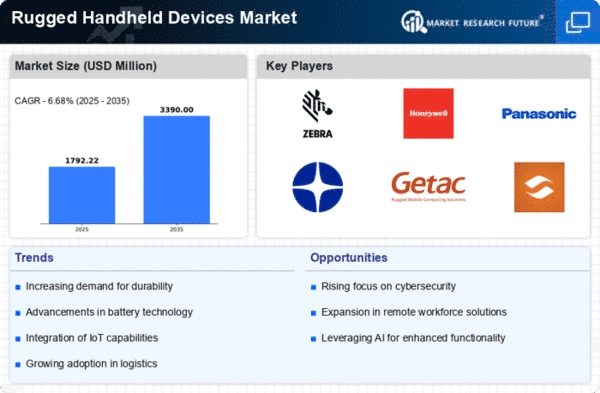
Rugged Handheld Devices Market Infographic
Purchase Options

Market Trends

Key Emerging Trends in the Rugged Handheld Devices Market

A increasing need for robust and adaptable mobile solutions across several industries has led to major trends and transformations in the rugged handheld device industry in recent years. Because they are built to survive challenging environments, rugged handheld devices are perfect for use in industries including manufacturing, logistics, healthcare, and public safety. The growing incorporation of cutting-edge technology to improve functionality and performance is one notable development in the market for rugged handheld devices. To enhance the entire user experience, manufacturers are implementing features like strong operating systems, potent CPUs, and high-resolution touchscreens.

Furthermore, integrating cutting-edge communication features, including 5G connection, has taken center stage in order to provide quicker data transfer and real-time field cooperation. The growing use of rugged portable devices in the healthcare industry is another noteworthy development. These gadgets are being used by medical practitioners for a number of purposes, such as point-of-care applications, asset tracking, and patient data management. The devices are ideally suited for the demanding healthcare environment because of their robustness and resistance to disinfectants, which enhances patient care and efficiency.

Rugged portable gadgets have also become more popular in the logistics and transportation sector. Organizations are using these devices for inventory management, order processing, and route optimization due to the growing complexity of supply chain operations. Rugged portable devices offer resilience in difficult distribution and warehousing environments, guaranteeing continuous operations under trying circumstances. The expanding trend of corporate mobility has an impact on the need for robust portable devices as well. Companies are realizing how critical it is to provide their employees with mobile solutions that are resistant to harsh outdoor and industrial settings. This trend is especially noticeable in field service applications, where engineers and technicians utilize rugged handhelds to perform diagnostics, access real-time information, and expedite maintenance operations.

Furthermore, the market for rugged portable devices continues to be significantly influenced by the military and defense industry. For military operations, reliable, field-ready communication equipment is essential. Military troops may rely on rugged handhelds to give them reliable tools for data collecting, navigation, and communication in difficult terrain and bad weather.


Author
Author Profile
Apoorva Priyadarshi
Research Analyst

With 4+ years of experience in Market Intelligence and Strategic Research, Apoorv specializes in ICT, Semiconductor, and BFSI markets. Combining strong analytical capabilities with a deep understanding of technology-driven industries, he focuses on delivering data-driven insights that support strategic decision-making. With a background in technology and business research, Apoorv has contributed to numerous global market studies, competitive landscape analyses, and opportunity assessments across sectors such as semiconductors, digital banking, cybersecurity, and telecommunications.

Leave a Comment

FAQs

What is the projected market valuation for the Rugged Handheld Devices Market in 2035?

<p>The projected market valuation for the Rugged Handheld Devices Market in 2035 is 3390.0 USD Million.</p>

What was the overall market valuation for the Rugged Handheld Devices Market in 2024?

<p>The overall market valuation for the Rugged Handheld Devices Market in 2024 was 1680.0 USD Million.</p>

What is the expected CAGR for the Rugged Handheld Devices Market during the forecast period 2025 - 2035?

<p>The expected CAGR for the Rugged Handheld Devices Market during the forecast period 2025 - 2035 is 6.68%.</p>

Which companies are considered key players in the Rugged Handheld Devices Market?

<p>Key players in the Rugged Handheld Devices Market include Zebra Technologies, Honeywell, Panasonic, Datalogic, Getac, Juniper Systems, Trimble, Sonim Technologies, and Motorola Solutions.</p>

What are the projected revenues for the Field Service application segment by 2035?

The projected revenues for the Field Service application segment are expected to reach between 670.0 and 1340.0 USD Million by 2035.

How does the Transportation and Logistics segment perform in terms of market valuation?

The Transportation and Logistics segment is projected to grow from 420.0 USD Million in 2024 to 850.0 USD Million by 2035.

What is the expected market size for the Military end-use segment by 2035?

The expected market size for the Military end-use segment is projected to range from 500.0 to 1000.0 USD Million by 2035.

Which operating system segment is anticipated to have the highest revenue by 2035?

The Android operating system segment is anticipated to have the highest revenue, projected to reach between 600.0 and 1200.0 USD Million by 2035.

What are the revenue projections for the Wearable form factor segment by 2035?

The revenue projections for the Wearable form factor segment are expected to range from 400.0 to 800.0 USD Million by 2035.

How does the Cellular connectivity segment compare in terms of market valuation?

The Cellular connectivity segment is projected to grow from 504.0 USD Million in 2024 to between 1020.0 USD Million by 2035.

Market Summary

As per MRFR analysis, the Rugged Handheld Devices Market Size was estimated at 1680.0 USD Million in 2024. The Rugged Handheld Devices industry is projected to grow from 1770.0 in 2025 to 3390.0 by 2035, exhibiting a compound annual growth rate (CAGR) of 6.68% during the forecast period 2025 - 2035.

Key Market Trends & Highlights

The Rugged Handheld Devices Market is experiencing robust growth driven by technological advancements and increasing demand across various sectors.

  • The market is witnessing increased adoption in industrial sectors, particularly in North America, which remains the largest market. Technological advancements are enhancing the functionality and durability of rugged handheld devices, appealing to diverse applications. Field service continues to dominate the market, while healthcare emerges as the fastest-growing segment, reflecting evolving needs. Key market drivers include the growing emphasis on field mobility and the integration of advanced technologies to meet regulatory compliance.

Market Size & Forecast

2024 Market Size 1680.0 (USD Million)
2035 Market Size 3390.0 (USD Million)
CAGR (2025 - 2035) 6.68%
Largest Regional Market Share in 2024 North America

Major Players

Zebra Technologies (US), <a title=" Honeywell " href="https://www.honeywell.com/us/en/news/featured-stories/2024/04/how-honeywell-ct47-help-maximize-roi" target="_blank" rel="noopener">Honeywell </a>(US), Panasonic (JP), Datalogic (IT), Getac (TW), Juniper Systems (US), <a title="Sonim Technologies" href="https://www.sonimtech.com/products" target="_blank" rel="noopener">Sonim Technologies</a> (US), Trimble (US), Motorola Solutions (US)

Market Trends

The Rugged Handheld Devices Market is currently experiencing a notable evolution, driven by the increasing demand for durable and reliable technology in various sectors. Industries such as construction, logistics, and field services are increasingly adopting these devices due to their ability to withstand harsh environments and provide uninterrupted performance. The integration of advanced features, such as enhanced connectivity options and improved battery life, appears to be a key factor in attracting businesses seeking efficiency and productivity. Furthermore, the growing emphasis on safety and compliance regulations is likely to propel the adoption of rugged devices, as organizations prioritize tools that can endure extreme conditions while ensuring operational continuity.

In addition, the Rugged Handheld Devices Market seems to be influenced by the rapid advancements in technology, including the incorporation of artificial intelligence and machine learning capabilities. These innovations may enhance the functionality of rugged devices, allowing for smarter data collection and analysis in real-time. As organizations continue to seek solutions that can adapt to their evolving needs, the market is poised for further growth. The increasing focus on mobility and remote work solutions is also expected to contribute to the expansion of this market, as businesses recognize the value of equipping their workforce with reliable tools that can perform under pressure. The rugged handheld electronic devices market is expanding as industries increasingly prioritize durable mobile computing solutions capable of operating reliably in harsh field environments. Growth in the rugged handheld device market reflects rising demand for resilient field technologies that support real-time communication, data capture, and operational efficiency across industrial sectors.

Increased Adoption in Industrial Sectors

The Rugged Handheld Devices Market is witnessing heightened adoption across various industrial sectors. Companies in construction, manufacturing, and logistics are increasingly recognizing the advantages of these devices, which offer durability and reliability in demanding environments. This trend suggests a shift towards integrating rugged technology into daily operations, enhancing productivity and efficiency.

Technological Advancements

Ongoing technological advancements are shaping the Rugged Handheld Devices Market. Innovations such as improved connectivity, enhanced processing power, and integration of AI capabilities are becoming more prevalent. These developments indicate a trend towards smarter, more efficient devices that can meet the evolving needs of users in various industries.

Focus on Mobility and Real-Time Data Access

The emphasis on mobility and real-time data access is significantly influencing the Rugged Handheld Devices Market. Organizations are increasingly seeking solutions that enable their workforce to access critical information on the go. This trend highlights the importance of equipping employees with tools that facilitate immediate decision-making and enhance operational efficiency.

Rugged Handheld Devices Market Market Drivers

Growth in Field Workforce

The Global Rugged Handheld Electronic Devices Market Industry is significantly influenced by the growth of the field workforce across various sectors. As industries expand their operations, there is a rising need for mobile solutions that facilitate real-time data collection and communication. This trend is particularly evident in sectors like utilities, transportation, and emergency services, where rugged devices are essential for ensuring operational efficiency. The increasing number of field workers is likely to drive the market value to an estimated 3.45 USD Billion by 2035, highlighting the importance of rugged handheld devices in enhancing productivity and safety in challenging environments.

Technological Advancements

Technological advancements play a pivotal role in shaping the Global Rugged Handheld Electronic Devices Market Industry. Innovations in materials, battery life, and processing power are driving the development of more efficient and capable rugged devices. For instance, the integration of advanced GPS and communication technologies enhances the functionality of these devices in field operations. As the market evolves, manufacturers are focusing on incorporating features such as biometric security and enhanced connectivity options. This trend is expected to contribute to the market's growth, with a projected CAGR of 6.7% from 2025 to 2035, reflecting the increasing reliance on sophisticated rugged handheld solutions.

Increasing Demand for Durability

The Global Rugged Handheld Electronic Devices Market Industry experiences a notable surge in demand for devices that can withstand harsh environments. Industries such as construction, military, and logistics require handheld devices that are resistant to water, dust, and extreme temperatures. This demand is reflected in the projected market value of 1.69 USD Billion in 2024, indicating a strong preference for rugged devices over conventional ones. Companies are increasingly investing in research and development to enhance the durability features of their products, ensuring they meet the rigorous standards set by various sectors. As a result, the market is likely to expand significantly in the coming years.

Integration of IoT and Smart Technologies

The integration of Internet of Things (IoT) and smart technologies is transforming the Global Rugged Handheld Electronic Devices Market Industry. As industries increasingly adopt IoT solutions, the need for rugged devices that can seamlessly connect and communicate with other smart devices becomes paramount. These handheld devices are equipped with sensors and connectivity features that allow for real-time data monitoring and analysis. This trend is likely to enhance operational efficiency and decision-making processes across various sectors. The growing adoption of IoT in rugged devices is expected to significantly impact market dynamics, fostering innovation and driving growth.

Regulatory Compliance and Safety Standards

Regulatory compliance and safety standards are critical drivers in the Global Rugged Handheld Electronic Devices Market Industry. Various industries are mandated to adhere to stringent regulations regarding equipment used in hazardous environments. Rugged handheld devices often meet these safety standards, making them indispensable for sectors such as oil and gas, mining, and pharmaceuticals. As companies strive to comply with these regulations, the demand for rugged devices is expected to rise. This compliance not only ensures worker safety but also enhances operational efficiency, thereby contributing to the overall growth of the market.

Market Segment Insights

By Application: Field Service (Largest) vs. Transportation and Logistics (Fastest-Growing)

<p>In the Rugged Handheld Devices Market, Field Service is currently the largest segment, accounting for a significant portion of the total market share. Its extensive use in industries such as utilities, telecommunications, and onsite repairs illustrates its critical role. On the other hand, the Transportation and Logistics sector is rapidly gaining traction, driven by the need for real-time tracking and inventory management solutions that rugged devices offer. This sector's increased emphasis on operational efficiency and supply chain management is propelling its growth.</p>

<p>Field Service: Dominant vs. Transportation and Logistics: Emerging</p>

<p>Field Service stands out as a dominant player in the Rugged Handheld Devices Market due to its reliance on durable devices for outdoor and harsh environments. These devices seamlessly integrate with field operations, enabling technicians to capture real-time data, manage workflows, and enhance customer service. Conversely, the Transportation and Logistics segment is emerging swiftly, fueled by the growing trend of e-commerce and demand for efficiency. Companies are increasingly adopting rugged handheld devices to streamline operations, optimize routing, and ensure effective communication within supply chains. Both segments highlight the adaptability and growing significance of rugged handheld devices across various applications.</p>

By End Use: Construction (Largest) vs. Military (Fastest-Growing)

<p>In the Rugged Handheld Devices Market, the construction segment captures a significant share, driven by the increasing adoption of technology in construction sites for real-time data access and field communication. It accounts for the largest portion of the market, with robust demand for durable devices to withstand challenging environments. In contrast, the military segment is the fastest-growing, fueled by the rising need for advanced communication and operational capabilities in defense operations, highlighting the strategic importance of rugged devices in critical situations.</p>

<p>Construction: Dominant vs. Military: Emerging</p>

<p>The construction segment is characterized by a strong demand for rugged handheld devices that can endure harsh conditions, ensuring seamless operation on job sites. These devices typically offer features such as long battery life, enhanced durability, and compatibility with project management software. On the other hand, the military segment is emerging rapidly, driven by a focus on leveraging cutting-edge technology for secure communications and situational awareness in tactical environments. The rugged devices used in military applications require high levels of data security and resilience, indicating a clear trend towards the integration of advanced technology to support critical missions.</p>

By Operating System: Android (Largest) vs. Windows (Fastest-Growing)

In the Rugged Handheld Devices Market, Android holds the largest share, appealing to a wide range of industries due to its flexibility and customization capabilities. Its open-source nature allows manufacturers to tailor devices to specific use cases, making it the preferred choice among users requiring rugged devices for various environments. Windows, while historically significant, is experiencing a rapid resurgence as a robust operating system for rugged handhelds, especially due to its strong enterprise applications and compatibility with existing infrastructure.

Android (Dominant) vs. Windows (Emerging)

Android's dominance in the rugged handheld devices market stems from its user-friendly interface and extensive app ecosystem, catering to different industries like logistics, construction, and manufacturing. It also offers robust security features, making it suitable for enterprise environments. In contrast, Windows is emerging as a strong alternative, particularly for professionals who rely on traditional desktop applications and require seamless integration with their business systems. The increase in demand for rugged devices in industries that value reliability ensures that both operating systems continue to evolve and adapt to the needs of the market.

By Form Factor: Handheld (Largest) vs. Wearable (Fastest-Growing)

In the Rugged Handheld Devices Market, the distribution of market share among different form factors shows a clear leader and emerging contenders. Handheld devices dominate the market, appreciated for their versatility and robustness in various challenging environments. Following closely, wearable devices are gaining traction, particularly in industries that require hands-free operations, enhancing user efficiency and safety. Vehicle-mounted devices, while crucial for specific applications, hold a smaller share compared to their handheld and wearable counterparts. Growth trends indicate a strong upward trajectory for the wearable segment, fueled by advancements in technology and increased adoption in sectors like logistics and field services. Companies are increasingly seeking solutions that integrate wearable technologies to enhance real-time data access and operational efficiency. In contrast, the handheld segment continues to thrive due to its established presence and extensive use cases across multiple industries, including construction, transportation, and public safety.

Handheld (Dominant) vs. Wearable (Emerging)

The Handheld segment remains the dominant force in the Rugged Handheld Devices Market, characterized by its robust build, extensive functionality, and ease of use. These devices are designed to withstand extreme conditions, making them ideal for sectors such as construction, military, and emergency services. Their versatility allows users to perform a variety of tasks, from data collection to communication, in demanding environments. On the other hand, the Wearable segment is emerging rapidly, capturing attention for its potential to revolutionize user interaction. Wearable rugged devices, such as smartwatches and head-mounted displays, offer hands-free capabilities and enhanced mobility, appealing to industries where efficiency and worker safety are paramount. While still gaining momentum, wearables complement traditional handhelds and are anticipated to become integral in operational workflows.

By Connectivity: Wi-Fi (Largest) vs. Bluetooth (Fastest-Growing)

<p>In the Rugged Handheld Devices Market, the connectivity options are primarily segmented into Wi-Fi, Bluetooth, Cellular, and NFC. Wi-Fi remains the largest segment, widely regarded for its reliability and high throughput capabilities, making it a preferred choice for users who require robust internet connectivity in challenging environments. In contrast, Bluetooth is witnessing rapid adoption due to its low power consumption and ease of use, appealing to users seeking mobility without sacrificing performance.</p>

<p>Wi-Fi (Dominant) vs. Bluetooth (Emerging)</p>

<p>Wi-Fi connectivity in rugged handheld devices is dominant, offering extensive range and speed, enabling users to access real-time data in demanding environments. Its reliability makes it the go-to option for industries like construction, logistics, and outdoor services. On the other hand, Bluetooth technology is emerging fiercely, allowing seamless connection to peripheral devices such as scanners and GPS units while consuming minimal power. This growth is encouraged by the rising need for versatility and the proliferation of devices that leverage Bluetooth for enhanced functionality, making it an essential feature in the evolving rugged handheld market.</p>

Get more detailed insights about Rugged Handheld Electronic Devices Market By Type, Growth, Trend and Overview - 2032 | MRFR

Regional Insights

North America : Market Leader in Rugged Devices

North America continues to lead the Rugged Handheld Devices market, holding a significant share of 840.0 million in 2024. The growth is driven by increasing demand in sectors like logistics, manufacturing, and public safety, where durability and reliability are paramount. Regulatory support for technology adoption in these industries further fuels market expansion, making it a key region for innovation and investment. The competitive landscape is robust, with major players like Zebra Technologies, Honeywell, and Motorola Solutions dominating the market. The U.S. is the primary contributor, leveraging advanced technology and a strong distribution network. Companies are focusing on enhancing product features, such as improved battery life and ruggedness, to meet the evolving needs of end-users, ensuring North America's continued leadership in this sector.

Europe : Emerging Market with Growth Potential

Europe's Rugged Handheld Devices market is valued at 480.0 million, showcasing a growing interest in durable technology across various sectors. The demand is driven by increasing automation and the need for reliable devices in challenging environments. Regulatory frameworks promoting digital transformation in industries like construction and logistics are also significant growth catalysts, positioning Europe as a promising market for rugged devices. Leading countries include Germany, the UK, and France, where companies are investing in advanced rugged technology. Key players like Datalogic and Panasonic are enhancing their offerings to cater to diverse industry needs. The competitive landscape is evolving, with a focus on innovation and sustainability, ensuring that Europe remains a vital player in The Rugged Handheld Devices.

Asia-Pacific : Rapidly Growing Technology Hub

The Asia-Pacific region, valued at 280.0 million, is witnessing rapid growth in the Rugged Handheld Devices market. This surge is attributed to increasing industrialization and the rising demand for reliable devices in sectors such as construction, mining, and logistics. Government initiatives aimed at enhancing infrastructure and technology adoption are further propelling market growth, making this region a focal point for rugged device manufacturers. Countries like Japan, China, and Australia are leading the charge, with a growing presence of key players such as Getac and Juniper Systems. The competitive landscape is characterized by innovation and strategic partnerships, as companies strive to meet the unique demands of diverse industries. As the region continues to evolve, the demand for rugged devices is expected to rise significantly, driven by technological advancements and market needs.

Middle East and Africa : Emerging Market with Unique Challenges

The Middle East and Africa (MEA) market for Rugged Handheld Devices is valued at 80.0 million, reflecting a nascent but growing interest in durable technology. The region faces unique challenges, including varying levels of infrastructure development and regulatory environments. However, increasing investments in sectors like oil and gas, logistics, and public safety are driving demand for rugged devices, making it a potential growth area for manufacturers. Countries such as South Africa and the UAE are at the forefront, with key players like Sonim Technologies and Trimble establishing a presence. The competitive landscape is evolving, with companies focusing on tailored solutions to meet local needs. As the region continues to develop, the demand for rugged handheld devices is expected to grow, driven by sector-specific requirements and technological advancements.

Key Players and Competitive Insights

The Rugged Handheld Devices Market is characterized by a dynamic competitive landscape, driven by the increasing demand for durable and reliable devices across various sectors, including logistics, manufacturing, and field services. Key players such as Zebra Technologies (US), Honeywell (US), and Panasonic (JP) are at the forefront, each adopting distinct strategies to enhance their market positioning. Zebra Technologies (US) focuses on innovation through the development of advanced scanning and data capture technologies, while Honeywell (US) emphasizes partnerships to expand its product offerings and reach. Panasonic (JP) is leveraging its extensive experience in rugged technology to cater to specific industry needs, thereby shaping a competitive environment that is increasingly reliant on technological advancements and customer-centric solutions. In terms of business tactics, companies are localizing manufacturing to reduce lead times and optimize supply chains, which is particularly crucial in a market that is moderately fragmented. This approach not only enhances operational efficiency but also allows for greater responsiveness to regional demands. The collective influence of these key players contributes to a competitive structure that encourages innovation and adaptability, as companies strive to differentiate themselves in a crowded marketplace. In November 2025, Zebra Technologies (US) announced the launch of its latest rugged handheld device, which integrates AI-driven analytics to improve operational efficiency in warehouse management. This strategic move underscores Zebra's commitment to innovation and positions it as a leader in the integration of advanced technologies within rugged devices. The introduction of AI capabilities is likely to enhance user experience and operational insights, thereby solidifying Zebra's competitive edge. In October 2025, Honeywell (US) expanded its partnership with a leading logistics provider to enhance its rugged device offerings tailored for supply chain management. This collaboration aims to develop customized solutions that address specific challenges faced by logistics companies. By aligning with industry leaders, Honeywell is not only broadening its market reach but also reinforcing its reputation as a provider of specialized rugged solutions, which could lead to increased market share. In September 2025, Panasonic (JP) unveiled a new rugged handheld device designed specifically for the construction industry, featuring enhanced durability and connectivity options. This strategic focus on niche markets allows Panasonic to cater to the unique needs of different sectors, potentially increasing its customer base and fostering brand loyalty. The emphasis on sector-specific solutions may also provide Panasonic with a competitive advantage in a market that values tailored offerings. As of December 2025, the competitive trends in the Rugged Handheld Devices Market are increasingly defined by digitalization, sustainability, and the integration of AI technologies. Strategic alliances are becoming more prevalent, as companies recognize the importance of collaboration in driving innovation and enhancing product offerings. Looking ahead, competitive differentiation is likely to evolve from traditional price-based competition to a focus on technological innovation, supply chain reliability, and sustainability initiatives. This shift suggests that companies that prioritize these aspects will be better positioned to thrive in an ever-evolving market.

Key Companies in the Rugged Handheld Devices Market include

Industry Developments

Dec 2021, Handheld Group upgraded its software system for its Nautiz X2 Rugged Android Handheld device to Android 11. The product is specially designed for logistics warehousing and supply chain applications. The device has an 8-core processor with 4 GB RAM and 64 GB storage.

It offers a slim and compact design while delivering the latest 2D bar code imaging technology for high-performance scanning.

Jan 2018, Datalogic SpA launched the Gryphon 4500 series of wireless scanners, a premium level of 2D handheld readers for general purpose applications that offers both wireless communications and new wireless battery charging models.

March 2018, Zebra Technologies launched TC20, a mobile computer in India. TC20 is a lightweight, durable and long-lasting mobile device developed for indoor use by retail and hospitality.

Feb 2018, Zebra Technologies launched TC25—a new rugged smartphone specifically designed for small- and medium-sized businesses (SMBs). The TC25 empowers field mobility workers to scan barcodes on parts, manage routes, and complete invoices on the spot.

July 2021, Honeywell International Inc. launched a line of rugged mobile computer series for retail workers in the e-commerce industry. The company launched CT45 and CT45XP mobile computers for the retail supply chain, including logistics, warehousing, in-store retail, and last-mile delivery.

Aug 2021, Advantech Co., Ltd launched the AMiS-22 Telehealth suitcase for mobile healthcare. The new handheld system is ideal for emergency response applications and remote or extreme environments, such as oil rigs, mining fields, marine hospitals, and mobile/pop-up clinics with limited space.

June 2022, Getec Technology Corp launched its getec F110 rugged tablet for use in robotic maintenance in the chemical industry.

March 2021, Getec Technology Corp launched the next-gen of the K120 fully rugged tablet series with superior performance for optimal productivity. The new tablet is specifically tailored to the need for public safety, manufacturing, utilities, defense, transportation, natural resources, and oil & gas application.

Sep 2018, Getac Technology Corp. launched a fully rugged, high-performance tablet that offers multi-mode usage via a detachable keyboard dock. The K120 can be used as a tablet or attached with a keyboard dock allowing it to be used as a full-function laptop.

May 2022, Juniper Systems Inc. has launched Android 11 update for its MESA 3 series rugged tablets. The update will have performance enhancement and additional security features.

Future Outlook

Rugged Handheld Devices Market Future Outlook

The Rugged Handheld Devices Market is projected to grow at a 6.68% CAGR from 2025 to 2035, driven by increasing demand for durability and mobility in various industries.

New opportunities lie in:

  • <p>Integration of AI for <a title="predictive maintenance" href="https://www.marketresearchfuture.com/reports/predictive-maintenance-market-2377" target="_blank" rel="noopener">predictive maintenance</a> solutions Expansion into emerging markets with tailored rugged devicesSafety-Certified Equipment Development of rugged devices for specialized industries like healthcare and logistics</p>

By 2035, the market is expected to solidify its position as a leader in durable mobile technology.

Market Segmentation

Rugged Handheld Devices Market End Use Outlook

  • Construction
  • Retail
  • Military
  • Telecommunications
  • Utilities

Rugged Handheld Devices Market Application Outlook

  • Field Service
  • Transportation and Logistics
  • Manufacturing
  • Public Safety
  • Healthcare

Rugged Handheld Devices Market Form Factor Outlook

  • Handheld
  • Wearable
  • Vehicle-Mounted

Rugged Handheld Devices Market Connectivity Outlook

  • Wi-Fi
  • Bluetooth
  • Cellular
  • NFC

Rugged Handheld Devices Market Operating System Outlook

  • Android
  • Windows
  • Linux
  • iOS

Report Scope

MARKET SIZE 2024 1680.0(USD Million)
MARKET SIZE 2025 1770.0(USD Million)
MARKET SIZE 2035 3390.0(USD Million)
COMPOUND ANNUAL GROWTH RATE (CAGR) 6.68% (2025 - 2035)
REPORT COVERAGE Revenue Forecast, Competitive Landscape, Growth Factors, and Trends
BASE YEAR 2024
Market Forecast Period 2025 - 2035
Historical Data 2019 - 2024
Market Forecast Units USD Million
Key Companies Profiled Zebra Technologies (US), Honeywell (US), Panasonic (JP), Datalogic (IT), Getac (TW), Juniper Systems (US), Sonim Technologies (US), Trimble (US), Motorola Solutions (US)
Segments Covered Application, End Use, Operating System, Form Factor, Connectivity
Key Market Opportunities Integration of advanced connectivity features enhances functionality in the Rugged Handheld Devices Market.
Key Market Dynamics Rising demand for durable devices drives innovation and competition in the rugged handheld devices market.
Countries Covered North America, Europe, APAC, South America, MEA

FAQs

What is the projected market valuation for the Rugged Handheld Devices Market in 2035?

<p>The projected market valuation for the Rugged Handheld Devices Market in 2035 is 3390.0 USD Million.</p>

What was the overall market valuation for the Rugged Handheld Devices Market in 2024?

<p>The overall market valuation for the Rugged Handheld Devices Market in 2024 was 1680.0 USD Million.</p>

What is the expected CAGR for the Rugged Handheld Devices Market during the forecast period 2025 - 2035?

<p>The expected CAGR for the Rugged Handheld Devices Market during the forecast period 2025 - 2035 is 6.68%.</p>

Which companies are considered key players in the Rugged Handheld Devices Market?

<p>Key players in the Rugged Handheld Devices Market include Zebra Technologies, Honeywell, Panasonic, Datalogic, Getac, Juniper Systems, Trimble, Sonim Technologies, and Motorola Solutions.</p>

What are the projected revenues for the Field Service application segment by 2035?

The projected revenues for the Field Service application segment are expected to reach between 670.0 and 1340.0 USD Million by 2035.

How does the Transportation and Logistics segment perform in terms of market valuation?

The Transportation and Logistics segment is projected to grow from 420.0 USD Million in 2024 to 850.0 USD Million by 2035.

What is the expected market size for the Military end-use segment by 2035?

The expected market size for the Military end-use segment is projected to range from 500.0 to 1000.0 USD Million by 2035.

Which operating system segment is anticipated to have the highest revenue by 2035?

The Android operating system segment is anticipated to have the highest revenue, projected to reach between 600.0 and 1200.0 USD Million by 2035.

What are the revenue projections for the Wearable form factor segment by 2035?

The revenue projections for the Wearable form factor segment are expected to range from 400.0 to 800.0 USD Million by 2035.

How does the Cellular connectivity segment compare in terms of market valuation?

The Cellular connectivity segment is projected to grow from 504.0 USD Million in 2024 to between 1020.0 USD Million by 2035.

  1. SECTION I: EXECUTIVE SUMMARY AND KEY HIGHLIGHTS
    1. | 1.1 EXECUTIVE SUMMARY
    2. | | 1.1.1 Market Overview
    3. | | 1.1.2 Key Findings
    4. | | 1.1.3 Market Segmentation
    5. | | 1.1.4 Competitive Landscape
    6. | | 1.1.5 Challenges and Opportunities
    7. | | 1.1.6 Future Outlook
  2. SECTION II: SCOPING, METHODOLOGY AND MARKET STRUCTURE
    1. | 2.1 MARKET INTRODUCTION
    2. | | 2.1.1 Definition
    3. | | 2.1.2 Scope of the study
    4. | | | 2.1.2.1 Research Objective
    5. | | | 2.1.2.2 Assumption
    6. | | | 2.1.2.3 Limitations
    7. | 2.2 RESEARCH METHODOLOGY
    8. | | 2.2.1 Overview
    9. | | 2.2.2 Data Mining
    10. | | 2.2.3 Secondary Research
    11. | | 2.2.4 Primary Research
    12. | | | 2.2.4.1 Primary Interviews and Information Gathering Process
    13. | | | 2.2.4.2 Breakdown of Primary Respondents
    14. | | 2.2.5 Forecasting Model
    15. | | 2.2.6 Market Size Estimation
    16. | | | 2.2.6.1 Bottom-Up Approach
    17. | | | 2.2.6.2 Top-Down Approach
    18. | | 2.2.7 Data Triangulation
    19. | | 2.2.8 Validation
  3. SECTION III: QUALITATIVE ANALYSIS
    1. | 3.1 MARKET DYNAMICS
    2. | | 3.1.1 Overview
    3. | | 3.1.2 Drivers
    4. | | 3.1.3 Restraints
    5. | | 3.1.4 Opportunities
    6. | 3.2 MARKET FACTOR ANALYSIS
    7. | | 3.2.1 Value chain Analysis
    8. | | 3.2.2 Porter's Five Forces Analysis
    9. | | | 3.2.2.1 Bargaining Power of Suppliers
    10. | | | 3.2.2.2 Bargaining Power of Buyers
    11. | | | 3.2.2.3 Threat of New Entrants
    12. | | | 3.2.2.4 Threat of Substitutes
    13. | | | 3.2.2.5 Intensity of Rivalry
    14. | | 3.2.3 COVID-19 Impact Analysis
    15. | | | 3.2.3.1 Market Impact Analysis
    16. | | | 3.2.3.2 Regional Impact
    17. | | | 3.2.3.3 Opportunity and Threat Analysis
  4. SECTION IV: QUANTITATIVE ANALYSIS
    1. | 4.1 Information and Communications Technology, BY Application (USD Million)
    2. | | 4.1.1 Field Service
    3. | | 4.1.2 Transportation and Logistics
    4. | | 4.1.3 Manufacturing
    5. | | 4.1.4 Public Safety
    6. | | 4.1.5 Healthcare
    7. | 4.2 Information and Communications Technology, BY End Use (USD Million)
    8. | | 4.2.1 Construction
    9. | | 4.2.2 Retail
    10. | | 4.2.3 Military
    11. | | 4.2.4 Telecommunications
    12. | | 4.2.5 Utilities
    13. | 4.3 Information and Communications Technology, BY Operating System (USD Million)
    14. | | 4.3.1 Android
    15. | | 4.3.2 Windows
    16. | | 4.3.3 Linux
    17. | | 4.3.4 iOS
    18. | 4.4 Information and Communications Technology, BY Form Factor (USD Million)
    19. | | 4.4.1 Handheld
    20. | | 4.4.2 Wearable
    21. | | 4.4.3 Vehicle-Mounted
    22. | 4.5 Information and Communications Technology, BY Connectivity (USD Million)
    23. | | 4.5.1 Wi-Fi
    24. | | 4.5.2 Bluetooth
    25. | | 4.5.3 Cellular
    26. | | 4.5.4 NFC
    27. | 4.6 Information and Communications Technology, BY Region (USD Million)
    28. | | 4.6.1 North America
    29. | | | 4.6.1.1 US
    30. | | | 4.6.1.2 Canada
    31. | | 4.6.2 Europe
    32. | | | 4.6.2.1 Germany
    33. | | | 4.6.2.2 UK
    34. | | | 4.6.2.3 France
    35. | | | 4.6.2.4 Russia
    36. | | | 4.6.2.5 Italy
    37. | | | 4.6.2.6 Spain
    38. | | | 4.6.2.7 Rest of Europe
    39. | | 4.6.3 APAC
    40. | | | 4.6.3.1 China
    41. | | | 4.6.3.2 India
    42. | | | 4.6.3.3 Japan
    43. | | | 4.6.3.4 South Korea
    44. | | | 4.6.3.5 Malaysia
    45. | | | 4.6.3.6 Thailand
    46. | | | 4.6.3.7 Indonesia
    47. | | | 4.6.3.8 Rest of APAC
    48. | | 4.6.4 South America
    49. | | | 4.6.4.1 Brazil
    50. | | | 4.6.4.2 Mexico
    51. | | | 4.6.4.3 Argentina
    52. | | | 4.6.4.4 Rest of South America
    53. | | 4.6.5 MEA
    54. | | | 4.6.5.1 GCC Countries
    55. | | | 4.6.5.2 South Africa
    56. | | | 4.6.5.3 Rest of MEA
  5. SECTION V: COMPETITIVE ANALYSIS
    1. | 5.1 Competitive Landscape
    2. | | 5.1.1 Overview
    3. | | 5.1.2 Competitive Analysis
    4. | | 5.1.3 Market share Analysis
    5. | | 5.1.4 Major Growth Strategy in the Information and Communications Technology
    6. | | 5.1.5 Competitive Benchmarking
    7. | | 5.1.6 Leading Players in Terms of Number of Developments in the Information and Communications Technology
    8. | | 5.1.7 Key developments and growth strategies
    9. | | | 5.1.7.1 New Product Launch/Service Deployment
    10. | | | 5.1.7.2 Merger & Acquisitions
    11. | | | 5.1.7.3 Joint Ventures
    12. | | 5.1.8 Major Players Financial Matrix
    13. | | | 5.1.8.1 Sales and Operating Income
    14. | | | 5.1.8.2 Major Players R&D Expenditure. 2023
    15. | 5.2 Company Profiles
    16. | | 5.2.1 Zebra Technologies (US)
    17. | | | 5.2.1.1 Financial Overview
    18. | | | 5.2.1.2 Products Offered
    19. | | | 5.2.1.3 Key Developments
    20. | | | 5.2.1.4 SWOT Analysis
    21. | | | 5.2.1.5 Key Strategies
    22. | | 5.2.2 Honeywell (US)
    23. | | | 5.2.2.1 Financial Overview
    24. | | | 5.2.2.2 Products Offered
    25. | | | 5.2.2.3 Key Developments
    26. | | | 5.2.2.4 SWOT Analysis
    27. | | | 5.2.2.5 Key Strategies
    28. | | 5.2.3 Panasonic (JP)
    29. | | | 5.2.3.1 Financial Overview
    30. | | | 5.2.3.2 Products Offered
    31. | | | 5.2.3.3 Key Developments
    32. | | | 5.2.3.4 SWOT Analysis
    33. | | | 5.2.3.5 Key Strategies
    34. | | 5.2.4 Datalogic (IT)
    35. | | | 5.2.4.1 Financial Overview
    36. | | | 5.2.4.2 Products Offered
    37. | | | 5.2.4.3 Key Developments
    38. | | | 5.2.4.4 SWOT Analysis
    39. | | | 5.2.4.5 Key Strategies
    40. | | 5.2.5 Getac (TW)
    41. | | | 5.2.5.1 Financial Overview
    42. | | | 5.2.5.2 Products Offered
    43. | | | 5.2.5.3 Key Developments
    44. | | | 5.2.5.4 SWOT Analysis
    45. | | | 5.2.5.5 Key Strategies
    46. | | 5.2.6 Juniper Systems (US)
    47. | | | 5.2.6.1 Financial Overview
    48. | | | 5.2.6.2 Products Offered
    49. | | | 5.2.6.3 Key Developments
    50. | | | 5.2.6.4 SWOT Analysis
    51. | | | 5.2.6.5 Key Strategies
    52. | | 5.2.7 Trimble (US)
    53. | | | 5.2.7.1 Financial Overview
    54. | | | 5.2.7.2 Products Offered
    55. | | | 5.2.7.3 Key Developments
    56. | | | 5.2.7.4 SWOT Analysis
    57. | | | 5.2.7.5 Key Strategies
    58. | | 5.2.8 Sonim Technologies (US)
    59. | | | 5.2.8.1 Financial Overview
    60. | | | 5.2.8.2 Products Offered
    61. | | | 5.2.8.3 Key Developments
    62. | | | 5.2.8.4 SWOT Analysis
    63. | | | 5.2.8.5 Key Strategies
    64. | | 5.2.9 Motorola Solutions (US)
    65. | | | 5.2.9.1 Financial Overview
    66. | | | 5.2.9.2 Products Offered
    67. | | | 5.2.9.3 Key Developments
    68. | | | 5.2.9.4 SWOT Analysis
    69. | | | 5.2.9.5 Key Strategies
    70. | 5.3 Appendix
    71. | | 5.3.1 References
    72. | | 5.3.2 Related Reports
  6. LIST OF FIGURES
    1. | 6.1 MARKET SYNOPSIS
    2. | 6.2 NORTH AMERICA MARKET ANALYSIS
    3. | 6.3 US MARKET ANALYSIS BY APPLICATION
    4. | 6.4 US MARKET ANALYSIS BY END USE
    5. | 6.5 US MARKET ANALYSIS BY OPERATING SYSTEM
    6. | 6.6 US MARKET ANALYSIS BY FORM FACTOR
    7. | 6.7 US MARKET ANALYSIS BY CONNECTIVITY
    8. | 6.8 CANADA MARKET ANALYSIS BY APPLICATION
    9. | 6.9 CANADA MARKET ANALYSIS BY END USE
    10. | 6.10 CANADA MARKET ANALYSIS BY OPERATING SYSTEM
    11. | 6.11 CANADA MARKET ANALYSIS BY FORM FACTOR
    12. | 6.12 CANADA MARKET ANALYSIS BY CONNECTIVITY
    13. | 6.13 EUROPE MARKET ANALYSIS
    14. | 6.14 GERMANY MARKET ANALYSIS BY APPLICATION
    15. | 6.15 GERMANY MARKET ANALYSIS BY END USE
    16. | 6.16 GERMANY MARKET ANALYSIS BY OPERATING SYSTEM
    17. | 6.17 GERMANY MARKET ANALYSIS BY FORM FACTOR
    18. | 6.18 GERMANY MARKET ANALYSIS BY CONNECTIVITY
    19. | 6.19 UK MARKET ANALYSIS BY APPLICATION
    20. | 6.20 UK MARKET ANALYSIS BY END USE
    21. | 6.21 UK MARKET ANALYSIS BY OPERATING SYSTEM
    22. | 6.22 UK MARKET ANALYSIS BY FORM FACTOR
    23. | 6.23 UK MARKET ANALYSIS BY CONNECTIVITY
    24. | 6.24 FRANCE MARKET ANALYSIS BY APPLICATION
    25. | 6.25 FRANCE MARKET ANALYSIS BY END USE
    26. | 6.26 FRANCE MARKET ANALYSIS BY OPERATING SYSTEM
    27. | 6.27 FRANCE MARKET ANALYSIS BY FORM FACTOR
    28. | 6.28 FRANCE MARKET ANALYSIS BY CONNECTIVITY
    29. | 6.29 RUSSIA MARKET ANALYSIS BY APPLICATION
    30. | 6.30 RUSSIA MARKET ANALYSIS BY END USE
    31. | 6.31 RUSSIA MARKET ANALYSIS BY OPERATING SYSTEM
    32. | 6.32 RUSSIA MARKET ANALYSIS BY FORM FACTOR
    33. | 6.33 RUSSIA MARKET ANALYSIS BY CONNECTIVITY
    34. | 6.34 ITALY MARKET ANALYSIS BY APPLICATION
    35. | 6.35 ITALY MARKET ANALYSIS BY END USE
    36. | 6.36 ITALY MARKET ANALYSIS BY OPERATING SYSTEM
    37. | 6.37 ITALY MARKET ANALYSIS BY FORM FACTOR
    38. | 6.38 ITALY MARKET ANALYSIS BY CONNECTIVITY
    39. | 6.39 SPAIN MARKET ANALYSIS BY APPLICATION
    40. | 6.40 SPAIN MARKET ANALYSIS BY END USE
    41. | 6.41 SPAIN MARKET ANALYSIS BY OPERATING SYSTEM
    42. | 6.42 SPAIN MARKET ANALYSIS BY FORM FACTOR
    43. | 6.43 SPAIN MARKET ANALYSIS BY CONNECTIVITY
    44. | 6.44 REST OF EUROPE MARKET ANALYSIS BY APPLICATION
    45. | 6.45 REST OF EUROPE MARKET ANALYSIS BY END USE
    46. | 6.46 REST OF EUROPE MARKET ANALYSIS BY OPERATING SYSTEM
    47. | 6.47 REST OF EUROPE MARKET ANALYSIS BY FORM FACTOR
    48. | 6.48 REST OF EUROPE MARKET ANALYSIS BY CONNECTIVITY
    49. | 6.49 APAC MARKET ANALYSIS
    50. | 6.50 CHINA MARKET ANALYSIS BY APPLICATION
    51. | 6.51 CHINA MARKET ANALYSIS BY END USE
    52. | 6.52 CHINA MARKET ANALYSIS BY OPERATING SYSTEM
    53. | 6.53 CHINA MARKET ANALYSIS BY FORM FACTOR
    54. | 6.54 CHINA MARKET ANALYSIS BY CONNECTIVITY
    55. | 6.55 INDIA MARKET ANALYSIS BY APPLICATION
    56. | 6.56 INDIA MARKET ANALYSIS BY END USE
    57. | 6.57 INDIA MARKET ANALYSIS BY OPERATING SYSTEM
    58. | 6.58 INDIA MARKET ANALYSIS BY FORM FACTOR
    59. | 6.59 INDIA MARKET ANALYSIS BY CONNECTIVITY
    60. | 6.60 JAPAN MARKET ANALYSIS BY APPLICATION
    61. | 6.61 JAPAN MARKET ANALYSIS BY END USE
    62. | 6.62 JAPAN MARKET ANALYSIS BY OPERATING SYSTEM
    63. | 6.63 JAPAN MARKET ANALYSIS BY FORM FACTOR
    64. | 6.64 JAPAN MARKET ANALYSIS BY CONNECTIVITY
    65. | 6.65 SOUTH KOREA MARKET ANALYSIS BY APPLICATION
    66. | 6.66 SOUTH KOREA MARKET ANALYSIS BY END USE
    67. | 6.67 SOUTH KOREA MARKET ANALYSIS BY OPERATING SYSTEM
    68. | 6.68 SOUTH KOREA MARKET ANALYSIS BY FORM FACTOR
    69. | 6.69 SOUTH KOREA MARKET ANALYSIS BY CONNECTIVITY
    70. | 6.70 MALAYSIA MARKET ANALYSIS BY APPLICATION
    71. | 6.71 MALAYSIA MARKET ANALYSIS BY END USE
    72. | 6.72 MALAYSIA MARKET ANALYSIS BY OPERATING SYSTEM
    73. | 6.73 MALAYSIA MARKET ANALYSIS BY FORM FACTOR
    74. | 6.74 MALAYSIA MARKET ANALYSIS BY CONNECTIVITY
    75. | 6.75 THAILAND MARKET ANALYSIS BY APPLICATION
    76. | 6.76 THAILAND MARKET ANALYSIS BY END USE
    77. | 6.77 THAILAND MARKET ANALYSIS BY OPERATING SYSTEM
    78. | 6.78 THAILAND MARKET ANALYSIS BY FORM FACTOR
    79. | 6.79 THAILAND MARKET ANALYSIS BY CONNECTIVITY
    80. | 6.80 INDONESIA MARKET ANALYSIS BY APPLICATION
    81. | 6.81 INDONESIA MARKET ANALYSIS BY END USE
    82. | 6.82 INDONESIA MARKET ANALYSIS BY OPERATING SYSTEM
    83. | 6.83 INDONESIA MARKET ANALYSIS BY FORM FACTOR
    84. | 6.84 INDONESIA MARKET ANALYSIS BY CONNECTIVITY
    85. | 6.85 REST OF APAC MARKET ANALYSIS BY APPLICATION
    86. | 6.86 REST OF APAC MARKET ANALYSIS BY END USE
    87. | 6.87 REST OF APAC MARKET ANALYSIS BY OPERATING SYSTEM
    88. | 6.88 REST OF APAC MARKET ANALYSIS BY FORM FACTOR
    89. | 6.89 REST OF APAC MARKET ANALYSIS BY CONNECTIVITY
    90. | 6.90 SOUTH AMERICA MARKET ANALYSIS
    91. | 6.91 BRAZIL MARKET ANALYSIS BY APPLICATION
    92. | 6.92 BRAZIL MARKET ANALYSIS BY END USE
    93. | 6.93 BRAZIL MARKET ANALYSIS BY OPERATING SYSTEM
    94. | 6.94 BRAZIL MARKET ANALYSIS BY FORM FACTOR
    95. | 6.95 BRAZIL MARKET ANALYSIS BY CONNECTIVITY
    96. | 6.96 MEXICO MARKET ANALYSIS BY APPLICATION
    97. | 6.97 MEXICO MARKET ANALYSIS BY END USE
    98. | 6.98 MEXICO MARKET ANALYSIS BY OPERATING SYSTEM
    99. | 6.99 MEXICO MARKET ANALYSIS BY FORM FACTOR
    100. | 6.100 MEXICO MARKET ANALYSIS BY CONNECTIVITY
    101. | 6.101 ARGENTINA MARKET ANALYSIS BY APPLICATION
    102. | 6.102 ARGENTINA MARKET ANALYSIS BY END USE
    103. | 6.103 ARGENTINA MARKET ANALYSIS BY OPERATING SYSTEM
    104. | 6.104 ARGENTINA MARKET ANALYSIS BY FORM FACTOR
    105. | 6.105 ARGENTINA MARKET ANALYSIS BY CONNECTIVITY
    106. | 6.106 REST OF SOUTH AMERICA MARKET ANALYSIS BY APPLICATION
    107. | 6.107 REST OF SOUTH AMERICA MARKET ANALYSIS BY END USE
    108. | 6.108 REST OF SOUTH AMERICA MARKET ANALYSIS BY OPERATING SYSTEM
    109. | 6.109 REST OF SOUTH AMERICA MARKET ANALYSIS BY FORM FACTOR
    110. | 6.110 REST OF SOUTH AMERICA MARKET ANALYSIS BY CONNECTIVITY
    111. | 6.111 MEA MARKET ANALYSIS
    112. | 6.112 GCC COUNTRIES MARKET ANALYSIS BY APPLICATION
    113. | 6.113 GCC COUNTRIES MARKET ANALYSIS BY END USE
    114. | 6.114 GCC COUNTRIES MARKET ANALYSIS BY OPERATING SYSTEM
    115. | 6.115 GCC COUNTRIES MARKET ANALYSIS BY FORM FACTOR
    116. | 6.116 GCC COUNTRIES MARKET ANALYSIS BY CONNECTIVITY
    117. | 6.117 SOUTH AFRICA MARKET ANALYSIS BY APPLICATION
    118. | 6.118 SOUTH AFRICA MARKET ANALYSIS BY END USE
    119. | 6.119 SOUTH AFRICA MARKET ANALYSIS BY OPERATING SYSTEM
    120. | 6.120 SOUTH AFRICA MARKET ANALYSIS BY FORM FACTOR
    121. | 6.121 SOUTH AFRICA MARKET ANALYSIS BY CONNECTIVITY
    122. | 6.122 REST OF MEA MARKET ANALYSIS BY APPLICATION
    123. | 6.123 REST OF MEA MARKET ANALYSIS BY END USE
    124. | 6.124 REST OF MEA MARKET ANALYSIS BY OPERATING SYSTEM
    125. | 6.125 REST OF MEA MARKET ANALYSIS BY FORM FACTOR
    126. | 6.126 REST OF MEA MARKET ANALYSIS BY CONNECTIVITY
    127. | 6.127 KEY BUYING CRITERIA OF INFORMATION AND COMMUNICATIONS TECHNOLOGY
    128. | 6.128 RESEARCH PROCESS OF MRFR
    129. | 6.129 DRO ANALYSIS OF INFORMATION AND COMMUNICATIONS TECHNOLOGY
    130. | 6.130 DRIVERS IMPACT ANALYSIS: INFORMATION AND COMMUNICATIONS TECHNOLOGY
    131. | 6.131 RESTRAINTS IMPACT ANALYSIS: INFORMATION AND COMMUNICATIONS TECHNOLOGY
    132. | 6.132 SUPPLY / VALUE CHAIN: INFORMATION AND COMMUNICATIONS TECHNOLOGY
    133. | 6.133 INFORMATION AND COMMUNICATIONS TECHNOLOGY, BY APPLICATION, 2024 (% SHARE)
    134. | 6.134 INFORMATION AND COMMUNICATIONS TECHNOLOGY, BY APPLICATION, 2024 TO 2035 (USD Million)
    135. | 6.135 INFORMATION AND COMMUNICATIONS TECHNOLOGY, BY END USE, 2024 (% SHARE)
    136. | 6.136 INFORMATION AND COMMUNICATIONS TECHNOLOGY, BY END USE, 2024 TO 2035 (USD Million)
    137. | 6.137 INFORMATION AND COMMUNICATIONS TECHNOLOGY, BY OPERATING SYSTEM, 2024 (% SHARE)
    138. | 6.138 INFORMATION AND COMMUNICATIONS TECHNOLOGY, BY OPERATING SYSTEM, 2024 TO 2035 (USD Million)
    139. | 6.139 INFORMATION AND COMMUNICATIONS TECHNOLOGY, BY FORM FACTOR, 2024 (% SHARE)
    140. | 6.140 INFORMATION AND COMMUNICATIONS TECHNOLOGY, BY FORM FACTOR, 2024 TO 2035 (USD Million)
    141. | 6.141 INFORMATION AND COMMUNICATIONS TECHNOLOGY, BY CONNECTIVITY, 2024 (% SHARE)
    142. | 6.142 INFORMATION AND COMMUNICATIONS TECHNOLOGY, BY CONNECTIVITY, 2024 TO 2035 (USD Million)
    143. | 6.143 BENCHMARKING OF MAJOR COMPETITORS
  7. LIST OF TABLES
    1. | 7.1 LIST OF ASSUMPTIONS
    2. | | 7.1.1
    3. | 7.2 North America MARKET SIZE ESTIMATES; FORECAST
    4. | | 7.2.1 BY APPLICATION, 2025-2035 (USD Million)
    5. | | 7.2.2 BY END USE, 2025-2035 (USD Million)
    6. | | 7.2.3 BY OPERATING SYSTEM, 2025-2035 (USD Million)
    7. | | 7.2.4 BY FORM FACTOR, 2025-2035 (USD Million)
    8. | | 7.2.5 BY CONNECTIVITY, 2025-2035 (USD Million)
    9. | 7.3 US MARKET SIZE ESTIMATES; FORECAST
    10. | | 7.3.1 BY APPLICATION, 2025-2035 (USD Million)
    11. | | 7.3.2 BY END USE, 2025-2035 (USD Million)
    12. | | 7.3.3 BY OPERATING SYSTEM, 2025-2035 (USD Million)
    13. | | 7.3.4 BY FORM FACTOR, 2025-2035 (USD Million)
    14. | | 7.3.5 BY CONNECTIVITY, 2025-2035 (USD Million)
    15. | 7.4 Canada MARKET SIZE ESTIMATES; FORECAST
    16. | | 7.4.1 BY APPLICATION, 2025-2035 (USD Million)
    17. | | 7.4.2 BY END USE, 2025-2035 (USD Million)
    18. | | 7.4.3 BY OPERATING SYSTEM, 2025-2035 (USD Million)
    19. | | 7.4.4 BY FORM FACTOR, 2025-2035 (USD Million)
    20. | | 7.4.5 BY CONNECTIVITY, 2025-2035 (USD Million)
    21. | 7.5 Europe MARKET SIZE ESTIMATES; FORECAST
    22. | | 7.5.1 BY APPLICATION, 2025-2035 (USD Million)
    23. | | 7.5.2 BY END USE, 2025-2035 (USD Million)
    24. | | 7.5.3 BY OPERATING SYSTEM, 2025-2035 (USD Million)
    25. | | 7.5.4 BY FORM FACTOR, 2025-2035 (USD Million)
    26. | | 7.5.5 BY CONNECTIVITY, 2025-2035 (USD Million)
    27. | 7.6 Germany MARKET SIZE ESTIMATES; FORECAST
    28. | | 7.6.1 BY APPLICATION, 2025-2035 (USD Million)
    29. | | 7.6.2 BY END USE, 2025-2035 (USD Million)
    30. | | 7.6.3 BY OPERATING SYSTEM, 2025-2035 (USD Million)
    31. | | 7.6.4 BY FORM FACTOR, 2025-2035 (USD Million)
    32. | | 7.6.5 BY CONNECTIVITY, 2025-2035 (USD Million)
    33. | 7.7 UK MARKET SIZE ESTIMATES; FORECAST
    34. | | 7.7.1 BY APPLICATION, 2025-2035 (USD Million)
    35. | | 7.7.2 BY END USE, 2025-2035 (USD Million)
    36. | | 7.7.3 BY OPERATING SYSTEM, 2025-2035 (USD Million)
    37. | | 7.7.4 BY FORM FACTOR, 2025-2035 (USD Million)
    38. | | 7.7.5 BY CONNECTIVITY, 2025-2035 (USD Million)
    39. | 7.8 France MARKET SIZE ESTIMATES; FORECAST
    40. | | 7.8.1 BY APPLICATION, 2025-2035 (USD Million)
    41. | | 7.8.2 BY END USE, 2025-2035 (USD Million)
    42. | | 7.8.3 BY OPERATING SYSTEM, 2025-2035 (USD Million)
    43. | | 7.8.4 BY FORM FACTOR, 2025-2035 (USD Million)
    44. | | 7.8.5 BY CONNECTIVITY, 2025-2035 (USD Million)
    45. | 7.9 Russia MARKET SIZE ESTIMATES; FORECAST
    46. | | 7.9.1 BY APPLICATION, 2025-2035 (USD Million)
    47. | | 7.9.2 BY END USE, 2025-2035 (USD Million)
    48. | | 7.9.3 BY OPERATING SYSTEM, 2025-2035 (USD Million)
    49. | | 7.9.4 BY FORM FACTOR, 2025-2035 (USD Million)
    50. | | 7.9.5 BY CONNECTIVITY, 2025-2035 (USD Million)
    51. | 7.10 Italy MARKET SIZE ESTIMATES; FORECAST
    52. | | 7.10.1 BY APPLICATION, 2025-2035 (USD Million)
    53. | | 7.10.2 BY END USE, 2025-2035 (USD Million)
    54. | | 7.10.3 BY OPERATING SYSTEM, 2025-2035 (USD Million)
    55. | | 7.10.4 BY FORM FACTOR, 2025-2035 (USD Million)
    56. | | 7.10.5 BY CONNECTIVITY, 2025-2035 (USD Million)
    57. | 7.11 Spain MARKET SIZE ESTIMATES; FORECAST
    58. | | 7.11.1 BY APPLICATION, 2025-2035 (USD Million)
    59. | | 7.11.2 BY END USE, 2025-2035 (USD Million)
    60. | | 7.11.3 BY OPERATING SYSTEM, 2025-2035 (USD Million)
    61. | | 7.11.4 BY FORM FACTOR, 2025-2035 (USD Million)
    62. | | 7.11.5 BY CONNECTIVITY, 2025-2035 (USD Million)
    63. | 7.12 Rest of Europe MARKET SIZE ESTIMATES; FORECAST
    64. | | 7.12.1 BY APPLICATION, 2025-2035 (USD Million)
    65. | | 7.12.2 BY END USE, 2025-2035 (USD Million)
    66. | | 7.12.3 BY OPERATING SYSTEM, 2025-2035 (USD Million)
    67. | | 7.12.4 BY FORM FACTOR, 2025-2035 (USD Million)
    68. | | 7.12.5 BY CONNECTIVITY, 2025-2035 (USD Million)
    69. | 7.13 APAC MARKET SIZE ESTIMATES; FORECAST
    70. | | 7.13.1 BY APPLICATION, 2025-2035 (USD Million)
    71. | | 7.13.2 BY END USE, 2025-2035 (USD Million)
    72. | | 7.13.3 BY OPERATING SYSTEM, 2025-2035 (USD Million)
    73. | | 7.13.4 BY FORM FACTOR, 2025-2035 (USD Million)
    74. | | 7.13.5 BY CONNECTIVITY, 2025-2035 (USD Million)
    75. | 7.14 China MARKET SIZE ESTIMATES; FORECAST
    76. | | 7.14.1 BY APPLICATION, 2025-2035 (USD Million)
    77. | | 7.14.2 BY END USE, 2025-2035 (USD Million)
    78. | | 7.14.3 BY OPERATING SYSTEM, 2025-2035 (USD Million)
    79. | | 7.14.4 BY FORM FACTOR, 2025-2035 (USD Million)
    80. | | 7.14.5 BY CONNECTIVITY, 2025-2035 (USD Million)
    81. | 7.15 India MARKET SIZE ESTIMATES; FORECAST
    82. | | 7.15.1 BY APPLICATION, 2025-2035 (USD Million)
    83. | | 7.15.2 BY END USE, 2025-2035 (USD Million)
    84. | | 7.15.3 BY OPERATING SYSTEM, 2025-2035 (USD Million)
    85. | | 7.15.4 BY FORM FACTOR, 2025-2035 (USD Million)
    86. | | 7.15.5 BY CONNECTIVITY, 2025-2035 (USD Million)
    87. | 7.16 Japan MARKET SIZE ESTIMATES; FORECAST
    88. | | 7.16.1 BY APPLICATION, 2025-2035 (USD Million)
    89. | | 7.16.2 BY END USE, 2025-2035 (USD Million)
    90. | | 7.16.3 BY OPERATING SYSTEM, 2025-2035 (USD Million)
    91. | | 7.16.4 BY FORM FACTOR, 2025-2035 (USD Million)
    92. | | 7.16.5 BY CONNECTIVITY, 2025-2035 (USD Million)
    93. | 7.17 South Korea MARKET SIZE ESTIMATES; FORECAST
    94. | | 7.17.1 BY APPLICATION, 2025-2035 (USD Million)
    95. | | 7.17.2 BY END USE, 2025-2035 (USD Million)
    96. | | 7.17.3 BY OPERATING SYSTEM, 2025-2035 (USD Million)
    97. | | 7.17.4 BY FORM FACTOR, 2025-2035 (USD Million)
    98. | | 7.17.5 BY CONNECTIVITY, 2025-2035 (USD Million)
    99. | 7.18 Malaysia MARKET SIZE ESTIMATES; FORECAST
    100. | | 7.18.1 BY APPLICATION, 2025-2035 (USD Million)
    101. | | 7.18.2 BY END USE, 2025-2035 (USD Million)
    102. | | 7.18.3 BY OPERATING SYSTEM, 2025-2035 (USD Million)
    103. | | 7.18.4 BY FORM FACTOR, 2025-2035 (USD Million)
    104. | | 7.18.5 BY CONNECTIVITY, 2025-2035 (USD Million)
    105. | 7.19 Thailand MARKET SIZE ESTIMATES; FORECAST
    106. | | 7.19.1 BY APPLICATION, 2025-2035 (USD Million)
    107. | | 7.19.2 BY END USE, 2025-2035 (USD Million)
    108. | | 7.19.3 BY OPERATING SYSTEM, 2025-2035 (USD Million)
    109. | | 7.19.4 BY FORM FACTOR, 2025-2035 (USD Million)
    110. | | 7.19.5 BY CONNECTIVITY, 2025-2035 (USD Million)
    111. | 7.20 Indonesia MARKET SIZE ESTIMATES; FORECAST
    112. | | 7.20.1 BY APPLICATION, 2025-2035 (USD Million)
    113. | | 7.20.2 BY END USE, 2025-2035 (USD Million)
    114. | | 7.20.3 BY OPERATING SYSTEM, 2025-2035 (USD Million)
    115. | | 7.20.4 BY FORM FACTOR, 2025-2035 (USD Million)
    116. | | 7.20.5 BY CONNECTIVITY, 2025-2035 (USD Million)
    117. | 7.21 Rest of APAC MARKET SIZE ESTIMATES; FORECAST
    118. | | 7.21.1 BY APPLICATION, 2025-2035 (USD Million)
    119. | | 7.21.2 BY END USE, 2025-2035 (USD Million)
    120. | | 7.21.3 BY OPERATING SYSTEM, 2025-2035 (USD Million)
    121. | | 7.21.4 BY FORM FACTOR, 2025-2035 (USD Million)
    122. | | 7.21.5 BY CONNECTIVITY, 2025-2035 (USD Million)
    123. | 7.22 South America MARKET SIZE ESTIMATES; FORECAST
    124. | | 7.22.1 BY APPLICATION, 2025-2035 (USD Million)
    125. | | 7.22.2 BY END USE, 2025-2035 (USD Million)
    126. | | 7.22.3 BY OPERATING SYSTEM, 2025-2035 (USD Million)
    127. | | 7.22.4 BY FORM FACTOR, 2025-2035 (USD Million)
    128. | | 7.22.5 BY CONNECTIVITY, 2025-2035 (USD Million)
    129. | 7.23 Brazil MARKET SIZE ESTIMATES; FORECAST
    130. | | 7.23.1 BY APPLICATION, 2025-2035 (USD Million)
    131. | | 7.23.2 BY END USE, 2025-2035 (USD Million)
    132. | | 7.23.3 BY OPERATING SYSTEM, 2025-2035 (USD Million)
    133. | | 7.23.4 BY FORM FACTOR, 2025-2035 (USD Million)
    134. | | 7.23.5 BY CONNECTIVITY, 2025-2035 (USD Million)
    135. | 7.24 Mexico MARKET SIZE ESTIMATES; FORECAST
    136. | | 7.24.1 BY APPLICATION, 2025-2035 (USD Million)
    137. | | 7.24.2 BY END USE, 2025-2035 (USD Million)
    138. | | 7.24.3 BY OPERATING SYSTEM, 2025-2035 (USD Million)
    139. | | 7.24.4 BY FORM FACTOR, 2025-2035 (USD Million)
    140. | | 7.24.5 BY CONNECTIVITY, 2025-2035 (USD Million)
    141. | 7.25 Argentina MARKET SIZE ESTIMATES; FORECAST
    142. | | 7.25.1 BY APPLICATION, 2025-2035 (USD Million)
    143. | | 7.25.2 BY END USE, 2025-2035 (USD Million)
    144. | | 7.25.3 BY OPERATING SYSTEM, 2025-2035 (USD Million)
    145. | | 7.25.4 BY FORM FACTOR, 2025-2035 (USD Million)
    146. | | 7.25.5 BY CONNECTIVITY, 2025-2035 (USD Million)
    147. | 7.26 Rest of South America MARKET SIZE ESTIMATES; FORECAST
    148. | | 7.26.1 BY APPLICATION, 2025-2035 (USD Million)
    149. | | 7.26.2 BY END USE, 2025-2035 (USD Million)
    150. | | 7.26.3 BY OPERATING SYSTEM, 2025-2035 (USD Million)
    151. | | 7.26.4 BY FORM FACTOR, 2025-2035 (USD Million)
    152. | | 7.26.5 BY CONNECTIVITY, 2025-2035 (USD Million)
    153. | 7.27 MEA MARKET SIZE ESTIMATES; FORECAST
    154. | | 7.27.1 BY APPLICATION, 2025-2035 (USD Million)
    155. | | 7.27.2 BY END USE, 2025-2035 (USD Million)
    156. | | 7.27.3 BY OPERATING SYSTEM, 2025-2035 (USD Million)
    157. | | 7.27.4 BY FORM FACTOR, 2025-2035 (USD Million)
    158. | | 7.27.5 BY CONNECTIVITY, 2025-2035 (USD Million)
    159. | 7.28 GCC Countries MARKET SIZE ESTIMATES; FORECAST
    160. | | 7.28.1 BY APPLICATION, 2025-2035 (USD Million)
    161. | | 7.28.2 BY END USE, 2025-2035 (USD Million)
    162. | | 7.28.3 BY OPERATING SYSTEM, 2025-2035 (USD Million)
    163. | | 7.28.4 BY FORM FACTOR, 2025-2035 (USD Million)
    164. | | 7.28.5 BY CONNECTIVITY, 2025-2035 (USD Million)
    165. | 7.29 South Africa MARKET SIZE ESTIMATES; FORECAST
    166. | | 7.29.1 BY APPLICATION, 2025-2035 (USD Million)
    167. | | 7.29.2 BY END USE, 2025-2035 (USD Million)
    168. | | 7.29.3 BY OPERATING SYSTEM, 2025-2035 (USD Million)
    169. | | 7.29.4 BY FORM FACTOR, 2025-2035 (USD Million)
    170. | | 7.29.5 BY CONNECTIVITY, 2025-2035 (USD Million)
    171. | 7.30 Rest of MEA MARKET SIZE ESTIMATES; FORECAST
    172. | | 7.30.1 BY APPLICATION, 2025-2035 (USD Million)
    173. | | 7.30.2 BY END USE, 2025-2035 (USD Million)
    174. | | 7.30.3 BY OPERATING SYSTEM, 2025-2035 (USD Million)
    175. | | 7.30.4 BY FORM FACTOR, 2025-2035 (USD Million)
    176. | | 7.30.5 BY CONNECTIVITY, 2025-2035 (USD Million)
    177. | 7.31 PRODUCT LAUNCH/PRODUCT DEVELOPMENT/APPROVAL
    178. | | 7.31.1
    179. | 7.32 ACQUISITION/PARTNERSHIP
    180. | | 7.32.1

Information and Communications Technology Market Segmentation

Information and Communications Technology By Application (USD Million, 2025-2035)

  • Field Service
  • Transportation and Logistics
  • Manufacturing
  • Public Safety
  • Healthcare

Information and Communications Technology By End Use (USD Million, 2025-2035)

  • Construction
  • Retail
  • Military
  • Telecommunications
  • Utilities

Information and Communications Technology By Operating System (USD Million, 2025-2035)

  • Android
  • Windows
  • Linux
  • iOS

Information and Communications Technology By Form Factor (USD Million, 2025-2035)

  • Handheld
  • Wearable
  • Vehicle-Mounted

Information and Communications Technology By Connectivity (USD Million, 2025-2035)

  • Wi-Fi
  • Bluetooth
  • Cellular
  • NFC
Infographic

Free Sample Request

Kindly complete the form below to receive a free sample of this Report

Get Free Sample

Customer Strories

Compare Licence

×
Features License Type
Single User Multiuser License Enterprise User
Price $4,950 $5,950 $7,250
Maximum User Access Limit 1 User Upto 10 Users Unrestricted Access Throughout the Organization
Free Customization
Direct Access to Analyst
Deliverable Format
Platform Access
Discount on Next Purchase 10% 15% 15%
Printable Versions