
Request Free Sample ×

Kindly complete the form below to receive a free sample of this Report

* Please use a valid business email

Leading companies partner with us for data-driven Insights

clients tt-cursor
Hero Background
English
Chinese
French
Japanese
Korean
German
Spanish

Rowing Machines Market Size

ID: MRFR/Equip/11002-HCR
128 Pages
Sejal Akre
March 2026

Rowing Machines Market Research Report Information By Type (Air, Water, Magnetic And Hydraulic), By Body Type (Metal And Solid Wood), By Weight Capacity (300 to 499 Pounds, 200 to 249 Pounds, 100 to 199 Pounds And Under 100 Pounds), By Distribution Channel (Online And Offline), By Resistant Level (Less Than 24 And More Than 24), By Color (Black, Light Grey And Others), By End-User (Commercial And Residential) And By Region (North America, Europe, Asia-Pacific, And Rest Of The World) –Market Forecast Till 2035.

Share:
Download PDF ×

We do not share your information with anyone. However, we may send you emails based on your report interest from time to time. You may contact us at any time to opt-out.

Rowing Machines Market Infographic
Purchase Options

Rowing Machines Size

Rowing Machines Market Growth Projections and Opportunities

Numerous market aspects impacting the rowing machines market together contribute to its dynamics, trends, and overall growth. Growing customer knowledge of the value of health and fitness is one important reason. People are prioritizing their health more and more, which is driving up demand for functional and adaptable home exercise equipment. Rowing machines are becoming more and more popular since they offer a full-body workout. One of the main factors boosting the market's demand for rowing machines is the growing awareness of health issues. Developments in technology have a significant impact on market dynamics in the rowing machine sector. The user experience is improved overall by the incorporation of intelligent features including real-time performance tracking, interactive training programs, and connectivity to fitness applications. Rowing machines that provide a digitally enhanced exercise regimen that increases motivation and engagement are attracting more and more customers. This technological integration gives producers a competitive edge, which helps to develop the market overall while also catering to the changing demands of customers. The COVID-19 epidemic has contributed to a global trend towards home-based workout solutions, which in turn has had a huge impact on the rowing machine industry. Rowing machines have become a popular option for low-impact yet effective cardiovascular training as more people choose for quick and easy at-home exercises. It is anticipated that this trend will continue, highlighting the market's relevance for home fitness equipment and influencing rowing machine design and functionality to meet the needs of at-home workout regimens. User-friendly design and ergonomics are two more important market factors. Customers want for rowing machines that are easy to use, adjustable, and comfortable. In response, manufacturers are improving the whole user experience by adding adjustable resistance levels, cozy chairs, and ergonomic designs. The emphasis on features that are easy to use responds to the market's requirement for rowing machines that can accommodate a wide range of customer preferences and demands.

Rowing Machines Market Size Graph
Author
Author Profile
Sejal Akre
Senior Research Analyst

She has over 5 years of rich experience, in market research and consulting providing valuable market insights to client. Hands on expertise in management consulting, and extensive knowledge in domain including ICT, Automotive & Transportation and Aerospace & Defense. She is skilled in Go-to market strategy, industry analysis, market sizing, in depth company profiling, competitive intelligence & benchmarking and value chain amongst others.

Leave a Comment

FAQs

What is the current valuation of the Rowing Machines Market in 2024?

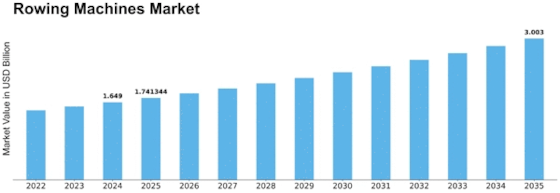
<p>The Rowing Machines Market was valued at 1.649 USD Billion in 2024.</p>

What is the projected market size for the Rowing Machines Market by 2035?

<p>The market is projected to reach 3.003 USD Billion by 2035.</p>

What is the expected CAGR for the Rowing Machines Market during the forecast period 2025 - 2035?

<p>The expected CAGR for the Rowing Machines Market during 2025 - 2035 is 5.6%.</p>

Which companies are considered key players in the Rowing Machines Market?

<p>Key players include Concept2, WaterRower, NordicTrack, ProForm, Stamina Products, Kettler, Life Fitness, Sunny Health & Fitness, and First Degree Fitness.</p>

What are the different types of rowing machines and their market valuations?

<p>The market valuations for rowing machine types include Air at 0.495 to 0.885 USD Billion, Water at 0.412 to 0.735 USD Billion, Magnetic at 0.372 to 0.675 USD Billion, and Hydraulic at 0.37 to 0.608 USD Billion.</p>

How does the body type segment perform in the Rowing Machines Market?

<p>The body type segment shows valuations of Metal at 1.049 to 1.703 USD Billion and Solid Wood at 0.6 to 1.3 USD Billion.</p>

What is the weight capacity distribution in the Rowing Machines Market?

Weight capacity segments include 300 to 499 Pounds at 0.412 to 0.735 USD Billion, 200 to 249 Pounds at 0.412 to 0.735 USD Billion, 100 to 199 Pounds at 0.412 to 0.735 USD Billion, and Under 100 Pounds at 0.413 to 0.798 USD Billion.

What are the distribution channels for rowing machines?

The distribution channels are segmented into Online at 0.8245 to 1.487 USD Billion and Offline at 0.8245 to 1.516 USD Billion.

What color options are available in the Rowing Machines Market?

Color options include Black at 0.825 to 1.475 USD Billion, Light Grey at 0.495 to 0.885 USD Billion, and Others at 0.329 to 0.643 USD Billion.

What is the end-user segmentation in the Rowing Machines Market?

The end-user segmentation includes Commercial at 0.825 to 1.475 USD Billion and Residential at 0.824 to 1.528 USD Billion.

Market Summary

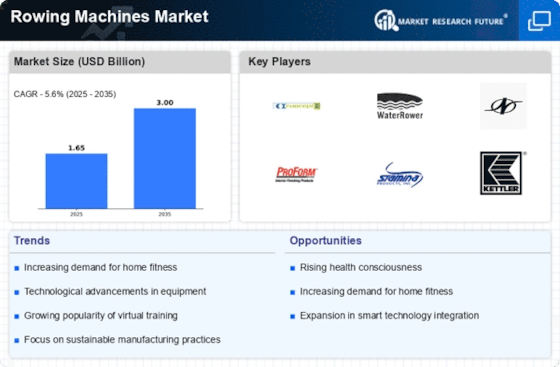
As per Market Research Future analysis, the Rowing Machines Market Size was estimated at 1.649 USD Billion in 2024. The Rowing Machines industry is projected to grow from USD 1.741 Billion in 2025 to USD 3.003 Billion by 2035, exhibiting a compound annual growth rate (CAGR) of 5.6% during the forecast period 2025 - 2035

Key Market Trends & Highlights

The rowing machines market is experiencing a dynamic shift towards technological integration and sustainability, driven by evolving consumer preferences.

  • North America remains the largest market for rowing machines, reflecting a strong demand for home fitness solutions. Asia-Pacific is emerging as the fastest-growing region, fueled by increasing health awareness and fitness trends. The air rowing machine segment dominates the market, while the water rowing machine segment is witnessing rapid growth due to its unique appeal. Key market drivers include heightened health consciousness and the growing popularity of home workouts, which are reshaping consumer purchasing behavior.

Market Size & Forecast

2024 Market Size 1.649 (USD Billion)
2035 Market Size 3.003 (USD Billion)
CAGR (2025 - 2035) 5.6%
Largest Regional Market Share in 2024 North America

Major Players

<a href="https://www.concept2.com/ergs/rowerg?srsltid=AfmBOoogsvMWLzSuS7u1QKu9Gai2TJ0FDmHpz1MVY8D8gEI5WpHoJuck">Concept2 </a>(US), WaterRower (US), NordicTrack (US), ProForm (US), Stamina Products (US), <a href="https://kettlersport.com/en-lu/rowing-machines/">Kettler </a>(DE), Life Fitness (US), Sunny Health &amp; Fitness (US), First Degree Fitness (AU)

Market Trends

The Rowing Machines Market is currently experiencing a notable evolution, driven by a growing awareness of fitness and wellness among consumers. As individuals increasingly prioritize health, the demand for effective home workout equipment has surged. Rowing machines, known for their ability to provide a full-body workout, are becoming a preferred choice for many. This trend is further supported by advancements in technology, which have led to the development of smart rowing machines that offer interactive features and connectivity options. These innovations not only enhance user experience but also cater to the needs of a tech-savvy audience. Moreover, the Rowing Machines Market is witnessing a shift towards sustainability, with manufacturers focusing on eco-friendly materials and production processes. This shift aligns with the broader consumer trend towards environmentally conscious purchasing decisions. As a result, brands that emphasize sustainability in their product offerings may find themselves at a competitive advantage. The combination of health consciousness and environmental awareness is likely to shape the future landscape of the Rowing Machines Market, suggesting a promising outlook for both manufacturers and consumers alike.

Technological Integration

The Rowing Machines Market is increasingly incorporating advanced technology, such as smart features and connectivity options. These innovations allow users to track their performance, engage in virtual competitions, and access personalized training programs, enhancing the overall workout experience.

Sustainability Focus

There is a growing emphasis on sustainability within the Rowing Machines Market, as manufacturers seek to utilize eco-friendly materials and production methods. This trend reflects a broader consumer preference for environmentally responsible products, potentially influencing purchasing decisions.

Home Fitness Popularity

The trend towards home fitness continues to gain momentum, with more individuals opting for at-home workout solutions. Rowing machines, offering versatility and efficiency, are becoming increasingly popular among consumers looking to maintain their fitness routines without the need for a gym membership.

Rowing Machines Market Market Drivers

Increased Health Awareness

The rising awareness regarding health and fitness is a pivotal driver for the Rowing Machines Market. As individuals become more conscious of their physical well-being, the demand for effective workout equipment surges. Rowing machines, known for their ability to provide a full-body workout, are increasingly favored by fitness enthusiasts. According to recent data, the massage equipment is projected to grow at a compound annual growth rate of approximately 4.5% over the next few years. This trend indicates a robust interest in home fitness solutions, with rowing machines being a prominent choice due to their efficiency and versatility. The Rowing Machines Market is likely to benefit from this heightened focus on health, as consumers seek equipment that aligns with their fitness goals.

Technological Advancements

Technological advancements play a crucial role in shaping the Rowing Machines Market. Innovations such as smart rowing machines equipped with interactive screens, performance tracking, and connectivity features are becoming increasingly prevalent. These advancements not only enhance the user experience but also attract a tech-savvy demographic. The integration of virtual training programs and gamification elements into rowing workouts is particularly appealing, as it fosters engagement and motivation. Market data suggests that the demand for smart fitness equipment is on the rise, with projections indicating a growth rate of around 6% annually. This trend underscores the importance of technology in the Rowing Machines Market, as manufacturers strive to meet consumer expectations for modern, connected fitness solutions.

Growing Popularity of Home Workouts

The growing popularity of home workouts is a significant driver for the Rowing Machines Market. As more individuals opt for exercising at home, the demand for compact and efficient fitness equipment has surged. Rowing machines, which offer a comprehensive workout without requiring extensive space, are particularly well-suited for home environments. Recent statistics indicate that the home fitness equipment market is expected to expand by approximately 5% annually, reflecting a shift in consumer preferences. This trend is further fueled by the convenience and flexibility that home workouts provide, allowing users to integrate fitness into their daily routines. Consequently, the Rowing Machines Market is poised to capitalize on this movement, as consumers seek effective solutions for their home fitness needs.

Focus on Sustainable Fitness Solutions

The increasing focus on sustainability is emerging as a key driver for the Rowing Machines Market. Consumers are becoming more environmentally conscious, leading to a demand for fitness equipment that aligns with sustainable practices. Manufacturers are responding by developing rowing machines made from eco-friendly materials and implementing sustainable production processes. This shift not only appeals to environmentally aware consumers but also positions brands favorably in a competitive market. Market analysis indicates that the demand for sustainable fitness products is likely to grow, with projections suggesting a rise of around 7% in this segment. As the Rowing Machines Market adapts to these changing consumer preferences, it may enhance its appeal and market share among eco-conscious buyers.

Rise of Competitive Sports and Training

The rise of competitive sports and training is a notable driver for the Rowing Machines Market. As more individuals engage in competitive rowing and other sports, the demand for specialized training equipment, including rowing machines, is increasing. These machines are recognized for their ability to build strength, endurance, and technique, making them essential for athletes. Recent data indicates that the sports training equipment market is projected to grow at a rate of approximately 5.5% annually. This trend suggests a growing interest in performance-oriented fitness solutions, which the Rowing Machines Market is well-positioned to address. As athletes and fitness enthusiasts seek to enhance their training regimens, the demand for high-quality rowing machines is likely to rise.

Market Segment Insights

By Type: Air (Largest) vs. Water (Fastest-Growing)

<p>In the Rowing Machines Market, the air resistance type currently dominates the landscape, capturing the largest share due to its popularity among fitness enthusiasts seeking a realistic rowing experience. Water resistance rowing machines follow closely, gaining increased traction as they provide smoother operation and a unique aesthetic appeal. Magnetic and hydraulic varieties make up a smaller percentage of the market, catering to niche audiences with specific preferences for quiet operation and compact designs suitable for home use.</p>

<p>Resistance Type: Air (Dominant) vs. Water (Emerging)</p>

<p>Air resistance rowing machines are appreciated for their authenticity and dynamic resistance during workouts, mirroring real rowing conditions. They are typically built for durability and often found in gym environments. In contrast, water resistance rowing machines offer an immersive experience, drawing users with their visually appealing water-filled tanks that create a calming ambiance while rowing. As the health and fitness trend continues to soar, these water-resistance machines are rapidly becoming popular, positioning themselves as an emerging choice for home fitness enthusiasts.</p>

By Body Type: Metal (Largest) vs. Solid Wood (Fastest-Growing)

<p>In the Rowing Machines Market, the body type segments are characterized prominently by Metal and Solid Wood. Metal rowing machines hold the largest share of the market due to their durability, strength, and the ability to withstand rigorous use. They are preferred in both commercial and home settings for their longevity and stability. Solid Wood, while comparatively smaller in market share, is rapidly gaining traction among consumers seeking aesthetic appeal and environmentally friendly products, presenting a unique niche in the market.</p>

<p>Body Type: Metal (Dominant) vs. Solid Wood (Emerging)</p>

<p>Metal rowing machines dominate the market because they offer robustness and reliability that appeal to a wide range of users, from fitness enthusiasts to serious athletes. Their construction typically features alloys that ensure a longer lifespan and better performance under heavy use. In contrast, Solid Wood rowing machines are emerging as a significant competitor, especially among health-conscious consumers and those valuing sustainable products. The use of natural materials provides a unique aesthetic appeal, and the eco-friendly attributes resonate well with today's environmentally aware market. As consumers continue to shift towards products with sustainable practices, Solid Wood rowing machines are likely to see an increase in popularity.</p>

By Weight Capacity: 300 to 499 Pounds (Largest) vs. 200 to 249 Pounds (Fastest-Growing)

<p>In the Rowing Machines Market, the '300 to 499 Pounds' weight capacity segment holds the largest share due to its appeal to users seeking robust equipment that can support heavier users. This segment caters primarily to serious athletes and fitness enthusiasts who require durable machines that can withstand rigorous workouts. Meanwhile, the '200 to 249 Pounds' category is emerging as the fastest-growing segment, driven by increasing consumer awareness about health and fitness, leading more casual users to seek stable and resilient rowing machines.</p>

<p>300 to 499 Pounds (Dominant) vs. 100 to 199 Pounds (Emerging)</p>

<p>The '300 to 499 Pounds' weight capacity segment is characterized by high durability and enhanced stability, attracting a dedicated user base that prioritizes performance and safety. This segment often features advanced engineering, providing features like reinforced frames and high-resistance settings for intense workouts. On the other hand, the '100 to 199 Pounds' category caters to a broader audience, including beginners and casual users who prefer lightweight, space-efficient options. While it is currently an emerging segment, its growth is propelled by rising interest in home fitness solutions that do not compromise on quality or functionality, making it a pivotal part of the market.</p>

By Distribution Channel: Online (Largest) vs. Offline (Fastest-Growing)

<p>In the Rowing Machines Market, the distribution of sales between online and offline channels reveals a clear preference for online purchasing, which has emerged as the largest segment. This preference stems from convenience, access to a wider variety of products, and competitive pricing online. The online channel continues to dominate due to the growing trend of e-commerce and consumer comfort with purchasing fitness equipment through digital platforms. Offline sales, while smaller in comparison, are witnessing significant growth as fitness enthusiasts often prefer to experience the equipment firsthand before making a purchase. Retail stores, gyms, and specialty fitness outlets are investing in enhanced in-store experiences to attract customers.</p>

<p>Distribution Channel: Online (Dominant) vs. Offline (Emerging)</p>

<p>Online distribution has firmly established itself as the dominant channel in the Rowing Machines Market. This segment benefits from a broad reach, allowing consumers to compare options, find reviews, and make informed decisions from the comfort of their homes. In contrast, the offline market is emerging rapidly, driven by a resurgence in fitness culture where consumers seek to test machines for comfort and performance prior to buying. Retailers are adapting by creating interactive spaces where customers can engage with the products. This hybrid approach caters to diverse consumer preferences, positioning both channels for continued relevance as the market evolves.</p>

By Resistant Level: Less Than 24 (Largest) vs. More Than 24 (Fastest-Growing)

<p>The Rowing Machines Market shows a clear distribution in its resistant level segmentation, with the 'Less Than 24' category claiming the largest share. This segment caters primarily to recreational users and those focusing on general fitness, which has contributed to its dominance in market presence. Conversely, 'More Than 24' resistance rowing machines are gaining traction due to an increase in high-intensity training and serious fitness enthusiasts seeking advanced equipment, marking a significant shift in user preferences. In terms of growth trends, the 'More Than 24' resistance category is emerging as the fastest-growing segment as consumers become more health-conscious and prioritize strength training in their routines. The rise of home fitness solutions, coupled with a surge in online fitness coaching, fuels the demand for these high-resistance machines, positioning them as a key player in the market's evolution.</p>

<p>Resistance Level: Less Than 24 (Dominant) vs. More Than 24 (Emerging)</p>

<p>The 'Less Than 24' resistance level represents the dominant market segment, appealing to casual users and beginners who value accessibility and ease of use. These machines typically feature adjustable resistance settings that allow users to ease into their workouts, making them a favorite for family fitness or light training sessions. On the other hand, the 'More Than 24' segment is emerging rapidly, characterized by its appeal to advanced users and fitness enthusiasts seeking to enhance their training intensity. These machines offer higher resistance levels, ideal for performance-oriented workouts, thus attracting a demographic focused on serious athletic training and competitive rowing. As trends shift towards specialized fitness equipment, both segments contribute uniquely to the market's overall dynamics.</p>

By Color: Black (Largest) vs. Light Grey (Fastest-Growing)

<p>In the Rowing Machines Market, the color segmentation reveals that black is the dominant choice among consumers, holding a significant share in the total sales. This preference is largely driven by its classic appeal and versatility, making it a favorite for both home gym owners and commercial fitness facilities. On the other hand, light grey has emerged as a growing trend, capturing the interest of modern users who seek aesthetics along with functionality in their fitness equipment.</p>

<p>Black (Dominant) vs. Light Grey (Emerging)</p>

<p>The black color in rowing machines has established itself as the dominant segment, thanks to its timeless look and broad appeal. It is frequently chosen due to its ability to seamlessly fit into various home interior styles and gym environments. Customers appreciate the sleek and professional appearance of black rowing machines, which often enhances the overall look of a fitness space. In contrast, light grey presents itself as an emerging choice, appealing to consumers who prefer a lighter color palette that conveys freshness and modernity. This segment is gradually gaining traction as manufacturers introduce sleek, modern designs that resonate well with design-conscious fitness enthusiasts.</p>

By End-User: Commercial (Largest) vs. Residential (Fastest-Growing)

<p>In the Rowing Machines Market, the end-user segment is primarily divided between commercial and residential sectors. The commercial segment accounts for the majority of market share, as gyms, fitness centers, and corporate wellness programs increasingly incorporate rowing machines into their training regimens. This substantial demand from professional fitness environments highlights the importance of this segment in shaping market dynamics. On the other hand, the residential segment is witnessing rapid growth, fueled by a surge in home fitness trends, driven by increasing awareness of health and fitness, and the convenience of working out at home.</p>

<p>End-User: Commercial (Dominant) vs. Residential (Emerging)</p>

<p>The commercial end-user segment is characterized by substantial demand from various fitness facilities, which is bolstered by a strong trend toward health and fitness. Gyms and health clubs recognize the value of versatile equipment like rowing machines in providing effective full-body workouts. Conversely, the residential segment is emerging as a significant player in the market, appealing to consumers seeking efficient exercise options within the comfort of their homes. This segment is being driven by technological advancements, such as the integration of connected fitness solutions and interactive workout experiences, which enhance user engagement. As fitness enthusiasts seek convenience and flexibility, the demand for residential rowing machines is on the rise, enabling manufacturers to focus on innovative solutions tailored to home users.</p>

Get more detailed insights about Rowing Machines Market Research Report – Forecast till 2035

Regional Insights

North America : Fitness Innovation Leader

North America is the largest market for rowing machines, holding approximately 45% of the global share. The region's growth is driven by increasing health awareness, a rise in home fitness trends, and supportive government initiatives promoting physical activity. The demand for high-quality fitness equipment is further fueled by the popularity of rowing as a low-impact, full-body workout. The United States leads the market, followed by Canada, with key players like Concept2, WaterRower, and NordicTrack dominating the landscape. The competitive environment is characterized by innovation and a focus on technology integration in fitness equipment. The presence of established brands and a growing number of fitness enthusiasts contribute to the region's robust market dynamics.

Europe : Emerging Fitness Hub

Europe is witnessing significant growth in the rowing machines market, accounting for about 30% of the global share. The increasing emphasis on health and fitness, coupled with government initiatives promoting active lifestyles, is driving demand. Countries like Germany and the UK are at the forefront, with rising participation in rowing sports and fitness activities. Regulatory support for health and wellness programs further catalyzes market expansion. Germany is the largest market in Europe, followed by the UK, with key players such as Kettler and Life Fitness leading the competition. The market is characterized by a mix of established brands and emerging companies focusing on innovative designs and technology. The competitive landscape is vibrant, with a growing trend towards smart fitness solutions that enhance user experience.

Asia-Pacific : Rapidly Growing Market

Asia-Pacific is rapidly emerging as a significant market for rowing machines, holding around 20% of the global share. The region's growth is driven by increasing urbanization, rising disposable incomes, and a growing awareness of health and fitness. Countries like China and Australia are leading the charge, with a notable increase in fitness centers and home gym setups. Government initiatives promoting sports and fitness further support market growth. China is the largest market in the region, followed by Australia, with key players like First Degree Fitness and Sunny Health & Fitness making their mark. The competitive landscape is evolving, with a mix of local and international brands vying for market share. The focus on innovative and affordable fitness solutions is shaping the market dynamics, catering to a diverse consumer base.

Middle East and Africa : Emerging Fitness Frontier

The Middle East and Africa region is gradually emerging in the rowing machines market, currently holding about 5% of the global share. The growth is driven by increasing health consciousness, urbanization, and a rise in fitness facilities. Countries like South Africa and the UAE are witnessing a surge in demand for fitness equipment, supported by government initiatives promoting active lifestyles and wellness. South Africa is the largest market in the region, followed by the UAE, with a growing number of fitness centers and home gym setups. The competitive landscape is characterized by a mix of local and international brands, with an increasing focus on quality and innovation. As the region continues to develop, the potential for market growth remains significant, driven by changing consumer preferences and lifestyle choices.

Key Players and Competitive Insights

Leading market players are heavily putting money on R&D to broaden their product ranges, which will contribute to the rowers market's further growth. Additionally, market players are engaging in a range of calculated initiatives to increase their worldwide presence, with important market developments involving the introduction of new products, contracts, M&A transactions, increased investment, and cooperation with other enterprises. To grow and endure in an increasingly cutthroat and dynamic market, Rowing Machines industry must provide reasonably priced goods.
One of the main business strategies employed by manufacturers is to manufacture locally in order to reduce operating expenses in the Rowing Machines industry to help customers and expand the market segment. In recent years, the Rowing Machines industry has provided some of the biggest benefits to medicine. Major players in the Rowers Market, including BODYCRAFT, Johnson Health Tech, Nautilus, Inc., Mr Captain Brand, Stamina Products, Inc., Sunny Health and Fitness, iFIT Inc., York Fitness UK, Infiniti, Concept2 inc. and others, are engaging in research and development activities in an effort to boost market demand.
Life Fitness is an American fitness firm that manufactures and distributes cardiovascular and strength training equipment under various names such as Life Fitness, Cybex, and Hammer Strength. It is a portfolio firm of KPS Capital Partners and is headquartered in Franklin Park, Illinois..
In March Life Fitness collaborated with World Gym International, a California-based American fitness centre. The company is expected to benefit from the cooperation deal by supplying World Gym International with gym equipment and newly launched rowing machines.
Adidas AG is a German athletic apparel and footwear manufacturer based in Herzogenaurach, Bavaria. It is Europe's largest sportswear producer and the world's second largest after Nike.  In August 2022, Adidas AG announced that CEO Kasper Rrsted would retire in 2023. In January of this year, Bjrn Gulden was appointed CEO.

Key Companies in the Rowing Machines Market include

Industry Developments

For Instance, September 2021 Nautilus, Inc. has signed a formal agreement to purchase VAY, a leader in motion technology. The acquisition will allow Nautilus to expand its JRNY digital platform by providing key technology to underpin the company's vision and motion-tracking capabilities, allowing for real-time data analysis during workouts.

For Instance, March 2021 Torque Fitness collaborated with CrossFit competitor Brent Fikowski. With this collaboration, the company hopes to improve product development of training equipment for home gyms.

Future Outlook

Rowing Machines Market Future Outlook

The Rowing Machines Market is projected to grow at a 5.6% CAGR from 2025 to 2035, driven by increasing health awareness, technological advancements, and rising demand for home fitness solutions.

New opportunities lie in:

  • <p>Development of smart rowing machines with integrated fitness tracking apps. Expansion into emerging markets with tailored marketing strategies. Partnerships with fitness influencers for brand promotion and product endorsements.</p>

By 2035, the Rowing Machines Market is expected to achieve substantial growth and innovation.

Market Segmentation

Rowing Machines Market Type Outlook

  • Air
  • Water
  • Magnetic
  • Hydraulic

Rowing Machines Market Color Outlook

  • Black
  • Light Grey
  • Others

Rowing Machines Market End-User Outlook

  • Commercial
  • Residential

Rowing Machines Market Body Type Outlook

  • Metal
  • Solid Wood

Rowing Machines Market Resistant Level Outlook

  • Less Than 24
  • More Than 24

Rowing Machines Market Weight Capacity Outlook

  • 300 to 499 Pounds
  • 200 to 249 Pounds
  • 100 to 199 Pounds
  • Under 100 Pounds

Rowing Machines Market Distribution Channel Outlook

  • Online
  • Offline

Report Scope

MARKET SIZE 2024 1.649(USD Billion)
MARKET SIZE 2025 1.741(USD Billion)
MARKET SIZE 2035 3.003(USD Billion)
COMPOUND ANNUAL GROWTH RATE (CAGR) 5.6% (2025 - 2035)
REPORT COVERAGE Revenue Forecast, Competitive Landscape, Growth Factors, and Trends
BASE YEAR 2024
Market Forecast Period 2025 - 2035
Historical Data 2019 - 2024
Market Forecast Units USD Billion
Key Companies Profiled Concept2 (US), WaterRower (US), NordicTrack (US), ProForm (US), Stamina Products (US), Kettler (DE), Life Fitness (US), Sunny Health & Fitness (US), First Degree Fitness (AU)
Segments Covered Type, Body Type, Weight Capacity, Distribution Channel, Resistant Level, Color, End-User, Region
Key Market Opportunities Integration of smart technology and personalized fitness solutions in the Rowing Machines Market.
Key Market Dynamics Rising consumer interest in home fitness drives innovation and competition in the rowing machines market.
Countries Covered North America, Europe, APAC, South America, MEA

FAQs

What is the current valuation of the Rowing Machines Market in 2024?

<p>The Rowing Machines Market was valued at 1.649 USD Billion in 2024.</p>

What is the projected market size for the Rowing Machines Market by 2035?

<p>The market is projected to reach 3.003 USD Billion by 2035.</p>

What is the expected CAGR for the Rowing Machines Market during the forecast period 2025 - 2035?

<p>The expected CAGR for the Rowing Machines Market during 2025 - 2035 is 5.6%.</p>

Which companies are considered key players in the Rowing Machines Market?

<p>Key players include Concept2, WaterRower, NordicTrack, ProForm, Stamina Products, Kettler, Life Fitness, Sunny Health & Fitness, and First Degree Fitness.</p>

What are the different types of rowing machines and their market valuations?

<p>The market valuations for rowing machine types include Air at 0.495 to 0.885 USD Billion, Water at 0.412 to 0.735 USD Billion, Magnetic at 0.372 to 0.675 USD Billion, and Hydraulic at 0.37 to 0.608 USD Billion.</p>

How does the body type segment perform in the Rowing Machines Market?

<p>The body type segment shows valuations of Metal at 1.049 to 1.703 USD Billion and Solid Wood at 0.6 to 1.3 USD Billion.</p>

What is the weight capacity distribution in the Rowing Machines Market?

Weight capacity segments include 300 to 499 Pounds at 0.412 to 0.735 USD Billion, 200 to 249 Pounds at 0.412 to 0.735 USD Billion, 100 to 199 Pounds at 0.412 to 0.735 USD Billion, and Under 100 Pounds at 0.413 to 0.798 USD Billion.

What are the distribution channels for rowing machines?

The distribution channels are segmented into Online at 0.8245 to 1.487 USD Billion and Offline at 0.8245 to 1.516 USD Billion.

What color options are available in the Rowing Machines Market?

Color options include Black at 0.825 to 1.475 USD Billion, Light Grey at 0.495 to 0.885 USD Billion, and Others at 0.329 to 0.643 USD Billion.

What is the end-user segmentation in the Rowing Machines Market?

The end-user segmentation includes Commercial at 0.825 to 1.475 USD Billion and Residential at 0.824 to 1.528 USD Billion.

  1. SECTION I: EXECUTIVE SUMMARY AND KEY HIGHLIGHTS
    1. | 1.1 EXECUTIVE SUMMARY
    2. | | 1.1.1 Market Overview
    3. | | 1.1.2 Key Findings
    4. | | 1.1.3 Market Segmentation
    5. | | 1.1.4 Competitive Landscape
    6. | | 1.1.5 Challenges and Opportunities
    7. | | 1.1.6 Future Outlook
  2. SECTION II: SCOPING, METHODOLOGY AND MARKET STRUCTURE
    1. | 2.1 MARKET INTRODUCTION
    2. | | 2.1.1 Definition
    3. | | 2.1.2 Scope of the study
    4. | | | 2.1.2.1 Research Objective
    5. | | | 2.1.2.2 Assumption
    6. | | | 2.1.2.3 Limitations
    7. | 2.2 RESEARCH METHODOLOGY
    8. | | 2.2.1 Overview
    9. | | 2.2.2 Data Mining
    10. | | 2.2.3 Secondary Research
    11. | | 2.2.4 Primary Research
    12. | | | 2.2.4.1 Primary Interviews and Information Gathering Process
    13. | | | 2.2.4.2 Breakdown of Primary Respondents
    14. | | 2.2.5 Forecasting Model
    15. | | 2.2.6 Market Size Estimation
    16. | | | 2.2.6.1 Bottom-Up Approach
    17. | | | 2.2.6.2 Top-Down Approach
    18. | | 2.2.7 Data Triangulation
    19. | | 2.2.8 Validation
  3. SECTION III: QUALITATIVE ANALYSIS
    1. | 3.1 MARKET DYNAMICS
    2. | | 3.1.1 Overview
    3. | | 3.1.2 Drivers
    4. | | 3.1.3 Restraints
    5. | | 3.1.4 Opportunities
    6. | 3.2 MARKET FACTOR ANALYSIS
    7. | | 3.2.1 Value chain Analysis
    8. | | 3.2.2 Porter's Five Forces Analysis
    9. | | | 3.2.2.1 Bargaining Power of Suppliers
    10. | | | 3.2.2.2 Bargaining Power of Buyers
    11. | | | 3.2.2.3 Threat of New Entrants
    12. | | | 3.2.2.4 Threat of Substitutes
    13. | | | 3.2.2.5 Intensity of Rivalry
    14. | | 3.2.3 COVID-19 Impact Analysis
    15. | | | 3.2.3.1 Market Impact Analysis
    16. | | | 3.2.3.2 Regional Impact
    17. | | | 3.2.3.3 Opportunity and Threat Analysis
  4. SECTION IV: QUANTITATIVE ANALYSIS
    1. | 4.1 Life Sciences, BY Type (USD Billion)
    2. | | 4.1.1 Air
    3. | | 4.1.2 Water
    4. | | 4.1.3 Magnetic
    5. | | 4.1.4 Hydraulic
    6. | 4.2 Life Sciences, BY Body Type (USD Billion)
    7. | | 4.2.1 Metal
    8. | | 4.2.2 Solid Wood
    9. | 4.3 Life Sciences, BY Weight Capacity (USD Billion)
    10. | | 4.3.1 300 to 499 Pounds
    11. | | 4.3.2 200 to 249 Pounds
    12. | | 4.3.3 100 to 199 Pounds
    13. | | 4.3.4 Under 100 Pounds
    14. | 4.4 Life Sciences, BY Distribution Channel (USD Billion)
    15. | | 4.4.1 Online
    16. | | 4.4.2 Offline
    17. | 4.5 Life Sciences, BY Resistant Level (USD Billion)
    18. | | 4.5.1 Less Than 24
    19. | | 4.5.2 More Than 24
    20. | 4.6 Life Sciences, BY Color (USD Billion)
    21. | | 4.6.1 Black
    22. | | 4.6.2 Light Grey
    23. | | 4.6.3 Others
    24. | 4.7 Life Sciences, BY End-User (USD Billion)
    25. | | 4.7.1 Commercial
    26. | | 4.7.2 Residential
    27. | 4.8 Life Sciences, BY Region (USD Billion)
    28. | | 4.8.1 North America
    29. | | | 4.8.1.1 US
    30. | | | 4.8.1.2 Canada
    31. | | 4.8.2 Europe
    32. | | | 4.8.2.1 Germany
    33. | | | 4.8.2.2 UK
    34. | | | 4.8.2.3 France
    35. | | | 4.8.2.4 Russia
    36. | | | 4.8.2.5 Italy
    37. | | | 4.8.2.6 Spain
    38. | | | 4.8.2.7 Rest of Europe
    39. | | 4.8.3 APAC
    40. | | | 4.8.3.1 China
    41. | | | 4.8.3.2 India
    42. | | | 4.8.3.3 Japan
    43. | | | 4.8.3.4 South Korea
    44. | | | 4.8.3.5 Malaysia
    45. | | | 4.8.3.6 Thailand
    46. | | | 4.8.3.7 Indonesia
    47. | | | 4.8.3.8 Rest of APAC
    48. | | 4.8.4 South America
    49. | | | 4.8.4.1 Brazil
    50. | | | 4.8.4.2 Mexico
    51. | | | 4.8.4.3 Argentina
    52. | | | 4.8.4.4 Rest of South America
    53. | | 4.8.5 MEA
    54. | | | 4.8.5.1 GCC Countries
    55. | | | 4.8.5.2 South Africa
    56. | | | 4.8.5.3 Rest of MEA
  5. SECTION V: COMPETITIVE ANALYSIS
    1. | 5.1 Competitive Landscape
    2. | | 5.1.1 Overview
    3. | | 5.1.2 Competitive Analysis
    4. | | 5.1.3 Market share Analysis
    5. | | 5.1.4 Major Growth Strategy in the Life Sciences
    6. | | 5.1.5 Competitive Benchmarking
    7. | | 5.1.6 Leading Players in Terms of Number of Developments in the Life Sciences
    8. | | 5.1.7 Key developments and growth strategies
    9. | | | 5.1.7.1 New Product Launch/Service Deployment
    10. | | | 5.1.7.2 Merger & Acquisitions
    11. | | | 5.1.7.3 Joint Ventures
    12. | | 5.1.8 Major Players Financial Matrix
    13. | | | 5.1.8.1 Sales and Operating Income
    14. | | | 5.1.8.2 Major Players R&D Expenditure. 2023
    15. | 5.2 Company Profiles
    16. | | 5.2.1 Concept2 (US)
    17. | | | 5.2.1.1 Financial Overview
    18. | | | 5.2.1.2 Products Offered
    19. | | | 5.2.1.3 Key Developments
    20. | | | 5.2.1.4 SWOT Analysis
    21. | | | 5.2.1.5 Key Strategies
    22. | | 5.2.2 WaterRower (US)
    23. | | | 5.2.2.1 Financial Overview
    24. | | | 5.2.2.2 Products Offered
    25. | | | 5.2.2.3 Key Developments
    26. | | | 5.2.2.4 SWOT Analysis
    27. | | | 5.2.2.5 Key Strategies
    28. | | 5.2.3 NordicTrack (US)
    29. | | | 5.2.3.1 Financial Overview
    30. | | | 5.2.3.2 Products Offered
    31. | | | 5.2.3.3 Key Developments
    32. | | | 5.2.3.4 SWOT Analysis
    33. | | | 5.2.3.5 Key Strategies
    34. | | 5.2.4 ProForm (US)
    35. | | | 5.2.4.1 Financial Overview
    36. | | | 5.2.4.2 Products Offered
    37. | | | 5.2.4.3 Key Developments
    38. | | | 5.2.4.4 SWOT Analysis
    39. | | | 5.2.4.5 Key Strategies
    40. | | 5.2.5 Stamina Products (US)
    41. | | | 5.2.5.1 Financial Overview
    42. | | | 5.2.5.2 Products Offered
    43. | | | 5.2.5.3 Key Developments
    44. | | | 5.2.5.4 SWOT Analysis
    45. | | | 5.2.5.5 Key Strategies
    46. | | 5.2.6 Kettler (DE)
    47. | | | 5.2.6.1 Financial Overview
    48. | | | 5.2.6.2 Products Offered
    49. | | | 5.2.6.3 Key Developments
    50. | | | 5.2.6.4 SWOT Analysis
    51. | | | 5.2.6.5 Key Strategies
    52. | | 5.2.7 Life Fitness (US)
    53. | | | 5.2.7.1 Financial Overview
    54. | | | 5.2.7.2 Products Offered
    55. | | | 5.2.7.3 Key Developments
    56. | | | 5.2.7.4 SWOT Analysis
    57. | | | 5.2.7.5 Key Strategies
    58. | | 5.2.8 Sunny Health & Fitness (US)
    59. | | | 5.2.8.1 Financial Overview
    60. | | | 5.2.8.2 Products Offered
    61. | | | 5.2.8.3 Key Developments
    62. | | | 5.2.8.4 SWOT Analysis
    63. | | | 5.2.8.5 Key Strategies
    64. | | 5.2.9 First Degree Fitness (AU)
    65. | | | 5.2.9.1 Financial Overview
    66. | | | 5.2.9.2 Products Offered
    67. | | | 5.2.9.3 Key Developments
    68. | | | 5.2.9.4 SWOT Analysis
    69. | | | 5.2.9.5 Key Strategies
    70. | 5.3 Appendix
    71. | | 5.3.1 References
    72. | | 5.3.2 Related Reports
  6. LIST OF FIGURES
    1. | 6.1 MARKET SYNOPSIS
    2. | 6.2 NORTH AMERICA MARKET ANALYSIS
    3. | 6.3 US MARKET ANALYSIS BY TYPE
    4. | 6.4 US MARKET ANALYSIS BY BODY TYPE
    5. | 6.5 US MARKET ANALYSIS BY WEIGHT CAPACITY
    6. | 6.6 US MARKET ANALYSIS BY DISTRIBUTION CHANNEL
    7. | 6.7 US MARKET ANALYSIS BY RESISTANT LEVEL
    8. | 6.8 US MARKET ANALYSIS BY COLOR
    9. | 6.9 US MARKET ANALYSIS BY END-USER
    10. | 6.10 CANADA MARKET ANALYSIS BY TYPE
    11. | 6.11 CANADA MARKET ANALYSIS BY BODY TYPE
    12. | 6.12 CANADA MARKET ANALYSIS BY WEIGHT CAPACITY
    13. | 6.13 CANADA MARKET ANALYSIS BY DISTRIBUTION CHANNEL
    14. | 6.14 CANADA MARKET ANALYSIS BY RESISTANT LEVEL
    15. | 6.15 CANADA MARKET ANALYSIS BY COLOR
    16. | 6.16 CANADA MARKET ANALYSIS BY END-USER
    17. | 6.17 EUROPE MARKET ANALYSIS
    18. | 6.18 GERMANY MARKET ANALYSIS BY TYPE
    19. | 6.19 GERMANY MARKET ANALYSIS BY BODY TYPE
    20. | 6.20 GERMANY MARKET ANALYSIS BY WEIGHT CAPACITY
    21. | 6.21 GERMANY MARKET ANALYSIS BY DISTRIBUTION CHANNEL
    22. | 6.22 GERMANY MARKET ANALYSIS BY RESISTANT LEVEL
    23. | 6.23 GERMANY MARKET ANALYSIS BY COLOR
    24. | 6.24 GERMANY MARKET ANALYSIS BY END-USER
    25. | 6.25 UK MARKET ANALYSIS BY TYPE
    26. | 6.26 UK MARKET ANALYSIS BY BODY TYPE
    27. | 6.27 UK MARKET ANALYSIS BY WEIGHT CAPACITY
    28. | 6.28 UK MARKET ANALYSIS BY DISTRIBUTION CHANNEL
    29. | 6.29 UK MARKET ANALYSIS BY RESISTANT LEVEL
    30. | 6.30 UK MARKET ANALYSIS BY COLOR
    31. | 6.31 UK MARKET ANALYSIS BY END-USER
    32. | 6.32 FRANCE MARKET ANALYSIS BY TYPE
    33. | 6.33 FRANCE MARKET ANALYSIS BY BODY TYPE
    34. | 6.34 FRANCE MARKET ANALYSIS BY WEIGHT CAPACITY
    35. | 6.35 FRANCE MARKET ANALYSIS BY DISTRIBUTION CHANNEL
    36. | 6.36 FRANCE MARKET ANALYSIS BY RESISTANT LEVEL
    37. | 6.37 FRANCE MARKET ANALYSIS BY COLOR
    38. | 6.38 FRANCE MARKET ANALYSIS BY END-USER
    39. | 6.39 RUSSIA MARKET ANALYSIS BY TYPE
    40. | 6.40 RUSSIA MARKET ANALYSIS BY BODY TYPE
    41. | 6.41 RUSSIA MARKET ANALYSIS BY WEIGHT CAPACITY
    42. | 6.42 RUSSIA MARKET ANALYSIS BY DISTRIBUTION CHANNEL
    43. | 6.43 RUSSIA MARKET ANALYSIS BY RESISTANT LEVEL
    44. | 6.44 RUSSIA MARKET ANALYSIS BY COLOR
    45. | 6.45 RUSSIA MARKET ANALYSIS BY END-USER
    46. | 6.46 ITALY MARKET ANALYSIS BY TYPE
    47. | 6.47 ITALY MARKET ANALYSIS BY BODY TYPE
    48. | 6.48 ITALY MARKET ANALYSIS BY WEIGHT CAPACITY
    49. | 6.49 ITALY MARKET ANALYSIS BY DISTRIBUTION CHANNEL
    50. | 6.50 ITALY MARKET ANALYSIS BY RESISTANT LEVEL
    51. | 6.51 ITALY MARKET ANALYSIS BY COLOR
    52. | 6.52 ITALY MARKET ANALYSIS BY END-USER
    53. | 6.53 SPAIN MARKET ANALYSIS BY TYPE
    54. | 6.54 SPAIN MARKET ANALYSIS BY BODY TYPE
    55. | 6.55 SPAIN MARKET ANALYSIS BY WEIGHT CAPACITY
    56. | 6.56 SPAIN MARKET ANALYSIS BY DISTRIBUTION CHANNEL
    57. | 6.57 SPAIN MARKET ANALYSIS BY RESISTANT LEVEL
    58. | 6.58 SPAIN MARKET ANALYSIS BY COLOR
    59. | 6.59 SPAIN MARKET ANALYSIS BY END-USER
    60. | 6.60 REST OF EUROPE MARKET ANALYSIS BY TYPE
    61. | 6.61 REST OF EUROPE MARKET ANALYSIS BY BODY TYPE
    62. | 6.62 REST OF EUROPE MARKET ANALYSIS BY WEIGHT CAPACITY
    63. | 6.63 REST OF EUROPE MARKET ANALYSIS BY DISTRIBUTION CHANNEL
    64. | 6.64 REST OF EUROPE MARKET ANALYSIS BY RESISTANT LEVEL
    65. | 6.65 REST OF EUROPE MARKET ANALYSIS BY COLOR
    66. | 6.66 REST OF EUROPE MARKET ANALYSIS BY END-USER
    67. | 6.67 APAC MARKET ANALYSIS
    68. | 6.68 CHINA MARKET ANALYSIS BY TYPE
    69. | 6.69 CHINA MARKET ANALYSIS BY BODY TYPE
    70. | 6.70 CHINA MARKET ANALYSIS BY WEIGHT CAPACITY
    71. | 6.71 CHINA MARKET ANALYSIS BY DISTRIBUTION CHANNEL
    72. | 6.72 CHINA MARKET ANALYSIS BY RESISTANT LEVEL
    73. | 6.73 CHINA MARKET ANALYSIS BY COLOR
    74. | 6.74 CHINA MARKET ANALYSIS BY END-USER
    75. | 6.75 INDIA MARKET ANALYSIS BY TYPE
    76. | 6.76 INDIA MARKET ANALYSIS BY BODY TYPE
    77. | 6.77 INDIA MARKET ANALYSIS BY WEIGHT CAPACITY
    78. | 6.78 INDIA MARKET ANALYSIS BY DISTRIBUTION CHANNEL
    79. | 6.79 INDIA MARKET ANALYSIS BY RESISTANT LEVEL
    80. | 6.80 INDIA MARKET ANALYSIS BY COLOR
    81. | 6.81 INDIA MARKET ANALYSIS BY END-USER
    82. | 6.82 JAPAN MARKET ANALYSIS BY TYPE
    83. | 6.83 JAPAN MARKET ANALYSIS BY BODY TYPE
    84. | 6.84 JAPAN MARKET ANALYSIS BY WEIGHT CAPACITY
    85. | 6.85 JAPAN MARKET ANALYSIS BY DISTRIBUTION CHANNEL
    86. | 6.86 JAPAN MARKET ANALYSIS BY RESISTANT LEVEL
    87. | 6.87 JAPAN MARKET ANALYSIS BY COLOR
    88. | 6.88 JAPAN MARKET ANALYSIS BY END-USER
    89. | 6.89 SOUTH KOREA MARKET ANALYSIS BY TYPE
    90. | 6.90 SOUTH KOREA MARKET ANALYSIS BY BODY TYPE
    91. | 6.91 SOUTH KOREA MARKET ANALYSIS BY WEIGHT CAPACITY
    92. | 6.92 SOUTH KOREA MARKET ANALYSIS BY DISTRIBUTION CHANNEL
    93. | 6.93 SOUTH KOREA MARKET ANALYSIS BY RESISTANT LEVEL
    94. | 6.94 SOUTH KOREA MARKET ANALYSIS BY COLOR
    95. | 6.95 SOUTH KOREA MARKET ANALYSIS BY END-USER
    96. | 6.96 MALAYSIA MARKET ANALYSIS BY TYPE
    97. | 6.97 MALAYSIA MARKET ANALYSIS BY BODY TYPE
    98. | 6.98 MALAYSIA MARKET ANALYSIS BY WEIGHT CAPACITY
    99. | 6.99 MALAYSIA MARKET ANALYSIS BY DISTRIBUTION CHANNEL
    100. | 6.100 MALAYSIA MARKET ANALYSIS BY RESISTANT LEVEL
    101. | 6.101 MALAYSIA MARKET ANALYSIS BY COLOR
    102. | 6.102 MALAYSIA MARKET ANALYSIS BY END-USER
    103. | 6.103 THAILAND MARKET ANALYSIS BY TYPE
    104. | 6.104 THAILAND MARKET ANALYSIS BY BODY TYPE
    105. | 6.105 THAILAND MARKET ANALYSIS BY WEIGHT CAPACITY
    106. | 6.106 THAILAND MARKET ANALYSIS BY DISTRIBUTION CHANNEL
    107. | 6.107 THAILAND MARKET ANALYSIS BY RESISTANT LEVEL
    108. | 6.108 THAILAND MARKET ANALYSIS BY COLOR
    109. | 6.109 THAILAND MARKET ANALYSIS BY END-USER
    110. | 6.110 INDONESIA MARKET ANALYSIS BY TYPE
    111. | 6.111 INDONESIA MARKET ANALYSIS BY BODY TYPE
    112. | 6.112 INDONESIA MARKET ANALYSIS BY WEIGHT CAPACITY
    113. | 6.113 INDONESIA MARKET ANALYSIS BY DISTRIBUTION CHANNEL
    114. | 6.114 INDONESIA MARKET ANALYSIS BY RESISTANT LEVEL
    115. | 6.115 INDONESIA MARKET ANALYSIS BY COLOR
    116. | 6.116 INDONESIA MARKET ANALYSIS BY END-USER
    117. | 6.117 REST OF APAC MARKET ANALYSIS BY TYPE
    118. | 6.118 REST OF APAC MARKET ANALYSIS BY BODY TYPE
    119. | 6.119 REST OF APAC MARKET ANALYSIS BY WEIGHT CAPACITY
    120. | 6.120 REST OF APAC MARKET ANALYSIS BY DISTRIBUTION CHANNEL
    121. | 6.121 REST OF APAC MARKET ANALYSIS BY RESISTANT LEVEL
    122. | 6.122 REST OF APAC MARKET ANALYSIS BY COLOR
    123. | 6.123 REST OF APAC MARKET ANALYSIS BY END-USER
    124. | 6.124 SOUTH AMERICA MARKET ANALYSIS
    125. | 6.125 BRAZIL MARKET ANALYSIS BY TYPE
    126. | 6.126 BRAZIL MARKET ANALYSIS BY BODY TYPE
    127. | 6.127 BRAZIL MARKET ANALYSIS BY WEIGHT CAPACITY
    128. | 6.128 BRAZIL MARKET ANALYSIS BY DISTRIBUTION CHANNEL
    129. | 6.129 BRAZIL MARKET ANALYSIS BY RESISTANT LEVEL
    130. | 6.130 BRAZIL MARKET ANALYSIS BY COLOR
    131. | 6.131 BRAZIL MARKET ANALYSIS BY END-USER
    132. | 6.132 MEXICO MARKET ANALYSIS BY TYPE
    133. | 6.133 MEXICO MARKET ANALYSIS BY BODY TYPE
    134. | 6.134 MEXICO MARKET ANALYSIS BY WEIGHT CAPACITY
    135. | 6.135 MEXICO MARKET ANALYSIS BY DISTRIBUTION CHANNEL
    136. | 6.136 MEXICO MARKET ANALYSIS BY RESISTANT LEVEL
    137. | 6.137 MEXICO MARKET ANALYSIS BY COLOR
    138. | 6.138 MEXICO MARKET ANALYSIS BY END-USER
    139. | 6.139 ARGENTINA MARKET ANALYSIS BY TYPE
    140. | 6.140 ARGENTINA MARKET ANALYSIS BY BODY TYPE
    141. | 6.141 ARGENTINA MARKET ANALYSIS BY WEIGHT CAPACITY
    142. | 6.142 ARGENTINA MARKET ANALYSIS BY DISTRIBUTION CHANNEL
    143. | 6.143 ARGENTINA MARKET ANALYSIS BY RESISTANT LEVEL
    144. | 6.144 ARGENTINA MARKET ANALYSIS BY COLOR
    145. | 6.145 ARGENTINA MARKET ANALYSIS BY END-USER
    146. | 6.146 REST OF SOUTH AMERICA MARKET ANALYSIS BY TYPE
    147. | 6.147 REST OF SOUTH AMERICA MARKET ANALYSIS BY BODY TYPE
    148. | 6.148 REST OF SOUTH AMERICA MARKET ANALYSIS BY WEIGHT CAPACITY
    149. | 6.149 REST OF SOUTH AMERICA MARKET ANALYSIS BY DISTRIBUTION CHANNEL
    150. | 6.150 REST OF SOUTH AMERICA MARKET ANALYSIS BY RESISTANT LEVEL
    151. | 6.151 REST OF SOUTH AMERICA MARKET ANALYSIS BY COLOR
    152. | 6.152 REST OF SOUTH AMERICA MARKET ANALYSIS BY END-USER
    153. | 6.153 MEA MARKET ANALYSIS
    154. | 6.154 GCC COUNTRIES MARKET ANALYSIS BY TYPE
    155. | 6.155 GCC COUNTRIES MARKET ANALYSIS BY BODY TYPE
    156. | 6.156 GCC COUNTRIES MARKET ANALYSIS BY WEIGHT CAPACITY
    157. | 6.157 GCC COUNTRIES MARKET ANALYSIS BY DISTRIBUTION CHANNEL
    158. | 6.158 GCC COUNTRIES MARKET ANALYSIS BY RESISTANT LEVEL
    159. | 6.159 GCC COUNTRIES MARKET ANALYSIS BY COLOR
    160. | 6.160 GCC COUNTRIES MARKET ANALYSIS BY END-USER
    161. | 6.161 SOUTH AFRICA MARKET ANALYSIS BY TYPE
    162. | 6.162 SOUTH AFRICA MARKET ANALYSIS BY BODY TYPE
    163. | 6.163 SOUTH AFRICA MARKET ANALYSIS BY WEIGHT CAPACITY
    164. | 6.164 SOUTH AFRICA MARKET ANALYSIS BY DISTRIBUTION CHANNEL
    165. | 6.165 SOUTH AFRICA MARKET ANALYSIS BY RESISTANT LEVEL
    166. | 6.166 SOUTH AFRICA MARKET ANALYSIS BY COLOR
    167. | 6.167 SOUTH AFRICA MARKET ANALYSIS BY END-USER
    168. | 6.168 REST OF MEA MARKET ANALYSIS BY TYPE
    169. | 6.169 REST OF MEA MARKET ANALYSIS BY BODY TYPE
    170. | 6.170 REST OF MEA MARKET ANALYSIS BY WEIGHT CAPACITY
    171. | 6.171 REST OF MEA MARKET ANALYSIS BY DISTRIBUTION CHANNEL
    172. | 6.172 REST OF MEA MARKET ANALYSIS BY RESISTANT LEVEL
    173. | 6.173 REST OF MEA MARKET ANALYSIS BY COLOR
    174. | 6.174 REST OF MEA MARKET ANALYSIS BY END-USER
    175. | 6.175 KEY BUYING CRITERIA OF LIFE SCIENCES
    176. | 6.176 RESEARCH PROCESS OF MRFR
    177. | 6.177 DRO ANALYSIS OF LIFE SCIENCES
    178. | 6.178 DRIVERS IMPACT ANALYSIS: LIFE SCIENCES
    179. | 6.179 RESTRAINTS IMPACT ANALYSIS: LIFE SCIENCES
    180. | 6.180 SUPPLY / VALUE CHAIN: LIFE SCIENCES
    181. | 6.181 LIFE SCIENCES, BY TYPE, 2024 (% SHARE)
    182. | 6.182 LIFE SCIENCES, BY TYPE, 2024 TO 2035 (USD Billion)
    183. | 6.183 LIFE SCIENCES, BY BODY TYPE, 2024 (% SHARE)
    184. | 6.184 LIFE SCIENCES, BY BODY TYPE, 2024 TO 2035 (USD Billion)
    185. | 6.185 LIFE SCIENCES, BY WEIGHT CAPACITY, 2024 (% SHARE)
    186. | 6.186 LIFE SCIENCES, BY WEIGHT CAPACITY, 2024 TO 2035 (USD Billion)
    187. | 6.187 LIFE SCIENCES, BY DISTRIBUTION CHANNEL, 2024 (% SHARE)
    188. | 6.188 LIFE SCIENCES, BY DISTRIBUTION CHANNEL, 2024 TO 2035 (USD Billion)
    189. | 6.189 LIFE SCIENCES, BY RESISTANT LEVEL, 2024 (% SHARE)
    190. | 6.190 LIFE SCIENCES, BY RESISTANT LEVEL, 2024 TO 2035 (USD Billion)
    191. | 6.191 LIFE SCIENCES, BY COLOR, 2024 (% SHARE)
    192. | 6.192 LIFE SCIENCES, BY COLOR, 2024 TO 2035 (USD Billion)
    193. | 6.193 LIFE SCIENCES, BY END-USER, 2024 (% SHARE)
    194. | 6.194 LIFE SCIENCES, BY END-USER, 2024 TO 2035 (USD Billion)
    195. | 6.195 BENCHMARKING OF MAJOR COMPETITORS
  7. LIST OF TABLES
    1. | 7.1 LIST OF ASSUMPTIONS
    2. | | 7.1.1
    3. | 7.2 North America MARKET SIZE ESTIMATES; FORECAST
    4. | | 7.2.1 BY TYPE, 2025-2035 (USD Billion)
    5. | | 7.2.2 BY BODY TYPE, 2025-2035 (USD Billion)
    6. | | 7.2.3 BY WEIGHT CAPACITY, 2025-2035 (USD Billion)
    7. | | 7.2.4 BY DISTRIBUTION CHANNEL, 2025-2035 (USD Billion)
    8. | | 7.2.5 BY RESISTANT LEVEL, 2025-2035 (USD Billion)
    9. | | 7.2.6 BY COLOR, 2025-2035 (USD Billion)
    10. | | 7.2.7 BY END-USER, 2025-2035 (USD Billion)
    11. | 7.3 US MARKET SIZE ESTIMATES; FORECAST
    12. | | 7.3.1 BY TYPE, 2025-2035 (USD Billion)
    13. | | 7.3.2 BY BODY TYPE, 2025-2035 (USD Billion)
    14. | | 7.3.3 BY WEIGHT CAPACITY, 2025-2035 (USD Billion)
    15. | | 7.3.4 BY DISTRIBUTION CHANNEL, 2025-2035 (USD Billion)
    16. | | 7.3.5 BY RESISTANT LEVEL, 2025-2035 (USD Billion)
    17. | | 7.3.6 BY COLOR, 2025-2035 (USD Billion)
    18. | | 7.3.7 BY END-USER, 2025-2035 (USD Billion)
    19. | 7.4 Canada MARKET SIZE ESTIMATES; FORECAST
    20. | | 7.4.1 BY TYPE, 2025-2035 (USD Billion)
    21. | | 7.4.2 BY BODY TYPE, 2025-2035 (USD Billion)
    22. | | 7.4.3 BY WEIGHT CAPACITY, 2025-2035 (USD Billion)
    23. | | 7.4.4 BY DISTRIBUTION CHANNEL, 2025-2035 (USD Billion)
    24. | | 7.4.5 BY RESISTANT LEVEL, 2025-2035 (USD Billion)
    25. | | 7.4.6 BY COLOR, 2025-2035 (USD Billion)
    26. | | 7.4.7 BY END-USER, 2025-2035 (USD Billion)
    27. | 7.5 Europe MARKET SIZE ESTIMATES; FORECAST
    28. | | 7.5.1 BY TYPE, 2025-2035 (USD Billion)
    29. | | 7.5.2 BY BODY TYPE, 2025-2035 (USD Billion)
    30. | | 7.5.3 BY WEIGHT CAPACITY, 2025-2035 (USD Billion)
    31. | | 7.5.4 BY DISTRIBUTION CHANNEL, 2025-2035 (USD Billion)
    32. | | 7.5.5 BY RESISTANT LEVEL, 2025-2035 (USD Billion)
    33. | | 7.5.6 BY COLOR, 2025-2035 (USD Billion)
    34. | | 7.5.7 BY END-USER, 2025-2035 (USD Billion)
    35. | 7.6 Germany MARKET SIZE ESTIMATES; FORECAST
    36. | | 7.6.1 BY TYPE, 2025-2035 (USD Billion)
    37. | | 7.6.2 BY BODY TYPE, 2025-2035 (USD Billion)
    38. | | 7.6.3 BY WEIGHT CAPACITY, 2025-2035 (USD Billion)
    39. | | 7.6.4 BY DISTRIBUTION CHANNEL, 2025-2035 (USD Billion)
    40. | | 7.6.5 BY RESISTANT LEVEL, 2025-2035 (USD Billion)
    41. | | 7.6.6 BY COLOR, 2025-2035 (USD Billion)
    42. | | 7.6.7 BY END-USER, 2025-2035 (USD Billion)
    43. | 7.7 UK MARKET SIZE ESTIMATES; FORECAST
    44. | | 7.7.1 BY TYPE, 2025-2035 (USD Billion)
    45. | | 7.7.2 BY BODY TYPE, 2025-2035 (USD Billion)
    46. | | 7.7.3 BY WEIGHT CAPACITY, 2025-2035 (USD Billion)
    47. | | 7.7.4 BY DISTRIBUTION CHANNEL, 2025-2035 (USD Billion)
    48. | | 7.7.5 BY RESISTANT LEVEL, 2025-2035 (USD Billion)
    49. | | 7.7.6 BY COLOR, 2025-2035 (USD Billion)
    50. | | 7.7.7 BY END-USER, 2025-2035 (USD Billion)
    51. | 7.8 France MARKET SIZE ESTIMATES; FORECAST
    52. | | 7.8.1 BY TYPE, 2025-2035 (USD Billion)
    53. | | 7.8.2 BY BODY TYPE, 2025-2035 (USD Billion)
    54. | | 7.8.3 BY WEIGHT CAPACITY, 2025-2035 (USD Billion)
    55. | | 7.8.4 BY DISTRIBUTION CHANNEL, 2025-2035 (USD Billion)
    56. | | 7.8.5 BY RESISTANT LEVEL, 2025-2035 (USD Billion)
    57. | | 7.8.6 BY COLOR, 2025-2035 (USD Billion)
    58. | | 7.8.7 BY END-USER, 2025-2035 (USD Billion)
    59. | 7.9 Russia MARKET SIZE ESTIMATES; FORECAST
    60. | | 7.9.1 BY TYPE, 2025-2035 (USD Billion)
    61. | | 7.9.2 BY BODY TYPE, 2025-2035 (USD Billion)
    62. | | 7.9.3 BY WEIGHT CAPACITY, 2025-2035 (USD Billion)
    63. | | 7.9.4 BY DISTRIBUTION CHANNEL, 2025-2035 (USD Billion)
    64. | | 7.9.5 BY RESISTANT LEVEL, 2025-2035 (USD Billion)
    65. | | 7.9.6 BY COLOR, 2025-2035 (USD Billion)
    66. | | 7.9.7 BY END-USER, 2025-2035 (USD Billion)
    67. | 7.10 Italy MARKET SIZE ESTIMATES; FORECAST
    68. | | 7.10.1 BY TYPE, 2025-2035 (USD Billion)
    69. | | 7.10.2 BY BODY TYPE, 2025-2035 (USD Billion)
    70. | | 7.10.3 BY WEIGHT CAPACITY, 2025-2035 (USD Billion)
    71. | | 7.10.4 BY DISTRIBUTION CHANNEL, 2025-2035 (USD Billion)
    72. | | 7.10.5 BY RESISTANT LEVEL, 2025-2035 (USD Billion)
    73. | | 7.10.6 BY COLOR, 2025-2035 (USD Billion)
    74. | | 7.10.7 BY END-USER, 2025-2035 (USD Billion)
    75. | 7.11 Spain MARKET SIZE ESTIMATES; FORECAST
    76. | | 7.11.1 BY TYPE, 2025-2035 (USD Billion)
    77. | | 7.11.2 BY BODY TYPE, 2025-2035 (USD Billion)
    78. | | 7.11.3 BY WEIGHT CAPACITY, 2025-2035 (USD Billion)
    79. | | 7.11.4 BY DISTRIBUTION CHANNEL, 2025-2035 (USD Billion)
    80. | | 7.11.5 BY RESISTANT LEVEL, 2025-2035 (USD Billion)
    81. | | 7.11.6 BY COLOR, 2025-2035 (USD Billion)
    82. | | 7.11.7 BY END-USER, 2025-2035 (USD Billion)
    83. | 7.12 Rest of Europe MARKET SIZE ESTIMATES; FORECAST
    84. | | 7.12.1 BY TYPE, 2025-2035 (USD Billion)
    85. | | 7.12.2 BY BODY TYPE, 2025-2035 (USD Billion)
    86. | | 7.12.3 BY WEIGHT CAPACITY, 2025-2035 (USD Billion)
    87. | | 7.12.4 BY DISTRIBUTION CHANNEL, 2025-2035 (USD Billion)
    88. | | 7.12.5 BY RESISTANT LEVEL, 2025-2035 (USD Billion)
    89. | | 7.12.6 BY COLOR, 2025-2035 (USD Billion)
    90. | | 7.12.7 BY END-USER, 2025-2035 (USD Billion)
    91. | 7.13 APAC MARKET SIZE ESTIMATES; FORECAST
    92. | | 7.13.1 BY TYPE, 2025-2035 (USD Billion)
    93. | | 7.13.2 BY BODY TYPE, 2025-2035 (USD Billion)
    94. | | 7.13.3 BY WEIGHT CAPACITY, 2025-2035 (USD Billion)
    95. | | 7.13.4 BY DISTRIBUTION CHANNEL, 2025-2035 (USD Billion)
    96. | | 7.13.5 BY RESISTANT LEVEL, 2025-2035 (USD Billion)
    97. | | 7.13.6 BY COLOR, 2025-2035 (USD Billion)
    98. | | 7.13.7 BY END-USER, 2025-2035 (USD Billion)
    99. | 7.14 China MARKET SIZE ESTIMATES; FORECAST
    100. | | 7.14.1 BY TYPE, 2025-2035 (USD Billion)
    101. | | 7.14.2 BY BODY TYPE, 2025-2035 (USD Billion)
    102. | | 7.14.3 BY WEIGHT CAPACITY, 2025-2035 (USD Billion)
    103. | | 7.14.4 BY DISTRIBUTION CHANNEL, 2025-2035 (USD Billion)
    104. | | 7.14.5 BY RESISTANT LEVEL, 2025-2035 (USD Billion)
    105. | | 7.14.6 BY COLOR, 2025-2035 (USD Billion)
    106. | | 7.14.7 BY END-USER, 2025-2035 (USD Billion)
    107. | 7.15 India MARKET SIZE ESTIMATES; FORECAST
    108. | | 7.15.1 BY TYPE, 2025-2035 (USD Billion)
    109. | | 7.15.2 BY BODY TYPE, 2025-2035 (USD Billion)
    110. | | 7.15.3 BY WEIGHT CAPACITY, 2025-2035 (USD Billion)
    111. | | 7.15.4 BY DISTRIBUTION CHANNEL, 2025-2035 (USD Billion)
    112. | | 7.15.5 BY RESISTANT LEVEL, 2025-2035 (USD Billion)
    113. | | 7.15.6 BY COLOR, 2025-2035 (USD Billion)
    114. | | 7.15.7 BY END-USER, 2025-2035 (USD Billion)
    115. | 7.16 Japan MARKET SIZE ESTIMATES; FORECAST
    116. | | 7.16.1 BY TYPE, 2025-2035 (USD Billion)
    117. | | 7.16.2 BY BODY TYPE, 2025-2035 (USD Billion)
    118. | | 7.16.3 BY WEIGHT CAPACITY, 2025-2035 (USD Billion)
    119. | | 7.16.4 BY DISTRIBUTION CHANNEL, 2025-2035 (USD Billion)
    120. | | 7.16.5 BY RESISTANT LEVEL, 2025-2035 (USD Billion)
    121. | | 7.16.6 BY COLOR, 2025-2035 (USD Billion)
    122. | | 7.16.7 BY END-USER, 2025-2035 (USD Billion)
    123. | 7.17 South Korea MARKET SIZE ESTIMATES; FORECAST
    124. | | 7.17.1 BY TYPE, 2025-2035 (USD Billion)
    125. | | 7.17.2 BY BODY TYPE, 2025-2035 (USD Billion)
    126. | | 7.17.3 BY WEIGHT CAPACITY, 2025-2035 (USD Billion)
    127. | | 7.17.4 BY DISTRIBUTION CHANNEL, 2025-2035 (USD Billion)
    128. | | 7.17.5 BY RESISTANT LEVEL, 2025-2035 (USD Billion)
    129. | | 7.17.6 BY COLOR, 2025-2035 (USD Billion)
    130. | | 7.17.7 BY END-USER, 2025-2035 (USD Billion)
    131. | 7.18 Malaysia MARKET SIZE ESTIMATES; FORECAST
    132. | | 7.18.1 BY TYPE, 2025-2035 (USD Billion)
    133. | | 7.18.2 BY BODY TYPE, 2025-2035 (USD Billion)
    134. | | 7.18.3 BY WEIGHT CAPACITY, 2025-2035 (USD Billion)
    135. | | 7.18.4 BY DISTRIBUTION CHANNEL, 2025-2035 (USD Billion)
    136. | | 7.18.5 BY RESISTANT LEVEL, 2025-2035 (USD Billion)
    137. | | 7.18.6 BY COLOR, 2025-2035 (USD Billion)
    138. | | 7.18.7 BY END-USER, 2025-2035 (USD Billion)
    139. | 7.19 Thailand MARKET SIZE ESTIMATES; FORECAST
    140. | | 7.19.1 BY TYPE, 2025-2035 (USD Billion)
    141. | | 7.19.2 BY BODY TYPE, 2025-2035 (USD Billion)
    142. | | 7.19.3 BY WEIGHT CAPACITY, 2025-2035 (USD Billion)
    143. | | 7.19.4 BY DISTRIBUTION CHANNEL, 2025-2035 (USD Billion)
    144. | | 7.19.5 BY RESISTANT LEVEL, 2025-2035 (USD Billion)
    145. | | 7.19.6 BY COLOR, 2025-2035 (USD Billion)
    146. | | 7.19.7 BY END-USER, 2025-2035 (USD Billion)
    147. | 7.20 Indonesia MARKET SIZE ESTIMATES; FORECAST
    148. | | 7.20.1 BY TYPE, 2025-2035 (USD Billion)
    149. | | 7.20.2 BY BODY TYPE, 2025-2035 (USD Billion)
    150. | | 7.20.3 BY WEIGHT CAPACITY, 2025-2035 (USD Billion)
    151. | | 7.20.4 BY DISTRIBUTION CHANNEL, 2025-2035 (USD Billion)
    152. | | 7.20.5 BY RESISTANT LEVEL, 2025-2035 (USD Billion)
    153. | | 7.20.6 BY COLOR, 2025-2035 (USD Billion)
    154. | | 7.20.7 BY END-USER, 2025-2035 (USD Billion)
    155. | 7.21 Rest of APAC MARKET SIZE ESTIMATES; FORECAST
    156. | | 7.21.1 BY TYPE, 2025-2035 (USD Billion)
    157. | | 7.21.2 BY BODY TYPE, 2025-2035 (USD Billion)
    158. | | 7.21.3 BY WEIGHT CAPACITY, 2025-2035 (USD Billion)
    159. | | 7.21.4 BY DISTRIBUTION CHANNEL, 2025-2035 (USD Billion)
    160. | | 7.21.5 BY RESISTANT LEVEL, 2025-2035 (USD Billion)
    161. | | 7.21.6 BY COLOR, 2025-2035 (USD Billion)
    162. | | 7.21.7 BY END-USER, 2025-2035 (USD Billion)
    163. | 7.22 South America MARKET SIZE ESTIMATES; FORECAST
    164. | | 7.22.1 BY TYPE, 2025-2035 (USD Billion)
    165. | | 7.22.2 BY BODY TYPE, 2025-2035 (USD Billion)
    166. | | 7.22.3 BY WEIGHT CAPACITY, 2025-2035 (USD Billion)
    167. | | 7.22.4 BY DISTRIBUTION CHANNEL, 2025-2035 (USD Billion)
    168. | | 7.22.5 BY RESISTANT LEVEL, 2025-2035 (USD Billion)
    169. | | 7.22.6 BY COLOR, 2025-2035 (USD Billion)
    170. | | 7.22.7 BY END-USER, 2025-2035 (USD Billion)
    171. | 7.23 Brazil MARKET SIZE ESTIMATES; FORECAST
    172. | | 7.23.1 BY TYPE, 2025-2035 (USD Billion)
    173. | | 7.23.2 BY BODY TYPE, 2025-2035 (USD Billion)
    174. | | 7.23.3 BY WEIGHT CAPACITY, 2025-2035 (USD Billion)
    175. | | 7.23.4 BY DISTRIBUTION CHANNEL, 2025-2035 (USD Billion)
    176. | | 7.23.5 BY RESISTANT LEVEL, 2025-2035 (USD Billion)
    177. | | 7.23.6 BY COLOR, 2025-2035 (USD Billion)
    178. | | 7.23.7 BY END-USER, 2025-2035 (USD Billion)
    179. | 7.24 Mexico MARKET SIZE ESTIMATES; FORECAST
    180. | | 7.24.1 BY TYPE, 2025-2035 (USD Billion)
    181. | | 7.24.2 BY BODY TYPE, 2025-2035 (USD Billion)
    182. | | 7.24.3 BY WEIGHT CAPACITY, 2025-2035 (USD Billion)
    183. | | 7.24.4 BY DISTRIBUTION CHANNEL, 2025-2035 (USD Billion)
    184. | | 7.24.5 BY RESISTANT LEVEL, 2025-2035 (USD Billion)
    185. | | 7.24.6 BY COLOR, 2025-2035 (USD Billion)
    186. | | 7.24.7 BY END-USER, 2025-2035 (USD Billion)
    187. | 7.25 Argentina MARKET SIZE ESTIMATES; FORECAST
    188. | | 7.25.1 BY TYPE, 2025-2035 (USD Billion)
    189. | | 7.25.2 BY BODY TYPE, 2025-2035 (USD Billion)
    190. | | 7.25.3 BY WEIGHT CAPACITY, 2025-2035 (USD Billion)
    191. | | 7.25.4 BY DISTRIBUTION CHANNEL, 2025-2035 (USD Billion)
    192. | | 7.25.5 BY RESISTANT LEVEL, 2025-2035 (USD Billion)
    193. | | 7.25.6 BY COLOR, 2025-2035 (USD Billion)
    194. | | 7.25.7 BY END-USER, 2025-2035 (USD Billion)
    195. | 7.26 Rest of South America MARKET SIZE ESTIMATES; FORECAST
    196. | | 7.26.1 BY TYPE, 2025-2035 (USD Billion)
    197. | | 7.26.2 BY BODY TYPE, 2025-2035 (USD Billion)
    198. | | 7.26.3 BY WEIGHT CAPACITY, 2025-2035 (USD Billion)
    199. | | 7.26.4 BY DISTRIBUTION CHANNEL, 2025-2035 (USD Billion)
    200. | | 7.26.5 BY RESISTANT LEVEL, 2025-2035 (USD Billion)
    201. | | 7.26.6 BY COLOR, 2025-2035 (USD Billion)
    202. | | 7.26.7 BY END-USER, 2025-2035 (USD Billion)
    203. | 7.27 MEA MARKET SIZE ESTIMATES; FORECAST
    204. | | 7.27.1 BY TYPE, 2025-2035 (USD Billion)
    205. | | 7.27.2 BY BODY TYPE, 2025-2035 (USD Billion)
    206. | | 7.27.3 BY WEIGHT CAPACITY, 2025-2035 (USD Billion)
    207. | | 7.27.4 BY DISTRIBUTION CHANNEL, 2025-2035 (USD Billion)
    208. | | 7.27.5 BY RESISTANT LEVEL, 2025-2035 (USD Billion)
    209. | | 7.27.6 BY COLOR, 2025-2035 (USD Billion)
    210. | | 7.27.7 BY END-USER, 2025-2035 (USD Billion)
    211. | 7.28 GCC Countries MARKET SIZE ESTIMATES; FORECAST
    212. | | 7.28.1 BY TYPE, 2025-2035 (USD Billion)
    213. | | 7.28.2 BY BODY TYPE, 2025-2035 (USD Billion)
    214. | | 7.28.3 BY WEIGHT CAPACITY, 2025-2035 (USD Billion)
    215. | | 7.28.4 BY DISTRIBUTION CHANNEL, 2025-2035 (USD Billion)
    216. | | 7.28.5 BY RESISTANT LEVEL, 2025-2035 (USD Billion)
    217. | | 7.28.6 BY COLOR, 2025-2035 (USD Billion)
    218. | | 7.28.7 BY END-USER, 2025-2035 (USD Billion)
    219. | 7.29 South Africa MARKET SIZE ESTIMATES; FORECAST
    220. | | 7.29.1 BY TYPE, 2025-2035 (USD Billion)
    221. | | 7.29.2 BY BODY TYPE, 2025-2035 (USD Billion)
    222. | | 7.29.3 BY WEIGHT CAPACITY, 2025-2035 (USD Billion)
    223. | | 7.29.4 BY DISTRIBUTION CHANNEL, 2025-2035 (USD Billion)
    224. | | 7.29.5 BY RESISTANT LEVEL, 2025-2035 (USD Billion)
    225. | | 7.29.6 BY COLOR, 2025-2035 (USD Billion)
    226. | | 7.29.7 BY END-USER, 2025-2035 (USD Billion)
    227. | 7.30 Rest of MEA MARKET SIZE ESTIMATES; FORECAST
    228. | | 7.30.1 BY TYPE, 2025-2035 (USD Billion)
    229. | | 7.30.2 BY BODY TYPE, 2025-2035 (USD Billion)
    230. | | 7.30.3 BY WEIGHT CAPACITY, 2025-2035 (USD Billion)
    231. | | 7.30.4 BY DISTRIBUTION CHANNEL, 2025-2035 (USD Billion)
    232. | | 7.30.5 BY RESISTANT LEVEL, 2025-2035 (USD Billion)
    233. | | 7.30.6 BY COLOR, 2025-2035 (USD Billion)
    234. | | 7.30.7 BY END-USER, 2025-2035 (USD Billion)
    235. | 7.31 PRODUCT LAUNCH/PRODUCT DEVELOPMENT/APPROVAL
    236. | | 7.31.1
    237. | 7.32 ACQUISITION/PARTNERSHIP
    238. | | 7.32.1

Life Sciences Market Segmentation

Life Sciences By Type (USD Billion, 2025-2035)

  • Air
  • Water
  • Magnetic
  • Hydraulic

Life Sciences By Body Type (USD Billion, 2025-2035)

  • Metal
  • Solid Wood

Life Sciences By Weight Capacity (USD Billion, 2025-2035)

  • 300 to 499 Pounds
  • 200 to 249 Pounds
  • 100 to 199 Pounds
  • Under 100 Pounds

Life Sciences By Distribution Channel (USD Billion, 2025-2035)

  • Online
  • Offline

Life Sciences By Resistant Level (USD Billion, 2025-2035)

  • Less Than 24
  • More Than 24

Life Sciences By Color (USD Billion, 2025-2035)

  • Black
  • Light Grey
  • Others

Life Sciences By End-User (USD Billion, 2025-2035)

  • Commercial
  • Residential
Infographic

Free Sample Request

Kindly complete the form below to receive a free sample of this Report

Get Free Sample

Customer Strories

Compare Licence

×
Features License Type
Single User Multiuser License Enterprise User
Price $4,950 $5,950 $7,250
Maximum User Access Limit 1 User Upto 10 Users Unrestricted Access Throughout the Organization
Free Customization
Direct Access to Analyst
Deliverable Format
Platform Access
Discount on Next Purchase 10% 15% 15%
Printable Versions