
Request Free Sample ×

Kindly complete the form below to receive a free sample of this Report

* Please use a valid business email

Leading companies partner with us for data-driven Insights

clients tt-cursor
Hero Background
English
Chinese
French
Japanese
Korean
German
Spanish

Rolling Stock Cables Market Analysis

ID: MRFR/SEM/10987-HCR
128 Pages
Ankit Gupta
April 2026

Rolling Stock Cables Market Size, Share and Research Report: By Type (Standard Wall, Medium Wall, and Thin Wall), By Application (Subway, Train, and Others) And By Region (North America, Europe, Asia-Pacific, And Rest Of The World) – Industry Forecast Till 2035

Share:
Download PDF ×

We do not share your information with anyone. However, we may send you emails based on your report interest from time to time. You may contact us at any time to opt-out.

Rolling Stock Cables Market Infographic
Purchase Options

Market Analysis

In-depth Analysis of Rolling Stock Cables Market Industry Landscape

The Rolling Stock Cables Market is characterized by dynamic and multifaceted market dynamics that shape its trajectory. One of the key driving forces is the rapid technological advancements in the field. As the rail industry embraces innovation, there is a growing demand for rolling stock cables that incorporate cutting-edge materials and manufacturing techniques. These technological upgrades enhance the overall performance, efficiency, and safety of rolling stock cables, reflecting the industry's commitment to staying at the forefront of technological progress.

Regulatory factors also significantly influence the market dynamics of rolling stock cables. Governments and regulatory bodies impose stringent standards and guidelines to ensure the safety and reliability of rail transportation. Compliance with these regulations is not only a legal necessity but also a critical aspect of market acceptance. Manufacturers must navigate and adapt to evolving regulatory landscapes to meet safety requirements and gain the trust of customers and industry stakeholders.

The global economy plays a crucial role in shaping the market dynamics of rolling stock cables. Economic fluctuations, currency exchange rates, and overall economic stability impact the cost of raw materials and manufacturing processes. As a result, these economic factors influence the pricing of rolling stock cables and can affect the purchasing decisions of manufacturers and end-users. The industry must remain resilient in the face of economic challenges and adapt strategies to navigate the dynamic economic environment.

The expansion and development of railway infrastructure globally contribute significantly to the market dynamics of rolling stock cables. Investments in rail projects, such as the construction of new rail networks and the upgrade of existing ones, drive the demand for high-quality cables. The ongoing urbanization and population growth in various regions further fuel the need for efficient and reliable transportation systems, thereby stimulating the market for rolling stock cables.

Market dynamics are also shaped by environmental considerations and sustainability goals. With increasing awareness of environmental issues, there is a growing preference for rolling stock cables that are energy-efficient and environmentally friendly. Manufacturers are under pressure to develop cables that align with sustainable practices, contributing to the overall green initiatives of the rail industry. This shift towards sustainability reflects changing consumer preferences and influences the market dynamics of rolling stock cables.

Competition among industry players is another critical factor influencing market dynamics. The presence of key players and the level of competition drive product innovation, pricing strategies, and overall market trends. Established companies invest in research and development to maintain a competitive edge, leading to the introduction of advanced rolling stock cable solutions. The competitive landscape fosters continuous improvement and innovation, benefiting end-users with more reliable and efficient products.


Author
Author Profile
Ankit Gupta
Team Lead - Research

Ankit Gupta is a seasoned market intelligence and strategic research professional with over six plus years of experience in the ICT and Semiconductor industries. With academic roots in Telecom, Marketing, and Electronics, he blends technical insight with business strategy. Ankit has led 200+ projects, including work for Fortune 500 clients like Microsoft and Rio Tinto, covering market sizing, tech forecasting, and go-to-market strategies. Known for bridging engineering and enterprise decision-making, his insights support growth, innovation, and investment planning across diverse technology markets.

Leave a Comment

FAQs

What is the current valuation of the Rolling Stock Cables Market?

<p>The market valuation was 4.403 USD Billion in 2024.</p>

What is the projected market size for the Rolling Stock Cables Market in 2035?

<p>The projected valuation for 2035 is 6.498 USD Billion.</p>

What is the expected CAGR for the Rolling Stock Cables Market from 2025 to 2035?

<p>The expected CAGR during the forecast period is 3.6%.</p>

Which companies are considered key players in the Rolling Stock Cables Market?

<p>Key players include Prysmian Group, Nexans, General Cable, and Southwire Company.</p>

What are the main segments of the Rolling Stock Cables Market?

<p>The main segments are categorized by type and application.</p>

What are the valuation figures for the different types of Rolling Stock Cables?

<p>Valuations for types include Standard Wall at 1.5 to 2.2 USD Billion, Medium Wall at 1.2 to 1.8 USD Billion, and Thin Wall at 1.703 to 2.498 USD Billion.</p>

How does the application segment of the Rolling Stock Cables Market perform?

The application segment includes Subway at 1.1 to 1.6 USD Billion, Train at 2.5 to 3.5 USD Billion, and Others at 0.8 to 1.4 USD Billion.

What trends are influencing the growth of the Rolling Stock Cables Market?

Trends include increasing demand for efficient transportation solutions and advancements in cable technology.

How does the performance of the Train application compare to others in the market?

The Train application shows the highest valuation, ranging from 2.5 to 3.5 USD Billion.

What factors could impact the future growth of the Rolling Stock Cables Market?

Factors may include technological advancements, regulatory changes, and shifts in transportation infrastructure investments.

Market Summary

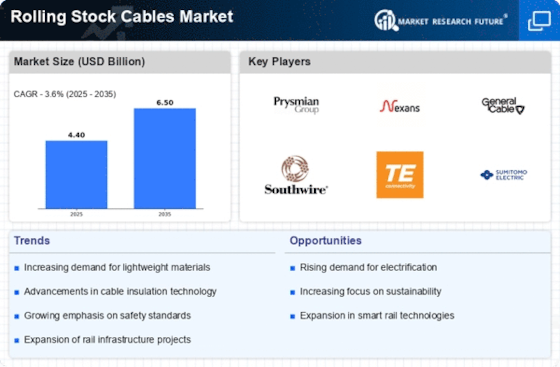
As per Market Research Future analysis, the Rolling Stock Cables Market Size was estimated at 4.403 USD Billion in 2024. The Rolling Stock Cables industry is projected to grow from 4.562 USD Billion in 2025 to 6.498 USD Billion by 2035, exhibiting a compound annual growth rate (CAGR) of 3.6% during the forecast period 2025 - 2035

Key Market Trends & Highlights

The Rolling Stock Cables Market is poised for growth driven by technological advancements and increasing electrification demands.

  • Technological advancements are reshaping the Rolling Stock Cables Market, enhancing performance and reliability. North America remains the largest market, while Asia-Pacific is emerging as the fastest-growing region in this sector. The Standard Wall segment holds the largest market share, whereas the Medium Wall segment is witnessing rapid growth. Key drivers include the increasing demand for electrification and the expansion of rail infrastructure, which are propelling market dynamics.

Market Size & Forecast

2024 Market Size 4.403 (USD Billion)
2035 Market Size 6.498 (USD Billion)
CAGR (2025 - 2035) 3.6%
Largest Regional Market Share in 2024 North America

Major Players

Prysmian Group (IT), Nexans (FR), General Cable (US), Southwire Company (US), TE Connectivity (CH), Sumitomo Electric Industries (JP), LS Cable &amp; System (KR), Kabelwerk Eupen AG (DE), Furukawa Electric Co., Ltd. (JP)

Market Trends

The Rolling Stock Cables Market is currently experiencing a transformative phase, driven by advancements in technology and increasing demand for efficient rail transport systems. The integration of smart technologies into rolling stock is reshaping the landscape, as manufacturers seek to enhance performance and reliability. This shift is accompanied by a growing emphasis on sustainability, with stakeholders prioritizing eco-friendly materials and production processes. As rail networks expand globally, the need for high-quality cables that can withstand harsh environments becomes paramount, indicating a robust future for this sector. Moreover, the market appears to be influenced by regulatory frameworks that promote safety and efficiency in rail operations. Governments are investing in infrastructure upgrades, which may lead to increased procurement of specialized cables designed for rolling stock applications. The focus on reducing maintenance costs and improving operational efficiency suggests that innovation will play a crucial role in shaping market dynamics. Overall, the Rolling Stock Cables Market is poised for growth, with various factors converging to create a favorable environment for development and investment in this essential component of rail transport.

Technological Advancements

The Rolling Stock Cables Market is witnessing a surge in technological innovations, particularly in the development of smart cables. These advanced products are designed to enhance communication and monitoring capabilities within rolling stock, thereby improving overall operational efficiency.

Sustainability Initiatives

There is a notable trend towards sustainability within the Rolling Stock Cables Market, as manufacturers increasingly adopt eco-friendly materials and practices. This shift not only addresses environmental concerns but also aligns with global efforts to reduce carbon footprints in transportation.

Regulatory Compliance

The market is also shaped by stringent regulatory requirements aimed at ensuring safety and reliability in rail systems. Compliance with these regulations necessitates the use of high-quality cables, which may drive demand for specialized products tailored to meet these standards.

Rolling Stock Cables Market Market Drivers

Expansion of Rail Infrastructure

The ongoing expansion of rail infrastructure is significantly influencing the Rolling Stock Cables Market. Governments and private entities are investing heavily in upgrading and expanding rail networks to accommodate increasing passenger and freight traffic. This expansion often involves the introduction of new rolling stock, which in turn drives the demand for high-quality cables designed for durability and performance. Recent reports indicate that investments in rail infrastructure are expected to reach several billion dollars annually, creating a robust market for rolling stock cables. As new projects are initiated, the need for reliable and efficient cable solutions becomes paramount, further propelling market growth.

Growing Focus on Safety Standards

The increasing emphasis on safety standards within the transportation sector is a crucial driver for the Rolling Stock Cables Market. Regulatory bodies are implementing stringent safety regulations to ensure the reliability and performance of rolling stock. This focus on safety necessitates the use of high-quality cables that meet or exceed these standards. Manufacturers are compelled to invest in research and development to create cables that not only comply with regulations but also enhance the overall safety of rail systems. As safety becomes a priority, the demand for specialized rolling stock cables is expected to rise, fostering market growth.

Increasing Demand for Electrification

The rising demand for electrification in the transportation sector is a pivotal driver for the Rolling Stock Cables Market. As countries strive to reduce carbon emissions and enhance energy efficiency, the shift towards electric trains and trams is becoming more pronounced. This transition necessitates the use of specialized cables that can withstand high voltage and ensure safety. According to recent data, the electrification of rail networks is projected to grow at a compound annual growth rate of approximately 5% over the next decade. This trend not only boosts the demand for rolling stock cables but also encourages manufacturers to innovate and develop more efficient products tailored to the needs of electric rolling stock.

Rise of Urbanization and Public Transport

The rise of urbanization and the corresponding increase in public transport initiatives are significantly impacting the Rolling Stock Cables Market. As urban populations grow, cities are investing in efficient public transport systems, including rail networks. This trend is driving the demand for new rolling stock, which requires advanced cable solutions. Recent statistics suggest that urban rail systems are experiencing a surge in ridership, prompting the need for reliable and durable cables that can support increased operational demands. Consequently, the market for rolling stock cables is likely to expand as cities prioritize sustainable and efficient public transport solutions.

Technological Innovations in Cable Manufacturing

Technological innovations in cable manufacturing are reshaping the Rolling Stock Cables Market. Advances in materials science and engineering have led to the development of cables that are lighter, more flexible, and capable of withstanding extreme conditions. Innovations such as the use of composite materials and improved insulation techniques enhance the performance and longevity of rolling stock cables. As manufacturers adopt these technologies, they are likely to meet the evolving demands of modern rail systems. The market is witnessing a shift towards smart cables equipped with sensors that monitor performance and detect faults, thereby improving safety and operational efficiency.

Market Segment Insights

By Type: Standard Wall (Largest) vs. Medium Wall (Fastest-Growing)

<p>In the Rolling Stock Cables Market, the Standard Wall segment holds the largest market share, owing to its established role in various rail applications. This segment is favored for its robust performance and reliability in challenging environments, making it the preferred choice for many manufacturers. The Medium Wall segment, while smaller in share, is rapidly gaining traction due to its favorable balance of weight and insulation properties, appealing to an increasing number of rail operators looking to enhance efficiency and reduce costs. The growth trends in the rolling stock cables industry indicate a shift towards lighter materials that still meet stringent safety standards. The rising adoption of lightweight rolling stock solutions is driving demand for Medium Wall cables, presenting substantial growth opportunities. Innovations in cable technology are tailing efforts to improve performance and adaptability in diverse operational conditions, supporting the expansion of this segment over the forecast period.</p>

<p>Standard Wall: Dominant vs. Medium Wall: Emerging</p>

<p>The Standard Wall cables are recognized for their robustness and ability to withstand harsh conditions, making them the dominant choice for conventional rolling stock applications. Their thick insulation layer offers excellent protection against mechanical stress and environmental factors. Conversely, the Medium Wall cables are emerging as a popular alternative, appealing to manufacturers focused on weight reduction without compromising safety or functionality. This segment is especially attractive for modernizing fleets, as it allows for improved energy efficiency and reduced overall costs. As railway companies increasingly prioritize sustainability and performance, the Medium Wall cables are positioned for significant growth.</p>

By Application: Train (Largest) vs. Subway (Fastest-Growing)

<p>In the Rolling Stock Cables Market, the application segment is primarily dominated by the Train category. This segment captures a significant portion of the market share, reflecting its central role in transportation and logistics. Conversely, the Subway category has emerged as an equally crucial part of the market, reflecting urbanization trends and increasing investments in public transportation systems. Other applications classified under 'Others' encompass various cable applications in niche markets, but they remain less influential compared to Train and Subway applications.</p>

<p>Subway (Emerging) vs. Train (Dominant)</p>

<p>The Train application represents the dominant force in the Rolling Stock Cables Market, characterized by its reliance on robust, high-performance cables that ensure the safety and efficiency of rail networks. Trains demand durable cables capable of withstanding harsh environmental conditions, which accentuates their market strength. In contrast, the Subway segment is rapidly emerging, driven by urban expansion and the rising focus on sustainable public transport solutions. With increasing investment from city planners and governments, Subway applications are harnessing advanced materials and technology to enhance performance and reliability, making them a notable contender in the market.</p>

Get more detailed insights about Rolling Stock Cables Market Research Report—Global Forecast till 2035

Regional Insights

North America : Innovation and Infrastructure Growth

North America is witnessing robust growth in the rolling stock cables market, driven by increasing investments in rail infrastructure and modernization projects. The region holds approximately 40% of the global market share, making it the largest market. Regulatory support for sustainable transport solutions and safety standards further catalyzes demand, particularly in the U.S. and Canada, which are the leading countries in this sector. The competitive landscape is characterized by the presence of major players such as General Cable and Southwire Company, alongside international firms like Prysmian Group and Nexans. These companies are focusing on innovation and technology to enhance product offerings. The U.S. market is particularly strong due to its extensive rail network and ongoing upgrades, while Canada is also investing heavily in rail transport, contributing to the overall market growth.

Europe : Sustainability and Innovation Focus

Europe is emerging as a significant player in the rolling stock cables market, driven by stringent regulations on sustainability and safety. The region accounts for approximately 30% of the global market share, making it the second-largest market. The European Union's commitment to reducing carbon emissions and enhancing rail transport efficiency is a key driver of demand. Countries like Germany and France are leading the charge, supported by government initiatives and funding for rail infrastructure projects. The competitive landscape in Europe is marked by key players such as Nexans and Prysmian Group, which are investing in innovative solutions to meet regulatory requirements. The presence of advanced manufacturing facilities and a skilled workforce further strengthens the market. Additionally, collaborations between governments and private sectors are fostering growth, ensuring that Europe remains at the forefront of rolling stock cable technology.

Asia-Pacific : Rapid Urbanization and Growth

The Asia-Pacific region is experiencing rapid growth in the rolling stock cables market, fueled by urbanization and increasing investments in rail infrastructure. This region holds approximately 25% of the global market share, with countries like China and India leading the way. Government initiatives to expand public transport networks and improve rail safety standards are significant growth drivers, creating a favorable environment for market expansion. China is the largest market in the region, with substantial investments in high-speed rail and urban transit systems. India follows closely, focusing on modernizing its railway infrastructure. The competitive landscape features key players such as Sumitomo Electric Industries and LS Cable & System, which are actively involved in supplying advanced cable solutions. The growing demand for efficient and reliable rail transport is expected to further boost market growth in this region.

Middle East and Africa : Emerging Markets and Infrastructure Needs

The Middle East and Africa region is witnessing emerging opportunities in the rolling stock cables market, driven by infrastructure development and urbanization. This region holds approximately 5% of the global market share, with countries like South Africa and the UAE leading the way. Government investments in rail projects and public transport systems are key growth drivers, supported by international funding and partnerships. South Africa is focusing on modernizing its rail network, while the UAE is investing heavily in expanding its metro systems. The competitive landscape includes local and international players, with companies like Kabelwerk Eupen AG and Furukawa Electric Co., Ltd. making significant inroads. The region's growing need for efficient transport solutions presents substantial opportunities for market players to expand their presence and offerings.

Key Players and Competitive Insights

Leading market players are putting a lot of money on R&D to broaden their product ranges, which will help the market for rolling stock cables grow even more. Additionally, market participants are engaging in a range of strategic initiatives to increase their worldwide reach, with important market developments such as the introduction of new products, contracts, mergers and acquisitions, increased investments, and cooperation with other businesses. to grow and endure in an increasingly competitive and challenging market environment, Rolling Stock Cables industry must provide reasonably priced goods.
One of the main business strategies employed by manufacturers is to produce locally to reduce operational expenses in the global Rolling Stock Cables industry to develop market sector and provide benefits to customers. In recent years, the Rolling Stock Cables industry has provided the transportation sector with some of the most significant benefits. Major players in the Rolling Stock Cables Market, including Caledonian Cables, PRYSMIAN GROUP, Eugania Rail Pacific, Electric Fever, NEXANS, ATL Technology, Prysmian, Tratos, Hengfei Cable, Siechem, and others, invest in operations for research and development in an effort to improve market demand.
Prysmian S.p.A. is a global corporation with its headquarters in Milan that specializes in the creation of electrical cable for use in the telecom, energy, and optical fiber industries. Prysmian has 23 plants in North America, 48 in Europe, 13 in LATAM, 7 in the meat industry, and 13 in Asia. It is the market leader for making cables for wind farms. The business is included in the FTSE MIB index and is traded on the Milan Stock Exchange.
Prysmian intends to invest about EUR 450 million by 2022 in order to achieve net-zero CO2 emissions for the Group and enhance the sustainability of its supply chain.
Caledonian Cables Ltd. is a maker of electric cables, which has received ISO 9001 certification. Eighty percent of the products made globally by the Caledonian Cable Group are exported to more than 60 different nations. Their area of expertise is the production of several cables. Armoured, non-armoured, underwater, and overhead cables are made in accordance with international quality requirements, or they can be made of composite material per the customer's specifications and, if necessary, with the addition of other services. In 2019, EDPR and ENGIE formed OW by combining their offshore wind project pipeline and assets.
At that time, the business had 1.5 GW under construction and 4.0 GW in development.

Key Companies in the Rolling Stock Cables Market include

Industry Developments

March 2021: Nexans strengthened its long-standing cooperation along RATP (the state-owned operator of the Paris public transportation networks) by gaining a two-year contract to offer specialist railway cables and logistical services to boost fire safety.

December 2020: Hitachi Cable America (HCA), a top producer of Premise, Fiber Optic, and Specialty cables, has added a new cooperation with Power Experts Group in Canada.

July 2020: Leoni, a global provider of solutions for power and data management in the automotive, railroad, and other industries, has developed two new cables. Leoni is now the first cable maker to release these cables on the market in the entire world.

Future Outlook

Rolling Stock Cables Market Future Outlook

The Rolling Stock Cables Market is projected to grow at a 3.6% CAGR from 2025 to 2035, driven by technological advancements, increased rail infrastructure investments, and rising demand for energy-efficient solutions.

New opportunities lie in:

  • Development of high-performance, lightweight cable materials for enhanced efficiency.
  • Integration of smart monitoring systems for predictive maintenance in rolling stock.
  • Expansion into emerging markets with tailored cable solutions for local rail networks.

By 2035, the market is expected to achieve robust growth, positioning itself as a leader in the transportation sector.

Market Segmentation

Rolling Stock Cables Market Type Outlook

  • Standard Wall
  • Medium Wall
  • Thin Wall

Rolling Stock Cables Market Application Outlook

  • Subway
  • Train
  • Others

Report Scope

MARKET SIZE 2024 4.403(USD Billion)
MARKET SIZE 2025 4.562(USD Billion)
MARKET SIZE 2035 6.498(USD Billion)
COMPOUND ANNUAL GROWTH RATE (CAGR) 3.6% (2025 - 2035)
REPORT COVERAGE Revenue Forecast, Competitive Landscape, Growth Factors, and Trends
BASE YEAR 2024
Market Forecast Period 2025 - 2035
Historical Data 2019 - 2024
Market Forecast Units USD Billion
Key Companies Profiled Prysmian Group (IT), Nexans (FR), General Cable (US), Southwire Company (US), TE Connectivity (CH), Sumitomo Electric Industries (JP), LS Cable & System (KR), Kabelwerk Eupen AG (DE), Furukawa Electric Co., Ltd. (JP)
Segments Covered Type, Application, Region
Key Market Opportunities Integration of advanced materials enhances performance and safety in the Rolling Stock Cables Market.
Key Market Dynamics Rising demand for lightweight, durable materials drives innovation in rolling stock cable technology and manufacturing processes.
Countries Covered North America, Europe, APAC, South America, MEA

FAQs

What is the current valuation of the Rolling Stock Cables Market?

<p>The market valuation was 4.403 USD Billion in 2024.</p>

What is the projected market size for the Rolling Stock Cables Market in 2035?

<p>The projected valuation for 2035 is 6.498 USD Billion.</p>

What is the expected CAGR for the Rolling Stock Cables Market from 2025 to 2035?

<p>The expected CAGR during the forecast period is 3.6%.</p>

Which companies are considered key players in the Rolling Stock Cables Market?

<p>Key players include Prysmian Group, Nexans, General Cable, and Southwire Company.</p>

What are the main segments of the Rolling Stock Cables Market?

<p>The main segments are categorized by type and application.</p>

What are the valuation figures for the different types of Rolling Stock Cables?

<p>Valuations for types include Standard Wall at 1.5 to 2.2 USD Billion, Medium Wall at 1.2 to 1.8 USD Billion, and Thin Wall at 1.703 to 2.498 USD Billion.</p>

How does the application segment of the Rolling Stock Cables Market perform?

The application segment includes Subway at 1.1 to 1.6 USD Billion, Train at 2.5 to 3.5 USD Billion, and Others at 0.8 to 1.4 USD Billion.

What trends are influencing the growth of the Rolling Stock Cables Market?

Trends include increasing demand for efficient transportation solutions and advancements in cable technology.

How does the performance of the Train application compare to others in the market?

The Train application shows the highest valuation, ranging from 2.5 to 3.5 USD Billion.

What factors could impact the future growth of the Rolling Stock Cables Market?

Factors may include technological advancements, regulatory changes, and shifts in transportation infrastructure investments.

  1. SECTION I: EXECUTIVE SUMMARY AND KEY HIGHLIGHTS
    1. | 1.1 EXECUTIVE SUMMARY
    2. | | 1.1.1 Market Overview
    3. | | 1.1.2 Key Findings
    4. | | 1.1.3 Market Segmentation
    5. | | 1.1.4 Competitive Landscape
    6. | | 1.1.5 Challenges and Opportunities
    7. | | 1.1.6 Future Outlook
  2. SECTION II: SCOPING, METHODOLOGY AND MARKET STRUCTURE
    1. | 2.1 MARKET INTRODUCTION
    2. | | 2.1.1 Definition
    3. | | 2.1.2 Scope of the study
    4. | | | 2.1.2.1 Research Objective
    5. | | | 2.1.2.2 Assumption
    6. | | | 2.1.2.3 Limitations
    7. | 2.2 RESEARCH METHODOLOGY
    8. | | 2.2.1 Overview
    9. | | 2.2.2 Data Mining
    10. | | 2.2.3 Secondary Research
    11. | | 2.2.4 Primary Research
    12. | | | 2.2.4.1 Primary Interviews and Information Gathering Process
    13. | | | 2.2.4.2 Breakdown of Primary Respondents
    14. | | 2.2.5 Forecasting Model
    15. | | 2.2.6 Market Size Estimation
    16. | | | 2.2.6.1 Bottom-Up Approach
    17. | | | 2.2.6.2 Top-Down Approach
    18. | | 2.2.7 Data Triangulation
    19. | | 2.2.8 Validation
  3. SECTION III: QUALITATIVE ANALYSIS
    1. | 3.1 MARKET DYNAMICS
    2. | | 3.1.1 Overview
    3. | | 3.1.2 Drivers
    4. | | 3.1.3 Restraints
    5. | | 3.1.4 Opportunities
    6. | 3.2 MARKET FACTOR ANALYSIS
    7. | | 3.2.1 Value chain Analysis
    8. | | 3.2.2 Porter's Five Forces Analysis
    9. | | | 3.2.2.1 Bargaining Power of Suppliers
    10. | | | 3.2.2.2 Bargaining Power of Buyers
    11. | | | 3.2.2.3 Threat of New Entrants
    12. | | | 3.2.2.4 Threat of Substitutes
    13. | | | 3.2.2.5 Intensity of Rivalry
    14. | | 3.2.3 COVID-19 Impact Analysis
    15. | | | 3.2.3.1 Market Impact Analysis
    16. | | | 3.2.3.2 Regional Impact
    17. | | | 3.2.3.3 Opportunity and Threat Analysis
  4. SECTION IV: QUANTITATIVE ANALYSIS
    1. | 4.1 Semiconductor & Electronics, BY Type (USD Billion)
    2. | | 4.1.1 Standard Wall
    3. | | 4.1.2 Medium Wall
    4. | | 4.1.3 Thin Wall
    5. | 4.2 Semiconductor & Electronics, BY Application (USD Billion)
    6. | | 4.2.1 Subway
    7. | | 4.2.2 Train
    8. | | 4.2.3 Others
    9. | 4.3 Semiconductor & Electronics, BY Region (USD Billion)
    10. | | 4.3.1 North America
    11. | | | 4.3.1.1 US
    12. | | | 4.3.1.2 Canada
    13. | | 4.3.2 Europe
    14. | | | 4.3.2.1 Germany
    15. | | | 4.3.2.2 UK
    16. | | | 4.3.2.3 France
    17. | | | 4.3.2.4 Russia
    18. | | | 4.3.2.5 Italy
    19. | | | 4.3.2.6 Spain
    20. | | | 4.3.2.7 Rest of Europe
    21. | | 4.3.3 APAC
    22. | | | 4.3.3.1 China
    23. | | | 4.3.3.2 India
    24. | | | 4.3.3.3 Japan
    25. | | | 4.3.3.4 South Korea
    26. | | | 4.3.3.5 Malaysia
    27. | | | 4.3.3.6 Thailand
    28. | | | 4.3.3.7 Indonesia
    29. | | | 4.3.3.8 Rest of APAC
    30. | | 4.3.4 South America
    31. | | | 4.3.4.1 Brazil
    32. | | | 4.3.4.2 Mexico
    33. | | | 4.3.4.3 Argentina
    34. | | | 4.3.4.4 Rest of South America
    35. | | 4.3.5 MEA
    36. | | | 4.3.5.1 GCC Countries
    37. | | | 4.3.5.2 South Africa
    38. | | | 4.3.5.3 Rest of MEA
  5. SECTION V: COMPETITIVE ANALYSIS
    1. | 5.1 Competitive Landscape
    2. | | 5.1.1 Overview
    3. | | 5.1.2 Competitive Analysis
    4. | | 5.1.3 Market share Analysis
    5. | | 5.1.4 Major Growth Strategy in the Semiconductor & Electronics
    6. | | 5.1.5 Competitive Benchmarking
    7. | | 5.1.6 Leading Players in Terms of Number of Developments in the Semiconductor & Electronics
    8. | | 5.1.7 Key developments and growth strategies
    9. | | | 5.1.7.1 New Product Launch/Service Deployment
    10. | | | 5.1.7.2 Merger & Acquisitions
    11. | | | 5.1.7.3 Joint Ventures
    12. | | 5.1.8 Major Players Financial Matrix
    13. | | | 5.1.8.1 Sales and Operating Income
    14. | | | 5.1.8.2 Major Players R&D Expenditure. 2023
    15. | 5.2 Company Profiles
    16. | | 5.2.1 Prysmian Group (IT)
    17. | | | 5.2.1.1 Financial Overview
    18. | | | 5.2.1.2 Products Offered
    19. | | | 5.2.1.3 Key Developments
    20. | | | 5.2.1.4 SWOT Analysis
    21. | | | 5.2.1.5 Key Strategies
    22. | | 5.2.2 Nexans (FR)
    23. | | | 5.2.2.1 Financial Overview
    24. | | | 5.2.2.2 Products Offered
    25. | | | 5.2.2.3 Key Developments
    26. | | | 5.2.2.4 SWOT Analysis
    27. | | | 5.2.2.5 Key Strategies
    28. | | 5.2.3 General Cable (US)
    29. | | | 5.2.3.1 Financial Overview
    30. | | | 5.2.3.2 Products Offered
    31. | | | 5.2.3.3 Key Developments
    32. | | | 5.2.3.4 SWOT Analysis
    33. | | | 5.2.3.5 Key Strategies
    34. | | 5.2.4 Southwire Company (US)
    35. | | | 5.2.4.1 Financial Overview
    36. | | | 5.2.4.2 Products Offered
    37. | | | 5.2.4.3 Key Developments
    38. | | | 5.2.4.4 SWOT Analysis
    39. | | | 5.2.4.5 Key Strategies
    40. | | 5.2.5 TE Connectivity (CH)
    41. | | | 5.2.5.1 Financial Overview
    42. | | | 5.2.5.2 Products Offered
    43. | | | 5.2.5.3 Key Developments
    44. | | | 5.2.5.4 SWOT Analysis
    45. | | | 5.2.5.5 Key Strategies
    46. | | 5.2.6 Sumitomo Electric Industries (JP)
    47. | | | 5.2.6.1 Financial Overview
    48. | | | 5.2.6.2 Products Offered
    49. | | | 5.2.6.3 Key Developments
    50. | | | 5.2.6.4 SWOT Analysis
    51. | | | 5.2.6.5 Key Strategies
    52. | | 5.2.7 LS Cable & System (KR)
    53. | | | 5.2.7.1 Financial Overview
    54. | | | 5.2.7.2 Products Offered
    55. | | | 5.2.7.3 Key Developments
    56. | | | 5.2.7.4 SWOT Analysis
    57. | | | 5.2.7.5 Key Strategies
    58. | | 5.2.8 Kabelwerk Eupen AG (DE)
    59. | | | 5.2.8.1 Financial Overview
    60. | | | 5.2.8.2 Products Offered
    61. | | | 5.2.8.3 Key Developments
    62. | | | 5.2.8.4 SWOT Analysis
    63. | | | 5.2.8.5 Key Strategies
    64. | | 5.2.9 Furukawa Electric Co., Ltd. (JP)
    65. | | | 5.2.9.1 Financial Overview
    66. | | | 5.2.9.2 Products Offered
    67. | | | 5.2.9.3 Key Developments
    68. | | | 5.2.9.4 SWOT Analysis
    69. | | | 5.2.9.5 Key Strategies
    70. | 5.3 Appendix
    71. | | 5.3.1 References
    72. | | 5.3.2 Related Reports
  6. LIST OF FIGURES
    1. | 6.1 MARKET SYNOPSIS
    2. | 6.2 NORTH AMERICA MARKET ANALYSIS
    3. | 6.3 US MARKET ANALYSIS BY TYPE
    4. | 6.4 US MARKET ANALYSIS BY APPLICATION
    5. | 6.5 CANADA MARKET ANALYSIS BY TYPE
    6. | 6.6 CANADA MARKET ANALYSIS BY APPLICATION
    7. | 6.7 EUROPE MARKET ANALYSIS
    8. | 6.8 GERMANY MARKET ANALYSIS BY TYPE
    9. | 6.9 GERMANY MARKET ANALYSIS BY APPLICATION
    10. | 6.10 UK MARKET ANALYSIS BY TYPE
    11. | 6.11 UK MARKET ANALYSIS BY APPLICATION
    12. | 6.12 FRANCE MARKET ANALYSIS BY TYPE
    13. | 6.13 FRANCE MARKET ANALYSIS BY APPLICATION
    14. | 6.14 RUSSIA MARKET ANALYSIS BY TYPE
    15. | 6.15 RUSSIA MARKET ANALYSIS BY APPLICATION
    16. | 6.16 ITALY MARKET ANALYSIS BY TYPE
    17. | 6.17 ITALY MARKET ANALYSIS BY APPLICATION
    18. | 6.18 SPAIN MARKET ANALYSIS BY TYPE
    19. | 6.19 SPAIN MARKET ANALYSIS BY APPLICATION
    20. | 6.20 REST OF EUROPE MARKET ANALYSIS BY TYPE
    21. | 6.21 REST OF EUROPE MARKET ANALYSIS BY APPLICATION
    22. | 6.22 APAC MARKET ANALYSIS
    23. | 6.23 CHINA MARKET ANALYSIS BY TYPE
    24. | 6.24 CHINA MARKET ANALYSIS BY APPLICATION
    25. | 6.25 INDIA MARKET ANALYSIS BY TYPE
    26. | 6.26 INDIA MARKET ANALYSIS BY APPLICATION
    27. | 6.27 JAPAN MARKET ANALYSIS BY TYPE
    28. | 6.28 JAPAN MARKET ANALYSIS BY APPLICATION
    29. | 6.29 SOUTH KOREA MARKET ANALYSIS BY TYPE
    30. | 6.30 SOUTH KOREA MARKET ANALYSIS BY APPLICATION
    31. | 6.31 MALAYSIA MARKET ANALYSIS BY TYPE
    32. | 6.32 MALAYSIA MARKET ANALYSIS BY APPLICATION
    33. | 6.33 THAILAND MARKET ANALYSIS BY TYPE
    34. | 6.34 THAILAND MARKET ANALYSIS BY APPLICATION
    35. | 6.35 INDONESIA MARKET ANALYSIS BY TYPE
    36. | 6.36 INDONESIA MARKET ANALYSIS BY APPLICATION
    37. | 6.37 REST OF APAC MARKET ANALYSIS BY TYPE
    38. | 6.38 REST OF APAC MARKET ANALYSIS BY APPLICATION
    39. | 6.39 SOUTH AMERICA MARKET ANALYSIS
    40. | 6.40 BRAZIL MARKET ANALYSIS BY TYPE
    41. | 6.41 BRAZIL MARKET ANALYSIS BY APPLICATION
    42. | 6.42 MEXICO MARKET ANALYSIS BY TYPE
    43. | 6.43 MEXICO MARKET ANALYSIS BY APPLICATION
    44. | 6.44 ARGENTINA MARKET ANALYSIS BY TYPE
    45. | 6.45 ARGENTINA MARKET ANALYSIS BY APPLICATION
    46. | 6.46 REST OF SOUTH AMERICA MARKET ANALYSIS BY TYPE
    47. | 6.47 REST OF SOUTH AMERICA MARKET ANALYSIS BY APPLICATION
    48. | 6.48 MEA MARKET ANALYSIS
    49. | 6.49 GCC COUNTRIES MARKET ANALYSIS BY TYPE
    50. | 6.50 GCC COUNTRIES MARKET ANALYSIS BY APPLICATION
    51. | 6.51 SOUTH AFRICA MARKET ANALYSIS BY TYPE
    52. | 6.52 SOUTH AFRICA MARKET ANALYSIS BY APPLICATION
    53. | 6.53 REST OF MEA MARKET ANALYSIS BY TYPE
    54. | 6.54 REST OF MEA MARKET ANALYSIS BY APPLICATION
    55. | 6.55 KEY BUYING CRITERIA OF SEMICONDUCTOR & ELECTRONICS
    56. | 6.56 RESEARCH PROCESS OF MRFR
    57. | 6.57 DRO ANALYSIS OF SEMICONDUCTOR & ELECTRONICS
    58. | 6.58 DRIVERS IMPACT ANALYSIS: SEMICONDUCTOR & ELECTRONICS
    59. | 6.59 RESTRAINTS IMPACT ANALYSIS: SEMICONDUCTOR & ELECTRONICS
    60. | 6.60 SUPPLY / VALUE CHAIN: SEMICONDUCTOR & ELECTRONICS
    61. | 6.61 SEMICONDUCTOR & ELECTRONICS, BY TYPE, 2024 (% SHARE)
    62. | 6.62 SEMICONDUCTOR & ELECTRONICS, BY TYPE, 2024 TO 2035 (USD Billion)
    63. | 6.63 SEMICONDUCTOR & ELECTRONICS, BY APPLICATION, 2024 (% SHARE)
    64. | 6.64 SEMICONDUCTOR & ELECTRONICS, BY APPLICATION, 2024 TO 2035 (USD Billion)
    65. | 6.65 BENCHMARKING OF MAJOR COMPETITORS
  7. LIST OF TABLES
    1. | 7.1 LIST OF ASSUMPTIONS
    2. | | 7.1.1
    3. | 7.2 North America MARKET SIZE ESTIMATES; FORECAST
    4. | | 7.2.1 BY TYPE, 2025-2035 (USD Billion)
    5. | | 7.2.2 BY APPLICATION, 2025-2035 (USD Billion)
    6. | 7.3 US MARKET SIZE ESTIMATES; FORECAST
    7. | | 7.3.1 BY TYPE, 2025-2035 (USD Billion)
    8. | | 7.3.2 BY APPLICATION, 2025-2035 (USD Billion)
    9. | 7.4 Canada MARKET SIZE ESTIMATES; FORECAST
    10. | | 7.4.1 BY TYPE, 2025-2035 (USD Billion)
    11. | | 7.4.2 BY APPLICATION, 2025-2035 (USD Billion)
    12. | 7.5 Europe MARKET SIZE ESTIMATES; FORECAST
    13. | | 7.5.1 BY TYPE, 2025-2035 (USD Billion)
    14. | | 7.5.2 BY APPLICATION, 2025-2035 (USD Billion)
    15. | 7.6 Germany MARKET SIZE ESTIMATES; FORECAST
    16. | | 7.6.1 BY TYPE, 2025-2035 (USD Billion)
    17. | | 7.6.2 BY APPLICATION, 2025-2035 (USD Billion)
    18. | 7.7 UK MARKET SIZE ESTIMATES; FORECAST
    19. | | 7.7.1 BY TYPE, 2025-2035 (USD Billion)
    20. | | 7.7.2 BY APPLICATION, 2025-2035 (USD Billion)
    21. | 7.8 France MARKET SIZE ESTIMATES; FORECAST
    22. | | 7.8.1 BY TYPE, 2025-2035 (USD Billion)
    23. | | 7.8.2 BY APPLICATION, 2025-2035 (USD Billion)
    24. | 7.9 Russia MARKET SIZE ESTIMATES; FORECAST
    25. | | 7.9.1 BY TYPE, 2025-2035 (USD Billion)
    26. | | 7.9.2 BY APPLICATION, 2025-2035 (USD Billion)
    27. | 7.10 Italy MARKET SIZE ESTIMATES; FORECAST
    28. | | 7.10.1 BY TYPE, 2025-2035 (USD Billion)
    29. | | 7.10.2 BY APPLICATION, 2025-2035 (USD Billion)
    30. | 7.11 Spain MARKET SIZE ESTIMATES; FORECAST
    31. | | 7.11.1 BY TYPE, 2025-2035 (USD Billion)
    32. | | 7.11.2 BY APPLICATION, 2025-2035 (USD Billion)
    33. | 7.12 Rest of Europe MARKET SIZE ESTIMATES; FORECAST
    34. | | 7.12.1 BY TYPE, 2025-2035 (USD Billion)
    35. | | 7.12.2 BY APPLICATION, 2025-2035 (USD Billion)
    36. | 7.13 APAC MARKET SIZE ESTIMATES; FORECAST
    37. | | 7.13.1 BY TYPE, 2025-2035 (USD Billion)
    38. | | 7.13.2 BY APPLICATION, 2025-2035 (USD Billion)
    39. | 7.14 China MARKET SIZE ESTIMATES; FORECAST
    40. | | 7.14.1 BY TYPE, 2025-2035 (USD Billion)
    41. | | 7.14.2 BY APPLICATION, 2025-2035 (USD Billion)
    42. | 7.15 India MARKET SIZE ESTIMATES; FORECAST
    43. | | 7.15.1 BY TYPE, 2025-2035 (USD Billion)
    44. | | 7.15.2 BY APPLICATION, 2025-2035 (USD Billion)
    45. | 7.16 Japan MARKET SIZE ESTIMATES; FORECAST
    46. | | 7.16.1 BY TYPE, 2025-2035 (USD Billion)
    47. | | 7.16.2 BY APPLICATION, 2025-2035 (USD Billion)
    48. | 7.17 South Korea MARKET SIZE ESTIMATES; FORECAST
    49. | | 7.17.1 BY TYPE, 2025-2035 (USD Billion)
    50. | | 7.17.2 BY APPLICATION, 2025-2035 (USD Billion)
    51. | 7.18 Malaysia MARKET SIZE ESTIMATES; FORECAST
    52. | | 7.18.1 BY TYPE, 2025-2035 (USD Billion)
    53. | | 7.18.2 BY APPLICATION, 2025-2035 (USD Billion)
    54. | 7.19 Thailand MARKET SIZE ESTIMATES; FORECAST
    55. | | 7.19.1 BY TYPE, 2025-2035 (USD Billion)
    56. | | 7.19.2 BY APPLICATION, 2025-2035 (USD Billion)
    57. | 7.20 Indonesia MARKET SIZE ESTIMATES; FORECAST
    58. | | 7.20.1 BY TYPE, 2025-2035 (USD Billion)
    59. | | 7.20.2 BY APPLICATION, 2025-2035 (USD Billion)
    60. | 7.21 Rest of APAC MARKET SIZE ESTIMATES; FORECAST
    61. | | 7.21.1 BY TYPE, 2025-2035 (USD Billion)
    62. | | 7.21.2 BY APPLICATION, 2025-2035 (USD Billion)
    63. | 7.22 South America MARKET SIZE ESTIMATES; FORECAST
    64. | | 7.22.1 BY TYPE, 2025-2035 (USD Billion)
    65. | | 7.22.2 BY APPLICATION, 2025-2035 (USD Billion)
    66. | 7.23 Brazil MARKET SIZE ESTIMATES; FORECAST
    67. | | 7.23.1 BY TYPE, 2025-2035 (USD Billion)
    68. | | 7.23.2 BY APPLICATION, 2025-2035 (USD Billion)
    69. | 7.24 Mexico MARKET SIZE ESTIMATES; FORECAST
    70. | | 7.24.1 BY TYPE, 2025-2035 (USD Billion)
    71. | | 7.24.2 BY APPLICATION, 2025-2035 (USD Billion)
    72. | 7.25 Argentina MARKET SIZE ESTIMATES; FORECAST
    73. | | 7.25.1 BY TYPE, 2025-2035 (USD Billion)
    74. | | 7.25.2 BY APPLICATION, 2025-2035 (USD Billion)
    75. | 7.26 Rest of South America MARKET SIZE ESTIMATES; FORECAST
    76. | | 7.26.1 BY TYPE, 2025-2035 (USD Billion)
    77. | | 7.26.2 BY APPLICATION, 2025-2035 (USD Billion)
    78. | 7.27 MEA MARKET SIZE ESTIMATES; FORECAST
    79. | | 7.27.1 BY TYPE, 2025-2035 (USD Billion)
    80. | | 7.27.2 BY APPLICATION, 2025-2035 (USD Billion)
    81. | 7.28 GCC Countries MARKET SIZE ESTIMATES; FORECAST
    82. | | 7.28.1 BY TYPE, 2025-2035 (USD Billion)
    83. | | 7.28.2 BY APPLICATION, 2025-2035 (USD Billion)
    84. | 7.29 South Africa MARKET SIZE ESTIMATES; FORECAST
    85. | | 7.29.1 BY TYPE, 2025-2035 (USD Billion)
    86. | | 7.29.2 BY APPLICATION, 2025-2035 (USD Billion)
    87. | 7.30 Rest of MEA MARKET SIZE ESTIMATES; FORECAST
    88. | | 7.30.1 BY TYPE, 2025-2035 (USD Billion)
    89. | | 7.30.2 BY APPLICATION, 2025-2035 (USD Billion)
    90. | 7.31 PRODUCT LAUNCH/PRODUCT DEVELOPMENT/APPROVAL
    91. | | 7.31.1
    92. | 7.32 ACQUISITION/PARTNERSHIP
    93. | | 7.32.1

Semiconductor & Electronics Market Segmentation

Semiconductor & Electronics By Type (USD Billion, 2025-2035)

  • Standard Wall
  • Medium Wall
  • Thin Wall

Semiconductor & Electronics By Application (USD Billion, 2025-2035)

  • Subway
  • Train
  • Others
Infographic

Free Sample Request

Kindly complete the form below to receive a free sample of this Report

Get Free Sample

Customer Strories

Compare Licence

×
Features License Type
Single User Multiuser License Enterprise User
Price $4,950 $5,950 $7,250
Maximum User Access Limit 1 User Upto 10 Users Unrestricted Access Throughout the Organization
Free Customization
Direct Access to Analyst
Deliverable Format
Platform Access
Discount on Next Purchase 10% 15% 15%
Printable Versions