

×
Hero Background
English
Chinese
French
Japanese
Korean
German
Spanish

Rockwool Market Trends

ID: MRFR/CnM/12513-HCR
128 Pages
Anshula Mandaokar
October 2025

Rockwool Market Research Report Information By Type (Roving, Chopped Strands, Fabric, and Mesh or Grids), By End User (Construction, Automotive, Aerospace & Defense, Power Generation, and Sports & Related Accessories) And By Region (North America, Europe, Asia-Pacific, And Rest Of The World) –Market Forecast Till 2035

Share:
Download PDF ×

We do not share your information with anyone. However, we may send you emails based on your report interest from time to time. You may contact us at any time to opt-out.

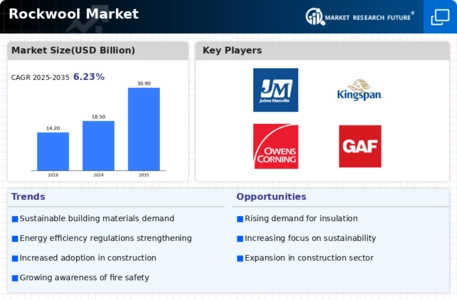
Rockwool Market Infographic
Purchase Options

Market Trends

Key Emerging Trends in the Rockwool Market

The market trends of Rockwool, also known as mineral wool or stone wool, are undergoing significant changes driven by factors such as sustainable construction practices, energy efficiency requirements, and the increasing focus on fire resistance. A notable trend in this market is the growing demand for Rockwool insulation as a key component in sustainable building solutions. As environmental consciousness rises, architects, builders, and homeowners are turning to Rockwool insulation for its eco-friendly properties. Manufactured from natural basalt rock and recycled slag, Rockwool is non-combustible and offers excellent thermal and acoustic insulation, aligning with the global push for green and energy-efficient construction materials.

Moreover, there is an increasing emphasis on fire-resistant insulation solutions in the Rockwool market. With fire safety being a critical concern in construction, Rockwool insulation has gained popularity for its inherent fire-resistant properties. This trend is particularly significant in applications where building codes and regulations require materials with high fire resistance, such as in commercial buildings, industrial facilities, and residential constructions.

Customization is emerging as another key trend in the Rockwool market. Construction projects often have unique requirements based on factors such as building design, climate conditions, and specific insulation needs. Manufacturers are responding by offering a variety of Rockwool products with different densities, thicknesses, and forms to cater to diverse construction applications. This trend allows builders and contractors to select Rockwool insulation solutions tailored to the specific requirements of their projects, ensuring optimal performance and efficiency.

Technological advancements are playing a pivotal role in reshaping the Rockwool market. Manufacturers are investing in innovative production processes to enhance the performance characteristics of Rockwool insulation. Advanced manufacturing techniques, such as dual-density technology and hydrophobic treatments, contribute to improved thermal conductivity, water resistance, and durability. These technological advancements ensure that Rockwool insulation continues to meet and exceed industry standards for efficiency and longevity.

Furthermore, there is a growing trend towards the use of Rockwool in applications beyond traditional insulation. The versatility of Rockwool extends to horticulture, where it is used as a growing medium for plants. Rockwool's ability to retain water, provide a stable pH environment, and offer excellent aeration makes it a preferred choice for hydroponic and soilless cultivation. This diversification of applications showcases Rockwool's adaptability and the expanding scope of its market reach.

In terms of market dynamics, competition among Rockwool manufacturers is intensifying. Companies are investing in research and development to enhance the sustainability, fire resistance, customization, technological features, and versatility of their Rockwool products. Meeting industry standards for insulation performance, fire safety, and environmental impact, as well as staying attuned to evolving construction practices, are critical factors for success in this competitive market. As the construction industry continues to prioritize sustainable and fire-resistant building materials, the Rockwool market is expected to witness sustained growth and further innovation.

Author
Anshula Mandaokar
Team Lead - Research

Anshula Mandaokar holds an academic degree in Chemical Engineering and has been contributing to the field for more than 5 years. She has expertise in Market Research and Business Consulting and serves as a Team Lead for a reputed Market Research firm under the Chemicals and Materials domain spectrum. She has worked on multiple projects, generating explicit results in a quick turnaround time. Her understanding of data interpretation justifies her role as a leader.

Leave a Comment

FAQs

How much is the Rockwool market?

Rockwool Market size was valued at USD 18.46 Billion in 2024

What is the growth rate of the Rockwool market?

Rockwool Market is projected to grow at a CAGR of 6.23% during the forecast period, 2025-2035

Which region held the biggest market share in the Rockwool market?

North America had the biggest share in the global market

Who are the prime players in the Rockwool market?

The key players in the market are Thermafiber, Inc., Rockwool International A/S, RockchatBETA, Johns Manville, Kingspan Group, Owens Corning, Paroc Group Oy, Saint-Gobin, GAF, and BYUCKSAN.

Which type led the Rockwool market?

The roving category dominated the market in 2024.

Which end-user had the biggest market share in the Rockwool market?

The construction had the biggest share in the global market.

Market Summary

As per Market Research Future Analysis, the global rockwool market was valued at USD 18.46 billion in 2024 and is projected to grow to USD 35.90 billion by 2035, with a CAGR of 6.23% from 2025 to 2035. The growth is driven by the increasing demand for sustainable and energy-efficient insulation solutions in the construction industry, alongside a focus on fire-resistant materials. The versatility of rockwool in various applications, its eco-friendly properties, and compliance with stringent building codes further enhance its market appeal. The North American region leads the market, supported by robust demand for energy-efficient solutions and green building practices.

Key Market Trends & Highlights

Key trends driving the rockwool market include sustainability, versatility, and regulatory compliance.

  • Market Size in 2024: USD 18.46 billion; projected to reach USD 35.90 billion by 2035. CAGR from 2025 to 2035: 6.23%; driven by demand for energy-efficient insulation. North America holds the largest market share due to stringent building codes and green practices. Roving segment dominates market revenue due to its versatility and ease of application.

Market Size & Forecast

2024 Market Size USD 18.46 Billion
2035 Market Size USD 35.90 Billion
CAGR (2024-2035) 6.23%
Largest Regional Market Share in 2024 North America

Major Players

<p>Key players include Thermafiber, Inc., Rockwool International A/S, Johns Manville, Kingspan Group, Owens Corning, and Knauf Insulation.</p>

Market Trends

Growing demand for sustainable and energy-efficient insulation solutions is driving the market growth

Market CAGR for rockwool is being driven by the rising demand for sustainable and energy-efficient insulation solutions in the construction industry. With a global shift towards green building practices and increased awareness of environmental impact, construction professionals are seeking insulation materials that align with sustainability goals. Rockwool Market, derived from natural volcanic rock or basalt, offers a compelling solution due to its eco-friendly and recyclable properties. Its ability to improve thermal and acoustic insulation aligns with the construction sector's focus on energy efficiency and noise reduction.

The rising stringency of building codes and regulations, emphasizing energy conservation and sustainable construction materials, further accelerates the adoption of rockwool. Governments and industry bodies are incentivizing or mandating the use of environmentally friendly insulation materials, boosting the market for rockwool. The material's durability and resistance to moisture contribute to its long lifespan, reducing the need for frequent replacements and minimizing construction waste. As contractors and builders strive to achieve green building certifications, such as LEED, rockwool's contribution to energy efficiency becomes a key factor in meeting stringent criteria.

Rockwool Market's versatility in applications, from residential to commercial and industrial projects, positions it as a go-to solution for a wider range of the construction needs. The material's adaptability to different construction methods and its ease of installation make it a preferred choice for contractors, contributing to the market's growth. The inherent fire resistance of rockwool adds an extra layer of safety assurance, a critical consideration for architects and builders.

Furthermore, the growing consciousness among consumers and businesses regarding the environmental footprint of construction materials influences purchasing decisions. Rockwool Market's sustainability profile aligns with this trend, making it an attractive option for those seeking environmentally responsible building solutions. The material's excellent sound absorption qualities cater to the increasing demand for acoustic comfort in buildings, especially in urban areas. Market expansion is also fueled by advancements in rockwool manufacturing processes, leading to more energy-efficient production and reduced environmental impact. Continuous innovation in product development, including variations such as rigid boards, batts, and loose-fill insulation, enhances the material's suitability for diverse construction requirements.

The competitive pricing of rockwool compared to alternative insulation materials further bolsters its market position. Thus, driving the Rockwool Market revenue.

Rockwool Market Market Drivers

Increased Awareness of Fire Safety

The Global Rockwool Market Industry is witnessing a heightened awareness of fire safety standards, which is propelling the demand for rockwool products. Rockwool Market is inherently non-combustible, providing superior fire resistance compared to traditional insulation materials. As building codes become more stringent, particularly in commercial and industrial sectors, the preference for fire-resistant materials like rockwool is likely to grow. This trend is evident in regions such as North America and Europe, where regulatory frameworks emphasize safety. Consequently, the market is poised for growth, as stakeholders prioritize materials that enhance safety and compliance.

Expansion of Construction Activities

The Global Rockwool Market Industry is significantly influenced by the expansion of construction activities across various regions. As urbanization accelerates, particularly in developing nations, the demand for residential and commercial buildings increases. This surge in construction is expected to drive the market value to 30.9 USD Billion by 2035. Rockwool Market's versatility and performance characteristics make it an ideal material for a wide range of applications, from roofing to wall insulation. The construction sector's growth is further supported by government initiatives aimed at promoting sustainable building practices, thereby enhancing the adoption of rockwool products.

Growing Demand for Insulation Materials

The Global Rockwool Market Industry experiences a robust demand for insulation materials, driven by the increasing need for energy efficiency in buildings. As governments worldwide implement stricter energy regulations, the use of rockwool insulation is becoming more prevalent. In 2024, the market is projected to reach 18.5 USD Billion, reflecting a significant shift towards sustainable building practices. This trend is particularly evident in Europe and North America, where energy conservation is prioritized. The insulation properties of rockwool not only enhance energy efficiency but also contribute to fire safety, making it a preferred choice among builders and architects.

Technological Advancements in Production

The Global Rockwool Market Industry benefits from ongoing technological advancements in production processes. Innovations in manufacturing techniques have led to improved product quality and performance, making rockwool more competitive against alternative insulation materials. Enhanced production efficiency not only reduces costs but also minimizes environmental impact, aligning with the industry's sustainability goals. As manufacturers adopt advanced technologies, the market is likely to see an increase in product offerings, catering to diverse consumer needs. This evolution in production capabilities is expected to support the market's growth trajectory, as stakeholders seek high-performance insulation solutions.

Sustainability and Eco-Friendly Building Practices

The Global Rockwool Market Industry is increasingly aligned with sustainability trends, as more consumers and builders seek eco-friendly materials. Rockwool Market is made from natural and recycled materials, which contributes to its appeal in green building initiatives. The growing emphasis on reducing carbon footprints and enhancing energy efficiency is likely to drive the market's compound annual growth rate (CAGR) of 4.8% from 2025 to 2035. This shift towards sustainable construction practices is particularly pronounced in regions with established green building certifications, such as LEED in North America and BREEAM in Europe, further solidifying rockwool's position in the market.

Market Segment Insights

Rockwool Market Type Insights

<p>The Rockwool Market segmentation, based on type, includes Roving, Chopped Strands, Fabric, and Mesh or Grids. The roving segment dominated the market, accounting for the largest market revenue due to its versatility and ease of application. Roving refers to continuous strands of rockwool fibers, making it adaptable for various insulation needs. The material's flexibility allows for seamless installation in both residential and industrial settings, contributing to its widespread use. Roving-type rockwool is particularly favored in construction applications, such as cavity wall insulation and roofing, where its uniformity and continuous nature enhance thermal performance.</p>

<p>Additionally, its compatibility with manufacturing processes for other rockwool products makes it a fundamental component, further solidifying its dominance in the market. Chopped strand-type&nbsp;rockwool boards are experiencing the fastest growth due to improved performance.</p>

<p>Figure 1: Rockwool Market, by Type, 2023 &amp; 2032 (USD Billion)</p>

Rockwool Market End User Insights

<p>The Rockwool Market segmentation, based on end users, includes Construction, Automotive, Aerospace &amp; Defense, Power Generation, and Sports &amp; Related Accessories. The construction category dominates the market because of its exceptional thermal and acoustic insulation properties, making it a preferred choice for builders and contractors. The material's versatility allows for its seamless integration into various construction applications, including residential, commercial, and industrial projects. Rockwool Market's effectiveness in enhancing energy efficiency aligns with the increasing demand for sustainable building practices, meeting stringent energy codes and regulations.</p>

<p>Its non-combustible nature also contributes to its prominence in the construction sector, addressing safety concerns and providing fire-resistant solutions. As the construction industry continues to prioritize green building materials and energy performance, rockwool's comprehensive benefits position it as a dominant player in the market. Further, automotive application is experiencing the fastest growth due to the Lightweighting trends and Stringent emission regulations.</p>

Get more detailed insights about Rockwool Market Research Report — Global Forecast till 2035

Regional Insights

By region, the study gives market insights into the North America, Europe, Asia-Pacific, and the Rest of the World. The North American Rockwool Market area dominates this market due to robust demand for energy-efficient insulation solutions in the construction industry and stringent building codes emphasizing sustainability and the region's focus on green building practices, combined with the versatility and effectiveness of Rockwool Market in meeting these requirements.

Further, the prime countries studied in the market report are The US, Canada, Germany, France, the UK, Italy, Spain, Japan, China, India, Australia, South Korea, and Brazil.

Figure 2: ROCKWOOL MARKET SHARE BY REGION 2023 (USD Billion)

ROCKWOOL MARKET SHARE BY REGION 2022

Source: The Secondary Research, Primary Research, Market Research Future Database and Analyst Review

Europe's Rockwool Market accounts for the second-largest market share due to the continent's strong commitment to energy efficiency, stringent building regulations, and the widespread adoption of sustainable construction practices. Further, the German Rockwool Market held the largest market share, and the UK Rockwool Market was the fastest-growing market in the European region.

The Asia-Pacific Rockwool Market is expected to rise at the fastest CAGR from the year 2023 to 2032. This is due to the region's rapid urbanization, increasing construction activities, and a growing emphasis on energy-efficient and sustainable building solutions. Moreover, China’s Rockwool Market held the largest market share, and the Indian Rockwool Market was the fastest-growing market in the Asia-Pacific region.

Key Players and Competitive Insights

Leading market players are investing heavily in the research and development in order to expand their product lines, which will help the Rockwool Market grow even more. Market players are also undertaking a variety of strategic activities to spread their global footprint, with important market developments including mergers and acquisitions, new product launches, contractual agreements, higher investments, and collaboration with other organizations. To spread and survive in a more competitive and rising market climate, the Rockwool industry must offer cost-effective items.

Manufacturing locally to minimize the operational costs is one of the key business tactics used by the manufacturers in the global Rockwool industry to benefit clients and increase the market sector. In recent years, the Rockwool industry has provided some of the most significant advantages to medicine. Prime players in the Rockwool Market, including Thermafiber, Inc., Rockwool Market International A/S, RockchatBETA, Johns Manville, Kingspan Group, Owens Corning, Paroc Group Oy, Saint-Gobin, GAF, BYUCKSAN, and others, are trying to increase market demand by investing in the research and development operations.

Rockwool Market International A/S is a leading global manufacturer of stone wool insulation. Headquartered in Hedehusene, Denmark, the company has grown into a key player in the insulation industry. Rockwool Market specializes in producing insulation solutions made from natural volcanic rock or basalt, providing products that contribute to energy efficiency, fire safety, and acoustic performance in buildings.

In October 2023, Rockwool Market International A/S and BASF SE partnered to develop and market a new generation of sustainable rockwool products with enhanced thermal and acoustic insulation properties. This partnership leverages BASF's expertise in polymer chemistry and Rockwool Market's experience in insulation materials to create innovative solutions for the construction industry.

Knauf Insulation, a leading global manufacturer of insulation materials, stands as a key player in the construction industry, providing innovative solutions for energy efficiency and sustainable building practices. Established in 1932 and headquartered in Germany, Knauf Insulation has expanded its reach to become a prominent supplier of insulation products worldwide. The company specializes in the manufacturing a diverse range of insulation materials, including glass wool, rock wool, and ecological insulating materials. Knauf Insulation is recognized for its commitment to environmental responsibility, producing insulation solutions that contribute to energy conservation and reduce carbon footprints in buildings.

In September 2023, Knauf Insulation and Saint-Gobain ISOVER signed a strategic partnership to collaborate on research and development of rockwool products for high-performance building applications. This collaboration aims to accelerate innovation and bring leading-edge insulation solutions to the market.

Key Companies in the Rockwool Market market include

Industry Developments

August 2023: Owens Corning and PAROC Group announced a joint venture to develop and manufacture rockwool products for the automotive industry. This venture combines Owens Corning's expertise in automotive insulation with PAROC's experience in rockwool production to provide optimal solutions for the growing EV market.

June 2023: The Chinese construction materials company CNBM Group acquired Rockwool Market Group, a leading global rockwool manufacturer. This acquisition gives CNBM access to advanced rockwool production technology and expands its global reach significantly.

May 2023: The Japanese insulation materials company Nitto Denko Corporation acquired a minority stake in the US-based startup EcoRockwool Market Inc., a developer of innovative and sustainable rockwool products. This investment allows Nitto Denko to gain access to cutting-edge technology and strengthen its position in the sustainable insulation market.

Future Outlook

Rockwool Market Future Outlook

<p>The Global Rockwool Market is projected to grow at a 6.23% CAGR from 2025 to 2035, driven by increasing demand for energy-efficient insulation and sustainable building materials.</p>

New opportunities lie in:

  • <p>Develop innovative Rockwool Market products for the renewable energy sector. Expand distribution networks in emerging markets to capture new customer bases. Invest in R&amp;D for enhanced fire-resistant Rockwool Market solutions to meet regulatory demands.</p>

<p>By 2035, the Global Rockwool Market is expected to achieve substantial growth, reflecting evolving industry standards and consumer preferences.</p>

Market Segmentation

Rockwool Type Outlook

  • Roving
  • Chopped Strands
  • Fabric
  • Mesh or Grids

Rockwool End User Outlook

  • Construction
  • Automotive
  • Aerospace & Defense
  • Power Generation
  • Sports & Related Accessories

Report Scope

Report Attribute/MetricDetails
Market Size 202418.46 Billion 
Market Size 203535.90 (Value (USD Billion))
Compound Annual Growth Rate (CAGR)6.23% (2025 - 2035)
Base Year2024
Market Forecast Period2025 - 2035
Historical Data2018- 2022
Market Forecast UnitsValue (USD Billion)
Report CoverageRevenue Forecast, The Market Competitive Landscape, Growth Factors, and Trends
Segments CoveredType, End User, and Region
Geographies CoveredNorth America, Europe, Asia Pacific, and the Rest of the World
Countries CoveredThe US, Canada, Germany, France, UK, Italy, Spain, Japan, China, India, Australia, South Korea, and Brazil
Key Companies Profiled Thermafiber, Inc., Rockwool International A/S, RockchatBETA, Johns Manville, Kingspan Group, Owens Corning, Paroc Group Oy, Saint-Gobin, GAF, BYUCKSAN
Key Market Opportunities·       Rising focus on fire-resistant building materials.
Key Market Dynamics·       Increased demand for sustainable and energy-efficient insulation solutions in the construction industry.
Market Size 202519.61 (Value (USD Billion))

FAQs

How much is the Rockwool market?

Rockwool Market size was valued at USD 18.46 Billion in 2024

What is the growth rate of the Rockwool market?

Rockwool Market is projected to grow at a CAGR of 6.23% during the forecast period, 2025-2035

Which region held the biggest market share in the Rockwool market?

North America had the biggest share in the global market

Who are the prime players in the Rockwool market?

The key players in the market are Thermafiber, Inc., Rockwool International A/S, RockchatBETA, Johns Manville, Kingspan Group, Owens Corning, Paroc Group Oy, Saint-Gobin, GAF, and BYUCKSAN.

Which type led the Rockwool market?

The roving category dominated the market in 2024.

Which end-user had the biggest market share in the Rockwool market?

The construction had the biggest share in the global market.

  1. EXECUTIVE SUMMARY
  2. MARKET INTRODUCTION
    1. Definition
    2. Scope of the Study
      1. Research Objective
      2. Assumptions
      3. Limitations
  3. RESEARCH METHODOLOGY
    1. Overview
    2. Data Mining
    3. Secondary Research
    4. Primary Research
      1. Primary Interviews and Information Gathering Process
      2. Breakdown of Primary Respondents
    5. Forecasting Model
    6. Market Size Estimation
      1. Bottom-Up Approach
      2. Top-Down Approach
    7. Data Triangulation
    8. Validation
  4. MARKET DYNAMICS
    1. Overview
    2. Drivers
    3. Restraints
    4. Opportunities
  5. MARKET FACTOR ANALYSIS
    1. Value Chain Analysis
    2. Porter’s Five Forces Analysis
      1. Bargaining Power of Suppliers
      2. Bargaining Power of Buyers
      3. Threat of New Entrants
      4. Threat of Substitutes
      5. Intensity of Rivalry
    3. COVID-19 Impact Analysis
      1. Market Impact Analysis
      2. Regional Impact
      3. Opportunity and Threat Analysis
  6. GLOBAL ROCKWOOL MARKET, BY TYPE
    1. Overview
    2. Roving
    3. Chopped Strands
    4. Fabric
    5. Mesh or Grids
  7. GLOBAL ROCKWOOL MARKET, BY END USER
    1. Overview
    2. Construction
    3. Automotive
    4. Aerospace & Defense
    5. Power Generation
    6. Sports & Related Accessories
  8. GLOBAL ROCKWOOL MARKET, BY REGION
    1. Overview
    2. North America
      1. US
      2. Canada
    3. Europe
      1. Germany
      2. France
      3. UK
      4. Italy
      5. Spain
      6. Rest of Europe
    4. Asia-Pacific
      1. China
      2. India
      3. Japan
      4. South Korea
      5. Australia
      6. Rest of Asia-Pacific
    5. Rest of the World
      1. Middle East
      2. Africa
      3. Latin America
  9. COMPETITIVE LANDSCAPE
    1. Overview
    2. Competitive Analysis
    3. Market Share Analysis
    4. Major Growth Strategy in the Global Rockwool Market,
    5. Competitive Benchmarking
    6. Leading Players in Terms of Number of Developments in the Global Rockwool Market,
    7. Key developments and Growth Strategies
      1. New Product Launch/Service Deployment
      2. Merger & Acquisitions
      3. Joint Ventures
    8. Major Players Financial Matrix
      1. Sales & Operating Income, 2022
      2. Major Players R&D Expenditure. 2022
  10. COMPANY PROFILES
    1. Thermafiber, Inc.
      1. Company Overview
      2. Financial Overview
      3. Products Offered
      4. Key Developments
      5. SWOT Analysis
      6. Key Strategies
    2. Rockwool International A/S
      1. Company Overview
      2. Financial Overview
      3. Products Offered
      4. Key Developments
      5. SWOT Analysis
      6. Key Strategies
    3. RockchatBETA
      1. Company Overview
      2. Financial Overview
      3. Products Offered
      4. Key Developments
      5. SWOT Analysis
      6. Key Strategies
    4. Johns Manville
      1. Company Overview
      2. Financial Overview
      3. Products Offered
      4. Key Developments
      5. SWOT Analysis
      6. Key Strategies
    5. Kingspan Group
      1. Company Overview
      2. Financial Overview
      3. Products Offered
      4. Key Developments
      5. SWOT Analysis
      6. Key Strategies
    6. Owens Corning
      1. Company Overview
      2. Financial Overview
      3. Products Offered
      4. Key Developments
      5. SWOT Analysis
      6. Key Strategies
    7. Paroc Group Oy
      1. Company Overview
      2. Financial Overview
      3. Products Offered
      4. Key Developments
      5. SWOT Analysis
      6. Key Strategies
    8. Saint-Gobin
      1. Company Overview
      2. Financial Overview
      3. Products Offered
      4. Key Developments
      5. SWOT Analysis
      6. Key Strategies
    9. GAF
      1. Company Overview
      2. Financial Overview
      3. Products Offered
      4. Key Developments
      5. SWOT Analysis
      6. Key Strategies
    10. BYUCKSAN
      1. Company Overview
      2. Financial Overview
      3. Products Offered
      4. Key Developments
      5. SWOT Analysis
      6. Key Strategies
  11. APPENDIX
    1. References
    2. Related Reports
  12. LIST OF TABLES
  13. GLOBAL ROCKWOOL MARKET, SYNOPSIS, 2018-2032
  14. GLOBAL ROCKWOOL MARKET, ESTIMATES & FORECAST, 2018-2032 (USD BILLION)
  15. GLOBAL ROCKWOOL MARKET, BY TYPE, 2018-2032 (USD BILLION)
  16. GLOBAL ROCKWOOL MARKET, BY END USER, 2018-2032 (USD BILLION)
  17. NORTH AMERICA: ROCKWOOL MARKET, BY TYPE, 2018-2032 (USD BILLION)
  18. NORTH AMERICA: ROCKWOOL MARKET, BY END USER, 2018-2032 (USD BILLION)
  19. US: ROCKWOOL MARKET, BY TYPE, 2018-2032 (USD BILLION)
  20. US: ROCKWOOL MARKET, BY END USER, 2018-2032 (USD BILLION)
  21. CANADA: ROCKWOOL MARKET, BY TYPE, 2018-2032 (USD BILLION)
  22. CANADA: ROCKWOOL MARKET, BY END USER, 2018-2032 (USD BILLION)
  23. EUROPE: ROCKWOOL MARKET, BY TYPE, 2018-2032 (USD BILLION)
  24. EUROPE: ROCKWOOL MARKET, BY END USER, 2018-2032 (USD BILLION)
  25. GERMANY: ROCKWOOL MARKET, BY TYPE, 2018-2032 (USD BILLION)
  26. GERMANY: ROCKWOOL MARKET, BY END USER, 2018-2032 (USD BILLION)
  27. FRANCE: ROCKWOOL MARKET, BY TYPE, 2018-2032 (USD BILLION)
  28. FRANCE: ROCKWOOL MARKET, BY END USER, 2018-2032 (USD BILLION)
  29. ITALY: ROCKWOOL MARKET, BY TYPE, 2018-2032 (USD BILLION)
  30. ITALY: ROCKWOOL MARKET, BY END USER, 2018-2032 (USD BILLION)
  31. SPAIN: ROCKWOOL MARKET, BY TYPE, 2018-2032 (USD BILLION)
  32. SPAIN: ROCKWOOL MARKET, BY END USER, 2018-2032 (USD BILLION)
  33. UK: ROCKWOOL MARKET, BY TYPE, 2018-2032 (USD BILLION)
  34. UK: ROCKWOOL MARKET, BY END USER, 2018-2032 (USD BILLION)
  35. REST OF EUROPE: ROCKWOOL MARKET, BY TYPE, 2018-2032 (USD BILLION)
  36. REST OF EUROPE: ROCKWOOL MARKET, BY END USER, 2018-2032 (USD BILLION)
  37. ASIA-PACIFIC: ROCKWOOL MARKET, BY TYPE, 2018-2032 (USD BILLION)
  38. ASIA-PACIFIC: ROCKWOOL MARKET, BY END USER, 2018-2032 (USD BILLION)
  39. JAPAN: ROCKWOOL MARKET, BY TYPE, 2018-2032 (USD BILLION)
  40. JAPAN: ROCKWOOL MARKET, BY END USER, 2018-2032 (USD BILLION)
  41. CHINA: ROCKWOOL MARKET, BY TYPE, 2018-2032 (USD BILLION)
  42. CHINA: ROCKWOOL MARKET, BY END USER, 2018-2032 (USD BILLION)
  43. INDIA: ROCKWOOL MARKET, BY TYPE, 2018-2032 (USD BILLION)
  44. INDIA: ROCKWOOL MARKET, BY END USER, 2018-2032 (USD BILLION)
  45. AUSTRALIA: ROCKWOOL MARKET, BY TYPE, 2018-2032 (USD BILLION)
  46. AUSTRALIA: ROCKWOOL MARKET, BY END USER, 2018-2032 (USD BILLION)
  47. SOUTH KOREA: ROCKWOOL MARKET, BY TYPE, 2018-2032 (USD BILLION)
  48. SOUTH KOREA: ROCKWOOL MARKET, BY END USER, 2018-2032 (USD BILLION)
  49. REST OF ASIA-PACIFIC: ROCKWOOL MARKET, BY TYPE, 2018-2032 (USD BILLION)
  50. REST OF ASIA-PACIFIC: ROCKWOOL MARKET, BY END USER, 2018-2032 (USD BILLION)
  51. REST OF THE WORLD: ROCKWOOL MARKET, BY TYPE, 2018-2032 (USD BILLION)
  52. REST OF THE WORLD: ROCKWOOL MARKET, BY END USER, 2018-2032 (USD BILLION)
  53. MIDDLE EAST: ROCKWOOL MARKET, BY TYPE, 2018-2032 (USD BILLION)
  54. MIDDLE EAST: ROCKWOOL MARKET, BY END USER, 2018-2032 (USD BILLION)
  55. AFRICA: ROCKWOOL MARKET, BY TYPE, 2018-2032 (USD BILLION)
  56. AFRICA: ROCKWOOL MARKET, BY END USER, 2018-2032 (USD BILLION)
  57. LATIN AMERICA: ROCKWOOL MARKET, BY TYPE, 2018-2032 (USD BILLION)
  58. LATIN AMERICA: ROCKWOOL MARKET, BY END USER, 2018-2032 (USD BILLION)
  59. LIST OF FIGURES
  60. RESEARCH PROCESS
  61. MARKET STRUCTURE FOR THE GLOBAL ROCKWOOL MARKET
  62. MARKET DYNAMICS FOR THE GLOBAL ROCKWOOL MARKET
  63. GLOBAL ROCKWOOL MARKET, SHARE (%), BY TYPE, 2022
  64. GLOBAL ROCKWOOL MARKET, SHARE (%), BY END USER, 2022
  65. GLOBAL ROCKWOOL MARKET, SHARE (%), BY REGION, 2022
  66. NORTH AMERICA: ROCKWOOL MARKET, SHARE (%), BY REGION, 2022
  67. EUROPE: ROCKWOOL MARKET, SHARE (%), BY REGION, 2022
  68. ASIA-PACIFIC: ROCKWOOL MARKET, SHARE (%), BY REGION, 2022
  69. REST OF THE WORLD: ROCKWOOL MARKET, SHARE (%), BY REGION, 2022
  70. GLOBAL ROCKWOOL MARKET: COMPANY SHARE ANALYSIS, 2022 (%)
  71. THERMAFIBER, INC.: FINANCIAL OVERVIEW SNAPSHOT
  72. THERMAFIBER, INC.: SWOT ANALYSIS
  73. ROCKWOOL INTERNATIONAL A/S: FINANCIAL OVERVIEW SNAPSHOT
  74. ROCKWOOL INTERNATIONAL A/S: SWOT ANALYSIS
  75. ROCKCHATBETA: FINANCIAL OVERVIEW SNAPSHOT
  76. ROCKCHATBETA: SWOT ANALYSIS
  77. JOHNS MANVILLE: FINANCIAL OVERVIEW SNAPSHOT
  78. JOHNS MANVILLE: SWOT ANALYSIS
  79. KINGSPAN GROUP: FINANCIAL OVERVIEW SNAPSHOT
  80. KINGSPAN GROUP: SWOT ANALYSIS
  81. OWENS CORNING: FINANCIAL OVERVIEW SNAPSHOT
  82. OWENS CORNING: SWOT ANALYSIS
  83. PAROC GROUP OY: FINANCIAL OVERVIEW SNAPSHOT
  84. PAROC GROUP OY: SWOT ANALYSIS
  85. SAINT-GOBIN: FINANCIAL OVERVIEW SNAPSHOT
  86. SAINT-GOBIN: SWOT ANALYSIS
  87. GAF: FINANCIAL OVERVIEW SNAPSHOT
  88. GAF: SWOT ANALYSIS
  89. BYUCKSAN: FINANCIAL OVERVIEW SNAPSHOT
  90. BYUCKSAN: SWOT ANALYSIS

Rockwool Market Segmentation

Market Segmentation Overview

  • Detailed segmentation data will be available in the full report
  • Comprehensive analysis by multiple parameters
  • Regional and country-level breakdowns
  • Market size forecasts by segment
Infographic

Free Sample Request

Kindly complete the form below to receive a free sample of this Report

Get Free Sample

Customer Strories

Compare Licence

×
Features License Type
Single User Multiuser License Enterprise User
Price $4,950 $5,950 $7,250
Maximum User Access Limit 1 User Upto 10 Users Unrestricted Access Throughout the Organization
Free Customization
Direct Access to Analyst
Deliverable Format
Platform Access
Discount on Next Purchase 10% 15% 15%
Printable Versions















