×
Request Free Sample ×

Kindly complete the form below to receive a free sample of this Report

* Please use a valid business email

Leading companies partner with us for data-driven Insights

clients tt-cursor
Hero Background

robotics-market

ID: MRFR/SEM/65963-CR
200 Pages
MRFR Team
December 2025

Share:
Download PDF ×

We do not share your information with anyone. However, we may send you emails based on your report interest from time to time. You may contact us at any time to opt-out.

robotics-market Infographic
Purchase Options

robotics-market Summary

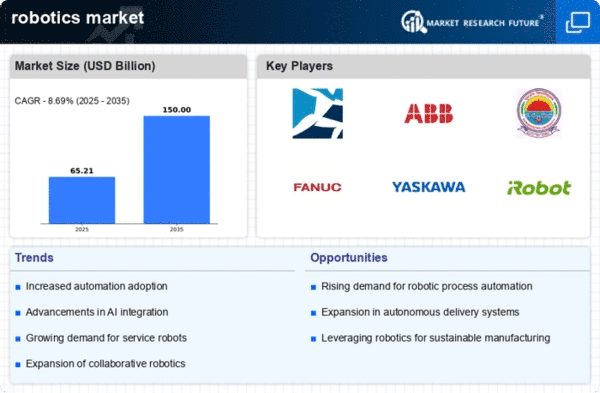
As per MRFR analysis, the robotics market was estimated at 60.0 USD Billion in 2024. The robotics industry is projected to grow from 65.21 USD Billion in 2025 to 150.0 USD Billion by 2035, exhibiting a compound annual growth rate (CAGR) of 8.69 during the forecast period 2025 - 2035.

Key Market Trends & Highlights

The robotics market is experiencing robust growth driven by automation and technological advancements.

  • The North American region remains the largest market for robotics, particularly in industrial automation.
  • Asia-Pacific is emerging as the fastest-growing region, with significant investments in healthcare robotics.
  • The industrial automation segment continues to dominate, while healthcare robotics is witnessing rapid expansion.
  • Rising demand for automation and advancements in AI are key drivers propelling market growth.

Market Size & Forecast

2024 Market Size 60.0 (USD Billion)
2035 Market Size 150.0 (USD Billion)
CAGR (2025 - 2035) 8.69%

Major Players

Boston Dynamics (US), ABB (CH), KUKA (DE), FANUC (JP), Yaskawa Electric (JP), iRobot (US), Intuitive Surgical (US), Universal Robots (DK), Siemens (DE), NVIDIA (US)

robotics-market Trends

The robotics market is currently experiencing a transformative phase characterized by rapid advancements in technology and increasing adoption across various sectors. Industries such as manufacturing, healthcare, and logistics are integrating robotic solutions to enhance efficiency and productivity. This integration is driven by the need for automation, which allows businesses to streamline operations and reduce labor costs. Furthermore, the growing emphasis on precision and quality in production processes is propelling the demand for sophisticated robotic systems. As a result, companies are investing heavily in research and development to create innovative robotic applications that cater to specific industry needs. In addition to industrial applications, the robotics market is witnessing a surge in consumer-oriented products. Household robots, such as vacuum cleaners and lawn mowers, are becoming more prevalent, reflecting a shift in consumer preferences towards automation in daily life. The rise of artificial intelligence and machine learning is also contributing to the evolution of robotics, enabling machines to perform complex tasks with greater autonomy. This trend suggests that the robotics market will continue to expand, driven by technological advancements and changing consumer behaviors, ultimately reshaping the landscape of various industries.

Increased Automation in Manufacturing

The robotics market is seeing a notable trend towards heightened automation within manufacturing processes. Companies are increasingly deploying robotic systems to enhance production efficiency, reduce human error, and improve overall output quality. This shift not only streamlines operations but also allows for greater flexibility in adapting to changing market demands.

Growth of Collaborative Robots

Collaborative robots, or cobots, are gaining traction in the robotics market as they are designed to work alongside human operators. This trend indicates a move towards safer and more efficient work environments, where robots assist rather than replace human labor. The integration of cobots is particularly beneficial in sectors requiring a blend of human intuition and robotic precision.

Expansion of Robotics in Healthcare

The application of robotics in healthcare is expanding, with innovations aimed at improving patient care and surgical outcomes. Robotic systems are being utilized for tasks ranging from minimally invasive surgeries to rehabilitation assistance. This trend highlights the potential for robotics to enhance the quality of healthcare services and improve patient experiences.

Market Segment Insights

By Application: Industrial Automation (Largest) vs. Healthcare Robotics (Fastest-Growing)

The robotics market is significantly influenced by diverse applications, with Industrial Automation holding the largest share. This segment encompasses a wide array of robotic technologies engaged in manufacturing processes, enhancing efficiency and precision. Healthcare Robotics, however, is emerging as a crucial player, capitalizing on advancements in technology and increasing demand for automation in surgical procedures, patient care, and rehabilitation, thus exhibiting rapid growth. The growth trends in the Industrial Automation sector are primarily driven by the ongoing push for operational efficiency, reduced labor costs, and the rising need for manufacturing adaptability. On the other hand, Healthcare Robotics is witnessing unprecedented growth, fueled by technological innovations such as AI and machine learning, which enhance the capabilities of robots to provide high-quality care, thereby creating a significant impact on healthcare delivery systems.

Application: Industrial Automation (Dominant) vs. Healthcare Robotics (Emerging)

Industrial Automation remains the dominant application in the robotics market, characterized by its widespread integration of robotic solutions in factories and manufacturing plants. These robots are designed to automate repetitive tasks, ensuring higher efficiency, durability, and safety in production lines. This segment benefits from continuous advancements in robotics, including the use of collaborative robots (cobots) that work alongside human workers. In contrast, Healthcare Robotics is an emerging segment, rapidly gaining traction due to technological innovations. Robots in this field are utilized for tasks ranging from surgical assistance to rehabilitation and elderly care, showcasing their potential to transform patient outcomes and healthcare practices. As healthcare systems strive for better efficiency and patient care, this segment will likely expand, aligning with industry needs.

By End Use: Manufacturing (Largest) vs. Healthcare (Fastest-Growing)

The robotics market is significantly influenced by the various end-use applications, with manufacturing commanding the largest share. This sector has adopted robotics for automation, leading to increased efficiency and reduced operational costs. Industries such as automotive and electronics manufacturing leverage robots for assembly and quality control, resulting in a strong foothold. Meanwhile, healthcare is rapidly gaining traction as a leading segment due to the growing integration of robotics in surgical procedures, rehabilitation, and patient care. Healthcare represents the fastest-growing segment within the robotics market, driven by technological advancements and the rising demand for minimally invasive surgeries. The pandemic has accelerated the adoption of robotic solutions in healthcare, enhancing patient outcomes and operational efficiencies. The manufacturing sector continues to evolve, embracing Industry 4.0 practices, while healthcare robotics focuses on precision, improved diagnostic capabilities, and enhanced patient interaction, creating a dynamic interplay between the two segments.

Manufacturing: Dominant vs. Healthcare: Emerging

Manufacturing robotics represents a dominant force in the market, characterized by its extensive deployment in production lines, particularly in industries like automotive and electronics. These robots excel in repetitive tasks such as assembly, welding, and material handling, ensuring precision and high throughput. The emphasis on automation to enhance productivity has solidified manufacturing's position. Conversely, the healthcare robotics sector is emerging rapidly, marked by innovative applications in surgical robots and rehabilitation devices. The focus is on improving patient care and procedural accuracy, alongside increasing demand for telepresence robots and disinfection solutions post-pandemic. As the healthcare landscape evolves, the integration of robotics is set to redefine patient interaction, making healthcare robotics a pivotal segment in the market.

By Type: Articulated Robots (Largest) vs. Collaborative Robots (Fastest-Growing)

The robotics market is experiencing significant segmentation by type. Articulated robots currently hold the largest market share due to their versatility and widespread application in manufacturing industries. These robots, capable of complex movements and tasks, are integral to automotive and electronics assembly lines. Collaborative robots, while smaller in market share, are witnessing rapid adoption, particularly in small and medium-sized enterprises, due to their ability to work safely alongside humans without the need for safety cages.

Articulated Robots (Dominant) vs. Collaborative Robots (Emerging)

Articulated robots are characterized by their multi-jointed arms and flexibility, enabling them to perform intricate operations across various industries, including automotive, electronics, and heavy machinery. Their dominance in the market is driven by advancements in robotic technology and automation needs. Conversely, collaborative robots—designed to work alongside human operators—are rapidly emerging as a popular choice for tasks requiring adaptability and safety. They are increasingly utilized in scenarios where human-robot interaction is essential, making them particularly valuable in sectors such as warehousing and light assembly. Their ability to provide cost-effective and scalable automation solutions is fueling their growth.

Get more detailed insights about robotics-market

Regional Insights

North America : Innovation and Leadership Hub

North America continues to lead The robotics market, holding a significant share of 30.0% in 2024. The region's growth is driven by advancements in technology, increased automation across industries, and supportive government policies promoting innovation. The demand for robotics solutions in manufacturing, healthcare, and logistics is on the rise, fueled by the need for efficiency and productivity. Regulatory frameworks are evolving to support the integration of robotics into various sectors, enhancing market dynamics. The competitive landscape in North America is robust, with key players such as Boston Dynamics, iRobot, and Intuitive Surgical leading the charge. The U.S. is the primary market, characterized by high investment in R&D and a strong focus on AI integration in robotics. Companies are increasingly collaborating with tech firms to enhance capabilities, ensuring that North America remains at the forefront of robotics innovation.

Europe : Emerging Robotics Powerhouse

Europe's robotics market is poised for significant growth, with a market size of 15.0% in 2024. The region benefits from a strong manufacturing base, particularly in Germany and France, where automation is becoming essential for maintaining competitiveness. Regulatory support, such as the EU's Digital Strategy, is fostering innovation and investment in robotics, particularly in sectors like automotive and healthcare. The push for sustainability and efficiency is driving demand for advanced robotic solutions across various industries. Leading countries in Europe include Germany, which is home to major players like KUKA and Siemens, and France, where robotics is increasingly integrated into manufacturing processes. The competitive landscape is characterized by a mix of established firms and startups, all vying for market share. The presence of key players and a collaborative ecosystem among industries and research institutions further enhance Europe's position in The robotics market.

Asia-Pacific : Rapidly Growing Robotics Sector

The Asia-Pacific region is witnessing rapid growth in the robotics market, with a market size of 12.0% in 2024. Countries like Japan and China are at the forefront, driven by significant investments in automation and robotics technology. The demand for robotics in manufacturing, logistics, and healthcare is surging, supported by government initiatives aimed at enhancing productivity and innovation. Regulatory frameworks are evolving to facilitate the adoption of robotics, making it a key driver of economic growth in the region. Japan remains a leader in robotics, with companies like FANUC and Yaskawa Electric leading the charge. China is also emerging as a major player, focusing on smart manufacturing and AI integration. The competitive landscape is dynamic, with both established firms and new entrants competing for market share. The presence of key players and a strong emphasis on R&D are propelling the Asia-Pacific region to new heights in The robotics market.

Middle East and Africa : Emerging Robotics Frontier

The Middle East and Africa (MEA) region is gradually emerging in the robotics market, with a market size of 3.0% in 2024. The growth is primarily driven by increasing investments in automation across various sectors, including manufacturing, healthcare, and logistics. Governments in the region are recognizing the potential of robotics to enhance productivity and efficiency, leading to supportive policies and initiatives aimed at fostering innovation. The demand for robotics solutions is expected to rise as industries seek to modernize and improve operational efficiency. Countries like South Africa and the UAE are leading the way in adopting robotics technologies, with a focus on enhancing industrial capabilities. The competitive landscape is still developing, with a mix of local and international players entering the market. As the region continues to invest in technology and infrastructure, the presence of key players will likely expand, positioning MEA as a growing player in The robotics market.


Key Players and Competitive Insights

The robotics market is currently characterized by a dynamic competitive landscape, driven by rapid technological advancements and increasing demand across various sectors. Key players such as Boston Dynamics (US), ABB (CH), and FANUC (JP) are at the forefront, each adopting distinct strategies to enhance their market positioning. Boston Dynamics (US) focuses on innovation in mobility and agility, particularly in the development of advanced robotic systems for logistics and manufacturing. ABB (CH), on the other hand, emphasizes automation solutions that integrate AI and machine learning, thereby enhancing operational efficiency in industrial applications. FANUC (JP) maintains a strong emphasis on robotics for manufacturing, leveraging its expertise in automation to cater to the growing needs of smart factories. Collectively, these strategies contribute to a competitive environment that is increasingly centered around technological innovation and operational efficiency.

In terms of business tactics, companies are increasingly localizing manufacturing to reduce lead times and optimize supply chains. This approach appears to be a response to the growing demand for customized solutions and the need for resilience in supply chain management. The market structure is moderately fragmented, with a mix of established players and emerging startups, each vying for market share. The collective influence of these key players shapes the competitive dynamics, as they continuously innovate and adapt to changing market conditions.

In November 2025, Boston Dynamics (US) announced a partnership with a leading logistics firm to deploy its robotic systems in warehouses across North America. This strategic move is likely to enhance operational efficiency and reduce labor costs, positioning Boston Dynamics as a leader in the logistics automation sector. The partnership underscores the growing trend of integrating robotics into supply chain operations, which is expected to drive further adoption of advanced robotic solutions.

In October 2025, ABB (CH) unveiled a new line of collaborative robots designed for small and medium-sized enterprises (SMEs). This launch is significant as it aims to democratize access to automation technologies, allowing SMEs to enhance productivity without substantial capital investment. By targeting this segment, ABB is likely to expand its customer base and reinforce its position in the automation market.

In September 2025, FANUC (JP) expanded its operations in Europe by establishing a new manufacturing facility in Germany. This expansion is indicative of FANUC's commitment to meeting the increasing demand for automation solutions in the European market. The facility is expected to enhance production capabilities and reduce delivery times, thereby strengthening FANUC's competitive edge in the region.

As of December 2025, current trends in the robotics market are heavily influenced by digitalization, sustainability, and the integration of AI technologies. Strategic alliances among key players are shaping the landscape, fostering innovation and collaboration. The shift from price-based competition to a focus on technological advancement and supply chain reliability is becoming increasingly evident. Moving forward, competitive differentiation will likely hinge on the ability to innovate and adapt to emerging market demands, as companies strive to leverage technology to enhance operational efficiencies and sustainability.

Key Companies in the robotics-market market include

Future Outlook

robotics-market Future Outlook

The robotics market is projected to grow at an 8.69% CAGR from 2024 to 2035, driven by advancements in AI, automation, and increased demand across various sectors.

New opportunities lie in:

  • Development of collaborative robots for small and medium enterprises.
  • Integration of robotics in supply chain logistics for efficiency.
  • Expansion of robotic process automation in financial services.

By 2035, the robotics market is expected to achieve substantial growth, reflecting its critical role in diverse industries.

Market Segmentation

robotics-market Type Outlook

  • Articulated Robots
  • Collaborative Robots
  • Mobile Robots
  • Humanoid Robots
  • Autonomous Robots

robotics-market End Use Outlook

  • Manufacturing
  • Healthcare
  • Agriculture
  • Retail
  • Military

robotics-market Application Outlook

  • Industrial Automation
  • Healthcare Robotics
  • Agricultural Robotics
  • Logistics and Warehousing
  • Service Robotics

Report Scope

MARKET SIZE 202460.0(USD Billion)
MARKET SIZE 202565.21(USD Billion)
MARKET SIZE 2035150.0(USD Billion)
COMPOUND ANNUAL GROWTH RATE (CAGR)8.69% (2024 - 2035)
REPORT COVERAGERevenue Forecast, Competitive Landscape, Growth Factors, and Trends
BASE YEAR2024
Market Forecast Period2025 - 2035
Historical Data2019 - 2024
Market Forecast UnitsUSD Billion
Key Companies ProfiledBoston Dynamics (US), ABB (CH), KUKA (DE), FANUC (JP), Yaskawa Electric (JP), iRobot (US), Intuitive Surgical (US), Universal Robots (DK), Siemens (DE), NVIDIA (US)
Segments CoveredApplication, End Use, Type
Key Market OpportunitiesIntegration of artificial intelligence in robotics enhances automation across various industries.
Key Market DynamicsTechnological advancements drive competitive forces, reshaping robotics applications across various industries and enhancing operational efficiencies.
Countries CoveredNorth America, Europe, APAC, South America, MEA

Leave a Comment

Download Free Sample

Kindly complete the form below to receive a free sample of this Report

Compare Licence

×
Features License Type
Single User Multiuser License Enterprise User
Price $4,950 $5,950 $7,250
Maximum User Access Limit 1 User Upto 10 Users Unrestricted Access Throughout the Organization
Free Customization
Direct Access to Analyst
Deliverable Format
Platform Access
Discount on Next Purchase 10% 15% 15%
Printable Versions