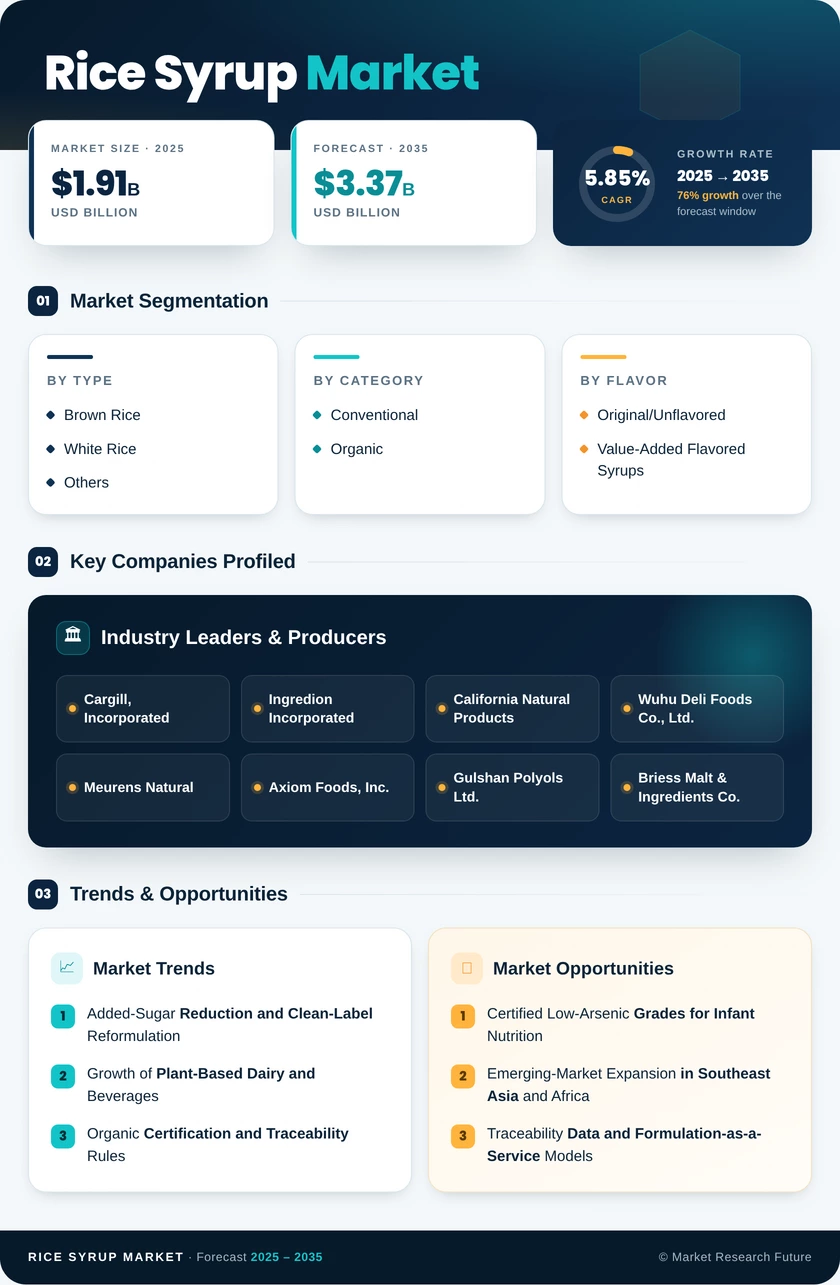
Rice Syrup Market (2026 - 2035)

ID: MRFR/FnB/5937-HCR 90 Pages Snehal Singh Last Updated: October 22, 2026
Rice Syrup Market Size, Share, Industry Trend & Analysis Research Report Information By Rice Type (Brown Rice; White Rice; Others), By Category (Conventional; Organic), By Flavor (Original/Unflavored; Value-Added Flavored Syrups), By Application (Bakery and Confectionery; Beverages; Dairy and Dessert Products; Infant Formula and Baby Foods; Other Applications), By Region (North America; Europe; Asia-Pacific; South America; Middle East and Africa) – Forecast Till 2035
Rice Syrup Market
Market Size
Forecast Period2026-2035
CAGR (2026-2035)5.85%
2025 Market SizeUSD 1.91 Billion
2035 Market SizeUSD 3.37 Billion
Key Players
Cargill
Incorporated
Ingredion Incorporated
California Natural Products
Wuhu Deli Foods Co., Ltd.
Meurens Natural
Opportunities
  • Certified Low-Arsenic Grades for Infant Nutrition
  • Emerging-Market Expansion in Southeast Asia and Africa
  • Traceability Data and Formulation-as-a-Service Models
  1. 1 Market Summary | |
  2. 2 Key Report Takeaways | |
    1. 2.1 By Rice Type | |
    2. 2.2 By Category | |
    3. 2.3 By Flavor | |
    4. 2.4 By Application | |
    5. 2.5 By Region | |
  3. 3 Market Size and Forecast (2021–2035) | |
  4. 4 Driver Impact Analysis | |
    1. 4.1 Added-Sugar Reduction and Clean-Label Reformulation | |
    2. 4.2 Growth of Plant-Based Dairy and Beverages | |
    3. 4.3 Organic Certification and Traceability Rules | |
    4. 4.4 Allergen-Friendly and Fructose-Free Positioning | |
    5. 4.5 Bakery and Confectionery Expansion in Asia-Pacific | |
    6. 4.6 Processing Gains and Sourcing Diversification | |
  5. 5 Restraints Impact Analysis | |
    1. 5.1 Inorganic Arsenic Scrutiny | |
    2. 5.2 Rice Price Volatility and Export Controls | |
    3. 5.3 Price Competition from Cheaper Starch Syrups | |
    4. 5.4 High Glycemic Index Perception | |
    5. 5.5 Organic Premiums and Certification Costs | |
  6. 6 Opportunities | |
    1. 6.1 Certified Low-Arsenic Grades for Infant Nutrition | |
    2. 6.2 Emerging-Market Expansion in Southeast Asia and Africa | |
    3. 6.3 Traceability Data and Formulation-as-a-Service Models | |
    4. 6.4 Flavored Syrups for Coffee and Foodservice | |
  7. 7 Regional Market Share and Country-Level Analysis | |
    1. 7.1 North America | | |
      1. 7.1.1 United States | | |
      2. 7.1.2 Canada | | |
      3. 7.1.3 Mexico | | |
      4. 7.1.4 Rest of North America | |
    2. 7.2 Europe | | |
      1. 7.2.1 Germany | | |
      2. 7.2.2 France | | |
      3. 7.2.3 United Kingdom | | |
      4. 7.2.4 Spain | | |
      5. 7.2.5 Netherlands | | |
      6. 7.2.6 Italy | | |
      7. 7.2.7 Sweden | | |
      8. 7.2.8 Poland | | |
      9. 7.2.9 Belgium | | |
      10. 7.2.10 Rest of Europe | |
    3. 7.3 Asia-Pacific | | |
      1. 7.3.1 China | | |
      2. 7.3.2 India | | |
      3. 7.3.3 Japan | | |
      4. 7.3.4 Australia | | |
      5. 7.3.5 South Korea | | |
      6. 7.3.6 Indonesia | | |
      7. 7.3.7 Thailand | | |
      8. 7.3.8 Singapore | | |
      9. 7.3.9 Rest of Asia-Pacific | |
    4. 7.4 South America | | |
      1. 7.4.1 Brazil | | |
      2. 7.4.2 Argentina | | |
      3. 7.4.3 Chile | | |
      4. 7.4.4 Colombia | | |
      5. 7.4.5 Peru | | |
      6. 7.4.6 Rest of South America | |
    5. 7.5 Middle East and Africa | | |
      1. 7.5.1 United Arab Emirates | | |
      2. 7.5.2 South Africa | | |
      3. 7.5.3 Nigeria | | |
      4. 7.5.4 Saudi Arabia | | |
      5. 7.5.5 Egypt | | |
      6. 7.5.6 Morocco | | |
      7. 7.5.7 Turkey | | |
      8. 7.5.8 Rest of Middle East and Africa | |
  8. 8 Future Outlook (2026–2035) | |
    1. 8.1 Enzyme Engineering and Process Automation | |
    2. 8.2 Sugar Taxes and Reformulation Economics | |
    3. 8.3 Climate Exposure of Rice Supply | |
    4. 8.4 Traceability and Sustainability Reporting | |
  9. 9 Segmentation Analysis | |
    1. 9.1 By Rice Type | | |
      1. 9.1.1 Brown Rice | | |
      2. 9.1.2 White Rice | | |
      3. 9.1.3 Others | |
    2. 9.2 By Category | | |
      1. 9.2.1 Conventional | | |
      2. 9.2.2 Organic | |
    3. 9.3 By Flavor | | |
      1. 9.3.1 Original/Unflavored | | |
      2. 9.3.2 Value-Added Flavored Syrups | |
    4. 9.4 By Application | | |
      1. 9.4.1 Bakery and Confectionery | | |
      2. 9.4.2 Beverages | | |
      3. 9.4.3 Dairy and Dessert Products | | |
      4. 9.4.4 Infant Formula and Baby Foods | | |
      5. 9.4.5 Other Applications | |
  10. 10 Competitive Landscape | |
    1. 10.1 Market Concentration Analysis | |
    2. 10.2 Competitive Benchmarking Matrix | |
    3. 10.3 Company Profiles | | |
      1. 10.3.1 Cargill, Incorporated | | |
      2. 10.3.2 Ingredion Incorporated | | |
      3. 10.3.3 California Natural Products | | |
      4. 10.3.4 Wuhu Deli Foods Co., Ltd. | | |
      5. 10.3.5 Meurens Natural | | |
      6. 10.3.6 Axiom Foods, Inc. | | |
      7. 10.3.7 Gulshan Polyols Ltd. | | |
      8. 10.3.8 Briess Malt & Ingredients Co. | | |
      9. 10.3.9 Ciranda, Inc. | | |
      10. 10.3.10 Lundberg Family Farms | |
  11. 11 Recent News & Developments | |
  12. 12 Report Scope and Methodology | |
  13. 13 Detailed Sources and Citations | |
  14. 14 Frequently Asked Questions (FAQs) | | LIST OF TABLES | |
  15. TABLE 1 Global Market Size & Forecast, by Revenue (USD Billion), 2021–2035 | |
  16. TABLE 2 Year-over-Year Growth Analysis, 2021–2035 | |
  17. TABLE 3 Driver Impact Analysis | |
  18. TABLE 4 Restraints Impact Analysis | |
  19. TABLE 5 Global Market Size, by Region, 2025 (USD Billion) | |
  20. TABLE 6 North America Market, by Country, 2025 | |
  21. TABLE 7 Europe Market, by Country, 2025 | |
  22. TABLE 8 Asia-Pacific Market, by Country, 2025 | |
  23. TABLE 9 South America Market, by Country, 2025 | |
  24. TABLE 10 Middle East and Africa Market, by Country, 2025 | |
  25. TABLE 11 Global Market, by Rice Type, 2021–2035 (USD Billion) | |
  26. TABLE 12 Global Market, by Category, 2021–2035 (USD Billion) | |
  27. TABLE 13 Global Market, by Flavor, 2021–2035 (USD Billion) | |
  28. TABLE 14 Global Market, by Application, 2021–2035 (USD Billion) | |
  29. TABLE 15 Competitive Benchmarking Matrix, 2025 | |
  30. TABLE 16 Recent News & Developments, 2023–2025 | |
  31. TABLE 17 Report Scope and Methodology | |
  32. TABLE 18 Detailed Sources and Citations | | LIST OF FIGURES | |
  33. FIGURE 1 Market Dynamics Overview – Drivers, Restraints, Opportunities | |
  34. FIGURE 2 Industry Value Chain Analysis | |
  35. FIGURE 3 Porter's Five Forces Analysis | |
  36. FIGURE 4 Global Market Size Trend, 2021–2035 (USD Billion) | |
  37. FIGURE 5 Year-over-Year Growth Trend, 2021–2035 | |
  38. FIGURE 6 Market Share, by Rice Type, 2025 | |
  39. FIGURE 7 Market Share, by Category, 2025 | |
  40. FIGURE 8 Market Share, by Flavor, 2025 | |
  41. FIGURE 9 Market Share, by Application, 2025 | |
  42. FIGURE 10 Regional Market Share, 2025 | |
  43. FIGURE 11 North America Country Share, 2025 | |
  44. FIGURE 12 Europe Country Share, 2025 | |
  45. FIGURE 13 Asia-Pacific Country Share, 2025 | |
  46. FIGURE 14 South America and Middle East and Africa Country Share, 2025 | |
  47. FIGURE 15 Competitive Landscape – Estimated Revenue Share Ranges, 2025

Segmentation Quick Reference

DimensionSub-SegmentsDominant SegmentFastest Growing Segment
By Rice TypeBrown Rice; White Rice; OthersBrown Rice (7.8% CAGR)Brown Rice (7.8% CAGR)
By CategoryConventional; OrganicConventional (52.6% share)Organic (6.6% CAGR)
By FlavorOriginal/Unflavored; Value-Added Flavored SyrupsOriginal/Unflavored (85.2% share)Value-Added Flavored Syrups (7.45% CAGR)
By ApplicationBakery and Confectionery; Beverages; Dairy and Dessert Products; Infant Formula and Baby Foods; Other ApplicationsBakery and Confectionery (31.5% share)Infant Formula and Baby Foods (7.6% CAGR)
By RegionNorth America; Europe; Asia-Pacific; South America; Middle East and AfricaEurope (33.8% share)North America (6.9% CAGR)

Market Segmentation Overview

By Rice Type

Sub-SegmentKey Trend
Brown RiceWhole-grain and micronutrient positioning in bakery and infant foods
White RiceCost-efficient supply for legacy confectionery lines
OthersBlack and red rice in niche sports and antioxidant products

Brown Rice leads this dimension and also grows fastest, because its intact bran layer supports nutrient and whole-grain claims that infant-food and bakery brands value. White Rice stays relevant where low unit cost and mature processing matter most, mainly in confectionery. Others, built on pigmented cultivars, remain a small premium niche limited by supply.

By Category

Sub-SegmentKey Trend
ConventionalPrice-led demand in high-volume bakery and confectionery
OrganicCertification-backed growth in baby foods and premium cereals

Conventional syrups hold the larger share because bakery and confectionery buyers prioritize cost. Organic syrups grow faster as the USDA's stricter enforcement rule improves trust in certified labels and baby-food brands upgrade formulations. Higher organic paddy costs are partly offset by lower dosage, given the higher maltose ratios of organic enzymatic profiles.

By Flavor

Sub-SegmentKey Trend
Original/UnflavoredNeutral sweetening for sauces, bars, and RTD drinks
Value-Added Flavored SyrupsBotanical infusions for coffee, foodservice, and retail

Original/Unflavored syrups dominate because their neutral taste lets manufacturers use them across many recipes without altering flavor. Value-Added Flavored Syrups grow fastest, driven by ginger, matcha, and cacao infusions sold into coffee shops and premium retail. Low-dose CO₂-extracted flavors let producers keep organic status while charging higher prices.

By Application

Sub-SegmentKey Trend
Bakery and ConfectioneryBrowning, moisture retention, and clean-label sweetening
BeveragesBody and sweetness in plant-based milks and RTD drinks
Dairy and Dessert ProductsUse in frozen desserts and yogurts
Infant Formula and Baby FoodsFructose-free, allergen-friendly sweetening under strict contaminant limits
Other ApplicationsSauces, nutrition bars, and sports gels

Bakery and Confectionery leads on volume because the syrup improves browning and moisture retention while supporting clean labels. Infant Formula and Baby Foods grows fastest, but only for suppliers that meet EU and California arsenic requirements. Beverages follow closely, with plant-based milk launches adding steady recurring demand.


Download PDF ×

We do not share your information with anyone. However, we may send you emails based on your report interest from time to time. You may contact us at any time to opt-out.