
Request Free Sample ×

Kindly complete the form below to receive a free sample of this Report

* Please use a valid business email

Leading companies partner with us for data-driven Insights

clients tt-cursor
Hero Background
English
Chinese
French
Japanese
Korean
German
Spanish

RF Power Amplifier Market Trends

ID: MRFR/SEM/2837-CR
100 Pages
Nirmit Biswas
July 2018

RF Power Amplifier Market Size, Share and Research Report By Product (Audio Power Amplifier, RF Power Amplifier, Traveling Wave Tube Amplifier & Solid-state Power Amplifier), By Class (Class A Power Amplifier, Class B power Amplifier, Class AB Power Amplifier, Class C Power Amplifier, Class D Power Amplifier), By Technology (Silicon, Silicon germanium, Gallium arsenide & Others), By End-User Industries (Consumer electronics, Industrial, Telecommunication, Military, Automotive & Others), And By Region –Industry Forecast Till 2035

Share:
Download PDF ×

We do not share your information with anyone. However, we may send you emails based on your report interest from time to time. You may contact us at any time to opt-out.

RF Power Amplifier Market Infographic
Purchase Options

Market Trends

Key Emerging Trends in the RF Power Amplifier Market

  Navigating the Growth of RF Power Amplifiers: A Simplified Perspective

The RF power amplifier market is on the rise, primarily driven by the surge in demand from cellular networks and the growing adoption of the Internet of Things (IoT). However, challenges such as high operating costs and the dynamic nature of the semiconductor industry could potentially slow down this growth. Yet, there are ample opportunities for enterprises, given the continuous innovations in linearization and power efficiency of RF power amplifiers.

Increasing Demand from Cellular Networks

In today's world, with the availability of extensive bandwidth, modern mobile communication systems operate in high-frequency ranges. The cellular network market has undergone substantial development since the introduction of the first modern mobile phone systems. There has been a consistent increase in the number of subscribers and higher data rates. The evolution has seen a transition from 2G to 3G and then to LTE (Long-Term Evolution).

As the demand for mobile phones and wireless connectivity continues to soar, integrated circuit (IC) manufacturers are striving to provide cost-effective solutions. Within the realm of RF transmitters, the RF power amplifier (PA) plays a crucial role. To address cost concerns and enable the full integration of a complete radio System-on-Chip (SoC), there's a trend toward integrating the entire transceiver and the RF power amplifier into a single CMOS chip.

The escalating demand for RF power amplifiers from cellular networks is driven by the need for efficient performance in this dynamic landscape. The integration of these amplifiers into the broader framework of cellular networks reflects the ongoing efforts to enhance connectivity and meet the increasing demands of a connected world.

In essence, the growth of the RF power amplifier market is intricately linked to its pivotal role in advancing cellular network capabilities, ensuring seamless communication, and keeping pace with the ever-evolving landscape of wireless technologies.


Author
Author Profile
Nirmit Biswas
Senior Research Analyst

With 5+ years of expertise in Market Intelligence and Strategic Research, Nirmit Biswas specializes in ICT, Semiconductors, and BFSI. Backed by an MBA in Financial Services and a Computer Science foundation, Nirmit blends technical depth with business acumen. He has successfully led 100+ projects for global enterprises and startups, including Amazon, Cisco, L&T and Huawei, delivering market estimations, competitive benchmarking, and GTM strategies. His focus lies in transforming complex data into clear, actionable insights that drive growth, innovation, and investment decisions. Recognized for bridging engineering innovation with executive strategy, Nirmit helps businesses navigate dynamic markets with confidence.

Leave a Comment

FAQs

What is the projected market valuation of the RF Power Amplifier Market by 2035?

<p>The RF Power Amplifier Market is projected to reach a valuation of 42.16 USD Billion by 2035.</p>

What was the market valuation of the RF Power Amplifier Market in 2024?

<p>In 2024, the RF Power Amplifier Market had a valuation of 12.6 USD Billion.</p>

What is the expected CAGR for the RF Power Amplifier Market during the forecast period 2025 - 2035?

<p>The expected CAGR for the RF Power Amplifier Market during the forecast period 2025 - 2035 is 11.61%.</p>

Which companies are considered key players in the RF Power Amplifier Market?

<p>Key players in the RF Power Amplifier Market include Broadcom, NXP Semiconductors, Texas Instruments, Qualcomm, and Infineon Technologies.</p>

What are the main product segments within the RF Power Amplifier Market?

<p>The main product segments include RF power amplifiers, audio power amplifiers, traveling wave tube amplifiers, and solid-state power amplifiers.</p>

How does the Class AB power amplifier segment perform in terms of market valuation?

<p>The Class AB power amplifier segment is valued at 3.78 USD Billion in 2024 and is projected to reach 12.93 USD Billion by 2035.</p>

What technology segments are present in the RF Power Amplifier Market?

Technology segments in the RF Power Amplifier Market include silicon, silicon germanium, gallium arsenide, and others.

Which end-user industries are driving demand for RF Power Amplifiers?

End-user industries driving demand include consumer electronics, telecommunications, military, automotive, and industrial sectors.

What is the market valuation for the silicon technology segment in 2024?

The silicon technology segment was valued at 5.04 USD Billion in 2024.

What is the projected growth for the traveling wave tube amplifier segment by 2035?

The traveling wave tube amplifier segment is expected to grow from 2.52 USD Billion in 2024 to 8.56 USD Billion by 2035.

Market Summary

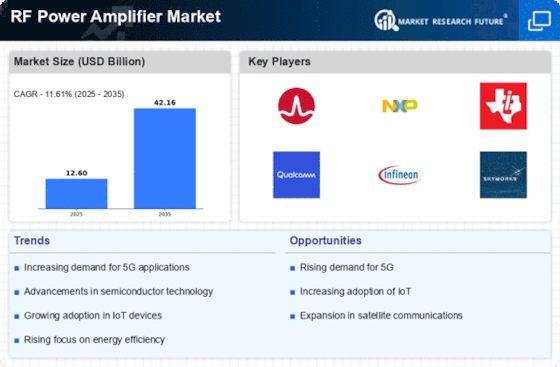
As per Market Research Future analysis, the RF Power Amplifier Market Size was estimated at 12.6 USD Billion in 2024. The RF Power Amplifier industry is projected to grow from 14.06 USD Billion in 2025 to 42.16 USD Billion by 2035, exhibiting a compound annual growth rate (CAGR) of 11.61% during the forecast period 2025 - 2035

Key Market Trends & Highlights

The RF Power Amplifier Market is poised for substantial growth driven by technological advancements and increasing demand across various sectors.

  • Technological advancements are propelling the RF Power Amplifier Market towards greater efficiency and performance. North America remains the largest market, while Asia-Pacific is emerging as the fastest-growing region in this sector. Solid-State Power Amplifiers dominate the market, whereas Traveling Wave Tube Amplifiers are witnessing the fastest growth. The rising demand for wireless communication and the expansion of IoT applications are key drivers fueling market growth.

Market Size & Forecast

2024 Market Size 12.6 (USD Billion)
2035 Market Size 42.16 (USD Billion)
CAGR (2025 - 2035) 11.61%
Largest Regional Market Share in 2024 North America

Major Players

Broadcom (US), NXP Semiconductors (NL), Texas Instruments (US), Qualcomm (US), Infineon Technologies (DE), Skyworks Solutions (US), Analog Devices (US), Mitsubishi Electric (JP), Renesas Electronics (JP)

Market Trends

The RF Power Amplifier Market is currently experiencing a dynamic evolution, driven by advancements in technology and increasing demand across various sectors. The proliferation of wireless communication systems, including mobile networks and satellite communications, has heightened the need for efficient and reliable power amplifiers. As industries strive for enhanced performance and energy efficiency, manufacturers are focusing on developing innovative solutions that cater to these requirements. Furthermore, the integration of RF power amplifiers in emerging applications, such as Internet of Things (IoT) devices and automotive technologies, suggests a promising trajectory for market growth. In addition, the RF Power Amplifier Market is witnessing a shift towards miniaturization and integration, as companies aim to create compact solutions without compromising on performance. This trend is particularly evident in consumer electronics, where space constraints necessitate smaller components. Moreover, the increasing emphasis on sustainability and energy conservation is prompting manufacturers to explore eco-friendly materials and designs. Overall, the RF Power Amplifier Market appears poised for continued expansion, driven by technological advancements and evolving consumer demands.

Technological Advancements

The RF Power Amplifier Market is significantly influenced by ongoing technological innovations. Enhanced designs and materials are being developed to improve efficiency and performance, catering to the growing demands of various applications. This trend indicates a shift towards more sophisticated amplifiers that can handle higher frequencies and power levels.

Integration with Emerging Technologies

The integration of RF power amplifiers into emerging technologies, such as IoT and automotive systems, is becoming increasingly prevalent. This trend highlights the versatility of RF amplifiers and their critical role in supporting the functionality of modern devices, suggesting a robust future for the market.

Focus on Miniaturization

A notable trend within the RF Power Amplifier Market is the emphasis on miniaturization. As consumer electronics evolve, the demand for smaller, more efficient components grows. This focus on compact designs reflects the industry's response to space limitations while maintaining high performance.

RF Power Amplifier Market Market Drivers

Expansion of IoT Applications

The proliferation of Internet of Things (IoT) applications is a key driver for the RF Power Amplifier Market. As more devices become interconnected, the need for reliable and efficient RF power amplifiers to facilitate communication between these devices is becoming increasingly critical. The IoT market is anticipated to reach a valuation of over 1 trillion by 2025, with RF power amplifiers playing a vital role in ensuring seamless connectivity. This trend suggests that the RF Power Amplifier Market will continue to expand as manufacturers develop specialized amplifiers tailored for IoT applications, enhancing overall system performance.

Growth in Consumer Electronics

The RF Power Amplifier Market is significantly influenced by the burgeoning consumer electronics sector. With the advent of smart devices, including smartphones, tablets, and wearables, the demand for high-performance RF power amplifiers is escalating. In 2025, the consumer electronics segment is expected to account for over 40% of the total RF power amplifier market share. This growth is attributed to the increasing integration of RF amplifiers in these devices to ensure optimal performance and energy efficiency. As manufacturers innovate to enhance device capabilities, the RF Power Amplifier Market is poised for substantial growth.

Advancements in Automotive Technology

The RF Power Amplifier Market is also benefiting from advancements in automotive technology, particularly with the rise of connected and autonomous vehicles. These vehicles require sophisticated communication systems to operate effectively, necessitating the use of high-performance RF power amplifiers. The automotive sector is projected to contribute significantly to the RF power amplifier market, with an expected growth rate of around 10% annually. This growth is indicative of the increasing integration of RF amplifiers in vehicle communication systems, enhancing safety and navigation features. As the automotive industry evolves, the RF Power Amplifier Market is likely to see continued investment and innovation.

Rising Demand for Wireless Communication

The RF Power Amplifier Market is experiencing a notable surge in demand driven by the increasing reliance on wireless communication technologies. As mobile devices proliferate, the need for efficient power amplifiers to enhance signal strength and quality becomes paramount. The market is projected to grow at a compound annual growth rate (CAGR) of approximately 8% over the next five years, reflecting the critical role of RF power amplifiers in supporting advanced communication standards such as 5G. This trend indicates a robust expansion in the RF Power Amplifier Market, as manufacturers strive to meet the evolving requirements of high-speed data transmission and connectivity.

Emerging Applications in Aerospace and Defense

The RF Power Amplifier Market is witnessing growth due to emerging applications in the aerospace and defense sectors. These industries require robust and reliable RF power amplifiers for various applications, including radar systems, satellite communications, and electronic warfare. The defense sector is expected to invest heavily in advanced RF technologies, with a projected market growth of approximately 7% over the next five years. This investment reflects the critical need for high-performance RF amplifiers to ensure operational effectiveness in complex environments. As defense and aerospace technologies advance, the RF Power Amplifier Market is likely to experience significant opportunities for growth.

Market Segment Insights

By Product: Solid-State Power Amplifier (Largest) vs. Traveling Wave Tube Amplifier (Fastest-Growing)

In the RF Power Amplifier Market, the segment values are characterized by a significant distribution where solid-state power amplifiers dominate the landscape due to their efficiency and reliability in various applications. This category holds the largest market share, driven by a growing reliance on these amplifiers in telecommunications and broadcasting sectors. On the other hand, traveling wave tube amplifiers, while smaller in share, are rapidly gaining traction, especially in aerospace and military applications due to their ability to handle high power at high frequencies.

Solid-State Power Amplifier (Dominant) vs. Traveling Wave Tube Amplifier (Emerging)

Solid-state power amplifiers are recognized for their robustness and energy efficiency, making them a preferred choice in several RF applications, including wireless communications and radar. They typically exhibit a longer lifespan and lower maintenance costs compared to traditional amplifiers. Conversely, traveling wave tube amplifiers are emerging strongly, primarily due to their unmatched performance in high-power applications such as satellite communications and electronic warfare. Their ability to amplify signals effectively at microwave frequencies positions them as a critical component in advanced RF systems, attracting significant interest for future developments.

By Class: Class AB Power Amplifier (Largest) vs. Class D Power Amplifier (Fastest-Growing)

The RF Power Amplifier Market is characterized by a diverse array of amplifier classes, each serving distinct applications and exhibiting varying market shares. The Class AB power amplifier holds the largest share due to its balanced efficiency and linearity, making it a preferred choice in many consumer electronics and communications systems. Following closely are Class A and Class B amplifiers, which cater to high-fidelity audio applications and specific telecom uses, respectively. Meanwhile, Class D power amplifiers are rapidly gaining traction thanks to their superior efficiency and compact design, appealing to modern electronic applications. In terms of growth trends, Class D power amplifiers are at the forefront, benefiting from advancements in technology that enhance their performance while reducing power consumption. The increasing demand for energy-efficient solutions in wireless communication and consumer electronics is significantly contributing to the rise of Class D. Moreover, the shift towards integrated solutions and the need for compact devices while maintaining high output power is driving the adoption of Class D amplifiers, making them the fastest-growing segment. The market dynamics are expected to favor the growth of Class D, thanks to these compelling advantages.

Class AB (Dominant) vs. Class D (Emerging)

Class AB power amplifiers have established themselves as a dominant presence in the RF Power Amplifier Market, combining the linearity of Class A with the efficiency of Class B, which makes them highly effective for various audio and RF applications. They are widely utilized in sectors requiring high fidelity and are known for their balanced performance amidst a range of operating conditions. Class AB amps provide a desirable trade-off between performance and efficiency, thus maintaining a significant market position. In contrast, Class D power amplifiers are emerging as a preferred alternative due to their excellent efficiency and compact design. Their ability to deliver high output power without substantial heat generation makes them ideal for modern electronic applications, including portable devices and communication systems, positioning them as an attractive option for future growth in the RF amplifier market.

By Technology: Silicon (Largest) vs. Gallium Arsenide (Fastest-Growing)

The RF Power Amplifier Market exhibits a diverse distribution across various technologies, with Silicon holding the largest market share due to its widespread applicability and cost-effectiveness. Silicon germanium is also notable for its favorable electrical properties, occupying a significant position, while Gallium arsenide is rapidly gaining traction for high-frequency applications. Other materials, although less prevalent, are carving out niches in specialized markets.

Technology: Silicon (Dominant) vs. Gallium Arsenide (Emerging)

Silicon stands out in the RF Power Amplifier Market as the dominant technology, lauded for its low production costs and efficiency across a range of applications. It is extensively used in communication systems and consumer electronics. Conversely, Gallium Arsenide is emerging as a vital player, especially in high-frequency and high-efficiency applications. It excels in environments requiring superior performance, such as aerospace and defense sectors. The growing demand for compact, high-performance amplifiers positions Gallium Arsenide for robust growth as technological innovations continue to evolve.

By End-User Industries: Telecommunication (Largest) vs. Consumer Electronics (Fastest-Growing)

In the RF Power Amplifier Market, the share distribution among end-user industries indicates that the telecommunication sector holds a significant portion of the market, underscoring its critical role in shaping the demand for RF amplifiers. Following closely is the consumer electronics segment, which is rapidly increasing its footprint as smart devices and IoT solutions gain momentum, thereby diversifying the applications of RF amplifiers.

Telecommunication: Dominant vs. Consumer Electronics: Emerging

The telecommunication sector remains the dominant force in the RF Power Amplifier Market, driven by the need for robust communication networks and advancements in 5G technology. This segment relies heavily on RF amplifiers to enhance signal strength, ensuring reliable transmission over increasing distances. In contrast, the consumer electronics industry is emerging as a significant player, fueled by the proliferation of smart devices and the demand for high-performance audio and video equipment. As trends like IoT and smart home initiatives grow, consumer electronics are poised to capture a larger share, indicating a transformative shift in RF power amplifier applications.

Get more detailed insights about RF Power Amplifier Market Research Report - Global Forecast 2035

Regional Insights

By region, the study provides market insights into North America, Europe, Asia-Pacific, and the Rest of the World. The North American RF power amplifier market, will dominate because of the ever-growing interest in mobile computing. With the help of RF power amplifiers, the capabilities of modern cell phones continue to improve in this region.

Further, the major countries studied in the market report are The US, Canada, German, France, the UK, Italy, Spain, China, Japan, India, Australia, South Korea, and Brazil.

Figure 2: RF Power Amplifier Market SHARE BY REGION 2022 (USD Billion)

Europe’s RF power amplifier market accounts for the second-largest market due to a growing demand for energy-efficient gadgets. Further, the RF power amplifier market held the largest market share, and the UK RF power amplifier market was the fastest-growing market in the European region.

The Asia-Pacific RF power amplifier market is expected to grow at the fastest CAGR from 2023 to 2032 due to the increasing research and development efforts for the RF power amplifier sector and the progress in wireless technology. In addition, the healthcare and pharmaceutical industries' rapid use of new technology has boosted demand for RF power amplifiers. Moreover, China’s RF power amplifier market held the largest market share, and the Indian RF power amplifier market was the fastest-rising market in the Asia-Pacific region.

Key Players and Competitive Insights

Leading market players are investing heavily in research and development to expand their product lines, which will help the RF power amplifier market grow even more. There are some strategies for action that market participants are implementing to increase their presence around the world's global footprint, with important market developments including new product launches, contractual agreements and acquisitions, higher investments, and collaboration with other organizations. To expand and survive in a more competitive and rising market climate, the RF power amplifier industry must offer cost-effective items.

Manufacturing locally to minimize operational costs is one of the key business tactics manufacturer use in the global RF power amplifier industry to benefit clients and increase the market sector. In recent years, the RF power amplifier industry has offered some of the most significant technological advancements. Major players in the RF power amplifier market, including Analog Devices Inc., Broadcom Ltd., II-VI Inc., Infineon Technologies AG, Mitsubishi Corporation, Murata Manufacturing Co. Ltd., NXP Semiconductors NV, Qualcomm Inc., Skyworks Solutions Inc., Toshiba Corporation, and others are attempting to grow market demand by investing in research and development operations.

Semiconductors are crucial for the current energy crisis and the digital transition. Because of this, Infineon is committed to leading the transition to digital and low-carbon technology. As a premier semiconductor firm in the world, we enable game-changing solutions for clean and efficient energy, clean and safe mobility, and a smart and secure Internet of Things. We make life better by making it easier, safer, and less harmful to the environment by working together with our customers. Infineon is a thriving worldwide corporation with a unique workforce thanks to its employees' knowledge, enthusiasm, and courage from more than 90 countries.

Since the semiconductor's discovery, we've made daily progress toward the future.

In March Infineon Technologies AG and GaN Systems said they had signed a final deal allowing Infineon to buy GaN Systems for $830 million. GaN Systems is a world leader in technology-making power conversion systems based on GaN.

Analog Devices is a world leader in semiconductors. It connects the digital and physical worlds to make breakthroughs at the Intelligent Edge. ADI combines analog, digital, and software technologies to make solutions that help improve digital factories, mobility, and digital healthcare, fight climate change, and connect people to the rest of the world in a reliable way.

In June it was announced that ADI's MEMS sensor technology would be used in Envision Energy's next generation of intelligent wind turbines. Envision Energy is a division of Envision Group that provides cutting-edge green technologies.

Improved real-time monitoring of vibration, tilt, and other information that might advise safer windmill operation and design is one of the initial goals of the partnership. Incorporating the cutting-edge features of MEMS sensors into real-time monitoring infrastructure is a step forward in the green energy revolution.

Key Companies in the RF Power Amplifier Market include

Industry Developments

September 2023: The Keysight EDA 2024 tool suite is expected to be a complete toolset for design through simulation and “shift left” workflow tools for increased RF/5G productivity. Keysight has a reputation as being a maker of high-end test and measurement equipment but is not as well-known as an EDA software vendor. This changed last week when the company introduced a new set of EDA tools, test programs and simulations into its software product line. This particular suite known as the Keysight EDA 2024 is aimed at RF, Microwave and 5G applications development.

The firm persists on having integrated end to end design with its EDA tools. Combination of device modeling, circuit design, EM simulation, layout capabilities along with system-level modeling in this suite.

September 2023: Teledyne e2v HiRel Electronics announces industry leading space qualified L- & S-band low noise amplifier (LNA) TDLNA002093SEP that operates at very low power levels while offering optimal performance making it ideal for demanding military radar requirements where low noise figure (NF), power consumption and small footprint are paramount to mission success.

This is packaged in a plastic surface mount package measuring 1.5 mm x 1.5 mm x 0.8 mm no leads using dual-flat no-lead (DFN) technology with six pins such that it can be inserted onto printed wiring boards without first drilling holes or any other kind of lead forming operation; it uses only four wires instead of eight unlike other packages available so far.

Renesas Electronics has expanded its RF offerings for legacy 5G macro BTSs by introducing four new high-reliability, high-performance parts that allow customers to access all elements in an RF system. This range incorporates the first-of-its-kind quad-channel F4482/1 TX variable gain amplifiers (VGA) and a dual channel first stage LNA from the F011x series. It is comprised also of a high-power pre-driver with P1dB over 1/2W named F1471 RF driver amplifier and F2934 RF switch for digital predistortion feedback path which has better isolation in smaller packages than other devices.

The enhanced lineup offers small form factor, improved reliability, higher performance as well as flexibility required by 5G Macro BTS systems.

March 2023: Qualcomm Technologies, Inc. revealed new IoT solutions, including the Qualcomm® QCS8550, Qualcomm® QCM8550, Qualcomm® QCS4490, and Qualcomm® QCM4490 Processors. These solutions will help the next generation of IoT devices move forward. The new and improved solutions have many features, powers, and ways to use them. They are made to meet the needs of the most demanding customers.

July 2023: Apollo MxFE is the latest and most modern software-defined, direct RF-sampling, wideband mixed-signal front-end platform from Analog Devices, Inc. Apollo MxFE paves the way for cutting-edge use cases in the Aerospace & Defense, Instrumentation, and Wireless Communications sectors, including phased array radar, electronic surveillance, test & measurement, and 6G communications.

Future Outlook

RF Power Amplifier Market Future Outlook

The RF Power Amplifier Market is projected to grow at 11.61% CAGR from 2025 to 2035, driven by advancements in telecommunications, IoT applications, and increased demand for high-frequency devices.

New opportunities lie in:

  • Development of integrated RF power amplifiers for 5G applications.
  • Expansion into emerging markets with tailored RF solutions.
  • Investment in research for energy-efficient amplifier technologies.

By 2035, the RF Power Amplifier Market is expected to achieve substantial growth and innovation.

Market Segmentation

RF Power Amplifier Market Class Outlook

  • Class A power amplifier
  • Class B power amplifier
  • Class AB power amplifier
  • Class C power amplifier
  • Class D power amplifier
  • Other

RF Power Amplifier Market Product Outlook

  • Audio power amplifier
  • RF power amplifier
  • Traveling wave tube amplifier
  • Solid-state power amplifier

RF Power Amplifier Market Technology Outlook

  • Silicon
  • Silicon germanium
  • Gallium arsenide
  • Other

RF Power Amplifier Market End-User Industries Outlook

  • Consumer electronics
  • Industrial
  • Telecommunication
  • Military
  • Defense
  • Automotive
  • Others

Report Scope

MARKET SIZE 2024 12.6(USD Billion)
MARKET SIZE 2025 14.06(USD Billion)
MARKET SIZE 2035 42.16(USD Billion)
COMPOUND ANNUAL GROWTH RATE (CAGR) 11.61% (2025 - 2035)
REPORT COVERAGE Revenue Forecast, Competitive Landscape, Growth Factors, and Trends
BASE YEAR 2024
Market Forecast Period 2025 - 2035
Historical Data 2019 - 2024
Market Forecast Units USD Billion
Key Companies Profiled Broadcom (US), NXP Semiconductors (NL), Texas Instruments (US), Qualcomm (US), Infineon Technologies (DE), Skyworks Solutions (US), Analog Devices (US), Mitsubishi Electric (JP), Renesas Electronics (JP)
Segments Covered Product, Class, Technology, End-User Industries, Region –Industry Forecast Till 2035
Key Market Opportunities Advancements in 5G technology drive demand for high-efficiency RF Power Amplifier solutions.
Key Market Dynamics Technological advancements and regulatory changes drive innovation and competition in the RF Power Amplifier market.
Countries Covered North America, Europe, APAC, South America, MEA

FAQs

What is the projected market valuation of the RF Power Amplifier Market by 2035?

<p>The RF Power Amplifier Market is projected to reach a valuation of 42.16 USD Billion by 2035.</p>

What was the market valuation of the RF Power Amplifier Market in 2024?

<p>In 2024, the RF Power Amplifier Market had a valuation of 12.6 USD Billion.</p>

What is the expected CAGR for the RF Power Amplifier Market during the forecast period 2025 - 2035?

<p>The expected CAGR for the RF Power Amplifier Market during the forecast period 2025 - 2035 is 11.61%.</p>

Which companies are considered key players in the RF Power Amplifier Market?

<p>Key players in the RF Power Amplifier Market include Broadcom, NXP Semiconductors, Texas Instruments, Qualcomm, and Infineon Technologies.</p>

What are the main product segments within the RF Power Amplifier Market?

<p>The main product segments include RF power amplifiers, audio power amplifiers, traveling wave tube amplifiers, and solid-state power amplifiers.</p>

How does the Class AB power amplifier segment perform in terms of market valuation?

<p>The Class AB power amplifier segment is valued at 3.78 USD Billion in 2024 and is projected to reach 12.93 USD Billion by 2035.</p>

What technology segments are present in the RF Power Amplifier Market?

Technology segments in the RF Power Amplifier Market include silicon, silicon germanium, gallium arsenide, and others.

Which end-user industries are driving demand for RF Power Amplifiers?

End-user industries driving demand include consumer electronics, telecommunications, military, automotive, and industrial sectors.

What is the market valuation for the silicon technology segment in 2024?

The silicon technology segment was valued at 5.04 USD Billion in 2024.

What is the projected growth for the traveling wave tube amplifier segment by 2035?

The traveling wave tube amplifier segment is expected to grow from 2.52 USD Billion in 2024 to 8.56 USD Billion by 2035.

  1. SECTION I: EXECUTIVE SUMMARY AND KEY HIGHLIGHTS
    1. | 1.1 EXECUTIVE SUMMARY
    2. | | 1.1.1 Market Overview
    3. | | 1.1.2 Key Findings
    4. | | 1.1.3 Market Segmentation
    5. | | 1.1.4 Competitive Landscape
    6. | | 1.1.5 Challenges and Opportunities
    7. | | 1.1.6 Future Outlook
  2. SECTION II: SCOPING, METHODOLOGY AND MARKET STRUCTURE
    1. | 2.1 MARKET INTRODUCTION
    2. | | 2.1.1 Definition
    3. | | 2.1.2 Scope of the study
    4. | | | 2.1.2.1 Research Objective
    5. | | | 2.1.2.2 Assumption
    6. | | | 2.1.2.3 Limitations
    7. | 2.2 RESEARCH METHODOLOGY
    8. | | 2.2.1 Overview
    9. | | 2.2.2 Data Mining
    10. | | 2.2.3 Secondary Research
    11. | | 2.2.4 Primary Research
    12. | | | 2.2.4.1 Primary Interviews and Information Gathering Process
    13. | | | 2.2.4.2 Breakdown of Primary Respondents
    14. | | 2.2.5 Forecasting Model
    15. | | 2.2.6 Market Size Estimation
    16. | | | 2.2.6.1 Bottom-Up Approach
    17. | | | 2.2.6.2 Top-Down Approach
    18. | | 2.2.7 Data Triangulation
    19. | | 2.2.8 Validation
  3. SECTION III: QUALITATIVE ANALYSIS
    1. | 3.1 MARKET DYNAMICS
    2. | | 3.1.1 Overview
    3. | | 3.1.2 Drivers
    4. | | 3.1.3 Restraints
    5. | | 3.1.4 Opportunities
    6. | 3.2 MARKET FACTOR ANALYSIS
    7. | | 3.2.1 Value chain Analysis
    8. | | 3.2.2 Porter's Five Forces Analysis
    9. | | | 3.2.2.1 Bargaining Power of Suppliers
    10. | | | 3.2.2.2 Bargaining Power of Buyers
    11. | | | 3.2.2.3 Threat of New Entrants
    12. | | | 3.2.2.4 Threat of Substitutes
    13. | | | 3.2.2.5 Intensity of Rivalry
    14. | | 3.2.3 COVID-19 Impact Analysis
    15. | | | 3.2.3.1 Market Impact Analysis
    16. | | | 3.2.3.2 Regional Impact
    17. | | | 3.2.3.3 Opportunity and Threat Analysis
  4. SECTION IV: QUANTITATIVE ANALYSIS
    1. | 4.1 Semiconductor & Electronics, BY Product (USD Billion)
    2. | | 4.1.1 Audio power amplifier
    3. | | 4.1.2 RF power amplifier
    4. | | 4.1.3 Traveling wave tube amplifier
    5. | | 4.1.4 Solid-state power amplifier
    6. | 4.2 Semiconductor & Electronics, BY Class (USD Billion)
    7. | | 4.2.1 Class A power amplifier
    8. | | 4.2.2 Class B power amplifier
    9. | | 4.2.3 Class AB power amplifier
    10. | | 4.2.4 Class C power amplifier
    11. | | 4.2.5 Class D power amplifier
    12. | | 4.2.6 Other
    13. | 4.3 Semiconductor & Electronics, BY Technology (USD Billion)
    14. | | 4.3.1 Silicon
    15. | | 4.3.2 Silicon germanium
    16. | | 4.3.3 Gallium arsenide
    17. | | 4.3.4 Other
    18. | 4.4 Semiconductor & Electronics, BY End-User Industries (USD Billion)
    19. | | 4.4.1 Consumer electronics
    20. | | 4.4.2 Industrial
    21. | | 4.4.3 Telecommunication
    22. | | 4.4.4 Military
    23. | | 4.4.5 Defense
    24. | | 4.4.6 Automotive
    25. | | 4.4.7 Others
    26. | 4.5 Semiconductor & Electronics, BY Region (USD Billion)
    27. | | 4.5.1 North America
    28. | | | 4.5.1.1 US
    29. | | | 4.5.1.2 Canada
    30. | | 4.5.2 Europe
    31. | | | 4.5.2.1 Germany
    32. | | | 4.5.2.2 UK
    33. | | | 4.5.2.3 France
    34. | | | 4.5.2.4 Russia
    35. | | | 4.5.2.5 Italy
    36. | | | 4.5.2.6 Spain
    37. | | | 4.5.2.7 Rest of Europe
    38. | | 4.5.3 APAC
    39. | | | 4.5.3.1 China
    40. | | | 4.5.3.2 India
    41. | | | 4.5.3.3 Japan
    42. | | | 4.5.3.4 South Korea
    43. | | | 4.5.3.5 Malaysia
    44. | | | 4.5.3.6 Thailand
    45. | | | 4.5.3.7 Indonesia
    46. | | | 4.5.3.8 Rest of APAC
    47. | | 4.5.4 South America
    48. | | | 4.5.4.1 Brazil
    49. | | | 4.5.4.2 Mexico
    50. | | | 4.5.4.3 Argentina
    51. | | | 4.5.4.4 Rest of South America
    52. | | 4.5.5 MEA
    53. | | | 4.5.5.1 GCC Countries
    54. | | | 4.5.5.2 South Africa
    55. | | | 4.5.5.3 Rest of MEA
  5. SECTION V: COMPETITIVE ANALYSIS
    1. | 5.1 Competitive Landscape
    2. | | 5.1.1 Overview
    3. | | 5.1.2 Competitive Analysis
    4. | | 5.1.3 Market share Analysis
    5. | | 5.1.4 Major Growth Strategy in the Semiconductor & Electronics
    6. | | 5.1.5 Competitive Benchmarking
    7. | | 5.1.6 Leading Players in Terms of Number of Developments in the Semiconductor & Electronics
    8. | | 5.1.7 Key developments and growth strategies
    9. | | | 5.1.7.1 New Product Launch/Service Deployment
    10. | | | 5.1.7.2 Merger & Acquisitions
    11. | | | 5.1.7.3 Joint Ventures
    12. | | 5.1.8 Major Players Financial Matrix
    13. | | | 5.1.8.1 Sales and Operating Income
    14. | | | 5.1.8.2 Major Players R&D Expenditure. 2023
    15. | 5.2 Company Profiles
    16. | | 5.2.1 Broadcom (US)
    17. | | | 5.2.1.1 Financial Overview
    18. | | | 5.2.1.2 Products Offered
    19. | | | 5.2.1.3 Key Developments
    20. | | | 5.2.1.4 SWOT Analysis
    21. | | | 5.2.1.5 Key Strategies
    22. | | 5.2.2 NXP Semiconductors (NL)
    23. | | | 5.2.2.1 Financial Overview
    24. | | | 5.2.2.2 Products Offered
    25. | | | 5.2.2.3 Key Developments
    26. | | | 5.2.2.4 SWOT Analysis
    27. | | | 5.2.2.5 Key Strategies
    28. | | 5.2.3 Texas Instruments (US)
    29. | | | 5.2.3.1 Financial Overview
    30. | | | 5.2.3.2 Products Offered
    31. | | | 5.2.3.3 Key Developments
    32. | | | 5.2.3.4 SWOT Analysis
    33. | | | 5.2.3.5 Key Strategies
    34. | | 5.2.4 Qualcomm (US)
    35. | | | 5.2.4.1 Financial Overview
    36. | | | 5.2.4.2 Products Offered
    37. | | | 5.2.4.3 Key Developments
    38. | | | 5.2.4.4 SWOT Analysis
    39. | | | 5.2.4.5 Key Strategies
    40. | | 5.2.5 Infineon Technologies (DE)
    41. | | | 5.2.5.1 Financial Overview
    42. | | | 5.2.5.2 Products Offered
    43. | | | 5.2.5.3 Key Developments
    44. | | | 5.2.5.4 SWOT Analysis
    45. | | | 5.2.5.5 Key Strategies
    46. | | 5.2.6 Skyworks Solutions (US)
    47. | | | 5.2.6.1 Financial Overview
    48. | | | 5.2.6.2 Products Offered
    49. | | | 5.2.6.3 Key Developments
    50. | | | 5.2.6.4 SWOT Analysis
    51. | | | 5.2.6.5 Key Strategies
    52. | | 5.2.7 Analog Devices (US)
    53. | | | 5.2.7.1 Financial Overview
    54. | | | 5.2.7.2 Products Offered
    55. | | | 5.2.7.3 Key Developments
    56. | | | 5.2.7.4 SWOT Analysis
    57. | | | 5.2.7.5 Key Strategies
    58. | | 5.2.8 Mitsubishi Electric (JP)
    59. | | | 5.2.8.1 Financial Overview
    60. | | | 5.2.8.2 Products Offered
    61. | | | 5.2.8.3 Key Developments
    62. | | | 5.2.8.4 SWOT Analysis
    63. | | | 5.2.8.5 Key Strategies
    64. | | 5.2.9 Renesas Electronics (JP)
    65. | | | 5.2.9.1 Financial Overview
    66. | | | 5.2.9.2 Products Offered
    67. | | | 5.2.9.3 Key Developments
    68. | | | 5.2.9.4 SWOT Analysis
    69. | | | 5.2.9.5 Key Strategies
    70. | 5.3 Appendix
    71. | | 5.3.1 References
    72. | | 5.3.2 Related Reports
  6. LIST OF FIGURES
    1. | 6.1 MARKET SYNOPSIS
    2. | 6.2 NORTH AMERICA MARKET ANALYSIS
    3. | 6.3 US MARKET ANALYSIS BY PRODUCT
    4. | 6.4 US MARKET ANALYSIS BY CLASS
    5. | 6.5 US MARKET ANALYSIS BY TECHNOLOGY
    6. | 6.6 US MARKET ANALYSIS BY END-USER INDUSTRIES
    7. | 6.7 CANADA MARKET ANALYSIS BY PRODUCT
    8. | 6.8 CANADA MARKET ANALYSIS BY CLASS
    9. | 6.9 CANADA MARKET ANALYSIS BY TECHNOLOGY
    10. | 6.10 CANADA MARKET ANALYSIS BY END-USER INDUSTRIES
    11. | 6.11 EUROPE MARKET ANALYSIS
    12. | 6.12 GERMANY MARKET ANALYSIS BY PRODUCT
    13. | 6.13 GERMANY MARKET ANALYSIS BY CLASS
    14. | 6.14 GERMANY MARKET ANALYSIS BY TECHNOLOGY
    15. | 6.15 GERMANY MARKET ANALYSIS BY END-USER INDUSTRIES
    16. | 6.16 UK MARKET ANALYSIS BY PRODUCT
    17. | 6.17 UK MARKET ANALYSIS BY CLASS
    18. | 6.18 UK MARKET ANALYSIS BY TECHNOLOGY
    19. | 6.19 UK MARKET ANALYSIS BY END-USER INDUSTRIES
    20. | 6.20 FRANCE MARKET ANALYSIS BY PRODUCT
    21. | 6.21 FRANCE MARKET ANALYSIS BY CLASS
    22. | 6.22 FRANCE MARKET ANALYSIS BY TECHNOLOGY
    23. | 6.23 FRANCE MARKET ANALYSIS BY END-USER INDUSTRIES
    24. | 6.24 RUSSIA MARKET ANALYSIS BY PRODUCT
    25. | 6.25 RUSSIA MARKET ANALYSIS BY CLASS
    26. | 6.26 RUSSIA MARKET ANALYSIS BY TECHNOLOGY
    27. | 6.27 RUSSIA MARKET ANALYSIS BY END-USER INDUSTRIES
    28. | 6.28 ITALY MARKET ANALYSIS BY PRODUCT
    29. | 6.29 ITALY MARKET ANALYSIS BY CLASS
    30. | 6.30 ITALY MARKET ANALYSIS BY TECHNOLOGY
    31. | 6.31 ITALY MARKET ANALYSIS BY END-USER INDUSTRIES
    32. | 6.32 SPAIN MARKET ANALYSIS BY PRODUCT
    33. | 6.33 SPAIN MARKET ANALYSIS BY CLASS
    34. | 6.34 SPAIN MARKET ANALYSIS BY TECHNOLOGY
    35. | 6.35 SPAIN MARKET ANALYSIS BY END-USER INDUSTRIES
    36. | 6.36 REST OF EUROPE MARKET ANALYSIS BY PRODUCT
    37. | 6.37 REST OF EUROPE MARKET ANALYSIS BY CLASS
    38. | 6.38 REST OF EUROPE MARKET ANALYSIS BY TECHNOLOGY
    39. | 6.39 REST OF EUROPE MARKET ANALYSIS BY END-USER INDUSTRIES
    40. | 6.40 APAC MARKET ANALYSIS
    41. | 6.41 CHINA MARKET ANALYSIS BY PRODUCT
    42. | 6.42 CHINA MARKET ANALYSIS BY CLASS
    43. | 6.43 CHINA MARKET ANALYSIS BY TECHNOLOGY
    44. | 6.44 CHINA MARKET ANALYSIS BY END-USER INDUSTRIES
    45. | 6.45 INDIA MARKET ANALYSIS BY PRODUCT
    46. | 6.46 INDIA MARKET ANALYSIS BY CLASS
    47. | 6.47 INDIA MARKET ANALYSIS BY TECHNOLOGY
    48. | 6.48 INDIA MARKET ANALYSIS BY END-USER INDUSTRIES
    49. | 6.49 JAPAN MARKET ANALYSIS BY PRODUCT
    50. | 6.50 JAPAN MARKET ANALYSIS BY CLASS
    51. | 6.51 JAPAN MARKET ANALYSIS BY TECHNOLOGY
    52. | 6.52 JAPAN MARKET ANALYSIS BY END-USER INDUSTRIES
    53. | 6.53 SOUTH KOREA MARKET ANALYSIS BY PRODUCT
    54. | 6.54 SOUTH KOREA MARKET ANALYSIS BY CLASS
    55. | 6.55 SOUTH KOREA MARKET ANALYSIS BY TECHNOLOGY
    56. | 6.56 SOUTH KOREA MARKET ANALYSIS BY END-USER INDUSTRIES
    57. | 6.57 MALAYSIA MARKET ANALYSIS BY PRODUCT
    58. | 6.58 MALAYSIA MARKET ANALYSIS BY CLASS
    59. | 6.59 MALAYSIA MARKET ANALYSIS BY TECHNOLOGY
    60. | 6.60 MALAYSIA MARKET ANALYSIS BY END-USER INDUSTRIES
    61. | 6.61 THAILAND MARKET ANALYSIS BY PRODUCT
    62. | 6.62 THAILAND MARKET ANALYSIS BY CLASS
    63. | 6.63 THAILAND MARKET ANALYSIS BY TECHNOLOGY
    64. | 6.64 THAILAND MARKET ANALYSIS BY END-USER INDUSTRIES
    65. | 6.65 INDONESIA MARKET ANALYSIS BY PRODUCT
    66. | 6.66 INDONESIA MARKET ANALYSIS BY CLASS
    67. | 6.67 INDONESIA MARKET ANALYSIS BY TECHNOLOGY
    68. | 6.68 INDONESIA MARKET ANALYSIS BY END-USER INDUSTRIES
    69. | 6.69 REST OF APAC MARKET ANALYSIS BY PRODUCT
    70. | 6.70 REST OF APAC MARKET ANALYSIS BY CLASS
    71. | 6.71 REST OF APAC MARKET ANALYSIS BY TECHNOLOGY
    72. | 6.72 REST OF APAC MARKET ANALYSIS BY END-USER INDUSTRIES
    73. | 6.73 SOUTH AMERICA MARKET ANALYSIS
    74. | 6.74 BRAZIL MARKET ANALYSIS BY PRODUCT
    75. | 6.75 BRAZIL MARKET ANALYSIS BY CLASS
    76. | 6.76 BRAZIL MARKET ANALYSIS BY TECHNOLOGY
    77. | 6.77 BRAZIL MARKET ANALYSIS BY END-USER INDUSTRIES
    78. | 6.78 MEXICO MARKET ANALYSIS BY PRODUCT
    79. | 6.79 MEXICO MARKET ANALYSIS BY CLASS
    80. | 6.80 MEXICO MARKET ANALYSIS BY TECHNOLOGY
    81. | 6.81 MEXICO MARKET ANALYSIS BY END-USER INDUSTRIES
    82. | 6.82 ARGENTINA MARKET ANALYSIS BY PRODUCT
    83. | 6.83 ARGENTINA MARKET ANALYSIS BY CLASS
    84. | 6.84 ARGENTINA MARKET ANALYSIS BY TECHNOLOGY
    85. | 6.85 ARGENTINA MARKET ANALYSIS BY END-USER INDUSTRIES
    86. | 6.86 REST OF SOUTH AMERICA MARKET ANALYSIS BY PRODUCT
    87. | 6.87 REST OF SOUTH AMERICA MARKET ANALYSIS BY CLASS
    88. | 6.88 REST OF SOUTH AMERICA MARKET ANALYSIS BY TECHNOLOGY
    89. | 6.89 REST OF SOUTH AMERICA MARKET ANALYSIS BY END-USER INDUSTRIES
    90. | 6.90 MEA MARKET ANALYSIS
    91. | 6.91 GCC COUNTRIES MARKET ANALYSIS BY PRODUCT
    92. | 6.92 GCC COUNTRIES MARKET ANALYSIS BY CLASS
    93. | 6.93 GCC COUNTRIES MARKET ANALYSIS BY TECHNOLOGY
    94. | 6.94 GCC COUNTRIES MARKET ANALYSIS BY END-USER INDUSTRIES
    95. | 6.95 SOUTH AFRICA MARKET ANALYSIS BY PRODUCT
    96. | 6.96 SOUTH AFRICA MARKET ANALYSIS BY CLASS
    97. | 6.97 SOUTH AFRICA MARKET ANALYSIS BY TECHNOLOGY
    98. | 6.98 SOUTH AFRICA MARKET ANALYSIS BY END-USER INDUSTRIES
    99. | 6.99 REST OF MEA MARKET ANALYSIS BY PRODUCT
    100. | 6.100 REST OF MEA MARKET ANALYSIS BY CLASS
    101. | 6.101 REST OF MEA MARKET ANALYSIS BY TECHNOLOGY
    102. | 6.102 REST OF MEA MARKET ANALYSIS BY END-USER INDUSTRIES
    103. | 6.103 KEY BUYING CRITERIA OF SEMICONDUCTOR & ELECTRONICS
    104. | 6.104 RESEARCH PROCESS OF MRFR
    105. | 6.105 DRO ANALYSIS OF SEMICONDUCTOR & ELECTRONICS
    106. | 6.106 DRIVERS IMPACT ANALYSIS: SEMICONDUCTOR & ELECTRONICS
    107. | 6.107 RESTRAINTS IMPACT ANALYSIS: SEMICONDUCTOR & ELECTRONICS
    108. | 6.108 SUPPLY / VALUE CHAIN: SEMICONDUCTOR & ELECTRONICS
    109. | 6.109 SEMICONDUCTOR & ELECTRONICS, BY PRODUCT, 2024 (% SHARE)
    110. | 6.110 SEMICONDUCTOR & ELECTRONICS, BY PRODUCT, 2024 TO 2035 (USD Billion)
    111. | 6.111 SEMICONDUCTOR & ELECTRONICS, BY CLASS, 2024 (% SHARE)
    112. | 6.112 SEMICONDUCTOR & ELECTRONICS, BY CLASS, 2024 TO 2035 (USD Billion)
    113. | 6.113 SEMICONDUCTOR & ELECTRONICS, BY TECHNOLOGY, 2024 (% SHARE)
    114. | 6.114 SEMICONDUCTOR & ELECTRONICS, BY TECHNOLOGY, 2024 TO 2035 (USD Billion)
    115. | 6.115 SEMICONDUCTOR & ELECTRONICS, BY END-USER INDUSTRIES, 2024 (% SHARE)
    116. | 6.116 SEMICONDUCTOR & ELECTRONICS, BY END-USER INDUSTRIES, 2024 TO 2035 (USD Billion)
    117. | 6.117 BENCHMARKING OF MAJOR COMPETITORS
  7. LIST OF TABLES
    1. | 7.1 LIST OF ASSUMPTIONS
    2. | | 7.1.1
    3. | 7.2 North America MARKET SIZE ESTIMATES; FORECAST
    4. | | 7.2.1 BY PRODUCT, 2025-2035 (USD Billion)
    5. | | 7.2.2 BY CLASS, 2025-2035 (USD Billion)
    6. | | 7.2.3 BY TECHNOLOGY, 2025-2035 (USD Billion)
    7. | | 7.2.4 BY END-USER INDUSTRIES, 2025-2035 (USD Billion)
    8. | 7.3 US MARKET SIZE ESTIMATES; FORECAST
    9. | | 7.3.1 BY PRODUCT, 2025-2035 (USD Billion)
    10. | | 7.3.2 BY CLASS, 2025-2035 (USD Billion)
    11. | | 7.3.3 BY TECHNOLOGY, 2025-2035 (USD Billion)
    12. | | 7.3.4 BY END-USER INDUSTRIES, 2025-2035 (USD Billion)
    13. | 7.4 Canada MARKET SIZE ESTIMATES; FORECAST
    14. | | 7.4.1 BY PRODUCT, 2025-2035 (USD Billion)
    15. | | 7.4.2 BY CLASS, 2025-2035 (USD Billion)
    16. | | 7.4.3 BY TECHNOLOGY, 2025-2035 (USD Billion)
    17. | | 7.4.4 BY END-USER INDUSTRIES, 2025-2035 (USD Billion)
    18. | 7.5 Europe MARKET SIZE ESTIMATES; FORECAST
    19. | | 7.5.1 BY PRODUCT, 2025-2035 (USD Billion)
    20. | | 7.5.2 BY CLASS, 2025-2035 (USD Billion)
    21. | | 7.5.3 BY TECHNOLOGY, 2025-2035 (USD Billion)
    22. | | 7.5.4 BY END-USER INDUSTRIES, 2025-2035 (USD Billion)
    23. | 7.6 Germany MARKET SIZE ESTIMATES; FORECAST
    24. | | 7.6.1 BY PRODUCT, 2025-2035 (USD Billion)
    25. | | 7.6.2 BY CLASS, 2025-2035 (USD Billion)
    26. | | 7.6.3 BY TECHNOLOGY, 2025-2035 (USD Billion)
    27. | | 7.6.4 BY END-USER INDUSTRIES, 2025-2035 (USD Billion)
    28. | 7.7 UK MARKET SIZE ESTIMATES; FORECAST
    29. | | 7.7.1 BY PRODUCT, 2025-2035 (USD Billion)
    30. | | 7.7.2 BY CLASS, 2025-2035 (USD Billion)
    31. | | 7.7.3 BY TECHNOLOGY, 2025-2035 (USD Billion)
    32. | | 7.7.4 BY END-USER INDUSTRIES, 2025-2035 (USD Billion)
    33. | 7.8 France MARKET SIZE ESTIMATES; FORECAST
    34. | | 7.8.1 BY PRODUCT, 2025-2035 (USD Billion)
    35. | | 7.8.2 BY CLASS, 2025-2035 (USD Billion)
    36. | | 7.8.3 BY TECHNOLOGY, 2025-2035 (USD Billion)
    37. | | 7.8.4 BY END-USER INDUSTRIES, 2025-2035 (USD Billion)
    38. | 7.9 Russia MARKET SIZE ESTIMATES; FORECAST
    39. | | 7.9.1 BY PRODUCT, 2025-2035 (USD Billion)
    40. | | 7.9.2 BY CLASS, 2025-2035 (USD Billion)
    41. | | 7.9.3 BY TECHNOLOGY, 2025-2035 (USD Billion)
    42. | | 7.9.4 BY END-USER INDUSTRIES, 2025-2035 (USD Billion)
    43. | 7.10 Italy MARKET SIZE ESTIMATES; FORECAST
    44. | | 7.10.1 BY PRODUCT, 2025-2035 (USD Billion)
    45. | | 7.10.2 BY CLASS, 2025-2035 (USD Billion)
    46. | | 7.10.3 BY TECHNOLOGY, 2025-2035 (USD Billion)
    47. | | 7.10.4 BY END-USER INDUSTRIES, 2025-2035 (USD Billion)
    48. | 7.11 Spain MARKET SIZE ESTIMATES; FORECAST
    49. | | 7.11.1 BY PRODUCT, 2025-2035 (USD Billion)
    50. | | 7.11.2 BY CLASS, 2025-2035 (USD Billion)
    51. | | 7.11.3 BY TECHNOLOGY, 2025-2035 (USD Billion)
    52. | | 7.11.4 BY END-USER INDUSTRIES, 2025-2035 (USD Billion)
    53. | 7.12 Rest of Europe MARKET SIZE ESTIMATES; FORECAST
    54. | | 7.12.1 BY PRODUCT, 2025-2035 (USD Billion)
    55. | | 7.12.2 BY CLASS, 2025-2035 (USD Billion)
    56. | | 7.12.3 BY TECHNOLOGY, 2025-2035 (USD Billion)
    57. | | 7.12.4 BY END-USER INDUSTRIES, 2025-2035 (USD Billion)
    58. | 7.13 APAC MARKET SIZE ESTIMATES; FORECAST
    59. | | 7.13.1 BY PRODUCT, 2025-2035 (USD Billion)
    60. | | 7.13.2 BY CLASS, 2025-2035 (USD Billion)
    61. | | 7.13.3 BY TECHNOLOGY, 2025-2035 (USD Billion)
    62. | | 7.13.4 BY END-USER INDUSTRIES, 2025-2035 (USD Billion)
    63. | 7.14 China MARKET SIZE ESTIMATES; FORECAST
    64. | | 7.14.1 BY PRODUCT, 2025-2035 (USD Billion)
    65. | | 7.14.2 BY CLASS, 2025-2035 (USD Billion)
    66. | | 7.14.3 BY TECHNOLOGY, 2025-2035 (USD Billion)
    67. | | 7.14.4 BY END-USER INDUSTRIES, 2025-2035 (USD Billion)
    68. | 7.15 India MARKET SIZE ESTIMATES; FORECAST
    69. | | 7.15.1 BY PRODUCT, 2025-2035 (USD Billion)
    70. | | 7.15.2 BY CLASS, 2025-2035 (USD Billion)
    71. | | 7.15.3 BY TECHNOLOGY, 2025-2035 (USD Billion)
    72. | | 7.15.4 BY END-USER INDUSTRIES, 2025-2035 (USD Billion)
    73. | 7.16 Japan MARKET SIZE ESTIMATES; FORECAST
    74. | | 7.16.1 BY PRODUCT, 2025-2035 (USD Billion)
    75. | | 7.16.2 BY CLASS, 2025-2035 (USD Billion)
    76. | | 7.16.3 BY TECHNOLOGY, 2025-2035 (USD Billion)
    77. | | 7.16.4 BY END-USER INDUSTRIES, 2025-2035 (USD Billion)
    78. | 7.17 South Korea MARKET SIZE ESTIMATES; FORECAST
    79. | | 7.17.1 BY PRODUCT, 2025-2035 (USD Billion)
    80. | | 7.17.2 BY CLASS, 2025-2035 (USD Billion)
    81. | | 7.17.3 BY TECHNOLOGY, 2025-2035 (USD Billion)
    82. | | 7.17.4 BY END-USER INDUSTRIES, 2025-2035 (USD Billion)
    83. | 7.18 Malaysia MARKET SIZE ESTIMATES; FORECAST
    84. | | 7.18.1 BY PRODUCT, 2025-2035 (USD Billion)
    85. | | 7.18.2 BY CLASS, 2025-2035 (USD Billion)
    86. | | 7.18.3 BY TECHNOLOGY, 2025-2035 (USD Billion)
    87. | | 7.18.4 BY END-USER INDUSTRIES, 2025-2035 (USD Billion)
    88. | 7.19 Thailand MARKET SIZE ESTIMATES; FORECAST
    89. | | 7.19.1 BY PRODUCT, 2025-2035 (USD Billion)
    90. | | 7.19.2 BY CLASS, 2025-2035 (USD Billion)
    91. | | 7.19.3 BY TECHNOLOGY, 2025-2035 (USD Billion)
    92. | | 7.19.4 BY END-USER INDUSTRIES, 2025-2035 (USD Billion)
    93. | 7.20 Indonesia MARKET SIZE ESTIMATES; FORECAST
    94. | | 7.20.1 BY PRODUCT, 2025-2035 (USD Billion)
    95. | | 7.20.2 BY CLASS, 2025-2035 (USD Billion)
    96. | | 7.20.3 BY TECHNOLOGY, 2025-2035 (USD Billion)
    97. | | 7.20.4 BY END-USER INDUSTRIES, 2025-2035 (USD Billion)
    98. | 7.21 Rest of APAC MARKET SIZE ESTIMATES; FORECAST
    99. | | 7.21.1 BY PRODUCT, 2025-2035 (USD Billion)
    100. | | 7.21.2 BY CLASS, 2025-2035 (USD Billion)
    101. | | 7.21.3 BY TECHNOLOGY, 2025-2035 (USD Billion)
    102. | | 7.21.4 BY END-USER INDUSTRIES, 2025-2035 (USD Billion)
    103. | 7.22 South America MARKET SIZE ESTIMATES; FORECAST
    104. | | 7.22.1 BY PRODUCT, 2025-2035 (USD Billion)
    105. | | 7.22.2 BY CLASS, 2025-2035 (USD Billion)
    106. | | 7.22.3 BY TECHNOLOGY, 2025-2035 (USD Billion)
    107. | | 7.22.4 BY END-USER INDUSTRIES, 2025-2035 (USD Billion)
    108. | 7.23 Brazil MARKET SIZE ESTIMATES; FORECAST
    109. | | 7.23.1 BY PRODUCT, 2025-2035 (USD Billion)
    110. | | 7.23.2 BY CLASS, 2025-2035 (USD Billion)
    111. | | 7.23.3 BY TECHNOLOGY, 2025-2035 (USD Billion)
    112. | | 7.23.4 BY END-USER INDUSTRIES, 2025-2035 (USD Billion)
    113. | 7.24 Mexico MARKET SIZE ESTIMATES; FORECAST
    114. | | 7.24.1 BY PRODUCT, 2025-2035 (USD Billion)
    115. | | 7.24.2 BY CLASS, 2025-2035 (USD Billion)
    116. | | 7.24.3 BY TECHNOLOGY, 2025-2035 (USD Billion)
    117. | | 7.24.4 BY END-USER INDUSTRIES, 2025-2035 (USD Billion)
    118. | 7.25 Argentina MARKET SIZE ESTIMATES; FORECAST
    119. | | 7.25.1 BY PRODUCT, 2025-2035 (USD Billion)
    120. | | 7.25.2 BY CLASS, 2025-2035 (USD Billion)
    121. | | 7.25.3 BY TECHNOLOGY, 2025-2035 (USD Billion)
    122. | | 7.25.4 BY END-USER INDUSTRIES, 2025-2035 (USD Billion)
    123. | 7.26 Rest of South America MARKET SIZE ESTIMATES; FORECAST
    124. | | 7.26.1 BY PRODUCT, 2025-2035 (USD Billion)
    125. | | 7.26.2 BY CLASS, 2025-2035 (USD Billion)
    126. | | 7.26.3 BY TECHNOLOGY, 2025-2035 (USD Billion)
    127. | | 7.26.4 BY END-USER INDUSTRIES, 2025-2035 (USD Billion)
    128. | 7.27 MEA MARKET SIZE ESTIMATES; FORECAST
    129. | | 7.27.1 BY PRODUCT, 2025-2035 (USD Billion)
    130. | | 7.27.2 BY CLASS, 2025-2035 (USD Billion)
    131. | | 7.27.3 BY TECHNOLOGY, 2025-2035 (USD Billion)
    132. | | 7.27.4 BY END-USER INDUSTRIES, 2025-2035 (USD Billion)
    133. | 7.28 GCC Countries MARKET SIZE ESTIMATES; FORECAST
    134. | | 7.28.1 BY PRODUCT, 2025-2035 (USD Billion)
    135. | | 7.28.2 BY CLASS, 2025-2035 (USD Billion)
    136. | | 7.28.3 BY TECHNOLOGY, 2025-2035 (USD Billion)
    137. | | 7.28.4 BY END-USER INDUSTRIES, 2025-2035 (USD Billion)
    138. | 7.29 South Africa MARKET SIZE ESTIMATES; FORECAST
    139. | | 7.29.1 BY PRODUCT, 2025-2035 (USD Billion)
    140. | | 7.29.2 BY CLASS, 2025-2035 (USD Billion)
    141. | | 7.29.3 BY TECHNOLOGY, 2025-2035 (USD Billion)
    142. | | 7.29.4 BY END-USER INDUSTRIES, 2025-2035 (USD Billion)
    143. | 7.30 Rest of MEA MARKET SIZE ESTIMATES; FORECAST
    144. | | 7.30.1 BY PRODUCT, 2025-2035 (USD Billion)
    145. | | 7.30.2 BY CLASS, 2025-2035 (USD Billion)
    146. | | 7.30.3 BY TECHNOLOGY, 2025-2035 (USD Billion)
    147. | | 7.30.4 BY END-USER INDUSTRIES, 2025-2035 (USD Billion)
    148. | 7.31 PRODUCT LAUNCH/PRODUCT DEVELOPMENT/APPROVAL
    149. | | 7.31.1
    150. | 7.32 ACQUISITION/PARTNERSHIP
    151. | | 7.32.1

Semiconductor & Electronics Market Segmentation

Semiconductor & Electronics By Product (USD Billion, 2025-2035)

  • Audio power amplifier
  • RF power amplifier
  • Traveling wave tube amplifier
  • Solid-state power amplifier

Semiconductor & Electronics By Class (USD Billion, 2025-2035)

  • Class A power amplifier
  • Class B power amplifier
  • Class AB power amplifier
  • Class C power amplifier
  • Class D power amplifier
  • Other

Semiconductor & Electronics By Technology (USD Billion, 2025-2035)

  • Silicon
  • Silicon germanium
  • Gallium arsenide
  • Other

Semiconductor & Electronics By End-User Industries (USD Billion, 2025-2035)

  • Consumer electronics
  • Industrial
  • Telecommunication
  • Military
  • Defense
  • Automotive
  • Others
Infographic

Free Sample Request

Kindly complete the form below to receive a free sample of this Report

Get Free Sample

Customer Strories

Compare Licence

×
Features License Type
Single User Multiuser License Enterprise User
Price $4,950 $5,950 $7,250
Maximum User Access Limit 1 User Upto 10 Users Unrestricted Access Throughout the Organization
Free Customization
Direct Access to Analyst
Deliverable Format
Platform Access
Discount on Next Purchase 10% 15% 15%
Printable Versions
%>