
×
Hero Background
English
Chinese
French
Japanese
Korean
German
Spanish

Retail Logistics Market Size

ID: MRFR/PCM/10023-HCR
111 Pages
Pradeep Nandi
October 2025

Retail Logistics Market Research Report Information By Type (Commerce enablement, Supply chain solutions, Reverse logistics & liquidation, Transportation Management, Others), By Solution (Conventional retail logistics, E-commerce retail logistics), By Mode of Transport (Roadways, Railways, Airways, Waterways), And By Region (North America, Europe, Asia-Pacific, And Rest Of The World) –Market Forecast Till 2035

Share:
Download PDF ×

We do not share your information with anyone. However, we may send you emails based on your report interest from time to time. You may contact us at any time to opt-out.

Retail Logistics Market Infographic
Purchase Options

Retail Logistics Size

Retail Logistics Market Growth Projections and Opportunities

The dynamics of the retail logistics market are influenced by a multitude of factors, each playing a significant role in shaping its landscape. One primary driver is consumer demand, which serves as the foundation upon which all other market factors rest. As consumer preferences evolve, so too must the retail logistics sector, adapting to meet changing demands for faster delivery, greater product variety, and seamless omnichannel experiences. Additionally, economic conditions exert considerable influence, with factors such as GDP growth, inflation rates, and employment levels impacting consumer spending habits and, consequently, the volume and nature of goods transported through the logistics network.

Technological advancements represent another pivotal factor in the retail logistics market. Innovations such as automation, artificial intelligence, and real-time tracking systems enhance efficiency, reduce costs, and improve customer service. Integration of these technologies into logistics operations has become essential for companies seeking to remain competitive in an increasingly digital marketplace. Moreover, sustainability considerations have emerged as a critical concern for both retailers and consumers alike. Environmental regulations, carbon emissions targets, and consumer preferences for eco-friendly products influence decisions regarding transportation modes, packaging materials, and supply chain practices.

Globalization has profoundly transformed the retail logistics landscape, facilitating the movement of goods across borders and opening new markets for retailers. However, geopolitical factors such as trade tensions, tariffs, and regulatory changes can disrupt supply chains and introduce uncertainty into the market. Furthermore, the rise of e-commerce has revolutionized retail logistics, fueling demand for last-mile delivery services and fulfillment centers strategically located near urban centers. As online shopping continues to grow, retailers must navigate the complexities of managing omnichannel inventories and meeting customer expectations for fast, reliable delivery.

Infrastructure investments play a crucial role in supporting the efficient movement of goods within the retail logistics network. Adequate transportation infrastructure, including roads, ports, and distribution centers, is essential for ensuring timely delivery of products to consumers. Moreover, investments in technology-enabled logistics hubs and warehousing facilities enhance operational efficiency and enable retailers to meet evolving customer demands effectively. However, infrastructure constraints, such as congestion and capacity limitations, can pose challenges for logistics providers, requiring innovative solutions and collaboration among stakeholders.

Regulatory policies also exert a significant influence on the retail logistics market, shaping industry practices and governing aspects such as labor standards, safety regulations, and taxation. Compliance with regulatory requirements is essential for retailers and logistics companies to avoid legal liabilities and maintain the trust of consumers and stakeholders. Moreover, changes in regulations, such as those related to data privacy or import/export procedures, can impact supply chain operations and necessitate adjustments in logistics strategies.

Lastly, competitive dynamics within the retail sector itself contribute to the complexities of the logistics market. Retailers compete not only on the basis of product offerings and pricing but also on the efficiency and reliability of their logistics operations. Strategic partnerships, mergers, and acquisitions are common tactics employed by retailers to strengthen their supply chain capabilities and gain a competitive edge. Additionally, the rise of third-party logistics providers offers retailers opportunities to outsource non-core logistics functions and access specialized expertise.

Retail Logistics Market Size Graph
Author
Pradeep Nandi
Senior Research Analyst

I have a bachelor's degree in mechanical engineering and an MBA. I have more than two years of expertise in the retail, food, and beverage, chemical, and material industries, and hence have developed a sound cross-domain expertise. A firm believer in lifelong learning and sharing of knowledge. Having a proclivity for hatching ideas and trying to absorb as much information as possible in a short amount of time. Introducing corporates to the data and insight, which enables them to move from probability to possibility, has been my key areas of interest. 

Leave a Comment

FAQs

What is the current valuation of the Retail Logistics Market in 2024?

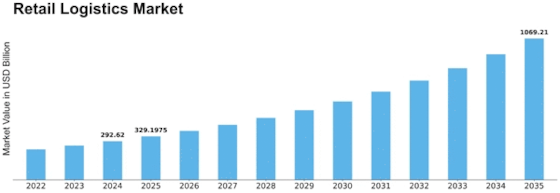
The Retail Logistics Market was valued at 292.62 USD Billion in 2024.

What is the projected market size for the Retail Logistics Market by 2035?

The market is projected to reach 1069.21 USD Billion by 2035.

What is the expected CAGR for the Retail Logistics Market during the forecast period 2025 - 2035?

The expected CAGR for the Retail Logistics Market during 2025 - 2035 is 12.5%.

Which companies are considered key players in the Retail Logistics Market?

Key players include Amazon, DHL, FedEx, UPS, XPO Logistics, Maersk, C.H. Robinson, Kuehne + Nagel, DB Schenker, and Nippon Express.

How does the valuation of conventional retail logistics compare to e-commerce retail logistics?

In 2024, conventional retail logistics was valued at 146.31 USD Billion, while e-commerce retail logistics reached 146.31 USD Billion.

What are the main segments within the Retail Logistics Market?

The main segments include conventional retail logistics, e-commerce retail logistics, commerce enablement, supply chain solutions, reverse logistics & liquidation, and transportation management.

Market Summary

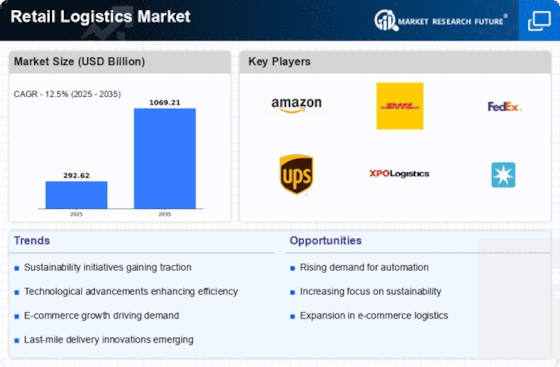
As per MRFR analysis, the Retail Logistics Market was estimated at 292.62 USD Billion in 2024. The Retail Logistics industry is projected to grow from 329.2 USD Billion in 2025 to 1069.21 USD Billion by 2035, exhibiting a compound annual growth rate (CAGR) of 12.5 during the forecast period 2025 - 2035.

Key Market Trends & Highlights

The Retail Logistics Market is experiencing transformative changes driven by technological advancements and evolving consumer expectations.

  • Automation is increasingly emphasized across logistics operations, enhancing efficiency and reducing costs.
  • Sustainability initiatives are gaining traction, with companies striving to minimize their environmental impact in logistics processes.
  • Innovations in last-mile delivery are reshaping consumer experiences, particularly in urban areas where speed is crucial.
  • E-commerce growth and technological advancements are major drivers, particularly in North America and Asia-Pacific, impacting both conventional and e-commerce retail logistics segments.

Market Size & Forecast

2024 Market Size 292.62 (USD Billion)
2035 Market Size 1069.21 (USD Billion)
CAGR (2025 - 2035) 12.5%
Largest Regional Market Share in 2024 Asia Pacific

Major Players

<p>Amazon (US), DHL (DE), FedEx (US), UPS (US), XPO Logistics (US), Maersk (DK), C.H. Robinson (US), Kuehne + Nagel (CH), DB Schenker (DE), Nippon Express (JP)</p>

Market Trends

The Retail Logistics Market is currently experiencing a transformative phase, driven by evolving consumer expectations and technological advancements. As e-commerce continues to expand, retailers are increasingly focusing on optimizing their supply chains to enhance efficiency and reduce costs. This shift necessitates a reevaluation of traditional logistics strategies, with an emphasis on integrating innovative solutions such as automation and data analytics. Furthermore, sustainability has emerged as a critical consideration, prompting companies to adopt greener practices in their logistics operations. This trend not only addresses environmental concerns but also aligns with consumer preferences for responsible sourcing and delivery methods. In addition, the Retail Logistics Market is witnessing a growing emphasis on last-mile delivery solutions. As consumers demand faster and more reliable delivery options, retailers are exploring various strategies to meet these expectations. This includes partnerships with local delivery services and the implementation of advanced tracking technologies. The interplay between consumer behavior and logistics capabilities suggests that companies must remain agile and responsive to market dynamics. Overall, the Retail Logistics Market appears poised for continued evolution, with a focus on efficiency, sustainability, and customer satisfaction shaping its future trajectory.

Emphasis on Automation

The Retail Logistics Market is increasingly adopting automation technologies to streamline operations. Automated systems enhance efficiency by reducing manual labor and minimizing errors in inventory management and order fulfillment. This trend indicates a shift towards more sophisticated logistics solutions that can adapt to fluctuating demand.

Sustainability Initiatives

Sustainability has become a focal point within the Retail Logistics Market, as companies strive to reduce their carbon footprint. This includes optimizing transportation routes, utilizing eco-friendly packaging, and implementing energy-efficient warehousing practices. Such initiatives not only appeal to environmentally conscious consumers but also contribute to long-term cost savings.

Last-Mile Delivery Innovations

The Retail Logistics Market is witnessing significant innovations in last-mile delivery solutions. Retailers are exploring diverse strategies, such as utilizing drones and autonomous vehicles, to enhance delivery speed and reliability. This trend reflects the growing importance of meeting consumer expectations for quick and efficient service.

Retail Logistics Market Market Drivers

E-commerce Growth

The Retail Logistics Market is experiencing a notable surge due to the rapid expansion of e-commerce. As consumers increasingly prefer online shopping, logistics providers are adapting to meet the rising demand for efficient delivery services. In 2025, e-commerce sales are projected to reach approximately 6 trillion USD, necessitating advanced logistics solutions. This growth compels retailers to enhance their supply chain capabilities, ensuring timely deliveries and improved customer satisfaction. Consequently, logistics companies are investing in technology and infrastructure to streamline operations, thereby positioning themselves favorably within the Retail Logistics Market. The shift towards e-commerce is likely to continue driving innovation and competition among logistics providers.

Consumer Expectations

Consumer expectations are evolving, significantly impacting the Retail Logistics Market. Today's consumers demand faster delivery times, transparency, and flexibility in shipping options. A recent survey indicates that 70% of consumers expect same-day or next-day delivery, compelling retailers to adapt their logistics strategies accordingly. This shift in consumer behavior drives logistics companies to innovate and enhance their service offerings. As a result, the Retail Logistics Market is witnessing an increased focus on last-mile delivery solutions and improved tracking systems. Meeting these heightened expectations is crucial for retailers aiming to maintain customer loyalty and satisfaction.

Sustainability Trends

Sustainability trends are increasingly influencing the Retail Logistics Market. As environmental concerns grow, consumers and businesses alike are prioritizing eco-friendly practices. Logistics providers are responding by adopting sustainable transportation methods, optimizing routes to reduce emissions, and utilizing recyclable packaging materials. In 2025, it is estimated that 50% of logistics companies will implement green initiatives as part of their operational strategies. This shift not only addresses consumer demand for sustainability but also enhances brand reputation. Consequently, the Retail Logistics Market is likely to see a rise in partnerships between retailers and logistics providers focused on sustainable practices.

Technological Advancements

Technological advancements play a pivotal role in shaping the Retail Logistics Market. Innovations such as artificial intelligence, machine learning, and the Internet of Things are revolutionizing logistics operations. These technologies enable real-time tracking, predictive analytics, and automated warehousing, enhancing efficiency and reducing operational costs. In 2025, the integration of these technologies is expected to increase logistics efficiency by up to 30%. As retailers seek to optimize their supply chains, the demand for tech-driven logistics solutions is likely to rise. This trend not only improves service delivery but also fosters a competitive edge for logistics providers within the Retail Logistics Market.

Global Supply Chain Resilience

The need for The Retail Logistics Industry. Recent disruptions have highlighted vulnerabilities in supply chains, prompting companies to reassess their logistics strategies. In 2025, businesses are expected to invest significantly in diversifying their supply chains and enhancing their logistics networks to mitigate risks. This focus on resilience encourages logistics providers to develop more robust systems capable of adapting to unforeseen challenges. As a result, the Retail Logistics Market is likely to witness a shift towards more flexible and responsive logistics solutions, ensuring continuity and reliability in service delivery.

Market Segment Insights

By Type: Conventional retail logistics (Largest) vs. E-commerce retail logistics (Fastest-Growing)

<p>The Retail Logistics Market is witnessing a notable distribution between conventional and e-commerce retail logistics, with conventional logistics accounting for the largest share due to its long-standing operational frameworks and extensive infrastructure. E-commerce retail logistics, however, has been rapidly gaining momentum, driven by the increasing online shopping trends fueled by consumer preferences for convenience and immediate delivery. This shift indicates a robust competition within the sector as e-commerce logistics adapt traditional logistics practices to optimize delivery efficiency.</p>

<p>Logistics Type: Conventional (Dominant) vs. E-commerce (Emerging)</p>

<p>Conventional retail logistics continues to be the dominant force within the market, characterized by established networks, long-term supplier relationships, and multimodal transportation options. These features allow for predictable supply chain management and stable inventory processes. In contrast, E-commerce retail logistics is emerging as a revolutionary segment that prioritizes speed and agility. With its reliance on digital infrastructure and advanced technologies such as automation and real-time tracking, e-commerce logistics cater to the growing demand for quick order fulfillment and flexibility. The notable growth of this segment reflects changing consumer behaviors and increasing investments in digital logistics solutions.</p>

By Solution: Commerce Enablement (Largest) vs. Transportation Management (Fastest-Growing)

<p>In the Retail Logistics Market, the distribution of market share among different solution segments is an essential aspect of understanding dynamics. Commerce enablement is the largest segment, driven by the increasing demand for seamless shopping experiences and integration of digital technology in logistics. This is followed by transportation management, which is rapidly growing as retailers seek efficient ways to optimize their distribution processes. Growth trends in the retail logistics solutions sector are largely propelled by advancements in technology and changing consumer behaviors. With the rise of e-commerce and omnichannel retailing, solutions that enhance supply chain efficiency, such as reverse logistics and supply chain frameworks, are gaining traction. Furthermore, investment in sustainable practices and digital innovations fuels the growth of these segments, particularly in transportation management, making it the fastest-growing segment in the market.</p>

<p>Commerce Enablement (Dominant) vs. Reverse Logistics & Liquidation (Emerging)</p>

<p>Commerce enablement remains dominant in the Retail Logistics Market, significantly enhancing the customer experience by integrating various channels and platforms for a seamless shopping journey. The focus on delivering personalized experiences through advanced data analytics and real-time inventory management positions this segment as a vital player. Conversely, reverse logistics and liquidation are emerging as essential components of retail strategy, driven by the need for cost reduction and sustainability. The increasing importance of returns management and efficient liquidation processes for unsold inventory has led to greater investment and innovation in this area. This shift not only helps in improving profitability but also aligns with consumer expectations regarding sustainability, thereby strengthening its position in the market.</p>

By Mode of Transport: Roadways (Largest) vs. Airways (Fastest-Growing)

<p>The Retail Logistics Market features a diverse mode of transport landscape, with roadways holding the largest market share, attributed to their flexibility and extensive network. Following roadways, railways and waterways play significant roles, particularly for bulk goods. Airways, while traditionally smaller, are rapidly gaining ground due to the increasing demand for expedited delivery services, particularly in e-commerce.</p>

<p>Roadways (Dominant) vs. Airways (Emerging)</p>

<p>Roadways dominate the Retail Logistics Market primarily due to their widespread accessibility and ability to reach remote areas quickly. This mode facilitates last-mile deliveries efficiently, catering to the growing need for convenience in consumer shopping habits. In contrast, airways are emerging as a crucial player, particularly in urban logistics, where speed is paramount. Companies are investing in air freight solutions to keep up with rising consumer expectations for fast delivery. The rapid development of technology and infrastructure within air transport is enhancing its efficiency, making it a vital option for high-value goods.</p>

Get more detailed insights about Retail Logistics Market Research Report—Global Forecast till 2035

Regional Insights

North America : Logistics Innovation Leader

North America is the largest market for retail logistics, accounting for approximately 40% of the global share. The region's growth is driven by the rapid expansion of e-commerce, increasing consumer demand for fast delivery, and advancements in technology. Regulatory support for infrastructure improvements and sustainability initiatives further catalyzes market growth. The U.S. leads this market, followed by Canada, which holds around 10% of the share. The competitive landscape in North America is dominated by key players such as Amazon, FedEx, and UPS, which leverage advanced logistics technologies and extensive distribution networks. The presence of major logistics hubs and a robust transportation infrastructure enhances operational efficiency. Additionally, companies like XPO Logistics and C.H. Robinson are innovating in last-mile delivery solutions, further intensifying competition in this dynamic market.

Europe : Sustainable Logistics Focus

Europe is the second-largest market for retail logistics, holding approximately 30% of the global share. The region's growth is propelled by stringent regulations aimed at sustainability and efficiency, alongside a growing e-commerce sector. Countries like Germany and the UK are leading this market, with Germany alone accounting for about 15% of the share. The European Union's Green Deal and initiatives to reduce carbon emissions are significant regulatory catalysts driving market dynamics. Leading countries in Europe include Germany, the UK, and France, with a competitive landscape featuring major players like DHL and DB Schenker. These companies are investing in green logistics solutions and digital transformation to enhance service delivery. The presence of advanced logistics infrastructure and a focus on innovation positions Europe as a key player in the retail logistics market, fostering a competitive environment that encourages growth and sustainability.

Asia-Pacific : Emerging Market Potential

Asia-Pacific is witnessing rapid growth in the retail logistics market, accounting for approximately 25% of the global share. The region's expansion is fueled by the booming e-commerce sector, increasing urbanization, and rising disposable incomes. China and India are the largest markets, with China alone holding about 20% of the global share. Government initiatives to improve logistics infrastructure and streamline regulations are also significant growth drivers in this region. The competitive landscape in Asia-Pacific is characterized by a mix of local and international players, including Nippon Express and Kuehne + Nagel. These companies are focusing on enhancing their logistics capabilities through technology adoption and strategic partnerships. The region's diverse market demands and rapid digitalization present both challenges and opportunities for logistics providers, making it a vibrant and competitive environment.

Middle East and Africa : Growing Logistics Infrastructure

The Middle East and Africa region is emerging as a significant player in the retail logistics market, holding approximately 5% of the global share. The growth is driven by increasing investments in logistics infrastructure, urbanization, and a growing middle class. Countries like the UAE and South Africa are leading this market, with the UAE accounting for a substantial portion of the regional share. Government initiatives to enhance trade and logistics capabilities are pivotal in shaping the market landscape. The competitive environment in this region is evolving, with key players such as Maersk and DB Schenker expanding their operations. The presence of free trade zones and strategic geographic locations enhances the region's appeal for logistics investments. As the retail sector continues to grow, logistics providers are adapting to meet the demands of a diverse consumer base, positioning the Middle East and Africa as a burgeoning market for retail logistics.

Key Players and Competitive Insights

The Retail Logistics Market is currently characterized by a dynamic competitive landscape, driven by rapid technological advancements and evolving consumer expectations. Key players such as Amazon (US), DHL (DE), and FedEx (US) are at the forefront, each adopting distinct strategies to enhance their operational capabilities. Amazon (US) continues to leverage its extensive fulfillment network and advanced data analytics to optimize delivery times, while DHL (DE) focuses on sustainability initiatives, aiming to reduce carbon emissions across its logistics operations. FedEx (US), on the other hand, emphasizes its global reach and service diversification, positioning itself as a leader in e-commerce logistics. Collectively, these strategies not only enhance individual company performance but also intensify competition within the market, as firms strive to meet the increasing demand for efficient and reliable logistics solutions.

In terms of business tactics, companies are increasingly localizing manufacturing and optimizing supply chains to respond swiftly to market fluctuations. The Retail Logistics Market appears moderately fragmented, with a mix of large multinational corporations and regional players. This structure allows for a diverse range of services and innovations, as key players collaborate and compete to capture market share. The influence of major companies is profound, as their strategic decisions often set industry standards and drive technological advancements.

In August 2025, Amazon (US) announced the expansion of its drone delivery service, aiming to enhance last-mile logistics efficiency. This strategic move is significant as it not only reduces delivery times but also aligns with the growing consumer preference for rapid fulfillment. By investing in drone technology, Amazon (US) positions itself to maintain a competitive edge in the e-commerce sector, potentially reshaping consumer expectations regarding delivery speed and convenience.

In September 2025, DHL (DE) unveiled its new green logistics initiative, which includes the deployment of electric vehicles across its delivery fleet. This initiative underscores DHL's commitment to sustainability and reflects a broader industry trend towards environmentally responsible logistics practices. By prioritizing green logistics, DHL (DE) not only enhances its brand reputation but also meets the increasing regulatory pressures and consumer demand for sustainable operations.

In October 2025, FedEx (US) launched a new AI-driven analytics platform designed to optimize supply chain management for its clients. This platform aims to provide real-time insights and predictive analytics, enabling businesses to make informed decisions regarding inventory and logistics. The introduction of such technology indicates a shift towards data-driven logistics solutions, which could significantly enhance operational efficiency and customer satisfaction.

As of October 2025, the Retail Logistics Market is witnessing a pronounced trend towards digitalization, sustainability, and the integration of artificial intelligence. Strategic alliances among key players are increasingly shaping the competitive landscape, fostering innovation and enhancing service offerings. The evolution of competition appears to be shifting from traditional price-based strategies to a focus on technological innovation, supply chain reliability, and sustainability. This transition suggests that companies that prioritize these aspects are likely to achieve a competitive advantage in the increasingly complex logistics environment.

Key Companies in the Retail Logistics Market market include

Industry Developments

In February 7th 2023, Amazon said they are working with Green Mountain Power, an electric utility company in Vermont that will have fleets of electric delivery vans delivering products to customers. This is aimed at reducing carbon emissions as well as establishing a sustainable logistics industry.

In November 3rd 2021, DHL International GmbH launched MySupplyChain, which is their Digital platform using AI and ML for seamless end-to-end visibility and control of supply chains. With this platform, retail trade is expected to gain from quicker and more effective logistics services.

Aramex PJSC, for example, proclaimed recently that it had effectively bought Access USA Shipping, LLC (MyUS), a technology-enabled global platform facilitating cross-border e-commerce. Aramex received all necessary regulatory clearances and later concluded the acquisition at about USD 265 million in cash in October 2022.

For instance, Boohoo Group plc picked DHL Supply Chain in October 2022 – a Germany-based contract logistics firm that is part of Deutsche Post DHL Group – to oversee their first-ever distribution center in the US. Warehousing solutions provided by DHL Supply Chain will enable Boohoo’s projected expansion in the US market, as the British fashion retailer has annual sales of over $2.4 billion.

The Logistics Efficiency Enhancement Program (LEEP) of the Government of India, August 2022 saw the Ministry of Road Transport & Highways (MoRTH) developing multimodal logistics parks to address inadequate roads and material handling infrastructure.

Future Outlook

Retail Logistics Market Future Outlook

<p>The Retail Logistics Market is poised for growth at a 12.5% CAGR from 2024 to 2035, driven by e-commerce expansion, technological advancements, and consumer demand for faster delivery.</p>

New opportunities lie in:

  • <p>Integration of AI-driven inventory management systems</p>
  • <p>Expansion of last-mile delivery solutions</p>
  • <p>Development of sustainable packaging and logistics practices</p>

<p>By 2035, the Retail Logistics Market is expected to achieve substantial growth, reflecting evolving consumer preferences and technological innovations.</p>

Market Segmentation

Retail Logistics Market Type Outlook

  • Conventional retail logistics
  • E-commerce retail logistics

Retail Logistics Market Solution Outlook

  • Commerce enablement
  • Supply chain solutions
  • Reverse logistics & liquidation
  • Transportation Management
  • Others

Retail Logistics Market Mode of Transport Outlook

  • Roadways
  • Railways
  • Airways
  • Waterways

Report Scope

MARKET SIZE 2024292.62(USD Billion)
MARKET SIZE 2025329.2(USD Billion)
MARKET SIZE 20351069.21(USD Billion)
COMPOUND ANNUAL GROWTH RATE (CAGR)12.5% (2024 - 2035)
REPORT COVERAGERevenue Forecast, Competitive Landscape, Growth Factors, and Trends
BASE YEAR2024
Market Forecast Period2025 - 2035
Historical Data2019 - 2024
Market Forecast UnitsUSD Billion
Key Companies ProfiledMarket analysis in progress
Segments CoveredMarket segmentation analysis in progress
Key Market OpportunitiesIntegration of advanced automation and artificial intelligence in the Retail Logistics Market enhances efficiency and reduces costs.
Key Market DynamicsTechnological advancements and evolving consumer preferences drive transformation in the Retail Logistics Market.
Countries CoveredNorth America, Europe, APAC, South America, MEA

FAQs

What is the current valuation of the Retail Logistics Market in 2024?

The Retail Logistics Market was valued at 292.62 USD Billion in 2024.

What is the projected market size for the Retail Logistics Market by 2035?

The market is projected to reach 1069.21 USD Billion by 2035.

What is the expected CAGR for the Retail Logistics Market during the forecast period 2025 - 2035?

The expected CAGR for the Retail Logistics Market during 2025 - 2035 is 12.5%.

Which companies are considered key players in the Retail Logistics Market?

Key players include Amazon, DHL, FedEx, UPS, XPO Logistics, Maersk, C.H. Robinson, Kuehne + Nagel, DB Schenker, and Nippon Express.

How does the valuation of conventional retail logistics compare to e-commerce retail logistics?

In 2024, conventional retail logistics was valued at 146.31 USD Billion, while e-commerce retail logistics reached 146.31 USD Billion.

What are the main segments within the Retail Logistics Market?

The main segments include conventional retail logistics, e-commerce retail logistics, commerce enablement, supply chain solutions, reverse logistics & liquidation, and transportation management.

  1. SECTION I: EXECUTIVE SUMMARY AND KEY HIGHLIGHTS
    1. EXECUTIVE SUMMARY
      1. Market Overview
      2. Key Findings
      3. Market Segmentation
      4. Competitive Landscape
      5. Challenges and Opportunities
      6. Future Outlook
  2. SECTION II: SCOPING, METHODOLOGY AND MARKET STRUCTURE
    1. MARKET INTRODUCTION
      1. Definition
      2. Scope of the study
    2. RESEARCH METHODOLOGY
      1. Overview
      2. Data Mining
      3. Secondary Research
      4. Primary Research
      5. Forecasting Model
      6. Market Size Estimation
      7. Data Triangulation
      8. Validation
  3. SECTION III: QUALITATIVE ANALYSIS
    1. MARKET DYNAMICS
      1. Overview
      2. Drivers
      3. Restraints
      4. Opportunities
    2. MARKET FACTOR ANALYSIS
      1. Value chain Analysis
      2. Porter's Five Forces Analysis
      3. COVID-19 Impact Analysis
  4. SECTION IV: QUANTITATIVE ANALYSIS
    1. Packaging & Transport, BY Type (USD Billion)
      1. Conventional retail logistics
      2. E-commerce retail logistics
    2. Packaging & Transport, BY Solution (USD Billion)
      1. Commerce enablement
      2. Supply chain solutions
      3. Reverse logistics & liquidation
      4. Transportation Management
      5. Others
    3. Packaging & Transport, BY Mode of Transport (USD Billion)
      1. Roadways
      2. Railways
      3. Airways
      4. Waterways
    4. Packaging & Transport, BY Region (USD Billion)
      1. North America
      2. Europe
      3. APAC
      4. South America
      5. MEA
  5. SECTION V: COMPETITIVE ANALYSIS
    1. Competitive Landscape
      1. Overview
      2. Competitive Analysis
      3. Market share Analysis
      4. Major Growth Strategy in the Packaging & Transport
      5. Competitive Benchmarking
      6. Leading Players in Terms of Number of Developments in the Packaging & Transport
      7. Key developments and growth strategies
      8. Major Players Financial Matrix
    2. Company Profiles
      1. Amazon (US)
      2. DHL (DE)
      3. FedEx (US)
      4. UPS (US)
      5. XPO Logistics (US)
      6. Maersk (DK)
      7. C.H. Robinson (US)
      8. Kuehne + Nagel (CH)
      9. DB Schenker (DE)
      10. Nippon Express (JP)
    3. Appendix
      1. References
      2. Related Reports
  6. LIST OF FIGURES
    1. MARKET SYNOPSIS
    2. NORTH AMERICA MARKET ANALYSIS
    3. US MARKET ANALYSIS BY TYPE
    4. US MARKET ANALYSIS BY SOLUTION
    5. US MARKET ANALYSIS BY MODE OF TRANSPORT
    6. CANADA MARKET ANALYSIS BY TYPE
    7. CANADA MARKET ANALYSIS BY SOLUTION
    8. CANADA MARKET ANALYSIS BY MODE OF TRANSPORT
    9. EUROPE MARKET ANALYSIS
    10. GERMANY MARKET ANALYSIS BY TYPE
    11. GERMANY MARKET ANALYSIS BY SOLUTION
    12. GERMANY MARKET ANALYSIS BY MODE OF TRANSPORT
    13. UK MARKET ANALYSIS BY TYPE
    14. UK MARKET ANALYSIS BY SOLUTION
    15. UK MARKET ANALYSIS BY MODE OF TRANSPORT
    16. FRANCE MARKET ANALYSIS BY TYPE
    17. FRANCE MARKET ANALYSIS BY SOLUTION
    18. FRANCE MARKET ANALYSIS BY MODE OF TRANSPORT
    19. RUSSIA MARKET ANALYSIS BY TYPE
    20. RUSSIA MARKET ANALYSIS BY SOLUTION
    21. RUSSIA MARKET ANALYSIS BY MODE OF TRANSPORT
    22. ITALY MARKET ANALYSIS BY TYPE
    23. ITALY MARKET ANALYSIS BY SOLUTION
    24. ITALY MARKET ANALYSIS BY MODE OF TRANSPORT
    25. SPAIN MARKET ANALYSIS BY TYPE
    26. SPAIN MARKET ANALYSIS BY SOLUTION
    27. SPAIN MARKET ANALYSIS BY MODE OF TRANSPORT
    28. REST OF EUROPE MARKET ANALYSIS BY TYPE
    29. REST OF EUROPE MARKET ANALYSIS BY SOLUTION
    30. REST OF EUROPE MARKET ANALYSIS BY MODE OF TRANSPORT
    31. APAC MARKET ANALYSIS
    32. CHINA MARKET ANALYSIS BY TYPE
    33. CHINA MARKET ANALYSIS BY SOLUTION
    34. CHINA MARKET ANALYSIS BY MODE OF TRANSPORT
    35. INDIA MARKET ANALYSIS BY TYPE
    36. INDIA MARKET ANALYSIS BY SOLUTION
    37. INDIA MARKET ANALYSIS BY MODE OF TRANSPORT
    38. JAPAN MARKET ANALYSIS BY TYPE
    39. JAPAN MARKET ANALYSIS BY SOLUTION
    40. JAPAN MARKET ANALYSIS BY MODE OF TRANSPORT
    41. SOUTH KOREA MARKET ANALYSIS BY TYPE
    42. SOUTH KOREA MARKET ANALYSIS BY SOLUTION
    43. SOUTH KOREA MARKET ANALYSIS BY MODE OF TRANSPORT
    44. MALAYSIA MARKET ANALYSIS BY TYPE
    45. MALAYSIA MARKET ANALYSIS BY SOLUTION
    46. MALAYSIA MARKET ANALYSIS BY MODE OF TRANSPORT
    47. THAILAND MARKET ANALYSIS BY TYPE
    48. THAILAND MARKET ANALYSIS BY SOLUTION
    49. THAILAND MARKET ANALYSIS BY MODE OF TRANSPORT
    50. INDONESIA MARKET ANALYSIS BY TYPE
    51. INDONESIA MARKET ANALYSIS BY SOLUTION
    52. INDONESIA MARKET ANALYSIS BY MODE OF TRANSPORT
    53. REST OF APAC MARKET ANALYSIS BY TYPE
    54. REST OF APAC MARKET ANALYSIS BY SOLUTION
    55. REST OF APAC MARKET ANALYSIS BY MODE OF TRANSPORT
    56. SOUTH AMERICA MARKET ANALYSIS
    57. BRAZIL MARKET ANALYSIS BY TYPE
    58. BRAZIL MARKET ANALYSIS BY SOLUTION
    59. BRAZIL MARKET ANALYSIS BY MODE OF TRANSPORT
    60. MEXICO MARKET ANALYSIS BY TYPE
    61. MEXICO MARKET ANALYSIS BY SOLUTION
    62. MEXICO MARKET ANALYSIS BY MODE OF TRANSPORT
    63. ARGENTINA MARKET ANALYSIS BY TYPE
    64. ARGENTINA MARKET ANALYSIS BY SOLUTION
    65. ARGENTINA MARKET ANALYSIS BY MODE OF TRANSPORT
    66. REST OF SOUTH AMERICA MARKET ANALYSIS BY TYPE
    67. REST OF SOUTH AMERICA MARKET ANALYSIS BY SOLUTION
    68. REST OF SOUTH AMERICA MARKET ANALYSIS BY MODE OF TRANSPORT
    69. MEA MARKET ANALYSIS
    70. GCC COUNTRIES MARKET ANALYSIS BY TYPE
    71. GCC COUNTRIES MARKET ANALYSIS BY SOLUTION
    72. GCC COUNTRIES MARKET ANALYSIS BY MODE OF TRANSPORT
    73. SOUTH AFRICA MARKET ANALYSIS BY TYPE
    74. SOUTH AFRICA MARKET ANALYSIS BY SOLUTION
    75. SOUTH AFRICA MARKET ANALYSIS BY MODE OF TRANSPORT
    76. REST OF MEA MARKET ANALYSIS BY TYPE
    77. REST OF MEA MARKET ANALYSIS BY SOLUTION
    78. REST OF MEA MARKET ANALYSIS BY MODE OF TRANSPORT
    79. KEY BUYING CRITERIA OF PACKAGING & TRANSPORT
    80. RESEARCH PROCESS OF MRFR
    81. DRO ANALYSIS OF PACKAGING & TRANSPORT
    82. DRIVERS IMPACT ANALYSIS: PACKAGING & TRANSPORT
    83. RESTRAINTS IMPACT ANALYSIS: PACKAGING & TRANSPORT
    84. SUPPLY / VALUE CHAIN: PACKAGING & TRANSPORT
    85. PACKAGING & TRANSPORT, BY TYPE, 2024 (% SHARE)
    86. PACKAGING & TRANSPORT, BY TYPE, 2024 TO 2035 (USD Billion)
    87. PACKAGING & TRANSPORT, BY SOLUTION, 2024 (% SHARE)
    88. PACKAGING & TRANSPORT, BY SOLUTION, 2024 TO 2035 (USD Billion)
    89. PACKAGING & TRANSPORT, BY MODE OF TRANSPORT, 2024 (% SHARE)
    90. PACKAGING & TRANSPORT, BY MODE OF TRANSPORT, 2024 TO 2035 (USD Billion)
    91. BENCHMARKING OF MAJOR COMPETITORS
  7. LIST OF TABLES
    1. LIST OF ASSUMPTIONS
    2. North America MARKET SIZE ESTIMATES; FORECAST
      1. BY TYPE, 2025-2035 (USD Billion)
      2. BY SOLUTION, 2025-2035 (USD Billion)
      3. BY MODE OF TRANSPORT, 2025-2035 (USD Billion)
    3. US MARKET SIZE ESTIMATES; FORECAST
      1. BY TYPE, 2025-2035 (USD Billion)
      2. BY SOLUTION, 2025-2035 (USD Billion)
      3. BY MODE OF TRANSPORT, 2025-2035 (USD Billion)
    4. Canada MARKET SIZE ESTIMATES; FORECAST
      1. BY TYPE, 2025-2035 (USD Billion)
      2. BY SOLUTION, 2025-2035 (USD Billion)
      3. BY MODE OF TRANSPORT, 2025-2035 (USD Billion)
    5. Europe MARKET SIZE ESTIMATES; FORECAST
      1. BY TYPE, 2025-2035 (USD Billion)
      2. BY SOLUTION, 2025-2035 (USD Billion)
      3. BY MODE OF TRANSPORT, 2025-2035 (USD Billion)
    6. Germany MARKET SIZE ESTIMATES; FORECAST
      1. BY TYPE, 2025-2035 (USD Billion)
      2. BY SOLUTION, 2025-2035 (USD Billion)
      3. BY MODE OF TRANSPORT, 2025-2035 (USD Billion)
    7. UK MARKET SIZE ESTIMATES; FORECAST
      1. BY TYPE, 2025-2035 (USD Billion)
      2. BY SOLUTION, 2025-2035 (USD Billion)
      3. BY MODE OF TRANSPORT, 2025-2035 (USD Billion)
    8. France MARKET SIZE ESTIMATES; FORECAST
      1. BY TYPE, 2025-2035 (USD Billion)
      2. BY SOLUTION, 2025-2035 (USD Billion)
      3. BY MODE OF TRANSPORT, 2025-2035 (USD Billion)
    9. Russia MARKET SIZE ESTIMATES; FORECAST
      1. BY TYPE, 2025-2035 (USD Billion)
      2. BY SOLUTION, 2025-2035 (USD Billion)
      3. BY MODE OF TRANSPORT, 2025-2035 (USD Billion)
    10. Italy MARKET SIZE ESTIMATES; FORECAST
      1. BY TYPE, 2025-2035 (USD Billion)
      2. BY SOLUTION, 2025-2035 (USD Billion)
      3. BY MODE OF TRANSPORT, 2025-2035 (USD Billion)
    11. Spain MARKET SIZE ESTIMATES; FORECAST
      1. BY TYPE, 2025-2035 (USD Billion)
      2. BY SOLUTION, 2025-2035 (USD Billion)
      3. BY MODE OF TRANSPORT, 2025-2035 (USD Billion)
    12. Rest of Europe MARKET SIZE ESTIMATES; FORECAST
      1. BY TYPE, 2025-2035 (USD Billion)
      2. BY SOLUTION, 2025-2035 (USD Billion)
      3. BY MODE OF TRANSPORT, 2025-2035 (USD Billion)
    13. APAC MARKET SIZE ESTIMATES; FORECAST
      1. BY TYPE, 2025-2035 (USD Billion)
      2. BY SOLUTION, 2025-2035 (USD Billion)
      3. BY MODE OF TRANSPORT, 2025-2035 (USD Billion)
    14. China MARKET SIZE ESTIMATES; FORECAST
      1. BY TYPE, 2025-2035 (USD Billion)
      2. BY SOLUTION, 2025-2035 (USD Billion)
      3. BY MODE OF TRANSPORT, 2025-2035 (USD Billion)
    15. India MARKET SIZE ESTIMATES; FORECAST
      1. BY TYPE, 2025-2035 (USD Billion)
      2. BY SOLUTION, 2025-2035 (USD Billion)
      3. BY MODE OF TRANSPORT, 2025-2035 (USD Billion)
    16. Japan MARKET SIZE ESTIMATES; FORECAST
      1. BY TYPE, 2025-2035 (USD Billion)
      2. BY SOLUTION, 2025-2035 (USD Billion)
      3. BY MODE OF TRANSPORT, 2025-2035 (USD Billion)
    17. South Korea MARKET SIZE ESTIMATES; FORECAST
      1. BY TYPE, 2025-2035 (USD Billion)
      2. BY SOLUTION, 2025-2035 (USD Billion)
      3. BY MODE OF TRANSPORT, 2025-2035 (USD Billion)
    18. Malaysia MARKET SIZE ESTIMATES; FORECAST
      1. BY TYPE, 2025-2035 (USD Billion)
      2. BY SOLUTION, 2025-2035 (USD Billion)
      3. BY MODE OF TRANSPORT, 2025-2035 (USD Billion)
    19. Thailand MARKET SIZE ESTIMATES; FORECAST
      1. BY TYPE, 2025-2035 (USD Billion)
      2. BY SOLUTION, 2025-2035 (USD Billion)
      3. BY MODE OF TRANSPORT, 2025-2035 (USD Billion)
    20. Indonesia MARKET SIZE ESTIMATES; FORECAST
      1. BY TYPE, 2025-2035 (USD Billion)
      2. BY SOLUTION, 2025-2035 (USD Billion)
      3. BY MODE OF TRANSPORT, 2025-2035 (USD Billion)
    21. Rest of APAC MARKET SIZE ESTIMATES; FORECAST
      1. BY TYPE, 2025-2035 (USD Billion)
      2. BY SOLUTION, 2025-2035 (USD Billion)
      3. BY MODE OF TRANSPORT, 2025-2035 (USD Billion)
    22. South America MARKET SIZE ESTIMATES; FORECAST
      1. BY TYPE, 2025-2035 (USD Billion)
      2. BY SOLUTION, 2025-2035 (USD Billion)
      3. BY MODE OF TRANSPORT, 2025-2035 (USD Billion)
    23. Brazil MARKET SIZE ESTIMATES; FORECAST
      1. BY TYPE, 2025-2035 (USD Billion)
      2. BY SOLUTION, 2025-2035 (USD Billion)
      3. BY MODE OF TRANSPORT, 2025-2035 (USD Billion)
    24. Mexico MARKET SIZE ESTIMATES; FORECAST
      1. BY TYPE, 2025-2035 (USD Billion)
      2. BY SOLUTION, 2025-2035 (USD Billion)
      3. BY MODE OF TRANSPORT, 2025-2035 (USD Billion)
    25. Argentina MARKET SIZE ESTIMATES; FORECAST
      1. BY TYPE, 2025-2035 (USD Billion)
      2. BY SOLUTION, 2025-2035 (USD Billion)
      3. BY MODE OF TRANSPORT, 2025-2035 (USD Billion)
    26. Rest of South America MARKET SIZE ESTIMATES; FORECAST
      1. BY TYPE, 2025-2035 (USD Billion)
      2. BY SOLUTION, 2025-2035 (USD Billion)
      3. BY MODE OF TRANSPORT, 2025-2035 (USD Billion)
    27. MEA MARKET SIZE ESTIMATES; FORECAST
      1. BY TYPE, 2025-2035 (USD Billion)
      2. BY SOLUTION, 2025-2035 (USD Billion)
      3. BY MODE OF TRANSPORT, 2025-2035 (USD Billion)
    28. GCC Countries MARKET SIZE ESTIMATES; FORECAST
      1. BY TYPE, 2025-2035 (USD Billion)
      2. BY SOLUTION, 2025-2035 (USD Billion)
      3. BY MODE OF TRANSPORT, 2025-2035 (USD Billion)
    29. South Africa MARKET SIZE ESTIMATES; FORECAST
      1. BY TYPE, 2025-2035 (USD Billion)
      2. BY SOLUTION, 2025-2035 (USD Billion)
      3. BY MODE OF TRANSPORT, 2025-2035 (USD Billion)
    30. Rest of MEA MARKET SIZE ESTIMATES; FORECAST
      1. BY TYPE, 2025-2035 (USD Billion)
      2. BY SOLUTION, 2025-2035 (USD Billion)
      3. BY MODE OF TRANSPORT, 2025-2035 (USD Billion)
    31. PRODUCT LAUNCH/PRODUCT DEVELOPMENT/APPROVAL
    32. ACQUISITION/PARTNERSHIP

Retail Logistics Market Segmentation

Retail Logistics Solution Outlook (USD Billion, 2018-2032)

Commerce enablement

Supply chain solutions

Reverse logistics & liquidation

Transportation Management

Others

Retail Logistics Type Outlook (USD Billion, 2018-2032)

Conventional retail logistics

E-commerce retail logistics

Retail Logistics Mode of Transport Outlook (USD Billion, 2018-2032)

Roadways

Railways

Airways

Waterways

Retail Logistics Products Regional Outlook (USD Billion, 2018-2032)

North America Outlook (USD Billion, 2018-2032)

North America Retail Logistics Products by Solution

Commerce enablement

Supply chain solutions

Reverse logistics & liquidation

Transportation Management

Others

North America Retail Logistics Products by Type

Conventional retail logistics

E-commerce retail logistics

North America Retail Logistics Products by Mode of Transport

Roadways

Railways

Airways

Waterways

US Outlook (USD Billion, 2018-2032)

US Retail Logistics Products by Solution

Commerce enablement

Supply chain solutions

Reverse logistics & liquidation

Transportation Management

Others

US Retail Logistics Products by Type

Conventional retail logistics

E-commerce retail logistics

US Retail Logistics Products by Mode of Transport

Roadways

Railways

Airways

Waterways

Canada Outlook (USD Billion, 2018-2032)

Canada Retail Logistics Products by Solution

Commerce enablement

Supply chain solutions

Reverse logistics & liquidation

Transportation Management

Others

Canada Retail Logistics Products by Type

Conventional retail logistics

E-commerce retail logistics

Canada Retail Logistics Products by Mode of Transport

Roadways

Railways

Airways

Waterways

Europe Outlook (USD Billion, 2018-2032)

Europe Retail Logistics Products by Solution

Commerce enablement

Supply chain solutions

Reverse logistics & liquidation

Transportation Management

Others

Europe Retail Logistics Products by Type

Conventional retail logistics

E-commerce retail logistics

Europe Retail Logistics Products by Mode of Transport

Roadways

Railways

Airways

Waterways

Germany Outlook (USD Billion, 2018-2032)

Germany Retail Logistics Products by Solution

Commerce enablement

Supply chain solutions

Reverse logistics & liquidation

Transportation Management

Others

Germany Retail Logistics Products by Type

Conventional retail logistics

E-commerce retail logistics

Germany Retail Logistics Products by Mode of Transport

Roadways

Railways

Airways

Waterways

France Outlook (USD Billion, 2018-2032)

France Retail Logistics Products by Solution

Commerce enablement

Supply chain solutions

Reverse logistics & liquidation

Transportation Management

Others

France Retail Logistics Products by Type

Conventional retail logistics

E-commerce retail logistics

France Retail Logistics Products by Mode of Transport

Roadways

Railways

Airways

Waterways

UK Outlook (USD Billion, 2018-2032)

UK Retail Logistics Products by Solution

Commerce enablement

Supply chain solutions

Reverse logistics & liquidation

Transportation Management

Others

UK Retail Logistics Products by Type

Conventional retail logistics

E-commerce retail logistics

UK Retail Logistics Products by Mode of Transport

Roadways

Railways

Airways

Waterways

Italy Outlook (USD Billion, 2018-2032)

Italy Retail Logistics Products by Solution

Commerce enablement

Supply chain solutions

Reverse logistics & liquidation

Transportation Management

Others

Italy Retail Logistics Products by Type

Conventional retail logistics

E-commerce retail logistics

Italy Retail Logistics Products by Mode of Transport

Roadways

Railways

Airways

Waterways

Spain Outlook (USD Billion, 2018-2032)

Spain Retail Logistics Products by Solution

Commerce enablement

Supply chain solutions

Reverse logistics & liquidation

Transportation Management

Others

Spain Retail Logistics Products by Type

Conventional retail logistics

E-commerce retail logistics

Spain Retail Logistics Products by Mode of Transport

Roadways

Railways

Airways

Waterways

Rest Of Europe Outlook (USD Billion, 2018-2032)

Rest Of Europe Retail Logistics Products by Solution

Commerce enablement

Supply chain solutions

Reverse logistics & liquidation

Transportation Management

Others

Rest Of Europe Retail Logistics Products by Type

Conventional retail logistics

E-commerce retail logistics

Rest Of Europe Retail Logistics Products by Mode of Transport

Roadways

Railways

Airways

Waterways

Asia-Pacific Outlook (USD Billion, 2018-2032)

Asia-Pacific Retail Logistics Products by Solution

Commerce enablement

Supply chain solutions

Reverse logistics & liquidation

Transportation Management

Others

Asia-Pacific Retail Logistics Products by Type

Conventional retail logistics

E-commerce retail logistics

Asia-Pacific Retail Logistics Products by Mode of Transport

Roadways

Railways

Airways

Waterways

China Outlook (USD Billion, 2018-2032)

China Retail Logistics Products by Solution

Commerce enablement

Supply chain solutions

Reverse logistics & liquidation

Transportation Management

Others

China Retail Logistics Products by Type

Conventional retail logistics

E-commerce retail logistics

China Retail Logistics Products by Mode of Transport

Roadways

Railways

Airways

Waterways

Japan Outlook (USD Billion, 2018-2032)

Japan Retail Logistics Products by Solution

Commerce enablement

Supply chain solutions

Reverse logistics & liquidation

Transportation Management

Others

Japan Retail Logistics Products by Type

Conventional retail logistics

E-commerce retail logistics

Japan Retail Logistics Products by Mode of Transport

Roadways

Railways

Airways

Waterways

India Outlook (USD Billion, 2018-2032)

India Retail Logistics Products by Solution

Commerce enablement

Supply chain solutions

Reverse logistics & liquidation

Transportation Management

Others

India Retail Logistics Products by Type

Conventional retail logistics

E-commerce retail logistics

India Retail Logistics Products by Mode of Transport

Roadways

Railways

Airways

Waterways

Australia Outlook (USD Billion, 2018-2032)

Australia Retail Logistics Products by Solution

Commerce enablement

Supply chain solutions

Reverse logistics & liquidation

Transportation Management

Others

Australia Retail Logistics Products by Type

Conventional retail logistics

E-commerce retail logistics

Australia Retail Logistics Products by Mode of Transport

Roadways

Railways

Airways

Waterways

Rest of Asia-Pacific Outlook (USD Billion, 2018-2032)

Rest of Asia-Pacific Retail Logistics Products by Solution

Commerce enablement

Supply chain solutions

Reverse logistics & liquidation

Transportation Management

Others

Rest of Asia-Pacific Retail Logistics Products by Type

Conventional retail logistics

E-commerce retail logistics

Rest of Asia-Pacific Retail Logistics Products by Mode of Transport

Roadways

Railways

Airways

Waterways

Rest of the World Outlook (USD Billion, 2018-2032)

Rest of the World Retail Logistics Products by Solution

Commerce enablement

Supply chain solutions

Reverse logistics & liquidation

Transportation Management

Others

Rest of the World Retail Logistics Products by Type

Conventional retail logistics

E-commerce retail logistics

Rest of the World Retail Logistics Products by Mode of Transport

Roadways

Railways

Airways

Waterways

Middle East Outlook (USD Billion, 2018-2032)

Middle East Retail Logistics Products by Solution

Commerce enablement

Supply chain solutions

Reverse logistics & liquidation

Transportation Management

Others

Middle East Retail Logistics Products by Type

Conventional retail logistics

E-commerce retail logistics

Middle East Retail Logistics Products by Mode of Transport

Roadways

Railways

Airways

Waterways

Africa Outlook (USD Billion, 2018-2032)

Africa Retail Logistics Products by Solution

Commerce enablement

Supply chain solutions

Reverse logistics & liquidation

Transportation Management

Others

Africa Retail Logistics Products by Type

Conventional retail logistics

E-commerce retail logistics

Africa Retail Logistics Products by Mode of Transport

Roadways

Railways

Airways

Waterways

Latin America Outlook (USD Billion, 2018-2032)

Latin America Retail Logistics Products by Solution

Commerce enablement

Supply chain solutions

Reverse logistics & liquidation

Transportation Management

Others

Latin America Retail Logistics Products by Type

Conventional retail logistics

E-commerce retail logistics

Latin America Retail Logistics Products by Mode of Transport

Roadways

Railways

Airways

Waterways

Infographic

Free Sample Request

Kindly complete the form below to receive a free sample of this Report

Get Free Sample

Customer Strories

Compare Licence

×
Features License Type
Single User Multiuser License Enterprise User
Price $4,950 $5,950 $7,250
Maximum User Access Limit 1 User Upto 10 Users Unrestricted Access Throughout the Organization
Free Customization
Direct Access to Analyst
Deliverable Format
Platform Access
Discount on Next Purchase 10% 15% 15%
Printable Versions