
Request Free Sample ×

Kindly complete the form below to receive a free sample of this Report

* Please use a valid business email

Leading companies partner with us for data-driven Insights

clients tt-cursor
Hero Background
English
Chinese
French
Japanese
Korean
German
Spanish

Reservoir Analysis Market Trends

ID: MRFR/EnP/6288-CR
138 Pages
Chitranshi Jaiswal
Last Updated: April 06, 2026

Reservoir Analysis Market Research Report Information by Reservoir Type (Conventional and Unconventional), by Service (Geo Modelling& Reservoir Simulation, Data Acquisition & Monitoring and Reservoir Sampling), By Application (Onshore and Offshore) and by Region (North America, Europe, Asia-Pacific, Middle East & Africa and South America) - Industry Size, Share, Trends & Forecast to 2035

Share:
Download PDF ×

We do not share your information with anyone. However, we may send you emails based on your report interest from time to time. You may contact us at any time to opt-out.

Reservoir Analysis Market Infographic
Purchase Options

Market Trends

Key Emerging Trends in the Reservoir Analysis Market

The reservoir analysis market is changing due to the oil and gas sector and the requirement for effective reservoir management solutions. In reservoir analysis, AI and ML are becoming more popular. These tools assist reservoir engineers optimize oil and gas recovery by interpreting data more accurately and in real time. AI and ML improve reservoir modeling, production forecasts, and performance optimization.

Integrated reservoir analysis systems that provide lifecycle insights are also becoming more popular. Integrated solutions simplify reservoir analysis by combining geophysics, geology, petrophysics, and reservoir engineering. This trend addresses the industry's requirement for comprehensive reservoir management, enabling more coherent and efficient decision-making. Integrated reservoir analysis solutions enhance reservoir knowledge and production plans.

The reservoir analysis industry is affected by the growing interest in unconventional resources including shale and tight gas. Complex reservoir architecture and varying geological characteristics make unconventional resources difficult. It takes advanced reservoir analysis methods to effectively characterize and model unconventional resources. The industry wants to maximize recovery from unconventional reservoirs, hence it needs specialist reservoir analysis tools.

The market also responds to global energy transition and environmental sustainability efforts. Reservoir analysis is essential for assessing renewable energy storage alternatives as the industry moves toward greener energy. Subsurface reservoirs for hydrogen or compressed air storage are being investigated. The viability and efficacy of subsurface storage for renewable energy efforts is determined by reservoir analysis.

Cloud-based reservoir analysis solutions are becoming more popular because they allow remote data access and team collaboration. Data accessibility, real-time collaboration, and scalable, cost-effective solutions are improved by cloud technology. In the present company context, remote work and digital collaboration are crucial to operational efficiency and resilience.

Regional oil and gas resources are maturing, increasing need for reservoir analysis services. Operators look for new ways to boost output and prolong field life as reservoirs age. Improved reservoir performance, increased oil recovery (EOR), and mature field development difficulties depend on reservoir analysis services. This shows the industry's dedication to maximize aged reservoirs' economic potential.

The rising focus on sustainable oil and gas operations also affects reservoir analysis. Reservoir management solutions now address carbon footprint reduction and resource conservation. Reservoir analysis tools examine reservoir operations' environmental effect and create methods to reduce environmental footprints, supporting the industry's commitment to sustainable and responsible energy production.

In conclusion, advanced technologies, integrated solutions, unconventional resources, renewable energy storage, cloud-based solutions, mature field optimization, and sustainability considerations are transforming the reservoir analysis market. These trends show that reservoir analysis in the oil and gas sector is dynamic and requires creativity and flexibility to address changing problems and contribute to a more sustainable and efficient energy future.


Author
Author Profile
Chitranshi Jaiswal
Team Lead - Research

Chitranshi is a Team Leader in the Chemicals & Materials (CnM) and Energy & Power (EnP) domains, with 6+ years of experience in market research. She leads and mentors teams to deliver cross-domain projects that equip clients with actionable insights and growth strategies. She is skilled in market estimation, forecasting, competitive benchmarking, and both primary & secondary research, enabling her to turn complex data into decision-ready insights. An engineer and MBA professional, she combines technical expertise with strategic acumen to solve dynamic market challenges. Chitranshi has successfully managed projects that support market entry, investment planning, and competitive positioning, while building strong client relationships. Certified in Advanced Excel & Power BI she leverages data-driven approaches to ensure accuracy, clarity, and impactful outcomes.

Leave a Comment

FAQs

What is the current valuation of the Reservoir Analysis Market as of 2024?

<p>The Reservoir Analysis Market was valued at 10102.32 USD Million in 2024.</p>

What is the projected market valuation for the Reservoir Analysis Market in 2035?

<p>The market is projected to reach a valuation of 16394.59 USD Million by 2035.</p>

What is the expected CAGR for the Reservoir Analysis Market during the forecast period 2025 - 2035?

<p>The expected CAGR for the Reservoir Analysis Market during 2025 - 2035 is 4.5%.</p>

Which companies are considered key players in the Reservoir Analysis Market?

<p>Key players in the market include Schlumberger, Halliburton, Baker Hughes, CGG, Emerson Electric, Weatherford International, Petrobras, TotalEnergies, and Eni.</p>

What are the two main types of reservoirs analyzed in the market?

<p>The two main types of reservoirs analyzed are Conventional and Unconventional, with valuations of 6000.0 to 9000.0 USD Million and 4102.32 to 7394.59 USD Million, respectively.</p>

What services are included in the Reservoir Analysis Market?

<p>Services include Geo Modeling & Reservoir Simulation, Data Acquisition & Monitoring, and Reservoir Sampling, with respective valuations ranging from 3030.7 to 6500.0 USD Million.</p>

How does the onshore application segment compare to the offshore segment in terms of market valuation?

<p>The onshore application segment is valued between 5050.0 and 8197.3 USD Million, while the offshore segment has a similar valuation range of 5052.32 to 8197.29 USD Million.</p>

What is the significance of Geo Modeling & Reservoir Simulation in the market?

<p>Geo Modeling & Reservoir Simulation is a crucial service segment, with a valuation range of 4040.93 to 6500.0 USD Million.</p>

How does the Reservoir Analysis Market's growth potential appear for the next decade?

<p>The growth potential appears robust, with a projected increase in market valuation from 10102.32 USD Million in 2024 to 16394.59 USD Million by 2035.</p>

What factors might influence the growth of the Reservoir Analysis Market during 2025 - 2035?

<p>Factors influencing growth may include advancements in technology, increasing demand for energy resources, and the strategic initiatives of key players like Schlumberger and Halliburton.</p>

Market Summary

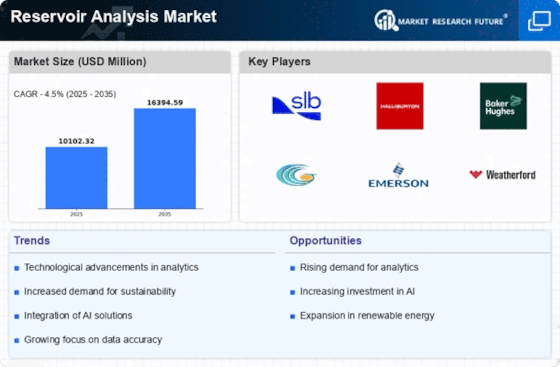
As per Market Research Future analysis, the Reservoir Analysis Market Size was estimated at 10102.32 USD Million in 2024. The Reservoir Analysis industry is projected to grow from 10556.93 USD Million in 2025 to 16394.59 USD Million by 2035, exhibiting a compound annual growth rate (CAGR) of 4% during the forecast period 2025 - 2035

Key Market Trends & Highlights

The Reservoir Analysis Market is poised for growth driven by technological advancements and sustainability initiatives.

  • Technological integration is transforming reservoir analysis, enhancing data accuracy and operational efficiency. A strong focus on sustainability is shaping practices in North America, the largest market for reservoir analysis. Collaborative approaches are emerging as key strategies in the Asia-Pacific region, the fastest-growing market. Increased demand for water resources and advancements in data analytics are major drivers propelling market expansion.

Market Size & Forecast

2024 Market Size 10102.32 (USD Million)
2035 Market Size 16394.59 (USD Million)
CAGR (2025 - 2035) 4.5%
Largest Regional Market Share in 2024 North America

Major Players

<a href="https://www.slb.com/products-and-services/innovating-in-oil-and-gas/reservoir-characterization/rock-and-fluid-analysis/reservoir-laboratories">Schlumberger</a> (US), Halliburton (US), Baker Hughes (US), CGG (FR), Emerson Electric (US), Weatherford International (IE), Petrobras (BR), <a href="https://prof.totalenergies.com/en/cours-et-conferences/reservoir-and-well-test-analysis/">TotalEnergies</a> (FR), Eni (IT)

Market Trends

The Reservoir Analysis Market is currently experiencing a dynamic evolution, driven by advancements in technology and increasing demand for efficient resource management. As industries seek to optimize their operations, the integration of sophisticated analytical tools has become paramount. These tools facilitate enhanced decision-making processes, enabling stakeholders to derive actionable insights from complex data sets. Furthermore, the growing emphasis on sustainability and environmental stewardship is prompting organizations to adopt more responsible practices in resource extraction and utilization. This shift not only aligns with regulatory requirements but also resonates with the broader societal push towards sustainable development. In addition, the Reservoir Analysis Market is witnessing a surge in collaboration among various sectors, including energy, water management, and environmental services. Such partnerships are fostering innovation and the sharing of best practices, which may lead to the development of more comprehensive analytical frameworks. As the market continues to mature, it appears poised for further growth, with emerging technologies such as artificial intelligence and machine learning likely to play a pivotal role in shaping its future. The interplay between technological advancements and regulatory pressures suggests a complex landscape that stakeholders must navigate carefully to remain competitive and responsive to evolving market demands.

Technological Integration

The incorporation of advanced technologies, such as artificial intelligence and machine learning, is transforming the Reservoir Analysis Market. These innovations enhance data processing capabilities, allowing for more accurate predictions and improved resource management.

Sustainability Focus

There is a growing trend towards sustainable practices within the Reservoir Analysis Market. Organizations are increasingly prioritizing environmentally responsible methods, which not only comply with regulations but also appeal to socially conscious consumers.

Collaborative Approaches

The Reservoir Analysis Market is seeing an increase in collaborative efforts among various sectors. Partnerships between energy, water management, and environmental organizations are fostering innovation and the sharing of knowledge, leading to more effective analytical solutions.

Reservoir Analysis Market Market Drivers

Advancements in Data Analytics

The integration of advanced data analytics into reservoir management is transforming the Reservoir Analysis Market. Technologies such as machine learning and artificial intelligence enable more accurate predictions of water availability and demand. These advancements allow for better decision-making processes regarding reservoir operations. The market for data analytics in water management is projected to reach substantial figures, indicating a robust growth trajectory. As organizations increasingly rely on data-driven insights, the Reservoir Analysis Market is likely to experience significant expansion, driven by the need for efficiency and precision in water resource management.

Increased Demand for Water Resources

The rising global population and urbanization have led to an increased demand for water resources, which significantly impacts the Reservoir Analysis Market. As cities expand, the need for efficient water management systems becomes paramount. This demand drives investments in reservoir analysis technologies, which help optimize water storage and distribution. According to recent data, the water scarcity issue affects over two billion people, prompting governments and organizations to seek advanced solutions. The Reservoir Analysis Market is thus positioned to grow as stakeholders prioritize sustainable water management practices to address these challenges.

Investment in Infrastructure Development

The ongoing investment in infrastructure development, particularly in water management systems, is a key driver for the Reservoir Analysis Market. Governments and private entities are allocating substantial funds to enhance water storage and distribution networks. This investment is crucial for addressing aging infrastructure and improving resilience against climate change impacts. The market for reservoir analysis technologies is expected to benefit from these developments, as stakeholders seek innovative solutions to optimize existing resources. As infrastructure projects progress, the Reservoir Analysis Market is likely to see increased demand for advanced analytical tools and methodologies.

Growing Awareness of Climate Change Impacts

The growing awareness of climate change impacts is influencing the Reservoir Analysis Market. Stakeholders are increasingly recognizing the need for adaptive water management strategies to mitigate the effects of climate variability. This awareness drives the demand for reservoir analysis technologies that can model and predict changes in water availability due to climate factors. As organizations strive to enhance their resilience to climate change, the market for reservoir analysis is expected to expand. The emphasis on sustainable practices and climate adaptation strategies positions the Reservoir Analysis Market as a critical component in addressing future water challenges.

Regulatory Compliance and Environmental Standards

Stringent regulatory frameworks and environmental standards are shaping the Reservoir Analysis Market. Governments worldwide are implementing policies aimed at sustainable water management and conservation. Compliance with these regulations necessitates the adoption of advanced reservoir analysis techniques to monitor and manage water resources effectively. The market is witnessing a shift towards technologies that facilitate compliance, as organizations seek to avoid penalties and enhance their sustainability profiles. This trend indicates a growing opportunity for the Reservoir Analysis Market, as stakeholders invest in solutions that align with regulatory requirements and environmental stewardship.

Market Segment Insights

By Type: Conventional (Largest) vs. Unconventional (Fastest-Growing)

The Global Reservoir Analysis Market shows a notable distribution of market share between conventional and unconventional reservoir types. Conventional reservoirs continue to dominate the market due to their established extraction methods and existing infrastructure, resulting in significant reliability for operators. This segment typically benefits from lower production costs and a simpler regulatory landscape, making it a preferred choice for many companies. Meanwhile, unconventional reservoirs are gaining ground rapidly, prompted by advancements in technology and increased investment in exploration activities. These reservoirs present a higher level of complexity but potential for substantial yield, thereby capturing attention amid changing energy demands.

Type: Conventional (Dominant) vs. Unconventional (Emerging)

The Conventional reservoir segment stands as a dominant force in the Reservoir Analysis Market, characterized by its well-established techniques and broad acceptance. These reservoirs are typically easier to extract resources from, leading to a more stable yield. The established methods and existing infrastructure contribute to reducing operational uncertainties, solidifying their market position. Conversely, Unconventional reservoirs are emerging rapidly, driven by new technologies and exploration strategies that maximize resource extraction in previously underserved areas. Although these require higher investments and advanced techniques, they hold significant potential for growth, especially as global demand pivots toward sustainable and cleaner energy sources.

By Service: Geo Modeling & Reservoir Simulation (Largest) vs. Data Acquisition & Monitoring (Fastest-Growing)

In the Reservoir Analysis Market, the service segment is partitioned into three key areas: Geo Modeling &amp; Reservoir Simulation, Data Acquisition &amp; Monitoring, and Reservoir Sampling. Among these, Geo Modeling &amp; Reservoir Simulation commands a significant share, reflecting its importance in accurately predicting reservoir behavior and optimizing production strategies. Meanwhile, Data Acquisition &amp; Monitoring, while currently smaller in terms of market share, is rapidly gaining traction due to the increasing emphasis on real-time data for decision-making processes in reservoir management.

Geo Modeling &amp; Reservoir Simulation (Dominant) vs. Reservoir Sampling (Emerging)

Geo Modeling &amp; Reservoir Simulation stands as the dominant force within the service segment, characterized by its critical role in visualizing subsurface geological formations and simulating reservoir performance. This service enables operators to make informed decisions through advanced modeling techniques, ensuring efficient resource extraction. In contrast, Reservoir Sampling, as an emerging value, is gaining attention for its importance in understanding reservoir properties. While not yet as widely adopted, its relevance is increasing as companies recognize the value of obtaining precise reservoir fluid samples to enhance production forecasts and reservoir management, underscoring its potential growth in the coming years.

By Application: Onshore (Largest) vs. Offshore (Fastest-Growing)

The Reservoir Analysis Market is characterized by two primary applications: onshore and offshore. The onshore segment currently holds the largest market share, driven by the extensive development of <a href="https://www.marketresearchfuture.com/reports/oil-gas-projects-market-16161">oil and gas</a> resources on land. This dominance is bolstered by advancements in drilling technology and reservoir management, allowing for enhanced extraction efficiency. In contrast, the offshore sector is witnessing rapid growth, fueled by increasing investments in deep-water exploration and production, which are becoming increasingly viable due to technological innovations.

Application: Onshore (Dominant) vs. Offshore (Emerging)

The onshore application segment of the Reservoir Analysis Market is well-established, benefiting from a long history of resource development and a robust infrastructure that supports extraction activities. Onshore reservoirs typically offer easier access and lower operational expenses compared to their offshore counterparts. Conversely, the <a href="https://www.marketresearchfuture.com/reports/offshore-energy-market-36717">offshore</a> application, though currently smaller, is considered an emerging market driven by the need to access untapped resources beneath the ocean floor. Technological advancements in subsea exploration, coupled with growing demand for energy resources, position the offshore segment for significant growth, making it an area of strategic focus for industry stakeholders.

Get more detailed insights about Reservoir Analysis Market Research Report - Global Forecast till 2035

Regional Insights

North America : Leading Innovation and Technology

North America is the largest market for reservoir analysis, holding approximately 45% of the global share. The region benefits from advanced technology adoption, significant investments in oil and gas exploration, and a robust regulatory framework that encourages innovation. The demand for efficient resource management and environmental compliance drives growth, with the U.S. and Canada being the primary contributors to this market. The competitive landscape is characterized by the presence of major players such as Schlumberger, Halliburton, and Baker Hughes, which leverage cutting-edge technologies to enhance reservoir performance. The U.S. leads in technological advancements, while Canada focuses on sustainable practices. The collaboration between industry and government further strengthens the market, ensuring a steady flow of innovations and solutions.

Europe : Sustainable Practices and Regulations

Europe is witnessing a significant shift towards sustainable reservoir analysis practices, holding about 30% of the global market share. The region's growth is driven by stringent environmental regulations and a commitment to reducing carbon emissions. Countries like Norway and the UK are at the forefront, implementing policies that promote efficient resource utilization and environmental protection, thus catalyzing demand for advanced reservoir analysis technologies. Leading players in Europe include CGG, TotalEnergies, and Eni, which are actively investing in innovative solutions to meet regulatory requirements. The competitive landscape is evolving, with a focus on collaboration between companies and governmental bodies to enhance sustainability. The European market is characterized by a strong emphasis on research and development, ensuring that new technologies align with environmental goals.

Asia-Pacific : Emerging Markets and Growth Potential

Asia-Pacific is emerging as a powerhouse in the reservoir analysis market, accounting for approximately 20% of the global share. The region's growth is fueled by increasing energy demands, particularly in countries like China and India, which are investing heavily in oil and gas exploration. Regulatory support for energy security and infrastructure development further enhances market prospects, making it a key area for future investments. The competitive landscape features local and international players, with companies like Petrobras and Weatherford International expanding their presence. The region is characterized by a mix of established firms and new entrants, driving innovation and competition. As energy consumption continues to rise, the demand for advanced reservoir analysis technologies is expected to grow, positioning Asia-Pacific as a critical market in the coming years.

Middle East and Africa : Resource-Rich and Strategic Market

The Middle East and Africa region holds about 5% of The Reservoir Analysis Market, driven by its rich natural resources and strategic importance in the global energy landscape. Countries like Saudi Arabia and the UAE are investing in advanced technologies to optimize oil extraction and enhance reservoir management. Regulatory frameworks are evolving to support sustainable practices, which is crucial for long-term growth in this sector. The competitive landscape is dominated by key players such as Schlumberger and Halliburton, which are leveraging their expertise to cater to the unique challenges of the region. The presence of state-owned enterprises also plays a significant role in shaping market dynamics. As the region continues to develop its energy sector, the demand for innovative reservoir analysis solutions is expected to rise, making it a focal point for investment.

Key Players and Competitive Insights

The Reservoir Analysis Market is currently characterized by a dynamic competitive landscape, driven by technological advancements and the increasing demand for efficient resource management. Key players such as Schlumberger (US), Halliburton (US), and Baker Hughes (US) are at the forefront, each adopting distinct strategies to enhance their market positioning. Schlumberger (US) focuses on innovation through digital transformation, leveraging advanced data analytics to optimize reservoir performance. Meanwhile, Halliburton (US) emphasizes strategic partnerships, collaborating with technology firms to integrate AI solutions into their reservoir analysis services. Baker Hughes (US) appears to be concentrating on sustainability initiatives, aligning its operations with global environmental standards, which is becoming increasingly vital in the energy sector. Collectively, these strategies not only enhance operational efficiency but also shape a competitive environment that prioritizes technological prowess and sustainability.

In terms of business tactics, companies are increasingly localizing manufacturing and optimizing supply chains to enhance responsiveness to market demands. The Reservoir Analysis Market is moderately fragmented, with a mix of established players and emerging firms. This structure allows for a diverse range of services and innovations, as key players leverage their strengths to capture market share. The collective influence of these companies fosters a competitive atmosphere where technological advancements and customer-centric solutions are paramount.

In August 2025, Schlumberger (US) announced a partnership with a leading AI firm to develop predictive analytics tools aimed at improving reservoir management. This strategic move is significant as it positions Schlumberger to harness cutting-edge technology, potentially leading to enhanced decision-making capabilities for clients. The integration of AI into their services could streamline operations and reduce costs, thereby reinforcing Schlumberger's competitive edge in the market.

In September 2025, Halliburton (US) launched a new suite of digital tools designed to optimize reservoir performance through real-time data analysis. This initiative reflects Halliburton's commitment to innovation and its strategic focus on enhancing operational efficiency. By providing clients with immediate insights, Halliburton is likely to strengthen its market position and attract new customers seeking advanced technological solutions.

In July 2025, Baker Hughes (US) unveiled a sustainability initiative aimed at reducing carbon emissions in reservoir analysis operations. This initiative underscores Baker Hughes' dedication to environmental stewardship, which is increasingly becoming a critical factor for clients in the energy sector. By prioritizing sustainability, Baker Hughes not only meets regulatory demands but also appeals to a growing segment of environmentally conscious consumers, thereby enhancing its competitive positioning.

As of October 2025, the Reservoir Analysis Market is witnessing a pronounced shift towards digitalization, sustainability, and AI integration. These trends are reshaping competitive dynamics, with strategic alliances becoming a pivotal factor in driving innovation and operational efficiency. The focus is gradually shifting from price-based competition to differentiation through technology and reliability in supply chains. Looking ahead, companies that successfully navigate these trends and invest in innovative solutions are likely to emerge as leaders in the evolving landscape of reservoir analysis.

Key Companies in the Reservoir Analysis Market include

Industry Developments

    • Market has been primarily divided into several segments, and each segment has profitable trends.
    • The segment is growing day by day; there is a new trend that is responsible for the growth
    • North America and Europe have more market share, but Asia Pacific is growing at a very fast pace.

Future Outlook

Reservoir Analysis Market Future Outlook

The Reservoir Analysis Market is projected to grow at a 4.5% CAGR from 2025 to 2035, driven by technological advancements, increasing demand for water resources, and enhanced data analytics capabilities.<br>The future of the Global Reservoir Analysis Market is increasingly defined by the integration of artificial intelligence (AI) and machine learning to automate complex subsurface modeling. As operators pivot toward unconventional reserves and deepwater exploration, the demand for real-time data acquisition and high-fidelity diagnostic tools is rising. Furthermore, the Global Reservoir Analysis Market is expanding its scope to include carbon capture storage (CCS) and geothermal assessments, aligning technical expertise with global sustainability goals.

New opportunities lie in:

  • <p>Integration of AI-driven predictive analytics tools for reservoir management. Development of remote monitoring systems for real-time data collection. Expansion into emerging markets with tailored reservoir solutions.</p>

By 2035, the Reservoir Analysis Market is expected to achieve robust growth, reflecting evolving industry needs.

Market Segmentation

Reservoir Analysis Market Type Outlook

  • Conventional
  • Unconventional

Reservoir Analysis Market Service Outlook

  • Geo Modeling & Reservoir Simulation
  • Data Acquisition & Monitoring
  • Reservoir Sampling

Reservoir Analysis Market Application Outlook

  • Onshore
  • Offshore

Report Scope

MARKET SIZE 2024 10102.32(USD Million)
MARKET SIZE 2025 10556.93(USD Million)
MARKET SIZE 2035 16394.59(USD Million)
COMPOUND ANNUAL GROWTH RATE (CAGR) 4.5% (2025 - 2035)
REPORT COVERAGE Revenue Forecast, Competitive Landscape, Growth Factors, and Trends
BASE YEAR 2024
Market Forecast Period 2025 - 2035
Historical Data 2019 - 2024
Market Forecast Units USD Million
Key Companies Profiled Market analysis in progress
Segments Covered Market segmentation analysis in progress
Key Market Opportunities Integration of advanced data analytics and artificial intelligence in the Reservoir Analysis Market.
Key Market Dynamics Technological advancements and regulatory changes drive innovation and competition in the Reservoir Analysis Market.
Countries Covered North America, Europe, APAC, South America, MEA

FAQs

What is the current valuation of the Reservoir Analysis Market as of 2024?

<p>The Reservoir Analysis Market was valued at 10102.32 USD Million in 2024.</p>

What is the projected market valuation for the Reservoir Analysis Market in 2035?

<p>The market is projected to reach a valuation of 16394.59 USD Million by 2035.</p>

What is the expected CAGR for the Reservoir Analysis Market during the forecast period 2025 - 2035?

<p>The expected CAGR for the Reservoir Analysis Market during 2025 - 2035 is 4.5%.</p>

Which companies are considered key players in the Reservoir Analysis Market?

<p>Key players in the market include Schlumberger, Halliburton, Baker Hughes, CGG, Emerson Electric, Weatherford International, Petrobras, TotalEnergies, and Eni.</p>

What are the two main types of reservoirs analyzed in the market?

<p>The two main types of reservoirs analyzed are Conventional and Unconventional, with valuations of 6000.0 to 9000.0 USD Million and 4102.32 to 7394.59 USD Million, respectively.</p>

What services are included in the Reservoir Analysis Market?

<p>Services include Geo Modeling & Reservoir Simulation, Data Acquisition & Monitoring, and Reservoir Sampling, with respective valuations ranging from 3030.7 to 6500.0 USD Million.</p>

How does the onshore application segment compare to the offshore segment in terms of market valuation?

<p>The onshore application segment is valued between 5050.0 and 8197.3 USD Million, while the offshore segment has a similar valuation range of 5052.32 to 8197.29 USD Million.</p>

What is the significance of Geo Modeling & Reservoir Simulation in the market?

<p>Geo Modeling & Reservoir Simulation is a crucial service segment, with a valuation range of 4040.93 to 6500.0 USD Million.</p>

How does the Reservoir Analysis Market's growth potential appear for the next decade?

<p>The growth potential appears robust, with a projected increase in market valuation from 10102.32 USD Million in 2024 to 16394.59 USD Million by 2035.</p>

What factors might influence the growth of the Reservoir Analysis Market during 2025 - 2035?

<p>Factors influencing growth may include advancements in technology, increasing demand for energy resources, and the strategic initiatives of key players like Schlumberger and Halliburton.</p>

  1. SECTION I: EXECUTIVE SUMMARY AND KEY HIGHLIGHTS
    1. | 1.1 EXECUTIVE SUMMARY
    2. | | 1.1.1 Market Overview
    3. | | 1.1.2 Key Findings
    4. | | 1.1.3 Market Segmentation
    5. | | 1.1.4 Competitive Landscape
    6. | | 1.1.5 Challenges and Opportunities
    7. | | 1.1.6 Future Outlook
  2. SECTION II: SCOPING, METHODOLOGY AND MARKET STRUCTURE
    1. | 2.1 MARKET INTRODUCTION
    2. | | 2.1.1 Definition
    3. | | 2.1.2 Scope of the study
    4. | | | 2.1.2.1 Research Objective
    5. | | | 2.1.2.2 Assumption
    6. | | | 2.1.2.3 Limitations
    7. | 2.2 RESEARCH METHODOLOGY
    8. | | 2.2.1 Overview
    9. | | 2.2.2 Data Mining
    10. | | 2.2.3 Secondary Research
    11. | | 2.2.4 Primary Research
    12. | | | 2.2.4.1 Primary Interviews and Information Gathering Process
    13. | | | 2.2.4.2 Breakdown of Primary Respondents
    14. | | 2.2.5 Forecasting Model
    15. | | 2.2.6 Market Size Estimation
    16. | | | 2.2.6.1 Bottom-Up Approach
    17. | | | 2.2.6.2 Top-Down Approach
    18. | | 2.2.7 Data Triangulation
    19. | | 2.2.8 Validation
  3. SECTION III: QUALITATIVE ANALYSIS
    1. | 3.1 MARKET DYNAMICS
    2. | | 3.1.1 Overview
    3. | | 3.1.2 Drivers
    4. | | 3.1.3 Restraints
    5. | | 3.1.4 Opportunities
    6. | 3.2 MARKET FACTOR ANALYSIS
    7. | | 3.2.1 Value chain Analysis
    8. | | 3.2.2 Porter's Five Forces Analysis
    9. | | | 3.2.2.1 Bargaining Power of Suppliers
    10. | | | 3.2.2.2 Bargaining Power of Buyers
    11. | | | 3.2.2.3 Threat of New Entrants
    12. | | | 3.2.2.4 Threat of Substitutes
    13. | | | 3.2.2.5 Intensity of Rivalry
    14. | | 3.2.3 COVID-19 Impact Analysis
    15. | | | 3.2.3.1 Market Impact Analysis
    16. | | | 3.2.3.2 Regional Impact
    17. | | | 3.2.3.3 Opportunity and Threat Analysis
  4. SECTION IV: QUANTITATIVE ANALYSIS
    1. | 4.1 Energy & Power, BY Type (USD Million)
    2. | | 4.1.1 Conventional
    3. | | 4.1.2 Unconventional
    4. | 4.2 Energy & Power, BY Service (USD Million)
    5. | | 4.2.1 Geo Modeling & Reservoir Simulation
    6. | | 4.2.2 Data Acquisition & Monitoring
    7. | | 4.2.3 Reservoir Sampling
    8. | 4.3 Energy & Power, BY Application (USD Million)
    9. | | 4.3.1 Onshore
    10. | | 4.3.2 Offshore
    11. | 4.4 Energy & Power, BY Region (USD Million)
    12. | | 4.4.1 North America
    13. | | | 4.4.1.1 US
    14. | | | 4.4.1.2 Canada
    15. | | 4.4.2 Europe
    16. | | | 4.4.2.1 Germany
    17. | | | 4.4.2.2 UK
    18. | | | 4.4.2.3 France
    19. | | | 4.4.2.4 Russia
    20. | | | 4.4.2.5 Italy
    21. | | | 4.4.2.6 Spain
    22. | | | 4.4.2.7 Rest of Europe
    23. | | 4.4.3 APAC
    24. | | | 4.4.3.1 China
    25. | | | 4.4.3.2 India
    26. | | | 4.4.3.3 Japan
    27. | | | 4.4.3.4 South Korea
    28. | | | 4.4.3.5 Malaysia
    29. | | | 4.4.3.6 Thailand
    30. | | | 4.4.3.7 Indonesia
    31. | | | 4.4.3.8 Rest of APAC
    32. | | 4.4.4 South America
    33. | | | 4.4.4.1 Brazil
    34. | | | 4.4.4.2 Mexico
    35. | | | 4.4.4.3 Argentina
    36. | | | 4.4.4.4 Rest of South America
    37. | | 4.4.5 MEA
    38. | | | 4.4.5.1 GCC Countries
    39. | | | 4.4.5.2 South Africa
    40. | | | 4.4.5.3 Rest of MEA
  5. SECTION V: COMPETITIVE ANALYSIS
    1. | 5.1 Competitive Landscape
    2. | | 5.1.1 Overview
    3. | | 5.1.2 Competitive Analysis
    4. | | 5.1.3 Market share Analysis
    5. | | 5.1.4 Major Growth Strategy in the Energy & Power
    6. | | 5.1.5 Competitive Benchmarking
    7. | | 5.1.6 Leading Players in Terms of Number of Developments in the Energy & Power
    8. | | 5.1.7 Key developments and growth strategies
    9. | | | 5.1.7.1 New Product Launch/Service Deployment
    10. | | | 5.1.7.2 Merger & Acquisitions
    11. | | | 5.1.7.3 Joint Ventures
    12. | | 5.1.8 Major Players Financial Matrix
    13. | | | 5.1.8.1 Sales and Operating Income
    14. | | | 5.1.8.2 Major Players R&D Expenditure. 2023
    15. | 5.2 Company Profiles
    16. | | 5.2.1 Schlumberger (US)
    17. | | | 5.2.1.1 Financial Overview
    18. | | | 5.2.1.2 Products Offered
    19. | | | 5.2.1.3 Key Developments
    20. | | | 5.2.1.4 SWOT Analysis
    21. | | | 5.2.1.5 Key Strategies
    22. | | 5.2.2 Halliburton (US)
    23. | | | 5.2.2.1 Financial Overview
    24. | | | 5.2.2.2 Products Offered
    25. | | | 5.2.2.3 Key Developments
    26. | | | 5.2.2.4 SWOT Analysis
    27. | | | 5.2.2.5 Key Strategies
    28. | | 5.2.3 Baker Hughes (US)
    29. | | | 5.2.3.1 Financial Overview
    30. | | | 5.2.3.2 Products Offered
    31. | | | 5.2.3.3 Key Developments
    32. | | | 5.2.3.4 SWOT Analysis
    33. | | | 5.2.3.5 Key Strategies
    34. | | 5.2.4 CGG (FR)
    35. | | | 5.2.4.1 Financial Overview
    36. | | | 5.2.4.2 Products Offered
    37. | | | 5.2.4.3 Key Developments
    38. | | | 5.2.4.4 SWOT Analysis
    39. | | | 5.2.4.5 Key Strategies
    40. | | 5.2.5 Emerson Electric (US)
    41. | | | 5.2.5.1 Financial Overview
    42. | | | 5.2.5.2 Products Offered
    43. | | | 5.2.5.3 Key Developments
    44. | | | 5.2.5.4 SWOT Analysis
    45. | | | 5.2.5.5 Key Strategies
    46. | | 5.2.6 Weatherford International (IE)
    47. | | | 5.2.6.1 Financial Overview
    48. | | | 5.2.6.2 Products Offered
    49. | | | 5.2.6.3 Key Developments
    50. | | | 5.2.6.4 SWOT Analysis
    51. | | | 5.2.6.5 Key Strategies
    52. | | 5.2.7 Petrobras (BR)
    53. | | | 5.2.7.1 Financial Overview
    54. | | | 5.2.7.2 Products Offered
    55. | | | 5.2.7.3 Key Developments
    56. | | | 5.2.7.4 SWOT Analysis
    57. | | | 5.2.7.5 Key Strategies
    58. | | 5.2.8 TotalEnergies (FR)
    59. | | | 5.2.8.1 Financial Overview
    60. | | | 5.2.8.2 Products Offered
    61. | | | 5.2.8.3 Key Developments
    62. | | | 5.2.8.4 SWOT Analysis
    63. | | | 5.2.8.5 Key Strategies
    64. | | 5.2.9 Eni (IT)
    65. | | | 5.2.9.1 Financial Overview
    66. | | | 5.2.9.2 Products Offered
    67. | | | 5.2.9.3 Key Developments
    68. | | | 5.2.9.4 SWOT Analysis
    69. | | | 5.2.9.5 Key Strategies
    70. | 5.3 Appendix
    71. | | 5.3.1 References
    72. | | 5.3.2 Related Reports
  6. LIST OF FIGURES
    1. | 6.1 MARKET SYNOPSIS
    2. | 6.2 NORTH AMERICA MARKET ANALYSIS
    3. | 6.3 US MARKET ANALYSIS BY TYPE
    4. | 6.4 US MARKET ANALYSIS BY SERVICE
    5. | 6.5 US MARKET ANALYSIS BY APPLICATION
    6. | 6.6 CANADA MARKET ANALYSIS BY TYPE
    7. | 6.7 CANADA MARKET ANALYSIS BY SERVICE
    8. | 6.8 CANADA MARKET ANALYSIS BY APPLICATION
    9. | 6.9 EUROPE MARKET ANALYSIS
    10. | 6.10 GERMANY MARKET ANALYSIS BY TYPE
    11. | 6.11 GERMANY MARKET ANALYSIS BY SERVICE
    12. | 6.12 GERMANY MARKET ANALYSIS BY APPLICATION
    13. | 6.13 UK MARKET ANALYSIS BY TYPE
    14. | 6.14 UK MARKET ANALYSIS BY SERVICE
    15. | 6.15 UK MARKET ANALYSIS BY APPLICATION
    16. | 6.16 FRANCE MARKET ANALYSIS BY TYPE
    17. | 6.17 FRANCE MARKET ANALYSIS BY SERVICE
    18. | 6.18 FRANCE MARKET ANALYSIS BY APPLICATION
    19. | 6.19 RUSSIA MARKET ANALYSIS BY TYPE
    20. | 6.20 RUSSIA MARKET ANALYSIS BY SERVICE
    21. | 6.21 RUSSIA MARKET ANALYSIS BY APPLICATION
    22. | 6.22 ITALY MARKET ANALYSIS BY TYPE
    23. | 6.23 ITALY MARKET ANALYSIS BY SERVICE
    24. | 6.24 ITALY MARKET ANALYSIS BY APPLICATION
    25. | 6.25 SPAIN MARKET ANALYSIS BY TYPE
    26. | 6.26 SPAIN MARKET ANALYSIS BY SERVICE
    27. | 6.27 SPAIN MARKET ANALYSIS BY APPLICATION
    28. | 6.28 REST OF EUROPE MARKET ANALYSIS BY TYPE
    29. | 6.29 REST OF EUROPE MARKET ANALYSIS BY SERVICE
    30. | 6.30 REST OF EUROPE MARKET ANALYSIS BY APPLICATION
    31. | 6.31 APAC MARKET ANALYSIS
    32. | 6.32 CHINA MARKET ANALYSIS BY TYPE
    33. | 6.33 CHINA MARKET ANALYSIS BY SERVICE
    34. | 6.34 CHINA MARKET ANALYSIS BY APPLICATION
    35. | 6.35 INDIA MARKET ANALYSIS BY TYPE
    36. | 6.36 INDIA MARKET ANALYSIS BY SERVICE
    37. | 6.37 INDIA MARKET ANALYSIS BY APPLICATION
    38. | 6.38 JAPAN MARKET ANALYSIS BY TYPE
    39. | 6.39 JAPAN MARKET ANALYSIS BY SERVICE
    40. | 6.40 JAPAN MARKET ANALYSIS BY APPLICATION
    41. | 6.41 SOUTH KOREA MARKET ANALYSIS BY TYPE
    42. | 6.42 SOUTH KOREA MARKET ANALYSIS BY SERVICE
    43. | 6.43 SOUTH KOREA MARKET ANALYSIS BY APPLICATION
    44. | 6.44 MALAYSIA MARKET ANALYSIS BY TYPE
    45. | 6.45 MALAYSIA MARKET ANALYSIS BY SERVICE
    46. | 6.46 MALAYSIA MARKET ANALYSIS BY APPLICATION
    47. | 6.47 THAILAND MARKET ANALYSIS BY TYPE
    48. | 6.48 THAILAND MARKET ANALYSIS BY SERVICE
    49. | 6.49 THAILAND MARKET ANALYSIS BY APPLICATION
    50. | 6.50 INDONESIA MARKET ANALYSIS BY TYPE
    51. | 6.51 INDONESIA MARKET ANALYSIS BY SERVICE
    52. | 6.52 INDONESIA MARKET ANALYSIS BY APPLICATION
    53. | 6.53 REST OF APAC MARKET ANALYSIS BY TYPE
    54. | 6.54 REST OF APAC MARKET ANALYSIS BY SERVICE
    55. | 6.55 REST OF APAC MARKET ANALYSIS BY APPLICATION
    56. | 6.56 SOUTH AMERICA MARKET ANALYSIS
    57. | 6.57 BRAZIL MARKET ANALYSIS BY TYPE
    58. | 6.58 BRAZIL MARKET ANALYSIS BY SERVICE
    59. | 6.59 BRAZIL MARKET ANALYSIS BY APPLICATION
    60. | 6.60 MEXICO MARKET ANALYSIS BY TYPE
    61. | 6.61 MEXICO MARKET ANALYSIS BY SERVICE
    62. | 6.62 MEXICO MARKET ANALYSIS BY APPLICATION
    63. | 6.63 ARGENTINA MARKET ANALYSIS BY TYPE
    64. | 6.64 ARGENTINA MARKET ANALYSIS BY SERVICE
    65. | 6.65 ARGENTINA MARKET ANALYSIS BY APPLICATION
    66. | 6.66 REST OF SOUTH AMERICA MARKET ANALYSIS BY TYPE
    67. | 6.67 REST OF SOUTH AMERICA MARKET ANALYSIS BY SERVICE
    68. | 6.68 REST OF SOUTH AMERICA MARKET ANALYSIS BY APPLICATION
    69. | 6.69 MEA MARKET ANALYSIS
    70. | 6.70 GCC COUNTRIES MARKET ANALYSIS BY TYPE
    71. | 6.71 GCC COUNTRIES MARKET ANALYSIS BY SERVICE
    72. | 6.72 GCC COUNTRIES MARKET ANALYSIS BY APPLICATION
    73. | 6.73 SOUTH AFRICA MARKET ANALYSIS BY TYPE
    74. | 6.74 SOUTH AFRICA MARKET ANALYSIS BY SERVICE
    75. | 6.75 SOUTH AFRICA MARKET ANALYSIS BY APPLICATION
    76. | 6.76 REST OF MEA MARKET ANALYSIS BY TYPE
    77. | 6.77 REST OF MEA MARKET ANALYSIS BY SERVICE
    78. | 6.78 REST OF MEA MARKET ANALYSIS BY APPLICATION
    79. | 6.79 KEY BUYING CRITERIA OF ENERGY & POWER
    80. | 6.80 RESEARCH PROCESS OF MRFR
    81. | 6.81 DRO ANALYSIS OF ENERGY & POWER
    82. | 6.82 DRIVERS IMPACT ANALYSIS: ENERGY & POWER
    83. | 6.83 RESTRAINTS IMPACT ANALYSIS: ENERGY & POWER
    84. | 6.84 SUPPLY / VALUE CHAIN: ENERGY & POWER
    85. | 6.85 ENERGY & POWER, BY TYPE, 2024 (% SHARE)
    86. | 6.86 ENERGY & POWER, BY TYPE, 2024 TO 2035 (USD Million)
    87. | 6.87 ENERGY & POWER, BY SERVICE, 2024 (% SHARE)
    88. | 6.88 ENERGY & POWER, BY SERVICE, 2024 TO 2035 (USD Million)
    89. | 6.89 ENERGY & POWER, BY APPLICATION, 2024 (% SHARE)
    90. | 6.90 ENERGY & POWER, BY APPLICATION, 2024 TO 2035 (USD Million)
    91. | 6.91 BENCHMARKING OF MAJOR COMPETITORS
  7. LIST OF TABLES
    1. | 7.1 LIST OF ASSUMPTIONS
    2. | | 7.1.1
    3. | 7.2 North America MARKET SIZE ESTIMATES; FORECAST
    4. | | 7.2.1 BY TYPE, 2025-2035 (USD Million)
    5. | | 7.2.2 BY SERVICE, 2025-2035 (USD Million)
    6. | | 7.2.3 BY APPLICATION, 2025-2035 (USD Million)
    7. | 7.3 US MARKET SIZE ESTIMATES; FORECAST
    8. | | 7.3.1 BY TYPE, 2025-2035 (USD Million)
    9. | | 7.3.2 BY SERVICE, 2025-2035 (USD Million)
    10. | | 7.3.3 BY APPLICATION, 2025-2035 (USD Million)
    11. | 7.4 Canada MARKET SIZE ESTIMATES; FORECAST
    12. | | 7.4.1 BY TYPE, 2025-2035 (USD Million)
    13. | | 7.4.2 BY SERVICE, 2025-2035 (USD Million)
    14. | | 7.4.3 BY APPLICATION, 2025-2035 (USD Million)
    15. | 7.5 Europe MARKET SIZE ESTIMATES; FORECAST
    16. | | 7.5.1 BY TYPE, 2025-2035 (USD Million)
    17. | | 7.5.2 BY SERVICE, 2025-2035 (USD Million)
    18. | | 7.5.3 BY APPLICATION, 2025-2035 (USD Million)
    19. | 7.6 Germany MARKET SIZE ESTIMATES; FORECAST
    20. | | 7.6.1 BY TYPE, 2025-2035 (USD Million)
    21. | | 7.6.2 BY SERVICE, 2025-2035 (USD Million)
    22. | | 7.6.3 BY APPLICATION, 2025-2035 (USD Million)
    23. | 7.7 UK MARKET SIZE ESTIMATES; FORECAST
    24. | | 7.7.1 BY TYPE, 2025-2035 (USD Million)
    25. | | 7.7.2 BY SERVICE, 2025-2035 (USD Million)
    26. | | 7.7.3 BY APPLICATION, 2025-2035 (USD Million)
    27. | 7.8 France MARKET SIZE ESTIMATES; FORECAST
    28. | | 7.8.1 BY TYPE, 2025-2035 (USD Million)
    29. | | 7.8.2 BY SERVICE, 2025-2035 (USD Million)
    30. | | 7.8.3 BY APPLICATION, 2025-2035 (USD Million)
    31. | 7.9 Russia MARKET SIZE ESTIMATES; FORECAST
    32. | | 7.9.1 BY TYPE, 2025-2035 (USD Million)
    33. | | 7.9.2 BY SERVICE, 2025-2035 (USD Million)
    34. | | 7.9.3 BY APPLICATION, 2025-2035 (USD Million)
    35. | 7.10 Italy MARKET SIZE ESTIMATES; FORECAST
    36. | | 7.10.1 BY TYPE, 2025-2035 (USD Million)
    37. | | 7.10.2 BY SERVICE, 2025-2035 (USD Million)
    38. | | 7.10.3 BY APPLICATION, 2025-2035 (USD Million)
    39. | 7.11 Spain MARKET SIZE ESTIMATES; FORECAST
    40. | | 7.11.1 BY TYPE, 2025-2035 (USD Million)
    41. | | 7.11.2 BY SERVICE, 2025-2035 (USD Million)
    42. | | 7.11.3 BY APPLICATION, 2025-2035 (USD Million)
    43. | 7.12 Rest of Europe MARKET SIZE ESTIMATES; FORECAST
    44. | | 7.12.1 BY TYPE, 2025-2035 (USD Million)
    45. | | 7.12.2 BY SERVICE, 2025-2035 (USD Million)
    46. | | 7.12.3 BY APPLICATION, 2025-2035 (USD Million)
    47. | 7.13 APAC MARKET SIZE ESTIMATES; FORECAST
    48. | | 7.13.1 BY TYPE, 2025-2035 (USD Million)
    49. | | 7.13.2 BY SERVICE, 2025-2035 (USD Million)
    50. | | 7.13.3 BY APPLICATION, 2025-2035 (USD Million)
    51. | 7.14 China MARKET SIZE ESTIMATES; FORECAST
    52. | | 7.14.1 BY TYPE, 2025-2035 (USD Million)
    53. | | 7.14.2 BY SERVICE, 2025-2035 (USD Million)
    54. | | 7.14.3 BY APPLICATION, 2025-2035 (USD Million)
    55. | 7.15 India MARKET SIZE ESTIMATES; FORECAST
    56. | | 7.15.1 BY TYPE, 2025-2035 (USD Million)
    57. | | 7.15.2 BY SERVICE, 2025-2035 (USD Million)
    58. | | 7.15.3 BY APPLICATION, 2025-2035 (USD Million)
    59. | 7.16 Japan MARKET SIZE ESTIMATES; FORECAST
    60. | | 7.16.1 BY TYPE, 2025-2035 (USD Million)
    61. | | 7.16.2 BY SERVICE, 2025-2035 (USD Million)
    62. | | 7.16.3 BY APPLICATION, 2025-2035 (USD Million)
    63. | 7.17 South Korea MARKET SIZE ESTIMATES; FORECAST
    64. | | 7.17.1 BY TYPE, 2025-2035 (USD Million)
    65. | | 7.17.2 BY SERVICE, 2025-2035 (USD Million)
    66. | | 7.17.3 BY APPLICATION, 2025-2035 (USD Million)
    67. | 7.18 Malaysia MARKET SIZE ESTIMATES; FORECAST
    68. | | 7.18.1 BY TYPE, 2025-2035 (USD Million)
    69. | | 7.18.2 BY SERVICE, 2025-2035 (USD Million)
    70. | | 7.18.3 BY APPLICATION, 2025-2035 (USD Million)
    71. | 7.19 Thailand MARKET SIZE ESTIMATES; FORECAST
    72. | | 7.19.1 BY TYPE, 2025-2035 (USD Million)
    73. | | 7.19.2 BY SERVICE, 2025-2035 (USD Million)
    74. | | 7.19.3 BY APPLICATION, 2025-2035 (USD Million)
    75. | 7.20 Indonesia MARKET SIZE ESTIMATES; FORECAST
    76. | | 7.20.1 BY TYPE, 2025-2035 (USD Million)
    77. | | 7.20.2 BY SERVICE, 2025-2035 (USD Million)
    78. | | 7.20.3 BY APPLICATION, 2025-2035 (USD Million)
    79. | 7.21 Rest of APAC MARKET SIZE ESTIMATES; FORECAST
    80. | | 7.21.1 BY TYPE, 2025-2035 (USD Million)
    81. | | 7.21.2 BY SERVICE, 2025-2035 (USD Million)
    82. | | 7.21.3 BY APPLICATION, 2025-2035 (USD Million)
    83. | 7.22 South America MARKET SIZE ESTIMATES; FORECAST
    84. | | 7.22.1 BY TYPE, 2025-2035 (USD Million)
    85. | | 7.22.2 BY SERVICE, 2025-2035 (USD Million)
    86. | | 7.22.3 BY APPLICATION, 2025-2035 (USD Million)
    87. | 7.23 Brazil MARKET SIZE ESTIMATES; FORECAST
    88. | | 7.23.1 BY TYPE, 2025-2035 (USD Million)
    89. | | 7.23.2 BY SERVICE, 2025-2035 (USD Million)
    90. | | 7.23.3 BY APPLICATION, 2025-2035 (USD Million)
    91. | 7.24 Mexico MARKET SIZE ESTIMATES; FORECAST
    92. | | 7.24.1 BY TYPE, 2025-2035 (USD Million)
    93. | | 7.24.2 BY SERVICE, 2025-2035 (USD Million)
    94. | | 7.24.3 BY APPLICATION, 2025-2035 (USD Million)
    95. | 7.25 Argentina MARKET SIZE ESTIMATES; FORECAST
    96. | | 7.25.1 BY TYPE, 2025-2035 (USD Million)
    97. | | 7.25.2 BY SERVICE, 2025-2035 (USD Million)
    98. | | 7.25.3 BY APPLICATION, 2025-2035 (USD Million)
    99. | 7.26 Rest of South America MARKET SIZE ESTIMATES; FORECAST
    100. | | 7.26.1 BY TYPE, 2025-2035 (USD Million)
    101. | | 7.26.2 BY SERVICE, 2025-2035 (USD Million)
    102. | | 7.26.3 BY APPLICATION, 2025-2035 (USD Million)
    103. | 7.27 MEA MARKET SIZE ESTIMATES; FORECAST
    104. | | 7.27.1 BY TYPE, 2025-2035 (USD Million)
    105. | | 7.27.2 BY SERVICE, 2025-2035 (USD Million)
    106. | | 7.27.3 BY APPLICATION, 2025-2035 (USD Million)
    107. | 7.28 GCC Countries MARKET SIZE ESTIMATES; FORECAST
    108. | | 7.28.1 BY TYPE, 2025-2035 (USD Million)
    109. | | 7.28.2 BY SERVICE, 2025-2035 (USD Million)
    110. | | 7.28.3 BY APPLICATION, 2025-2035 (USD Million)
    111. | 7.29 South Africa MARKET SIZE ESTIMATES; FORECAST
    112. | | 7.29.1 BY TYPE, 2025-2035 (USD Million)
    113. | | 7.29.2 BY SERVICE, 2025-2035 (USD Million)
    114. | | 7.29.3 BY APPLICATION, 2025-2035 (USD Million)
    115. | 7.30 Rest of MEA MARKET SIZE ESTIMATES; FORECAST
    116. | | 7.30.1 BY TYPE, 2025-2035 (USD Million)
    117. | | 7.30.2 BY SERVICE, 2025-2035 (USD Million)
    118. | | 7.30.3 BY APPLICATION, 2025-2035 (USD Million)
    119. | 7.31 PRODUCT LAUNCH/PRODUCT DEVELOPMENT/APPROVAL
    120. | | 7.31.1
    121. | 7.32 ACQUISITION/PARTNERSHIP
    122. | | 7.32.1

Energy & Power Market Segmentation

Energy & Power By Type (USD Million, 2025-2035)

  • Conventional
  • Unconventional

Energy & Power By Service (USD Million, 2025-2035)

  • Geo Modeling & Reservoir Simulation
  • Data Acquisition & Monitoring
  • Reservoir Sampling

Energy & Power By Application (USD Million, 2025-2035)

  • Onshore
  • Offshore
Infographic

Free Sample Request

Kindly complete the form below to receive a free sample of this Report

Get Free Sample

Customer Strories

Compare Licence

×
Features License Type
Single User Multiuser License Enterprise User
Price $4,950 $5,950 $7,250
Maximum User Access Limit 1 User Upto 10 Users Unrestricted Access Throughout the Organization
Free Customization
Direct Access to Analyst
Deliverable Format
Platform Access
Discount on Next Purchase 10% 15% 15%
Printable Versions