Request Free Sample ×

Kindly complete the form below to receive a free sample of this Report

* Please use a valid business email

Leading companies partner with us for data-driven Insights

clients tt-cursor
Hero Background
English
Chinese
French
Japanese
Korean
German
Spanish

Renewable Energy Market Size

ID: MRFR/EnP/0986-CR
200 Pages
Chitranshi Jaiswal
July 2025

Renewable Energy Market Size, Share & Growth Analysis Report By Energy Source (Solar, Wind, Hydropower, Geothermal, Biomass), By Technology (Photovoltaic, Concentrated Solar Power, Onshore Wind Turbines, Offshore Wind Turbines, Hydroelectric Power Plants), By Application (Electricity Generation, Heating, Transportation, Cooling, Industrial Processes), By End Use (Residential, Commercial, Industrial, Utilities) and By Regional (North America, Europe, South America, Asia Pacific, Middle East and Africa) - Growth & Industry Forecast to 2035

Share:
Download PDF ×

We do not share your information with anyone. However, we may send you emails based on your report interest from time to time. You may contact us at any time to opt-out.

Renewable Energy Market Infographic
Purchase Options

Renewable Energy Size

Renewable Energy Market Growth Projections and Opportunities

The global demand for energy is on the rise, and the diminishing reserves of non-renewable energy sources are steering the trajectory of the global renewable energy market. This market is propelled by harnessing natural elements like sunlight, geothermal power, wind, and biomass, which continuously replenish themselves. Projections indicate a substantial growth with a Compound Annual Growth Rate (CAGR) of 8.54% during the forecast period from 2018 to 2023.

In 2017, Asia-Pacific took the lead in the global renewable energy market, capturing a substantial share of 34.12%, closely trailed by North America at 23.99% and Europe at 22.04%. The segmentation of the global renewable energy market is based on type, end-use, and region.

Diving into types, the market is categorized into hydropower, wind energy, solar energy, bioenergy, geothermal energy, and ocean energy. Among these, the hydropower segment is anticipated to experience the fastest growth. This surge can be attributed to the escalating hydropower generation in countries like China and India. In 2018, hydropower secured a significant 26.25% share of the overall global renewable energy market.

On the front of end-use, the global renewable energy market is segmented into industrial, residential, and commercial categories. In 2017, the industrial sector dominated with a substantial market share of 40.77%, closely followed by the residential segment, accounting for 35.18% of the market.

The promising growth of the global renewable energy market is further underlined by the continuous depletion of traditional energy sources and the escalating global energy demand. As we traverse through the forecast period, the renewable energy sector is poised to witness considerable advancements, with hydropower emerging as a frontrunner in the race.

In essence, the dynamics of renewable energy are being shaped by a global shift towards sustainable practices. The increasing recognition of the environmental impact of traditional energy sources and the urgent need for cleaner alternatives are steering the world towards embracing renewable energy solutions. With the market set to grow at a robust CAGR, the global renewable energy landscape is on the verge of transformative developments that will play a pivotal role in shaping the future of energy generation and consumption.

As the world grapples with the challenges of depleting natural resources and the environmental consequences of conventional energy, the surge in the global renewable energy market presents an optimistic outlook. The strides made in hydropower, wind energy, solar energy, bioenergy, geothermal energy, and ocean energy underscore a collective effort towards a sustainable and eco-friendly energy future.

In conclusion, the global renewable energy market is not just a market; it is a beacon of hope for a greener and more sustainable world. The increasing reliance on renewable sources signifies a fundamental shift in our approach to energy, one that is aligned with the urgent need for environmental conservation and responsible energy consumption. The future promises further growth, innovation, and a cleaner energy landscape that benefits both the planet and its inhabitants.
Renewable Energy Market Size Graph
Author
Author Profile
Chitranshi Jaiswal
Team Lead - Research

Chitranshi is a Team Leader in the Chemicals & Materials (CnM) and Energy & Power (EnP) domains, with 6+ years of experience in market research. She leads and mentors teams to deliver cross-domain projects that equip clients with actionable insights and growth strategies. She is skilled in market estimation, forecasting, competitive benchmarking, and both primary & secondary research, enabling her to turn complex data into decision-ready insights. An engineer and MBA professional, she combines technical expertise with strategic acumen to solve dynamic market challenges. Chitranshi has successfully managed projects that support market entry, investment planning, and competitive positioning, while building strong client relationships. Certified in Advanced Excel & Power BI she leverages data-driven approaches to ensure accuracy, clarity, and impactful outcomes.

Leave a Comment

FAQs

What is the current valuation of the renewable energy market as of 2024?

<p>The renewable energy market was valued at 1200.0 USD Billion in 2024.</p>

What is the projected market valuation for renewable energy by 2035?

<p>The renewable energy market is projected to reach 2500.0 USD Billion by 2035.</p>

What is the expected compound annual growth rate (CAGR) for the renewable energy market from 2025 to 2035?

<p>The expected CAGR for the renewable energy market during the forecast period 2025 - 2035 is 6.9%.</p>

Which segment of renewable energy is projected to have the highest valuation by application in 2035?

<p>By 2035, the Utility segment is projected to reach a valuation of 650.0 USD Billion.</p>

How does the valuation of solar power generation compare to wind power generation in 2035?

<p>In 2035, solar power generation is projected to reach 650.0 USD Billion, while wind power generation is expected to reach 600.0 USD Billion.</p>

What are the projected valuations for hydropower and geothermal energy generation by 2035?

<p>By 2035, hydropower generation is projected to reach 400.0 USD Billion, whereas geothermal energy is expected to reach 250.0 USD Billion.</p>

Which technology type is anticipated to dominate the renewable energy market by 2035?

<p>Wind turbine technology is anticipated to dominate, with a projected valuation of 900.0 USD Billion by 2035.</p>

What is the expected valuation for the residential segment of renewable energy by 2035?

<p>The residential segment is expected to reach a valuation of 500.0 USD Billion by 2035.</p>

Who are the key players leading the renewable energy market?

<p>Key players in the renewable energy market include NextEra Energy, Iberdrola, Enel, Orsted, Siemens Gamesa, Vestas Wind Systems, Canadian Solar, First Solar, and Brookfield Renewable Partners.</p>

What is the projected valuation for biomass energy generation by 2035?

<p>Biomass energy generation is projected to reach a valuation of 600.0 USD Billion by 2035.</p>

Market Summary

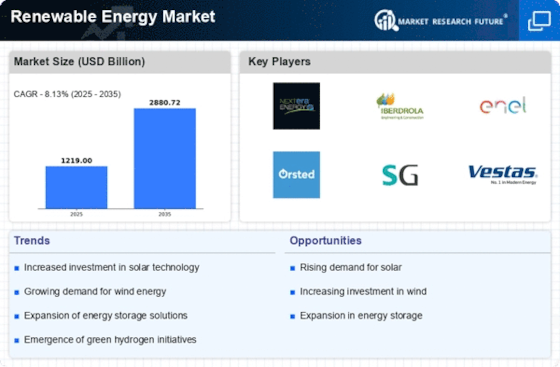
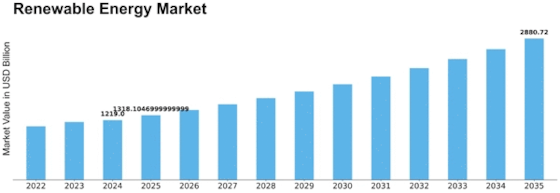
As per MRFR analysis, the Renewable Energy Market was estimated at 1219.0 USD Billion in 2024. The Renewable Energy Industry is projected to grow from 1318.13 USD Billion in 2025 to 2880.72 USD Billion by 2035, exhibiting a compound annual growth rate (CAGR) of 8.13% during the forecast period 2025 - 2035.

Key Market Trends & Highlights

The Renewable Energy Market is poised for robust growth driven by technological advancements and increasing consumer demand for sustainability.

  • Technological advancements are enhancing the efficiency and affordability of renewable energy solutions. In North America, policy and regulatory support is fostering a favorable environment for renewable energy investments. The Asia-Pacific region is experiencing rapid growth, driven by rising energy demand and a shift towards sustainable practices. Investment in renewable energy infrastructure and government incentives are key drivers propelling market expansion.

Market Size & Forecast

2024 Market Size 1219.0 (USD Billion)
2035 Market Size 2880.72 (USD Billion)
CAGR (2025 - 2035) 8.13%
Largest Regional Market Share in 2024 Asia-Pacific

Major Players

<a href="https://www.nexteraenergy.com/clp/ahead-of-whats-next.html">NextEra Energy</a> (US), Iberdrola (ES), Enel (IT), Orsted (DK), Siemens Gamesa (ES), Vestas Wind Systems (DK), Canadian Solar (CA), First Solar (US), <a href="https://www.brookfield.com/about-us/capabilities/renewable-power-transition">Brookfield Renewable Partners</a> (CA)

Market Trends

The Renewable Energy Market is currently experiencing a transformative phase characterized by a growing emphasis on sustainability and environmental responsibility. As global awareness of climate change intensifies, nations are increasingly prioritizing the transition from fossil fuels to renewable sources. This shift is driven by technological advancements, which enhance the efficiency and affordability of renewable energy solutions. Furthermore, government policies and incentives play a crucial role in fostering investment in solar, wind, and other renewable technologies.

The integration of renewable energy into existing infrastructures is also gaining traction, suggesting a potential for a more resilient energy grid. In addition to technological progress, consumer preferences are evolving, with a notable increase in demand for clean energy options. Businesses and households alike are seeking to reduce their carbon footprints, which is likely to propel further growth in the Renewable Energy Market. The rise of electric vehicles and energy storage solutions indicates a shift towards a more sustainable energy ecosystem. Overall, the Renewable Energy Market appears poised for continued expansion, driven by a combination of innovation, policy support, and changing consumer behaviors.

Technological Advancements

Recent innovations in renewable energy technologies are enhancing efficiency and reducing costs. Breakthroughs in solar panel design and wind turbine performance are making these sources more accessible and competitive against traditional energy forms.

Policy and Regulatory Support

Government initiatives and regulations are increasingly favoring renewable energy development. Incentives such as tax credits and subsidies are encouraging investments, while stricter emissions standards are pushing industries towards cleaner energy solutions.

Consumer Demand for Sustainability

There is a growing trend among consumers to prioritize sustainable energy options. This shift is influencing businesses to adopt renewable energy practices, thereby driving demand for clean energy solutions across various sectors.

Renewable Energy Market Market Drivers

Government Incentives and Subsidies

Government policies and incentives are pivotal in shaping the Renewable Energy Market. Many countries are implementing favorable policies, such as tax credits, grants, and feed-in tariffs, to encourage the adoption of renewable energy sources. For example, in 2025, several nations have reported a significant increase in the deployment of solar energy systems due to enhanced financial incentives. These measures not only stimulate investment but also create a more favorable environment for businesses and consumers to transition to renewable energy. Furthermore, the Renewable Energy Market is likely to benefit from international agreements aimed at reducing greenhouse gas emissions, which may lead to stricter regulations on fossil fuel usage. As governments continue to prioritize sustainability, the Renewable Energy Market is expected to thrive, attracting further investments and innovations.

Corporate Sustainability Initiatives

The growing emphasis on corporate sustainability is significantly influencing the Renewable Energy Market. Many companies are adopting renewable energy solutions as part of their corporate social responsibility strategies. In 2025, a notable percentage of Fortune 500 companies have committed to sourcing a substantial portion of their energy from renewable sources, reflecting a broader trend towards sustainability in business practices. This shift not only enhances corporate reputations but also aligns with consumer preferences for environmentally responsible products and services. The Renewable Energy Market stands to benefit from this trend, as increased corporate demand for renewable energy drives investments and innovation. As businesses continue to prioritize sustainability, the Renewable Energy Market is expected to expand, creating new opportunities for growth and development.

Rising Energy Demand and Supply Constraints

The increasing The Renewable Energy Industry. As populations grow and economies expand, the need for sustainable energy solutions becomes more pressing. In 2025, energy demand is projected to rise by approximately 30 percent, necessitating a shift towards renewable sources to meet this demand sustainably. Supply constraints in traditional energy sources, such as oil and natural gas, further amplify the urgency for renewable alternatives. The Renewable Energy Market is well-positioned to address these challenges, as advancements in energy storage and grid integration technologies enhance the reliability of renewable sources. Consequently, the Renewable Energy Market is likely to play a crucial role in ensuring energy security while mitigating environmental impacts.

Investment in Renewable Energy Infrastructure

The Renewable Energy Market is experiencing a surge in investment, driven by the increasing recognition of the need for sustainable energy solutions. In recent years, investments in renewable energy infrastructure have reached unprecedented levels, with estimates suggesting that global investments could exceed 2 trillion dollars by 2025. This influx of capital is primarily directed towards solar, wind, and hydroelectric projects, which are seen as pivotal in reducing carbon emissions. Furthermore, the Renewable Energy Market benefits from the growing participation of private investors and institutional funds, which are increasingly allocating resources to green technologies. This trend indicates a shift in investment strategies, where financial returns are aligned with environmental sustainability goals. As a result, the Renewable Energy Market is likely to witness accelerated growth, fostering innovation and enhancing energy security.

Technological Innovations in Energy Generation

Technological advancements play a crucial role in shaping the Renewable Energy Market. Innovations in energy generation technologies, such as improved solar photovoltaic cells and advanced wind turbine designs, are enhancing efficiency and reducing costs. For instance, the efficiency of solar panels has improved significantly, with some models achieving over 25 percent efficiency. This progress not only makes renewable energy more competitive with fossil fuels but also expands its applicability across various sectors. Additionally, the integration of smart grid technologies is facilitating better energy management and distribution, further bolstering the Renewable Energy Market. As these technologies continue to evolve, they are expected to drive down costs and increase the adoption of renewable energy sources, thereby contributing to a more sustainable energy landscape.

Market Segment Insights

By Application: Solar Power Generation (Largest) vs. Wind Power Generation (Fastest-Growing)

<p>The renewable energy market showcases diverse applications, with Solar Power Generation leading in market share due to its widespread adoption and technological advancements. Wind Power Generation follows closely, carving out its space in various geographical areas and benefiting from increasing investments. Hydropower Generation remains significant, rooted in established infrastructures, while Geothermal and Biomass Energy continue to contribute modestly to the overall landscape. Each segment's performance reflects varying levels of investment and public acceptance, with solar and wind taking the lion's share of the market.</p>

<p>Renewable Energy: Solar Power Generation (Dominant) vs. Wind Power Generation (Emerging)</p>

<p>Solar Power Generation stands as the dominant force in the renewable energy market, buoyed by decreasing costs of photovoltaic technology and expanding installations across residential and commercial sectors. Its appeal lies in the abounding availability of sunlight and the ability to integrate it seamlessly into existing grids. In contrast, Wind Power Generation is emerging rapidly, gaining traction from technological innovations, offshore projects, and supportive policies. Wind power's scalability and efficiency make it increasingly viable, positioning it as a crucial solution in the transition to a sustainable energy economy. Together, these segments illustrate the dynamic nature of renewable energy applications.</p>

By Technology Type: Photovoltaic Technology (Largest) vs. Wind Turbine Technology (Fastest-Growing)

<p>The renewable energy market is dominated by various technology types, with photovoltaic technology taking the lead in terms of market share. Photovoltaic systems harness sunlight through solar panels, making them widely adopted across residential and commercial sectors. Wind turbine technology follows closely, showcasing significant growth potential driven by advancements in turbine efficiency and the global shift towards clean energy sources. In recent years, the renewable energy landscape has witnessed remarkable trends underpinning the growth of these technologies. Photovoltaic technology remains a staple due to its established infrastructure and decreasing costs. Meanwhile, wind turbine technology is becoming increasingly popular, supported by government incentives, improvements in wind energy harnessing capabilities, and a rising demand for sustainable solutions. These growth drivers reflect a positive shift towards renewable energy adoption, setting a promising stage for future advancements in technology.</p>

<p>Technology: Photovoltaic (Dominant) vs. Wind Turbine (Emerging)</p>

<p>Photovoltaic technology has established itself as the dominant force in the renewable energy sector, widely recognized for its ability to convert sunlight into electricity efficiently. This technology benefits from continued innovations that improve energy conversion rates and reduce installation costs, making it attractive for residential and commercial applications alike. Conversely, wind turbine technology, while emerging, is rapidly gaining traction due to technological enhancements and rising efficiency in energy capture and production. As the wind energy sector expands, new wind turbine designs and larger capacity systems promise to increase output and decrease costs. Combined, these technologies illustrate the dynamic landscape of the renewable energy market, driving the transition to greener energy solutions.</p>

By End Use: Residential (Largest) vs. Commercial (Fastest-Growing)

<p>The US renewables energy market showcases a diverse distribution of end-use segments, with the residential sector holding the largest share. This segment benefits from a growing awareness among homeowners about sustainability and cost savings on energy bills. Following closely, the commercial sector is rapidly expanding as businesses strive to enhance their green credentials and decrease operational costs through renewable energy solutions, positioning it as a significant player in the market.</p>

<p>Residential (Dominant) vs. Commercial (Emerging)</p>

<p>The residential segment is marked by a substantial uptake of solar panels and energy-efficient appliances as homeowners prioritize environmental responsibility and energy independence. This dominance reflects consumers' increasing inclination towards self-generation and sustainable practices, supported by various state incentives. Conversely, the commercial segment, although currently smaller, is emerging rapidly, driven by corporate sustainability initiatives and regulations mandating the use of renewable energy sources. Businesses are increasingly adopting solar and wind solutions to reduce their carbon footprint and enhance brand reputation, signaling a shift towards larger investments in renewable technologies as they seek competitive advantages.</p>

By End Use: Residential (Largest) vs. Commercial (Fastest-Growing)

<p>In the Renewable Energy Market, the end-use segment is primarily divided into Residential, Commercial, Industrial, and Utilities. Among these, the Residential sector holds the largest share due to the rising adoption of solar panels and home energy solutions. Consumers are increasingly investing in renewable technologies to enhance energy efficiency and reduce dependence on fossil fuels. On the other hand, the Commercial segment is rapidly expanding as businesses look to lower energy costs and improve sustainability practices through renewable sources. The accelerating growth of the Commercial segment can be attributed to various factors, including government incentives for green energy adoption, rising electricity prices, and increasing awareness of corporate social responsibility. Innovations in energy storage technologies and the declining costs of solar and wind energy systems are encouraging more commercial enterprises to transition to renewable energy sources. This shift not only benefits the businesses in terms of cost savings but also contributes positively to the environment by reducing carbon footprints.</p>

<p>Residential (Dominant) vs. Utilities (Emerging)</p>

<p>The Residential sector is characterized by its vast market potential, driven by individual homeowners seeking sustainable energy solutions that also offer long-term savings. This segment leads in market share as consumers are increasingly inclined to invest in off-grid systems and solar installations that provide energy independence. Furthermore, urbanization and the push towards energy-efficient homes enhance the growth prospects. In contrast, the Utilities segment, while classified as emerging, is on the verge of transformation. Utilities are rapidly expanding their renewable energy portfolios, integrating technologies such as smart grids to facilitate cleaner energy distribution. This shift is driven by the urgent need to meet regulatory requirements and adapt to the changing energy landscape, making it an attractive area for investment and innovation within the renewable energy market.</p>

Get more detailed insights about Renewable Energy Market Research Report - Global Forecast to 2035

Regional Insights

North America : Renewable Energy Leader

North America is witnessing robust growth in the renewable energy sector, driven by increasing demand for clean energy solutions and supportive regulatory frameworks. The market size reached $300.0 billion in 2024, reflecting a significant share of the global market. Key drivers include state-level incentives, federal tax credits, and a growing emphasis on sustainability among consumers and businesses alike. The transition to renewable sources is further catalyzed by technological advancements and decreasing costs of solar and wind energy. The competitive landscape is dominated by major players such as NextEra Energy and First Solar, which are leading the charge in solar energy production. Additionally, Canadian Solar and Brookfield Renewable Partners are making significant contributions to the market. The U.S. and Canada are the leading countries in this region, with ambitious targets for renewable energy adoption, aiming for a cleaner and more sustainable energy future. The focus on innovation and investment in infrastructure is expected to drive further growth in the coming years.

Europe : Sustainable Energy Transition

Europe is at the forefront of the renewable energy revolution, with a market size of $400.0 billion in 2024. The region benefits from stringent environmental regulations and ambitious climate goals, which are driving investments in renewable technologies. The European Green Deal aims to make Europe the first climate-neutral continent by 2050, fostering a favorable environment for renewable energy growth. This commitment is reflected in the increasing share of renewables in the energy mix, supported by government incentives and public awareness. Leading countries such as Germany, Spain, and Denmark are spearheading the transition, with companies like Iberdrola and Siemens Gamesa playing pivotal roles in wind and solar energy production. The competitive landscape is characterized by innovation and collaboration among key players, enhancing the region's capacity to meet its energy needs sustainably. The focus on offshore wind and solar energy is expected to further solidify Europe's position as a global leader in renewable energy.

Asia-Pacific : Emerging Renewable Powerhouse

Asia-Pacific has emerged as a powerhouse in the renewable energy sector, boasting the largest market share of $450.0 billion in 2024. The region's growth is fueled by rapid urbanization, increasing energy demand, and government initiatives promoting clean energy. Countries like China and India are leading the charge, implementing ambitious renewable energy targets and investing heavily in solar and wind projects. The regulatory environment is becoming increasingly supportive, with policies aimed at reducing carbon emissions and enhancing energy security. China stands out as a global leader in renewable energy production, with companies like Canadian Solar and Enel making significant contributions. The competitive landscape is vibrant, with numerous players vying for market share, driven by technological advancements and cost reductions. The region's focus on innovation and sustainability is expected to propel further growth, making it a critical player in The Renewable Energy.

Middle East and Africa : Emerging Energy Frontier

The Middle East and Africa region is gradually emerging as a significant player in the renewable energy market, with a market size of $69.0 billion in 2024. The growth is primarily driven by the need for energy diversification and sustainability, as countries seek to reduce their reliance on fossil fuels. Government initiatives and investments in solar and wind energy projects are gaining momentum, supported by favorable climatic conditions for renewable energy generation. The region's vast solar potential is particularly noteworthy, with several countries setting ambitious renewable energy targets. Leading countries such as South Africa and the UAE are at the forefront of this transition, with key players like Orsted and Vestas Wind Systems actively participating in renewable projects. The competitive landscape is evolving, with increasing interest from international investors and partnerships aimed at enhancing renewable energy capacity. As the region continues to develop its renewable energy infrastructure, it holds significant potential for future growth in the sector.

Key Players and Competitive Insights

The Renewable Energy Market is currently characterized by a dynamic competitive landscape, driven by a confluence of technological advancements, regulatory support, and increasing consumer demand for sustainable energy solutions. Major players such as NextEra Energy (US), Iberdrola (ES), and Orsted (DK) are strategically positioning themselves through innovation and regional expansion. NextEra Energy (US) focuses on solar and wind energy, leveraging its extensive portfolio to enhance operational efficiency. Iberdrola (ES) emphasizes its commitment to sustainability, investing heavily in renewable projects across Europe and the Americas. Orsted (DK), a leader in offshore wind, is expanding its footprint in emerging markets, thereby shaping a competitive environment that prioritizes sustainability and technological prowess.
Key business tactics within the Renewable Energy Market include localizing manufacturing and optimizing supply chains to enhance resilience and reduce costs. The market structure appears moderately fragmented, with a mix of large corporations and smaller players. The collective influence of key players fosters a competitive atmosphere where innovation and strategic partnerships are paramount for success.
In January 2026, NextEra Energy (US) announced a significant investment of $2 billion in solar energy projects across the southeastern United States. This strategic move is likely to bolster its market share and reinforce its commitment to renewable energy, aligning with the growing demand for clean energy solutions in the region. The investment not only enhances NextEra's operational capacity but also positions the company as a leader in the transition towards a sustainable energy future.
In December 2025, Iberdrola (ES) secured a €1.5 billion financing deal to expand its offshore wind projects in the North Sea. This action underscores Iberdrola's aggressive growth strategy and its focus on harnessing wind energy, which is expected to contribute significantly to its overall energy mix. The financing will facilitate the development of new projects, thereby enhancing Iberdrola's competitive edge in the renewable sector.
In February 2026, Orsted (DK) announced a partnership with a leading technology firm to integrate AI solutions into its energy management systems. This collaboration aims to optimize energy production and distribution, reflecting a broader trend towards digitalization in the industry. By leveraging AI, Orsted is likely to improve operational efficiency and reduce costs, positioning itself favorably in a rapidly evolving market.
As of February 2026, current competitive trends in the Renewable Energy Market are increasingly defined by digitalization, sustainability, and the integration of advanced technologies such as AI. Strategic alliances are playing a crucial role in shaping the landscape, enabling companies to pool resources and expertise. Looking ahead, competitive differentiation is expected to evolve, with a shift from price-based competition to a focus on innovation, technology, and supply chain reliability. This transition may redefine how companies compete, emphasizing the importance of sustainable practices and technological advancements in securing a competitive advantage.

Key Companies in the Renewable Energy Market include

Industry Developments

  • Q2 2024: Siemens Gamesa to build new wind turbine blade factory in New York Siemens Gamesa announced plans to construct a wind turbine blade manufacturing facility in New York, marking a significant investment in U.S. renewable energy infrastructure and supporting local job creation.
  • Q2 2024: NextEra Energy Partners Announces $1.1 Billion Acquisition of Renewable Energy Market Assets NextEra Energy Partners acquired a portfolio of wind and solar assets valued at $1.1 billion, expanding its renewable energy footprint across several U.S. states.
  • Q2 2024: BP and Equinor sign $1.3bn deal to develop US offshore wind projects BP and Equinor finalized a $1.3 billion agreement to jointly develop offshore wind projects in the United States, aiming to accelerate the transition to clean energy.
  • Q2 2024: Enel Green Power starts operations at 300 MW solar plant in Texas Enel Green Power commenced commercial operations at its new 300 MW solar power plant in Texas, further expanding its renewable energy generation capacity in the U.S., causing green energy growth.
  • Q2 2024: SunPower Raises $450 Million in Convertible Debt to Fund Solar Expansion SunPower secured $450 million in convertible debt financing to support the expansion of its residential and commercial solar business in North America.
  • Q2 2024: Vestas wins 500 MW wind turbine order from Pattern Energy Vestas received a 500 MW wind turbine order from Pattern Energy for a new wind farm project in the United States, strengthening its position in the U.S. wind market.
  • Q2 2024: TotalEnergies and Adani Green Energy form $600m Indian renewables partnership TotalEnergies and Adani Green Energy entered a $600 million partnership to jointly develop renewable energy projects in India, targeting significant capacity additions, which causes green energy growth.
  • Q2 2024: Brookfield Renewable closes $2 billion acquisition of US solar developer Brookfield Renewable completed the $2 billion acquisition of a major U.S. solar project developer, expanding its renewable energy portfolio and project pipeline.
  • Q2 2024: First Solar to build new $1.1 billion manufacturing facility in Louisiana First Solar announced plans to invest $1.1 billion in a new solar panel manufacturing facility in Louisiana, expected to create hundreds of jobs and boost U.S. solar manufacturing capacity.
  • Q2 2024: Orsted secures $1.5 billion in green bond offering for offshore wind projects Orsted raised $1.5 billion through a green bond issuance to finance the development of new offshore wind projects in Europe and North America.
  • Q2 2024: Tesla launches new Megapack battery factory in Shanghai Tesla officially opened its new Megapack battery manufacturing facility in Shanghai, aiming to meet growing demand for grid-scale energy storage solutions in Asia.
  • Q2 2024: Iberdrola appoints new CEO to lead global renewables expansion Iberdrola named a new chief executive officer to drive its global renewable energy expansion strategy, focusing on wind, solar, and green hydrogen projects.

Future Outlook

Renewable Energy Market Future Outlook

The Renewable Energy Market is projected to grow at an 8.13% CAGR from 2024 to 2035, driven by technological advancements, regulatory support, and increasing demand for sustainable energy solutions.

New opportunities lie in:

  • <p>Development of integrated energy storage solutions for renewable sources. Expansion of green hydrogen production facilities to meet industrial demand. Investment in smart grid technologies to enhance energy distribution efficiency.</p>

By 2035, the Renewable Energy Market is expected to be robust, driven by innovation and increasing global energy needs.

Market Segmentation

Renewable Energy Market End Use Outlook

  • Residential
  • Commercial
  • Industrial
  • Utility
  • Agricultural

Renewable Energy Market Technology Outlook

  • Solar Power
  • Wind Power
  • Hydropower
  • Biomass Energy
  • Geothermal Energy

Renewable Energy Market Application Outlook

  • Electricity Generation
  • Heating
  • Transportation
  • Energy Storage
  • Desalination

Report Scope

MARKET SIZE 2024 1219.0(USD Billion)
MARKET SIZE 2025 1318.13(USD Billion)
MARKET SIZE 2035 2880.72(USD Billion)
COMPOUND ANNUAL GROWTH RATE (CAGR) 8.13% (2024 - 2035)
REPORT COVERAGE Revenue Forecast, Competitive Landscape, Growth Factors, and Trends
BASE YEAR 2024
Market Forecast Period 2025 - 2035
Historical Data 2019 - 2024
Market Forecast Units USD Billion
Key Companies Profiled NextEra Energy (US), Iberdrola (ES), Enel (IT), Orsted (DK), Siemens Gamesa (ES), Vestas Wind Systems (DK), Canadian Solar (CA), First Solar (US), Brookfield Renewable Partners (CA)
Segments Covered Application, Technology, End Use
Key Market Opportunities Integration of energy storage solutions enhances reliability in the Renewable Energy Market.
Key Market Dynamics Technological advancements and regulatory support drive rapid growth and competition in the renewable energy sector.
Countries Covered North America, Europe, APAC, South America, MEA

FAQs

What is the current valuation of the renewable energy market as of 2024?

<p>The renewable energy market was valued at 1200.0 USD Billion in 2024.</p>

What is the projected market valuation for renewable energy by 2035?

<p>The renewable energy market is projected to reach 2500.0 USD Billion by 2035.</p>

What is the expected compound annual growth rate (CAGR) for the renewable energy market from 2025 to 2035?

<p>The expected CAGR for the renewable energy market during the forecast period 2025 - 2035 is 6.9%.</p>

Which segment of renewable energy is projected to have the highest valuation by application in 2035?

<p>By 2035, the Utility segment is projected to reach a valuation of 650.0 USD Billion.</p>

How does the valuation of solar power generation compare to wind power generation in 2035?

<p>In 2035, solar power generation is projected to reach 650.0 USD Billion, while wind power generation is expected to reach 600.0 USD Billion.</p>

What are the projected valuations for hydropower and geothermal energy generation by 2035?

<p>By 2035, hydropower generation is projected to reach 400.0 USD Billion, whereas geothermal energy is expected to reach 250.0 USD Billion.</p>

Which technology type is anticipated to dominate the renewable energy market by 2035?

<p>Wind turbine technology is anticipated to dominate, with a projected valuation of 900.0 USD Billion by 2035.</p>

What is the expected valuation for the residential segment of renewable energy by 2035?

<p>The residential segment is expected to reach a valuation of 500.0 USD Billion by 2035.</p>

Who are the key players leading the renewable energy market?

<p>Key players in the renewable energy market include NextEra Energy, Iberdrola, Enel, Orsted, Siemens Gamesa, Vestas Wind Systems, Canadian Solar, First Solar, and Brookfield Renewable Partners.</p>

What is the projected valuation for biomass energy generation by 2035?

<p>Biomass energy generation is projected to reach a valuation of 600.0 USD Billion by 2035.</p>

  1. SECTION I: EXECUTIVE SUMMARY AND KEY HIGHLIGHTS
    1. | 1.1 EXECUTIVE SUMMARY
    2. | | 1.1.1 Market Overview
    3. | | 1.1.2 Key Findings
    4. | | 1.1.3 Market Segmentation
    5. | | 1.1.4 Competitive Landscape
    6. | | 1.1.5 Challenges and Opportunities
    7. | | 1.1.6 Future Outlook
  2. SECTION II: SCOPING, METHODOLOGY AND MARKET STRUCTURE
    1. | 2.1 MARKET INTRODUCTION
    2. | | 2.1.1 Definition
    3. | | 2.1.2 Scope of the study
    4. | | | 2.1.2.1 Research Objective
    5. | | | 2.1.2.2 Assumption
    6. | | | 2.1.2.3 Limitations
    7. | 2.2 RESEARCH METHODOLOGY
    8. | | 2.2.1 Overview
    9. | | 2.2.2 Data Mining
    10. | | 2.2.3 Secondary Research
    11. | | 2.2.4 Primary Research
    12. | | | 2.2.4.1 Primary Interviews and Information Gathering Process
    13. | | | 2.2.4.2 Breakdown of Primary Respondents
    14. | | 2.2.5 Forecasting Model
    15. | | 2.2.6 Market Size Estimation
    16. | | | 2.2.6.1 Bottom-Up Approach
    17. | | | 2.2.6.2 Top-Down Approach
    18. | | 2.2.7 Data Triangulation
    19. | | 2.2.8 Validation
  3. SECTION III: QUALITATIVE ANALYSIS
    1. | 3.1 MARKET DYNAMICS
    2. | | 3.1.1 Overview
    3. | | 3.1.2 Drivers
    4. | | 3.1.3 Restraints
    5. | | 3.1.4 Opportunities
    6. | 3.2 MARKET FACTOR ANALYSIS
    7. | | 3.2.1 Value chain Analysis
    8. | | 3.2.2 Porter's Five Forces Analysis
    9. | | | 3.2.2.1 Bargaining Power of Suppliers
    10. | | | 3.2.2.2 Bargaining Power of Buyers
    11. | | | 3.2.2.3 Threat of New Entrants
    12. | | | 3.2.2.4 Threat of Substitutes
    13. | | | 3.2.2.5 Intensity of Rivalry
    14. | | 3.2.3 COVID-19 Impact Analysis
    15. | | | 3.2.3.1 Market Impact Analysis
    16. | | | 3.2.3.2 Regional Impact
    17. | | | 3.2.3.3 Opportunity and Threat Analysis
  4. SECTION IV: QUANTITATIVE ANALYSIS
    1. | 4.1 Energy & Power, BY Application (USD Billion)
    2. | | 4.1.1 Solar Power Generation
    3. | | 4.1.2 Wind Power Generation
    4. | | 4.1.3 Hydropower Generation
    5. | | 4.1.4 Geothermal Energy
    6. | | 4.1.5 Biomass Energy
    7. | 4.2 Energy & Power, BY Technology Type (USD Billion)
    8. | | 4.2.1 Photovoltaic Technology
    9. | | 4.2.2 Concentrated Solar Power
    10. | | 4.2.3 Wind Turbine Technology
    11. | | 4.2.4 Hydropower Technology
    12. | | 4.2.5 Biogas Technology
    13. | 4.3 Energy & Power, BY End Use (USD Billion)
    14. | | 4.3.1 Residential
    15. | | 4.3.2 Commercial
    16. | | 4.3.3 Industrial
    17. | | 4.3.4 Transportation
    18. | | 4.3.5 Utility
    19. | 4.4 Energy & Power, BY Region (USD Billion)
    20. | | 4.4.1 North America
    21. | | | 4.4.1.1 US
    22. | | | 4.4.1.2 Canada
    23. | | 4.4.2 Europe
    24. | | | 4.4.2.1 Germany
    25. | | | 4.4.2.2 UK
    26. | | | 4.4.2.3 France
    27. | | | 4.4.2.4 Russia
    28. | | | 4.4.2.5 Italy
    29. | | | 4.4.2.6 Spain
    30. | | | 4.4.2.7 Rest of Europe
    31. | | 4.4.3 APAC
    32. | | | 4.4.3.1 China
    33. | | | 4.4.3.2 India
    34. | | | 4.4.3.3 Japan
    35. | | | 4.4.3.4 South Korea
    36. | | | 4.4.3.5 Malaysia
    37. | | | 4.4.3.6 Thailand
    38. | | | 4.4.3.7 Indonesia
    39. | | | 4.4.3.8 Rest of APAC
    40. | | 4.4.4 South America
    41. | | | 4.4.4.1 Brazil
    42. | | | 4.4.4.2 Mexico
    43. | | | 4.4.4.3 Argentina
    44. | | | 4.4.4.4 Rest of South America
    45. | | 4.4.5 MEA
    46. | | | 4.4.5.1 GCC Countries
    47. | | | 4.4.5.2 South Africa
    48. | | | 4.4.5.3 Rest of MEA
  5. SECTION V: COMPETITIVE ANALYSIS
    1. | 5.1 Competitive Landscape
    2. | | 5.1.1 Overview
    3. | | 5.1.2 Competitive Analysis
    4. | | 5.1.3 Market share Analysis
    5. | | 5.1.4 Major Growth Strategy in the Energy & Power
    6. | | 5.1.5 Competitive Benchmarking
    7. | | 5.1.6 Leading Players in Terms of Number of Developments in the Energy & Power
    8. | | 5.1.7 Key developments and growth strategies
    9. | | | 5.1.7.1 New Product Launch/Service Deployment
    10. | | | 5.1.7.2 Merger & Acquisitions
    11. | | | 5.1.7.3 Joint Ventures
    12. | | 5.1.8 Major Players Financial Matrix
    13. | | | 5.1.8.1 Sales and Operating Income
    14. | | | 5.1.8.2 Major Players R&D Expenditure. 2023
    15. | 5.2 Company Profiles
    16. | | 5.2.1 NextEra Energy (US)
    17. | | | 5.2.1.1 Financial Overview
    18. | | | 5.2.1.2 Products Offered
    19. | | | 5.2.1.3 Key Developments
    20. | | | 5.2.1.4 SWOT Analysis
    21. | | | 5.2.1.5 Key Strategies
    22. | | 5.2.2 Iberdrola (ES)
    23. | | | 5.2.2.1 Financial Overview
    24. | | | 5.2.2.2 Products Offered
    25. | | | 5.2.2.3 Key Developments
    26. | | | 5.2.2.4 SWOT Analysis
    27. | | | 5.2.2.5 Key Strategies
    28. | | 5.2.3 Enel (IT)
    29. | | | 5.2.3.1 Financial Overview
    30. | | | 5.2.3.2 Products Offered
    31. | | | 5.2.3.3 Key Developments
    32. | | | 5.2.3.4 SWOT Analysis
    33. | | | 5.2.3.5 Key Strategies
    34. | | 5.2.4 Orsted (DK)
    35. | | | 5.2.4.1 Financial Overview
    36. | | | 5.2.4.2 Products Offered
    37. | | | 5.2.4.3 Key Developments
    38. | | | 5.2.4.4 SWOT Analysis
    39. | | | 5.2.4.5 Key Strategies
    40. | | 5.2.5 Siemens Gamesa (ES)
    41. | | | 5.2.5.1 Financial Overview
    42. | | | 5.2.5.2 Products Offered
    43. | | | 5.2.5.3 Key Developments
    44. | | | 5.2.5.4 SWOT Analysis
    45. | | | 5.2.5.5 Key Strategies
    46. | | 5.2.6 Vestas Wind Systems (DK)
    47. | | | 5.2.6.1 Financial Overview
    48. | | | 5.2.6.2 Products Offered
    49. | | | 5.2.6.3 Key Developments
    50. | | | 5.2.6.4 SWOT Analysis
    51. | | | 5.2.6.5 Key Strategies
    52. | | 5.2.7 Canadian Solar (CA)
    53. | | | 5.2.7.1 Financial Overview
    54. | | | 5.2.7.2 Products Offered
    55. | | | 5.2.7.3 Key Developments
    56. | | | 5.2.7.4 SWOT Analysis
    57. | | | 5.2.7.5 Key Strategies
    58. | | 5.2.8 First Solar (US)
    59. | | | 5.2.8.1 Financial Overview
    60. | | | 5.2.8.2 Products Offered
    61. | | | 5.2.8.3 Key Developments
    62. | | | 5.2.8.4 SWOT Analysis
    63. | | | 5.2.8.5 Key Strategies
    64. | | 5.2.9 Brookfield Renewable Partners (CA)
    65. | | | 5.2.9.1 Financial Overview
    66. | | | 5.2.9.2 Products Offered
    67. | | | 5.2.9.3 Key Developments
    68. | | | 5.2.9.4 SWOT Analysis
    69. | | | 5.2.9.5 Key Strategies
    70. | 5.3 Appendix
    71. | | 5.3.1 References
    72. | | 5.3.2 Related Reports
  6. LIST OF FIGURES
    1. | 6.1 MARKET SYNOPSIS
    2. | 6.2 NORTH AMERICA MARKET ANALYSIS
    3. | 6.3 US MARKET ANALYSIS BY APPLICATION
    4. | 6.4 US MARKET ANALYSIS BY TECHNOLOGY TYPE
    5. | 6.5 US MARKET ANALYSIS BY END USE
    6. | 6.6 CANADA MARKET ANALYSIS BY APPLICATION
    7. | 6.7 CANADA MARKET ANALYSIS BY TECHNOLOGY TYPE
    8. | 6.8 CANADA MARKET ANALYSIS BY END USE
    9. | 6.9 EUROPE MARKET ANALYSIS
    10. | 6.10 GERMANY MARKET ANALYSIS BY APPLICATION
    11. | 6.11 GERMANY MARKET ANALYSIS BY TECHNOLOGY TYPE
    12. | 6.12 GERMANY MARKET ANALYSIS BY END USE
    13. | 6.13 UK MARKET ANALYSIS BY APPLICATION
    14. | 6.14 UK MARKET ANALYSIS BY TECHNOLOGY TYPE
    15. | 6.15 UK MARKET ANALYSIS BY END USE
    16. | 6.16 FRANCE MARKET ANALYSIS BY APPLICATION
    17. | 6.17 FRANCE MARKET ANALYSIS BY TECHNOLOGY TYPE
    18. | 6.18 FRANCE MARKET ANALYSIS BY END USE
    19. | 6.19 RUSSIA MARKET ANALYSIS BY APPLICATION
    20. | 6.20 RUSSIA MARKET ANALYSIS BY TECHNOLOGY TYPE
    21. | 6.21 RUSSIA MARKET ANALYSIS BY END USE
    22. | 6.22 ITALY MARKET ANALYSIS BY APPLICATION
    23. | 6.23 ITALY MARKET ANALYSIS BY TECHNOLOGY TYPE
    24. | 6.24 ITALY MARKET ANALYSIS BY END USE
    25. | 6.25 SPAIN MARKET ANALYSIS BY APPLICATION
    26. | 6.26 SPAIN MARKET ANALYSIS BY TECHNOLOGY TYPE
    27. | 6.27 SPAIN MARKET ANALYSIS BY END USE
    28. | 6.28 REST OF EUROPE MARKET ANALYSIS BY APPLICATION
    29. | 6.29 REST OF EUROPE MARKET ANALYSIS BY TECHNOLOGY TYPE
    30. | 6.30 REST OF EUROPE MARKET ANALYSIS BY END USE
    31. | 6.31 APAC MARKET ANALYSIS
    32. | 6.32 CHINA MARKET ANALYSIS BY APPLICATION
    33. | 6.33 CHINA MARKET ANALYSIS BY TECHNOLOGY TYPE
    34. | 6.34 CHINA MARKET ANALYSIS BY END USE
    35. | 6.35 INDIA MARKET ANALYSIS BY APPLICATION
    36. | 6.36 INDIA MARKET ANALYSIS BY TECHNOLOGY TYPE
    37. | 6.37 INDIA MARKET ANALYSIS BY END USE
    38. | 6.38 JAPAN MARKET ANALYSIS BY APPLICATION
    39. | 6.39 JAPAN MARKET ANALYSIS BY TECHNOLOGY TYPE
    40. | 6.40 JAPAN MARKET ANALYSIS BY END USE
    41. | 6.41 SOUTH KOREA MARKET ANALYSIS BY APPLICATION
    42. | 6.42 SOUTH KOREA MARKET ANALYSIS BY TECHNOLOGY TYPE
    43. | 6.43 SOUTH KOREA MARKET ANALYSIS BY END USE
    44. | 6.44 MALAYSIA MARKET ANALYSIS BY APPLICATION
    45. | 6.45 MALAYSIA MARKET ANALYSIS BY TECHNOLOGY TYPE
    46. | 6.46 MALAYSIA MARKET ANALYSIS BY END USE
    47. | 6.47 THAILAND MARKET ANALYSIS BY APPLICATION
    48. | 6.48 THAILAND MARKET ANALYSIS BY TECHNOLOGY TYPE
    49. | 6.49 THAILAND MARKET ANALYSIS BY END USE
    50. | 6.50 INDONESIA MARKET ANALYSIS BY APPLICATION
    51. | 6.51 INDONESIA MARKET ANALYSIS BY TECHNOLOGY TYPE
    52. | 6.52 INDONESIA MARKET ANALYSIS BY END USE
    53. | 6.53 REST OF APAC MARKET ANALYSIS BY APPLICATION
    54. | 6.54 REST OF APAC MARKET ANALYSIS BY TECHNOLOGY TYPE
    55. | 6.55 REST OF APAC MARKET ANALYSIS BY END USE
    56. | 6.56 SOUTH AMERICA MARKET ANALYSIS
    57. | 6.57 BRAZIL MARKET ANALYSIS BY APPLICATION
    58. | 6.58 BRAZIL MARKET ANALYSIS BY TECHNOLOGY TYPE
    59. | 6.59 BRAZIL MARKET ANALYSIS BY END USE
    60. | 6.60 MEXICO MARKET ANALYSIS BY APPLICATION
    61. | 6.61 MEXICO MARKET ANALYSIS BY TECHNOLOGY TYPE
    62. | 6.62 MEXICO MARKET ANALYSIS BY END USE
    63. | 6.63 ARGENTINA MARKET ANALYSIS BY APPLICATION
    64. | 6.64 ARGENTINA MARKET ANALYSIS BY TECHNOLOGY TYPE
    65. | 6.65 ARGENTINA MARKET ANALYSIS BY END USE
    66. | 6.66 REST OF SOUTH AMERICA MARKET ANALYSIS BY APPLICATION
    67. | 6.67 REST OF SOUTH AMERICA MARKET ANALYSIS BY TECHNOLOGY TYPE
    68. | 6.68 REST OF SOUTH AMERICA MARKET ANALYSIS BY END USE
    69. | 6.69 MEA MARKET ANALYSIS
    70. | 6.70 GCC COUNTRIES MARKET ANALYSIS BY APPLICATION
    71. | 6.71 GCC COUNTRIES MARKET ANALYSIS BY TECHNOLOGY TYPE
    72. | 6.72 GCC COUNTRIES MARKET ANALYSIS BY END USE
    73. | 6.73 SOUTH AFRICA MARKET ANALYSIS BY APPLICATION
    74. | 6.74 SOUTH AFRICA MARKET ANALYSIS BY TECHNOLOGY TYPE
    75. | 6.75 SOUTH AFRICA MARKET ANALYSIS BY END USE
    76. | 6.76 REST OF MEA MARKET ANALYSIS BY APPLICATION
    77. | 6.77 REST OF MEA MARKET ANALYSIS BY TECHNOLOGY TYPE
    78. | 6.78 REST OF MEA MARKET ANALYSIS BY END USE
    79. | 6.79 KEY BUYING CRITERIA OF ENERGY & POWER
    80. | 6.80 RESEARCH PROCESS OF MRFR
    81. | 6.81 DRO ANALYSIS OF ENERGY & POWER
    82. | 6.82 DRIVERS IMPACT ANALYSIS: ENERGY & POWER
    83. | 6.83 RESTRAINTS IMPACT ANALYSIS: ENERGY & POWER
    84. | 6.84 SUPPLY / VALUE CHAIN: ENERGY & POWER
    85. | 6.85 ENERGY & POWER, BY APPLICATION, 2024 (% SHARE)
    86. | 6.86 ENERGY & POWER, BY APPLICATION, 2024 TO 2035 (USD Billion)
    87. | 6.87 ENERGY & POWER, BY TECHNOLOGY TYPE, 2024 (% SHARE)
    88. | 6.88 ENERGY & POWER, BY TECHNOLOGY TYPE, 2024 TO 2035 (USD Billion)
    89. | 6.89 ENERGY & POWER, BY END USE, 2024 (% SHARE)
    90. | 6.90 ENERGY & POWER, BY END USE, 2024 TO 2035 (USD Billion)
    91. | 6.91 BENCHMARKING OF MAJOR COMPETITORS
  7. LIST OF TABLES
    1. | 7.1 LIST OF ASSUMPTIONS
    2. | | 7.1.1
    3. | 7.2 North America MARKET SIZE ESTIMATES; FORECAST
    4. | | 7.2.1 BY APPLICATION, 2025-2035 (USD Billion)
    5. | | 7.2.2 BY TECHNOLOGY TYPE, 2025-2035 (USD Billion)
    6. | | 7.2.3 BY END USE, 2025-2035 (USD Billion)
    7. | 7.3 US MARKET SIZE ESTIMATES; FORECAST
    8. | | 7.3.1 BY APPLICATION, 2025-2035 (USD Billion)
    9. | | 7.3.2 BY TECHNOLOGY TYPE, 2025-2035 (USD Billion)
    10. | | 7.3.3 BY END USE, 2025-2035 (USD Billion)
    11. | 7.4 Canada MARKET SIZE ESTIMATES; FORECAST
    12. | | 7.4.1 BY APPLICATION, 2025-2035 (USD Billion)
    13. | | 7.4.2 BY TECHNOLOGY TYPE, 2025-2035 (USD Billion)
    14. | | 7.4.3 BY END USE, 2025-2035 (USD Billion)
    15. | 7.5 Europe MARKET SIZE ESTIMATES; FORECAST
    16. | | 7.5.1 BY APPLICATION, 2025-2035 (USD Billion)
    17. | | 7.5.2 BY TECHNOLOGY TYPE, 2025-2035 (USD Billion)
    18. | | 7.5.3 BY END USE, 2025-2035 (USD Billion)
    19. | 7.6 Germany MARKET SIZE ESTIMATES; FORECAST
    20. | | 7.6.1 BY APPLICATION, 2025-2035 (USD Billion)
    21. | | 7.6.2 BY TECHNOLOGY TYPE, 2025-2035 (USD Billion)
    22. | | 7.6.3 BY END USE, 2025-2035 (USD Billion)
    23. | 7.7 UK MARKET SIZE ESTIMATES; FORECAST
    24. | | 7.7.1 BY APPLICATION, 2025-2035 (USD Billion)
    25. | | 7.7.2 BY TECHNOLOGY TYPE, 2025-2035 (USD Billion)
    26. | | 7.7.3 BY END USE, 2025-2035 (USD Billion)
    27. | 7.8 France MARKET SIZE ESTIMATES; FORECAST
    28. | | 7.8.1 BY APPLICATION, 2025-2035 (USD Billion)
    29. | | 7.8.2 BY TECHNOLOGY TYPE, 2025-2035 (USD Billion)
    30. | | 7.8.3 BY END USE, 2025-2035 (USD Billion)
    31. | 7.9 Russia MARKET SIZE ESTIMATES; FORECAST
    32. | | 7.9.1 BY APPLICATION, 2025-2035 (USD Billion)
    33. | | 7.9.2 BY TECHNOLOGY TYPE, 2025-2035 (USD Billion)
    34. | | 7.9.3 BY END USE, 2025-2035 (USD Billion)
    35. | 7.10 Italy MARKET SIZE ESTIMATES; FORECAST
    36. | | 7.10.1 BY APPLICATION, 2025-2035 (USD Billion)
    37. | | 7.10.2 BY TECHNOLOGY TYPE, 2025-2035 (USD Billion)
    38. | | 7.10.3 BY END USE, 2025-2035 (USD Billion)
    39. | 7.11 Spain MARKET SIZE ESTIMATES; FORECAST
    40. | | 7.11.1 BY APPLICATION, 2025-2035 (USD Billion)
    41. | | 7.11.2 BY TECHNOLOGY TYPE, 2025-2035 (USD Billion)
    42. | | 7.11.3 BY END USE, 2025-2035 (USD Billion)
    43. | 7.12 Rest of Europe MARKET SIZE ESTIMATES; FORECAST
    44. | | 7.12.1 BY APPLICATION, 2025-2035 (USD Billion)
    45. | | 7.12.2 BY TECHNOLOGY TYPE, 2025-2035 (USD Billion)
    46. | | 7.12.3 BY END USE, 2025-2035 (USD Billion)
    47. | 7.13 APAC MARKET SIZE ESTIMATES; FORECAST
    48. | | 7.13.1 BY APPLICATION, 2025-2035 (USD Billion)
    49. | | 7.13.2 BY TECHNOLOGY TYPE, 2025-2035 (USD Billion)
    50. | | 7.13.3 BY END USE, 2025-2035 (USD Billion)
    51. | 7.14 China MARKET SIZE ESTIMATES; FORECAST
    52. | | 7.14.1 BY APPLICATION, 2025-2035 (USD Billion)
    53. | | 7.14.2 BY TECHNOLOGY TYPE, 2025-2035 (USD Billion)
    54. | | 7.14.3 BY END USE, 2025-2035 (USD Billion)
    55. | 7.15 India MARKET SIZE ESTIMATES; FORECAST
    56. | | 7.15.1 BY APPLICATION, 2025-2035 (USD Billion)
    57. | | 7.15.2 BY TECHNOLOGY TYPE, 2025-2035 (USD Billion)
    58. | | 7.15.3 BY END USE, 2025-2035 (USD Billion)
    59. | 7.16 Japan MARKET SIZE ESTIMATES; FORECAST
    60. | | 7.16.1 BY APPLICATION, 2025-2035 (USD Billion)
    61. | | 7.16.2 BY TECHNOLOGY TYPE, 2025-2035 (USD Billion)
    62. | | 7.16.3 BY END USE, 2025-2035 (USD Billion)
    63. | 7.17 South Korea MARKET SIZE ESTIMATES; FORECAST
    64. | | 7.17.1 BY APPLICATION, 2025-2035 (USD Billion)
    65. | | 7.17.2 BY TECHNOLOGY TYPE, 2025-2035 (USD Billion)
    66. | | 7.17.3 BY END USE, 2025-2035 (USD Billion)
    67. | 7.18 Malaysia MARKET SIZE ESTIMATES; FORECAST
    68. | | 7.18.1 BY APPLICATION, 2025-2035 (USD Billion)
    69. | | 7.18.2 BY TECHNOLOGY TYPE, 2025-2035 (USD Billion)
    70. | | 7.18.3 BY END USE, 2025-2035 (USD Billion)
    71. | 7.19 Thailand MARKET SIZE ESTIMATES; FORECAST
    72. | | 7.19.1 BY APPLICATION, 2025-2035 (USD Billion)
    73. | | 7.19.2 BY TECHNOLOGY TYPE, 2025-2035 (USD Billion)
    74. | | 7.19.3 BY END USE, 2025-2035 (USD Billion)
    75. | 7.20 Indonesia MARKET SIZE ESTIMATES; FORECAST
    76. | | 7.20.1 BY APPLICATION, 2025-2035 (USD Billion)
    77. | | 7.20.2 BY TECHNOLOGY TYPE, 2025-2035 (USD Billion)
    78. | | 7.20.3 BY END USE, 2025-2035 (USD Billion)
    79. | 7.21 Rest of APAC MARKET SIZE ESTIMATES; FORECAST
    80. | | 7.21.1 BY APPLICATION, 2025-2035 (USD Billion)
    81. | | 7.21.2 BY TECHNOLOGY TYPE, 2025-2035 (USD Billion)
    82. | | 7.21.3 BY END USE, 2025-2035 (USD Billion)
    83. | 7.22 South America MARKET SIZE ESTIMATES; FORECAST
    84. | | 7.22.1 BY APPLICATION, 2025-2035 (USD Billion)
    85. | | 7.22.2 BY TECHNOLOGY TYPE, 2025-2035 (USD Billion)
    86. | | 7.22.3 BY END USE, 2025-2035 (USD Billion)
    87. | 7.23 Brazil MARKET SIZE ESTIMATES; FORECAST
    88. | | 7.23.1 BY APPLICATION, 2025-2035 (USD Billion)
    89. | | 7.23.2 BY TECHNOLOGY TYPE, 2025-2035 (USD Billion)
    90. | | 7.23.3 BY END USE, 2025-2035 (USD Billion)
    91. | 7.24 Mexico MARKET SIZE ESTIMATES; FORECAST
    92. | | 7.24.1 BY APPLICATION, 2025-2035 (USD Billion)
    93. | | 7.24.2 BY TECHNOLOGY TYPE, 2025-2035 (USD Billion)
    94. | | 7.24.3 BY END USE, 2025-2035 (USD Billion)
    95. | 7.25 Argentina MARKET SIZE ESTIMATES; FORECAST
    96. | | 7.25.1 BY APPLICATION, 2025-2035 (USD Billion)
    97. | | 7.25.2 BY TECHNOLOGY TYPE, 2025-2035 (USD Billion)
    98. | | 7.25.3 BY END USE, 2025-2035 (USD Billion)
    99. | 7.26 Rest of South America MARKET SIZE ESTIMATES; FORECAST
    100. | | 7.26.1 BY APPLICATION, 2025-2035 (USD Billion)
    101. | | 7.26.2 BY TECHNOLOGY TYPE, 2025-2035 (USD Billion)
    102. | | 7.26.3 BY END USE, 2025-2035 (USD Billion)
    103. | 7.27 MEA MARKET SIZE ESTIMATES; FORECAST
    104. | | 7.27.1 BY APPLICATION, 2025-2035 (USD Billion)
    105. | | 7.27.2 BY TECHNOLOGY TYPE, 2025-2035 (USD Billion)
    106. | | 7.27.3 BY END USE, 2025-2035 (USD Billion)
    107. | 7.28 GCC Countries MARKET SIZE ESTIMATES; FORECAST
    108. | | 7.28.1 BY APPLICATION, 2025-2035 (USD Billion)
    109. | | 7.28.2 BY TECHNOLOGY TYPE, 2025-2035 (USD Billion)
    110. | | 7.28.3 BY END USE, 2025-2035 (USD Billion)
    111. | 7.29 South Africa MARKET SIZE ESTIMATES; FORECAST
    112. | | 7.29.1 BY APPLICATION, 2025-2035 (USD Billion)
    113. | | 7.29.2 BY TECHNOLOGY TYPE, 2025-2035 (USD Billion)
    114. | | 7.29.3 BY END USE, 2025-2035 (USD Billion)
    115. | 7.30 Rest of MEA MARKET SIZE ESTIMATES; FORECAST
    116. | | 7.30.1 BY APPLICATION, 2025-2035 (USD Billion)
    117. | | 7.30.2 BY TECHNOLOGY TYPE, 2025-2035 (USD Billion)
    118. | | 7.30.3 BY END USE, 2025-2035 (USD Billion)
    119. | 7.31 PRODUCT LAUNCH/PRODUCT DEVELOPMENT/APPROVAL
    120. | | 7.31.1
    121. | 7.32 ACQUISITION/PARTNERSHIP
    122. | | 7.32.1

Energy & Power Market Segmentation

Energy & Power By Application (USD Billion, 2025-2035)

  • Solar Power Generation
  • Wind Power Generation
  • Hydropower Generation
  • Geothermal Energy
  • Biomass Energy

Energy & Power By Technology Type (USD Billion, 2025-2035)

  • Photovoltaic Technology
  • Concentrated Solar Power
  • Wind Turbine Technology
  • Hydropower Technology
  • Biogas Technology

Energy & Power By End Use (USD Billion, 2025-2035)

  • Residential
  • Commercial
  • Industrial
  • Transportation
  • Utility
Infographic

Free Sample Request

Kindly complete the form below to receive a free sample of this Report

Get Free Sample

Customer Strories

Compare Licence

×
Features License Type
Single User Multiuser License Enterprise User
Price $4,950 $5,950 $7,250
Maximum User Access Limit 1 User Upto 10 Users Unrestricted Access Throughout the Organization
Free Customization
Direct Access to Analyst
Deliverable Format
Platform Access
Discount on Next Purchase 10% 15% 15%
Printable Versions