
×
Hero Background
English
Chinese
French
Japanese
Korean
German
Spanish

Remote Towers Market Share

ID: MRFR/AD/8756-HCR
168 Pages
Swapnil Palwe
October 2025

Remote Towers Market Research Report By Technology (Remote Flight Operations, Air Traffic Management, Terminal Control Systems, Camera and Sensor Technology), By Application (Commercial Aviation, Military Aviation, Unmanned Aerial Vehicles, Airport Operations), By End Use (Airports, Defense Organizations, Aerospace Companies, Traffic Management Authorities) and By Regional (North America, Europe, South America, Asia Pacific, Middle East and Africa) - Forecast to 2035.

Share:
Download PDF ×

We do not share your information with anyone. However, we may send you emails based on your report interest from time to time. You may contact us at any time to opt-out.

Remote Towers Market Infographic
Purchase Options

Market Share

Remote Towers Market Share Analysis

The remote towers market, an air traffic management field that is changing fast, has grown greatly as more airports adopt the remote tower technology. In this market, companies have adopted different strategies to position themselves in the market and hence get ahead of their competitors. One of the primary strategies is differentiation where these firms emphasize on advanced remote tower solutions like improved visualization, integration of artificial intelligence and also scalability. Companies try to attract aviation authorities and airport operators who would like to have state-of-the-art remote tower technologies for improved air traffic management by offering distinct capabilities.

Cost leadership is another critical strategy in this Remote Towers sector. Some companies stress on cost-effective deployment and operational models with competitively priced remote tower solutions that are still of good quality. This approach considers varying budgetary allocations within airports thereby making them affordable for a broad range of actors involved in aviation. Optimization of costs through efficient use of technology and lean operations allows firms to position themselves as low-cost providers especially in markets where affordability matters most.

Collaboration and partnerships play a vital role in market positioning within the Remote Towers sector. Companies often form strategic alliances with Air Navigation Service Providers (ANSPs), airport authorities or technology integrators among others. Through such collaborations, comprehensive remote tower solutions that can be integrated into existing air traffic management systems without any hitches are developed.Strategic partnerships also enhance companies' understanding of specific requirements and regulatory frameworks in the aviation industry thereby developing customized offerings that address unique needs for different airports.

Market penetration forms part of strategic approaches used by companies wishing to achieve greater market share within this Remote Towers industry.Involves entering new markets or increasing adoption within existing ones.Targeting emerging markets and locations with soaring demand for sophisticated air traffic management systems as global aviation landscape transforms.Successful market penetration hinges on thorough comprehension of local aviation regulations, air traffic patterns, as well as idiosyncrasies related to various airport environments.

In these regards customer-centric strategies are important for Remote Towers. Companies put their customers first by providing comprehensive training programs, technical support, and flexibility in deployments. Building strong relationships with aviation authorities and airport operators builds trust that is necessary for repeat business as well as referrals. Understanding the importance of remote tower technology in enhancing airport operations helps to develop solutions tailored to specific requirements of diverse customers operating within various aviation settings.

Innovation remains a key driver in the Remote Towers market, with companies investing in research and development to introduce advanced features and functionalities. Continuous innovation leads to the development of remote tower systems with improved automation, real-time data analytics, and cybersecurity measures. These advancements not only attract customers seeking cutting-edge solutions but also position companies as leaders in providing reliable and state-of-the-art remote tower technology for different airports and air traffic control centers.

Regulatory compliance is at stake when it comes to market positioning within the Remote Towers sector. It is crucial that companies ensure their remote tower solutions meet strict aviation safety standards and regulatory compliance.Making sure these requirements are met guarantees the security aspect of remote towers while also improving on-market credibility hence positioning such products are regulation compliant."


Author
Swapnil Palwe
Team Lead - Research

With a technical background as Bachelor's in Mechanical Engineering, with MBA in Operations Management , Swapnil has 6+ years of experience in market research, consulting and analytics with the tasks of data mining, analysis, and project execution. He is the POC for our clients, for their consulting projects running under the Automotive/A&D domain. Swapnil has worked on major projects in verticals such as Aerospace & Defense, Automotive and many other domain projects. He has worked on projects for fortune 500 companies' syndicate and consulting projects along with several government projects.

Leave a Comment

FAQs

What is the projected market valuation of the Remote Towers Market by 2035?

The Remote Towers Market is projected to reach a valuation of 11.01 USD Billion by 2035.

What was the market valuation of the Remote Towers Market in 2024?

In 2024, the Remote Towers Market had a valuation of 0.401 USD Billion.

What is the expected CAGR for the Remote Towers Market during the forecast period 2025 - 2035?

The expected CAGR for the Remote Towers Market during the forecast period 2025 - 2035 is 35.14%.

Which companies are considered key players in the Remote Towers Market?

Key players in the Remote Towers Market include Thales, Indra Sistemas, Frequentis, Searidge Technologies, NATS, Airservices Australia, Saab, Leonardo, and Northrop Grumman.

What are the main technology segments within the Remote Towers Market?

The main technology segments include Remote Flight Operations, Air Traffic Management, Terminal Control Systems, and Camera and Sensor Technology.

How does the Remote Towers Market perform in the commercial aviation sector?

The Remote Towers Market is valued at 3.5 USD Billion in the commercial aviation sector as of 2025.

What is the valuation of the Remote Towers Market in the military aviation segment?

The military aviation segment of the Remote Towers Market is valued at 2.5 USD Billion in 2025.

What end-use segments are included in the Remote Towers Market analysis?

End-use segments include Airports, Defense Organizations, Aerospace Companies, and Traffic Management Authorities.

What is the projected valuation for the Camera and Sensor Technology segment by 2035?

The Camera and Sensor Technology segment is projected to reach a valuation of 2.31 USD Billion by 2035.

Market Summary

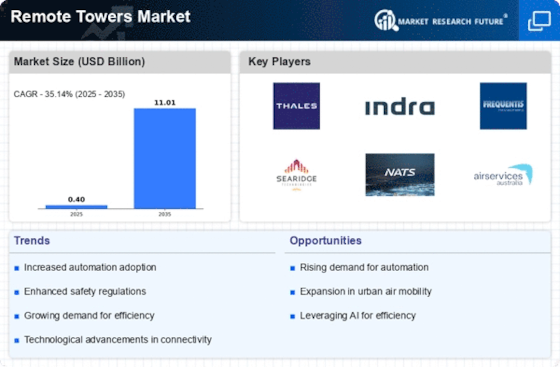
As per MRFR analysis, the Remote Towers Market Size was estimated at 0.401 USD Billion in 2024. The Remote Towers industry is projected to grow from 0.5419 in 2025 to 11.01 by 2035, exhibiting a compound annual growth rate (CAGR) of 35.14 during the forecast period 2025 - 2035.

Key Market Trends & Highlights

The Remote Towers Market is poised for substantial growth driven by technological advancements and regulatory support.

  • North America remains the largest market for remote towers, reflecting a robust demand for innovative air traffic management solutions.
  • Asia-Pacific is emerging as the fastest-growing region, propelled by increasing investments in aviation infrastructure and technology.
  • Remote Flight Operations dominate the market, while Camera and Sensor Technology is rapidly gaining traction as a key growth segment.
  • The market is driven by the need for enhanced air traffic management efficiency and advancements in communication technologies.

Market Size & Forecast

2024 Market Size 0.401 (USD Billion)
2035 Market Size 11.01 (USD Billion)
CAGR (2025 - 2035) 35.14%
Largest Regional Market Share in 2024 North America

Major Players

<p>Thales (FR), Indra Sistemas (ES), Frequentis (AT), Searidge Technologies (CA), NATS (GB), Airservices Australia (AU), Saab (SE), Leonardo (IT), Northrop Grumman (US)</p>

Market Trends

The Remote Towers Market is currently experiencing a transformative phase, driven by advancements in technology and the increasing demand for efficient air traffic management solutions. This market encompasses a range of services and products that facilitate remote air traffic control, allowing for enhanced operational efficiency and safety. As the aviation industry evolves, stakeholders are increasingly recognizing the potential of remote towers to optimize airport operations, reduce costs, and improve overall service delivery. The integration of innovative technologies, such as artificial intelligence and advanced communication systems, appears to be a key factor in shaping the future landscape of this market. Moreover, the Remote Towers Market seems poised for growth as regulatory bodies and aviation authorities begin to embrace these modern solutions. The shift towards remote operations not only addresses the challenges of traditional air traffic control but also aligns with sustainability goals by minimizing the environmental impact of airport operations. As airports seek to modernize their infrastructure, the adoption of remote tower technology may become a strategic priority. This evolving market landscape indicates a promising future, where remote towers could play a pivotal role in the global aviation ecosystem.

Technological Advancements

The Remote Towers Market is witnessing rapid technological innovations that enhance the capabilities of air traffic management systems. These advancements include the integration of artificial intelligence, machine learning, and advanced communication technologies, which collectively improve situational awareness and decision-making processes for air traffic controllers.

Regulatory Support

There appears to be a growing trend of regulatory bodies supporting the implementation of remote tower solutions. This support is likely to facilitate the adoption of these technologies, as authorities recognize their potential to improve safety and efficiency in air traffic operations.

Sustainability Initiatives

The Remote Towers Market is increasingly aligned with global sustainability initiatives. As airports strive to reduce their carbon footprint, the adoption of remote tower technology may contribute to more efficient operations, thereby supporting environmental goals and enhancing the overall sustainability of the aviation sector.

Remote Towers Market Market Drivers

Focus on Safety and Risk Management

The Remote Towers Market is driven by an intensified focus on safety and risk management within the aviation sector. As air traffic volumes increase, the need for robust safety measures becomes paramount. Remote towers enhance situational awareness for air traffic controllers, allowing for better decision-making and risk mitigation. The implementation of advanced surveillance technologies, such as radar and camera systems, further bolsters safety protocols. Recent studies suggest that remote tower operations can lead to a reduction in operational errors, thereby improving overall safety outcomes. This emphasis on safety is likely to propel the Remote Towers Market forward, as stakeholders prioritize investments in technologies that enhance the safety and reliability of air traffic management.

Cost-Effectiveness of Remote Operations

The Remote Towers Market is witnessing a growing interest in the cost-effectiveness of remote operations. By utilizing remote towers, airports can significantly reduce operational costs associated with staffing and infrastructure. Traditional control towers require a substantial investment in physical infrastructure and personnel, whereas remote towers can be operated with fewer resources. This shift not only lowers operational expenses but also allows for the reallocation of funds to other critical areas within the aviation sector. Recent analyses indicate that airports implementing remote tower solutions can achieve cost savings of up to 30%. As financial pressures mount within the aviation industry, the Remote Towers Market is likely to see increased adoption of these cost-effective solutions.

Advancements in Communication Technologies

The Remote Towers Market is significantly influenced by advancements in communication technologies. Innovations such as high-speed internet, satellite communications, and secure data transmission systems are crucial for the effective operation of remote towers. These technologies facilitate real-time data sharing and communication between air traffic controllers and aircraft, which is essential for maintaining safety and efficiency. The integration of 5G technology is particularly noteworthy, as it promises to enhance connectivity and reduce latency in communications. As the Remote Towers Market evolves, the adoption of these advanced communication systems is expected to increase, potentially leading to a more interconnected and efficient air traffic management framework.

Increased Demand for Air Traffic Management Efficiency

The Remote Towers Market is experiencing a surge in demand for enhanced air traffic management efficiency. As air traffic continues to grow, traditional control towers face limitations in capacity and operational efficiency. Remote towers offer a solution by enabling air traffic controllers to manage multiple airports from a centralized location, thereby optimizing resource allocation. According to recent data, the air traffic management sector is projected to grow at a compound annual growth rate of 5.5% over the next five years. This growth is likely to drive investments in remote tower technologies, as stakeholders seek to improve safety and efficiency in airspace management. The Remote Towers Market is thus positioned to benefit from this increasing demand for innovative solutions that streamline operations and enhance overall air traffic management.

Regulatory Frameworks Supporting Remote Tower Implementation

The Remote Towers Market is positively impacted by evolving regulatory frameworks that support the implementation of remote tower technologies. Regulatory bodies are increasingly recognizing the benefits of remote operations in enhancing safety and efficiency in air traffic management. As regulations adapt to accommodate these technologies, airports are more inclined to invest in remote tower solutions. For instance, several countries have begun to establish guidelines that facilitate the certification and operation of remote towers, thereby streamlining the approval process. This regulatory support is crucial for the growth of the Remote Towers Market, as it provides a clear pathway for airports to transition to modernized air traffic management systems.

Market Segment Insights

Remote Towers Market Segment Insights

Remote Towers Market Segment Insights

Remote Towers Market Technology Insights

Remote Towers Market Technology Insights

The  Remote Towers Market revenue showcased a burgeoning sector driven by advancements in technology. The segment of Technology within the Remote Towers Market encapsulated various critical components including Remote Flight Operations, Air Traffic Management, Terminal Control Systems, and Camera and Sensor Technology, each playing a significant role in the overall efficiency and safety of aviation operations.

Remote Flight Operations stood as a leading component in the market, valued at 1.2 USD Billion in 2023 and forecasted to grow substantially to 3.1 USD Billion by 2032.

 This prominence could be attributed to the increasing demand for effective and efficient flight management systems that enhance operational capabilities and reduce costs.

Meanwhile, Air Traffic Management also held a substantial market share, with a valuation of 1.0 USD Billion in 2023, anticipated to expand to 2.5 USD Billion within the same period. This area was critical as it ensured the safe and orderly flow of air traffic, addressing the growing congestion in airspace and the need for advanced solutions to manage flight operations safely.

Remote Towers Market Application Insights

Remote Towers Market Application Insights

The Remote Towers Market showcases diverse applications that cater to various sectors, most notably Commercial Aviation, Military Aviation, Unmanned Aerial Vehicles, and Airport Operations. The Commercial Aviation sector plays a crucial role, as it benefits from advanced remote tower technologies that enhance operational efficiency and safety.

Military Aviation applications leverage these systems for strategic advantages and improved situational awareness. Unmanned Aerial Vehicles are gaining traction, driven by their increasing deployment in surveillance and logistics operations, thus marking their importance in modern aviation.

Airport Operations see substantial integration of remote tower services, facilitating real-time monitoring and management of air traffic. The  Remote Towers Market data reveals a trend towards increased efficiency and automation adoption across these segments, presenting significant growth drivers such as demand for improved air traffic management and reduction of operational costs.

However, the industry faces challenges like regulatory hurdles and technological integration. As the market continues to evolve, opportunities for innovation and expansion remain significant, paving the way for further advancements across these applications and contributing to the overall growth in the  Remote Towers Market.

Remote Towers Market End Use Insights

Remote Towers Market End Use Insights

The Remote Towers Market showcases a diverse range of applications across various end uses, contributing significantly to its overall growth and development. Among these applications, airports represent a critical segment driven by the need for improved air traffic management and safety. Defense organizations leverage remote tower technology to enhance situational awareness and operational efficiency, which is vital in strategic decision-making.

Aerospace companies benefit from remote towers by facilitating advanced operations and streamlining processes, while traffic management authorities utilize these systems to optimize traffic flow and improve safety measures.

Each of these segments reflects a major focus on innovation and efficiency, shaping the future of the  Remote Towers Market. With growing demand for integrated and automated solutions, the  Remote Towers Market revenue is set to climb, bolstered by advancements in technology and rising investments across these sectors.

This evolving landscape highlights the importance of identifying key trends, growth drivers, challenges, and opportunities inherent within the  Remote Towers Market data.

Get more detailed insights about Remote Towers Market Research Report - Global Forecast till 2035

Regional Insights

North America : Leading Innovation and Adoption

North America is the largest market for remote towers, holding approximately 45% of the global share. The region's growth is driven by increasing air traffic, advancements in technology, and supportive regulatory frameworks. The Federal Aviation Administration (FAA) has been instrumental in promoting remote tower systems, enhancing safety and efficiency in air traffic management. The demand for cost-effective solutions is also propelling market growth, as airports seek to optimize operations. The United States is the leading country in this sector, with significant contributions from companies like Thales, Northrop Grumman, and Searidge Technologies. Canada follows closely, leveraging its vast airspace and technological advancements. The competitive landscape is characterized by collaborations between key players and government agencies, fostering innovation and ensuring compliance with safety regulations. The presence of established firms enhances market dynamics, driving further investment in remote tower technologies.

Europe : Regulatory Frameworks Driving Growth

Europe is the second-largest market for remote towers, accounting for approximately 30% of the global share. The region's growth is fueled by stringent safety regulations and a push for modernization in air traffic management. The European Union Aviation Safety Agency (EASA) has been pivotal in establishing guidelines that encourage the adoption of remote tower technologies, enhancing operational efficiency and safety across member states. Leading countries in Europe include the United Kingdom, Germany, and France, where companies like NATS, Thales, and Indra Sistemas are making significant strides. The competitive landscape is marked by partnerships between private firms and governmental bodies, aimed at developing innovative solutions. The presence of key players and a robust regulatory environment are driving investments, ensuring that Europe remains at the forefront of remote tower technology advancements.

Asia-Pacific : Emerging Market with High Potential

Asia-Pacific is witnessing rapid growth in the remote towers market, holding about 20% of the global share. The region's expansion is driven by increasing air traffic, urbanization, and the need for improved air traffic management systems. Countries like Australia and Japan are leading the charge, supported by government initiatives aimed at modernizing airport infrastructure and enhancing safety protocols. The demand for innovative solutions is further propelled by the region's growing aviation sector. Australia is a key player in this market, with Airservices Australia leading the way in remote tower implementation. Japan is also emerging as a significant contributor, with investments in advanced technologies. The competitive landscape is characterized by collaborations among local and international firms, fostering innovation and ensuring compliance with safety standards. The presence of established companies like Frequentis and Saab enhances the region's market dynamics, driving further growth in remote tower technologies.

Middle East and Africa : Untapped Potential in Aviation

The Middle East and Africa region is gradually emerging in the remote towers market, holding approximately 5% of the global share. The growth is driven by increasing investments in aviation infrastructure and a rising demand for efficient air traffic management systems. Countries like the United Arab Emirates and South Africa are at the forefront, with government initiatives aimed at enhancing airport operations and safety measures. The region's strategic location as a The Remote Towers Market expansion. The competitive landscape is still developing, with key players like Leonardo and local firms beginning to explore remote tower technologies. The presence of international companies is fostering knowledge transfer and innovation, which is crucial for the region's growth. As the aviation sector continues to expand, the demand for remote tower solutions is expected to rise, presenting significant opportunities for investment and development in the coming years.

Key Players and Competitive Insights

The  Remote Towers Market is an emerging sector that combines advanced technology with air traffic management, fundamentally reshaping how air traffic services are delivered. This market is characterized by rapid innovation and a growing demand for efficient and safe air traffic operations, particularly in remote and underserved regions.

Various factors, including increasing air traffic demands, the necessity for cost-effective solutions, and advancements in digital technology, are driving competition among key market players. As stakeholders navigate this competitive landscape, they are increasingly focusing on partnerships, technological advancements, and regulatory compliance to secure their position in the market.

The  shift towards modernized air traffic management systems is creating multiple opportunities for players looking to leverage innovative technologies, ultimately leading to improved operational efficiency and safety in air traffic control.

Boeing has established a significant presence in the  Remote Towers Market by utilizing its extensive experience in aerospace technology and innovative solutions to enhance air traffic management. The company's strengths lie in its deep understanding of aviation and the significant investment in research and development, leading to the creation of advanced remote tower systems that integrate seamlessly with existing air traffic control operations.

Boeing's commitment to safety and reliability makes it a preferred partner for various stakeholders in the aviation sector. Its ability to provide scalable solutions and tailor them to the unique needs of different airports enhances its competitive edge. Additionally, strong relationships with regulatory bodies and its  network allow Boeing to effectively advocate for the integration of remote tower technologies, thereby strengthening its position within the market.

General Dynamics, on the other hand, brings a complementary set of strengths to the  Remote Towers Market. The company is recognized for its proficiency in advanced technologies, particularly in areas such as information technology and defense systems. This expertise enables General Dynamics to develop sophisticated remote tower solutions that enhance situational awareness and operational efficiency.

The company leverages its strong engineering capabilities and commitment to innovation to create reliable systems that meet the rigorous demands of air traffic management. General Dynamics also possesses a robust focus on cybersecurity, which is increasingly critical as remote operations become more prevalent.

By ensuring its systems are secure and resilient, the company can address concerns that stakeholders may have regarding the safety and integrity of remote tower operations, thus solidifying its role in this evolving market.

Key Companies in the Remote Towers Market market include

Industry Developments

Recent developments in the  Remote Towers Market indicate a surge in investment and technological advancements. Companies like Boeing and Lockheed Martin are focusing on integrating automation and AI into remote tower solutions, aiming to enhance air traffic management efficiency.

General Dynamics has been working on expanding its remote tower capabilities for enhanced operational safety, while AeroVironment and Honeywell are collaborating on integrating drones within remote tower systems for better surveillance and monitoring. In the realm of mergers and acquisitions, Thales and Indra have announced strategic partnerships to boost their offerings in remote tower technology, which is anticipated to drive innovation and market growth.

Additionally, the increasing demand for cost-effective air traffic control solutions has resulted in market valuation growth for key players such as Raytheon Technologies and Northrop Grumman, reflecting a favorable environment for growth and expansion initiatives.

This dynamic landscape showcases a concerted effort among industry leaders to advance remote tower technologies, support efficient air traffic management, and extend their market reach significantly.

Future Outlook

Remote Towers Market Future Outlook

<p>The Remote Towers Market is projected to grow at a 35.14% CAGR from 2024 to 2035, driven by technological advancements, increased air traffic, and demand for operational efficiency.</p>

New opportunities lie in:

  • <p>Development of AI-driven air traffic management systems</p>
  • <p>Expansion of remote tower services to underserved regions</p>
  • <p>Integration of advanced cybersecurity measures for remote operations</p>

<p>By 2035, the Remote Towers Market is expected to achieve substantial growth, positioning itself as a leader in aviation technology.</p>

Market Segmentation

Remote Towers Market End Use Outlook

  • Airports
  • Defense Organizations
  • Aerospace Companies
  • Traffic Management Authorities

Remote Towers Market Technology Outlook

  • Remote Flight Operations
  • Air Traffic Management
  • Terminal Control Systems
  • Camera and Sensor Technology

Remote Towers Market Application Outlook

  • Commercial Aviation
  • Military Aviation
  • Unmanned Aerial Vehicles
  • Airport Operations

Report Scope

MARKET SIZE 20240.401(USD Billion)
MARKET SIZE 20250.5419(USD Billion)
MARKET SIZE 203511.01(USD Billion)
COMPOUND ANNUAL GROWTH RATE (CAGR)35.14% (2024 - 2035)
REPORT COVERAGERevenue Forecast, Competitive Landscape, Growth Factors, and Trends
BASE YEAR2024
Market Forecast Period2025 - 2035
Historical Data2019 - 2024
Market Forecast UnitsUSD Billion
Key Companies ProfiledMarket analysis in progress
Segments CoveredMarket segmentation analysis in progress
Key Market OpportunitiesIntegration of advanced automation and artificial intelligence in Remote Towers Market enhances operational efficiency and safety.
Key Market DynamicsTechnological advancements and regulatory changes drive the adoption of remote tower solutions in air traffic management.
Countries CoveredNorth America, Europe, APAC, South America, MEA

FAQs

What is the projected market valuation of the Remote Towers Market by 2035?

The Remote Towers Market is projected to reach a valuation of 11.01 USD Billion by 2035.

What was the market valuation of the Remote Towers Market in 2024?

In 2024, the Remote Towers Market had a valuation of 0.401 USD Billion.

What is the expected CAGR for the Remote Towers Market during the forecast period 2025 - 2035?

The expected CAGR for the Remote Towers Market during the forecast period 2025 - 2035 is 35.14%.

Which companies are considered key players in the Remote Towers Market?

Key players in the Remote Towers Market include Thales, Indra Sistemas, Frequentis, Searidge Technologies, NATS, Airservices Australia, Saab, Leonardo, and Northrop Grumman.

What are the main technology segments within the Remote Towers Market?

The main technology segments include Remote Flight Operations, Air Traffic Management, Terminal Control Systems, and Camera and Sensor Technology.

How does the Remote Towers Market perform in the commercial aviation sector?

The Remote Towers Market is valued at 3.5 USD Billion in the commercial aviation sector as of 2025.

What is the valuation of the Remote Towers Market in the military aviation segment?

The military aviation segment of the Remote Towers Market is valued at 2.5 USD Billion in 2025.

What end-use segments are included in the Remote Towers Market analysis?

End-use segments include Airports, Defense Organizations, Aerospace Companies, and Traffic Management Authorities.

What is the projected valuation for the Camera and Sensor Technology segment by 2035?

The Camera and Sensor Technology segment is projected to reach a valuation of 2.31 USD Billion by 2035.

  1. SECTION I: EXECUTIVE SUMMARY AND KEY HIGHLIGHTS
    1. EXECUTIVE SUMMARY
      1. Market Overview
      2. Key Findings
      3. Market Segmentation
      4. Competitive Landscape
      5. Challenges and Opportunities
      6. Future Outlook
  2. SECTION II: SCOPING, METHODOLOGY AND MARKET STRUCTURE
    1. MARKET INTRODUCTION
      1. Definition
      2. Scope of the study
    2. RESEARCH METHODOLOGY
      1. Overview
      2. Data Mining
      3. Secondary Research
      4. Primary Research
      5. Forecasting Model
      6. Market Size Estimation
      7. Data Triangulation
      8. Validation
  3. SECTION III: QUALITATIVE ANALYSIS
    1. MARKET DYNAMICS
      1. Overview
      2. Drivers
      3. Restraints
      4. Opportunities
    2. MARKET FACTOR ANALYSIS
      1. Value chain Analysis
      2. Porter's Five Forces Analysis
      3. COVID-19 Impact Analysis
  4. SECTION IV: QUANTITATIVE ANALYSIS
    1. Aerospace & Defense, BY Technology (USD Billion)
      1. Remote Flight Operations
      2. Air Traffic Management
      3. Terminal Control Systems
      4. Camera and Sensor Technology
    2. Aerospace & Defense, BY Application (USD Billion)
      1. Commercial Aviation
      2. Military Aviation
      3. Unmanned Aerial Vehicles
      4. Airport Operations
    3. Aerospace & Defense, BY End Use (USD Billion)
      1. Airports
      2. Defense Organizations
      3. Aerospace Companies
      4. Traffic Management Authorities
    4. Aerospace & Defense, BY Region (USD Billion)
      1. North America
      2. Europe
      3. APAC
      4. South America
      5. MEA
  5. SECTION V: COMPETITIVE ANALYSIS
    1. Competitive Landscape
      1. Overview
      2. Competitive Analysis
      3. Market share Analysis
      4. Major Growth Strategy in the Aerospace & Defense
      5. Competitive Benchmarking
      6. Leading Players in Terms of Number of Developments in the Aerospace & Defense
      7. Key developments and growth strategies
      8. Major Players Financial Matrix
    2. Company Profiles
      1. Thales (FR)
      2. Indra Sistemas (ES)
      3. Frequentis (AT)
      4. Searidge Technologies (CA)
      5. NATS (GB)
      6. Airservices Australia (AU)
      7. Saab (SE)
      8. Leonardo (IT)
      9. Northrop Grumman (US)
    3. Appendix
      1. References
      2. Related Reports
  6. LIST OF FIGURES
    1. MARKET SYNOPSIS
    2. NORTH AMERICA MARKET ANALYSIS
    3. US MARKET ANALYSIS BY TECHNOLOGY
    4. US MARKET ANALYSIS BY APPLICATION
    5. US MARKET ANALYSIS BY END USE
    6. CANADA MARKET ANALYSIS BY TECHNOLOGY
    7. CANADA MARKET ANALYSIS BY APPLICATION
    8. CANADA MARKET ANALYSIS BY END USE
    9. EUROPE MARKET ANALYSIS
    10. GERMANY MARKET ANALYSIS BY TECHNOLOGY
    11. GERMANY MARKET ANALYSIS BY APPLICATION
    12. GERMANY MARKET ANALYSIS BY END USE
    13. UK MARKET ANALYSIS BY TECHNOLOGY
    14. UK MARKET ANALYSIS BY APPLICATION
    15. UK MARKET ANALYSIS BY END USE
    16. FRANCE MARKET ANALYSIS BY TECHNOLOGY
    17. FRANCE MARKET ANALYSIS BY APPLICATION
    18. FRANCE MARKET ANALYSIS BY END USE
    19. RUSSIA MARKET ANALYSIS BY TECHNOLOGY
    20. RUSSIA MARKET ANALYSIS BY APPLICATION
    21. RUSSIA MARKET ANALYSIS BY END USE
    22. ITALY MARKET ANALYSIS BY TECHNOLOGY
    23. ITALY MARKET ANALYSIS BY APPLICATION
    24. ITALY MARKET ANALYSIS BY END USE
    25. SPAIN MARKET ANALYSIS BY TECHNOLOGY
    26. SPAIN MARKET ANALYSIS BY APPLICATION
    27. SPAIN MARKET ANALYSIS BY END USE
    28. REST OF EUROPE MARKET ANALYSIS BY TECHNOLOGY
    29. REST OF EUROPE MARKET ANALYSIS BY APPLICATION
    30. REST OF EUROPE MARKET ANALYSIS BY END USE
    31. APAC MARKET ANALYSIS
    32. CHINA MARKET ANALYSIS BY TECHNOLOGY
    33. CHINA MARKET ANALYSIS BY APPLICATION
    34. CHINA MARKET ANALYSIS BY END USE
    35. INDIA MARKET ANALYSIS BY TECHNOLOGY
    36. INDIA MARKET ANALYSIS BY APPLICATION
    37. INDIA MARKET ANALYSIS BY END USE
    38. JAPAN MARKET ANALYSIS BY TECHNOLOGY
    39. JAPAN MARKET ANALYSIS BY APPLICATION
    40. JAPAN MARKET ANALYSIS BY END USE
    41. SOUTH KOREA MARKET ANALYSIS BY TECHNOLOGY
    42. SOUTH KOREA MARKET ANALYSIS BY APPLICATION
    43. SOUTH KOREA MARKET ANALYSIS BY END USE
    44. MALAYSIA MARKET ANALYSIS BY TECHNOLOGY
    45. MALAYSIA MARKET ANALYSIS BY APPLICATION
    46. MALAYSIA MARKET ANALYSIS BY END USE
    47. THAILAND MARKET ANALYSIS BY TECHNOLOGY
    48. THAILAND MARKET ANALYSIS BY APPLICATION
    49. THAILAND MARKET ANALYSIS BY END USE
    50. INDONESIA MARKET ANALYSIS BY TECHNOLOGY
    51. INDONESIA MARKET ANALYSIS BY APPLICATION
    52. INDONESIA MARKET ANALYSIS BY END USE
    53. REST OF APAC MARKET ANALYSIS BY TECHNOLOGY
    54. REST OF APAC MARKET ANALYSIS BY APPLICATION
    55. REST OF APAC MARKET ANALYSIS BY END USE
    56. SOUTH AMERICA MARKET ANALYSIS
    57. BRAZIL MARKET ANALYSIS BY TECHNOLOGY
    58. BRAZIL MARKET ANALYSIS BY APPLICATION
    59. BRAZIL MARKET ANALYSIS BY END USE
    60. MEXICO MARKET ANALYSIS BY TECHNOLOGY
    61. MEXICO MARKET ANALYSIS BY APPLICATION
    62. MEXICO MARKET ANALYSIS BY END USE
    63. ARGENTINA MARKET ANALYSIS BY TECHNOLOGY
    64. ARGENTINA MARKET ANALYSIS BY APPLICATION
    65. ARGENTINA MARKET ANALYSIS BY END USE
    66. REST OF SOUTH AMERICA MARKET ANALYSIS BY TECHNOLOGY
    67. REST OF SOUTH AMERICA MARKET ANALYSIS BY APPLICATION
    68. REST OF SOUTH AMERICA MARKET ANALYSIS BY END USE
    69. MEA MARKET ANALYSIS
    70. GCC COUNTRIES MARKET ANALYSIS BY TECHNOLOGY
    71. GCC COUNTRIES MARKET ANALYSIS BY APPLICATION
    72. GCC COUNTRIES MARKET ANALYSIS BY END USE
    73. SOUTH AFRICA MARKET ANALYSIS BY TECHNOLOGY
    74. SOUTH AFRICA MARKET ANALYSIS BY APPLICATION
    75. SOUTH AFRICA MARKET ANALYSIS BY END USE
    76. REST OF MEA MARKET ANALYSIS BY TECHNOLOGY
    77. REST OF MEA MARKET ANALYSIS BY APPLICATION
    78. REST OF MEA MARKET ANALYSIS BY END USE
    79. KEY BUYING CRITERIA OF AEROSPACE & DEFENSE
    80. RESEARCH PROCESS OF MRFR
    81. DRO ANALYSIS OF AEROSPACE & DEFENSE
    82. DRIVERS IMPACT ANALYSIS: AEROSPACE & DEFENSE
    83. RESTRAINTS IMPACT ANALYSIS: AEROSPACE & DEFENSE
    84. SUPPLY / VALUE CHAIN: AEROSPACE & DEFENSE
    85. AEROSPACE & DEFENSE, BY TECHNOLOGY, 2024 (% SHARE)
    86. AEROSPACE & DEFENSE, BY TECHNOLOGY, 2024 TO 2035 (USD Billion)
    87. AEROSPACE & DEFENSE, BY APPLICATION, 2024 (% SHARE)
    88. AEROSPACE & DEFENSE, BY APPLICATION, 2024 TO 2035 (USD Billion)
    89. AEROSPACE & DEFENSE, BY END USE, 2024 (% SHARE)
    90. AEROSPACE & DEFENSE, BY END USE, 2024 TO 2035 (USD Billion)
    91. BENCHMARKING OF MAJOR COMPETITORS
  7. LIST OF TABLES
    1. LIST OF ASSUMPTIONS
    2. North America MARKET SIZE ESTIMATES; FORECAST
      1. BY TECHNOLOGY, 2025-2035 (USD Billion)
      2. BY APPLICATION, 2025-2035 (USD Billion)
      3. BY END USE, 2025-2035 (USD Billion)
    3. US MARKET SIZE ESTIMATES; FORECAST
      1. BY TECHNOLOGY, 2025-2035 (USD Billion)
      2. BY APPLICATION, 2025-2035 (USD Billion)
      3. BY END USE, 2025-2035 (USD Billion)
    4. Canada MARKET SIZE ESTIMATES; FORECAST
      1. BY TECHNOLOGY, 2025-2035 (USD Billion)
      2. BY APPLICATION, 2025-2035 (USD Billion)
      3. BY END USE, 2025-2035 (USD Billion)
    5. Europe MARKET SIZE ESTIMATES; FORECAST
      1. BY TECHNOLOGY, 2025-2035 (USD Billion)
      2. BY APPLICATION, 2025-2035 (USD Billion)
      3. BY END USE, 2025-2035 (USD Billion)
    6. Germany MARKET SIZE ESTIMATES; FORECAST
      1. BY TECHNOLOGY, 2025-2035 (USD Billion)
      2. BY APPLICATION, 2025-2035 (USD Billion)
      3. BY END USE, 2025-2035 (USD Billion)
    7. UK MARKET SIZE ESTIMATES; FORECAST
      1. BY TECHNOLOGY, 2025-2035 (USD Billion)
      2. BY APPLICATION, 2025-2035 (USD Billion)
      3. BY END USE, 2025-2035 (USD Billion)
    8. France MARKET SIZE ESTIMATES; FORECAST
      1. BY TECHNOLOGY, 2025-2035 (USD Billion)
      2. BY APPLICATION, 2025-2035 (USD Billion)
      3. BY END USE, 2025-2035 (USD Billion)
    9. Russia MARKET SIZE ESTIMATES; FORECAST
      1. BY TECHNOLOGY, 2025-2035 (USD Billion)
      2. BY APPLICATION, 2025-2035 (USD Billion)
      3. BY END USE, 2025-2035 (USD Billion)
    10. Italy MARKET SIZE ESTIMATES; FORECAST
      1. BY TECHNOLOGY, 2025-2035 (USD Billion)
      2. BY APPLICATION, 2025-2035 (USD Billion)
      3. BY END USE, 2025-2035 (USD Billion)
    11. Spain MARKET SIZE ESTIMATES; FORECAST
      1. BY TECHNOLOGY, 2025-2035 (USD Billion)
      2. BY APPLICATION, 2025-2035 (USD Billion)
      3. BY END USE, 2025-2035 (USD Billion)
    12. Rest of Europe MARKET SIZE ESTIMATES; FORECAST
      1. BY TECHNOLOGY, 2025-2035 (USD Billion)
      2. BY APPLICATION, 2025-2035 (USD Billion)
      3. BY END USE, 2025-2035 (USD Billion)
    13. APAC MARKET SIZE ESTIMATES; FORECAST
      1. BY TECHNOLOGY, 2025-2035 (USD Billion)
      2. BY APPLICATION, 2025-2035 (USD Billion)
      3. BY END USE, 2025-2035 (USD Billion)
    14. China MARKET SIZE ESTIMATES; FORECAST
      1. BY TECHNOLOGY, 2025-2035 (USD Billion)
      2. BY APPLICATION, 2025-2035 (USD Billion)
      3. BY END USE, 2025-2035 (USD Billion)
    15. India MARKET SIZE ESTIMATES; FORECAST
      1. BY TECHNOLOGY, 2025-2035 (USD Billion)
      2. BY APPLICATION, 2025-2035 (USD Billion)
      3. BY END USE, 2025-2035 (USD Billion)
    16. Japan MARKET SIZE ESTIMATES; FORECAST
      1. BY TECHNOLOGY, 2025-2035 (USD Billion)
      2. BY APPLICATION, 2025-2035 (USD Billion)
      3. BY END USE, 2025-2035 (USD Billion)
    17. South Korea MARKET SIZE ESTIMATES; FORECAST
      1. BY TECHNOLOGY, 2025-2035 (USD Billion)
      2. BY APPLICATION, 2025-2035 (USD Billion)
      3. BY END USE, 2025-2035 (USD Billion)
    18. Malaysia MARKET SIZE ESTIMATES; FORECAST
      1. BY TECHNOLOGY, 2025-2035 (USD Billion)
      2. BY APPLICATION, 2025-2035 (USD Billion)
      3. BY END USE, 2025-2035 (USD Billion)
    19. Thailand MARKET SIZE ESTIMATES; FORECAST
      1. BY TECHNOLOGY, 2025-2035 (USD Billion)
      2. BY APPLICATION, 2025-2035 (USD Billion)
      3. BY END USE, 2025-2035 (USD Billion)
    20. Indonesia MARKET SIZE ESTIMATES; FORECAST
      1. BY TECHNOLOGY, 2025-2035 (USD Billion)
      2. BY APPLICATION, 2025-2035 (USD Billion)
      3. BY END USE, 2025-2035 (USD Billion)
    21. Rest of APAC MARKET SIZE ESTIMATES; FORECAST
      1. BY TECHNOLOGY, 2025-2035 (USD Billion)
      2. BY APPLICATION, 2025-2035 (USD Billion)
      3. BY END USE, 2025-2035 (USD Billion)
    22. South America MARKET SIZE ESTIMATES; FORECAST
      1. BY TECHNOLOGY, 2025-2035 (USD Billion)
      2. BY APPLICATION, 2025-2035 (USD Billion)
      3. BY END USE, 2025-2035 (USD Billion)
    23. Brazil MARKET SIZE ESTIMATES; FORECAST
      1. BY TECHNOLOGY, 2025-2035 (USD Billion)
      2. BY APPLICATION, 2025-2035 (USD Billion)
      3. BY END USE, 2025-2035 (USD Billion)
    24. Mexico MARKET SIZE ESTIMATES; FORECAST
      1. BY TECHNOLOGY, 2025-2035 (USD Billion)
      2. BY APPLICATION, 2025-2035 (USD Billion)
      3. BY END USE, 2025-2035 (USD Billion)
    25. Argentina MARKET SIZE ESTIMATES; FORECAST
      1. BY TECHNOLOGY, 2025-2035 (USD Billion)
      2. BY APPLICATION, 2025-2035 (USD Billion)
      3. BY END USE, 2025-2035 (USD Billion)
    26. Rest of South America MARKET SIZE ESTIMATES; FORECAST
      1. BY TECHNOLOGY, 2025-2035 (USD Billion)
      2. BY APPLICATION, 2025-2035 (USD Billion)
      3. BY END USE, 2025-2035 (USD Billion)
    27. MEA MARKET SIZE ESTIMATES; FORECAST
      1. BY TECHNOLOGY, 2025-2035 (USD Billion)
      2. BY APPLICATION, 2025-2035 (USD Billion)
      3. BY END USE, 2025-2035 (USD Billion)
    28. GCC Countries MARKET SIZE ESTIMATES; FORECAST
      1. BY TECHNOLOGY, 2025-2035 (USD Billion)
      2. BY APPLICATION, 2025-2035 (USD Billion)
      3. BY END USE, 2025-2035 (USD Billion)
    29. South Africa MARKET SIZE ESTIMATES; FORECAST
      1. BY TECHNOLOGY, 2025-2035 (USD Billion)
      2. BY APPLICATION, 2025-2035 (USD Billion)
      3. BY END USE, 2025-2035 (USD Billion)
    30. Rest of MEA MARKET SIZE ESTIMATES; FORECAST
      1. BY TECHNOLOGY, 2025-2035 (USD Billion)
      2. BY APPLICATION, 2025-2035 (USD Billion)
      3. BY END USE, 2025-2035 (USD Billion)
    31. PRODUCT LAUNCH/PRODUCT DEVELOPMENT/APPROVAL
    32. ACQUISITION/PARTNERSHIP

Remote Towers Market Market Segmentation


  • Remote Towers Market By Technology (USD Billion, 2019-2032)

    • Remote Flight Operations
    • Air Traffic Management
    • Terminal Control Systems
    • Camera and Sensor Technology

  • Remote Towers Market By Application (USD Billion, 2019-2032)

    • Commercial Aviation
    • Military Aviation
    • Unmanned Aerial Vehicles
    • Airport Operations

  • Remote Towers Market By End Use (USD Billion, 2019-2032)

    • Airports
    • Defense Organizations
    • Aerospace Companies
    • Traffic Management Authorities

  • Remote Towers Market By Regional (USD Billion, 2019-2032)

    • North America
    • Europe
    • South America
    • Asia Pacific
    • Middle East and Africa

Remote Towers Market Regional Outlook (USD Billion, 2019-2032)


  • North America Outlook (USD Billion, 2019-2032)

    • North America Remote Towers Market by Technology Type

      • Remote Flight Operations
      • Air Traffic Management
      • Terminal Control Systems
      • Camera and Sensor Technology
    • North America Remote Towers Market by Application Type

      • Commercial Aviation
      • Military Aviation
      • Unmanned Aerial Vehicles
      • Airport Operations
    • North America Remote Towers Market by End Use Type

      • Airports
      • Defense Organizations
      • Aerospace Companies
      • Traffic Management Authorities
    • North America Remote Towers Market by Regional Type

      • US
      • Canada
    • US Outlook (USD Billion, 2019-2032)
    • US Remote Towers Market by Technology Type

      • Remote Flight Operations
      • Air Traffic Management
      • Terminal Control Systems
      • Camera and Sensor Technology
    • US Remote Towers Market by Application Type

      • Commercial Aviation
      • Military Aviation
      • Unmanned Aerial Vehicles
      • Airport Operations
    • US Remote Towers Market by End Use Type

      • Airports
      • Defense Organizations
      • Aerospace Companies
      • Traffic Management Authorities
    • CANADA Outlook (USD Billion, 2019-2032)
    • CANADA Remote Towers Market by Technology Type

      • Remote Flight Operations
      • Air Traffic Management
      • Terminal Control Systems
      • Camera and Sensor Technology
    • CANADA Remote Towers Market by Application Type

      • Commercial Aviation
      • Military Aviation
      • Unmanned Aerial Vehicles
      • Airport Operations
    • CANADA Remote Towers Market by End Use Type

      • Airports
      • Defense Organizations
      • Aerospace Companies
      • Traffic Management Authorities
  • Europe Outlook (USD Billion, 2019-2032)

    • Europe Remote Towers Market by Technology Type

      • Remote Flight Operations
      • Air Traffic Management
      • Terminal Control Systems
      • Camera and Sensor Technology
    • Europe Remote Towers Market by Application Type

      • Commercial Aviation
      • Military Aviation
      • Unmanned Aerial Vehicles
      • Airport Operations
    • Europe Remote Towers Market by End Use Type

      • Airports
      • Defense Organizations
      • Aerospace Companies
      • Traffic Management Authorities
    • Europe Remote Towers Market by Regional Type

      • Germany
      • UK
      • France
      • Russia
      • Italy
      • Spain
      • Rest of Europe
    • GERMANY Outlook (USD Billion, 2019-2032)
    • GERMANY Remote Towers Market by Technology Type

      • Remote Flight Operations
      • Air Traffic Management
      • Terminal Control Systems
      • Camera and Sensor Technology
    • GERMANY Remote Towers Market by Application Type

      • Commercial Aviation
      • Military Aviation
      • Unmanned Aerial Vehicles
      • Airport Operations
    • GERMANY Remote Towers Market by End Use Type

      • Airports
      • Defense Organizations
      • Aerospace Companies
      • Traffic Management Authorities
    • UK Outlook (USD Billion, 2019-2032)
    • UK Remote Towers Market by Technology Type

      • Remote Flight Operations
      • Air Traffic Management
      • Terminal Control Systems
      • Camera and Sensor Technology
    • UK Remote Towers Market by Application Type

      • Commercial Aviation
      • Military Aviation
      • Unmanned Aerial Vehicles
      • Airport Operations
    • UK Remote Towers Market by End Use Type

      • Airports
      • Defense Organizations
      • Aerospace Companies
      • Traffic Management Authorities
    • FRANCE Outlook (USD Billion, 2019-2032)
    • FRANCE Remote Towers Market by Technology Type

      • Remote Flight Operations
      • Air Traffic Management
      • Terminal Control Systems
      • Camera and Sensor Technology
    • FRANCE Remote Towers Market by Application Type

      • Commercial Aviation
      • Military Aviation
      • Unmanned Aerial Vehicles
      • Airport Operations
    • FRANCE Remote Towers Market by End Use Type

      • Airports
      • Defense Organizations
      • Aerospace Companies
      • Traffic Management Authorities
    • RUSSIA Outlook (USD Billion, 2019-2032)
    • RUSSIA Remote Towers Market by Technology Type

      • Remote Flight Operations
      • Air Traffic Management
      • Terminal Control Systems
      • Camera and Sensor Technology
    • RUSSIA Remote Towers Market by Application Type

      • Commercial Aviation
      • Military Aviation
      • Unmanned Aerial Vehicles
      • Airport Operations
    • RUSSIA Remote Towers Market by End Use Type

      • Airports
      • Defense Organizations
      • Aerospace Companies
      • Traffic Management Authorities
    • ITALY Outlook (USD Billion, 2019-2032)
    • ITALY Remote Towers Market by Technology Type

      • Remote Flight Operations
      • Air Traffic Management
      • Terminal Control Systems
      • Camera and Sensor Technology
    • ITALY Remote Towers Market by Application Type

      • Commercial Aviation
      • Military Aviation
      • Unmanned Aerial Vehicles
      • Airport Operations
    • ITALY Remote Towers Market by End Use Type

      • Airports
      • Defense Organizations
      • Aerospace Companies
      • Traffic Management Authorities
    • SPAIN Outlook (USD Billion, 2019-2032)
    • SPAIN Remote Towers Market by Technology Type

      • Remote Flight Operations
      • Air Traffic Management
      • Terminal Control Systems
      • Camera and Sensor Technology
    • SPAIN Remote Towers Market by Application Type

      • Commercial Aviation
      • Military Aviation
      • Unmanned Aerial Vehicles
      • Airport Operations
    • SPAIN Remote Towers Market by End Use Type

      • Airports
      • Defense Organizations
      • Aerospace Companies
      • Traffic Management Authorities
    • REST OF EUROPE Outlook (USD Billion, 2019-2032)
    • REST OF EUROPE Remote Towers Market by Technology Type

      • Remote Flight Operations
      • Air Traffic Management
      • Terminal Control Systems
      • Camera and Sensor Technology
    • REST OF EUROPE Remote Towers Market by Application Type

      • Commercial Aviation
      • Military Aviation
      • Unmanned Aerial Vehicles
      • Airport Operations
    • REST OF EUROPE Remote Towers Market by End Use Type

      • Airports
      • Defense Organizations
      • Aerospace Companies
      • Traffic Management Authorities
  • APAC Outlook (USD Billion, 2019-2032)

    • APAC Remote Towers Market by Technology Type

      • Remote Flight Operations
      • Air Traffic Management
      • Terminal Control Systems
      • Camera and Sensor Technology
    • APAC Remote Towers Market by Application Type

      • Commercial Aviation
      • Military Aviation
      • Unmanned Aerial Vehicles
      • Airport Operations
    • APAC Remote Towers Market by End Use Type

      • Airports
      • Defense Organizations
      • Aerospace Companies
      • Traffic Management Authorities
    • APAC Remote Towers Market by Regional Type

      • China
      • India
      • Japan
      • South Korea
      • Malaysia
      • Thailand
      • Indonesia
      • Rest of APAC
    • CHINA Outlook (USD Billion, 2019-2032)
    • CHINA Remote Towers Market by Technology Type

      • Remote Flight Operations
      • Air Traffic Management
      • Terminal Control Systems
      • Camera and Sensor Technology
    • CHINA Remote Towers Market by Application Type

      • Commercial Aviation
      • Military Aviation
      • Unmanned Aerial Vehicles
      • Airport Operations
    • CHINA Remote Towers Market by End Use Type

      • Airports
      • Defense Organizations
      • Aerospace Companies
      • Traffic Management Authorities
    • INDIA Outlook (USD Billion, 2019-2032)
    • INDIA Remote Towers Market by Technology Type

      • Remote Flight Operations
      • Air Traffic Management
      • Terminal Control Systems
      • Camera and Sensor Technology
    • INDIA Remote Towers Market by Application Type

      • Commercial Aviation
      • Military Aviation
      • Unmanned Aerial Vehicles
      • Airport Operations
    • INDIA Remote Towers Market by End Use Type

      • Airports
      • Defense Organizations
      • Aerospace Companies
      • Traffic Management Authorities
    • JAPAN Outlook (USD Billion, 2019-2032)
    • JAPAN Remote Towers Market by Technology Type

      • Remote Flight Operations
      • Air Traffic Management
      • Terminal Control Systems
      • Camera and Sensor Technology
    • JAPAN Remote Towers Market by Application Type

      • Commercial Aviation
      • Military Aviation
      • Unmanned Aerial Vehicles
      • Airport Operations
    • JAPAN Remote Towers Market by End Use Type

      • Airports
      • Defense Organizations
      • Aerospace Companies
      • Traffic Management Authorities
    • SOUTH KOREA Outlook (USD Billion, 2019-2032)
    • SOUTH KOREA Remote Towers Market by Technology Type

      • Remote Flight Operations
      • Air Traffic Management
      • Terminal Control Systems
      • Camera and Sensor Technology
    • SOUTH KOREA Remote Towers Market by Application Type

      • Commercial Aviation
      • Military Aviation
      • Unmanned Aerial Vehicles
      • Airport Operations
    • SOUTH KOREA Remote Towers Market by End Use Type

      • Airports
      • Defense Organizations
      • Aerospace Companies
      • Traffic Management Authorities
    • MALAYSIA Outlook (USD Billion, 2019-2032)
    • MALAYSIA Remote Towers Market by Technology Type

      • Remote Flight Operations
      • Air Traffic Management
      • Terminal Control Systems
      • Camera and Sensor Technology
    • MALAYSIA Remote Towers Market by Application Type

      • Commercial Aviation
      • Military Aviation
      • Unmanned Aerial Vehicles
      • Airport Operations
    • MALAYSIA Remote Towers Market by End Use Type

      • Airports
      • Defense Organizations
      • Aerospace Companies
      • Traffic Management Authorities
    • THAILAND Outlook (USD Billion, 2019-2032)
    • THAILAND Remote Towers Market by Technology Type

      • Remote Flight Operations
      • Air Traffic Management
      • Terminal Control Systems
      • Camera and Sensor Technology
    • THAILAND Remote Towers Market by Application Type

      • Commercial Aviation
      • Military Aviation
      • Unmanned Aerial Vehicles
      • Airport Operations
    • THAILAND Remote Towers Market by End Use Type

      • Airports
      • Defense Organizations
      • Aerospace Companies
      • Traffic Management Authorities
    • INDONESIA Outlook (USD Billion, 2019-2032)
    • INDONESIA Remote Towers Market by Technology Type

      • Remote Flight Operations
      • Air Traffic Management
      • Terminal Control Systems
      • Camera and Sensor Technology
    • INDONESIA Remote Towers Market by Application Type

      • Commercial Aviation
      • Military Aviation
      • Unmanned Aerial Vehicles
      • Airport Operations
    • INDONESIA Remote Towers Market by End Use Type

      • Airports
      • Defense Organizations
      • Aerospace Companies
      • Traffic Management Authorities
    • REST OF APAC Outlook (USD Billion, 2019-2032)
    • REST OF APAC Remote Towers Market by Technology Type

      • Remote Flight Operations
      • Air Traffic Management
      • Terminal Control Systems
      • Camera and Sensor Technology
    • REST OF APAC Remote Towers Market by Application Type

      • Commercial Aviation
      • Military Aviation
      • Unmanned Aerial Vehicles
      • Airport Operations
    • REST OF APAC Remote Towers Market by End Use Type

      • Airports
      • Defense Organizations
      • Aerospace Companies
      • Traffic Management Authorities
  • South America Outlook (USD Billion, 2019-2032)

    • South America Remote Towers Market by Technology Type

      • Remote Flight Operations
      • Air Traffic Management
      • Terminal Control Systems
      • Camera and Sensor Technology
    • South America Remote Towers Market by Application Type

      • Commercial Aviation
      • Military Aviation
      • Unmanned Aerial Vehicles
      • Airport Operations
    • South America Remote Towers Market by End Use Type

      • Airports
      • Defense Organizations
      • Aerospace Companies
      • Traffic Management Authorities
    • South America Remote Towers Market by Regional Type

      • Brazil
      • Mexico
      • Argentina
      • Rest of South America
    • BRAZIL Outlook (USD Billion, 2019-2032)
    • BRAZIL Remote Towers Market by Technology Type

      • Remote Flight Operations
      • Air Traffic Management
      • Terminal Control Systems
      • Camera and Sensor Technology
    • BRAZIL Remote Towers Market by Application Type

      • Commercial Aviation
      • Military Aviation
      • Unmanned Aerial Vehicles
      • Airport Operations
    • BRAZIL Remote Towers Market by End Use Type

      • Airports
      • Defense Organizations
      • Aerospace Companies
      • Traffic Management Authorities
    • MEXICO Outlook (USD Billion, 2019-2032)
    • MEXICO Remote Towers Market by Technology Type

      • Remote Flight Operations
      • Air Traffic Management
      • Terminal Control Systems
      • Camera and Sensor Technology
    • MEXICO Remote Towers Market by Application Type

      • Commercial Aviation
      • Military Aviation
      • Unmanned Aerial Vehicles
      • Airport Operations
    • MEXICO Remote Towers Market by End Use Type

      • Airports
      • Defense Organizations
      • Aerospace Companies
      • Traffic Management Authorities
    • ARGENTINA Outlook (USD Billion, 2019-2032)
    • ARGENTINA Remote Towers Market by Technology Type

      • Remote Flight Operations
      • Air Traffic Management
      • Terminal Control Systems
      • Camera and Sensor Technology
    • ARGENTINA Remote Towers Market by Application Type

      • Commercial Aviation
      • Military Aviation
      • Unmanned Aerial Vehicles
      • Airport Operations
    • ARGENTINA Remote Towers Market by End Use Type

      • Airports
      • Defense Organizations
      • Aerospace Companies
      • Traffic Management Authorities
    • REST OF SOUTH AMERICA Outlook (USD Billion, 2019-2032)
    • REST OF SOUTH AMERICA Remote Towers Market by Technology Type

      • Remote Flight Operations
      • Air Traffic Management
      • Terminal Control Systems
      • Camera and Sensor Technology
    • REST OF SOUTH AMERICA Remote Towers Market by Application Type

      • Commercial Aviation
      • Military Aviation
      • Unmanned Aerial Vehicles
      • Airport Operations
    • REST OF SOUTH AMERICA Remote Towers Market by End Use Type

      • Airports
      • Defense Organizations
      • Aerospace Companies
      • Traffic Management Authorities
  • MEA Outlook (USD Billion, 2019-2032)

    • MEA Remote Towers Market by Technology Type

      • Remote Flight Operations
      • Air Traffic Management
      • Terminal Control Systems
      • Camera and Sensor Technology
    • MEA Remote Towers Market by Application Type

      • Commercial Aviation
      • Military Aviation
      • Unmanned Aerial Vehicles
      • Airport Operations
    • MEA Remote Towers Market by End Use Type

      • Airports
      • Defense Organizations
      • Aerospace Companies
      • Traffic Management Authorities
    • MEA Remote Towers Market by Regional Type

      • GCC Countries
      • South Africa
      • Rest of MEA
    • GCC COUNTRIES Outlook (USD Billion, 2019-2032)
    • GCC COUNTRIES Remote Towers Market by Technology Type

      • Remote Flight Operations
      • Air Traffic Management
      • Terminal Control Systems
      • Camera and Sensor Technology
    • GCC COUNTRIES Remote Towers Market by Application Type

      • Commercial Aviation
      • Military Aviation
      • Unmanned Aerial Vehicles
      • Airport Operations
    • GCC COUNTRIES Remote Towers Market by End Use Type

      • Airports
      • Defense Organizations
      • Aerospace Companies
      • Traffic Management Authorities
    • SOUTH AFRICA Outlook (USD Billion, 2019-2032)
    • SOUTH AFRICA Remote Towers Market by Technology Type

      • Remote Flight Operations
      • Air Traffic Management
      • Terminal Control Systems
      • Camera and Sensor Technology
    • SOUTH AFRICA Remote Towers Market by Application Type

      • Commercial Aviation
      • Military Aviation
      • Unmanned Aerial Vehicles
      • Airport Operations
    • SOUTH AFRICA Remote Towers Market by End Use Type

      • Airports
      • Defense Organizations
      • Aerospace Companies
      • Traffic Management Authorities
    • REST OF MEA Outlook (USD Billion, 2019-2032)
    • REST OF MEA Remote Towers Market by Technology Type

      • Remote Flight Operations
      • Air Traffic Management
      • Terminal Control Systems
      • Camera and Sensor Technology
    • REST OF MEA Remote Towers Market by Application Type

      • Commercial Aviation
      • Military Aviation
      • Unmanned Aerial Vehicles
      • Airport Operations
    • REST OF MEA Remote Towers Market by End Use Type

      • Airports
      • Defense Organizations
      • Aerospace Companies
      • Traffic Management Authorities


Infographic

Free Sample Request

Kindly complete the form below to receive a free sample of this Report

Get Free Sample

Customer Strories

Compare Licence

×
Features License Type
Single User Multiuser License Enterprise User
Price $4,950 $5,950 $7,250
Maximum User Access Limit 1 User Upto 10 Users Unrestricted Access Throughout the Organization
Free Customization
Direct Access to Analyst
Deliverable Format
Platform Access
Discount on Next Purchase 10% 15% 15%
Printable Versions