
Request Free Sample ×

Kindly complete the form below to receive a free sample of this Report

* Please use a valid business email

Leading companies partner with us for data-driven Insights

clients tt-cursor
Hero Background
English
Chinese
French
Japanese
Korean
German
Spanish

Remote Automotive Exhaust Sensing Market Analysis

ID: MRFR/SEM/10848-HCR
128 Pages
Aarti Dhapte
December 2024

Remote Automotive Exhaust Sensing Market Size, Share and Research Report By Offerings (Hardware, Software, and Services), By Fuel Type (Petrol and Diesel), By Types (Carbon Monoxide (CO), Carbon Dioxide (CO2), Nitrogen Oxide (NOX), and Particular Matter (PM)), And By Region (North America, Europe, Asia-Pacific, And Rest Of The World) – Industry Forecast Till 2035

Share:
Download PDF ×

We do not share your information with anyone. However, we may send you emails based on your report interest from time to time. You may contact us at any time to opt-out.

Remote Automotive Exhaust Sensing Market Infographic
Purchase Options

Market Analysis

In-depth Analysis of Remote Automotive Exhaust Sensing Market Industry Landscape

The remote automotive exhaust sensing market is characterized by dynamic and multifaceted market dynamics that significantly influence its growth and evolution. One key driver is the increasing global concern for environmental sustainability. Governments worldwide are implementing stringent emission regulations to combat air pollution, pushing automotive manufacturers to adopt advanced sensing technologies for exhaust monitoring. This regulatory landscape creates a demand for remote automotive exhaust sensing solutions, fostering market growth.

Technological advancements play a pivotal role in shaping the market dynamics. As sensor technologies continue to evolve, remote automotive exhaust sensing systems become more sophisticated and efficient. Miniaturization, increased sensitivity, and improved integration capabilities contribute to the development of compact and reliable sensing solutions. This technological progress not only enhances the accuracy of exhaust measurements but also opens up new opportunities for innovation and differentiation within the market.

The market dynamics are also influenced by the growing prevalence of electric and hybrid vehicles. While these alternative fuel vehicles contribute to reduced emissions, they present unique challenges for exhaust sensing. Market players must adapt their sensing solutions to cater to the distinctive characteristics of electric and hybrid vehicle emissions, ensuring their relevance in this changing automotive landscape. The coexistence of traditional internal combustion engine vehicles and alternative fuel vehicles further adds complexity to the market dynamics.

The globalization of the automotive industry is another significant factor shaping the dynamics of the remote automotive exhaust sensing market. As automotive manufacturers expand their operations globally, the need for standardized sensing solutions becomes paramount. Remote sensing technologies must be adaptable to different regional regulations, fuel compositions, and vehicle types. This globalization trend fosters collaborations and partnerships among market players to create versatile sensing systems that can address the diverse needs of the global automotive market.

Market dynamics are also influenced by the integration of artificial intelligence (AI) and data analytics in remote automotive exhaust sensing systems. The vast amounts of data generated by these sensing solutions can be leveraged for real-time monitoring, predictive maintenance, and performance optimization. The integration of AI enhances the overall functionality of exhaust sensing systems, providing actionable insights and contributing to the efficiency of the automotive ecosystem. This infusion of smart technologies not only aligns with the industry's quest for sustainability but also drives market growth through increased demand for advanced, data-driven sensing solutions.

Furthermore, market dynamics are shaped by the emphasis on cost-effective solutions. As the automotive industry faces economic challenges, manufacturers seek exhaust sensing solutions that offer a balance between affordability and performance. Companies that can optimize manufacturing processes, achieve economies of scale, and provide cost-effective sensing solutions gain a competitive advantage in the market. Cost efficiency becomes a crucial factor in driving adoption, especially among price-sensitive segments of the automotive industry.

Market dynamics also reflect the industry's response to changing consumer preferences and expectations. The demand for user-friendly, reliable, and easily integrable remote automotive exhaust sensing systems is on the rise. Manufacturers that prioritize customer-centric design and functionality enhance their market positioning, driving adoption and market growth.


Author
Author Profile
Aarti Dhapte
AVP - Research

A consulting professional focused on helping businesses navigate complex markets through structured research and strategic insights. I partner with clients to solve high-impact business problems across market entry strategy, competitive intelligence, and opportunity assessment. Over the course of my experience, I have led and contributed to 100+ market research and consulting engagements, delivering insights across multiple industries and geographies, and supporting strategic decisions linked to $500M+ market opportunities. My core expertise lies in building robust market sizing, forecasting, and commercial models (top-down and bottom-up), alongside deep-dive competitive and industry analysis. I have played a key role in shaping go-to-market strategies, investment cases, and growth roadmaps, enabling clients to make confident, data-backed decisions in dynamic markets.

Leave a Comment

FAQs

What is the projected market valuation of the Remote Automotive Exhaust Sensing Market by 2035?

<p>The market is projected to reach a valuation of 0.5457 USD Billion by 2035.</p>

What was the market valuation of the Remote Automotive Exhaust Sensing Market in 2024?

<p>In 2024, the market valuation stood at 0.1195 USD Billion.</p>

What is the expected CAGR for the Remote Automotive Exhaust Sensing Market from 2025 to 2035?

<p>The expected CAGR during the forecast period 2025 - 2035 is 14.8%.</p>

Which companies are considered key players in the Remote Automotive Exhaust Sensing Market?

<p>Key players include Bosch, Continental, Delphi Technologies, Denso, Honeywell, Magna International, Valeo, Aptiv, and Siemens.</p>

What are the main segments of the Remote Automotive Exhaust Sensing Market?

<p>The main segments include Offering, Fuel Type, and Types.</p>

What was the valuation of the Hardware segment in 2024?

<p>The Hardware segment was valued at 0.0458 USD Billion in 2024.</p>

How does the valuation of the Software segment compare to the Hardware segment in 2024?

In 2024, the Software segment was valued at 0.0366 USD Billion, which is lower than the Hardware segment.

What is the projected valuation for the Diesel fuel type segment by 2035?

The Diesel fuel type segment is projected to reach a valuation of 0.2729 USD Billion by 2035.

What types of emissions are monitored in the Remote Automotive Exhaust Sensing Market?

The types of emissions monitored include Carbon Monoxide (CO), Carbon Dioxide (CO2), Nitrogen Oxide (NOx), and Particulate Matter (PM).

What was the valuation of the Nitrogen Oxide (NOx) segment in 2024?

The Nitrogen Oxide (NOx) segment was valued at 0.03 USD Billion in 2024.

Market Summary

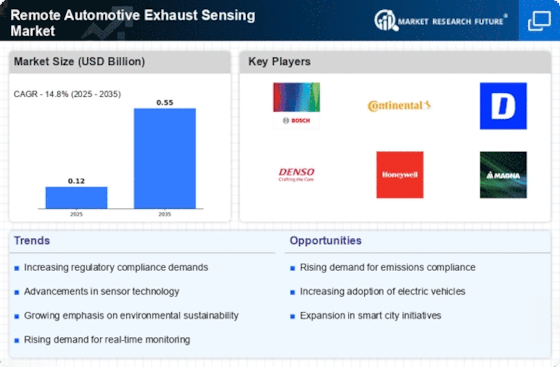
As per Market Research Future analysis, the Remote Automotive Exhaust Sensing Market Size was estimated at 0.1195 USD Billion in 2024. The Remote Automotive Exhaust Sensing industry is projected to grow from USD 0.1372 Billion in 2025 to USD 0.5457 Billion by 2035, exhibiting a compound annual growth rate (CAGR) of 14.8% during the forecast period 2025 - 2035

Key Market Trends & Highlights

The Remote Automotive Exhaust Sensing Market is poised for substantial growth driven by regulatory compliance and technological advancements.

  • North America remains the largest market for remote automotive exhaust sensing, driven by stringent environmental regulations. The Asia-Pacific region is emerging as the fastest-growing market, fueled by increasing vehicle production and urbanization. The hardware segment dominates the market, while the software segment is experiencing rapid growth due to advancements in data analytics. Key market drivers include regulatory compliance and consumer demand for sustainability, alongside rising fuel prices influencing market dynamics.

Market Size & Forecast

2024 Market Size 0.1195 (USD Billion)
2035 Market Size 0.5457 (USD Billion)
CAGR (2025 - 2035) 14.8%
Largest Regional Market Share in 2024 North America

Major Players

Bosch (DE), Continental (DE), Delphi Technologies (GB), Denso (JP), Honeywell (US), Magna International (CA), Valeo (FR), Aptiv (IE), Siemens (DE)

Market Trends

The Remote Automotive Exhaust Sensing Market is currently experiencing a notable evolution, driven by increasing regulatory pressures and a growing emphasis on environmental sustainability. As governments worldwide implement stricter emissions standards, automotive manufacturers are compelled to adopt advanced sensing technologies that monitor and manage exhaust emissions more effectively. This shift not only aligns with global efforts to reduce air pollution but also enhances vehicle performance and efficiency. Furthermore, the integration of remote sensing technologies into vehicles is becoming more prevalent, allowing for real-time monitoring and data collection, which can lead to improved compliance with environmental regulations. In addition to regulatory influences, consumer awareness regarding environmental issues is rising, prompting a demand for cleaner automotive solutions.

The Remote Automotive Exhaust Sensing Market appears to be responding to this trend by innovating and developing more sophisticated sensing systems. These advancements may include the use of artificial intelligence and machine learning to analyze exhaust data, thereby providing insights that can lead to better vehicle design and operation. As the Remote Automotive Exhaust Sensing Market continues to evolve, it is likely that collaboration between automotive manufacturers and technology providers will intensify, fostering a more sustainable future for the automotive industry.

Regulatory Compliance and Innovation

The Remote Automotive Exhaust Sensing Market is increasingly shaped by stringent emissions regulations. Manufacturers are innovating to meet these standards, leading to the development of advanced sensing technologies that enhance compliance and vehicle performance.

Consumer Demand for Sustainability

Growing consumer awareness regarding environmental issues is driving demand for cleaner automotive solutions. This trend is prompting manufacturers to adopt remote sensing technologies that monitor emissions and improve overall vehicle efficiency.

Integration of Advanced Technologies

The Remote Automotive Exhaust Sensing Market is witnessing a trend towards the integration of artificial intelligence and machine learning in exhaust sensing systems. These technologies enable real-time data analysis, providing valuable insights for optimizing vehicle design and operation.

Remote Automotive Exhaust Sensing Market Market Drivers

Consumer Demand for Sustainability

In recent years, there has been a marked increase in consumer awareness regarding environmental issues, which significantly influences the Remote Automotive Exhaust Sensing Market. Consumers are increasingly favoring vehicles that demonstrate lower emissions and better fuel efficiency. This shift in consumer preferences is prompting automotive manufacturers to integrate advanced exhaust sensing technologies into their vehicles. The market data indicates that vehicles equipped with remote sensing capabilities are more appealing to environmentally conscious consumers, leading to higher sales. As sustainability becomes a key purchasing criterion, the Remote Automotive Exhaust Sensing Market is poised for growth, as manufacturers strive to meet the evolving expectations of their customer base.

Integration of Advanced Technologies

The Remote Automotive Exhaust Sensing Market is benefiting from the rapid integration of advanced technologies such as IoT and AI. These technologies enable real-time data collection and analysis, enhancing the accuracy and efficiency of emissions monitoring. The incorporation of IoT devices allows for seamless communication between vehicles and monitoring systems, facilitating proactive maintenance and compliance checks. Market analysis suggests that the adoption of AI-driven analytics can significantly improve the predictive capabilities of exhaust sensing systems, leading to better performance and reduced emissions. As automotive manufacturers increasingly embrace these technologies, the Remote Automotive Exhaust Sensing Market is likely to witness substantial growth, driven by the demand for smarter, more efficient vehicles.

Regulatory Compliance and Innovation

The Remote Automotive Exhaust Sensing Market is experiencing a surge in demand due to stringent regulatory frameworks aimed at reducing vehicular emissions. Governments worldwide are implementing more rigorous standards for emissions testing, which necessitates advanced sensing technologies. This regulatory pressure compels automotive manufacturers to adopt remote sensing solutions that ensure compliance with environmental regulations. The market is projected to grow as manufacturers invest in innovative technologies to meet these standards. For instance, the introduction of real-time monitoring systems allows for immediate detection of emissions violations, thereby enhancing compliance. As regulations evolve, the Remote Automotive Exhaust Sensing Market is likely to expand, driven by the need for continuous innovation in emissions monitoring and reporting.

Rising Fuel Prices and Economic Factors

Economic factors, particularly rising fuel prices, are influencing the Remote Automotive Exhaust Sensing Market. As fuel costs escalate, consumers are more inclined to seek vehicles that offer better fuel efficiency and lower emissions. This trend compels manufacturers to invest in advanced exhaust sensing technologies that optimize engine performance and reduce fuel consumption. Market data indicates that vehicles equipped with effective exhaust sensing systems can achieve significant improvements in fuel efficiency, making them more attractive to cost-conscious consumers. Consequently, the Remote Automotive Exhaust Sensing Market is expected to grow as manufacturers respond to economic pressures by enhancing their vehicle offerings with innovative exhaust sensing solutions.

Technological Advancements in Sensor Technology

The Remote Automotive Exhaust Sensing Market is significantly influenced by ongoing technological advancements in sensor technology. Innovations in sensor design and materials are leading to more accurate and reliable exhaust measurements. These advancements enable the development of compact, cost-effective sensors that can be easily integrated into various vehicle models. The market is witnessing a trend towards miniaturization and increased sensitivity of exhaust sensors, which enhances their performance in real-world conditions. As automotive manufacturers seek to improve the reliability of emissions data, the demand for advanced sensor technologies is likely to rise. This trend suggests a promising future for the Remote Automotive Exhaust Sensing Market, as manufacturers prioritize the integration of cutting-edge sensor solutions.

Market Segment Insights

By Offering: Hardware (Largest) vs. Software (Fastest-Growing)

<p>In the Remote Automotive Exhaust Sensing Market, the offering segment is primarily comprised of hardware, software, and services, with hardware holding the largest market share. This dominance is attributed to the essential need for durable and reliable physical components to effectively manage exhaust sensing in vehicles. On the other hand, software solutions are gaining momentum, reflecting a notable shift towards innovative technologies that enhance vehicle performance and compliance with emission standards.</p>

<p>Hardware (Dominant) vs. Software (Emerging)</p>

<p>Hardware solutions are critical for the Remote Automotive Exhaust Sensing Market, as they include the sensors, actuators, and other components necessary for accurate emissions measurement. These components are essential for ensuring that vehicles adhere to strict emission regulations, thus reinforcing their dominant position. Conversely, software is emerging as a vital element, providing real-time data analysis and reporting, which is increasingly required due to the push for smarter vehicles. The integration of software with hardware solutions allows for sophisticated monitoring and predictive maintenance, driving growth in this segment. As regulations tighten globally, the need for advanced software solutions will likely accelerate, positioning it as a key driver of innovation.</p>

By Fuel Type: Petrol (Largest) vs. Diesel (Fastest-Growing)

<p>In the Remote Automotive Exhaust Sensing Market, the fuel type segment demonstrates a notable distribution, with Petrol leading as the largest segment. This dominance is attributed to the widespread use of petrol vehicles in various global regions. Conversely, Diesel is emerging rapidly, capturing a significant share as advancements in diesel technology continue to improve emissions control, prompting increased adoption of diesel-powered vehicles with enhanced exhaust sensing systems. The growth trends in this segment indicate a shift in consumer preference and regulatory pressures focusing on reducing emissions. Petrol continues to maintain its lead, but the Diesel segment is witnessing the fastest growth driven by innovations in exhaust sensing technologies designed to meet stricter emissions standards. Key drivers include the rising demand for cleaner diesel technology and ongoing developments in remote sensing solutions that enhance vehicle compliance and performance monitoring.</p>

<p>Fuel Type: Petrol (Dominant) vs. Diesel (Emerging)</p>

<p>Petrol remains the dominant fuel type in the Remote Automotive Exhaust Sensing Market, characterized by its broad applicability across a wide range of vehicles and its significant footprint in urban environments. The petrol segment utilizes advanced exhaust sensing technologies that ensure compliance with emissions regulations, making it a preferred choice for many manufacturers. On the other hand, Diesel is emerging as a strong contender, particularly in commercial vehicle segments, due to higher fuel efficiency and lower CO2 emissions compared to petrol. As manufacturers innovate with precision sensing technologies for diesel exhaust systems, the segment is gaining traction, thus reflecting its growing importance in the market landscape. Both segments are integral in shaping the future of automotive emissions management.</p>

By Types: Carbon Monoxide (CO) (Largest) vs. Nitrogen Oxide (NOx) (Fastest-Growing)

<p>In the Remote Automotive Exhaust Sensing Market, Carbon Monoxide (CO) holds the largest market share, primarily due to stringent regulations on vehicle emissions and the inherent dangers of CO as a toxic pollutant. Its prevalence in automotive exhaust has led to significant investments in remote sensing technologies to monitor and control emissions effectively. Following closely, Nitrogen Oxide (NOx) is emerging as the fastest-growing segment due to the increasing awareness of its environmental impact and supportive policies aimed at reducing vehicular NOx emissions. The growth drivers for CO include technological advancements that enable real-time monitoring and analysis, which play a crucial role in meeting regulatory requirements. Meanwhile, the rapid growth of the NOx segment is fueled by the rising adoption of advanced emission control systems in vehicles. This segment is benefiting from innovations in sensor technology, which can detect NOx levels more accurately and efficiently, propelling its market expansion even further.</p>

<p>Carbon Monoxide (CO) (Dominant) vs. Particulate Matter (PM) (Emerging)</p>

<p>Carbon Monoxide (CO) remains the dominant component in the Remote Automotive Exhaust Sensing Market, given its critical role in vehicle emission standards and the health implications tied to its exposure. CO is extensively monitored using advanced sensor technologies that provide real-time feedback to ensure compliance with environmental regulations. In contrast, Particulate Matter (PM) is emerging as a crucial segment, gaining increased attention due to the growing concern over air quality and health effects associated with fine particulate emissions. The development of reliable PM sensing technologies is still relatively nascent, but it is rapidly evolving as manufacturers respond to regulatory shifts and consumer demand for cleaner transportation options, leading to a burgeoning market for PM sensing solutions.</p>

Get more detailed insights about Remote Automotive Exhaust Sensing Market Research Report—Global Forecast till 2035

Regional Insights

North America : Innovation and Regulation Hub

North America is the largest market for remote automotive exhaust sensing, holding approximately 40% of the global share. The region's growth is driven by stringent environmental regulations and a strong push towards electric vehicles. The demand for advanced sensing technologies is further fueled by increasing consumer awareness regarding emissions and fuel efficiency. Regulatory bodies are actively promoting cleaner technologies, which is expected to enhance market growth. The United States and Canada are the leading countries in this sector, with major players like Honeywell, Bosch, and Continental establishing a strong foothold. The competitive landscape is characterized by continuous innovation and partnerships among key players to enhance product offerings. The presence of advanced manufacturing facilities and R&D centers in these countries supports the development of cutting-edge technologies in automotive exhaust sensing.

Europe : Sustainability and Innovation Focus

Europe is the second-largest market for remote automotive exhaust sensing, accounting for around 30% of the global market share. The region's growth is significantly influenced by the European Union's stringent emissions regulations and initiatives aimed at reducing carbon footprints. The increasing adoption of electric and hybrid vehicles is also driving demand for advanced sensing technologies, as manufacturers seek to comply with environmental standards and consumer expectations. Leading countries in Remote Automotive Exhaust Sensing Market include Germany, France, and the UK, where major automotive manufacturers and technology providers are based. Key players such as Denso, Valeo, and Siemens are actively involved in developing innovative solutions to meet regulatory requirements. The competitive landscape is marked by collaborations and investments in R&D to enhance product capabilities and market reach.

Asia-Pacific : Emerging Market Potential

Asia-Pacific is witnessing rapid growth in the remote automotive exhaust sensing market, holding approximately 25% of the global share. The region's growth is driven by increasing vehicle production and rising environmental concerns. Countries like China and India are focusing on improving air quality, leading to a surge in demand for advanced exhaust sensing technologies. Government initiatives aimed at promoting electric vehicles are also contributing to market expansion. China is the largest market in the region, followed by Japan and India, where key players like Denso and Delphi Technologies are making significant investments. The competitive landscape is evolving, with local manufacturers emerging alongside established global players. The focus on innovation and technology adoption is expected to drive further growth in this sector, as countries strive to meet environmental standards and consumer demands.

Middle East and Africa : Resource-Rich and Growing Demand

The Middle East and Africa region is gradually emerging in the remote automotive exhaust sensing market, holding about 5% of the global share. The growth is primarily driven by increasing vehicle ownership and a growing awareness of environmental issues. Countries in this region are beginning to implement stricter emissions regulations, which is expected to boost demand for advanced sensing technologies in the automotive sector. The Remote Automotive Exhaust Sensing Market is still in its nascent stage but shows potential for significant growth. Leading countries include South Africa and the UAE, where the automotive industry is expanding. The competitive landscape is characterized by a mix of local and international players, with companies like Magna International and Aptiv looking to establish a presence. As the region continues to develop its automotive infrastructure, the demand for innovative exhaust sensing solutions is likely to increase, paving the way for new opportunities in the Remote Automotive Exhaust Sensing Market.

Key Players and Competitive Insights

Leading market players are investing heavily in research and development in order to develop their product lines, which will help the Remote Automotive Exhaust Sensing Market rise even more. Market participants are also undertaking a diversity of strategic activities to build their global footprint, with important market developments along with new product launches, contractual agreements, mergers and additions, higher investments, and coordination with organizations. To develop and survive in a competitive and growing market climate, the remote automotive exhaust sensing industry must offer cost-effective items. Manufacturing locally to minimize operational costs is one of the key business tactics used by manufacturers in the global Remote Automotive Exhaust Sensing industry to benefit clients and raise the market sector. In recent years, the Remote Automotive Exhaust Sensing industry has offered certain of the most significant advantages to medicine. Many players in the Remote Automotive Exhaust Sensing Market, including Opus Group AB (Sweden), Hager Environmental & Atmospheric Technologies (US), Doppler Environmental Protection Technology Co., Ltd. (China), Anhui Baolong Environmental Protection Technology Co., Ltd. (China), Korea Environment Corporation (South Korea), and Hangzhou Chunlai Technology Co., Ltd. (China) Hager Environmental & Atmospheric Technologies, LLC was founded in 2009 to establish an advanced and unique technology designed to revolutionize the Vehicle Emission Testing Industry. This technology, EDAR (Emissions Detection and Reporting), is an eye-safe laser-based technology for remotely detecting and measuring the absorption of environmentally critical gases coming out of a moving vehicle. EDAR contains a multi-patented system of hardware and software, which permits for a multi-spectral 3-dimensional image of the complete exhaust plume of a moving car. Additionally, EDAR provides increased sensitivity, in some cases of over 2,000%, and resolutions of a million times greater versus existing technologies in use today. Korea Environment Corporation (KECO) is an organization affiliated with the Ministry of Environment that contributes to the development of an environment-friendly country by efficiently promoting greenhouse gas-related projects to prevent environmental pollution, improve the environment, encourage resource circulation, and respond to climate change. KECO is a quasi-governmental institution under the Ministry of Environment that aims to become a global comprehensive service institution. Its mission is to contribute to eco-friendly national development by making the environment better and promoting resource circulation. In order to achieve the national mid-term greenhouse gas reduction target of 37% in accordance with the Frame Act on Low Carbon, Green Growth, Korea Environment Corporation designated and manages the companies and workplaces with a greenhouse gas emission and energy consumption of 15,000tCO2eq 80TJ or more as management companies to achieve the greenhouse gas reduction goal and energy saving.

Key Companies in the Remote Automotive Exhaust Sensing Market include

Industry Developments

  • Q2 2024: Bosch launches next-generation remote automotive exhaust sensing system for commercial fleets Bosch announced the commercial launch of its new remote automotive exhaust sensing system, designed to help fleet operators monitor and reduce vehicle emissions in real time. The system leverages advanced sensor technology and cloud-based analytics to ensure compliance with evolving environmental regulations.
  • Q1 2024: HORIBA partners with European city to deploy remote vehicle emissions monitoring pilot HORIBA announced a partnership with a major European municipality to pilot its remote automotive exhaust sensing technology, aiming to monitor urban vehicle emissions and support local air quality initiatives.
  • Q2 2024: Emissions Analytics secures Series B funding to expand remote exhaust sensing operations Emissions Analytics raised a Series B funding round to scale its remote automotive exhaust sensing solutions, with plans to expand deployment in North America and Europe.
  • Q3 2024: AVL opens new R&D center focused on remote exhaust sensing technologies AVL inaugurated a new research and development facility dedicated to advancing remote automotive exhaust sensing systems, aiming to accelerate innovation in emissions monitoring.
  • Q2 2025: Sensors, Inc. announces contract win for remote exhaust sensing deployment in California Sensors, Inc. secured a contract with a California regulatory agency to deploy its remote automotive exhaust sensing technology for statewide vehicle emissions monitoring.
  • Q1 2025: Opus Group acquires minority stake in remote exhaust sensing startup AirSentry Opus Group announced the acquisition of a minority stake in AirSentry, a startup specializing in remote automotive exhaust sensing, to strengthen its position in the emissions monitoring market.
  • Q2 2024: UK government approves remote exhaust sensing technology for national emissions compliance program The UK government granted regulatory approval for the use of remote automotive exhaust sensing systems in its national vehicle emissions compliance program, marking a significant step for technology adoption.
  • Q3 2024: TNO and Siemens Mobility announce partnership to develop next-gen remote exhaust sensors TNO and Siemens Mobility entered a strategic partnership to co-develop advanced remote automotive exhaust sensing solutions, targeting improved accuracy and scalability for urban air quality management.
  • Q1 2025: PEMS Solutions appoints new CEO to drive growth in remote exhaust sensing market PEMS Solutions named a new chief executive officer, tasking the leader with expanding the company's footprint in the remote automotive exhaust sensing sector.
  • Q2 2025: Continental unveils AI-powered remote exhaust sensing platform at industry expo Continental introduced an AI-driven remote automotive exhaust sensing platform at a major industry event, highlighting its capabilities for real-time emissions analysis and regulatory compliance.
  • Q1 2024: Clean Air Asia launches remote exhaust sensing pilot in Manila Clean Air Asia initiated a pilot project in Manila using remote automotive exhaust sensing technology to assess and address urban vehicle emissions.
  • Q3 2025: EcoSense Technologies closes $15M Series A to accelerate remote exhaust sensing product rollout EcoSense Technologies completed a $15 million Series A funding round to support the commercial rollout of its remote automotive exhaust sensing products in Asia and Europe.

Future Outlook

Remote Automotive Exhaust Sensing Market Future Outlook

The Remote Automotive Exhaust Sensing Market is projected to grow at a 14.8% CAGR from 2025 to 2035, driven by regulatory pressures, technological advancements, and increasing environmental awareness.

New opportunities lie in:

  • <p>Development of integrated sensor systems for real-time emissions monitoring Partnerships with automotive manufacturers for OEM sensor integration Expansion into emerging markets with tailored exhaust sensing solutions</p>

By 2035, the Remote Automotive Exhaust Sensing Market is expected to be robust, driven by innovation and regulatory compliance.

Market Segmentation

Remote Automotive Exhaust Sensing Market Types Outlook

  • Carbon Monoxide (CO)
  • Carbon Dioxide (CO2)
  • Nitrogen Oxide (NOx)
  • Particulate Matter (PM)

Remote Automotive Exhaust Sensing Market Offering Outlook

  • Hardware
  • Software
  • Services

Remote Automotive Exhaust Sensing Market Fuel Type Outlook

  • Petrol
  • Diesel

Report Scope

MARKET SIZE 2024 0.1195(USD Billion)
MARKET SIZE 2025 0.1372(USD Billion)
MARKET SIZE 2035 0.5457(USD Billion)
COMPOUND ANNUAL GROWTH RATE (CAGR) 14.8% (2025 - 2035)
REPORT COVERAGE Revenue Forecast, Competitive Landscape, Growth Factors, and Trends
BASE YEAR 2024
Market Forecast Period 2025 - 2035
Historical Data 2019 - 2024
Market Forecast Units USD Billion
Key Companies Profiled Bosch (DE), Continental (DE), Delphi Technologies (GB), Denso (JP), Honeywell (US), Magna International (CA), Valeo (FR), Aptiv (IE), Siemens (DE)
Segments Covered Offerings, Fuel Type, Types, Region
Key Market Opportunities Integration of advanced sensor technologies for real-time emissions monitoring in the Remote Automotive Exhaust Sensing Market.
Key Market Dynamics Rising regulatory pressures drive innovation in remote automotive exhaust sensing technologies for enhanced emissions monitoring.
Countries Covered North America, Europe, APAC, South America, MEA

FAQs

What is the projected market valuation of the Remote Automotive Exhaust Sensing Market by 2035?

<p>The market is projected to reach a valuation of 0.5457 USD Billion by 2035.</p>

What was the market valuation of the Remote Automotive Exhaust Sensing Market in 2024?

<p>In 2024, the market valuation stood at 0.1195 USD Billion.</p>

What is the expected CAGR for the Remote Automotive Exhaust Sensing Market from 2025 to 2035?

<p>The expected CAGR during the forecast period 2025 - 2035 is 14.8%.</p>

Which companies are considered key players in the Remote Automotive Exhaust Sensing Market?

<p>Key players include Bosch, Continental, Delphi Technologies, Denso, Honeywell, Magna International, Valeo, Aptiv, and Siemens.</p>

What are the main segments of the Remote Automotive Exhaust Sensing Market?

<p>The main segments include Offering, Fuel Type, and Types.</p>

What was the valuation of the Hardware segment in 2024?

<p>The Hardware segment was valued at 0.0458 USD Billion in 2024.</p>

How does the valuation of the Software segment compare to the Hardware segment in 2024?

In 2024, the Software segment was valued at 0.0366 USD Billion, which is lower than the Hardware segment.

What is the projected valuation for the Diesel fuel type segment by 2035?

The Diesel fuel type segment is projected to reach a valuation of 0.2729 USD Billion by 2035.

What types of emissions are monitored in the Remote Automotive Exhaust Sensing Market?

The types of emissions monitored include Carbon Monoxide (CO), Carbon Dioxide (CO2), Nitrogen Oxide (NOx), and Particulate Matter (PM).

What was the valuation of the Nitrogen Oxide (NOx) segment in 2024?

The Nitrogen Oxide (NOx) segment was valued at 0.03 USD Billion in 2024.

  1. SECTION I: EXECUTIVE SUMMARY AND KEY HIGHLIGHTS
    1. | 1.1 EXECUTIVE SUMMARY
    2. | | 1.1.1 Market Overview
    3. | | 1.1.2 Key Findings
    4. | | 1.1.3 Market Segmentation
    5. | | 1.1.4 Competitive Landscape
    6. | | 1.1.5 Challenges and Opportunities
    7. | | 1.1.6 Future Outlook
  2. SECTION II: SCOPING, METHODOLOGY AND MARKET STRUCTURE
    1. | 2.1 MARKET INTRODUCTION
    2. | | 2.1.1 Definition
    3. | | 2.1.2 Scope of the study
    4. | | | 2.1.2.1 Research Objective
    5. | | | 2.1.2.2 Assumption
    6. | | | 2.1.2.3 Limitations
    7. | 2.2 RESEARCH METHODOLOGY
    8. | | 2.2.1 Overview
    9. | | 2.2.2 Data Mining
    10. | | 2.2.3 Secondary Research
    11. | | 2.2.4 Primary Research
    12. | | | 2.2.4.1 Primary Interviews and Information Gathering Process
    13. | | | 2.2.4.2 Breakdown of Primary Respondents
    14. | | 2.2.5 Forecasting Model
    15. | | 2.2.6 Market Size Estimation
    16. | | | 2.2.6.1 Bottom-Up Approach
    17. | | | 2.2.6.2 Top-Down Approach
    18. | | 2.2.7 Data Triangulation
    19. | | 2.2.8 Validation
  3. SECTION III: QUALITATIVE ANALYSIS
    1. | 3.1 MARKET DYNAMICS
    2. | | 3.1.1 Overview
    3. | | 3.1.2 Drivers
    4. | | 3.1.3 Restraints
    5. | | 3.1.4 Opportunities
    6. | 3.2 MARKET FACTOR ANALYSIS
    7. | | 3.2.1 Value chain Analysis
    8. | | 3.2.2 Porter's Five Forces Analysis
    9. | | | 3.2.2.1 Bargaining Power of Suppliers
    10. | | | 3.2.2.2 Bargaining Power of Buyers
    11. | | | 3.2.2.3 Threat of New Entrants
    12. | | | 3.2.2.4 Threat of Substitutes
    13. | | | 3.2.2.5 Intensity of Rivalry
    14. | | 3.2.3 COVID-19 Impact Analysis
    15. | | | 3.2.3.1 Market Impact Analysis
    16. | | | 3.2.3.2 Regional Impact
    17. | | | 3.2.3.3 Opportunity and Threat Analysis
  4. SECTION IV: QUANTITATIVE ANALYSIS
    1. | 4.1 Semiconductor & Electronics, BY Offering (USD Billion)
    2. | | 4.1.1 Hardware
    3. | | 4.1.2 Software
    4. | | 4.1.3 Services
    5. | 4.2 Semiconductor & Electronics, BY Fuel Type (USD Billion)
    6. | | 4.2.1 Petrol
    7. | | 4.2.2 Diesel
    8. | 4.3 Semiconductor & Electronics, BY Types (USD Billion)
    9. | | 4.3.1 Carbon Monoxide (CO)
    10. | | 4.3.2 Carbon Dioxide (CO2)
    11. | | 4.3.3 Nitrogen Oxide (NOx)
    12. | | 4.3.4 Particulate Matter (PM)
    13. | 4.4 Semiconductor & Electronics, BY Region (USD Billion)
    14. | | 4.4.1 North America
    15. | | | 4.4.1.1 US
    16. | | | 4.4.1.2 Canada
    17. | | 4.4.2 Europe
    18. | | | 4.4.2.1 Germany
    19. | | | 4.4.2.2 UK
    20. | | | 4.4.2.3 France
    21. | | | 4.4.2.4 Russia
    22. | | | 4.4.2.5 Italy
    23. | | | 4.4.2.6 Spain
    24. | | | 4.4.2.7 Rest of Europe
    25. | | 4.4.3 APAC
    26. | | | 4.4.3.1 China
    27. | | | 4.4.3.2 India
    28. | | | 4.4.3.3 Japan
    29. | | | 4.4.3.4 South Korea
    30. | | | 4.4.3.5 Malaysia
    31. | | | 4.4.3.6 Thailand
    32. | | | 4.4.3.7 Indonesia
    33. | | | 4.4.3.8 Rest of APAC
    34. | | 4.4.4 South America
    35. | | | 4.4.4.1 Brazil
    36. | | | 4.4.4.2 Mexico
    37. | | | 4.4.4.3 Argentina
    38. | | | 4.4.4.4 Rest of South America
    39. | | 4.4.5 MEA
    40. | | | 4.4.5.1 GCC Countries
    41. | | | 4.4.5.2 South Africa
    42. | | | 4.4.5.3 Rest of MEA
  5. SECTION V: COMPETITIVE ANALYSIS
    1. | 5.1 Competitive Landscape
    2. | | 5.1.1 Overview
    3. | | 5.1.2 Competitive Analysis
    4. | | 5.1.3 Market share Analysis
    5. | | 5.1.4 Major Growth Strategy in the Semiconductor & Electronics
    6. | | 5.1.5 Competitive Benchmarking
    7. | | 5.1.6 Leading Players in Terms of Number of Developments in the Semiconductor & Electronics
    8. | | 5.1.7 Key developments and growth strategies
    9. | | | 5.1.7.1 New Product Launch/Service Deployment
    10. | | | 5.1.7.2 Merger & Acquisitions
    11. | | | 5.1.7.3 Joint Ventures
    12. | | 5.1.8 Major Players Financial Matrix
    13. | | | 5.1.8.1 Sales and Operating Income
    14. | | | 5.1.8.2 Major Players R&D Expenditure. 2023
    15. | 5.2 Company Profiles
    16. | | 5.2.1 Bosch (DE)
    17. | | | 5.2.1.1 Financial Overview
    18. | | | 5.2.1.2 Products Offered
    19. | | | 5.2.1.3 Key Developments
    20. | | | 5.2.1.4 SWOT Analysis
    21. | | | 5.2.1.5 Key Strategies
    22. | | 5.2.2 Continental (DE)
    23. | | | 5.2.2.1 Financial Overview
    24. | | | 5.2.2.2 Products Offered
    25. | | | 5.2.2.3 Key Developments
    26. | | | 5.2.2.4 SWOT Analysis
    27. | | | 5.2.2.5 Key Strategies
    28. | | 5.2.3 Delphi Technologies (GB)
    29. | | | 5.2.3.1 Financial Overview
    30. | | | 5.2.3.2 Products Offered
    31. | | | 5.2.3.3 Key Developments
    32. | | | 5.2.3.4 SWOT Analysis
    33. | | | 5.2.3.5 Key Strategies
    34. | | 5.2.4 Denso (JP)
    35. | | | 5.2.4.1 Financial Overview
    36. | | | 5.2.4.2 Products Offered
    37. | | | 5.2.4.3 Key Developments
    38. | | | 5.2.4.4 SWOT Analysis
    39. | | | 5.2.4.5 Key Strategies
    40. | | 5.2.5 Honeywell (US)
    41. | | | 5.2.5.1 Financial Overview
    42. | | | 5.2.5.2 Products Offered
    43. | | | 5.2.5.3 Key Developments
    44. | | | 5.2.5.4 SWOT Analysis
    45. | | | 5.2.5.5 Key Strategies
    46. | | 5.2.6 Magna International (CA)
    47. | | | 5.2.6.1 Financial Overview
    48. | | | 5.2.6.2 Products Offered
    49. | | | 5.2.6.3 Key Developments
    50. | | | 5.2.6.4 SWOT Analysis
    51. | | | 5.2.6.5 Key Strategies
    52. | | 5.2.7 Valeo (FR)
    53. | | | 5.2.7.1 Financial Overview
    54. | | | 5.2.7.2 Products Offered
    55. | | | 5.2.7.3 Key Developments
    56. | | | 5.2.7.4 SWOT Analysis
    57. | | | 5.2.7.5 Key Strategies
    58. | | 5.2.8 Aptiv (IE)
    59. | | | 5.2.8.1 Financial Overview
    60. | | | 5.2.8.2 Products Offered
    61. | | | 5.2.8.3 Key Developments
    62. | | | 5.2.8.4 SWOT Analysis
    63. | | | 5.2.8.5 Key Strategies
    64. | | 5.2.9 Siemens (DE)
    65. | | | 5.2.9.1 Financial Overview
    66. | | | 5.2.9.2 Products Offered
    67. | | | 5.2.9.3 Key Developments
    68. | | | 5.2.9.4 SWOT Analysis
    69. | | | 5.2.9.5 Key Strategies
    70. | 5.3 Appendix
    71. | | 5.3.1 References
    72. | | 5.3.2 Related Reports
  6. LIST OF FIGURES
    1. | 6.1 MARKET SYNOPSIS
    2. | 6.2 NORTH AMERICA MARKET ANALYSIS
    3. | 6.3 US MARKET ANALYSIS BY OFFERING
    4. | 6.4 US MARKET ANALYSIS BY FUEL TYPE
    5. | 6.5 US MARKET ANALYSIS BY TYPES
    6. | 6.6 CANADA MARKET ANALYSIS BY OFFERING
    7. | 6.7 CANADA MARKET ANALYSIS BY FUEL TYPE
    8. | 6.8 CANADA MARKET ANALYSIS BY TYPES
    9. | 6.9 EUROPE MARKET ANALYSIS
    10. | 6.10 GERMANY MARKET ANALYSIS BY OFFERING
    11. | 6.11 GERMANY MARKET ANALYSIS BY FUEL TYPE
    12. | 6.12 GERMANY MARKET ANALYSIS BY TYPES
    13. | 6.13 UK MARKET ANALYSIS BY OFFERING
    14. | 6.14 UK MARKET ANALYSIS BY FUEL TYPE
    15. | 6.15 UK MARKET ANALYSIS BY TYPES
    16. | 6.16 FRANCE MARKET ANALYSIS BY OFFERING
    17. | 6.17 FRANCE MARKET ANALYSIS BY FUEL TYPE
    18. | 6.18 FRANCE MARKET ANALYSIS BY TYPES
    19. | 6.19 RUSSIA MARKET ANALYSIS BY OFFERING
    20. | 6.20 RUSSIA MARKET ANALYSIS BY FUEL TYPE
    21. | 6.21 RUSSIA MARKET ANALYSIS BY TYPES
    22. | 6.22 ITALY MARKET ANALYSIS BY OFFERING
    23. | 6.23 ITALY MARKET ANALYSIS BY FUEL TYPE
    24. | 6.24 ITALY MARKET ANALYSIS BY TYPES
    25. | 6.25 SPAIN MARKET ANALYSIS BY OFFERING
    26. | 6.26 SPAIN MARKET ANALYSIS BY FUEL TYPE
    27. | 6.27 SPAIN MARKET ANALYSIS BY TYPES
    28. | 6.28 REST OF EUROPE MARKET ANALYSIS BY OFFERING
    29. | 6.29 REST OF EUROPE MARKET ANALYSIS BY FUEL TYPE
    30. | 6.30 REST OF EUROPE MARKET ANALYSIS BY TYPES
    31. | 6.31 APAC MARKET ANALYSIS
    32. | 6.32 CHINA MARKET ANALYSIS BY OFFERING
    33. | 6.33 CHINA MARKET ANALYSIS BY FUEL TYPE
    34. | 6.34 CHINA MARKET ANALYSIS BY TYPES
    35. | 6.35 INDIA MARKET ANALYSIS BY OFFERING
    36. | 6.36 INDIA MARKET ANALYSIS BY FUEL TYPE
    37. | 6.37 INDIA MARKET ANALYSIS BY TYPES
    38. | 6.38 JAPAN MARKET ANALYSIS BY OFFERING
    39. | 6.39 JAPAN MARKET ANALYSIS BY FUEL TYPE
    40. | 6.40 JAPAN MARKET ANALYSIS BY TYPES
    41. | 6.41 SOUTH KOREA MARKET ANALYSIS BY OFFERING
    42. | 6.42 SOUTH KOREA MARKET ANALYSIS BY FUEL TYPE
    43. | 6.43 SOUTH KOREA MARKET ANALYSIS BY TYPES
    44. | 6.44 MALAYSIA MARKET ANALYSIS BY OFFERING
    45. | 6.45 MALAYSIA MARKET ANALYSIS BY FUEL TYPE
    46. | 6.46 MALAYSIA MARKET ANALYSIS BY TYPES
    47. | 6.47 THAILAND MARKET ANALYSIS BY OFFERING
    48. | 6.48 THAILAND MARKET ANALYSIS BY FUEL TYPE
    49. | 6.49 THAILAND MARKET ANALYSIS BY TYPES
    50. | 6.50 INDONESIA MARKET ANALYSIS BY OFFERING
    51. | 6.51 INDONESIA MARKET ANALYSIS BY FUEL TYPE
    52. | 6.52 INDONESIA MARKET ANALYSIS BY TYPES
    53. | 6.53 REST OF APAC MARKET ANALYSIS BY OFFERING
    54. | 6.54 REST OF APAC MARKET ANALYSIS BY FUEL TYPE
    55. | 6.55 REST OF APAC MARKET ANALYSIS BY TYPES
    56. | 6.56 SOUTH AMERICA MARKET ANALYSIS
    57. | 6.57 BRAZIL MARKET ANALYSIS BY OFFERING
    58. | 6.58 BRAZIL MARKET ANALYSIS BY FUEL TYPE
    59. | 6.59 BRAZIL MARKET ANALYSIS BY TYPES
    60. | 6.60 MEXICO MARKET ANALYSIS BY OFFERING
    61. | 6.61 MEXICO MARKET ANALYSIS BY FUEL TYPE
    62. | 6.62 MEXICO MARKET ANALYSIS BY TYPES
    63. | 6.63 ARGENTINA MARKET ANALYSIS BY OFFERING
    64. | 6.64 ARGENTINA MARKET ANALYSIS BY FUEL TYPE
    65. | 6.65 ARGENTINA MARKET ANALYSIS BY TYPES
    66. | 6.66 REST OF SOUTH AMERICA MARKET ANALYSIS BY OFFERING
    67. | 6.67 REST OF SOUTH AMERICA MARKET ANALYSIS BY FUEL TYPE
    68. | 6.68 REST OF SOUTH AMERICA MARKET ANALYSIS BY TYPES
    69. | 6.69 MEA MARKET ANALYSIS
    70. | 6.70 GCC COUNTRIES MARKET ANALYSIS BY OFFERING
    71. | 6.71 GCC COUNTRIES MARKET ANALYSIS BY FUEL TYPE
    72. | 6.72 GCC COUNTRIES MARKET ANALYSIS BY TYPES
    73. | 6.73 SOUTH AFRICA MARKET ANALYSIS BY OFFERING
    74. | 6.74 SOUTH AFRICA MARKET ANALYSIS BY FUEL TYPE
    75. | 6.75 SOUTH AFRICA MARKET ANALYSIS BY TYPES
    76. | 6.76 REST OF MEA MARKET ANALYSIS BY OFFERING
    77. | 6.77 REST OF MEA MARKET ANALYSIS BY FUEL TYPE
    78. | 6.78 REST OF MEA MARKET ANALYSIS BY TYPES
    79. | 6.79 KEY BUYING CRITERIA OF SEMICONDUCTOR & ELECTRONICS
    80. | 6.80 RESEARCH PROCESS OF MRFR
    81. | 6.81 DRO ANALYSIS OF SEMICONDUCTOR & ELECTRONICS
    82. | 6.82 DRIVERS IMPACT ANALYSIS: SEMICONDUCTOR & ELECTRONICS
    83. | 6.83 RESTRAINTS IMPACT ANALYSIS: SEMICONDUCTOR & ELECTRONICS
    84. | 6.84 SUPPLY / VALUE CHAIN: SEMICONDUCTOR & ELECTRONICS
    85. | 6.85 SEMICONDUCTOR & ELECTRONICS, BY OFFERING, 2024 (% SHARE)
    86. | 6.86 SEMICONDUCTOR & ELECTRONICS, BY OFFERING, 2024 TO 2035 (USD Billion)
    87. | 6.87 SEMICONDUCTOR & ELECTRONICS, BY FUEL TYPE, 2024 (% SHARE)
    88. | 6.88 SEMICONDUCTOR & ELECTRONICS, BY FUEL TYPE, 2024 TO 2035 (USD Billion)
    89. | 6.89 SEMICONDUCTOR & ELECTRONICS, BY TYPES, 2024 (% SHARE)
    90. | 6.90 SEMICONDUCTOR & ELECTRONICS, BY TYPES, 2024 TO 2035 (USD Billion)
    91. | 6.91 BENCHMARKING OF MAJOR COMPETITORS
  7. LIST OF TABLES
    1. | 7.1 LIST OF ASSUMPTIONS
    2. | | 7.1.1
    3. | 7.2 North America MARKET SIZE ESTIMATES; FORECAST
    4. | | 7.2.1 BY OFFERING, 2025-2035 (USD Billion)
    5. | | 7.2.2 BY FUEL TYPE, 2025-2035 (USD Billion)
    6. | | 7.2.3 BY TYPES, 2025-2035 (USD Billion)
    7. | 7.3 US MARKET SIZE ESTIMATES; FORECAST
    8. | | 7.3.1 BY OFFERING, 2025-2035 (USD Billion)
    9. | | 7.3.2 BY FUEL TYPE, 2025-2035 (USD Billion)
    10. | | 7.3.3 BY TYPES, 2025-2035 (USD Billion)
    11. | 7.4 Canada MARKET SIZE ESTIMATES; FORECAST
    12. | | 7.4.1 BY OFFERING, 2025-2035 (USD Billion)
    13. | | 7.4.2 BY FUEL TYPE, 2025-2035 (USD Billion)
    14. | | 7.4.3 BY TYPES, 2025-2035 (USD Billion)
    15. | 7.5 Europe MARKET SIZE ESTIMATES; FORECAST
    16. | | 7.5.1 BY OFFERING, 2025-2035 (USD Billion)
    17. | | 7.5.2 BY FUEL TYPE, 2025-2035 (USD Billion)
    18. | | 7.5.3 BY TYPES, 2025-2035 (USD Billion)
    19. | 7.6 Germany MARKET SIZE ESTIMATES; FORECAST
    20. | | 7.6.1 BY OFFERING, 2025-2035 (USD Billion)
    21. | | 7.6.2 BY FUEL TYPE, 2025-2035 (USD Billion)
    22. | | 7.6.3 BY TYPES, 2025-2035 (USD Billion)
    23. | 7.7 UK MARKET SIZE ESTIMATES; FORECAST
    24. | | 7.7.1 BY OFFERING, 2025-2035 (USD Billion)
    25. | | 7.7.2 BY FUEL TYPE, 2025-2035 (USD Billion)
    26. | | 7.7.3 BY TYPES, 2025-2035 (USD Billion)
    27. | 7.8 France MARKET SIZE ESTIMATES; FORECAST
    28. | | 7.8.1 BY OFFERING, 2025-2035 (USD Billion)
    29. | | 7.8.2 BY FUEL TYPE, 2025-2035 (USD Billion)
    30. | | 7.8.3 BY TYPES, 2025-2035 (USD Billion)
    31. | 7.9 Russia MARKET SIZE ESTIMATES; FORECAST
    32. | | 7.9.1 BY OFFERING, 2025-2035 (USD Billion)
    33. | | 7.9.2 BY FUEL TYPE, 2025-2035 (USD Billion)
    34. | | 7.9.3 BY TYPES, 2025-2035 (USD Billion)
    35. | 7.10 Italy MARKET SIZE ESTIMATES; FORECAST
    36. | | 7.10.1 BY OFFERING, 2025-2035 (USD Billion)
    37. | | 7.10.2 BY FUEL TYPE, 2025-2035 (USD Billion)
    38. | | 7.10.3 BY TYPES, 2025-2035 (USD Billion)
    39. | 7.11 Spain MARKET SIZE ESTIMATES; FORECAST
    40. | | 7.11.1 BY OFFERING, 2025-2035 (USD Billion)
    41. | | 7.11.2 BY FUEL TYPE, 2025-2035 (USD Billion)
    42. | | 7.11.3 BY TYPES, 2025-2035 (USD Billion)
    43. | 7.12 Rest of Europe MARKET SIZE ESTIMATES; FORECAST
    44. | | 7.12.1 BY OFFERING, 2025-2035 (USD Billion)
    45. | | 7.12.2 BY FUEL TYPE, 2025-2035 (USD Billion)
    46. | | 7.12.3 BY TYPES, 2025-2035 (USD Billion)
    47. | 7.13 APAC MARKET SIZE ESTIMATES; FORECAST
    48. | | 7.13.1 BY OFFERING, 2025-2035 (USD Billion)
    49. | | 7.13.2 BY FUEL TYPE, 2025-2035 (USD Billion)
    50. | | 7.13.3 BY TYPES, 2025-2035 (USD Billion)
    51. | 7.14 China MARKET SIZE ESTIMATES; FORECAST
    52. | | 7.14.1 BY OFFERING, 2025-2035 (USD Billion)
    53. | | 7.14.2 BY FUEL TYPE, 2025-2035 (USD Billion)
    54. | | 7.14.3 BY TYPES, 2025-2035 (USD Billion)
    55. | 7.15 India MARKET SIZE ESTIMATES; FORECAST
    56. | | 7.15.1 BY OFFERING, 2025-2035 (USD Billion)
    57. | | 7.15.2 BY FUEL TYPE, 2025-2035 (USD Billion)
    58. | | 7.15.3 BY TYPES, 2025-2035 (USD Billion)
    59. | 7.16 Japan MARKET SIZE ESTIMATES; FORECAST
    60. | | 7.16.1 BY OFFERING, 2025-2035 (USD Billion)
    61. | | 7.16.2 BY FUEL TYPE, 2025-2035 (USD Billion)
    62. | | 7.16.3 BY TYPES, 2025-2035 (USD Billion)
    63. | 7.17 South Korea MARKET SIZE ESTIMATES; FORECAST
    64. | | 7.17.1 BY OFFERING, 2025-2035 (USD Billion)
    65. | | 7.17.2 BY FUEL TYPE, 2025-2035 (USD Billion)
    66. | | 7.17.3 BY TYPES, 2025-2035 (USD Billion)
    67. | 7.18 Malaysia MARKET SIZE ESTIMATES; FORECAST
    68. | | 7.18.1 BY OFFERING, 2025-2035 (USD Billion)
    69. | | 7.18.2 BY FUEL TYPE, 2025-2035 (USD Billion)
    70. | | 7.18.3 BY TYPES, 2025-2035 (USD Billion)
    71. | 7.19 Thailand MARKET SIZE ESTIMATES; FORECAST
    72. | | 7.19.1 BY OFFERING, 2025-2035 (USD Billion)
    73. | | 7.19.2 BY FUEL TYPE, 2025-2035 (USD Billion)
    74. | | 7.19.3 BY TYPES, 2025-2035 (USD Billion)
    75. | 7.20 Indonesia MARKET SIZE ESTIMATES; FORECAST
    76. | | 7.20.1 BY OFFERING, 2025-2035 (USD Billion)
    77. | | 7.20.2 BY FUEL TYPE, 2025-2035 (USD Billion)
    78. | | 7.20.3 BY TYPES, 2025-2035 (USD Billion)
    79. | 7.21 Rest of APAC MARKET SIZE ESTIMATES; FORECAST
    80. | | 7.21.1 BY OFFERING, 2025-2035 (USD Billion)
    81. | | 7.21.2 BY FUEL TYPE, 2025-2035 (USD Billion)
    82. | | 7.21.3 BY TYPES, 2025-2035 (USD Billion)
    83. | 7.22 South America MARKET SIZE ESTIMATES; FORECAST
    84. | | 7.22.1 BY OFFERING, 2025-2035 (USD Billion)
    85. | | 7.22.2 BY FUEL TYPE, 2025-2035 (USD Billion)
    86. | | 7.22.3 BY TYPES, 2025-2035 (USD Billion)
    87. | 7.23 Brazil MARKET SIZE ESTIMATES; FORECAST
    88. | | 7.23.1 BY OFFERING, 2025-2035 (USD Billion)
    89. | | 7.23.2 BY FUEL TYPE, 2025-2035 (USD Billion)
    90. | | 7.23.3 BY TYPES, 2025-2035 (USD Billion)
    91. | 7.24 Mexico MARKET SIZE ESTIMATES; FORECAST
    92. | | 7.24.1 BY OFFERING, 2025-2035 (USD Billion)
    93. | | 7.24.2 BY FUEL TYPE, 2025-2035 (USD Billion)
    94. | | 7.24.3 BY TYPES, 2025-2035 (USD Billion)
    95. | 7.25 Argentina MARKET SIZE ESTIMATES; FORECAST
    96. | | 7.25.1 BY OFFERING, 2025-2035 (USD Billion)
    97. | | 7.25.2 BY FUEL TYPE, 2025-2035 (USD Billion)
    98. | | 7.25.3 BY TYPES, 2025-2035 (USD Billion)
    99. | 7.26 Rest of South America MARKET SIZE ESTIMATES; FORECAST
    100. | | 7.26.1 BY OFFERING, 2025-2035 (USD Billion)
    101. | | 7.26.2 BY FUEL TYPE, 2025-2035 (USD Billion)
    102. | | 7.26.3 BY TYPES, 2025-2035 (USD Billion)
    103. | 7.27 MEA MARKET SIZE ESTIMATES; FORECAST
    104. | | 7.27.1 BY OFFERING, 2025-2035 (USD Billion)
    105. | | 7.27.2 BY FUEL TYPE, 2025-2035 (USD Billion)
    106. | | 7.27.3 BY TYPES, 2025-2035 (USD Billion)
    107. | 7.28 GCC Countries MARKET SIZE ESTIMATES; FORECAST
    108. | | 7.28.1 BY OFFERING, 2025-2035 (USD Billion)
    109. | | 7.28.2 BY FUEL TYPE, 2025-2035 (USD Billion)
    110. | | 7.28.3 BY TYPES, 2025-2035 (USD Billion)
    111. | 7.29 South Africa MARKET SIZE ESTIMATES; FORECAST
    112. | | 7.29.1 BY OFFERING, 2025-2035 (USD Billion)
    113. | | 7.29.2 BY FUEL TYPE, 2025-2035 (USD Billion)
    114. | | 7.29.3 BY TYPES, 2025-2035 (USD Billion)
    115. | 7.30 Rest of MEA MARKET SIZE ESTIMATES; FORECAST
    116. | | 7.30.1 BY OFFERING, 2025-2035 (USD Billion)
    117. | | 7.30.2 BY FUEL TYPE, 2025-2035 (USD Billion)
    118. | | 7.30.3 BY TYPES, 2025-2035 (USD Billion)
    119. | 7.31 PRODUCT LAUNCH/PRODUCT DEVELOPMENT/APPROVAL
    120. | | 7.31.1
    121. | 7.32 ACQUISITION/PARTNERSHIP
    122. | | 7.32.1

Semiconductor & Electronics Market Segmentation

Semiconductor & Electronics By Offering (USD Billion, 2025-2035)

  • Hardware
  • Software
  • Services

Semiconductor & Electronics By Fuel Type (USD Billion, 2025-2035)

  • Petrol
  • Diesel

Semiconductor & Electronics By Types (USD Billion, 2025-2035)

  • Carbon Monoxide (CO)
  • Carbon Dioxide (CO2)
  • Nitrogen Oxide (NOx)
  • Particulate Matter (PM)
Infographic

Free Sample Request

Kindly complete the form below to receive a free sample of this Report

Get Free Sample

Customer Strories

Compare Licence

×
Features License Type
Single User Multiuser License Enterprise User
Price $4,950 $5,950 $7,250
Maximum User Access Limit 1 User Upto 10 Users Unrestricted Access Throughout the Organization
Free Customization
Direct Access to Analyst
Deliverable Format
Platform Access
Discount on Next Purchase 10% 15% 15%
Printable Versions