Request Free Sample ×

Kindly complete the form below to receive a free sample of this Report

* Please use a valid business email

Leading companies partner with us for data-driven Insights

clients tt-cursor
Hero Background
English
Chinese
French
Japanese
Korean
German
Spanish

Remittance Market Size

ID: MRFR/ICT/10478-HCR
200 Pages
Ankit Gupta
Last Updated: April 06, 2026

Remittance Market Size, Share and Trends Analysis Research Report By Transfer Method (Bank Transfers, Mobile Wallets, Cash Transfers, Online Money Transfer Services), By End User (Individuals, Businesses, Non-Profit Organizations), By Destination Type (Domestic Remittances, International Remittances), By Payer Type (Employed Individuals, Unemployed Individuals, Immigrants) and By Regional (North America, Europe, South America, Asia Pacific, Middle East and Africa) - Forecast to 2035

Share:
Download PDF ×

We do not share your information with anyone. However, we may send you emails based on your report interest from time to time. You may contact us at any time to opt-out.

Remittance Market Infographic
Purchase Options

Remittance Size

Remittance Market Growth Projections and Opportunities

It is essential to note that economic conditions in both sending and receiving countries play a critical role in shaping the remittance market. It is common for migrant workers to send money back home to their dependents and relatives in their native countries; economic factors such as job prospects, exchange rates, local political stability are related with volume and frequency of remittance transactions. Variations in these economic conditions have a direct bearing on the flow of remittances; hence making it a very responsive market based on global economic trends.

There has been an impact on the remittance market due to digital technologies. Remitter payment platforms have made sending money cheaply and quickly by eliminating bureaucratic procedures used previously thus leading to online platforms that help streamline payments between people especially those from developing nations like India or Philippines where many inhabitants work abroad with resultant costs being lower than traditional methods which require physical intermediaries such as banks who charge high commissions because they need more paperwork done before initiating any transaction. This change towards digitization is not only driven by convenience but also necessitated by rising demand for faster cross-border payments that can be tracked transparently.

The competition within the remittance industry encompasses different types of service providers including mainline banks, money transfer operators (MTOs), fintech startups as well as digital platforms. Competition occurs through- for example transaction costs/exchange rate/speed at which funds are available/ accessibility points. Conventional firms face stiff rivalry from nimble fintechs using technology innovation offer cheaper and better user experience remittance services. Both senders and receivers religiously follow changes in the exchange rate with an aim of maximizing the value of funds sent through this mode. Fintech platforms commonly offer competitive exchange rates which attract customers seeking better value for their money, thereby contributing to overall competitiveness of the remittance market.

Furthermore, financial inclusion initiatives shape remittance industry dynamics. The growth of the remittance market is spurred by various efforts targeted at improving access to banking services as well as digital financial tools especially in regions characterized with large unbanked population. Mobile money transfer products and e-wallets provide opportunities for individuals without traditional bank accounts to send or receive money, thereby enhancing financial inclusion and expanding a wider market for wire transfers.

Geopolitical factors have great effects on remittance market dynamics. Political instability, sanctions, and global events may affect flow of remittances resulting in uncertainty among both senders and receivers. These elements may change migration patterns, demand for remitting services as well as overall structure of the industry.
Remittance Market Size Graph
Author
Author Profile
Ankit Gupta
Team Lead - Research

Ankit Gupta is a seasoned market intelligence and strategic research professional with over six plus years of experience in the ICT and Semiconductor industries. With academic roots in Telecom, Marketing, and Electronics, he blends technical insight with business strategy. Ankit has led 200+ projects, including work for Fortune 500 clients like Microsoft and Rio Tinto, covering market sizing, tech forecasting, and go-to-market strategies. Known for bridging engineering and enterprise decision-making, his insights support growth, innovation, and investment planning across diverse technology markets.

Leave a Comment

FAQs

What is the projected market valuation of The Global Remittance by 2035?

<p>The Global Remittance is projected to reach a valuation of 85.44 USD Billion by 2035.</p>

What was the market valuation of The Global Remittance in 2024?

<p>In 2024, The Global Remittance was valued at 56.68 USD Billion.</p>

What is the expected CAGR for The Global Remittance during the forecast period 2025 - 2035?

<p>The expected CAGR for The Global Remittance during the forecast period 2025 - 2035 is 3.8%.</p>

Which segment of The Global Remittance had the highest valuation in 2024?

<p>In 2024, the segment of International Remittances had the highest valuation at 36.68 USD Billion.</p>

What are the key players in The Global Remittance?

<p>Key players in The Global Remittance include Western Union, MoneyGram, PayPal, TransferWise, Remitly, WorldRemit, Skrill, Xoom, and Revolut.</p>

How much did the Mobile Wallets segment contribute to the market in 2024?

<p>The Mobile Wallets segment contributed 15.0 USD Billion to The Global Remittance in 2024.</p>

What is the projected growth for the Individuals segment by 2035?

<p>The Individuals segment is projected to grow to 50.0 USD Billion by 2035.</p>

What was the valuation of Domestic Remittances in 2024?

<p>In 2024, the valuation of Domestic Remittances was 20.0 USD Billion.</p>

Which payer type is expected to see significant growth by 2035?

<p>The Employed Individuals payer type is expected to grow to 45.0 USD Billion by 2035.</p>

What is the projected valuation for the Cash Transfers segment by 2035?

<p>The Cash Transfers segment is projected to reach a valuation of 15.0 USD Billion by 2035.</p>

Market Summary

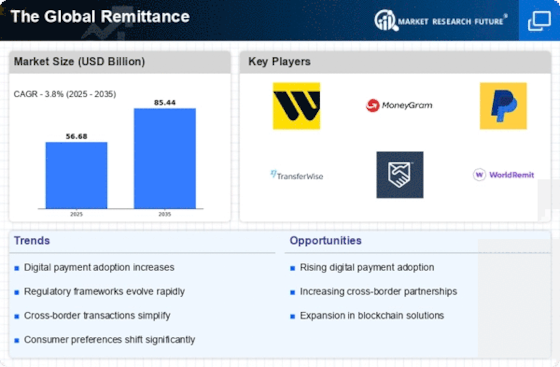
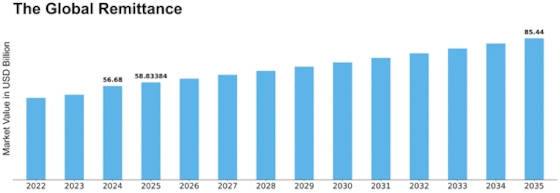
As per Market Research Future analysis, The Global Remittance Market Size was estimated at 56.68 USD Billion in 2024. The Global Remittance industry is projected to grow from 58.83 USD Billion in 2025 to 85.44 USD Billion by 2035, exhibiting a compound annual growth rate (CAGR) of 3.8% during the forecast period 2025 - 2035

Key Market Trends & Highlights

The Global Remittance Market is experiencing a dynamic shift towards digital solutions and evolving consumer preferences.

  • North America remains the largest market for remittances, driven by high volumes of economic migration. Asia-Pacific is the fastest-growing region, reflecting increasing financial inclusion and mobile technology adoption. Bank transfers continue to dominate the market, while mobile wallets are emerging as the fastest-growing segment. Technological advancements and consumer preferences for speed and convenience are key drivers shaping the market landscape.

Market Size & Forecast

2024 Market Size 56.68 (USD Billion)
2035 Market Size 85.44 (USD Billion)
CAGR (2025 - 2035) 3.8%
Largest Regional Market Share in 2024 Europe

Major Players

<a title="Western Union" href="https://www.westernunion.com/blog/en/gb/what-is-a-remittance/" target="_blank" rel="noopener">Western Union</a> (US), MoneyGram (US), <a title="PayPal" href="https://www.paypal.com/us/money-hub/article/what-is-remittance" target="_blank" rel="noopener">PayPal</a> (US), TransferWise (GB), Remitly (US), WorldRemit (GB), Skrill (GB), Xoom (US), Revolut (GB)

Market Trends

The Global Remittance Market is currently experiencing a dynamic transformation, driven by various factors that influence the flow of money across borders. The increasing globalization of economies, coupled with advancements in technology, appears to be reshaping how individuals and businesses engage in remittance transactions. Digital platforms and mobile applications are gaining traction, providing users with more accessible and efficient means to send and receive funds. This shift towards digitalization may enhance the overall user experience, potentially leading to increased participation in the remittance ecosystem. Moreover, regulatory frameworks are evolving to accommodate the changing landscape of The Global Remittance Market. Governments are recognizing the importance of remittances in supporting economic development and are implementing policies that facilitate smoother transactions. This regulatory support could foster a more competitive environment, encouraging innovation among service providers. As the market continues to adapt to these trends, it is likely that new players will emerge, further diversifying the options available to consumers and businesses alike. The interplay of technology, regulation, and consumer behavior will undoubtedly shape the future of remittances on a global scale. The rise of cross border remittances is driving growth in the global remittance market, particularly among migrant workers sending funds home. The global remittance industry is projected to grow steadily from 2025 to 2035, driven by digitalization and increased migration. Global remittances are increasingly facilitated by mobile wallets and digital platforms, enhancing accessibility for individuals and businesses worldwide. The international remittance market size owing to the growing importance of cross-border money transfers.

Digital Transformation

The rise of digital platforms is revolutionizing The Global Remittance Market. Users are increasingly turning to mobile applications and online services for their remittance needs, which enhances convenience and accessibility. This trend suggests a shift away from traditional methods, as digital solutions offer faster and more cost-effective options. Western Union continues to hold a significant money transfer market share, while fintech companies like Remitly and TransferWise are capturing emerging segments. This remittance report provides a detailed analysis of market size, trends, key players, and growth opportunities from 2025 to 2035. The remittances market is witnessing significant transformation due to digital adoption, regulatory evolution, and changing consumer preferences.

Regulatory Evolution

Regulatory frameworks are adapting to the changing dynamics of The Global Remittance Market. Governments are recognizing the vital role of remittances in economic growth and are implementing policies that streamline processes. This evolution may lead to a more competitive landscape, encouraging innovation among service providers.

Consumer Behavior Shifts

There appears to be a notable change in consumer preferences regarding remittance services. As awareness of various options increases, individuals are likely to seek out providers that offer better rates, transparency, and user-friendly experiences. This shift could drive competition and improve service quality across the market.

Remittance Market Market Drivers

Regulatory Frameworks

The regulatory frameworks governing the remittance sector are evolving, which could significantly impact The Global Remittance Industry. Governments are increasingly focusing on anti-money laundering (AML) and combating the financing of terrorism (CFT) regulations. In 2025, it is anticipated that stricter compliance measures will be implemented, affecting how remittance companies operate. While these regulations aim to enhance security and consumer protection, they may also impose additional costs on service providers. This could lead to a consolidation of smaller players in the market, as they struggle to meet compliance requirements. However, a well-regulated environment may also foster consumer trust, potentially increasing the volume of remittances sent through formal channels.

Economic Migration Trends

Economic migration trends are a significant driver of The Global Remittance Industry. As individuals seek better employment opportunities abroad, the flow of remittances to their home countries continues to rise. In 2025, it is projected that remittances will reach approximately 700 billion USD, reflecting the increasing reliance of developing economies on these funds. Countries with high emigration rates, such as India and Mexico, are expected to see substantial inflows, which can contribute to local economic development. This trend indicates that as long as economic disparities exist, the demand for remittance services will likely persist, thereby sustaining growth in the industry.

Technological Advancements

Technological advancements play a pivotal role in shaping The Global Remittance Industry. The proliferation of mobile banking and digital wallets has transformed how remittances are sent and received. In 2025, it is estimated that over 1.7 billion people globally remain unbanked, yet mobile technology offers a viable solution for these individuals. The integration of blockchain technology is also gaining traction, potentially reducing transaction costs and increasing transparency. As these technologies evolve, they may enhance the efficiency of cross-border transactions, thereby attracting more users to the remittance services. The ongoing digital transformation is likely to create a more inclusive financial ecosystem, which could further stimulate growth in the remittance sector.

Financial Inclusion Initiatives

Financial inclusion initiatives are increasingly influencing The Global Remittance Industry. Governments and organizations are recognizing the importance of integrating underserved populations into the financial system. In 2025, various initiatives aimed at promoting financial literacy and access to banking services are expected to gain momentum. These efforts may lead to a broader customer base for remittance services, as more individuals gain access to formal financial channels. Additionally, partnerships between remittance companies and local financial institutions could facilitate easier access to services for marginalized communities. As financial inclusion progresses, it is likely to enhance the overall volume of remittances, thereby driving growth in the industry.

Consumer Preferences for Speed and Convenience

Consumer preferences for speed and convenience are reshaping The Global Remittance Industry. In an increasingly fast-paced world, individuals are seeking quicker and more efficient ways to send money across borders. The demand for instant remittance services is on the rise, with many consumers willing to pay a premium for immediate transactions. In 2025, it is estimated that nearly 60% of remittance transactions will be completed within minutes, reflecting a shift towards real-time services. This trend is likely to compel remittance providers to innovate and enhance their service offerings, ensuring they meet the evolving expectations of consumers. As a result, companies that prioritize speed and user experience may gain a competitive edge in the market.

Market Segment Insights

By Transfer Method: Bank Transfers (Largest) vs. Mobile Wallets (Fastest-Growing)

The Global Remittance Market showcases a diverse landscape, withBank Transfers accounting for the largest share among transfer methods, driven by established infrastructure and trust. <a href="https://www.marketresearchfuture.com/reports/mobile-wallet-market-2059">Mobile Wallets</a> are rapidly capturing market attention as they are increasingly preferred by users for their convenience and integration with technology, thus experiencing quicker adoption rates compared to traditional methods. Other methods such as Cash Transfers and Online Money Transfer Services also play significant roles, but they are relatively smaller in terms of overall market share.

Bank Transfers: Established (Dominant) vs. Mobile Wallets: Innovative (Emerging)

Bank Transfers have solidified their position as a dominant transfer method due to their reliability and the extensive network established by financial institutions. They cater to larger transactions, often preferred for international remittances. On the other hand, Mobile Wallets are emerging as a game-changer in the remittance landscape. Their flexibility and ease of use appeal to younger demographics, fostering rapid growth. As financial technology evolves, Mobile Wallets continue to innovate, offering additional features like <a href="https://www.marketresearchfuture.com/reports/cryptocurrency-market-31627">cryptocurrency</a> transfers, which boost their attractiveness against traditional methods.

By End User: Individuals (Largest) vs. Businesses (Fastest-Growing)

In The Global Remittance Market, the end user segment reveals a diverse distribution of market share among individuals, businesses, and non-profit organizations. Individuals dominate this market, as they account for a significant portion of the remittance flows, primarily due to the rising number of migrant workers sending money home. Conversely, businesses utilize remittance services for cross-border payments, and while their share is smaller than that of individuals, it is experiencing rapid growth due to increased globalization and the expansion of e-commerce.

Individuals (Dominant) vs. Businesses (Emerging)

The individuals segment plays a crucial role in The Global Remittance Market, characterized by a high volume of transactions driven by personal remittances, such as financial support to family members abroad. This segment is marked by a preference for convenient and cost-effective transfer methods. On the other hand, businesses are emerging as a significant segment, leveraging remittance services for international transactions and payments. This growth is fueled by the increasing need for real-time payment solutions and the rise of digital platforms. Businesses, particularly small and medium enterprises, are increasingly recognizing the benefits of effective remittance services, making them an important player in the evolving landscape of global financial transactions.

By Destination Type: Domestic Remittances (Largest) vs. International Remittances (Fastest-Growing)

The Global Remittance Market is characterized by a diverse distribution of domestic and international remittances. Domestic remittances hold the largest share as they cater to local financial needs, driving a significant flow of funds within countries. On the other hand, international remittances, which involve money transfer across borders, have been gaining momentum and are now recognized as a vital aspect of global financial interactions. As globalization continues to enhance connectivity, the allocation of funds internationally is showing notable growth.

Remittances: Domestic (Dominant) vs. International (Emerging)

Domestic remittances are predominantly utilized by individuals to support family members, contributing significantly to local economies. Often triggered by labor migration within nations, these remittances ensure financial stability for recipients. In contrast, international remittances are propelled by a broader spectrum of factors including enhanced technology in banking systems and increased mobility of the workforce. This segment is termed as 'emerging' due to its rapid growth, driven by the rising number of global migrants and the ease of cross-border transactions facilitated by <a href="https://www.marketresearchfuture.com/reports/digital-experience-platform-market-28791">digital platforms</a>.

By Payer Type: Employed Individuals (Largest) vs. Immigrants (Fastest-Growing)

In The Global Remittance Market, the payer type segment reveals a noteworthy distribution among employed individuals, unemployed individuals, and immigrants. Employed individuals hold the largest share, as they typically have stable income sources and are more likely to remit funds abroad to support family and economic development in their home countries. Unemployed individuals represent a smaller portion of the market since financial constraints limit their ability to send remittances, while immigrants, who actively send funds back home, are quickly gaining traction in this segment.

Employed Individuals (Dominant) vs. Immigrants (Emerging)

Employed individuals dominate The Global Remittance Market due to their consistent income levels, allowing them to send regular remittances. This group primarily sends money to family members back home, ensuring support for education, healthcare, and other necessities. On the other hand, immigrants are emerging as a significant force in this market. As the population of skilled and unskilled immigrants grows globally, their remittance behaviors are evolving, making this segment particularly dynamic. Immigrants often utilize various remittance channels and services tailored to their needs, prompting service providers to innovate and adapt to this shifting landscape.

Get more detailed insights about Remittance Market Research Report - Global Forecast till 2035

Regional Insights

North America : Leading Remittance Market Hub

North America holds the largest remittance market share, accounting for approximately 40% of global flows. The growth is driven by a high volume of migrant workers sending money back home, particularly to Latin America and the Caribbean. Regulatory support, such as the Financial Crimes Enforcement Network's guidelines, has also facilitated smoother transactions. The demand for digital remittance services is on the rise, reflecting a shift towards more efficient and cost-effective solutions. The United States is the leading country in this region, with major players like Western Union, MoneyGram, and PayPal dominating the market. Canada follows as the second-largest market, benefiting from its diverse immigrant population. The competitive landscape is characterized by both traditional players and emerging fintech companies like Remitly and TransferWise, which are innovating to capture market share and enhance user experience.

Europe : Diverse Market Dynamics

Europe is witnessing a significant transformation in the remittance market, driven by increasing digitalization and regulatory frameworks that promote competition. The region holds about 25% of The Global Remittance Market share, with the UK and Germany being the largest contributors. The European Union's Payment Services Directive has catalyzed innovation, allowing for more efficient cross-border transactions and lower fees, thus enhancing consumer access to remittance services. The UK stands out as a key player, hosting major companies like TransferWise and WorldRemit, while Germany is also emerging as a strong market due to its large expatriate community. The competitive landscape is marked by a mix of established financial institutions and new fintech entrants, all vying for a share of the growing digital remittance space. This dynamic environment is expected to foster further growth and innovation in the coming years.

Asia-Pacific : Emerging Market Potential

Asia-Pacific is rapidly emerging as a significant player in The Global Remittance Market, accounting for approximately 20% of the total market share. The region's growth is fueled by a large expatriate workforce, particularly in countries like India and China, which are among the top recipients of remittances globally. Regulatory initiatives aimed at improving financial inclusion and reducing transaction costs are also driving demand for remittance services in this region. India leads the market, with a substantial inflow of remittances from the Indian diaspora, followed by China and the Philippines. The competitive landscape features a mix of traditional players like Western Union and innovative fintech solutions such as Xoom and Revolut, which are catering to the evolving needs of consumers. This dynamic environment is expected to continue fostering growth as more individuals seek efficient and cost-effective ways to send money home.

Middle East and Africa : Untapped Market Opportunities

The Middle East and Africa region is characterized by its untapped potential in the remittance market, currently holding about 15% of the global share. The growth is primarily driven by a large number of migrant workers in the Gulf Cooperation Council (GCC) countries sending money back to their home countries in Africa and South Asia. Regulatory frameworks are gradually evolving to support remittance services, which is expected to enhance market accessibility and efficiency. Countries like the UAE and Saudi Arabia are leading the remittance flows, with a significant presence of key players such as MoneyGram and Western Union. The competitive landscape is increasingly attracting fintech companies that offer innovative solutions to reduce costs and improve transaction speeds. As the region continues to develop its financial infrastructure, the remittance market is poised for substantial growth in the coming years.

Key Players and Competitive Insights

The Global Remittance Market is currently characterized by a dynamic competitive landscape, driven by technological advancements and evolving consumer preferences. Major players such as Western Union (US), MoneyGram (US), and TransferWise (GB) are strategically positioning themselves through digital transformation and regional expansion. Western Union (US) continues to leverage its extensive network, focusing on enhancing its digital services to cater to a tech-savvy clientele. Meanwhile, MoneyGram (US) emphasizes partnerships with fintech companies to broaden its service offerings, thereby enhancing customer accessibility. TransferWise (GB), now known as Wise, is committed to transparency in pricing and speed of transactions, which resonates well with consumers seeking cost-effective solutions. Collectively, these strategies contribute to a competitive environment that is increasingly focused on innovation and customer-centric services. In terms of business tactics, companies are increasingly localizing their services to meet regional demands, optimizing their supply chains to enhance efficiency. The market appears moderately fragmented, with a mix of established players and emerging fintech disruptors. This structure allows for a diverse range of services, catering to various consumer needs while fostering competition among key players. The collective influence of these companies shapes market dynamics, as they strive to differentiate themselves through unique value propositions. In August 2025, Western Union (US) announced a partnership with a leading blockchain technology firm to enhance the security and speed of its remittance services. This strategic move is likely to bolster Western Union's competitive edge by addressing consumer concerns regarding transaction security, while also appealing to a younger demographic that values technological innovation. The integration of blockchain technology may streamline operations and reduce costs, positioning Western Union favorably in a rapidly evolving market. In September 2025, MoneyGram (US) launched a new mobile app designed to facilitate instant money transfers across borders. This initiative reflects MoneyGram's commitment to digital transformation and aims to attract a broader customer base, particularly among millennials and Gen Z consumers who prefer mobile solutions. By enhancing user experience and accessibility, MoneyGram is likely to strengthen its market position and increase transaction volumes. In July 2025, Wise (GB) expanded its services to include cryptocurrency transactions, allowing users to send and receive funds in various digital currencies. This strategic expansion not only diversifies Wise's offerings but also positions the company at the forefront of the growing trend towards digital currencies in remittances. By catering to the increasing demand for cryptocurrency services, Wise may capture a new segment of tech-savvy consumers, further solidifying its competitive stance. As of October 2025, the competitive trends in The Global Remittance Market are increasingly defined by digitalization, sustainability, and the integration of artificial intelligence. Strategic alliances among key players are shaping the landscape, fostering innovation and enhancing service delivery. Looking ahead, it appears that competitive differentiation will evolve from traditional price-based competition to a focus on technological innovation, customer experience, and supply chain reliability. Companies that prioritize these aspects are likely to thrive in an increasingly complex and competitive environment.

Key Companies in the Remittance Market include

Industry Developments

The Remittance Market is still quickly modernizing. Major digital-first companies like PayPal, Xoom, Remitly, Alipay, and MoneyGram are making their platforms better for users and expanding their payout networks. In April 2023, Western Union and Alipay teamed up to make it easier to send money from the U.S. to China through Alipay's payout system.Remitly, a big digital remittance company, had 5.0 million active customers in the second quarter of 2023.

This was a 47% increase over the same time last year, showing that more people are using and engaging with the service. Overall, the value of remittance services is going up. This is because people are investing in digital transformation and there is a growing need for safe ways to send money. This is happening because of ongoing global migration and economic problems.

Future Outlook

Remittance Market Future Outlook

The Global Remittance Market is projected to grow at a 3.8% CAGR from 2025 to 2035, driven by digitalization, increased migration, and evolving consumer preferences.

New opportunities lie in:

  • <p>Expansion of blockchain-based remittance solutions Development of mobile wallet partnerships for seamless transactions Implementation of AI-driven fraud detection systems</p>

By 2035, the market is expected to be robust, reflecting sustained growth and innovation.

Market Segmentation

Remittance Market End User Outlook

  • Individuals
  • Businesses
  • Non-Profit Organizations

Remittance Market Payer Type Outlook

  • Employed Individuals
  • Unemployed Individuals
  • Immigrants

Remittance Market Transfer Method Outlook

  • Bank Transfers
  • Mobile Wallets
  • Cash Transfers
  • Online Money Transfer Services

Remittance Market Destination Type Outlook

  • Domestic Remittances
  • International Remittances

Report Scope

MARKET SIZE 2024 56.68(USD Billion)
MARKET SIZE 2025 58.83(USD Billion)
MARKET SIZE 2035 85.44(USD Billion)
COMPOUND ANNUAL GROWTH RATE (CAGR) 3.8% (2025 - 2035)
REPORT COVERAGE Revenue Forecast, Competitive Landscape, Growth Factors, and Trends
BASE YEAR 2024
Market Forecast Period 2025 - 2035
Historical Data 2019 - 2024
Market Forecast Units USD Billion
Key Companies Profiled Western Union (US), MoneyGram (US), PayPal (US), TransferWise (GB), Remitly (US), WorldRemit (GB), Skrill (GB), Xoom (US), Revolut (GB)
Segments Covered Transfer Method, End User, Destination Type, Payer Type, Regional
Key Market Opportunities Integration of blockchain technology enhances transparency and reduces costs in The Global Remittance.
Key Market Dynamics Technological advancements and regulatory changes are reshaping competitive dynamics in the remittance market.
Countries Covered North America, Europe, APAC, South America, MEA

FAQs

What is the projected market valuation of The Global Remittance by 2035?

<p>The Global Remittance is projected to reach a valuation of 85.44 USD Billion by 2035.</p>

What was the market valuation of The Global Remittance in 2024?

<p>In 2024, The Global Remittance was valued at 56.68 USD Billion.</p>

What is the expected CAGR for The Global Remittance during the forecast period 2025 - 2035?

<p>The expected CAGR for The Global Remittance during the forecast period 2025 - 2035 is 3.8%.</p>

Which segment of The Global Remittance had the highest valuation in 2024?

<p>In 2024, the segment of International Remittances had the highest valuation at 36.68 USD Billion.</p>

What are the key players in The Global Remittance?

<p>Key players in The Global Remittance include Western Union, MoneyGram, PayPal, TransferWise, Remitly, WorldRemit, Skrill, Xoom, and Revolut.</p>

How much did the Mobile Wallets segment contribute to the market in 2024?

<p>The Mobile Wallets segment contributed 15.0 USD Billion to The Global Remittance in 2024.</p>

What is the projected growth for the Individuals segment by 2035?

<p>The Individuals segment is projected to grow to 50.0 USD Billion by 2035.</p>

What was the valuation of Domestic Remittances in 2024?

<p>In 2024, the valuation of Domestic Remittances was 20.0 USD Billion.</p>

Which payer type is expected to see significant growth by 2035?

<p>The Employed Individuals payer type is expected to grow to 45.0 USD Billion by 2035.</p>

What is the projected valuation for the Cash Transfers segment by 2035?

<p>The Cash Transfers segment is projected to reach a valuation of 15.0 USD Billion by 2035.</p>

  1. SECTION I: EXECUTIVE SUMMARY AND KEY HIGHLIGHTS
    1. | 1.1 EXECUTIVE SUMMARY
    2. | | 1.1.1 Market Overview
    3. | | 1.1.2 Key Findings
    4. | | 1.1.3 Market Segmentation
    5. | | 1.1.4 Competitive Landscape
    6. | | 1.1.5 Challenges and Opportunities
    7. | | 1.1.6 Future Outlook
  2. SECTION II: SCOPING, METHODOLOGY AND MARKET STRUCTURE
    1. | 2.1 MARKET INTRODUCTION
    2. | | 2.1.1 Definition
    3. | | 2.1.2 Scope of the study
    4. | | | 2.1.2.1 Research Objective
    5. | | | 2.1.2.2 Assumption
    6. | | | 2.1.2.3 Limitations
    7. | 2.2 RESEARCH METHODOLOGY
    8. | | 2.2.1 Overview
    9. | | 2.2.2 Data Mining
    10. | | 2.2.3 Secondary Research
    11. | | 2.2.4 Primary Research
    12. | | | 2.2.4.1 Primary Interviews and Information Gathering Process
    13. | | | 2.2.4.2 Breakdown of Primary Respondents
    14. | | 2.2.5 Forecasting Model
    15. | | 2.2.6 Market Size Estimation
    16. | | | 2.2.6.1 Bottom-Up Approach
    17. | | | 2.2.6.2 Top-Down Approach
    18. | | 2.2.7 Data Triangulation
    19. | | 2.2.8 Validation
  3. SECTION III: QUALITATIVE ANALYSIS
    1. | 3.1 MARKET DYNAMICS
    2. | | 3.1.1 Overview
    3. | | 3.1.2 Drivers
    4. | | 3.1.3 Restraints
    5. | | 3.1.4 Opportunities
    6. | 3.2 MARKET FACTOR ANALYSIS
    7. | | 3.2.1 Value chain Analysis
    8. | | 3.2.2 Porter's Five Forces Analysis
    9. | | | 3.2.2.1 Bargaining Power of Suppliers
    10. | | | 3.2.2.2 Bargaining Power of Buyers
    11. | | | 3.2.2.3 Threat of New Entrants
    12. | | | 3.2.2.4 Threat of Substitutes
    13. | | | 3.2.2.5 Intensity of Rivalry
    14. | | 3.2.3 COVID-19 Impact Analysis
    15. | | | 3.2.3.1 Market Impact Analysis
    16. | | | 3.2.3.2 Regional Impact
    17. | | | 3.2.3.3 Opportunity and Threat Analysis
  4. SECTION IV: QUANTITATIVE ANALYSIS
    1. | 4.1 Information and Communications Technology, BY Transfer Method (USD Billion)
    2. | | 4.1.1 Bank Transfers
    3. | | 4.1.2 Mobile Wallets
    4. | | 4.1.3 Cash Transfers
    5. | | 4.1.4 Online Money Transfer Services
    6. | 4.2 Information and Communications Technology, BY End User (USD Billion)
    7. | | 4.2.1 Individuals
    8. | | 4.2.2 Businesses
    9. | | 4.2.3 Non-Profit Organizations
    10. | 4.3 Information and Communications Technology, BY Destination Type (USD Billion)
    11. | | 4.3.1 Domestic Remittances
    12. | | 4.3.2 International Remittances
    13. | 4.4 Information and Communications Technology, BY Payer Type (USD Billion)
    14. | | 4.4.1 Employed Individuals
    15. | | 4.4.2 Unemployed Individuals
    16. | | 4.4.3 Immigrants
    17. | 4.5 Information and Communications Technology, BY Region (USD Billion)
    18. | | 4.5.1 North America
    19. | | | 4.5.1.1 US
    20. | | | 4.5.1.2 Canada
    21. | | 4.5.2 Europe
    22. | | | 4.5.2.1 Germany
    23. | | | 4.5.2.2 UK
    24. | | | 4.5.2.3 France
    25. | | | 4.5.2.4 Russia
    26. | | | 4.5.2.5 Italy
    27. | | | 4.5.2.6 Spain
    28. | | | 4.5.2.7 Rest of Europe
    29. | | 4.5.3 APAC
    30. | | | 4.5.3.1 China
    31. | | | 4.5.3.2 India
    32. | | | 4.5.3.3 Japan
    33. | | | 4.5.3.4 South Korea
    34. | | | 4.5.3.5 Malaysia
    35. | | | 4.5.3.6 Thailand
    36. | | | 4.5.3.7 Indonesia
    37. | | | 4.5.3.8 Rest of APAC
    38. | | 4.5.4 South America
    39. | | | 4.5.4.1 Brazil
    40. | | | 4.5.4.2 Mexico
    41. | | | 4.5.4.3 Argentina
    42. | | | 4.5.4.4 Rest of South America
    43. | | 4.5.5 MEA
    44. | | | 4.5.5.1 GCC Countries
    45. | | | 4.5.5.2 South Africa
    46. | | | 4.5.5.3 Rest of MEA
  5. SECTION V: COMPETITIVE ANALYSIS
    1. | 5.1 Competitive Landscape
    2. | | 5.1.1 Overview
    3. | | 5.1.2 Competitive Analysis
    4. | | 5.1.3 Market share Analysis
    5. | | 5.1.4 Major Growth Strategy in the Information and Communications Technology
    6. | | 5.1.5 Competitive Benchmarking
    7. | | 5.1.6 Leading Players in Terms of Number of Developments in the Information and Communications Technology
    8. | | 5.1.7 Key developments and growth strategies
    9. | | | 5.1.7.1 New Product Launch/Service Deployment
    10. | | | 5.1.7.2 Merger & Acquisitions
    11. | | | 5.1.7.3 Joint Ventures
    12. | | 5.1.8 Major Players Financial Matrix
    13. | | | 5.1.8.1 Sales and Operating Income
    14. | | | 5.1.8.2 Major Players R&D Expenditure. 2023
    15. | 5.2 Company Profiles
    16. | | 5.2.1 Western Union (US)
    17. | | | 5.2.1.1 Financial Overview
    18. | | | 5.2.1.2 Products Offered
    19. | | | 5.2.1.3 Key Developments
    20. | | | 5.2.1.4 SWOT Analysis
    21. | | | 5.2.1.5 Key Strategies
    22. | | 5.2.2 MoneyGram (US)
    23. | | | 5.2.2.1 Financial Overview
    24. | | | 5.2.2.2 Products Offered
    25. | | | 5.2.2.3 Key Developments
    26. | | | 5.2.2.4 SWOT Analysis
    27. | | | 5.2.2.5 Key Strategies
    28. | | 5.2.3 PayPal (US)
    29. | | | 5.2.3.1 Financial Overview
    30. | | | 5.2.3.2 Products Offered
    31. | | | 5.2.3.3 Key Developments
    32. | | | 5.2.3.4 SWOT Analysis
    33. | | | 5.2.3.5 Key Strategies
    34. | | 5.2.4 TransferWise (GB)
    35. | | | 5.2.4.1 Financial Overview
    36. | | | 5.2.4.2 Products Offered
    37. | | | 5.2.4.3 Key Developments
    38. | | | 5.2.4.4 SWOT Analysis
    39. | | | 5.2.4.5 Key Strategies
    40. | | 5.2.5 Remitly (US)
    41. | | | 5.2.5.1 Financial Overview
    42. | | | 5.2.5.2 Products Offered
    43. | | | 5.2.5.3 Key Developments
    44. | | | 5.2.5.4 SWOT Analysis
    45. | | | 5.2.5.5 Key Strategies
    46. | | 5.2.6 WorldRemit (GB)
    47. | | | 5.2.6.1 Financial Overview
    48. | | | 5.2.6.2 Products Offered
    49. | | | 5.2.6.3 Key Developments
    50. | | | 5.2.6.4 SWOT Analysis
    51. | | | 5.2.6.5 Key Strategies
    52. | | 5.2.7 Skrill (GB)
    53. | | | 5.2.7.1 Financial Overview
    54. | | | 5.2.7.2 Products Offered
    55. | | | 5.2.7.3 Key Developments
    56. | | | 5.2.7.4 SWOT Analysis
    57. | | | 5.2.7.5 Key Strategies
    58. | | 5.2.8 Xoom (US)
    59. | | | 5.2.8.1 Financial Overview
    60. | | | 5.2.8.2 Products Offered
    61. | | | 5.2.8.3 Key Developments
    62. | | | 5.2.8.4 SWOT Analysis
    63. | | | 5.2.8.5 Key Strategies
    64. | | 5.2.9 Revolut (GB)
    65. | | | 5.2.9.1 Financial Overview
    66. | | | 5.2.9.2 Products Offered
    67. | | | 5.2.9.3 Key Developments
    68. | | | 5.2.9.4 SWOT Analysis
    69. | | | 5.2.9.5 Key Strategies
    70. | 5.3 Appendix
    71. | | 5.3.1 References
    72. | | 5.3.2 Related Reports
  6. LIST OF FIGURES
    1. | 6.1 MARKET SYNOPSIS
    2. | 6.2 NORTH AMERICA MARKET ANALYSIS
    3. | 6.3 US MARKET ANALYSIS BY TRANSFER METHOD
    4. | 6.4 US MARKET ANALYSIS BY END USER
    5. | 6.5 US MARKET ANALYSIS BY DESTINATION TYPE
    6. | 6.6 US MARKET ANALYSIS BY PAYER TYPE
    7. | 6.7 CANADA MARKET ANALYSIS BY TRANSFER METHOD
    8. | 6.8 CANADA MARKET ANALYSIS BY END USER
    9. | 6.9 CANADA MARKET ANALYSIS BY DESTINATION TYPE
    10. | 6.10 CANADA MARKET ANALYSIS BY PAYER TYPE
    11. | 6.11 EUROPE MARKET ANALYSIS
    12. | 6.12 GERMANY MARKET ANALYSIS BY TRANSFER METHOD
    13. | 6.13 GERMANY MARKET ANALYSIS BY END USER
    14. | 6.14 GERMANY MARKET ANALYSIS BY DESTINATION TYPE
    15. | 6.15 GERMANY MARKET ANALYSIS BY PAYER TYPE
    16. | 6.16 UK MARKET ANALYSIS BY TRANSFER METHOD
    17. | 6.17 UK MARKET ANALYSIS BY END USER
    18. | 6.18 UK MARKET ANALYSIS BY DESTINATION TYPE
    19. | 6.19 UK MARKET ANALYSIS BY PAYER TYPE
    20. | 6.20 FRANCE MARKET ANALYSIS BY TRANSFER METHOD
    21. | 6.21 FRANCE MARKET ANALYSIS BY END USER
    22. | 6.22 FRANCE MARKET ANALYSIS BY DESTINATION TYPE
    23. | 6.23 FRANCE MARKET ANALYSIS BY PAYER TYPE
    24. | 6.24 RUSSIA MARKET ANALYSIS BY TRANSFER METHOD
    25. | 6.25 RUSSIA MARKET ANALYSIS BY END USER
    26. | 6.26 RUSSIA MARKET ANALYSIS BY DESTINATION TYPE
    27. | 6.27 RUSSIA MARKET ANALYSIS BY PAYER TYPE
    28. | 6.28 ITALY MARKET ANALYSIS BY TRANSFER METHOD
    29. | 6.29 ITALY MARKET ANALYSIS BY END USER
    30. | 6.30 ITALY MARKET ANALYSIS BY DESTINATION TYPE
    31. | 6.31 ITALY MARKET ANALYSIS BY PAYER TYPE
    32. | 6.32 SPAIN MARKET ANALYSIS BY TRANSFER METHOD
    33. | 6.33 SPAIN MARKET ANALYSIS BY END USER
    34. | 6.34 SPAIN MARKET ANALYSIS BY DESTINATION TYPE
    35. | 6.35 SPAIN MARKET ANALYSIS BY PAYER TYPE
    36. | 6.36 REST OF EUROPE MARKET ANALYSIS BY TRANSFER METHOD
    37. | 6.37 REST OF EUROPE MARKET ANALYSIS BY END USER
    38. | 6.38 REST OF EUROPE MARKET ANALYSIS BY DESTINATION TYPE
    39. | 6.39 REST OF EUROPE MARKET ANALYSIS BY PAYER TYPE
    40. | 6.40 APAC MARKET ANALYSIS
    41. | 6.41 CHINA MARKET ANALYSIS BY TRANSFER METHOD
    42. | 6.42 CHINA MARKET ANALYSIS BY END USER
    43. | 6.43 CHINA MARKET ANALYSIS BY DESTINATION TYPE
    44. | 6.44 CHINA MARKET ANALYSIS BY PAYER TYPE
    45. | 6.45 INDIA MARKET ANALYSIS BY TRANSFER METHOD
    46. | 6.46 INDIA MARKET ANALYSIS BY END USER
    47. | 6.47 INDIA MARKET ANALYSIS BY DESTINATION TYPE
    48. | 6.48 INDIA MARKET ANALYSIS BY PAYER TYPE
    49. | 6.49 JAPAN MARKET ANALYSIS BY TRANSFER METHOD
    50. | 6.50 JAPAN MARKET ANALYSIS BY END USER
    51. | 6.51 JAPAN MARKET ANALYSIS BY DESTINATION TYPE
    52. | 6.52 JAPAN MARKET ANALYSIS BY PAYER TYPE
    53. | 6.53 SOUTH KOREA MARKET ANALYSIS BY TRANSFER METHOD
    54. | 6.54 SOUTH KOREA MARKET ANALYSIS BY END USER
    55. | 6.55 SOUTH KOREA MARKET ANALYSIS BY DESTINATION TYPE
    56. | 6.56 SOUTH KOREA MARKET ANALYSIS BY PAYER TYPE
    57. | 6.57 MALAYSIA MARKET ANALYSIS BY TRANSFER METHOD
    58. | 6.58 MALAYSIA MARKET ANALYSIS BY END USER
    59. | 6.59 MALAYSIA MARKET ANALYSIS BY DESTINATION TYPE
    60. | 6.60 MALAYSIA MARKET ANALYSIS BY PAYER TYPE
    61. | 6.61 THAILAND MARKET ANALYSIS BY TRANSFER METHOD
    62. | 6.62 THAILAND MARKET ANALYSIS BY END USER
    63. | 6.63 THAILAND MARKET ANALYSIS BY DESTINATION TYPE
    64. | 6.64 THAILAND MARKET ANALYSIS BY PAYER TYPE
    65. | 6.65 INDONESIA MARKET ANALYSIS BY TRANSFER METHOD
    66. | 6.66 INDONESIA MARKET ANALYSIS BY END USER
    67. | 6.67 INDONESIA MARKET ANALYSIS BY DESTINATION TYPE
    68. | 6.68 INDONESIA MARKET ANALYSIS BY PAYER TYPE
    69. | 6.69 REST OF APAC MARKET ANALYSIS BY TRANSFER METHOD
    70. | 6.70 REST OF APAC MARKET ANALYSIS BY END USER
    71. | 6.71 REST OF APAC MARKET ANALYSIS BY DESTINATION TYPE
    72. | 6.72 REST OF APAC MARKET ANALYSIS BY PAYER TYPE
    73. | 6.73 SOUTH AMERICA MARKET ANALYSIS
    74. | 6.74 BRAZIL MARKET ANALYSIS BY TRANSFER METHOD
    75. | 6.75 BRAZIL MARKET ANALYSIS BY END USER
    76. | 6.76 BRAZIL MARKET ANALYSIS BY DESTINATION TYPE
    77. | 6.77 BRAZIL MARKET ANALYSIS BY PAYER TYPE
    78. | 6.78 MEXICO MARKET ANALYSIS BY TRANSFER METHOD
    79. | 6.79 MEXICO MARKET ANALYSIS BY END USER
    80. | 6.80 MEXICO MARKET ANALYSIS BY DESTINATION TYPE
    81. | 6.81 MEXICO MARKET ANALYSIS BY PAYER TYPE
    82. | 6.82 ARGENTINA MARKET ANALYSIS BY TRANSFER METHOD
    83. | 6.83 ARGENTINA MARKET ANALYSIS BY END USER
    84. | 6.84 ARGENTINA MARKET ANALYSIS BY DESTINATION TYPE
    85. | 6.85 ARGENTINA MARKET ANALYSIS BY PAYER TYPE
    86. | 6.86 REST OF SOUTH AMERICA MARKET ANALYSIS BY TRANSFER METHOD
    87. | 6.87 REST OF SOUTH AMERICA MARKET ANALYSIS BY END USER
    88. | 6.88 REST OF SOUTH AMERICA MARKET ANALYSIS BY DESTINATION TYPE
    89. | 6.89 REST OF SOUTH AMERICA MARKET ANALYSIS BY PAYER TYPE
    90. | 6.90 MEA MARKET ANALYSIS
    91. | 6.91 GCC COUNTRIES MARKET ANALYSIS BY TRANSFER METHOD
    92. | 6.92 GCC COUNTRIES MARKET ANALYSIS BY END USER
    93. | 6.93 GCC COUNTRIES MARKET ANALYSIS BY DESTINATION TYPE
    94. | 6.94 GCC COUNTRIES MARKET ANALYSIS BY PAYER TYPE
    95. | 6.95 SOUTH AFRICA MARKET ANALYSIS BY TRANSFER METHOD
    96. | 6.96 SOUTH AFRICA MARKET ANALYSIS BY END USER
    97. | 6.97 SOUTH AFRICA MARKET ANALYSIS BY DESTINATION TYPE
    98. | 6.98 SOUTH AFRICA MARKET ANALYSIS BY PAYER TYPE
    99. | 6.99 REST OF MEA MARKET ANALYSIS BY TRANSFER METHOD
    100. | 6.100 REST OF MEA MARKET ANALYSIS BY END USER
    101. | 6.101 REST OF MEA MARKET ANALYSIS BY DESTINATION TYPE
    102. | 6.102 REST OF MEA MARKET ANALYSIS BY PAYER TYPE
    103. | 6.103 KEY BUYING CRITERIA OF INFORMATION AND COMMUNICATIONS TECHNOLOGY
    104. | 6.104 RESEARCH PROCESS OF MRFR
    105. | 6.105 DRO ANALYSIS OF INFORMATION AND COMMUNICATIONS TECHNOLOGY
    106. | 6.106 DRIVERS IMPACT ANALYSIS: INFORMATION AND COMMUNICATIONS TECHNOLOGY
    107. | 6.107 RESTRAINTS IMPACT ANALYSIS: INFORMATION AND COMMUNICATIONS TECHNOLOGY
    108. | 6.108 SUPPLY / VALUE CHAIN: INFORMATION AND COMMUNICATIONS TECHNOLOGY
    109. | 6.109 INFORMATION AND COMMUNICATIONS TECHNOLOGY, BY TRANSFER METHOD, 2024 (% SHARE)
    110. | 6.110 INFORMATION AND COMMUNICATIONS TECHNOLOGY, BY TRANSFER METHOD, 2024 TO 2035 (USD Billion)
    111. | 6.111 INFORMATION AND COMMUNICATIONS TECHNOLOGY, BY END USER, 2024 (% SHARE)
    112. | 6.112 INFORMATION AND COMMUNICATIONS TECHNOLOGY, BY END USER, 2024 TO 2035 (USD Billion)
    113. | 6.113 INFORMATION AND COMMUNICATIONS TECHNOLOGY, BY DESTINATION TYPE, 2024 (% SHARE)
    114. | 6.114 INFORMATION AND COMMUNICATIONS TECHNOLOGY, BY DESTINATION TYPE, 2024 TO 2035 (USD Billion)
    115. | 6.115 INFORMATION AND COMMUNICATIONS TECHNOLOGY, BY PAYER TYPE, 2024 (% SHARE)
    116. | 6.116 INFORMATION AND COMMUNICATIONS TECHNOLOGY, BY PAYER TYPE, 2024 TO 2035 (USD Billion)
    117. | 6.117 BENCHMARKING OF MAJOR COMPETITORS
  7. LIST OF TABLES
    1. | 7.1 LIST OF ASSUMPTIONS
    2. | | 7.1.1
    3. | 7.2 North America MARKET SIZE ESTIMATES; FORECAST
    4. | | 7.2.1 BY TRANSFER METHOD, 2025-2035 (USD Billion)
    5. | | 7.2.2 BY END USER, 2025-2035 (USD Billion)
    6. | | 7.2.3 BY DESTINATION TYPE, 2025-2035 (USD Billion)
    7. | | 7.2.4 BY PAYER TYPE, 2025-2035 (USD Billion)
    8. | 7.3 US MARKET SIZE ESTIMATES; FORECAST
    9. | | 7.3.1 BY TRANSFER METHOD, 2025-2035 (USD Billion)
    10. | | 7.3.2 BY END USER, 2025-2035 (USD Billion)
    11. | | 7.3.3 BY DESTINATION TYPE, 2025-2035 (USD Billion)
    12. | | 7.3.4 BY PAYER TYPE, 2025-2035 (USD Billion)
    13. | 7.4 Canada MARKET SIZE ESTIMATES; FORECAST
    14. | | 7.4.1 BY TRANSFER METHOD, 2025-2035 (USD Billion)
    15. | | 7.4.2 BY END USER, 2025-2035 (USD Billion)
    16. | | 7.4.3 BY DESTINATION TYPE, 2025-2035 (USD Billion)
    17. | | 7.4.4 BY PAYER TYPE, 2025-2035 (USD Billion)
    18. | 7.5 Europe MARKET SIZE ESTIMATES; FORECAST
    19. | | 7.5.1 BY TRANSFER METHOD, 2025-2035 (USD Billion)
    20. | | 7.5.2 BY END USER, 2025-2035 (USD Billion)
    21. | | 7.5.3 BY DESTINATION TYPE, 2025-2035 (USD Billion)
    22. | | 7.5.4 BY PAYER TYPE, 2025-2035 (USD Billion)
    23. | 7.6 Germany MARKET SIZE ESTIMATES; FORECAST
    24. | | 7.6.1 BY TRANSFER METHOD, 2025-2035 (USD Billion)
    25. | | 7.6.2 BY END USER, 2025-2035 (USD Billion)
    26. | | 7.6.3 BY DESTINATION TYPE, 2025-2035 (USD Billion)
    27. | | 7.6.4 BY PAYER TYPE, 2025-2035 (USD Billion)
    28. | 7.7 UK MARKET SIZE ESTIMATES; FORECAST
    29. | | 7.7.1 BY TRANSFER METHOD, 2025-2035 (USD Billion)
    30. | | 7.7.2 BY END USER, 2025-2035 (USD Billion)
    31. | | 7.7.3 BY DESTINATION TYPE, 2025-2035 (USD Billion)
    32. | | 7.7.4 BY PAYER TYPE, 2025-2035 (USD Billion)
    33. | 7.8 France MARKET SIZE ESTIMATES; FORECAST
    34. | | 7.8.1 BY TRANSFER METHOD, 2025-2035 (USD Billion)
    35. | | 7.8.2 BY END USER, 2025-2035 (USD Billion)
    36. | | 7.8.3 BY DESTINATION TYPE, 2025-2035 (USD Billion)
    37. | | 7.8.4 BY PAYER TYPE, 2025-2035 (USD Billion)
    38. | 7.9 Russia MARKET SIZE ESTIMATES; FORECAST
    39. | | 7.9.1 BY TRANSFER METHOD, 2025-2035 (USD Billion)
    40. | | 7.9.2 BY END USER, 2025-2035 (USD Billion)
    41. | | 7.9.3 BY DESTINATION TYPE, 2025-2035 (USD Billion)
    42. | | 7.9.4 BY PAYER TYPE, 2025-2035 (USD Billion)
    43. | 7.10 Italy MARKET SIZE ESTIMATES; FORECAST
    44. | | 7.10.1 BY TRANSFER METHOD, 2025-2035 (USD Billion)
    45. | | 7.10.2 BY END USER, 2025-2035 (USD Billion)
    46. | | 7.10.3 BY DESTINATION TYPE, 2025-2035 (USD Billion)
    47. | | 7.10.4 BY PAYER TYPE, 2025-2035 (USD Billion)
    48. | 7.11 Spain MARKET SIZE ESTIMATES; FORECAST
    49. | | 7.11.1 BY TRANSFER METHOD, 2025-2035 (USD Billion)
    50. | | 7.11.2 BY END USER, 2025-2035 (USD Billion)
    51. | | 7.11.3 BY DESTINATION TYPE, 2025-2035 (USD Billion)
    52. | | 7.11.4 BY PAYER TYPE, 2025-2035 (USD Billion)
    53. | 7.12 Rest of Europe MARKET SIZE ESTIMATES; FORECAST
    54. | | 7.12.1 BY TRANSFER METHOD, 2025-2035 (USD Billion)
    55. | | 7.12.2 BY END USER, 2025-2035 (USD Billion)
    56. | | 7.12.3 BY DESTINATION TYPE, 2025-2035 (USD Billion)
    57. | | 7.12.4 BY PAYER TYPE, 2025-2035 (USD Billion)
    58. | 7.13 APAC MARKET SIZE ESTIMATES; FORECAST
    59. | | 7.13.1 BY TRANSFER METHOD, 2025-2035 (USD Billion)
    60. | | 7.13.2 BY END USER, 2025-2035 (USD Billion)
    61. | | 7.13.3 BY DESTINATION TYPE, 2025-2035 (USD Billion)
    62. | | 7.13.4 BY PAYER TYPE, 2025-2035 (USD Billion)
    63. | 7.14 China MARKET SIZE ESTIMATES; FORECAST
    64. | | 7.14.1 BY TRANSFER METHOD, 2025-2035 (USD Billion)
    65. | | 7.14.2 BY END USER, 2025-2035 (USD Billion)
    66. | | 7.14.3 BY DESTINATION TYPE, 2025-2035 (USD Billion)
    67. | | 7.14.4 BY PAYER TYPE, 2025-2035 (USD Billion)
    68. | 7.15 India MARKET SIZE ESTIMATES; FORECAST
    69. | | 7.15.1 BY TRANSFER METHOD, 2025-2035 (USD Billion)
    70. | | 7.15.2 BY END USER, 2025-2035 (USD Billion)
    71. | | 7.15.3 BY DESTINATION TYPE, 2025-2035 (USD Billion)
    72. | | 7.15.4 BY PAYER TYPE, 2025-2035 (USD Billion)
    73. | 7.16 Japan MARKET SIZE ESTIMATES; FORECAST
    74. | | 7.16.1 BY TRANSFER METHOD, 2025-2035 (USD Billion)
    75. | | 7.16.2 BY END USER, 2025-2035 (USD Billion)
    76. | | 7.16.3 BY DESTINATION TYPE, 2025-2035 (USD Billion)
    77. | | 7.16.4 BY PAYER TYPE, 2025-2035 (USD Billion)
    78. | 7.17 South Korea MARKET SIZE ESTIMATES; FORECAST
    79. | | 7.17.1 BY TRANSFER METHOD, 2025-2035 (USD Billion)
    80. | | 7.17.2 BY END USER, 2025-2035 (USD Billion)
    81. | | 7.17.3 BY DESTINATION TYPE, 2025-2035 (USD Billion)
    82. | | 7.17.4 BY PAYER TYPE, 2025-2035 (USD Billion)
    83. | 7.18 Malaysia MARKET SIZE ESTIMATES; FORECAST
    84. | | 7.18.1 BY TRANSFER METHOD, 2025-2035 (USD Billion)
    85. | | 7.18.2 BY END USER, 2025-2035 (USD Billion)
    86. | | 7.18.3 BY DESTINATION TYPE, 2025-2035 (USD Billion)
    87. | | 7.18.4 BY PAYER TYPE, 2025-2035 (USD Billion)
    88. | 7.19 Thailand MARKET SIZE ESTIMATES; FORECAST
    89. | | 7.19.1 BY TRANSFER METHOD, 2025-2035 (USD Billion)
    90. | | 7.19.2 BY END USER, 2025-2035 (USD Billion)
    91. | | 7.19.3 BY DESTINATION TYPE, 2025-2035 (USD Billion)
    92. | | 7.19.4 BY PAYER TYPE, 2025-2035 (USD Billion)
    93. | 7.20 Indonesia MARKET SIZE ESTIMATES; FORECAST
    94. | | 7.20.1 BY TRANSFER METHOD, 2025-2035 (USD Billion)
    95. | | 7.20.2 BY END USER, 2025-2035 (USD Billion)
    96. | | 7.20.3 BY DESTINATION TYPE, 2025-2035 (USD Billion)
    97. | | 7.20.4 BY PAYER TYPE, 2025-2035 (USD Billion)
    98. | 7.21 Rest of APAC MARKET SIZE ESTIMATES; FORECAST
    99. | | 7.21.1 BY TRANSFER METHOD, 2025-2035 (USD Billion)
    100. | | 7.21.2 BY END USER, 2025-2035 (USD Billion)
    101. | | 7.21.3 BY DESTINATION TYPE, 2025-2035 (USD Billion)
    102. | | 7.21.4 BY PAYER TYPE, 2025-2035 (USD Billion)
    103. | 7.22 South America MARKET SIZE ESTIMATES; FORECAST
    104. | | 7.22.1 BY TRANSFER METHOD, 2025-2035 (USD Billion)
    105. | | 7.22.2 BY END USER, 2025-2035 (USD Billion)
    106. | | 7.22.3 BY DESTINATION TYPE, 2025-2035 (USD Billion)
    107. | | 7.22.4 BY PAYER TYPE, 2025-2035 (USD Billion)
    108. | 7.23 Brazil MARKET SIZE ESTIMATES; FORECAST
    109. | | 7.23.1 BY TRANSFER METHOD, 2025-2035 (USD Billion)
    110. | | 7.23.2 BY END USER, 2025-2035 (USD Billion)
    111. | | 7.23.3 BY DESTINATION TYPE, 2025-2035 (USD Billion)
    112. | | 7.23.4 BY PAYER TYPE, 2025-2035 (USD Billion)
    113. | 7.24 Mexico MARKET SIZE ESTIMATES; FORECAST
    114. | | 7.24.1 BY TRANSFER METHOD, 2025-2035 (USD Billion)
    115. | | 7.24.2 BY END USER, 2025-2035 (USD Billion)
    116. | | 7.24.3 BY DESTINATION TYPE, 2025-2035 (USD Billion)
    117. | | 7.24.4 BY PAYER TYPE, 2025-2035 (USD Billion)
    118. | 7.25 Argentina MARKET SIZE ESTIMATES; FORECAST
    119. | | 7.25.1 BY TRANSFER METHOD, 2025-2035 (USD Billion)
    120. | | 7.25.2 BY END USER, 2025-2035 (USD Billion)
    121. | | 7.25.3 BY DESTINATION TYPE, 2025-2035 (USD Billion)
    122. | | 7.25.4 BY PAYER TYPE, 2025-2035 (USD Billion)
    123. | 7.26 Rest of South America MARKET SIZE ESTIMATES; FORECAST
    124. | | 7.26.1 BY TRANSFER METHOD, 2025-2035 (USD Billion)
    125. | | 7.26.2 BY END USER, 2025-2035 (USD Billion)
    126. | | 7.26.3 BY DESTINATION TYPE, 2025-2035 (USD Billion)
    127. | | 7.26.4 BY PAYER TYPE, 2025-2035 (USD Billion)
    128. | 7.27 MEA MARKET SIZE ESTIMATES; FORECAST
    129. | | 7.27.1 BY TRANSFER METHOD, 2025-2035 (USD Billion)
    130. | | 7.27.2 BY END USER, 2025-2035 (USD Billion)
    131. | | 7.27.3 BY DESTINATION TYPE, 2025-2035 (USD Billion)
    132. | | 7.27.4 BY PAYER TYPE, 2025-2035 (USD Billion)
    133. | 7.28 GCC Countries MARKET SIZE ESTIMATES; FORECAST
    134. | | 7.28.1 BY TRANSFER METHOD, 2025-2035 (USD Billion)
    135. | | 7.28.2 BY END USER, 2025-2035 (USD Billion)
    136. | | 7.28.3 BY DESTINATION TYPE, 2025-2035 (USD Billion)
    137. | | 7.28.4 BY PAYER TYPE, 2025-2035 (USD Billion)
    138. | 7.29 South Africa MARKET SIZE ESTIMATES; FORECAST
    139. | | 7.29.1 BY TRANSFER METHOD, 2025-2035 (USD Billion)
    140. | | 7.29.2 BY END USER, 2025-2035 (USD Billion)
    141. | | 7.29.3 BY DESTINATION TYPE, 2025-2035 (USD Billion)
    142. | | 7.29.4 BY PAYER TYPE, 2025-2035 (USD Billion)
    143. | 7.30 Rest of MEA MARKET SIZE ESTIMATES; FORECAST
    144. | | 7.30.1 BY TRANSFER METHOD, 2025-2035 (USD Billion)
    145. | | 7.30.2 BY END USER, 2025-2035 (USD Billion)
    146. | | 7.30.3 BY DESTINATION TYPE, 2025-2035 (USD Billion)
    147. | | 7.30.4 BY PAYER TYPE, 2025-2035 (USD Billion)
    148. | 7.31 PRODUCT LAUNCH/PRODUCT DEVELOPMENT/APPROVAL
    149. | | 7.31.1
    150. | 7.32 ACQUISITION/PARTNERSHIP
    151. | | 7.32.1

Information and Communications Technology Market Segmentation

Information and Communications Technology By Transfer Method (USD Billion, 2025-2035)

  • Bank Transfers
  • Mobile Wallets
  • Cash Transfers
  • Online Money Transfer Services

Information and Communications Technology By End User (USD Billion, 2025-2035)

  • Individuals
  • Businesses
  • Non-Profit Organizations

Information and Communications Technology By Destination Type (USD Billion, 2025-2035)

  • Domestic Remittances
  • International Remittances

Information and Communications Technology By Payer Type (USD Billion, 2025-2035)

  • Employed Individuals
  • Unemployed Individuals
  • Immigrants
Infographic

Free Sample Request

Kindly complete the form below to receive a free sample of this Report

Get Free Sample

Customer Strories

Compare Licence

×
Features License Type
Single User Multiuser License Enterprise User
Price $4,950 $5,950 $7,250
Maximum User Access Limit 1 User Upto 10 Users Unrestricted Access Throughout the Organization
Free Customization
Direct Access to Analyst
Deliverable Format
Platform Access
Discount on Next Purchase 10% 15% 15%
Printable Versions