×
Request Free Sample ×

Kindly complete the form below to receive a free sample of this Report

* Please use a valid business email

Leading companies partner with us for data-driven Insights

clients tt-cursor
Hero Background

US Non-phthalate Plasticizer Market

ID: MRFR/CnM/18602-HCR
111 Pages
Chitranshi Jaiswal
October 2025

US Non-Phthalate Plasticizer Market Research Report: By Type (Adipates, Benzoates, Trimillitates) and By Application (Flooring & Wall Covering, Film & Sheets, Wire & Cable, Toys & Childcare Article) - Forecast to 2035.

Share:
Download PDF ×

We do not share your information with anyone. However, we may send you emails based on your report interest from time to time. You may contact us at any time to opt-out.

US Non-phthalate Plasticizer Market Infographic
Purchase Options

US Non-phthalate Plasticizer Market Summary

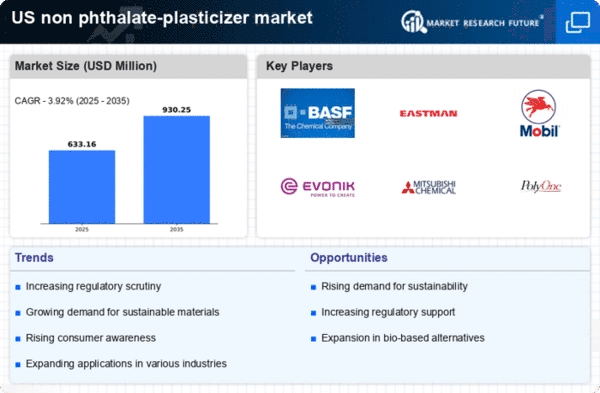
As per MRFR analysis, the US non phthalate-plasticizer market size was estimated at 609.28 $ Million in 2024. The US non phthalate-plasticizer market is projected to grow from 633.16 $ Million in 2025 to 930.25 $ Million by 2035, exhibiting a compound annual growth rate (CAGR) of 3.92% during the forecast period 2025 - 2035.

Key Market Trends & Highlights

The US non phthalate-plasticizer market is experiencing a shift towards sustainability and regulatory compliance.

  • Regulatory compliance and safety standards are increasingly shaping product formulations in the non phthalate-plasticizer market.
  • Sustainability and eco-friendly alternatives are becoming pivotal in driving consumer preferences and industry innovations.
  • Technological innovations in formulation are enhancing the performance and application scope of non phthalate plasticizers.
  • Increasing consumer awareness and regulatory pressure are key drivers propelling the growth of the non phthalate-plasticizer market.

Market Size & Forecast

2024 Market Size 609.28 (USD Million)
2035 Market Size 930.25 (USD Million)
CAGR (2025 - 2035) 3.92%

Major Players

BASF SE (DE), Eastman Chemical Company (US), ExxonMobil Chemical (US), Evonik Industries AG (DE), Mitsubishi Chemical Corporation (JP), PolyOne Corporation (US), Solvay SA (BE), Teknor Apex Company (US)

US Non-phthalate Plasticizer Market Trends

The non phthalate-plasticizer market is currently experiencing a notable shift as industries increasingly prioritize health and environmental safety. This transition is largely driven by regulatory changes and growing consumer awareness regarding the potential hazards associated with traditional phthalate plasticizers. As a result, manufacturers are actively seeking alternatives that not only meet safety standards but also maintain performance characteristics. The demand for non phthalate options is particularly pronounced in sectors such as toys, medical devices, and food packaging, where compliance with stringent regulations is essential. Furthermore, innovations in formulation technology are enabling the development of new non phthalate solutions that offer enhanced functionality, thereby expanding their applicability across various industries. In addition to regulatory influences, market dynamics are also shaped by the increasing emphasis on sustainability. Companies are recognizing the importance of adopting eco-friendly practices, which has led to a rise in the use of bio-based non phthalate plasticizers. This trend aligns with broader environmental goals and reflects a commitment to reducing the carbon footprint associated with plastic production. As the non phthalate-plasticizer market continues to evolve, it appears poised for growth, driven by a combination of regulatory pressures, consumer preferences, and technological advancements that favor safer and more sustainable materials.

Regulatory Compliance and Safety Standards

The non phthalate-plasticizer market is significantly influenced by stringent regulations aimed at ensuring product safety. As authorities implement more rigorous standards, manufacturers are compelled to transition towards safer alternatives. This shift not only addresses health concerns but also enhances market competitiveness, as compliance becomes a key differentiator.

Sustainability and Eco-Friendly Alternatives

There is a growing trend towards sustainability within the non phthalate-plasticizer market. Companies are increasingly adopting bio-based alternatives that align with environmental goals. This movement reflects a broader commitment to reducing ecological impact, appealing to environmentally conscious consumers and stakeholders.

Technological Innovations in Formulation

Advancements in formulation technology are playing a crucial role in the non phthalate-plasticizer market. Innovations are enabling the development of new products that maintain performance while adhering to safety standards. This trend not only broadens the application scope but also enhances the overall appeal of non phthalate solutions.

Market Segment Insights

By Type: Adipates (Largest) vs. benzoates (Fastest-Growing)

In the US non phthalate-plasticizer market, adipates are recognized as the largest segment, commanding a significant share due to their versatile applications in the manufacturing of flexible, durable products. Benzoates, on the other hand, are emerging as the fastest-growing segment, gaining traction as manufacturers increasingly seek sustainable and non-toxic alternatives for various consumer goods. Their ability to provide functional benefits while addressing health concerns has made them increasingly popular among manufacturers and consumers alike. The growth trends in this market are driven by an increasing consumer demand for environmentally friendly products and stringent regulations against harmful materials. Adipates continue to hold their ground due to their established use and reliability, while benzoates are rapidly evolving, carving a niche in the market due to their favorable properties. This dynamic market is also supported by innovations and advancements in production technologies that enhance performance and usability of these plasticizers.

Adipates: Dominant vs. Benzoates: Emerging

Adipates are established as the dominant player in the US non phthalate-plasticizer market, known for their excellent plasticizing properties that enhance flexibility and durability in various applications. They have a proven track record, particularly in constructing products like flooring and coatings. Conversely, benzoates, characterized by their lower volatility and good compatibility with various resins, are emerging as a preferred choice for manufacturers looking to reduce environmental impacts. As benzoates gain more attention for their sustainability profile, they are expected to play a crucial role in shaping the future landscape of the market, capturing the interest of companies focused on eco-friendly alternatives.

By Application: Flooring & Wall Covering (Largest) vs. Toys & Childcare Article (Fastest-Growing)

In the US non phthalate-plasticizer market, the application segment showcases distinct strengths among its categories. Flooring & Wall Covering holds a significant share, being the largest application due to its widespread use in residential and commercial spaces. On the other hand, Film & Sheets and Wire & Cable are also notable but lag behind in terms of overall market share. The Toys & Childcare Article segment has garnered attention for its rapid adoption, reflecting rising consumer awareness about safety and regulations regarding child products. Growth trends in this segment are propelled by increasing health concerns and regulatory shifts favoring non-toxic alternatives. As consumers become more discerning, particularly in areas affecting children's safety, the demand for phthalate-free options in childcare products is surging. Additionally, advancements in material technology and sustainability practices are driving innovation within Flooring & Wall Covering, enhancing its market position and fostering competitive growth.

Flooring & Wall Covering (Dominant) vs. Toys & Childcare Article (Emerging)

Flooring & Wall Covering is the dominant segment within the US non phthalate-plasticizer market, characterized by its extensive applications in residential and commercial properties. Its versatility and aesthetic appeal make it a sought-after choice among builders and homeowners alike. The segment benefits from a steady demand as consumers and businesses increasingly focus on sustainable building materials. On the other hand, Toys & Childcare Article is an emerging segment witnessing rapid growth, driven by heightened regulatory scrutiny and a shift in consumer preferences towards safe, non-toxic materials. This segment captures the interest of manufacturers aiming to align with safety standards while promoting environmental consciousness, thus solidifying its position within the broader market landscape.

Get more detailed insights about US Non-phthalate Plasticizer Market

Key Players and Competitive Insights

The non phthalate-plasticizer market is currently characterized by a dynamic competitive landscape, driven by increasing regulatory scrutiny and a growing consumer preference for safer alternatives. Key players such as BASF SE (Germany), Eastman Chemical Company (US), and ExxonMobil Chemical (US) are actively positioning themselves through innovation and strategic partnerships. BASF SE (Germany) focuses on developing bio-based plasticizers, which aligns with sustainability trends, while Eastman Chemical Company (US) emphasizes its commitment to circular economy principles, enhancing its product portfolio with recycled materials. ExxonMobil Chemical (US) is leveraging its extensive supply chain to optimize production efficiency, thereby maintaining a competitive edge in pricing and availability. Collectively, these strategies contribute to a moderately fragmented market structure, where innovation and sustainability are becoming pivotal in shaping competitive dynamics.

In terms of business tactics, companies are increasingly localizing manufacturing to reduce lead times and enhance responsiveness to market demands. Supply chain optimization remains a critical focus, particularly in light of recent disruptions. The competitive structure of the market appears to be moderately fragmented, with several players vying for market share, yet the influence of major companies is substantial. This collective presence fosters a competitive environment where innovation and operational efficiency are paramount.

In September 2025, BASF SE (Germany) announced the launch of a new line of bio-based plasticizers aimed at reducing environmental impact. This strategic move not only enhances BASF's product offerings but also positions the company as a leader in sustainable solutions, potentially attracting environmentally conscious consumers and businesses. The introduction of these products may significantly influence market trends, as competitors may feel pressured to innovate similarly.

In October 2025, Eastman Chemical Company (US) unveiled a partnership with a leading recycling firm to develop advanced recycling technologies for plasticizers. This collaboration underscores Eastman's commitment to sustainability and circular economy practices, potentially setting a new standard in the industry. By integrating recycled materials into their product lines, Eastman could enhance its market position and appeal to a broader customer base focused on sustainability.

In August 2025, ExxonMobil Chemical (US) expanded its production capacity for non phthalate plasticizers at its facility in Texas. This expansion is indicative of ExxonMobil's strategy to meet the rising demand for safer plasticizers, particularly in the automotive and construction sectors. By increasing production capabilities, ExxonMobil is likely to strengthen its market presence and improve supply chain reliability, which is crucial in a competitive landscape.

As of November 2025, the competitive trends in the non phthalate-plasticizer market are increasingly defined by digitalization, sustainability, and the integration of advanced technologies such as AI. Strategic alliances are becoming more prevalent, as companies recognize the need to collaborate to enhance innovation and operational efficiency. Looking ahead, competitive differentiation is expected to evolve, with a notable shift from price-based competition to a focus on innovation, technology, and supply chain reliability. This transition may redefine market dynamics, compelling companies to invest in R&D and sustainable practices to maintain their competitive edge.


Key Companies in the US Non-phthalate Plasticizer Market market include

Industry Developments

Recent developments in the US Non-Phthalate Plasticizer Market have shown significant activity, particularly among key players such as Mitsubishi Chemical Corporation, ExxonMobil, and BASF. There has been a notable increase in the demand for non-phthalate plasticizers due to growing regulatory pressures and consumer preferences shifting towards sustainable products.

The market is reacting positively to the increased focus on eco-friendly solutions, with companies like Eastman Chemical Company and DOW enhancing their product lines to meet this demand. In terms of mergers and acquisitions, there was a significant acquisition by LG Chem of a specialty chemical firm in July 2023, aiming to bolster its portfolio in the non-phthalate sector.

Also, Kraton Corporation announced a strategic partnership with Solvay in May 2023 to develop novel biobased plasticizers, paving the way for innovation in the market. The market size in the US has experienced robust growth, attributed to various technological advancements and increased production capacities, reflecting a valuation that supports ongoing investment opportunities in the sector.

Over the last couple of years, initiatives aimed at reducing environmental footprints among companies have further accelerated the transition towards non-phthalate solutions, leading to a transformation in product offerings and market dynamics.

Future Outlook

US Non-phthalate Plasticizer Market Future Outlook

The non phthalate-plasticizer market is projected to grow at 3.92% CAGR from 2024 to 2035, driven by regulatory changes, consumer demand for safer products, and technological advancements.

New opportunities lie in:

  • Development of bio-based non phthalate plasticizers for sustainable applications.
  • Expansion into emerging markets with tailored product offerings.
  • Investment in R&D for innovative formulations enhancing performance and safety.

By 2035, the market is expected to achieve robust growth, positioning itself as a leader in sustainable plasticizer solutions.

Market Segmentation

US Non-phthalate Plasticizer Market Type Outlook

  • Adipates
  • Benzoates
  • Trimillitates

US Non-phthalate Plasticizer Market Application Outlook

  • Flooring & Wall Covering
  • Film & Sheets
  • Wire & Cable
  • Toys & Childcare Article

Report Scope

MARKET SIZE 2024609.28(USD Million)
MARKET SIZE 2025633.16(USD Million)
MARKET SIZE 2035930.25(USD Million)
COMPOUND ANNUAL GROWTH RATE (CAGR)3.92% (2024 - 2035)
REPORT COVERAGERevenue Forecast, Competitive Landscape, Growth Factors, and Trends
BASE YEAR2024
Market Forecast Period2025 - 2035
Historical Data2019 - 2024
Market Forecast UnitsUSD Million
Key Companies Profiled["BASF SE (DE)", "Eastman Chemical Company (US)", "ExxonMobil Chemical (US)", "Evonik Industries AG (DE)", "Mitsubishi Chemical Corporation (JP)", "PolyOne Corporation (US)", "Solvay SA (BE)", "Teknor Apex Company (US)"]
Segments CoveredType, Application
Key Market OpportunitiesGrowing demand for safer alternatives drives innovation in the non phthalate-plasticizer market.
Key Market DynamicsRising consumer demand for safer alternatives drives innovation in the non phthalate-plasticizer market.
Countries CoveredUS

Leave a Comment

Download Free Sample

Kindly complete the form below to receive a free sample of this Report

Compare Licence

×
Features License Type
Single User Multiuser License Enterprise User
Price $4,950 $5,950 $7,250
Maximum User Access Limit 1 User Upto 10 Users Unrestricted Access Throughout the Organization
Free Customization
Direct Access to Analyst
Deliverable Format
Platform Access
Discount on Next Purchase 10% 15% 15%
Printable Versions