Request Free Sample ×

Kindly complete the form below to receive a free sample of this Report

* Please use a valid business email

Leading companies partner with us for data-driven Insights

clients tt-cursor
Hero Background
English
Chinese
French
Japanese
Korean
German
Spanish

Refurbished Medical Devices Market Trends

ID: MRFR/MED/0774-HCR
80 Pages
Nidhi Mandole
Last Updated: April 06, 2026

Refurbished Medical Devices Market Research Report: Size, Share, Trend Analysis By Device Type (Imaging Equipment, Surgical Instruments, Patient Monitoring Devices, Therapeutic Equipment), By End Users (Hospitals, Diagnostic Centers, Clinics, Research Institutions), By Product Condition (Like New, Refurbished, Used), By Applications (Cardiology, Orthopedics, Neurology, General Surgery) and By Region (North America, Europe, South America, Asia Pacific, Middle East and Africa) - Growth Outlook & Industry Forecast 2025 To 2035

Share:
Download PDF ×

We do not share your information with anyone. However, we may send you emails based on your report interest from time to time. You may contact us at any time to opt-out.

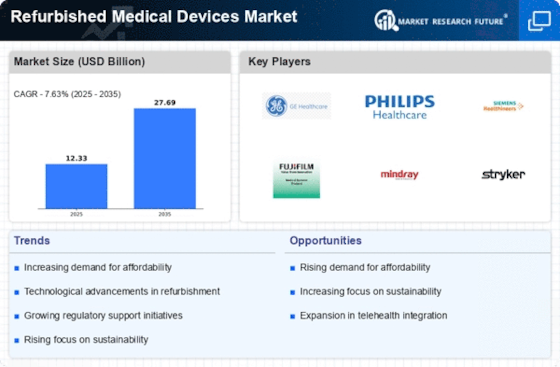
Refurbished Medical Devices Market Infographic
Purchase Options

Market Trends

Key Emerging Trends in the Refurbished Medical Devices Market

Growing Demand: As more people look for affordable alternatives to brand-new equipment, the market for reconditioned medical devices is seeing a boom in demand. Refurbished equipment is a good option for healthcare organizations looking to cut costs. Cost reductions: The significant cost reductions linked to reconditioned medical equipment are one of the main forces behind industry changes. Clinics and hospitals may get top-notch equipment at a fraction of the price, which enables them to manage resources more effectively. Technological Advancements: Refurbished medical equipment sometimes has newer technology in addition to being reasonably priced. Healthcare institutions are more likely to update when newer models are released, which keeps the market supplied with high-quality reconditioned equipment. Environmental Sustainability: As refurbished electronics conform to environmentally friendly standards, the market is being impacted by the emphasis on sustainability. Refurbishing medical equipment to increase its lifespan lowers electronic waste and promotes a more sustainable healthcare sector. Regulatory Compliance: The healthcare sector's stricter rules are encouraging the standardization of reconditioned medical equipment. Adherence to regulatory guidelines guarantees the security and efficiency of these gadgets, fostering confidence among medical experts. Growing Knowledge: One significant market development is the growing knowledge of healthcare professionals regarding the advantages of reconditioned equipment. As word gets out about these goods' dependability and affordability, more organizations are prepared to look into and make investments in refurbished solutions. Collaborations and Partnerships: Refurbished medical equipment manufacturers are teaming up with healthcare providers in strategic alliances. Through these partnerships, the supply chain will be streamlined, and a consistent supply of high-quality reconditioned equipment will be provided to satisfy the increasing demand. Diagnostic Imaging Equipment: MRI machines and X-ray machines account for a sizable portion of the market for reconditioned medical equipment. Healthcare institutions are able to improve diagnostic capabilities without sacrificing quality because of the low cost of used imaging equipment. Dental and Surgical tools: In the market for reconditioned medical devices, dental and surgical tools are starting to take the lead alongside diagnostic imaging equipment. Both larger hospitals and smaller healthcare institutions are benefiting from the cost of reconditioned surgical instruments.


Author
Author Profile
Nidhi Mandole
Senior Research Analyst

She is an extremely curious individual currently working in Healthcare and Medical Devices Domain. Nidhi is comfortably versed in data centric research backed by healthcare educational background. She leverages extensive data mining and analytics tools such as Primary and Secondary Research, Statistical Analysis, Machine Learning, Data Modelling. Her key role also involves Technical Sales Support, Client Interaction and Project management within the Healthcare team. Lastly, she showcases extensive affinity towards learning new skills and remain fascinated in implementing them.

Leave a Comment

FAQs

What is the current valuation of the Refurbished Medical Devices Market?

<p>The market valuation was 12.33 USD Billion in 2024.</p>

What is the projected market size for the Refurbished Medical Devices Market by 2035?

<p>The market is projected to reach 27.69 USD Billion by 2035.</p>

What is the expected CAGR for the market during the forecast period?

The expected CAGR for the market from 2025 to 2035 is 7.63%.

Which segments are included in the market?

Key segments include Imaging Equipment, Surgical Instruments, Patient Monitoring Devices, and Therapeutic Equipment.

What was the valuation of Imaging Equipment in 2024?

<p>The valuation of Imaging Equipment was 3.7 USD Billion in 2024.</p>

How much is the Refurbished segment expected to grow by 2035?

<p>The Refurbished segment is projected to grow from 6.0 USD Billion in 2024 to 13.5 USD Billion by 2035.</p>

Which end-user segments are driving the Refurbished Medical Devices Market?

<p>End-user segments include Hospitals, Diagnostic Centers, Clinics, and Research Institutions.</p>

What was the market size for Surgical Instruments in 2024?

<p>The market size for Surgical Instruments was 2.5 USD Billion in 2024.</p>

Who are the key players in the Refurbished Medical Devices Market?

<p>Key players include GE Healthcare, Philips Healthcare, Siemens Healthineers, and Fujifilm Medical Systems.</p>

What is the projected valuation for Patient Monitoring Devices by 2035?

<p>The projected valuation for Patient Monitoring Devices is expected to reach 6.8 USD Billion by 2035.</p>

Market Summary

According to Market Research Future analysis, the Refurbished Medical Devices Market Size was valued at USD 12.33 Billion in 2024 & the market is projected to grow from USD 13.27 Billion in 2025 to USD 27.69 Billion by 2035, registering a CAGR of 7.63% during the forecast period 2025–2035. North America led the market with over 45% share, generating around USD 5.55 billion in revenue. The market is primarily driven by rising healthcare cost pressures and the need for affordable diagnostic and treatment solutions. Healthcare providers increasingly adopt refurbished equipment to expand access while maintaining quality care standards and operational efficiency globally. 
 
According to World Health Organization, global healthcare spending reached over USD 9.8 trillion, accounting for nearly 10% of GDP, encouraging cost-efficient solutions like refurbished devices. Additionally, Institute for Health Metrics and Evaluation highlights increasing healthcare demand, with global disease burden rising significantly, reinforcing adoption of affordable medical technologies across emerging and developed healthcare systems.

Key Market Trends & Highlights

The Refurbished Medical Devices Market is experiencing robust growth driven by sustainability and cost efficiency.

  • North America holds over 45% market share in 2024, driven by high healthcare spending and strong regulatory support. Europe market reached USD 3.70 billion in 2024, accounting for 30% share with sustainability-driven refurbishment adoption. Imaging equipment dominates with 42% share, driven by increasing global diagnostic demand and rising chronic disease prevalence worldwide. Hospitals account for 48% share, supported by growing patient volume and need for cost-efficient, high-performance medical equipment solutions. Cardiology leads applications with 38% share, fueled by increasing cardiovascular disease burden and demand for affordable diagnostic technologies.

Market Size & Forecast

2024 Market Size 12.33 (Billion USD)
2035 Market Size 27.69 (Billion USD)
CAGR (2025 - 2035) 7.63%
Largest Regional Market Share in 2024 North America

Major Players

Companies such as <a href="https://www.gehealthcare.in/products/goldseal-refurbished-systems">GE Healthcare</a> (US), Philips Healthcare (NL), Siemens Healthineers (DE), Fujifilm Medical Systems (JP), Mindray (CN), Stryker (US), Olympus Corporation (JP), Nihon Kohden Corporation (JP), Interscope Medical (US) are some of the major participants in the global market.

Market Trends

The Refurbished Medical Devices Market is currently experiencing a notable transformation, driven by various factors that influence healthcare systems globally. The increasing demand for cost-effective medical solutions, coupled with the rising emphasis on sustainability, appears to be reshaping the landscape of medical equipment procurement. Healthcare providers are increasingly recognizing the value of refurbished devices, which not only offer significant savings but also contribute to environmental conservation by reducing waste. This trend suggests a shift in perception, where refurbished devices are no longer viewed as inferior but rather as viable alternatives that meet stringent quality standards.

Moreover, advancements in technology and rigorous refurbishment processes have enhanced the reliability and performance of these devices, further bolstering their acceptance in clinical settings. As healthcare facilities strive to optimize budgets while maintaining high-quality patient care, the market is likely to expand, attracting a diverse range of stakeholders. The interplay between economic pressures and the need for innovative solutions indicates a promising future for this sector, as it adapts to the evolving demands of the healthcare industry.

Growing Acceptance of Refurbished Devices

There is an increasing recognition among healthcare providers regarding the quality and reliability of refurbished medical equipment. This trend suggests that many institutions are beginning to prioritize cost savings without compromising on patient care.

Centers for Disease Control and Prevention reports over 60% of healthcare facilities in cost-sensitive regions prioritize affordable equipment procurement, while Pan American Health Organization highlights that improving access to essential medical technologies significantly enhances healthcare delivery efficiency, supporting increased adoption of refurbished devices across hospitals and clinics globally.

Sustainability Initiatives

The emphasis on environmental sustainability is influencing purchasing decisions in the healthcare sector. Refurbished medical equipment align with these initiatives, as they help reduce waste and promote a circular economy.

United Nations Population Fund emphasizes sustainable healthcare systems to support over 8 billion global population needs, while World Health Organization estimates healthcare waste contributes up to 15% hazardous materials, encouraging reuse strategies like refurbishment to reduce environmental impact and promote circular healthcare economies.

Technological Advancements in Refurbishment

Innovations in refurbishment processes are enhancing the performance and safety of refurbished devices. This trend indicates that as technology evolves, the quality of refurbished products is likely to improve, further driving market growth.

European Centre for Disease Prevention and Control highlights increasing reliance on advanced diagnostic technologies across Europe, while Médecins Sans Frontières reports improved medical equipment performance in low-resource settings due to upgraded refurbished technologies, enabling broader access to quality care and supporting market expansion.

Refurbished Medical Devices Market Market Drivers

Cost Efficiency in Healthcare

The rising cost of healthcare has prompted many institutions to seek cost-effective solutions, leading to an increased interest in the Refurbished Medical Devices Market. Refurbished devices often provide a more affordable alternative to new equipment, allowing healthcare providers to allocate resources more efficiently.
 
For instance, hospitals can save up to 50% on equipment costs by opting for refurbished devices. This trend is particularly evident in developing regions where budget constraints are more pronounced. As healthcare systems strive to maintain quality while managing expenses, the demand for refurbished medical devices is likely to grow, indicating a shift in purchasing strategies across the industry.

Regulatory Support and Standards

Regulatory bodies have increasingly recognized the importance of refurbished medical devices, leading to the establishment of stringent standards and guidelines. This regulatory support enhances the credibility of the Refurbished Medical Devices Market, as it assures healthcare providers of the safety and efficacy of refurbished products.
 
Compliance with these regulations not only fosters trust among consumers but also encourages manufacturers to invest in refurbishment processes. As a result, the market is witnessing a surge in refurbished devices that meet high-quality standards, which could potentially expand market share and consumer acceptance in the coming years.

Environmental Sustainability Concerns

The emphasis on environmental sustainability has become a pivotal driver for the Refurbished Medical Devices Market. As healthcare organizations strive to reduce their carbon footprint, refurbished devices present an eco-friendly alternative to new equipment. By extending the lifecycle of medical devices, refurbishment practices contribute to waste reduction and resource conservation.
 
This alignment with sustainability goals not only appeals to environmentally conscious consumers but also positions refurbished devices as a responsible choice in the healthcare sector. The market is likely to benefit from this trend as more institutions adopt sustainable practices in their procurement strategies.

Increased Demand for Medical Equipment

The growing demand for medical equipment, driven by an aging population and rising chronic diseases, has created a favorable environment for the Refurbished Medical Devices Market. As healthcare facilities expand to meet patient needs, the pressure to acquire more equipment intensifies.
 
Refurbished devices offer a viable solution to this demand, providing access to essential medical technology without the prohibitive costs associated with new devices. Market data suggests that the refurbishment sector could see a compound annual growth rate of approximately 10% over the next few years, reflecting the increasing reliance on refurbished solutions to address healthcare challenges.

Technological Innovations in Refurbishment

Technological advancements in refurbishment processes are enhancing the quality and reliability of refurbished medical devices, thereby bolstering the Refurbished Medical Devices Market. Innovations such as advanced diagnostic tools and automated refurbishment techniques are improving the efficiency of the refurbishment process.
 
These developments ensure that refurbished devices meet or exceed the performance of new equipment, which is crucial for gaining the trust of healthcare providers. As technology continues to evolve, the market is expected to witness an influx of high-quality refurbished devices, potentially reshaping purchasing decisions and expanding market opportunities.

Market Segment Insights

By Device Type: Imaging Equipment (Largest) vs. Surgical Instruments (Fastest-Growing)

The market displays a diverse range of device types, with imaging equipment holding the largest share in the refurbished medical devices market at 42%. This segment benefits from a robust demand for advanced diagnostic tools, driven by a rising prevalence of chronic diseases and the need for accurate imaging solutions. Surgical Instruments follow, showcasing significant relevance due to their essential role in surgical procedures and the increasing adoption of minimally invasive techniques.

Imaging Equipment (Dominant) vs. Surgical Instruments (Emerging)

Imaging Equipment stands out as the dominant segment within the market, largely due to the technical advancements that enhance diagnostic processes while providing cost-effective solutions to healthcare facilities. The demand for refurbished imaging devices, such as MRI machines and ultrasound equipment, has surged as hospitals seek to optimize budgets without compromising quality. Meanwhile, Surgical Instruments are emerging as a crucial segment, attracting attention for their affordability and reliability in surgical operations. The growing trends towards minimally invasive procedures further favor this segment, as it offers surgical instruments that meet the evolving needs of modern healthcare.

By End User: Hospitals (Largest) vs. Clinics (Fastest-Growing)

Hospitals dominate as the largest end-user segment in the refurbished medical devices market, accounting for a 48% share and a substantial portion of overall demand. They are followed by diagnostic centers, clinics, and research institutions, each contributing to the diverse landscape of healthcare facilities requiring refurbished devices. The growing preference among hospitals for cost-effective medical equipment continues to solidify their leading position in this market.

Hospitals: (Dominant) vs. Clinics (Emerging)

Hospitals represent the dominant force in the market, as they require a vast array of medical equipment for various functions, such as surgeries and critical care. They benefit from purchasing refurbished devices, which offer high-quality equipment while reducing costs significantly. In contrast, clinics are emerging rapidly as a significant segment, driven by the increasing number of outpatient services and a growing focus on affordable healthcare solutions. As clinics seek to balance performance with budget constraints, the refurbishment market provides them with an appealing option to acquire reliable medical devices without hefty investments.

By Product Condition: Like New (Largest) vs. Refurbished (Fastest-Growing)

The 'Product Condition' segment within the refurbished medical devices market showcases diverse offerings categorized primarily into 'Like New', 'Refurbished', and 'Used'. The 'Like New' condition represents the largest market share at 46%, appealing to healthcare providers seeking the closest alternative to brand-new equipment. Following closely, the 'Refurbished' category is recognized for its quality assurance and is increasingly preferred due to its reliability and cost-effectiveness, capturing a growing share of the market.

Like New (Dominant) vs. Refurbished (Emerging)

In the market, the 'Like New' segment stands out as the dominant player, providing devices that exhibit minimal signs of usage, often accompanied by warranties that instill confidence in buyers. These devices cater to premium healthcare facilities that prioritize high-quality standards and safety. Conversely, the 'Refurbished' segment has emerged as a significant contender, focusing on devices that have undergone extensive refurbishment processes, making them nearly as reliable as new. This segment's appeal lies in its cost efficiency and sustainability, leveraging environmental concerns while meeting the stringent quality demands of various medical contexts.

By Application: Cardiology (Largest) vs. Orthopedics (Fastest-Growing)

In the Refurbished Medical Devices Market, the application segment displays a diverse distribution, with cardiology emerging as the largest contributor, accounting for 38% of the market share. This sector encapsulates a range of devices including electrocardiograms and angioplasty equipment, appealing to healthcare providers focused on cost-effective solutions. Meanwhile, orthopedics, positioned as the fastest-growing segment, is gaining traction due to heightened demand for refurbished surgical instruments and imaging devices, particularly driven by rising aging populations and the incidence of chronic musculoskeletal conditions.

Cardiology (Dominant) vs. Orthopedics (Emerging)

Cardiology represents a dominant segment within the market, characterized by its extensive range of both diagnostic and therapeutic devices. The refurbishment of these devices supports healthcare facilities in managing budgets while retaining high-quality care. In contrast, the orthopedic segment is emerging rapidly as healthcare systems increasingly adopt refurbished orthopedic devices such as surgical tables and imaging equipment. The growth in this area is propelled by advancements in refurbishment technologies, allowing for improved reliability and performance of these devices, meeting the demands of busy surgical environments.

Get more detailed insights about Refurbished Medical Devices Market Research Report- Forecast to 2035

Regional Insights

North America : Market Leader in Innovation

North America leads in the Refurbished Medical Devices Market size, accounting for over 45% of the global revenue in 2024. The region's growth is driven by increasing healthcare costs, a rising demand for cost-effective medical solutions, and stringent regulations promoting the use of refurbished devices. The regulatory environment, particularly in the U.S., encourages the adoption of refurbished devices, enhancing their market presence.

Centers for Disease Control and Prevention reports that 6 in 10 adults in the U.S. have at least one chronic disease, increasing demand for diagnostic equipment, while Institute for Health Metrics and Evaluation highlights rising healthcare costs exceeding USD 4 trillion in the U.S., reinforcing demand for cost-effective refurbished solutions.

The United States is the leading country in this sector, with significant contributions from key players like GE Healthcare and Stryker. Canada also plays a vital role, focusing on sustainable healthcare solutions. The competitive landscape is characterized by a mix of established companies and emerging players, all striving to innovate and meet the growing demand for affordable healthcare solutions. The presence of major manufacturers ensures a robust supply chain and product availability.

Europe : Growing Market with Regulations

Europe Refurbished Medical Devices Market size was valued at USD 3.70 billion in 2024, making it the second-largest regional market with a 30% share. The growth in this region is fueled by increasing healthcare expenditures, a focus on sustainability, and regulatory frameworks that support the refurbishment of medical devices. The European Union has implemented regulations that encourage the use of refurbished devices, making them a viable option for healthcare providers.

European Centre for Disease Prevention and Control indicates increasing chronic disease prevalence across Europe, while World Health Organization reports Europe’s aging population will reach over 25% aged 60+ by 2050, driving demand for sustainable and cost-efficient medical device solutions including refurbished equipment.

Leading countries in Europe include Germany, France, and the Netherlands, where major players like Philips Healthcare and Siemens Healthineers are based. The competitive landscape is marked by a strong emphasis on quality and compliance with EU regulations. The presence of established companies alongside innovative startups fosters a dynamic market environment, ensuring a steady supply of high-quality refurbished medical monitors.

Asia-Pacific : Emerging Market with Potential

Asia-Pacific is an emerging powerhouse in the refurbished medical devices market, holding about 20% of the global market share. The region's growth is driven by increasing healthcare needs, a growing aging population, and rising healthcare costs. Countries like China and India are witnessing a surge in demand for cost-effective medical solutions, supported by government initiatives aimed at improving healthcare access and affordability.

China is the largest market in the region, followed by India, where local manufacturers are increasingly entering the refurbished market. The competitive landscape is evolving, with both domestic and international players striving to capture market share. Key players like Mindray and Fujifilm Medical Systems are expanding their offerings, ensuring a diverse range of refurbished medical devices to meet the growing demand in the region.

Middle East and Africa : Untapped Market Opportunities

The Middle East and Africa represent a resource-rich frontier for the refurbished medical devices market, holding approximately 5% of the global market share. The growth in this region is driven by increasing investments in healthcare infrastructure, a rising prevalence of chronic diseases, and a growing awareness of the benefits of refurbished devices. Governments are beginning to recognize the importance of affordable healthcare solutions, which is catalyzing market growth.

Leading countries include South Africa and the UAE, where there is a growing interest in sustainable healthcare practices. The competitive landscape is still developing, with a mix of local and international players. Companies are focusing on establishing partnerships and collaborations to enhance their market presence and improve access to refurbished medical devices, addressing the needs of a diverse population.

Key Players and Competitive Insights

The Refurbished Medical Devices Market is characterized by a dynamic and evolving landscape where various players compete to capture market share while meeting stringent regulatory standards. As healthcare institutions increasingly adopt cost-effective solutions without compromising quality, the demand for refurbished medical devices is on the rise.  This market includes a diverse range of products, such as imaging equipment, surgical instruments, and patient monitoring devices, each playing a crucial role in enhancing healthcare delivery.
 
The competitive insights reveal key trends such as the growing acceptance of refurbished devices by healthcare providers, the emphasis on sustainability, and the requirement for rigorous certification processes that ensure safety and efficacy. Companies are leveraging technological advancements and strategic partnerships to enhance their offerings and to cater to a broader segment of healthcare facilities, ranging from large hospitals to small clinics. Hitachi has established a significant presence in the Refurbished Medical Devices Market, leveraging its reputation for high-quality imaging equipment and strong customer service.
 
The company focuses on refurbishing its medical imaging systems, ensuring compliance with industry standards, which reinforces its commitment to patient safety and operational efficiency.  Hitachi's strengths lie in its advanced technological capabilities, extensive research and development, and a strong brand reputation that instills trust among healthcare providers. Furthermore, the company's emphasis on sustainability by promoting reused technologies aligns with the growing demand for eco-friendly healthcare solutions, thereby enhancing its competitive edge in the refurbished devices market. Stryker stands as a formidable player in the Refurbished Medical Devices Market, known for its diverse portfolio that includes surgical equipment, orthopedic devices, and patient care solutions.
 
The company's strength is rooted in its commitment to innovation and a comprehensive understanding of market needs, making it a trusted partner in the healthcare sector. Stryker's extensive market presence is bolstered by its strategic mergers and acquisitions, which have expanded its capabilities and solidified its position among leading players in the industry.  The focus on refurbishing key products, such as surgical instruments and imaging devices, allows Stryker to offer cost-effective alternatives while maintaining high standards of quality and performance. This adaptability and focus on customer-centric solutions enable Stryker to meet the evolving needs of healthcare providers globally, thereby reinforcing its status as a leader in the market.

Key Companies in the Refurbished Medical Devices Market include

Industry Developments

Recent developments in the Refurbished Medical Devices Market indicate a surge in demand for cost-effective medical equipment across hospitals and healthcare facilities. Companies like GE Healthcare, Siemens Healthineers, and Philips Healthcare continue to expand their refurbishing capabilities to meet this growing need while ensuring quality and compliance with health regulations.

In March 2023, Apex Medical Equipment introduced a series of refurbished surgical robots that are AI-enabled and equipped with sophisticated algorithms. This technology is designed to improve the precision of minimally invasive surgeries. 

In June 2023, Global MedTech Solutions collaborated with a significant pharmaceutical organization to develop refurbished infusion pumps that are equipped with intelligent monitoring systems that dynamically adjust dosages. 

Siemens Healthineers expanded its refurbished medical device portfolio in October 2023 to address the increasing demand for affordable diagnostic equipment.

Future Outlook

Refurbished Medical Devices Market Future Outlook

The Refurbished Medical Devices Market size is projected to reach USD 27.69 Billion by 2035, growing at a CAGR of 7.63%, driven by cost efficiency, technological advancements, and increasing demand for healthcare accessibility.

New opportunities lie in:

  • <p>Expansion of telehealth services with refurbished diagnostic equipment. Partnerships with hospitals for bulk refurbishment contracts. Development of specialized refurbishment programs for high-demand devices.</p>

By 2035, the market is expected to be robust, reflecting substantial growth and innovation.

Market Segmentation

Refurbished Medical Devices Market End User Outlook

  • Hospitals
  • Diagnostic Centers
  • Clinics
  • Research Institutions

Refurbished Medical Devices Market Application Outlook

  • Cardiology
  • Orthopedics
  • Neurology
  • General Surgery

Refurbished Medical Devices Market Device Type Outlook

  • Imaging Equipment
  • Surgical Instruments
  • Patient Monitoring Devices
  • Therapeutic Equipment

Refurbished Medical Devices Market Product Condition Outlook

  • Like New
  • Refurbished
  • Used

Report Scope

MARKET SIZE 2024 12.33(USD Billion)
MARKET SIZE 2025 13.27(USD Billion)
MARKET SIZE 2035 27.69(USD Billion)
COMPOUND ANNUAL GROWTH RATE (CAGR) 7.63% (2025 - 2035)
REPORT COVERAGE Revenue Forecast, Competitive Landscape, Growth Factors, and Trends
BASE YEAR 2024
Market Forecast Period 2025 - 2035
Historical Data 2019 - 2024
Market Forecast Units USD Billion
Key Companies Profiled GE Healthcare (US), Philips Healthcare (NL), Siemens Healthineers (DE), Fujifilm Medical Systems (JP), Mindray (CN), Stryker (US), Olympus Corporation (JP), Nihon Kohden Corporation (JP), Interscope Medical (US)
Segments Covered Device Type, End Users, Product Condition, Applications, Regional
Key Market Opportunities Growing demand for cost-effective healthcare solutions drives expansion in the market.
Key Market Dynamics Rising demand for cost-effective healthcare solutions drives growth in the market.
Countries Covered North America, Europe, APAC, South America, MEA

FAQs

What is the current valuation of the Refurbished Medical Devices Market?

<p>The market valuation was 12.33 USD Billion in 2024.</p>

What is the projected market size for the Refurbished Medical Devices Market by 2035?

<p>The market is projected to reach 27.69 USD Billion by 2035.</p>

What is the expected CAGR for the market during the forecast period?

The expected CAGR for the market from 2025 to 2035 is 7.63%.

Which segments are included in the market?

Key segments include Imaging Equipment, Surgical Instruments, Patient Monitoring Devices, and Therapeutic Equipment.

What was the valuation of Imaging Equipment in 2024?

<p>The valuation of Imaging Equipment was 3.7 USD Billion in 2024.</p>

How much is the Refurbished segment expected to grow by 2035?

<p>The Refurbished segment is projected to grow from 6.0 USD Billion in 2024 to 13.5 USD Billion by 2035.</p>

Which end-user segments are driving the Refurbished Medical Devices Market?

<p>End-user segments include Hospitals, Diagnostic Centers, Clinics, and Research Institutions.</p>

What was the market size for Surgical Instruments in 2024?

<p>The market size for Surgical Instruments was 2.5 USD Billion in 2024.</p>

Who are the key players in the Refurbished Medical Devices Market?

<p>Key players include GE Healthcare, Philips Healthcare, Siemens Healthineers, and Fujifilm Medical Systems.</p>

What is the projected valuation for Patient Monitoring Devices by 2035?

<p>The projected valuation for Patient Monitoring Devices is expected to reach 6.8 USD Billion by 2035.</p>

  1. SECTION I: EXECUTIVE SUMMARY AND KEY HIGHLIGHTS |
    1. EXECUTIVE SUMMARY | |
      1. Market Overview | |
      2. Key Findings | |
      3. Market Segmentation | |
      4. Competitive Landscape | |
      5. Challenges and Opportunities | |
      6. Future Outlook 2
  2. SECTION II: SCOPING, METHODOLOGY AND MARKET STRUCTURE |
    1. MARKET INTRODUCTION | |
      1. Definition | |
      2. Scope of the study | | |
    2. RESEARCH METHODOLOGY | |
      1. Overview | |
      2. Data Mining | |
      3. Secondary Research | |
      4. Primary Research | | |
      5. Forecasting Model | |
      6. Market Size Estimation | | |
      7. Data Triangulation | |
      8. Validation 3
  3. SECTION III: QUALITATIVE ANALYSIS |
    1. MARKET DYNAMICS | |
      1. Overview | |
      2. Drivers | |
      3. Restraints | |
      4. Opportunities |
    2. MARKET FACTOR ANALYSIS | |
      1. Value chain Analysis | |
      2. Porter's Five Forces Analysis | | |
      3. COVID-19 Impact Analysis | | |
  4. SECTION IV: QUANTITATIVE ANALYSIS |
    1. Healthcare, BY Device Type (USD Billion) | |
      1. Imaging Equipment | |
      2. Surgical Instruments | |
      3. Patient Monitoring Devices | |
      4. Therapeutic Equipment |
    2. Healthcare, BY End User (USD Billion) | |
      1. Hospitals | |
      2. Diagnostic Centers | |
      3. Clinics | |
      4. Research Institutions |
    3. Healthcare, BY Product Condition (USD Billion) | |
      1. Like New | |
      2. Refurbished | |
      3. Used |
    4. Healthcare, BY Application (USD Billion) | |
      1. Cardiology | |
      2. Orthopedics | |
      3. Neurology | |
      4. General Surgery |
    5. Healthcare, BY Region (USD Billion) | |
      1. North America | | |
      2. Europe | | |
      3. APAC | | |
      4. South America | | |
      5. MEA | | |
  5. SECTION V: COMPETITIVE ANALYSIS |
    1. Competitive Landscape | |
      1. Overview | |
      2. Competitive Analysis | |
      3. Market share Analysis | |
      4. Major Growth Strategy in the Healthcare | |
      5. Competitive Benchmarking | |
      6. Leading Players in Terms of Number of Developments in the Healthcare | |
      7. Key developments and growth strategies | | |
      8. Major Players Financial Matrix | | |
    2. Company Profiles | |
      1. GE Healthcare (US) | | |
      2. Philips Healthcare (NL) | | |
      3. Siemens Healthineers (DE) | | |
      4. Fujifilm Medical Systems (JP) | | |
      5. Mindray (CN) | | |
      6. Stryker (US) | | |
      7. Olympus Corporation (JP) | | |
      8. Nihon Kohden Corporation (JP) | | |
      9. Interscope Medical (US) | | |
    3. Appendix | |
      1. References | |
      2. Related Reports 6 LIST OF FIGURES |
    4. MARKET SYNOPSIS |
    5. NORTH AMERICA MARKET ANALYSIS |
    6. US MARKET ANALYSIS BY DEVICE TYPE |
    7. US MARKET ANALYSIS BY END USER |
    8. US MARKET ANALYSIS BY PRODUCT CONDITION |
    9. US MARKET ANALYSIS BY APPLICATION |
    10. CANADA MARKET ANALYSIS BY DEVICE TYPE |
    11. CANADA MARKET ANALYSIS BY END USER |
    12. CANADA MARKET ANALYSIS BY PRODUCT CONDITION |
    13. CANADA MARKET ANALYSIS BY APPLICATION |
    14. EUROPE MARKET ANALYSIS |
    15. GERMANY MARKET ANALYSIS BY DEVICE TYPE |
    16. GERMANY MARKET ANALYSIS BY END USER |
    17. GERMANY MARKET ANALYSIS BY PRODUCT CONDITION |
    18. GERMANY MARKET ANALYSIS BY APPLICATION |
    19. UK MARKET ANALYSIS BY DEVICE TYPE |
    20. UK MARKET ANALYSIS BY END USER |
    21. UK MARKET ANALYSIS BY PRODUCT CONDITION |
    22. UK MARKET ANALYSIS BY APPLICATION |
    23. FRANCE MARKET ANALYSIS BY DEVICE TYPE |
    24. FRANCE MARKET ANALYSIS BY END USER |
    25. FRANCE MARKET ANALYSIS BY PRODUCT CONDITION |
    26. FRANCE MARKET ANALYSIS BY APPLICATION |
    27. RUSSIA MARKET ANALYSIS BY DEVICE TYPE |
    28. RUSSIA MARKET ANALYSIS BY END USER |
    29. RUSSIA MARKET ANALYSIS BY PRODUCT CONDITION |
    30. RUSSIA MARKET ANALYSIS BY APPLICATION |
    31. ITALY MARKET ANALYSIS BY DEVICE TYPE |
    32. ITALY MARKET ANALYSIS BY END USER |
    33. ITALY MARKET ANALYSIS BY PRODUCT CONDITION |
    34. ITALY MARKET ANALYSIS BY APPLICATION |
    35. SPAIN MARKET ANALYSIS BY DEVICE TYPE |
    36. SPAIN MARKET ANALYSIS BY END USER |
    37. SPAIN MARKET ANALYSIS BY PRODUCT CONDITION |
    38. SPAIN MARKET ANALYSIS BY APPLICATION |
    39. REST OF EUROPE MARKET ANALYSIS BY DEVICE TYPE |
    40. REST OF EUROPE MARKET ANALYSIS BY END USER |
    41. REST OF EUROPE MARKET ANALYSIS BY PRODUCT CONDITION |
    42. REST OF EUROPE MARKET ANALYSIS BY APPLICATION |
    43. APAC MARKET ANALYSIS |
    44. CHINA MARKET ANALYSIS BY DEVICE TYPE |
    45. CHINA MARKET ANALYSIS BY END USER |
    46. CHINA MARKET ANALYSIS BY PRODUCT CONDITION |
    47. CHINA MARKET ANALYSIS BY APPLICATION |
    48. INDIA MARKET ANALYSIS BY DEVICE TYPE |
    49. INDIA MARKET ANALYSIS BY END USER |
    50. INDIA MARKET ANALYSIS BY PRODUCT CONDITION |
    51. INDIA MARKET ANALYSIS BY APPLICATION |
    52. JAPAN MARKET ANALYSIS BY DEVICE TYPE |
    53. JAPAN MARKET ANALYSIS BY END USER |
    54. JAPAN MARKET ANALYSIS BY PRODUCT CONDITION |
    55. JAPAN MARKET ANALYSIS BY APPLICATION |
    56. SOUTH KOREA MARKET ANALYSIS BY DEVICE TYPE |
    57. SOUTH KOREA MARKET ANALYSIS BY END USER |
    58. SOUTH KOREA MARKET ANALYSIS BY PRODUCT CONDITION |
    59. SOUTH KOREA MARKET ANALYSIS BY APPLICATION |
    60. MALAYSIA MARKET ANALYSIS BY DEVICE TYPE |
    61. MALAYSIA MARKET ANALYSIS BY END USER |
    62. MALAYSIA MARKET ANALYSIS BY PRODUCT CONDITION |
    63. MALAYSIA MARKET ANALYSIS BY APPLICATION |
    64. THAILAND MARKET ANALYSIS BY DEVICE TYPE |
    65. THAILAND MARKET ANALYSIS BY END USER |
    66. THAILAND MARKET ANALYSIS BY PRODUCT CONDITION |
    67. THAILAND MARKET ANALYSIS BY APPLICATION |
    68. INDONESIA MARKET ANALYSIS BY DEVICE TYPE |
    69. INDONESIA MARKET ANALYSIS BY END USER |
    70. INDONESIA MARKET ANALYSIS BY PRODUCT CONDITION |
    71. INDONESIA MARKET ANALYSIS BY APPLICATION |
    72. REST OF APAC MARKET ANALYSIS BY DEVICE TYPE |
    73. REST OF APAC MARKET ANALYSIS BY END USER |
    74. REST OF APAC MARKET ANALYSIS BY PRODUCT CONDITION |
    75. REST OF APAC MARKET ANALYSIS BY APPLICATION |
    76. SOUTH AMERICA MARKET ANALYSIS |
    77. BRAZIL MARKET ANALYSIS BY DEVICE TYPE |
    78. BRAZIL MARKET ANALYSIS BY END USER |
    79. BRAZIL MARKET ANALYSIS BY PRODUCT CONDITION |
    80. BRAZIL MARKET ANALYSIS BY APPLICATION |
    81. MEXICO MARKET ANALYSIS BY DEVICE TYPE |
    82. MEXICO MARKET ANALYSIS BY END USER |
    83. MEXICO MARKET ANALYSIS BY PRODUCT CONDITION |
    84. MEXICO MARKET ANALYSIS BY APPLICATION |
    85. ARGENTINA MARKET ANALYSIS BY DEVICE TYPE |
    86. ARGENTINA MARKET ANALYSIS BY END USER |
    87. ARGENTINA MARKET ANALYSIS BY PRODUCT CONDITION |
    88. ARGENTINA MARKET ANALYSIS BY APPLICATION |
    89. REST OF SOUTH AMERICA MARKET ANALYSIS BY DEVICE TYPE |
    90. REST OF SOUTH AMERICA MARKET ANALYSIS BY END USER |
    91. REST OF SOUTH AMERICA MARKET ANALYSIS BY PRODUCT CONDITION |
    92. REST OF SOUTH AMERICA MARKET ANALYSIS BY APPLICATION |
    93. MEA MARKET ANALYSIS |
    94. GCC COUNTRIES MARKET ANALYSIS BY DEVICE TYPE |
    95. GCC COUNTRIES MARKET ANALYSIS BY END USER |
    96. GCC COUNTRIES MARKET ANALYSIS BY PRODUCT CONDITION |
    97. GCC COUNTRIES MARKET ANALYSIS BY APPLICATION |
    98. SOUTH AFRICA MARKET ANALYSIS BY DEVICE TYPE |
    99. SOUTH AFRICA MARKET ANALYSIS BY END USER |
    100. SOUTH AFRICA MARKET ANALYSIS BY PRODUCT CONDITION |
    101. SOUTH AFRICA MARKET ANALYSIS BY APPLICATION |
    102. REST OF MEA MARKET ANALYSIS BY DEVICE TYPE |
    103. REST OF MEA MARKET ANALYSIS BY END USER |
    104. REST OF MEA MARKET ANALYSIS BY PRODUCT CONDITION |
    105. REST OF MEA MARKET ANALYSIS BY APPLICATION |
    106. KEY BUYING CRITERIA OF HEALTHCARE |
    107. RESEARCH PROCESS OF MRFR |
    108. DRO ANALYSIS OF HEALTHCARE |
    109. DRIVERS IMPACT ANALYSIS: HEALTHCARE |
    110. RESTRAINTS IMPACT ANALYSIS: HEALTHCARE |
    111. SUPPLY / VALUE CHAIN: HEALTHCARE |
    112. HEALTHCARE, BY DEVICE TYPE, 2024 (% SHARE) |
    113. HEALTHCARE, BY DEVICE TYPE, 2024 TO 2035 (USD Billion) |
    114. HEALTHCARE, BY END USER, 2024 (% SHARE) |
    115. HEALTHCARE, BY END USER, 2024 TO 2035 (USD Billion) |
    116. HEALTHCARE, BY PRODUCT CONDITION, 2024 (% SHARE) |
    117. HEALTHCARE, BY PRODUCT CONDITION, 2024 TO 2035 (USD Billion) |
    118. HEALTHCARE, BY APPLICATION, 2024 (% SHARE) |
    119. HEALTHCARE, BY APPLICATION, 2024 TO 2035 (USD Billion) |
    120. BENCHMARKING OF MAJOR COMPETITORS 7 LIST OF TABLES |
    121. LIST OF ASSUMPTIONS | |
      1. |
    122. North America MARKET SIZE ESTIMATES; FORECAST | |
      1. BY DEVICE TYPE, 2025-2035 (USD Billion) | |
      2. BY END USER, 2025-2035 (USD Billion) | |
      3. BY PRODUCT CONDITION, 2025-2035 (USD Billion) | |
      4. BY APPLICATION, 2025-2035 (USD Billion) |
    123. US MARKET SIZE ESTIMATES; FORECAST | |
      1. BY DEVICE TYPE, 2025-2035 (USD Billion) | |
      2. BY END USER, 2025-2035 (USD Billion) | |
      3. BY PRODUCT CONDITION, 2025-2035 (USD Billion) | |
      4. BY APPLICATION, 2025-2035 (USD Billion) |
    124. Canada MARKET SIZE ESTIMATES; FORECAST | |
      1. BY DEVICE TYPE, 2025-2035 (USD Billion) | |
      2. BY END USER, 2025-2035 (USD Billion) | |
      3. BY PRODUCT CONDITION, 2025-2035 (USD Billion) | |
      4. BY APPLICATION, 2025-2035 (USD Billion) |
    125. Europe MARKET SIZE ESTIMATES; FORECAST | |
      1. BY DEVICE TYPE, 2025-2035 (USD Billion) | |
      2. BY END USER, 2025-2035 (USD Billion) | |
      3. BY PRODUCT CONDITION, 2025-2035 (USD Billion) | |
      4. BY APPLICATION, 2025-2035 (USD Billion) |
    126. Germany MARKET SIZE ESTIMATES; FORECAST | |
      1. BY DEVICE TYPE, 2025-2035 (USD Billion) | |
      2. BY END USER, 2025-2035 (USD Billion) | |
      3. BY PRODUCT CONDITION, 2025-2035 (USD Billion) | |
      4. BY APPLICATION, 2025-2035 (USD Billion) |
    127. UK MARKET SIZE ESTIMATES; FORECAST | |
      1. BY DEVICE TYPE, 2025-2035 (USD Billion) | |
      2. BY END USER, 2025-2035 (USD Billion) | |
      3. BY PRODUCT CONDITION, 2025-2035 (USD Billion) | |
      4. BY APPLICATION, 2025-2035 (USD Billion) |
    128. France MARKET SIZE ESTIMATES; FORECAST | |
      1. BY DEVICE TYPE, 2025-2035 (USD Billion) | |
      2. BY END USER, 2025-2035 (USD Billion) | |
      3. BY PRODUCT CONDITION, 2025-2035 (USD Billion) | |
      4. BY APPLICATION, 2025-2035 (USD Billion) |
    129. Russia MARKET SIZE ESTIMATES; FORECAST | |
      1. BY DEVICE TYPE, 2025-2035 (USD Billion) | |
      2. BY END USER, 2025-2035 (USD Billion) | |
      3. BY PRODUCT CONDITION, 2025-2035 (USD Billion) | |
      4. BY APPLICATION, 2025-2035 (USD Billion) |
    130. Italy MARKET SIZE ESTIMATES; FORECAST | |
      1. BY DEVICE TYPE, 2025-2035 (USD Billion) | |
      2. BY END USER, 2025-2035 (USD Billion) | |
      3. BY PRODUCT CONDITION, 2025-2035 (USD Billion) | |
      4. BY APPLICATION, 2025-2035 (USD Billion) |
    131. Spain MARKET SIZE ESTIMATES; FORECAST | |
      1. BY DEVICE TYPE, 2025-2035 (USD Billion) | |
      2. BY END USER, 2025-2035 (USD Billion) | |
      3. BY PRODUCT CONDITION, 2025-2035 (USD Billion) | |
      4. BY APPLICATION, 2025-2035 (USD Billion) |
    132. Rest of Europe MARKET SIZE ESTIMATES; FORECAST | |
      1. BY DEVICE TYPE, 2025-2035 (USD Billion) | |
      2. BY END USER, 2025-2035 (USD Billion) | |
      3. BY PRODUCT CONDITION, 2025-2035 (USD Billion) | |
      4. BY APPLICATION, 2025-2035 (USD Billion) |
    133. APAC MARKET SIZE ESTIMATES; FORECAST | |
      1. BY DEVICE TYPE, 2025-2035 (USD Billion) | |
      2. BY END USER, 2025-2035 (USD Billion) | |
      3. BY PRODUCT CONDITION, 2025-2035 (USD Billion) | |
      4. BY APPLICATION, 2025-2035 (USD Billion) |
    134. China MARKET SIZE ESTIMATES; FORECAST | |
      1. BY DEVICE TYPE, 2025-2035 (USD Billion) | |
      2. BY END USER, 2025-2035 (USD Billion) | |
      3. BY PRODUCT CONDITION, 2025-2035 (USD Billion) | |
      4. BY APPLICATION, 2025-2035 (USD Billion) |
    135. India MARKET SIZE ESTIMATES; FORECAST | |
      1. BY DEVICE TYPE, 2025-2035 (USD Billion) | |
      2. BY END USER, 2025-2035 (USD Billion) | |
      3. BY PRODUCT CONDITION, 2025-2035 (USD Billion) | |
      4. BY APPLICATION, 2025-2035 (USD Billion) |
    136. Japan MARKET SIZE ESTIMATES; FORECAST | |
      1. BY DEVICE TYPE, 2025-2035 (USD Billion) | |
      2. BY END USER, 2025-2035 (USD Billion) | |
      3. BY PRODUCT CONDITION, 2025-2035 (USD Billion) | |
      4. BY APPLICATION, 2025-2035 (USD Billion) |
    137. South Korea MARKET SIZE ESTIMATES; FORECAST | |
      1. BY DEVICE TYPE, 2025-2035 (USD Billion) | |
      2. BY END USER, 2025-2035 (USD Billion) | |
      3. BY PRODUCT CONDITION, 2025-2035 (USD Billion) | |
      4. BY APPLICATION, 2025-2035 (USD Billion) |
    138. Malaysia MARKET SIZE ESTIMATES; FORECAST | |
      1. BY DEVICE TYPE, 2025-2035 (USD Billion) | |
      2. BY END USER, 2025-2035 (USD Billion) | |
      3. BY PRODUCT CONDITION, 2025-2035 (USD Billion) | |
      4. BY APPLICATION, 2025-2035 (USD Billion) |
    139. Thailand MARKET SIZE ESTIMATES; FORECAST | |
      1. BY DEVICE TYPE, 2025-2035 (USD Billion) | |
      2. BY END USER, 2025-2035 (USD Billion) | |
      3. BY PRODUCT CONDITION, 2025-2035 (USD Billion) | |
      4. BY APPLICATION, 2025-2035 (USD Billion) |
    140. Indonesia MARKET SIZE ESTIMATES; FORECAST | |
      1. BY DEVICE TYPE, 2025-2035 (USD Billion) | |
      2. BY END USER, 2025-2035 (USD Billion) | |
      3. BY PRODUCT CONDITION, 2025-2035 (USD Billion) | |
      4. BY APPLICATION, 2025-2035 (USD Billion) |
    141. Rest of APAC MARKET SIZE ESTIMATES; FORECAST | |
      1. BY DEVICE TYPE, 2025-2035 (USD Billion) | |
      2. BY END USER, 2025-2035 (USD Billion) | |
      3. BY PRODUCT CONDITION, 2025-2035 (USD Billion) | |
      4. BY APPLICATION, 2025-2035 (USD Billion) |
    142. South America MARKET SIZE ESTIMATES; FORECAST | |
      1. BY DEVICE TYPE, 2025-2035 (USD Billion) | |
      2. BY END USER, 2025-2035 (USD Billion) | |
      3. BY PRODUCT CONDITION, 2025-2035 (USD Billion) | |
      4. BY APPLICATION, 2025-2035 (USD Billion) |
    143. Brazil MARKET SIZE ESTIMATES; FORECAST | |
      1. BY DEVICE TYPE, 2025-2035 (USD Billion) | |
      2. BY END USER, 2025-2035 (USD Billion) | |
      3. BY PRODUCT CONDITION, 2025-2035 (USD Billion) | |
      4. BY APPLICATION, 2025-2035 (USD Billion) |
    144. Mexico MARKET SIZE ESTIMATES; FORECAST | |
      1. BY DEVICE TYPE, 2025-2035 (USD Billion) | |
      2. BY END USER, 2025-2035 (USD Billion) | |
      3. BY PRODUCT CONDITION, 2025-2035 (USD Billion) | |
      4. BY APPLICATION, 2025-2035 (USD Billion) |
    145. Argentina MARKET SIZE ESTIMATES; FORECAST | |
      1. BY DEVICE TYPE, 2025-2035 (USD Billion) | |
      2. BY END USER, 2025-2035 (USD Billion) | |
      3. BY PRODUCT CONDITION, 2025-2035 (USD Billion) | |
      4. BY APPLICATION, 2025-2035 (USD Billion) |
    146. Rest of South America MARKET SIZE ESTIMATES; FORECAST | |
      1. BY DEVICE TYPE, 2025-2035 (USD Billion) | |
      2. BY END USER, 2025-2035 (USD Billion) | |
      3. BY PRODUCT CONDITION, 2025-2035 (USD Billion) | |
      4. BY APPLICATION, 2025-2035 (USD Billion) |
    147. MEA MARKET SIZE ESTIMATES; FORECAST | |
      1. BY DEVICE TYPE, 2025-2035 (USD Billion) | |
      2. BY END USER, 2025-2035 (USD Billion) | |
      3. BY PRODUCT CONDITION, 2025-2035 (USD Billion) | |
      4. BY APPLICATION, 2025-2035 (USD Billion) |
    148. GCC Countries MARKET SIZE ESTIMATES; FORECAST | |
      1. BY DEVICE TYPE, 2025-2035 (USD Billion) | |
      2. BY END USER, 2025-2035 (USD Billion) | |
      3. BY PRODUCT CONDITION, 2025-2035 (USD Billion) | |
      4. BY APPLICATION, 2025-2035 (USD Billion) |
    149. South Africa MARKET SIZE ESTIMATES; FORECAST | |
      1. BY DEVICE TYPE, 2025-2035 (USD Billion) | |
      2. BY END USER, 2025-2035 (USD Billion) | |
      3. BY PRODUCT CONDITION, 2025-2035 (USD Billion) | |
      4. BY APPLICATION, 2025-2035 (USD Billion) |
    150. Rest of MEA MARKET SIZE ESTIMATES; FORECAST | |
      1. BY DEVICE TYPE, 2025-2035 (USD Billion) | |
      2. BY END USER, 2025-2035 (USD Billion) | |
      3. BY PRODUCT CONDITION, 2025-2035 (USD Billion) | |
      4. BY APPLICATION, 2025-2035 (USD Billion) |
    151. PRODUCT LAUNCH/PRODUCT DEVELOPMENT/APPROVAL | |
      1. |
    152. ACQUISITION/PARTNERSHIP | |

Healthcare Market Segmentation

Healthcare By Device Type (USD Billion, 2025-2035)

  • Imaging Equipment
  • Surgical Instruments
  • Patient Monitoring Devices
  • Therapeutic Equipment

Healthcare By End User (USD Billion, 2025-2035)

  • Hospitals
  • Diagnostic Centers
  • Clinics
  • Research Institutions

Healthcare By Product Condition (USD Billion, 2025-2035)

  • Like New
  • Refurbished
  • Used

Healthcare By Application (USD Billion, 2025-2035)

  • Cardiology
  • Orthopedics
  • Neurology
  • General Surgery
Infographic

Free Sample Request

Kindly complete the form below to receive a free sample of this Report

Get Free Sample

Customer Strories

Compare Licence

×
Features License Type
Single User Multiuser License Enterprise User
Price $4,950 $5,950 $7,250
Maximum User Access Limit 1 User Upto 10 Users Unrestricted Access Throughout the Organization
Free Customization
Direct Access to Analyst
Deliverable Format
Platform Access
Discount on Next Purchase 10% 15% 15%
Printable Versions