Request Free Sample ×

Kindly complete the form below to receive a free sample of this Report

* Please use a valid business email

Leading companies partner with us for data-driven Insights

clients tt-cursor
Hero Background
English
Chinese
French
Japanese
Korean
German
Spanish

Refurbished Electronics Market Size

ID: MRFR/SEM/10811-HCR
200 Pages
Ankit Gupta
March 2026

Refurbished Electronics Market Size, Share & Industry Analysis: By Product (Laptops, Tablets, Gaming Consoles, Audio Equipment), By End User (Students, Corporate Sector, Educational Institutions, Government Organizations), By Distribution Channel (Online Retailers and E-commerce, Physical Stores, Authorized Refurbishment Centers, Direct Sales), And By Region (North America, Europe, Asia-Pacific, And Rest Of The World) –Industry Forecast Till 2035

Share:
Download PDF ×

We do not share your information with anyone. However, we may send you emails based on your report interest from time to time. You may contact us at any time to opt-out.

Refurbished Electronics Market Infographic
Purchase Options

Refurbished Electronics Size

Refurbished Electronics Market Growth Projections and Opportunities

The refurbished electronics market is a dynamic and rapidly growing sector that is significantly influenced by various market factors. One of the key drivers of this market is the increasing consumer demand for cost-effective and sustainable electronic devices. As technology advances at a rapid pace, consumers often seek the latest gadgets, leaving behind slightly older yet perfectly functional devices. Refurbished electronics, which are pre-owned devices that have been repaired and restored to a like-new condition, provide a more affordable alternative for budget-conscious consumers.

Another crucial factor shaping the refurbished electronics market is environmental awareness. With a growing emphasis on sustainability and reducing electronic waste, consumers are increasingly opting for refurbished devices as a way to minimize their environmental impact. Manufacturers and retailers in the refurbished electronics market often highlight the eco-friendly aspects of their products, contributing to a positive perception of refurbished devices among environmentally conscious consumers.

The economic factor also plays a significant role in the growth of the refurbished electronics market. In times of economic uncertainty, consumers tend to be more price-sensitive and look for cost-effective alternatives. Refurbished electronics offer a compelling option for those who want reliable devices without the hefty price tag associated with brand-new products. The affordability of refurbished devices makes them an attractive choice for individuals and businesses alike, contributing to the overall expansion of the market.

Moreover, the technological advancements in the refurbishment process itself contribute to the market's growth. Refurbished electronics are no longer perceived as inferior or less reliable compared to their new counterparts. Improved refurbishment techniques, stringent quality control measures, and warranties provided by manufacturers and retailers have bolstered consumer confidence in refurbished products. As a result, buyers are more willing to consider refurbished electronics as a viable and trustworthy option, further fueling market growth.

Government regulations and policies also influence the refurbished electronics market. Some regions may have strict regulations regarding the disposal of electronic waste, pushing consumers and businesses to explore sustainable alternatives such as refurbishment. Incentives and initiatives by governments to promote the circular economy and reduce electronic waste contribute to the positive momentum of the refurbished electronics market.

Additionally, the availability of a wide range of refurbished products across different categories and brands contributes to the market's appeal. From smartphones and laptops to home appliances, consumers have a plethora of options to choose from when opting for refurbished electronics. This diverse product offering caters to various consumer preferences and needs, expanding the market's reach and appeal.

However, challenges such as consumer skepticism and concerns about the reliability of refurbished products still exist. Education and awareness campaigns regarding the quality and benefits of refurbished electronics are essential to overcoming these challenges and fostering greater acceptance among consumers.
Refurbished Electronics Market Size Graph
Author
Author Profile
Ankit Gupta
Team Lead - Research

Ankit Gupta is a seasoned market intelligence and strategic research professional with over six plus years of experience in the ICT and Semiconductor industries. With academic roots in Telecom, Marketing, and Electronics, he blends technical insight with business strategy. Ankit has led 200+ projects, including work for Fortune 500 clients like Microsoft and Rio Tinto, covering market sizing, tech forecasting, and go-to-market strategies. Known for bridging engineering and enterprise decision-making, his insights support growth, innovation, and investment planning across diverse technology markets.

Leave a Comment

FAQs

What is the current valuation of the refurbished electronics market in 2024?

<p>The refurbished electronics market was valued at 124.61 USD Billion in 2024.</p>

What is the projected market size for refurbished electronics by 2035?

<p>The market is projected to reach 487.47 USD Billion by 2035.</p>

What is the expected CAGR for the refurbished electronics market from 2025 to 2035?

<p>The expected CAGR for the refurbished electronics market during the forecast period 2025 - 2035 is 13.2%.</p>

Which product segments are leading in the refurbished electronics market?

<p>Laptops, tablets, gaming consoles, and audio equipment are key product segments, with laptops valued at 160.0 USD Billion by 2035.</p>

How does the corporate sector contribute to the refurbished electronics market?

<p>The corporate sector is projected to contribute 150.0 USD Billion by 2035, indicating substantial demand.</p>

What role do online retailers play in the distribution of refurbished electronics?

<p>Online retailers and e-commerce are expected to account for 150.0 USD Billion in sales by 2035.</p>

Which companies are considered key players in the refurbished electronics market?

Key players include Apple, Samsung, Dell, HP, Lenovo, Microsoft, Asus, Sony, and Toshiba.

What is the expected growth of the educational institutions segment in the refurbished electronics market?

The educational institutions segment is projected to grow to 120.0 USD Billion by 2035.

How do authorized refurbishment centers impact the market?

Authorized refurbishment centers are anticipated to generate 120.0 USD Billion in revenue by 2035.

What is the significance of the gaming consoles segment in the refurbished electronics market?

The gaming consoles segment is expected to reach 100.0 USD Billion by 2035, reflecting its growing popularity.

Market Summary

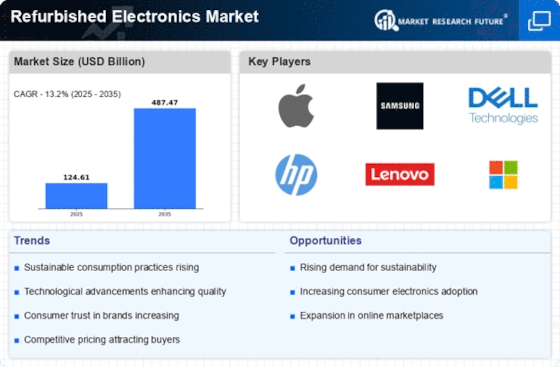
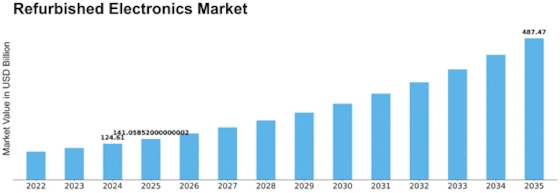
As per Market Research Future analysis, the Refurbished Electronics Market Size was estimated at 124.61 USD Billion in 2024. The Refurbished Electronics industry is projected to grow from 141.06 USD Billion in 2025 to 487.47 USD Billion by 2035, exhibiting a compound annual growth rate (CAGR) of 13.2% during the forecast period 2025 - 2035

Key Market Trends & Highlights

The refurbished electronics market is experiencing robust growth driven by sustainability and economic factors.

  • North America remains the largest market for refurbished electronics, driven by increasing consumer awareness of sustainability.
  • The Asia-Pacific region is emerging as the fastest-growing market, fueled by rising demand for affordable technology solutions.
  • Laptops dominate the refurbished segment, while tablets are witnessing the fastest growth due to their increasing adoption among younger consumers.
  • Sustainability awareness and economic viability are key drivers, as consumers seek cost-effective and environmentally friendly alternatives.

Market Size & Forecast

2024 Market Size 124.61 (USD Billion)
2035 Market Size 487.47 (USD Billion)
CAGR (2025 - 2035) 13.2%
Largest Regional Market Share in 2024 North America

Major Players

Apple (US), Samsung (KR), Dell (US), HP (US), Lenovo (CN), Microsoft (US), Asus (TW), Sony (JP), Toshiba (JP)

Market Trends

The Refurbished Electronics Market is currently experiencing a notable transformation, driven by a confluence of consumer preferences and environmental considerations. As individuals become increasingly aware of sustainability, the demand for refurbished products appears to be on the rise. This shift is not merely a trend but rather a reflection of a broader societal movement towards responsible consumption. Consumers are now more inclined to purchase refurbished items, recognizing their potential to reduce electronic waste and contribute to a circular economy. Furthermore, advancements in technology and quality assurance processes have enhanced the reliability of refurbished electronics, making them a viable alternative to new products. In addition to environmental factors, economic considerations play a pivotal role in shaping the Refurbished Electronics Market. The rising cost of new electronics has prompted consumers to seek more affordable options, leading to a growing acceptance of refurbished devices. Retailers and manufacturers are increasingly investing in refurbishment processes, ensuring that these products meet high standards of quality and performance. This evolving landscape suggests that the market will continue to expand, as both consumers and businesses recognize the benefits of refurbished electronics in terms of cost savings and sustainability. As the market matures, it is likely to witness further innovations and improvements, solidifying its position within the broader electronics industry.

Sustainability Awareness

There is a growing consciousness among consumers regarding environmental issues, which is driving the demand for refurbished electronics. This trend indicates a shift towards more sustainable purchasing habits, as individuals seek to minimize their ecological footprint.

Economic Viability

The rising costs associated with new electronic devices have led consumers to explore more budget-friendly alternatives. This trend suggests that refurbished products are increasingly viewed as practical solutions, appealing to cost-conscious buyers.

Quality Assurance Improvements

Advancements in refurbishment processes and quality control measures are enhancing the reliability of refurbished electronics. This trend indicates that consumers are becoming more confident in the performance of these products, further boosting market growth.

Refurbished Electronics Market Market Drivers

Economic Viability

Economic factors play a crucial role in shaping the Refurbished Electronics Market. With the rising cost of new electronic devices, consumers are increasingly seeking cost-effective alternatives. Refurbished electronics often provide a viable solution, offering significant savings compared to brand-new products. Data suggests that the refurbished market is projected to grow at a compound annual growth rate of over 10% in the coming years, driven by this economic rationale. Additionally, businesses are recognizing the potential for profit in the refurbishment process, leading to an increase in the number of companies entering this market. This economic viability not only attracts budget-conscious consumers but also encourages manufacturers to invest in refurbishment programs, thereby expanding the overall market landscape.

Sustainability Awareness

The increasing awareness of sustainability among consumers appears to be a pivotal driver for the Refurbished Electronics Market. As environmental concerns gain traction, individuals are more inclined to opt for refurbished products, which contribute to reducing electronic waste. Reports indicate that the electronics sector is responsible for a substantial portion of global waste, with millions of tons discarded annually. By choosing refurbished electronics, consumers not only save money but also participate in a more sustainable consumption model. This shift in consumer behavior is likely to bolster the demand for refurbished products, as companies align their offerings with eco-friendly practices. The Refurbished Electronics Market is thus positioned to benefit from this growing trend, as businesses increasingly emphasize their commitment to sustainability in marketing strategies.

Technological Advancements

Technological advancements are significantly influencing the Refurbished Electronics Market. As technology evolves, the lifecycle of electronic devices shortens, leading to a higher volume of products entering the refurbishment cycle. Innovations in refurbishment processes, such as automated testing and quality assurance, enhance the reliability of refurbished products, making them more appealing to consumers. Furthermore, the integration of advanced technologies in refurbished devices, such as improved software and hardware capabilities, ensures that these products remain competitive with new models. This trend suggests that the Refurbished Electronics Market is not merely a secondary market but a dynamic sector that adapts to technological changes, potentially attracting a broader customer base.

Regulatory Support and Incentives

Regulatory support and incentives are emerging as influential drivers in the Refurbished Electronics Market. Governments are increasingly recognizing the importance of promoting sustainable practices, leading to policies that encourage the refurbishment and resale of electronics. Incentives such as tax breaks for refurbishment companies and programs aimed at educating consumers about the benefits of refurbished products are becoming more common. This regulatory environment is likely to stimulate growth in the refurbished sector, as businesses are motivated to comply with sustainability goals. Furthermore, as regulations evolve, the Refurbished Electronics Market may see enhanced legitimacy and consumer confidence, paving the way for broader acceptance and market expansion.

Consumer Trust and Quality Assurance

Consumer trust is paramount in the Refurbished Electronics Market, and improvements in quality assurance are fostering this trust. As more companies implement rigorous testing and certification processes, the perception of refurbished products is shifting positively. Data indicates that a significant percentage of consumers are now willing to purchase refurbished electronics, provided they come with warranties and guarantees. This shift is likely to enhance the overall market, as consumers feel more secure in their purchases. Additionally, brands that prioritize quality assurance are likely to see increased loyalty and repeat business, further solidifying their position in the Refurbished Electronics Market. The emphasis on quality not only benefits consumers but also elevates the standards across the industry.

Market Segment Insights

By Product: Laptops (Largest) vs. Tablets (Fastest-Growing)

<p>In the refurbished electronics market, laptops currently hold the largest share among product segments. They are popular for their balance of functionality and affordability, appealing to both consumers and businesses alike. On the other hand, tablets are gaining traction rapidly, especially among younger demographics and educational institutions, which are seeking cost-effective solutions without sacrificing performance. The distribution between these two segments emphasizes the enduring appeal of laptops while highlighting the shifting preferences towards mobility and touch-based interfaces offered by tablets.</p>

<p>Laptops: Dominant vs. Tablets: Emerging</p>

<p>Laptops have established themselves as the dominant product in the refurbished electronics market, largely due to their robust functionality and versatility, catering to various user needs from casual browsing to professional use. They are preferred in corporate environments and for personal use alike, largely because of their established presence in the market. In contrast, tablets are emerging as a formidable contender, particularly appealing to educators and students, thanks to their lightweight design and increasing app functionalities. While laptops are seen as all-rounders, tablets focus on mobility and ease of use, which positions them well in the education and entertainment sectors.</p>

By End User: Students (Largest) vs. Corporate Sector (Fastest-Growing)

<p>In the Refurbished Electronics Market, the end user segment is broadly classified into Students, Corporate Sector, Educational Institutions, and Government Organizations. Among these, Students represent the largest share as they seek cost-effective alternatives to purchase necessary electronics for their educational needs. This segment thrives on affordability and the availability of refurbished gadgets, primarily laptops and smartphones, which are essential for digital learning environments. The Corporate Sector, while not as large as the student segment, is the fastest-growing in this market, fueled by businesses' increasing preference for sustainable practices and cost-cutting measures.</p>

<p>Students (Dominant) vs. Corporate Sector (Emerging)</p>

<p>The Students segment is characterized by a high demand for affordable electronic devices, driven by the digitalization of education. This group typically opts for refurbished laptops and tablets as reliable tools for studying, making this segment a dominant player in the refurbished electronics market. In contrast, the Corporate Sector is emerging rapidly, marked by an uptick in businesses looking to embrace sustainability and reduce overhead costs. Companies are increasingly turning to refurbished electronics to equip their employees while minimizing their environmental footprint, thus positioning this segment as a key growth driver in the market.</p>

By Distribution Channel: Online Retailers and E-commerce (Largest) vs. Physical Stores (Fastest-Growing)

<p>In the refurbished electronics market, Online Retailers and E-commerce account for a significant portion of distribution channels, driven by the convenience and wide variety they offer. This channel enables consumers to compare prices easily and read reviews, enhancing their purchasing experience. Physical Stores, while traditionally strong in retail, are now evolving to adapt to online trends, observing a notable surge in customer footfall as shoppers seek hands-on experiences before purchasing refurbished devices. The growth of the refurbished electronics market via Online Retailers continues to be reinforced by increasing consumer trust in online transactions and the expanding digital infrastructure. Conversely, Physical Stores are witnessing a resurgence, particularly in urban areas, where consumers appreciate the tactile interaction. Meanwhile, Authorized Refurbishment Centers and Direct Sales also play essential roles but are lesser in terms of market share and growth when compared to these leading channels.</p>

<p>Online Retailers (Dominant) vs. Physical Stores (Emerging)</p>

<p>Online Retailers are establishing a dominant position in the refurbished electronics market by offering extensive selections and competitive pricing, making it a preferred choice for tech-savvy consumers. Their platforms leverage user-friendly interfaces, personalized recommendations, and robust customer service, ensuring a smooth shopping experience. On the other hand, Physical Stores are emerging trends characterized by enhancing customer engagement strategies, allowing consumers to test products directly and receive immediate assistance. These emerging stores are strategically located in key areas, combining the benefits of online pricing with the assurance of physical interaction. The competition between these channels is shaping purchasing behavior, catering to diverse consumer preferences and driving market dynamics.</p>

Get more detailed insights about Refurbished Electronics Market Research Report – Forecast till 2035

Regional Insights

North America : Tech Innovation Leader

North America is witnessing significant growth in the refurbished electronics market, driven by increasing consumer awareness of sustainability and cost-effectiveness. The region holds approximately 40% of the global market share, making it the largest market. Regulatory support for electronic waste management and recycling initiatives further catalyzes this growth, encouraging consumers to opt for refurbished products. The United States and Canada are the leading countries in this sector, with major players like Apple, Dell, and HP dominating the landscape. The competitive environment is characterized by a mix of established brands and emerging startups focusing on quality assurance and warranty offerings. This dynamic fosters innovation and enhances consumer trust in refurbished electronics, contributing to the market's expansion.

Europe : Sustainability Focused Market

Europe is rapidly evolving into a key player in the refurbished electronics market, driven by stringent environmental regulations and a strong consumer shift towards sustainable products. The region accounts for approximately 30% of the global market share, making it the second-largest market. Initiatives like the EU's Circular Economy Action Plan are pivotal in promoting refurbished goods, thereby enhancing market demand and consumer acceptance. Leading countries such as Germany, France, and the UK are at the forefront of this trend, with a competitive landscape featuring both established brands and local refurbishers. Major players like Samsung and Lenovo are investing in refurbishment programs to meet the growing demand. The presence of robust e-commerce platforms further facilitates access to refurbished products, enhancing market penetration and consumer choice.

Asia-Pacific : Emerging Market Potential

Asia-Pacific is emerging as a significant player in the refurbished electronics market, driven by rising disposable incomes and increasing urbanization. The region holds about 20% of the global market share, with countries like China and India leading the charge. The growing awareness of environmental issues and the demand for affordable technology are key drivers of this market's expansion, supported by favorable government policies promoting electronic waste recycling. China is the largest market in the region, with a competitive landscape featuring both domestic and international brands. Companies like Lenovo and Asus are actively participating in refurbishment initiatives, catering to the growing consumer base. The presence of a large youth demographic further fuels demand, as younger consumers are more inclined to purchase refurbished electronics for their affordability and sustainability benefits.

Middle East and Africa : Untapped Market Opportunities

The Middle East and Africa region is gradually recognizing the potential of the refurbished electronics market, driven by increasing smartphone penetration and a growing middle class. This region currently holds about 10% of the global market share, with significant opportunities for growth. Factors such as rising awareness of sustainability and cost savings are encouraging consumers to consider refurbished products, supported by local government initiatives aimed at reducing electronic waste. Countries like South Africa and the UAE are leading the way in this market, with a competitive landscape that includes both local and international players. Companies are focusing on quality assurance and warranty services to build consumer trust. The region's unique demographic trends, including a young population, further enhance the demand for affordable technology solutions, positioning the refurbished market for future growth.

Key Players and Competitive Insights

Leading market players are investing a lot in R&D to expand their product line, which will help the market for refurbished electronics grow even more. Market participants are also engaging in different strategic initiatives to expand their presence globally. These initiatives include the introduction of new products, the formation of contractual agreements, mergers and acquisitions, increased investments, and collaboration with other organizations for market developments. In order to thrive in an increasingly competitive and expanding market, the refurbished electronics industry must offer cost-effective options.One of the primary business strategies utilized by manufacturers in the worldwide refurbished electronics industry to assist customers and expand the market sector is local manufacturing to decrease the operational costs. Some of the biggest benefits to medicine in recent years have come from the remanufacturing of electronics. Major players in the refurbished electronics market, including Apple Inc., Samsung Electronics, Amazon Renewed, Best Buy, Dell Outlet, HP Renew, Lenovo Outlet, Microsoft Authorized Refurbisher Program, Newegg Renew, Gazelle, GameStop, Back Market, Decluttr, Swappa, BuyDig, B&H Photo Video, TigerDirect, eBay.Located in Cupertino, California, Apple Inc. is a multinational technology corporation best known for creating and marketing consumer gadgets, software, and services. Since then, it has developed into one of the most lucrative and famous companies in the world. Apple is synonymous with innovation and elegant design. The company has a history of pioneering technologies, including the graphical user interface, mouse-driven computing, and touch-sensitive screens. Products like the iPhone revolutionized the smartphone industry, setting new standards for user experience and design aesthetics.Apple made an announcement in January 2023 regarding its plans to expand the range of refurbished products to include the iPhone 13 lineup. These refurbished iPhones will be available for purchase through Apple's online store and authorized resellers.A global leader in technology, Dell Technologies is based in Round Rock, Texas, in the United States. One of the leading technology infrastructure firms in the world. Dell is renowned for its wide array of products, including personal computers (desktops, laptops, workstations), servers, storage devices, networking equipment, monitors, printers, and peripherals. The company provides end-to-end solutions, from hardware to software, aimed at businesses of all sizes, educational institutions, government organizations, and individual consumers. Dell has strategically acquired several technology companies, including EMC Corporation and VMware, expanding its portfolio and strengthening its presence in the enterprise market.These acquisitions have allowed Dell to offer a broader range of services and solutions, positioning itself as a major player in the digital transformation space. Dell made an announcement in March 2023 regarding its plans to broaden its range of refurbished products, which will now include the XPS 13 and XPS 15 laptops. These refurbished laptops will be made available for purchase through Dell's online store as well as authorized resellers.

Key Companies in the Refurbished Electronics Market include

Industry Developments

January 2023: Back Market, a prominent refurbished electronics marketplace in Europe, has acquired Back Market USA, a leading refurbished electronics marketplace in the United States. This acquisition enables Back Market to broaden its presence in the US market.

February 2023: Brightstar, a worldwide company specializing in the management of mobile device lifecycles, has formed a collaboration with Gazelle, a prominent online marketplace for pre-owned electronics. This strategic partnership enables Brightstar to offer reconditioned devices for sale.

March 2023: Envy, a prominent retailer of refurbished electronics, has completed the acquisition of NextWorth, a leading online marketplace specializing in used electronics. This strategic move will enable Envy to significantly broaden its presence within the US market.

Future Outlook

Refurbished Electronics Market Future Outlook

The Refurbished Electronics Market is projected to grow at a 13.2% CAGR from 2025 to 2035, driven by sustainability trends, cost savings, and technological advancements.

New opportunities lie in:

  • Expansion of online marketplaces for refurbished products.
  • Development of certification programs to enhance consumer trust.
  • Partnerships with manufacturers for exclusive refurbished product lines.

By 2035, the market is expected to solidify its position as a key player in the electronics industry.

Market Segmentation

Refurbished Electronics Market Product Outlook

  • Laptops
  • Tablets
  • Gaming Consoles
  • Audio Equipment

Refurbished Electronics Market End User Outlook

  • Students
  • Corporate Sector
  • Educational Institutions
  • Government Organizations

Refurbished Electronics Market Distribution Channel Outlook

  • Online Retailers and E-commerce
  • Physical Stores
  • Authorized Refurbishment Centers
  • Direct Sales

Report Scope

MARKET SIZE 2024 124.61(USD Billion)
MARKET SIZE 2025 141.06(USD Billion)
MARKET SIZE 2035 487.47(USD Billion)
COMPOUND ANNUAL GROWTH RATE (CAGR) 13.2% (2025 - 2035)
REPORT COVERAGE Revenue Forecast, Competitive Landscape, Growth Factors, and Trends
BASE YEAR 2024
Market Forecast Period 2025 - 2035
Historical Data 2019 - 2024
Market Forecast Units USD Billion
Key Companies Profiled Apple (US), Samsung (KR), Dell (US), HP (US), Lenovo (CN), Microsoft (US), Asus (TW), Sony (JP), Toshiba (JP)
Segments Covered Product, End User, Distribution Channel, Region
Key Market Opportunities Growing consumer preference for sustainable products drives demand in the Refurbished Electronics Market.
Key Market Dynamics Rising consumer demand for sustainable options drives growth in the refurbished electronics market amid competitive pressures.
Countries Covered North America, Europe, APAC, South America, MEA

FAQs

What is the current valuation of the refurbished electronics market in 2024?

<p>The refurbished electronics market was valued at 124.61 USD Billion in 2024.</p>

What is the projected market size for refurbished electronics by 2035?

<p>The market is projected to reach 487.47 USD Billion by 2035.</p>

What is the expected CAGR for the refurbished electronics market from 2025 to 2035?

<p>The expected CAGR for the refurbished electronics market during the forecast period 2025 - 2035 is 13.2%.</p>

Which product segments are leading in the refurbished electronics market?

<p>Laptops, tablets, gaming consoles, and audio equipment are key product segments, with laptops valued at 160.0 USD Billion by 2035.</p>

How does the corporate sector contribute to the refurbished electronics market?

<p>The corporate sector is projected to contribute 150.0 USD Billion by 2035, indicating substantial demand.</p>

What role do online retailers play in the distribution of refurbished electronics?

<p>Online retailers and e-commerce are expected to account for 150.0 USD Billion in sales by 2035.</p>

Which companies are considered key players in the refurbished electronics market?

Key players include Apple, Samsung, Dell, HP, Lenovo, Microsoft, Asus, Sony, and Toshiba.

What is the expected growth of the educational institutions segment in the refurbished electronics market?

The educational institutions segment is projected to grow to 120.0 USD Billion by 2035.

How do authorized refurbishment centers impact the market?

Authorized refurbishment centers are anticipated to generate 120.0 USD Billion in revenue by 2035.

What is the significance of the gaming consoles segment in the refurbished electronics market?

The gaming consoles segment is expected to reach 100.0 USD Billion by 2035, reflecting its growing popularity.

  1. SECTION I: EXECUTIVE SUMMARY AND KEY HIGHLIGHTS
    1. | 1.1 EXECUTIVE SUMMARY
    2. | | 1.1.1 Market Overview
    3. | | 1.1.2 Key Findings
    4. | | 1.1.3 Market Segmentation
    5. | | 1.1.4 Competitive Landscape
    6. | | 1.1.5 Challenges and Opportunities
    7. | | 1.1.6 Future Outlook
  2. SECTION II: SCOPING, METHODOLOGY AND MARKET STRUCTURE
    1. | 2.1 MARKET INTRODUCTION
    2. | | 2.1.1 Definition
    3. | | 2.1.2 Scope of the study
    4. | | | 2.1.2.1 Research Objective
    5. | | | 2.1.2.2 Assumption
    6. | | | 2.1.2.3 Limitations
    7. | 2.2 RESEARCH METHODOLOGY
    8. | | 2.2.1 Overview
    9. | | 2.2.2 Data Mining
    10. | | 2.2.3 Secondary Research
    11. | | 2.2.4 Primary Research
    12. | | | 2.2.4.1 Primary Interviews and Information Gathering Process
    13. | | | 2.2.4.2 Breakdown of Primary Respondents
    14. | | 2.2.5 Forecasting Model
    15. | | 2.2.6 Market Size Estimation
    16. | | | 2.2.6.1 Bottom-Up Approach
    17. | | | 2.2.6.2 Top-Down Approach
    18. | | 2.2.7 Data Triangulation
    19. | | 2.2.8 Validation
  3. SECTION III: QUALITATIVE ANALYSIS
    1. | 3.1 MARKET DYNAMICS
    2. | | 3.1.1 Overview
    3. | | 3.1.2 Drivers
    4. | | 3.1.3 Restraints
    5. | | 3.1.4 Opportunities
    6. | 3.2 MARKET FACTOR ANALYSIS
    7. | | 3.2.1 Value chain Analysis
    8. | | 3.2.2 Porter's Five Forces Analysis
    9. | | | 3.2.2.1 Bargaining Power of Suppliers
    10. | | | 3.2.2.2 Bargaining Power of Buyers
    11. | | | 3.2.2.3 Threat of New Entrants
    12. | | | 3.2.2.4 Threat of Substitutes
    13. | | | 3.2.2.5 Intensity of Rivalry
    14. | | 3.2.3 COVID-19 Impact Analysis
    15. | | | 3.2.3.1 Market Impact Analysis
    16. | | | 3.2.3.2 Regional Impact
    17. | | | 3.2.3.3 Opportunity and Threat Analysis
  4. SECTION IV: QUANTITATIVE ANALYSIS
    1. | 4.1 Semiconductor & Electronics, BY Product (USD Billion)
    2. | | 4.1.1 Laptops
    3. | | 4.1.2 Tablets
    4. | | 4.1.3 Gaming Consoles
    5. | | 4.1.4 Audio Equipment
    6. | 4.2 Semiconductor & Electronics, BY End User (USD Billion)
    7. | | 4.2.1 Students
    8. | | 4.2.2 Corporate Sector
    9. | | 4.2.3 Educational Institutions
    10. | | 4.2.4 Government Organizations
    11. | 4.3 Semiconductor & Electronics, BY Distribution Channel (USD Billion)
    12. | | 4.3.1 Online Retailers and E-commerce
    13. | | 4.3.2 Physical Stores
    14. | | 4.3.3 Authorized Refurbishment Centers
    15. | | 4.3.4 Direct Sales
    16. | 4.4 Semiconductor & Electronics, BY Region (USD Billion)
    17. | | 4.4.1 North America
    18. | | | 4.4.1.1 US
    19. | | | 4.4.1.2 Canada
    20. | | 4.4.2 Europe
    21. | | | 4.4.2.1 Germany
    22. | | | 4.4.2.2 UK
    23. | | | 4.4.2.3 France
    24. | | | 4.4.2.4 Russia
    25. | | | 4.4.2.5 Italy
    26. | | | 4.4.2.6 Spain
    27. | | | 4.4.2.7 Rest of Europe
    28. | | 4.4.3 APAC
    29. | | | 4.4.3.1 China
    30. | | | 4.4.3.2 India
    31. | | | 4.4.3.3 Japan
    32. | | | 4.4.3.4 South Korea
    33. | | | 4.4.3.5 Malaysia
    34. | | | 4.4.3.6 Thailand
    35. | | | 4.4.3.7 Indonesia
    36. | | | 4.4.3.8 Rest of APAC
    37. | | 4.4.4 South America
    38. | | | 4.4.4.1 Brazil
    39. | | | 4.4.4.2 Mexico
    40. | | | 4.4.4.3 Argentina
    41. | | | 4.4.4.4 Rest of South America
    42. | | 4.4.5 MEA
    43. | | | 4.4.5.1 GCC Countries
    44. | | | 4.4.5.2 South Africa
    45. | | | 4.4.5.3 Rest of MEA
  5. SECTION V: COMPETITIVE ANALYSIS
    1. | 5.1 Competitive Landscape
    2. | | 5.1.1 Overview
    3. | | 5.1.2 Competitive Analysis
    4. | | 5.1.3 Market share Analysis
    5. | | 5.1.4 Major Growth Strategy in the Semiconductor & Electronics
    6. | | 5.1.5 Competitive Benchmarking
    7. | | 5.1.6 Leading Players in Terms of Number of Developments in the Semiconductor & Electronics
    8. | | 5.1.7 Key developments and growth strategies
    9. | | | 5.1.7.1 New Product Launch/Service Deployment
    10. | | | 5.1.7.2 Merger & Acquisitions
    11. | | | 5.1.7.3 Joint Ventures
    12. | | 5.1.8 Major Players Financial Matrix
    13. | | | 5.1.8.1 Sales and Operating Income
    14. | | | 5.1.8.2 Major Players R&D Expenditure. 2023
    15. | 5.2 Company Profiles
    16. | | 5.2.1 Apple (US)
    17. | | | 5.2.1.1 Financial Overview
    18. | | | 5.2.1.2 Products Offered
    19. | | | 5.2.1.3 Key Developments
    20. | | | 5.2.1.4 SWOT Analysis
    21. | | | 5.2.1.5 Key Strategies
    22. | | 5.2.2 Samsung (KR)
    23. | | | 5.2.2.1 Financial Overview
    24. | | | 5.2.2.2 Products Offered
    25. | | | 5.2.2.3 Key Developments
    26. | | | 5.2.2.4 SWOT Analysis
    27. | | | 5.2.2.5 Key Strategies
    28. | | 5.2.3 Dell (US)
    29. | | | 5.2.3.1 Financial Overview
    30. | | | 5.2.3.2 Products Offered
    31. | | | 5.2.3.3 Key Developments
    32. | | | 5.2.3.4 SWOT Analysis
    33. | | | 5.2.3.5 Key Strategies
    34. | | 5.2.4 HP (US)
    35. | | | 5.2.4.1 Financial Overview
    36. | | | 5.2.4.2 Products Offered
    37. | | | 5.2.4.3 Key Developments
    38. | | | 5.2.4.4 SWOT Analysis
    39. | | | 5.2.4.5 Key Strategies
    40. | | 5.2.5 Lenovo (CN)
    41. | | | 5.2.5.1 Financial Overview
    42. | | | 5.2.5.2 Products Offered
    43. | | | 5.2.5.3 Key Developments
    44. | | | 5.2.5.4 SWOT Analysis
    45. | | | 5.2.5.5 Key Strategies
    46. | | 5.2.6 Microsoft (US)
    47. | | | 5.2.6.1 Financial Overview
    48. | | | 5.2.6.2 Products Offered
    49. | | | 5.2.6.3 Key Developments
    50. | | | 5.2.6.4 SWOT Analysis
    51. | | | 5.2.6.5 Key Strategies
    52. | | 5.2.7 Asus (TW)
    53. | | | 5.2.7.1 Financial Overview
    54. | | | 5.2.7.2 Products Offered
    55. | | | 5.2.7.3 Key Developments
    56. | | | 5.2.7.4 SWOT Analysis
    57. | | | 5.2.7.5 Key Strategies
    58. | | 5.2.8 Sony (JP)
    59. | | | 5.2.8.1 Financial Overview
    60. | | | 5.2.8.2 Products Offered
    61. | | | 5.2.8.3 Key Developments
    62. | | | 5.2.8.4 SWOT Analysis
    63. | | | 5.2.8.5 Key Strategies
    64. | | 5.2.9 Toshiba (JP)
    65. | | | 5.2.9.1 Financial Overview
    66. | | | 5.2.9.2 Products Offered
    67. | | | 5.2.9.3 Key Developments
    68. | | | 5.2.9.4 SWOT Analysis
    69. | | | 5.2.9.5 Key Strategies
    70. | 5.3 Appendix
    71. | | 5.3.1 References
    72. | | 5.3.2 Related Reports
  6. LIST OF FIGURES
    1. | 6.1 MARKET SYNOPSIS
    2. | 6.2 NORTH AMERICA MARKET ANALYSIS
    3. | 6.3 US MARKET ANALYSIS BY PRODUCT
    4. | 6.4 US MARKET ANALYSIS BY END USER
    5. | 6.5 US MARKET ANALYSIS BY DISTRIBUTION CHANNEL
    6. | 6.6 CANADA MARKET ANALYSIS BY PRODUCT
    7. | 6.7 CANADA MARKET ANALYSIS BY END USER
    8. | 6.8 CANADA MARKET ANALYSIS BY DISTRIBUTION CHANNEL
    9. | 6.9 EUROPE MARKET ANALYSIS
    10. | 6.10 GERMANY MARKET ANALYSIS BY PRODUCT
    11. | 6.11 GERMANY MARKET ANALYSIS BY END USER
    12. | 6.12 GERMANY MARKET ANALYSIS BY DISTRIBUTION CHANNEL
    13. | 6.13 UK MARKET ANALYSIS BY PRODUCT
    14. | 6.14 UK MARKET ANALYSIS BY END USER
    15. | 6.15 UK MARKET ANALYSIS BY DISTRIBUTION CHANNEL
    16. | 6.16 FRANCE MARKET ANALYSIS BY PRODUCT
    17. | 6.17 FRANCE MARKET ANALYSIS BY END USER
    18. | 6.18 FRANCE MARKET ANALYSIS BY DISTRIBUTION CHANNEL
    19. | 6.19 RUSSIA MARKET ANALYSIS BY PRODUCT
    20. | 6.20 RUSSIA MARKET ANALYSIS BY END USER
    21. | 6.21 RUSSIA MARKET ANALYSIS BY DISTRIBUTION CHANNEL
    22. | 6.22 ITALY MARKET ANALYSIS BY PRODUCT
    23. | 6.23 ITALY MARKET ANALYSIS BY END USER
    24. | 6.24 ITALY MARKET ANALYSIS BY DISTRIBUTION CHANNEL
    25. | 6.25 SPAIN MARKET ANALYSIS BY PRODUCT
    26. | 6.26 SPAIN MARKET ANALYSIS BY END USER
    27. | 6.27 SPAIN MARKET ANALYSIS BY DISTRIBUTION CHANNEL
    28. | 6.28 REST OF EUROPE MARKET ANALYSIS BY PRODUCT
    29. | 6.29 REST OF EUROPE MARKET ANALYSIS BY END USER
    30. | 6.30 REST OF EUROPE MARKET ANALYSIS BY DISTRIBUTION CHANNEL
    31. | 6.31 APAC MARKET ANALYSIS
    32. | 6.32 CHINA MARKET ANALYSIS BY PRODUCT
    33. | 6.33 CHINA MARKET ANALYSIS BY END USER
    34. | 6.34 CHINA MARKET ANALYSIS BY DISTRIBUTION CHANNEL
    35. | 6.35 INDIA MARKET ANALYSIS BY PRODUCT
    36. | 6.36 INDIA MARKET ANALYSIS BY END USER
    37. | 6.37 INDIA MARKET ANALYSIS BY DISTRIBUTION CHANNEL
    38. | 6.38 JAPAN MARKET ANALYSIS BY PRODUCT
    39. | 6.39 JAPAN MARKET ANALYSIS BY END USER
    40. | 6.40 JAPAN MARKET ANALYSIS BY DISTRIBUTION CHANNEL
    41. | 6.41 SOUTH KOREA MARKET ANALYSIS BY PRODUCT
    42. | 6.42 SOUTH KOREA MARKET ANALYSIS BY END USER
    43. | 6.43 SOUTH KOREA MARKET ANALYSIS BY DISTRIBUTION CHANNEL
    44. | 6.44 MALAYSIA MARKET ANALYSIS BY PRODUCT
    45. | 6.45 MALAYSIA MARKET ANALYSIS BY END USER
    46. | 6.46 MALAYSIA MARKET ANALYSIS BY DISTRIBUTION CHANNEL
    47. | 6.47 THAILAND MARKET ANALYSIS BY PRODUCT
    48. | 6.48 THAILAND MARKET ANALYSIS BY END USER
    49. | 6.49 THAILAND MARKET ANALYSIS BY DISTRIBUTION CHANNEL
    50. | 6.50 INDONESIA MARKET ANALYSIS BY PRODUCT
    51. | 6.51 INDONESIA MARKET ANALYSIS BY END USER
    52. | 6.52 INDONESIA MARKET ANALYSIS BY DISTRIBUTION CHANNEL
    53. | 6.53 REST OF APAC MARKET ANALYSIS BY PRODUCT
    54. | 6.54 REST OF APAC MARKET ANALYSIS BY END USER
    55. | 6.55 REST OF APAC MARKET ANALYSIS BY DISTRIBUTION CHANNEL
    56. | 6.56 SOUTH AMERICA MARKET ANALYSIS
    57. | 6.57 BRAZIL MARKET ANALYSIS BY PRODUCT
    58. | 6.58 BRAZIL MARKET ANALYSIS BY END USER
    59. | 6.59 BRAZIL MARKET ANALYSIS BY DISTRIBUTION CHANNEL
    60. | 6.60 MEXICO MARKET ANALYSIS BY PRODUCT
    61. | 6.61 MEXICO MARKET ANALYSIS BY END USER
    62. | 6.62 MEXICO MARKET ANALYSIS BY DISTRIBUTION CHANNEL
    63. | 6.63 ARGENTINA MARKET ANALYSIS BY PRODUCT
    64. | 6.64 ARGENTINA MARKET ANALYSIS BY END USER
    65. | 6.65 ARGENTINA MARKET ANALYSIS BY DISTRIBUTION CHANNEL
    66. | 6.66 REST OF SOUTH AMERICA MARKET ANALYSIS BY PRODUCT
    67. | 6.67 REST OF SOUTH AMERICA MARKET ANALYSIS BY END USER
    68. | 6.68 REST OF SOUTH AMERICA MARKET ANALYSIS BY DISTRIBUTION CHANNEL
    69. | 6.69 MEA MARKET ANALYSIS
    70. | 6.70 GCC COUNTRIES MARKET ANALYSIS BY PRODUCT
    71. | 6.71 GCC COUNTRIES MARKET ANALYSIS BY END USER
    72. | 6.72 GCC COUNTRIES MARKET ANALYSIS BY DISTRIBUTION CHANNEL
    73. | 6.73 SOUTH AFRICA MARKET ANALYSIS BY PRODUCT
    74. | 6.74 SOUTH AFRICA MARKET ANALYSIS BY END USER
    75. | 6.75 SOUTH AFRICA MARKET ANALYSIS BY DISTRIBUTION CHANNEL
    76. | 6.76 REST OF MEA MARKET ANALYSIS BY PRODUCT
    77. | 6.77 REST OF MEA MARKET ANALYSIS BY END USER
    78. | 6.78 REST OF MEA MARKET ANALYSIS BY DISTRIBUTION CHANNEL
    79. | 6.79 KEY BUYING CRITERIA OF SEMICONDUCTOR & ELECTRONICS
    80. | 6.80 RESEARCH PROCESS OF MRFR
    81. | 6.81 DRO ANALYSIS OF SEMICONDUCTOR & ELECTRONICS
    82. | 6.82 DRIVERS IMPACT ANALYSIS: SEMICONDUCTOR & ELECTRONICS
    83. | 6.83 RESTRAINTS IMPACT ANALYSIS: SEMICONDUCTOR & ELECTRONICS
    84. | 6.84 SUPPLY / VALUE CHAIN: SEMICONDUCTOR & ELECTRONICS
    85. | 6.85 SEMICONDUCTOR & ELECTRONICS, BY PRODUCT, 2024 (% SHARE)
    86. | 6.86 SEMICONDUCTOR & ELECTRONICS, BY PRODUCT, 2024 TO 2035 (USD Billion)
    87. | 6.87 SEMICONDUCTOR & ELECTRONICS, BY END USER, 2024 (% SHARE)
    88. | 6.88 SEMICONDUCTOR & ELECTRONICS, BY END USER, 2024 TO 2035 (USD Billion)
    89. | 6.89 SEMICONDUCTOR & ELECTRONICS, BY DISTRIBUTION CHANNEL, 2024 (% SHARE)
    90. | 6.90 SEMICONDUCTOR & ELECTRONICS, BY DISTRIBUTION CHANNEL, 2024 TO 2035 (USD Billion)
    91. | 6.91 BENCHMARKING OF MAJOR COMPETITORS
  7. LIST OF TABLES
    1. | 7.1 LIST OF ASSUMPTIONS
    2. | | 7.1.1
    3. | 7.2 North America MARKET SIZE ESTIMATES; FORECAST
    4. | | 7.2.1 BY PRODUCT, 2025-2035 (USD Billion)
    5. | | 7.2.2 BY END USER, 2025-2035 (USD Billion)
    6. | | 7.2.3 BY DISTRIBUTION CHANNEL, 2025-2035 (USD Billion)
    7. | 7.3 US MARKET SIZE ESTIMATES; FORECAST
    8. | | 7.3.1 BY PRODUCT, 2025-2035 (USD Billion)
    9. | | 7.3.2 BY END USER, 2025-2035 (USD Billion)
    10. | | 7.3.3 BY DISTRIBUTION CHANNEL, 2025-2035 (USD Billion)
    11. | 7.4 Canada MARKET SIZE ESTIMATES; FORECAST
    12. | | 7.4.1 BY PRODUCT, 2025-2035 (USD Billion)
    13. | | 7.4.2 BY END USER, 2025-2035 (USD Billion)
    14. | | 7.4.3 BY DISTRIBUTION CHANNEL, 2025-2035 (USD Billion)
    15. | 7.5 Europe MARKET SIZE ESTIMATES; FORECAST
    16. | | 7.5.1 BY PRODUCT, 2025-2035 (USD Billion)
    17. | | 7.5.2 BY END USER, 2025-2035 (USD Billion)
    18. | | 7.5.3 BY DISTRIBUTION CHANNEL, 2025-2035 (USD Billion)
    19. | 7.6 Germany MARKET SIZE ESTIMATES; FORECAST
    20. | | 7.6.1 BY PRODUCT, 2025-2035 (USD Billion)
    21. | | 7.6.2 BY END USER, 2025-2035 (USD Billion)
    22. | | 7.6.3 BY DISTRIBUTION CHANNEL, 2025-2035 (USD Billion)
    23. | 7.7 UK MARKET SIZE ESTIMATES; FORECAST
    24. | | 7.7.1 BY PRODUCT, 2025-2035 (USD Billion)
    25. | | 7.7.2 BY END USER, 2025-2035 (USD Billion)
    26. | | 7.7.3 BY DISTRIBUTION CHANNEL, 2025-2035 (USD Billion)
    27. | 7.8 France MARKET SIZE ESTIMATES; FORECAST
    28. | | 7.8.1 BY PRODUCT, 2025-2035 (USD Billion)
    29. | | 7.8.2 BY END USER, 2025-2035 (USD Billion)
    30. | | 7.8.3 BY DISTRIBUTION CHANNEL, 2025-2035 (USD Billion)
    31. | 7.9 Russia MARKET SIZE ESTIMATES; FORECAST
    32. | | 7.9.1 BY PRODUCT, 2025-2035 (USD Billion)
    33. | | 7.9.2 BY END USER, 2025-2035 (USD Billion)
    34. | | 7.9.3 BY DISTRIBUTION CHANNEL, 2025-2035 (USD Billion)
    35. | 7.10 Italy MARKET SIZE ESTIMATES; FORECAST
    36. | | 7.10.1 BY PRODUCT, 2025-2035 (USD Billion)
    37. | | 7.10.2 BY END USER, 2025-2035 (USD Billion)
    38. | | 7.10.3 BY DISTRIBUTION CHANNEL, 2025-2035 (USD Billion)
    39. | 7.11 Spain MARKET SIZE ESTIMATES; FORECAST
    40. | | 7.11.1 BY PRODUCT, 2025-2035 (USD Billion)
    41. | | 7.11.2 BY END USER, 2025-2035 (USD Billion)
    42. | | 7.11.3 BY DISTRIBUTION CHANNEL, 2025-2035 (USD Billion)
    43. | 7.12 Rest of Europe MARKET SIZE ESTIMATES; FORECAST
    44. | | 7.12.1 BY PRODUCT, 2025-2035 (USD Billion)
    45. | | 7.12.2 BY END USER, 2025-2035 (USD Billion)
    46. | | 7.12.3 BY DISTRIBUTION CHANNEL, 2025-2035 (USD Billion)
    47. | 7.13 APAC MARKET SIZE ESTIMATES; FORECAST
    48. | | 7.13.1 BY PRODUCT, 2025-2035 (USD Billion)
    49. | | 7.13.2 BY END USER, 2025-2035 (USD Billion)
    50. | | 7.13.3 BY DISTRIBUTION CHANNEL, 2025-2035 (USD Billion)
    51. | 7.14 China MARKET SIZE ESTIMATES; FORECAST
    52. | | 7.14.1 BY PRODUCT, 2025-2035 (USD Billion)
    53. | | 7.14.2 BY END USER, 2025-2035 (USD Billion)
    54. | | 7.14.3 BY DISTRIBUTION CHANNEL, 2025-2035 (USD Billion)
    55. | 7.15 India MARKET SIZE ESTIMATES; FORECAST
    56. | | 7.15.1 BY PRODUCT, 2025-2035 (USD Billion)
    57. | | 7.15.2 BY END USER, 2025-2035 (USD Billion)
    58. | | 7.15.3 BY DISTRIBUTION CHANNEL, 2025-2035 (USD Billion)
    59. | 7.16 Japan MARKET SIZE ESTIMATES; FORECAST
    60. | | 7.16.1 BY PRODUCT, 2025-2035 (USD Billion)
    61. | | 7.16.2 BY END USER, 2025-2035 (USD Billion)
    62. | | 7.16.3 BY DISTRIBUTION CHANNEL, 2025-2035 (USD Billion)
    63. | 7.17 South Korea MARKET SIZE ESTIMATES; FORECAST
    64. | | 7.17.1 BY PRODUCT, 2025-2035 (USD Billion)
    65. | | 7.17.2 BY END USER, 2025-2035 (USD Billion)
    66. | | 7.17.3 BY DISTRIBUTION CHANNEL, 2025-2035 (USD Billion)
    67. | 7.18 Malaysia MARKET SIZE ESTIMATES; FORECAST
    68. | | 7.18.1 BY PRODUCT, 2025-2035 (USD Billion)
    69. | | 7.18.2 BY END USER, 2025-2035 (USD Billion)
    70. | | 7.18.3 BY DISTRIBUTION CHANNEL, 2025-2035 (USD Billion)
    71. | 7.19 Thailand MARKET SIZE ESTIMATES; FORECAST
    72. | | 7.19.1 BY PRODUCT, 2025-2035 (USD Billion)
    73. | | 7.19.2 BY END USER, 2025-2035 (USD Billion)
    74. | | 7.19.3 BY DISTRIBUTION CHANNEL, 2025-2035 (USD Billion)
    75. | 7.20 Indonesia MARKET SIZE ESTIMATES; FORECAST
    76. | | 7.20.1 BY PRODUCT, 2025-2035 (USD Billion)
    77. | | 7.20.2 BY END USER, 2025-2035 (USD Billion)
    78. | | 7.20.3 BY DISTRIBUTION CHANNEL, 2025-2035 (USD Billion)
    79. | 7.21 Rest of APAC MARKET SIZE ESTIMATES; FORECAST
    80. | | 7.21.1 BY PRODUCT, 2025-2035 (USD Billion)
    81. | | 7.21.2 BY END USER, 2025-2035 (USD Billion)
    82. | | 7.21.3 BY DISTRIBUTION CHANNEL, 2025-2035 (USD Billion)
    83. | 7.22 South America MARKET SIZE ESTIMATES; FORECAST
    84. | | 7.22.1 BY PRODUCT, 2025-2035 (USD Billion)
    85. | | 7.22.2 BY END USER, 2025-2035 (USD Billion)
    86. | | 7.22.3 BY DISTRIBUTION CHANNEL, 2025-2035 (USD Billion)
    87. | 7.23 Brazil MARKET SIZE ESTIMATES; FORECAST
    88. | | 7.23.1 BY PRODUCT, 2025-2035 (USD Billion)
    89. | | 7.23.2 BY END USER, 2025-2035 (USD Billion)
    90. | | 7.23.3 BY DISTRIBUTION CHANNEL, 2025-2035 (USD Billion)
    91. | 7.24 Mexico MARKET SIZE ESTIMATES; FORECAST
    92. | | 7.24.1 BY PRODUCT, 2025-2035 (USD Billion)
    93. | | 7.24.2 BY END USER, 2025-2035 (USD Billion)
    94. | | 7.24.3 BY DISTRIBUTION CHANNEL, 2025-2035 (USD Billion)
    95. | 7.25 Argentina MARKET SIZE ESTIMATES; FORECAST
    96. | | 7.25.1 BY PRODUCT, 2025-2035 (USD Billion)
    97. | | 7.25.2 BY END USER, 2025-2035 (USD Billion)
    98. | | 7.25.3 BY DISTRIBUTION CHANNEL, 2025-2035 (USD Billion)
    99. | 7.26 Rest of South America MARKET SIZE ESTIMATES; FORECAST
    100. | | 7.26.1 BY PRODUCT, 2025-2035 (USD Billion)
    101. | | 7.26.2 BY END USER, 2025-2035 (USD Billion)
    102. | | 7.26.3 BY DISTRIBUTION CHANNEL, 2025-2035 (USD Billion)
    103. | 7.27 MEA MARKET SIZE ESTIMATES; FORECAST
    104. | | 7.27.1 BY PRODUCT, 2025-2035 (USD Billion)
    105. | | 7.27.2 BY END USER, 2025-2035 (USD Billion)
    106. | | 7.27.3 BY DISTRIBUTION CHANNEL, 2025-2035 (USD Billion)
    107. | 7.28 GCC Countries MARKET SIZE ESTIMATES; FORECAST
    108. | | 7.28.1 BY PRODUCT, 2025-2035 (USD Billion)
    109. | | 7.28.2 BY END USER, 2025-2035 (USD Billion)
    110. | | 7.28.3 BY DISTRIBUTION CHANNEL, 2025-2035 (USD Billion)
    111. | 7.29 South Africa MARKET SIZE ESTIMATES; FORECAST
    112. | | 7.29.1 BY PRODUCT, 2025-2035 (USD Billion)
    113. | | 7.29.2 BY END USER, 2025-2035 (USD Billion)
    114. | | 7.29.3 BY DISTRIBUTION CHANNEL, 2025-2035 (USD Billion)
    115. | 7.30 Rest of MEA MARKET SIZE ESTIMATES; FORECAST
    116. | | 7.30.1 BY PRODUCT, 2025-2035 (USD Billion)
    117. | | 7.30.2 BY END USER, 2025-2035 (USD Billion)
    118. | | 7.30.3 BY DISTRIBUTION CHANNEL, 2025-2035 (USD Billion)
    119. | 7.31 PRODUCT LAUNCH/PRODUCT DEVELOPMENT/APPROVAL
    120. | | 7.31.1
    121. | 7.32 ACQUISITION/PARTNERSHIP
    122. | | 7.32.1

Semiconductor & Electronics Market Segmentation

Semiconductor & Electronics By Product (USD Billion, 2025-2035)

  • Laptops
  • Tablets
  • Gaming Consoles
  • Audio Equipment

Semiconductor & Electronics By End User (USD Billion, 2025-2035)

  • Students
  • Corporate Sector
  • Educational Institutions
  • Government Organizations

Semiconductor & Electronics By Distribution Channel (USD Billion, 2025-2035)

  • Online Retailers and E-commerce
  • Physical Stores
  • Authorized Refurbishment Centers
  • Direct Sales
Infographic

Free Sample Request

Kindly complete the form below to receive a free sample of this Report

Get Free Sample

Customer Strories

Compare Licence

×
Features License Type
Single User Multiuser License Enterprise User
Price $4,950 $5,950 $7,250
Maximum User Access Limit 1 User Upto 10 Users Unrestricted Access Throughout the Organization
Free Customization
Direct Access to Analyst
Deliverable Format
Platform Access
Discount on Next Purchase 10% 15% 15%
Printable Versions
%>