Request Free Sample ×

Kindly complete the form below to receive a free sample of this Report

* Please use a valid business email

Leading companies partner with us for data-driven Insights

clients tt-cursor
Hero Background
English
Chinese
French
Japanese
Korean
German
Spanish

Reflective Materials Market Share

ID: MRFR/CnM/5044-HCR
140 Pages
Priya Nagrale
April 2026

Reflective Materials Market Research Report Information By Material Type (Microprismatic, Glass, Ceramic Beads), By Product Type (Fabric, Sheet, Paints & Inks, Tape & Films, Coatings, Specialty Products And Others), By End-User Industry (Building & Construction, Automotive, Healthcare, Textile And Others) And By Region (North America, Europe, Asia-Pacific, And Rest Of The World) –Market Forecast Till 2035

Share:
Download PDF ×

We do not share your information with anyone. However, we may send you emails based on your report interest from time to time. You may contact us at any time to opt-out.

Reflective Materials Market Infographic
Purchase Options

Market Share

Reflective Materials Market Share Analysis

The Reflective Materials Market is an active segment with distinct roles played across various sectors such as transportation, construction, and clothing; hence, it is a dynamic industry. Market share positioning strategies are necessary for companies looking forward to gaining a competitive edge. This is because companies strive to differentiate their products from those of competitors operating within the same market by offering unique, creative, reflective solutions. Some firms target low-cost leadership since the market demand for these items is price sensitive, such that they focus on being the priced producers of these reflective materials. In this respect, while enhancing production processes, optimizing material sourcing efficiency and streamlining operations will help lower total costs. Therefore, making sure that there are products that are affordable but do not compromise on quality reflects price sensitivity among customers, thereby leading to sizeable market shares being achieved. On the other hand, the position of reflective materials' market share is influenced by strategic alliances and partnerships. Other businesses, suppliers, or distributors may collaborate to increase customer reach and offer better products. For instance, a manufacturer of clothing or safety equipment can decide to ally with reflective material supplying companies so that they can serve customers within a wide range of end-user applications. Reflective materials companies also employ a market segmentation strategy. By providing customized reflective solutions for different consumer segments, these organizations enable their customers to cater to unique industry needs. For example, what makes up automotive requirements of reflective materials may not be suitable at all for the construction sector. Segmenting its customers' reach into urban areas while customizing promotional efforts and products according to each segment should help ensure that a more varied market base is attended to. Apart from segmenting markets, another common approach in the Reflective Materials Market is geographical diversification. Businesses may operate in new regions or countries because new markets are opening up, which need product diversity appropriately matched with relative demand. This also evens out operational risks and capitalizes on local trends and laws. The key to success in the Reflective Materials Market lies in continuous innovation, where firms engage in research and development activities to come up with current solutions in this field ahead of others who may want to copy them. Therefore, not only does this proactive approach help firms meet changing consumers' tastes, but it also enables them to introduce novel products, thereby capturing a more extensive shareholder.


Author
Author Profile
Priya Nagrale
Senior Research Analyst

With an experience of over five years in market research industry (Chemicals & Materials domain), I gather and analyze market data from diverse sources to produce results, which are then presented back to a client. Also, provide recommendations based on the findings. As a Senior Research Analyst, I perform quality checks (QC) for market estimations, QC for reports, and handle queries and work extensively on client customizations. Also, handle the responsibilities of client proposals, report planning, report finalization, and execution

Leave a Comment

FAQs

What is the current valuation of the Reflective Materials Market as of 2024?

<p>The Reflective Materials Market was valued at 71.06 USD Billion in 2024.</p>

What is the projected market size for the Reflective Materials Market in 2035?

<p>The market is projected to reach 178.11 USD Billion by 2035.</p>

What is the expected CAGR for the Reflective Materials Market during the forecast period 2025 - 2035?

<p>The expected CAGR for the Reflective Materials Market during 2025 - 2035 is 8.71%.</p>

Which material type segment is anticipated to have the highest valuation in the Reflective Materials Market?

<p>The Glass segment is expected to have a valuation ranging from 30.0 to 80.0 USD Billion.</p>

What are the key product types in the Reflective Materials Market?

<p>Key product types include Fabric, Sheet, Paints & Inks, Tape & Films, Coatings, Specialty Products, and Others.</p>

Which end-user industry is projected to dominate the Reflective Materials Market?

<p>The Automotive industry is projected to dominate with a valuation between 20.0 and 50.0 USD Billion.</p>

Who are the leading players in the Reflective Materials Market?

Key players include 3M, Avery Dennison, Reflective Solutions, Nippon Carbide Industries, and Orafol.

What is the valuation range for the Ceramic Beads material type in the Reflective Materials Market?

The Ceramic Beads material type is valued between 21.06 and 48.11 USD Billion.

How does the projected growth of the Reflective Materials Market compare to its 2024 valuation?

The market is expected to grow significantly from its 2024 valuation of 71.06 USD Billion to 178.11 USD Billion by 2035.

What is the valuation range for the Tape & Films product type in the Reflective Materials Market?

The Tape &amp; Films product type is projected to have a valuation between 12.0 and 30.0 USD Billion.

Market Summary

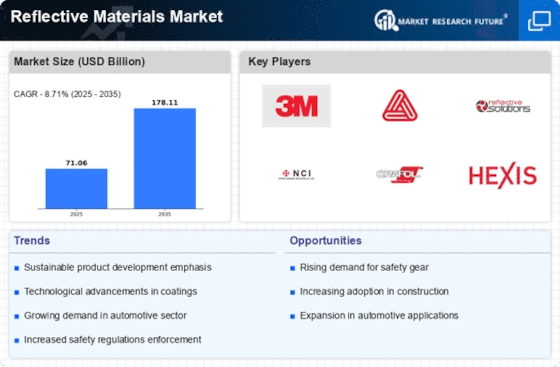
As per Market Research Future analysis, the Reflective Materials Market Size was estimated at 71.06 USD Billion in 2024. The Reflective Materials industry is projected to grow from 77.25 USD Billion in 2025 to 178.11 USD Billion by 2035, exhibiting a compound annual growth rate (CAGR) of 8.71% during the forecast period 2025 - 2035

Key Market Trends & Highlights

The Reflective Materials Market is poised for growth driven by technological advancements and sustainability initiatives.

  • North America remains the largest market for reflective materials, driven by robust demand in construction and automotive sectors.
  • Asia-Pacific is emerging as the fastest-growing region, with increasing investments in infrastructure and safety applications.
  • The Microprismatic segment holds the largest market share, while the Glass segment is witnessing rapid growth due to its innovative applications.
  • Key market drivers include the growing demand in the construction sector and the increased focus on safety regulations, which are shaping industry dynamics.

Market Size & Forecast

2024 Market Size 71.06 (USD Billion)
2035 Market Size 178.11 (USD Billion)
CAGR (2025 - 2035) 8.71%
Largest Regional Market Share in 2024 North America

Major Players

3M (US), Avery Dennison (US), Reflective Solutions (US), Nippon Carbide Industries (JP), Orafol (DE), Hexis (FR), Lintec Corporation (JP), Sika AG (CH), Mactac (US)

Market Trends

The Reflective Materials Market is currently experiencing a notable evolution, driven by a confluence of technological advancements and increasing awareness regarding safety and visibility. As industries such as construction, automotive, and fashion embrace innovative reflective solutions, the demand for high-performance materials is on the rise. This shift is largely influenced by regulatory frameworks that emphasize safety standards, compelling manufacturers to adopt reflective materials in their products. Furthermore, the integration of smart technologies into reflective materials is emerging, suggesting a future where these materials not only enhance visibility but also interact with their environment in real-time. In addition to safety considerations, sustainability is becoming a pivotal factor in the Reflective Materials Market. Manufacturers are increasingly focusing on eco-friendly materials and production processes, aligning with global trends towards environmental responsibility. This shift not only caters to consumer preferences but also addresses regulatory pressures for sustainable practices. As the market continues to evolve, it appears that the intersection of innovation, safety, and sustainability will shape the future landscape of reflective materials, potentially leading to new applications and market opportunities.

Technological Integration

The Reflective Materials Market is witnessing a trend towards the incorporation of advanced technologies. Innovations such as smart reflective materials, which can adapt to varying light conditions, are gaining traction. This development enhances functionality and opens avenues for applications in diverse sectors, including transportation and personal safety.

Sustainability Focus

There is a growing emphasis on sustainability within the Reflective Materials Market. Manufacturers are increasingly adopting eco-friendly materials and processes, responding to consumer demand for environmentally responsible products. This trend not only aligns with global sustainability goals but also enhances brand reputation.

Regulatory Influence

Regulatory frameworks are playing a crucial role in shaping the Reflective Materials Market. Stricter safety standards and guidelines are prompting industries to integrate reflective materials into their products. This regulatory influence is likely to drive innovation and expand the market as companies seek compliance and competitive advantage.

Reflective Materials Market Market Drivers

Advancements in Technology

Technological advancements play a pivotal role in shaping the Reflective Materials Market. Innovations in material science have led to the development of high-performance reflective coatings and films that enhance visibility and durability. For instance, the introduction of microprismatic technology has significantly improved the retroreflectivity of materials, making them more effective in low-light conditions. This has resulted in a surge in applications across various sectors, including transportation and safety equipment. The market is expected to benefit from ongoing research and development efforts aimed at creating more efficient and cost-effective reflective materials. As technology continues to evolve, it is anticipated that the Reflective Materials Market will expand, catering to the growing needs of diverse industries.

Expansion of Automotive Applications

The automotive sector is experiencing a significant expansion in the use of reflective materials, which is a crucial driver for the Reflective Materials Market. Reflective materials are employed in various automotive applications, including safety markings, reflective films, and interior components. The increasing emphasis on vehicle safety and visibility is prompting manufacturers to incorporate reflective materials into their designs. Additionally, the rise in electric and autonomous vehicles is expected to further boost the demand for innovative reflective solutions. As the automotive industry evolves, the Reflective Materials Market is likely to benefit from the growing integration of reflective technologies, enhancing safety and performance in vehicles.

Growing Demand in Construction Sector

The construction sector is witnessing a notable increase in the adoption of reflective materials, driven by the need for enhanced safety and energy efficiency. Reflective materials are utilized in various applications, including road markings, safety apparel, and building facades. The Reflective Materials Market is projected to experience a compound annual growth rate of approximately 5.2% over the next five years, as construction projects increasingly prioritize visibility and sustainability. This trend is further supported by the rising awareness of the benefits of reflective surfaces in reducing energy consumption and improving safety standards. As urbanization continues to expand, the demand for reflective materials in construction is likely to escalate, thereby propelling the overall market forward.

Increased Focus on Safety Regulations

The implementation of stringent safety regulations across various industries is a key driver for the Reflective Materials Market. Governments and regulatory bodies are increasingly mandating the use of reflective materials in safety apparel, road signage, and construction equipment to enhance visibility and reduce accidents. For example, regulations such as the ANSI/ISEA 107 standard in the United States require specific performance criteria for high-visibility clothing. This regulatory landscape is likely to bolster the demand for reflective materials, as companies strive to comply with safety standards. The market is projected to grow as industries recognize the importance of investing in reflective solutions to ensure worker safety and meet regulatory requirements.

Rising Awareness of Environmental Impact

There is a growing awareness regarding the environmental impact of materials used in various applications, which is influencing the Reflective Materials Market. Consumers and businesses alike are increasingly seeking sustainable alternatives that minimize ecological footprints. Reflective materials, particularly those made from recycled or eco-friendly components, are gaining traction as they contribute to energy savings and reduced heat absorption. This shift towards sustainability is expected to drive innovation in the development of reflective materials that align with environmental goals. As more industries adopt sustainable practices, the demand for eco-friendly reflective materials is likely to rise, further propelling the market forward.

Market Segment Insights

By Material Type: Microprismatic (Largest) vs. Glass (Fastest-Growing)

<p>In the Reflective Materials Market, the distribution of material types showcases a clear dominance of microprismatic materials, which hold the largest market share due to their exceptional light-reflecting properties and versatility in various applications. Glass materials follow closely, while ceramic beads, though valuable, occupy a smaller portion of the market share. This segmentation highlights the consumer preference for durable and efficient reflective materials in diverse sectors such as safety signage, transportation, and construction.</p>

<p>Microprismatic (Dominant) vs. Glass (Emerging)</p>

<p>Microprismatic materials are recognized for their superior performance in high-visibility applications, making them dominant in the Reflective Materials Market. Their construction consists of micro-sized prisms that enhance light reflection, thereby increasing safety and visibility. In contrast, glass materials are emerging as a significant player in this market space, fueled by innovations in manufacturing and recycling processes, making them more cost-effective and eco-friendly. The unique attributes of glass, including its high clarity and durable nature, appeal to both consumers and manufacturers looking for sustainable options. The competition between these two material types is intensifying as technological advancements pave the way for new products that cater to evolving market needs.</p>

By Product Type: Fabric (Largest) vs. Sheet (Fastest-Growing)

<p>In the Reflective Materials Market, the 'Product Type' segment showcases a diverse range of offerings, with Fabric accounting for the largest market share. This segment appeals to various applications, including safety gear and outdoor advertising. Sheets also hold significant popularity, driven by their versatility in construction and automotive sectors. Other segment values like Paints & Inks, Tape & Films, and Coatings contribute to the market, albeit to a lesser extent. Specialty Products and Others also carve out specific niches, creating a varied landscape where different materials can serve particular uses in reflective applications. As the demand for sustainable and innovative materials rises, growth trends show an increase in the adoption of reflective products across various industries. The popularity of lightweight and flexible materials like Sheet is propelling them to become the fastest-growing segment due to their ease of use and installation. Fabric remains dominant due to its established presence, especially in personal safety and outdoor applications. Continued advancements in technology and an emphasis on safety regulations are expected to drive further growth in the reflective materials sector, fostering innovation across all product types.</p>

<p>Fabric (Dominant) vs. Sheet (Emerging)</p>

<p>Fabric and Sheet are pivotal players in the Reflective Materials Market. Fabric, recognized for its adaptability and durability, is widely utilized in various applications, particularly in personal safety gear and outdoor advertising. Its extensive use showcases its established dominance in the sector, making it a go-to choice for many industries requiring visibility and safety. In contrast, Sheet products represent an emerging trend, increasingly favored for their ease of handling and versatility, particularly in construction and automotive applications. Their lower production costs and ability to conform to different shapes without losing reflective properties make them attractive for various manufacturers. Together, these products illustrate a dynamic landscape in the reflective materials sector, where established solutions meet emerging innovations.</p>

By End-User Industry: Building & Construction (Largest) vs. Automotive (Fastest-Growing)

<p>In the Reflective Materials Market, the Building & Construction sector holds the largest share, driven by increasing regulations on energy efficiency and design <a href="https://www.marketresearchfuture.com/reports/aesthetics-market-3136" target="_blank" title="aesthetics">aesthetics</a>. Reflective materials are extensively utilized in roofing, facades, and road markings to enhance visibility and reduce heat absorption. The Automotive industry is rapidly growing, leveraging reflective materials for safety features and improving vehicle aesthetics. This sector is adopting innovative materials that enhance visibility in various lighting conditions. As urbanization continues and sustainability initiatives gain momentum, the demand for reflective materials across various end-user industries is expected to surge. The growing focus on safety and energy efficiency in construction and automotive applications resonates with consumers, stakeholders, and regulatory bodies looking for environmentally friendly solutions. The Healthcare and Textile industries are also adopting reflective materials, but to a lesser degree compared to the leading sectors, yet they present potential growth opportunities in specialty applications.</p>

<p>Building & Construction: Dominant vs. Automotive: Emerging</p>

<p>The Building & Construction sector is a dominant player in the Reflective Materials Market, characterized by an increasing focus on energy efficiency and sustainable building practices. Materials used in this sector include reflective insulation, coatings, and films, providing benefits such as heat reduction and improved visibility for infrastructure projects. Conversely, the Automotive sector is emerging rapidly, integrating reflective materials to enhance vehicle safety and performance. Innovations include reflective safety gear and coatings that adapt to environmental conditions, appealing to consumers prioritizing safety and aesthetics. Furthermore, the growth in electric and autonomous vehicles is likely to spur additional demand for reflective materials that enhance vehicle visibility and functionality in diverse weather conditions.</p>

Get more detailed insights about Reflective Materials Market Research Report - Global Forecast till 2035

Regional Insights

North America : Market Leader in Innovation

North America is the largest market for reflective materials, holding approximately 40% of the global share. The region's growth is driven by stringent safety regulations, increasing demand in construction and automotive sectors, and advancements in technology. The U.S. and Canada are the primary contributors, with a focus on enhancing visibility and safety in various applications. Regulatory bodies are pushing for higher standards, further fueling market expansion. The competitive landscape in North America is robust, featuring key players like 3M, Avery Dennison, and Reflective Solutions. These companies are investing in R&D to innovate and improve product offerings. The presence of established manufacturers and a strong distribution network enhances market accessibility. The region's focus on sustainability and eco-friendly materials is also shaping the future of reflective products, ensuring continued growth and innovation.

Europe : Emerging Market with Regulations

Europe is witnessing significant growth in the reflective materials market, accounting for approximately 30% of the global share. The region's expansion is driven by increasing safety regulations, particularly in transportation and construction sectors. Countries like Germany and France are leading the market, with a strong emphasis on compliance with EU safety standards. The regulatory environment is a key catalyst, promoting the adoption of reflective materials in various applications. Leading countries in Europe include Germany, France, and the UK, where major players like Orafol and Hexis are prominent. The competitive landscape is characterized by innovation and collaboration among manufacturers to meet regulatory demands. The market is also influenced by sustainability trends, with companies focusing on eco-friendly materials. This dynamic environment fosters growth and positions Europe as a significant player in The Reflective Materials Market.

Asia-Pacific : Rapid Growth and Adoption

Asia-Pacific is rapidly emerging as a significant player in the reflective materials market, holding approximately 25% of the global share. The region's growth is fueled by increasing urbanization, infrastructure development, and rising safety awareness. Countries like China and Japan are at the forefront, with substantial investments in transportation and construction sectors driving demand for reflective materials. Government initiatives aimed at improving road safety are also contributing to market expansion. The competitive landscape in Asia-Pacific is diverse, with key players such as Nippon Carbide Industries and Lintec Corporation leading the charge. The market is characterized by a mix of local and international companies, fostering innovation and competitive pricing. As the region continues to develop, the demand for high-quality reflective materials is expected to rise, further solidifying Asia-Pacific's position in the global market.

Middle East and Africa : Untapped Potential and Growth

The Middle East and Africa region is gradually emerging in the reflective materials market, currently holding about 5% of the global share. The growth is driven by increasing infrastructure projects and a rising focus on safety regulations in countries like the UAE and South Africa. The region's untapped potential presents opportunities for manufacturers to expand their presence. Government initiatives aimed at enhancing road safety are also contributing to market growth. Leading countries in this region include the UAE and South Africa, where local players are beginning to establish a foothold. The competitive landscape is evolving, with both local and international companies vying for market share. As awareness of safety standards increases, the demand for reflective materials is expected to grow, paving the way for new entrants and innovations in the market.

Key Players and Competitive Insights

Leading market players are investing heavily in research and development in order to expand their product lines, which will help the Reflective Materials Market, grow even more. Market participants are also undertaking a variety of strategic activities to expand their footprint, with important market developments including new product launches, contractual agreements, mergers and acquisitions, higher investments, and collaboration with other organizations. To expand and survive in a more competitive and rising market climate, Reflective Material sindustry must offer cost-effective items.
Manufacturing locally to minimize operational costs is one of the key business tactics used by manufacturers in the Reflective Materials industry to benefit clients and increase the market sector. In recent years, the Reflective Materials industry has offered some of the most significant advantages to medicine. Major players in the Reflective Materials Market, including Dominic Optical (China), Changzhou Hua R Sheng Reflective Material Co., Ltd. (China), Coats Group ple (UK), Asian Paints PPG (India), and others, are attempting to increase market demand by investing in research and development operations.
Avery Dennison Corporation is a worldwide corporation that produces and sells pressure-sensitive adhesive materials (such as self-adhesive labels), RFID inlays, apparel branding labels and tags, and specialist medical goods. The corporation is a Fortune 500 company headquartered in Mentor, Ohio. In July 2021, Avery Dennison Corporation has released a new reflective film designed to increase vehicle visibility on the road. The new V-8000 Series film is highly reflective and long-lasting, making it ideal for emergency vehicles, commercial vehicles, and trailers.
3M is a multinational business based in the United States that operates in the domains of industry, worker safety, healthcare, and consumer goods. Adhesives, abrasives, laminates, passive fire protection, personal protective equipment, window films, paint protection films, dental and orthodontic products, electrical and electronic connecting and insulating materials, medical products, car-care products, electronic circuits, healthcare software, and optical films are among the over 60,000 products manufactured by the company under various brands. It is headquartered in Maplewood, Minnesota, a suburb of Saint Paul.
In August 2019, The 3M Scotchlite Reflective Material C790 Carbon Black Stretch Transfer Film is the latest addition to 3M's new line of reflective material products. The device is intended to provide advanced visibility and comfort to those who wear high-visibility apparel.

Key Companies in the Reflective Materials Market include

Industry Developments

In December 2022, The Reflexite V92 Daybright Colours Series is a new series of reflective material products from Reflexite Corporation. The product is intended to provide advanced visibility and colour vibrancy to those who wear high-visibility apparel.

In January 2023, The DM Reflective Material Heat Transfer Film is a new range of reflective material products introduced by DM Reflective Materials Market Co., Ltd. The product is intended for use in the production of sportswear and other apparel, and it provides high reflectivity and durability. The new product is expected to propel the reflective materials industry forward in the future years.

In December 2022, ORAFOL Americas has introduced a new reflective film for use in the production of traffic signs. The new ORALITE 5700 Engineering Grade Reflective Film has exceptional reflectivity and durability, making it perfect for use in a variety of traffic sign applications.

Future Outlook

Reflective Materials Market Future Outlook

The Reflective Materials Market is projected to grow at an 8.71% CAGR from 2025 to 2035, driven by increasing safety regulations and technological advancements.

New opportunities lie in:

  • Development of smart reflective materials for enhanced visibility in low-light conditions.
  • Expansion into emerging markets with tailored reflective solutions for local industries.
  • Partnerships with automotive manufacturers for integrated reflective technologies in vehicle design.

By 2035, the Reflective Materials Market is expected to achieve substantial growth and innovation.

Market Segmentation

Reflective Materials Market Product Type Outlook

  • Fabric
  • Sheet
  • Paints & Inks
  • Tape & Films
  • Coatings
  • Specialty Products
  • Others

Reflective Materials Market Material Type Outlook

  • Microprismatic
  • Glass
  • Ceramic Beads

Reflective Materials Market End-User Industry Outlook

  • Building & Construction
  • Automotive
  • Healthcare
  • Textile
  • Others

Report Scope

MARKET SIZE 2024 71.06(USD Billion)
MARKET SIZE 2025 77.25(USD Billion)
MARKET SIZE 2035 178.11(USD Billion)
COMPOUND ANNUAL GROWTH RATE (CAGR) 8.71% (2025 - 2035)
REPORT COVERAGE Revenue Forecast, Competitive Landscape, Growth Factors, and Trends
BASE YEAR 2024
Market Forecast Period 2025 - 2035
Historical Data 2019 - 2024
Market Forecast Units USD Billion
Key Companies Profiled 3M (US), Avery Dennison (US), Reflective Solutions (US), Nippon Carbide Industries (JP), Orafol (DE), Hexis (FR), Lintec Corporation (JP), Sika AG (CH), Mactac (US)
Segments Covered Material Type, Product Type, End-User Industry, Region
Key Market Opportunities Growing demand for safety applications drives innovation in the Reflective Materials Market.
Key Market Dynamics Rising demand for safety regulations drives innovation and competition in the reflective materials sector.
Countries Covered North America, Europe, APAC, South America, MEA

FAQs

What is the current valuation of the Reflective Materials Market as of 2024?

<p>The Reflective Materials Market was valued at 71.06 USD Billion in 2024.</p>

What is the projected market size for the Reflective Materials Market in 2035?

<p>The market is projected to reach 178.11 USD Billion by 2035.</p>

What is the expected CAGR for the Reflective Materials Market during the forecast period 2025 - 2035?

<p>The expected CAGR for the Reflective Materials Market during 2025 - 2035 is 8.71%.</p>

Which material type segment is anticipated to have the highest valuation in the Reflective Materials Market?

<p>The Glass segment is expected to have a valuation ranging from 30.0 to 80.0 USD Billion.</p>

What are the key product types in the Reflective Materials Market?

<p>Key product types include Fabric, Sheet, Paints & Inks, Tape & Films, Coatings, Specialty Products, and Others.</p>

Which end-user industry is projected to dominate the Reflective Materials Market?

<p>The Automotive industry is projected to dominate with a valuation between 20.0 and 50.0 USD Billion.</p>

Who are the leading players in the Reflective Materials Market?

Key players include 3M, Avery Dennison, Reflective Solutions, Nippon Carbide Industries, and Orafol.

What is the valuation range for the Ceramic Beads material type in the Reflective Materials Market?

The Ceramic Beads material type is valued between 21.06 and 48.11 USD Billion.

How does the projected growth of the Reflective Materials Market compare to its 2024 valuation?

The market is expected to grow significantly from its 2024 valuation of 71.06 USD Billion to 178.11 USD Billion by 2035.

What is the valuation range for the Tape & Films product type in the Reflective Materials Market?

The Tape &amp; Films product type is projected to have a valuation between 12.0 and 30.0 USD Billion.

  1. SECTION I: EXECUTIVE SUMMARY AND KEY HIGHLIGHTS
    1. | 1.1 EXECUTIVE SUMMARY
    2. | | 1.1.1 Market Overview
    3. | | 1.1.2 Key Findings
    4. | | 1.1.3 Market Segmentation
    5. | | 1.1.4 Competitive Landscape
    6. | | 1.1.5 Challenges and Opportunities
    7. | | 1.1.6 Future Outlook
  2. SECTION II: SCOPING, METHODOLOGY AND MARKET STRUCTURE
    1. | 2.1 MARKET INTRODUCTION
    2. | | 2.1.1 Definition
    3. | | 2.1.2 Scope of the study
    4. | | | 2.1.2.1 Research Objective
    5. | | | 2.1.2.2 Assumption
    6. | | | 2.1.2.3 Limitations
    7. | 2.2 RESEARCH METHODOLOGY
    8. | | 2.2.1 Overview
    9. | | 2.2.2 Data Mining
    10. | | 2.2.3 Secondary Research
    11. | | 2.2.4 Primary Research
    12. | | | 2.2.4.1 Primary Interviews and Information Gathering Process
    13. | | | 2.2.4.2 Breakdown of Primary Respondents
    14. | | 2.2.5 Forecasting Model
    15. | | 2.2.6 Market Size Estimation
    16. | | | 2.2.6.1 Bottom-Up Approach
    17. | | | 2.2.6.2 Top-Down Approach
    18. | | 2.2.7 Data Triangulation
    19. | | 2.2.8 Validation
  3. SECTION III: QUALITATIVE ANALYSIS
    1. | 3.1 MARKET DYNAMICS
    2. | | 3.1.1 Overview
    3. | | 3.1.2 Drivers
    4. | | 3.1.3 Restraints
    5. | | 3.1.4 Opportunities
    6. | 3.2 MARKET FACTOR ANALYSIS
    7. | | 3.2.1 Value chain Analysis
    8. | | 3.2.2 Porter's Five Forces Analysis
    9. | | | 3.2.2.1 Bargaining Power of Suppliers
    10. | | | 3.2.2.2 Bargaining Power of Buyers
    11. | | | 3.2.2.3 Threat of New Entrants
    12. | | | 3.2.2.4 Threat of Substitutes
    13. | | | 3.2.2.5 Intensity of Rivalry
    14. | | 3.2.3 COVID-19 Impact Analysis
    15. | | | 3.2.3.1 Market Impact Analysis
    16. | | | 3.2.3.2 Regional Impact
    17. | | | 3.2.3.3 Opportunity and Threat Analysis
  4. SECTION IV: QUANTITATIVE ANALYSIS
    1. | 4.1 Chemicals and Materials, BY Material Type (USD Billion)
    2. | | 4.1.1 Microprismatic
    3. | | 4.1.2 Glass
    4. | | 4.1.3 Ceramic Beads
    5. | 4.2 Chemicals and Materials, BY Product Type (USD Billion)
    6. | | 4.2.1 Fabric
    7. | | 4.2.2 Sheet
    8. | | 4.2.3 Paints & Inks
    9. | | 4.2.4 Tape & Films
    10. | | 4.2.5 Coatings
    11. | | 4.2.6 Specialty Products
    12. | | 4.2.7 Others
    13. | 4.3 Chemicals and Materials, BY End-User Industry (USD Billion)
    14. | | 4.3.1 Building & Construction
    15. | | 4.3.2 Automotive
    16. | | 4.3.3 Healthcare
    17. | | 4.3.4 Textile
    18. | | 4.3.5 Others
    19. | 4.4 Chemicals and Materials, BY Region (USD Billion)
    20. | | 4.4.1 North America
    21. | | | 4.4.1.1 US
    22. | | | 4.4.1.2 Canada
    23. | | 4.4.2 Europe
    24. | | | 4.4.2.1 Germany
    25. | | | 4.4.2.2 UK
    26. | | | 4.4.2.3 France
    27. | | | 4.4.2.4 Russia
    28. | | | 4.4.2.5 Italy
    29. | | | 4.4.2.6 Spain
    30. | | | 4.4.2.7 Rest of Europe
    31. | | 4.4.3 APAC
    32. | | | 4.4.3.1 China
    33. | | | 4.4.3.2 India
    34. | | | 4.4.3.3 Japan
    35. | | | 4.4.3.4 South Korea
    36. | | | 4.4.3.5 Malaysia
    37. | | | 4.4.3.6 Thailand
    38. | | | 4.4.3.7 Indonesia
    39. | | | 4.4.3.8 Rest of APAC
    40. | | 4.4.4 South America
    41. | | | 4.4.4.1 Brazil
    42. | | | 4.4.4.2 Mexico
    43. | | | 4.4.4.3 Argentina
    44. | | | 4.4.4.4 Rest of South America
    45. | | 4.4.5 MEA
    46. | | | 4.4.5.1 GCC Countries
    47. | | | 4.4.5.2 South Africa
    48. | | | 4.4.5.3 Rest of MEA
  5. SECTION V: COMPETITIVE ANALYSIS
    1. | 5.1 Competitive Landscape
    2. | | 5.1.1 Overview
    3. | | 5.1.2 Competitive Analysis
    4. | | 5.1.3 Market share Analysis
    5. | | 5.1.4 Major Growth Strategy in the Chemicals and Materials
    6. | | 5.1.5 Competitive Benchmarking
    7. | | 5.1.6 Leading Players in Terms of Number of Developments in the Chemicals and Materials
    8. | | 5.1.7 Key developments and growth strategies
    9. | | | 5.1.7.1 New Product Launch/Service Deployment
    10. | | | 5.1.7.2 Merger & Acquisitions
    11. | | | 5.1.7.3 Joint Ventures
    12. | | 5.1.8 Major Players Financial Matrix
    13. | | | 5.1.8.1 Sales and Operating Income
    14. | | | 5.1.8.2 Major Players R&D Expenditure. 2023
    15. | 5.2 Company Profiles
    16. | | 5.2.1 3M (US)
    17. | | | 5.2.1.1 Financial Overview
    18. | | | 5.2.1.2 Products Offered
    19. | | | 5.2.1.3 Key Developments
    20. | | | 5.2.1.4 SWOT Analysis
    21. | | | 5.2.1.5 Key Strategies
    22. | | 5.2.2 Avery Dennison (US)
    23. | | | 5.2.2.1 Financial Overview
    24. | | | 5.2.2.2 Products Offered
    25. | | | 5.2.2.3 Key Developments
    26. | | | 5.2.2.4 SWOT Analysis
    27. | | | 5.2.2.5 Key Strategies
    28. | | 5.2.3 Reflective Solutions (US)
    29. | | | 5.2.3.1 Financial Overview
    30. | | | 5.2.3.2 Products Offered
    31. | | | 5.2.3.3 Key Developments
    32. | | | 5.2.3.4 SWOT Analysis
    33. | | | 5.2.3.5 Key Strategies
    34. | | 5.2.4 Nippon Carbide Industries (JP)
    35. | | | 5.2.4.1 Financial Overview
    36. | | | 5.2.4.2 Products Offered
    37. | | | 5.2.4.3 Key Developments
    38. | | | 5.2.4.4 SWOT Analysis
    39. | | | 5.2.4.5 Key Strategies
    40. | | 5.2.5 Orafol (DE)
    41. | | | 5.2.5.1 Financial Overview
    42. | | | 5.2.5.2 Products Offered
    43. | | | 5.2.5.3 Key Developments
    44. | | | 5.2.5.4 SWOT Analysis
    45. | | | 5.2.5.5 Key Strategies
    46. | | 5.2.6 Hexis (FR)
    47. | | | 5.2.6.1 Financial Overview
    48. | | | 5.2.6.2 Products Offered
    49. | | | 5.2.6.3 Key Developments
    50. | | | 5.2.6.4 SWOT Analysis
    51. | | | 5.2.6.5 Key Strategies
    52. | | 5.2.7 Lintec Corporation (JP)
    53. | | | 5.2.7.1 Financial Overview
    54. | | | 5.2.7.2 Products Offered
    55. | | | 5.2.7.3 Key Developments
    56. | | | 5.2.7.4 SWOT Analysis
    57. | | | 5.2.7.5 Key Strategies
    58. | | 5.2.8 Sika AG (CH)
    59. | | | 5.2.8.1 Financial Overview
    60. | | | 5.2.8.2 Products Offered
    61. | | | 5.2.8.3 Key Developments
    62. | | | 5.2.8.4 SWOT Analysis
    63. | | | 5.2.8.5 Key Strategies
    64. | | 5.2.9 Mactac (US)
    65. | | | 5.2.9.1 Financial Overview
    66. | | | 5.2.9.2 Products Offered
    67. | | | 5.2.9.3 Key Developments
    68. | | | 5.2.9.4 SWOT Analysis
    69. | | | 5.2.9.5 Key Strategies
    70. | 5.3 Appendix
    71. | | 5.3.1 References
    72. | | 5.3.2 Related Reports
  6. LIST OF FIGURES
    1. | 6.1 MARKET SYNOPSIS
    2. | 6.2 NORTH AMERICA MARKET ANALYSIS
    3. | 6.3 US MARKET ANALYSIS BY MATERIAL TYPE
    4. | 6.4 US MARKET ANALYSIS BY PRODUCT TYPE
    5. | 6.5 US MARKET ANALYSIS BY END-USER INDUSTRY
    6. | 6.6 CANADA MARKET ANALYSIS BY MATERIAL TYPE
    7. | 6.7 CANADA MARKET ANALYSIS BY PRODUCT TYPE
    8. | 6.8 CANADA MARKET ANALYSIS BY END-USER INDUSTRY
    9. | 6.9 EUROPE MARKET ANALYSIS
    10. | 6.10 GERMANY MARKET ANALYSIS BY MATERIAL TYPE
    11. | 6.11 GERMANY MARKET ANALYSIS BY PRODUCT TYPE
    12. | 6.12 GERMANY MARKET ANALYSIS BY END-USER INDUSTRY
    13. | 6.13 UK MARKET ANALYSIS BY MATERIAL TYPE
    14. | 6.14 UK MARKET ANALYSIS BY PRODUCT TYPE
    15. | 6.15 UK MARKET ANALYSIS BY END-USER INDUSTRY
    16. | 6.16 FRANCE MARKET ANALYSIS BY MATERIAL TYPE
    17. | 6.17 FRANCE MARKET ANALYSIS BY PRODUCT TYPE
    18. | 6.18 FRANCE MARKET ANALYSIS BY END-USER INDUSTRY
    19. | 6.19 RUSSIA MARKET ANALYSIS BY MATERIAL TYPE
    20. | 6.20 RUSSIA MARKET ANALYSIS BY PRODUCT TYPE
    21. | 6.21 RUSSIA MARKET ANALYSIS BY END-USER INDUSTRY
    22. | 6.22 ITALY MARKET ANALYSIS BY MATERIAL TYPE
    23. | 6.23 ITALY MARKET ANALYSIS BY PRODUCT TYPE
    24. | 6.24 ITALY MARKET ANALYSIS BY END-USER INDUSTRY
    25. | 6.25 SPAIN MARKET ANALYSIS BY MATERIAL TYPE
    26. | 6.26 SPAIN MARKET ANALYSIS BY PRODUCT TYPE
    27. | 6.27 SPAIN MARKET ANALYSIS BY END-USER INDUSTRY
    28. | 6.28 REST OF EUROPE MARKET ANALYSIS BY MATERIAL TYPE
    29. | 6.29 REST OF EUROPE MARKET ANALYSIS BY PRODUCT TYPE
    30. | 6.30 REST OF EUROPE MARKET ANALYSIS BY END-USER INDUSTRY
    31. | 6.31 APAC MARKET ANALYSIS
    32. | 6.32 CHINA MARKET ANALYSIS BY MATERIAL TYPE
    33. | 6.33 CHINA MARKET ANALYSIS BY PRODUCT TYPE
    34. | 6.34 CHINA MARKET ANALYSIS BY END-USER INDUSTRY
    35. | 6.35 INDIA MARKET ANALYSIS BY MATERIAL TYPE
    36. | 6.36 INDIA MARKET ANALYSIS BY PRODUCT TYPE
    37. | 6.37 INDIA MARKET ANALYSIS BY END-USER INDUSTRY
    38. | 6.38 JAPAN MARKET ANALYSIS BY MATERIAL TYPE
    39. | 6.39 JAPAN MARKET ANALYSIS BY PRODUCT TYPE
    40. | 6.40 JAPAN MARKET ANALYSIS BY END-USER INDUSTRY
    41. | 6.41 SOUTH KOREA MARKET ANALYSIS BY MATERIAL TYPE
    42. | 6.42 SOUTH KOREA MARKET ANALYSIS BY PRODUCT TYPE
    43. | 6.43 SOUTH KOREA MARKET ANALYSIS BY END-USER INDUSTRY
    44. | 6.44 MALAYSIA MARKET ANALYSIS BY MATERIAL TYPE
    45. | 6.45 MALAYSIA MARKET ANALYSIS BY PRODUCT TYPE
    46. | 6.46 MALAYSIA MARKET ANALYSIS BY END-USER INDUSTRY
    47. | 6.47 THAILAND MARKET ANALYSIS BY MATERIAL TYPE
    48. | 6.48 THAILAND MARKET ANALYSIS BY PRODUCT TYPE
    49. | 6.49 THAILAND MARKET ANALYSIS BY END-USER INDUSTRY
    50. | 6.50 INDONESIA MARKET ANALYSIS BY MATERIAL TYPE
    51. | 6.51 INDONESIA MARKET ANALYSIS BY PRODUCT TYPE
    52. | 6.52 INDONESIA MARKET ANALYSIS BY END-USER INDUSTRY
    53. | 6.53 REST OF APAC MARKET ANALYSIS BY MATERIAL TYPE
    54. | 6.54 REST OF APAC MARKET ANALYSIS BY PRODUCT TYPE
    55. | 6.55 REST OF APAC MARKET ANALYSIS BY END-USER INDUSTRY
    56. | 6.56 SOUTH AMERICA MARKET ANALYSIS
    57. | 6.57 BRAZIL MARKET ANALYSIS BY MATERIAL TYPE
    58. | 6.58 BRAZIL MARKET ANALYSIS BY PRODUCT TYPE
    59. | 6.59 BRAZIL MARKET ANALYSIS BY END-USER INDUSTRY
    60. | 6.60 MEXICO MARKET ANALYSIS BY MATERIAL TYPE
    61. | 6.61 MEXICO MARKET ANALYSIS BY PRODUCT TYPE
    62. | 6.62 MEXICO MARKET ANALYSIS BY END-USER INDUSTRY
    63. | 6.63 ARGENTINA MARKET ANALYSIS BY MATERIAL TYPE
    64. | 6.64 ARGENTINA MARKET ANALYSIS BY PRODUCT TYPE
    65. | 6.65 ARGENTINA MARKET ANALYSIS BY END-USER INDUSTRY
    66. | 6.66 REST OF SOUTH AMERICA MARKET ANALYSIS BY MATERIAL TYPE
    67. | 6.67 REST OF SOUTH AMERICA MARKET ANALYSIS BY PRODUCT TYPE
    68. | 6.68 REST OF SOUTH AMERICA MARKET ANALYSIS BY END-USER INDUSTRY
    69. | 6.69 MEA MARKET ANALYSIS
    70. | 6.70 GCC COUNTRIES MARKET ANALYSIS BY MATERIAL TYPE
    71. | 6.71 GCC COUNTRIES MARKET ANALYSIS BY PRODUCT TYPE
    72. | 6.72 GCC COUNTRIES MARKET ANALYSIS BY END-USER INDUSTRY
    73. | 6.73 SOUTH AFRICA MARKET ANALYSIS BY MATERIAL TYPE
    74. | 6.74 SOUTH AFRICA MARKET ANALYSIS BY PRODUCT TYPE
    75. | 6.75 SOUTH AFRICA MARKET ANALYSIS BY END-USER INDUSTRY
    76. | 6.76 REST OF MEA MARKET ANALYSIS BY MATERIAL TYPE
    77. | 6.77 REST OF MEA MARKET ANALYSIS BY PRODUCT TYPE
    78. | 6.78 REST OF MEA MARKET ANALYSIS BY END-USER INDUSTRY
    79. | 6.79 KEY BUYING CRITERIA OF CHEMICALS AND MATERIALS
    80. | 6.80 RESEARCH PROCESS OF MRFR
    81. | 6.81 DRO ANALYSIS OF CHEMICALS AND MATERIALS
    82. | 6.82 DRIVERS IMPACT ANALYSIS: CHEMICALS AND MATERIALS
    83. | 6.83 RESTRAINTS IMPACT ANALYSIS: CHEMICALS AND MATERIALS
    84. | 6.84 SUPPLY / VALUE CHAIN: CHEMICALS AND MATERIALS
    85. | 6.85 CHEMICALS AND MATERIALS, BY MATERIAL TYPE, 2024 (% SHARE)
    86. | 6.86 CHEMICALS AND MATERIALS, BY MATERIAL TYPE, 2024 TO 2035 (USD Billion)
    87. | 6.87 CHEMICALS AND MATERIALS, BY PRODUCT TYPE, 2024 (% SHARE)
    88. | 6.88 CHEMICALS AND MATERIALS, BY PRODUCT TYPE, 2024 TO 2035 (USD Billion)
    89. | 6.89 CHEMICALS AND MATERIALS, BY END-USER INDUSTRY, 2024 (% SHARE)
    90. | 6.90 CHEMICALS AND MATERIALS, BY END-USER INDUSTRY, 2024 TO 2035 (USD Billion)
    91. | 6.91 BENCHMARKING OF MAJOR COMPETITORS
  7. LIST OF TABLES
    1. | 7.1 LIST OF ASSUMPTIONS
    2. | | 7.1.1
    3. | 7.2 North America MARKET SIZE ESTIMATES; FORECAST
    4. | | 7.2.1 BY MATERIAL TYPE, 2025-2035 (USD Billion)
    5. | | 7.2.2 BY PRODUCT TYPE, 2025-2035 (USD Billion)
    6. | | 7.2.3 BY END-USER INDUSTRY, 2025-2035 (USD Billion)
    7. | 7.3 US MARKET SIZE ESTIMATES; FORECAST
    8. | | 7.3.1 BY MATERIAL TYPE, 2025-2035 (USD Billion)
    9. | | 7.3.2 BY PRODUCT TYPE, 2025-2035 (USD Billion)
    10. | | 7.3.3 BY END-USER INDUSTRY, 2025-2035 (USD Billion)
    11. | 7.4 Canada MARKET SIZE ESTIMATES; FORECAST
    12. | | 7.4.1 BY MATERIAL TYPE, 2025-2035 (USD Billion)
    13. | | 7.4.2 BY PRODUCT TYPE, 2025-2035 (USD Billion)
    14. | | 7.4.3 BY END-USER INDUSTRY, 2025-2035 (USD Billion)
    15. | 7.5 Europe MARKET SIZE ESTIMATES; FORECAST
    16. | | 7.5.1 BY MATERIAL TYPE, 2025-2035 (USD Billion)
    17. | | 7.5.2 BY PRODUCT TYPE, 2025-2035 (USD Billion)
    18. | | 7.5.3 BY END-USER INDUSTRY, 2025-2035 (USD Billion)
    19. | 7.6 Germany MARKET SIZE ESTIMATES; FORECAST
    20. | | 7.6.1 BY MATERIAL TYPE, 2025-2035 (USD Billion)
    21. | | 7.6.2 BY PRODUCT TYPE, 2025-2035 (USD Billion)
    22. | | 7.6.3 BY END-USER INDUSTRY, 2025-2035 (USD Billion)
    23. | 7.7 UK MARKET SIZE ESTIMATES; FORECAST
    24. | | 7.7.1 BY MATERIAL TYPE, 2025-2035 (USD Billion)
    25. | | 7.7.2 BY PRODUCT TYPE, 2025-2035 (USD Billion)
    26. | | 7.7.3 BY END-USER INDUSTRY, 2025-2035 (USD Billion)
    27. | 7.8 France MARKET SIZE ESTIMATES; FORECAST
    28. | | 7.8.1 BY MATERIAL TYPE, 2025-2035 (USD Billion)
    29. | | 7.8.2 BY PRODUCT TYPE, 2025-2035 (USD Billion)
    30. | | 7.8.3 BY END-USER INDUSTRY, 2025-2035 (USD Billion)
    31. | 7.9 Russia MARKET SIZE ESTIMATES; FORECAST
    32. | | 7.9.1 BY MATERIAL TYPE, 2025-2035 (USD Billion)
    33. | | 7.9.2 BY PRODUCT TYPE, 2025-2035 (USD Billion)
    34. | | 7.9.3 BY END-USER INDUSTRY, 2025-2035 (USD Billion)
    35. | 7.10 Italy MARKET SIZE ESTIMATES; FORECAST
    36. | | 7.10.1 BY MATERIAL TYPE, 2025-2035 (USD Billion)
    37. | | 7.10.2 BY PRODUCT TYPE, 2025-2035 (USD Billion)
    38. | | 7.10.3 BY END-USER INDUSTRY, 2025-2035 (USD Billion)
    39. | 7.11 Spain MARKET SIZE ESTIMATES; FORECAST
    40. | | 7.11.1 BY MATERIAL TYPE, 2025-2035 (USD Billion)
    41. | | 7.11.2 BY PRODUCT TYPE, 2025-2035 (USD Billion)
    42. | | 7.11.3 BY END-USER INDUSTRY, 2025-2035 (USD Billion)
    43. | 7.12 Rest of Europe MARKET SIZE ESTIMATES; FORECAST
    44. | | 7.12.1 BY MATERIAL TYPE, 2025-2035 (USD Billion)
    45. | | 7.12.2 BY PRODUCT TYPE, 2025-2035 (USD Billion)
    46. | | 7.12.3 BY END-USER INDUSTRY, 2025-2035 (USD Billion)
    47. | 7.13 APAC MARKET SIZE ESTIMATES; FORECAST
    48. | | 7.13.1 BY MATERIAL TYPE, 2025-2035 (USD Billion)
    49. | | 7.13.2 BY PRODUCT TYPE, 2025-2035 (USD Billion)
    50. | | 7.13.3 BY END-USER INDUSTRY, 2025-2035 (USD Billion)
    51. | 7.14 China MARKET SIZE ESTIMATES; FORECAST
    52. | | 7.14.1 BY MATERIAL TYPE, 2025-2035 (USD Billion)
    53. | | 7.14.2 BY PRODUCT TYPE, 2025-2035 (USD Billion)
    54. | | 7.14.3 BY END-USER INDUSTRY, 2025-2035 (USD Billion)
    55. | 7.15 India MARKET SIZE ESTIMATES; FORECAST
    56. | | 7.15.1 BY MATERIAL TYPE, 2025-2035 (USD Billion)
    57. | | 7.15.2 BY PRODUCT TYPE, 2025-2035 (USD Billion)
    58. | | 7.15.3 BY END-USER INDUSTRY, 2025-2035 (USD Billion)
    59. | 7.16 Japan MARKET SIZE ESTIMATES; FORECAST
    60. | | 7.16.1 BY MATERIAL TYPE, 2025-2035 (USD Billion)
    61. | | 7.16.2 BY PRODUCT TYPE, 2025-2035 (USD Billion)
    62. | | 7.16.3 BY END-USER INDUSTRY, 2025-2035 (USD Billion)
    63. | 7.17 South Korea MARKET SIZE ESTIMATES; FORECAST
    64. | | 7.17.1 BY MATERIAL TYPE, 2025-2035 (USD Billion)
    65. | | 7.17.2 BY PRODUCT TYPE, 2025-2035 (USD Billion)
    66. | | 7.17.3 BY END-USER INDUSTRY, 2025-2035 (USD Billion)
    67. | 7.18 Malaysia MARKET SIZE ESTIMATES; FORECAST
    68. | | 7.18.1 BY MATERIAL TYPE, 2025-2035 (USD Billion)
    69. | | 7.18.2 BY PRODUCT TYPE, 2025-2035 (USD Billion)
    70. | | 7.18.3 BY END-USER INDUSTRY, 2025-2035 (USD Billion)
    71. | 7.19 Thailand MARKET SIZE ESTIMATES; FORECAST
    72. | | 7.19.1 BY MATERIAL TYPE, 2025-2035 (USD Billion)
    73. | | 7.19.2 BY PRODUCT TYPE, 2025-2035 (USD Billion)
    74. | | 7.19.3 BY END-USER INDUSTRY, 2025-2035 (USD Billion)
    75. | 7.20 Indonesia MARKET SIZE ESTIMATES; FORECAST
    76. | | 7.20.1 BY MATERIAL TYPE, 2025-2035 (USD Billion)
    77. | | 7.20.2 BY PRODUCT TYPE, 2025-2035 (USD Billion)
    78. | | 7.20.3 BY END-USER INDUSTRY, 2025-2035 (USD Billion)
    79. | 7.21 Rest of APAC MARKET SIZE ESTIMATES; FORECAST
    80. | | 7.21.1 BY MATERIAL TYPE, 2025-2035 (USD Billion)
    81. | | 7.21.2 BY PRODUCT TYPE, 2025-2035 (USD Billion)
    82. | | 7.21.3 BY END-USER INDUSTRY, 2025-2035 (USD Billion)
    83. | 7.22 South America MARKET SIZE ESTIMATES; FORECAST
    84. | | 7.22.1 BY MATERIAL TYPE, 2025-2035 (USD Billion)
    85. | | 7.22.2 BY PRODUCT TYPE, 2025-2035 (USD Billion)
    86. | | 7.22.3 BY END-USER INDUSTRY, 2025-2035 (USD Billion)
    87. | 7.23 Brazil MARKET SIZE ESTIMATES; FORECAST
    88. | | 7.23.1 BY MATERIAL TYPE, 2025-2035 (USD Billion)
    89. | | 7.23.2 BY PRODUCT TYPE, 2025-2035 (USD Billion)
    90. | | 7.23.3 BY END-USER INDUSTRY, 2025-2035 (USD Billion)
    91. | 7.24 Mexico MARKET SIZE ESTIMATES; FORECAST
    92. | | 7.24.1 BY MATERIAL TYPE, 2025-2035 (USD Billion)
    93. | | 7.24.2 BY PRODUCT TYPE, 2025-2035 (USD Billion)
    94. | | 7.24.3 BY END-USER INDUSTRY, 2025-2035 (USD Billion)
    95. | 7.25 Argentina MARKET SIZE ESTIMATES; FORECAST
    96. | | 7.25.1 BY MATERIAL TYPE, 2025-2035 (USD Billion)
    97. | | 7.25.2 BY PRODUCT TYPE, 2025-2035 (USD Billion)
    98. | | 7.25.3 BY END-USER INDUSTRY, 2025-2035 (USD Billion)
    99. | 7.26 Rest of South America MARKET SIZE ESTIMATES; FORECAST
    100. | | 7.26.1 BY MATERIAL TYPE, 2025-2035 (USD Billion)
    101. | | 7.26.2 BY PRODUCT TYPE, 2025-2035 (USD Billion)
    102. | | 7.26.3 BY END-USER INDUSTRY, 2025-2035 (USD Billion)
    103. | 7.27 MEA MARKET SIZE ESTIMATES; FORECAST
    104. | | 7.27.1 BY MATERIAL TYPE, 2025-2035 (USD Billion)
    105. | | 7.27.2 BY PRODUCT TYPE, 2025-2035 (USD Billion)
    106. | | 7.27.3 BY END-USER INDUSTRY, 2025-2035 (USD Billion)
    107. | 7.28 GCC Countries MARKET SIZE ESTIMATES; FORECAST
    108. | | 7.28.1 BY MATERIAL TYPE, 2025-2035 (USD Billion)
    109. | | 7.28.2 BY PRODUCT TYPE, 2025-2035 (USD Billion)
    110. | | 7.28.3 BY END-USER INDUSTRY, 2025-2035 (USD Billion)
    111. | 7.29 South Africa MARKET SIZE ESTIMATES; FORECAST
    112. | | 7.29.1 BY MATERIAL TYPE, 2025-2035 (USD Billion)
    113. | | 7.29.2 BY PRODUCT TYPE, 2025-2035 (USD Billion)
    114. | | 7.29.3 BY END-USER INDUSTRY, 2025-2035 (USD Billion)
    115. | 7.30 Rest of MEA MARKET SIZE ESTIMATES; FORECAST
    116. | | 7.30.1 BY MATERIAL TYPE, 2025-2035 (USD Billion)
    117. | | 7.30.2 BY PRODUCT TYPE, 2025-2035 (USD Billion)
    118. | | 7.30.3 BY END-USER INDUSTRY, 2025-2035 (USD Billion)
    119. | 7.31 PRODUCT LAUNCH/PRODUCT DEVELOPMENT/APPROVAL
    120. | | 7.31.1
    121. | 7.32 ACQUISITION/PARTNERSHIP
    122. | | 7.32.1

Chemicals and Materials Market Segmentation

Chemicals and Materials By Material Type (USD Billion, 2025-2035)

  • Microprismatic
  • Glass
  • Ceramic Beads

Chemicals and Materials By Product Type (USD Billion, 2025-2035)

  • Fabric
  • Sheet
  • Paints & Inks
  • Tape & Films
  • Coatings
  • Specialty Products
  • Others

Chemicals and Materials By End-User Industry (USD Billion, 2025-2035)

  • Building & Construction
  • Automotive
  • Healthcare
  • Textile
  • Others
Infographic

Free Sample Request

Kindly complete the form below to receive a free sample of this Report

Get Free Sample

Customer Strories

Compare Licence

×
Features License Type
Single User Multiuser License Enterprise User
Price $4,950 $5,950 $7,250
Maximum User Access Limit 1 User Upto 10 Users Unrestricted Access Throughout the Organization
Free Customization
Direct Access to Analyst
Deliverable Format
Platform Access
Discount on Next Purchase 10% 15% 15%
Printable Versions
%>