Request Free Sample ×

Kindly complete the form below to receive a free sample of this Report

* Please use a valid business email

Leading companies partner with us for data-driven Insights

clients tt-cursor
Hero Background
English
Chinese
French
Japanese
Korean
German
Spanish

Refining Catalysts Market Analysis

ID: MRFR/CnM/1035-HCR
111 Pages
Chitranshi Jaiswal
December 2024

Refining Catalyst Market Research Report Information By Type (FCC Catalysts, Hydrotreating Catalysts, Hydrocracking Catalysts, Catalytic Reforming Catalysts) Ingredients (Zeolites, Metals, and Chemical Compounds), And By Region (North America, Europe, Asia-Pacific, And Rest Of The World) – Market Forecast Till 2035.

Share:
Download PDF ×

We do not share your information with anyone. However, we may send you emails based on your report interest from time to time. You may contact us at any time to opt-out.

Refining Catalysts Market Infographic
Purchase Options

Market Analysis

In-depth Analysis of Refining Catalysts Market Industry Landscape

The refining catalyst market operates within a complex framework influenced by various factors. At its core, the demand for refining catalysts is intricately tied to the global petroleum industry. This industry, which encompasses refining operations, is driven by factors such as crude oil prices, technological advancements, environmental regulations, and market demand for refined petroleum products. Fluctuations in crude oil prices significantly impact the profitability of refining operations, directly affecting the demand for catalysts. When crude prices are high, refiners seek to maximize efficiency and yield through the use of catalysts, whereas during periods of low prices, cost-saving measures may lead to reduced catalyst consumption.

On the basis of type, hydrocracking catalyst segment is expected to exhibit the highest growth during the forecast period. The hydrocracking catalysts are used extensively because it does not produce coke as a by-product, which results in the efficient conversion of feedstock. On the basis of the ingredient, the metal segment accounted for the largest share in 2019 and is anticipated to exhibit the same trend during the forecast period. The metals are highly employed in hydrocracking and hydrotreating for the removal of unwanted particles and for reducing emissions of harmful gases. Thereby, the growing demand for less emitting fuel owing to the stringent government regulations is majorly contributing to the growth of the segment.

Technological advancements play a crucial role in shaping the market dynamics of refining catalysts. Continuous research and development efforts aim to improve catalyst efficiency, selectivity, and longevity, thereby enhancing the overall performance of refining processes. Catalyst manufacturers strive to innovate new formulations and manufacturing techniques to meet the evolving needs of refiners, such as increasing the production of high-value products like gasoline and diesel while minimizing the generation of unwanted by-products.

Environmental regulations exert a significant influence on the refining catalyst market. Stringent emissions standards and mandates to reduce the sulfur content in transportation fuels have compelled refiners to invest in advanced catalyst technologies that facilitate cleaner and more efficient refining processes. Catalysts capable of selectively removing sulfur, nitrogen, and other pollutants from crude oil feedstocks play a crucial role in ensuring compliance with regulatory requirements while minimizing environmental impact.

Market demand for refined petroleum products serves as a primary driver for the refining catalyst market. Economic growth, industrialization, and urbanization in emerging economies contribute to rising consumption of fuels and petrochemicals, thereby driving demand for refining capacity expansion and catalysts. Additionally, shifting consumer preferences towards cleaner and higher-quality fuels necessitate the use of advanced catalysts to meet stringent product specifications and quality standards.

The competitive landscape of the refining catalyst market is characterized by the presence of several major players, each vying for market share through product differentiation, innovation, and strategic collaborations. Key market participants engage in extensive research and development activities to maintain a competitive edge and cater to the diverse needs of refiners worldwide. Furthermore, mergers, acquisitions, and partnerships are common strategies employed by companies to expand their market presence and enhance their product portfolios.

Geopolitical factors and supply chain dynamics also impact the refining catalyst market. Regional variations in crude oil availability, refining capacity, and regulatory frameworks influence the demand for catalysts in different parts of the world. Furthermore, disruptions in the supply chain, such as trade tensions, natural disasters, or logistical challenges, can affect the availability and pricing of raw materials essential for catalyst manufacturing, thereby impacting market dynamics.


Author
Author Profile
Chitranshi Jaiswal
Team Lead - Research

Chitranshi is a Team Leader in the Chemicals & Materials (CnM) and Energy & Power (EnP) domains, with 6+ years of experience in market research. She leads and mentors teams to deliver cross-domain projects that equip clients with actionable insights and growth strategies. She is skilled in market estimation, forecasting, competitive benchmarking, and both primary & secondary research, enabling her to turn complex data into decision-ready insights. An engineer and MBA professional, she combines technical expertise with strategic acumen to solve dynamic market challenges. Chitranshi has successfully managed projects that support market entry, investment planning, and competitive positioning, while building strong client relationships. Certified in Advanced Excel & Power BI she leverages data-driven approaches to ensure accuracy, clarity, and impactful outcomes.

Leave a Comment

FAQs

What is the projected market valuation of The Global Refining Catalyst by 2035?

<p>The projected market valuation for The Global Refining Catalyst is 7.722 USD Billion by 2035.</p>

What was the market valuation of The Global Refining Catalyst in 2024?

<p>The overall market valuation of The Global Refining Catalyst was 4.515 USD Billion in 2024.</p>

What is the expected CAGR for The Global Refining Catalyst during the forecast period 2025 - 2035?

<p>The expected CAGR for The Global Refining Catalyst during the forecast period 2025 - 2035 is 5.0%.</p>

Which companies are considered key players in The Global Refining Catalyst?

<p>Key players in The Global Refining Catalyst include BASF SE, ExxonMobil Chemical Company, Royal Dutch Shell plc, and Honeywell UOP.</p>

What are the main types of catalysts in The Global Refining Catalyst?

<p>The main types of catalysts in The Global Refining Catalyst include FCC Catalysts, Hydrotreating Catalysts, Hydrocracking Catalysts, and Catalytic Reforming Catalysts.</p>

What was the valuation of FCC Catalysts in 2024?

<p>The valuation of FCC Catalysts in 2024 was 1.5 USD Billion.</p>

What is the projected valuation for Chemical Compounds in The Global Refining Catalyst by 2035?

The projected valuation for Chemical Compounds in The Global Refining Catalyst is 3.422 USD Billion by 2035.

How do the valuations of Zeolites compare to Metals in The Global Refining Catalyst?

In 2024, the valuation of Zeolites was 1.5 USD Billion, whereas Metals had a valuation of 1.0 USD Billion.

What is the expected growth trend for Hydrocracking Catalysts from 2024 to 2035?

The expected growth trend for Hydrocracking Catalysts indicates an increase from 1.0 USD Billion in 2024 to 1.7 USD Billion by 2035.

Which ingredient segment is projected to have the highest valuation by 2035?

The ingredient segment projected to have the highest valuation by 2035 is Chemical Compounds, estimated at 3.422 USD Billion.

Market Summary

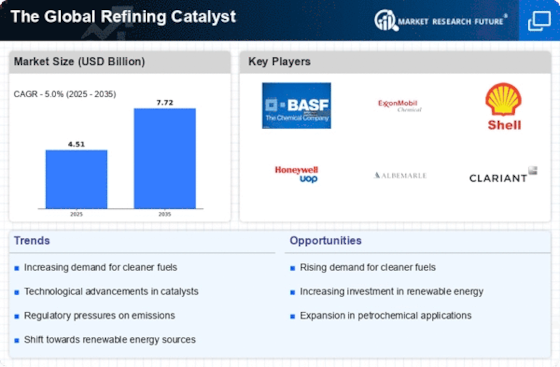
As per Market Research Future analysis, The Refining Catalysts Market Size was estimated at 4.515 USD Billion in 2024. The refining catalyst industry is projected to grow from 4.741 USD Billion in 2025 to 7.722 USD Billion by 2035, exhibiting a compound annual growth rate (CAGR) of 5.0% during the forecast period 2025 - 2035

Key Market Trends & Highlights

The Global Refining Catalyst is poised for growth driven by sustainability and technological advancements.

  • Asia-Pacific is the dominant region in the refining catalysts market, accounting for a 40.12% share in 2025, driven by expanding refining capacities and strong energy demand Asia-Pacific is the fastest-growing region, reflecting increasing investments in refining capacity and a shift towards renewable energy sources. FCC catalysts lead the market by type, holding a 42.9% share in 2025, owing to their critical role in maximizing fuel production efficiency. Hydrotreating catalysts are the fastest-growing segment, projected to expand at a CAGR of approximately 5.64% through 2035, driven by their effectiveness in producing low-sulfur and cleaner fuels.

Market Size & Forecast

2024 Market Size 4.515 (USD Billion)
2035 Market Size 7.722 (USD Billion)
CAGR (2025 - 2035) 5.0%
Largest Regional Market Share in 2024 Asia Pacific

Major Players

BASF SE (DE), ExxonMobil Chemical Company (US), Royal Dutch Shell plc (NL), Honeywell UOP (US), Albemarle Corporation (US), Clariant AG (CH), Johnson Matthey plc (GB), Haldor Topsoe A/S (DK), SABIC (SA)

Market Trends

The Refining Catalysts Market is currently experiencing a dynamic evolution, driven by the increasing demand for cleaner fuels and the need for enhanced efficiency in refining processes. This market appears to be influenced by various factors, including regulatory pressures aimed at reducing emissions and the growing emphasis on sustainability. As refiners seek to optimize their operations, the adoption of advanced catalytic technologies seems to be gaining traction, potentially leading to improved product yields and reduced operational costs. Furthermore, the shift towards renewable energy sources may also impact the market landscape, as refiners adapt to changing energy paradigms and consumer preferences. In addition, the competitive landscape of The Refining Catalysts Market is characterized by ongoing innovations and strategic collaborations among key players. Companies are likely investing in research and development to create more effective catalysts that can withstand harsher operating conditions while maintaining high performance. This trend suggests a potential for increased market fragmentation, as new entrants may emerge with novel solutions. Overall, The Refining Catalysts Market appears poised for growth, with various factors shaping its trajectory in the coming years.

Sustainability Initiatives

The Refining Catalysts Market is witnessing a notable shift towards sustainability initiatives. Refiners are increasingly focusing on developing catalysts that minimize environmental impact, aligning with global efforts to reduce carbon footprints. This trend indicates a growing preference for eco-friendly solutions that not only comply with regulations but also appeal to environmentally conscious consumers.

Technological Advancements

Technological advancements are playing a crucial role in the evolution of The Refining Catalysts Market. Innovations in catalyst formulations and processes are enhancing efficiency and effectiveness, allowing refiners to achieve higher yields and better product quality. This trend suggests that ongoing research and development will continue to drive market growth.

Regulatory Compliance

Regulatory compliance remains a significant driver in The Refining Catalysts Market. Stricter environmental regulations are compelling refiners to adopt advanced catalytic technologies that meet new standards. This trend highlights the necessity for continuous adaptation within the industry to ensure compliance while maintaining operational efficiency.

Refining Catalysts Market Market Drivers

Rising Demand for Clean Fuels

The increasing The Refining Catalysts Market. As nations strive to meet stringent environmental regulations, the demand for cleaner and more efficient fuel production processes intensifies. This trend is reflected in the projected growth of the refining catalyst market, which is expected to reach USD 6.5 billion by 2026. The refining catalyst market is adapting to these changes by developing catalysts that enhance the yield of cleaner fuels, thereby aligning with sustainability goals. Furthermore, the shift towards low-sulfur fuels in marine and automotive applications is likely to bolster the demand for advanced refining catalysts, as they play a crucial role in desulfurization processes.

Shift Towards Renewable Energy Sources

The transition towards renewable energy sources is emerging as a notable driver for the refining catalyst market. As the global energy landscape evolves, there is an increasing focus on biofuels and other renewable alternatives. This shift necessitates the development of specialized catalysts that can efficiently process biomass and other renewable feedstocks. The refining catalyst market is poised to benefit from this trend, as refiners seek to diversify their product offerings and meet the growing demand for sustainable energy solutions. The market for refining catalysts is projected to expand as refiners invest in technologies that enable the production of renewable fuels, thereby aligning with global sustainability initiatives.

Technological Innovations in Catalysts

Technological advancements in catalyst formulations and processes are significantly influencing the refining catalyst market. Innovations such as the development of nanostructured catalysts and improved hydrocracking technologies are enhancing the efficiency and effectiveness of refining processes. These advancements not only increase the yield of valuable products but also reduce energy consumption, which is a critical factor in the current market landscape. The refining catalyst market is projected to witness a compound annual growth rate of approximately 4.5% through 2026, driven by these technological innovations. As refiners seek to optimize operations and reduce costs, the adoption of cutting-edge catalyst technologies is likely to become more prevalent.

Increasing Investment in Refining Capacity

Global refining capacity additions — particularly in Asia-Pacific and the Middle East — are bringing new catalyst demand centres online; planned additions exceed 8 million barrels/day through 2030. The refining catalyst market is expected to benefit from these developments, as new refineries will require advanced catalysts to optimize production processes. Additionally, the increasing complexity of crude oil feedstocks necessitates the use of sophisticated refining catalysts, further propelling market growth. The refining catalyst market is anticipated to see a surge in demand as these investments materialize.

Regulatory Pressures for Emission Reductions

Regulatory frameworks aimed at reducing emissions are exerting considerable influence on the refining catalyst market. Governments worldwide are implementing stricter regulations to curb greenhouse gas emissions and improve air quality. This regulatory landscape is driving refiners to adopt advanced catalytic technologies that facilitate compliance with emission standards. The refining catalyst market is likely to experience growth as refiners invest in catalysts that enhance the efficiency of hydroprocessing and other refining operations. The need for compliance with regulations such as the European Union's Euro 6 standards and the U.S. Environmental Protection Agency's Tier 3 regulations is expected to further stimulate demand for high-performance catalysts.

Market Segment Insights

By Type: FCC Catalysts (Largest) vs. Hydrotreating Catalysts (Fastest-Growing)

In The Refining Catalysts Market, FCC catalysts dominate the refining catalysts market, holding a 42.9% share in 2026, driven by their extensive use in fluid catalytic cracking units to convert heavy feedstock into high-value gasoline, LPG, and petrochemical olefins. This segment significantly contributes to the overall market growth due to its essential role in the conversion of heavy crude oils into lighter products. Hydrotreating Catalysts, while having a smaller share than FCC Catalysts, are experiencing rapid growth as refiners focus on upgrading crude oil qualities and reducing impurities, which is becoming increasingly critical in achieving stringent environmental regulations. 

FCC Catalysts (Dominant) vs. Hydrocracking Catalysts (Emerging)

FCC Catalysts are recognized for their dominant position in the refining industry due to their efficiency in processing various feedstocks into valuable hydrocarbons. Their ability to produce high-yield light products makes them a preferred choice among refiners. In contrast, Hydrocracking Catalysts are emerging as a vital component in refining, allowing for the upgrading of heavier feedstocks into lighter, more desirable products. As the demand for cleaner fuels grows and regulations become stricter, Hydrotreating catalysts are the fastest-growing segment, projected to expand at a CAGR of 5.64% through 2034, supported by rising demand for low-sulfur fuels and stringent environmental regulations such as IMO 2020 and Euro 7 standards.

By Ingredients: Zeolites (Largest) vs. Metals (Fastest-Growing)

In The Global Refining Catalyst, the ingredients segment is dominated by <a href="https://www.marketresearchfuture.com/reports/zeolites-market-11942">zeolites</a>, which hold the largest segment in the refining catalysts market, accounting for an estimated 28.7%–45.8% share in 2026, driven by their well-defined microporous structure and strong acidity, which make them highly effective in catalytic cracking, isomerisation, and hydrocracking processes. Metals, particularly precious metals like platinum and palladium, follow closely behind and are gaining traction as demand for more efficient catalytic processes increases. The increasing complexity of crude oil feeds is driving the utilization of advanced catalysts, which further solidifies zeolites' position in the market. As the global refining landscape evolves, the demand for effective catalysts is turning the spotlight on metals as the fastest-growing segment within the ingredients. The rise in environmentally friendly regulations is pushing refiners to adopt cleaner and more efficient processes, thus increasing the reliance on metal catalysts. Innovation in catalyst formulations and ongoing research in optimizing metal catalysts also contribute to their accelerating growth, catering to the shift towards sustainable refining operations.

Zeolites (Dominant) vs. Metals (Emerging)

Zeolites are regarded as the dominant ingredients in The Refining Catalysts Market due to their unique porous structure and catalytic properties, making them exceptionally effective for a variety of processes. Their stability at high temperatures and resistance to deactivation makes them an ideal choice for hydrocracking and catalytic cracking applications. In contrast, metals, particularly platinum and palladium, are emerging as key players due to their significant role in improving catalyst performance and efficiency. The evolution of refinery operations towards utilizing more specialized metal catalysts is fueled by technological advancements. The increasing focus on environmental regulations and the demand for cleaner fuels is placing metals in a favorable growth trajectory, as they are often integral to developing sustainable catalytic processes.

Get more detailed insights about Refining Catalysts Market Research Report - Forecast to 2035

Regional Insights

By region, the study provides market insights into North America, Europe, Asia-Pacific, and the Rest of the World. Asia Pacific is the largest refining catalyst market in the world. This can be attributed to several factors, including the growing demand for petroleum products in the region, the increasing number of refineries being built and expanded in countries such as China and India, and the implementation of stricter environmental regulations in the region. China and India are among the largest consumers of petroleum products globally.

The United States dominates the North American refining catalysts market, valued at USD 1.67 billion in 2026 and accounting for around 70% of the regional share, driven by shale-derived feedstocks that require advanced FCC catalyst formulations and stringent EPA Tier 3 fuel standards.

The growing demand for gasoline and diesel fuels in these countries is driving the demand for refining catalysts to increase the efficiency of the refining process and to produce higher-quality fuels. Additionally, many countries in the Asia Pacific, including China and India, are implementing stricter environmental regulations that limit the amount of sulfur and other pollutants in transportation fuels. This is driving the demand for refining catalysts, particularly hydrotreating catalysts, which can remove impurities from crude oil and other feedstocks to produce cleaner-burning fuels.

Further, the major countries studied in the market report are The U.S., Canada, Germany, France, the UK, Italy, Spain, China, Japan, India, Australia, South Korea, and Brazil

Europe holds a 22.0% share, with the market increasing from USD 2.00 billion in 2025 to USD 2.09 billion in 2026, driven by EU Euro 7 emission standards, ultra-low sulfur diesel mandates, and growing adoption of catalysts for sustainable aviation fuel.

Europe is home to several refineries, and many of them are located in countries such as Germany, France, Italy, and Spain. The presence of these refineries creates a significant demand for refining catalysts, which contributes to Europe's market share in the industry. European countries have some of the strictest environmental regulations in the world, and refineries must comply with these regulations to operate. Refining catalysts can help refineries meet these regulations by reducing emissions and improving efficiency.

Therefore, the demand for refining catalysts in Europe is driven by the need to comply with environmental regulations.  Europe is a densely populated region with high levels of economic activity, resulting in high demand for refined products such as gasoline, diesel, and jet fuel. Refining catalysts are essential in improving the efficiency of the refining process, increasing the yield of refined products, and meeting the demand for these products. Further, the Germany Refining Catalyst market held the largest market share, and the UK Refining Catalyst market was the fastest-growing market in the European region.

North America, Refining Catalyst market, is expected to grow at the fastest CAGR from 2023 to 2030. North America is home to several refineries, and many of them are located in the United States. The presence of these refineries creates a significant demand for refining catalysts, which contributes to North America's market share in the industry. The refining industry in North America is highly advanced and employs sophisticated technologies to enhance the efficiency of the refining process.

Refining catalysts play a crucial role in these advanced technologies, and their use contributes to the growth of the refining catalyst market in North America. North America has experienced a significant increase in the production of shale gas in recent years. The abundance of shale gas has led to a surge in demand for refined products such as gasoline and diesel, creating a need for more efficient refining processes that use refining catalysts. Moreover, the U.S. Refining Catalyst market held the largest market share, and the Canada Refining Catalyst market was the fastest-growing market in the North American region.

Asia-Pacific is the largest regional market, valued at USD 4.10 billion in 2025 and projected to reach USD 4.37 billion in 2026, holding a 40.12% share, driven by China National VI regulations, refinery expansions in India, and increasing capacity additions across Southeast Asia.

Key Players and Competitive Insights

Major market players are spending a lot of money on R&D to increase their product lines, which will help the Refining Catalyst market grow even more. Market participants are also taking a range of strategic initiatives to grow their worldwide footprint, with key market developments such as new product launches, contractual agreements, mergers and acquisitions, increased investments, and collaboration with other organizations. Competitors in the Refining Catalyst industry must offer cost-effective items to expand and survive in an increasingly competitive and rising market environment. The major market players are investing a lot of money in R&D to expand their product lines, which will spur further market growth for Refining Catalyst. With significant market development like new product releases, contractual agreements, mergers and acquisitions, increased investments, and collaboration with other organizations, market participants are also undertaking various strategic activities to expand their global presence. To grow and thrive in a market climate that is becoming more competitive and growing, competitors in the Refining Catalyst industry must offer affordable products. Manufacturing locally to cut operating costs is one of the main business tactics manufacturers use in the Refining Catalysts Market industry to benefit customers and expand the market sector. Major Refining Catalyst market players, including Albemarle Corporation. W. R. Grace & Co., Haldor Topsoe A/S, Honeywell, Uop Llc., Criterion Catalysts & Technologies L.P, Axens Sa, BASF SE, China Petroleum & Chemical Corporation, Clariant International Ltd, and Johnson Matthey Plc, and others, are attempting to increase market demand by funding R&D initiatives.
Albemarle Corporation is a global specialty chemicals company headquartered in Charlotte, North Carolina, United States. Albemarle operates in three business segments, Lithium: This segment produces lithium compounds that are used in batteries for electric vehicles and energy storage applications. Bromine Specialties: This segment produces bromine and bromine-based products that are used in flame retardants, oil and gas drilling, and water purification. Catalysts: This segment produces catalysts that are used in various refining processes to improve efficiency and reduce emissions. Honeywell International Inc. is a diversified technology and manufacturing company based in Charlotte, North Carolina, United States. Honeywell operates in four main business segments Aerospace: This segment produces advanced systems and components for commercial and military aircraft, as well as space vehicles and equipment. Building Technologies: This segment provides technologies and services for commercial buildings, including heating, ventilation, and air conditioning (HVAC) systems, security systems, and energy management systems. Performance Materials and Technologies: This segment produces materials and technologies for various industries, including petrochemicals, refining, and renewable energy. Safety and Productivity Solutions: This segment provides products and services to improve worker safety and productivity, including personal protective equipment, gas detection instruments, and mobile computing devices.
Evonik introduced Octamax, a novel catalyst product that is extremely sustainable and enhances the efficacy of sulfur removal for refinery fuel, in 2024. The method uses specially chosen NiMo and CoMo catalysts that have been improved and regenerated under ideal circumstances for use in cracked gasoline hydrodesulfurization (HDS) units. In order to satisfy the needs of the current gasoline pool, Evonik's economical solution boosts the removal of sulfur and enhances the retention of octane level, expanding the business line's sustainable catalyst offers for refinery applications. The launch of W. R. Grace & Co.'s PARAGONTM FCC catalyst, which combines a unique Vanadium (V) trap based on rare earth elements into high matrix surface area catalyst solutions for the FCC unit, is scheduled for 2023.
Refiners may process a variety of feedstocks more profitably by expanding their FCC operating window and increasing their flexibility with PARAGON technology. Significantly, this method improves conversion at constant coke yield and maximizes bottoms upgrading of feedstocks, enabling refiners to produce fuels in a more sustainable way. The PARAGON catalyst expands on Grace's MIDAS® catalyst platform's metal tolerance and is the outcome of a multi-year research and development initiative aimed at creating an enhanced Vanadium trap. Verdium, a novel method of processing recycled metal based on mass balance, was introduced in 2023 by BASF Environmental Catalyst and Metal Solutions (ECMS). Recycled platinum group metals (PGMs), according to ECMS, are vital minerals used in catalysts and are necessary for the supply of platinum, palladium, and rhodium.
Cargill Incorporated (US) is the leading natural ester transformer fluid supplier through its FR3 and Envirotemp product lines; opened its first FR3 manufacturing facility in Yangjiang, China in December 2021; partnered with Delta Star in May 2021 for in-field retro-filling services; and is expanding upstream canola feedstock capacity in Canada to ensure long-term FR3 supply security.

Key Companies in the Refining Catalysts Market include

Industry Developments

  • Q2 2024: BASF launches Fourtiva™ FCC catalyst to boost butylene yield and reduce emissions BASF introduced its Fourtiva™ FCC catalyst, designed to enhance butylene yield while minimizing dry gas and coke production, supporting refineries in meeting stricter environmental regulations and cleaner fuel mandates.
  • Q2 2024: Honeywell UOP awarded contract for new hydroprocessing catalyst supply to Indian Oil Corporation Honeywell UOP announced it has been selected by Indian Oil Corporation to supply advanced hydroprocessing catalysts for a major refinery upgrade project aimed at producing cleaner fuels in India.
  • Q1 2024: Johnson Matthey opens new catalyst manufacturing facility in China Johnson Matthey inaugurated a new catalyst production plant in Yantai, China, to meet growing demand for advanced refining catalysts in the Asia-Pacific region.
  • Q2 2024: Clariant and Lummus Technology partner to commercialize new olefin production catalyst Clariant and Lummus Technology announced a strategic partnership to commercialize a new catalyst technology for olefin production, targeting improved efficiency and lower emissions in refinery operations.
  • Q1 2024: Chevron Phillips Chemical signs agreement with Axens for advanced FCC catalyst supply Chevron Phillips Chemical entered into a multi-year agreement with Axens to supply advanced FCC catalysts for its U.S. Gulf Coast refineries, aiming to enhance gasoline yield and reduce environmental impact.
  • Q3 2024: Shell launches new hydrocracking catalyst for ultra-low sulfur diesel production Shell Catalysts & Technologies introduced a new hydrocracking catalyst designed to help refineries produce ultra-low sulfur diesel more efficiently, supporting compliance with global emission standards.
  • Q2 2024: W. R. Grace & Co. acquires specialty catalyst assets from Albemarle W. R. Grace & Co. completed the acquisition of select specialty refining catalyst assets from Albemarle, expanding its portfolio and strengthening its position in the global refining catalysts market.
  • Q1 2024: ExxonMobil appoints new head of global refining catalysts division ExxonMobil announced the appointment of Dr. Lisa Chen as the new head of its global refining catalysts division, signaling a renewed focus on innovation and sustainability in catalyst development.
  • Q2 2025: BASF and Sinopec extend partnership with new catalyst R&D center in Nanjing BASF and Sinopec opened a joint research and development center in Nanjing, China, dedicated to advancing refinery catalyst technologies for cleaner fuel production.
  • Q1 2025: Johnson Matthey secures major contract to supply FCC catalysts to Middle East refinery Johnson Matthey announced a multi-year contract to supply fluid catalytic cracking (FCC) catalysts to a leading Middle Eastern refinery, supporting the region's drive for higher efficiency and cleaner fuels.
  • Q3 2024: Haldor Topsoe wins contract for renewable diesel catalyst supply to European refinery Haldor Topsoe secured a contract to supply its proprietary renewable diesel catalysts to a major European refinery, enabling the production of sustainable fuels from waste feedstocks.
  • Q2 2025: Shell and Petrobras sign agreement for co-development of next-generation refining catalysts Shell and Petrobras entered into a collaboration agreement to jointly develop and commercialize next-generation refining catalysts aimed at improving process efficiency and reducing carbon emissions.
  • In October 2025, ExxonMobil launched a new-generation Univolt transformer oil with superior oxidation stability and longer service life, and expanded its global distribution network to address accelerating demand for high-performance insulating fluids driven by data center construction and renewable energy grid integration.
  • In July 2025, Shell completed the acquisition of Raj Petro Specialities in India, strengthening local transformer oil production and specialty blending capabilities for the APAC region and positioning its Shell Diala and MIDEL product lines for deeper penetration in India's rapidly expanding distribution substation and HVDC transformer market.
  • In April 2025, Shell launched its MIDEL ester-based transformer liquid globally alongside Shell Diala GTL, expanding its bio-based and synthetic transformer oil portfolio to support utility customers seeking improved energy efficiency and lower environmental risk profiles.
  •  

Future Outlook

Refining Catalysts Market Future Outlook

The Refining Catalysts Market is projected to grow at a 5.0% CAGR from 2025 to 2035, driven by increasing demand for cleaner fuels and technological advancements in refining processes.

New opportunities lie in:

  • <p>Development of advanced hydrocracking catalysts for enhanced yield Expansion into emerging markets with tailored catalyst solutions Investment in R&amp;D for sustainable and eco-friendly catalyst alternatives</p>

By 2035, the market is expected to solidify its position as a leader in refining technologies.

Market Segmentation

Refining Catalysts Market Type Outlook

  • FCC Catalysts
  • Hydrotreating Catalysts
  • Hydrocracking Catalysts
  • Catalytic Reforming Catalysts

Refining Catalysts Market Ingredients Outlook

  • Zeolites
  • Metals
  • Chemical Compounds

Report Scope

MARKET SIZE 2024 4.515(USD Billion)
MARKET SIZE 2025 4.741(USD Billion)
MARKET SIZE 2035 7.722(USD Billion)
COMPOUND ANNUAL GROWTH RATE (CAGR) 5.0% (2025 - 2035)
REPORT COVERAGE Revenue Forecast, Competitive Landscape, Growth Factors, and Trends
BASE YEAR 2024
Market Forecast Period 2025 - 2035
Historical Data 2019 - 2024
Market Forecast Units USD Billion
Key Companies Profiled BASF SE (DE), ExxonMobil Chemical Company (US), Royal Dutch Shell plc (NL), Honeywell UOP (US), Albemarle Corporation (US), Clariant AG (CH), Johnson Matthey plc (GB), Haldor Topsoe A/S (DK), SABIC (SA)
Segments Covered Type, Region
Key Market Opportunities Adoption of advanced catalysts for enhanced efficiency in cleaner fuel production drives The Global Refining Catalyst growth.
Key Market Dynamics Technological advancements in refining catalysts drive efficiency and sustainability in petroleum processing operations.
Countries Covered North America, Europe, APAC, South America, MEA

FAQs

What is the projected market valuation of The Global Refining Catalyst by 2035?

<p>The projected market valuation for The Global Refining Catalyst is 7.722 USD Billion by 2035.</p>

What was the market valuation of The Global Refining Catalyst in 2024?

<p>The overall market valuation of The Global Refining Catalyst was 4.515 USD Billion in 2024.</p>

What is the expected CAGR for The Global Refining Catalyst during the forecast period 2025 - 2035?

<p>The expected CAGR for The Global Refining Catalyst during the forecast period 2025 - 2035 is 5.0%.</p>

Which companies are considered key players in The Global Refining Catalyst?

<p>Key players in The Global Refining Catalyst include BASF SE, ExxonMobil Chemical Company, Royal Dutch Shell plc, and Honeywell UOP.</p>

What are the main types of catalysts in The Global Refining Catalyst?

<p>The main types of catalysts in The Global Refining Catalyst include FCC Catalysts, Hydrotreating Catalysts, Hydrocracking Catalysts, and Catalytic Reforming Catalysts.</p>

What was the valuation of FCC Catalysts in 2024?

<p>The valuation of FCC Catalysts in 2024 was 1.5 USD Billion.</p>

What is the projected valuation for Chemical Compounds in The Global Refining Catalyst by 2035?

The projected valuation for Chemical Compounds in The Global Refining Catalyst is 3.422 USD Billion by 2035.

How do the valuations of Zeolites compare to Metals in The Global Refining Catalyst?

In 2024, the valuation of Zeolites was 1.5 USD Billion, whereas Metals had a valuation of 1.0 USD Billion.

What is the expected growth trend for Hydrocracking Catalysts from 2024 to 2035?

The expected growth trend for Hydrocracking Catalysts indicates an increase from 1.0 USD Billion in 2024 to 1.7 USD Billion by 2035.

Which ingredient segment is projected to have the highest valuation by 2035?

The ingredient segment projected to have the highest valuation by 2035 is Chemical Compounds, estimated at 3.422 USD Billion.

  1. SECTION I: EXECUTIVE SUMMARY AND KEY HIGHLIGHTS |
    1. EXECUTIVE SUMMARY | |
      1. Market Overview | |
      2. Key Findings | |
      3. Market Segmentation | |
      4. Competitive Landscape | |
      5. Challenges and Opportunities | |
      6. Future Outlook 2
  2. SECTION II: SCOPING, METHODOLOGY AND MARKET STRUCTURE |
    1. MARKET INTRODUCTION | |
      1. Definition | |
      2. Scope of the study | | |
    2. RESEARCH METHODOLOGY | |
      1. Overview | |
      2. Data Mining | |
      3. Secondary Research | |
      4. Primary Research | | |
      5. Forecasting Model | |
      6. Market Size Estimation | | |
      7. Data Triangulation | |
      8. Validation 3
  3. SECTION III: QUALITATIVE ANALYSIS |
    1. MARKET DYNAMICS | |
      1. Overview | |
      2. Drivers | |
      3. Restraints | |
      4. Opportunities |
    2. MARKET FACTOR ANALYSIS | |
      1. Value chain Analysis | |
      2. Porter's Five Forces Analysis | | |
      3. COVID-19 Impact Analysis | | |
  4. SECTION IV: QUANTITATIVE ANALYSIS |
    1. Chemicals and Materials, BY Type (USD Billion) | |
      1. FCC Catalysts | |
      2. Hydrotreating Catalysts | |
      3. Hydrocracking Catalysts | |
      4. Catalytic Reforming Catalysts |
    2. Chemicals and Materials, BY Ingredients (USD Billion) | |
      1. Zeolites | |
      2. Metals | |
      3. Chemical Compounds |
    3. Chemicals and Materials, BY Region (USD Billion) | |
      1. North America | | |
      2. Europe | | |
      3. APAC | | |
      4. South America | | |
      5. MEA | | |
  5. SECTION V: COMPETITIVE ANALYSIS |
    1. Competitive Landscape | |
      1. Overview | |
      2. Competitive Analysis | |
      3. Market share Analysis | |
      4. Major Growth Strategy in the Chemicals and Materials | |
      5. Competitive Benchmarking | |
      6. Leading Players in Terms of Number of Developments in the Chemicals and Materials | |
      7. Key developments and growth strategies | | |
      8. Major Players Financial Matrix | | |
    2. Company Profiles | |
      1. BASF SE (DE) | | |
      2. ExxonMobil Chemical Company (US) | | |
      3. Royal Dutch Shell plc (NL) | | |
      4. Honeywell UOP (US) | | |
      5. Albemarle Corporation (US) | | |
      6. Clariant AG (CH) | | |
      7. Johnson Matthey plc (GB) | | |
      8. Haldor Topsoe A/S (DK) | | |
      9. SABIC (SA) | | |
    3. Appendix | |
      1. References | |
      2. Related Reports 6 LIST OF FIGURES |
    4. MARKET SYNOPSIS |
    5. NORTH AMERICA MARKET ANALYSIS |
    6. US MARKET ANALYSIS BY TYPE |
    7. US MARKET ANALYSIS BY INGREDIENTS |
    8. CANADA MARKET ANALYSIS BY TYPE |
    9. CANADA MARKET ANALYSIS BY INGREDIENTS |
    10. EUROPE MARKET ANALYSIS |
    11. GERMANY MARKET ANALYSIS BY TYPE |
    12. GERMANY MARKET ANALYSIS BY INGREDIENTS |
    13. UK MARKET ANALYSIS BY TYPE |
    14. UK MARKET ANALYSIS BY INGREDIENTS |
    15. FRANCE MARKET ANALYSIS BY TYPE |
    16. FRANCE MARKET ANALYSIS BY INGREDIENTS |
    17. RUSSIA MARKET ANALYSIS BY TYPE |
    18. RUSSIA MARKET ANALYSIS BY INGREDIENTS |
    19. ITALY MARKET ANALYSIS BY TYPE |
    20. ITALY MARKET ANALYSIS BY INGREDIENTS |
    21. SPAIN MARKET ANALYSIS BY TYPE |
    22. SPAIN MARKET ANALYSIS BY INGREDIENTS |
    23. REST OF EUROPE MARKET ANALYSIS BY TYPE |
    24. REST OF EUROPE MARKET ANALYSIS BY INGREDIENTS |
    25. APAC MARKET ANALYSIS |
    26. CHINA MARKET ANALYSIS BY TYPE |
    27. CHINA MARKET ANALYSIS BY INGREDIENTS |
    28. INDIA MARKET ANALYSIS BY TYPE |
    29. INDIA MARKET ANALYSIS BY INGREDIENTS |
    30. JAPAN MARKET ANALYSIS BY TYPE |
    31. JAPAN MARKET ANALYSIS BY INGREDIENTS |
    32. SOUTH KOREA MARKET ANALYSIS BY TYPE |
    33. SOUTH KOREA MARKET ANALYSIS BY INGREDIENTS |
    34. MALAYSIA MARKET ANALYSIS BY TYPE |
    35. MALAYSIA MARKET ANALYSIS BY INGREDIENTS |
    36. THAILAND MARKET ANALYSIS BY TYPE |
    37. THAILAND MARKET ANALYSIS BY INGREDIENTS |
    38. INDONESIA MARKET ANALYSIS BY TYPE |
    39. INDONESIA MARKET ANALYSIS BY INGREDIENTS |
    40. REST OF APAC MARKET ANALYSIS BY TYPE |
    41. REST OF APAC MARKET ANALYSIS BY INGREDIENTS |
    42. SOUTH AMERICA MARKET ANALYSIS |
    43. BRAZIL MARKET ANALYSIS BY TYPE |
    44. BRAZIL MARKET ANALYSIS BY INGREDIENTS |
    45. MEXICO MARKET ANALYSIS BY TYPE |
    46. MEXICO MARKET ANALYSIS BY INGREDIENTS |
    47. ARGENTINA MARKET ANALYSIS BY TYPE |
    48. ARGENTINA MARKET ANALYSIS BY INGREDIENTS |
    49. REST OF SOUTH AMERICA MARKET ANALYSIS BY TYPE |
    50. REST OF SOUTH AMERICA MARKET ANALYSIS BY INGREDIENTS |
    51. MEA MARKET ANALYSIS |
    52. GCC COUNTRIES MARKET ANALYSIS BY TYPE |
    53. GCC COUNTRIES MARKET ANALYSIS BY INGREDIENTS |
    54. SOUTH AFRICA MARKET ANALYSIS BY TYPE |
    55. SOUTH AFRICA MARKET ANALYSIS BY INGREDIENTS |
    56. REST OF MEA MARKET ANALYSIS BY TYPE |
    57. REST OF MEA MARKET ANALYSIS BY INGREDIENTS |
    58. KEY BUYING CRITERIA OF CHEMICALS AND MATERIALS |
    59. RESEARCH PROCESS OF MRFR |
    60. DRO ANALYSIS OF CHEMICALS AND MATERIALS |
    61. DRIVERS IMPACT ANALYSIS: CHEMICALS AND MATERIALS |
    62. RESTRAINTS IMPACT ANALYSIS: CHEMICALS AND MATERIALS |
    63. SUPPLY / VALUE CHAIN: CHEMICALS AND MATERIALS |
    64. CHEMICALS AND MATERIALS, BY TYPE, 2024 (% SHARE) |
    65. CHEMICALS AND MATERIALS, BY TYPE, 2024 TO 2035 (USD Billion) |
    66. CHEMICALS AND MATERIALS, BY INGREDIENTS, 2024 (% SHARE) |
    67. CHEMICALS AND MATERIALS, BY INGREDIENTS, 2024 TO 2035 (USD Billion) |
    68. BENCHMARKING OF MAJOR COMPETITORS 7 LIST OF TABLES |
    69. LIST OF ASSUMPTIONS | |
      1. |
    70. North America MARKET SIZE ESTIMATES; FORECAST | |
      1. BY TYPE, 2025-2035 (USD Billion) | |
      2. BY INGREDIENTS, 2025-2035 (USD Billion) |
    71. US MARKET SIZE ESTIMATES; FORECAST | |
      1. BY TYPE, 2025-2035 (USD Billion) | |
      2. BY INGREDIENTS, 2025-2035 (USD Billion) |
    72. Canada MARKET SIZE ESTIMATES; FORECAST | |
      1. BY TYPE, 2025-2035 (USD Billion) | |
      2. BY INGREDIENTS, 2025-2035 (USD Billion) |
    73. Europe MARKET SIZE ESTIMATES; FORECAST | |
      1. BY TYPE, 2025-2035 (USD Billion) | |
      2. BY INGREDIENTS, 2025-2035 (USD Billion) |
    74. Germany MARKET SIZE ESTIMATES; FORECAST | |
      1. BY TYPE, 2025-2035 (USD Billion) | |
      2. BY INGREDIENTS, 2025-2035 (USD Billion) |
    75. UK MARKET SIZE ESTIMATES; FORECAST | |
      1. BY TYPE, 2025-2035 (USD Billion) | |
      2. BY INGREDIENTS, 2025-2035 (USD Billion) |
    76. France MARKET SIZE ESTIMATES; FORECAST | |
      1. BY TYPE, 2025-2035 (USD Billion) | |
      2. BY INGREDIENTS, 2025-2035 (USD Billion) |
    77. Russia MARKET SIZE ESTIMATES; FORECAST | |
      1. BY TYPE, 2025-2035 (USD Billion) | |
      2. BY INGREDIENTS, 2025-2035 (USD Billion) |
    78. Italy MARKET SIZE ESTIMATES; FORECAST | |
      1. BY TYPE, 2025-2035 (USD Billion) | |
      2. BY INGREDIENTS, 2025-2035 (USD Billion) |
    79. Spain MARKET SIZE ESTIMATES; FORECAST | |
      1. BY TYPE, 2025-2035 (USD Billion) | |
      2. BY INGREDIENTS, 2025-2035 (USD Billion) |
    80. Rest of Europe MARKET SIZE ESTIMATES; FORECAST | |
      1. BY TYPE, 2025-2035 (USD Billion) | |
      2. BY INGREDIENTS, 2025-2035 (USD Billion) |
    81. APAC MARKET SIZE ESTIMATES; FORECAST | |
      1. BY TYPE, 2025-2035 (USD Billion) | |
      2. BY INGREDIENTS, 2025-2035 (USD Billion) |
    82. China MARKET SIZE ESTIMATES; FORECAST | |
      1. BY TYPE, 2025-2035 (USD Billion) | |
      2. BY INGREDIENTS, 2025-2035 (USD Billion) |
    83. India MARKET SIZE ESTIMATES; FORECAST | |
      1. BY TYPE, 2025-2035 (USD Billion) | |
      2. BY INGREDIENTS, 2025-2035 (USD Billion) |
    84. Japan MARKET SIZE ESTIMATES; FORECAST | |
      1. BY TYPE, 2025-2035 (USD Billion) | |
      2. BY INGREDIENTS, 2025-2035 (USD Billion) |
    85. South Korea MARKET SIZE ESTIMATES; FORECAST | |
      1. BY TYPE, 2025-2035 (USD Billion) | |
      2. BY INGREDIENTS, 2025-2035 (USD Billion) |
    86. Malaysia MARKET SIZE ESTIMATES; FORECAST | |
      1. BY TYPE, 2025-2035 (USD Billion) | |
      2. BY INGREDIENTS, 2025-2035 (USD Billion) |
    87. Thailand MARKET SIZE ESTIMATES; FORECAST | |
      1. BY TYPE, 2025-2035 (USD Billion) | |
      2. BY INGREDIENTS, 2025-2035 (USD Billion) |
    88. Indonesia MARKET SIZE ESTIMATES; FORECAST | |
      1. BY TYPE, 2025-2035 (USD Billion) | |
      2. BY INGREDIENTS, 2025-2035 (USD Billion) |
    89. Rest of APAC MARKET SIZE ESTIMATES; FORECAST | |
      1. BY TYPE, 2025-2035 (USD Billion) | |
      2. BY INGREDIENTS, 2025-2035 (USD Billion) |
    90. South America MARKET SIZE ESTIMATES; FORECAST | |
      1. BY TYPE, 2025-2035 (USD Billion) | |
      2. BY INGREDIENTS, 2025-2035 (USD Billion) |
    91. Brazil MARKET SIZE ESTIMATES; FORECAST | |
      1. BY TYPE, 2025-2035 (USD Billion) | |
      2. BY INGREDIENTS, 2025-2035 (USD Billion) |
    92. Mexico MARKET SIZE ESTIMATES; FORECAST | |
      1. BY TYPE, 2025-2035 (USD Billion) | |
      2. BY INGREDIENTS, 2025-2035 (USD Billion) |
    93. Argentina MARKET SIZE ESTIMATES; FORECAST | |
      1. BY TYPE, 2025-2035 (USD Billion) | |
      2. BY INGREDIENTS, 2025-2035 (USD Billion) |
    94. Rest of South America MARKET SIZE ESTIMATES; FORECAST | |
      1. BY TYPE, 2025-2035 (USD Billion) | |
      2. BY INGREDIENTS, 2025-2035 (USD Billion) |
    95. MEA MARKET SIZE ESTIMATES; FORECAST | |
      1. BY TYPE, 2025-2035 (USD Billion) | |
      2. BY INGREDIENTS, 2025-2035 (USD Billion) |
    96. GCC Countries MARKET SIZE ESTIMATES; FORECAST | |
      1. BY TYPE, 2025-2035 (USD Billion) | |
      2. BY INGREDIENTS, 2025-2035 (USD Billion) |
    97. South Africa MARKET SIZE ESTIMATES; FORECAST | |
      1. BY TYPE, 2025-2035 (USD Billion) | |
      2. BY INGREDIENTS, 2025-2035 (USD Billion) |
    98. Rest of MEA MARKET SIZE ESTIMATES; FORECAST | |
      1. BY TYPE, 2025-2035 (USD Billion) | |
      2. BY INGREDIENTS, 2025-2035 (USD Billion) |
    99. PRODUCT LAUNCH/PRODUCT DEVELOPMENT/APPROVAL | |
      1. |
    100. ACQUISITION/PARTNERSHIP | |

Chemicals and Materials Market Segmentation

Chemicals and Materials By Type (USD Billion, 2025-2035)

  • FCC Catalysts
  • Hydrotreating Catalysts
  • Hydrocracking Catalysts
  • Catalytic Reforming Catalysts

Chemicals and Materials By Ingredients (USD Billion, 2025-2035)

  • Zeolites
  • Metals
  • Chemical Compounds
Infographic

Free Sample Request

Kindly complete the form below to receive a free sample of this Report

Get Free Sample

Customer Strories

Compare Licence

×
Features License Type
Single User Multiuser License Enterprise User
Price $4,950 $5,950 $7,250
Maximum User Access Limit 1 User Upto 10 Users Unrestricted Access Throughout the Organization
Free Customization
Direct Access to Analyst
Deliverable Format
Platform Access
Discount on Next Purchase 10% 15% 15%
Printable Versions