×
Request Free Sample ×

Kindly complete the form below to receive a free sample of this Report

* Please use a valid business email

Leading companies partner with us for data-driven Insights

clients tt-cursor
Hero Background
English
Chinese
French
Japanese
Korean
German
Spanish

Redispersible Polymer Powder Market Share

ID: MRFR/CnM/3836-CR
138 Pages
Priya Nagrale
May 2018

Redispersible Polymer Powder Market Size, Share & Industry Analysis Research Report Information: By Type (Styrene Butadiene Dispersible), By Application (Tiles and Flooring, Insulation System), By End-Use (Residential Construction) - Global Forecast till 2035

Share:
Download PDF ×

We do not share your information with anyone. However, we may send you emails based on your report interest from time to time. You may contact us at any time to opt-out.

Redispersible Polymer Powder Market Infographic
×
Redispersible Polymer Powder Market Infographic Full View
Purchase Options

Market Share

Redispersible Polymer Powder Market Share Analysis

Let's talk about something called redispersible polymer powder. It's like a special powder that can do some really cool things, especially in construction. When you mix it with water, it turns into a special glue that helps things stick together. This makes it super useful for making building materials strong and durable. Many construction projects use this powder to make sure everything holds up well over time.

Now, when we talk about the redispersible polymer powder market, it's like talking about a big collection of different powders. Each type of powder has its own strengths and is good for specific things, like making walls strong or floors sturdy. In 2016, one type of powder got a lot of attention and was used a bunch in different projects. People liked it because it worked really well for what they needed.

Guess what? The redispersible polymer powder market is getting even bigger. More and more people are using it for all sorts of projects. It's becoming more popular, and by 2023, it might be even more important. The reason for this growth is that people are discovering how useful this powder is. It's like a superhero for construction projects, making everything tougher and more long-lasting.

Now, when we look at this market in different parts of the world, we see some interesting things. Some places are using this powder more than others. People are finding out about its benefits, and the demand is going up. In the future, we expect the redispersible polymer powder market to keep growing. It's like the story of a helpful powder spreading to more and more places, making buildings and structures all around the world stronger.

Author
Priya Nagrale
Senior Research Analyst

With an experience of over five years in market research industry (Chemicals & Materials domain), I gather and analyze market data from diverse sources to produce results, which are then presented back to a client. Also, provide recommendations based on the findings. As a Senior Research Analyst, I perform quality checks (QC) for market estimations, QC for reports, and handle queries and work extensively on client customizations. Also, handle the responsibilities of client proposals, report planning, report finalization, and execution

Leave a Comment

FAQs

What is the market’s valuation?

The global redispersible polymer powder market is expected to grow to more than USD 2.39 billion by 2035.

What is the CAGR of the market?

The market is expected to exhibit a strong 6.66% CAGR over the forecast period from 2017 to 2023.

What is the major driver for the market?

Growing use of redispersable polymer powder in tile and flooring applications is the major driver for the market.

Which is the leading regional market?

Asia Pacific is the largest regional market due to the growing construction industry in the region.

What are the leading market players?

Leading players in the global redispersible polymer powder market include Acquos, Wacker Chemie, and Dow, among others.

Market Summary

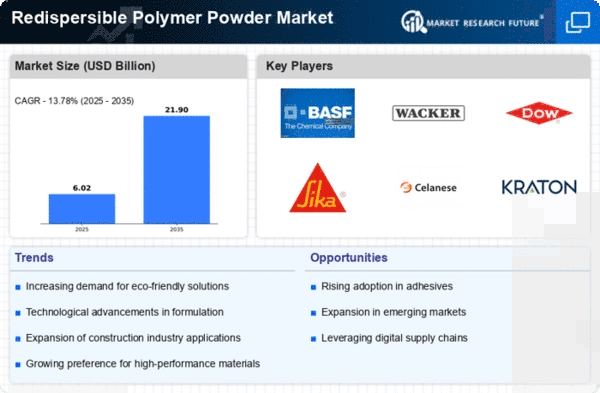
As per MRFR analysis, the Redispersible Polymer Powder Market Size was estimated at 5.29 USD Billion in 2024. The Redispersible Polymer Powder industry is projected to grow from 6.02 in 2025 to 21.9 by 2035, exhibiting a compound annual growth rate (CAGR) of 13.78% during the forecast period 2025 - 2035.

Key Market Trends & Highlights

The Redispersible Polymer Powder Market is poised for robust growth driven by sustainability and technological advancements.

  • The market is witnessing a pronounced shift towards sustainability, influencing product development and consumer preferences. Technological advancements are enhancing the performance and versatility of redispersible polymer powders across various applications. In North America, the construction segment remains the largest market, while the Asia-Pacific region is emerging as the fastest-growing area for redispersible polymer powders. Key market drivers include rising construction activities and sustainability initiatives, which are shaping the demand landscape.

Market Size & Forecast

2024 Market Size 5.29 (USD Billion)
2035 Market Size 21.9 (USD Billion)
CAGR (2025 - 2035) 13.78%
Largest Regional Market Share in 2024 Asia-Pacific

Major Players

<p>BASF SE (DE), Wacker Chemie AG (DE), Dow Inc. (US), Sika AG (CH), Celanese Corporation (US), Kraton Corporation (US), Ashland Global Holdings Inc. (US), Hexion Inc. (US)</p>

Market Trends

The Redispersible Polymer Powder Market is currently experiencing a notable transformation, driven by various factors that influence its growth trajectory. The increasing demand for construction materials that enhance performance characteristics, such as adhesion, flexibility, and water resistance, appears to be a primary catalyst. Additionally, the rising trend of sustainable building practices suggests a shift towards eco-friendly materials, which may further propel the adoption of redispersible polymer powders in various applications. As industries seek to improve product quality while minimizing environmental impact, the relevance of these powders in formulations is likely to expand. Moreover, the Redispersible Polymer Powder Market is witnessing advancements in technology that enhance the properties of these materials. Innovations in production processes and formulations could lead to improved performance attributes, making them more appealing to manufacturers. The growing awareness of the benefits associated with redispersible polymer powders, such as their ability to improve workability and durability, indicates a positive outlook for the market. As stakeholders continue to explore new applications and formulations, the market is poised for further development, potentially leading to increased competition and diversification in product offerings.

Sustainability Focus

The emphasis on sustainable construction practices is shaping the Redispersible Polymer Powder Market. Manufacturers are increasingly seeking eco-friendly alternatives that align with environmental regulations and consumer preferences. This trend may lead to the development of innovative formulations that reduce carbon footprints while maintaining performance.

Technological Advancements

Ongoing technological innovations are enhancing the properties of redispersible polymer powders. Improved production techniques and formulations are likely to result in superior performance characteristics, making these materials more attractive for various applications in construction and other industries.

Diverse Applications

The versatility of redispersible polymer powders is expanding their applications across multiple sectors. From construction to adhesives and coatings, the growing recognition of their benefits suggests a potential increase in demand, as industries explore new uses and formulations.

Redispersible Polymer Powder Market Market Drivers

Market Growth Projections

The Global Redispersible Polymer Powder Market Industry is projected to experience robust growth in the coming years. With a market value anticipated to reach 5.29 USD Billion in 2024 and further expand to 21.9 USD Billion by 2035, the industry is poised for a compound annual growth rate (CAGR) of 13.78% from 2025 to 2035. This growth is indicative of the increasing applications of redispersible polymer powders across various sectors, including construction, adhesives, and coatings. The positive market outlook reflects the ongoing innovations and rising demand for high-performance materials, positioning the Global Redispersible Polymer Powder Market Industry for sustained expansion.

Expansion of Emerging Markets

Emerging markets play a crucial role in the growth of the Global Redispersible Polymer Powder Market Industry. Countries in Asia-Pacific, Latin America, and Africa are experiencing rapid industrialization and urbanization, leading to increased demand for construction materials. The expansion of these markets is fueled by rising disposable incomes and urban population growth, which drive the need for housing and infrastructure development. As these regions invest in construction projects, the demand for redispersible polymer powders is expected to rise, contributing to the overall growth trajectory of the market. This trend underscores the potential of emerging markets in shaping the future of the Global Redispersible Polymer Powder Market Industry.

Growing Demand in Construction Sector

The Global Redispersible Polymer Powder Market Industry experiences a surge in demand primarily driven by the construction sector. As urbanization accelerates, the need for high-performance construction materials increases. Redispersible polymer powders enhance the properties of cement-based products, improving adhesion, flexibility, and water resistance. This trend is particularly evident in regions with rapid infrastructure development, where the market is projected to reach 1.85 USD Billion in 2024. The construction industry's growth, fueled by government initiatives and investments in housing and commercial projects, significantly contributes to the expansion of the Global Redispersible Polymer Powder Market Industry.

Rising Adoption in Adhesives and Sealants

The Global Redispersible Polymer Powder Market Industry is witnessing a notable increase in the adoption of these powders in adhesives and sealants. The versatility of redispersible polymer powders allows for enhanced bonding strength and flexibility in various applications, making them a preferred choice for manufacturers. As industries focus on developing eco-friendly and high-performance adhesive solutions, the demand for redispersible polymer powders is expected to grow. This trend aligns with the projected market growth, with estimates indicating a rise to 3.42 USD Billion by 2035, reflecting a compound annual growth rate (CAGR) of 5.77% from 2025 to 2035.

Technological Advancements in Polymer Chemistry

Technological advancements in polymer chemistry significantly influence the Global Redispersible Polymer Powder Market Industry. Innovations in production techniques and formulations lead to the development of superior polymer powders with enhanced properties. These advancements allow for better performance in various applications, including construction, coatings, and adhesives. As manufacturers strive to meet evolving industry standards and consumer preferences, the continuous improvement of redispersible polymer powders becomes essential. This dynamic environment fosters growth and positions the market for substantial expansion, as companies leverage these innovations to capture a larger share of the Global Redispersible Polymer Powder Market Industry.

Increasing Focus on Sustainable Construction Practices

The Global Redispersible Polymer Powder Market Industry is increasingly shaped by the focus on sustainable construction practices. As environmental concerns rise, builders and manufacturers are seeking materials that minimize ecological impact. Redispersible polymer powders, which can enhance the performance of eco-friendly building materials, are gaining traction. This shift towards sustainability is not only driven by regulatory pressures but also by consumer demand for greener products. As a result, the market is likely to see significant growth opportunities, aligning with the broader trend of sustainable development in the construction sector, thereby reinforcing the Global Redispersible Polymer Powder Market Industry.


Market Segment Insights

By Application: Construction (Largest) vs. Adhesives (Fastest-Growing)

<p>In the Redispersible Polymer Powder Market, the application segment shows a diverse distribution of shares among various values, with Construction dominating the landscape. This sector is extensively utilized in building materials, driving the demand due to ongoing infrastructure development and urbanization. Adhesives are following close behind, showcasing significant potential and witnessing rapid adoption, driven by increased demand for durable bonding solutions across various industries, including automotive and woodworking.</p>

<p>Construction (Dominant) vs. Adhesives (Emerging)</p>

<p>The Construction application of Redispersible Polymer Powders is characterized by its essential role in enhancing the performance of cement-based materials, which are extensively used in the building and construction industry. This segment benefits from an increasing focus on quality and durability in construction projects, making it a dominant player in the market. On the other hand, the Adhesives segment is emerging as a significant player due to a rising trend in DIY projects and lightweight <a href="https://www.marketresearchfuture.com/reports/construction-materials-market-12121">construction materials</a>. The growing need for efficient, eco-friendly adhesives plays a crucial role in the expansion of this segment. Both sectors are poised for growth, albeit at different rates, highlighting the competitive nature of the Redispersible Polymer Powder market.</p>

By End Use: Residential (Largest) vs. Commercial (Fastest-Growing)

<p>In the Redispersible Polymer Powder Market, the end use segment exhibits significant diversity, with residential applications holding the largest market share. This is primarily driven by the growing demand for construction materials in home renovations and new builds. Conversely, the commercial sector is emerging as the fastest-growing segment, fueled by increased investments in <a href="https://www.marketresearchfuture.com/reports/india-commercial-real-estate-market-20709">commercial real estate</a> and infrastructure development, which rely heavily on the performance-enhancing properties of redispersible polymer powders.</p>

<p>Commercial: Expanding Applications (Dominant) vs. Infrastructure: Development Projects (Emerging)</p>

<p>The commercial segment of the Redispersible Polymer Powder Market is characterized by its expanding applications in various sectors, including flooring, tile adhesives, and paints. Its dominance is attributable to a surge in construction activities and a shift towards high-performance materials that offer better adhesion, flexibility, and durability. In contrast, the infrastructure sector represents an emerging opportunity, driven by ongoing global investments in transport and public utility projects. This segment leverages redispersible polymer powders for their superior binding and balancing properties—essential for projects requiring reliability under varying environmental conditions.</p>

By Type: Vinyl Acetate Ethylene (Largest) vs. Styrene Butadiene (Fastest-Growing)

<p>In the Redispersible Polymer Powder Market, <a href="https://www.marketresearchfuture.com/reports/vinyl-acetate-ethylene-copolymer-powder-market-22540">Vinyl Acetate Ethylene</a> (VAE) holds the largest market share among the various type segments. Its advantageous properties, such as excellent adhesion and flexibility, make it a preferred choice in construction and adhesive applications. On the other hand, <a href="https://www.marketresearchfuture.com/reports/styrene-butadiene-styrene-market-5948">Styrene Butadiene</a> (SB) is emerging as the fastest-growing segment, thanks to its increasing adoption in diverse applications like paints and coatings, owing to its superior thermal stability and water resistance. The growth trends in these segments reflect a shift towards high-performance materials, with VAE benefiting from robust demand in the construction sector. Meanwhile, SB is gaining traction as manufacturers seek cost-effective alternatives, driving innovation and expanding its application scope. This evolving landscape indicates a dynamic competition between established and emerging segment leaders in the market.</p>

<p>VAE (Dominant) vs. SB (Emerging)</p>

<p>Vinyl Acetate Ethylene (VAE) is currently the dominant force in the Redispersible Polymer Powder Market, known for its exceptional versatility and performance in various applications, particularly in adhesives, paints, and coatings. Its robust adhesion properties and eco-friendliness enhance its market appeal, establishing it as a go-to choice for many manufacturers. In contrast, Styrene Butadiene (SB) is regarded as an emerging segment, characterized by its rapid growth and adaptability. SB's unique combination of flexibility and durability makes it suitable for a broad spectrum of applications, which is increasingly capturing the attention of producers. These segment dynamics highlight VAE's stronghold in the market, while SB's innovations and cost advantages present opportunities for significant market penetration.</p>

By Formulation: Powder (Largest) vs. Granules (Fastest-Growing)

<p>In the Redispersible Polymer Powder Market, the formulation segment is primarily composed of three categories: Powder, Granules, and Liquid. Among these, Powder holds the largest market share, driven by its widespread application in construction and building materials. Granules, while smaller in market share compared to Powder, are emerging rapidly due to their ease of use and handling in various manufacturing processes.</p>

<p>Powder (Dominant) vs. Granules (Emerging)</p>

<p>Powder formulations have established themselves as the dominant choice in the Redispersible Polymer Powder Market due to their versatility and effectiveness in enhancing adhesion, flexibility, and durability in construction materials. They are widely utilized in dry mix mortars, adhesives, and putties. In contrast, Granules are rapidly gaining traction as an emerging formulation due to their convenience and cleaner application methods. Granules minimize dust formation, making them more user-friendly, and their growing popularity is supported by advances in polymer technology that enhance performance characteristics, making them suitable for a wider range of applications.</p>

By Distribution Channel: Direct Sales (Largest) vs. Online Sales (Fastest-Growing)

<p>The distribution channel segment of the Redispersible Polymer Powder Market primarily consists of Direct Sales, Online Sales, and Distributors. Direct Sales hold the largest market share due to established relationships with manufacturers and clients, ensuring a steady stream of sales transactions. Online Sales, while smaller in share, are rapidly gaining traction as businesses adapt to digital commerce, led by increased online purchasing behavior driven by convenience and accessibility.</p>

<p>Direct Sales (Dominant) vs. Online Sales (Emerging)</p>

<p>Direct Sales remain the dominant channel in the Redispersible Polymer Powder Market, capitalizing on strong personal relationships and customized services that cater to specific customer needs. This approach allows businesses to maintain significant control over transactions, fostering high customer loyalty and repeat purchases. Conversely, Online Sales are emerging as a crucial avenue for growth, fueled by the rising trend of e-commerce and digital platforms. This channel offers benefits such as wider reach and enhanced marketing opportunities. Companies are harnessing digital tools to improve their online presence, consequently broadening market access and appealing to tech-savvy customers seeking the convenience of online ordering.</p>

Get more detailed insights about Redispersible Polymer Powder Market Research Report – Forecast to 2035

Regional Insights

North America : Established Market with Growth Potential

The North American redispersible polymer powder market is projected to reach $1.77 billion by 2025, driven by increasing demand in construction and adhesives sectors. Regulatory support for sustainable building materials is also a significant catalyst, enhancing market growth. The region's focus on innovation and quality standards further propels the market, with a growing emphasis on eco-friendly products. Leading countries in this region include the US and Canada, where major players like Dow Inc. and Ashland Global Holdings Inc. dominate the landscape. The competitive environment is characterized by strategic partnerships and technological advancements. The presence of established companies ensures a robust supply chain, catering to diverse applications in construction and industrial sectors.

Europe : Innovation and Sustainability Focus

Europe's redispersible polymer powder market is valued at $1.5 billion, with a strong emphasis on innovation and sustainability. The region is witnessing a shift towards eco-friendly construction materials, driven by stringent regulations and consumer demand for sustainable solutions. This trend is expected to bolster market growth, as companies adapt to meet these evolving standards. Germany, France, and the UK are key players in this market, with companies like BASF SE and Wacker Chemie AG leading the charge. The competitive landscape is marked by continuous R&D efforts and collaborations aimed at enhancing product performance. The presence of regulatory bodies ensures compliance and fosters innovation, making Europe a pivotal region in the global market.

Asia-Pacific : Emerging Powerhouse in Market Growth

The Asia-Pacific region dominates the redispersible polymer powder market, with a market size of $2.5 billion. This growth is fueled by rapid urbanization, increasing construction activities, and a rising demand for high-performance building materials. Government initiatives aimed at infrastructure development and housing projects are significant drivers, creating a favorable environment for market expansion. China, India, and Japan are the leading countries in this region, with a strong presence of key players like Sika AG and Celanese Corporation. The competitive landscape is characterized by a mix of local and international companies, all vying for market share. The region's focus on innovation and cost-effective solutions positions it as a critical player in The Redispersible Polymer Powder.

Middle East and Africa : Emerging Market with Growth Opportunities

The Middle East and Africa redispersible polymer powder market is valued at $0.52 billion, with significant growth potential driven by increasing construction activities and infrastructure development. The region is witnessing a surge in demand for high-quality building materials, supported by government initiatives aimed at urbanization and economic diversification. This trend is expected to enhance market dynamics in the coming years. Countries like the UAE and South Africa are at the forefront of this market, with a growing number of local and international players entering the scene. The competitive landscape is evolving, with companies focusing on innovation and sustainability to meet the rising demand. The presence of key players is gradually increasing, contributing to a more robust market framework.

Key Players and Competitive Insights

The Redispersible Polymer Powder Market is characterized by a competitive landscape that is increasingly shaped by innovation, sustainability, and strategic partnerships. Key players such as BASF SE (DE), Wacker Chemie AG (DE), and Dow Inc. (US) are actively pursuing strategies that emphasize product development and market expansion. For instance, BASF SE (DE) has focused on enhancing its product portfolio through sustainable practices, which aligns with the growing demand for eco-friendly construction materials. Meanwhile, Wacker Chemie AG (DE) has been investing in digital transformation initiatives to optimize its manufacturing processes, thereby improving efficiency and reducing costs. These strategies collectively contribute to a dynamic competitive environment where innovation and operational excellence are paramount. In terms of business tactics, companies are increasingly localizing manufacturing to better serve regional markets and optimize supply chains. This approach appears to be a response to the need for agility in production and distribution, particularly in a moderately fragmented market. The collective influence of major players, including Sika AG (CH) and Celanese Corporation (US), suggests a trend towards consolidation, where strategic alliances and partnerships are becoming essential for maintaining competitive advantage.

In November Sika AG (CH) announced the acquisition of a regional competitor, which is expected to enhance its market share and expand its product offerings in the Redispersible Polymer Powder segment. This strategic move not only strengthens Sika's position but also reflects a broader trend of consolidation within the industry, as companies seek to leverage synergies and enhance their competitive edge. The acquisition is likely to facilitate access to new technologies and customer bases, thereby driving growth.

In October Dow Inc. (US) launched a new line of redispersible polymer powders designed specifically for high-performance applications in the construction sector. This product introduction underscores Dow's commitment to innovation and its focus on meeting the evolving needs of customers. By investing in R&D and developing specialized products, Dow aims to differentiate itself in a competitive market, potentially capturing a larger share of the growing demand for advanced construction materials.

In September Wacker Chemie AG (DE) expanded its production capacity for redispersible polymer powders in response to increasing global demand. This expansion not only enhances Wacker's ability to meet customer needs but also positions the company favorably in a market that is witnessing rising consumption. The strategic decision to increase capacity indicates Wacker's confidence in the market's growth trajectory and its commitment to maintaining a competitive edge through operational scalability.

As of December the competitive trends in the Redispersible Polymer Powder Market are increasingly defined by digitalization, sustainability, and the integration of advanced technologies such as AI. Strategic alliances are playing a crucial role in shaping the current landscape, as companies collaborate to enhance their product offerings and operational efficiencies. Looking ahead, it appears that competitive differentiation will evolve from traditional price-based competition to a focus on innovation, technology, and supply chain reliability. This shift suggests that companies that prioritize sustainable practices and technological advancements are likely to thrive in the future.

Key Companies in the Redispersible Polymer Powder Market include

Industry Developments

    • In April 2020, the highly populated Celanese Corporation decided to acquire Elotex’s range of redispersible polymer powder which improves the sustainability quotient of the building materials. Celanese got success in owning the worldwide production units for these polymer powders across Asia and Europe coupled with every product under Elotex’s portfolio along with its commercial facilities, technology, and customer agreements.
    • In June 2020, one of the leading enterprises, Celanese Corporation introduces the advanced Elotex range, Elotex FX 1000. This latest powder is based on vinyl versatile and copolymer vinyl acetate and helps in boosting the performance and quality of flexible, high-class, cementitious tile adhesives. This Elotex FX1000 also exhibits impressive eco-friendliness by helping the end-use industries to design the tile adhesives according to the strict environmental regulations about dry mortars.

Future Outlook

Redispersible Polymer Powder Market Future Outlook

<p>The Redispersible Polymer Powder Market is projected to grow at a 13.78% CAGR from 2025 to 2035, driven by increasing demand in construction and adhesive applications.</p>

New opportunities lie in:

  • <p>Expansion into emerging markets with tailored product offerings. Development of eco-friendly redispersible polymer powders to meet sustainability demands. Investment in advanced manufacturing technologies to enhance production efficiency.</p>

<p>By 2035, the market is expected to achieve robust growth, solidifying its position as a key player in the industry.</p>

Market Segmentation

Redispersible Polymer Powder Market Type Outlook

  • Vinyl Acetate Ethylene
  • Styrene Butadiene
  • Acrylic
  • Ethylene Vinyl Acetate

Redispersible Polymer Powder Market End Use Outlook

  • Residential
  • Commercial
  • Industrial
  • Infrastructure

Redispersible Polymer Powder Market Application Outlook

  • Construction
  • Adhesives
  • Coatings
  • Sealants
  • Mortars

Redispersible Polymer Powder Market Formulation Outlook

  • Powder
  • Granules
  • Liquid

Redispersible Polymer Powder Market Distribution Channel Outlook

  • Direct Sales
  • Online Sales
  • Distributors

Report Scope

MARKET SIZE 2024 5.29(USD Billion)
MARKET SIZE 2025 6.02(USD Billion)
MARKET SIZE 2035 21.9(USD Billion)
COMPOUND ANNUAL GROWTH RATE (CAGR) 13.78% (2025 - 2035)
REPORT COVERAGE Revenue Forecast, Competitive Landscape, Growth Factors, and Trends
BASE YEAR 2024
Market Forecast Period 2025 - 2035
Historical Data 2019 - 2024
Market Forecast Units USD Billion
Key Companies Profiled BASF SE (DE), Wacker Chemie AG (DE), Dow Inc. (US), Sika AG (CH), Celanese Corporation (US), Kraton Corporation (US), Ashland Global Holdings Inc. (US), Hexion Inc. (US)
Segments Covered Application, End Use, Type, Formulation, Distribution Channel
Key Market Opportunities Growing demand for eco-friendly construction materials drives innovation in the Redispersible Polymer Powder Market.
Key Market Dynamics Rising demand for eco-friendly construction materials drives innovation in redispersible polymer powder formulations and applications.
Countries Covered North America, Europe, APAC, South America, MEA

FAQs

What is the market’s valuation?

The global redispersible polymer powder market is expected to grow to more than USD 2.39 billion by 2035.

What is the CAGR of the market?

The market is expected to exhibit a strong 6.66% CAGR over the forecast period from 2017 to 2023.

What is the major driver for the market?

Growing use of redispersable polymer powder in tile and flooring applications is the major driver for the market.

Which is the leading regional market?

Asia Pacific is the largest regional market due to the growing construction industry in the region.

What are the leading market players?

Leading players in the global redispersible polymer powder market include Acquos, Wacker Chemie, and Dow, among others.

  1. SECTION I: EXECUTIVE SUMMARY AND KEY HIGHLIGHTS
    1. | 1.1 EXECUTIVE SUMMARY
    2. | 1.1.1 Market Overview
    3. | 1.1.2 Key Findings
    4. | 1.1.3 Market Segmentation
    5. | 1.1.4 Competitive Landscape
    6. | 1.1.5 Challenges and Opportunities
    7. | 1.1.6 Future Outlook
  2. SECTION II: SCOPING, METHODOLOGY AND MARKET STRUCTURE
    1. | 2.1 MARKET INTRODUCTION
    2. | 2.1.1 Definition
    3. | 2.1.2 Scope of the study
    4. |-- 2.1.2.1 Research Objective
    5. |-- 2.1.2.2 Assumption
    6. |-- 2.1.2.3 Limitations
    7. | 2.2 RESEARCH METHODOLOGY
    8. | 2.2.1 Overview
    9. | 2.2.2 Data Mining
    10. | 2.2.3 Secondary Research
    11. | 2.2.4 Primary Research
    12. |-- 2.2.4.1 Primary Interviews and Information Gathering Process
    13. |-- 2.2.4.2 Breakdown of Primary Respondents
    14. | 2.2.5 Forecasting Model
    15. | 2.2.6 Market Size Estimation
    16. |-- 2.2.6.1 Bottom-Up Approach
    17. |-- 2.2.6.2 Top-Down Approach
    18. | 2.2.7 Data Triangulation
    19. | 2.2.8 Validation
  3. SECTION III: QUALITATIVE ANALYSIS
    1. | 3.1 MARKET DYNAMICS
    2. | 3.1.1 Overview
    3. | 3.1.2 Drivers
    4. | 3.1.3 Restraints
    5. | 3.1.4 Opportunities
    6. | 3.2 MARKET FACTOR ANALYSIS
    7. | 3.2.1 Value chain Analysis
    8. | 3.2.2 Porter's Five Forces Analysis
    9. |-- 3.2.2.1 Bargaining Power of Suppliers
    10. |-- 3.2.2.2 Bargaining Power of Buyers
    11. |-- 3.2.2.3 Threat of New Entrants
    12. |-- 3.2.2.4 Threat of Substitutes
    13. |-- 3.2.2.5 Intensity of Rivalry
    14. | 3.2.3 COVID-19 Impact Analysis
    15. |-- 3.2.3.1 Market Impact Analysis
    16. |-- 3.2.3.2 Regional Impact
    17. |-- 3.2.3.3 Opportunity and Threat Analysis
  4. SECTION IV: QUANTITATIVE ANALYSIS
    1. | 4.1 Chemicals and Materials, BY Application (USD Billion)
    2. | 4.1.1 Construction
    3. | 4.1.2 Adhesives
    4. | 4.1.3 Coatings
    5. | 4.1.4 Sealants
    6. | 4.1.5 Mortars
    7. | 4.2 Chemicals and Materials, BY End Use (USD Billion)
    8. | 4.2.1 Residential
    9. | 4.2.2 Commercial
    10. | 4.2.3 Industrial
    11. | 4.2.4 Infrastructure
    12. | 4.3 Chemicals and Materials, BY Type (USD Billion)
    13. | 4.3.1 Vinyl Acetate Ethylene
    14. | 4.3.2 Styrene Butadiene
    15. | 4.3.3 Acrylic
    16. | 4.3.4 Ethylene Vinyl Acetate
    17. | 4.4 Chemicals and Materials, BY Formulation (USD Billion)
    18. | 4.4.1 Powder
    19. | 4.4.2 Granules
    20. | 4.4.3 Liquid
    21. | 4.5 Chemicals and Materials, BY Distribution Channel (USD Billion)
    22. | 4.5.1 Direct Sales
    23. | 4.5.2 Online Sales
    24. | 4.5.3 Distributors
    25. | 4.6 Chemicals and Materials, BY Region (USD Billion)
    26. | 4.6.1 North America
    27. |-- 4.6.1.1 US
    28. |-- 4.6.1.2 Canada
    29. | 4.6.2 Europe
    30. |-- 4.6.2.1 Germany
    31. |-- 4.6.2.2 UK
    32. |-- 4.6.2.3 France
    33. |-- 4.6.2.4 Russia
    34. |-- 4.6.2.5 Italy
    35. |-- 4.6.2.6 Spain
    36. |-- 4.6.2.7 Rest of Europe
    37. | 4.6.3 APAC
    38. |-- 4.6.3.1 China
    39. |-- 4.6.3.2 India
    40. |-- 4.6.3.3 Japan
    41. |-- 4.6.3.4 South Korea
    42. |-- 4.6.3.5 Malaysia
    43. |-- 4.6.3.6 Thailand
    44. |-- 4.6.3.7 Indonesia
    45. |-- 4.6.3.8 Rest of APAC
    46. | 4.6.4 South America
    47. |-- 4.6.4.1 Brazil
    48. |-- 4.6.4.2 Mexico
    49. |-- 4.6.4.3 Argentina
    50. |-- 4.6.4.4 Rest of South America
    51. | 4.6.5 MEA
    52. |-- 4.6.5.1 GCC Countries
    53. |-- 4.6.5.2 South Africa
    54. |-- 4.6.5.3 Rest of MEA
  5. SECTION V: COMPETITIVE ANALYSIS
    1. | 5.1 Competitive Landscape
    2. | 5.1.1 Overview
    3. | 5.1.2 Competitive Analysis
    4. | 5.1.3 Market share Analysis
    5. | 5.1.4 Major Growth Strategy in the Chemicals and Materials
    6. | 5.1.5 Competitive Benchmarking
    7. | 5.1.6 Leading Players in Terms of Number of Developments in the Chemicals and Materials
    8. | 5.1.7 Key developments and growth strategies
    9. |-- 5.1.7.1 New Product Launch/Service Deployment
    10. |-- 5.1.7.2 Merger & Acquisitions
    11. |-- 5.1.7.3 Joint Ventures
    12. | 5.1.8 Major Players Financial Matrix
    13. |-- 5.1.8.1 Sales and Operating Income
    14. |-- 5.1.8.2 Major Players R&D Expenditure. 2023
    15. | 5.2 Company Profiles
    16. | 5.2.1 BASF SE (DE)
    17. |-- 5.2.1.1 Financial Overview
    18. |-- 5.2.1.2 Products Offered
    19. |-- 5.2.1.3 Key Developments
    20. |-- 5.2.1.4 SWOT Analysis
    21. |-- 5.2.1.5 Key Strategies
    22. | 5.2.2 Wacker Chemie AG (DE)
    23. |-- 5.2.2.1 Financial Overview
    24. |-- 5.2.2.2 Products Offered
    25. |-- 5.2.2.3 Key Developments
    26. |-- 5.2.2.4 SWOT Analysis
    27. |-- 5.2.2.5 Key Strategies
    28. | 5.2.3 Dow Inc. (US)
    29. |-- 5.2.3.1 Financial Overview
    30. |-- 5.2.3.2 Products Offered
    31. |-- 5.2.3.3 Key Developments
    32. |-- 5.2.3.4 SWOT Analysis
    33. |-- 5.2.3.5 Key Strategies
    34. | 5.2.4 Sika AG (CH)
    35. |-- 5.2.4.1 Financial Overview
    36. |-- 5.2.4.2 Products Offered
    37. |-- 5.2.4.3 Key Developments
    38. |-- 5.2.4.4 SWOT Analysis
    39. |-- 5.2.4.5 Key Strategies
    40. | 5.2.5 Celanese Corporation (US)
    41. |-- 5.2.5.1 Financial Overview
    42. |-- 5.2.5.2 Products Offered
    43. |-- 5.2.5.3 Key Developments
    44. |-- 5.2.5.4 SWOT Analysis
    45. |-- 5.2.5.5 Key Strategies
    46. | 5.2.6 Kraton Corporation (US)
    47. |-- 5.2.6.1 Financial Overview
    48. |-- 5.2.6.2 Products Offered
    49. |-- 5.2.6.3 Key Developments
    50. |-- 5.2.6.4 SWOT Analysis
    51. |-- 5.2.6.5 Key Strategies
    52. | 5.2.7 Ashland Global Holdings Inc. (US)
    53. |-- 5.2.7.1 Financial Overview
    54. |-- 5.2.7.2 Products Offered
    55. |-- 5.2.7.3 Key Developments
    56. |-- 5.2.7.4 SWOT Analysis
    57. |-- 5.2.7.5 Key Strategies
    58. | 5.2.8 Hexion Inc. (US)
    59. |-- 5.2.8.1 Financial Overview
    60. |-- 5.2.8.2 Products Offered
    61. |-- 5.2.8.3 Key Developments
    62. |-- 5.2.8.4 SWOT Analysis
    63. |-- 5.2.8.5 Key Strategies
    64. | 5.3 Appendix
    65. | 5.3.1 References
    66. | 5.3.2 Related Reports

Chemicals and Materials Market Segmentation

Chemicals and Materials By Application (USD Billion, 2025-2035)

  • Construction
  • Adhesives
  • Coatings
  • Sealants
  • Mortars

Chemicals and Materials By End Use (USD Billion, 2025-2035)

  • Residential
  • Commercial
  • Industrial
  • Infrastructure

Chemicals and Materials By Type (USD Billion, 2025-2035)

  • Vinyl Acetate Ethylene
  • Styrene Butadiene
  • Acrylic
  • Ethylene Vinyl Acetate

Chemicals and Materials By Formulation (USD Billion, 2025-2035)

  • Powder
  • Granules
  • Liquid

Chemicals and Materials By Distribution Channel (USD Billion, 2025-2035)

  • Direct Sales
  • Online Sales
  • Distributors
Infographic

Free Sample Request

Kindly complete the form below to receive a free sample of this Report

Get Free Sample

Customer Strories

Compare Licence

×
Features License Type
Single User Multiuser License Enterprise User
Price $4,950 $5,950 $7,250
Maximum User Access Limit 1 User Upto 10 Users Unrestricted Access Throughout the Organization
Free Customization
Direct Access to Analyst
Deliverable Format
Platform Access
Discount on Next Purchase 10% 15% 15%
Printable Versions