Request Free Sample ×

Kindly complete the form below to receive a free sample of this Report

* Please use a valid business email

Leading companies partner with us for data-driven Insights

clients tt-cursor
Hero Background
English
Chinese
French
Japanese
Korean
German
Spanish

Red Brick Market Share

ID: MRFR/CnM/10550-HCR
111 Pages
Chitranshi Jaiswal
March 2026

Red Brick Market Size, Share & Industry Analysis Research Report: By Brick Type (Hollow Bricks, Solid Bricks), By Color Type (Single Color Bricks, Blend Bricks), By Application (Residential Buildings, Commercial Buildings, Other) and By Regional : Global Opportunity Analysis and Industry Forecast, 2025 - 2035

Share:
Download PDF ×

We do not share your information with anyone. However, we may send you emails based on your report interest from time to time. You may contact us at any time to opt-out.

Red Brick Market Infographic
Purchase Options

Market Share

Red Brick Market Share Analysis

In the dynamic, ever-changing Red Brick Market, firms apply diverse techniques to earn strong brand and be the top player in the industry. A core component of achieving a competitive market share position is corporate ongoing invention in bricks manufacturing and use. Firms invest in research and development to enrich the quality, sustainability and overall aesthetics of the red bricks, which includes focusing on factors like energy efficiency, color variation and refined production processes. Through the manufacturing of advanced solutions, firms will be able to gain market share from customers that are concerned with durability and environmental friendliness for their residential, commercial and institutional construction work.

Pricing strategies are key elements in defining the market share for the Red Brick Market. Some companies employ a cost leadership strategy, which involves supplying their red bricks at highly competitive prices to woo penny-pinching builders and developers. On the contrary, super premium pricing strategies of companies providing superior quality and particular textures or finishes could be considered. Such a premium strategy addresses customers who first and foremost opt for high-end red brick products, bringing in higher margins and perception of, which are the factors important for the company.

Distribution network is a key component of market share positioning and has to be very efficient and cover lots of routes. Companies work with construction materials dealers, contractors, and architect firms to distribute the red bricks all over the place. A neatly designed distribution system not only widens outreach but also makes certain of that clients have simple access to those multifunction building materials when they are constructing their facilities. Generally, the consumer behavior is impacted by accessibility issues, and the firms position their products to capitalize on this trend by supplying the market appropriately.

The existence of strategic partnerships and collaborations with the main players from construction, architecture, and design industry constitutes one of the key aspects of the market share positioning in the Red Stone Market. By creating partnerships with architects, builders, or real estate developers companies are able to combine individual unique expertise, reach new markets, and identify possible main challenges regarding the brick and project specifications. Through the engagements, partnerships and mergers, the proportion of the market and a company position in the Red Brick Market are greatly influenced.

A strong marketing and brand strategy are inseparable elements of market share achievements. Companies are investing in a robust brand building and brand promoting processes through the various means, like digital marketing, approach to construction events and joint effort with architects and contractors. A company that has a well-established brand will preferably attract new clients but also build trust among construction professional, developers, as well as homeowners, making a company have a higher share in the red bricks market.

Author
Author Profile
Chitranshi Jaiswal
Team Lead - Research

Chitranshi is a Team Leader in the Chemicals & Materials (CnM) and Energy & Power (EnP) domains, with 6+ years of experience in market research. She leads and mentors teams to deliver cross-domain projects that equip clients with actionable insights and growth strategies. She is skilled in market estimation, forecasting, competitive benchmarking, and both primary & secondary research, enabling her to turn complex data into decision-ready insights. An engineer and MBA professional, she combines technical expertise with strategic acumen to solve dynamic market challenges. Chitranshi has successfully managed projects that support market entry, investment planning, and competitive positioning, while building strong client relationships. Certified in Advanced Excel & Power BI she leverages data-driven approaches to ensure accuracy, clarity, and impactful outcomes.

Leave a Comment

FAQs

What is the current valuation of The Global Red Brick?

<p>The Global Red Brick was valued at 2.293 USD Billion in 2024.</p>

What is the projected market valuation for The Global Red Brick in 2035?

<p>The market is projected to reach a valuation of 3.801 USD Billion by 2035.</p>

What is the expected CAGR for The Global Red Brick from 2025 to 2035?

<p>The expected CAGR for The Global Red Brick during the forecast period 2025 - 2035 is 4.7%.</p>

Which companies are considered key players in The Global Red Brick?

<p>Key players in the market include Wienerberger AG, Boral Limited, General Shale, Forterra Inc., Brickworks Limited, Cemex S.A.B. de C.V., Eagle Roofing Products, and Macon Brick Company.</p>

How do hollow and solid bricks compare in market valuation?

<p>In 2024, hollow bricks were valued at approximately 0.918 USD Billion, while solid bricks were valued at around 1.375 USD Billion.</p>

What are the market valuations for different color types of red bricks?

<p>Single color bricks were valued at 1.5 USD Billion, whereas blend bricks were valued at 0.793 USD Billion in 2024.</p>

What applications dominate The Global Red Brick?

<p>In 2024, residential buildings accounted for 0.917 USD Billion, while commercial buildings and other applications each accounted for 0.688 USD Billion.</p>

What is the growth potential for the hollow brick segment?

<p>The hollow brick segment is expected to grow from 0.918 USD Billion in 2024 to an estimated 1.531 USD Billion by 2035.</p>

How does the solid brick segment's growth compare to hollow bricks?

<p>The solid brick segment is projected to increase from 1.375 USD Billion in 2024 to approximately 2.271 USD Billion by 2035.</p>

What trends are influencing the color type segment of the market?

The single color brick segment is anticipated to grow from 1.5 USD Billion in 2024 to 2.5 USD Billion by 2035, indicating a rising preference for uniformity in construction.

Market Summary

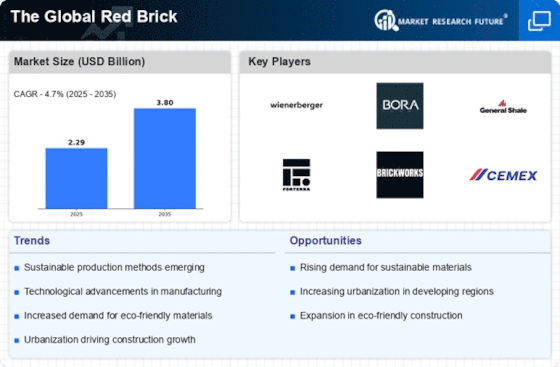
As per Market Research Future analysis, The Global Red Brick Market Size was estimated at 2.293 USD Billion in 2024. The red brick industry is projected to grow from 2.401 USD Billion in 2025 to 3.801 USD Billion by 2035, exhibiting a compound annual growth rate (CAGR) of 4% during the forecast period 2025 - 2035

Key Market Trends & Highlights

The Global Red Brick Market is experiencing a transformative shift driven by sustainability and technological advancements.

  • North America remains the largest market for red bricks, driven by robust construction activities and architectural trends. The Asia-Pacific region is emerging as the fastest-growing market, fueled by rapid urbanization and increasing infrastructure development. Hollow bricks dominate the market due to their lightweight and insulation properties, while solid bricks are witnessing the fastest growth in demand. Key market drivers include rising urbanization and sustainability initiatives, which are shaping the future of red brick production.

Market Size & Forecast

2024 Market Size 2.293 (USD Billion)
2035 Market Size 3.801 (USD Billion)
CAGR (2025 - 2035) 4.7%
Largest Regional Market Share in 2024 Europe

Major Players

Wienerberger AG (AT), Boral Limited (AU), General Shale (US), Forterra Inc. (US), Brickworks Limited (AU), Cemex S.A.B. de C.V. (MX), Eagle Roofing Products (US), Macon Brick Company (US)

Market Trends

The Global Red Brick Market is currently experiencing a dynamic phase characterized by evolving consumer preferences and increasing demand for sustainable building materials. As urbanization accelerates, the construction sector is witnessing a shift towards eco-friendly products, which appears to be influencing the production and consumption patterns of red bricks. This trend is likely driven by a growing awareness of environmental issues and the need for energy-efficient construction practices. Furthermore, the integration of advanced manufacturing technologies may enhance the quality and durability of red bricks, thereby appealing to a broader range of consumers. In addition, The Global Red Brick Market seems to be benefiting from a resurgence in traditional architectural styles, which often incorporate red bricks as a primary material. This revival may be attributed to a desire for aesthetic appeal and historical authenticity in new constructions. As a result, manufacturers are likely adapting their offerings to meet these changing demands, potentially leading to innovations in design and functionality. Overall, the market appears poised for growth, with various factors converging to shape its future trajectory.

Sustainability Focus

There is a noticeable shift towards sustainable building materials within  the Red Brick Market trends. This trend reflects a growing consumer preference for eco-friendly products, which may be driven by heightened awareness of environmental impacts.

Technological Advancements

The integration of advanced manufacturing technologies is transforming the production processes in The Global Red Brick Market. These innovations could enhance the quality and durability of red bricks, making them more appealing to consumers.

Architectural Revival

A resurgence in traditional architectural styles is influencing the demand for red bricks. This trend suggests that consumers are increasingly valuing aesthetic appeal and historical authenticity in their construction projects.

Red Brick Market Market Drivers

Rising Urbanization

The increasing trend of urbanization is a pivotal driver for the red brick market. As populations migrate towards urban centers, the demand for residential and commercial buildings escalates. This surge in construction activities necessitates the use of durable building materials, with red bricks being a preferred choice due to their strength and aesthetic appeal. In recent years, urban areas have witnessed a construction boom, with the red brick market projected to grow at a compound annual growth rate of approximately 5% over the next five years. This growth is likely fueled by the need for sustainable and energy-efficient buildings, which red bricks can provide, thus reinforcing their position in the market.

Architectural Trends

Architectural trends play a significant role in shaping the red brick market. The resurgence of traditional and heritage architecture has led to a renewed interest in red bricks, which are often favored for their aesthetic qualities and historical significance. Architects and builders are increasingly incorporating red bricks into contemporary designs, blending modern functionality with classic appeal. This trend is evident in various projects worldwide, where red bricks are used to create visually striking facades and sustainable buildings. The market data suggests that the demand for red bricks in architectural applications is likely to increase, driven by consumer preferences for unique and environmentally friendly materials.

Technological Innovations

Technological innovations are reshaping the red brick market by enhancing production processes and product quality. Advances in manufacturing techniques have led to the development of high-performance red bricks that offer improved durability and thermal efficiency. These innovations not only reduce production costs but also cater to the growing demand for energy-efficient building materials. The integration of automation and smart technologies in brick production is expected to drive efficiency and sustainability. Market analysis indicates that the adoption of such technologies could potentially increase the market share of red bricks, as builders seek to leverage these advancements for competitive advantage.

Infrastructure Development

Infrastructure development remains a critical driver for the red brick market. Governments across various regions are investing heavily in infrastructure projects, including roads, bridges, and public facilities. This investment not only enhances connectivity but also stimulates the construction sector, leading to increased demand for building materials. The red brick market has benefited from this trend, as red bricks are often utilized in the construction of durable and long-lasting structures. Recent data indicates that infrastructure spending is expected to rise significantly, with projections suggesting a growth rate of around 6% annually. This trend underscores the importance of red bricks in meeting the demands of modern infrastructure.

Sustainability Initiatives

Sustainability initiatives are becoming increasingly influential in the red brick market. As environmental concerns rise, builders and consumers are seeking eco-friendly materials that minimize carbon footprints. Red bricks, particularly those produced using sustainable practices, are gaining traction due to their energy efficiency and recyclability. The market is witnessing a shift towards green building certifications, which often favor the use of red bricks. Recent studies indicate that the sustainable building materials market is expected to grow by over 10% in the coming years, suggesting a favorable outlook for red bricks as a sustainable choice in construction.

Market Segment Insights

By Type: Hollow Bricks (Largest) vs. Solid Bricks (Fastest-Growing)

In lobal Red Brick Market, hollow bricks currently hold a substantial share, making them the largest segment. Their popularity stems from characteristics such as lower weight, improved insulation properties, and ease of handling, which have contributed to their widespread use in construction projects globally. Solid bricks, while trailing in market share, are gaining traction due to their strength and durability in load-bearing applications, making them a preferred choice for many builders. The growth dynamics of the red brick market showcase hollow bricks leading in production and consumption, driven by the increasing demand for sustainable building materials and energy-efficient construction practices. On the other hand, solid bricks are rapidly emerging, with a notable increase in demand from both residential and commercial sectors, attributed to their robustness and thermal mass benefits. The ongoing urbanization and infrastructural development projects further bolster their market presence, highlighting the evolving preferences in building materials among architects and builders.

Hollow Bricks (Dominant) vs. Solid Bricks (Emerging)

Hollow bricks are presently the dominant force within The Global Red Brick Market, primarily due to their lightweight structure, which reduces transportation costs and facilitates easier installation. These bricks are designed with cavities that significantly enhance their thermal insulation properties, making them an environmentally friendly choice for <a href="https://www.marketresearchfuture.com/reports/energy-efficient-building-market-8697">energy-efficient buildings</a>. Their ability to reduce the overall weight of structures and improve seismic performance is also favored in regions prone to earthquakes. Meanwhile, solid bricks are positioned as an emerging choice, showcasing enhanced performance in structural integrity and resistance to external elements. As trends toward sustainable construction grow, solid bricks are preferred for their durability and long lifespan, making them increasingly popular among builders and developers looking for reliable and strong materials for construction.

By Color Type: Single Color Bricks (Largest) vs. Blend Bricks (Fastest-Growing)

In The Global Red Brick Market, the dominance of Single Color Bricks is prominent, capturing a significant portion of the overall market share. These bricks, characterized by their uniformity and classic appearance, have been the preferred choice among traditional builders and architects for years. In contrast, Blend Bricks, which offer a mix of colors and textures, have been gaining traction, driven by modern design trends that favor creativity and personalization in construction. Their versatility has allowed them to carve out a growing niche within the market, appealing to homeowners and commercial projects looking for unique aesthetics. The growth trends in the Color Type segment highlight a distinct shift towards customization and contemporary design. As aesthetics play a crucial role in the construction industry, Blend Bricks are emerging as the fastest-growing segment, driven by the increasing demand for innovative designs in residential and commercial properties. Factors such as urbanization, eco-friendly construction practices, and a rising preference for sustainability are propelling the popularity of blended options, enabling architects to achieve visually appealing structures that stand out in a competitive market.

Single Color Bricks (Dominant) vs. Blend Bricks (Emerging)

Single Color Bricks, as the dominant segment in The Global Red Brick Market, are known for their classic aesthetic appeal and reliability. These bricks are favored in traditional architecture and construction due to their straightforward styling and ease of use. They promise durability and are often associated with quality craftsmanship. On the other hand, Blend Bricks are rapidly emerging as a popular choice in modern construction, offering a diverse range of colors and textures that cater to contemporary design preferences. Their ability to adapt to various architectural styles and promote individuality makes them increasingly attractive to both builders and homeowners alike. The competition between these two segments underscores the evolving tastes in the market, balancing classic durability against innovative design.

By Application: Residential Buildings (Largest) vs. Commercial Buildings (Fastest-Growing)

In The Global Red Brick Market, the application segment is primarily dominated by residential buildings, which account for a significant share of overall demand. This dominance can be attributed to the ongoing construction and renovation projects worldwide, which continuously require red bricks for building homes, infrastructure, and related facilities. Commercial buildings, while having a smaller market share, are seeing an increase in demand, driven by the rise in commercial construction activities and urbanization efforts in developing regions. The growth trends for The Global Red Brick Market's application segment show a robust increase in both residential and commercial building sectors. Residential buildings are driven by factors such as population growth, increased disposable income, and a growing preference for sustainable construction materials. Conversely, commercial buildings are witnessing accelerated growth due to investments in infrastructure and commercial real estate developments, particularly in emerging economies. These trends indicate a vibrant and evolving market with significant potential for growth in both applications.

Residential Buildings (Dominant) vs. Commercial Buildings (Emerging)

Residential buildings are characterized by their significant contribution to The Global Red <a href="https://www.marketresearchfuture.com/reports/bricks-market-25099">Brick Market</a>, serving as the primary driver of demand due to their traditional use in home construction. These structures prioritize durability, aesthetics, and thermal insulation, appealing to homeowners looking for long-lasting materials. The dominant position of residential buildings reflects their essential role in development projects across various regions, showcasing a steady demand for red bricks. In contrast, commercial buildings represent an emerging segment, fueled by a surge in construction activities in urban areas. Rapid urbanization, coupled with an increase in commercial real estate projects, positions commercial buildings as a growing force within the market. The shift towards modern architectural designs and the use of red bricks in non-traditional applications further enhances their attractiveness in this segment.

Get more detailed insights about Red Brick Market Research Report - Forecast to 2035

Regional Insights

The Global Red Brick Market revenue is witnessing significant growth across various regions. By 2024, North America is projected to hold a market value of 0.8 USD Billion, making it a major contributor, with expectations to rise to 1.3 USD Billion by 2035, mainly driven by infrastructure developments and urbanization. Europe follows closely, with a valuation of 0.6 USD Billion in 2024 and an increase to 1.0 USD Billion by 2035, reflecting a strong demand for eco-friendly building materials and aesthetic preferences.

South America, while smaller at 0.4 USD Billion in 2024, shows promise for growth to 0.6 USD Billion by 2035 due to increasing construction activities.In Asia Pacific, the market value starts at 0.3 USD Billion and could reach 0.8 USD Billion, driven by rapid urbanization and housing projects in emerging economies. The Middle East and Africa, valued at 0.2 USD Billion in 2024, is expected to grow to 0.3 USD Billion, characterized by significant infrastructural investments.

The Global Red Brick Market segmentation highlights North America and Europe as significant markets due to their higher valuations, showcasing the dominant role they play in the industry. Overall, market data indicates a steady growth trend fueled by construction activities and sustainability considerations across all regions.

Key Players and Competitive Insights

The Global Red Brick Market exhibits a dynamic landscape characterized by fluctuating demands, regional variations, and shifts in construction trends. This market is driven by the growing urbanization, infrastructural developments, and a rising trend towards sustainable building practices. Various manufacturers compete on multiple fronts, including product quality, pricing, distribution networks, and innovation in manufacturing processes. The competitive environment is further intensified by the presence of local and regional players who are continuously seeking to gain market share against established multinational companies. Understanding these competitive insights is essential for stakeholders to navigate through challenges and capitalize on emerging opportunities within the global red brick market. Acme Brick has made significant inroads in the Global Red Brick Market, known for its extensive product portfolio and unwavering commitment to quality. The company's offerings include a wide range of red brick products suited for residential, commercial, and industrial applications. Acme Brick’s strong market presence is bolstered by its emphasis on customer service and satisfaction, which has established a loyal clientele worldwide. The company actively pursues mergers and acquisitions to bolster its market share and expand its operational footprint, thereby enhancing its capabilities to deliver high-quality products. Additionally, Acme Brick remains focused on sustainable manufacturing practices, integrating eco-friendly processes into their production lines. This dedication not only strengthens their brand reputation but also aligns with global trends toward greener construction practices.

Key Companies in the Red Brick Market include

Industry Developments

  • Q2 2025: Redbrick Acquires Quartz from G/O Media To Drive Next Phase of Growth for Pioneering Digital Media Company Redbrick announced the acquisition of digital media company Quartz and The Inventory from G/O Media, expanding its portfolio and aiming to drive innovation in the evolving media landscape.
  • Q2 2025: RED BRICK VENTURES LLC - SEC.gov Red Brick Market Ventures LLC filed a Form C with the SEC, indicating a new funding round for its private real estate investment activities focused on residential properties.
  • Q2 2025: Red Brick Market Ventures on Invown 2025 Red Brick Market Ventures initiated a fundraising campaign to acquire Paulina Apartments, a 26-unit residential building in Chicago, Illinois.

Future Outlook

Red Brick Market Future Outlook

The Red Brick Market size is projected to grow at a 4.7% CAGR from 2025 to 2035, driven by urbanization, infrastructure development, and sustainable building practices.<br>The future of the Red Brick Market is stable, supported by urbanization and heritage restoration. Growth focuses on hollow brick <a href="https://www.marketresearchfuture.com/reports/insulation-market-1654" target="_blank" title="insulation">insulation</a> and automated, zig-zag kiln technology to reduce environmental impact.

New opportunities lie in:

  • <p>Expansion into eco-friendly brick production methods Development of automated brick manufacturing technologies Strategic partnerships with construction firms for bulk supply agreements</p>

By 2035, the Red Brick Market share is expected to achieve robust growth, solidifying its position in the construction industry.

Market Segmentation

Red Brick Market Type Outlook

  • Hollow Bricks
  • Solid Bricks

Red Brick Market Color Type Outlook

  • Single Color Bricks
  • Blend Bricks

Red Brick Market Application Outlook

  • Residential Buildings
  • Commercial Buildings
  • Other

Report Scope

MARKET SIZE 2024 2.293(USD Billion)
MARKET SIZE 2025 2.401(USD Billion)
MARKET SIZE 2035 3.801(USD Billion)
COMPOUND ANNUAL GROWTH RATE (CAGR) 4.7% (2025 - 2035)
REPORT COVERAGE Revenue Forecast, Competitive Landscape, Growth Factors, and Trends
BASE YEAR 2024
Market Forecast Period 2025 - 2035
Historical Data 2019 - 2024
Market Forecast Units USD Billion
Key Companies Profiled Wienerberger AG (AT), Boral Limited (AU), General Shale (US), Forterra Inc. (US), Brickworks Limited (AU), Cemex S.A.B. de C.V. (MX), Eagle Roofing Products (US), Macon Brick Company (US)
Segments Covered Brick Type, Color Type, Application, Regional : Global Opportunity Analysis and Industry Forecast, 2025 - 2035
Key Market Opportunities Adoption of sustainable manufacturing practices enhances competitiveness in The Global Red Brick.
Key Market Dynamics Rising demand for sustainable construction materials drives innovation and competition in the red brick market.
Countries Covered North America, Europe, APAC, South America, MEA

FAQs

What is the current valuation of The Global Red Brick?

<p>The Global Red Brick was valued at 2.293 USD Billion in 2024.</p>

What is the projected market valuation for The Global Red Brick in 2035?

<p>The market is projected to reach a valuation of 3.801 USD Billion by 2035.</p>

What is the expected CAGR for The Global Red Brick from 2025 to 2035?

<p>The expected CAGR for The Global Red Brick during the forecast period 2025 - 2035 is 4.7%.</p>

Which companies are considered key players in The Global Red Brick?

<p>Key players in the market include Wienerberger AG, Boral Limited, General Shale, Forterra Inc., Brickworks Limited, Cemex S.A.B. de C.V., Eagle Roofing Products, and Macon Brick Company.</p>

How do hollow and solid bricks compare in market valuation?

<p>In 2024, hollow bricks were valued at approximately 0.918 USD Billion, while solid bricks were valued at around 1.375 USD Billion.</p>

What are the market valuations for different color types of red bricks?

<p>Single color bricks were valued at 1.5 USD Billion, whereas blend bricks were valued at 0.793 USD Billion in 2024.</p>

What applications dominate The Global Red Brick?

<p>In 2024, residential buildings accounted for 0.917 USD Billion, while commercial buildings and other applications each accounted for 0.688 USD Billion.</p>

What is the growth potential for the hollow brick segment?

<p>The hollow brick segment is expected to grow from 0.918 USD Billion in 2024 to an estimated 1.531 USD Billion by 2035.</p>

How does the solid brick segment's growth compare to hollow bricks?

<p>The solid brick segment is projected to increase from 1.375 USD Billion in 2024 to approximately 2.271 USD Billion by 2035.</p>

What trends are influencing the color type segment of the market?

The single color brick segment is anticipated to grow from 1.5 USD Billion in 2024 to 2.5 USD Billion by 2035, indicating a rising preference for uniformity in construction.

  1. SECTION I: EXECUTIVE SUMMARY AND KEY HIGHLIGHTS
    1. | 1.1 EXECUTIVE SUMMARY
    2. | | 1.1.1 Market Overview
    3. | | 1.1.2 Key Findings
    4. | | 1.1.3 Market Segmentation
    5. | | 1.1.4 Competitive Landscape
    6. | | 1.1.5 Challenges and Opportunities
    7. | | 1.1.6 Future Outlook
  2. SECTION II: SCOPING, METHODOLOGY AND MARKET STRUCTURE
    1. | 2.1 MARKET INTRODUCTION
    2. | | 2.1.1 Definition
    3. | | 2.1.2 Scope of the study
    4. | | | 2.1.2.1 Research Objective
    5. | | | 2.1.2.2 Assumption
    6. | | | 2.1.2.3 Limitations
    7. | 2.2 RESEARCH METHODOLOGY
    8. | | 2.2.1 Overview
    9. | | 2.2.2 Data Mining
    10. | | 2.2.3 Secondary Research
    11. | | 2.2.4 Primary Research
    12. | | | 2.2.4.1 Primary Interviews and Information Gathering Process
    13. | | | 2.2.4.2 Breakdown of Primary Respondents
    14. | | 2.2.5 Forecasting Model
    15. | | 2.2.6 Market Size Estimation
    16. | | | 2.2.6.1 Bottom-Up Approach
    17. | | | 2.2.6.2 Top-Down Approach
    18. | | 2.2.7 Data Triangulation
    19. | | 2.2.8 Validation
  3. SECTION III: QUALITATIVE ANALYSIS
    1. | 3.1 MARKET DYNAMICS
    2. | | 3.1.1 Overview
    3. | | 3.1.2 Drivers
    4. | | 3.1.3 Restraints
    5. | | 3.1.4 Opportunities
    6. | 3.2 MARKET FACTOR ANALYSIS
    7. | | 3.2.1 Value chain Analysis
    8. | | 3.2.2 Porter's Five Forces Analysis
    9. | | | 3.2.2.1 Bargaining Power of Suppliers
    10. | | | 3.2.2.2 Bargaining Power of Buyers
    11. | | | 3.2.2.3 Threat of New Entrants
    12. | | | 3.2.2.4 Threat of Substitutes
    13. | | | 3.2.2.5 Intensity of Rivalry
    14. | | 3.2.3 COVID-19 Impact Analysis
    15. | | | 3.2.3.1 Market Impact Analysis
    16. | | | 3.2.3.2 Regional Impact
    17. | | | 3.2.3.3 Opportunity and Threat Analysis
  4. SECTION IV: QUANTITATIVE ANALYSIS
    1. | 4.1 Chemicals and Materials, BY Type (USD Billion)
    2. | | 4.1.1 Hollow Bricks
    3. | | 4.1.2 Solid Bricks
    4. | 4.2 Chemicals and Materials, BY Color Type (USD Billion)
    5. | | 4.2.1 Single Color Bricks
    6. | | 4.2.2 Blend Bricks
    7. | 4.3 Chemicals and Materials, BY Application (USD Billion)
    8. | | 4.3.1 Residential Buildings
    9. | | 4.3.2 Commercial Buildings
    10. | | 4.3.3 Other
    11. | 4.4 Chemicals and Materials, BY Region (USD Billion)
    12. | | 4.4.1 North America
    13. | | | 4.4.1.1 US
    14. | | | 4.4.1.2 Canada
    15. | | 4.4.2 Europe
    16. | | | 4.4.2.1 Germany
    17. | | | 4.4.2.2 UK
    18. | | | 4.4.2.3 France
    19. | | | 4.4.2.4 Russia
    20. | | | 4.4.2.5 Italy
    21. | | | 4.4.2.6 Spain
    22. | | | 4.4.2.7 Rest of Europe
    23. | | 4.4.3 APAC
    24. | | | 4.4.3.1 China
    25. | | | 4.4.3.2 India
    26. | | | 4.4.3.3 Japan
    27. | | | 4.4.3.4 South Korea
    28. | | | 4.4.3.5 Malaysia
    29. | | | 4.4.3.6 Thailand
    30. | | | 4.4.3.7 Indonesia
    31. | | | 4.4.3.8 Rest of APAC
    32. | | 4.4.4 South America
    33. | | | 4.4.4.1 Brazil
    34. | | | 4.4.4.2 Mexico
    35. | | | 4.4.4.3 Argentina
    36. | | | 4.4.4.4 Rest of South America
    37. | | 4.4.5 MEA
    38. | | | 4.4.5.1 GCC Countries
    39. | | | 4.4.5.2 South Africa
    40. | | | 4.4.5.3 Rest of MEA
  5. SECTION V: COMPETITIVE ANALYSIS
    1. | 5.1 Competitive Landscape
    2. | | 5.1.1 Overview
    3. | | 5.1.2 Competitive Analysis
    4. | | 5.1.3 Market share Analysis
    5. | | 5.1.4 Major Growth Strategy in the Chemicals and Materials
    6. | | 5.1.5 Competitive Benchmarking
    7. | | 5.1.6 Leading Players in Terms of Number of Developments in the Chemicals and Materials
    8. | | 5.1.7 Key developments and growth strategies
    9. | | | 5.1.7.1 New Product Launch/Service Deployment
    10. | | | 5.1.7.2 Merger & Acquisitions
    11. | | | 5.1.7.3 Joint Ventures
    12. | | 5.1.8 Major Players Financial Matrix
    13. | | | 5.1.8.1 Sales and Operating Income
    14. | | | 5.1.8.2 Major Players R&D Expenditure. 2023
    15. | 5.2 Company Profiles
    16. | | 5.2.1 Wienerberger AG (AT)
    17. | | | 5.2.1.1 Financial Overview
    18. | | | 5.2.1.2 Products Offered
    19. | | | 5.2.1.3 Key Developments
    20. | | | 5.2.1.4 SWOT Analysis
    21. | | | 5.2.1.5 Key Strategies
    22. | | 5.2.2 Boral Limited (AU)
    23. | | | 5.2.2.1 Financial Overview
    24. | | | 5.2.2.2 Products Offered
    25. | | | 5.2.2.3 Key Developments
    26. | | | 5.2.2.4 SWOT Analysis
    27. | | | 5.2.2.5 Key Strategies
    28. | | 5.2.3 General Shale (US)
    29. | | | 5.2.3.1 Financial Overview
    30. | | | 5.2.3.2 Products Offered
    31. | | | 5.2.3.3 Key Developments
    32. | | | 5.2.3.4 SWOT Analysis
    33. | | | 5.2.3.5 Key Strategies
    34. | | 5.2.4 Forterra Inc. (US)
    35. | | | 5.2.4.1 Financial Overview
    36. | | | 5.2.4.2 Products Offered
    37. | | | 5.2.4.3 Key Developments
    38. | | | 5.2.4.4 SWOT Analysis
    39. | | | 5.2.4.5 Key Strategies
    40. | | 5.2.5 Brickworks Limited (AU)
    41. | | | 5.2.5.1 Financial Overview
    42. | | | 5.2.5.2 Products Offered
    43. | | | 5.2.5.3 Key Developments
    44. | | | 5.2.5.4 SWOT Analysis
    45. | | | 5.2.5.5 Key Strategies
    46. | | 5.2.6 Cemex S.A.B. de C.V. (MX)
    47. | | | 5.2.6.1 Financial Overview
    48. | | | 5.2.6.2 Products Offered
    49. | | | 5.2.6.3 Key Developments
    50. | | | 5.2.6.4 SWOT Analysis
    51. | | | 5.2.6.5 Key Strategies
    52. | | 5.2.7 Eagle Roofing Products (US)
    53. | | | 5.2.7.1 Financial Overview
    54. | | | 5.2.7.2 Products Offered
    55. | | | 5.2.7.3 Key Developments
    56. | | | 5.2.7.4 SWOT Analysis
    57. | | | 5.2.7.5 Key Strategies
    58. | | 5.2.8 Macon Brick Company (US)
    59. | | | 5.2.8.1 Financial Overview
    60. | | | 5.2.8.2 Products Offered
    61. | | | 5.2.8.3 Key Developments
    62. | | | 5.2.8.4 SWOT Analysis
    63. | | | 5.2.8.5 Key Strategies
    64. | 5.3 Appendix
    65. | | 5.3.1 References
    66. | | 5.3.2 Related Reports
  6. LIST OF FIGURES
    1. | 6.1 MARKET SYNOPSIS
    2. | 6.2 NORTH AMERICA MARKET ANALYSIS
    3. | 6.3 US MARKET ANALYSIS BY TYPE
    4. | 6.4 US MARKET ANALYSIS BY COLOR TYPE
    5. | 6.5 US MARKET ANALYSIS BY APPLICATION
    6. | 6.6 CANADA MARKET ANALYSIS BY TYPE
    7. | 6.7 CANADA MARKET ANALYSIS BY COLOR TYPE
    8. | 6.8 CANADA MARKET ANALYSIS BY APPLICATION
    9. | 6.9 EUROPE MARKET ANALYSIS
    10. | 6.10 GERMANY MARKET ANALYSIS BY TYPE
    11. | 6.11 GERMANY MARKET ANALYSIS BY COLOR TYPE
    12. | 6.12 GERMANY MARKET ANALYSIS BY APPLICATION
    13. | 6.13 UK MARKET ANALYSIS BY TYPE
    14. | 6.14 UK MARKET ANALYSIS BY COLOR TYPE
    15. | 6.15 UK MARKET ANALYSIS BY APPLICATION
    16. | 6.16 FRANCE MARKET ANALYSIS BY TYPE
    17. | 6.17 FRANCE MARKET ANALYSIS BY COLOR TYPE
    18. | 6.18 FRANCE MARKET ANALYSIS BY APPLICATION
    19. | 6.19 RUSSIA MARKET ANALYSIS BY TYPE
    20. | 6.20 RUSSIA MARKET ANALYSIS BY COLOR TYPE
    21. | 6.21 RUSSIA MARKET ANALYSIS BY APPLICATION
    22. | 6.22 ITALY MARKET ANALYSIS BY TYPE
    23. | 6.23 ITALY MARKET ANALYSIS BY COLOR TYPE
    24. | 6.24 ITALY MARKET ANALYSIS BY APPLICATION
    25. | 6.25 SPAIN MARKET ANALYSIS BY TYPE
    26. | 6.26 SPAIN MARKET ANALYSIS BY COLOR TYPE
    27. | 6.27 SPAIN MARKET ANALYSIS BY APPLICATION
    28. | 6.28 REST OF EUROPE MARKET ANALYSIS BY TYPE
    29. | 6.29 REST OF EUROPE MARKET ANALYSIS BY COLOR TYPE
    30. | 6.30 REST OF EUROPE MARKET ANALYSIS BY APPLICATION
    31. | 6.31 APAC MARKET ANALYSIS
    32. | 6.32 CHINA MARKET ANALYSIS BY TYPE
    33. | 6.33 CHINA MARKET ANALYSIS BY COLOR TYPE
    34. | 6.34 CHINA MARKET ANALYSIS BY APPLICATION
    35. | 6.35 INDIA MARKET ANALYSIS BY TYPE
    36. | 6.36 INDIA MARKET ANALYSIS BY COLOR TYPE
    37. | 6.37 INDIA MARKET ANALYSIS BY APPLICATION
    38. | 6.38 JAPAN MARKET ANALYSIS BY TYPE
    39. | 6.39 JAPAN MARKET ANALYSIS BY COLOR TYPE
    40. | 6.40 JAPAN MARKET ANALYSIS BY APPLICATION
    41. | 6.41 SOUTH KOREA MARKET ANALYSIS BY TYPE
    42. | 6.42 SOUTH KOREA MARKET ANALYSIS BY COLOR TYPE
    43. | 6.43 SOUTH KOREA MARKET ANALYSIS BY APPLICATION
    44. | 6.44 MALAYSIA MARKET ANALYSIS BY TYPE
    45. | 6.45 MALAYSIA MARKET ANALYSIS BY COLOR TYPE
    46. | 6.46 MALAYSIA MARKET ANALYSIS BY APPLICATION
    47. | 6.47 THAILAND MARKET ANALYSIS BY TYPE
    48. | 6.48 THAILAND MARKET ANALYSIS BY COLOR TYPE
    49. | 6.49 THAILAND MARKET ANALYSIS BY APPLICATION
    50. | 6.50 INDONESIA MARKET ANALYSIS BY TYPE
    51. | 6.51 INDONESIA MARKET ANALYSIS BY COLOR TYPE
    52. | 6.52 INDONESIA MARKET ANALYSIS BY APPLICATION
    53. | 6.53 REST OF APAC MARKET ANALYSIS BY TYPE
    54. | 6.54 REST OF APAC MARKET ANALYSIS BY COLOR TYPE
    55. | 6.55 REST OF APAC MARKET ANALYSIS BY APPLICATION
    56. | 6.56 SOUTH AMERICA MARKET ANALYSIS
    57. | 6.57 BRAZIL MARKET ANALYSIS BY TYPE
    58. | 6.58 BRAZIL MARKET ANALYSIS BY COLOR TYPE
    59. | 6.59 BRAZIL MARKET ANALYSIS BY APPLICATION
    60. | 6.60 MEXICO MARKET ANALYSIS BY TYPE
    61. | 6.61 MEXICO MARKET ANALYSIS BY COLOR TYPE
    62. | 6.62 MEXICO MARKET ANALYSIS BY APPLICATION
    63. | 6.63 ARGENTINA MARKET ANALYSIS BY TYPE
    64. | 6.64 ARGENTINA MARKET ANALYSIS BY COLOR TYPE
    65. | 6.65 ARGENTINA MARKET ANALYSIS BY APPLICATION
    66. | 6.66 REST OF SOUTH AMERICA MARKET ANALYSIS BY TYPE
    67. | 6.67 REST OF SOUTH AMERICA MARKET ANALYSIS BY COLOR TYPE
    68. | 6.68 REST OF SOUTH AMERICA MARKET ANALYSIS BY APPLICATION
    69. | 6.69 MEA MARKET ANALYSIS
    70. | 6.70 GCC COUNTRIES MARKET ANALYSIS BY TYPE
    71. | 6.71 GCC COUNTRIES MARKET ANALYSIS BY COLOR TYPE
    72. | 6.72 GCC COUNTRIES MARKET ANALYSIS BY APPLICATION
    73. | 6.73 SOUTH AFRICA MARKET ANALYSIS BY TYPE
    74. | 6.74 SOUTH AFRICA MARKET ANALYSIS BY COLOR TYPE
    75. | 6.75 SOUTH AFRICA MARKET ANALYSIS BY APPLICATION
    76. | 6.76 REST OF MEA MARKET ANALYSIS BY TYPE
    77. | 6.77 REST OF MEA MARKET ANALYSIS BY COLOR TYPE
    78. | 6.78 REST OF MEA MARKET ANALYSIS BY APPLICATION
    79. | 6.79 KEY BUYING CRITERIA OF CHEMICALS AND MATERIALS
    80. | 6.80 RESEARCH PROCESS OF MRFR
    81. | 6.81 DRO ANALYSIS OF CHEMICALS AND MATERIALS
    82. | 6.82 DRIVERS IMPACT ANALYSIS: CHEMICALS AND MATERIALS
    83. | 6.83 RESTRAINTS IMPACT ANALYSIS: CHEMICALS AND MATERIALS
    84. | 6.84 SUPPLY / VALUE CHAIN: CHEMICALS AND MATERIALS
    85. | 6.85 CHEMICALS AND MATERIALS, BY TYPE, 2024 (% SHARE)
    86. | 6.86 CHEMICALS AND MATERIALS, BY TYPE, 2024 TO 2035 (USD Billion)
    87. | 6.87 CHEMICALS AND MATERIALS, BY COLOR TYPE, 2024 (% SHARE)
    88. | 6.88 CHEMICALS AND MATERIALS, BY COLOR TYPE, 2024 TO 2035 (USD Billion)
    89. | 6.89 CHEMICALS AND MATERIALS, BY APPLICATION, 2024 (% SHARE)
    90. | 6.90 CHEMICALS AND MATERIALS, BY APPLICATION, 2024 TO 2035 (USD Billion)
    91. | 6.91 BENCHMARKING OF MAJOR COMPETITORS
  7. LIST OF TABLES
    1. | 7.1 LIST OF ASSUMPTIONS
    2. | | 7.1.1
    3. | 7.2 North America MARKET SIZE ESTIMATES; FORECAST
    4. | | 7.2.1 BY TYPE, 2025-2035 (USD Billion)
    5. | | 7.2.2 BY COLOR TYPE, 2025-2035 (USD Billion)
    6. | | 7.2.3 BY APPLICATION, 2025-2035 (USD Billion)
    7. | 7.3 US MARKET SIZE ESTIMATES; FORECAST
    8. | | 7.3.1 BY TYPE, 2025-2035 (USD Billion)
    9. | | 7.3.2 BY COLOR TYPE, 2025-2035 (USD Billion)
    10. | | 7.3.3 BY APPLICATION, 2025-2035 (USD Billion)
    11. | 7.4 Canada MARKET SIZE ESTIMATES; FORECAST
    12. | | 7.4.1 BY TYPE, 2025-2035 (USD Billion)
    13. | | 7.4.2 BY COLOR TYPE, 2025-2035 (USD Billion)
    14. | | 7.4.3 BY APPLICATION, 2025-2035 (USD Billion)
    15. | 7.5 Europe MARKET SIZE ESTIMATES; FORECAST
    16. | | 7.5.1 BY TYPE, 2025-2035 (USD Billion)
    17. | | 7.5.2 BY COLOR TYPE, 2025-2035 (USD Billion)
    18. | | 7.5.3 BY APPLICATION, 2025-2035 (USD Billion)
    19. | 7.6 Germany MARKET SIZE ESTIMATES; FORECAST
    20. | | 7.6.1 BY TYPE, 2025-2035 (USD Billion)
    21. | | 7.6.2 BY COLOR TYPE, 2025-2035 (USD Billion)
    22. | | 7.6.3 BY APPLICATION, 2025-2035 (USD Billion)
    23. | 7.7 UK MARKET SIZE ESTIMATES; FORECAST
    24. | | 7.7.1 BY TYPE, 2025-2035 (USD Billion)
    25. | | 7.7.2 BY COLOR TYPE, 2025-2035 (USD Billion)
    26. | | 7.7.3 BY APPLICATION, 2025-2035 (USD Billion)
    27. | 7.8 France MARKET SIZE ESTIMATES; FORECAST
    28. | | 7.8.1 BY TYPE, 2025-2035 (USD Billion)
    29. | | 7.8.2 BY COLOR TYPE, 2025-2035 (USD Billion)
    30. | | 7.8.3 BY APPLICATION, 2025-2035 (USD Billion)
    31. | 7.9 Russia MARKET SIZE ESTIMATES; FORECAST
    32. | | 7.9.1 BY TYPE, 2025-2035 (USD Billion)
    33. | | 7.9.2 BY COLOR TYPE, 2025-2035 (USD Billion)
    34. | | 7.9.3 BY APPLICATION, 2025-2035 (USD Billion)
    35. | 7.10 Italy MARKET SIZE ESTIMATES; FORECAST
    36. | | 7.10.1 BY TYPE, 2025-2035 (USD Billion)
    37. | | 7.10.2 BY COLOR TYPE, 2025-2035 (USD Billion)
    38. | | 7.10.3 BY APPLICATION, 2025-2035 (USD Billion)
    39. | 7.11 Spain MARKET SIZE ESTIMATES; FORECAST
    40. | | 7.11.1 BY TYPE, 2025-2035 (USD Billion)
    41. | | 7.11.2 BY COLOR TYPE, 2025-2035 (USD Billion)
    42. | | 7.11.3 BY APPLICATION, 2025-2035 (USD Billion)
    43. | 7.12 Rest of Europe MARKET SIZE ESTIMATES; FORECAST
    44. | | 7.12.1 BY TYPE, 2025-2035 (USD Billion)
    45. | | 7.12.2 BY COLOR TYPE, 2025-2035 (USD Billion)
    46. | | 7.12.3 BY APPLICATION, 2025-2035 (USD Billion)
    47. | 7.13 APAC MARKET SIZE ESTIMATES; FORECAST
    48. | | 7.13.1 BY TYPE, 2025-2035 (USD Billion)
    49. | | 7.13.2 BY COLOR TYPE, 2025-2035 (USD Billion)
    50. | | 7.13.3 BY APPLICATION, 2025-2035 (USD Billion)
    51. | 7.14 China MARKET SIZE ESTIMATES; FORECAST
    52. | | 7.14.1 BY TYPE, 2025-2035 (USD Billion)
    53. | | 7.14.2 BY COLOR TYPE, 2025-2035 (USD Billion)
    54. | | 7.14.3 BY APPLICATION, 2025-2035 (USD Billion)
    55. | 7.15 India MARKET SIZE ESTIMATES; FORECAST
    56. | | 7.15.1 BY TYPE, 2025-2035 (USD Billion)
    57. | | 7.15.2 BY COLOR TYPE, 2025-2035 (USD Billion)
    58. | | 7.15.3 BY APPLICATION, 2025-2035 (USD Billion)
    59. | 7.16 Japan MARKET SIZE ESTIMATES; FORECAST
    60. | | 7.16.1 BY TYPE, 2025-2035 (USD Billion)
    61. | | 7.16.2 BY COLOR TYPE, 2025-2035 (USD Billion)
    62. | | 7.16.3 BY APPLICATION, 2025-2035 (USD Billion)
    63. | 7.17 South Korea MARKET SIZE ESTIMATES; FORECAST
    64. | | 7.17.1 BY TYPE, 2025-2035 (USD Billion)
    65. | | 7.17.2 BY COLOR TYPE, 2025-2035 (USD Billion)
    66. | | 7.17.3 BY APPLICATION, 2025-2035 (USD Billion)
    67. | 7.18 Malaysia MARKET SIZE ESTIMATES; FORECAST
    68. | | 7.18.1 BY TYPE, 2025-2035 (USD Billion)
    69. | | 7.18.2 BY COLOR TYPE, 2025-2035 (USD Billion)
    70. | | 7.18.3 BY APPLICATION, 2025-2035 (USD Billion)
    71. | 7.19 Thailand MARKET SIZE ESTIMATES; FORECAST
    72. | | 7.19.1 BY TYPE, 2025-2035 (USD Billion)
    73. | | 7.19.2 BY COLOR TYPE, 2025-2035 (USD Billion)
    74. | | 7.19.3 BY APPLICATION, 2025-2035 (USD Billion)
    75. | 7.20 Indonesia MARKET SIZE ESTIMATES; FORECAST
    76. | | 7.20.1 BY TYPE, 2025-2035 (USD Billion)
    77. | | 7.20.2 BY COLOR TYPE, 2025-2035 (USD Billion)
    78. | | 7.20.3 BY APPLICATION, 2025-2035 (USD Billion)
    79. | 7.21 Rest of APAC MARKET SIZE ESTIMATES; FORECAST
    80. | | 7.21.1 BY TYPE, 2025-2035 (USD Billion)
    81. | | 7.21.2 BY COLOR TYPE, 2025-2035 (USD Billion)
    82. | | 7.21.3 BY APPLICATION, 2025-2035 (USD Billion)
    83. | 7.22 South America MARKET SIZE ESTIMATES; FORECAST
    84. | | 7.22.1 BY TYPE, 2025-2035 (USD Billion)
    85. | | 7.22.2 BY COLOR TYPE, 2025-2035 (USD Billion)
    86. | | 7.22.3 BY APPLICATION, 2025-2035 (USD Billion)
    87. | 7.23 Brazil MARKET SIZE ESTIMATES; FORECAST
    88. | | 7.23.1 BY TYPE, 2025-2035 (USD Billion)
    89. | | 7.23.2 BY COLOR TYPE, 2025-2035 (USD Billion)
    90. | | 7.23.3 BY APPLICATION, 2025-2035 (USD Billion)
    91. | 7.24 Mexico MARKET SIZE ESTIMATES; FORECAST
    92. | | 7.24.1 BY TYPE, 2025-2035 (USD Billion)
    93. | | 7.24.2 BY COLOR TYPE, 2025-2035 (USD Billion)
    94. | | 7.24.3 BY APPLICATION, 2025-2035 (USD Billion)
    95. | 7.25 Argentina MARKET SIZE ESTIMATES; FORECAST
    96. | | 7.25.1 BY TYPE, 2025-2035 (USD Billion)
    97. | | 7.25.2 BY COLOR TYPE, 2025-2035 (USD Billion)
    98. | | 7.25.3 BY APPLICATION, 2025-2035 (USD Billion)
    99. | 7.26 Rest of South America MARKET SIZE ESTIMATES; FORECAST
    100. | | 7.26.1 BY TYPE, 2025-2035 (USD Billion)
    101. | | 7.26.2 BY COLOR TYPE, 2025-2035 (USD Billion)
    102. | | 7.26.3 BY APPLICATION, 2025-2035 (USD Billion)
    103. | 7.27 MEA MARKET SIZE ESTIMATES; FORECAST
    104. | | 7.27.1 BY TYPE, 2025-2035 (USD Billion)
    105. | | 7.27.2 BY COLOR TYPE, 2025-2035 (USD Billion)
    106. | | 7.27.3 BY APPLICATION, 2025-2035 (USD Billion)
    107. | 7.28 GCC Countries MARKET SIZE ESTIMATES; FORECAST
    108. | | 7.28.1 BY TYPE, 2025-2035 (USD Billion)
    109. | | 7.28.2 BY COLOR TYPE, 2025-2035 (USD Billion)
    110. | | 7.28.3 BY APPLICATION, 2025-2035 (USD Billion)
    111. | 7.29 South Africa MARKET SIZE ESTIMATES; FORECAST
    112. | | 7.29.1 BY TYPE, 2025-2035 (USD Billion)
    113. | | 7.29.2 BY COLOR TYPE, 2025-2035 (USD Billion)
    114. | | 7.29.3 BY APPLICATION, 2025-2035 (USD Billion)
    115. | 7.30 Rest of MEA MARKET SIZE ESTIMATES; FORECAST
    116. | | 7.30.1 BY TYPE, 2025-2035 (USD Billion)
    117. | | 7.30.2 BY COLOR TYPE, 2025-2035 (USD Billion)
    118. | | 7.30.3 BY APPLICATION, 2025-2035 (USD Billion)
    119. | 7.31 PRODUCT LAUNCH/PRODUCT DEVELOPMENT/APPROVAL
    120. | | 7.31.1
    121. | 7.32 ACQUISITION/PARTNERSHIP
    122. | | 7.32.1

Chemicals and Materials Market Segmentation

Chemicals and Materials By Type (USD Billion, 2025-2035)

  • Hollow Bricks
  • Solid Bricks

Chemicals and Materials By Color Type (USD Billion, 2025-2035)

  • Single Color Bricks
  • Blend Bricks

Chemicals and Materials By Application (USD Billion, 2025-2035)

  • Residential Buildings
  • Commercial Buildings
  • Other
Infographic

Free Sample Request

Kindly complete the form below to receive a free sample of this Report

Get Free Sample

Customer Strories

Compare Licence

×
Features License Type
Single User Multiuser License Enterprise User
Price $4,950 $5,950 $7,250
Maximum User Access Limit 1 User Upto 10 Users Unrestricted Access Throughout the Organization
Free Customization
Direct Access to Analyst
Deliverable Format
Platform Access
Discount on Next Purchase 10% 15% 15%
Printable Versions