Request Free Sample ×

Kindly complete the form below to receive a free sample of this Report

* Please use a valid business email

Leading companies partner with us for data-driven Insights

clients tt-cursor
Hero Background
English
Chinese
French
Japanese
Korean
German
Spanish

Recycled Polyethylene Terephthalate Market Share

ID: MRFR/CnM/4356-CR
111 Pages
Chitranshi Jaiswal
June 2025

Recycled Polyethylene Terephthalate Market Size, Share & Industry Analysis Research Report By Type (Clear, Colored), By Application (Fiber, Sheet & Film, Strapping, Food Grade Bottles & Containers, Non-Food Grade – Bottles & Containers, Others) and By Regional (North America, Europe, South America, Asia Pacific, Middle East and Africa) - Forecast to 2035

Share:
Download PDF ×

We do not share your information with anyone. However, we may send you emails based on your report interest from time to time. You may contact us at any time to opt-out.

Recycled Polyethylene Terephthalate Market Infographic
Purchase Options

Market Share

Recycled Polyethylene Terephthalate Market Share Analysis

PET polyester is highly recyclable. It is a polymer made from cleaned terephthalic corrosive and altered ethylene glycol. The most widely recycled plastic is recycled polyethylene terephthalate (RPET). Material recovery habitats can sort recyclables like PET and bale them for delivery to a PET reuse office. As with other discarded materials, focus on careful bundle handling and stockpiling to avoid item tainting. Polyester staple fiber, fiber for modern end-use, and PET bundling and compartments for food and non-food goods can be made from recycled PET (rPET). Due to the purpose, it is usually combined virgin-to-recycled.

One notable rPET market practice is separation. Companies hope to stand out and attract eco-conscious clients by delivering unique recycled PET products. This could involve improving rPET characteristics or creating specific applications like high-performance bundling materials or strong materials. As customers become more aware of the environmental impact of their purchases, separation allows companies to specialize and gain an edge.

Cost authority is another market share assessment method. Many rPET companies upgrade their production cycles to achieve economies of scale and lower costs. These companies hope to attract more customers and cost-conscious consumers by selling high-quality recycled PET products at low prices. Cost endeavor involves skilled store network executives, high-level reusing innovations, and essential organizations to ensure a consistent and practical recycled PET stock.

Collaboration and partnerships are crucial to rPET market share. Companies often partner with garbage collection, recycling, or end-customers like beverage and bundling companies. These coordinated activities strengthen the reuse system and create a mastery and asset trading organization. By working together, companies may strengthen their market position and promote recycled PET as an alternative.

Geographic extension is another way rPET market players gain market share. As recycled PET becomes more popular internationally, companies seek new markets and regions. Establishing assembly offices, diffusion groups, or partnering with adjacent companies to leverage market data are examples. By expanding geologically, companies can capitalize on developing markets and diversify their clientele, reducing their dependency on clear districts and increasing market flexibility.

In addition, maintainability and CSR are crucial to rPET market share. Earth-conscious customers appreciate companies that communicate their environmental responsibility and moral strategy. Creating a strong profile boosts brand image and attracts eco-conscious buyers. As manageability becomes a key factor in consumer buying decisions, companies that adapt to ecological attributes can gain market share.

Author
Author Profile
Chitranshi Jaiswal
Team Lead - Research

Chitranshi is a Team Leader in the Chemicals & Materials (CnM) and Energy & Power (EnP) domains, with 6+ years of experience in market research. She leads and mentors teams to deliver cross-domain projects that equip clients with actionable insights and growth strategies. She is skilled in market estimation, forecasting, competitive benchmarking, and both primary & secondary research, enabling her to turn complex data into decision-ready insights. An engineer and MBA professional, she combines technical expertise with strategic acumen to solve dynamic market challenges. Chitranshi has successfully managed projects that support market entry, investment planning, and competitive positioning, while building strong client relationships. Certified in Advanced Excel & Power BI she leverages data-driven approaches to ensure accuracy, clarity, and impactful outcomes.

Leave a Comment

FAQs

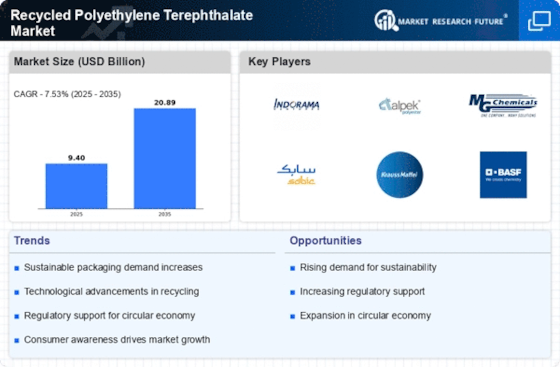
What is the projected market valuation of the Recycled Polyethylene Terephthalate Market by 2035?

<p>The projected market valuation for the Recycled Polyethylene Terephthalate Market is 20.89 USD Billion by 2035.</p>

What was the market valuation of the Recycled Polyethylene Terephthalate Market in 2024?

<p>The market valuation of the Recycled Polyethylene Terephthalate Market was 9.4 USD Billion in 2024.</p>

What is the expected CAGR for the Recycled Polyethylene Terephthalate Market from 2025 to 2035?

<p>The expected CAGR for the Recycled Polyethylene Terephthalate Market during the forecast period 2025 - 2035 is 7.53%.</p>

Which companies are considered key players in the Recycled Polyethylene Terephthalate Market?

<p>Key players in the Recycled Polyethylene Terephthalate Market include Indorama Ventures, Alpek Polyester, M&G Chemicals, SABIC, and others.</p>

What are the main types of Recycled Polyethylene Terephthalate products and their market values?

<p>The main types include Clear, valued at 11.5 USD Billion, and Colored, valued at 9.39 USD Billion.</p>

What applications dominate the Recycled Polyethylene Terephthalate Market?

<p>Dominant applications include Food Grade Bottles & Containers, valued at 7.0 USD Billion, and Non-Food Grade Bottles & Containers, valued at 4.5 USD Billion.</p>

How does the market for Fiber compare to other applications in the Recycled Polyethylene Terephthalate Market?

<p>The Fiber application is valued at 3.5 USD Billion, indicating a strong position compared to other applications.</p>

What is the market value for Sheet & Film applications in the Recycled Polyethylene Terephthalate Market?

<p>The market value for Sheet & Film applications is projected to reach 2.8 USD Billion.</p>

What is the significance of the Strapping application in the Recycled Polyethylene Terephthalate Market?

<p>The Strapping application holds a market value of 1.9 USD Billion, reflecting its relevance in the overall market.</p>

How do the projected values for 2035 compare to those in 2024 for the Recycled Polyethylene Terephthalate Market?

<p>The projected values for 2035 indicate substantial growth from 9.4 USD Billion in 2024 to 20.89 USD Billion.</p>

Market Summary

As per Market Research Future analysis, the Recycled Polyethylene Terephthalate Market Size was estimated at 1.3 USD Billion in 2024. The Recycled Polyethylene Terephthalate industry is projected to grow from 1.4 USD Billion in 2025 to 2.7 USD Billion by 2035, exhibiting a compound annual growth rate (CAGR) of 6.80% during the forecast period 2025 - 2035

Key Market Trends & Highlights

The Recycled Polyethylene Terephthalate Market is experiencing robust growth driven by sustainability and technological advancements.

  • North America remains the largest market for recycled polyethylene terephthalate, driven by strong sustainability initiatives. The Asia-Pacific region is emerging as the fastest-growing market, fueled by increasing consumer awareness and demand for recycled products. Clear recycled polyethylene terephthalate continues to dominate the market, while food grade bottles and containers are witnessing the fastest growth. Key market drivers include the rising demand for sustainable packaging and regulatory frameworks that promote recycling efforts.

Market Size & Forecast

2024 Market Size 1.3(USD Billion)
2035 Market Size 2.7(USD Billion)
CAGR (2025 - 2035) 6.80%
Largest Regional Market Share in 2024 Europe

Major Players

Placon, Clear Path Recycling LLC, Verdeco Recycling, Inc., Indorama Ventures Public Ltd., Zhejiang Anshun Pettechs Fibre Co., Ltd., PolyQuest, Alpek Polyester, M&amp;G Chemicals, SABIC, KraussMaffei Group 

Market Trends

The Recycled Polyethylene Terephthalate Market is currently experiencing a notable transformation driven by increasing environmental awareness and regulatory pressures. As consumers and industries alike prioritize sustainability, the demand for recycled materials is on the rise. This shift is prompting manufacturers to innovate and enhance their recycling processes, thereby improving the quality and availability of recycled polyethylene terephthalate. Furthermore, the market is witnessing a growing interest from various sectors, including packaging, textiles, and automotive, which are increasingly adopting recycled materials to meet their sustainability goals. In addition to consumer demand, government initiatives aimed at reducing plastic waste are playing a crucial role in shaping the Recycled Polyethylene Terephthalate Market. Policies promoting recycling and the use of recycled content are encouraging companies to invest in advanced recycling technologies. This trend not only supports the circular economy but also fosters collaboration among stakeholders, including manufacturers, recyclers, and policymakers. As the market evolves, it appears poised for further growth, with innovations in recycling technologies and increased consumer engagement likely to drive future developments.

Sustainability Initiatives

The Recycled Polyethylene Terephthalate Market is increasingly influenced by sustainability initiatives. Companies are adopting eco-friendly practices to align with consumer preferences for environmentally responsible products. This trend is fostering a shift towards the use of recycled materials across various industries.

Technological Advancements

Technological advancements in recycling processes are enhancing the efficiency and effectiveness of recycling polyethylene terephthalate. Innovations in sorting, cleaning, and processing are improving the quality of recycled materials, making them more appealing to manufacturers.

Regulatory Support

Regulatory support is becoming a driving force in the Recycled Polyethylene Terephthalate Market. Governments are implementing policies that encourage recycling and the use of recycled content, which is likely to stimulate market growth and promote sustainable practices.

Recycled Polyethylene Terephthalate Market Market Drivers

Collaboration Across the Supply Chain

Collaboration among stakeholders in the supply chain is emerging as a pivotal driver for the Recycled Polyethylene Terephthalate Market. Partnerships between manufacturers, recyclers, and retailers are essential for creating a robust ecosystem that supports recycling initiatives. By working together, these entities can streamline processes, improve collection rates, and enhance the quality of recycled materials. For instance, initiatives that involve take-back programs and closed-loop systems are gaining traction, allowing companies to reclaim and recycle their products effectively. This collaborative approach not only boosts the availability of recycled PET but also fosters innovation in recycling technologies. As a result, the Recycled Polyethylene Terephthalate Market is likely to benefit from increased efficiency and sustainability, ultimately contributing to a circular economy.

Regulatory Frameworks Promoting Recycling

The Recycled Polyethylene Terephthalate Market is significantly influenced by regulatory frameworks that promote recycling initiatives. Governments worldwide are implementing stringent regulations aimed at reducing plastic waste and encouraging the use of recycled materials. For example, many regions have set ambitious targets for recycling rates, with some aiming for 50% or higher by 2030. These regulations create a favorable environment for the growth of the Recycled Polyethylene Terephthalate Market, as manufacturers are incentivized to incorporate recycled PET into their products. Compliance with these regulations not only enhances corporate responsibility but also opens up new market opportunities for businesses that prioritize sustainability. As such, the regulatory landscape is a key driver of innovation and investment in the recycling sector.

Increasing Demand for Sustainable Packaging

The Recycled Polyethylene Terephthalate Market is experiencing a notable surge in demand for sustainable packaging solutions. As consumers become increasingly environmentally conscious, brands are compelled to adopt eco-friendly materials. In 2025, the demand for recycled PET in packaging applications is projected to reach approximately 5 million tons, reflecting a significant shift towards sustainability. This trend is driven by the need to reduce plastic waste and the carbon footprint associated with traditional packaging materials. Companies are actively seeking recycled PET to meet consumer preferences and regulatory requirements, thereby propelling the growth of the Recycled Polyethylene Terephthalate Market. Furthermore, the integration of recycled materials into packaging not only enhances brand image but also aligns with corporate sustainability goals, making it a strategic imperative for businesses.

Technological Innovations in Recycling Processes

Technological advancements play a crucial role in enhancing the efficiency of recycling processes within the Recycled Polyethylene Terephthalate Market. Innovations such as advanced sorting technologies and chemical recycling methods are improving the quality and yield of recycled PET. For instance, the introduction of enzymatic recycling techniques has shown potential in breaking down PET into its original monomers, allowing for higher purity levels. As of 2025, the adoption of these technologies is expected to increase the recycling rate of PET bottles to over 60%, significantly impacting the availability of recycled materials. This not only supports the circular economy but also reduces reliance on virgin PET, thereby fostering a more sustainable approach within the Recycled Polyethylene Terephthalate Market.

Consumer Awareness and Preference for Recycled Products

Consumer awareness regarding environmental issues is a driving force behind the growth of the Recycled Polyethylene Terephthalate Market. As individuals become more informed about the impact of plastic pollution, there is a marked preference for products made from recycled materials. Surveys indicate that over 70% of consumers are willing to pay a premium for products that utilize recycled PET, reflecting a shift in purchasing behavior. This trend is particularly evident in sectors such as fashion and consumer goods, where brands are increasingly marketing their use of recycled materials. Consequently, the Recycled Polyethylene Terephthalate Market is poised for expansion as companies respond to this consumer demand by integrating recycled PET into their offerings, thereby enhancing their market competitiveness.

Market Segment Insights

By Type: Clear (Largest) vs. Colored (Emerging)

In the Recycled Polyethylene Terephthalate Market, the segment composition is notably dominated by clear rPET, which holds a significant share due to its extensive applications in packaging, particularly in the beverage industry. Clear rPET is preferred for its aesthetic appeal and high-performance characteristics, making it the primary choice for many manufacturers. Meanwhile, colored rPET is steadily gaining traction, accounting for a smaller but growing share as it sees increased adoption in non-food applications and consumer goods, where color differentiation enhances product attractiveness.

Clear (Dominant) vs. Colored (Emerging)

The clear rPET segment is characterized by its broad applicability, primarily in the food and beverage packaging sector, owing to its clarity and recyclability. This dominance is further supported by stringent recycling regulations and growing consumer preference for transparent packaging that showcases product quality. Conversely, colored rPET is considered an emerging segment, primarily used in niche applications including household items and automotive parts. Its growth is driven by innovation in coloring techniques and an increasing demand for customized packaging solutions, offering opportunities for brands to differentiate their products while adhering to sustainability goals.

By Application: Fiber (Largest) vs. Food Grade Bottles & Containers (Fastest-Growing)

The Recycled Polyethylene Terephthalate Market (rPET) market shows diverse application areas, with Fiber leading the segment by commanding the largest share. Fiber’s extensive use in textiles and apparel is propelling its market dominance, reflecting a strong and growing consumer preference for sustainable products. Following Fiber is the Food Grade Bottles and Containers segment, which plays a crucial role in the increasing demand for rPET in the food and beverage sector. Other segments, such as Sheet &amp; Film and Strapping, hold significant but smaller market shares. As sustainability becomes a priority across industries, several segments within the rPET market are poised for growth. The Food Grade Bottles and Containers segment is particularly noteworthy, driven by stringent regulations on single-use plastics and a growing preference for eco-friendly packaging solutions. Innovations in recycling technologies and increased consumer awareness are further propelling the resurgence of rPET materials into mainstream applications, particularly as brands look to enhance their environmental credentials.

Fiber (Dominant) vs. Non-Food Grade Bottles &amp; Containers (Emerging)

The Fiber segment is established as a dominant force in the recycled polyethylene terephthalate market, primarily due to its integration into the textile industry, where it is increasingly used to create sustainable apparel and home textiles. This segment benefits from the circular economy, as brands and manufacturers focus on reducing waste and employing recycled materials. In contrast, the Non-Food Grade Bottles &amp; Containers segment represents an emerging opportunity, characterized by its growing acceptance for various industrial applications. Although it currently holds a smaller market share, its potential for expansion lies in the increasing adoption of rPET for non-consumable goods, driven by sustainability initiatives and the need for effective waste management practices.

Get more detailed insights about Recycled Polyethylene Terephthalate Market Research Report - Forecast till 2035

Regional Insights

The  Recycled Polyethylene Terephthalate Market reflects substantial growth potential across its regional segment, driven by increasing awareness of sustainability and recycling initiatives. In 2024, the market is projected to reach a valuation of 9.4 USD Billion, with North America contributing 2.8 USD Billion and Europe slightly leading at 3.2 USD Billion. This dominance is due to stringent environmental regulations and robust recycling infrastructure in these regions.

Asia Pacific, valued at 2.2 USD Billion, is expected to expand rapidly, harnessing growing consumer demand for eco-friendly products.South America and the Middle East and Africa, while smaller at 0.9 USD Billion and 0.3 USD Billion respectively, show potential for growth as local industries adopt recycling practices. The expected growth of the  Recycled Polyethylene Terephthalate Market industry aligns with  sustainability trends, allowing major markets to innovate recycling technologies and promote market growth.

The overall market segmentation across these regions showcases the varying levels of maturity and commitment to recycled materials, with North America and Europe taking the lead, further emphasizing their significant roles in shaping the future of recycled plastics.

Key Players and Competitive Insights

The  Recycled Polyethylene Terephthalate Market has emerged as a significant segment within the broader recycling and materials industry, driven by increasing environmental awareness, regulatory pressures, and consumer demand for sustainable products. This market is characterized by a mix of established players and innovative newcomers, each vying for a share in an industry that is poised for extensive growth. The growing emphasis on circular economy principles has led to substantial investments in recycling technologies, which have improved the efficiency and quality of recycled PET products.Competitive insights into this market reveal a landscape where companies are focusing on enhancing their production capabilities, streamlining supply chains, and expanding their geographic footprints to capture new opportunities. Companies are also leveraging partnerships and collaborations to strengthen their market presence, while navigating challenges such as fluctuating raw material prices and the need for advanced recycling processes.Suez Recycling and Recovery plays a critical role in the  Recycled Polyethylene Terephthalate Market, providing a range of services aimed at the sustainable management of resources.The company focuses on waste management solutions that include recycling operations for PET and other materials, capitalizing on its extensive network and technological advancements to collect and process recyclables effectively. Key products and services offered by Suez include recycling services, waste management consultations, and sustainable resource recovery solutions that cater to diverse industries. With a robust  presence, Suez has positioned itself as a leader in recycling and recovery, expanding its operations through strategic mergers and acquisitions that enhance its capabilities and market reach.Its strengths include a comprehensive approach to waste management that integrates innovative technologies and sustainable practices, allowing for increased efficiency and reductions in landfill waste. These attributes contribute significantly to its competitive advantage in the  Recycled Polyethylene Terephthalate Market.

Key Companies in the Recycled Polyethylene Terephthalate Market include

Industry Developments

Recent developments in the  Recycled Polyethylene Terephthalate Market indicate a growing emphasis on sustainability and circular economy initiatives, with many companies actively enhancing their recycling capabilities. Noteworthy is Indorama Ventures, which has been expanding its recycling operations ly to meet the surging demand for sustainable materials. Alpek has also made strides, focusing on boosting its recycled PET capacity to fulfill market needs. In terms of current affairs, M&G Chemicals announced its plans in September 2023 to enhance its operational capabilities to contribute to the circular economy cycle.

In merger and acquisition news, in August 2023, Suez Recycling and Recovery acquired Clean Tech Incorporated, a deal aimed at strengthening their recycling capabilities. This shift is impacting the overall market valuation, with companies like Plastipak and DAK Americas seeing considerable growth in their stock performance, reflecting increased investor confidence due to their sustainability actions. Over the last two to three years, there has been an ongoing trend towards increased investment in recycling technologies, driven by rising consumer demand for sustainable packaging solutions.


Future Outlook

Recycled Polyethylene Terephthalate Market Future Outlook

The Recycled Polyethylene Terephthalate Market is projected to grow at a 6.80% CAGR from 2025 to 2035, driven by increasing sustainability initiatives and regulatory support.

New opportunities lie in:

  • <p>Expansion of advanced recycling technologies for higher quality outputs. Development of partnerships with brands for closed-loop recycling systems. Investment in automated sorting facilities to enhance material recovery rates.</p>

By 2035, the market is expected to solidify its position as a leader in sustainable materials.

Market Segmentation

Recycled Polyethylene Terephthalate Market Type Outlook

  • Clear
  • Colored

Recycled Polyethylene Terephthalate Market Application Outlook

  • Fiber
  • Sheet & Film
  • Strapping
  • Food Grade Bottles & Containers
  • Non-Food Grade Bottles & Containers
  • Others

Report Scope

MARKET SIZE 2024 1.3(USD Billion)
MARKET SIZE 2025 1.4(USD Billion)
MARKET SIZE 2035 2.7(USD Billion)
COMPOUND ANNUAL GROWTH RATE (CAGR) 6.80% (2025 - 2035)
REPORT COVERAGE Revenue Forecast, Competitive Landscape, Growth Factors, and Trends
BASE YEAR 2024
Market Forecast Period 2025 - 2035
Historical Data 2019 - 2024
Market Forecast Units USD Billion
Key Companies Profiled Placon, Clear Path Recycling LLC, Verdeco Recycling, Inc., Indorama Ventures Public Ltd., Zhejiang Anshun Pettechs Fibre Co., Ltd., PolyQuest, Alpek Polyester, M&G Chemicals, SABIC, KraussMaffei Group 
Segments Covered Type, Application, Regional
Key Market Opportunities Growing demand for sustainable packaging solutions drives innovation in the Recycled Polyethylene Terephthalate Market.
Key Market Dynamics Rising consumer demand for sustainable packaging drives innovation and competition in the Recycled Polyethylene Terephthalate Market.
Countries Covered North America, Europe, APAC, South America, MEA

FAQs

What is the projected market valuation of the Recycled Polyethylene Terephthalate Market by 2035?

<p>The projected market valuation for the Recycled Polyethylene Terephthalate Market is 20.89 USD Billion by 2035.</p>

What was the market valuation of the Recycled Polyethylene Terephthalate Market in 2024?

<p>The market valuation of the Recycled Polyethylene Terephthalate Market was 9.4 USD Billion in 2024.</p>

What is the expected CAGR for the Recycled Polyethylene Terephthalate Market from 2025 to 2035?

<p>The expected CAGR for the Recycled Polyethylene Terephthalate Market during the forecast period 2025 - 2035 is 7.53%.</p>

Which companies are considered key players in the Recycled Polyethylene Terephthalate Market?

<p>Key players in the Recycled Polyethylene Terephthalate Market include Indorama Ventures, Alpek Polyester, M&G Chemicals, SABIC, and others.</p>

What are the main types of Recycled Polyethylene Terephthalate products and their market values?

<p>The main types include Clear, valued at 11.5 USD Billion, and Colored, valued at 9.39 USD Billion.</p>

What applications dominate the Recycled Polyethylene Terephthalate Market?

<p>Dominant applications include Food Grade Bottles & Containers, valued at 7.0 USD Billion, and Non-Food Grade Bottles & Containers, valued at 4.5 USD Billion.</p>

How does the market for Fiber compare to other applications in the Recycled Polyethylene Terephthalate Market?

<p>The Fiber application is valued at 3.5 USD Billion, indicating a strong position compared to other applications.</p>

What is the market value for Sheet & Film applications in the Recycled Polyethylene Terephthalate Market?

<p>The market value for Sheet & Film applications is projected to reach 2.8 USD Billion.</p>

What is the significance of the Strapping application in the Recycled Polyethylene Terephthalate Market?

<p>The Strapping application holds a market value of 1.9 USD Billion, reflecting its relevance in the overall market.</p>

How do the projected values for 2035 compare to those in 2024 for the Recycled Polyethylene Terephthalate Market?

<p>The projected values for 2035 indicate substantial growth from 9.4 USD Billion in 2024 to 20.89 USD Billion.</p>

  1. SECTION I: EXECUTIVE SUMMARY AND KEY HIGHLIGHTS
    1. | 1.1 EXECUTIVE SUMMARY
    2. | | 1.1.1 Market Overview
    3. | | 1.1.2 Key Findings
    4. | | 1.1.3 Market Segmentation
    5. | | 1.1.4 Competitive Landscape
    6. | | 1.1.5 Challenges and Opportunities
    7. | | 1.1.6 Future Outlook
  2. SECTION II: SCOPING, METHODOLOGY AND MARKET STRUCTURE
    1. | 2.1 MARKET INTRODUCTION
    2. | | 2.1.1 Definition
    3. | | 2.1.2 Scope of the study
    4. | | | 2.1.2.1 Research Objective
    5. | | | 2.1.2.2 Assumption
    6. | | | 2.1.2.3 Limitations
    7. | 2.2 RESEARCH METHODOLOGY
    8. | | 2.2.1 Overview
    9. | | 2.2.2 Data Mining
    10. | | 2.2.3 Secondary Research
    11. | | 2.2.4 Primary Research
    12. | | | 2.2.4.1 Primary Interviews and Information Gathering Process
    13. | | | 2.2.4.2 Breakdown of Primary Respondents
    14. | | 2.2.5 Forecasting Model
    15. | | 2.2.6 Market Size Estimation
    16. | | | 2.2.6.1 Bottom-Up Approach
    17. | | | 2.2.6.2 Top-Down Approach
    18. | | 2.2.7 Data Triangulation
    19. | | 2.2.8 Validation
  3. SECTION III: QUALITATIVE ANALYSIS
    1. | 3.1 MARKET DYNAMICS
    2. | | 3.1.1 Overview
    3. | | 3.1.2 Drivers
    4. | | 3.1.3 Restraints
    5. | | 3.1.4 Opportunities
    6. | 3.2 MARKET FACTOR ANALYSIS
    7. | | 3.2.1 Value chain Analysis
    8. | | 3.2.2 Porter's Five Forces Analysis
    9. | | | 3.2.2.1 Bargaining Power of Suppliers
    10. | | | 3.2.2.2 Bargaining Power of Buyers
    11. | | | 3.2.2.3 Threat of New Entrants
    12. | | | 3.2.2.4 Threat of Substitutes
    13. | | | 3.2.2.5 Intensity of Rivalry
    14. | | 3.2.3 COVID-19 Impact Analysis
    15. | | | 3.2.3.1 Market Impact Analysis
    16. | | | 3.2.3.2 Regional Impact
    17. | | | 3.2.3.3 Opportunity and Threat Analysis
  4. SECTION IV: QUANTITATIVE ANALYSIS
    1. | 4.1 Chemicals and Materials, BY Type (USD Billion)
    2. | | 4.1.1 Clear
    3. | | 4.1.2 Colored
    4. | 4.2 Chemicals and Materials, BY Application (USD Billion)
    5. | | 4.2.1 Fiber
    6. | | 4.2.2 Sheet & Film
    7. | | 4.2.3 Strapping
    8. | | 4.2.4 Food Grade Bottles & Containers
    9. | | 4.2.5 Non-Food Grade Bottles & Containers
    10. | | 4.2.6 Others
    11. | 4.3 Chemicals and Materials, BY Region (USD Billion)
    12. | | 4.3.1 North America
    13. | | | 4.3.1.1 US
    14. | | | 4.3.1.2 Canada
    15. | | 4.3.2 Europe
    16. | | | 4.3.2.1 Germany
    17. | | | 4.3.2.2 UK
    18. | | | 4.3.2.3 France
    19. | | | 4.3.2.4 Russia
    20. | | | 4.3.2.5 Italy
    21. | | | 4.3.2.6 Spain
    22. | | | 4.3.2.7 Rest of Europe
    23. | | 4.3.3 APAC
    24. | | | 4.3.3.1 China
    25. | | | 4.3.3.2 India
    26. | | | 4.3.3.3 Japan
    27. | | | 4.3.3.4 South Korea
    28. | | | 4.3.3.5 Malaysia
    29. | | | 4.3.3.6 Thailand
    30. | | | 4.3.3.7 Indonesia
    31. | | | 4.3.3.8 Rest of APAC
    32. | | 4.3.4 South America
    33. | | | 4.3.4.1 Brazil
    34. | | | 4.3.4.2 Mexico
    35. | | | 4.3.4.3 Argentina
    36. | | | 4.3.4.4 Rest of South America
    37. | | 4.3.5 MEA
    38. | | | 4.3.5.1 GCC Countries
    39. | | | 4.3.5.2 South Africa
    40. | | | 4.3.5.3 Rest of MEA
  5. SECTION V: COMPETITIVE ANALYSIS
    1. | 5.1 Competitive Landscape
    2. | | 5.1.1 Overview
    3. | | 5.1.2 Competitive Analysis
    4. | | 5.1.3 Market share Analysis
    5. | | 5.1.4 Major Growth Strategy in the Chemicals and Materials
    6. | | 5.1.5 Competitive Benchmarking
    7. | | 5.1.6 Leading Players in Terms of Number of Developments in the Chemicals and Materials
    8. | | 5.1.7 Key developments and growth strategies
    9. | | | 5.1.7.1 New Product Launch/Service Deployment
    10. | | | 5.1.7.2 Merger & Acquisitions
    11. | | | 5.1.7.3 Joint Ventures
    12. | | 5.1.8 Major Players Financial Matrix
    13. | | | 5.1.8.1 Sales and Operating Income
    14. | | | 5.1.8.2 Major Players R&D Expenditure. 2023
    15. | 5.2 Company Profiles
    16. | | 5.2.1 Indorama Ventures (TH)
    17. | | | 5.2.1.1 Financial Overview
    18. | | | 5.2.1.2 Products Offered
    19. | | | 5.2.1.3 Key Developments
    20. | | | 5.2.1.4 SWOT Analysis
    21. | | | 5.2.1.5 Key Strategies
    22. | | 5.2.2 Alpek Polyester (MX)
    23. | | | 5.2.2.1 Financial Overview
    24. | | | 5.2.2.2 Products Offered
    25. | | | 5.2.2.3 Key Developments
    26. | | | 5.2.2.4 SWOT Analysis
    27. | | | 5.2.2.5 Key Strategies
    28. | | 5.2.3 M&G Chemicals (IT)
    29. | | | 5.2.3.1 Financial Overview
    30. | | | 5.2.3.2 Products Offered
    31. | | | 5.2.3.3 Key Developments
    32. | | | 5.2.3.4 SWOT Analysis
    33. | | | 5.2.3.5 Key Strategies
    34. | | 5.2.4 SABIC (SA)
    35. | | | 5.2.4.1 Financial Overview
    36. | | | 5.2.4.2 Products Offered
    37. | | | 5.2.4.3 Key Developments
    38. | | | 5.2.4.4 SWOT Analysis
    39. | | | 5.2.4.5 Key Strategies
    40. | | 5.2.5 KraussMaffei Group (DE)
    41. | | | 5.2.5.1 Financial Overview
    42. | | | 5.2.5.2 Products Offered
    43. | | | 5.2.5.3 Key Developments
    44. | | | 5.2.5.4 SWOT Analysis
    45. | | | 5.2.5.5 Key Strategies
    46. | | 5.2.6 BASF (DE)
    47. | | | 5.2.6.1 Financial Overview
    48. | | | 5.2.6.2 Products Offered
    49. | | | 5.2.6.3 Key Developments
    50. | | | 5.2.6.4 SWOT Analysis
    51. | | | 5.2.6.5 Key Strategies
    52. | | 5.2.7 LyondellBasell Industries (US)
    53. | | | 5.2.7.1 Financial Overview
    54. | | | 5.2.7.2 Products Offered
    55. | | | 5.2.7.3 Key Developments
    56. | | | 5.2.7.4 SWOT Analysis
    57. | | | 5.2.7.5 Key Strategies
    58. | | 5.2.8 Repreve (US)
    59. | | | 5.2.8.1 Financial Overview
    60. | | | 5.2.8.2 Products Offered
    61. | | | 5.2.8.3 Key Developments
    62. | | | 5.2.8.4 SWOT Analysis
    63. | | | 5.2.8.5 Key Strategies
    64. | | 5.2.9 Green Dot (US)
    65. | | | 5.2.9.1 Financial Overview
    66. | | | 5.2.9.2 Products Offered
    67. | | | 5.2.9.3 Key Developments
    68. | | | 5.2.9.4 SWOT Analysis
    69. | | | 5.2.9.5 Key Strategies
    70. | 5.3 Appendix
    71. | | 5.3.1 References
    72. | | 5.3.2 Related Reports
  6. LIST OF FIGURES
    1. | 6.1 MARKET SYNOPSIS
    2. | 6.2 NORTH AMERICA MARKET ANALYSIS
    3. | 6.3 US MARKET ANALYSIS BY TYPE
    4. | 6.4 US MARKET ANALYSIS BY APPLICATION
    5. | 6.5 CANADA MARKET ANALYSIS BY TYPE
    6. | 6.6 CANADA MARKET ANALYSIS BY APPLICATION
    7. | 6.7 EUROPE MARKET ANALYSIS
    8. | 6.8 GERMANY MARKET ANALYSIS BY TYPE
    9. | 6.9 GERMANY MARKET ANALYSIS BY APPLICATION
    10. | 6.10 UK MARKET ANALYSIS BY TYPE
    11. | 6.11 UK MARKET ANALYSIS BY APPLICATION
    12. | 6.12 FRANCE MARKET ANALYSIS BY TYPE
    13. | 6.13 FRANCE MARKET ANALYSIS BY APPLICATION
    14. | 6.14 RUSSIA MARKET ANALYSIS BY TYPE
    15. | 6.15 RUSSIA MARKET ANALYSIS BY APPLICATION
    16. | 6.16 ITALY MARKET ANALYSIS BY TYPE
    17. | 6.17 ITALY MARKET ANALYSIS BY APPLICATION
    18. | 6.18 SPAIN MARKET ANALYSIS BY TYPE
    19. | 6.19 SPAIN MARKET ANALYSIS BY APPLICATION
    20. | 6.20 REST OF EUROPE MARKET ANALYSIS BY TYPE
    21. | 6.21 REST OF EUROPE MARKET ANALYSIS BY APPLICATION
    22. | 6.22 APAC MARKET ANALYSIS
    23. | 6.23 CHINA MARKET ANALYSIS BY TYPE
    24. | 6.24 CHINA MARKET ANALYSIS BY APPLICATION
    25. | 6.25 INDIA MARKET ANALYSIS BY TYPE
    26. | 6.26 INDIA MARKET ANALYSIS BY APPLICATION
    27. | 6.27 JAPAN MARKET ANALYSIS BY TYPE
    28. | 6.28 JAPAN MARKET ANALYSIS BY APPLICATION
    29. | 6.29 SOUTH KOREA MARKET ANALYSIS BY TYPE
    30. | 6.30 SOUTH KOREA MARKET ANALYSIS BY APPLICATION
    31. | 6.31 MALAYSIA MARKET ANALYSIS BY TYPE
    32. | 6.32 MALAYSIA MARKET ANALYSIS BY APPLICATION
    33. | 6.33 THAILAND MARKET ANALYSIS BY TYPE
    34. | 6.34 THAILAND MARKET ANALYSIS BY APPLICATION
    35. | 6.35 INDONESIA MARKET ANALYSIS BY TYPE
    36. | 6.36 INDONESIA MARKET ANALYSIS BY APPLICATION
    37. | 6.37 REST OF APAC MARKET ANALYSIS BY TYPE
    38. | 6.38 REST OF APAC MARKET ANALYSIS BY APPLICATION
    39. | 6.39 SOUTH AMERICA MARKET ANALYSIS
    40. | 6.40 BRAZIL MARKET ANALYSIS BY TYPE
    41. | 6.41 BRAZIL MARKET ANALYSIS BY APPLICATION
    42. | 6.42 MEXICO MARKET ANALYSIS BY TYPE
    43. | 6.43 MEXICO MARKET ANALYSIS BY APPLICATION
    44. | 6.44 ARGENTINA MARKET ANALYSIS BY TYPE
    45. | 6.45 ARGENTINA MARKET ANALYSIS BY APPLICATION
    46. | 6.46 REST OF SOUTH AMERICA MARKET ANALYSIS BY TYPE
    47. | 6.47 REST OF SOUTH AMERICA MARKET ANALYSIS BY APPLICATION
    48. | 6.48 MEA MARKET ANALYSIS
    49. | 6.49 GCC COUNTRIES MARKET ANALYSIS BY TYPE
    50. | 6.50 GCC COUNTRIES MARKET ANALYSIS BY APPLICATION
    51. | 6.51 SOUTH AFRICA MARKET ANALYSIS BY TYPE
    52. | 6.52 SOUTH AFRICA MARKET ANALYSIS BY APPLICATION
    53. | 6.53 REST OF MEA MARKET ANALYSIS BY TYPE
    54. | 6.54 REST OF MEA MARKET ANALYSIS BY APPLICATION
    55. | 6.55 KEY BUYING CRITERIA OF CHEMICALS AND MATERIALS
    56. | 6.56 RESEARCH PROCESS OF MRFR
    57. | 6.57 DRO ANALYSIS OF CHEMICALS AND MATERIALS
    58. | 6.58 DRIVERS IMPACT ANALYSIS: CHEMICALS AND MATERIALS
    59. | 6.59 RESTRAINTS IMPACT ANALYSIS: CHEMICALS AND MATERIALS
    60. | 6.60 SUPPLY / VALUE CHAIN: CHEMICALS AND MATERIALS
    61. | 6.61 CHEMICALS AND MATERIALS, BY TYPE, 2024 (% SHARE)
    62. | 6.62 CHEMICALS AND MATERIALS, BY TYPE, 2024 TO 2035 (USD Billion)
    63. | 6.63 CHEMICALS AND MATERIALS, BY APPLICATION, 2024 (% SHARE)
    64. | 6.64 CHEMICALS AND MATERIALS, BY APPLICATION, 2024 TO 2035 (USD Billion)
    65. | 6.65 BENCHMARKING OF MAJOR COMPETITORS
  7. LIST OF TABLES
    1. | 7.1 LIST OF ASSUMPTIONS
    2. | | 7.1.1
    3. | 7.2 North America MARKET SIZE ESTIMATES; FORECAST
    4. | | 7.2.1 BY TYPE, 2025-2035 (USD Billion)
    5. | | 7.2.2 BY APPLICATION, 2025-2035 (USD Billion)
    6. | 7.3 US MARKET SIZE ESTIMATES; FORECAST
    7. | | 7.3.1 BY TYPE, 2025-2035 (USD Billion)
    8. | | 7.3.2 BY APPLICATION, 2025-2035 (USD Billion)
    9. | 7.4 Canada MARKET SIZE ESTIMATES; FORECAST
    10. | | 7.4.1 BY TYPE, 2025-2035 (USD Billion)
    11. | | 7.4.2 BY APPLICATION, 2025-2035 (USD Billion)
    12. | 7.5 Europe MARKET SIZE ESTIMATES; FORECAST
    13. | | 7.5.1 BY TYPE, 2025-2035 (USD Billion)
    14. | | 7.5.2 BY APPLICATION, 2025-2035 (USD Billion)
    15. | 7.6 Germany MARKET SIZE ESTIMATES; FORECAST
    16. | | 7.6.1 BY TYPE, 2025-2035 (USD Billion)
    17. | | 7.6.2 BY APPLICATION, 2025-2035 (USD Billion)
    18. | 7.7 UK MARKET SIZE ESTIMATES; FORECAST
    19. | | 7.7.1 BY TYPE, 2025-2035 (USD Billion)
    20. | | 7.7.2 BY APPLICATION, 2025-2035 (USD Billion)
    21. | 7.8 France MARKET SIZE ESTIMATES; FORECAST
    22. | | 7.8.1 BY TYPE, 2025-2035 (USD Billion)
    23. | | 7.8.2 BY APPLICATION, 2025-2035 (USD Billion)
    24. | 7.9 Russia MARKET SIZE ESTIMATES; FORECAST
    25. | | 7.9.1 BY TYPE, 2025-2035 (USD Billion)
    26. | | 7.9.2 BY APPLICATION, 2025-2035 (USD Billion)
    27. | 7.10 Italy MARKET SIZE ESTIMATES; FORECAST
    28. | | 7.10.1 BY TYPE, 2025-2035 (USD Billion)
    29. | | 7.10.2 BY APPLICATION, 2025-2035 (USD Billion)
    30. | 7.11 Spain MARKET SIZE ESTIMATES; FORECAST
    31. | | 7.11.1 BY TYPE, 2025-2035 (USD Billion)
    32. | | 7.11.2 BY APPLICATION, 2025-2035 (USD Billion)
    33. | 7.12 Rest of Europe MARKET SIZE ESTIMATES; FORECAST
    34. | | 7.12.1 BY TYPE, 2025-2035 (USD Billion)
    35. | | 7.12.2 BY APPLICATION, 2025-2035 (USD Billion)
    36. | 7.13 APAC MARKET SIZE ESTIMATES; FORECAST
    37. | | 7.13.1 BY TYPE, 2025-2035 (USD Billion)
    38. | | 7.13.2 BY APPLICATION, 2025-2035 (USD Billion)
    39. | 7.14 China MARKET SIZE ESTIMATES; FORECAST
    40. | | 7.14.1 BY TYPE, 2025-2035 (USD Billion)
    41. | | 7.14.2 BY APPLICATION, 2025-2035 (USD Billion)
    42. | 7.15 India MARKET SIZE ESTIMATES; FORECAST
    43. | | 7.15.1 BY TYPE, 2025-2035 (USD Billion)
    44. | | 7.15.2 BY APPLICATION, 2025-2035 (USD Billion)
    45. | 7.16 Japan MARKET SIZE ESTIMATES; FORECAST
    46. | | 7.16.1 BY TYPE, 2025-2035 (USD Billion)
    47. | | 7.16.2 BY APPLICATION, 2025-2035 (USD Billion)
    48. | 7.17 South Korea MARKET SIZE ESTIMATES; FORECAST
    49. | | 7.17.1 BY TYPE, 2025-2035 (USD Billion)
    50. | | 7.17.2 BY APPLICATION, 2025-2035 (USD Billion)
    51. | 7.18 Malaysia MARKET SIZE ESTIMATES; FORECAST
    52. | | 7.18.1 BY TYPE, 2025-2035 (USD Billion)
    53. | | 7.18.2 BY APPLICATION, 2025-2035 (USD Billion)
    54. | 7.19 Thailand MARKET SIZE ESTIMATES; FORECAST
    55. | | 7.19.1 BY TYPE, 2025-2035 (USD Billion)
    56. | | 7.19.2 BY APPLICATION, 2025-2035 (USD Billion)
    57. | 7.20 Indonesia MARKET SIZE ESTIMATES; FORECAST
    58. | | 7.20.1 BY TYPE, 2025-2035 (USD Billion)
    59. | | 7.20.2 BY APPLICATION, 2025-2035 (USD Billion)
    60. | 7.21 Rest of APAC MARKET SIZE ESTIMATES; FORECAST
    61. | | 7.21.1 BY TYPE, 2025-2035 (USD Billion)
    62. | | 7.21.2 BY APPLICATION, 2025-2035 (USD Billion)
    63. | 7.22 South America MARKET SIZE ESTIMATES; FORECAST
    64. | | 7.22.1 BY TYPE, 2025-2035 (USD Billion)
    65. | | 7.22.2 BY APPLICATION, 2025-2035 (USD Billion)
    66. | 7.23 Brazil MARKET SIZE ESTIMATES; FORECAST
    67. | | 7.23.1 BY TYPE, 2025-2035 (USD Billion)
    68. | | 7.23.2 BY APPLICATION, 2025-2035 (USD Billion)
    69. | 7.24 Mexico MARKET SIZE ESTIMATES; FORECAST
    70. | | 7.24.1 BY TYPE, 2025-2035 (USD Billion)
    71. | | 7.24.2 BY APPLICATION, 2025-2035 (USD Billion)
    72. | 7.25 Argentina MARKET SIZE ESTIMATES; FORECAST
    73. | | 7.25.1 BY TYPE, 2025-2035 (USD Billion)
    74. | | 7.25.2 BY APPLICATION, 2025-2035 (USD Billion)
    75. | 7.26 Rest of South America MARKET SIZE ESTIMATES; FORECAST
    76. | | 7.26.1 BY TYPE, 2025-2035 (USD Billion)
    77. | | 7.26.2 BY APPLICATION, 2025-2035 (USD Billion)
    78. | 7.27 MEA MARKET SIZE ESTIMATES; FORECAST
    79. | | 7.27.1 BY TYPE, 2025-2035 (USD Billion)
    80. | | 7.27.2 BY APPLICATION, 2025-2035 (USD Billion)
    81. | 7.28 GCC Countries MARKET SIZE ESTIMATES; FORECAST
    82. | | 7.28.1 BY TYPE, 2025-2035 (USD Billion)
    83. | | 7.28.2 BY APPLICATION, 2025-2035 (USD Billion)
    84. | 7.29 South Africa MARKET SIZE ESTIMATES; FORECAST
    85. | | 7.29.1 BY TYPE, 2025-2035 (USD Billion)
    86. | | 7.29.2 BY APPLICATION, 2025-2035 (USD Billion)
    87. | 7.30 Rest of MEA MARKET SIZE ESTIMATES; FORECAST
    88. | | 7.30.1 BY TYPE, 2025-2035 (USD Billion)
    89. | | 7.30.2 BY APPLICATION, 2025-2035 (USD Billion)
    90. | 7.31 PRODUCT LAUNCH/PRODUCT DEVELOPMENT/APPROVAL
    91. | | 7.31.1
    92. | 7.32 ACQUISITION/PARTNERSHIP
    93. | | 7.32.1

Chemicals and Materials Market Segmentation

Chemicals and Materials By Type (USD Billion, 2025-2035)

  • Clear
  • Colored

Chemicals and Materials By Application (USD Billion, 2025-2035)

  • Fiber
  • Sheet & Film
  • Strapping
  • Food Grade Bottles & Containers
  • Non-Food Grade Bottles & Containers
  • Others
Infographic

Free Sample Request

Kindly complete the form below to receive a free sample of this Report

Get Free Sample

Customer Strories

Compare Licence

×
Features License Type
Single User Multiuser License Enterprise User
Price $4,950 $5,950 $7,250
Maximum User Access Limit 1 User Upto 10 Users Unrestricted Access Throughout the Organization
Free Customization
Direct Access to Analyst
Deliverable Format
Platform Access
Discount on Next Purchase 10% 15% 15%
Printable Versions