
×
Hero Background
English
Chinese
French
Japanese
Korean
German
Spanish

Reciprocating Compressor Market Size

ID: MRFR/EnP/6879-CR
155 Pages
Anshula Mandaokar
March 2021

Reciprocating Compressor Market Research Report Information By Type (Portable and Stationary), By Lubrication (Oil-Free and Oil-Filled), By Stage Type (single stage, multi stage), By Type (single acting, double acting, diaphragm), By End User (oil & gas, pharmaceutical, chemical plants, refrigeration plants, manufacturing, automotive, others) And By Region (North America, Europe, Asia-Pacific, And Rest Of The World) – Market Forecast Till 2035

Share:
Download PDF ×

We do not share your information with anyone. However, we may send you emails based on your report interest from time to time. You may contact us at any time to opt-out.

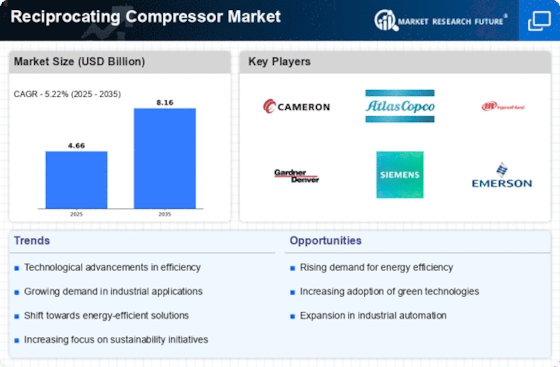
Reciprocating Compressor Market Infographic
Purchase Options

Reciprocating Compressor Size

Reciprocating Compressor Market Growth Projections and Opportunities

Various market factors act as forces that influence the reciprocating compressor industry, such dynamics and performance. The increasing demand for reciprocating compressors across different industries also acts as a major driver of the market. Some of these compressors are critical to multiple applications such as in oil & gas, petrochemicals, chemicals, and manufacturing where efficient compression of gases is necessary. As these sectors grow and advance, the need for reciprocating compressors will continue to increase with market growth. Another major market dynamics is the global energy landscape. Due to the growing importance of energy efficiency and sustainability, industries are increasingly installing reciprocating compressors because they operate reliably. These compressors can work with multiple types of gases and can perform under various circumstances, making them the preferred units used by industries involved in decreasing energy usage and pollution. Technological innovations are another important factor influencing the reciprocating compressor market. Innovations are generated from continuous research and development activities on these compressors, which improve efficiency; performance reliability. Smart technologies, including IoT and better control systems integrate with the reciprocating compressors to make them more dynamic for changes in operating conditions. This technological change attracts companies seeking latest solutions to enhance their process efficiency. The reciprocating compressor market is very much affected by the landscape of economics and capital investments on various industries. Compressed air investments are boosted by economic growth, industrial development along with infrastructure enablement for gas applications such as transmission storage and processing. On the other hand, economic declines or uncertainties may result in investment slowdown and hence affect market. It is vital for businesses working in the reciprocating compressor market to comprehend and adapt themselves these economic factors. Regardless of market regulations and environmental policies affect the reciprocating compressor industry. Emission and environmental impact regulations make industries to invest in compressors that meet these standards. This results in an increasing requirement for green and low emission reciprocating compressors congruent with global endeavours to combat climate change as well as reduce carbon footprint. Secondly, the forces influencing the competitive landscape of reciprocating compressor market include mergers and acquisitions as well as partnerships by leading competitors. These actions help companies to improve their market share, increase the number of products that they offer, and use synergies to gain competitive advantage. Salient factors impacting the competition dynamics in this market include customer preferences, regional trends affecting the markets and competitive prices.
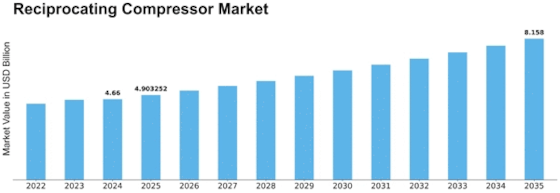
Reciprocating Compressor Market Size Graph
Author
Anshula Mandaokar
Team Lead - Research

Anshula Mandaokar holds an academic degree in Chemical Engineering and has been contributing to the field for more than 5 years. She has expertise in Market Research and Business Consulting and serves as a Team Lead for a reputed Market Research firm under the Chemicals and Materials domain spectrum. She has worked on multiple projects, generating explicit results in a quick turnaround time. Her understanding of data interpretation justifies her role as a leader.

Leave a Comment

FAQs

What is the projected market valuation of the Reciprocating Compressor Market by 2035?

The Reciprocating Compressor Market is projected to reach a valuation of 8.158 USD Billion by 2035.

What was the market valuation of the Reciprocating Compressor Market in 2024?

In 2024, the market valuation of the Reciprocating Compressor Market was 4.66 USD Billion.

What is the expected CAGR for the Reciprocating Compressor Market during the forecast period 2025 - 2035?

The expected CAGR for the Reciprocating Compressor Market during the forecast period 2025 - 2035 is 5.22%.

Which companies are considered key players in the Reciprocating Compressor Market?

Key players in the Reciprocating Compressor Market include Cameron International, Atlas Copco, Ingersoll Rand, and Gardner Denver.

What are the projected revenues for the Portable and Stationary segments by 2035?

By 2035, the Portable segment is projected to generate revenues of 2.4 USD Billion, while the Stationary segment is expected to reach 5.76 USD Billion.

How do the Oil-Free and Oil Filled lubrication segments compare in terms of projected revenue by 2035?

The Oil-Free lubrication segment is projected to reach 2.5 USD Billion, whereas the Oil Filled segment is expected to generate 5.66 USD Billion by 2035.

Market Summary

As per Market Research Future analysis, the Reciprocating Compressor Market Size was estimated at 4.66 USD Billion in 2024. The Reciprocating Compressor industry is projected to grow from 4.903 USD Billion in 2025 to 8.158 USD Billion by 2035, exhibiting a compound annual growth rate (CAGR) of 5.22% during the forecast period 2025 - 2035.

Key Market Trends & Highlights

The Reciprocating Compressor Market is poised for growth driven by technological advancements and increasing demand across various sectors.

  • Technological advancements are enhancing the efficiency and performance of reciprocating compressors, particularly in North America. Customization and flexibility in design are becoming essential to meet diverse industrial needs, especially in the Asia-Pacific region. Sustainability focus is driving the adoption of oil-free compressors, which are currently the largest segment in the market. Rising demand in the oil and gas sector, along with growth in refrigeration and air conditioning, are key drivers propelling market expansion.

Market Size & Forecast

2024 Market Size 4.66 (USD Billion)
2035 Market Size 8.158 (USD Billion)
CAGR (2025 - 2035) 5.22%
Largest Regional Market Share in 2024 Asia Pacific

Major Players

<p>Cameron International (US), <a href="https://www.atlascopco.com/en-ae/compressors/reciprocating-compressors">Atlas Copco</a> (SE), Ingersoll Rand (US), Gardner Denver (US), Siemens (DE), Emerson Electric (US), Boge Compressors (DE), Kobelco Compressors (JP), <a href="https://america.sullair.com/en/oem/hitachi-oil-free-reciprocating-compressor">Sullair</a> (US)</p>

Market Trends

The Reciprocating Compressor Market is currently experiencing a dynamic phase characterized by evolving technological advancements and increasing demand across various sectors. Industries such as oil and gas, refrigeration, and manufacturing are driving the need for efficient and reliable compression solutions. The emphasis on energy efficiency and sustainability is prompting manufacturers to innovate, leading to the development of advanced compressor designs that optimize performance while minimizing environmental impact. Furthermore, the growing trend towards automation and smart technologies is influencing the market, as companies seek to enhance operational efficiency and reduce downtime through predictive maintenance and real-time monitoring. In addition to technological innovations, the Reciprocating Compressor Market is witnessing a shift in consumer preferences towards customized solutions tailored to specific applications. This trend indicates a move away from one-size-fits-all products, as businesses increasingly require compressors that meet their unique operational needs. Moreover, the expansion of emerging economies is contributing to the market's growth, as industrialization and urbanization create new opportunities for compressor applications. Overall, the Reciprocating Compressor Market appears poised for continued evolution, driven by a combination of technological advancements, changing consumer demands, and global economic factors.

Technological Advancements

The Reciprocating Compressor Market is seeing rapid technological advancements that enhance efficiency and performance. Innovations in materials and design are leading to compressors that operate at higher pressures and temperatures, thereby improving overall productivity. Additionally, the integration of smart technologies allows for better monitoring and control, which can lead to reduced operational costs.

Customization and Flexibility

There is a noticeable trend towards customization within the Reciprocating Compressor Market. Companies are increasingly seeking tailored solutions that cater to specific operational requirements. This shift reflects a broader demand for flexibility, as businesses aim to optimize their processes and improve efficiency through specialized compressor designs.

Sustainability Focus

Sustainability is becoming a central theme in the Reciprocating Compressor Market. Manufacturers are prioritizing eco-friendly practices and energy-efficient designs to meet regulatory standards and consumer expectations. This focus on sustainability not only addresses environmental concerns but also enhances the market's appeal to a growing segment of environmentally conscious consumers.

Reciprocating Compressor Market Market Drivers

Rising Demand in Oil and Gas Sector

The oil and gas sector continues to exhibit a robust demand for reciprocating compressors, primarily due to their efficiency in handling high-pressure applications. As exploration and production activities expand, the need for reliable compression solutions becomes paramount. In 2025, the reciprocating compressor market is projected to witness a growth rate of approximately 5.2%, driven by the increasing investments in upstream oil and gas projects. This trend indicates a sustained reliance on reciprocating compressors for gas processing and transportation, thereby solidifying their role in the energy sector.

Emerging Applications in Renewable Energy

The reciprocating compressor market is witnessing emerging applications in the renewable energy sector, particularly in hydrogen production and storage. As the world shifts towards sustainable energy solutions, the demand for efficient compression technologies is likely to rise. In 2025, the market may experience a growth rate of approximately 6% due to the increasing focus on hydrogen as a clean energy carrier. This trend suggests that reciprocating compressors will play a vital role in facilitating the transition to renewable energy sources, thereby expanding their application scope.

Regulatory Compliance and Safety Standards

The increasing emphasis on regulatory compliance and safety standards is influencing the reciprocating compressor market. Industries are required to adhere to stringent safety regulations, which necessitate the use of reliable and efficient compression systems. In 2025, the market is expected to grow as companies invest in advanced reciprocating compressors that meet these regulatory requirements. This trend indicates a shift towards higher quality and safer equipment, as businesses prioritize compliance to avoid penalties and ensure operational safety. Consequently, the demand for reciprocating compressors that align with these standards is likely to rise.

Growth in Refrigeration and Air Conditioning

The refrigeration and air conditioning sectors are experiencing notable growth, which significantly impacts the reciprocating compressor market. With rising temperatures and changing climate patterns, the demand for efficient cooling systems is escalating. In 2025, the market for reciprocating compressors in these applications is expected to grow by around 4.8%. This growth is attributed to the increasing adoption of energy-efficient technologies and the need for reliable cooling solutions in both residential and commercial settings. Consequently, reciprocating compressors are becoming integral to modern refrigeration systems.

Industrial Automation and Process Optimization

The trend towards industrial automation and process optimization is reshaping the reciprocating compressor market. Industries are increasingly adopting automated systems to enhance operational efficiency and reduce costs. In 2025, the market is likely to see a surge in demand for reciprocating compressors that can integrate seamlessly with automated processes. This shift is driven by the need for precise control over compression processes, which reciprocating compressors can provide. As industries seek to optimize their operations, the role of these compressors in maintaining efficiency and reliability becomes increasingly critical.

Market Segment Insights

Reciprocating Compressor Market Type Insights

<p>The Reciprocating Compressor Market segmentation, based on type, includes Portable and Stationary. The stationary segment dominated the market, accounting for the largest market revenue. Stationary reciprocating air compressors are utilized in air conditioners, refrigerators, automotive, and automotive, and are also used in industries in manufacturing facilities, workshops, <a href="https://www.marketresearchfuture.com/reports/energy-efficient-warehouse-lighting-system-market-35076">warehouses</a>, etc. The rising demand for air conditioners and refrigerators owing to the growing middle class and rising per capita income is likely to fuel the industry's growth.</p>

Reciprocating Compressor Market Lubrication Insights

<p>The Reciprocating Compressor Market segmentation, based on lubrication, includes Oil-Free and Oil Filled. The oil-free category dominates the market due to the rapidly growing healthcare sector that requires clean and uncontaminated air requirements. The air released from the compressors should not consist of any contaminants or foreign particles that are critical for various operations in healthcare-related sectors. The Oil-free types offer various industries to perform more cost-efficient activities, and these compressors are also used in home appliance, electronic, and food &amp; beverage industries.</p>

<p>Figure 1: Reciprocating Compressor Market, by Lubrication, 2024 &amp; 2032 (USD Billion)</p>

<p>Source: Primary Research, Secondary Research, Market Research Future Database, and Analyst Review</p>

Get more detailed insights about Reciprocating Compressor Market Research Report - Global Forecast till 2035

Regional Insights

North America : Innovation and Demand Surge

The North American reciprocating compressor market is driven by increasing industrial activities and stringent environmental regulations. The U.S. holds the largest market share at approximately 60%, followed by Canada at around 20%. The demand for energy-efficient compressors is rising, supported by government incentives for sustainable practices. Regulatory frameworks are pushing industries to adopt advanced technologies, enhancing market growth. Leading the market are key players like Ingersoll Rand and Cameron International, which dominate with innovative solutions. The competitive landscape is characterized by a mix of established companies and emerging players, focusing on technological advancements and customer-centric solutions. The presence of major manufacturers ensures a robust supply chain, catering to diverse industrial needs.

Europe : Sustainability and Innovation Focus

Europe's reciprocating compressor market is witnessing significant growth, driven by the push for sustainability and energy efficiency. Germany and the UK are the largest markets, holding approximately 35% and 25% market shares, respectively. Regulatory initiatives, such as the European Green Deal, are catalyzing the adoption of eco-friendly technologies, enhancing market dynamics. The demand for compressors in renewable energy sectors is also on the rise, further boosting growth. Key players like Siemens and Boge Compressors are at the forefront, leveraging innovation to meet regulatory standards. The competitive landscape is marked by collaborations and partnerships aimed at developing advanced compressor technologies. Countries like France and Italy are also emerging as significant players, contributing to a diverse and competitive market environment.

Asia-Pacific : Rapid Industrialization and Growth

The Asia-Pacific region is experiencing rapid growth in the reciprocating compressor market, driven by industrialization and urbanization. China and India are the largest markets, accounting for approximately 40% and 25% of the market share, respectively. The increasing demand for energy-efficient solutions and government initiatives to boost manufacturing are key growth drivers. Regulatory support for infrastructure development is also enhancing market prospects. The competitive landscape features major players like Kobelco Compressors and Atlas Copco, focusing on innovation and customer satisfaction. The presence of a large number of manufacturers in countries like Japan and South Korea fosters a competitive environment, encouraging technological advancements. The region's diverse industrial base further supports the demand for reciprocating compressors across various sectors.

Middle East and Africa : Emerging Markets and Opportunities

The Middle East and Africa region is witnessing a gradual increase in the reciprocating compressor market, driven by industrial growth and energy sector investments. The UAE and South Africa are the leading markets, holding approximately 30% and 20% market shares, respectively. The region's focus on diversifying economies and enhancing industrial capabilities is fostering demand for advanced compressor technologies. Regulatory frameworks are evolving to support sustainable practices, further driving market growth. Key players like Sullair and Emerson Electric are establishing a strong presence, focusing on innovative solutions tailored to regional needs. The competitive landscape is characterized by a mix of local and international companies, enhancing market dynamics. Countries like Nigeria and Saudi Arabia are also emerging as significant players, contributing to the region's growth potential.

Key Players and Competitive Insights

The Reciprocating Compressor Market is currently characterized by a dynamic competitive landscape, driven by technological advancements, increasing demand for energy-efficient solutions, and a growing emphasis on sustainability. Major players such as Cameron International (US), Atlas Copco (SE), and Ingersoll Rand (US) are strategically positioned to leverage these trends. Cameron International (US) focuses on innovation in compressor technology, particularly in the oil and gas sector, while Atlas Copco (SE) emphasizes digital transformation and smart manufacturing processes. Ingersoll Rand (US) is actively pursuing regional expansion and partnerships to enhance its market presence, collectively shaping a competitive environment that is increasingly focused on technological differentiation and customer-centric solutions.

Key business tactics within the market include localizing manufacturing to reduce costs and optimize supply chains, which is particularly relevant in the context of global trade dynamics. The competitive structure of the Reciprocating Compressor Market appears moderately fragmented, with several key players exerting influence over various segments. This fragmentation allows for niche players to thrive, while larger companies consolidate their market share through strategic acquisitions and partnerships.

In August 2025, Cameron International (US) announced a significant investment in a new manufacturing facility aimed at enhancing its production capabilities for high-efficiency compressors. This move is likely to bolster its competitive edge by enabling faster response times to market demands and improving product availability. The strategic importance of this investment lies in its potential to meet the increasing demand for energy-efficient solutions in the oil and gas sector, aligning with global sustainability goals.

In September 2025, Atlas Copco (SE) launched a new line of smart reciprocating compressors equipped with IoT technology, allowing for real-time monitoring and predictive maintenance. This innovation not only enhances operational efficiency but also positions Atlas Copco as a leader in the digital transformation of compressor technology. The introduction of these smart solutions reflects a broader trend towards integrating advanced technologies into traditional manufacturing processes, which could redefine customer expectations in the market.

In July 2025, Ingersoll Rand (US) entered into a strategic partnership with a leading renewable energy firm to develop hybrid compressor systems that utilize both traditional and renewable energy sources. This collaboration underscores Ingersoll Rand's commitment to sustainability and innovation, potentially setting a new standard for energy-efficient compressor solutions. The strategic importance of this partnership lies in its ability to address the growing demand for environmentally friendly technologies in various industrial applications.

As of October 2025, the competitive trends in the Reciprocating Compressor Market are increasingly defined by digitalization, sustainability, and the integration of artificial intelligence. Strategic alliances among key players are shaping the landscape, fostering innovation and enhancing product offerings. Looking ahead, competitive differentiation is likely to evolve from traditional price-based competition towards a focus on technological innovation, reliability in supply chains, and the ability to meet sustainability targets. This shift may redefine market dynamics, compelling companies to invest in R&D and collaborative ventures to maintain their competitive edge.

Key Companies in the Reciprocating Compressor Market market include

Industry Developments

March 2022: Garden Denver launched its new piston compressor offering. The GD70 oil-greased up cylinder blower is anticipated to be used in strain off-stacking mass fluids traveling from solvents to pitches. Its in-line design is a two-cylinder, single-stage compressor with a small surface area, which makes room for additional on-loading and off-loading equipment.

October 2020: Lontra declared that Blade Compressors LLC, a division of Industrial Air Centers headquartered in Jeffersonville, Indiana (USA), had signed an agreement to serve as the National Distributor for Lontra Blade Compressors and future Lontra products and services in North America.

August 2019: MARELLI, a leading automotive supplier, announced that it had formed a partnership with Shanghai Highly Co., Ltd, in China. MARELLI and Johnson Controls-Hitachi Air Conditioning have agreed to an Equity Transfer agreement as a part of the partnership.

Future Outlook

Reciprocating Compressor Market Future Outlook

<p>The Reciprocating Compressor Market is projected to grow at a 5.22% CAGR from 2024 to 2035, driven by industrial expansion, energy efficiency demands, and technological advancements.</p>

New opportunities lie in:

  • <p>Development of energy-efficient compressor models for industrial applications.</p>
  • <p>Expansion into emerging markets with tailored compressor solutions.</p>
  • <p>Integration of IoT technology for predictive maintenance services.</p>

<p>By 2035, the market is expected to achieve robust growth, positioning itself as a leader in energy-efficient solutions.</p>

Market Segmentation

Reciprocating Compressor Market Type Outlook

  • Single Acting
  • Double Acting
  • Diaphragm

Reciprocating Compressor Market End User Outlook

  • Oil & Gas
  • Pharmaceutical
  • Chemical Plants
  • Refrigeration Plants
  • Manufacturing
  • Automotive
  • Others

Reciprocating Compressor Market Stage Type Outlook

  • Single Stage
  • Multi Stage

Reciprocating Compressor Market Lubrication Outlook

  • Oil-Free
  • Oil Filled

Report Scope

MARKET SIZE 2024 4.66(USD Billion)
MARKET SIZE 2025 4.903(USD Billion)
MARKET SIZE 2035 8.158(USD Billion)
COMPOUND ANNUAL GROWTH RATE (CAGR) 5.22% (2024 - 2035)
REPORT COVERAGE Revenue Forecast, Competitive Landscape, Growth Factors, and Trends
BASE YEAR 2024
Market Forecast Period 2025 - 2035
Historical Data 2019 - 2024
Market Forecast Units USD Billion
Key Companies Profiled Market analysis in progress
Segments Covered Market segmentation analysis in progress
Key Market Opportunities Integration of advanced materials enhances efficiency and durability in the Reciprocating Compressor Market.
Key Market Dynamics Technological advancements and regulatory pressures drive innovation and efficiency in the reciprocating compressor market.
Countries Covered North America, Europe, APAC, South America, MEA

FAQs

What is the projected market valuation of the Reciprocating Compressor Market by 2035?

The Reciprocating Compressor Market is projected to reach a valuation of 8.158 USD Billion by 2035.

What was the market valuation of the Reciprocating Compressor Market in 2024?

In 2024, the market valuation of the Reciprocating Compressor Market was 4.66 USD Billion.

What is the expected CAGR for the Reciprocating Compressor Market during the forecast period 2025 - 2035?

The expected CAGR for the Reciprocating Compressor Market during the forecast period 2025 - 2035 is 5.22%.

Which companies are considered key players in the Reciprocating Compressor Market?

Key players in the Reciprocating Compressor Market include Cameron International, Atlas Copco, Ingersoll Rand, and Gardner Denver.

What are the projected revenues for the Portable and Stationary segments by 2035?

By 2035, the Portable segment is projected to generate revenues of 2.4 USD Billion, while the Stationary segment is expected to reach 5.76 USD Billion.

How do the Oil-Free and Oil Filled lubrication segments compare in terms of projected revenue by 2035?

The Oil-Free lubrication segment is projected to reach 2.5 USD Billion, whereas the Oil Filled segment is expected to generate 5.66 USD Billion by 2035.

  1. SECTION I: EXECUTIVE SUMMARY AND KEY HIGHLIGHTS
    1. EXECUTIVE SUMMARY
      1. Market Overview
      2. Key Findings
      3. Market Segmentation
      4. Competitive Landscape
      5. Challenges and Opportunities
      6. Future Outlook 2
  2. SECTION II: SCOPING, METHODOLOGY AND MARKET STRUCTURE
    1. MARKET INTRODUCTION
      1. Definition
      2. Scope of the study
    2. RESEARCH METHODOLOGY
      1. Overview
      2. Data Mining
      3. Secondary Research
      4. Primary Research
      5. Forecasting Model
      6. Market Size Estimation
      7. Data Triangulation
      8. Validation 3
  3. SECTION III: QUALITATIVE ANALYSIS
    1. MARKET DYNAMICS
      1. Overview
      2. Drivers
      3. Restraints
      4. Opportunities
    2. MARKET FACTOR ANALYSIS
      1. Value chain Analysis
      2. Porter's Five Forces Analysis
      3. COVID-19 Impact Analysis
  4. SECTION IV: QUANTITATIVE ANALYSIS
    1. Energy & Power, BY Type (USD Billion)
      1. Single Acting
      2. Double Acting
      3. Diaphragm
    2. Energy & Power, BY Lubrication (USD Billion)
      1. Oil-Free
      2. Oil Filled
    3. Energy & Power, BY Stage Type (USD Billion)
      1. Single Stage
      2. Multi Stage
    4. Energy & Power, BY End User (USD Billion)
      1. Oil & Gas
      2. Pharmaceutical
      3. Chemical Plants
      4. Refrigeration Plants
      5. Manufacturing
      6. Automotive
      7. Others
    5. Energy & Power, BY Region (USD Billion)
      1. North America
      2. Europe
      3. APAC
      4. South America
      5. MEA
  5. SECTION V: COMPETITIVE ANALYSIS
    1. Competitive Landscape
      1. Overview
      2. Competitive Analysis
      3. Market share Analysis
      4. Major Growth Strategy in the Energy & Power
      5. Competitive Benchmarking
      6. Leading Players in Terms of Number of Developments in the Energy & Power
      7. Key developments and growth strategies
      8. Major Players Financial Matrix
    2. Company Profiles
      1. Cameron International (US)
      2. Atlas Copco (SE)
      3. Ingersoll Rand (US)
      4. Gardner Denver (US)
      5. Siemens (DE)
      6. Emerson Electric (US)
      7. Boge Compressors (DE)
      8. Kobelco Compressors (JP)
      9. Sullair (US)
    3. Appendix
      1. References
      2. Related Reports 6 LIST OF FIGURES
    4. MARKET SYNOPSIS
    5. NORTH AMERICA MARKET ANALYSIS
    6. US MARKET ANALYSIS BY TYPE
    7. US MARKET ANALYSIS BY LUBRICATION
    8. US MARKET ANALYSIS BY STAGE TYPE
    9. US MARKET ANALYSIS BY END USER
    10. CANADA MARKET ANALYSIS BY TYPE
    11. CANADA MARKET ANALYSIS BY LUBRICATION
    12. CANADA MARKET ANALYSIS BY STAGE TYPE
    13. CANADA MARKET ANALYSIS BY END USER
    14. EUROPE MARKET ANALYSIS
    15. GERMANY MARKET ANALYSIS BY TYPE
    16. GERMANY MARKET ANALYSIS BY LUBRICATION
    17. GERMANY MARKET ANALYSIS BY STAGE TYPE
    18. GERMANY MARKET ANALYSIS BY END USER
    19. UK MARKET ANALYSIS BY TYPE
    20. UK MARKET ANALYSIS BY LUBRICATION
    21. UK MARKET ANALYSIS BY STAGE TYPE
    22. UK MARKET ANALYSIS BY END USER
    23. FRANCE MARKET ANALYSIS BY TYPE
    24. FRANCE MARKET ANALYSIS BY LUBRICATION
    25. FRANCE MARKET ANALYSIS BY STAGE TYPE
    26. FRANCE MARKET ANALYSIS BY END USER
    27. RUSSIA MARKET ANALYSIS BY TYPE
    28. RUSSIA MARKET ANALYSIS BY LUBRICATION
    29. RUSSIA MARKET ANALYSIS BY STAGE TYPE
    30. RUSSIA MARKET ANALYSIS BY END USER
    31. ITALY MARKET ANALYSIS BY TYPE
    32. ITALY MARKET ANALYSIS BY LUBRICATION
    33. ITALY MARKET ANALYSIS BY STAGE TYPE
    34. ITALY MARKET ANALYSIS BY END USER
    35. SPAIN MARKET ANALYSIS BY TYPE
    36. SPAIN MARKET ANALYSIS BY LUBRICATION
    37. SPAIN MARKET ANALYSIS BY STAGE TYPE
    38. SPAIN MARKET ANALYSIS BY END USER
    39. REST OF EUROPE MARKET ANALYSIS BY TYPE
    40. REST OF EUROPE MARKET ANALYSIS BY LUBRICATION
    41. REST OF EUROPE MARKET ANALYSIS BY STAGE TYPE
    42. REST OF EUROPE MARKET ANALYSIS BY END USER
    43. APAC MARKET ANALYSIS
    44. CHINA MARKET ANALYSIS BY TYPE
    45. CHINA MARKET ANALYSIS BY LUBRICATION
    46. CHINA MARKET ANALYSIS BY STAGE TYPE
    47. CHINA MARKET ANALYSIS BY END USER
    48. INDIA MARKET ANALYSIS BY TYPE
    49. INDIA MARKET ANALYSIS BY LUBRICATION
    50. INDIA MARKET ANALYSIS BY STAGE TYPE
    51. INDIA MARKET ANALYSIS BY END USER
    52. JAPAN MARKET ANALYSIS BY TYPE
    53. JAPAN MARKET ANALYSIS BY LUBRICATION
    54. JAPAN MARKET ANALYSIS BY STAGE TYPE
    55. JAPAN MARKET ANALYSIS BY END USER
    56. SOUTH KOREA MARKET ANALYSIS BY TYPE
    57. SOUTH KOREA MARKET ANALYSIS BY LUBRICATION
    58. SOUTH KOREA MARKET ANALYSIS BY STAGE TYPE
    59. SOUTH KOREA MARKET ANALYSIS BY END USER
    60. MALAYSIA MARKET ANALYSIS BY TYPE
    61. MALAYSIA MARKET ANALYSIS BY LUBRICATION
    62. MALAYSIA MARKET ANALYSIS BY STAGE TYPE
    63. MALAYSIA MARKET ANALYSIS BY END USER
    64. THAILAND MARKET ANALYSIS BY TYPE
    65. THAILAND MARKET ANALYSIS BY LUBRICATION
    66. THAILAND MARKET ANALYSIS BY STAGE TYPE
    67. THAILAND MARKET ANALYSIS BY END USER
    68. INDONESIA MARKET ANALYSIS BY TYPE
    69. INDONESIA MARKET ANALYSIS BY LUBRICATION
    70. INDONESIA MARKET ANALYSIS BY STAGE TYPE
    71. INDONESIA MARKET ANALYSIS BY END USER
    72. REST OF APAC MARKET ANALYSIS BY TYPE
    73. REST OF APAC MARKET ANALYSIS BY LUBRICATION
    74. REST OF APAC MARKET ANALYSIS BY STAGE TYPE
    75. REST OF APAC MARKET ANALYSIS BY END USER
    76. SOUTH AMERICA MARKET ANALYSIS
    77. BRAZIL MARKET ANALYSIS BY TYPE
    78. BRAZIL MARKET ANALYSIS BY LUBRICATION
    79. BRAZIL MARKET ANALYSIS BY STAGE TYPE
    80. BRAZIL MARKET ANALYSIS BY END USER
    81. MEXICO MARKET ANALYSIS BY TYPE
    82. MEXICO MARKET ANALYSIS BY LUBRICATION
    83. MEXICO MARKET ANALYSIS BY STAGE TYPE
    84. MEXICO MARKET ANALYSIS BY END USER
    85. ARGENTINA MARKET ANALYSIS BY TYPE
    86. ARGENTINA MARKET ANALYSIS BY LUBRICATION
    87. ARGENTINA MARKET ANALYSIS BY STAGE TYPE
    88. ARGENTINA MARKET ANALYSIS BY END USER
    89. REST OF SOUTH AMERICA MARKET ANALYSIS BY TYPE
    90. REST OF SOUTH AMERICA MARKET ANALYSIS BY LUBRICATION
    91. REST OF SOUTH AMERICA MARKET ANALYSIS BY STAGE TYPE
    92. REST OF SOUTH AMERICA MARKET ANALYSIS BY END USER
    93. MEA MARKET ANALYSIS
    94. GCC COUNTRIES MARKET ANALYSIS BY TYPE
    95. GCC COUNTRIES MARKET ANALYSIS BY LUBRICATION
    96. GCC COUNTRIES MARKET ANALYSIS BY STAGE TYPE
    97. GCC COUNTRIES MARKET ANALYSIS BY END USER
    98. SOUTH AFRICA MARKET ANALYSIS BY TYPE
    99. SOUTH AFRICA MARKET ANALYSIS BY LUBRICATION
    100. SOUTH AFRICA MARKET ANALYSIS BY STAGE TYPE
    101. SOUTH AFRICA MARKET ANALYSIS BY END USER
    102. REST OF MEA MARKET ANALYSIS BY TYPE
    103. REST OF MEA MARKET ANALYSIS BY LUBRICATION
    104. REST OF MEA MARKET ANALYSIS BY STAGE TYPE
    105. REST OF MEA MARKET ANALYSIS BY END USER
    106. KEY BUYING CRITERIA OF ENERGY & POWER
    107. RESEARCH PROCESS OF MRFR
    108. DRO ANALYSIS OF ENERGY & POWER
    109. DRIVERS IMPACT ANALYSIS: ENERGY & POWER
    110. RESTRAINTS IMPACT ANALYSIS: ENERGY & POWER
    111. SUPPLY / VALUE CHAIN: ENERGY & POWER
    112. ENERGY & POWER, BY TYPE, 2024 (% SHARE)
    113. ENERGY & POWER, BY TYPE, 2024 TO 2035 (USD Billion)
    114. ENERGY & POWER, BY LUBRICATION, 2024 (% SHARE)
    115. ENERGY & POWER, BY LUBRICATION, 2024 TO 2035 (USD Billion)
    116. ENERGY & POWER, BY STAGE TYPE, 2024 (% SHARE)
    117. ENERGY & POWER, BY STAGE TYPE, 2024 TO 2035 (USD Billion)
    118. ENERGY & POWER, BY END USER, 2024 (% SHARE)
    119. ENERGY & POWER, BY END USER, 2024 TO 2035 (USD Billion)
    120. BENCHMARKING OF MAJOR COMPETITORS 7 LIST OF TABLES
    121. LIST OF ASSUMPTIONS
    122. North America MARKET SIZE ESTIMATES; FORECAST
      1. BY TYPE, 2025-2035 (USD Billion)
      2. BY LUBRICATION, 2025-2035 (USD Billion)
      3. BY STAGE TYPE, 2025-2035 (USD Billion)
      4. BY END USER, 2025-2035 (USD Billion)
    123. US MARKET SIZE ESTIMATES; FORECAST
      1. BY TYPE, 2025-2035 (USD Billion)
      2. BY LUBRICATION, 2025-2035 (USD Billion)
      3. BY STAGE TYPE, 2025-2035 (USD Billion)
      4. BY END USER, 2025-2035 (USD Billion)
    124. Canada MARKET SIZE ESTIMATES; FORECAST
      1. BY TYPE, 2025-2035 (USD Billion)
      2. BY LUBRICATION, 2025-2035 (USD Billion)
      3. BY STAGE TYPE, 2025-2035 (USD Billion)
      4. BY END USER, 2025-2035 (USD Billion)
    125. Europe MARKET SIZE ESTIMATES; FORECAST
      1. BY TYPE, 2025-2035 (USD Billion)
      2. BY LUBRICATION, 2025-2035 (USD Billion)
      3. BY STAGE TYPE, 2025-2035 (USD Billion)
      4. BY END USER, 2025-2035 (USD Billion)
    126. Germany MARKET SIZE ESTIMATES; FORECAST
      1. BY TYPE, 2025-2035 (USD Billion)
      2. BY LUBRICATION, 2025-2035 (USD Billion)
      3. BY STAGE TYPE, 2025-2035 (USD Billion)
      4. BY END USER, 2025-2035 (USD Billion)
    127. UK MARKET SIZE ESTIMATES; FORECAST
      1. BY TYPE, 2025-2035 (USD Billion)
      2. BY LUBRICATION, 2025-2035 (USD Billion)
      3. BY STAGE TYPE, 2025-2035 (USD Billion)
      4. BY END USER, 2025-2035 (USD Billion)
    128. France MARKET SIZE ESTIMATES; FORECAST
      1. BY TYPE, 2025-2035 (USD Billion)
      2. BY LUBRICATION, 2025-2035 (USD Billion)
      3. BY STAGE TYPE, 2025-2035 (USD Billion)
      4. BY END USER, 2025-2035 (USD Billion)
    129. Russia MARKET SIZE ESTIMATES; FORECAST
      1. BY TYPE, 2025-2035 (USD Billion)
      2. BY LUBRICATION, 2025-2035 (USD Billion)
      3. BY STAGE TYPE, 2025-2035 (USD Billion)
      4. BY END USER, 2025-2035 (USD Billion)
    130. Italy MARKET SIZE ESTIMATES; FORECAST
      1. BY TYPE, 2025-2035 (USD Billion)
      2. BY LUBRICATION, 2025-2035 (USD Billion)
      3. BY STAGE TYPE, 2025-2035 (USD Billion)
      4. BY END USER, 2025-2035 (USD Billion)
    131. Spain MARKET SIZE ESTIMATES; FORECAST
      1. BY TYPE, 2025-2035 (USD Billion)
      2. BY LUBRICATION, 2025-2035 (USD Billion)
      3. BY STAGE TYPE, 2025-2035 (USD Billion)
      4. BY END USER, 2025-2035 (USD Billion)
    132. Rest of Europe MARKET SIZE ESTIMATES; FORECAST
      1. BY TYPE, 2025-2035 (USD Billion)
      2. BY LUBRICATION, 2025-2035 (USD Billion)
      3. BY STAGE TYPE, 2025-2035 (USD Billion)
      4. BY END USER, 2025-2035 (USD Billion)
    133. APAC MARKET SIZE ESTIMATES; FORECAST
      1. BY TYPE, 2025-2035 (USD Billion)
      2. BY LUBRICATION, 2025-2035 (USD Billion)
      3. BY STAGE TYPE, 2025-2035 (USD Billion)
      4. BY END USER, 2025-2035 (USD Billion)
    134. China MARKET SIZE ESTIMATES; FORECAST
      1. BY TYPE, 2025-2035 (USD Billion)
      2. BY LUBRICATION, 2025-2035 (USD Billion)
      3. BY STAGE TYPE, 2025-2035 (USD Billion)
      4. BY END USER, 2025-2035 (USD Billion)
    135. India MARKET SIZE ESTIMATES; FORECAST
      1. BY TYPE, 2025-2035 (USD Billion)
      2. BY LUBRICATION, 2025-2035 (USD Billion)
      3. BY STAGE TYPE, 2025-2035 (USD Billion)
      4. BY END USER, 2025-2035 (USD Billion)
    136. Japan MARKET SIZE ESTIMATES; FORECAST
      1. BY TYPE, 2025-2035 (USD Billion)
      2. BY LUBRICATION, 2025-2035 (USD Billion)
      3. BY STAGE TYPE, 2025-2035 (USD Billion)
      4. BY END USER, 2025-2035 (USD Billion)
    137. South Korea MARKET SIZE ESTIMATES; FORECAST
      1. BY TYPE, 2025-2035 (USD Billion)
      2. BY LUBRICATION, 2025-2035 (USD Billion)
      3. BY STAGE TYPE, 2025-2035 (USD Billion)
      4. BY END USER, 2025-2035 (USD Billion)
    138. Malaysia MARKET SIZE ESTIMATES; FORECAST
      1. BY TYPE, 2025-2035 (USD Billion)
      2. BY LUBRICATION, 2025-2035 (USD Billion)
      3. BY STAGE TYPE, 2025-2035 (USD Billion)
      4. BY END USER, 2025-2035 (USD Billion)
    139. Thailand MARKET SIZE ESTIMATES; FORECAST
      1. BY TYPE, 2025-2035 (USD Billion)
      2. BY LUBRICATION, 2025-2035 (USD Billion)
      3. BY STAGE TYPE, 2025-2035 (USD Billion)
      4. BY END USER, 2025-2035 (USD Billion)
    140. Indonesia MARKET SIZE ESTIMATES; FORECAST
      1. BY TYPE, 2025-2035 (USD Billion)
      2. BY LUBRICATION, 2025-2035 (USD Billion)
      3. BY STAGE TYPE, 2025-2035 (USD Billion)
      4. BY END USER, 2025-2035 (USD Billion)
    141. Rest of APAC MARKET SIZE ESTIMATES; FORECAST
      1. BY TYPE, 2025-2035 (USD Billion)
      2. BY LUBRICATION, 2025-2035 (USD Billion)
      3. BY STAGE TYPE, 2025-2035 (USD Billion)
      4. BY END USER, 2025-2035 (USD Billion)
    142. South America MARKET SIZE ESTIMATES; FORECAST
      1. BY TYPE, 2025-2035 (USD Billion)
      2. BY LUBRICATION, 2025-2035 (USD Billion)
      3. BY STAGE TYPE, 2025-2035 (USD Billion)
      4. BY END USER, 2025-2035 (USD Billion)
    143. Brazil MARKET SIZE ESTIMATES; FORECAST
      1. BY TYPE, 2025-2035 (USD Billion)
      2. BY LUBRICATION, 2025-2035 (USD Billion)
      3. BY STAGE TYPE, 2025-2035 (USD Billion)
      4. BY END USER, 2025-2035 (USD Billion)
    144. Mexico MARKET SIZE ESTIMATES; FORECAST
      1. BY TYPE, 2025-2035 (USD Billion)
      2. BY LUBRICATION, 2025-2035 (USD Billion)
      3. BY STAGE TYPE, 2025-2035 (USD Billion)
      4. BY END USER, 2025-2035 (USD Billion)
    145. Argentina MARKET SIZE ESTIMATES; FORECAST
      1. BY TYPE, 2025-2035 (USD Billion)
      2. BY LUBRICATION, 2025-2035 (USD Billion)
      3. BY STAGE TYPE, 2025-2035 (USD Billion)
      4. BY END USER, 2025-2035 (USD Billion)
    146. Rest of South America MARKET SIZE ESTIMATES; FORECAST
      1. BY TYPE, 2025-2035 (USD Billion)
      2. BY LUBRICATION, 2025-2035 (USD Billion)
      3. BY STAGE TYPE, 2025-2035 (USD Billion)
      4. BY END USER, 2025-2035 (USD Billion)
    147. MEA MARKET SIZE ESTIMATES; FORECAST
      1. BY TYPE, 2025-2035 (USD Billion)
      2. BY LUBRICATION, 2025-2035 (USD Billion)
      3. BY STAGE TYPE, 2025-2035 (USD Billion)
      4. BY END USER, 2025-2035 (USD Billion)
    148. GCC Countries MARKET SIZE ESTIMATES; FORECAST
      1. BY TYPE, 2025-2035 (USD Billion)
      2. BY LUBRICATION, 2025-2035 (USD Billion)
      3. BY STAGE TYPE, 2025-2035 (USD Billion)
      4. BY END USER, 2025-2035 (USD Billion)
    149. South Africa MARKET SIZE ESTIMATES; FORECAST
      1. BY TYPE, 2025-2035 (USD Billion)
      2. BY LUBRICATION, 2025-2035 (USD Billion)
      3. BY STAGE TYPE, 2025-2035 (USD Billion)
      4. BY END USER, 2025-2035 (USD Billion)
    150. Rest of MEA MARKET SIZE ESTIMATES; FORECAST
      1. BY TYPE, 2025-2035 (USD Billion)
      2. BY LUBRICATION, 2025-2035 (USD Billion)
      3. BY STAGE TYPE, 2025-2035 (USD Billion)
      4. BY END USER, 2025-2035 (USD Billion)
    151. PRODUCT LAUNCH/PRODUCT DEVELOPMENT/APPROVAL
    152. ACQUISITION/PARTNERSHIP

Reciprocating Compressor Market Segmentation

Reciprocating Compressor Type Outlook (USD Billion, 2018-2032)

Portable

Stationary

Reciprocating Compressor Lubrication Outlook (USD Billion, 2018-2032)

Oil-Free

Oil Filled

Reciprocating Compressor Regional Outlook (USD Billion, 2018-2032)

North America Outlook (USD Billion, 2018-2032)

North America Reciprocating Compressors by Type

Portable

Stationary

North America Reciprocating Compressor by Lubrication

Oil-Free

Oil Filled

US Outlook (USD Billion, 2018-2032)

US Reciprocating Compressors by Type

Portable

Stationary

US Reciprocating Compressor by Lubrication

Oil-Free

Oil Filled

CANADA Outlook (USD Billion, 2018-2032)

CANADA Reciprocating Compressors by Type

Portable

Stationary

CANADA Reciprocating Compressor by Lubrication

Oil-Free

Oil Filled

Europe Outlook (USD Billion, 2018-2032)

Europe Reciprocating Compressors by Type

Portable

Stationary

Europe Reciprocating Compressor by Lubrication

Oil-Free

Oil Filled

Germany Outlook (USD Billion, 2018-2032)

Germany Reciprocating Compressors by Type

Portable

Stationary

Germany Reciprocating Compressor by Lubrication

Oil-Free

Oil Filled

France Outlook (USD Billion, 2018-2032)

France Reciprocating Compressors by Type

Portable

Stationary

France Reciprocating Compressor by Lubrication

Oil-Free

Oil Filled

UK Outlook (USD Billion, 2018-2032)

UK Reciprocating Compressors by Type

Portable

Stationary

UK Reciprocating Compressor by Lubrication

Oil-Free

Oil Filled

ITALY Outlook (USD Billion, 2018-2032)

ITALY Reciprocating Compressors by Type

Portable

Stationary

ITALY Reciprocating Compressor by Lubrication

Oil-Free

Oil Filled

SPAIN Outlook (USD Billion, 2018-2032)

Spain Reciprocating Compressors by Type

Portable

Stationary

Spain Reciprocating Compressor by Lubrication

Oil-Free

Oil Filled

Rest Of Europe Outlook (USD Billion, 2018-2032)

Rest Of Europe Reciprocating Compressors by Type

Portable

Stationary

REST OF EUROPE Reciprocating Compressor by Lubrication

Oil-Free

Oil Filled

Asia-Pacific Outlook (USD Billion, 2018-2032)

Asia-Pacific Reciprocating Compressors by Type

Portable

Stationary

Asia-Pacific Reciprocating Compressor by Lubrication

Oil-Free

Oil Filled

China Outlook (USD Billion, 2018-2032)

China Reciprocating Compressors by Type

Portable

Stationary

China Reciprocating Compressor by Lubrication

Oil-Free

Oil Filled

Japan Outlook (USD Billion, 2018-2032)

Japan Reciprocating Compressors by Type

Portable

Stationary

Japan Reciprocating Compressor by Lubrication

Oil-Free

Oil Filled

India Outlook (USD Billion, 2018-2032)

India Reciprocating Compressors by Type

Portable

Stationary

India Reciprocating Compressor by Lubrication

Oil-Free

Oil Filled

Australia Outlook (USD Billion, 2018-2032)

Australia Reciprocating Compressors by Type

Portable

Stationary

Australia Reciprocating Compressor by Lubrication

Oil-Free

Oil Filled

Rest of Asia-Pacific Outlook (USD Billion, 2018-2032)

Rest of Asia-Pacific Reciprocating Compressors by Type

Portable

Stationary

Rest of Asia-Pacific Reciprocating Compressor by Lubrication

Oil-Free

Oil Filled

Rest of the World Outlook (USD Billion, 2018-2032)

Rest of the World Reciprocating Compressors by Type

Portable

Stationary

Rest of the World Reciprocating Compressor by Lubrication

Oil-Free

Oil Filled

Middle East Outlook (USD Billion, 2018-2032)

Middle East Reciprocating Compressors by Type

Portable

Stationary

Middle East Reciprocating Compressor by Lubrication

Oil-Free

Oil Filled

Africa Outlook (USD Billion, 2018-2032)

Africa Reciprocating Compressors by Type

Portable

Stationary

Africa Reciprocating Compressor by Lubrication

Oil-Free

Oil Filled

Latin America Outlook (USD Billion, 2018-2032)

Latin America Reciprocating Compressors by Type

Portable

Stationary

Latin America Reciprocating Compressor by Lubrication

Oil-Free

Oil Filled

Infographic

Free Sample Request

Kindly complete the form below to receive a free sample of this Report

Get Free Sample

Customer Strories

Compare Licence

×
Features License Type
Single User Multiuser License Enterprise User
Price $4,950 $5,950 $7,250
Maximum User Access Limit 1 User Upto 10 Users Unrestricted Access Throughout the Organization
Free Customization
Direct Access to Analyst
Deliverable Format
Platform Access
Discount on Next Purchase 10% 15% 15%
Printable Versions