×
Hero Background
English
Chinese
French
Japanese
Korean
German
Spanish

Real Time Health Monitoring Devices Market Size

ID: MRFR/MED/2422-CR
120 Pages
Kinjoll Dey
July 2019

Real Time Health Monitoring Devices Market Research Report Information By Type (Wearable Devices and Connected Home Health Medical Devices), By End User (Hospitals, Clinics, Ambulatory Centers And Homecare Settings) And By Region (North America, Europe, Asia-Pacific, And Rest Of The World) –Market Forecast Till 2035

Share:
Download PDF ×

We do not share your information with anyone. However, we may send you emails based on your report interest from time to time. You may contact us at any time to opt-out.

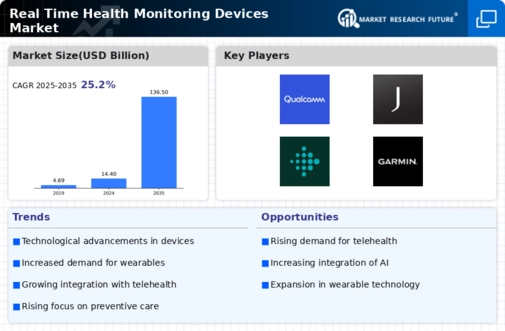
Real Time Health Monitoring Devices Market Infographic
Purchase Options

Real Time Health Monitoring Devices Size

Real Time Health Monitoring Devices Market Growth Projections and Opportunities

The market for devices that monitor our health in real time is growing quickly. These devices come in different types, and one of the most popular ones is wearable devices. In 2015, wearable devices, like fitness bands and smart clothing, made up the largest part of this market. The value of this market was $16,192.9 million in 2015, and it's predicted to reach a whopping $39,794.6 million by 2022.

Among wearable devices, fitness bands were the leaders in 2015, making up the biggest share of the market. Their value was $5,972.9 million in 2015, and it's expected to climb to $14,900.9 million by 2022. Another rapidly growing category in this market is smart clothing, which is predicted to increase by 14.39% every year from 2016 to 2022.

The home health medical devices segment is also making significant strides in real-time health monitoring. This category is the fastest growing, with a Compound Annual Growth Rate (CAGR) of 14.75% expected between 2016 and 2022. In this segment, connected devices used at home are becoming increasingly popular.

Glucometers, which monitor blood sugar levels, held the largest share of the connected home health medical devices market in 2015. The value of this segment was $4,796.3 million in 2015, and it's projected to reach $12,493.8 million. The fastest-growing category in this segment is pulse oximeters, devices that measure oxygen levels in the blood. This category is anticipated to grow at a CAGR of 15.10% during the forecast period from 2016 to 2022.

These advancements in real-time health monitoring devices are not just about numbers; they represent a shift in how we take care of our health. Wearable devices, such as fitness bands and smart clothing, make it easier for individuals to keep track of their health on a daily basis. Meanwhile, connected home health medical devices, like glucometers and pulse oximeters, bring the convenience of monitoring vital health metrics from the comfort of one's home.

The growing market for these devices indicates a broader trend toward proactive health management. People are increasingly recognizing the importance of staying informed about their health in real time, and these devices provide the tools to do so conveniently. As technology continues to advance, we can expect even more innovative and user-friendly devices that empower individuals to take control of their health.
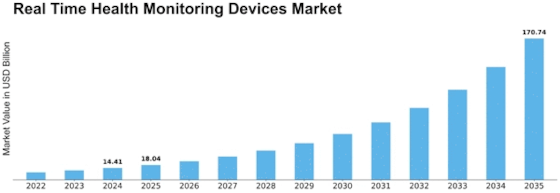
Real Time Health Monitoring Devices Market Size Graph
Author
Kinjoll Dey
Research Analyst Level I

He is an extremely curious individual currently working in Healthcare and Medical Devices Domain. Kinjoll is comfortably versed in data centric research backed by healthcare educational background. He leverages extensive data mining and analytics tools such as Primary and Secondary Research, Statistical Analysis, Machine Learning, Data Modelling. His key role also involves Technical Sales Support, Client Interaction and Project management within the Healthcare team. Lastly, he showcases extensive affinity towards learning new skills and remain fascinated in implementing them.

Leave a Comment

FAQs

What is the projected market valuation for the Real Time Health Monitoring Devices Market in 2035?

The projected market valuation for the Real Time Health Monitoring Devices Market in 2035 is 170.74 USD Billion.

What was the market valuation for Real Time Health Monitoring Devices in 2024?

The market valuation for Real Time Health Monitoring Devices in 2024 was 14.41 USD Billion.

What is the expected CAGR for the Real Time Health Monitoring Devices Market from 2025 to 2035?

The expected CAGR for the Real Time Health Monitoring Devices Market during the forecast period 2025 - 2035 is 25.2%.

Which segment of Real Time Health Monitoring Devices had the highest valuation in 2024?

In 2024, the Wearable Devices segment had the highest valuation at 100.0 USD Billion.

What are the key end-user segments for Real Time Health Monitoring Devices?

The key end-user segments include Hospitals, Clinics, Ambulatory Centers, and Homecare Settings.

Which company is a leading player in the Real Time Health Monitoring Devices Market?

Apple Inc. is one of the leading players in the Real Time Health Monitoring Devices Market.

Market Summary

As per MRFR analysis, the Real Time Health Monitoring Devices Market was estimated at 14.41 USD Billion in 2024. The Real Time Health Monitoring Devices industry is projected to grow from 18.04 USD Billion in 2025 to 170.74 USD Billion by 2035, exhibiting a compound annual growth rate (CAGR) of 25.2 during the forecast period 2025 - 2035.

Key Market Trends & Highlights

The Real Time Health Monitoring Devices Market is experiencing robust growth driven by technological advancements and increasing consumer demand for personalized health solutions.

  • North America remains the largest market for real time health monitoring devices, driven by high healthcare expenditure and advanced technology adoption. The Asia-Pacific region is emerging as the fastest-growing market, fueled by a rising population and increasing health awareness. Wearable devices dominate the market, while connected home health medical devices are witnessing rapid growth due to their convenience and accessibility. Key market drivers include the rising prevalence of chronic diseases and the growing aging population, which necessitate continuous health monitoring.

Market Size & Forecast

2024 Market Size 14.41 (USD Billion)
2035 Market Size 170.74 (USD Billion)
CAGR (2025 - 2035) 25.2%
Largest Regional Market Share in 2024 North America

Major Players

<p>Apple Inc. (US), Samsung Electronics (KR), Philips Healthcare (NL), <a href="https://www.medtronic.com/en-us/healthcare-professionals/products.html">Medtronic </a>(US), Abbott Laboratories (US), Fitbit LLC (US), Garmin Ltd. (US), Omron Healthcare (JP), Honeywell International Inc. (US)</p>

Market Trends

The Real Time Health Monitoring Devices Market is currently experiencing a notable transformation, driven by advancements in technology and an increasing emphasis on personalized healthcare. The integration of artificial intelligence and machine learning into these devices enhances their capabilities, allowing for more accurate and timely health assessments. This shift towards real-time data collection and analysis empowers both healthcare providers and patients, fostering a proactive approach to health management. Furthermore, the growing prevalence of chronic diseases necessitates continuous monitoring, which these devices effectively facilitate. As a result, the market is poised for substantial growth, reflecting a broader trend towards digital health solutions. In addition, the rising awareness of health and wellness among consumers is propelling demand for wearable devices that monitor vital signs and other health metrics. This trend is further supported by the increasing adoption of telehealth services, which rely on real-time data to inform clinical decisions. The convergence of these factors suggests a robust future for the Real Time Health Monitoring Devices Market, as stakeholders seek innovative solutions to enhance patient outcomes and streamline healthcare delivery.

Technological Advancements

The Real Time Health Monitoring Devices Market is witnessing rapid technological innovations, particularly in sensor technology and data analytics. These advancements enable devices to provide more precise and comprehensive health information, enhancing user experience and engagement.

Consumer Demand for Personalization

There is a growing trend towards personalized health monitoring solutions, as consumers increasingly seek devices tailored to their specific health needs. This shift is driving manufacturers to develop customizable features that cater to individual preferences.

Integration with Telehealth Services

The integration of real-time monitoring devices with telehealth platforms is becoming more prevalent. This synergy allows for seamless communication between patients and healthcare providers, facilitating timely interventions and improving overall care.

Real Time Health Monitoring Devices Market Market Drivers

Growing Aging Population

The demographic shift towards an aging population is a crucial factor propelling the Real Time Health Monitoring Devices Market. As individuals age, they often experience a higher prevalence of health issues that necessitate continuous monitoring. The World Health Organization projects that the number of people aged 60 years and older will double from 12% to 22% of the global population by 2050. This demographic trend creates a substantial market opportunity for health monitoring devices tailored to the needs of older adults. The Real Time Health Monitoring Devices Market is likely to expand as healthcare providers and families seek solutions that enhance the quality of life for seniors, enabling them to live independently while ensuring their health is closely monitored.

Rising Prevalence of Chronic Diseases

The increasing incidence of chronic diseases such as diabetes, cardiovascular disorders, and respiratory conditions is a primary driver for the Real Time Health Monitoring Devices Market. As healthcare systems strive to manage these conditions effectively, the demand for real-time monitoring solutions has surged. According to recent data, chronic diseases account for approximately 70% of all deaths worldwide, highlighting the urgent need for continuous health monitoring. This trend is likely to propel the market forward, as patients and healthcare providers seek innovative devices that facilitate timely interventions and improve patient outcomes. The Real Time Health Monitoring Devices Market is thus positioned to benefit from this growing focus on chronic disease management, as stakeholders recognize the value of proactive health monitoring.

Increased Focus on Preventive Healthcare

There is a notable shift towards preventive healthcare, which is significantly impacting the Real Time Health Monitoring Devices Market. As awareness of the importance of early detection and prevention of health issues grows, consumers are increasingly seeking devices that provide real-time health data. This trend is supported by various health initiatives aimed at reducing healthcare costs and improving population health outcomes. The market for preventive health technologies is expected to grow, with estimates indicating a potential increase in investment in health monitoring solutions. Consequently, the Real Time Health Monitoring Devices Market stands to benefit from this proactive approach to health management, as individuals and healthcare systems prioritize prevention over treatment.

Integration with Mobile Health Applications

The integration of real-time health monitoring devices with mobile health applications is transforming the Real Time Health Monitoring Devices Market. This synergy allows users to track their health metrics conveniently and receive personalized insights directly on their smartphones. The proliferation of mobile health applications has created a robust ecosystem that enhances user engagement and adherence to health monitoring protocols. Recent studies suggest that mobile health applications can improve health outcomes by facilitating better communication between patients and healthcare providers. As more consumers adopt smartphones and seek comprehensive health management solutions, the Real Time Health Monitoring Devices Market is likely to experience accelerated growth, driven by this technological convergence.

Technological Innovations in Wearable Devices

Technological advancements in wearable devices are significantly influencing the Real Time Health Monitoring Devices Market. Innovations such as improved sensor technology, enhanced battery life, and advanced data analytics capabilities are making these devices more effective and user-friendly. For instance, the integration of artificial intelligence and machine learning algorithms allows for more accurate health assessments and personalized feedback. The market for wearable health devices is projected to reach substantial figures, with estimates suggesting it could exceed 60 billion dollars by 2026. This growth is indicative of the increasing consumer acceptance and reliance on technology for health management, thereby driving the Real Time Health Monitoring Devices Market forward.

Market Segment Insights

By Type: Wearable Devices (Largest) vs. Connected Home Health Medical Devices (Fastest-Growing)

<p>In the Real Time Health Monitoring Devices Market, wearable devices currently hold the largest share, driven by their widespread adoption and integration into daily health tracking routines. Their popularity stems from advancements in technology, which have led to enhanced features such as heart rate monitoring, fitness tracking, and sleep analysis. On the other hand, connected home health medical devices are making significant inroads, reflecting growing consumer interest in remote health management and telemedicine services, particularly post-pandemic.</p>

<p>Wearable Devices (Dominant) vs. Connected Home Health Medical Devices (Emerging)</p>

<p>Wearable devices represent the dominant segment in the Real Time Health Monitoring Devices Market, characterized by their portability and user-friendly design. They empower users with real-time health data, fostering proactive health management. Conversely, connected home health medical devices are emerging rapidly, driven by innovations in telehealth and increasing consumer demand for convenient health solutions. These devices facilitate remote monitoring and care, making them particularly appealing to an aging <a href="https://www.marketresearchfuture.com/reports/population-health-management-market-3123">population </a>and individuals managing chronic conditions. Their integration with smartphones and other digital platforms enhances user experience and drives market growth.</p>

By End User: Hospitals (Largest) vs. Homecare Settings (Fastest-Growing)

<p>The Real Time Health Monitoring Devices Market is primarily segmented into four key end users: hospitals, clinics, ambulatory centers, and homecare settings. Among these, hospitals hold the largest market share due to their advanced infrastructure and high patient volumes, which necessitate the use of real-time health monitoring devices. Clinics and ambulatory centers are also significant players, albeit with smaller shares, while homecare settings are rapidly gaining traction as healthcare increasingly shifts towards personalized and remote monitoring solutions.</p>

<p>Hospitals (Dominant) vs. Homecare Settings (Emerging)</p>

<p>Hospitals stand as the dominant end user in the Real Time Health Monitoring Devices Market, leveraging extensive budgets for technologically advanced health monitoring systems to enhance patient care and operational efficiency. These facilities utilize real-time monitoring devices for critical care, post-operative recovery, and chronic disease management. On the other hand, homecare settings represent an emerging segment, driven by an increasing preference for at-home healthcare solutions. The growth in this segment is supported by technological advancements in wearable devices and telehealth services, enabling patients to receive quality care from the comfort of their homes while reducing the burden on hospital resources.</p>

Get more detailed insights about Real Time Health Monitoring Devices Market Research Report - Forecast till 2035

Regional Insights

By region, the study provides the market insights into North America, Europe, Asia-Pacific and Rest of the World. The North American Real Time Health Monitoring Devices Market area will dominate this market, owing to the region's robust healthcare infrastructure and high disposable income. The United States and Canada are the major contributors, with an increasing adoption of wearable fitness trackers and smart watches.

Further, the major countries studied in the market report are The US, Canada, German, France, the UK, Italy, Spain, China, Japan, India, Australia, South Korea, and Brazil.

EuropeReal Time Health Monitoring Devices Market accounts for the second-largest market share due to increasing focus on preventive healthcare and fitness among the population. Further, the GermanReal Time Health Monitoring Devices Marketheld the largest market share, and the UK Real Time Health Monitoring Devices Market was the fastest growing market in the European region

The Asia-Pacific Real Time Health Monitoring Devices Market is expected to grow at the fastest CAGR from 2023 to 2032. This is due to rising awareness about health and fitness, coupled with the expanding smart phone penetration, accelerates the market's expansion in the region. Moreover, China’s Real Time Health Monitoring Devices Market held the largest market share, and the Indian Real Time Health Monitoring Devices Market was the fastest growing market in the Asia-Pacific region.

Key Players and Competitive Insights

Leading market players are investing heavily in research and development in order to expand their product lines, which will help the Real Time Health Monitoring Devices Market, grow even more. Market participants are also undertaking a variety of strategic activities to expand their footprint, with important market developments including new product launches, contractual agreements, mergers and acquisitions, higher investments, and collaboration with other organizations. To expand and survive in a more competitive and rising market climate, Real Time Health Monitoring Devicesindustry must offer cost-effective items.

Manufacturing locally to minimize operational costs is one of the key business tactics used by manufacturers in the Real Time Health Monitoring Devices industry to benefit clients and increase the market sector. In recent years, the Real Time Health Monitoring Devicesindustry has offered some of the most significant advantages to medicine. 

Major players in the Real Time Health Monitoring Devices Market, including GE Healthcare (U.K.), Qualcomm (U.S.), Jawbone Inc. (U.S.), Withings SA (France), Fitbit Inc. (U.S.), Garmin Ltd. (Switzerland), and others, are attempting to increase market demand by investing in research and development operations.

Qualcomm is known for developing innovations that push the boundaries of what's possible across devices and networks to enable next-generation experiences and drive digital transformation across industries. Decades of extensive research fuels every one of our extraordinary inventions and our one technology roadmap allows us to efficiently scale our portfolio of industry- leading mobile innovations to support virtually every device connected to the cloud. 

Goldman Sachs predicts that generative Al could raise GDP by almost $7 trillion over a 10-year period. Hybrid Al, which distributes processing between the device and the cloud, is a key part of achieving this growth across the economy. On-device Al processing offers many benefits, including user privacy, security, immediacy, enhanced reliability, and cost. The pace, scale, and high integration that drive the mobile industry are allowing Al to scale to billions of devices. The power-efficient Al technology that we research and develop is fundamental across industries and products, spanning from smart phones, PCs, and XR to loT and automotive.

Jawbone is a 460MW onshore wind power project located in Montana, United States. It is being developed by Gaelectric LLC; Seventus LLC. The project is currently under construction. The project is expected to enter commercial operation in 2023. The project is owned by Gaelectric LLC; Seventus LLC. Jawbone profile includes core details such as plant name, technology, capacity, status, plant proponents (owners, developers, etc.), owner stakes, etc as well as key operational data including generation, year online, decommissioning year, capital expenditure, etc. 

Details on project-specific contacts along with relevant news, deals, and contracts are also provided through the plant profile. This is an on-demand report that will be delivered upon request. The report will be delivered within 1 business day of the purchase, excluding weekends and holidays. Certain sections of the report may be removed or altered based on data availability and relevance.

Key Companies in the Real Time Health Monitoring Devices Market market include

Industry Developments

March 2023: A study published in the journal Nature reported that wearable devices can be used to accurately track sleep apnea. This finding could help to improve the diagnosis and treatment of this sleep disorder . February 2023 :Apple announced that it will be releasing a new generation of Apple Watch with new features, including a built-in ECG sensor and a blood oxygen sensor. March 2021: Garmin acquired Aero Data, a Scottsdale AZ based company that provides aircraft performance software for over 135 airlines worldwide. The company will continue to operate under the Aero Data brand.

Future Outlook

Real Time Health Monitoring Devices Market Future Outlook

<p>The Real Time Health Monitoring Devices Market is projected to grow at a 25.2% CAGR from 2024 to 2035, driven by technological advancements, increasing health awareness, and rising demand for remote patient monitoring.</p>

New opportunities lie in:

  • <p>Integration of AI-driven analytics for predictive health insights.</p><p>Expansion into emerging markets with tailored health solutions.</p><p>Development of subscription-based models for continuous monitoring services.</p>

<p>By 2035, the market is expected to be robust, reflecting substantial growth and innovation.</p>

Market Segmentation

Real Time Health Monitoring Devices Market Type Outlook

  • Wearable Devices
  • Connected Home Health Medical Devices

Real Time Health Monitoring Devices Market End User Outlook

  • Hospitals
  • Clinics
  • Ambulatory Centers
  • Homecare Settings

Report Scope

MARKET SIZE 202414.41(USD Billion)
MARKET SIZE 202518.04(USD Billion)
MARKET SIZE 2035170.74(USD Billion)
COMPOUND ANNUAL GROWTH RATE (CAGR)25.2% (2024 - 2035)
REPORT COVERAGERevenue Forecast, Competitive Landscape, Growth Factors, and Trends
BASE YEAR2024
Market Forecast Period2025 - 2035
Historical Data2019 - 2024
Market Forecast UnitsUSD Billion
Key Companies ProfiledMarket analysis in progress
Segments CoveredMarket segmentation analysis in progress
Key Market OpportunitiesIntegration of artificial intelligence enhances predictive analytics in the Real Time Health Monitoring Devices Market.
Key Market DynamicsTechnological advancements and regulatory changes drive innovation and competition in the Real Time Health Monitoring Devices Market.
Countries CoveredNorth America, Europe, APAC, South America, MEA

FAQs

What is the projected market valuation for the Real Time Health Monitoring Devices Market in 2035?

The projected market valuation for the Real Time Health Monitoring Devices Market in 2035 is 170.74 USD Billion.

What was the market valuation for Real Time Health Monitoring Devices in 2024?

The market valuation for Real Time Health Monitoring Devices in 2024 was 14.41 USD Billion.

What is the expected CAGR for the Real Time Health Monitoring Devices Market from 2025 to 2035?

The expected CAGR for the Real Time Health Monitoring Devices Market during the forecast period 2025 - 2035 is 25.2%.

Which segment of Real Time Health Monitoring Devices had the highest valuation in 2024?

In 2024, the Wearable Devices segment had the highest valuation at 100.0 USD Billion.

What are the key end-user segments for Real Time Health Monitoring Devices?

The key end-user segments include Hospitals, Clinics, Ambulatory Centers, and Homecare Settings.

Which company is a leading player in the Real Time Health Monitoring Devices Market?

Apple Inc. is one of the leading players in the Real Time Health Monitoring Devices Market.

  1. SECTION I: EXECUTIVE SUMMARY AND KEY HIGHLIGHTS
    1. EXECUTIVE SUMMARY
      1. Market Overview
      2. Key Findings
      3. Market Segmentation
      4. Competitive Landscape
      5. Challenges and Opportunities
      6. Future Outlook 2
  2. SECTION II: SCOPING, METHODOLOGY AND MARKET STRUCTURE
    1. MARKET INTRODUCTION
      1. Definition
      2. Scope of the study
    2. RESEARCH METHODOLOGY
      1. Overview
      2. Data Mining
      3. Secondary Research
      4. Primary Research
      5. Forecasting Model
      6. Market Size Estimation
      7. Data Triangulation
      8. Validation 3
  3. SECTION III: QUALITATIVE ANALYSIS
    1. MARKET DYNAMICS
      1. Overview
      2. Drivers
      3. Restraints
      4. Opportunities
    2. MARKET FACTOR ANALYSIS
      1. Value chain Analysis
      2. Porter's Five Forces Analysis
      3. COVID-19 Impact Analysis
  4. SECTION IV: QUANTITATIVE ANALYSIS
    1. Healthcare, BY Type (USD Billion)
      1. Wearable Devices
      2. Connected Home Health Medical Devices
    2. Healthcare, BY End User (USD Billion)
      1. Hospitals
      2. Clinics
      3. Ambulatory Centers
      4. Homecare Settings
    3. Healthcare, BY Region (USD Billion)
      1. North America
      2. Europe
      3. APAC
      4. South America
      5. MEA
  5. SECTION V: COMPETITIVE ANALYSIS
    1. Competitive Landscape
      1. Overview
      2. Competitive Analysis
      3. Market share Analysis
      4. Major Growth Strategy in the Healthcare
      5. Competitive Benchmarking
      6. Leading Players in Terms of Number of Developments in the Healthcare
      7. Key developments and growth strategies
      8. Major Players Financial Matrix
    2. Company Profiles
      1. Apple Inc. (US)
      2. Samsung Electronics (KR)
      3. Philips Healthcare (NL)
      4. Medtronic (US)
      5. Abbott Laboratories (US)
      6. Fitbit LLC (US)
      7. Garmin Ltd. (US)
      8. Omron Healthcare (JP)
      9. Honeywell International Inc. (US)
    3. Appendix
      1. References
      2. Related Reports 6 LIST OF FIGURES
    4. MARKET SYNOPSIS
    5. NORTH AMERICA MARKET ANALYSIS
    6. US MARKET ANALYSIS BY TYPE
    7. US MARKET ANALYSIS BY END USER
    8. CANADA MARKET ANALYSIS BY TYPE
    9. CANADA MARKET ANALYSIS BY END USER
    10. EUROPE MARKET ANALYSIS
    11. GERMANY MARKET ANALYSIS BY TYPE
    12. GERMANY MARKET ANALYSIS BY END USER
    13. UK MARKET ANALYSIS BY TYPE
    14. UK MARKET ANALYSIS BY END USER
    15. FRANCE MARKET ANALYSIS BY TYPE
    16. FRANCE MARKET ANALYSIS BY END USER
    17. RUSSIA MARKET ANALYSIS BY TYPE
    18. RUSSIA MARKET ANALYSIS BY END USER
    19. ITALY MARKET ANALYSIS BY TYPE
    20. ITALY MARKET ANALYSIS BY END USER
    21. SPAIN MARKET ANALYSIS BY TYPE
    22. SPAIN MARKET ANALYSIS BY END USER
    23. REST OF EUROPE MARKET ANALYSIS BY TYPE
    24. REST OF EUROPE MARKET ANALYSIS BY END USER
    25. APAC MARKET ANALYSIS
    26. CHINA MARKET ANALYSIS BY TYPE
    27. CHINA MARKET ANALYSIS BY END USER
    28. INDIA MARKET ANALYSIS BY TYPE
    29. INDIA MARKET ANALYSIS BY END USER
    30. JAPAN MARKET ANALYSIS BY TYPE
    31. JAPAN MARKET ANALYSIS BY END USER
    32. SOUTH KOREA MARKET ANALYSIS BY TYPE
    33. SOUTH KOREA MARKET ANALYSIS BY END USER
    34. MALAYSIA MARKET ANALYSIS BY TYPE
    35. MALAYSIA MARKET ANALYSIS BY END USER
    36. THAILAND MARKET ANALYSIS BY TYPE
    37. THAILAND MARKET ANALYSIS BY END USER
    38. INDONESIA MARKET ANALYSIS BY TYPE
    39. INDONESIA MARKET ANALYSIS BY END USER
    40. REST OF APAC MARKET ANALYSIS BY TYPE
    41. REST OF APAC MARKET ANALYSIS BY END USER
    42. SOUTH AMERICA MARKET ANALYSIS
    43. BRAZIL MARKET ANALYSIS BY TYPE
    44. BRAZIL MARKET ANALYSIS BY END USER
    45. MEXICO MARKET ANALYSIS BY TYPE
    46. MEXICO MARKET ANALYSIS BY END USER
    47. ARGENTINA MARKET ANALYSIS BY TYPE
    48. ARGENTINA MARKET ANALYSIS BY END USER
    49. REST OF SOUTH AMERICA MARKET ANALYSIS BY TYPE
    50. REST OF SOUTH AMERICA MARKET ANALYSIS BY END USER
    51. MEA MARKET ANALYSIS
    52. GCC COUNTRIES MARKET ANALYSIS BY TYPE
    53. GCC COUNTRIES MARKET ANALYSIS BY END USER
    54. SOUTH AFRICA MARKET ANALYSIS BY TYPE
    55. SOUTH AFRICA MARKET ANALYSIS BY END USER
    56. REST OF MEA MARKET ANALYSIS BY TYPE
    57. REST OF MEA MARKET ANALYSIS BY END USER
    58. KEY BUYING CRITERIA OF HEALTHCARE
    59. RESEARCH PROCESS OF MRFR
    60. DRO ANALYSIS OF HEALTHCARE
    61. DRIVERS IMPACT ANALYSIS: HEALTHCARE
    62. RESTRAINTS IMPACT ANALYSIS: HEALTHCARE
    63. SUPPLY / VALUE CHAIN: HEALTHCARE
    64. HEALTHCARE, BY TYPE, 2024 (% SHARE)
    65. HEALTHCARE, BY TYPE, 2024 TO 2035 (USD Billion)
    66. HEALTHCARE, BY END USER, 2024 (% SHARE)
    67. HEALTHCARE, BY END USER, 2024 TO 2035 (USD Billion)
    68. BENCHMARKING OF MAJOR COMPETITORS 7 LIST OF TABLES
    69. LIST OF ASSUMPTIONS
    70. North America MARKET SIZE ESTIMATES; FORECAST
      1. BY TYPE, 2025-2035 (USD Billion)
      2. BY END USER, 2025-2035 (USD Billion)
    71. US MARKET SIZE ESTIMATES; FORECAST
      1. BY TYPE, 2025-2035 (USD Billion)
      2. BY END USER, 2025-2035 (USD Billion)
    72. Canada MARKET SIZE ESTIMATES; FORECAST
      1. BY TYPE, 2025-2035 (USD Billion)
      2. BY END USER, 2025-2035 (USD Billion)
    73. Europe MARKET SIZE ESTIMATES; FORECAST
      1. BY TYPE, 2025-2035 (USD Billion)
      2. BY END USER, 2025-2035 (USD Billion)
    74. Germany MARKET SIZE ESTIMATES; FORECAST
      1. BY TYPE, 2025-2035 (USD Billion)
      2. BY END USER, 2025-2035 (USD Billion)
    75. UK MARKET SIZE ESTIMATES; FORECAST
      1. BY TYPE, 2025-2035 (USD Billion)
      2. BY END USER, 2025-2035 (USD Billion)
    76. France MARKET SIZE ESTIMATES; FORECAST
      1. BY TYPE, 2025-2035 (USD Billion)
      2. BY END USER, 2025-2035 (USD Billion)
    77. Russia MARKET SIZE ESTIMATES; FORECAST
      1. BY TYPE, 2025-2035 (USD Billion)
      2. BY END USER, 2025-2035 (USD Billion)
    78. Italy MARKET SIZE ESTIMATES; FORECAST
      1. BY TYPE, 2025-2035 (USD Billion)
      2. BY END USER, 2025-2035 (USD Billion)
    79. Spain MARKET SIZE ESTIMATES; FORECAST
      1. BY TYPE, 2025-2035 (USD Billion)
      2. BY END USER, 2025-2035 (USD Billion)
    80. Rest of Europe MARKET SIZE ESTIMATES; FORECAST
      1. BY TYPE, 2025-2035 (USD Billion)
      2. BY END USER, 2025-2035 (USD Billion)
    81. APAC MARKET SIZE ESTIMATES; FORECAST
      1. BY TYPE, 2025-2035 (USD Billion)
      2. BY END USER, 2025-2035 (USD Billion)
    82. China MARKET SIZE ESTIMATES; FORECAST
      1. BY TYPE, 2025-2035 (USD Billion)
      2. BY END USER, 2025-2035 (USD Billion)
    83. India MARKET SIZE ESTIMATES; FORECAST
      1. BY TYPE, 2025-2035 (USD Billion)
      2. BY END USER, 2025-2035 (USD Billion)
    84. Japan MARKET SIZE ESTIMATES; FORECAST
      1. BY TYPE, 2025-2035 (USD Billion)
      2. BY END USER, 2025-2035 (USD Billion)
    85. South Korea MARKET SIZE ESTIMATES; FORECAST
      1. BY TYPE, 2025-2035 (USD Billion)
      2. BY END USER, 2025-2035 (USD Billion)
    86. Malaysia MARKET SIZE ESTIMATES; FORECAST
      1. BY TYPE, 2025-2035 (USD Billion)
      2. BY END USER, 2025-2035 (USD Billion)
    87. Thailand MARKET SIZE ESTIMATES; FORECAST
      1. BY TYPE, 2025-2035 (USD Billion)
      2. BY END USER, 2025-2035 (USD Billion)
    88. Indonesia MARKET SIZE ESTIMATES; FORECAST
      1. BY TYPE, 2025-2035 (USD Billion)
      2. BY END USER, 2025-2035 (USD Billion)
    89. Rest of APAC MARKET SIZE ESTIMATES; FORECAST
      1. BY TYPE, 2025-2035 (USD Billion)
      2. BY END USER, 2025-2035 (USD Billion)
    90. South America MARKET SIZE ESTIMATES; FORECAST
      1. BY TYPE, 2025-2035 (USD Billion)
      2. BY END USER, 2025-2035 (USD Billion)
    91. Brazil MARKET SIZE ESTIMATES; FORECAST
      1. BY TYPE, 2025-2035 (USD Billion)
      2. BY END USER, 2025-2035 (USD Billion)
    92. Mexico MARKET SIZE ESTIMATES; FORECAST
      1. BY TYPE, 2025-2035 (USD Billion)
      2. BY END USER, 2025-2035 (USD Billion)
    93. Argentina MARKET SIZE ESTIMATES; FORECAST
      1. BY TYPE, 2025-2035 (USD Billion)
      2. BY END USER, 2025-2035 (USD Billion)
    94. Rest of South America MARKET SIZE ESTIMATES; FORECAST
      1. BY TYPE, 2025-2035 (USD Billion)
      2. BY END USER, 2025-2035 (USD Billion)
    95. MEA MARKET SIZE ESTIMATES; FORECAST
      1. BY TYPE, 2025-2035 (USD Billion)
      2. BY END USER, 2025-2035 (USD Billion)
    96. GCC Countries MARKET SIZE ESTIMATES; FORECAST
      1. BY TYPE, 2025-2035 (USD Billion)
      2. BY END USER, 2025-2035 (USD Billion)
    97. South Africa MARKET SIZE ESTIMATES; FORECAST
      1. BY TYPE, 2025-2035 (USD Billion)
      2. BY END USER, 2025-2035 (USD Billion)
    98. Rest of MEA MARKET SIZE ESTIMATES; FORECAST
      1. BY TYPE, 2025-2035 (USD Billion)
      2. BY END USER, 2025-2035 (USD Billion)
    99. PRODUCT LAUNCH/PRODUCT DEVELOPMENT/APPROVAL
    100. ACQUISITION/PARTNERSHIP

Market Segmentation

Real Time Health Monitoring Devices Market Type Outlook (USD Billion, 2018-2032)

Wearable Devices

Connected Home Health Medical Devices

Real Time Health Monitoring Devices Market End User Outlook (USD Billion, 2018-2032)

Hospitals

Clinics

Ambulatory Centers

Homecare Settings

Real Time Health Monitoring Devices Market Regional Outlook (USD Billion, 2018-2032)

North AmericaOutlook (USD Billion, 2018-2032)

North America Real Time Health Monitoring Devices Market by Type

Wearable Devices

Connected Home Health Medical Devices

North America Real Time Health Monitoring Devices Market by End User

Hospitals

Clinics

Ambulatory Centers

Homecare Settings

US Outlook (USD Billion, 2018-2032)

US Real Time Health Monitoring Devices Market by Type

Wearable Devices

Connected Home Health Medical Devices

US Real Time Health Monitoring Devices Market by End User

Hospitals

Clinics

Ambulatory Centers

Homecare Settings

CANADA Outlook (USD Billion, 2018-2032)

CANADA Real Time Health Monitoring Devices Market by Type

Wearable Devices

Connected Home Health Medical Devices

CANADA Real Time Health Monitoring Devices Market by End User

Hospitals

Clinics

Ambulatory Centers

Homecare Settings

EuropeOutlook (USD Billion, 2018-2032)

Europe Real Time Health Monitoring Devices Market by Type

Wearable Devices

Connected Home Health Medical Devices

Europe Real Time Health Monitoring Devices Market by End User

Hospitals

Clinics

Ambulatory Centers

Homecare Settings

Germany Outlook (USD Billion, 2018-2032)

Germany Real Time Health Monitoring Devices Market by Type

Wearable Devices

Connected Home Health Medical Devices

Germany Real Time Health Monitoring Devices Market by End User

Hospitals

Clinics

Ambulatory Centers

Homecare Settings

France Outlook (USD Billion, 2018-2032)

France Real Time Health Monitoring Devices Market by Type

Wearable Devices

Connected Home Health Medical Devices

France Real Time Health Monitoring Devices Market by End User

Hospitals

Clinics

Ambulatory Centers

Homecare Settings

UK Outlook (USD Billion, 2018-2032)

UK Real Time Health Monitoring Devices Market by Type

Wearable Devices

Connected Home Health Medical Devices

UK Real Time Health Monitoring Devices Market by End User

Hospitals

Clinics

Ambulatory Centers

Homecare Settings

ITALY Outlook (USD Billion, 2018-2032)

ITALY Real Time Health Monitoring Devices Market by Type

Wearable Devices

Connected Home Health Medical Devices

ITALY Real Time Health Monitoring Devices Market by End User

Hospitals

Clinics

Ambulatory Centers

Homecare Settings

SPAIN Outlook (USD Billion, 2018-2032)

SPAIN Real Time Health Monitoring Devices Market by Type

Wearable Devices

Connected Home Health Medical Devices

SPAIN Real Time Health Monitoring Devices Market by End User

Hospitals

Clinics

Ambulatory Centers

Homecare Settings

Rest of Europe Outlook (USD Billion, 2018-2032)

Rest of Europe Real Time Health Monitoring Devices Market by Type

Wearable Devices

Connected Home Health Medical Devices

Rest of Europe Real Time Health Monitoring Devices Market by End User

Hospitals

Clinics

Ambulatory Centers

Homecare Settings

Asia-PacificOutlook (USD Billion, 2018-2032)

Asia-Pacific Real Time Health Monitoring Devices Market by Type

Wearable Devices

Connected Home Health Medical Devices

Asia-Pacific Real Time Health Monitoring Devices Market by End User

Hospitals

Clinics

Ambulatory Centers

Homecare Settings

China Outlook (USD Billion, 2018-2032)

China Real Time Health Monitoring Devices Market by Type

Wearable Devices

Connected Home Health Medical Devices

China Real Time Health Monitoring Devices Market by End User

Hospitals

Clinics

Ambulatory Centers

Homecare Settings

Japan Outlook (USD Billion, 2018-2032)

Japan Real Time Health Monitoring Devices Market by Type

Wearable Devices

Connected Home Health Medical Devices

Japan Real Time Health Monitoring Devices Market by End User

Hospitals

Clinics

Ambulatory Centers

Homecare Settings

India Outlook (USD Billion, 2018-2032)

India Real Time Health Monitoring Devices Market by Type

Wearable Devices

Connected Home Health Medical Devices

India Real Time Health Monitoring Devices Market by End User

Hospitals

Clinics

Ambulatory Centers

Homecare Settings

Australia Outlook (USD Billion, 2018-2032)

Australia Real Time Health Monitoring Devices Market by Type

Wearable Devices

Connected Home Health Medical Devices

Australia Real Time Health Monitoring Devices Market by End User

Hospitals

Clinics

Ambulatory Centers

Homecare Settings

Rest of Asia-Pacific Outlook (USD Billion, 2018-2032)

Rest of Asia-Pacific Real Time Health Monitoring Devices Market by Type

Wearable Devices

Connected Home Health Medical Devices

Rest of Asia-Pacific Real Time Health Monitoring Devices Market by End User

Hospitals

Clinics

Ambulatory Centers

Homecare Settings

Rest of the WorldOutlook (USD Billion, 2018-2032)

Rest of the World Real Time Health Monitoring Devices Market by Type

Wearable Devices

Connected Home Health Medical Devices

Rest of the World Real Time Health Monitoring Devices Market by End User

Hospitals

Clinics

Ambulatory Centers

Homecare Settings

Middle East Outlook (USD Billion, 2018-2032)

Middle East Real Time Health Monitoring Devices Market by Type

Wearable Devices

Connected Home Health Medical Devices

Middle East Real Time Health Monitoring Devices Market by End User

Hospitals

Clinics

Ambulatory Centers

Homecare Settings

Africa Outlook (USD Billion, 2018-2032)

Africa Real Time Health Monitoring Devices Market by Type

Wearable Devices

Connected Home Health Medical Devices

Africa Real Time Health Monitoring Devices Market by End User

Hospitals

Clinics

Ambulatory Centers

Homecare Settings

Latin America Outlook (USD Billion, 2018-2032)

Latin America Real Time Health Monitoring Devices Market by Type

Wearable Devices

Connected Home Health Medical Devices

Latin America Real Time Health Monitoring Devices Market by End User

Hospitals

Clinics

Ambulatory Centers

Homecare Settings

Infographic

Free Sample Request

Kindly complete the form below to receive a free sample of this Report

Get Free Sample

Customer Strories

Compare Licence

×
Features License Type
Single User Multiuser License Enterprise User
Price $4,950 $5,950 $7,250
Maximum User Access Limit 1 User Upto 10 Users Unrestricted Access Throughout the Organization
Free Customization
Direct Access to Analyst
Deliverable Format
Platform Access
Discount on Next Purchase 10% 15% 15%
Printable Versions