×
Hero Background
English
Chinese
French
Japanese
Korean
German
Spanish

Reactive Diluents Market Trends

ID: MRFR/CnM/4555-HCR
100 Pages
Chitranshi Jaiswal
October 2025

Reactive Diluents Market Research Report Information by Type (Aliphatic, Aromatic, and Cycloaliphatic), Application (Paints & Coatings, Polymers & Composites, Adhesives & Sealants, and Others), and Region (Asia-Pacific, North America, Europe, Latin America, and the Middle East & Africa)—Forecast Till 2035

Share:
Download PDF ×

We do not share your information with anyone. However, we may send you emails based on your report interest from time to time. You may contact us at any time to opt-out.

Reactive Diluents Market Infographic
Purchase Options

Market Trends

Key Emerging Trends in the Reactive Diluents Market

The market trends of reactive diluents have witnessed significant developments, reflecting a dynamic landscape driven by diverse factors. Reactive diluents play a crucial role in various industries, particularly in the coatings, adhesives, and composites sectors. One prominent trend shaping the market is the growing demand for eco-friendly and sustainable solutions. As environmental concerns continue to gain prominence, industries are actively seeking reactive diluents that not only enhance performance but also adhere to stringent environmental regulations.

In recent years, there has been a noticeable shift towards water-based formulations, driven by the desire to reduce volatile organic compound (VOC) emissions. This shift is directly impacting the market for reactive diluents, as manufacturers focus on developing waterborne formulations that incorporate these diluents to meet the demand for environmentally friendly products. The market is witnessing a surge in research and development activities to create reactive diluents that offer low toxicity, low VOC content, and improved overall sustainability.

Another key trend in the reactive diluents market is the increasing emphasis on innovation and customization. Industries are seeking tailor-made solutions to meet specific application requirements, driving manufacturers to invest in advanced technologies and formulations. Customized reactive diluents not only enhance the performance of end products but also contribute to cost-effectiveness by optimizing the overall production process. This trend is fostering collaborations between manufacturers and end-users to co-create solutions that address unique challenges in various industries.

Globalization has also played a pivotal role in shaping market trends for reactive diluents. The interconnectedness of markets has led to increased competition, prompting manufacturers to expand their product portfolios and geographical reach. The demand for high-performance reactive diluents is not limited to specific regions, and manufacturers are strategically positioning themselves to cater to a global customer base. This has resulted in the establishment of partnerships, mergers, and acquisitions to strengthen market presence and gain a competitive edge.

Furthermore, the market is witnessing a rise in the adoption of novel reactive diluents in emerging industries, such as 3D printing and electronic materials. The versatility of reactive diluents makes them suitable for a wide range of applications beyond traditional industries. As these emerging sectors continue to grow, the demand for specialized reactive diluents is expected to increase, creating new opportunities for market players.

Despite the positive outlook, challenges persist in the reactive diluents market. Fluctuating raw material prices and the dependency on petrochemical feedstocks can impact production costs, influencing market dynamics. Additionally, stringent regulatory requirements regarding chemical safety and health hazards pose challenges for manufacturers in terms of compliance and product development. Market players are investing in research to develop bio-based and renewable sources for reactive diluents to address these challenges and contribute to the overall sustainability of the industry.
Author
Chitranshi Jaiswal
Research Analyst Level I

In her 3 years of experience in the market research field, she has handled critical cross-domain projects. She has an in-depth knowledge of market estimation & analysis, problem-solving, primary as well as secondary research, and team management.She holds an engineering degree and is an MBA professional from a well-known university, capable of evaluating the market and competitive conditions. An exceptional strategist with excellent communication skills and a passion for delivering cutting-edge & practical insights for the market. Proficient in multi-tasking, and can successfully deal with competing demands, while maintaining complete confidentiality. Generated business through active client and project development, networking, and high-quality responses. Her knowledge and skills have helped in making solid business decisions, securing funding from investors, and avoiding business failures.

Leave a Comment

FAQs

What CAGR, the reactive diluents market would achieve during the forecast period of 2025-2035?

The global reactive diluents market has been expected to increase at a CAGR of 5.93%, with a value of USD 845 billion over the estimated projected years 2024-2035.

What could hold back the reactive diluents market growth?

Unstable crude oil prices and increasing intake of phenolic resins as an alternative can prevent market growth.

Which one is the largest reactive diluents market?

The Asia Pacific market has a better market share in 2018 than others.

What would drive the US reactive diluents market?

The automotive industry would drive growth for the US reactive diluents market.

Market Summary

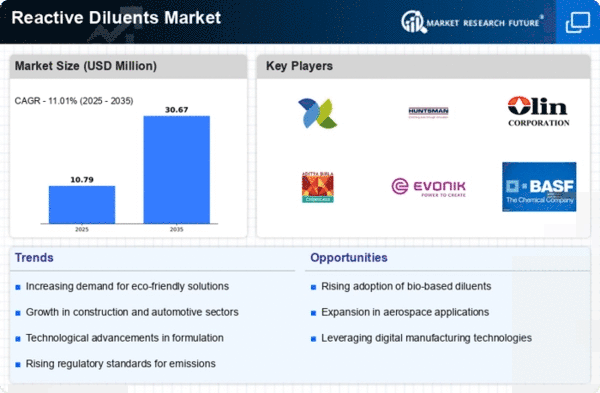
As per MRFR analysis, the Reactive Diluents Market Size was estimated at 9.72 USD Million in 2024. The Reactive Diluents industry is projected to grow from 10.79 in 2025 to 30.67 by 2035, exhibiting a compound annual growth rate (CAGR) of 11.01 during the forecast period 2025 - 2035.

Key Market Trends & Highlights

The Reactive Diluents Market is poised for growth driven by sustainability and technological advancements.

  • The market is witnessing a pronounced shift towards sustainability, influencing product development and consumer preferences.
  • North America remains the largest market, while Asia-Pacific is emerging as the fastest-growing region in reactive diluents.
  • In the segment analysis, adhesives dominate the market, whereas coatings are experiencing rapid growth due to innovative applications.
  • Key drivers include the increasing demand in the construction sector and the rising awareness of environmental regulations.

Market Size & Forecast

2024 Market Size 9.72 (USD Million)
2035 Market Size 30.67 (USD Million)
CAGR (2025 - 2035) 11.01%
Largest Regional Market Share in 2024 North America

Major Players

<p>Hexion Inc. (US), Huntsman Corporation (US), Olin Corporation (US), Aditya Birla Chemicals (IN), Evonik Industries AG (DE), BASF SE (DE), Mitsubishi Chemical Corporation (JP), SABIC (SA), Kraton Corporation (US)</p>

Market Trends

The Reactive Diluents Market is currently experiencing a notable transformation, driven by the increasing demand for high-performance coatings and adhesives across various industries. This market appears to be influenced by the growing emphasis on sustainability and eco-friendly products, prompting manufacturers to innovate and develop reactive diluents that align with environmental regulations. As industries such as automotive, construction, and electronics continue to expand, the need for effective and efficient diluents becomes more pronounced. Furthermore, advancements in technology and material science are likely to enhance the performance characteristics of these products, making them more appealing to end-users. In addition, the Reactive Diluents Market seems to be characterized by a shift towards bio-based and renewable resources. This trend indicates a potential for growth as consumers and businesses alike seek alternatives that reduce their carbon footprint. The increasing awareness of health and safety standards is also shaping product development, as manufacturers strive to create formulations that minimize hazardous components. Overall, the market is poised for continued evolution, with a focus on innovation, sustainability, and performance enhancement, which may lead to new opportunities for stakeholders in the coming years.

Sustainability Focus

The Reactive Diluents Market is witnessing a growing trend towards sustainability, as manufacturers prioritize eco-friendly formulations. This shift is driven by increasing regulatory pressures and consumer demand for greener products, prompting companies to explore bio-based alternatives.

Technological Advancements

Innovations in material science are significantly impacting the Reactive Diluents Market. Enhanced performance characteristics and improved formulations are emerging as a result of ongoing research and development efforts, which may lead to more efficient and effective products.

Health and Safety Regulations

The emphasis on health and safety standards is shaping the Reactive Diluents Market. Manufacturers are increasingly focused on creating products that comply with stringent regulations, thereby reducing hazardous components and enhancing user safety.

Reactive Diluents Market Market Drivers

Market Growth Projections

The Global Reactive Diluent Market Industry is projected to experience substantial growth over the next decade. With a market value of 638.8 USD Million anticipated in 2024, the industry is set to expand significantly, driven by various factors such as increasing demand from end-use sectors and technological advancements. The market is expected to grow at a CAGR of 5.3% from 2025 to 2035, indicating a robust upward trajectory. This growth is likely to be supported by the ongoing innovations in product formulations and the rising emphasis on sustainable solutions. As the market evolves, it presents numerous opportunities for stakeholders to capitalize on emerging trends.

Growth in End-Use Industries

The Global Reactive Diluent Market Industry is significantly influenced by the expansion of end-use industries such as automotive, construction, and electronics. These sectors are increasingly utilizing reactive diluents in coatings, adhesives, and sealants, which enhances product performance and durability. The automotive industry, in particular, is adopting advanced coatings that require reactive diluents to improve resistance to environmental factors. As these industries continue to grow, the demand for reactive diluents is expected to rise, potentially leading to a market value of 1127.1 USD Million by 2035. This growth trajectory indicates a robust correlation between industrial expansion and the reactive diluent market.

Increasing Construction Activities

The Global Reactive Diluent Market Industry is benefiting from the surge in construction activities worldwide. With urbanization and infrastructure development on the rise, there is an increasing demand for high-performance coatings and adhesives that utilize reactive diluents. These materials are essential for ensuring durability and longevity in construction applications. For example, the use of reactive diluents in epoxy coatings enhances their adhesion and resistance to harsh environmental conditions. As construction projects expand, the market for reactive diluents is expected to grow, aligning with the overall industry trend of increased investment in infrastructure and building projects globally.

Rising Demand for Eco-Friendly Solutions

The Global Reactive Diluent Market Industry is witnessing a notable shift towards eco-friendly solutions, driven by increasing environmental regulations and consumer preferences for sustainable products. Manufacturers are increasingly adopting bio-based reactive diluents, which are derived from renewable resources. This trend is expected to enhance the market's growth, as eco-friendly products often command a premium price. For instance, the demand for bio-based reactive diluents is projected to rise significantly, contributing to the overall market value, which is anticipated to reach 638.8 USD Million in 2024. This shift not only aligns with global sustainability goals but also opens new avenues for innovation in product development.

Technological Advancements in Formulations

Technological advancements in the formulation of reactive diluents are playing a crucial role in the Global Reactive Diluent Market Industry. Innovations in chemical processes and formulation techniques are enabling the development of high-performance diluents that offer enhanced properties such as lower viscosity and improved compatibility with various resins. These advancements not only improve product efficiency but also cater to the specific needs of diverse applications. As a result, manufacturers are likely to invest in research and development to create superior products, which could drive market growth at a CAGR of 5.3% from 2025 to 2035. This focus on innovation is essential for maintaining competitive advantage in the market.

Regulatory Support for Chemical Innovations

Regulatory frameworks supporting chemical innovations are significantly impacting the Global Reactive Diluent Market Industry. Governments worldwide are implementing policies that encourage the development and use of advanced chemical products, including reactive diluents. These regulations often focus on reducing volatile organic compounds and enhancing product safety, which can drive manufacturers to innovate. As companies adapt to these regulations, the demand for compliant and high-performance reactive diluents is likely to increase. This regulatory support not only fosters innovation but also positions the market for sustained growth, potentially leading to a market value of 1127.1 USD Million by 2035.

Market Segment Insights

By Application: Adhesives (Largest) vs. Coatings (Fastest-Growing)

<p>In the Reactive Diluents Market, the application segment showcases a diverse distribution with adhesives leading in market share. This dominance is attributed to their essential role in various industries, including construction, automotive, and electronics, facilitating strong adhesion properties and improving overall performance. Following adhesives, coatings have emerged as a significant application, driven by the increased demand for protective and decorative coatings in building and automotive sectors.</p>

<p>Adhesives (Dominant) vs. Coatings (Emerging)</p>

<p>Adhesives serve as a dominant application in the Reactive Diluents Market due to their versatility and widespread use in various industry sectors like construction and automotive, where strong bonding is crucial. The growth in construction activities and innovations in adhesive formulations have solidified their position. Coatings, while currently an emerging segment, are experiencing rapid growth bolstered by trends in environmental regulations and the need for high-performance coatings. They play a crucial role in enhancing surface protection and aesthetics across multiple applications, including industrial and consumer uses.</p>

By End Use Industry: Aerospace (Largest) vs. Automotive (Fastest-Growing)

<p>In the Reactive Diluents Market, the distribution of market share among various end-use industries is notably varied. Aerospace holds the largest share, driven by its critical need for high-performance materials that ensure safety and durability. Following closely, the automotive sector also accounts for a significant portion, increasingly leveraging reactive diluents for advanced coatings and adhesives that enhance vehicle performance and longevity, emphasizing the industry's pivotal role in the market dynamics. Growth trends within these segments reflect an exciting trajectory, particularly within the automotive sector, which is currently identified as the fastest-growing. The transition towards electric vehicles and the adoption of lightweight materials are key drivers propelling this growth. Additionally, aerospace continues to thrive as the demand for next-generation aircraft materials rises, highlighting a robust future characterized by innovation and sustainability in reactive diluents applications.</p>

<p>Aerospace (Dominant) vs. Automotive (Emerging)</p>

<p>Aerospace is represented as a dominant segment in the Reactive Diluents Market due to its stringent material requirements for safety and performance. The sector prioritizes high-quality diluents that meet regulatory compliances while addressing issues like weight reduction and efficiency. In contrast, the automotive industry emerges as a rapidly growing segment, driven by the ongoing transformation towards electric and hybrid vehicles. This shift necessitates new formulations that offer improved adhesion, flexibility, and temperature resistance. As automotive manufacturers seek innovative solutions to enhance product performance amidst rising environmental standards, the demand for reactive diluents is rapidly increasing, suggesting a dynamic evolution of both segments in the coming years.</p>

By Type: Aliphatic (Largest) vs. Aromatic (Fastest-Growing)

<p>In the Reactive Diluents Market, the distribution of types showcases a diverse landscape. Aliphatic diluents hold the largest share due to their extensive applications in coatings and adhesives, favored for their low viscosity and excellent solvency. Aromatic diluents, while currently a smaller segment, are rapidly gaining traction due to their superior performance in specific applications. As industries continue to innovate, these diluents are adapting to new formulations, leading to a competitive market environment with shifting dynamics. The growth trends within the segment are influenced by several key factors. The increasing demand for high-performance coatings and sealants, particularly in automotive and construction applications, has escalated the need for effective reactive diluents. Environmental regulations are also shaping the market, pushing manufacturers towards developing more sustainable and eco-friendly diluents. This has amplified interest in upgrading existing aliphatic technologies while exploring aromatic solutions, thus fueling their growth and adoption in various industrial applications.</p>

<p>Aliphatic (Dominant) vs. Cycloaliphatic (Emerging)</p>

<p>Aliphatic reactive diluents are characterized by their low viscosity, high solvency, and versatility in various formulations, leading them to dominate the market. They are extensively used in applications such as coatings, adhesives, and composites, owing to their favorable characteristics, including excellent chemical resistance and minimal odor. On the other hand, cycloaliphatic reactive diluents are emerging in the market, gaining attention for their ability to enhance the performance of epoxy systems. They offer improved clarity and yellowing resistance, making them suitable for high-end applications like electronics and optical devices. As industries seek innovative solutions to meet specific performance criteria, the tandem growth of these two segments illustrates the evolving nature of the Reactive Diluents Market.</p>

By Formulation Type: Solvent-Based (Largest) vs. Water-Based (Fastest-Growing)

<p>The formulation type segment in the Reactive Diluents Market displays varying market shares among its key components: solvent-based, water-based, powder-based, and UV-curable. Solvent-based diluents currently dominate the market due to their wide applicability and established performance in several industrial sectors. Emerging as a strong contender, the water-based formulation is quickly gaining traction owing to the growing preference for environmentally friendly options, highlighting a shift in consumer demand within this space.</p>

<p>Solvent-Based (Dominant) vs. Water-Based (Emerging)</p>

<p>Solvent-based reactive diluents remain dominant within the formulation type segment, offering superior performance and versatility across various applications, including coatings and adhesives. Their ability to improve the reactivity and performance of final products has made them a popular choice among manufacturers. Conversely, water-based reactive diluents are emerging as a significant segment, driven by a global trend towards sustainable practices and reduced VOC emissions. These products are favored in applications where environmental regulations are stringent, leading to increasing R&D focus on developing high-performance water-based solutions that do not compromise on efficiency.</p>

By Chemical Structure: Monofunctional (Largest) vs. Multifunctional (Fastest-Growing)

<p>In the Reactive Diluents Market, the chemical structure segment showcases varying market shares among monofunctional, difunctional, and multifunctional diluents. Monofunctional diluents hold the largest portion due to their versatility and widespread application in various industries, providing essential properties for epoxy formulations and other resins. In contrast, difunctional reactive diluents are also notable, catering to specific applications that require enhanced cross-linking density. Multifunctional diluents, while smaller in market share, are witnessing notable growth due to their ability to provide improved performance characteristics in coatings, adhesives, and sealants. The growth trends within this segment are shaped by ongoing innovations and evolving industry requirements. The increasing demand for efficient and sustainable materials is propelling the adoption of multifunctional reactive diluents, which are perceived as environmentally friendly alternatives. Additionally, industries such as automotive and construction are pushing for advanced formulations, which in turn drive the growth of multifunctional products. As manufacturers focus on improving chemical properties and performance, the multifunctional segment is projected to expand rapidly in the coming years, while monofunctional remains central due to its established market presence.</p>

<p>Monofunctional (Dominant) vs. Multifunctional (Emerging)</p>

<p>Monofunctional reactive diluents are dominant in the market, characterized by their singular functionality that allows them to effectively lower viscosity and improve the handling of various resin systems. They are widely used in the production of coatings and adhesives, making them essential for applications that prioritize stability and quality. Their well-established presence offers reliability to manufacturers seeking consistent performance in their products. In contrast, multifunctional reactive diluents are emerging rapidly, driven by the need for high-performance solutions. These products feature multiple functional groups, enabling better chemical reactivity and cross-linking potential. While they currently occupy a smaller share of the market, their ability to meet the increasing demands for innovative and high-performance formulations positions them for significant growth in the future, especially in industries requiring advanced materials.</p>

Get more detailed insights about Reactive Diluents Market Research Report - Global Forecast Till 2035

Regional Insights

North America : Market Leader in Diluents

North America is poised to maintain its leadership in the Reactive Diluents Market, holding a significant market share of 4.86 in 2024. The region's growth is driven by increasing demand in the automotive and construction sectors, alongside stringent regulations promoting the use of eco-friendly materials. The presence of major players like Hexion Inc. and Huntsman Corporation further fuels market expansion, supported by innovations in product formulations. The competitive landscape in North America is characterized by a robust presence of key players, including Olin Corporation and Kraton Corporation. These companies are investing in R&D to enhance product performance and sustainability. The U.S. remains the largest market, with Canada and Mexico also contributing to growth. Regulatory frameworks are increasingly favoring the adoption of reactive diluents, ensuring a favorable environment for market players.

Europe : Emerging Market with Potential

Europe's Reactive Diluents Market is valued at 2.91, reflecting a growing interest in sustainable solutions across various industries. The region is witnessing a shift towards eco-friendly products, driven by stringent EU regulations aimed at reducing VOC emissions. This regulatory landscape is a key catalyst for market growth, as manufacturers adapt to meet these standards while enhancing product performance. Leading countries in this region include Germany, France, and the UK, where companies like BASF SE and Evonik Industries AG are prominent. The competitive landscape is evolving, with a focus on innovation and sustainability. The presence of established players and a growing number of startups are contributing to a dynamic market environment, positioning Europe as a significant player in the global reactive diluents landscape.

Asia-Pacific : Rapidly Growing Market Segment

The Asia-Pacific region, with a market size of 1.62, is experiencing rapid growth in the Reactive Diluents Market. This surge is primarily driven by the booming construction and automotive sectors, alongside increasing industrialization. Countries like China and India are leading this growth, supported by government initiatives aimed at enhancing infrastructure and manufacturing capabilities. The demand for high-performance materials is also on the rise, further propelling market expansion. In this competitive landscape, key players such as Mitsubishi Chemical Corporation and Aditya Birla Chemicals are making significant strides. The presence of these companies is bolstered by strategic partnerships and investments in R&D. As the region continues to develop, the focus on sustainable and innovative solutions will likely shape the future of the reactive diluents market in Asia-Pacific, making it a critical area for investment and growth.

Middle East and Africa : Emerging Market with Challenges

The Middle East and Africa (MEA) region, with a market size of 0.33, presents unique challenges and opportunities in the Reactive Diluents Market. The growth in this region is primarily driven by increasing industrial activities and a rising demand for construction materials. However, the market faces hurdles such as regulatory challenges and limited awareness of reactive diluents' benefits. Despite these challenges, there is a growing interest in sustainable solutions that could drive future growth. Countries like South Africa and the UAE are emerging as key players in this market, with local companies beginning to invest in reactive diluents. The competitive landscape is still developing, with a mix of local and international players. As awareness increases and regulations evolve, the MEA region could see significant growth in the reactive diluents market, making it an area of interest for future investments.

Key Players and Competitive Insights

The Reactive Diluents Market is currently characterized by a dynamic competitive landscape, driven by increasing demand for high-performance materials across various industries, including coatings, adhesives, and composites. Key players such as Hexion Inc. (US), Huntsman Corporation (US), and Evonik Industries AG (DE) are strategically positioning themselves through innovation and regional expansion. Hexion Inc. (US) focuses on developing advanced formulations that enhance product performance, while Huntsman Corporation (US) emphasizes sustainability in its product offerings. Evonik Industries AG (DE) is leveraging its expertise in specialty chemicals to cater to niche markets, thereby shaping a competitive environment that prioritizes technological advancement and customer-centric solutions.

In terms of business tactics, companies are increasingly localizing manufacturing to reduce lead times and optimize supply chains. The market appears moderately fragmented, with several players vying for market share. However, the collective influence of major companies is significant, as they drive trends in product development and sustainability initiatives. This competitive structure suggests that while there is room for smaller players, the dominance of established firms is likely to shape market dynamics in the foreseeable future.

In November 2025, Hexion Inc. (US) announced the launch of a new line of bio-based reactive diluents aimed at reducing environmental impact. This strategic move not only aligns with global sustainability trends but also positions Hexion as a leader in eco-friendly solutions within the market. The introduction of these products is expected to attract environmentally conscious customers and enhance Hexion's competitive edge.

Similarly, in October 2025, Huntsman Corporation (US) expanded its production capacity for reactive diluents in response to rising demand in the Asia-Pacific region. This expansion is significant as it allows Huntsman to better serve its growing customer base while optimizing logistics and reducing costs. The strategic focus on regional growth indicates Huntsman's commitment to maintaining a strong market presence and meeting local needs effectively.

In September 2025, Evonik Industries AG (DE) entered into a strategic partnership with a leading automotive manufacturer to develop specialized reactive diluents for high-performance coatings. This collaboration is indicative of Evonik's strategy to integrate closely with key industry players, thereby enhancing its product offerings and market reach. Such partnerships are likely to foster innovation and accelerate the development of tailored solutions that meet specific industry requirements.

As of December 2025, current trends in the Reactive Diluents Market are increasingly defined by digitalization, sustainability, and the integration of AI technologies. Strategic alliances are becoming more prevalent, as companies recognize the value of collaboration in driving innovation and enhancing product development. The competitive landscape is shifting from traditional price-based competition to a focus on technological differentiation, supply chain reliability, and sustainable practices. This evolution suggests that companies that prioritize innovation and strategic partnerships will likely emerge as leaders in the market.

Key Companies in the Reactive Diluents Market market include

Industry Developments

December 2021 - 

In December 2021, The Bodo Moller Chemie Group signed a partnership deal with Imerys to strengthen its business operations. 

March 2019 - 

In March 2019, Hexion announced the launch of its application development centre in Shanghai, to enhance its business expansion in APAC.

Future Outlook

Reactive Diluents Market Future Outlook

<p>The Reactive Diluents Market is poised for growth at 11.01% CAGR from 2024 to 2035, driven by increasing demand in coatings, adhesives, and composites.</p>

New opportunities lie in:

  • <p>Development of bio-based reactive diluents for sustainable applications.</p>
  • <p>Expansion into emerging markets with tailored product offerings.</p>
  • <p>Investment in R&D for high-performance diluents targeting aerospace and automotive sectors.</p>

<p>By 2035, the Reactive Diluents Market is expected to achieve robust growth and diversification.</p>

Market Segmentation

Reactive Diluents Market Type Outlook

  • Aliphatic
  • Aromatic
  • Cycloaliphatic
  • Epoxy
  • Phenolic

Reactive Diluents Market Application Outlook

  • Adhesives
  • Coatings
  • Composites
  • Sealants
  • Inks

Reactive Diluents Market End Use Industry Outlook

  • Aerospace
  • Automotive
  • Construction
  • Electronics
  • Marine

Reactive Diluents Market Formulation Type Outlook

  • Solvent-Based
  • Water-Based
  • Powder-Based
  • UV-Curable

Reactive Diluents Market Chemical Structure Outlook

  • Monofunctional
  • Difunctional
  • Multifunctional

Report Scope

MARKET SIZE 20249.72(USD Million)
MARKET SIZE 202510.79(USD Million)
MARKET SIZE 203530.67(USD Million)
COMPOUND ANNUAL GROWTH RATE (CAGR)11.01% (2024 - 2035)
REPORT COVERAGERevenue Forecast, Competitive Landscape, Growth Factors, and Trends
BASE YEAR2024
Market Forecast Period2025 - 2035
Historical Data2019 - 2024
Market Forecast UnitsUSD Million
Key Companies ProfiledHexion Inc. (US), Huntsman Corporation (US), Olin Corporation (US), Aditya Birla Chemicals (IN), Evonik Industries AG (DE), BASF SE (DE), Mitsubishi Chemical Corporation (JP), SABIC (SA), Kraton Corporation (US)
Segments CoveredApplication, End Use Industry, Type, Formulation Type, Chemical Structure
Key Market OpportunitiesGrowing demand for eco-friendly formulations drives innovation in the Reactive Diluents Market.
Key Market DynamicsRising demand for eco-friendly formulations drives innovation in reactive diluents and enhances competitive market dynamics.
Countries CoveredNorth America, Europe, APAC, South America, MEA

FAQs

What CAGR, the reactive diluents market would achieve during the forecast period of 2025-2035?

The global reactive diluents market has been expected to increase at a CAGR of 5.93%, with a value of USD 845 billion over the estimated projected years 2024-2035.

What could hold back the reactive diluents market growth?

Unstable crude oil prices and increasing intake of phenolic resins as an alternative can prevent market growth.

Which one is the largest reactive diluents market?

The Asia Pacific market has a better market share in 2018 than others.

What would drive the US reactive diluents market?

The automotive industry would drive growth for the US reactive diluents market.

  1. Executive Summary
  2. Scope of the Report
    1. Market Definition
    2. Scope of the
    3. Study
    4. List of Assumptions
    5. Markets Structure
  3. Market Research
    1. Methodology
    2. Research Process
    3. Secondary Research
    4. Primary Research
    5. Forecast Model
  4. Market Factor Analysis of the Global Reactive Diluents
    1. Market
    2. Supply Chain Analysis
      1. Raw Material Suppliers
      2. Distributors/Retailers/Wholesalers/E-Commerce
      3. End Users
      4. Bargaining
      5. Bargaining Power
      6. Threat of Substitutes
      7. Intensity of Competitive Rivalry
    3. Manufacturers/Producers
    4. Porter’s Five Forces Analysis
    5. Threat of New Entrants
    6. Power of Buyers
    7. of Suppliers
    8. Market Dynamics of the Global Reactive Diluents Market
    9. Introduction
    10. Drivers
    11. Restraints
    12. Opportunities
    13. Challenges
    14. Trends/Technology
  5. Global Reactive
  6. Diluents Market, by Type
    1. Introduction
      1. Market Estimates &
    2. Aliphatic
    3. Market Estimates & Forecast, 2020-2027
    4. Forecast, by Region, 2020-2027
    5. Aromatic
      1. Market Estimates & Forecast, 2020-2027
      2. Market Estimates &
    6. Forecast, by Region, 2020-2027
    7. Cycloaliphatic
      1. Market Estimates & Forecast, 2020-2027
      2. Market
    8. Estimates & Forecast, by Region, 2020-2027
  7. Global
  8. Reactive Diluents Market, by Application
    1. Introduction
    2. Paints & Coating
      1. Market Estimates
      2. Market Estimates & Forecast, by
    3. & Forecast, 2020-2027
    4. Region, 2020-2027
    5. Adhesives & Sealants
      1. Market Estimates
    6. Market Estimates & Forecast, 2020-2027
    7. & Forecast, by Region, 2020-2027
    8. Plastics & Composites
      1. Market Estimates & Forecast, 2020-2027
      2. Market
    9. Estimates & Forecast, by Region, 2020-2027
    10. Others
      1. Market Estimates & Forecast, 2020-2027
      2. Market Estimates & Forecast, by Region, 2020-2027
  9. Global Reactive Diluents Market, by Region
    1. Introduction
    2. North America
      1. Market Estimates
      2. Market Estimates &
      3. Market Estimates &
      4. Market Estimates
      5. US
      6. Canada
    3. & Forecast, 2020-2027
    4. Forecast by Type, 2020-2027
    5. Forecast by Application, 2020-2027
    6. & Forecast by End-use Industry, 2020-2027
    7. & Forecast, 2020-2027
    8. & Forecast by Application, 2020-2027
    9. & Forecast by Type, 2020-2027
    10. & Forecast by End-use Industry, 2020-2027
    11. Europe
      1. Market Estimates & Forecast, 2020-2027
      2. France
      3. Spain
      4. Russia
      5. Poland
      6. Rest of Europe
      7. Market Estimates & Forecast,
      8. Market Estimates & Forecast by Type,
      9. Market Estimates & Forecast by Application,
      10. Market Estimates & Forecast by End-use
      11. China
      12. Japan
      13. Australia
      14. Rest of Asia-Pacific
    12. Market Estimates & Forecast by Type, 2020-2027
    13. Market Estimates & Forecast by Application, 2020-2027
    14. Market Estimates & Forecast by End-use Industry, 2020-2027
    15. Germany
    16. Market Estimates & Forecast, 2020-2027
    17. Market Estimates & Forecast by Application, 2020-2027
    18. by End-use Industry, 2020-2027
    19. Market Estimates & Forecast by Type, 2020-2027
    20. Market Estimates & Forecast by End-use Industry, 2020-2027
    21. Italy
    22. Market Estimates & Forecast, 2020-2027
    23. Market Estimates & Forecast by Application, 2020-2027
    24. by End-use Industry, 2020-2027
    25. Market Estimates & Forecast by Type, 2020-2027
    26. Market Estimates & Forecast by End-use Industry, 2020-2027
    27. UK
    28. Market Estimates & Forecast, 2020-2027
    29. & Forecast by Application, 2020-2027
    30. & Forecast by Type, 2020-2027
    31. & Forecast by End-use Industry, 2020-2027
    32. & Forecast, 2020-2027
    33. & Forecast by Application, 2020-2027
    34. Market Estimates & Forecast by Type, 2020-2027
    35. Market Estimates & Forecast by End-use Industry,2020-2027
    36. Asia-Pacific
    37. Industry, 2020-2027
    38. Market Estimates & Forecast by Type, 2020-2027
    39. Market Estimates & Forecast by End-use Industry, 2020-2027
    40. India
    41. Market Estimates & Forecast, 2020-2027
    42. Market Estimates & Forecast by Application, 2020-2027
    43. by End-use Industry, 2020-2027
    44. & Forecast, 2020-2027
    45. & Forecast by Application, 2020-2027
    46. Market Estimates & Forecast by Type, 2020-2027
    47. Market Estimates & Forecast by End-use Industry, 2020-2027
    48. New Zealand
    49. Market Estimates & Forecast, 2020-2027
    50. Market Estimates & Forecast by Application, 2020-2027
    51. by End-use Industry, 2020-2027
    52. & Forecast, 2020-2027
    53. & Forecast by Application, 2020-2027
    54. Middle East & Africa
      1. Market
      2. Market Estimates
      3. Market Estimates
      4. Turkey
      5. North Africa
      6. Rest of Middle East
    55. Market Estimates & Forecast, 2020-2027
    56. Estimates & Forecast by Type, 2020-2027
    57. & Forecast by Application, 2020-2027
    58. & Forecast by End-use Industry, 2020-2027
    59. Forecast, 2020-2027
    60. Market Estimates & Forecast by Type, 2020-2027
    61. Estimates & Forecast by End-use Industry, 2020-2027
    62. Israel
    63. Market Estimates & Forecast, 2020-2027
    64. & Forecast by Application, 2020-2027
    65. Market Estimates & Forecast by Type, 2020-2027
    66. Market Estimates & Forecast by End-use Industry, 2020-2027
    67. GCC
    68. Market Estimates & Forecast, 2020-2027
    69. Market Estimates & Forecast by Application, 2020-2027
    70. by End-use Industry, 2020-2027
    71. & Africa
    72. Market Estimates & Forecast, 2020-2027
    73. Market Estimates & Forecast by Application, 2020-2027
    74. by End-use Industry, 2020-2027
    75. Latin America
      1. Market
      2. Market Estimates
      3. Market
      4. Mexico
      5. Argentina
    76. Market Estimates & Forecast, 2020-2027
    77. Estimates & Forecast by Type, 2020-2027
    78. & Forecast by Application, 2020-2027
    79. Estimates & Forecast by End-use Industry, 2020-2027
    80. Brazil
    81. Market Estimates & Forecast, 2020-2027
    82. Market Estimates & Forecast by Application, 2020-2027
    83. by End-use Industry, 2020-2027
    84. & Forecast, 2020-2027
    85. & Forecast by Application, 2020-2027
    86. Market Estimates & Forecast by Type, 2020-2027
    87. Market Estimates & Forecast by End-use Industry, 2020-2027
    88. Rest of Latin America
    89. & Forecast by Type, 2020-2027
    90. & Forecast by End-use Industry, 2020-2027
  10. Company
    1. Landscape
    2. Introduction
    3. Market Strategy
    4. Key Development Analysis (Expansion/Merger
    5. & Acquisition/Joint Venture/New Product Development/Agreement/Investment)
  11. Company Profiles
    1. BASF SE
    2. Financial Updates
    3. Segment Overview
    4. Key Developments
    5. Evonik Industries AG
    6. Company Overview
    7. Bodo Möller Chemie GmbH
    8. Financial Updates
    9. Segment Overview
    10. Key Developments
    11. Ipox Chemicals GmbH
    12. Company Overview
    13. Updates
    14. UL LLC
    15. Financial Updates
    16. Segment Overview
    17. Key Developments
    18. Cargill, Incorporated
    19. Product/Business Segment Overview
    20. Analysis
    21. Product/Business Segment Overview
    22. Analysis
    23. Overview
    24. Product/Business Segment Overview
    25. Analysis
    26. Financial Updates
    27. Product/Business Segment Overview
    28. SWOT Analysis
    29. Product/Business Segment Overview
    30. Strategy
    31. SA
    32. Overview
    33. Strategy
    34. Shokubai Co., Ltd
    35. Company Overview
    36. Key Developments
    37. Financial Updates
    38. Segment Overview
    39. SWOT Analysis
    40. Product/Business Segment Overview
    41. Strategy
  12. Company Overview
  13. Product/Business
  14. Strategy
  15. SWOT Analysis
  16. Financial Updates
  17. Product/Business Segment Overview
  18. Strategy
  19. Key Developments
  20. SWOT Analysis
  21. Company Overview
  22. Product/Business
  23. Strategy
  24. SWOT Analysis
  25. Financial Updates
  26. Product/Business Segment Overview
  27. Strategy
  28. Key Developments
  29. SWOT Analysis
    1. Huntsman Corporations
      1. Company Overview
      2. Financial
      3. Product/Business Segment Overview
      4. Strategy
      5. Key Developments
      6. SWOT Analysis
      7. Company Overview
      8. Product/Business
      9. Strategy
      10. SWOT Analysis
      11. Company Overview
      12. Financial Updates
      13. Strategy
      14. Key Developments
      15. SWOT
    2. Air Products and Chemicals, Inc.
      1. Company Overview
      2. Financial Updates
      3. Strategy
      4. Key Developments
      5. SWOT
    3. Hexion
      1. Company
      2. Financial Updates
      3. Strategy
      4. Key Developments
      5. SWOT
    4. Sachem Inc.
      1. Company Overview
      2. Strategy
      3. Key Developments
    5. Aditya Birla Chemicals
      1. Company Overview
      2. Financial Updates
      3. Key Developments
      4. SWOT Analysis
    6. Arkema
      1. Company
      2. Financial Updates
      3. Product/Business Segment Overview
      4. Key Developments
      5. SWOT Analysis
    7. Nippon
      1. Financial Updates
      2. Product/Business Segment Overview
      3. Strategy
      4. SWOT Analysis
    8. Adeka Corporation
      1. Company Overview
      2. Product/Business
      3. Strategy
      4. Key Developments
    9. EMS-Chemie Holding Ag
      1. Company Overview
      2. Financial Updates
      3. Key Developments
      4. SWOT Analysis
  30. Conclusion
  31. LIST OF TABLES
  32. Global
    1. Reactive Diluents Market: By Region, 2020-2027
  33. North
    1. America: Reactive Diluents Market: By Country, 2020-2027
    2. Table 3
    3. Europe: Reactive Diluents Market: By Country, 2020-2027
    4. Table
  34. Asia-Pacific: Reactive Diluents Market: By Country, 2020-2027
  35. Middle East & Africa: Reactive Diluents
    1. Market: By Country, 2020-2027
  36. Latin America:
    1. Reactive Diluents Market: By Country, 2020-2027
    2. Table 7
    3. Global Reactive Diluents Type Market: By Regions, 2020-2027
    4. Table
  37. North America: Reactive Diluents Type Market: By Country, 2020-2027
  38. Europe: Reactive Diluents Type Market: By
    1. Country, 2020-2027
    2. Table10 Asia-Pacific: Reactive
    3. Diluents Type Market: By Country, 2020-2027
    4. Table11 Middle
    5. East & Africa: Reactive Diluents Type Market: By Country, 2020-2027
    6. Table12 Latin America: Reactive Diluents Type Market: By Country,
    7. Table13 Global Reactive Diluents Application
    8. Market: By Regions, 2020-2027
    9. Table14 North America:
    10. Reactive Diluents by Application Market: By Country, 2020-2027
    11. Table15
    12. Europe: Reactive Diluents Application Market: By Country, 2020-2027
    13. Table16 Asia-Pacific: Reactive Diluents Application Market:
    14. By Country, 2020-2027
    15. Table17 Middle East & Africa:
    16. Reactive Diluents Application Market: By Country, 2020-2027
    17. Table18
    18. Latin America: Reactive Diluents Application Market: By Country, 2020-2027
    19. Table19 Global Type Market: By Region, 2020-2027
    20. Table20 Global Application Market: By Region, 2020-2027
    21. Table21 Global End-use Industry Market: By Region, 2020-2027
    22. Table22 North America: Reactive Diluents Market, By
    23. Country
    24. Table23 North America: Reactive Diluents Market,
    25. By Type
    26. Table24 North America: Reactive Diluents Market,
    27. By Application
    28. Table25 Europe: Reactive Diluents Market,
    29. By Country
    30. Table26 Europe: Reactive Diluents Market,
    31. By Type
  39. Table27 Europe: Reactive Diluents Market, By Application
  40. Table28 Asia-Pacific: Reactive Diluents Market, By Country
  41. Table29 Asia-Pacific: Reactive Diluents Market, By Type
    1. Table30
  42. Asia-Pacific: Reactive Diluents Market, By Application
    1. Table31
  43. Middle East & Africa: Reactive Diluents Market, By Country
    1. Table32
  44. Middle East & Africa: Reactive Diluents Market, By Type
    1. Table33
  45. Middle East & Africa: Reactive Diluents Market, By Application
  46. Table34 Latin America: Reactive Diluents Market, By Country
    1. Table35 Latin America: Reactive Diluents Market, By
    2. Type
    3. Table36 Latin America: Reactive Diluents Market, By
    4. Application
  47. LIST OF FIGURES
    1. FIGURE 1
    2. Global Reactive Diluents Market Segmentation
    3. FIGURE 2
    4. Forecast Research Methodology
  48. Five Forces Analysis of
    1. Global Reactive Diluents Market
  49. Value Chain of Global
    1. Reactive Diluents Market
  50. Share of Global Reactive Diluents
  51. Market in 2020, by country (in %)
  52. Global Reactive Diluents
    1. Market, 2020-2027
  53. Global Reactive Diluents Market Size
    1. by Type, 2020
  54. Share of Global Reactive Diluents Market
    1. by Type, 2020-2027
  55. Global Reactive Diluents Market Size
    1. by Application, 2020
  56. Share of Global Reactive Diluents Market
    1. by Application, 2020-2027

Reactive Diluents Market Segmentation

Market Segmentation Overview

  • Detailed segmentation data will be available in the full report
  • Comprehensive analysis by multiple parameters
  • Regional and country-level breakdowns
  • Market size forecasts by segment
Infographic

Free Sample Request

Kindly complete the form below to receive a free sample of this Report

Get Free Sample

Customer Strories

Compare Licence

×
Features License Type
Single User Multiuser License Enterprise User
Price $4,950 $5,950 $7,250
Maximum User Access Limit 1 User Upto 10 Users Unrestricted Access Throughout the Organization
Free Customization
Direct Access to Analyst
Deliverable Format
Platform Access
Discount on Next Purchase 10% 15% 15%
Printable Versions