×
  • Cat-intel
  • MedIntelliX
  • Resources
  • About Us
  • Hero Background
    English
    Chinese
    French
    Japanese
    Korean
    German
    Spanish

    Radiation Protection Apparels Market Share

    ID: MRFR/HC/5982-CR
    160 Pages
    Rahul Gotadki
    March 2023

    Radiation Protection Apparels Market Research Report Information By Material (Lead-Free, Lead-Based and Light Lead Composite), By Product Type (Aprons, Gloves, Head Shields, Thyroid Shields and Others), By End Use (Hospitals and Clinics, Diagnostic Centers, Research Laboratories, Specialty Clinics and Others) And By Region (North America, Europe, Asia-Pacific, And Rest Of The World) –Marke...

    Share:
    Download PDF ×

    We do not share your information with anyone. However, we may send you emails based on your report interest from time to time. You may contact us at any time to opt-out.

    Radiation Protection Apparels Market Infographic
    Purchase Options

    Market Share

    Radiation Protection Apparels Market Share Analysis

    In the realm of radiation protection apparels, the choice of materials is pivotal in determining the efficacy, durability, and overall performance of these protective garments. Among the materials, the Lead-Based segment has asserted its dominance, accounting for the largest market share of 52.87% in 2021, with a substantial market value of USD 339.75 million. This segment is expected to continue its ascendancy, registering the highest Compound Annual Growth Rate (CAGR) of 7.5% during the forecast period. Lead and lead alloys have long been regarded as excellent materials for radiation shielding, owing to their exceptional properties.

    One of the standout features of lead as a shielding material is its ease of use. This malleable and ductile material allows for easy manipulation and adaptation to various forms, making it highly versatile in manufacturing protective apparels. This ease of workability is a significant advantage, especially in industries where tailored and customized shielding solutions are crucial.

    Moreover, lead excels across all types of shielding applications, demonstrating superior performance in providing effective protection against radiation exposure. For individuals working with or around radiation, lead serves as a reliable protective barrier, instilling a sense of security and peace of mind. Its efficacy in attenuating radiation makes it a trusted choice for diverse applications, from medical settings to industrial environments where radiation exposure is a concern.

    However, the extensive use of lead in protective apparels has raised environmental concerns. The disposal of over 150,000 lead X-ray aprons annually contributes to the generation of more than 1 million pounds of toxic lead metal waste globally. Recognizing the environmental impact and potential health risks associated with lead exposure, there is a growing shift towards lead-free products.

    The Lead-Free segment emerged as a robust contender, holding the second-largest market share in 2020, valued at USD 357 million. Lead-free materials represent a significant innovation in radiation protection apparels, addressing both environmental and health concerns. These lead-free alternatives are typically composed of two attenuating elements, providing a flexible and lightweight solution while maintaining excellent protective capabilities.

    One notable example of lead-free innovation is AliMed's FeatherLite Lead-Free weight option, available in Perfect Fit™ Aprons. This product leverages innovative technology to achieve the same 0.5 mm Pb-equivalent level of protective antimony, with less embedded plastic. The result is a lead-free option that is 10% lighter than Ultralight Lead-Free alternatives and 42% lighter than Standard Lead aprons. This reduction in weight is achieved without compromising on protection, and it addresses the potential risk of injuries associated with heavier protective aprons.

    Beyond lead and lead-free options, there is ongoing research in the radiation protection apparels market exploring composites such as tungsten and barium sulfate (BaSO4)-containing PET fibers. These materials offer alternative approaches to radiation shielding, presenting new possibilities for developing advanced protective garments with enhanced properties.

    In conclusion, the materials used in radiation protection apparels play a pivotal role in shaping the industry landscape. While lead has historically dominated due to its excellent shielding properties, the environmental and health concerns associated with lead exposure have fueled the rise of lead-free alternatives. The Lead-Based segment continues to lead the market, but the Lead-Free segment is gaining momentum, driven by innovations that prioritize both effectiveness and environmental sustainability. As technology advances, the ongoing research into novel materials promises to bring further advancements, ensuring that radiation protection apparels evolve to meet the ever-changing demands of safety, efficiency, and environmental responsibility.


    Author
    Rahul Gotadki
    Assistant Manager

    He holds an experience of about 7+ years in Market Research and Business Consulting, working under the spectrum of Life Sciences and Healthcare domains. Rahul conceptualizes and implements a scalable business strategy and provides strategic leadership to the clients. His expertise lies in market estimation, competitive intelligence, pipeline analysis, customer assessment, etc. In addition to the above, his other responsibility includes strategic tracking of high growth markets & advising clients on the potential areas of focus they could direct their business initiatives

    Leave a Comment

    FAQs

    What is the projected growth of the Radiation Protection Apparels market?

    The Radiation Protection Apparels market is the expected increase in total market value of 4.25 USD billion over a defined forecast period 2025–2035. It is driven by factors such as demand trends, technological advances, regulatory changes, and geographic expansion.

    What is the size of the Radiation Protection Apparels market?

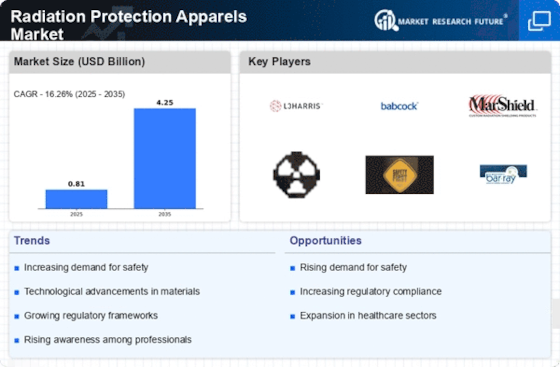
    Radiation Protection Apparels market size was valued at approximately 0.81 billion USD in 2024. This figure will reach 4.25 billion USD covering all regions (America, Europe, Asia, MEA and ROW), focusing its segments / services / distribution channels till 2035.

    What is the CAGR of the Radiation Protection Apparels market?

    Radiation Protection Apparels market is expected to grow at a CAGR of 16.26% between 2025 and 2035.

    How much will the Radiation Protection Apparels market be worth by 2035?

    Radiation Protection Apparels market is expected to be worth of 4.25 billion USD, reflecting growth driven by usage, technology and global demands by the end of 2035.

    How will the Radiation Protection Apparels market perform over the next 10 years?

    Over the next 10 years the Radiation Protection Apparels market is expected to shift from usd billion 0.81 to 4.25 billion USD, led by adoption of advanced tech, demographic trends, regulatory approvals, with potential headwinds from 2025 to 2035.

    Which region held the largest market share in the radiation protection apparels market?

    North America had the largest share in the market.

    Market Summary

    As per Market Research Future Analysis, the Global Radiation Protection Apparels Market was valued at USD 0.81 Billion in 2025 and is projected to reach USD 4.25 Billion by 2035, growing at a CAGR of 16.26% from 2025 to 2035. The market growth is driven by the increasing use of radiation protective clothing in medical imaging procedures and advancements in anti-radiation clothing technology. The demand for lead-free materials is rising due to their lightweight and non-toxic properties, while gloves are the leading product type in revenue generation. North America is expected to dominate the market due to regulatory requirements and heightened awareness of radiation safety.

    Key Market Trends & Highlights

    The radiation protection apparels market is experiencing significant growth driven by various factors.

    • Market Size in 2024: USD 0.81 Billion; projected to reach USD 4.25 Billion by 2035. CAGR from 2025 to 2035: 16.26%; driven by increased medical imaging activities. Lead-free segment dominates due to its lightweight and non-toxic nature. North America holds the largest market share, attributed to regulatory requirements and safety awareness.

    Market Size & Forecast

    2025 Market Size USD 0.81 Billion
    2035 Market Size USD 4.25 Billion
    CAGR (2025-2035) 16.26%
    Largest Regional Market North America.

    Major Players

    <p>Key players include <a href="https://infabcorp.com/radiation-protection-apparel-market-2023/">INFAB Corporation</a> (US), Barrier Technologies (US), Kiran Medical Systems (India), MAVIG (Germany), Ultraray (Canada), and others.</p>

    Market Trends

    Increase in medical imaging activities is driving the market growth

    There has been a huge growth in the cost of healthcare, the amount of medical imaging tests performed, and the population's exposure to X-rays and other radiation. Computed tomography (CT) and ultrasound (US) exams more than doubled between 2010 and 2020, according to a study that was published in the November 2021 issue of the journal Healthcare (Basel). Healthcare workers using imaging equipment for medical diagnostics, especially X-rays, wear protective equipment to reduce their exposure to dangerous radiation. As a result, there is an increasing need for radiation protection clothing due to increased medical imaging activities.

    Thus, driving the radiation protection apparels market revenue.

    Radiation Protection Apparels Market Market Drivers

    Market Growth Projections

    The Global Radiation Protection Apparels Market Industry is poised for substantial growth, with projections indicating a market size of 0.81 USD Billion in 2024 and an increase to 2.04 USD Billion by 2035. This growth trajectory suggests a compound annual growth rate (CAGR) of 8.77% from 2025 to 2035. Such figures highlight the increasing demand for radiation protection apparel across various sectors, including healthcare, industrial, and research environments. The market's expansion is likely driven by factors such as technological advancements, regulatory compliance, and the growing awareness of radiation risks, indicating a robust future for the industry.

    Growth in Healthcare Sector

    The expansion of the healthcare sector, particularly in diagnostic imaging and cancer treatment, is a significant driver for the Global Radiation Protection Apparels Market Industry. As the number of diagnostic procedures involving radiation increases, so does the need for protective apparel among healthcare workers. The rise in cancer cases globally necessitates advanced treatment options, which often involve radiation therapy. This trend is reflected in the market's growth trajectory, with projections indicating a rise from 0.81 USD Billion in 2024 to 2.04 USD Billion by 2035. The healthcare sector's continuous growth is likely to sustain demand for radiation protection apparel in the coming years.

    Increasing Awareness of Radiation Risks

    The growing awareness regarding the risks associated with radiation exposure is a primary driver for the Global Radiation Protection Apparels Market Industry. As healthcare professionals, industrial workers, and the general public become more informed about the potential hazards of radiation, the demand for protective apparel is likely to surge. This heightened awareness is reflected in the projected market growth, with the industry expected to reach 0.81 USD Billion in 2024 and potentially 2.04 USD Billion by 2035. Such figures indicate a compound annual growth rate (CAGR) of 8.77% from 2025 to 2035, underscoring the urgency for effective protective solutions.

    Technological Advancements in Materials

    Innovations in materials science are significantly impacting the Global Radiation Protection Apparels Market Industry. The development of lightweight, flexible, and more effective radiation shielding materials enhances the comfort and usability of protective apparel. For instance, advancements in lead-free materials and the incorporation of nanotechnology are leading to the creation of garments that provide superior protection without compromising mobility. This trend not only appeals to healthcare professionals but also to industries such as aerospace and nuclear energy, where radiation exposure is a concern. As these technologies evolve, they are likely to drive market growth and expand the range of available products.

    Regulatory Compliance and Safety Standards

    The implementation of stringent regulatory frameworks and safety standards across various industries is a crucial driver for the Global Radiation Protection Apparels Market Industry. Governments and regulatory bodies are increasingly mandating the use of protective apparel in environments where radiation exposure is a risk. This regulatory push compels organizations to invest in compliant protective gear, thereby expanding the market. For example, the International Atomic Energy Agency (IAEA) and other organizations provide guidelines that necessitate the use of radiation protection apparel in medical and industrial settings. As compliance becomes non-negotiable, the demand for high-quality protective apparel is expected to rise.

    Emerging Markets and Industrial Applications

    Emerging markets are increasingly recognizing the importance of radiation protection, thereby driving the Global Radiation Protection Apparels Market Industry. Countries with expanding industrial sectors, particularly in nuclear energy and medical imaging, are witnessing a surge in demand for protective apparel. As these markets develop, they adopt international safety standards, which further fuels the need for effective radiation protection solutions. The anticipated growth in these regions aligns with the overall market forecast, suggesting a robust CAGR of 8.77% from 2025 to 2035. This trend indicates a promising future for manufacturers and suppliers of radiation protection apparel.

    Market Segment Insights

    Radiation Protection Apparels Material Insights

    <p>The radiation protection apparels market segmentation, based on material includes lead-free, lead-based and&nbsp;light lead composite. The lead-free segment dominated the market due to its toxicity-free and lightweight nature. The market for radiation protective clothing is also anticipated to reach new heights as a result of the rising demand for technologically advanced lead-free items.</p>

    <p>Figure 1: Radiation Protection Apparels Market, by Material, 2022 &amp; 2032 (USD Billion)</p>

    <p>Source: Secondary Research, Primary Research, Market Research Future Database and Analyst Review</p>

    Radiation Protection Apparels Product Type Insights

    <p>The radiation protection apparels market segmentation, based on product type, includes aprons, gloves, head shields, thyroid shields and others. The gloves category generated the most income due to the widespread use of these aprons in medical settings and their high availability. The main driving force behind this market segment is the longevity and effectiveness of these aprons in shielding the body from radiation. Conversely, ongoing care and financial support for R&amp;D initiatives are anticipated to increase product demand.</p>

    Radiation Protection Apparels End Use Insights

    <p>The radiation protection apparels market segmentation, based on end use, includes hospitals and clinics, diagnostic centers, research laboratories, specialty clinics and others. The hospitals and clinics category generated the most income due to the rising imaging technology demand. Radiologic technicians are needed to operate medical imaging devices like computed tomography (CT) and X-rays in hospitals and clinics for diagnostic and therapeutic purposes. Radiologic technicians employ personal protection equipment (PPE), such as clothes or other protective equipment (including aprons) to shield themselves from ionizing radiation when utilizing this medical imaging equipment.</p>

    <p>Therefore, it is anticipated that the increase in radiologic technicians will directly impact the industry for radiation protective clothing for medical professionals.</p>

    Get more detailed insights about Radiation Protection Apparels Market Research Report – Forecast till 2035

    Regional Insights

    By region, the study provides the market insights into North America, Europe, Asia-Pacific and Rest of the World. The North American radiation protection apparels market area will dominate this market as a result of the region's regulatory requirements. The expansion of radiation protective aprons in the area is also attributed to increased efforts by both public and commercial organisations to inform the public about radiation's seriousness and negative effects. The North American market is expanding due to increased radiation safety awareness, increased radiography procedures, and ongoing research into the creation of new and more sophisticated radiation protection systems.

    Further, the major countries studied in the market report are The US, Canada, German, France, the UK, Italy, Spain, China, Japan, India, Australia, South Korea, and Brazil.

    Figure 2: Radiation Protection Apparels Market Share By Region 2022 (USD Billion) 

    Radiation Protection Apparels Market Regions

    Source: Secondary Research, Primary Research, Market Research Future Database and Analyst Review

    Europe radiation protection apparels market accounts for the second-largest market share. The established healthcare system and growing insurance coverage in this area are responsible for the market's growth. The rising share can also be attributable to the increasing number of radiography procedures and healthcare professionals that use radiography equipment. Further, the German radiation protection apparels market held the largest market share, and the UK radiation protection apparels market was the fastest growing market in the European region

    The Asia-Pacific Radiation protection apparels Market is expected to grow at the fastest CAGR from 2024 to 2032 because the market for protective garments is using technology more and more. Additionally, because of the region's abundant supply of raw materials and affordable labour, many businesses are concentrating their expansion efforts there. Moreover, China’s radiation protection apparels market held the largest market share, and the Indian radiation protection apparels market was the fastest growing market in the Asia-Pacific region.

    Key Players and Competitive Insights

    Leading market players are investing heavily in research and development in order to expand their product lines, which will help the radiation protection apparels market, grow even more. Market participants are also undertaking a variety of strategic activities to expand their footprint, with important market developments including new product launches, contractual agreements, mergers and acquisitions, higher investments, and collaboration with other organizations. To expand and survive in a more competitive and rising market climate, radiation protection apparels industry must offer cost-effective items.

    Manufacturing locally to minimize operational costs is one of the key business tactics used by manufacturers in the radiation protection apparels industry to benefit clients and increase the market sector. In recent years, the radiation protection apparels industry has offered some of the most significant advantages to market.

    Major players in the radiation protection apparels market attempting to increase market demand by investing in research and development operations include INFAB Corporation (US), Barrier Technologies (US), Kiran Medical Systems (India), MAVIG (Germany), Ultraray (Canada), SIMAD X-Ray Medical Technology (Italy), Bar-Ray Products (US), Shielding International, Inc. (US), Lite Tech, Inc. (US), Scanflex Medical (Sweden), Biodex Medical Systems (US) and Cablas srl (Italy).

    Medical equipment is made by MAVIG GmbH. The business sells mobile shields, radiation-protected observation windows, and x-ray protective and suspension systems. MAVIG offers services to clients all around the world. The product line consists of radiation protection curtains, built-in windows, mobile X-ray shields, monitors, lamps and upper and lower body shields for surgery and examination tables. It also includes personal radiation protection clothing and accessories.

    The US-based INFAB Corporation produces top-notch radiation Medical Protective Equipment gear and accessories for the medical industry. The company has been researching, creating, and producing highly sophisticated radiation attenuation solutions for medical professionals worldwide since its founding in 1979. It offers a variety of goods, including thyroid shields, lead gloves, lead caps, and lead aprons. The leading producer of radiation safety gear is Barrier Technologies.

    Key Companies in the Radiation Protection Apparels Market market include

    Industry Developments

    November 2021:In medical radiation, MAVIG has introduced a new line of X-ray protective apparel and accessories. This includes its proprietary Balance RA631 series vest and skirt for all-around protection with unique characteristics that notably set it apart from other two-piece models.

    March 2020:The 903 Reverse Vest & Skirt Line from INFAB Corporation is extremely protective against scatter radiation and has a snug and comfortable fit. The 903 Reverse Vest & Skirt is a 2-piece outfit that offers complete wraparound protection. It is specifically made to distribute weight between the shoulders and waist equally.

    Future Outlook

    Radiation Protection Apparels Market Future Outlook

    <p>The Radiation Protection Apparels Market is projected to grow at an 16.26% CAGR from 2025 to 2035, driven by technological advancements and increasing regulatory standards.</p>

    New opportunities lie in:

    • <p>Develop eco-friendly radiation protection materials to meet growing sustainability demands. Invest in smart textiles integrated with radiation detection technology for enhanced safety. Expand distribution channels in emerging markets to capitalize on rising healthcare investments.</p>

    <p>By 2035, the market is expected to achieve substantial growth, reflecting heightened awareness and demand for radiation protection. <a href="https://www.accessdata.fda.gov/scripts/cdrh/cfdocs/cfpcd/classification.cfm?ID=OEA">Radiation Protection Apparels therapeutics FDA insights</a> including regulatory guidance, approvals, safety alerts, and oversight of products and clinical practices relevant to Radiation Protection Apparels.</p>

    Market Segmentation

    Radiation Protection Apparels End Use Outlook (USD Billion, 2018-2032)

    • Hospitals and Clinics
    • Diagnostic Centers
    • Research Laboratories
    • Specialty Clinics
    • Others

    Radiation Protection Apparels Material Outlook (USD Billion, 2018-2032)

    •  Lead-Free
    • Lead-Based
    • Light Lead Composite

    Radiation Protection Apparels Regional Outlook (USD Billion, 2018-2032)

    • {""=>["China"
    • "Japan"
    • "India"
    • "Australia"
    • "South Korea"
    • "Rest of Asia-Pacific"]}
    • {""=>["Middle East"
    • "Africa"
    • "Latin America"]}

     Radiation Protection Apparels Material Outlook (USD Billion, 2018-2032)

    •  Lead-Free
    • Lead-Based
    • Light Lead Composite

    Radiation Protection Apparels Product Type Outlook (USD Billion, 2018-2032)

    •  Aprons
    • Gloves
    • Head Shields
    • Thyroid Shields
    • Others

    Report Scope

    Report Attribute/MetricDetails
    Market Size 2024USD 0.81 Billion
    Market Size 20354.25 (Value (USD Billion))
    Compound Annual Growth Rate (CAGR)16.26% (2025 - 2035)
    Base Year2024
    Market Forecast Period2025 - 2035
    Historical Data2018- 2022
    Market Forecast UnitsValue (USD Billion)
    Report CoverageRevenue Forecast, Market Competitive Landscape, Growth Factors, and Trends
    Segments CoveredMaterial, Product Type, End Use and Region
    Geographies CoveredNorth America, Europe, Asia Pacific, and the Rest of the World
    Countries CoveredThe US, Canada, German, France, UK, Italy, Spain, China, Japan, India, Australia, South Korea, and Brazil
    Key Companies ProfiledINFAB Corporation (US), Barrier Technologies (US), Kiran Medical Systems (India), MAVIG (Germany), Ultraray (Canada), SIMAD X-Ray Medical Technology (Italy), Bar-Ray Products (US), Shielding International, Inc. (US), Lite Tech, Inc. (US), Scanflex Medical (Sweden), Biodex Medical Systems (US) and Cablas srl (Italy)
    Key Market OpportunitiesIncrease in the technological advancements in anti-radiation clothing
    Key Market DynamicsIncrease in number of medical imaging processes Higher awareness among people working in radiation prone settings
    Market Size 20250.94 (Value (USD Billion))

    FAQs

    What is the projected growth of the Radiation Protection Apparels market?

    The Radiation Protection Apparels market is the expected increase in total market value of 4.25 USD billion over a defined forecast period 2025–2035. It is driven by factors such as demand trends, technological advances, regulatory changes, and geographic expansion.

    What is the size of the Radiation Protection Apparels market?

    Radiation Protection Apparels market size was valued at approximately 0.81 billion USD in 2024. This figure will reach 4.25 billion USD covering all regions (America, Europe, Asia, MEA and ROW), focusing its segments / services / distribution channels till 2035.

    What is the CAGR of the Radiation Protection Apparels market?

    Radiation Protection Apparels market is expected to grow at a CAGR of 16.26% between 2025 and 2035.

    How much will the Radiation Protection Apparels market be worth by 2035?

    Radiation Protection Apparels market is expected to be worth of 4.25 billion USD, reflecting growth driven by usage, technology and global demands by the end of 2035.

    How will the Radiation Protection Apparels market perform over the next 10 years?

    Over the next 10 years the Radiation Protection Apparels market is expected to shift from usd billion 0.81 to 4.25 billion USD, led by adoption of advanced tech, demographic trends, regulatory approvals, with potential headwinds from 2025 to 2035.

    Which region held the largest market share in the radiation protection apparels market?

    North America had the largest share in the market.

    1. SECTION I: EXECUTIVE SUMMARY AND KEY HIGHLIGHTS
      1. | 1.1 EXECUTIVE SUMMARY
      2. | | 1.1.1 Market Overview
      3. | | 1.1.2 Key Findings
      4. | | 1.1.3 Market Segmentation
      5. | | 1.1.4 Competitive Landscape
      6. | | 1.1.5 Challenges and Opportunities
      7. | | 1.1.6 Future Outlook
    2. SECTION II: SCOPING, METHODOLOGY AND MARKET STRUCTURE
      1. | 2.1 MARKET INTRODUCTION
      2. | | 2.1.1 Definition
      3. | | 2.1.2 Scope of the study
      4. | | | 2.1.2.1 Research Objective
      5. | | | 2.1.2.2 Assumption
      6. | | | 2.1.2.3 Limitations
      7. | 2.2 RESEARCH METHODOLOGY
      8. | | 2.2.1 Overview
      9. | | 2.2.2 Data Mining
      10. | | 2.2.3 Secondary Research
      11. | | 2.2.4 Primary Research
      12. | | | 2.2.4.1 Primary Interviews and Information Gathering Process
      13. | | | 2.2.4.2 Breakdown of Primary Respondents
      14. | | 2.2.5 Forecasting Model
      15. | | 2.2.6 Market Size Estimation
      16. | | | 2.2.6.1 Bottom-Up Approach
      17. | | | 2.2.6.2 Top-Down Approach
      18. | | 2.2.7 Data Triangulation
      19. | | 2.2.8 Validation
    3. SECTION III: QUALITATIVE ANALYSIS
      1. | 3.1 MARKET DYNAMICS
      2. | | 3.1.1 Overview
      3. | | 3.1.2 Drivers
      4. | | 3.1.3 Restraints
      5. | | 3.1.4 Opportunities
      6. | 3.2 MARKET FACTOR ANALYSIS
      7. | | 3.2.1 Value chain Analysis
      8. | | 3.2.2 Porter's Five Forces Analysis
      9. | | | 3.2.2.1 Bargaining Power of Suppliers
      10. | | | 3.2.2.2 Bargaining Power of Buyers
      11. | | | 3.2.2.3 Threat of New Entrants
      12. | | | 3.2.2.4 Threat of Substitutes
      13. | | | 3.2.2.5 Intensity of Rivalry
      14. | | 3.2.3 COVID-19 Impact Analysis
      15. | | | 3.2.3.1 Market Impact Analysis
      16. | | | 3.2.3.2 Regional Impact
      17. | | | 3.2.3.3 Opportunity and Threat Analysis
    4. SECTION IV: QUANTITATIVE ANALYSIS
      1. | 4.1 Healthcare, BY Material (USD Billion)
      2. | | 4.1.1 Lead-Free
      3. | | 4.1.2 Lead-Based
      4. | | 4.1.3 Light Lead Composite
      5. | 4.2 Healthcare, BY Product Type (USD Billion)
      6. | | 4.2.1 Aprons
      7. | | 4.2.2 Gloves
      8. | | 4.2.3 Head Shields
      9. | | 4.2.4 Thyroid Shields
      10. | | 4.2.5 Others
      11. | 4.3 Healthcare, BY End Use (USD Billion)
      12. | | 4.3.1 Hospitals and Clinics
      13. | | 4.3.2 Diagnostic Centers
      14. | | 4.3.3 Research Laboratories
      15. | | 4.3.4 Specialty Clinics
      16. | | 4.3.5 Others
      17. | 4.4 Healthcare, BY Region (USD Billion)
      18. | | 4.4.1 North America
      19. | | | 4.4.1.1 US
      20. | | | 4.4.1.2 Canada
      21. | | 4.4.2 Europe
      22. | | | 4.4.2.1 Germany
      23. | | | 4.4.2.2 UK
      24. | | | 4.4.2.3 France
      25. | | | 4.4.2.4 Russia
      26. | | | 4.4.2.5 Italy
      27. | | | 4.4.2.6 Spain
      28. | | | 4.4.2.7 Rest of Europe
      29. | | 4.4.3 APAC
      30. | | | 4.4.3.1 China
      31. | | | 4.4.3.2 India
      32. | | | 4.4.3.3 Japan
      33. | | | 4.4.3.4 South Korea
      34. | | | 4.4.3.5 Malaysia
      35. | | | 4.4.3.6 Thailand
      36. | | | 4.4.3.7 Indonesia
      37. | | | 4.4.3.8 Rest of APAC
      38. | | 4.4.4 South America
      39. | | | 4.4.4.1 Brazil
      40. | | | 4.4.4.2 Mexico
      41. | | | 4.4.4.3 Argentina
      42. | | | 4.4.4.4 Rest of South America
      43. | | 4.4.5 MEA
      44. | | | 4.4.5.1 GCC Countries
      45. | | | 4.4.5.2 South Africa
      46. | | | 4.4.5.3 Rest of MEA
    5. SECTION V: COMPETITIVE ANALYSIS
      1. | 5.1 Competitive Landscape
      2. | | 5.1.1 Overview
      3. | | 5.1.2 Competitive Analysis
      4. | | 5.1.3 Market share Analysis
      5. | | 5.1.4 Major Growth Strategy in the Healthcare
      6. | | 5.1.5 Competitive Benchmarking
      7. | | 5.1.6 Leading Players in Terms of Number of Developments in the Healthcare
      8. | | 5.1.7 Key developments and growth strategies
      9. | | | 5.1.7.1 New Product Launch/Service Deployment
      10. | | | 5.1.7.2 Merger & Acquisitions
      11. | | | 5.1.7.3 Joint Ventures
      12. | | 5.1.8 Major Players Financial Matrix
      13. | | | 5.1.8.1 Sales and Operating Income
      14. | | | 5.1.8.2 Major Players R&D Expenditure. 2023
      15. | 5.2 Company Profiles
      16. | | 5.2.1 L3Harris Technologies (US)
      17. | | | 5.2.1.1 Financial Overview
      18. | | | 5.2.1.2 Products Offered
      19. | | | 5.2.1.3 Key Developments
      20. | | | 5.2.1.4 SWOT Analysis
      21. | | | 5.2.1.5 Key Strategies
      22. | | 5.2.2 Babcock International Group (GB)
      23. | | | 5.2.2.1 Financial Overview
      24. | | | 5.2.2.2 Products Offered
      25. | | | 5.2.2.3 Key Developments
      26. | | | 5.2.2.4 SWOT Analysis
      27. | | | 5.2.2.5 Key Strategies
      28. | | 5.2.3 MarShield (CA)
      29. | | | 5.2.3.1 Financial Overview
      30. | | | 5.2.3.2 Products Offered
      31. | | | 5.2.3.3 Key Developments
      32. | | | 5.2.3.4 SWOT Analysis
      33. | | | 5.2.3.5 Key Strategies
      34. | | 5.2.4 Radiation Protection Products (US)
      35. | | | 5.2.4.1 Financial Overview
      36. | | | 5.2.4.2 Products Offered
      37. | | | 5.2.4.3 Key Developments
      38. | | | 5.2.4.4 SWOT Analysis
      39. | | | 5.2.4.5 Key Strategies
      40. | | 5.2.5 Global Safety First (US)
      41. | | | 5.2.5.1 Financial Overview
      42. | | | 5.2.5.2 Products Offered
      43. | | | 5.2.5.3 Key Developments
      44. | | | 5.2.5.4 SWOT Analysis
      45. | | | 5.2.5.5 Key Strategies
      46. | | 5.2.6 Kiran Radiology (IN)
      47. | | | 5.2.6.1 Financial Overview
      48. | | | 5.2.6.2 Products Offered
      49. | | | 5.2.6.3 Key Developments
      50. | | | 5.2.6.4 SWOT Analysis
      51. | | | 5.2.6.5 Key Strategies
      52. | | 5.2.7 Bar-Ray Products (US)
      53. | | | 5.2.7.1 Financial Overview
      54. | | | 5.2.7.2 Products Offered
      55. | | | 5.2.7.3 Key Developments
      56. | | | 5.2.7.4 SWOT Analysis
      57. | | | 5.2.7.5 Key Strategies
      58. | | 5.2.8 Shielding International (US)
      59. | | | 5.2.8.1 Financial Overview
      60. | | | 5.2.8.2 Products Offered
      61. | | | 5.2.8.3 Key Developments
      62. | | | 5.2.8.4 SWOT Analysis
      63. | | | 5.2.8.5 Key Strategies
      64. | 5.3 Appendix
      65. | | 5.3.1 References
      66. | | 5.3.2 Related Reports
    6. LIST OF FIGURES
      1. | 6.1 MARKET SYNOPSIS
      2. | 6.2 NORTH AMERICA MARKET ANALYSIS
      3. | 6.3 US MARKET ANALYSIS BY MATERIAL
      4. | 6.4 US MARKET ANALYSIS BY PRODUCT TYPE
      5. | 6.5 US MARKET ANALYSIS BY END USE
      6. | 6.6 CANADA MARKET ANALYSIS BY MATERIAL
      7. | 6.7 CANADA MARKET ANALYSIS BY PRODUCT TYPE
      8. | 6.8 CANADA MARKET ANALYSIS BY END USE
      9. | 6.9 EUROPE MARKET ANALYSIS
      10. | 6.10 GERMANY MARKET ANALYSIS BY MATERIAL
      11. | 6.11 GERMANY MARKET ANALYSIS BY PRODUCT TYPE
      12. | 6.12 GERMANY MARKET ANALYSIS BY END USE
      13. | 6.13 UK MARKET ANALYSIS BY MATERIAL
      14. | 6.14 UK MARKET ANALYSIS BY PRODUCT TYPE
      15. | 6.15 UK MARKET ANALYSIS BY END USE
      16. | 6.16 FRANCE MARKET ANALYSIS BY MATERIAL
      17. | 6.17 FRANCE MARKET ANALYSIS BY PRODUCT TYPE
      18. | 6.18 FRANCE MARKET ANALYSIS BY END USE
      19. | 6.19 RUSSIA MARKET ANALYSIS BY MATERIAL
      20. | 6.20 RUSSIA MARKET ANALYSIS BY PRODUCT TYPE
      21. | 6.21 RUSSIA MARKET ANALYSIS BY END USE
      22. | 6.22 ITALY MARKET ANALYSIS BY MATERIAL
      23. | 6.23 ITALY MARKET ANALYSIS BY PRODUCT TYPE
      24. | 6.24 ITALY MARKET ANALYSIS BY END USE
      25. | 6.25 SPAIN MARKET ANALYSIS BY MATERIAL
      26. | 6.26 SPAIN MARKET ANALYSIS BY PRODUCT TYPE
      27. | 6.27 SPAIN MARKET ANALYSIS BY END USE
      28. | 6.28 REST OF EUROPE MARKET ANALYSIS BY MATERIAL
      29. | 6.29 REST OF EUROPE MARKET ANALYSIS BY PRODUCT TYPE
      30. | 6.30 REST OF EUROPE MARKET ANALYSIS BY END USE
      31. | 6.31 APAC MARKET ANALYSIS
      32. | 6.32 CHINA MARKET ANALYSIS BY MATERIAL
      33. | 6.33 CHINA MARKET ANALYSIS BY PRODUCT TYPE
      34. | 6.34 CHINA MARKET ANALYSIS BY END USE
      35. | 6.35 INDIA MARKET ANALYSIS BY MATERIAL
      36. | 6.36 INDIA MARKET ANALYSIS BY PRODUCT TYPE
      37. | 6.37 INDIA MARKET ANALYSIS BY END USE
      38. | 6.38 JAPAN MARKET ANALYSIS BY MATERIAL
      39. | 6.39 JAPAN MARKET ANALYSIS BY PRODUCT TYPE
      40. | 6.40 JAPAN MARKET ANALYSIS BY END USE
      41. | 6.41 SOUTH KOREA MARKET ANALYSIS BY MATERIAL
      42. | 6.42 SOUTH KOREA MARKET ANALYSIS BY PRODUCT TYPE
      43. | 6.43 SOUTH KOREA MARKET ANALYSIS BY END USE
      44. | 6.44 MALAYSIA MARKET ANALYSIS BY MATERIAL
      45. | 6.45 MALAYSIA MARKET ANALYSIS BY PRODUCT TYPE
      46. | 6.46 MALAYSIA MARKET ANALYSIS BY END USE
      47. | 6.47 THAILAND MARKET ANALYSIS BY MATERIAL
      48. | 6.48 THAILAND MARKET ANALYSIS BY PRODUCT TYPE
      49. | 6.49 THAILAND MARKET ANALYSIS BY END USE
      50. | 6.50 INDONESIA MARKET ANALYSIS BY MATERIAL
      51. | 6.51 INDONESIA MARKET ANALYSIS BY PRODUCT TYPE
      52. | 6.52 INDONESIA MARKET ANALYSIS BY END USE
      53. | 6.53 REST OF APAC MARKET ANALYSIS BY MATERIAL
      54. | 6.54 REST OF APAC MARKET ANALYSIS BY PRODUCT TYPE
      55. | 6.55 REST OF APAC MARKET ANALYSIS BY END USE
      56. | 6.56 SOUTH AMERICA MARKET ANALYSIS
      57. | 6.57 BRAZIL MARKET ANALYSIS BY MATERIAL
      58. | 6.58 BRAZIL MARKET ANALYSIS BY PRODUCT TYPE
      59. | 6.59 BRAZIL MARKET ANALYSIS BY END USE
      60. | 6.60 MEXICO MARKET ANALYSIS BY MATERIAL
      61. | 6.61 MEXICO MARKET ANALYSIS BY PRODUCT TYPE
      62. | 6.62 MEXICO MARKET ANALYSIS BY END USE
      63. | 6.63 ARGENTINA MARKET ANALYSIS BY MATERIAL
      64. | 6.64 ARGENTINA MARKET ANALYSIS BY PRODUCT TYPE
      65. | 6.65 ARGENTINA MARKET ANALYSIS BY END USE
      66. | 6.66 REST OF SOUTH AMERICA MARKET ANALYSIS BY MATERIAL
      67. | 6.67 REST OF SOUTH AMERICA MARKET ANALYSIS BY PRODUCT TYPE
      68. | 6.68 REST OF SOUTH AMERICA MARKET ANALYSIS BY END USE
      69. | 6.69 MEA MARKET ANALYSIS
      70. | 6.70 GCC COUNTRIES MARKET ANALYSIS BY MATERIAL
      71. | 6.71 GCC COUNTRIES MARKET ANALYSIS BY PRODUCT TYPE
      72. | 6.72 GCC COUNTRIES MARKET ANALYSIS BY END USE
      73. | 6.73 SOUTH AFRICA MARKET ANALYSIS BY MATERIAL
      74. | 6.74 SOUTH AFRICA MARKET ANALYSIS BY PRODUCT TYPE
      75. | 6.75 SOUTH AFRICA MARKET ANALYSIS BY END USE
      76. | 6.76 REST OF MEA MARKET ANALYSIS BY MATERIAL
      77. | 6.77 REST OF MEA MARKET ANALYSIS BY PRODUCT TYPE
      78. | 6.78 REST OF MEA MARKET ANALYSIS BY END USE
      79. | 6.79 KEY BUYING CRITERIA OF HEALTHCARE
      80. | 6.80 RESEARCH PROCESS OF MRFR
      81. | 6.81 DRO ANALYSIS OF HEALTHCARE
      82. | 6.82 DRIVERS IMPACT ANALYSIS: HEALTHCARE
      83. | 6.83 RESTRAINTS IMPACT ANALYSIS: HEALTHCARE
      84. | 6.84 SUPPLY / VALUE CHAIN: HEALTHCARE
      85. | 6.85 HEALTHCARE, BY MATERIAL, 2024 (% SHARE)
      86. | 6.86 HEALTHCARE, BY MATERIAL, 2024 TO 2035 (USD Billion)
      87. | 6.87 HEALTHCARE, BY PRODUCT TYPE, 2024 (% SHARE)
      88. | 6.88 HEALTHCARE, BY PRODUCT TYPE, 2024 TO 2035 (USD Billion)
      89. | 6.89 HEALTHCARE, BY END USE, 2024 (% SHARE)
      90. | 6.90 HEALTHCARE, BY END USE, 2024 TO 2035 (USD Billion)
      91. | 6.91 BENCHMARKING OF MAJOR COMPETITORS
    7. LIST OF TABLES
      1. | 7.1 LIST OF ASSUMPTIONS
      2. | | 7.1.1
      3. | 7.2 North America MARKET SIZE ESTIMATES; FORECAST
      4. | | 7.2.1 BY MATERIAL, 2025-2035 (USD Billion)
      5. | | 7.2.2 BY PRODUCT TYPE, 2025-2035 (USD Billion)
      6. | | 7.2.3 BY END USE, 2025-2035 (USD Billion)
      7. | 7.3 US MARKET SIZE ESTIMATES; FORECAST
      8. | | 7.3.1 BY MATERIAL, 2025-2035 (USD Billion)
      9. | | 7.3.2 BY PRODUCT TYPE, 2025-2035 (USD Billion)
      10. | | 7.3.3 BY END USE, 2025-2035 (USD Billion)
      11. | 7.4 Canada MARKET SIZE ESTIMATES; FORECAST
      12. | | 7.4.1 BY MATERIAL, 2025-2035 (USD Billion)
      13. | | 7.4.2 BY PRODUCT TYPE, 2025-2035 (USD Billion)
      14. | | 7.4.3 BY END USE, 2025-2035 (USD Billion)
      15. | 7.5 Europe MARKET SIZE ESTIMATES; FORECAST
      16. | | 7.5.1 BY MATERIAL, 2025-2035 (USD Billion)
      17. | | 7.5.2 BY PRODUCT TYPE, 2025-2035 (USD Billion)
      18. | | 7.5.3 BY END USE, 2025-2035 (USD Billion)
      19. | 7.6 Germany MARKET SIZE ESTIMATES; FORECAST
      20. | | 7.6.1 BY MATERIAL, 2025-2035 (USD Billion)
      21. | | 7.6.2 BY PRODUCT TYPE, 2025-2035 (USD Billion)
      22. | | 7.6.3 BY END USE, 2025-2035 (USD Billion)
      23. | 7.7 UK MARKET SIZE ESTIMATES; FORECAST
      24. | | 7.7.1 BY MATERIAL, 2025-2035 (USD Billion)
      25. | | 7.7.2 BY PRODUCT TYPE, 2025-2035 (USD Billion)
      26. | | 7.7.3 BY END USE, 2025-2035 (USD Billion)
      27. | 7.8 France MARKET SIZE ESTIMATES; FORECAST
      28. | | 7.8.1 BY MATERIAL, 2025-2035 (USD Billion)
      29. | | 7.8.2 BY PRODUCT TYPE, 2025-2035 (USD Billion)
      30. | | 7.8.3 BY END USE, 2025-2035 (USD Billion)
      31. | 7.9 Russia MARKET SIZE ESTIMATES; FORECAST
      32. | | 7.9.1 BY MATERIAL, 2025-2035 (USD Billion)
      33. | | 7.9.2 BY PRODUCT TYPE, 2025-2035 (USD Billion)
      34. | | 7.9.3 BY END USE, 2025-2035 (USD Billion)
      35. | 7.10 Italy MARKET SIZE ESTIMATES; FORECAST
      36. | | 7.10.1 BY MATERIAL, 2025-2035 (USD Billion)
      37. | | 7.10.2 BY PRODUCT TYPE, 2025-2035 (USD Billion)
      38. | | 7.10.3 BY END USE, 2025-2035 (USD Billion)
      39. | 7.11 Spain MARKET SIZE ESTIMATES; FORECAST
      40. | | 7.11.1 BY MATERIAL, 2025-2035 (USD Billion)
      41. | | 7.11.2 BY PRODUCT TYPE, 2025-2035 (USD Billion)
      42. | | 7.11.3 BY END USE, 2025-2035 (USD Billion)
      43. | 7.12 Rest of Europe MARKET SIZE ESTIMATES; FORECAST
      44. | | 7.12.1 BY MATERIAL, 2025-2035 (USD Billion)
      45. | | 7.12.2 BY PRODUCT TYPE, 2025-2035 (USD Billion)
      46. | | 7.12.3 BY END USE, 2025-2035 (USD Billion)
      47. | 7.13 APAC MARKET SIZE ESTIMATES; FORECAST
      48. | | 7.13.1 BY MATERIAL, 2025-2035 (USD Billion)
      49. | | 7.13.2 BY PRODUCT TYPE, 2025-2035 (USD Billion)
      50. | | 7.13.3 BY END USE, 2025-2035 (USD Billion)
      51. | 7.14 China MARKET SIZE ESTIMATES; FORECAST
      52. | | 7.14.1 BY MATERIAL, 2025-2035 (USD Billion)
      53. | | 7.14.2 BY PRODUCT TYPE, 2025-2035 (USD Billion)
      54. | | 7.14.3 BY END USE, 2025-2035 (USD Billion)
      55. | 7.15 India MARKET SIZE ESTIMATES; FORECAST
      56. | | 7.15.1 BY MATERIAL, 2025-2035 (USD Billion)
      57. | | 7.15.2 BY PRODUCT TYPE, 2025-2035 (USD Billion)
      58. | | 7.15.3 BY END USE, 2025-2035 (USD Billion)
      59. | 7.16 Japan MARKET SIZE ESTIMATES; FORECAST
      60. | | 7.16.1 BY MATERIAL, 2025-2035 (USD Billion)
      61. | | 7.16.2 BY PRODUCT TYPE, 2025-2035 (USD Billion)
      62. | | 7.16.3 BY END USE, 2025-2035 (USD Billion)
      63. | 7.17 South Korea MARKET SIZE ESTIMATES; FORECAST
      64. | | 7.17.1 BY MATERIAL, 2025-2035 (USD Billion)
      65. | | 7.17.2 BY PRODUCT TYPE, 2025-2035 (USD Billion)
      66. | | 7.17.3 BY END USE, 2025-2035 (USD Billion)
      67. | 7.18 Malaysia MARKET SIZE ESTIMATES; FORECAST
      68. | | 7.18.1 BY MATERIAL, 2025-2035 (USD Billion)
      69. | | 7.18.2 BY PRODUCT TYPE, 2025-2035 (USD Billion)
      70. | | 7.18.3 BY END USE, 2025-2035 (USD Billion)
      71. | 7.19 Thailand MARKET SIZE ESTIMATES; FORECAST
      72. | | 7.19.1 BY MATERIAL, 2025-2035 (USD Billion)
      73. | | 7.19.2 BY PRODUCT TYPE, 2025-2035 (USD Billion)
      74. | | 7.19.3 BY END USE, 2025-2035 (USD Billion)
      75. | 7.20 Indonesia MARKET SIZE ESTIMATES; FORECAST
      76. | | 7.20.1 BY MATERIAL, 2025-2035 (USD Billion)
      77. | | 7.20.2 BY PRODUCT TYPE, 2025-2035 (USD Billion)
      78. | | 7.20.3 BY END USE, 2025-2035 (USD Billion)
      79. | 7.21 Rest of APAC MARKET SIZE ESTIMATES; FORECAST
      80. | | 7.21.1 BY MATERIAL, 2025-2035 (USD Billion)
      81. | | 7.21.2 BY PRODUCT TYPE, 2025-2035 (USD Billion)
      82. | | 7.21.3 BY END USE, 2025-2035 (USD Billion)
      83. | 7.22 South America MARKET SIZE ESTIMATES; FORECAST
      84. | | 7.22.1 BY MATERIAL, 2025-2035 (USD Billion)
      85. | | 7.22.2 BY PRODUCT TYPE, 2025-2035 (USD Billion)
      86. | | 7.22.3 BY END USE, 2025-2035 (USD Billion)
      87. | 7.23 Brazil MARKET SIZE ESTIMATES; FORECAST
      88. | | 7.23.1 BY MATERIAL, 2025-2035 (USD Billion)
      89. | | 7.23.2 BY PRODUCT TYPE, 2025-2035 (USD Billion)
      90. | | 7.23.3 BY END USE, 2025-2035 (USD Billion)
      91. | 7.24 Mexico MARKET SIZE ESTIMATES; FORECAST
      92. | | 7.24.1 BY MATERIAL, 2025-2035 (USD Billion)
      93. | | 7.24.2 BY PRODUCT TYPE, 2025-2035 (USD Billion)
      94. | | 7.24.3 BY END USE, 2025-2035 (USD Billion)
      95. | 7.25 Argentina MARKET SIZE ESTIMATES; FORECAST
      96. | | 7.25.1 BY MATERIAL, 2025-2035 (USD Billion)
      97. | | 7.25.2 BY PRODUCT TYPE, 2025-2035 (USD Billion)
      98. | | 7.25.3 BY END USE, 2025-2035 (USD Billion)
      99. | 7.26 Rest of South America MARKET SIZE ESTIMATES; FORECAST
      100. | | 7.26.1 BY MATERIAL, 2025-2035 (USD Billion)
      101. | | 7.26.2 BY PRODUCT TYPE, 2025-2035 (USD Billion)
      102. | | 7.26.3 BY END USE, 2025-2035 (USD Billion)
      103. | 7.27 MEA MARKET SIZE ESTIMATES; FORECAST
      104. | | 7.27.1 BY MATERIAL, 2025-2035 (USD Billion)
      105. | | 7.27.2 BY PRODUCT TYPE, 2025-2035 (USD Billion)
      106. | | 7.27.3 BY END USE, 2025-2035 (USD Billion)
      107. | 7.28 GCC Countries MARKET SIZE ESTIMATES; FORECAST
      108. | | 7.28.1 BY MATERIAL, 2025-2035 (USD Billion)
      109. | | 7.28.2 BY PRODUCT TYPE, 2025-2035 (USD Billion)
      110. | | 7.28.3 BY END USE, 2025-2035 (USD Billion)
      111. | 7.29 South Africa MARKET SIZE ESTIMATES; FORECAST
      112. | | 7.29.1 BY MATERIAL, 2025-2035 (USD Billion)
      113. | | 7.29.2 BY PRODUCT TYPE, 2025-2035 (USD Billion)
      114. | | 7.29.3 BY END USE, 2025-2035 (USD Billion)
      115. | 7.30 Rest of MEA MARKET SIZE ESTIMATES; FORECAST
      116. | | 7.30.1 BY MATERIAL, 2025-2035 (USD Billion)
      117. | | 7.30.2 BY PRODUCT TYPE, 2025-2035 (USD Billion)
      118. | | 7.30.3 BY END USE, 2025-2035 (USD Billion)
      119. | 7.31 PRODUCT LAUNCH/PRODUCT DEVELOPMENT/APPROVAL
      120. | | 7.31.1
      121. | 7.32 ACQUISITION/PARTNERSHIP
      122. | | 7.32.1

    Market Segmentation

    Radiation Protection Apparels Material Outlook (USD Billion, 2018-2032)

    Lead-Free

    Lead-Based

    Light Lead Composite

    Radiation Protection Apparels Product Type Outlook (USD Billion, 2018-2032)

    Aprons

    Gloves

    Head Shields

    Thyroid Shields

    Others

    Radiation Protection Apparels End Use Outlook (USD Billion, 2018-2032)

    Hospitals and Clinics

    Diagnostic Centers

    Research Laboratories

    Specialty Clinics

    Others

    Radiation Protection Apparels Regional Outlook (USD Billion, 2018-2032)

    North America Outlook (USD Billion, 2018-2032)

    North America Radiation Protection Apparels by Material

    Lead-Free

    Lead-Based

    Light Lead Composite

    North America Radiation Protection Apparels by Product Type

    Aprons

    Gloves

    Head Shields

    Thyroid Shields

    Others

    North America Radiation Protection Apparels by End Use

    Hospitals and Clinics

    Diagnostic Centers

    Research Laboratories

    Specialty Clinics

    Others

    US Outlook (USD Billion, 2018-2032)

    US Radiation Protection Apparels by Material

    Lead-Free

    Lead-Based

    Light Lead Composite

    US Radiation Protection Apparels by Product Type

    Aprons

    Gloves

    Head Shields

    Thyroid Shields

    Others

    US Radiation Protection Apparels by End Use

    Hospitals and Clinics

    Diagnostic Centers

    Research Laboratories

    Specialty Clinics

    Others

    Canada Outlook (USD Billion, 2018-2032)

    Canada Radiation Protection Apparels by Material

    Lead-Free

    Lead-Based

    Light Lead Composite

    Canada Radiation Protection Apparels by Product Type

    Aprons

    Gloves

    Head Shields

    Thyroid Shields

    Others

    Canada Radiation Protection Apparels by End Use

    Hospitals and Clinics

    Diagnostic Centers

    Research Laboratories

    Specialty Clinics

    Others

    Europe Outlook (USD Billion, 2018-2032)

    Europe Radiation Protection Apparels by Material

    Lead-Free

    Lead-Based

    Light Lead Composite

    Europe Radiation Protection Apparels by Product Type

    Aprons

    Gloves

    Head Shields

    Thyroid Shields

    Others

    Europe Radiation Protection Apparels by End Use

    Hospitals and Clinics

    Diagnostic Centers

    Research Laboratories

    Specialty Clinics

    Others

    Germany Outlook (USD Billion, 2018-2032)

    Germany Radiation Protection Apparels by Material

    Lead-Free

    Lead-Based

    Light Lead Composite

    Germany Radiation Protection Apparels by Product Type

    Aprons

    Gloves

    Head Shields

    Thyroid Shields

    Others

    Germany Radiation Protection Apparels by End Use

    Hospitals and Clinics

    Diagnostic Centers

    Research Laboratories

    Specialty Clinics

    Others

    France Outlook (USD Billion, 2018-2032)

    France Radiation Protection Apparels by Material

    Lead-Free

    Lead-Based

    Light Lead Composite

    France Radiation Protection Apparels by Product Type

    Aprons

    Gloves

    Head Shields

    Thyroid Shields

    Others

    France Radiation Protection Apparels by End Use

    Hospitals and Clinics

    Diagnostic Centers

    Research Laboratories

    Specialty Clinics

    Others

    UK Outlook (USD Billion, 2018-2032)

    UK Radiation Protection Apparels by Material

    Lead-Free

    Lead-Based

    Light Lead Composite

    UK Radiation Protection Apparels by Product Type

    Aprons

    Gloves

    Head Shields

    Thyroid Shields

    Others

    UK Radiation Protection Apparels by End Use

    Hospitals and Clinics

    Diagnostic Centers

    Research Laboratories

    Specialty Clinics

    Others

    Italy Outlook (USD Billion, 2018-2032)

    Italy Radiation Protection Apparels by Material

    Lead-Free

    Lead-Based

    Light Lead Composite

    Italy Radiation Protection Apparels by Product Type

    Aprons

    Gloves

    Head Shields

    Thyroid Shields

    Others

    Italy Radiation Protection Apparels by End Use

    Hospitals and Clinics

    Diagnostic Centers

    Research Laboratories

    Specialty Clinics

    Others

    Spain Outlook (USD Billion, 2018-2032)

    Spain Radiation Protection Apparels by Material

    Lead-Free

    Lead-Based

    Light Lead Composite

    Spain Radiation Protection Apparels by Product Type

    Aprons

    Gloves

    Head Shields

    Thyroid Shields

    Others

    Spain Radiation Protection Apparels by End Use

    Hospitals and Clinics

    Diagnostic Centers

    Research Laboratories

    Specialty Clinics

    Others

    Rest Of Europe Outlook (USD Billion, 2018-2032)

    Rest Of Europe Radiation Protection Apparels by Material

    Lead-Free

    Lead-Based

    Light Lead Composite

    Rest Of Europe Radiation Protection Apparels by Product Type

    Aprons

    Gloves

    Head Shields

    Thyroid Shields

    Others

    Rest Of Europe Radiation Protection Apparels by End Use

    Hospitals and Clinics

    Diagnostic Centers

    Research Laboratories

    Specialty Clinics

    Others

    Asia-Pacific Outlook (USD Billion, 2018-2032)

    Asia-Pacific Radiation Protection Apparels by Material

    Lead-Free

    Lead-Based

    Light Lead Composite

    Asia-Pacific Radiation Protection Apparels by Product Type

    Aprons

    Gloves

    Head Shields

    Thyroid Shields

    Others

    Asia-Pacific Radiation Protection Apparels by End Use

    Hospitals and Clinics

    Diagnostic Centers

    Research Laboratories

    Specialty Clinics

    Others

    China Outlook (USD Billion, 2018-2032)

    China Radiation Protection Apparels by Material

    Lead-Free

    Lead-Based

    Light Lead Composite

    China Radiation Protection Apparels by Product Type

    Aprons

    Gloves

    Head Shields

    Thyroid Shields

    Others

    China Radiation Protection Apparels by End Use

    Hospitals and Clinics

    Diagnostic Centers

    Research Laboratories

    Specialty Clinics

    Others

    Japan Outlook (USD Billion, 2018-2032)

    Japan Radiation Protection Apparels by Material

    Lead-Free

    Lead-Based

    Light Lead Composite

    Japan Radiation Protection Apparels by Product Type

    Aprons

    Gloves

    Head Shields

    Thyroid Shields

    Others

    Japan Radiation Protection Apparels by End Use

    Hospitals and Clinics

    Diagnostic Centers

    Research Laboratories

    Specialty Clinics

    Others

    India Outlook (USD Billion, 2018-2032)

    India Radiation Protection Apparels by Material

    Lead-Free

    Lead-Based

    Light Lead Composite

    India Radiation Protection Apparels by Product Type

    Aprons

    Gloves

    Head Shields

    Thyroid Shields

    Others

    India Radiation Protection Apparels by End Use

    Hospitals and Clinics

    Diagnostic Centers

    Research Laboratories

    Specialty Clinics

    Others

    Australia Outlook (USD Billion, 2018-2032)

    Australia Radiation Protection Apparels by Material

    Lead-Free

    Lead-Based

    Light Lead Composite

    Australia Radiation Protection Apparels by Product Type

    Aprons

    Gloves

    Head Shields

    Thyroid Shields

    Others

    Australia Radiation Protection Apparels by End Use

    Hospitals and Clinics

    Diagnostic Centers

    Research Laboratories

    Specialty Clinics

    Others

    Rest of Asia-Pacific Outlook (USD Billion, 2018-2032)

    Rest of Asia-Pacific Radiation Protection Apparels by Material

    Lead-Free

    Lead-Based

    Light Lead Composite

    Rest of Asia-Pacific Radiation Protection Apparels by Product Type

    Aprons

    Gloves

    Head Shields

    Thyroid Shields

    Others

    Rest of Asia-Pacific Radiation Protection Apparels by End Use

    Hospitals and Clinics

    Diagnostic Centers

    Research Laboratories

    Specialty Clinics

    Others

    Rest of the World Outlook (USD Billion, 2018-2032)

    Rest of the World Radiation Protection Apparels by Material

    Lead-Free

    Lead-Based

    Light Lead Composite

    Rest of the World Radiation Protection Apparels by Product Type

    Aprons

    Gloves

    Head Shields

    Thyroid Shields

    Others

    Rest of the World Radiation Protection Apparels by End Use

    Hospitals and Clinics

    Diagnostic Centers

    Research Laboratories

    Specialty Clinics

    Others

    Middle East Outlook (USD Billion, 2018-2032)

    Middle East Radiation Protection Apparels by Material

    Lead-Free

    Lead-Based

    Light Lead Composite

    Middle East Radiation Protection Apparels by Product Type

    Aprons

    Gloves

    Head Shields

    Thyroid Shields

    Others

    Middle East Radiation Protection Apparels by End Use

    Hospitals and Clinics

    Diagnostic Centers

    Research Laboratories

    Specialty Clinics

    Others

    Africa Outlook (USD Billion, 2018-2032)

    Africa Radiation Protection Apparels by Material

    Lead-Free

    Lead-Based

    Light Lead Composite

    Africa Radiation Protection Apparels by Product Type

    Aprons

    Gloves

    Head Shields

    Thyroid Shields

    Others

    Africa Radiation Protection Apparels by End Use

    Hospitals and Clinics

    Diagnostic Centers

    Research Laboratories

    Specialty Clinics

    Others

    Latin America Outlook (USD Billion, 2018-2032)

    Latin America Radiation Protection Apparels by Material

    Lead-Free

    Lead-Based

    Light Lead Composite

    Latin America Radiation Protection Apparels by Product Type

    Aprons

    Gloves

    Head Shields

    Thyroid Shields

    Others

    Latin America Radiation Protection Apparels by End Use

    Hospitals and Clinics

    Diagnostic Centers

    Research Laboratories

    Specialty Clinics

    Others

    Infographic

    Free Sample Request

    Kindly complete the form below to receive a free sample of this Report

    Get Free Sample

    Customer Strories

    “I am very pleased with how market segments have been defined in a relevant way for my purposes (such as "Portable Freezers & refrigerators" and "last-mile"). In general the report is well structured. Thanks very much for your efforts.”

    Victoria Milne

    Founder
    Case Study
    Chemicals and Materials

    Compare Licence

    ×
    Features License Type
    Single User Multiuser License Enterprise User
    Price $4,950 $5,950 $7,250
    Maximum User Access Limit 1 User Upto 10 Users Unrestricted Access Throughout the Organization
    Free Customization
    Direct Access to Analyst
    Deliverable Format
    Platform Access
    Discount on Next Purchase 10% 15% 15%
    Printable Versions