Request Free Sample ×

Kindly complete the form below to receive a free sample of this Report

* Please use a valid business email

Leading companies partner with us for data-driven Insights

clients tt-cursor
Hero Background
English
Chinese
French
Japanese
Korean
German
Spanish

Radiation Protection Apparels Market Trends

ID: MRFR/HC/5982-CR
160 Pages
Vikita Thakur
March 2023

Radiation Protection Apparels Market Research Report Information By Material (Lead-Free, Lead-Based and Light Lead Composite), By Product Type (Aprons, Gloves, Head Shields, Thyroid Shields and Others), By End Use (Hospitals and Clinics, Diagnostic Centers, Research Laboratories, Specialty Clinics and Others) And By Region (North America, Europe, Asia-Pacific, And Rest Of The World) –Market Forecast Till 2035

Share:
Download PDF ×

We do not share your information with anyone. However, we may send you emails based on your report interest from time to time. You may contact us at any time to opt-out.

Radiation Protection Apparels Market Infographic
Purchase Options

Market Trends

Key Emerging Trends in the Radiation Protection Apparels Market

The landscape of healthcare is undergoing a profound transformation, marked by a surge in healthcare expenditure and a concomitant increase in medical imaging processes. This paradigm shift is not only reshaping the healthcare industry but is also raising pertinent questions about the potential implications for both healthcare professionals and patients. One of the notable consequences of this transformation is the exponential rise in the number of medical imaging examinations and the subsequent exposure of the population to X-rays and other forms of radiation. A study published in November 2021 in the journal Healthcare (Basel) sheds light on the significant escalation in medical imaging procedures. The research findings indicate a noteworthy trend: the number of computed tomography (CT) and ultrasound (US) examinations nearly doubled over the course of a decade, spanning from 2010 to 2020. This surge in imaging tests underscores the growing reliance on diagnostic imaging techniques in the healthcare ecosystem. To contextualize this growth, it is illuminating to consider the specific data from England. In August 2021 alone, a staggering 3.22 million imaging tests were conducted across the country. Among these, X-rays accounted for 1.60 million procedures. The prevalence of X-ray examinations is particularly noteworthy because, while they are invaluable tools for medical diagnosis, X-rays entail exposure to ionizing radiation, which can be potentially harmful. The risks associated with medical diagnostic imaging, especially X-rays, have prompted healthcare professionals to adopt stringent safety measures. Those operating imaging equipment are required to don protective gears designed to shield them from the potentially harmful effects of radiation exposure. These protective measures are essential to ensure the well-being of healthcare providers while they perform vital diagnostic procedures. The surge in medical imaging activities, as evidenced by the substantial increase in CT, US, and X-ray examinations, is a driving force behind the escalating demand for radiation protection apparels. These specialized garments, ranging from lead aprons to protective eyewear, are designed to mitigate the risks associated with radiation exposure during medical imaging processes. They play a pivotal role in safeguarding the health and safety of healthcare professionals who are at the forefront of delivering diagnostic services to patients. As the healthcare industry continues to evolve, with an increasing emphasis on diagnostic precision and advanced imaging technologies, the demand for radiation protection apparels is expected to persist. The imperative to strike a balance between the benefits of medical imaging for accurate diagnosis and the potential risks of radiation exposure underscores the critical role of protective measures. In conclusion, the healthcare landscape is witnessing a remarkable increase in medical imaging processes, fueled by rising healthcare expenditure and the quest for accurate diagnostic tools. The surge in computed tomography and ultrasound examinations, coupled with the pervasive use of X-rays, is a testament to the pivotal role of diagnostic imaging in modern healthcare. However, this advancement comes with the responsibility of addressing the potential risks associated with radiation exposure. The escalating demand for radiation protection apparels signifies a proactive approach in ensuring the safety of healthcare professionals engaged in vital diagnostic procedures. As medical imaging continues to be a cornerstone of healthcare practices, the need for effective radiation protection measures will remain paramount in preserving the well-being of both patients and the healthcare workforce.


Author
Author Profile
Vikita Thakur
Senior Research Analyst

She holds an experience of about 5+ years in market research and business consulting projects for sectors such as life sciences, medical devices, and healthcare IT. She possesses a robust background in data analysis, market estimation, competitive intelligence, pipeline analysis market trend identification, and consumer behavior insights. Her expertise lies in technical Sales support, client interaction and project management, designing and implementing market research studies, conducting competitive analysis, and synthesizing complex data into actionable recommendations that drive business growth.

Leave a Comment

FAQs

What is the projected market valuation for the Radiation Protection Apparels Market in 2035?

<p>The projected market valuation for the Radiation Protection Apparels Market in 2035 is 4.249 USD Billion.</p>

What was the market valuation for Radiation Protection Apparels in 2024?

<p>The market valuation for Radiation Protection Apparels in 2024 was 0.81 USD Billion.</p>

What is the expected CAGR for the Radiation Protection Apparels Market from 2025 to 2035?

<p>The expected CAGR for the Radiation Protection Apparels Market during the forecast period 2025 - 2035 is 16.26%.</p>

Which companies are considered key players in the Radiation Protection Apparels Market?

<p>Key players in the Radiation Protection Apparels Market include L3Harris Technologies, Babcock International Group, MarShield, and others.</p>

What are the main product types in the Radiation Protection Apparels Market?

<p>Main product types in the market include aprons, gloves, head shields, and thyroid shields.</p>

How did the valuation of lead-based radiation protection apparel compare to lead-free in 2024?

<p>In 2024, the valuation for lead-based radiation protection apparel was 0.35 USD Billion, compared to 0.25 USD Billion for lead-free.</p>

What segment is expected to have the highest valuation in 2035 within the Radiation Protection Apparels Market?

The segment expected to have the highest valuation in 2035 is lead-based apparel, projected to reach 1.75 USD Billion.

What end-use segment contributed the most to the market in 2024?

In 2024, hospitals and clinics contributed the most to the market, with a valuation of 0.324 USD Billion.

What is the projected growth for gloves in the Radiation Protection Apparels Market by 2035?

The projected valuation for gloves in the Radiation Protection Apparels Market is expected to reach 0.844 USD Billion by 2035.

How does the market for thyroid shields compare to head shields in terms of valuation in 2024?

In 2024, the market valuation for thyroid shields was 0.162 USD Billion, while head shields were valued at 0.081 USD Billion.

Market Summary

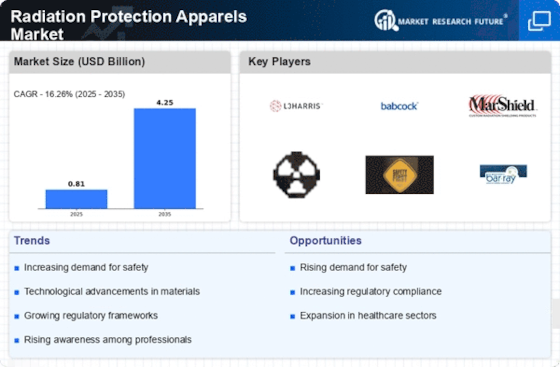
As per Market Research Future analysis, the Radiation Protection Apparels Market Size was estimated at 0.81 USD Billion in 2024. The Radiation Protection Apparels industry is projected to grow from 0.9417 USD Billion in 2025 to 4.249 USD Billion by 2035, exhibiting a compound annual growth rate (CAGR) of 16.26% during the forecast period 2025 - 2035

Key Market Trends & Highlights

The Radiation Protection Apparels Market is experiencing a dynamic shift driven by technological advancements and regulatory influences.

  • Technological advancements in materials are enhancing the effectiveness of radiation protection apparels, particularly in North America. The integration of smart technologies is becoming increasingly prevalent, especially in the Asia-Pacific region, indicating a trend towards more sophisticated protective gear. Lead-free aprons dominate the market, while lead-based options are witnessing rapid growth due to evolving consumer preferences. Increasing awareness of radiation risks and stringent regulatory standards are key drivers propelling market expansion.

Market Size & Forecast

2024 Market Size 0.81 (USD Billion)
2035 Market Size 4.249 (USD Billion)
CAGR (2025 - 2035) 16.26%
Largest Regional Market Share in 2024 North America

Major Players

L3Harris Technologies (US), Babcock International Group (GB), MarShield (CA), Radiation Protection Products (US), Global Safety First (US), Kiran Radiology (IN), Bar-Ray Products (US), Shielding International (US)

Market Trends

The Radiation Protection Apparels Market is currently experiencing a notable evolution, driven by increasing awareness regarding the potential hazards associated with radiation exposure. This heightened consciousness is prompting various sectors, including healthcare, nuclear energy, and industrial applications, to prioritize safety measures. Consequently, there is a growing demand for specialized apparel designed to shield individuals from harmful radiation.

Manufacturers are responding to this trend by innovating materials and designs that enhance protection while ensuring comfort and usability. As a result, the market landscape is becoming increasingly competitive, with companies striving to differentiate their offerings through advanced technology and superior quality. In addition to the rising demand, regulatory frameworks are also shaping the Radiation Protection Apparels Market.

Governments and health organizations are implementing stringent guidelines to ensure the safety of workers in radiation-prone environments. This regulatory push is likely to drive further investment in research and development, leading to the introduction of more effective protective gear. Moreover, the integration of smart technologies into radiation protection apparel is emerging as a potential game-changer, offering real-time monitoring and enhanced functionality. Overall, the market appears poised for growth, with various factors converging to create a dynamic environment for innovation and expansion.

Technological Advancements in Materials

The Radiation Protection Apparels Market is witnessing a shift towards the incorporation of advanced materials that offer enhanced protective capabilities. Innovations in smart fabric technology are enabling the development of lighter, more flexible, and durable apparel, which could improve user comfort and compliance. This trend suggests a potential for increased adoption across various sectors, as organizations seek to provide effective protection without compromising on mobility.

Regulatory Influence on Market Dynamics

Regulatory bodies are playing a crucial role in shaping the Radiation Protection Apparels Market. Stricter safety standards and guidelines are being established to protect workers in high-risk environments. This regulatory influence may drive manufacturers to invest in compliance and innovation, ensuring that their products meet the evolving requirements of safety and effectiveness.

Integration of Smart Technologies

The integration of smart technologies into radiation protection apparel is emerging as a noteworthy trend. Wearable devices that monitor radiation exposure in real-time could enhance safety measures for users. This development indicates a potential shift towards more interactive and responsive protective gear, which may appeal to a broader audience seeking advanced safety solutions.

Radiation Protection Apparels Market Market Drivers

Growth of the Healthcare Sector

The overall growth of the healthcare sector is a fundamental driver for the Radiation Protection Apparels Market. As healthcare facilities expand and new technologies are adopted, the need for radiation protection apparel becomes increasingly pronounced. The expansion of hospitals, clinics, and diagnostic centers contributes to a higher volume of procedures that involve radiation exposure. Consequently, the demand for protective apparel is likely to increase as healthcare providers prioritize the safety of their staff and patients. Market analysts predict that the healthcare sector's growth will continue to fuel the demand for radiation protection garments, thereby enhancing the market's prospects in the foreseeable future.

Regulatory Standards and Compliance

Regulatory standards play a crucial role in shaping the Radiation Protection Apparels Market. Governments and health organizations have established stringent guidelines to ensure the safety of medical personnel and patients during procedures involving radiation. Compliance with these regulations necessitates the use of appropriate protective apparel, which in turn drives market growth. The enforcement of these standards has led to an increase in demand for certified radiation protection garments, as healthcare facilities seek to mitigate legal liabilities and enhance safety measures. The market is expected to witness a steady increase in demand as compliance becomes more stringent across various regions.

Increasing Awareness of Radiation Risks

The growing awareness of radiation exposure risks among healthcare professionals and patients is a pivotal driver for the Radiation Protection Apparels Market. As medical imaging technologies advance, the potential for radiation exposure increases, prompting a heightened focus on protective measures. This awareness is reflected in the rising demand for protective apparel, as institutions prioritize safety protocols. According to recent data, the market for radiation protection apparel is projected to grow at a compound annual growth rate of approximately 5.2% over the next few years. This trend indicates a shift towards prioritizing safety in medical environments, thereby bolstering the market for radiation protection apparel.

Technological Innovations in Fabrication

Technological innovations in the fabrication of radiation protection materials are significantly influencing the Radiation Protection Apparels Market. Advances in textile technology have led to the development of lighter, more flexible, and effective protective garments. These innovations not only enhance comfort for users but also improve the overall efficacy of radiation shielding. The introduction of new materials, such as lead-free composites, is gaining traction, appealing to environmentally conscious consumers and institutions. As a result, the market is likely to experience a surge in demand for these advanced protective apparel options, reflecting a broader trend towards sustainable practices in healthcare.

Rising Incidence of Cancer and Diagnostic Imaging

The rising incidence of cancer and the increasing reliance on diagnostic imaging techniques are driving the Radiation Protection Apparels Market. As the prevalence of cancer continues to escalate, the demand for imaging procedures, such as X-rays and CT scans, has surged. This trend necessitates the use of effective radiation protection apparel to safeguard both patients and healthcare workers. Market data suggests that the demand for radiation protection garments is expected to rise in tandem with the growth of the diagnostic imaging market, which is projected to expand significantly in the coming years. This correlation underscores the critical role of protective apparel in modern healthcare.

Market Segment Insights

By Material: Lead-Free (Largest) vs. Lead-Based (Fastest-Growing)

In the Radiation Protection Apparels Market, the material segment is divided into three categories: Lead-Free, Lead-Based, and Light Lead Composite. Among these, Lead-Free apparel has captured the largest share due to its lightweight, comfort, and increasing demand for less hazardous options. Lead-Based garments, while traditionally popular for their effective protection, are witnessing a decline as health concerns rise in various industries. The Light Lead Composite segment is smaller but is gradually gaining traction.

Lead-Free (Dominant) vs. Lead-Based (Emerging)

Lead-Free radiation protection apparel is characterized by its innovative materials that provide safety without the use of traditional lead, making them highly sought after for their lightweight and comfort. This segment appeals particularly to users in the medical sector who prioritize both protection and dexterity. On the other hand, Lead-Based apparel, while still effective, is considered an emerging segment as environmental regulations and health concerns drive the market towards safer alternatives. Consequently, manufacturers are working on improving the efficacy and comfort of Lead-Based options to retain their market position.

By Product Type: Aprons (Largest) vs. Gloves (Fastest-Growing)

In the Radiation Protection Apparels Market, aprons hold the largest market share due to their widespread usage in various medical and industrial applications. The protection offered by aprons against ionizing radiation makes them essential in settings like hospitals and laboratories where exposure risk is significant. Meanwhile, gloves have emerged as the fastest-growing segment, increasingly adopted for procedures that require dexterity and protection, such as interventional radiology and surgical operations, reflecting changing industry standards and growing awareness regarding safety practices. The growth trends in this segment are driven by advancements in material technologies that enhance comfort and protection. As regulations around safety in medical and industrial sectors become stringent, the demand for specialized radiation protection apparel, particularly gloves, is experiencing a notable uptick. Increased awareness around health hazards associated with radiation exposure has further propelled the adoption of safety apparel, making gloves a focal point for innovation and growth within the market.

Aprons (Dominant) vs. Gloves (Emerging)

Aprons are currently the dominant product type in the Radiation Protection Apparels Market, mainly due to their effectiveness in shielding vital organs from radiation exposure. Commonly made from lead or alternatives like lead-free materials, these aprons provide comprehensive coverage and comfort for users, which has solidified their role across multiple healthcare and industrial applications. On the other hand, gloves have emerged as an important segment, catering to situations where both protection and flexibility are essential. The increasing complexity of radiological procedures has driven this segment to innovate, with materials focusing on lightweight and flexible designs that still comply with safety standards. Although gloves represent a smaller share compared to aprons, their growing adoption reflects a shift towards more specialized and versatile radiation protection solutions.

By End Use: Hospitals and Clinics (Largest) vs. Research Laboratories (Fastest-Growing)

The 'End Use' segment of the Radiation Protection Apparels Market showcases a diverse range of applications, with hospitals and clinics leading in market share. This segment is driven by the growing demand for safety protocols and protective gear in clinical environments where radiation exposure is a concern. Meanwhile, diagnostic centers and specialty clinics also contribute significantly, though they follow behind hospitals in terms of overall market presence. Other end users, while smaller in size, nonetheless add variability to the segment's landscape. The growth trends within the end-use sector indicate a rising emphasis on patient safety and staff protection in healthcare settings. Research laboratories are emerging as the fastest-growing segment, fueled by advancements in radiation-related studies and regulatory requirements that demand high standards of safety apparel. This focus on innovation and research underlines the increasing importance of protective garments as laboratories expand their capabilities and face new challenges in radiation exposure risks.

Hospitals and Clinics (Dominant) vs. Research Laboratories (Emerging)

Hospitals and clinics currently dominate the radiation protection apparels market due to their extensive need for protective gear in everyday operations. This segment prioritizes staff and patient safety, particularly in departments involving radiology and surgical procedures. In contrast, research laboratories represent an emerging segment, demonstrating rapid growth as new technologies and research methodologies materialize. These laboratories require specialized radiation protection wear to safeguard researchers and staff engaged in advanced experimental processes. The drive toward enhanced research capabilities necessitates that these facilities adopt state-of-the-art protective apparel, effectively bridging clinical practice and laboratory innovation.

Get more detailed insights about Radiation Protection Apparels Market Research Report – Forecast till 2035

Regional Insights

North America : Leading Innovation and Demand

The North American market for radiation protection apparels is driven by stringent regulatory standards and increasing awareness of radiation safety. The region holds approximately 45% of the global market share, making it the largest market. The demand is further fueled by advancements in technology and a growing healthcare sector that prioritizes safety measures. Regulatory bodies like the FDA and OSHA play a crucial role in shaping market dynamics, ensuring compliance and safety in medical environments. The United States is the dominant player in this region, with key companies such as L3Harris Technologies and Radiation Protection Products leading the market. Canada also contributes significantly, with firms like MarShield enhancing the competitive landscape. The presence of established players and ongoing innovations in product offerings are expected to sustain growth in this sector, making North America a focal point for radiation protection apparel.

Europe : Regulatory Framework Driving Growth

Europe is witnessing a robust growth trajectory in the radiation protection apparels market, driven by comprehensive regulatory frameworks and increasing healthcare investments. The region accounts for approximately 30% of the global market share, making it the second-largest market. The germany radiation protection apparels market leads due to strong industrial and healthcare infrastructure, while the france radiation protection apparels market is expanding with increased focus on safety compliance and innovation. Leading countries such as Germany, the UK, and France are at the forefront of this market, with companies like Babcock International Group and Bar-Ray Products enhancing competition. The presence of innovative manufacturers and a focus on research and development are key factors contributing to market expansion. As healthcare facilities increasingly prioritize safety, the demand for high-quality radiation protection apparel is expected to rise significantly.

Asia-Pacific : Emerging Markets and Opportunities

The Asia-Pacific region is emerging as a significant player in the radiation protection apparels market, driven by rapid industrialization and increasing healthcare expenditures. This region holds approximately 20% of the global market share, The china radiation protection apparels market is a key growth driver due to rapid industrialization and increasing healthcare investments. Similarly, the india radiation protection apparels market is expanding with rising awareness and improvements in healthcare infrastructure. The japan radiation protection apparels market stands out for its advanced technology adoption and stringent safety standards. India is particularly noteworthy, with companies like Kiran Radiology making strides in the market. The competitive landscape is characterized by a mix of local and international players, fostering innovation and affordability. As the region continues to develop its healthcare infrastructure, the demand for radiation protection apparel is expected to surge, presenting ample opportunities for growth and investment.

Middle East and Africa : Untapped Potential and Growth

The Middle East and Africa region is gradually recognizing the importance of radiation protection apparels, driven by increasing healthcare investments and awareness of safety standards. This region currently holds about 5% of the global market share, indicating significant untapped potential. The growth is supported by government initiatives aimed at improving healthcare infrastructure and regulatory frameworks that promote safety in medical practices. The gcc radiation protection apparels market is gaining traction, particularly in countries like the UAE, where healthcare modernization is a priority. Countries like South Africa and the UAE are leading the way in adopting radiation protection measures, with a growing number of healthcare facilities prioritizing safety. The competitive landscape is still developing, with opportunities for both local and international players to enter the market. As awareness continues to grow, the demand for radiation protection apparel is expected to increase, paving the way for future growth in this region.

Key Players and Competitive Insights

The Radiation Protection Apparels Market is characterized by a dynamic competitive landscape, driven by increasing awareness of radiation hazards and the need for protective gear across various sectors, including healthcare, nuclear energy, and industrial applications. Key players such as L3Harris Technologies (US), Babcock International Group (GB), and MarShield (CA) are strategically positioned to leverage innovation and technological advancements. L3Harris Technologies (US) focuses on integrating advanced materials into their product lines, enhancing the protective capabilities of their apparel. Meanwhile, Babcock International Group (GB) emphasizes partnerships with healthcare institutions to expand its market reach, while MarShield (CA) is dedicated to regional expansion, particularly in North America, to cater to the growing demand for radiation protection solutions. The business tactics employed by these companies reflect a concerted effort to optimize supply chains and localize manufacturing processes. The market structure appears moderately fragmented, with several players vying for market share. However, the collective influence of these key players is significant, as they drive innovation and set industry standards. Their strategies not only enhance their competitive positioning but also contribute to the overall growth of the market. In August 2025, L3Harris Technologies (US) announced a collaboration with a leading healthcare provider to develop next-generation radiation protection apparel utilizing smart textiles. This strategic move is likely to enhance their product offerings and cater to the evolving needs of healthcare professionals, thereby solidifying their market position. Similarly, in July 2025, Babcock International Group (GB) secured a contract with a major nuclear facility to supply customized radiation protection gear, indicating their commitment to meeting specific industry requirements and reinforcing their reputation as a trusted supplier. In September 2025, MarShield (CA) launched a new line of lightweight, flexible radiation protection garments designed for use in medical imaging environments. This innovation not only addresses the comfort and mobility concerns of healthcare workers but also positions MarShield as a forward-thinking player in the market. The introduction of such products suggests a shift towards more user-friendly solutions, which could attract a broader customer base. As of October 2025, the competitive trends in the Radiation Protection Apparels Market are increasingly defined by digitalization, sustainability, and the integration of artificial intelligence. Companies are forming strategic alliances to enhance their technological capabilities and improve product offerings. This shift indicates a movement away from traditional price-based competition towards a focus on innovation, technology, and supply chain reliability. Looking ahead, it seems that competitive differentiation will increasingly hinge on the ability to innovate and adapt to changing market demands, thereby ensuring long-term sustainability and growth.

Key Companies in the Radiation Protection Apparels Market include

Industry Developments

November 2021:In medical radiation, MAVIG has introduced a new line of X-ray protective apparel and accessories. This includes its proprietary Balance RA631 series vest and skirt for all-around protection with unique characteristics that notably set it apart from other two-piece models.

March 2020:The 903 Reverse Vest & Skirt Line from INFAB Corporation is extremely protective against scatter radiation and has a snug and comfortable fit. The 903 Reverse Vest & Skirt is a 2-piece outfit that offers complete wraparound protection. It is specifically made to distribute weight between the shoulders and waist equally.

Future Outlook

Radiation Protection Apparels Market Future Outlook

The Radiation Protection Apparels Market is projected to grow at a 16.26% CAGR from 2025 to 2035, driven by increasing regulatory standards and technological advancements.

New opportunities lie in:

  • <p>Development of customizable radiation protection solutions for diverse industries. Expansion into emerging markets with tailored product offerings. Integration of smart textiles for enhanced user safety and comfort.</p>

By 2035, the market is expected to achieve substantial growth, positioning itself as a leader in safety apparel.

Market Segmentation

Radiation Protection Apparels Market End Use Outlook

  • Hospitals and Clinics
  • Diagnostic Centers
  • Research Laboratories
  • Specialty Clinics
  • Others

Radiation Protection Apparels Market Material Outlook

  • Lead-Free
  • Lead-Based
  • Light Lead Composite

Radiation Protection Apparels Market Product Type Outlook

  • Aprons
  • Gloves
  • Head Shields
  • Thyroid Shields
  • Others

Report Scope

MARKET SIZE 2024 0.81(USD Billion)
MARKET SIZE 2025 0.9417(USD Billion)
MARKET SIZE 2035 4.249(USD Billion)
COMPOUND ANNUAL GROWTH RATE (CAGR) 16.26% (2025 - 2035)
REPORT COVERAGE Revenue Forecast, Competitive Landscape, Growth Factors, and Trends
BASE YEAR 2024
Market Forecast Period 2025 - 2035
Historical Data 2019 - 2024
Market Forecast Units USD Billion
Key Companies Profiled L3Harris Technologies (US), Babcock International Group (GB), MarShield (CA), Radiation Protection Products (US), Global Safety First (US), Kiran Radiology (IN), Bar-Ray Products (US), Shielding International (US)
Segments Covered Material, Product Type, End Use, Region
Key Market Opportunities Advancements in materials technology enhance protective capabilities in the Radiation Protection Apparels Market.
Key Market Dynamics Rising regulatory standards and technological advancements drive innovation in the radiation protection apparels market.
Countries Covered North America, Europe, APAC, South America, MEA

FAQs

What is the projected market valuation for the Radiation Protection Apparels Market in 2035?

<p>The projected market valuation for the Radiation Protection Apparels Market in 2035 is 4.249 USD Billion.</p>

What was the market valuation for Radiation Protection Apparels in 2024?

<p>The market valuation for Radiation Protection Apparels in 2024 was 0.81 USD Billion.</p>

What is the expected CAGR for the Radiation Protection Apparels Market from 2025 to 2035?

<p>The expected CAGR for the Radiation Protection Apparels Market during the forecast period 2025 - 2035 is 16.26%.</p>

Which companies are considered key players in the Radiation Protection Apparels Market?

<p>Key players in the Radiation Protection Apparels Market include L3Harris Technologies, Babcock International Group, MarShield, and others.</p>

What are the main product types in the Radiation Protection Apparels Market?

<p>Main product types in the market include aprons, gloves, head shields, and thyroid shields.</p>

How did the valuation of lead-based radiation protection apparel compare to lead-free in 2024?

<p>In 2024, the valuation for lead-based radiation protection apparel was 0.35 USD Billion, compared to 0.25 USD Billion for lead-free.</p>

What segment is expected to have the highest valuation in 2035 within the Radiation Protection Apparels Market?

The segment expected to have the highest valuation in 2035 is lead-based apparel, projected to reach 1.75 USD Billion.

What end-use segment contributed the most to the market in 2024?

In 2024, hospitals and clinics contributed the most to the market, with a valuation of 0.324 USD Billion.

What is the projected growth for gloves in the Radiation Protection Apparels Market by 2035?

The projected valuation for gloves in the Radiation Protection Apparels Market is expected to reach 0.844 USD Billion by 2035.

How does the market for thyroid shields compare to head shields in terms of valuation in 2024?

In 2024, the market valuation for thyroid shields was 0.162 USD Billion, while head shields were valued at 0.081 USD Billion.

  1. SECTION I: EXECUTIVE SUMMARY AND KEY HIGHLIGHTS |
    1. EXECUTIVE SUMMARY | |
      1. Market Overview | |
      2. Key Findings | |
      3. Market Segmentation | |
      4. Competitive Landscape | |
      5. Challenges and Opportunities | |
      6. Future Outlook 2
  2. SECTION II: SCOPING, METHODOLOGY AND MARKET STRUCTURE |
    1. MARKET INTRODUCTION | |
      1. Definition | |
      2. Scope of the study | | |
    2. RESEARCH METHODOLOGY | |
      1. Overview | |
      2. Data Mining | |
      3. Secondary Research | |
      4. Primary Research | | |
      5. Forecasting Model | |
      6. Market Size Estimation | | |
      7. Data Triangulation | |
      8. Validation 3
  3. SECTION III: QUALITATIVE ANALYSIS |
    1. MARKET DYNAMICS | |
      1. Overview | |
      2. Drivers | |
      3. Restraints | |
      4. Opportunities |
    2. MARKET FACTOR ANALYSIS | |
      1. Value chain Analysis | |
      2. Porter's Five Forces Analysis | | |
      3. COVID-19 Impact Analysis | | |
  4. SECTION IV: QUANTITATIVE ANALYSIS |
    1. Healthcare, BY Material (USD Billion) | |
      1. Lead-Free | |
      2. Lead-Based | |
      3. Light Lead Composite |
    2. Healthcare, BY Product Type (USD Billion) | |
      1. Aprons | |
      2. Gloves | |
      3. Head Shields | |
      4. Thyroid Shields | |
      5. Others |
    3. Healthcare, BY End Use (USD Billion) | |
      1. Hospitals and Clinics | |
      2. Diagnostic Centers | |
      3. Research Laboratories | |
      4. Specialty Clinics | |
      5. Others |
    4. Healthcare, BY Region (USD Billion) | |
      1. North America | | |
      2. Europe | | |
      3. APAC | | |
      4. South America | | |
      5. MEA | | |
  5. SECTION V: COMPETITIVE ANALYSIS |
    1. Competitive Landscape | |
      1. Overview | |
      2. Competitive Analysis | |
      3. Market share Analysis | |
      4. Major Growth Strategy in the Healthcare | |
      5. Competitive Benchmarking | |
      6. Leading Players in Terms of Number of Developments in the Healthcare | |
      7. Key developments and growth strategies | | |
      8. Major Players Financial Matrix | | |
    2. Company Profiles | |
      1. L3Harris Technologies (US) | | |
      2. Babcock International Group (GB) | | |
      3. MarShield (CA) | | |
      4. Radiation Protection Products (US) | | |
      5. Global Safety First (US) | | |
      6. Kiran Radiology (IN) | | |
      7. Bar-Ray Products (US) | | |
      8. Shielding International (US) | | |
    3. Appendix | |
      1. References | |
      2. Related Reports 6 LIST OF FIGURES |
    4. MARKET SYNOPSIS |
    5. NORTH AMERICA MARKET ANALYSIS |
    6. US MARKET ANALYSIS BY MATERIAL |
    7. US MARKET ANALYSIS BY PRODUCT TYPE |
    8. US MARKET ANALYSIS BY END USE |
    9. CANADA MARKET ANALYSIS BY MATERIAL |
    10. CANADA MARKET ANALYSIS BY PRODUCT TYPE |
    11. CANADA MARKET ANALYSIS BY END USE |
    12. EUROPE MARKET ANALYSIS |
    13. GERMANY MARKET ANALYSIS BY MATERIAL |
    14. GERMANY MARKET ANALYSIS BY PRODUCT TYPE |
    15. GERMANY MARKET ANALYSIS BY END USE |
    16. UK MARKET ANALYSIS BY MATERIAL |
    17. UK MARKET ANALYSIS BY PRODUCT TYPE |
    18. UK MARKET ANALYSIS BY END USE |
    19. FRANCE MARKET ANALYSIS BY MATERIAL |
    20. FRANCE MARKET ANALYSIS BY PRODUCT TYPE |
    21. FRANCE MARKET ANALYSIS BY END USE |
    22. RUSSIA MARKET ANALYSIS BY MATERIAL |
    23. RUSSIA MARKET ANALYSIS BY PRODUCT TYPE |
    24. RUSSIA MARKET ANALYSIS BY END USE |
    25. ITALY MARKET ANALYSIS BY MATERIAL |
    26. ITALY MARKET ANALYSIS BY PRODUCT TYPE |
    27. ITALY MARKET ANALYSIS BY END USE |
    28. SPAIN MARKET ANALYSIS BY MATERIAL |
    29. SPAIN MARKET ANALYSIS BY PRODUCT TYPE |
    30. SPAIN MARKET ANALYSIS BY END USE |
    31. REST OF EUROPE MARKET ANALYSIS BY MATERIAL |
    32. REST OF EUROPE MARKET ANALYSIS BY PRODUCT TYPE |
    33. REST OF EUROPE MARKET ANALYSIS BY END USE |
    34. APAC MARKET ANALYSIS |
    35. CHINA MARKET ANALYSIS BY MATERIAL |
    36. CHINA MARKET ANALYSIS BY PRODUCT TYPE |
    37. CHINA MARKET ANALYSIS BY END USE |
    38. INDIA MARKET ANALYSIS BY MATERIAL |
    39. INDIA MARKET ANALYSIS BY PRODUCT TYPE |
    40. INDIA MARKET ANALYSIS BY END USE |
    41. JAPAN MARKET ANALYSIS BY MATERIAL |
    42. JAPAN MARKET ANALYSIS BY PRODUCT TYPE |
    43. JAPAN MARKET ANALYSIS BY END USE |
    44. SOUTH KOREA MARKET ANALYSIS BY MATERIAL |
    45. SOUTH KOREA MARKET ANALYSIS BY PRODUCT TYPE |
    46. SOUTH KOREA MARKET ANALYSIS BY END USE |
    47. MALAYSIA MARKET ANALYSIS BY MATERIAL |
    48. MALAYSIA MARKET ANALYSIS BY PRODUCT TYPE |
    49. MALAYSIA MARKET ANALYSIS BY END USE |
    50. THAILAND MARKET ANALYSIS BY MATERIAL |
    51. THAILAND MARKET ANALYSIS BY PRODUCT TYPE |
    52. THAILAND MARKET ANALYSIS BY END USE |
    53. INDONESIA MARKET ANALYSIS BY MATERIAL |
    54. INDONESIA MARKET ANALYSIS BY PRODUCT TYPE |
    55. INDONESIA MARKET ANALYSIS BY END USE |
    56. REST OF APAC MARKET ANALYSIS BY MATERIAL |
    57. REST OF APAC MARKET ANALYSIS BY PRODUCT TYPE |
    58. REST OF APAC MARKET ANALYSIS BY END USE |
    59. SOUTH AMERICA MARKET ANALYSIS |
    60. BRAZIL MARKET ANALYSIS BY MATERIAL |
    61. BRAZIL MARKET ANALYSIS BY PRODUCT TYPE |
    62. BRAZIL MARKET ANALYSIS BY END USE |
    63. MEXICO MARKET ANALYSIS BY MATERIAL |
    64. MEXICO MARKET ANALYSIS BY PRODUCT TYPE |
    65. MEXICO MARKET ANALYSIS BY END USE |
    66. ARGENTINA MARKET ANALYSIS BY MATERIAL |
    67. ARGENTINA MARKET ANALYSIS BY PRODUCT TYPE |
    68. ARGENTINA MARKET ANALYSIS BY END USE |
    69. REST OF SOUTH AMERICA MARKET ANALYSIS BY MATERIAL |
    70. REST OF SOUTH AMERICA MARKET ANALYSIS BY PRODUCT TYPE |
    71. REST OF SOUTH AMERICA MARKET ANALYSIS BY END USE |
    72. MEA MARKET ANALYSIS |
    73. GCC COUNTRIES MARKET ANALYSIS BY MATERIAL |
    74. GCC COUNTRIES MARKET ANALYSIS BY PRODUCT TYPE |
    75. GCC COUNTRIES MARKET ANALYSIS BY END USE |
    76. SOUTH AFRICA MARKET ANALYSIS BY MATERIAL |
    77. SOUTH AFRICA MARKET ANALYSIS BY PRODUCT TYPE |
    78. SOUTH AFRICA MARKET ANALYSIS BY END USE |
    79. REST OF MEA MARKET ANALYSIS BY MATERIAL |
    80. REST OF MEA MARKET ANALYSIS BY PRODUCT TYPE |
    81. REST OF MEA MARKET ANALYSIS BY END USE |
    82. KEY BUYING CRITERIA OF HEALTHCARE |
    83. RESEARCH PROCESS OF MRFR |
    84. DRO ANALYSIS OF HEALTHCARE |
    85. DRIVERS IMPACT ANALYSIS: HEALTHCARE |
    86. RESTRAINTS IMPACT ANALYSIS: HEALTHCARE |
    87. SUPPLY / VALUE CHAIN: HEALTHCARE |
    88. HEALTHCARE, BY MATERIAL, 2024 (% SHARE) |
    89. HEALTHCARE, BY MATERIAL, 2024 TO 2035 (USD Billion) |
    90. HEALTHCARE, BY PRODUCT TYPE, 2024 (% SHARE) |
    91. HEALTHCARE, BY PRODUCT TYPE, 2024 TO 2035 (USD Billion) |
    92. HEALTHCARE, BY END USE, 2024 (% SHARE) |
    93. HEALTHCARE, BY END USE, 2024 TO 2035 (USD Billion) |
    94. BENCHMARKING OF MAJOR COMPETITORS 7 LIST OF TABLES |
    95. LIST OF ASSUMPTIONS | |
      1. |
    96. North America MARKET SIZE ESTIMATES; FORECAST | |
      1. BY MATERIAL, 2025-2035 (USD Billion) | |
      2. BY PRODUCT TYPE, 2025-2035 (USD Billion) | |
      3. BY END USE, 2025-2035 (USD Billion) |
    97. US MARKET SIZE ESTIMATES; FORECAST | |
      1. BY MATERIAL, 2025-2035 (USD Billion) | |
      2. BY PRODUCT TYPE, 2025-2035 (USD Billion) | |
      3. BY END USE, 2025-2035 (USD Billion) |
    98. Canada MARKET SIZE ESTIMATES; FORECAST | |
      1. BY MATERIAL, 2025-2035 (USD Billion) | |
      2. BY PRODUCT TYPE, 2025-2035 (USD Billion) | |
      3. BY END USE, 2025-2035 (USD Billion) |
    99. Europe MARKET SIZE ESTIMATES; FORECAST | |
      1. BY MATERIAL, 2025-2035 (USD Billion) | |
      2. BY PRODUCT TYPE, 2025-2035 (USD Billion) | |
      3. BY END USE, 2025-2035 (USD Billion) |
    100. Germany MARKET SIZE ESTIMATES; FORECAST | |
      1. BY MATERIAL, 2025-2035 (USD Billion) | |
      2. BY PRODUCT TYPE, 2025-2035 (USD Billion) | |
      3. BY END USE, 2025-2035 (USD Billion) |
    101. UK MARKET SIZE ESTIMATES; FORECAST | |
      1. BY MATERIAL, 2025-2035 (USD Billion) | |
      2. BY PRODUCT TYPE, 2025-2035 (USD Billion) | |
      3. BY END USE, 2025-2035 (USD Billion) |
    102. France MARKET SIZE ESTIMATES; FORECAST | |
      1. BY MATERIAL, 2025-2035 (USD Billion) | |
      2. BY PRODUCT TYPE, 2025-2035 (USD Billion) | |
      3. BY END USE, 2025-2035 (USD Billion) |
    103. Russia MARKET SIZE ESTIMATES; FORECAST | |
      1. BY MATERIAL, 2025-2035 (USD Billion) | |
      2. BY PRODUCT TYPE, 2025-2035 (USD Billion) | |
      3. BY END USE, 2025-2035 (USD Billion) |
    104. Italy MARKET SIZE ESTIMATES; FORECAST | |
      1. BY MATERIAL, 2025-2035 (USD Billion) | |
      2. BY PRODUCT TYPE, 2025-2035 (USD Billion) | |
      3. BY END USE, 2025-2035 (USD Billion) |
    105. Spain MARKET SIZE ESTIMATES; FORECAST | |
      1. BY MATERIAL, 2025-2035 (USD Billion) | |
      2. BY PRODUCT TYPE, 2025-2035 (USD Billion) | |
      3. BY END USE, 2025-2035 (USD Billion) |
    106. Rest of Europe MARKET SIZE ESTIMATES; FORECAST | |
      1. BY MATERIAL, 2025-2035 (USD Billion) | |
      2. BY PRODUCT TYPE, 2025-2035 (USD Billion) | |
      3. BY END USE, 2025-2035 (USD Billion) |
    107. APAC MARKET SIZE ESTIMATES; FORECAST | |
      1. BY MATERIAL, 2025-2035 (USD Billion) | |
      2. BY PRODUCT TYPE, 2025-2035 (USD Billion) | |
      3. BY END USE, 2025-2035 (USD Billion) |
    108. China MARKET SIZE ESTIMATES; FORECAST | |
      1. BY MATERIAL, 2025-2035 (USD Billion) | |
      2. BY PRODUCT TYPE, 2025-2035 (USD Billion) | |
      3. BY END USE, 2025-2035 (USD Billion) |
    109. India MARKET SIZE ESTIMATES; FORECAST | |
      1. BY MATERIAL, 2025-2035 (USD Billion) | |
      2. BY PRODUCT TYPE, 2025-2035 (USD Billion) | |
      3. BY END USE, 2025-2035 (USD Billion) |
    110. Japan MARKET SIZE ESTIMATES; FORECAST | |
      1. BY MATERIAL, 2025-2035 (USD Billion) | |
      2. BY PRODUCT TYPE, 2025-2035 (USD Billion) | |
      3. BY END USE, 2025-2035 (USD Billion) |
    111. South Korea MARKET SIZE ESTIMATES; FORECAST | |
      1. BY MATERIAL, 2025-2035 (USD Billion) | |
      2. BY PRODUCT TYPE, 2025-2035 (USD Billion) | |
      3. BY END USE, 2025-2035 (USD Billion) |
    112. Malaysia MARKET SIZE ESTIMATES; FORECAST | |
      1. BY MATERIAL, 2025-2035 (USD Billion) | |
      2. BY PRODUCT TYPE, 2025-2035 (USD Billion) | |
      3. BY END USE, 2025-2035 (USD Billion) |
    113. Thailand MARKET SIZE ESTIMATES; FORECAST | |
      1. BY MATERIAL, 2025-2035 (USD Billion) | |
      2. BY PRODUCT TYPE, 2025-2035 (USD Billion) | |
      3. BY END USE, 2025-2035 (USD Billion) |
    114. Indonesia MARKET SIZE ESTIMATES; FORECAST | |
      1. BY MATERIAL, 2025-2035 (USD Billion) | |
      2. BY PRODUCT TYPE, 2025-2035 (USD Billion) | |
      3. BY END USE, 2025-2035 (USD Billion) |
    115. Rest of APAC MARKET SIZE ESTIMATES; FORECAST | |
      1. BY MATERIAL, 2025-2035 (USD Billion) | |
      2. BY PRODUCT TYPE, 2025-2035 (USD Billion) | |
      3. BY END USE, 2025-2035 (USD Billion) |
    116. South America MARKET SIZE ESTIMATES; FORECAST | |
      1. BY MATERIAL, 2025-2035 (USD Billion) | |
      2. BY PRODUCT TYPE, 2025-2035 (USD Billion) | |
      3. BY END USE, 2025-2035 (USD Billion) |
    117. Brazil MARKET SIZE ESTIMATES; FORECAST | |
      1. BY MATERIAL, 2025-2035 (USD Billion) | |
      2. BY PRODUCT TYPE, 2025-2035 (USD Billion) | |
      3. BY END USE, 2025-2035 (USD Billion) |
    118. Mexico MARKET SIZE ESTIMATES; FORECAST | |
      1. BY MATERIAL, 2025-2035 (USD Billion) | |
      2. BY PRODUCT TYPE, 2025-2035 (USD Billion) | |
      3. BY END USE, 2025-2035 (USD Billion) |
    119. Argentina MARKET SIZE ESTIMATES; FORECAST | |
      1. BY MATERIAL, 2025-2035 (USD Billion) | |
      2. BY PRODUCT TYPE, 2025-2035 (USD Billion) | |
      3. BY END USE, 2025-2035 (USD Billion) |
    120. Rest of South America MARKET SIZE ESTIMATES; FORECAST | |
      1. BY MATERIAL, 2025-2035 (USD Billion) | |
      2. BY PRODUCT TYPE, 2025-2035 (USD Billion) | |
      3. BY END USE, 2025-2035 (USD Billion) |
    121. MEA MARKET SIZE ESTIMATES; FORECAST | |
      1. BY MATERIAL, 2025-2035 (USD Billion) | |
      2. BY PRODUCT TYPE, 2025-2035 (USD Billion) | |
      3. BY END USE, 2025-2035 (USD Billion) |
    122. GCC Countries MARKET SIZE ESTIMATES; FORECAST | |
      1. BY MATERIAL, 2025-2035 (USD Billion) | |
      2. BY PRODUCT TYPE, 2025-2035 (USD Billion) | |
      3. BY END USE, 2025-2035 (USD Billion) |
    123. South Africa MARKET SIZE ESTIMATES; FORECAST | |
      1. BY MATERIAL, 2025-2035 (USD Billion) | |
      2. BY PRODUCT TYPE, 2025-2035 (USD Billion) | |
      3. BY END USE, 2025-2035 (USD Billion) |
    124. Rest of MEA MARKET SIZE ESTIMATES; FORECAST | |
      1. BY MATERIAL, 2025-2035 (USD Billion) | |
      2. BY PRODUCT TYPE, 2025-2035 (USD Billion) | |
      3. BY END USE, 2025-2035 (USD Billion) |
    125. PRODUCT LAUNCH/PRODUCT DEVELOPMENT/APPROVAL | |
      1. |
    126. ACQUISITION/PARTNERSHIP | |

Healthcare Market Segmentation

Healthcare By Material (USD Billion, 2025-2035)

  • Lead-Free
  • Lead-Based
  • Light Lead Composite

Healthcare By Product Type (USD Billion, 2025-2035)

  • Aprons
  • Gloves
  • Head Shields
  • Thyroid Shields
  • Others

Healthcare By End Use (USD Billion, 2025-2035)

  • Hospitals and Clinics
  • Diagnostic Centers
  • Research Laboratories
  • Specialty Clinics
  • Others
Infographic

Free Sample Request

Kindly complete the form below to receive a free sample of this Report

Get Free Sample

Customer Strories

Compare Licence

×
Features License Type
Single User Multiuser License Enterprise User
Price $4,950 $5,950 $7,250
Maximum User Access Limit 1 User Upto 10 Users Unrestricted Access Throughout the Organization
Free Customization
Direct Access to Analyst
Deliverable Format
Platform Access
Discount on Next Purchase 10% 15% 15%
Printable Versions
%>