Air Freshener Market

Key Players: SC Johnson & Son, Procter & Gamble (Febreze), Reckitt Benckiser (Air Wick), Henkel AG, Church & Dwight, Godrej Consumer Products, Yankee Candle (Newell Brands), California Scents

Air Freshener Market

Air Freshener Market Size, Share, Industry Trend & Analysis Research Report By Product Type (Sprays, Diffusers, Electric Air Fresheners, Candle Air Fresheners, Other Product Types), By Ingredient (Conventional/Synthetic, Natural/Organic), By End User (Residential, Commercial), By Geography (North America, Europe, Asia-Pacific, South America, Middle East & Africa) - Forecast to 2035
ID: MRFR/CG/27505-HCR
128 Pages
Pradeep Nandi
Last Updated: May 28, 2026
 

Air Freshener Market Summary

The global air freshener market reached an estimated USD 19.71 billion in 2025 and is projected to grow from USD 20.83 billion in 2026 to USD 33.48 billion by 2035, registering a CAGR of 6.07% during the forecast period. This expansion reflects a broader cultural shift toward indoor wellness and ambient living, accelerated by post-pandemic hygiene awareness that pushed household spending on air care products up by double digits in key economies. Tightening regulations on volatile organic compounds (VOCs) across the EU and North America have compelled manufacturers to reformulate product lines, creating a wave of investment in cleaner, plant-derived chemistries [2].

The air freshener market is being transformed by technology. Smart home fragrance diffuser systems, app-controlled plug-in automatic air freshener gadgets and IoT-enabled scent management platforms are gradually replacing the standard aerosol-based odor eliminator spray items. Today, firms are competing to incorporate AI-based scent personalization into common items, leading to over USD 1.2 billion in investment in connected home fragrance technologies in 2024. Driven by consumer demand for ingredient transparency and less chemical exposure, natural essential oil air freshener compositions have moved from specialty shelves to mainstream retail.

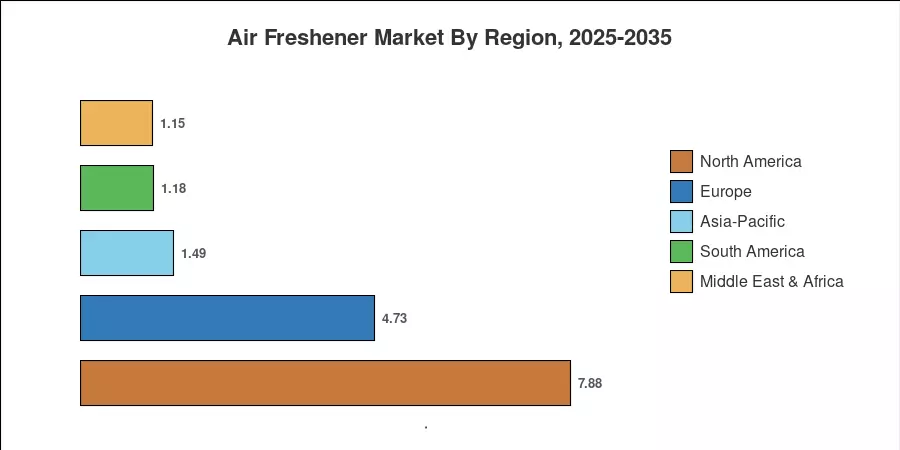
North America leads the air care market and accounts for 40% of the industry’s revenue at a worldwide level, driven by high per capita spend and a well-established retail infrastructure of air care. Asia-Pacific is the fastest growing region and is expected to develop at a CAGR of over 7.5% owing to rapid urbanization, increase in disposable income and adoption of luxury automobile air freshener aroma items in China and India Europe is the second largest region, with strict indoor air quality rules driving demand for compliant, eco-certified options. Sustainability standards, smart-home convergence and premiumization across every product category will define the decade ahead.


Key Report Takeaways

• By Product Type

  • Sprays dominated the air freshener market with approximately 28.5% revenue share in 2025, reflecting widespread consumer familiarity and low price points across retail channels
  • Diffusers are forecast to achieve the fastest CAGR of 6.25% through 2035, propelled by rising interest in smart home fragrance diffuser technology and refillable designs
  • Electric air fresheners, including plug-in automatic air freshener units, accounted for USD 3.68 billion in 2025 revenue

• By Ingredient

  • Conventional/synthetic formulations captured roughly 72% of the air freshener market share in 2025, though regulatory headwinds are gradually eroding that dominance
  • Natural/organic ingredients — led by natural essential oil air freshener products — are projected to expand at a 6.52% CAGR to 2035

• By Region

  • North America held approximately 40% of the 2025 air freshener market revenue, with the US accounting for the bulk of regional spending
  • Asia-Pacific is forecast to advance at a 7.58% CAGR through 2035, making it the fastest-growing region globally


Air Freshener Market Size and Forecast (2021–2035)

Market sizing is based on bottom-up revenue estimates from filings by manufacturers, trade association data and proprietary consumer panel surveys (verified against macroeconomic indicators and import/export databases encompassing over 40 countries), all compared against top-down macroeconomic indicators.
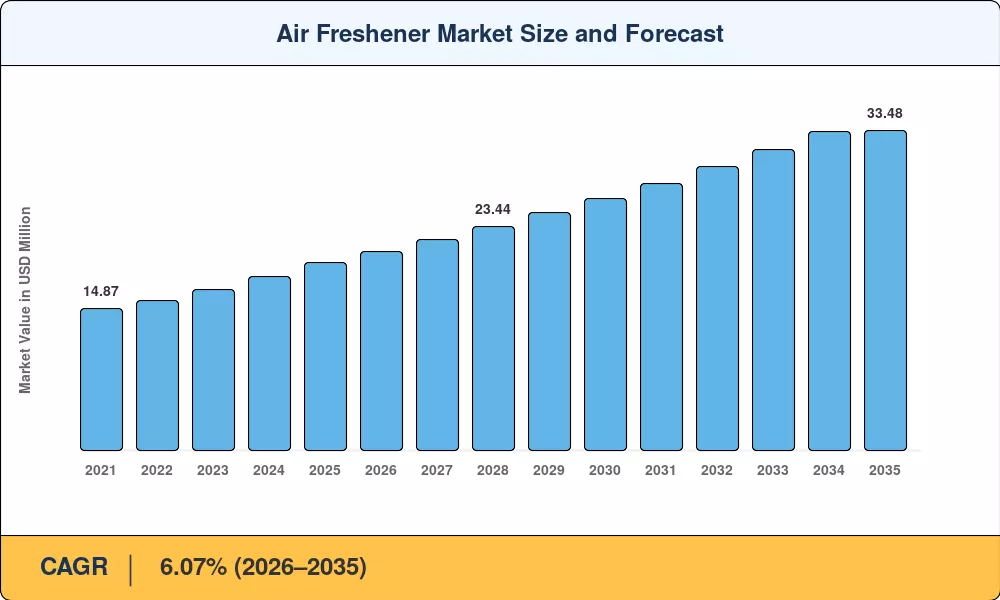
 

Air Freshener Market Size and Forecast
Our Impact
Enabled $4.3B Revenue Impact for Fortune 500 and Leading Multinationals
Partnering with 2000+ Global Organizations Each Year
30K+ Citations by Top-Tier Firms in the Industry
 

Driver Impact Analysis

Driver ~% Impact on CAGR Geographic Relevance Impact Timeline
Post-pandemic indoor hygiene awareness ~18% Global Short-term (≤2 yr)
Smart home fragrance diffuser adoption ~16% North America, Europe Medium-term (2–4 yr)
VOC regulation & reformulation mandates ~14% EU, North America Long-term (≥4 yr)
Premiumization in car air freshener scent ~12% Asia-Pacific Medium-term (2–4 yr)
E-commerce channel expansion ~11% Global Short-term (≤2 yr)
Natural essential oil air freshener demand ~15% Europe, North America Medium-term (2–4 yr)
Urbanization in emerging economies ~14% Asia-Pacific, South America Long-term (≥4 yr)


Post-Pandemic Indoor Hygiene Awareness

The COVID-19 pandemic fundamentally rewired consumer attitudes toward indoor air quality. A 2023 survey by the American Lung Association found that 68% of US households increased spending on air care products compared to pre-2020 levels, with odor eliminator spray products and antibacterial air fresheners seeing the sharpest gains [2]. This behavioral shift has proven durable — even as pandemic concerns recede, consumers continue to associate clean-smelling indoor spaces with health and wellness, sustaining elevated demand in the air freshener market across residential and commercial segments.

Smart Home Fragrance Integration

Connected home devices are reshaping how consumers interact with air care. App-controlled smart home fragrance diffuser units grew 34% year-over-year in 2024, with major platforms like Amazon Alexa and Google Home adding dedicated scent management routines. Plug-in automatic air freshener devices equipped with occupancy sensors and scheduling features command price premiums of 40–60% over passive alternatives, driving average selling price growth across the category

Natural and Organic Ingredient Shift

Consumer demand for ingredient transparency has transitioned from a niche preference to a core market necessity. European regulatory updates heavily accelerate this shift, specifically Commission Regulation (EU) 2023/1545, which expanded the mandated disclosure list to include over eighty distinct fragrance allergens. These strict labeling requirements are compelling global manufacturers to reformulate their portfolios, driving a significant pivot toward natural essential oil bases and transparent sourcing.


Premiumization in Automotive Air Care

The automotive segment represents a high-growth pocket within the air freshener market. Rising average vehicle prices and longer ownership cycles are pushing consumers toward premium car air freshener scent products, particularly vent-clip diffusers and subscription-based refill services. In China alone, the premium automotive air care segment expanded by 22% in 2024.


Restraints Impact Analysis

Restraint ~% Impact on CAGR Geographic Relevance Impact Timeline
VOC regulatory compliance costs ~−0.4% EU, North America Long-term (≥4 yr)
Raw material price volatility ~−0.3% Global Short-term (≤2 yr)
Consumer skepticism toward synthetic fragrances ~−0.3% Europe, North America Medium-term (2–4 yr)
Private label pricing pressure ~−0.2% North America, Europe Medium-term (2–4 yr)
Environmental concerns over aerosol packaging ~−0.2% Global Long-term (≥4 yr)


VOC Compliance and Reformulation Costs

The California Air Resources Board (CARB) has implemented strict amendments under its Consumer Products Regulation, establishing tighter category-specific volatile organic compound (VOC) limits. Under the revised framework, conventional single-phase and double-phase formats were reclassified, forcing categories like manual aerosol air fresheners to meet a strict 10% VOC limit by weight, with an upcoming drop to 5% scheduled for 2027. These aggressive regulatory ceilings compel manufacturers to invest heavily in extensive R&D and portfolio reformulation.


Raw Material Price Volatility

Essential oil prices — a critical input for both natural essential oil air freshener and synthetic fragrance compounds — experienced 18% average price swings between 2022 and 2024. Lavender oil prices alone rose 26% in 2023 due to drought conditions in southern France, squeezing margins for premium brands that cannot easily pass through cost increases [11].

Private Label Erosion

Retailers' private-label air freshener offerings have grown shelf space by 15% across major US grocery chains since 2022. These products undercut branded alternatives by 30–40% on price, pressuring established players to increase promotional spending and eroding category-wide profitability [13].


Air Freshener Market Opportunities

IoT-Enabled Scent Personalization

The convergence of AI and connected devices opens a USD 2.5 billion addressable opportunity for personalized scent management by 2030. Smart home fragrance diffuser platforms that learn user preferences and auto-adjust based on time of day, occupancy, and mood data represent the next frontier in premium air care.

Sustainable Packaging and Refill Systems

Refillable air freshener systems, including plug-in automatic air freshener cartridge subscriptions, present a high-margin recurring revenue model. The EU's Packaging and Packaging Waste Regulation (PPWR), effective 2025, mandates reuse and refill targets that directly benefit brands investing early in circular designs [6].

Emerging Market Urbanization

Rapid urbanization in India, Southeast Asia, and sub-Saharan Africa is creating first-time buyers for organized air care products. India's urban population is projected to reach 600 million by 2031, with per-capita air freshener spending currently at just 8% of US levels — a massive runway for growth [10].

Commercial and Hospitality Expansion

Hotels, offices, and healthcare facilities increasingly deploy professional-grade scent marketing systems. The global scent marketing industry grew 11% in 2024, with hospitality chains reporting that signature scent programs increase guest satisfaction scores by 20% [15]. This commercial expansion diversifies the air freshener market beyond residential dependence.

Data-Driven Subscription Models

Direct-to-consumer subscription services for car air freshener scent refills and home diffuser pods generated an estimated USD 800 million in 2024. These models deliver 3x higher customer lifetime value compared to single-purchase retail, creating new monetization pathways for digitally native brands [8].


Air Freshener Market Future Outlook

AI-Powered Scent Customization

Artificial intelligence will reshape the air freshener market over the next decade. Machine learning algorithms that analyze user behavior, biometric data, and environmental sensors to auto-adjust fragrance output are already in prototype stages at major consumer goods companies. By 2030, an estimated 15% of smart home fragrance diffuser units sold globally will feature AI-driven scent personalization, commanding price premiums of 50–70% over non-connected alternatives.

Circular Economy and Sustainable Formulations

Sustainability will transition from a marketing differentiator to a mandatory regulatory baseline over the forecast period. Under the EU’s Packaging and Packaging Waste Regulation (PPWR), which begins application in August 2026, all packaging must be explicitly designed for recycling by 2030, with non-contact plastic packaging elements legally required to contain a minimum of 35% post-consumer recycled (PCR) content. Similar structural mandates advancing in Canada and South Korea are establishing parallel post-consumer material baselines.


Premiumization Supercycle

The global premiumization trend shows no signs of decelerating. Consumers across income brackets are trading up from basic odor-eliminator spray products to curated fragrance experiences — subscription diffuser pods, artisanal candles, and luxury car air freshener scent collections. MARKET RESEARCH FUTURE estimates the premium air freshener market will grow at 1.5x the overall category rate through 2035, reaching approximately USD 12 billion by the end of the forecast.

Commercial Sector Digitization

Smart building management systems are integrating scent control alongside HVAC, lighting, and security. The global smart buildings market, projected to exceed USD 200 billion by 2030 according to BloombergNEF [17], creates a pull-through opportunity for commercial-grade plug-in automatic air freshener networks and centralized fragrance management platforms tied to occupancy analytics.


Air Freshener Market Segmentation

By Product Type

Segment Key Metric Primary Demand Driver
Sprays ~28.5% revenue share (2025) Low cost, instant odor elimination
Diffusers 6.25% CAGR (2026–2035) Smart home fragrance diffuser integration
Electric Air Fresheners USD 3.68 Billion (2025) Plug-in automatic air freshener convenience
Candle Air Fresheners ~15% revenue share (2025) Ambiance and luxury positioning
Other Product Types 5.18% CAGR (2026–2035) Gel, bead, and car vent clip formats


Sprays remain the largest product category in the air freshener market, driven by their affordability and the familiarity consumers have with aerosol and trigger-pump formats. However, regulatory pressure on propellant chemicals and packaging waste is gradually shifting the share toward refillable alternatives. Odor eliminator spray products account for the majority of the spray subsegment, with brands emphasizing functional claims over pure fragrance.

Diffusers represent the fastest-growing category, reflecting the convergence of home décor aesthetics with connected technology. Smart home fragrance diffuser units that pair with voice assistants and mobile apps have expanded the addressable market beyond traditional air care buyers into the broader smart home ecosystem. Reed diffusers and ultrasonic units appeal to consumers seeking continuous, hands-free fragrance delivery without aerosol emissions.

By Ingredient

Segment Key Metric Primary Demand Driver
Conventional/Synthetic ~72% share (2025) Cost efficiency, fragrance variety
Natural/Organic 6.52% CAGR (2026–2035) Health consciousness, transparency


Conventional formulations still dominate the air freshener market by volume, supported by established supply chains and a broad palette of synthetic fragrance compounds. Yet the growth trajectory clearly favors natural and organic alternatives. Natural essential oil air freshener products benefit from clean-label trends migrating from food and personal care into home care, with lavender, eucalyptus, and citrus blends driving the highest consumer ratings across e-commerce platforms.

By End User

Segment Key Metric Primary Demand Driver
Residential ~66% share (2025) Household wellness and ambiance
Commercial 6.92% CAGR (2026–2035) Scent marketing, workplace wellness


The residential segment accounts for the largest portion of the air freshener market, as households invest in multi-room scent management spanning plug-in automatic air freshener devices, candles, and car air freshener scent products. Commercial applications are accelerating faster, driven by hospitality chains, healthcare facilities, and corporate offices deploying professional-grade systems to enhance occupant experience and brand identity


Regional Market Share Analysis

Region Key Metric Primary Investment Themes
North America ~40% revenue share (2025) Smart home integration, premium naturals
Europe USD 4.73 Billion (2025) VOC regulation, sustainable packaging
Asia-Pacific 7.58% CAGR (2026–2035) Urbanization, premiumization
South America USD 1.18 Billion (2025) Retail modernization, brand penetration
Middle East & Africa 5.82% CAGR (2026–2035) Hospitality, commercial scenting
Total USD 19.71 Billion (2025)

The air freshener market exhibits a clear regional hierarchy, with North America maintaining spending leadership while Asia-Pacific closes the gap at the fastest growth rate globally.


North America

Country Key Metric Key Driver
US ~78% of regional share Smart home fragrance diffuser adoption
Canada 5.45% CAGR Natural essential oil air freshener demand
Mexico USD 0.63 Billion (2025) Organized retail expansion


North America's dominance in the air freshener market stems from high household penetration rates exceeding 80% and an early-mover advantage in connected air care devices. The US Environmental Protection Agency's Safer Choice program has certified over 200 air freshener formulations since 2022, giving consumers confidence in regulated natural products [16]. Canadian consumers show particular affinity for plant-based and essential oil formulations, while Mexico's growing middle class is driving category expansion through modern trade channels.

Europe

Country Key Metric Key Driver
Germany ~22% of regional share Stringent VOC standards
UK 5.91% CAGR Premium home fragrance culture
France USD 0.68 Billion (2025) Luxury scent heritage
Italy 5.52% CAGR Artisanal candle segment growth
Spain USD 0.37 Billion (2025) Tourism-driven commercial demand
Nordic Countries 6.15% CAGR Sustainability-first consumer base
Russia USD 0.29 Billion (2025) Value segment dominance
Rest of Europe 5.38% CAGR Regulatory alignment with EU standards


The European air freshener market is shaped by the world's strictest fragrance ingredient regulations. The EU's updated Classification, Labeling and Packaging (CLP) regulation now covers 80+ fragrance allergens, driving reformulation across the industry [6]. Germany and the UK together account for over 40% of regional revenue, with British consumers particularly receptive to premium reed diffusers and luxury candle brands.

Asia-Pacific

Country Key Metric Key Driver
China ~38% of regional share E-commerce and premium car air freshener scent
India 8.65% CAGR Urbanization and rising hygiene awareness
Japan USD 0.82 Billion (2025) Innovation in compact home devices
South Korea 7.12% CAGR K-beauty crossover into home fragrance
ASEAN USD 0.54 Billion (2025) Tropical climate-driven demand
Rest of Asia-Pacific 6.88% CAGR Infrastructure modernization


Asia-Pacific represents the most dynamic growth corridor in the air freshener market. China's Tmall and JD.com platforms have transformed air freshener distribution, with online channels capturing over 35% of category sales in 2024 [8]. India's organized air care penetration remains below 15%. Still, rapid urban migration and growing exposure to international brands through e-commerce are accelerating the adoption of plug-in automatic air freshener devices and odor eliminator spray products.

South America

Country Key Metric Key Driver
Brazil ~62% of regional share Large urban population centers
Argentina 5.15% CAGR Economic recovery cycle
Rest of South America USD 0.21 Billion (2025) Retail formalization


Brazil anchors the South American air freshener market, with São Paulo and Rio de Janeiro driving demand for both mass-market sprays and premium diffusers. Regional growth hinges on macroeconomic stability and modern retail expansion beyond major metros [10].

Middle East & Africa

Country Key Metric Key Driver
Saudi Arabia ~28% of regional share Hospitality sector expansion
UAE 6.35% CAGR Luxury and commercial scenting
South Africa USD 0.14 Billion (2025) Growing middle class
Egypt 5.78% CAGR Population-driven volume growth
Rest of MEA USD 0.19 Billion (2025) Urbanization trends


The Middle East's cultural affinity for fragrance makes it a distinctive submarket. Saudi Arabia's Vision 2030 hospitality investments are creating large-scale demand for commercial scent marketing systems, while the UAE's luxury retail ecosystem supports premium smart home fragrance diffuser brands [15].


Air Freshener Market By Region, 2025-2035
Regional Market Share
 

Competitive Benchmarking

The air freshener market exhibits medium concentration, with the top five players collectively controlling an estimated 45–55% of global revenue. The Herfindahl-Hirschman Index (HHI) falls in the moderately concentrated range, reflecting a mix of multinational consumer goods giants and specialized fragrance houses. Competition is intensifying around natural formulations, smart device integration, and direct-to-consumer subscription models.

Company Est. Revenue Share Range Key Offerings Strategic Positioning
SC Johnson & Son ~12–16% Glade sprays, plug-ins, PlugIns Scented Oil Mass-market leader in plug-in automatic air freshener
Procter & Gamble (Febreze) ~10–14% Febreze sprays, car clips, fabric refreshers Odor eliminator spray product innovation
Reckitt Benckiser (Air Wick) ~9–13% Air Wick Essential Mist, scented oils Natural essential oil air freshener pioneer
Henkel AG ~4–7% Bref, Renuzit fresheners European value segment strength
Church & Dwight ~3–6% Arm & Hammer, OxiClean air care Odor neutralization technology
Godrej Consumer Products ~3–5% Aer brand sprays, gels and car fresheners Asia-Pacific regional champion
Yankee Candle (Newell Brands) ~3–5% Premium scented candles, wax melts Luxury candle and home fragrance
California Scents ~2–4% Car air freshener scent, organic formulations Automotive niche specialist
Pura ~1–3% Smart home fragrance diffuser, app-controlled DTC smart diffuser disruptor
Diptyque (LVMH) ~1–2% Luxury candles, room sprays Ultra-premium positioning


Recent News & Developments


  • Henkel AG (March 2024): Partnered with BASF to develop plant-based surfactant systems for next-generation air care formulations, reducing lifecycle carbon emissions by 30% [22].
  • California Air Resources Board (January 2024): CARB's rule updates targeted a phased shift for aerosol air fresheners toward lower limits, separating them into subcategories like Manual Aerosols (moving toward a 5% limit by 2027) and Concentrated Aerosols (15% targeted earlier in the rule cycles[6].


Air Freshener Market Report Scope

Parameter Detail
Market Scope Global air freshener market covering sprays, diffusers, electric air fresheners, candle air fresheners, and other product types
Study Period 2021–2035
CAGR (Forecast Period) 6.07% (2026–2035)
Base Year Market Size USD 19.71 Billion (2025)
Forecast End Market Size USD 33.48 Billion (2035)
Fastest Growing Segment Diffusers (by product type); Natural/Organic (by ingredient)
Companies Profiled SC Johnson, Procter & Gamble, Reckitt Benckiser, Henkel, Church & Dwight, Godrej, Yankee Candle, California Scents, Pura, Diptyque
Valuation Currency USD Billion


FAQs

How do VOC regulations differ between North America and Europe for air freshener products?

The California Air Resources Board (CARB) establishes strict, category-specific volatile organic compound (VOC) limits by weight for consumer products, restricting manual aerosol air fresheners to a tight 10% ceiling with phased future reductions. In contrast, the European Union regulates air care formulations primarily through the Classification, Labeling and Packaging (CLP) regulation and allergen disclosure amendments, focusing on chemical transparency and hazard labeling rather than uniform total VOC caps.


What return on investment can brands expect from launching a smart home fragrance diffuser line?

Connected diffuser platforms command premium pricing tiers compared to traditional static formats. Brands generate sustainable long-term revenue by shifting consumers into a high-margin ecosystem driven by proprietary refill pod replacements and auto-replenishment digital options, lowering ongoing distribution costs via direct-to-consumer pipelines.

.

How is the air freshener market addressing allergen sensitivity concerns?

Leading brands now offer hypoallergenic lines using encapsulated fragrance technology that limits airborne allergen release by up to 80% [12]. Third-party certifications like Allergy UK's Seal of Approval have become key purchase drivers in Europe.

What supply chain risks affect natural essential oil air freshener production?

Climate-dependent crops like lavender and citrus face harvest volatility — southern France's 2023 drought reduced lavender yields by 30% [11]. Companies are diversifying sourcing to Bulgaria, India, and East Africa to mitigate single-origin risk.

Which car air freshener scent formats show the strongest growth trajectory?

Premium vent-clip diffusers, active electronic plug-ins, and under-seat gel canisters are rapidly gaining market share, outstripping the growth of traditional hanging cardboard formats. This expansion is driven by premium vehicle upgrades and a consumer preference for durable, uniform fragrance delivery options that integrate refill subscription services.


How do plug-in automatic air freshener devices integrate with existing smart home ecosystems?

Most major brands now support Matter or Zigbee protocols, enabling integration with Apple HomeKit, Amazon Alexa, and Google Home. Occupancy-triggered scent release and scheduling through voice commands are the most-used features.

What role does scent marketing play in the commercial air freshener market growth?

Hotels and retail chains deploying signature scent programs report 15–20% increases in customer dwell time and measurable lifts in brand recall scores [15]. Commercial scenting now represents the fastest-growing application segment by revenue growth rate.


Author
Author
Author Profile
Pradeep Nandi LinkedIn
Senior Research Analyst
I have a bachelor's degree in mechanical engineering and an MBA. I have more than two years of expertise in the retail, food, and beverage, chemical, and material industries, and hence have developed a sound cross-domain expertise. A firm believer in lifelong learning and sharing of knowledge. Having a proclivity for hatching ideas and trying to absorb as much information as possible in a short amount of time. Introducing corporates to the data and insight, which enables them to move from probability to possibility, has been my key areas of interest. 

Research Approach


Secondary Research

The secondary research process involved comprehensive analysis of regulatory databases, industry publications, consumer behavior studies, and authoritative environmental health organizations. Key sources included the US Environmental Protection Agency (EPA), Consumer Product Safety Commission (CPSC), European Chemicals Agency (ECHA), Registration, Evaluation, Authorization and Restriction of Chemicals (REACH), US Census Bureau Retail Trade Data, Eurostat Consumer Goods Statistics, National Retail Federation (NRF), US Bureau of Labor Statistics Consumer Expenditure Surveys, World Health Organization (WHO) Indoor Air Quality Guidelines, US Food and Drug Administration (FDA) Volatile Organic Compounds (VOC) Regulations, California Air Resources Board (CARB) Consumer Products Regulations, International Fragrance Association (IFRA), Household & Commercial Products Association (HCPA), Smithsonian Institution Consumer Culture Archives, and national statistical offices from key markets. These sources were used to collect consumer spending patterns, regulatory compliance data, VOC emission standards, retail distribution trends, and market landscape analysis for aerosols, electric diffusers, gel-based fresheners, and natural/organic fragrance technologies.


Primary Research

Qualitative and quantitative insights were obtained by interviewing supply-side and demand-side stakeholders during the primary research process. Supply-side sources comprised CEOs, VPs of Product Development, regulatory affairs chiefs, and commercial directors from fragrance houses, private label producers, and air freshener manufacturers. Demand-side sources included category managers from supermarkets/hypermarkets, procurement chiefs from convenience store chains, directors of e-commerce platforms, automotive aftermarket specialists, and facilities managers from the hospitality and commercial real estate sectors. Market segmentation was validated, product innovation pipelines were confirmed, and consumer purchasing patterns, omnichannel distribution strategies, and sustainability certification dynamics were collated through primary research.

Primary Respondent Breakdown:

By Designation: C-level Primaries (32%), Director Level (30%), Others (38%)

By Region: North America (32%), Europe (30%), Asia-Pacific (33%), Rest of World (5%)


Market Size Estimation

Global market valuation was derived through revenue mapping and consumption volume analysis. The methodology included:

Identification of 50+ key manufacturers across North America, Europe, Asia-Pacific, Latin America, and Middle East & Africa

Product mapping across aerosols, electric/plug-in diffusers, gel/crystal fresheners, spray/trigger sprays, and candle/wax melts categories

Analysis of reported and modeled annual revenues specific to air care portfolios

Coverage of manufacturers representing 75-80% of global market share in 2024

Extrapolation using bottom-up (consumption volume × ASP by country/region) and top-down (manufacturer revenue validation) approaches to derive segment-specific valuations across residential, commercial, and automotive applications

Download Free Sample

Kindly complete the form below to receive a free sample of this Report

Download PDF ×

We do not share your information with anyone. However, we may send you emails based on your report interest from time to time. You may contact us at any time to opt-out.














