Request Free Sample ×

Kindly complete the form below to receive a free sample of this Report

* Please use a valid business email

Leading companies partner with us for data-driven Insights

clients tt-cursor
Hero Background
English
Chinese
French
Japanese
Korean
German
Spanish

Quinoa Seeds Market Share

ID: MRFR/FnB/5794-HCR
90 Pages
Snehal Singh
April 2026

Quinoa Seeds Market Size, Share, Industry Trend & Analysis Research Report Information By Type (White, Black, Red), By Category (Organic, Conventional), By Application (Food & Beverages, Personal Care, Pharmaceutical), And By Region (North America, Europe, Asia-Pacific, And Rest Of The World) – Forecast Till 2035

Share:
Download PDF ×

We do not share your information with anyone. However, we may send you emails based on your report interest from time to time. You may contact us at any time to opt-out.

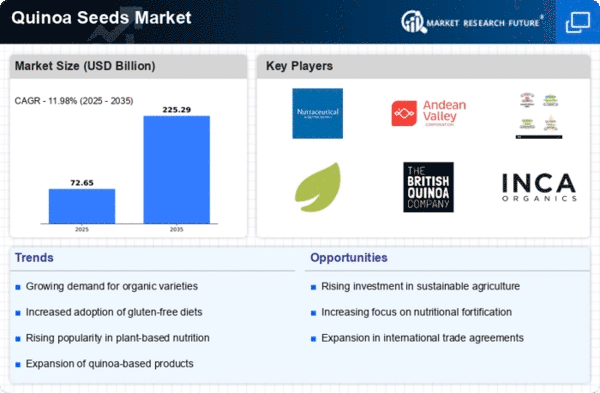
Quinoa Seeds Market Infographic
Purchase Options

Market Share

Quinoa Seeds Market Share Analysis

In recent years, the Quinoa Seeds market has experienced an impressive growth trajectory fueled by a growing consumer knowledge on quinoa’s dietary benefits and healthier food desires. In this competitive environment, firms have employed different share positioning strategies to gain market foothold.

This makes them very significant in enhancing strong bones, healthy hearts and blood sugar levels stabilization. Increased utilization of quinoa seeds in personal care products by European consumers is projected to significantly increase the region’s market share over the next few years. Such recognition of quinoa seeds as useful ingredients for personal care items complements a rising awareness about their ability to enhance health thereby strengthening their position in Europe.

However, the Asia-Pacific region is expected to excel with the highest CAGR due to high demand from consumers who prefer quinoa seeds because they are well known for having excellent nutritive values. In Asia-Pacific there is high buyer consciousness concerning nutrition which makes quina seed a popular choice that leads to its use and consequent robust market growth within this locality. The area also shows an increased trend towards the inclusion of quinoa seeds in various dietary and personal practices highlighting its potential as a major player within the developing global quina seed market.

Differentiation is one common strategy where companies focus on unique attributes and qualities of their seeds to differentiate themselves from competitors in terms of quality value offered. This may involve promoting organic or non-GMO certifications, emphasizing some nutritional benefits or even advocating for sustainability and ethical sourcing methods. Differentiation enables businesses attract specific groups of customers according to their tastes while still maintaining separate brand image.

Similarly cost leadership can be used as another market positioning strategy. A number of enterprises will lay emphasis on economies of scale, improving production processes and reducing costs so that they can offer cheaper prices for qunioa seeds. This method intends to entice more customers mainly those price sensitive ones thus achieve a larger portion of the market through affordability aspect. However, it is important for them not to compromise on the value of their goods in a bid to maintain quality.

Within Quinoa Seeds market, innovativeness is an important element in positioning for market share. Firms invest in research and development to come up with different varieties, flavors or forms of quinoa. These include quinoa based snacks, ready-to-eat meals or innovative packaging designs that attract consumers who want unique and easy-to-prepare foods. Besides keeping pace with changes within the market environment it is also allows such companies a piece of evolving consumer tastes.

Geographic expansion is a market share positioning strategy that involves entering new markets or expanding the distribution network. Companies are either venturing into untapped markets or consolidating their presence in existing ones in order to take advantage of the growing popularity of quinoa outside regional boundaries. This approach enables firms reach more customers thereby increasing sales volumes as well as maintaining their positions at global level of Quinoa Seeds market.


Author
Author Profile
Snehal Singh
Manager - Research

High acumen in analyzing complex macro & micro markets with more than 6 years of work experience in the field of market research. By implementing her analytical skills in forecasting and estimation into market research reports, she has expertise in Packaging, Construction, and Equipment domains. She handles a team size of 20-25 resources and ensures smooth running of the projects, associated marketing activities, and client servicing.

Leave a Comment

FAQs

What is the current valuation of the Quinoa Seeds Market as of 2024?

<p>The Quinoa Seeds Market was valued at 64.88 USD Billion in 2024.</p>

What is the projected market size for the Quinoa Seeds Market by 2035?

The market is projected to reach 225.29 USD Billion by 2035.

What is the expected CAGR for the Quinoa Seeds Market during the forecast period 2025 - 2035?

The expected CAGR for the Quinoa Seeds Market during 2025 - 2035 is 11.98%.

Which application segment holds the largest market share in the Quinoa Seeds Market?

The Food Industry segment is projected to dominate with a valuation of 90.0 USD Billion.

How do organic quinoa seeds compare to conventional quinoa seeds in terms of market valuation?

Organic quinoa seeds are valued at 46.0 USD Billion, while conventional quinoa seeds are valued at 85.0 USD Billion.

What distribution channel is expected to generate the highest revenue in the Quinoa Seeds Market?

Supermarkets are anticipated to generate the highest revenue, with a valuation of 90.0 USD Billion.

Which key players are leading the Quinoa Seeds Market?

Key players include Nutraceutical Corporation, Andean Valley Corporation, and Quinoa Corporation, among others.

What is the projected valuation for the nutraceuticals segment in the Quinoa Seeds Market?

The nutraceuticals segment is projected to reach 45.0 USD Billion.

How does the market for black quinoa seeds compare to that of red quinoa seeds?

Black quinoa seeds are valued at 31.29 USD Billion, while red quinoa seeds are valued at 35.0 USD Billion.

What is the expected growth trend for the beverage industry segment in the Quinoa Seeds Market?

The beverage industry segment is projected to grow to 35.0 USD Billion.

Market Summary

As per MRFR analysis, the Quinoa Seeds Market Size was estimated at 64.88 USD Billion in 2024. The Quinoa Seeds industry is projected to grow from 72.65 USD Billion in 2025 to 225.29 USD Billion by 2035, exhibiting a compound annual growth rate (CAGR) of 11.98% during the forecast period 2025 - 2035.

Key Market Trends & Highlights

The Quinoa Seeds Market is experiencing robust growth driven by health trends and sustainability.

  • Health consciousness is significantly driving demand for quinoa seeds, particularly in North America. The rise of gluten-free alternatives is propelling quinoa's popularity in both the food and beverage industries. Sustainability and organic practices are becoming increasingly important, especially in the Asia-Pacific region. Health benefits of quinoa seeds and the growing demand for plant-based proteins are key market drivers.

Market Size & Forecast

2024 Market Size 64.88 (USD Billion)
2035 Market Size 225.29 (USD Billion)
CAGR (2025 - 2035) 11.98%
Largest Regional Market Share in 2024 North America

Major Players

Nutraceutical Corporation (US), Andean Valley Corporation (PE), Quinoa Corporation (US), Alter Eco (US), The British Quinoa Company (GB), Inca Organics (US), Royal Quinoa (BO), Quinoa Foods Company (US), Grain of the Andes (PE)

Market Trends

The Quinoa Seeds Market is currently experiencing a notable transformation, driven by a growing awareness of health and nutrition among consumers. This shift is reflected in the increasing demand for plant-based protein sources, as quinoa seeds are recognized for their high protein content and essential amino acids. Furthermore, the trend towards organic and non-GMO products is gaining traction, as consumers seek out food options that align with their values regarding sustainability and environmental impact. As a result, producers are adapting their cultivation practices to meet these evolving consumer preferences, which may lead to innovations in farming techniques and supply chain management. In addition, the Quinoa Seeds Market is witnessing a rise in the popularity of gluten-free diets, as quinoa serves as an excellent alternative for individuals with gluten sensitivities. This trend is further supported by the increasing incorporation of quinoa into various food products, including snacks, cereals, and ready-to-eat meals. Retailers are also expanding their offerings to include quinoa-based products, thereby enhancing accessibility for consumers. Overall, the Quinoa Seeds Market appears poised for continued growth, driven by health-conscious consumers and a shift towards sustainable agricultural practices.

Health Consciousness Driving Demand

The growing awareness of health and nutrition among consumers is significantly influencing the Quinoa Seeds Market. As individuals increasingly seek plant-based protein sources, quinoa seeds are gaining recognition for their nutritional benefits, including high protein content and essential amino acids.

Rise of Gluten-Free Alternatives

The Quinoa Seeds Market is benefiting from the rising popularity of gluten-free diets. Quinoa serves as a suitable alternative for those with gluten sensitivities, leading to its incorporation into various food products, such as snacks and cereals.

Sustainability and Organic Practices

There is a notable trend towards organic and non-GMO products within the Quinoa Seeds Market. Consumers are increasingly prioritizing sustainability, prompting producers to adopt environmentally friendly farming practices and innovative supply chain solutions.

Culinary Innovation and Versatility

The Quinoa Seeds Market is experiencing a wave of culinary innovation, with chefs and food manufacturers incorporating quinoa into diverse dishes. This trend enhances the seed's versatility and introduces it to new consumer segments, supporting long-term quinoa seeds market growth.

Quinoa Seeds Market Market Drivers

Rising Health Consciousness

The increasing awareness of health and nutrition among consumers is driving the Global Quinoa Seeds Industry. Quinoa is recognized for its high protein content, essential amino acids, and gluten-free nature, making it a preferred choice for health-conscious individuals. As more people adopt plant-based diets, the demand for quinoa seeds is expected to rise significantly. In 2024, the market is projected to reach 64.9 USD Billion, reflecting a growing trend towards healthier food options. This shift in consumer preferences suggests that the Global Quinoa Seeds Industry will continue to expand as quinoa becomes a staple in health-oriented diets.

Diverse Culinary Applications

Quinoa's versatility in culinary applications is a significant driver for the Global Quinoa Seeds Industry. It is used in various dishes, from salads to baked goods, appealing to a wide range of consumers. The grain's ability to absorb flavors and its unique texture make it a popular ingredient in both traditional and modern cuisines. As culinary trends evolve, the demand for quinoa is likely to increase. This trend is supported by the projected CAGR of 11.98% for the period from 2025 to 2035, indicating that the Global Quinoa Seeds Industry will continue to thrive as chefs and home cooks alike embrace this nutritious grain.

Sustainable Agriculture Practices

The Global Quinoa Seeds Industry is benefiting from the increasing emphasis on sustainable agriculture. Farmers are increasingly adopting quinoa cultivation due to its resilience to adverse climatic conditions and low water requirements. This adaptability makes quinoa an attractive crop for regions facing water scarcity. The market is likely to see substantial growth as more farmers transition to sustainable practices. By 2035, the industry could reach 225.3 USD Billion, driven by the demand for environmentally friendly crops. This trend indicates a potential shift in agricultural practices, positioning quinoa as a key player in sustainable food production.

Market Trends and Growth Projections

The Global Quinoa Seeds Industry is poised for substantial growth, with projections indicating a market value of 64.9 USD Billion in 2024 and potentially reaching 225.3 USD Billion by 2035. This growth is driven by various factors, including rising health consciousness, sustainable agriculture practices, and the increasing popularity of plant-based diets. The anticipated CAGR of 11.98% from 2025 to 2035 suggests a robust expansion phase for the industry. These trends highlight the dynamic nature of the quinoa market, as it adapts to changing consumer preferences and global food security challenges.

Growing Vegan and Vegetarian Population

The rise in the vegan and vegetarian population is significantly influencing the Global Quinoa Seeds Industry. Quinoa serves as an excellent protein source for individuals following plant-based diets, providing essential nutrients that are often lacking in such diets. As more consumers seek alternatives to animal products, the demand for quinoa seeds is expected to surge. This demographic shift is likely to contribute to the market's growth, with projections suggesting that the industry could reach 225.3 USD Billion by 2035. The increasing popularity of plant-based diets indicates a promising future for quinoa as a staple food.

Nutritional Benefits and Functional Foods

The nutritional profile of quinoa, which includes high levels of fiber, vitamins, and minerals, positions it as a functional food in the Global Quinoa Seeds Industry. Consumers are increasingly seeking foods that offer health benefits beyond basic nutrition, and quinoa fits this demand perfectly. Its status as a superfood is driving its popularity among health enthusiasts and fitness communities. As awareness of functional foods grows, the market for quinoa seeds is likely to expand. The projected CAGR of 11.98% for 2025 to 2035 indicates a robust growth trajectory for the Global Quinoa Seeds Industry, reflecting the increasing consumer focus on health and wellness.

Market Segment Insights

By Application: Food Industry (Largest) vs. Beverage Industry (Fastest-Growing)

The quinoa seeds market is characterized by diverse application segments, with the food industry holding the largest market share. The food sector leverages the nutritious components of quinoa seeds, integrating them into various products including snacks, cereals, and health foods. On the other hand, the beverage industry is marking its presence, growing rapidly as consumers shift towards healthy drink alternatives that include quinoa as a functional ingredient. This segment, while smaller compared to food, is gaining traction quickly.

Food Industry: Snacks (Dominant) vs. Beverage Industry: Health Drinks (Emerging)

In the food industry, snacks made with quinoa are leading the market due to their convenience and nutritional benefits, appealing to health-conscious consumers. This segment thrives on innovation, as manufacturers develop new quinoa-based snacks that cater to dietary trends. Conversely, the beverage industry, particularly <a href="https://www.marketresearchfuture.com/reports/health-drinks-market-41909" target="_blank" title="health drinks">health drinks</a> infused with quinoa, is emerging strongly. As more consumers lean towards refreshing and nutritious beverages, quinoa's adaptability as an additive in smoothies and energy drinks is becoming popular. This shift is driven by rising awareness of the health benefits associated with quinoa, positioning it well for future growth.

By Type: Organic Quinoa Seeds (Largest) vs. Sprouted Quinoa Seeds (Fastest-Growing)

<p>The quinoa seeds market has shown a dynamic distribution among various types, with Organic Quinoa Seeds capturing the largest market share. This segment has gained significant traction due to the rising consumer preference for organic and health-oriented food products. Conventional Quinoa Seeds also hold a notable share, catering to a broader audience, while Red and Black Quinoa Seeds have carved out their niches appealing to those seeking diverse nutritional profiles. Sprouted Quinoa Seeds, though currently smaller in share, are rapidly gaining attention in the market.</p>

<p>Organic Quinoa Seeds (Dominant) vs. Sprouted Quinoa Seeds (Emerging)</p>

<p>Organic Quinoa Seeds are recognized as the dominant player in the quinoa seeds market, driven by increasing health consciousness among consumers and the demand for organic farming practices. They are often deemed superior due to the absence of synthetic pesticides and fertilizers, appealing to environmentally-conscious customers. On the other hand, Sprouted Quinoa Seeds are emerging rapidly as a new trend in the market, valued for their enhanced nutritional benefits such as improved digestibility and nutrient absorption. This segment is particularly popular among health enthusiasts looking for innovative food options, positioning itself favorably for future growth.</p>

By Distribution Channel: Online Retail (Largest) vs. Supermarkets (Fastest-Growing)

<p>In the Quinoa Seeds Market, distribution is evolving with Online Retail holding the largest share, catering to the increasing consumer preference for convenience and accessibility. Supermarkets are also significant players, attracting health-conscious shoppers who appreciate the presence of quinoa as a versatile superfood among their offerings. Health Food Stores, Specialty Stores, and Direct Sales further contribute, albeit on a smaller scale, to the overall distribution landscape.</p>

<p>Supermarkets (Dominant) vs. Health Food Stores (Emerging)</p>

<p>Supermarkets stand as the dominant distribution channel in the Quinoa Seeds Market, leveraging their extensive reach and established supply chains. They provide consumers with easy access to quinoa products, which are increasingly featured in health-conscious offerings. On the other hand, Health Food Stores serve a more niche market, appealing to health enthusiasts who prioritize organic and specialty items. While they are currently considered emerging players, the growth potential for Health Food Stores is significant as awareness of quinoa's health benefits expands. This segment appeals to consumers looking for quality and expertise in health foods, paving the way for increased market penetration.</p>

By Distribution Channel: Online Retail (Largest) vs. Supermarkets (Fastest-Growing)

In the Quinoa Seeds Market, the distribution channel landscape is diverse, with online retail leading as the dominant channel. It offers convenience and accessibility for consumers, allowing them to purchase products from the comfort of their homes. Supermarkets also hold a significant share but are growing at a rapid pace, as more consumers are seeking healthy options in such retail environments. As health consciousness rises, the trends in the quinoa seeds market are heavily influenced by the growing popularity of health food stores and direct sales. Health food stores are effectively targeting niche markets, focusing on organic and non-GMO products. Meanwhile, direct sales are tapping into local communities and enhancing brand loyalty through personal engagement and education about quinoa’s health benefits.

Online Retail (Dominant) vs. Direct Sales (Emerging)

Online retail stands out as the dominant distribution channel in the Quinoa Seeds Market, owing to its immense growth in ecommerce and consumer preference for online shopping. It provides a broad range of products, catering to the increasing demand for quinoa among health-conscious consumers. On the other hand, direct sales are emerging as a noteworthy segment, primarily focused on building relationships directly with consumers. This channel allows brands to engage with their audience, educate them on the benefits of quinoa, and create a loyal customer base. As both channels continue to evolve, they are expected to complement each other while meeting diverse consumer preferences.

By Form: Whole Seeds (Largest) vs. Flour (Fastest-Growing)

In the Quinoa Seeds Market, the segment is marked by a notable distribution among the various forms of quinoa, with Whole Seeds commanding the largest share due to their versatility and consumer preference for minimally processed products. In contrast, Flour is observing a rapid rise in popularity as consumers increasingly look for gluten-free alternatives in baking and cooking, thereby expanding its market presence significantly.

Whole Seeds (Dominant) vs. Flour (Emerging)

Whole Seeds dominate the Quinoa Seeds Market due to their nutritional richness and adaptability in various culinary applications. They appeal to health-conscious consumers who prioritize whole foods. On the other hand, Flour is emerging as a popular option among bakers and food manufacturers seeking gluten-free ingredients. Its versatility allows it to be used in a wide array of products, from bread to snacks, contributing to its rapid growth. As more consumers adopt gluten-free diets or seek healthier alternatives, the demand for <a href="https://www.marketresearchfuture.com/reports/quinoa-flour-market-7386" target="_blank" title="quinoa flour">quinoa flour</a> is soaring, positioning it as a key player in the market.

Get more detailed insights about Quinoa Seeds Market Research Report – Forecast till 2035

Regional Insights

North America : Market Leader in Quinoa Seeds

North America is poised to maintain its leadership in the quinoa seeds market, holding a significant share of 32.44% in 2024. The region's growth is driven by increasing health consciousness among consumers, rising demand for organic products, and supportive regulatory frameworks promoting sustainable agriculture. The trend towards plant-based diets further fuels the demand for quinoa, recognized for its high nutritional value and versatility in various culinary applications. The United States and Canada are the leading countries in this market, with key players such as Nutraceutical Corporation and Quinoa Corporation driving innovation and supply chain efficiency. The competitive landscape is characterized by a mix of established companies and emerging brands, all vying for market share. The presence of these key players ensures a robust supply of quinoa seeds, catering to both domestic and international markets.

Europe : Growing Demand for Health Foods

Europe is witnessing a growing interest in quinoa seeds, with a market share of 18.74% in 2024. This growth is largely attributed to the increasing consumer preference for healthy and organic food options, alongside government initiatives promoting sustainable agriculture. The European market is also influenced by stringent food safety regulations, which encourage the adoption of high-quality quinoa products. The trend towards gluten-free diets further enhances the demand for quinoa as a nutritious alternative. Leading countries in this region include Germany, France, and the UK, where the presence of key players like The British Quinoa Company and Alter Eco is notable. The competitive landscape is marked by a mix of local and international brands, all striving to meet the rising consumer demand. The European market is characterized by innovation in product offerings, including ready-to-eat quinoa meals and snacks, catering to the health-conscious consumer.

Asia-Pacific : Emerging Powerhouse for Quinoa

Asia-Pacific is emerging as a significant player in the quinoa seeds market, with a market share of 10.92% in 2024. The region's growth is driven by increasing health awareness, rising disposable incomes, and a growing trend towards vegetarian and vegan diets. Governments are also beginning to recognize the potential of quinoa as a nutritious crop, leading to supportive policies aimed at boosting local production and consumption. The demand for organic and health foods is expected to further accelerate market growth in this region. Countries like Australia and New Zealand are leading the charge in quinoa cultivation and consumption, with local brands beginning to emerge. The competitive landscape is evolving, with both domestic and international players looking to capitalize on the growing interest in quinoa. Key players in the region are focusing on product innovation and marketing strategies to attract health-conscious consumers, thereby enhancing their market presence.

Middle East and Africa : Niche Market for Quinoa Seeds

The Middle East and Africa region represents a niche market for quinoa seeds, with a market share of 2.78% in 2024. The growth in this region is primarily driven by increasing awareness of health benefits associated with quinoa, alongside a gradual shift towards healthier eating habits. Local governments are beginning to support the cultivation of quinoa as part of broader agricultural initiatives aimed at improving food security and nutrition. The rising interest in organic and superfoods is also contributing to market growth. Countries such as South Africa and Kenya are at the forefront of quinoa adoption, with local farmers exploring its cultivation. The competitive landscape is still developing, with a few key players like Grain of the Andes making strides in the market. As awareness grows, more local brands are expected to enter the market, enhancing competition and product availability.

Key Players and Competitive Insights

The Quinoa Seeds Market is currently characterized by a dynamic competitive landscape, driven by increasing consumer demand for health-conscious food options and the growing popularity of plant-based diets. Key players such as Nutraceutical Corporation (US), Andean Valley Corporation (PE), and Alter Eco (US) are strategically positioning themselves through innovation and sustainability initiatives. Nutraceutical Corporation (US) focuses on enhancing product quality and expanding its organic offerings, while Andean Valley Corporation (PE) emphasizes local sourcing and community engagement to strengthen its brand identity. Alter Eco (US) is leveraging its commitment to fair trade and environmental sustainability, which resonates well with the eco-conscious consumer base. Collectively, these strategies contribute to a competitive environment that prioritizes quality, sustainability, and ethical practices.In terms of business tactics, companies are increasingly localizing manufacturing and optimizing supply chains to enhance efficiency and reduce costs. The market structure appears moderately fragmented, with several players vying for market share. This fragmentation allows for diverse offerings and competitive pricing, yet the influence of key players remains significant, as they set trends and standards that smaller companies often follow.
In November Nutraceutical Corporation (US) announced a partnership with a leading agricultural technology firm to develop advanced farming techniques aimed at increasing quinoa yield and reducing environmental impact. This strategic move is likely to enhance their production capabilities and align with the growing consumer preference for sustainably sourced products. By investing in technology, Nutraceutical Corporation (US) positions itself as a leader in innovation within the market.
In October Andean Valley Corporation (PE) launched a new line of quinoa-based snacks, targeting the health-conscious consumer segment. This product diversification not only expands their portfolio but also taps into the rising trend of convenient, healthy snacking. The introduction of these snacks could potentially increase brand visibility and market penetration, reinforcing their competitive stance.
In September Alter Eco (US) unveiled a new initiative aimed at carbon neutrality across its supply chain by 2030. This ambitious goal reflects a broader trend within the industry towards sustainability and could enhance their brand loyalty among environmentally conscious consumers. By prioritizing sustainability, Alter Eco (US) differentiates itself in a crowded market, appealing to a demographic that values ethical consumption.
As of December the competitive trends in the Quinoa Seeds Market are increasingly defined by digitalization, sustainability, and the integration of AI technologies. Strategic alliances are becoming more prevalent, as companies recognize the value of collaboration in enhancing innovation and market reach. Looking ahead, competitive differentiation is likely to evolve from traditional price-based competition to a focus on innovation, technology, and supply chain reliability. This shift suggests that companies that can effectively leverage these trends will be better positioned to thrive in the evolving market landscape.

Key Companies in the Quinoa Seeds Market include

Industry Developments

March 2020: Candid Holdings, U.S. based brand, announced the launch of a line of chocolate snacks made with upcycled cacao fruit and organic Quinoa. The product is available in four flavors viz; Pineapple & Coconut, Banana & Nibs, Golden Berry Turmeric & Mango, and Mango & Cinnamon.

February 2020: Ardent Mills announced the complete acquisition of Andean Naturals' quinoa sourcing, cleaning, and packaging operation in Yuba City, California. This acquisition is anticipated to help Ardent Mills enter the organic quinoa seeds market.

Future Outlook

Quinoa Seeds Market Future Outlook

The Quinoa <a href="https://www.marketresearchfuture.com/reports/seeds-market-7252" target="_blank" title="seeds">Seeds</a> Market is projected to grow at 11.98% CAGR from 2025 to 2035, driven by rising health consciousness, increasing demand for gluten-free products, and sustainable agricultural practices.

New opportunities lie in:

  • <p>Expansion into emerging markets with tailored marketing strategies. Development of value-added quinoa products for health-conscious consumers. Investment in sustainable farming technologies to enhance yield and quality.</p>

By 2035, the Quinoa Seeds Market is expected to achieve robust growth and increased global presence.

Market Segmentation

Quinoa Seeds Market Form Outlook

  • Whole Seeds
  • Flakes
  • Flour
  • Puffed Quinoa

Quinoa Seeds Market Type Outlook

  • Organic Quinoa Seeds
  • Conventional Quinoa Seeds
  • Processed Quinoa Seeds

Quinoa Seeds Market End Use Outlook

  • Household
  • Commercial
  • Industrial

Quinoa Seeds Market Application Outlook

  • Food Industry
  • Beverage Industry
  • Nutraceuticals
  • Cosmetics
  • Animal Feed

Quinoa Seeds Market Distribution Channel Outlook

  • Online Retail
  • Supermarkets
  • Health Food Stores
  • Direct Sales

Report Scope

MARKET SIZE 2024 64.88(USD Billion)
MARKET SIZE 2025 72.65(USD Billion)
MARKET SIZE 2035 225.29(USD Billion)
COMPOUND ANNUAL GROWTH RATE (CAGR) 11.98% (2025 - 2035)
REPORT COVERAGE Revenue Forecast, Competitive Landscape, Growth Factors, and Trends
BASE YEAR 2024
Market Forecast Period 2025 - 2035
Historical Data 2019 - 2024
Market Forecast Units USD Billion
Key Companies Profiled Nutraceutical Corporation (US), Andean Valley Corporation (PE), Quinoa Corporation (US), Alter Eco (US), The British Quinoa Company (GB), Inca Organics (US), Royal Quinoa (BO), Quinoa Foods Company (US), Grain of the Andes (PE)
Segments Covered Application, End Use, Type, Distribution Channel, Form
Key Market Opportunities Growing consumer demand for gluten-free and plant-based protein options in the Quinoa Seeds Market.
Key Market Dynamics Rising consumer demand for plant-based proteins drives innovation and competition in the quinoa seeds market.
Countries Covered North America, Europe, APAC, South America, MEA

FAQs

What is the current valuation of the Quinoa Seeds Market as of 2024?

<p>The Quinoa Seeds Market was valued at 64.88 USD Billion in 2024.</p>

What is the projected market size for the Quinoa Seeds Market by 2035?

The market is projected to reach 225.29 USD Billion by 2035.

What is the expected CAGR for the Quinoa Seeds Market during the forecast period 2025 - 2035?

The expected CAGR for the Quinoa Seeds Market during 2025 - 2035 is 11.98%.

Which application segment holds the largest market share in the Quinoa Seeds Market?

The Food Industry segment is projected to dominate with a valuation of 90.0 USD Billion.

How do organic quinoa seeds compare to conventional quinoa seeds in terms of market valuation?

Organic quinoa seeds are valued at 46.0 USD Billion, while conventional quinoa seeds are valued at 85.0 USD Billion.

What distribution channel is expected to generate the highest revenue in the Quinoa Seeds Market?

Supermarkets are anticipated to generate the highest revenue, with a valuation of 90.0 USD Billion.

Which key players are leading the Quinoa Seeds Market?

Key players include Nutraceutical Corporation, Andean Valley Corporation, and Quinoa Corporation, among others.

What is the projected valuation for the nutraceuticals segment in the Quinoa Seeds Market?

The nutraceuticals segment is projected to reach 45.0 USD Billion.

How does the market for black quinoa seeds compare to that of red quinoa seeds?

Black quinoa seeds are valued at 31.29 USD Billion, while red quinoa seeds are valued at 35.0 USD Billion.

What is the expected growth trend for the beverage industry segment in the Quinoa Seeds Market?

The beverage industry segment is projected to grow to 35.0 USD Billion.

  1. SECTION I: EXECUTIVE SUMMARY AND KEY HIGHLIGHTS
    1. | 1.1 EXECUTIVE SUMMARY
    2. | | 1.1.1 Market Overview
    3. | | 1.1.2 Key Findings
    4. | | 1.1.3 Market Segmentation
    5. | | 1.1.4 Competitive Landscape
    6. | | 1.1.5 Challenges and Opportunities
    7. | | 1.1.6 Future Outlook
  2. SECTION II: SCOPING, METHODOLOGY AND MARKET STRUCTURE
    1. | 2.1 MARKET INTRODUCTION
    2. | | 2.1.1 Definition
    3. | | 2.1.2 Scope of the study
    4. | | | 2.1.2.1 Research Objective
    5. | | | 2.1.2.2 Assumption
    6. | | | 2.1.2.3 Limitations
    7. | 2.2 RESEARCH METHODOLOGY
    8. | | 2.2.1 Overview
    9. | | 2.2.2 Data Mining
    10. | | 2.2.3 Secondary Research
    11. | | 2.2.4 Primary Research
    12. | | | 2.2.4.1 Primary Interviews and Information Gathering Process
    13. | | | 2.2.4.2 Breakdown of Primary Respondents
    14. | | 2.2.5 Forecasting Model
    15. | | 2.2.6 Market Size Estimation
    16. | | | 2.2.6.1 Bottom-Up Approach
    17. | | | 2.2.6.2 Top-Down Approach
    18. | | 2.2.7 Data Triangulation
    19. | | 2.2.8 Validation
  3. SECTION III: QUALITATIVE ANALYSIS
    1. | 3.1 MARKET DYNAMICS
    2. | | 3.1.1 Overview
    3. | | 3.1.2 Drivers
    4. | | 3.1.3 Restraints
    5. | | 3.1.4 Opportunities
    6. | 3.2 MARKET FACTOR ANALYSIS
    7. | | 3.2.1 Value chain Analysis
    8. | | 3.2.2 Porter's Five Forces Analysis
    9. | | | 3.2.2.1 Bargaining Power of Suppliers
    10. | | | 3.2.2.2 Bargaining Power of Buyers
    11. | | | 3.2.2.3 Threat of New Entrants
    12. | | | 3.2.2.4 Threat of Substitutes
    13. | | | 3.2.2.5 Intensity of Rivalry
    14. | | 3.2.3 COVID-19 Impact Analysis
    15. | | | 3.2.3.1 Market Impact Analysis
    16. | | | 3.2.3.2 Regional Impact
    17. | | | 3.2.3.3 Opportunity and Threat Analysis
  4. SECTION IV: QUANTITATIVE ANALYSIS
    1. | 4.1 Food, Beverages & Nutrition, BY Application (USD Billion)
    2. | | 4.1.1 Food Industry
    3. | | 4.1.2 Beverage Industry
    4. | | 4.1.3 Nutraceuticals
    5. | | 4.1.4 Cosmetics
    6. | | 4.1.5 Animal Feed
    7. | 4.2 Food, Beverages & Nutrition, BY Type (USD Billion)
    8. | | 4.2.1 Organic Quinoa Seeds
    9. | | 4.2.2 Conventional Quinoa Seeds
    10. | | 4.2.3 Sprouted Quinoa Seeds
    11. | | 4.2.4 Red Quinoa Seeds
    12. | | 4.2.5 Black Quinoa Seeds
    13. | 4.3 Food, Beverages & Nutrition, BY Distribution Channel (USD Billion)
    14. | | 4.3.1 Online Retail
    15. | | 4.3.2 Supermarkets
    16. | | 4.3.3 Health Food Stores
    17. | | 4.3.4 Specialty Stores
    18. | | 4.3.5 Direct Sales
    19. | 4.4 Food, Beverages & Nutrition, BY Region (USD Billion)
    20. | | 4.4.1 North America
    21. | | | 4.4.1.1 US
    22. | | | 4.4.1.2 Canada
    23. | | 4.4.2 Europe
    24. | | | 4.4.2.1 Germany
    25. | | | 4.4.2.2 UK
    26. | | | 4.4.2.3 France
    27. | | | 4.4.2.4 Russia
    28. | | | 4.4.2.5 Italy
    29. | | | 4.4.2.6 Spain
    30. | | | 4.4.2.7 Rest of Europe
    31. | | 4.4.3 APAC
    32. | | | 4.4.3.1 China
    33. | | | 4.4.3.2 India
    34. | | | 4.4.3.3 Japan
    35. | | | 4.4.3.4 South Korea
    36. | | | 4.4.3.5 Malaysia
    37. | | | 4.4.3.6 Thailand
    38. | | | 4.4.3.7 Indonesia
    39. | | | 4.4.3.8 Rest of APAC
    40. | | 4.4.4 South America
    41. | | | 4.4.4.1 Brazil
    42. | | | 4.4.4.2 Mexico
    43. | | | 4.4.4.3 Argentina
    44. | | | 4.4.4.4 Rest of South America
    45. | | 4.4.5 MEA
    46. | | | 4.4.5.1 GCC Countries
    47. | | | 4.4.5.2 South Africa
    48. | | | 4.4.5.3 Rest of MEA
  5. SECTION V: COMPETITIVE ANALYSIS
    1. | 5.1 Competitive Landscape
    2. | | 5.1.1 Overview
    3. | | 5.1.2 Competitive Analysis
    4. | | 5.1.3 Market share Analysis
    5. | | 5.1.4 Major Growth Strategy in the Food, Beverages & Nutrition
    6. | | 5.1.5 Competitive Benchmarking
    7. | | 5.1.6 Leading Players in Terms of Number of Developments in the Food, Beverages & Nutrition
    8. | | 5.1.7 Key developments and growth strategies
    9. | | | 5.1.7.1 New Product Launch/Service Deployment
    10. | | | 5.1.7.2 Merger & Acquisitions
    11. | | | 5.1.7.3 Joint Ventures
    12. | | 5.1.8 Major Players Financial Matrix
    13. | | | 5.1.8.1 Sales and Operating Income
    14. | | | 5.1.8.2 Major Players R&D Expenditure. 2023
    15. | 5.2 Company Profiles
    16. | | 5.2.1 Nutraceutical Corporation (US)
    17. | | | 5.2.1.1 Financial Overview
    18. | | | 5.2.1.2 Products Offered
    19. | | | 5.2.1.3 Key Developments
    20. | | | 5.2.1.4 SWOT Analysis
    21. | | | 5.2.1.5 Key Strategies
    22. | | 5.2.2 Andean Valley Corporation (PE)
    23. | | | 5.2.2.1 Financial Overview
    24. | | | 5.2.2.2 Products Offered
    25. | | | 5.2.2.3 Key Developments
    26. | | | 5.2.2.4 SWOT Analysis
    27. | | | 5.2.2.5 Key Strategies
    28. | | 5.2.3 Quinoa Corporation (US)
    29. | | | 5.2.3.1 Financial Overview
    30. | | | 5.2.3.2 Products Offered
    31. | | | 5.2.3.3 Key Developments
    32. | | | 5.2.3.4 SWOT Analysis
    33. | | | 5.2.3.5 Key Strategies
    34. | | 5.2.4 Alter Eco (US)
    35. | | | 5.2.4.1 Financial Overview
    36. | | | 5.2.4.2 Products Offered
    37. | | | 5.2.4.3 Key Developments
    38. | | | 5.2.4.4 SWOT Analysis
    39. | | | 5.2.4.5 Key Strategies
    40. | | 5.2.5 The British Quinoa Company (GB)
    41. | | | 5.2.5.1 Financial Overview
    42. | | | 5.2.5.2 Products Offered
    43. | | | 5.2.5.3 Key Developments
    44. | | | 5.2.5.4 SWOT Analysis
    45. | | | 5.2.5.5 Key Strategies
    46. | | 5.2.6 Inca Organics (US)
    47. | | | 5.2.6.1 Financial Overview
    48. | | | 5.2.6.2 Products Offered
    49. | | | 5.2.6.3 Key Developments
    50. | | | 5.2.6.4 SWOT Analysis
    51. | | | 5.2.6.5 Key Strategies
    52. | | 5.2.7 Royal Quinoa (BO)
    53. | | | 5.2.7.1 Financial Overview
    54. | | | 5.2.7.2 Products Offered
    55. | | | 5.2.7.3 Key Developments
    56. | | | 5.2.7.4 SWOT Analysis
    57. | | | 5.2.7.5 Key Strategies
    58. | | 5.2.8 Quinoa Foods Company (PE)
    59. | | | 5.2.8.1 Financial Overview
    60. | | | 5.2.8.2 Products Offered
    61. | | | 5.2.8.3 Key Developments
    62. | | | 5.2.8.4 SWOT Analysis
    63. | | | 5.2.8.5 Key Strategies
    64. | | 5.2.9 Grain of the Andes (PE)
    65. | | | 5.2.9.1 Financial Overview
    66. | | | 5.2.9.2 Products Offered
    67. | | | 5.2.9.3 Key Developments
    68. | | | 5.2.9.4 SWOT Analysis
    69. | | | 5.2.9.5 Key Strategies
    70. | 5.3 Appendix
    71. | | 5.3.1 References
    72. | | 5.3.2 Related Reports
  6. LIST OF FIGURES
    1. | 6.1 MARKET SYNOPSIS
    2. | 6.2 NORTH AMERICA MARKET ANALYSIS
    3. | 6.3 US MARKET ANALYSIS BY APPLICATION
    4. | 6.4 US MARKET ANALYSIS BY TYPE
    5. | 6.5 US MARKET ANALYSIS BY DISTRIBUTION CHANNEL
    6. | 6.6 CANADA MARKET ANALYSIS BY APPLICATION
    7. | 6.7 CANADA MARKET ANALYSIS BY TYPE
    8. | 6.8 CANADA MARKET ANALYSIS BY DISTRIBUTION CHANNEL
    9. | 6.9 EUROPE MARKET ANALYSIS
    10. | 6.10 GERMANY MARKET ANALYSIS BY APPLICATION
    11. | 6.11 GERMANY MARKET ANALYSIS BY TYPE
    12. | 6.12 GERMANY MARKET ANALYSIS BY DISTRIBUTION CHANNEL
    13. | 6.13 UK MARKET ANALYSIS BY APPLICATION
    14. | 6.14 UK MARKET ANALYSIS BY TYPE
    15. | 6.15 UK MARKET ANALYSIS BY DISTRIBUTION CHANNEL
    16. | 6.16 FRANCE MARKET ANALYSIS BY APPLICATION
    17. | 6.17 FRANCE MARKET ANALYSIS BY TYPE
    18. | 6.18 FRANCE MARKET ANALYSIS BY DISTRIBUTION CHANNEL
    19. | 6.19 RUSSIA MARKET ANALYSIS BY APPLICATION
    20. | 6.20 RUSSIA MARKET ANALYSIS BY TYPE
    21. | 6.21 RUSSIA MARKET ANALYSIS BY DISTRIBUTION CHANNEL
    22. | 6.22 ITALY MARKET ANALYSIS BY APPLICATION
    23. | 6.23 ITALY MARKET ANALYSIS BY TYPE
    24. | 6.24 ITALY MARKET ANALYSIS BY DISTRIBUTION CHANNEL
    25. | 6.25 SPAIN MARKET ANALYSIS BY APPLICATION
    26. | 6.26 SPAIN MARKET ANALYSIS BY TYPE
    27. | 6.27 SPAIN MARKET ANALYSIS BY DISTRIBUTION CHANNEL
    28. | 6.28 REST OF EUROPE MARKET ANALYSIS BY APPLICATION
    29. | 6.29 REST OF EUROPE MARKET ANALYSIS BY TYPE
    30. | 6.30 REST OF EUROPE MARKET ANALYSIS BY DISTRIBUTION CHANNEL
    31. | 6.31 APAC MARKET ANALYSIS
    32. | 6.32 CHINA MARKET ANALYSIS BY APPLICATION
    33. | 6.33 CHINA MARKET ANALYSIS BY TYPE
    34. | 6.34 CHINA MARKET ANALYSIS BY DISTRIBUTION CHANNEL
    35. | 6.35 INDIA MARKET ANALYSIS BY APPLICATION
    36. | 6.36 INDIA MARKET ANALYSIS BY TYPE
    37. | 6.37 INDIA MARKET ANALYSIS BY DISTRIBUTION CHANNEL
    38. | 6.38 JAPAN MARKET ANALYSIS BY APPLICATION
    39. | 6.39 JAPAN MARKET ANALYSIS BY TYPE
    40. | 6.40 JAPAN MARKET ANALYSIS BY DISTRIBUTION CHANNEL
    41. | 6.41 SOUTH KOREA MARKET ANALYSIS BY APPLICATION
    42. | 6.42 SOUTH KOREA MARKET ANALYSIS BY TYPE
    43. | 6.43 SOUTH KOREA MARKET ANALYSIS BY DISTRIBUTION CHANNEL
    44. | 6.44 MALAYSIA MARKET ANALYSIS BY APPLICATION
    45. | 6.45 MALAYSIA MARKET ANALYSIS BY TYPE
    46. | 6.46 MALAYSIA MARKET ANALYSIS BY DISTRIBUTION CHANNEL
    47. | 6.47 THAILAND MARKET ANALYSIS BY APPLICATION
    48. | 6.48 THAILAND MARKET ANALYSIS BY TYPE
    49. | 6.49 THAILAND MARKET ANALYSIS BY DISTRIBUTION CHANNEL
    50. | 6.50 INDONESIA MARKET ANALYSIS BY APPLICATION
    51. | 6.51 INDONESIA MARKET ANALYSIS BY TYPE
    52. | 6.52 INDONESIA MARKET ANALYSIS BY DISTRIBUTION CHANNEL
    53. | 6.53 REST OF APAC MARKET ANALYSIS BY APPLICATION
    54. | 6.54 REST OF APAC MARKET ANALYSIS BY TYPE
    55. | 6.55 REST OF APAC MARKET ANALYSIS BY DISTRIBUTION CHANNEL
    56. | 6.56 SOUTH AMERICA MARKET ANALYSIS
    57. | 6.57 BRAZIL MARKET ANALYSIS BY APPLICATION
    58. | 6.58 BRAZIL MARKET ANALYSIS BY TYPE
    59. | 6.59 BRAZIL MARKET ANALYSIS BY DISTRIBUTION CHANNEL
    60. | 6.60 MEXICO MARKET ANALYSIS BY APPLICATION
    61. | 6.61 MEXICO MARKET ANALYSIS BY TYPE
    62. | 6.62 MEXICO MARKET ANALYSIS BY DISTRIBUTION CHANNEL
    63. | 6.63 ARGENTINA MARKET ANALYSIS BY APPLICATION
    64. | 6.64 ARGENTINA MARKET ANALYSIS BY TYPE
    65. | 6.65 ARGENTINA MARKET ANALYSIS BY DISTRIBUTION CHANNEL
    66. | 6.66 REST OF SOUTH AMERICA MARKET ANALYSIS BY APPLICATION
    67. | 6.67 REST OF SOUTH AMERICA MARKET ANALYSIS BY TYPE
    68. | 6.68 REST OF SOUTH AMERICA MARKET ANALYSIS BY DISTRIBUTION CHANNEL
    69. | 6.69 MEA MARKET ANALYSIS
    70. | 6.70 GCC COUNTRIES MARKET ANALYSIS BY APPLICATION
    71. | 6.71 GCC COUNTRIES MARKET ANALYSIS BY TYPE
    72. | 6.72 GCC COUNTRIES MARKET ANALYSIS BY DISTRIBUTION CHANNEL
    73. | 6.73 SOUTH AFRICA MARKET ANALYSIS BY APPLICATION
    74. | 6.74 SOUTH AFRICA MARKET ANALYSIS BY TYPE
    75. | 6.75 SOUTH AFRICA MARKET ANALYSIS BY DISTRIBUTION CHANNEL
    76. | 6.76 REST OF MEA MARKET ANALYSIS BY APPLICATION
    77. | 6.77 REST OF MEA MARKET ANALYSIS BY TYPE
    78. | 6.78 REST OF MEA MARKET ANALYSIS BY DISTRIBUTION CHANNEL
    79. | 6.79 KEY BUYING CRITERIA OF FOOD, BEVERAGES & NUTRITION
    80. | 6.80 RESEARCH PROCESS OF MRFR
    81. | 6.81 DRO ANALYSIS OF FOOD, BEVERAGES & NUTRITION
    82. | 6.82 DRIVERS IMPACT ANALYSIS: FOOD, BEVERAGES & NUTRITION
    83. | 6.83 RESTRAINTS IMPACT ANALYSIS: FOOD, BEVERAGES & NUTRITION
    84. | 6.84 SUPPLY / VALUE CHAIN: FOOD, BEVERAGES & NUTRITION
    85. | 6.85 FOOD, BEVERAGES & NUTRITION, BY APPLICATION, 2024 (% SHARE)
    86. | 6.86 FOOD, BEVERAGES & NUTRITION, BY APPLICATION, 2024 TO 2035 (USD Billion)
    87. | 6.87 FOOD, BEVERAGES & NUTRITION, BY TYPE, 2024 (% SHARE)
    88. | 6.88 FOOD, BEVERAGES & NUTRITION, BY TYPE, 2024 TO 2035 (USD Billion)
    89. | 6.89 FOOD, BEVERAGES & NUTRITION, BY DISTRIBUTION CHANNEL, 2024 (% SHARE)
    90. | 6.90 FOOD, BEVERAGES & NUTRITION, BY DISTRIBUTION CHANNEL, 2024 TO 2035 (USD Billion)
    91. | 6.91 BENCHMARKING OF MAJOR COMPETITORS
  7. LIST OF TABLES
    1. | 7.1 LIST OF ASSUMPTIONS
    2. | | 7.1.1
    3. | 7.2 North America MARKET SIZE ESTIMATES; FORECAST
    4. | | 7.2.1 BY APPLICATION, 2025-2035 (USD Billion)
    5. | | 7.2.2 BY TYPE, 2025-2035 (USD Billion)
    6. | | 7.2.3 BY DISTRIBUTION CHANNEL, 2025-2035 (USD Billion)
    7. | 7.3 US MARKET SIZE ESTIMATES; FORECAST
    8. | | 7.3.1 BY APPLICATION, 2025-2035 (USD Billion)
    9. | | 7.3.2 BY TYPE, 2025-2035 (USD Billion)
    10. | | 7.3.3 BY DISTRIBUTION CHANNEL, 2025-2035 (USD Billion)
    11. | 7.4 Canada MARKET SIZE ESTIMATES; FORECAST
    12. | | 7.4.1 BY APPLICATION, 2025-2035 (USD Billion)
    13. | | 7.4.2 BY TYPE, 2025-2035 (USD Billion)
    14. | | 7.4.3 BY DISTRIBUTION CHANNEL, 2025-2035 (USD Billion)
    15. | 7.5 Europe MARKET SIZE ESTIMATES; FORECAST
    16. | | 7.5.1 BY APPLICATION, 2025-2035 (USD Billion)
    17. | | 7.5.2 BY TYPE, 2025-2035 (USD Billion)
    18. | | 7.5.3 BY DISTRIBUTION CHANNEL, 2025-2035 (USD Billion)
    19. | 7.6 Germany MARKET SIZE ESTIMATES; FORECAST
    20. | | 7.6.1 BY APPLICATION, 2025-2035 (USD Billion)
    21. | | 7.6.2 BY TYPE, 2025-2035 (USD Billion)
    22. | | 7.6.3 BY DISTRIBUTION CHANNEL, 2025-2035 (USD Billion)
    23. | 7.7 UK MARKET SIZE ESTIMATES; FORECAST
    24. | | 7.7.1 BY APPLICATION, 2025-2035 (USD Billion)
    25. | | 7.7.2 BY TYPE, 2025-2035 (USD Billion)
    26. | | 7.7.3 BY DISTRIBUTION CHANNEL, 2025-2035 (USD Billion)
    27. | 7.8 France MARKET SIZE ESTIMATES; FORECAST
    28. | | 7.8.1 BY APPLICATION, 2025-2035 (USD Billion)
    29. | | 7.8.2 BY TYPE, 2025-2035 (USD Billion)
    30. | | 7.8.3 BY DISTRIBUTION CHANNEL, 2025-2035 (USD Billion)
    31. | 7.9 Russia MARKET SIZE ESTIMATES; FORECAST
    32. | | 7.9.1 BY APPLICATION, 2025-2035 (USD Billion)
    33. | | 7.9.2 BY TYPE, 2025-2035 (USD Billion)
    34. | | 7.9.3 BY DISTRIBUTION CHANNEL, 2025-2035 (USD Billion)
    35. | 7.10 Italy MARKET SIZE ESTIMATES; FORECAST
    36. | | 7.10.1 BY APPLICATION, 2025-2035 (USD Billion)
    37. | | 7.10.2 BY TYPE, 2025-2035 (USD Billion)
    38. | | 7.10.3 BY DISTRIBUTION CHANNEL, 2025-2035 (USD Billion)
    39. | 7.11 Spain MARKET SIZE ESTIMATES; FORECAST
    40. | | 7.11.1 BY APPLICATION, 2025-2035 (USD Billion)
    41. | | 7.11.2 BY TYPE, 2025-2035 (USD Billion)
    42. | | 7.11.3 BY DISTRIBUTION CHANNEL, 2025-2035 (USD Billion)
    43. | 7.12 Rest of Europe MARKET SIZE ESTIMATES; FORECAST
    44. | | 7.12.1 BY APPLICATION, 2025-2035 (USD Billion)
    45. | | 7.12.2 BY TYPE, 2025-2035 (USD Billion)
    46. | | 7.12.3 BY DISTRIBUTION CHANNEL, 2025-2035 (USD Billion)
    47. | 7.13 APAC MARKET SIZE ESTIMATES; FORECAST
    48. | | 7.13.1 BY APPLICATION, 2025-2035 (USD Billion)
    49. | | 7.13.2 BY TYPE, 2025-2035 (USD Billion)
    50. | | 7.13.3 BY DISTRIBUTION CHANNEL, 2025-2035 (USD Billion)
    51. | 7.14 China MARKET SIZE ESTIMATES; FORECAST
    52. | | 7.14.1 BY APPLICATION, 2025-2035 (USD Billion)
    53. | | 7.14.2 BY TYPE, 2025-2035 (USD Billion)
    54. | | 7.14.3 BY DISTRIBUTION CHANNEL, 2025-2035 (USD Billion)
    55. | 7.15 India MARKET SIZE ESTIMATES; FORECAST
    56. | | 7.15.1 BY APPLICATION, 2025-2035 (USD Billion)
    57. | | 7.15.2 BY TYPE, 2025-2035 (USD Billion)
    58. | | 7.15.3 BY DISTRIBUTION CHANNEL, 2025-2035 (USD Billion)
    59. | 7.16 Japan MARKET SIZE ESTIMATES; FORECAST
    60. | | 7.16.1 BY APPLICATION, 2025-2035 (USD Billion)
    61. | | 7.16.2 BY TYPE, 2025-2035 (USD Billion)
    62. | | 7.16.3 BY DISTRIBUTION CHANNEL, 2025-2035 (USD Billion)
    63. | 7.17 South Korea MARKET SIZE ESTIMATES; FORECAST
    64. | | 7.17.1 BY APPLICATION, 2025-2035 (USD Billion)
    65. | | 7.17.2 BY TYPE, 2025-2035 (USD Billion)
    66. | | 7.17.3 BY DISTRIBUTION CHANNEL, 2025-2035 (USD Billion)
    67. | 7.18 Malaysia MARKET SIZE ESTIMATES; FORECAST
    68. | | 7.18.1 BY APPLICATION, 2025-2035 (USD Billion)
    69. | | 7.18.2 BY TYPE, 2025-2035 (USD Billion)
    70. | | 7.18.3 BY DISTRIBUTION CHANNEL, 2025-2035 (USD Billion)
    71. | 7.19 Thailand MARKET SIZE ESTIMATES; FORECAST
    72. | | 7.19.1 BY APPLICATION, 2025-2035 (USD Billion)
    73. | | 7.19.2 BY TYPE, 2025-2035 (USD Billion)
    74. | | 7.19.3 BY DISTRIBUTION CHANNEL, 2025-2035 (USD Billion)
    75. | 7.20 Indonesia MARKET SIZE ESTIMATES; FORECAST
    76. | | 7.20.1 BY APPLICATION, 2025-2035 (USD Billion)
    77. | | 7.20.2 BY TYPE, 2025-2035 (USD Billion)
    78. | | 7.20.3 BY DISTRIBUTION CHANNEL, 2025-2035 (USD Billion)
    79. | 7.21 Rest of APAC MARKET SIZE ESTIMATES; FORECAST
    80. | | 7.21.1 BY APPLICATION, 2025-2035 (USD Billion)
    81. | | 7.21.2 BY TYPE, 2025-2035 (USD Billion)
    82. | | 7.21.3 BY DISTRIBUTION CHANNEL, 2025-2035 (USD Billion)
    83. | 7.22 South America MARKET SIZE ESTIMATES; FORECAST
    84. | | 7.22.1 BY APPLICATION, 2025-2035 (USD Billion)
    85. | | 7.22.2 BY TYPE, 2025-2035 (USD Billion)
    86. | | 7.22.3 BY DISTRIBUTION CHANNEL, 2025-2035 (USD Billion)
    87. | 7.23 Brazil MARKET SIZE ESTIMATES; FORECAST
    88. | | 7.23.1 BY APPLICATION, 2025-2035 (USD Billion)
    89. | | 7.23.2 BY TYPE, 2025-2035 (USD Billion)
    90. | | 7.23.3 BY DISTRIBUTION CHANNEL, 2025-2035 (USD Billion)
    91. | 7.24 Mexico MARKET SIZE ESTIMATES; FORECAST
    92. | | 7.24.1 BY APPLICATION, 2025-2035 (USD Billion)
    93. | | 7.24.2 BY TYPE, 2025-2035 (USD Billion)
    94. | | 7.24.3 BY DISTRIBUTION CHANNEL, 2025-2035 (USD Billion)
    95. | 7.25 Argentina MARKET SIZE ESTIMATES; FORECAST
    96. | | 7.25.1 BY APPLICATION, 2025-2035 (USD Billion)
    97. | | 7.25.2 BY TYPE, 2025-2035 (USD Billion)
    98. | | 7.25.3 BY DISTRIBUTION CHANNEL, 2025-2035 (USD Billion)
    99. | 7.26 Rest of South America MARKET SIZE ESTIMATES; FORECAST
    100. | | 7.26.1 BY APPLICATION, 2025-2035 (USD Billion)
    101. | | 7.26.2 BY TYPE, 2025-2035 (USD Billion)
    102. | | 7.26.3 BY DISTRIBUTION CHANNEL, 2025-2035 (USD Billion)
    103. | 7.27 MEA MARKET SIZE ESTIMATES; FORECAST
    104. | | 7.27.1 BY APPLICATION, 2025-2035 (USD Billion)
    105. | | 7.27.2 BY TYPE, 2025-2035 (USD Billion)
    106. | | 7.27.3 BY DISTRIBUTION CHANNEL, 2025-2035 (USD Billion)
    107. | 7.28 GCC Countries MARKET SIZE ESTIMATES; FORECAST
    108. | | 7.28.1 BY APPLICATION, 2025-2035 (USD Billion)
    109. | | 7.28.2 BY TYPE, 2025-2035 (USD Billion)
    110. | | 7.28.3 BY DISTRIBUTION CHANNEL, 2025-2035 (USD Billion)
    111. | 7.29 South Africa MARKET SIZE ESTIMATES; FORECAST
    112. | | 7.29.1 BY APPLICATION, 2025-2035 (USD Billion)
    113. | | 7.29.2 BY TYPE, 2025-2035 (USD Billion)
    114. | | 7.29.3 BY DISTRIBUTION CHANNEL, 2025-2035 (USD Billion)
    115. | 7.30 Rest of MEA MARKET SIZE ESTIMATES; FORECAST
    116. | | 7.30.1 BY APPLICATION, 2025-2035 (USD Billion)
    117. | | 7.30.2 BY TYPE, 2025-2035 (USD Billion)
    118. | | 7.30.3 BY DISTRIBUTION CHANNEL, 2025-2035 (USD Billion)
    119. | 7.31 PRODUCT LAUNCH/PRODUCT DEVELOPMENT/APPROVAL
    120. | | 7.31.1
    121. | 7.32 ACQUISITION/PARTNERSHIP
    122. | | 7.32.1

Food, Beverages & Nutrition Market Segmentation

Food, Beverages & Nutrition By Application (USD Billion, 2025-2035)

  • Food Industry
  • Beverage Industry
  • Nutraceuticals
  • Cosmetics
  • Animal Feed

Food, Beverages & Nutrition By Type (USD Billion, 2025-2035)

  • Organic Quinoa Seeds
  • Conventional Quinoa Seeds
  • Sprouted Quinoa Seeds
  • Red Quinoa Seeds
  • Black Quinoa Seeds

Food, Beverages & Nutrition By Distribution Channel (USD Billion, 2025-2035)

  • Online Retail
  • Supermarkets
  • Health Food Stores
  • Specialty Stores
  • Direct Sales
Infographic

Free Sample Request

Kindly complete the form below to receive a free sample of this Report

Get Free Sample

Customer Strories

Compare Licence

×
Features License Type
Single User Multiuser License Enterprise User
Price $4,950 $5,950 $7,250
Maximum User Access Limit 1 User Upto 10 Users Unrestricted Access Throughout the Organization
Free Customization
Direct Access to Analyst
Deliverable Format
Platform Access
Discount on Next Purchase 10% 15% 15%
Printable Versions
%>