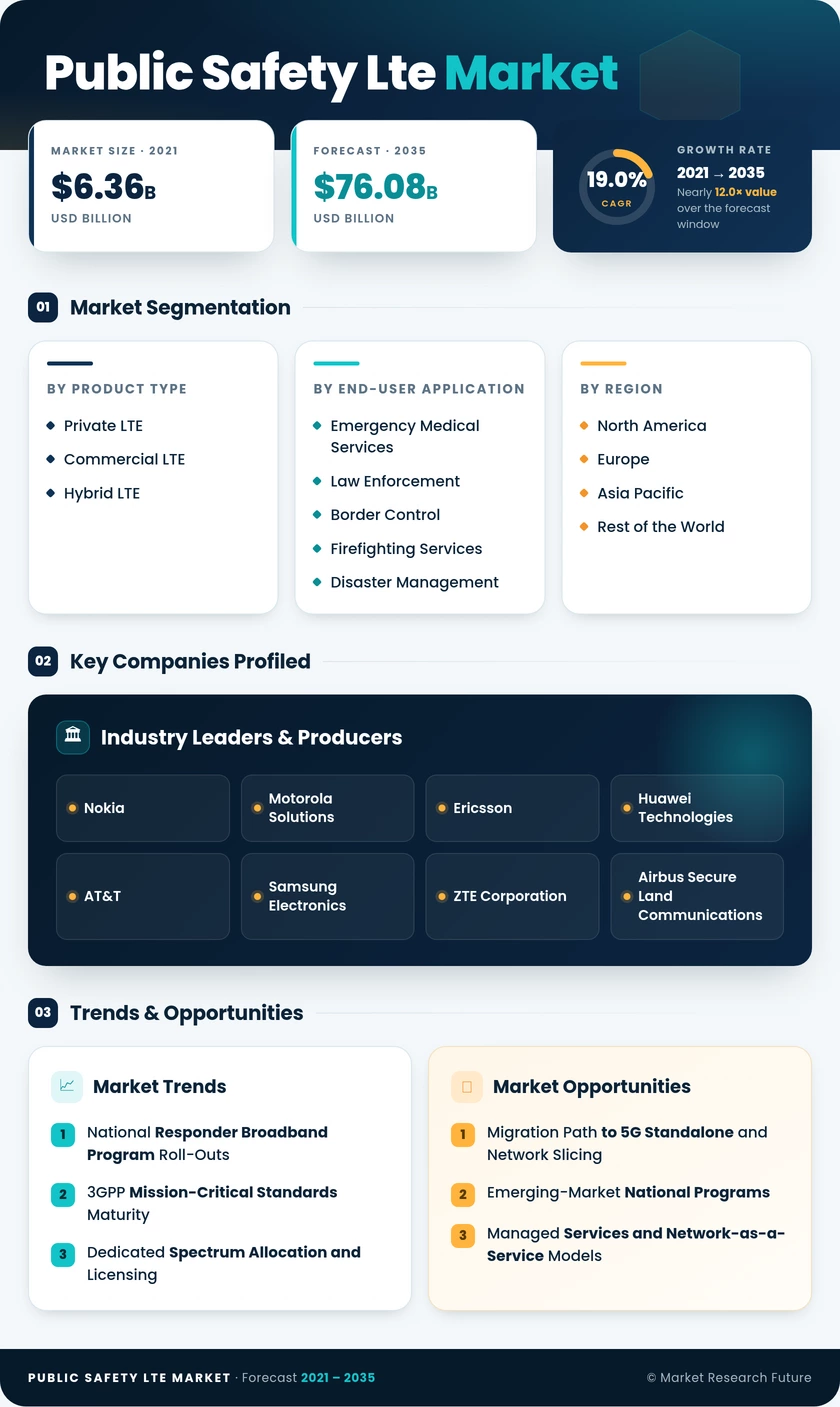
Segmentation Quick Reference
| Dimension | Sub-Segments | Dominant Segment | Fastest Growing Segment |
| By Product Type | Private LTE; Commercial LTE; Hybrid LTE | Private LTE (48.6% share) | Hybrid LTE (21.4% CAGR) |
| By End-user Application | Emergency Medical Services; Law Enforcement; Border Control; Firefighting Services; Disaster Management | Law Enforcement (37.4% share) | Disaster Management (22.3% CAGR) |
| By Region | North America; Europe; Asia Pacific; Rest of the World | Europe (34.2% share) | Asia Pacific (21.8% CAGR) |
Market Segmentation Overview
By Product Type
| Sub-Segment | Key Trend |
| Private LTE | Sovereign core ownership required by national accreditation regimes; strongest in Europe and United States federal deployments |
| Commercial LTE | Carrier-sold priority and pre-emption tiers expand reach to municipal agencies with no capital budget. |
| Hybrid LTE | Dedicated core with leased radio access becomes the default compromise for territory-wide coverage economics. |
Private LTE leads this dimension because security accreditation in Europe and North America effectively requires the agency to control the core and demonstrate data residency, a condition Commercial LTE tiers cannot satisfy for classified traffic. Hybrid LTE grows fastest as program sponsors accept that full dedicated coverage beyond dense urban zones cannot be funded, and pair an owned core with leased carrier radio in rural territory. Commercial LTE retains a substantial revenue base among smaller municipal buyers whose procurement rules favour operating expenditure over capital, but its share erodes as accreditation standards tighten.
By End-user Application
| Sub-Segment | Key Trend |
| Emergency Medical Services | Pre-hospital telemetry and telemedicine links raise sustained uplink requirements per vehicle. |
| Law Enforcement | Fleet-scale body-worn video and live database queries dominate traffic volume. |
| Border Control | Extended-perimeter sensor and surveillance networks drive dedicated coverage in low-density terrain. |
| Firefighting Services | In-building and sub-surface penetration requirements shape coverage specification. |
| Disaster Management | Deployable assets and multi-agency talkgroup interworking become standing budget lines. |
Law Enforcement holds the largest share because it combines the biggest responder headcount with the heaviest per-user data load once body-worn video moves from pilot to fleet deployment. Disaster Management expands fastest as climate-linked event frequency converts what was episodic contingency spending into recurring appropriations for deployable coverage and cross-agency coordination. Firefighting Services and Emergency Medical Services buy differently from both: firefighting procurement is dictated by in-building and sub-surface penetration guarantees that macro coverage figures obscure, while Emergency Medical Services demand follows hospital integration mandates rather than incident volume.


 Noah Malgeri
Co-Founder

 Peter Groot koerkamp
Account and Business Manager

 Younghwan Choi
Senior Retail Manager

 Mark Irwin
Management Consultant

 Akif Moroglu
Strategy & Business Development Director

 Guilherme Gomes Martins
Product Management Director

 Joseph Aguayo
Sales Operations & Pricing Manager

 La Terria Dodd
Program Support Specialist

 Rob Kooiker
Group Product Manager HVAC & Fire Protection GMA