Request Free Sample ×

Kindly complete the form below to receive a free sample of this Report

* Please use a valid business email

Leading companies partner with us for data-driven Insights

clients tt-cursor
Hero Background
English
Chinese
French
Japanese
Korean
German
Spanish

Psoriasis Treatment Market Size

ID: MRFR/Pharma/2052-HCR
200 Pages
Satyendra Maurya
Last Updated: April 10, 2026

Psoriasis Treatment Market Size, Growth Research Report By Treatment Type (Topical Treatments, Systemic Treatments, Phototherapy, Biologics), By Administration Route (Oral, Topical, Injectable, Intravenous), By Indication (Plaque Psoriasis, Guttate Psoriasis, Inverse Psoriasis, Pustular Psoriasis), By End User (Hospital, Dermatology Clinics, Homecare Settings) and By Regional (North America, Europe, South America, Asia Pacific, Middle East and Africa) - Competitor Industry Analysis and Trends Forecast Till 2035

Share:
Download PDF ×

We do not share your information with anyone. However, we may send you emails based on your report interest from time to time. You may contact us at any time to opt-out.

Psoriasis Treatment Market Infographic
Purchase Options

Psoriasis Treatment Size

Psoriasis Treatment Market Growth Projections and Opportunities

The psoriasis treatment market is impacted by a thorough exhibit of contemplations, mirroring the modern idea of the immune system skin jumble as well as the progressing dermatological treatments scene. The Psoriasis treatment market is moved by worldwide commonness, including millions, stemming in significant need for successful choices to oversee side effects and change personal satisfaction. Designated treatments and biologics have changed psoriasis treatment, offering created adequacy with restricted incidental effects contrasted with obsolete foundational treatments, backing market development. The take off in understanding mindfulness and upgraded demonstrative capacities has prompted a raise in the psoriasis treatment market, bringing about expanded interest for pertinent medicines. The psoriasis treatment market is progressing towards patient-driven propels, zeroing in on fitting treatment systems to individual requirements, tendencies, and ways of life. Worldwide drives advancing psoriasis mindfulness, decreasing disgrace, advancing early finding, and pushing for compelling treatment choices add to showcase development and lessen shame. Psoriasis, a condition portrayed by comorbidities like metabolic issues, cardiovascular infections, and joint inflammation, has prompted an expanding prerequisite for exhaustive treatment arrangements. Medical care experts offer different therapy decisions for psoriasis, including skin corticosteroids, phototherapy, foundational meds, and biologics, guaranteeing market adaptability and flexibility to individual patient necessities. Innovative work endeavours have prompted a strong pipeline of arising treatments for psoriasis, promising future patient choices and supporting the development of the treatment market. Health care coverage inclusion and repayment strategies altogether impact admittance to the psoriasis treatment, guaranteeing more extensive patient access and driving the reception of various inventive and costly medicines. Therapy adherence stays testing because of therapy intricacy, aftereffects, and ongoing psoriasis, provoking the market to foster more advantageous, patient-accommodating treatment choices. Topographical varieties in treatment rehearses, impacted by different social elements, medical care framework, and financial variables, require a nuanced comprehension of the local market subtleties in psoriasis the executives.

Psoriasis Treatment Market Size Graph
Author
Author Profile
Satyendra Maurya
Research Analyst

An accomplished research analyst with high proficiency in market forecasting, data visualization, competitive benchmarking, and others. He holds a pronounced track record in research and consulting projects for sectors such as life sciences, medical devices, and healthcare IT. His capabilities in qualitative and quantitative analysis have resulted in positive client outcomes. Working on niche market trends, opportunities, sales, and forecasted value is part of his skill set.

Leave a Comment

FAQs

What is the current valuation of the Psoriasis Treatment Market as of 2024?

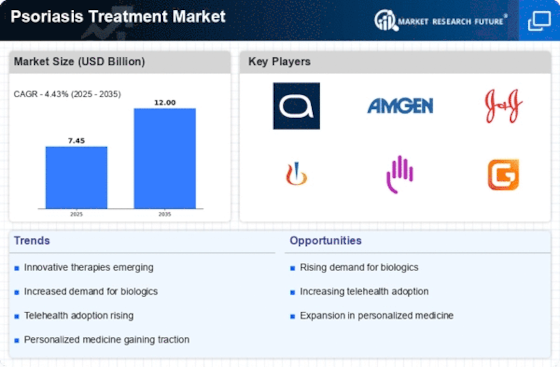
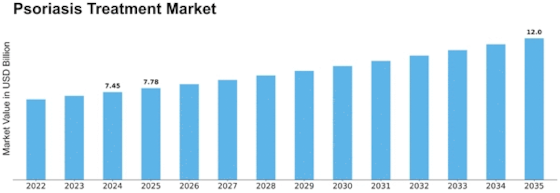
<p>The Psoriasis Treatment Market was valued at 7.45 USD Billion in 2024.</p>

What is the projected market size for the Psoriasis Treatment Market by 2035?

<p>The market is projected to reach 12.0 USD Billion by 2035.</p>

What is the expected CAGR for the market during the forecast period 2025 - 2035?

The expected CAGR for the market during 2025 - 2035 is 4.43%.

Which segment of the Psoriasis Treatment Market had the highest valuation in 2024?

<p>In 2024, the Biologics segment had the highest valuation at 2.95 USD Billion.</p>

What are the projected values for Topical Treatments in the Psoriasis Treatment Market by 2035?

<p>Topical Treatments are projected to reach 2.5 USD Billion by 2035.</p>

How does the market for Injectable treatments compare to Oral treatments in 2024?

<p>In 2024, the market for Injectable treatments was valued at 2.0 USD Billion, while Oral treatments were also at 1.5 USD Billion.</p>

What is the expected growth for the Homecare Settings segment by 2035?

<p>The Homecare Settings segment is expected to grow to 5.0 USD Billion by 2035.</p>

Which key players are leading the Psoriasis Treatment Market?

Key players in the market include AbbVie, Amgen, Johnson &amp; Johnson, and Novartis.

What is the projected value of Plaque Psoriasis treatments by 2035?

<p>Plaque Psoriasis treatments are projected to reach 5.0 USD Billion by 2035.</p>

What is the anticipated market performance for Dermatology Clinics in the coming years?

<p>Dermatology Clinics are expected to grow to 3.0 USD Billion by 2035.</p>

Market Summary

According to Market Research Future analysis, the Psoriasis Treatment Market Size was valued at USD 28.6 Billion in 2025 & the market is projected to grow from USD 31.2 Billion in 2026 to USD 68.80 Billion by 2035, registering a CAGR of 9.2% during the forecast period 2026–2035. North America led the market with over 45% share, generating around USD 12.87 billion in revenue.
 
Rising global prevalence of psoriasis and other chronic inflammatory skin conditions is a major growth driver, supported by increasing awareness, improved diagnosis rates, and growing demand for advanced therapies, significantly accelerating adoption of effective and targeted psoriasis treatment solutions worldwide.
 
According to WHO, psoriasis affects approximately 2–3% of the global population, representing over 125 million people worldwide, while IHME reports skin diseases contribute to more than 42 million years lived with disability (YLDs) globally, highlighting strong and sustained demand for effective psoriasis treatment solutions.

Key Market Trends & Highlights

The Psoriasis Treatment Market is experiencing a transformative shift towards innovative therapies and personalized care.

  • North America leads with over 45% revenue share in 2025, driven by high prevalence and advanced biologic adoption. Europe accounted for USD 8.58 billion in 2025, holding 30% share supported by strong healthcare systems and awareness. Psoriasis affects over 125 million people globally, significantly driving long-term demand for advanced and effective treatment solutions. Topical treatments dominate with 48% share in 2024, supported by accessibility and effectiveness in mild-to-moderate psoriasis cases.

Market Size & Forecast

2025 Market Size 28.6 (USD Billion)
2035 Market Size 68.8 (USD Billion)
CAGR (2025 - 2035) 9.2%
Largest Regional Market Share in 2024 North America

Major Players

Companies such as <a title="AbbVie" href="https://www.abbvie.com/content/dam/abbvie-dotcom/uploads/PDFs/results-summaries/Clinical_Study_M15-992_English.pdf" target="_blank" rel="noopener">AbbVie</a> (US), Amgen (US), Johnson &amp; Johnson (US), <a title="Novartis" href="https://www.novartis.com/us-en/news/media-releases/novartis-cosentyx-shows-almost-all-psoriasis-patients-rapidly-regain-skin-clearance-following-treatment-pause" target="_blank" rel="noopener">Novartis</a> (CH), Bristol-Myers Squibb (US), GSK (GB), Eli Lilly (US), Sanofi (FR), UCB (BE) are some of the major participants in the global market.

Market Trends

The Psoriasis Treatment Market is currently experiencing a dynamic evolution, driven by a combination of innovative therapies and a growing understanding of the disease's underlying mechanisms. Recent advancements in biologic treatments, which target specific pathways involved in the inflammatory process, appear to be reshaping the therapeutic landscape. Additionally, psoriasis statistics suggest that the increasing prevalence of psoriasis globally suggests a rising demand for effective treatment options.

This trend is further supported by heightened awareness and education surrounding the condition, which encourages patients to seek medical advice and explore available therapies. Moreover, the market is witnessing a shift towards personalized medicine, where treatments are tailored to individual patient profiles. This approach not only enhances treatment efficacy but also minimizes potential side effects, thereby improving patient adherence, augmenting the psoriasis market size.

The integration of digital health technologies, such as telemedicine and mobile health applications, is also gaining traction, facilitating better patient management and follow-up care. As the market continues to evolve, stakeholders must remain vigilant to emerging trends and adapt strategies accordingly to meet the diverse needs of patients and healthcare providers alike.

Rise of Biologic Therapies

The Psoriasis Treatment Market is increasingly characterized by the emergence of biologic therapies. Psoriasis statistics suggest that these advanced treatments target specific components of the immune system, offering a more effective approach to managing psoriasis symptoms. As research progresses, the development of new biologics is likely to expand treatment options, potentially leading to improved patient outcomes.

  • According to CDC and WHO data, autoimmune diseases affect nearly 5–8% of the global population, while biologic therapies have demonstrated efficacy rates exceeding 70% improvement in psoriasis severity (PASI 75) in clinical studies, supporting strong adoption of targeted biologic treatments in managing moderate-to-severe psoriasis cases.

Personalized Medicine Approach

There is a noticeable shift towards personalized medicine within the Psoriasis Treatment Market. Tailoring treatments to individual patient characteristics may enhance therapeutic effectiveness and reduce adverse effects. This trend suggests a growing recognition of the need for customized care in managing chronic conditions like psoriasis.

  • IHME reports that chronic diseases account for over 41 million deaths annually, while WHO highlights that personalized treatment approaches can improve therapeutic outcomes by up to 30%, reinforcing the shift toward individualized psoriasis care strategies that enhance effectiveness and minimize adverse reactions.

Integration of Digital Health Solutions

The incorporation of digital health solutions is transforming the Psoriasis Treatment Market. Telemedicine and mobile applications are facilitating better patient engagement and monitoring. This trend indicates a move towards more accessible and efficient healthcare delivery, which could significantly improve treatment adherence and patient satisfaction.

  • According to UNICEF, over 5.3 billion people globally use the internet, while WHO reports telemedicine utilization increased by more than 25% in recent years, enabling improved remote monitoring, adherence, and patient engagement in chronic disease management, including psoriasis treatment and long-term care solutions.

Psoriasis Treatment Market Market Drivers

Growing Awareness and Education

The increasing awareness and education surrounding psoriasis are crucial drivers for the Psoriasis Treatment Market. Campaigns aimed at educating the public about the condition and its treatment options have led to a rise in diagnosis rates. Patients are now more informed about their treatment choices, which encourages them to seek medical advice.
 
This heightened awareness is particularly evident in regions where healthcare initiatives focus on chronic diseases. As more individuals understand the implications of psoriasis, the demand for effective treatments is expected to rise, thereby propelling the market forward.

Increasing Prevalence of Psoriasis

The rising incidence of psoriasis is a pivotal driver in the Psoriasis Treatment Market. Recent estimates indicate that approximately 2-3% of the population is affected by this chronic skin condition, leading to a growing demand for effective treatment options.
 
As awareness of psoriasis increases, more individuals seek medical intervention, thereby expanding the market. The prevalence of psoriasis is particularly notable in developed regions, where healthcare access is more readily available. This trend suggests that the market will continue to grow as healthcare providers develop new therapies to meet the needs of an expanding patient population.

Advancements in Treatment Modalities

Innovations in treatment modalities are significantly influencing the Psoriasis Treatment Market. The introduction of biologic therapies, which target specific pathways in the immune system, has transformed the treatment landscape. These therapies have shown efficacy in moderate to severe cases, leading to increased adoption among healthcare professionals.
 
Furthermore, the market is witnessing a surge in topical treatments and systemic therapies, which cater to varying degrees of psoriasis severity. The continuous research and development efforts in this area indicate a promising future for the market, as new and improved therapies are likely to emerge.

Regulatory Support for New Therapies

Regulatory support for the approval of new therapies is a vital driver in the Psoriasis Treatment Market. Regulatory agencies are increasingly expediting the review process for innovative treatments, particularly biologics and novel systemic therapies. This trend is encouraging pharmaceutical companies to invest in research and development, leading to a more diverse array of treatment options for patients.
 
The favorable regulatory environment not only accelerates the availability of new therapies but also enhances competition within the market. As a result, the market is likely to experience growth as new and effective treatments become accessible to patients.

Rising Investment in Healthcare Infrastructure

The expansion of healthcare infrastructure is a significant factor impacting the Psoriasis Treatment Market. Increased investment in healthcare facilities and services enhances access to dermatological care, which is essential for effective psoriasis management.
 
Governments and private entities are focusing on improving healthcare systems, particularly in underserved areas. This investment is likely to facilitate better diagnosis and treatment options for psoriasis patients. As healthcare systems evolve, the market is poised to benefit from improved patient access and a broader range of treatment modalities.

Market Segment Insights

By Type: Topical Treatments (Largest) vs. Biologics (Fastest-Growing)

The Topical Treatments segment dominates the Psoriasis Treatment Market share at 48% due to its widespread use and accessibility for patients. This segment includes various therapies such as corticosteroids, vitamin D analogs, and retinoids, which are effective for mild to moderate cases of psoriasis. On the other hand, Biologics, which are advanced medications targeting specific parts of the immune system, are gaining traction and hold a significant part of the market due to their effectiveness in severe cases, resulting in their rapid growth.

Topical Treatments (Dominant) vs. Biologics (Emerging)

Topical Treatments have established themselves as the cornerstone for managing psoriasis for many patients, especially those with mild to moderate conditions. These treatments are often preferred due to their ease of use, direct application, and lower risk of systemic side effects. In contrast, Biologics represent an emerging avenue in psoriasis therapy, offering targeted relief for moderate to severe cases through innovative methods that inhibit inflammatory pathways. Their increasing effectiveness and the medical community's growing familiarity with these drugs are driving rapid adoption. As a result, while Topical Treatments remain dominant, Biologics are set to capture a larger share of the market, owing to a favorable outlook and endorsement from dermatology guidelines.

By Administration Route: Topical (Largest) vs. Injectable (Fastest-Growing)

The administration route segment displays significant diversity, with topical treatments holding the largest Psoriasis Treatment Market share at 52%. These treatments are favored due to their direct application on affected areas, resulting in minimal systemic exposure. Injectables, while representing a smaller share currently, are emerging as a potent contender due to their efficacy and the increasing patient and physician acceptance. Oral and intravenous routes, though available, occupy more specialized niches within the market.

Topical (Dominant) vs. Injectable (Emerging)

Topical treatments for psoriasis, including creams, ointments, and gels, dominate the market due to their targeted nature and ease of use. They are widely preferred by patients and healthcare providers for milder cases and are often the first line of defense. Conversely, injectable treatments, such as biologics, are rapidly gaining traction as they offer significant relief for moderate to severe psoriasis. They harness advanced biotechnology and have shown impressive efficacy rates, making them an attractive option for treatment-resistant patients. This shift towards injectables represents a growing trend in the market, driven by continued advancements in technology and the increasing prevalence of psoriasis.

By Indication: Plaque Psoriasis (Largest) vs. Guttate Psoriasis (Fastest-Growing)

The psoriasis treatment market features a diverse range of indications, with Plaque Psoriasis accounting for the largest market share at 62%. This subtype is the most prevalent form of psoriasis and is characterized by raised, inflamed lesions covered with silvery scales. Guttate Psoriasis, while smaller in share compared to Plaque, has been noted for its rapid growth, primarily in younger populations and influenced by factors such as streptococcal infections. As the awareness and diagnosis of various psoriasis types improve, the market distribution reflects these changes in patient demographics and symptom presentations.

Plaque Psoriasis (Dominant) vs. Guttate Psoriasis (Emerging)

Plaque Psoriasis remains the dominant indication in the market, largely due to its high prevalence and the extensive range of effective therapies available. Patients with Plaque Psoriasis often experience chronic symptoms, leading to consistent demand for treatment options. In contrast, Guttate Psoriasis is emerging quickly, especially among adolescents and young adults, as it is often a result of infections or stress. While it may not be as well-known as Plaque, the increasing incidence rates and novel treatment approaches are propelling its market presence. Patients with Guttate are generally more receptive to new therapies, creating opportunities for innovative treatment options.

By End User: Hospital (Largest) vs. Dermatology Clinics (Fastest-Growing)

Hospitals account for the largest share in the psoriasis treatment market, representing 46% of the end-user segment. This is primarily due to their capacity to offer comprehensive care, advanced treatment options, and the availability of specialist healthcare professionals. Dermatology clinics follow closely, yet they are witnessing an impressive surge in demand as more patients seek specialized care in a focused environment. Homecare settings are becoming increasingly relevant, particularly for those preferring convenience and personalized treatment regimens, although they hold a smaller share compared to hospitals and clinics.

Dermatology Clinics (Dominant) vs. Homecare Settings (Emerging)

Dermatology clinics serve as a dominant force in the market due to their targeted approach to skincare and treatment of specific conditions, which resonates well with patients seeking expert help. They not only provide customized treatment plans and access to cutting-edge therapies but also facilitate continuous monitoring of patients' progress, enhancing treatment efficacy. Conversely, homecare settings are emerging as a vital alternative, especially amid the growing trend of telemedicine and patient-centric care models. The convenience of managing psoriasis treatments at home appeals to many patients, especially those with mild to moderate conditions, thus fostering growth opportunities in this segment.

Get more detailed insights about Psoriasis Treatment Market Research Report - Forecast till 2035

Regional Insights

North America : Leading Market for Treatments

North America leads in the Psoriasis Treatment Market size, accounting for over 45% of the global revenue in 2025. The region's growth is driven by increasing prevalence of psoriasis, advancements in treatment options, and supportive regulatory frameworks. The U.S. Food and Drug Administration (FDA) has accelerated the approval process for innovative therapies, enhancing market dynamics.

  • According to CDC, over 7.5 million people in the U.S. are affected by psoriasis, while healthcare expenditure exceeds USD 4.5 trillion annually, supporting widespread access to advanced therapies and accelerating adoption of innovative psoriasis treatment solutions across the region.

The demand for biologics and targeted therapies is on the rise, further propelling market growth. The competitive landscape in North America is robust, with key players such as AbbVie, Amgen, and Johnson & Johnson leading the market. The presence of advanced healthcare infrastructure and high healthcare expenditure supports the adoption of new therapies. Additionally, ongoing clinical trials and research initiatives are expected to introduce novel treatment options, solidifying North America's position as a leader in the market.

Europe : Emerging Market with Growth Potential

Europe Psoriasis Treatment Market size was valued at USD 8.58 billion in 2025, making it the second-largest regional market with a 30% share. The region is witnessing significant growth due to rising awareness about psoriasis, increasing healthcare investments, and favorable reimbursement policies. The European Medicines Agency (EMA) has been proactive in approving new therapies, which has stimulated market demand.

  • According to ECDC and WHO Europe, psoriasis affects approximately 14 million people in Europe, while healthcare spending accounts for nearly 10% of GDP, supporting improved access to advanced dermatological treatments and strengthening demand for effective psoriasis therapies across the region.

The growing focus on personalized medicine is also a key driver of market expansion in Europe. Leading countries in Europe include Germany, France, and the UK, which are home to several prominent pharmaceutical companies. Key players such as Novartis, GSK, and Sanofi are actively involved in developing innovative treatments. The competitive landscape is characterized by a mix of established companies and emerging biotech firms, fostering a dynamic environment for psoriasis treatment advancements.

Asia-Pacific : Rapidly Growing Treatment Sector

The Asia-Pacific region is emerging as a significant player in the psoriasis treatment market, accounting for approximately 20% of the global market share. The growth is driven by increasing awareness of skin diseases, rising disposable incomes, and expanding healthcare access. Countries like China and India are witnessing a surge in demand for psoriasis treatments, supported by government initiatives aimed at improving healthcare infrastructure and access to medications.

Regulatory bodies are also streamlining approval processes for new therapies, enhancing market dynamics. In the competitive landscape, key players such as Eli Lilly and Pfizer are making substantial investments in the region. The presence of local pharmaceutical companies is also increasing, contributing to a diverse market. The growing trend of telemedicine and digital health solutions is expected to further boost treatment accessibility and patient engagement in the Asia-Pacific region, driving future growth.

Middle East and Africa : Emerging Market with Challenges

The Middle East and Africa (MEA) region is gradually developing its psoriasis treatment market, holding approximately 5% of the global market share. The growth is hindered by challenges such as limited healthcare infrastructure, high treatment costs, and varying levels of awareness about psoriasis. However, increasing investments in healthcare and initiatives to improve access to treatments are expected to drive market growth in the coming years. Regulatory bodies are working to enhance the approval processes for new therapies, which could stimulate market dynamics.

Leading countries in the MEA region include South Africa and the UAE, where there is a growing presence of international pharmaceutical companies. Key players are beginning to explore opportunities in this region, focusing on affordable treatment options. The competitive landscape is evolving, with local firms collaborating with global companies to enhance treatment availability and awareness, paving the way for future growth in the market.

Key Players and Competitive Insights

The Psoriasis Treatment Market is characterized by a dynamic competitive landscape, driven by a confluence of innovation, strategic partnerships, and a growing emphasis on personalized medicine. Major players such as AbbVie (US), Amgen (US), and Novartis (CH) are at the forefront, leveraging their extensive research capabilities and established market presence to enhance their product offerings. AbbVie (US) continues to focus on its flagship product, Humira, while also investing in the development of new therapies that target specific patient populations. Meanwhile, Amgen (US) is expanding its portfolio through strategic collaborations aimed at enhancing its biologics pipeline, which is crucial in addressing the diverse needs of psoriasis patients. Novartis (CH) is similarly positioned, emphasizing its commitment to innovation through the development of novel therapies that not only improve efficacy but also reduce treatment burden for patients.
 
In terms of business tactics, companies are increasingly localizing manufacturing and optimizing supply chains to enhance efficiency and responsiveness to market demands. The competitive structure of the psoriasis treatment market appears moderately fragmented, with several key players exerting influence over various segments. This fragmentation allows for a diverse range of treatment options, catering to different patient demographics and preferences, while also fostering a competitive environment that encourages continuous innovation. 
 
In August 2025, AbbVie (US) announced a strategic partnership with a leading biotechnology firm to co-develop a new class of oral therapies for psoriasis. This collaboration is expected to accelerate the development timeline and enhance AbbVie’s competitive edge in the oral treatment segment, which is gaining traction among patients seeking alternatives to injectable therapies. The strategic importance of this partnership lies in its potential to broaden AbbVie’s market share and reinforce its position as a leader in psoriasis treatment. 
 
In September 2025, Amgen (US) launched a new digital health platform aimed at improving patient engagement and adherence to psoriasis treatments. This initiative reflects a growing trend towards digitalization in healthcare, where technology is leveraged to enhance patient outcomes. By integrating digital tools into its treatment protocols, Amgen (US) not only improves patient experience but also gathers valuable data that can inform future product development.
 
 In October 2025, Novartis (CH) unveiled a sustainability initiative focused on reducing the environmental impact of its manufacturing processes for psoriasis treatments. This move aligns with the increasing demand for sustainable practices within the pharmaceutical industry and positions Novartis as a forward-thinking player committed to corporate social responsibility. The strategic importance of this initiative is multifaceted, as it not only addresses regulatory pressures but also resonates with environmentally conscious consumers.
 
As of October 2025, the competitive trends in the psoriasis treatment market are increasingly defined by digitalization, sustainability, and the integration of artificial intelligence in drug development. Strategic alliances are becoming more prevalent, as companies recognize the value of collaboration in navigating complex market dynamics. Looking ahead, competitive differentiation is likely to evolve from traditional price-based competition towards a focus on innovation, technological advancements, and supply chain reliability, ultimately enhancing patient care and treatment outcomes.

Key Companies in the Psoriasis Treatment Market include

Industry Developments

In recent months, the Global Psoriasis Treatment Market has experienced significant developments, particularly with companies like AbbVie making strides in Research and Development for improved biologic therapies. In September 2023, Pfizer launched a new clinical trial aimed at exploring innovative treatments for moderate to severe psoriasis, showcasing ongoing commitment in this sector. Similarly, in August 2023, Merck announced advancements in their psoriasis portfolio, aimed at enhancing patient outcomes. 

Major companies including Johnson and Johnson and Novartis continue to engage in improving treatment options, while GSK has been actively investing in research to tap into emerging treatment modalities. In terms of mergers and acquisitions, in July 2023, AstraZeneca completed the acquisition of a portfolio from a small biotech company focused on skin diseases, significantly enhancing their capabilities in the psoriasis market. 

Reports indicate that there is growing momentum for biologic therapies, which has led to increased valuations for key players in the market. Over the past two to three years, the industry has witnessed a marked increase in interest and investment, particularly in targeting more effective treatment options for patients, as the demand for innovative solutions continues to rise globally.

Future Outlook

Psoriasis Treatment Market Future Outlook

The Psoriasis Treatment Market size is projected to reach USD 68.80 Billion by 2035, growing at a CAGR of 9.2%, driven by increasing prevalence, innovative therapies, and rising healthcare expenditure.

New opportunities lie in:

  • <p>Development of personalized biologic therapies targeting specific patient profiles. Expansion of telehealth services for <a title="remote patient monitoring" href="https://www.marketresearchfuture.com/reports/remote-patient-monitoring-market-10905" target="_blank" rel="noopener">remote patient monitoring</a> and consultations. Investment in digital health platforms for treatment adherence and education.</p>

By 2035, the Psoriasis Treatment Market is expected to achieve substantial growth and innovation.

Market Segmentation

Psoriasis Treatment Market Type Outlook

  • Topical Treatments
  • Systemic Treatments
  • Phototherapy
  • Biologics

Psoriasis Treatment Market End User Outlook

  • Hospital
  • Dermatology Clinics
  • Homecare Settings

Psoriasis Treatment Market Indication Outlook

  • Plaque Psoriasis
  • Guttate Psoriasis
  • Inverse Psoriasis
  • Pustular Psoriasis

Psoriasis Treatment Market Administration Route Outlook

  • Oral
  • Topical
  • Injectable
  • Intravenous

Report Scope

MARKET SIZE 2025 28.6(USD Billion)
MARKET SIZE 2026 31.2(USD Billion)
MARKET SIZE 2035 68.8(USD Billion)
COMPOUND ANNUAL GROWTH RATE (CAGR) 9.2% (2026 - 2035)
REPORT COVERAGE Revenue Forecast, Competitive Landscape, Growth Factors, and Trends
BASE YEAR 2025
Market Forecast Period 2026 - 2035
Historical Data 2019 - 2024
Market Forecast Units USD Billion
Key Companies Profiled AbbVie (US), Amgen (US), Johnson & Johnson (US), Novartis (CH), Bristol-Myers Squibb (US), GSK (GB), Eli Lilly (US), Sanofi (FR), UCB (BE)
Segments Covered Treatment Type, Administration Route, Indication, End User, Regional
Key Market Opportunities Emergence of biologics and personalized therapies enhances treatment options in the market.
Key Market Dynamics Rising demand for biologics drives innovation and competition in the psoriasis treatment landscape.
Countries Covered North America, Europe, APAC, South America, MEA

FAQs

What is the current valuation of the Psoriasis Treatment Market as of 2024?

<p>The Psoriasis Treatment Market was valued at 7.45 USD Billion in 2024.</p>

What is the projected market size for the Psoriasis Treatment Market by 2035?

<p>The market is projected to reach 12.0 USD Billion by 2035.</p>

What is the expected CAGR for the market during the forecast period 2025 - 2035?

The expected CAGR for the market during 2025 - 2035 is 4.43%.

Which segment of the Psoriasis Treatment Market had the highest valuation in 2024?

<p>In 2024, the Biologics segment had the highest valuation at 2.95 USD Billion.</p>

What are the projected values for Topical Treatments in the Psoriasis Treatment Market by 2035?

<p>Topical Treatments are projected to reach 2.5 USD Billion by 2035.</p>

How does the market for Injectable treatments compare to Oral treatments in 2024?

<p>In 2024, the market for Injectable treatments was valued at 2.0 USD Billion, while Oral treatments were also at 1.5 USD Billion.</p>

What is the expected growth for the Homecare Settings segment by 2035?

<p>The Homecare Settings segment is expected to grow to 5.0 USD Billion by 2035.</p>

Which key players are leading the Psoriasis Treatment Market?

Key players in the market include AbbVie, Amgen, Johnson &amp; Johnson, and Novartis.

What is the projected value of Plaque Psoriasis treatments by 2035?

<p>Plaque Psoriasis treatments are projected to reach 5.0 USD Billion by 2035.</p>

What is the anticipated market performance for Dermatology Clinics in the coming years?

<p>Dermatology Clinics are expected to grow to 3.0 USD Billion by 2035.</p>

  1. SECTION I: EXECUTIVE SUMMARY AND KEY HIGHLIGHTS |
    1. EXECUTIVE SUMMARY | |
      1. Market Overview | |
      2. Key Findings | |
      3. Market Segmentation | |
      4. Competitive Landscape | |
      5. Challenges and Opportunities | |
      6. Future Outlook 2
  2. SECTION II: SCOPING, METHODOLOGY AND MARKET STRUCTURE |
    1. MARKET INTRODUCTION | |
      1. Definition | |
      2. Scope of the study | | |
    2. RESEARCH METHODOLOGY | |
      1. Overview | |
      2. Data Mining | |
      3. Secondary Research | |
      4. Primary Research | | |
      5. Forecasting Model | |
      6. Market Size Estimation | | |
      7. Data Triangulation | |
      8. Validation 3
  3. SECTION III: QUALITATIVE ANALYSIS |
    1. MARKET DYNAMICS | |
      1. Overview | |
      2. Drivers | |
      3. Restraints | |
      4. Opportunities |
    2. MARKET FACTOR ANALYSIS | |
      1. Value chain Analysis | |
      2. Porter's Five Forces Analysis | | |
      3. COVID-19 Impact Analysis | | |
  4. SECTION IV: QUANTITATIVE ANALYSIS |
    1. Healthcare, BY Type (USD Billion) | |
      1. Topical Treatments | |
      2. Systemic Treatments | |
      3. Phototherapy | |
      4. Biologics |
    2. Healthcare, BY Administration Route (USD Billion) | |
      1. Oral | |
      2. Topical | |
      3. Injectable | |
      4. Intravenous |
    3. Healthcare, BY Indication (USD Billion) | |
      1. Plaque Psoriasis | |
      2. Guttate Psoriasis | |
      3. Inverse Psoriasis | |
      4. Pustular Psoriasis |
    4. Healthcare, BY End User (USD Billion) | |
      1. Hospital | |
      2. Dermatology Clinics | |
      3. Homecare Settings |
    5. Healthcare, BY Region (USD Billion) | |
      1. North America | | |
      2. Europe | | |
      3. APAC | | |
      4. South America | | |
      5. MEA | | |
  5. SECTION V: COMPETITIVE ANALYSIS |
    1. Competitive Landscape | |
      1. Overview | |
      2. Competitive Analysis | |
      3. Market share Analysis | |
      4. Major Growth Strategy in the Healthcare | |
      5. Competitive Benchmarking | |
      6. Leading Players in Terms of Number of Developments in the Healthcare | |
      7. Key developments and growth strategies | | |
      8. Major Players Financial Matrix | | |
    2. Company Profiles | |
      1. AbbVie (US) | | |
      2. Amgen (US) | | |
      3. Johnson & Johnson (US) | | |
      4. Novartis (CH) | | |
      5. Bristol-Myers Squibb (US) | | |
      6. GSK (GB) | | |
      7. Eli Lilly (US) | | |
      8. Sanofi (FR) | | |
      9. UCB (BE) | | |
    3. Appendix | |
      1. References | |
      2. Related Reports 6 LIST OF FIGURES |
    4. MARKET SYNOPSIS |
    5. NORTH AMERICA MARKET ANALYSIS |
    6. US MARKET ANALYSIS BY TYPE |
    7. US MARKET ANALYSIS BY ADMINISTRATION ROUTE |
    8. US MARKET ANALYSIS BY INDICATION |
    9. US MARKET ANALYSIS BY END USER |
    10. CANADA MARKET ANALYSIS BY TYPE |
    11. CANADA MARKET ANALYSIS BY ADMINISTRATION ROUTE |
    12. CANADA MARKET ANALYSIS BY INDICATION |
    13. CANADA MARKET ANALYSIS BY END USER |
    14. EUROPE MARKET ANALYSIS |
    15. GERMANY MARKET ANALYSIS BY TYPE |
    16. GERMANY MARKET ANALYSIS BY ADMINISTRATION ROUTE |
    17. GERMANY MARKET ANALYSIS BY INDICATION |
    18. GERMANY MARKET ANALYSIS BY END USER |
    19. UK MARKET ANALYSIS BY TYPE |
    20. UK MARKET ANALYSIS BY ADMINISTRATION ROUTE |
    21. UK MARKET ANALYSIS BY INDICATION |
    22. UK MARKET ANALYSIS BY END USER |
    23. FRANCE MARKET ANALYSIS BY TYPE |
    24. FRANCE MARKET ANALYSIS BY ADMINISTRATION ROUTE |
    25. FRANCE MARKET ANALYSIS BY INDICATION |
    26. FRANCE MARKET ANALYSIS BY END USER |
    27. RUSSIA MARKET ANALYSIS BY TYPE |
    28. RUSSIA MARKET ANALYSIS BY ADMINISTRATION ROUTE |
    29. RUSSIA MARKET ANALYSIS BY INDICATION |
    30. RUSSIA MARKET ANALYSIS BY END USER |
    31. ITALY MARKET ANALYSIS BY TYPE |
    32. ITALY MARKET ANALYSIS BY ADMINISTRATION ROUTE |
    33. ITALY MARKET ANALYSIS BY INDICATION |
    34. ITALY MARKET ANALYSIS BY END USER |
    35. SPAIN MARKET ANALYSIS BY TYPE |
    36. SPAIN MARKET ANALYSIS BY ADMINISTRATION ROUTE |
    37. SPAIN MARKET ANALYSIS BY INDICATION |
    38. SPAIN MARKET ANALYSIS BY END USER |
    39. REST OF EUROPE MARKET ANALYSIS BY TYPE |
    40. REST OF EUROPE MARKET ANALYSIS BY ADMINISTRATION ROUTE |
    41. REST OF EUROPE MARKET ANALYSIS BY INDICATION |
    42. REST OF EUROPE MARKET ANALYSIS BY END USER |
    43. APAC MARKET ANALYSIS |
    44. CHINA MARKET ANALYSIS BY TYPE |
    45. CHINA MARKET ANALYSIS BY ADMINISTRATION ROUTE |
    46. CHINA MARKET ANALYSIS BY INDICATION |
    47. CHINA MARKET ANALYSIS BY END USER |
    48. INDIA MARKET ANALYSIS BY TYPE |
    49. INDIA MARKET ANALYSIS BY ADMINISTRATION ROUTE |
    50. INDIA MARKET ANALYSIS BY INDICATION |
    51. INDIA MARKET ANALYSIS BY END USER |
    52. JAPAN MARKET ANALYSIS BY TYPE |
    53. JAPAN MARKET ANALYSIS BY ADMINISTRATION ROUTE |
    54. JAPAN MARKET ANALYSIS BY INDICATION |
    55. JAPAN MARKET ANALYSIS BY END USER |
    56. SOUTH KOREA MARKET ANALYSIS BY TYPE |
    57. SOUTH KOREA MARKET ANALYSIS BY ADMINISTRATION ROUTE |
    58. SOUTH KOREA MARKET ANALYSIS BY INDICATION |
    59. SOUTH KOREA MARKET ANALYSIS BY END USER |
    60. MALAYSIA MARKET ANALYSIS BY TYPE |
    61. MALAYSIA MARKET ANALYSIS BY ADMINISTRATION ROUTE |
    62. MALAYSIA MARKET ANALYSIS BY INDICATION |
    63. MALAYSIA MARKET ANALYSIS BY END USER |
    64. THAILAND MARKET ANALYSIS BY TYPE |
    65. THAILAND MARKET ANALYSIS BY ADMINISTRATION ROUTE |
    66. THAILAND MARKET ANALYSIS BY INDICATION |
    67. THAILAND MARKET ANALYSIS BY END USER |
    68. INDONESIA MARKET ANALYSIS BY TYPE |
    69. INDONESIA MARKET ANALYSIS BY ADMINISTRATION ROUTE |
    70. INDONESIA MARKET ANALYSIS BY INDICATION |
    71. INDONESIA MARKET ANALYSIS BY END USER |
    72. REST OF APAC MARKET ANALYSIS BY TYPE |
    73. REST OF APAC MARKET ANALYSIS BY ADMINISTRATION ROUTE |
    74. REST OF APAC MARKET ANALYSIS BY INDICATION |
    75. REST OF APAC MARKET ANALYSIS BY END USER |
    76. SOUTH AMERICA MARKET ANALYSIS |
    77. BRAZIL MARKET ANALYSIS BY TYPE |
    78. BRAZIL MARKET ANALYSIS BY ADMINISTRATION ROUTE |
    79. BRAZIL MARKET ANALYSIS BY INDICATION |
    80. BRAZIL MARKET ANALYSIS BY END USER |
    81. MEXICO MARKET ANALYSIS BY TYPE |
    82. MEXICO MARKET ANALYSIS BY ADMINISTRATION ROUTE |
    83. MEXICO MARKET ANALYSIS BY INDICATION |
    84. MEXICO MARKET ANALYSIS BY END USER |
    85. ARGENTINA MARKET ANALYSIS BY TYPE |
    86. ARGENTINA MARKET ANALYSIS BY ADMINISTRATION ROUTE |
    87. ARGENTINA MARKET ANALYSIS BY INDICATION |
    88. ARGENTINA MARKET ANALYSIS BY END USER |
    89. REST OF SOUTH AMERICA MARKET ANALYSIS BY TYPE |
    90. REST OF SOUTH AMERICA MARKET ANALYSIS BY ADMINISTRATION ROUTE |
    91. REST OF SOUTH AMERICA MARKET ANALYSIS BY INDICATION |
    92. REST OF SOUTH AMERICA MARKET ANALYSIS BY END USER |
    93. MEA MARKET ANALYSIS |
    94. GCC COUNTRIES MARKET ANALYSIS BY TYPE |
    95. GCC COUNTRIES MARKET ANALYSIS BY ADMINISTRATION ROUTE |
    96. GCC COUNTRIES MARKET ANALYSIS BY INDICATION |
    97. GCC COUNTRIES MARKET ANALYSIS BY END USER |
    98. SOUTH AFRICA MARKET ANALYSIS BY TYPE |
    99. SOUTH AFRICA MARKET ANALYSIS BY ADMINISTRATION ROUTE |
    100. SOUTH AFRICA MARKET ANALYSIS BY INDICATION |
    101. SOUTH AFRICA MARKET ANALYSIS BY END USER |
    102. REST OF MEA MARKET ANALYSIS BY TYPE |
    103. REST OF MEA MARKET ANALYSIS BY ADMINISTRATION ROUTE |
    104. REST OF MEA MARKET ANALYSIS BY INDICATION |
    105. REST OF MEA MARKET ANALYSIS BY END USER |
    106. KEY BUYING CRITERIA OF HEALTHCARE |
    107. RESEARCH PROCESS OF MRFR |
    108. DRO ANALYSIS OF HEALTHCARE |
    109. DRIVERS IMPACT ANALYSIS: HEALTHCARE |
    110. RESTRAINTS IMPACT ANALYSIS: HEALTHCARE |
    111. SUPPLY / VALUE CHAIN: HEALTHCARE |
    112. HEALTHCARE, BY TYPE, 2024 (% SHARE) |
    113. HEALTHCARE, BY TYPE, 2024 TO 2035 (USD Billion) |
    114. HEALTHCARE, BY ADMINISTRATION ROUTE, 2024 (% SHARE) |
    115. HEALTHCARE, BY ADMINISTRATION ROUTE, 2024 TO 2035 (USD Billion) |
    116. HEALTHCARE, BY INDICATION, 2024 (% SHARE) |
    117. HEALTHCARE, BY INDICATION, 2024 TO 2035 (USD Billion) |
    118. HEALTHCARE, BY END USER, 2024 (% SHARE) |
    119. HEALTHCARE, BY END USER, 2024 TO 2035 (USD Billion) |
    120. BENCHMARKING OF MAJOR COMPETITORS 7 LIST OF TABLES |
    121. LIST OF ASSUMPTIONS | |
      1. |
    122. North America MARKET SIZE ESTIMATES; FORECAST | |
      1. BY TYPE, 2025-2035 (USD Billion) | |
      2. BY ADMINISTRATION ROUTE, 2025-2035 (USD Billion) | |
      3. BY INDICATION, 2025-2035 (USD Billion) | |
      4. BY END USER, 2025-2035 (USD Billion) |
    123. US MARKET SIZE ESTIMATES; FORECAST | |
      1. BY TYPE, 2025-2035 (USD Billion) | |
      2. BY ADMINISTRATION ROUTE, 2025-2035 (USD Billion) | |
      3. BY INDICATION, 2025-2035 (USD Billion) | |
      4. BY END USER, 2025-2035 (USD Billion) |
    124. Canada MARKET SIZE ESTIMATES; FORECAST | |
      1. BY TYPE, 2025-2035 (USD Billion) | |
      2. BY ADMINISTRATION ROUTE, 2025-2035 (USD Billion) | |
      3. BY INDICATION, 2025-2035 (USD Billion) | |
      4. BY END USER, 2025-2035 (USD Billion) |
    125. Europe MARKET SIZE ESTIMATES; FORECAST | |
      1. BY TYPE, 2025-2035 (USD Billion) | |
      2. BY ADMINISTRATION ROUTE, 2025-2035 (USD Billion) | |
      3. BY INDICATION, 2025-2035 (USD Billion) | |
      4. BY END USER, 2025-2035 (USD Billion) |
    126. Germany MARKET SIZE ESTIMATES; FORECAST | |
      1. BY TYPE, 2025-2035 (USD Billion) | |
      2. BY ADMINISTRATION ROUTE, 2025-2035 (USD Billion) | |
      3. BY INDICATION, 2025-2035 (USD Billion) | |
      4. BY END USER, 2025-2035 (USD Billion) |
    127. UK MARKET SIZE ESTIMATES; FORECAST | |
      1. BY TYPE, 2025-2035 (USD Billion) | |
      2. BY ADMINISTRATION ROUTE, 2025-2035 (USD Billion) | |
      3. BY INDICATION, 2025-2035 (USD Billion) | |
      4. BY END USER, 2025-2035 (USD Billion) |
    128. France MARKET SIZE ESTIMATES; FORECAST | |
      1. BY TYPE, 2025-2035 (USD Billion) | |
      2. BY ADMINISTRATION ROUTE, 2025-2035 (USD Billion) | |
      3. BY INDICATION, 2025-2035 (USD Billion) | |
      4. BY END USER, 2025-2035 (USD Billion) |
    129. Russia MARKET SIZE ESTIMATES; FORECAST | |
      1. BY TYPE, 2025-2035 (USD Billion) | |
      2. BY ADMINISTRATION ROUTE, 2025-2035 (USD Billion) | |
      3. BY INDICATION, 2025-2035 (USD Billion) | |
      4. BY END USER, 2025-2035 (USD Billion) |
    130. Italy MARKET SIZE ESTIMATES; FORECAST | |
      1. BY TYPE, 2025-2035 (USD Billion) | |
      2. BY ADMINISTRATION ROUTE, 2025-2035 (USD Billion) | |
      3. BY INDICATION, 2025-2035 (USD Billion) | |
      4. BY END USER, 2025-2035 (USD Billion) |
    131. Spain MARKET SIZE ESTIMATES; FORECAST | |
      1. BY TYPE, 2025-2035 (USD Billion) | |
      2. BY ADMINISTRATION ROUTE, 2025-2035 (USD Billion) | |
      3. BY INDICATION, 2025-2035 (USD Billion) | |
      4. BY END USER, 2025-2035 (USD Billion) |
    132. Rest of Europe MARKET SIZE ESTIMATES; FORECAST | |
      1. BY TYPE, 2025-2035 (USD Billion) | |
      2. BY ADMINISTRATION ROUTE, 2025-2035 (USD Billion) | |
      3. BY INDICATION, 2025-2035 (USD Billion) | |
      4. BY END USER, 2025-2035 (USD Billion) |
    133. APAC MARKET SIZE ESTIMATES; FORECAST | |
      1. BY TYPE, 2025-2035 (USD Billion) | |
      2. BY ADMINISTRATION ROUTE, 2025-2035 (USD Billion) | |
      3. BY INDICATION, 2025-2035 (USD Billion) | |
      4. BY END USER, 2025-2035 (USD Billion) |
    134. China MARKET SIZE ESTIMATES; FORECAST | |
      1. BY TYPE, 2025-2035 (USD Billion) | |
      2. BY ADMINISTRATION ROUTE, 2025-2035 (USD Billion) | |
      3. BY INDICATION, 2025-2035 (USD Billion) | |
      4. BY END USER, 2025-2035 (USD Billion) |
    135. India MARKET SIZE ESTIMATES; FORECAST | |
      1. BY TYPE, 2025-2035 (USD Billion) | |
      2. BY ADMINISTRATION ROUTE, 2025-2035 (USD Billion) | |
      3. BY INDICATION, 2025-2035 (USD Billion) | |
      4. BY END USER, 2025-2035 (USD Billion) |
    136. Japan MARKET SIZE ESTIMATES; FORECAST | |
      1. BY TYPE, 2025-2035 (USD Billion) | |
      2. BY ADMINISTRATION ROUTE, 2025-2035 (USD Billion) | |
      3. BY INDICATION, 2025-2035 (USD Billion) | |
      4. BY END USER, 2025-2035 (USD Billion) |
    137. South Korea MARKET SIZE ESTIMATES; FORECAST | |
      1. BY TYPE, 2025-2035 (USD Billion) | |
      2. BY ADMINISTRATION ROUTE, 2025-2035 (USD Billion) | |
      3. BY INDICATION, 2025-2035 (USD Billion) | |
      4. BY END USER, 2025-2035 (USD Billion) |
    138. Malaysia MARKET SIZE ESTIMATES; FORECAST | |
      1. BY TYPE, 2025-2035 (USD Billion) | |
      2. BY ADMINISTRATION ROUTE, 2025-2035 (USD Billion) | |
      3. BY INDICATION, 2025-2035 (USD Billion) | |
      4. BY END USER, 2025-2035 (USD Billion) |
    139. Thailand MARKET SIZE ESTIMATES; FORECAST | |
      1. BY TYPE, 2025-2035 (USD Billion) | |
      2. BY ADMINISTRATION ROUTE, 2025-2035 (USD Billion) | |
      3. BY INDICATION, 2025-2035 (USD Billion) | |
      4. BY END USER, 2025-2035 (USD Billion) |
    140. Indonesia MARKET SIZE ESTIMATES; FORECAST | |
      1. BY TYPE, 2025-2035 (USD Billion) | |
      2. BY ADMINISTRATION ROUTE, 2025-2035 (USD Billion) | |
      3. BY INDICATION, 2025-2035 (USD Billion) | |
      4. BY END USER, 2025-2035 (USD Billion) |
    141. Rest of APAC MARKET SIZE ESTIMATES; FORECAST | |
      1. BY TYPE, 2025-2035 (USD Billion) | |
      2. BY ADMINISTRATION ROUTE, 2025-2035 (USD Billion) | |
      3. BY INDICATION, 2025-2035 (USD Billion) | |
      4. BY END USER, 2025-2035 (USD Billion) |
    142. South America MARKET SIZE ESTIMATES; FORECAST | |
      1. BY TYPE, 2025-2035 (USD Billion) | |
      2. BY ADMINISTRATION ROUTE, 2025-2035 (USD Billion) | |
      3. BY INDICATION, 2025-2035 (USD Billion) | |
      4. BY END USER, 2025-2035 (USD Billion) |
    143. Brazil MARKET SIZE ESTIMATES; FORECAST | |
      1. BY TYPE, 2025-2035 (USD Billion) | |
      2. BY ADMINISTRATION ROUTE, 2025-2035 (USD Billion) | |
      3. BY INDICATION, 2025-2035 (USD Billion) | |
      4. BY END USER, 2025-2035 (USD Billion) |
    144. Mexico MARKET SIZE ESTIMATES; FORECAST | |
      1. BY TYPE, 2025-2035 (USD Billion) | |
      2. BY ADMINISTRATION ROUTE, 2025-2035 (USD Billion) | |
      3. BY INDICATION, 2025-2035 (USD Billion) | |
      4. BY END USER, 2025-2035 (USD Billion) |
    145. Argentina MARKET SIZE ESTIMATES; FORECAST | |
      1. BY TYPE, 2025-2035 (USD Billion) | |
      2. BY ADMINISTRATION ROUTE, 2025-2035 (USD Billion) | |
      3. BY INDICATION, 2025-2035 (USD Billion) | |
      4. BY END USER, 2025-2035 (USD Billion) |
    146. Rest of South America MARKET SIZE ESTIMATES; FORECAST | |
      1. BY TYPE, 2025-2035 (USD Billion) | |
      2. BY ADMINISTRATION ROUTE, 2025-2035 (USD Billion) | |
      3. BY INDICATION, 2025-2035 (USD Billion) | |
      4. BY END USER, 2025-2035 (USD Billion) |
    147. MEA MARKET SIZE ESTIMATES; FORECAST | |
      1. BY TYPE, 2025-2035 (USD Billion) | |
      2. BY ADMINISTRATION ROUTE, 2025-2035 (USD Billion) | |
      3. BY INDICATION, 2025-2035 (USD Billion) | |
      4. BY END USER, 2025-2035 (USD Billion) |
    148. GCC Countries MARKET SIZE ESTIMATES; FORECAST | |
      1. BY TYPE, 2025-2035 (USD Billion) | |
      2. BY ADMINISTRATION ROUTE, 2025-2035 (USD Billion) | |
      3. BY INDICATION, 2025-2035 (USD Billion) | |
      4. BY END USER, 2025-2035 (USD Billion) |
    149. South Africa MARKET SIZE ESTIMATES; FORECAST | |
      1. BY TYPE, 2025-2035 (USD Billion) | |
      2. BY ADMINISTRATION ROUTE, 2025-2035 (USD Billion) | |
      3. BY INDICATION, 2025-2035 (USD Billion) | |
      4. BY END USER, 2025-2035 (USD Billion) |
    150. Rest of MEA MARKET SIZE ESTIMATES; FORECAST | |
      1. BY TYPE, 2025-2035 (USD Billion) | |
      2. BY ADMINISTRATION ROUTE, 2025-2035 (USD Billion) | |
      3. BY INDICATION, 2025-2035 (USD Billion) | |
      4. BY END USER, 2025-2035 (USD Billion) |
    151. PRODUCT LAUNCH/PRODUCT DEVELOPMENT/APPROVAL | |
      1. |
    152. ACQUISITION/PARTNERSHIP | |

Healthcare Market Segmentation

Healthcare By Type (USD Billion, 2025-2035)

  • Topical Treatments
  • Systemic Treatments
  • Phototherapy
  • Biologics

Healthcare By Administration Route (USD Billion, 2025-2035)

  • Oral
  • Topical
  • Injectable
  • Intravenous

Healthcare By Indication (USD Billion, 2025-2035)

  • Plaque Psoriasis
  • Guttate Psoriasis
  • Inverse Psoriasis
  • Pustular Psoriasis

Healthcare By End User (USD Billion, 2025-2035)

  • Hospital
  • Dermatology Clinics
  • Homecare Settings
Infographic

Free Sample Request

Kindly complete the form below to receive a free sample of this Report

Get Free Sample

Customer Strories

Compare Licence

×
Features License Type
Single User Multiuser License Enterprise User
Price $4,950 $5,950 $7,250
Maximum User Access Limit 1 User Upto 10 Users Unrestricted Access Throughout the Organization
Free Customization
Direct Access to Analyst
Deliverable Format
Platform Access
Discount on Next Purchase 10% 15% 15%
Printable Versions