×
Hero Background
English
Chinese
French
Japanese
Korean
German
Spanish

Protein Trends Technologies Market Trends

ID: MRFR/LS/0599-HCR
80 Pages
Rahul Gotadki
October 2025

Protein Trends & Technologies Market Research Report Information By Technology (Protein Chip, Tandem Mass Spectrometry, Nuclear Magnetic Resonance, X-Ray Crystallography, Electrophoresis, Liquid Chromatography, High-Performance liquid chromatography, Chromatography, and Others), By Application (Protein Identification, De Novo (Peptide) Sequencing, Protein Quantitation, Protein Structure Determination, Biomarkers, Proteogenomics, Diagnostics, Antibody Characterization, and Treatment Development), By End Users (Pharmaceutical Companies, Bi... read more

Share:
Download PDF ×

We do not share your information with anyone. However, we may send you emails based on your report interest from time to time. You may contact us at any time to opt-out.

Protein Trends Technologies Market Infographic
Purchase Options

Market Trends

Key Emerging Trends in the Protein Trends Technologies Market

The Protein Trends and Technologies market is changing due to customer tastes, technology, and a focus on sustainable and plant-based protein sources. Market trends include rising demand for plant-based proteins. With the rise of vegetarianism, veganism, and plant-centric diets, animal-based protein sources are declining. This trend is pushing plant protein technology innovation, resulting in a variety of plant-derived protein products to fulfill consumer nutritional needs.

To address sustainability, protein technologies are advanced. Traditional animal agriculture's environmental effect has spurred the search for sustainable protein sources. This has led to cell-based and fermentation-derived protein technologies. These technologies support the global quest for sustainable and ethical food choices by producing protein more sustainably and efficiently.

To address demand for protein-enriched foods and beverages, several food and beverage items are adding protein. Protein is being added to snacks, beverages, meal replacements, and sports nutrition products to suit different tastes and lifestyles. The increased awareness of protein's role in health, muscle maintenance, and satiety drives this trend.

Personalized nutrition and protein product customisation to fit health goals and dietary needs are also rising. Technology and genetic testing allow companies to offer individualized protein solutions depending on an individual's genetics, health, and lifestyle. This trend shows a protein market movement toward customization and consumer focus.

Protein product clean label and transparent sourcing are also growing. Protein with few ingredients, no chemicals, preservatives, or allergens is what consumers want. This clean label movement is affecting product development and marketing as producers address demand for natural and minimally processed protein sources.

Novel protein sources outside plant and animal origins also affect the Protein Trends and Technologies market. Alternative protein sources including insects, algae, and fungi may be healthier and better for the environment. Diversifying protein sources makes the protein industry more flexible and adaptable, giving customers more options and encouraging protein technology innovation.

The market is also responding to growing awareness of proteins' involvement in worldwide hunger. Protein fortification and supplementation are becoming significant ways to fight protein deficit, especially in locations with inadequate protein sources. This trend emphasizes protein technology' role in global food security and nutrition.


Author
Rahul Gotadki
Assistant Manager

He holds an experience of about 7+ years in Market Research and Business Consulting, working under the spectrum of Life Sciences and Healthcare domains. Rahul conceptualizes and implements a scalable business strategy and provides strategic leadership to the clients. His expertise lies in market estimation, competitive intelligence, pipeline analysis, customer assessment, etc. In addition to the above, his other responsibility includes strategic tracking of high growth markets & advising clients on the potential areas of focus they could direct their business initiatives

Leave a Comment

FAQs

What is the projected growth of the Protein Trends and Technologies market?

The Protein Trends and Technologies market is the expected increase in total market value of 14.53 USD billion over a defined forecast period 2025–2035. It is driven by factors such as demand trends, technological advances, regulatory changes, and geographic expansion.

What is the size of the Protein Trends and Technologies market?

Protein Trends and Technologies market size was valued at approximately 6.56 billion USD in 2024. This figure will reach 14.53 billion USD covering all regions (America, Europe, Asia, MEA and ROW), focusing its segments / services / distribution channels till 2035.

What is the CAGR of the Protein Trends and Technologies market?

Protein Trends and Technologies market is expected to grow at a CAGR of 7.5% between 2025 and 2035.

How much will the Protein Trends and Technologies market be worth by 2035?

Protein Trends and Technologies market is expected to be worth of 14.53 billion USD, reflecting growth driven by usage, technology and global demands by the end of 2035.

How will the Protein Trends and Technologies market perform over the next 10 years?

Over the next 10 years the Protein Trends and Technologies market is expected to shift from usd billion 6.56 to 14.53 billion USD, led by adoption of advanced tech, demographic trends, regulatory approvals, with potential headwinds from 2025 to 2035.

Which region held the largest market share in the Protein Trends & Technologies market?

North America had the largest share in the market

Market Summary

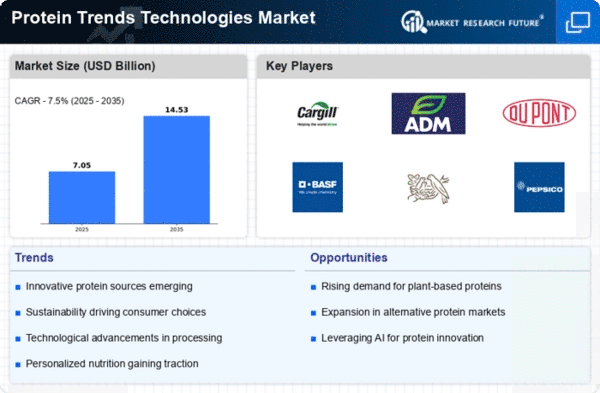
As per MRFR analysis, the Protein Trends Technologies Market Size was estimated at 6.56 USD Billion in 2024. The Protein Trends Technologies industry is projected to grow from 7.05 USD Billion in 2025 to 14.53 USD Billion by 2035, exhibiting a compound annual growth rate (CAGR) of 7.5 during the forecast period 2025 - 2035.

Key Market Trends & Highlights

The Protein Trends Technologies Market is experiencing a dynamic shift towards sustainable and personalized nutrition solutions.

  • The rise of plant-based proteins is reshaping consumer preferences, particularly in North America, which remains the largest market.
  • Advancements in protein processing technologies are enhancing the efficiency and quality of protein extraction across various applications.
  • Personalized nutrition trends are gaining traction, especially in the nutraceuticals segment, which is currently the fastest-growing area.
  • Increasing demand for sustainable protein sources and rising health awareness are driving the expansion of protein fortification in food products.

Market Size & Forecast

2024 Market Size 6.56 (USD Billion)
2035 Market Size 14.53 (USD Billion)
CAGR (2025 - 2035) 7.5%
Largest Regional Market Share in 2024 North America

Major Players

<p>Cargill (US), Archer Daniels Midland (US), BASF (DE), DuPont (US), Nestle (CH), PepsiCo (US), Kraft Heinz (US), Unilever (GB), Olam International (SG)</p>

Market Trends

The Protein Trends Technologies Market is currently experiencing a dynamic evolution, driven by a confluence of consumer preferences and technological advancements. As individuals increasingly prioritize health and wellness, there is a noticeable shift towards protein-rich diets. This trend is not merely a fleeting phase; it reflects a broader societal movement towards nutrition that emphasizes the importance of protein in maintaining overall health. Innovations in food technology are facilitating the development of diverse protein sources, including plant-based and alternative proteins, which cater to a wide array of dietary needs and preferences. Moreover, the Protein Trends Technologies Market is witnessing a surge in research and development efforts aimed at enhancing protein extraction and processing methods. These advancements are likely to improve the efficiency and sustainability of protein production, addressing concerns related to environmental impact and resource utilization. As the market continues to expand, it appears poised to attract significant investment, fostering further innovation and diversification in protein offerings. This evolving landscape suggests a promising future for stakeholders engaged in the Protein Trends Technologies Market, as they adapt to the changing demands of consumers and the global food system.

Rise of Plant-Based Proteins

The Protein Trends Technologies Market is observing a notable increase in the popularity of plant-based proteins. This shift is largely influenced by growing consumer awareness regarding health, sustainability, and ethical considerations. As more individuals seek alternatives to traditional animal proteins, companies are innovating to create appealing plant-based options that mimic the taste and texture of meat, thereby broadening their market appeal.

Advancements in Protein Processing Technologies

Technological innovations in protein processing are transforming the Protein Trends Technologies Market. Enhanced extraction methods and processing techniques are enabling manufacturers to produce high-quality protein ingredients more efficiently. These advancements not only improve yield but also contribute to the sustainability of protein production, aligning with the increasing demand for environmentally friendly practices.

Personalized Nutrition Trends

The concept of personalized nutrition is gaining traction within the Protein Trends Technologies Market. Consumers are increasingly seeking tailored dietary solutions that meet their specific health needs and preferences. This trend is prompting companies to develop protein products that cater to individual requirements, potentially leading to a more customized approach to nutrition and health management.

Protein Trends Technologies Market Market Drivers

Market Growth Projections

The Global Protein Trends and Technologies Market Industry is poised for substantial growth, with projections indicating a market size of 6.56 USD Billion in 2024 and an anticipated increase to 14.5 USD Billion by 2035. This growth trajectory reflects a compound annual growth rate of 7.5% from 2025 to 2035. Such figures highlight the increasing consumer interest in protein-rich diets and the ongoing innovations in protein technologies. The market's expansion is likely to be driven by various factors, including rising health consciousness, technological advancements, and the demand for sustainable protein sources.

Rising Health Consciousness

The increasing awareness of health and wellness among consumers drives the Global Protein Trends and Technologies Market Industry. As individuals prioritize nutritious diets, the demand for protein-rich foods surges. This trend is evident in the growing popularity of plant-based proteins, which cater to both health-conscious consumers and those seeking sustainable options. In 2024, the market is projected to reach 6.56 USD Billion, reflecting a significant shift towards healthier eating habits. Furthermore, the emphasis on protein intake for muscle maintenance and overall health is likely to sustain this growth trajectory, as consumers become more informed about dietary choices.

Diverse Applications of Protein Products

The versatility of protein products across various sectors fuels the Global Protein Trends and Technologies Market Industry. Proteins are not only essential in food and beverages but also find applications in pharmaceuticals, cosmetics, and animal feed. This broad applicability enhances market growth as industries seek to incorporate protein for its functional benefits. For instance, protein fortification in snacks and beverages is gaining traction, appealing to health-conscious consumers. The expanding range of protein applications is likely to contribute to the market's robust growth, as businesses recognize the value of protein in enhancing product offerings.

Sustainability and Environmental Concerns

Sustainability is becoming a pivotal factor influencing the Global Protein Trends and Technologies Market Industry. Consumers are increasingly concerned about the environmental impact of food production, particularly animal agriculture. This concern drives the demand for sustainable protein sources, such as plant-based proteins and lab-grown meats. Companies are responding by investing in sustainable practices and developing eco-friendly protein alternatives. The market's projected growth to 14.5 USD Billion by 2035 underscores the importance of sustainability in shaping consumer preferences. As awareness of climate change and resource depletion rises, the shift towards sustainable protein sources is likely to accelerate.

Consumer Demand for Personalized Nutrition

The trend towards personalized nutrition is gaining momentum within the Global Protein Trends and Technologies Market Industry. Consumers are increasingly seeking tailored dietary solutions that align with their individual health goals and lifestyles. This shift is prompting companies to develop protein products that cater to specific dietary needs, such as high-protein snacks for athletes or protein supplements for weight management. The growing interest in personalized nutrition is likely to drive innovation in protein formulations and product development, further propelling market growth. As consumers prioritize customized dietary options, the demand for diverse protein products is expected to rise.

Technological Advancements in Protein Production

Innovations in protein production technologies are reshaping the Global Protein Trends and Technologies Market Industry. Techniques such as fermentation, precision fermentation, and cellular agriculture are emerging, enabling the creation of high-quality proteins with reduced environmental impact. These advancements not only enhance the efficiency of protein production but also cater to the growing demand for alternative protein sources. As a result, the market is expected to witness a compound annual growth rate of 7.5% from 2025 to 2035. This technological evolution is crucial for meeting the protein needs of a growing global population while addressing sustainability concerns.

Market Segment Insights

By Application: Food and Beverage (Largest) vs. Nutraceuticals (Fastest-Growing)

<p>In the Protein Trends Technologies Market, the application segment reveals a diverse distribution of market shares among its key players. 'Food and Beverage' emerges as the largest segment, signifying its strong dominance in the protein market applications due to the growing prevalence of protein-rich dietary preferences among consumers. Additionally, sectors like 'Animal Feed' and 'Pharmaceuticals' hold significant market shares too, showcasing their essential roles in enhancing health and wellness through protein formulas. On the growth front, the 'Nutraceuticals' segment is recognized as the fastest-growing area, fueled by the increasing consumer inclination towards health supplements and functional foods. Factors propelling this growth include rising health awareness, an aging population, and a surge in fitness trends, all of which encourage the consumption of protein-enhanced products to promote overall well-being.</p>

<p>Food and Beverage (Dominant) vs. Nutraceuticals (Emerging)</p>

<p>The 'Food and Beverage' application is characterized by its extensive incorporation of protein trends, driven by heightened consumer demand for healthier food options and noticeable shifts towards plant-based alternatives. This sector's dominance lies not only in traditional products but also in innovative protein ingredients that enhance flavor and nutritional profiles. Conversely, the 'Nutraceuticals' segment is gaining momentum as an emerging area, primarily due to expanded market reach and an evolving consumer base that actively seeks out supplements aimed at boosting health. With increasing investments in research and development, both segments are set to evolve, reflecting the ongoing transformations in consumer preferences and dietary trends.</p>

By Source: Plant-Based (Largest) vs. Animal-Based (Fastest-Growing)

<p>The Protein Trends Technologies Market exhibits a diverse sourcing landscape, with plant-based proteins taking the lead in terms of market share. This dominance is attributed to the rising consumer demand for vegan and vegetarian options, reflecting a shift in dietary preferences towards more sustainable and health-conscious alternatives. Meanwhile, animal-based proteins continue to hold a significant presence, appealing to traditional consumers seeking familiar protein sources, thus maintaining a crucial role in the overall market distribution. The growth trends in the protein sourcing segment reveal a notable acceleration for animal-based proteins, driven by innovations in production and processing technologies. This segment's expansion is further fueled by increasing awareness of nutritional benefits associated with animal proteins. Conversely, the plant-based segment benefits from strong promotional initiatives and increased investment in R&D, catering to the evolving consumer consciousness around health, environment, and ethics.</p>

<p>Plant-Based (Dominant) vs. Microbial (Emerging)</p>

<p>The plant-based protein segment stands out as the dominant force in the Protein Trends Technologies Market, characterized by an array of diverse offerings including pea, soy, and hemp proteins. This segment enjoys strong consumer loyalty, driven by health trends and environmental concerns, positioning itself as the preferred choice among health-conscious individuals. In contrast, the microbial protein segment is emerging as a promising alternative, leveraging advanced biotechnological processes to produce high-quality protein from microorganisms. This segment is gaining momentum, particularly in applications like food supplementation and alternative protein sources, thus attracting investment and innovation aimed at enhancing its market acceptance and application versatility.</p>

By Form: Powder (Largest) vs. Liquid (Fastest-Growing)

<p>In the Protein Trends Technologies Market, the 'Form' segment is characterized by diverse offerings including powder, liquid, granular, capsules, and tablets. Among these, powder is the dominant form, widely utilized due to its versatility and ease of incorporation into various dietary regimes. Liquid forms, while currently smaller in market share, are rapidly gaining traction due to the increasing consumer preference for ready-to-drink protein solutions and their ideal usage for on-the-go lifestyles. The market dynamics showcase a robust growth trajectory for liquid forms driven by innovations focusing on enhanced taste profiles and functional benefits. The rise of e-commerce and the increasing awareness of health benefits associated with protein consumption further bolster the adoption of liquid protein products, making them one of the fastest-growing segments within the market.</p>

<p>Protein Form: Powder (Dominant) vs. Liquid (Emerging)</p>

<p>The Protein Trends Technologies Market's powder segment is characterized by a rich array of protein types, including whey, casein, soy, and pea, making it a versatile choice for consumers. Its dominant status is attributed to its effectiveness in various applications such as meal replacements, sports nutrition, and dietary supplements. Powders also offer convenience and customization for users seeking specific protein intake needs. In contrast, liquid proteins, while still emerging, are gaining popularity due to their user-friendliness and quick absorption rates. These liquid solutions cater to busy lifestyles, enabling easy consumption without the need for preparation. The innovative formulations and flavors being introduced in-liquid protein products are fostering consumer loyalty and broadening their market appeal.</p>

By End Use: Dietary Supplements (Largest) vs. Sports Nutrition (Fastest-Growing)

<p>In the Protein Trends Technologies Market, the end-use segment is diverse, with Dietary Supplements holding the largest share, signaling strong consumer preference for health and wellness products. Functional Foods and Clinical Nutrition follow, reflecting a growing trend towards nutrition-rich solutions integral to daily diets. Sports Nutrition, while smaller in market share compared to Dietary Supplements, is gaining traction, indicating a shift in consumer focus towards fitness and performance-related nutritional products. Overall, the distribution illustrates a market leaning heavily on health-focused solutions while simultaneously embracing innovative nutrition options. The growth trends within this segment are fueled by increasing health consciousness among consumers and the rising prevalence of lifestyle diseases, prompting a shift towards preventive healthcare. The demand for products that enhance physical performance, particularly within the Sports Nutrition sub-segment, is on the rise, driven by fitness trends and an active lifestyle. Additionally, innovations in protein sourcing and formulation are pushing boundaries, catering to diverse dietary needs and preferences, indicating robust growth potential in the years to come.</p>

<p>Dietary Supplements (Dominant) vs. Clinical Nutrition (Emerging)</p>

<p>Dietary Supplements remain dominant in the Protein Trends Technologies Market due to their wide acceptance and variety, including protein powders, vitamins, and minerals that cater to health-conscious consumers. The segment is characterized by an expansive range of products that focus on enhancing everyday health and well-being. In contrast, Clinical Nutrition is emerging rapidly, targeting specific health conditions and patient needs, such as post-surgery recovery or managing chronic diseases. This segment emphasizes specialized protein products formulated for clinical settings, showcasing growth driven by an aging population and increasing healthcare expenditures. The innovation within these categories, alongside user-friendly consumption formats, highlights the dynamic shifts in consumer demands and the industry's responsiveness to these trends.</p>

Get more detailed insights about Protein Trends & Technologies Market Research Report - Forecast to 2035

Regional Insights

North America : Market Leader in Protein Trends

North America is poised to maintain its leadership in the Protein Trends Technologies Market, holding a significant market share of 3.3 billion. The region's growth is driven by increasing consumer demand for plant-based proteins, health-conscious eating, and innovative food technologies. Regulatory support for sustainable practices further enhances market dynamics, encouraging investments in protein alternatives and functional foods. The competitive landscape is robust, with key players like Cargill, Archer Daniels Midland, and DuPont leading the charge. The U.S. and Canada are at the forefront, leveraging advanced agricultural practices and R&D capabilities. The presence of major corporations ensures a steady supply chain and innovation pipeline, positioning North America as a hub for protein technology advancements.

Europe : Emerging Market with Growth Potential

Europe's Protein Trends Technologies Market is valued at 1.8 billion, reflecting a growing interest in sustainable protein sources and health-oriented products. The region benefits from stringent regulations promoting food safety and environmental sustainability, which drive innovation in protein technologies. Consumer trends favor plant-based diets, pushing manufacturers to adapt and diversify their offerings to meet evolving demands. Leading countries such as Germany, France, and the UK are pivotal in this market, with companies like BASF and Unilever investing heavily in R&D. The competitive landscape is characterized by a mix of established players and startups, fostering a dynamic environment for innovation. The European market is increasingly focused on transparency and sustainability, aligning with consumer preferences for ethically sourced proteins.

Asia-Pacific : Rapid Growth in Protein Demand

The Asia-Pacific region, valued at 1.2 billion, is experiencing rapid growth in the Protein Trends Technologies Market, driven by rising populations and increasing health awareness. Countries like China and India are witnessing a surge in demand for protein-rich foods, influenced by changing dietary habits and urbanization. Regulatory frameworks are evolving to support food safety and innovation, further propelling market growth. Key players such as Olam International and Nestle are expanding their presence in this region, capitalizing on the growing consumer base. The competitive landscape is marked by a mix of local and international companies, all vying for market share. The focus on health and wellness is prompting investments in alternative protein sources, making Asia-Pacific a critical area for future growth in protein technologies.

Middle East and Africa : Emerging Market with Unique Challenges

The Middle East and Africa region, with a market size of 0.26 billion, presents unique challenges and opportunities in the Protein Trends Technologies Market. The growth is driven by increasing urbanization and a rising middle class, leading to higher protein consumption. However, regulatory hurdles and supply chain issues pose significant challenges to market expansion. Governments are beginning to recognize the importance of food security, prompting initiatives to support local protein production. Countries like South Africa and the UAE are at the forefront, with local companies and international players exploring opportunities in this emerging market. The competitive landscape is still developing, with a focus on innovative solutions to address food scarcity and nutritional needs. The region's diverse consumer preferences necessitate tailored approaches to protein offerings, making it a complex yet promising market.

Key Players and Competitive Insights

The Protein Trends Technologies Market is characterized by a dynamic competitive landscape, driven by increasing consumer demand for protein-rich products and innovations in food technology. Key players such as Cargill (US), DuPont (US), and Nestle (CH) are strategically positioned to leverage their extensive research and development capabilities. Cargill (US) focuses on enhancing its product portfolio through sustainable sourcing and innovative processing techniques, while DuPont (US) emphasizes biotechnology to improve protein extraction methods. Nestle (CH), on the other hand, is investing heavily in plant-based protein alternatives, reflecting a broader trend towards health-conscious consumer preferences. Collectively, these strategies not only enhance their market presence but also shape the competitive environment by fostering innovation and sustainability.

In terms of business tactics, companies are increasingly localizing manufacturing to reduce supply chain vulnerabilities and optimize logistics. The market structure appears moderately fragmented, with several players vying for market share. However, the influence of major companies is substantial, as they set industry standards and drive technological advancements. This competitive structure encourages smaller firms to innovate and differentiate their offerings, thereby contributing to a vibrant market ecosystem.

In November 2025, Cargill (US) announced a partnership with a leading biotechnology firm to develop a new line of plant-based protein products aimed at the growing vegan market. This strategic move is significant as it not only diversifies Cargill's product offerings but also positions the company to capitalize on the increasing consumer shift towards plant-based diets. The collaboration is expected to enhance Cargill's innovation capabilities and strengthen its competitive edge in the protein sector.

In October 2025, DuPont (US) launched a new enzyme technology that improves the efficiency of protein extraction from legumes. This advancement is crucial as it addresses the rising demand for sustainable protein sources while reducing production costs. By enhancing the extraction process, DuPont (US) is likely to attract a broader customer base, including manufacturers of plant-based food products, thereby reinforcing its market leadership.

In September 2025, Nestle (CH) unveiled a new initiative aimed at reducing its carbon footprint across its protein supply chain. This initiative includes investments in renewable energy and sustainable farming practices. The strategic importance of this move lies in Nestle's commitment to sustainability, which resonates with environmentally conscious consumers and enhances brand loyalty. As sustainability becomes a key differentiator in the market, Nestle's proactive approach may set a benchmark for competitors.

As of December 2025, current trends in the Protein Trends Technologies Market indicate a strong emphasis on digitalization, sustainability, and the integration of artificial intelligence in production processes. Strategic alliances among key players are increasingly shaping the competitive landscape, fostering innovation and collaboration. Looking ahead, it appears that competitive differentiation will evolve from traditional price-based strategies to a focus on innovation, technological advancements, and supply chain reliability. This shift suggests that companies that prioritize these aspects are likely to thrive in an increasingly competitive environment.

Key Companies in the Protein Trends Technologies Market market include

Industry Developments

November 2021: Pronativ® Native Micellar Casein and Pronativ® Native Whey Protein were used by Lactalis Ingredients in the introduction of novel high-protein product concepts. High-protein puddings and shakes are two of the notions that were deduced.

Future Outlook

Protein Trends Technologies Market Future Outlook

<p>The Protein Trends Technologies Market is projected to grow at a 7.5% CAGR from 2024 to 2035, driven by increasing demand for plant-based proteins and technological advancements.</p>

New opportunities lie in:

  • <p>Development of personalized protein supplements for niche markets.</p>
  • <p>Integration of AI in protein sourcing and production processes.</p>
  • <p>Expansion of protein-based food products in emerging markets.</p>

<p>By 2035, the market is expected to be robust, reflecting substantial growth and innovation.</p>

Market Segmentation

Protein Trends Technologies Market Form Outlook

  • Powder
  • Liquid
  • Granular
  • Capsules
  • Tablets

Protein Trends Technologies Market Source Outlook

  • Plant-Based
  • Animal-Based
  • Microbial
  • Synthetic
  • Fermented

Protein Trends Technologies Market End Use Outlook

  • Dietary Supplements
  • Functional Foods
  • Sports Nutrition
  • Clinical Nutrition
  • Food Processing

Protein Trends Technologies Market Application Outlook

  • Food and Beverage
  • Nutraceuticals
  • Animal Feed
  • Personal Care
  • Pharmaceuticals

Report Scope

MARKET SIZE 20246.56(USD Billion)
MARKET SIZE 20257.05(USD Billion)
MARKET SIZE 203514.53(USD Billion)
COMPOUND ANNUAL GROWTH RATE (CAGR)7.5% (2024 - 2035)
REPORT COVERAGERevenue Forecast, Competitive Landscape, Growth Factors, and Trends
BASE YEAR2024
Market Forecast Period2025 - 2035
Historical Data2019 - 2024
Market Forecast UnitsUSD Billion
Key Companies ProfiledCargill (US), Archer Daniels Midland (US), BASF (DE), DuPont (US), Nestle (CH), PepsiCo (US), Kraft Heinz (US), Unilever (GB), Olam International (SG)
Segments CoveredApplication, Source, Form, End Use
Key Market OpportunitiesAdvancements in plant-based protein technologies cater to rising consumer demand for sustainable food options.
Key Market DynamicsRising consumer demand for plant-based proteins drives innovation and competition in protein technologies.
Countries CoveredNorth America, Europe, APAC, South America, MEA

FAQs

What is the projected growth of the Protein Trends and Technologies market?

The Protein Trends and Technologies market is the expected increase in total market value of 14.53 USD billion over a defined forecast period 2025–2035. It is driven by factors such as demand trends, technological advances, regulatory changes, and geographic expansion.

What is the size of the Protein Trends and Technologies market?

Protein Trends and Technologies market size was valued at approximately 6.56 billion USD in 2024. This figure will reach 14.53 billion USD covering all regions (America, Europe, Asia, MEA and ROW), focusing its segments / services / distribution channels till 2035.

What is the CAGR of the Protein Trends and Technologies market?

Protein Trends and Technologies market is expected to grow at a CAGR of 7.5% between 2025 and 2035.

How much will the Protein Trends and Technologies market be worth by 2035?

Protein Trends and Technologies market is expected to be worth of 14.53 billion USD, reflecting growth driven by usage, technology and global demands by the end of 2035.

How will the Protein Trends and Technologies market perform over the next 10 years?

Over the next 10 years the Protein Trends and Technologies market is expected to shift from usd billion 6.56 to 14.53 billion USD, led by adoption of advanced tech, demographic trends, regulatory approvals, with potential headwinds from 2025 to 2035.

Which region held the largest market share in the Protein Trends & Technologies market?

North America had the largest share in the market

  1. Report Prologue
  2. Introduction
    1. Definition
    2. Scope of the Study
      1. Research Objective
      2. Assumptions
      3. Limitations
    3. Market Structure
    4. Market Segmentation
  3. Research Methodology
    1. Research Process
    2. Primary Research
    3. Secondary Research
    4. Market Size Estimation
    5. Forecast Model
  4. Market Dynamics
    1. Drivers
    2. Restraints
    3. Opportunities
    4. Threats
    5. Macroeconomic Indicators
  5. Market Factor Analysis
    1. Value Chain Analysis
    2. Porters Five Forces
    3. Demand & supply: gap analysis
    4. Pricing Analysis
    5. Investment Opportunity Analysis
    6. Merger and Acquisition Landscape
    7. Up-Coming trends in protein trends & technologies market
      1. Market trends
      2. Technological trends
  6. Global Protein trends & technologies market by of technology
    1. Protein Chip
    2. Tandem Mass Spectrometry
    3. Nuclear Magnetic Resonance
    4. X-Ray Crystallography
    5. Electrophoresis
      1. 2d Electrophoresis
      2. Gel-Electrophoresis.
    6. Chromatography
      1. Ion-Exchange Chromatography
      2. Liquid Chromatography
      3. High-Performance Liquid Chromatography (HPLC)
    7. Others.
  7. Global Protein trends & technologies market by application
    1. Protein identification
    2. De Novo (Peptide) Sequencing
    3. Protein quantitation
    4. Protein structure determination
    5. Biomarkers
    6. Proteogenomics
    7. Diagnostics
    8. Antibody characterization
    9. Treatment development
  8. Global Protein trends & technologies market by end users
    1. Pharmaceutical companies
    2. Biotechnology companies
    3. Research Institutes
    4. Others
  9. Global Protein trends & technologies market by region
    1. Introduction
    2. Americas
      1. North America
      2. South America
    3. Europe
      1. Western Europe
      2. Eastern Europe
    4. 9.3.1.1Germany
    5. Asia Pacific
      1. Japan
      2. China
      3. India
      4. Republic of Korea
      5. Australia
      6. Rest of Asia Pacific
    6. Middle East & Africa
      1. United Arab Emirates
      2. Saudi Arabia
      3. Oman
      4. Qatar
      5. Kuwait
      6. Rest of Middle East & Africa
  10. Competitive Landscape
  11. Company Profile
    1. Rigaku Corporation
      1. Overview
      2. Product/Business Segment Overview
      3. Financial Updates
      4. Key Developments
    2. Hampton Research Corp.
      1. Overview
      2. Product/Business Segment Overview
      3. Financial Updates
      4. Key Developments
    3. Jena Bioscience GmbH
      1. Overview
      2. Product/Business Segment Overview
      3. Financial Updates
      4. Key Developments
    4. Thermo Fisher Scientific Inc.
      1. Overview
      2. Product/Business Segment Overview
      3. Financial Updates
      4. Key Development
    5. Molecular Dimensions Ltd.
      1. Overview
      2. Product/Business Segment Overview
      3. Financial Updates
      4. Key Developments
    6. Formulatrix, Inc.
      1. Overview
      2. Product/Business Segment Overview
      3. Financial Updates
      4. Key Developments
    7. Bruker Corporation
      1. Overview
      2. Product/Business Segment Overview
      3. Financial Updates
      4. Key Developments
    8. Agilent Technologies, Inc.,
      1. Overview
      2. Product/Business Segment Overview
      3. Financial Updates
      4. Key Developments
    9. Others
  12. Conclusion
    1. Key Findings
      1. From CEO’s Viewpoint
      2. Unmet Needs of the Market
    2. Key Companies to Watch
    3. Prediction of protein industry
  13. Appendix
  14. LIST OF TABLES
  15. Protein Trends and Technology Industry Synopsis, 2020-2027
  16. Global Protein Trends and Technology Market Estimates & Forecast, 2020-2027, (USD Million)
  17. Global Protein Trends and Technology Market, by Region, 2020-2027, (USD Million)
  18. Global Protein Trends and Technology Market, by Technology, 2020-2027, (USD Million)
  19. Global Protein Trends and Technology Market, by Application, 2020-2027, (USD Million)
  20. Global Protein Trends and Technology Market, by End-User, 2020-2027, (USD Million)
  21. Americas Protein Trends and Technology Market, by Technology, 2020-2027, (USD Million)
  22. Americas Protein Trends and Technology Market, by Application, 2020-2027, (USD Million)
  23. Americas Protein Trends and Technology Market, by End-User, 2020-2027, (USD Million)
  24. North America Protein Trends and Technology Market, by Technology, 2020-2027, (USD Million)
  25. North America Protein Trends and Technology Market, by Application, 2020-2027, (USD Million)
  26. North America Protein Trends and Technology Market, by End-User, 2020-2027, (USD Million)
  27. South America Protein Trends and Technology Market, by Technology, 2020-2027, (USD Million)
  28. South America Protein Trends and Technology Market, by Application, 2020-2027, (USD Million)
  29. South America Protein Trends and Technology Market, by End-User, 2020-2027, (USD Million)
  30. Europe Protein Trends and Technology Market, by Technology, 2020-2027, (USD Million)
  31. Europe Protein Trends and Technology Market, by Application, 2020-2027, (USD Million)
  32. Europe Protein Trends and Technology Market, by End-User, 2020-2027, (USD Million)
  33. Western Europe Protein Trends and Technology Market by Technology, 2020-2027, (USD Million)
  34. Western Europe Protein Trends and Technology Market, by Application, 2020-2027, (USD Million)
  35. Western Europe Protein Trends and Technology Market, by End-User, 2020-2027, (USD Million)
  36. Eastern Europe Protein Trends and Technology Market, by Technology, 2020-2027, (USD Million)
  37. Eastern Europe Protein Trends and Technology Market, by Application, 2020-2027, (USD Million)
  38. Eastern Europe Protein Trends and Technology Market, by End-User, 2020-2027, (USD Million)
  39. Asia Pacific Protein Trends and Technology Market, by Technology, 2020-2027, (USD Million)
  40. Asia Pacific Protein Trends and Technology Market, by Application, 2020-2027, (USD Million)
  41. Asia Pacific Protein Trends and Technology Market, by End-User, 2020-2027, (USD Million)
  42. Middle East & Africa Protein Trends and Technology Market, by Technology, 2020-2027, (USD Million)
  43. Middle East & Africa Protein Trends and Technology Market, by Application, 2020-2027, (USD Million)
  44. Middle East & Africa Protein Trends and Technology Market, by End-User, 2020-2027, (USD Million) 
  45. LIST OF FIGURES
  46. Research Process
  47. Segmentation for Global Protein Trends and Technology Market
  48. Segmentation Market Dynamics for Protein Trends and Technology Market
  49. Global Protein Trends and Technology Market Share, by Technology 2020
  50. Global Protein Trends and Technology Market Share, by Application 2020
  51. Global Protein Trends and Technology Market Share, by End User, 2020
  52. Global Protein Trends and Technology Market Share, by Region, 2020
  53. Americas Protein Trends and Technology Market Share, by Country, 2020
  54. Europe Protein Trends and Technology Market Share, by Country, 2020
  55. Asia Pacific Protein Trends and Technology Market Share, by Country, 2020
  56. Middle East & Africa Protein Trends and Technology Market Share, by Country, 2020
  57. Global Protein Trends and Technology Market: Company Share Analysis, 2020 (%)"

Market Segmentation

Protein Trends & Technologies Technology Outlook (USD Billion, 2018-2032)

Protein chip

Tandem Mass spectrometry

Electrophoresis

Chromatography

Liquid Chromatography

High-Performance liquid chromatography

Nuclear magnetic resonance

X-ray crystallography

Others

Protein Trends & Technologies Application Outlook (USD Billion, 2018-2032)

Protein identification

De novo (peptide) sequencing

Protein quantitation

Protein structure determination

Biomarker

Proteogenomics

Diagnostics

Antibody characterization

Treatment development

Protein Trends & Technologies End-User Outlook (USD Billion, 2018-2032)

Pharmaceutical companies

Biotechnology companies

Research institutes

Others

Protein Trends & Technologies Regional Outlook (USD Billion, 2018-2032)

North America Outlook (USD Billion, 2018-2032)

Protein Trends & Technologies by Technology

Protein chip

Tandem Mass spectrometry

Electrophoresis

Chromatography

Liquid Chromatography

High-Performance liquid chromatography

Nuclear magnetic resonance

X-ray crystallography

Others

Protein Trends & Technologies Application Outlook (USD Billion, 2018-2032)

Protein identification

De novo (peptide) sequencing

Protein quantitation

Protein structure determination

Biomarker

Proteogenomics

Diagnostics

Antibody characterization

Treatment development

Protein Trends & Technologies End-User Outlook (USD Billion, 2018-2032)

Pharmaceutical companies

Biotechnology companies

Research institutes

Others

US Outlook (USD Billion, 2018-2032)

Protein Trends & Technologies by Technology

Protein chip

Tandem Mass spectrometry

Electrophoresis

Chromatography

Liquid Chromatography

High-Performance liquid chromatography

Nuclear magnetic resonance

X-ray crystallography

Others

Protein Trends & Technologies Application Outlook (USD Billion, 2018-2032)

Protein identification

De novo (peptide) sequencing

Protein quantitation

Protein structure determination

Biomarker

Proteogenomics

Diagnostics

Antibody characterization

Treatment development

Protein Trends & Technologies End-User Outlook (USD Billion, 2018-2032)

Pharmaceutical companies

Biotechnology companies

Research institutes

Others

Canada Outlook (USD Billion, 2018-2032)

Protein Trends & Technologies by Technology

Protein chip

Tandem Mass spectrometry

Electrophoresis

Chromatography

Liquid Chromatography

High-Performance liquid chromatography

Nuclear magnetic resonance

X-ray crystallography

Others

Protein Trends & Technologies Application Outlook (USD Billion, 2018-2032)

Protein identification

De novo (peptide) sequencing

Protein quantitation

Protein structure determination

Biomarker

Proteogenomics

Diagnostics

Antibody characterization

Treatment development

Protein Trends & Technologies End-User Outlook (USD Billion, 2018-2032)

Pharmaceutical companies

Biotechnology companies

Research institutes

Others

Europe Outlook (USD Billion, 2018-2032)

Protein Trends & Technologies by Technology

Protein chip

Tandem Mass spectrometry

Electrophoresis

Chromatography

Liquid Chromatography

High-Performance liquid chromatography

Nuclear magnetic resonance

X-ray crystallography

Others

Protein Trends & Technologies Application Outlook (USD Billion, 2018-2032)

Protein identification

De novo (peptide) sequencing

Protein quantitation

Protein structure determination

Biomarker

Proteogenomics

Diagnostics

Antibody characterization

Treatment development

Protein Trends & Technologies End-User Outlook (USD Billion, 2018-2032)

Pharmaceutical companies

Biotechnology companies

Research institutes

Others

Germany Outlook (USD Billion, 2018-2032)

Protein Trends & Technologies by Technology

Protein chip

Tandem Mass spectrometry

Electrophoresis

Chromatography

Liquid Chromatography

High-Performance liquid chromatography

Nuclear magnetic resonance

X-ray crystallography

Others

Protein Trends & Technologies Application Outlook (USD Billion, 2018-2032)

Protein identification

De novo (peptide) sequencing

Protein quantitation

Protein structure determination

Biomarker

Proteogenomics

Diagnostics

Antibody characterization

Treatment development

Protein Trends & Technologies End-User Outlook (USD Billion, 2018-2032)

Pharmaceutical companies

Biotechnology companies

Research institutes

Others

France Outlook (USD Billion, 2018-2032)

Protein Trends & Technologies by Technology

Protein chip

Tandem Mass spectrometry

Electrophoresis

Chromatography

Liquid Chromatography

High-Performance liquid chromatography

Nuclear magnetic resonance

X-ray crystallography

Others

Protein Trends & Technologies Application Outlook (USD Billion, 2018-2032)

Protein identification

De novo (peptide) sequencing

Protein quantitation

Protein structure determination

Biomarker

Proteogenomics

Diagnostics

Antibody characterization

Treatment development

Protein Trends & Technologies End-User Outlook (USD Billion, 2018-2032)

Pharmaceutical companies

Biotechnology companies

Research institutes

Others

UK Outlook (USD Billion, 2018-2032)

Protein Trends & Technologies by Technology

Protein chip

Tandem Mass spectrometry

Electrophoresis

Chromatography

Liquid Chromatography

High-Performance liquid chromatography

Nuclear magnetic resonance

X-ray crystallography

Others

Protein Trends & Technologies Application Outlook (USD Billion, 2018-2032)

Protein identification

De novo (peptide) sequencing

Protein quantitation

Protein structure determination

Biomarker

Proteogenomics

Diagnostics

Antibody characterization

Treatment development

Protein Trends & Technologies End-User Outlook (USD Billion, 2018-2032)

Pharmaceutical companies

Biotechnology companies

Research institutes

Others

Italy Outlook (USD Billion, 2018-2032)

Protein Trends & Technologies by Technology

Protein chip

Tandem Mass spectrometry

Electrophoresis

Chromatography

Liquid Chromatography

High-Performance liquid chromatography

Nuclear magnetic resonance

X-ray crystallography

Others

Protein Trends & Technologies Application Outlook (USD Billion, 2018-2032)

Protein identification

De novo (peptide) sequencing

Protein quantitation

Protein structure determination

Biomarker

Proteogenomics

Diagnostics

Antibody characterization

Treatment development

Protein Trends & Technologies End-User Outlook (USD Billion, 2018-2032)

Pharmaceutical companies

Biotechnology companies

Research institutes

Others

Spain Outlook (USD Billion, 2018-2032)

Protein Trends & Technologies by Technology

Protein chip

Tandem Mass spectrometry

Electrophoresis

Chromatography

Liquid Chromatography

High-Performance liquid chromatography

Nuclear magnetic resonance

X-ray crystallography

Others

Protein Trends & Technologies Application Outlook (USD Billion, 2018-2032)

Protein identification

De novo (peptide) sequencing

Protein quantitation

Protein structure determination

Biomarker

Proteogenomics

Diagnostics

Antibody characterization

Treatment development

Protein Trends & Technologies End-User Outlook (USD Billion, 2018-2032)

Pharmaceutical companies

Biotechnology companies

Research institutes

Others

Rest Of Europe Outlook (USD Billion, 2018-2032)

Protein Trends & Technologies by Technology

Protein chip

Tandem Mass spectrometry

Electrophoresis

Chromatography

Liquid Chromatography

High-Performance liquid chromatography

Nuclear magnetic resonance

X-ray crystallography

Others

Protein Trends & Technologies Application Outlook (USD Billion, 2018-2032)

Protein identification

De novo (peptide) sequencing

Protein quantitation

Protein structure determination

Biomarker

Proteogenomics

Diagnostics

Antibody characterization

Treatment development

Protein Trends & Technologies End-User Outlook (USD Billion, 2018-2032)

Pharmaceutical companies

Biotechnology companies

Research institutes

Others

Asia-Pacific Outlook (USD Billion, 2018-2032)

Protein Trends & Technologies by Technology

Protein chip

Tandem Mass spectrometry

Electrophoresis

Chromatography

Liquid Chromatography

High-Performance liquid chromatography

Nuclear magnetic resonance

X-ray crystallography

Others

Protein Trends & Technologies Application Outlook (USD Billion, 2018-2032)

Protein identification

De novo (peptide) sequencing

Protein quantitation

Protein structure determination

Biomarker

Proteogenomics

Diagnostics

Antibody characterization

Treatment development

Protein Trends & Technologies End-User Outlook (USD Billion, 2018-2032)

Pharmaceutical companies

Biotechnology companies

Research institutes

Others

China Outlook (USD Billion, 2018-2032)

Protein Trends & Technologies by Technology

Protein chip

Tandem Mass spectrometry

Electrophoresis

Chromatography

Liquid Chromatography

High-Performance liquid chromatography

Nuclear magnetic resonance

X-ray crystallography

Others

Protein Trends & Technologies Application Outlook (USD Billion, 2018-2032)

Protein identification

De novo (peptide) sequencing

Protein quantitation

Protein structure determination

Biomarker

Proteogenomics

Diagnostics

Antibody characterization

Treatment development

Protein Trends & Technologies End-User Outlook (USD Billion, 2018-2032)

Pharmaceutical companies

Biotechnology companies

Research institutes

Others

Japan Outlook (USD Billion, 2018-2032)

Protein Trends & Technologies by Technology

Protein chip

Tandem Mass spectrometry

Electrophoresis

Chromatography

Liquid Chromatography

High-Performance liquid chromatography

Nuclear magnetic resonance

X-ray crystallography

Others

Protein Trends & Technologies Application Outlook (USD Billion, 2018-2032)

Protein identification

De novo (peptide) sequencing

Protein quantitation

Protein structure determination

Biomarker

Proteogenomics

Diagnostics

Antibody characterization

Treatment development

Protein Trends & Technologies End-User Outlook (USD Billion, 2018-2032)

Pharmaceutical companies

Biotechnology companies

Research institutes

Others

India Outlook (USD Billion, 2018-2032)

Protein Trends & Technologies by Technology

Protein chip

Tandem Mass spectrometry

Electrophoresis

Chromatography

Liquid Chromatography

High-Performance liquid chromatography

Nuclear magnetic resonance

X-ray crystallography

Others

Protein Trends & Technologies Application Outlook (USD Billion, 2018-2032)

Protein identification

De novo (peptide) sequencing

Protein quantitation

Protein structure determination

Biomarker

Proteogenomics

Diagnostics

Antibody characterization

Treatment development

Protein Trends & Technologies End-User Outlook (USD Billion, 2018-2032)

Pharmaceutical companies

Biotechnology companies

Research institutes

Others

Australia Outlook (USD Billion, 2018-2032)

Protein Trends & Technologies by Technology

Protein chip

Tandem Mass spectrometry

Electrophoresis

Chromatography

Liquid Chromatography

High-Performance liquid chromatography

Nuclear magnetic resonance

X-ray crystallography

Others

Protein Trends & Technologies Application Outlook (USD Billion, 2018-2032)

Protein identification

De novo (peptide) sequencing

Protein quantitation

Protein structure determination

Biomarker

Proteogenomics

Diagnostics

Antibody characterization

Treatment development

Protein Trends & Technologies End-User Outlook (USD Billion, 2018-2032)

Pharmaceutical companies

Biotechnology companies

Research institutes

Others

Rest of Asia-Pacific Outlook (USD Billion, 2018-2032)

Protein Trends & Technologies by Technology

Protein chip

Tandem Mass spectrometry

Electrophoresis

Chromatography

Liquid Chromatography

High-Performance liquid chromatography

Nuclear magnetic resonance

X-ray crystallography

Others

Protein Trends & Technologies Application Outlook (USD Billion, 2018-2032)

Protein identification

De novo (peptide) sequencing

Protein quantitation

Protein structure determination

Biomarker

Proteogenomics

Diagnostics

Antibody characterization

Treatment development

Protein Trends & Technologies End-User Outlook (USD Billion, 2018-2032)

Pharmaceutical companies

Biotechnology companies

Research institutes

Others

Rest of the World Outlook (USD Billion, 2018-2032)

Protein Trends & Technologies by Technology

Protein chip

Tandem Mass spectrometry

Electrophoresis

Chromatography

Liquid Chromatography

High-Performance liquid chromatography

Nuclear magnetic resonance

X-ray crystallography

Others

Protein Trends & Technologies Application Outlook (USD Billion, 2018-2032)

Protein identification

De novo (peptide) sequencing

Protein quantitation

Protein structure determination

Biomarker

Proteogenomics

Diagnostics

Antibody characterization

Treatment development

Protein Trends & Technologies End-User Outlook (USD Billion, 2018-2032)

Pharmaceutical companies

Biotechnology companies

Research institutes

Others

Middle East Outlook (USD Billion, 2018-2032)

Protein Trends & Technologies by Technology

Protein chip

Tandem Mass spectrometry

Electrophoresis

Chromatography

Liquid Chromatography

High-Performance liquid chromatography

Nuclear magnetic resonance

X-ray crystallography

Others

Protein Trends & Technologies Application Outlook (USD Billion, 2018-2032)

Protein identification

De novo (peptide) sequencing

Protein quantitation

Protein structure determination

Biomarker

Proteogenomics

Diagnostics

Antibody characterization

Treatment development

Protein Trends & Technologies End-User Outlook (USD Billion, 2018-2032)

Pharmaceutical companies

Biotechnology companies

Research institutes

Others

Africa Outlook (USD Billion, 2018-2032)

Protein Trends & Technologies by Technology

Protein chip

Tandem Mass spectrometry

Electrophoresis

Chromatography

Liquid Chromatography

High-Performance liquid chromatography

Nuclear magnetic resonance

X-ray crystallography

Others

Protein Trends & Technologies Application Outlook (USD Billion, 2018-2032)

Protein identification

De novo (peptide) sequencing

Protein quantitation

Protein structure determination

Biomarker

Proteogenomics

Diagnostics

Antibody characterization

Treatment development

Protein Trends & Technologies End-User Outlook (USD Billion, 2018-2032)

Pharmaceutical companies

Biotechnology companies

Research institutes

Others

Latin America Outlook (USD Billion, 2018-2032)

Protein Trends & Technologies by Technology

Protein chip

Tandem Mass spectrometry

Electrophoresis

Chromatography

Liquid Chromatography

High-Performance liquid chromatography

Nuclear magnetic resonance

X-ray crystallography

Others

Protein Trends & Technologies Application Outlook (USD Billion, 2018-2032)

Protein identification

De novo (peptide) sequencing

Protein quantitation

Protein structure determination

Biomarker

Proteogenomics

Diagnostics

Antibody characterization

Treatment development

Protein Trends & Technologies End-User Outlook (USD Billion, 2018-2032)

Pharmaceutical companies

Biotechnology companies

Research institutes

Others

Infographic

Free Sample Request

Kindly complete the form below to receive a free sample of this Report

Get Free Sample

Customer Strories

Compare Licence

×
Features License Type
Single User Multiuser License Enterprise User
Price $4,950 $5,950 $7,250
Maximum User Access Limit 1 User Upto 10 Users Unrestricted Access Throughout the Organization
Free Customization
Direct Access to Analyst
Deliverable Format
Platform Access
Discount on Next Purchase 10% 15% 15%
Printable Versions