
Request Free Sample ×

Kindly complete the form below to receive a free sample of this Report

* Please use a valid business email

Leading companies partner with us for data-driven Insights

clients tt-cursor
Hero Background
English
Chinese
French
Japanese
Korean
German
Spanish

Protein Ingredients Market Share

ID: MRFR/FnB/0736-CR
151 Pages
Pradeep Nandi
May 2017

Protein Ingredients Market Size, Share, Industry Trend & Analysis Research Report Information By Product (Plant Protein, Animal/Dairy Proteins, Microbe Protein, and Others), By Application (Food & Beverages, Infant Formulations, Clinical Nutrition, Animal Feed, and Others), And By Region (North America, Europe, Asia-Pacific, And Rest Of The World) – Forecast Till 2035

Share:
Download PDF ×

We do not share your information with anyone. However, we may send you emails based on your report interest from time to time. You may contact us at any time to opt-out.

Protein Ingredients Market Infographic
Purchase Options

Market Share

Protein Ingredients Market Share Analysis

The protein ingredients market is dynamic and influenced by a myriad of factors that shape its growth and evolution. With the increasing awareness of the importance of protein in the diet for overall health and wellness, the demand for protein ingredients has experienced substantial growth. This surge in demand is driven by various factors, including changing dietary preferences, rising health consciousness, and the growing popularity of protein-rich diets among fitness enthusiasts and athletes.

One of the key drivers of the protein ingredients market is the shifting consumer preferences towards healthier and more nutritious food options. As consumers become more health-conscious, they are seeking out products that offer higher protein content as part of a balanced diet. This trend is particularly pronounced among millennials and younger generations, who prioritize health and wellness in their purchasing decisions. Consequently, food and beverage manufacturers are increasingly incorporating protein ingredients into a wide range of products to cater to this growing demand.

Moreover, the protein ingredients market is influenced by advancements in food technology and manufacturing processes. Technological innovations have enabled the development of protein ingredients with improved functionality, taste, and texture, making them more versatile for use in various food and beverage applications. Additionally, advancements in protein extraction and purification techniques have made it possible to derive protein ingredients from a diverse range of sources, including plants, dairy, and insects, thereby expanding the market opportunities.

Regulatory dynamics also play a crucial role in shaping the protein ingredients market landscape. Regulatory frameworks governing food safety, labeling, and ingredient approval have a significant impact on the development and commercialization of protein ingredients. Compliance with regulatory standards is essential for market players to ensure product safety and maintain consumer trust. Moreover, regulatory approvals for novel protein sources and ingredients can open up new market opportunities and drive innovation within the industry.

Furthermore, market dynamics are influenced by factors such as supply chain dynamics, raw material availability, and pricing volatility. The sourcing of high-quality protein-rich raw materials, such as soy, whey, pea, and rice, can be influenced by factors such as weather conditions, agricultural practices, and geopolitical events, affecting the overall market dynamics. Fluctuations in raw material prices and currency exchange rates can impact production costs and pricing strategies, posing challenges for manufacturers and impacting market competitiveness.

Competitive dynamics also shape the protein ingredients market, with a diverse range of players competing for market share. The market is characterized by the presence of multinational corporations, regional players, and startups, each vying for a competitive edge through product innovation, strategic partnerships, and market expansion initiatives. Additionally, branding and marketing efforts aimed at highlighting the nutritional benefits and functionality of protein ingredients are instrumental in driving consumer adoption and brand loyalty.


Author
Author Profile
Pradeep Nandi
Senior Research Analyst

I have a bachelor's degree in mechanical engineering and an MBA. I have more than two years of expertise in the retail, food, and beverage, chemical, and material industries, and hence have developed a sound cross-domain expertise. A firm believer in lifelong learning and sharing of knowledge. Having a proclivity for hatching ideas and trying to absorb as much information as possible in a short amount of time. Introducing corporates to the data and insight, which enables them to move from probability to possibility, has been my key areas of interest. 

Leave a Comment

FAQs

What is the current valuation of The Global Protein Ingredients?

<p>The Global Protein Ingredients was valued at 46.22 USD Billion in 2024.</p>

What is the projected market size for The Global Protein Ingredients by 2035?

The market is projected to reach 115.85 USD Billion by 2035.

What is the expected CAGR for The Global Protein Ingredients during the forecast period 2025 - 2035?

The expected CAGR for the market during the forecast period is 8.71%.

Which segments are included in The Global Protein Ingredients?

The market segments include Plant Protein, Animal/Dairy Proteins, Microbe Protein, and Others.

What are the projected valuations for Plant Protein and Animal/Dairy Proteins by 2035?

Plant Protein is projected to reach 37.0 USD Billion, while Animal/Dairy Proteins may reach 50.0 USD Billion by 2035.

How does the Clinical Nutrition segment perform in The Global Protein Ingredients?

The Clinical Nutrition segment is expected to grow from 6.0 USD Billion in 2024 to 15.0 USD Billion by 2035.

Who are the key players in The Global Protein Ingredients?

Key players include Cargill, Archer Daniels Midland, DuPont, BASF, Fonterra, Ingredion, Tate &amp; Lyle, AGT Food and Ingredients, and Kerry Group.

What applications are driving growth in The Global Protein Ingredients?

Applications driving growth include Food &amp; Beverages, Infant Formulations, Clinical Nutrition, and Animal Feed.

What is the projected valuation for the Animal Feed application by 2035?

The Animal Feed application is projected to reach 25.0 USD Billion by 2035.

How does the market for Microbe Protein compare to other segments?

The Microbe Protein segment is expected to grow from 5.0 USD Billion in 2024 to 15.0 USD Billion by 2035, indicating a notable increase.

Market Summary

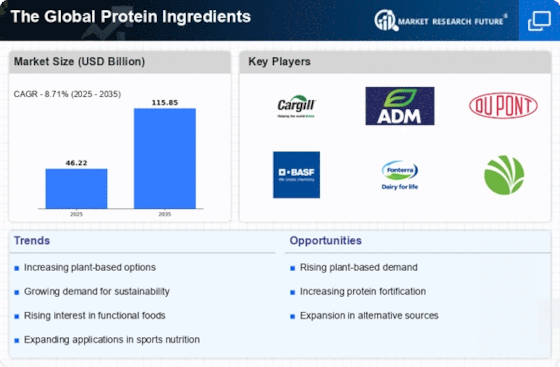
As per Market Research Future analysis, The Global Protein Ingredients Market was estimated at 46.22 USD Billion in 2024. The protein ingredients industry is projected to grow from 50.25 USD Billion in 2025 to 115.85 USD Billion by 2035, exhibiting a compound annual growth rate (CAGR) of 8.71% during the forecast period 2025 - 2035

Key Market Trends & Highlights

The Global Protein Ingredients Market is experiencing a transformative shift towards plant-based and sustainable options.

  • The rise of plant-based proteins is reshaping consumer preferences, particularly in North America. Technological advancements in protein production are enhancing efficiency and sustainability in the Asia-Pacific region. The food and beverages segment remains the largest, while the animal feed segment is witnessing rapid growth. Increasing health consciousness and the expansion of the sports nutrition sector are driving demand for diverse protein sources.

Market Size & Forecast

2024 Market Size 46.22 (USD Billion)
2035 Market Size 115.85 (USD Billion)
CAGR (2025 - 2035) 8.71%
Largest Regional Market Share in 2024 North America

Major Players

Cargill (US), Archer Daniels Midland (US), DuPont (US), BASF (DE), Fonterra (NZ), Ingredion (US), Tate &amp; Lyle (GB), AGT Food and Ingredients (CA), Kerry Group (IE)

Market Trends

The Global Protein Ingredients Market is currently experiencing a dynamic evolution, driven by increasing consumer awareness regarding health and nutrition. This heightened focus on dietary protein has led to a surge in demand for various protein sources, including plant-based, animal-based, and dairy proteins. As consumers become more discerning about their food choices, manufacturers are responding by innovating and diversifying their product offerings. This trend is further fueled by the growing popularity of protein-enriched foods and beverages, which are perceived as beneficial for overall well-being and fitness. 

Key plant protein ingredients market trends include rising demand for pea, soy, and chickpea proteins driven by clean-label and vegan food innovations. Major pea protein ingredients market trends include increased use in ready-to-drink beverages, bakery products, and functional nutrition. Moreover, the Protein Ingredients Market landscape is characterized by a shift towards sustainable and environmentally friendly protein sources. This shift is indicative of a broader societal movement towards sustainability, as consumers seek products that align with their values. Consequently, companies are increasingly investing in research and development to explore alternative protein sources, such as insects and algae, which may offer lower environmental impacts. The interplay of these factors suggests that The Global Protein Ingredients Market is poised for continued growth, with evolving consumer preferences shaping its trajectory.

Rise of Plant-Based Proteins

The demand for plant-based proteins is on the rise, as consumers increasingly seek alternatives to traditional animal proteins. This trend reflects a growing awareness of health benefits associated with plant-based diets, as well as concerns regarding animal welfare and environmental sustainability. Manufacturers are responding by developing innovative plant protein products that cater to diverse dietary preferences.

Focus on Clean Label Products

There is a notable shift towards clean label products within The Global Protein Ingredients Market. Consumers are becoming more conscious of ingredient transparency and are favoring products with minimal processing and recognizable ingredients. This trend encourages manufacturers to reformulate their offerings, ensuring that they meet the evolving expectations of health-conscious consumers.

Technological Advancements in Protein Production

Technological innovations are playing a crucial role in the evolution of The Global Protein Ingredients Market. Advances in extraction and processing techniques are enabling the development of high-quality protein ingredients that meet specific consumer needs. These innovations not only enhance product quality but also improve production efficiency, potentially reshaping the competitive landscape.

Protein Ingredients Market Market Drivers

Increasing Health Consciousness

The rising awareness of health and wellness among consumers appears to be a pivotal driver for The Global Protein Ingredients Industry. Individuals are increasingly seeking protein-rich diets to support fitness goals, weight management, and overall health. This trend is reflected in the growing demand for protein supplements and fortified foods. According to recent data, the protein supplement segment is projected to witness a compound annual growth rate of approximately 8% over the next five years. As consumers prioritize nutritional value, manufacturers are responding by innovating and diversifying their product offerings, thereby enhancing the market landscape.

Growth of the Functional Foods Market

The functional foods market is expanding rapidly, which appears to be a significant driver for The Global Protein Ingredients Industry. Consumers are increasingly seeking foods that offer health benefits beyond basic nutrition, including enhanced immunity and digestive health. This trend is fostering the development of protein-enriched functional foods, such as protein bars and fortified beverages. Market Research Future indicates that the functional foods segment is projected to grow at a compound annual growth rate of approximately 7% over the next five years, thereby creating new opportunities for protein ingredient manufacturers.

Expansion of the Sports Nutrition Sector

The sports nutrition sector is experiencing notable growth, which seems to be significantly influencing The Global Protein Ingredients Industry. Athletes and fitness enthusiasts are increasingly incorporating protein supplements into their diets to enhance performance and recovery. Market data indicates that the sports nutrition segment is expected to reach a valuation of over 30 billion dollars by 2026. This surge is prompting manufacturers to develop specialized protein products tailored to the needs of this demographic, thereby driving innovation and competition within the market.

Rising Demand for Sustainable Protein Sources

Sustainability concerns are becoming increasingly prominent, potentially reshaping The Global Protein Ingredients Industry. Consumers are gravitating towards protein sources that are environmentally friendly and ethically produced. This shift is evident in the growing popularity of plant-based proteins, which are perceived as more sustainable compared to traditional animal-based proteins. Market analysis suggests that the plant-based protein segment could capture a significant share of the overall protein market, with projections indicating a growth rate of around 10% annually. This trend is compelling manufacturers to invest in sustainable practices and product development.

Technological Innovations in Protein Extraction

Technological advancements in protein extraction and processing are likely to play a crucial role in the evolution of The Global Protein Ingredients Industry. Innovations such as enzymatic hydrolysis and membrane filtration are enhancing the efficiency and quality of protein extraction. These technologies not only improve yield but also enable the production of high-purity protein ingredients that meet diverse consumer needs. As a result, manufacturers are increasingly adopting these technologies to stay competitive, which may lead to a more dynamic and responsive market environment.

Market Segment Insights

By Product: Plant Protein (Largest) vs. Animal/Dairy Proteins (Fastest-Growing)

In The Global Protein Ingredients Market, the distribution of market share among various product segments reveals Plant Protein as the largest segment, increasingly favored by health-conscious consumers and those adopting plant-based diets. This shift towards plant-based proteins is fueled by the growing awareness of sustainability and health benefits. In contrast, Animal/Dairy Proteins are witnessing rapid growth, propelled by the rising demand for high-quality and complete proteins from dairy sources, favored in various applications such as sports nutrition and functional foods. The plant protein ingredients market holds the largest share, supported by growing adoption of plant-based diets and increasing demand for sustainable protein alternatives. The pea protein ingredients market is gaining traction due to its allergen-free profile and wide application in meat substitutes and sports nutrition products.

Plant Protein (Dominant) vs. Animal/Dairy Proteins (Emerging)

Plant protein is characterized by its extensive portfolio of sources, including peas, soy, and quinoa, offering diverse functional properties and nutritional profiles that appeal to both consumers and manufacturers. Its dominance stems from increasing dietary shifts towards veganism and vegetarianism, coupled with stringent dietary regulations. The soy and milk protein ingredients market continues to expand due to strong demand from sports nutrition, infant formulations, and functional food applications. On the other hand, Animal/Dairy Proteins are emerging due to their superior amino acid profiles and consumer preference for natural sources of protein. With innovations in processing and product formulation, these proteins are gaining traction in ready-to-eat meals and health supplements, reflecting a growing trend in personalized nutrition and fitness-oriented diets. The animal feed protein ingredients market is witnessing rapid growth due to increasing focus on livestock nutrition and sustainable feed solutions. The protein hydrolysate ingredients market is growing steadily, supported by its high digestibility and increased use in clinical nutrition and sports supplements. This whey protein ingredients market analysis highlights rising consumption across sports nutrition, clinical nutrition, and functional beverages.

By Application: Food & Beverages (Largest) vs. Animal Feed (Fastest-Growing)

The Global Protein Ingredients Market is primarily segmented into Food &amp; Beverages, Infant Formulations, Clinical Nutrition, Animal Feed, and Others. Among these, Food &amp; Beverages holds the largest market share, primarily due to the increasing consumer demand for protein-enriched foods and beverages. Moreover, Infant Formulations and Clinical Nutrition also contribute significantly to the overall market, owing to the rising awareness regarding health and wellness among consumers. Animal Feed has gained traction, driven by the growing livestock sector, indicating a diversified application of protein ingredients across industries.

Food &amp; Beverages (Dominant) vs. Animal Feed (Emerging)

In The Global Protein Ingredients Market, the Food &amp; Beverages segment is characterized by its extensive use of protein sources in various products like dairy, meat substitutes, and sports nutrition. This segment’s dominance stems from shifting consumer preferences towards healthier food options, promoting high-protein diets. The food protein ingredient market dominates overall demand, driven by the rising popularity of protein-enriched foods and beverages. Meanwhile, the Animal Feed segment is emerging swiftly due to the increasing focus on <a href="https://www.marketresearchfuture.com/reports/animal-health-market-7163">animal health</a> and productivity. The rising global population demands more sustainable food sources, thus enhancing the role of protein ingredients in feed formulations for livestock and pet food. The synergy between these segments highlights the evolving landscape of protein uses across both human and <a href="https://www.marketresearchfuture.com/reports/animal-nutrition-market-24290" target="_blank" rel="noopener">animal nutrition</a>.

Get more detailed insights about Protein Ingredients Market Research Report - Forecast to 2035

Regional Insights

By region, the study gives market insights into North America, Europe, Asia-Pacific, and the Rest of the World. The North America protein ingredients market leads globally due to high consumer awareness, strong sports nutrition demand, and advanced food processing infrastructure. The US is the largest contributor to the growth of the protein ingredients market.

Further, major countries studied in the market report are The U.S., Canada, German, France, the UK, Italy, Spain, China, Japan, India, Australia, South Korea, and Brazil. The United States alternative protein ingredients market is expanding rapidly due to innovation in plant-based foods and increasing investment in sustainable protein solutions. The Canada protein ingredients market is supported by strong demand for plant-based and dairy protein products across food and nutrition industries.

Europe's Protein Ingredients Market accounts for the second-largest market share due to the increase in demand for healthy food and beverages and medical products. Further, the German Protein Ingredients Market held the largest market share due to rising demand for medical and nutritional products in bone and muscle development in the European region. The Europe whey protein ingredients market is expanding due to increased demand for sports nutrition and medical nutrition products across Germany, France, and the UK.

The Asia-Pacific Protein Ingredients Market is expected to grow at the fastest rate. This is due to the increase in demand for animal and plant protein ingredients and economic development and expansion of the food and beverage and healthcare sector. The India chickpea protein ingredients market is emerging due to abundant raw material availability and increasing demand for plant-based protein alternatives. Moreover, China’s Protein Ingredients Market held the largest market share, and the Indian Protein Ingredients industry was the fastest-growing market in the Asia-Pacific region.

The South Africa protein ingredients market is experiencing moderate growth, supported by rising demand for affordable nutritional products and animal feed applications.

Key Players and Competitive Insights

Leading market players are investing heavily in research and development in order to expand their product lines, which will help the Protein Ingredients Market grow even more. Market participants are also undertaking a variety of strategic activities to expand their footprint, with important market developments including new product launches, contractual agreements, mergers and acquisitions, higher investments, and collaboration with other organizations. To expand and survive in a more competitive and rising market climate, the Protein Ingredients industry must offer cost-effective items.Manufacturing locally to minimize operational costs is one of the key business tactics used by manufacturers in the Protein Ingredients industry to benefit clients and increase the market sector. In recent years, the Protein Ingredients industry has offered some of the most significant advantages to nutrition. Major players in the Protein Ingredients Market, including Archer-Daniels-Midland Company, Bunge Limited, Cargill, DuPont, Fonterra Co-operative Group, Friesland, Kewpie Corporation, Mead Johnson Nutrition Company, Kerry Group, Omega Protein Corporation, Arla Foods Ingredients , and others, are attempting to increase market demand by investing in research and development operations.ADM provides the power of nature to enhance the quality of life; it is a leading human and animal nutrition company that delivers solutions today for the future. Their scientist, through research and development, is providing groundbreaking products to support healthier living; their innovative products are leading a new future for plant-based consumers and industrial solutions to replace petroleum-based products. They have unmatched agricultural supply chain managers and professors that will give food security by connecting local needs with capabilities.
In May Marfrig and ADM launched Plantplus Foods, a joint offer that will provide consumers with plant-based goods in North and South America. ADM plans to give all of its technological expertise to develop the system that collates ingredients, scents, and a plant basis from a protein complex comprising its new pea protein facility in North Dakota.Arla Foods Ingredients is a worldwide leader in value-added whey solutions that provides premium ingredients derived from whey, which supports the food industry with the development and efficient processing of natural, functional, and nutritious foods. They provide worldwide manufacturers of early life nutrition, health foods, and food and beverage products. Arla Food Ingredients launched Lcprodan BLG-100, pure BLG ingredients with a unique nutritional profile, in October 2021. It consists of 45% more leucine which is a major amino acid for muscle building, than the already available protein isolates.

Key Companies in the Protein Ingredients Market include

Industry Developments

October 2021: Arla Foods Ingredients launched Lacprodan BLG-100, a pure BLG component with the particular nutritional profile. It was made by using a patented novel separation technique and consists of 45% more leucine than it is present in commercial whey protein isolates, which is a primary amino acid for muscle growth.

January 2022: Nutriance was introduced to ADM's ingredients portfolio. Nutriance is a line of wheat concentrates that have been used in sports and geriatric nutrition.

In 2022 : Germany emerged as the leading revenue contributor in Europe, marking a significant milestone in the region. The surging geriatric populace within Germany has spurred a notable uptick in the need for specialized medical nutritional products, particularly those aiding in the maintenance of bone density and muscle strength. This heightened demand has been a driving force behind the increased consumption of these vital ingredients in recent times.

Furthermore, the substantial role played by protein ingredients in the treatment of Alzheimer's disease has notably influenced the market landscape within Germany. This positive impact has further amplified the market's growth trajectory, underscoring the significance of these ingredients in addressing critical health concerns.

February 2021 : Frieslandcampina Solutions and AGT Foods together started the collaboration to introduce pea and fava bean isolates as plant-based proteins in the market.

Future Outlook

Protein Ingredients Market Future Outlook

The Global Protein Ingredients Market is projected to grow at an 8.71% CAGR from 2025 to 2035, driven by rising health consciousness, demand for plant-based proteins, and innovations in food technology.

New opportunities lie in:

  • <p>Expansion into emerging markets with tailored protein solutions. Development of personalized nutrition products leveraging protein ingredients. Investment in sustainable sourcing practices to enhance brand loyalty.</p>

By 2035, the market is expected to solidify its position as a leader in the global food industry.

Market Segmentation

Protein Ingredients Market Product Outlook

  • Plant Protein
  • Animal/Dairy Proteins
  • Microbe Protein
  • Others

Protein Ingredients Market Application Outlook

  • Food & Beverages
  • Infant Formulations
  • Clinical Nutrition
  • Animal Feed
  • Others

Report Scope

MARKET SIZE 2024 46.22(USD Billion)
MARKET SIZE 2025 50.25(USD Billion)
MARKET SIZE 2035 115.85(USD Billion)
COMPOUND ANNUAL GROWTH RATE (CAGR) 8.71% (2025 - 2035)
REPORT COVERAGE Revenue Forecast, Competitive Landscape, Growth Factors, and Trends
BASE YEAR 2024
Market Forecast Period 2025 - 2035
Historical Data 2019 - 2024
Market Forecast Units USD Billion
Key Companies Profiled Cargill (US), Archer Daniels Midland (US), DuPont (US), BASF (DE), Fonterra (NZ), Ingredion (US), Tate & Lyle (GB), AGT Food and Ingredients (CA), Kerry Group (IE)
Segments Covered Product, Application, Region
Key Market Opportunities Growing demand for plant-based protein alternatives drives innovation in The Global Protein Ingredients.
Key Market Dynamics Rising consumer demand for plant-based proteins drives innovation and competition in the protein ingredients sector.
Countries Covered North America, Europe, APAC, South America, MEA

FAQs

What is the current valuation of The Global Protein Ingredients?

<p>The Global Protein Ingredients was valued at 46.22 USD Billion in 2024.</p>

What is the projected market size for The Global Protein Ingredients by 2035?

The market is projected to reach 115.85 USD Billion by 2035.

What is the expected CAGR for The Global Protein Ingredients during the forecast period 2025 - 2035?

The expected CAGR for the market during the forecast period is 8.71%.

Which segments are included in The Global Protein Ingredients?

The market segments include Plant Protein, Animal/Dairy Proteins, Microbe Protein, and Others.

What are the projected valuations for Plant Protein and Animal/Dairy Proteins by 2035?

Plant Protein is projected to reach 37.0 USD Billion, while Animal/Dairy Proteins may reach 50.0 USD Billion by 2035.

How does the Clinical Nutrition segment perform in The Global Protein Ingredients?

The Clinical Nutrition segment is expected to grow from 6.0 USD Billion in 2024 to 15.0 USD Billion by 2035.

Who are the key players in The Global Protein Ingredients?

Key players include Cargill, Archer Daniels Midland, DuPont, BASF, Fonterra, Ingredion, Tate &amp; Lyle, AGT Food and Ingredients, and Kerry Group.

What applications are driving growth in The Global Protein Ingredients?

Applications driving growth include Food &amp; Beverages, Infant Formulations, Clinical Nutrition, and Animal Feed.

What is the projected valuation for the Animal Feed application by 2035?

The Animal Feed application is projected to reach 25.0 USD Billion by 2035.

How does the market for Microbe Protein compare to other segments?

The Microbe Protein segment is expected to grow from 5.0 USD Billion in 2024 to 15.0 USD Billion by 2035, indicating a notable increase.

  1. SECTION I: EXECUTIVE SUMMARY AND KEY HIGHLIGHTS
    1. | 1.1 EXECUTIVE SUMMARY
    2. | | 1.1.1 Market Overview
    3. | | 1.1.2 Key Findings
    4. | | 1.1.3 Market Segmentation
    5. | | 1.1.4 Competitive Landscape
    6. | | 1.1.5 Challenges and Opportunities
    7. | | 1.1.6 Future Outlook
  2. SECTION II: SCOPING, METHODOLOGY AND MARKET STRUCTURE
    1. | 2.1 MARKET INTRODUCTION
    2. | | 2.1.1 Definition
    3. | | 2.1.2 Scope of the study
    4. | | | 2.1.2.1 Research Objective
    5. | | | 2.1.2.2 Assumption
    6. | | | 2.1.2.3 Limitations
    7. | 2.2 RESEARCH METHODOLOGY
    8. | | 2.2.1 Overview
    9. | | 2.2.2 Data Mining
    10. | | 2.2.3 Secondary Research
    11. | | 2.2.4 Primary Research
    12. | | | 2.2.4.1 Primary Interviews and Information Gathering Process
    13. | | | 2.2.4.2 Breakdown of Primary Respondents
    14. | | 2.2.5 Forecasting Model
    15. | | 2.2.6 Market Size Estimation
    16. | | | 2.2.6.1 Bottom-Up Approach
    17. | | | 2.2.6.2 Top-Down Approach
    18. | | 2.2.7 Data Triangulation
    19. | | 2.2.8 Validation
  3. SECTION III: QUALITATIVE ANALYSIS
    1. | 3.1 MARKET DYNAMICS
    2. | | 3.1.1 Overview
    3. | | 3.1.2 Drivers
    4. | | 3.1.3 Restraints
    5. | | 3.1.4 Opportunities
    6. | 3.2 MARKET FACTOR ANALYSIS
    7. | | 3.2.1 Value chain Analysis
    8. | | 3.2.2 Porter's Five Forces Analysis
    9. | | | 3.2.2.1 Bargaining Power of Suppliers
    10. | | | 3.2.2.2 Bargaining Power of Buyers
    11. | | | 3.2.2.3 Threat of New Entrants
    12. | | | 3.2.2.4 Threat of Substitutes
    13. | | | 3.2.2.5 Intensity of Rivalry
    14. | | 3.2.3 COVID-19 Impact Analysis
    15. | | | 3.2.3.1 Market Impact Analysis
    16. | | | 3.2.3.2 Regional Impact
    17. | | | 3.2.3.3 Opportunity and Threat Analysis
  4. SECTION IV: QUANTITATIVE ANALYSIS
    1. | 4.1 Food, Beverages & Nutrition, BY Product (USD Billion)
    2. | | 4.1.1 Plant Protein
    3. | | 4.1.2 Animal/Dairy Proteins
    4. | | 4.1.3 Microbe Protein
    5. | | 4.1.4 Others
    6. | 4.2 Food, Beverages & Nutrition, BY Application (USD Billion)
    7. | | 4.2.1 Food & Beverages
    8. | | 4.2.2 Infant Formulations
    9. | | 4.2.3 Clinical Nutrition
    10. | | 4.2.4 Animal Feed
    11. | | 4.2.5 Others
    12. | 4.3 Food, Beverages & Nutrition, BY Region (USD Billion)
    13. | | 4.3.1 North America
    14. | | | 4.3.1.1 US
    15. | | | 4.3.1.2 Canada
    16. | | 4.3.2 Europe
    17. | | | 4.3.2.1 Germany
    18. | | | 4.3.2.2 UK
    19. | | | 4.3.2.3 France
    20. | | | 4.3.2.4 Russia
    21. | | | 4.3.2.5 Italy
    22. | | | 4.3.2.6 Spain
    23. | | | 4.3.2.7 Rest of Europe
    24. | | 4.3.3 APAC
    25. | | | 4.3.3.1 China
    26. | | | 4.3.3.2 India
    27. | | | 4.3.3.3 Japan
    28. | | | 4.3.3.4 South Korea
    29. | | | 4.3.3.5 Malaysia
    30. | | | 4.3.3.6 Thailand
    31. | | | 4.3.3.7 Indonesia
    32. | | | 4.3.3.8 Rest of APAC
    33. | | 4.3.4 South America
    34. | | | 4.3.4.1 Brazil
    35. | | | 4.3.4.2 Mexico
    36. | | | 4.3.4.3 Argentina
    37. | | | 4.3.4.4 Rest of South America
    38. | | 4.3.5 MEA
    39. | | | 4.3.5.1 GCC Countries
    40. | | | 4.3.5.2 South Africa
    41. | | | 4.3.5.3 Rest of MEA
  5. SECTION V: COMPETITIVE ANALYSIS
    1. | 5.1 Competitive Landscape
    2. | | 5.1.1 Overview
    3. | | 5.1.2 Competitive Analysis
    4. | | 5.1.3 Market share Analysis
    5. | | 5.1.4 Major Growth Strategy in the Food, Beverages & Nutrition
    6. | | 5.1.5 Competitive Benchmarking
    7. | | 5.1.6 Leading Players in Terms of Number of Developments in the Food, Beverages & Nutrition
    8. | | 5.1.7 Key developments and growth strategies
    9. | | | 5.1.7.1 New Product Launch/Service Deployment
    10. | | | 5.1.7.2 Merger & Acquisitions
    11. | | | 5.1.7.3 Joint Ventures
    12. | | 5.1.8 Major Players Financial Matrix
    13. | | | 5.1.8.1 Sales and Operating Income
    14. | | | 5.1.8.2 Major Players R&D Expenditure. 2023
    15. | 5.2 Company Profiles
    16. | | 5.2.1 Cargill (US)
    17. | | | 5.2.1.1 Financial Overview
    18. | | | 5.2.1.2 Products Offered
    19. | | | 5.2.1.3 Key Developments
    20. | | | 5.2.1.4 SWOT Analysis
    21. | | | 5.2.1.5 Key Strategies
    22. | | 5.2.2 Archer Daniels Midland (US)
    23. | | | 5.2.2.1 Financial Overview
    24. | | | 5.2.2.2 Products Offered
    25. | | | 5.2.2.3 Key Developments
    26. | | | 5.2.2.4 SWOT Analysis
    27. | | | 5.2.2.5 Key Strategies
    28. | | 5.2.3 DuPont (US)
    29. | | | 5.2.3.1 Financial Overview
    30. | | | 5.2.3.2 Products Offered
    31. | | | 5.2.3.3 Key Developments
    32. | | | 5.2.3.4 SWOT Analysis
    33. | | | 5.2.3.5 Key Strategies
    34. | | 5.2.4 BASF (DE)
    35. | | | 5.2.4.1 Financial Overview
    36. | | | 5.2.4.2 Products Offered
    37. | | | 5.2.4.3 Key Developments
    38. | | | 5.2.4.4 SWOT Analysis
    39. | | | 5.2.4.5 Key Strategies
    40. | | 5.2.5 Fonterra (NZ)
    41. | | | 5.2.5.1 Financial Overview
    42. | | | 5.2.5.2 Products Offered
    43. | | | 5.2.5.3 Key Developments
    44. | | | 5.2.5.4 SWOT Analysis
    45. | | | 5.2.5.5 Key Strategies
    46. | | 5.2.6 Ingredion (US)
    47. | | | 5.2.6.1 Financial Overview
    48. | | | 5.2.6.2 Products Offered
    49. | | | 5.2.6.3 Key Developments
    50. | | | 5.2.6.4 SWOT Analysis
    51. | | | 5.2.6.5 Key Strategies
    52. | | 5.2.7 Tate & Lyle (GB)
    53. | | | 5.2.7.1 Financial Overview
    54. | | | 5.2.7.2 Products Offered
    55. | | | 5.2.7.3 Key Developments
    56. | | | 5.2.7.4 SWOT Analysis
    57. | | | 5.2.7.5 Key Strategies
    58. | | 5.2.8 AGT Food and Ingredients (CA)
    59. | | | 5.2.8.1 Financial Overview
    60. | | | 5.2.8.2 Products Offered
    61. | | | 5.2.8.3 Key Developments
    62. | | | 5.2.8.4 SWOT Analysis
    63. | | | 5.2.8.5 Key Strategies
    64. | | 5.2.9 Kerry Group (IE)
    65. | | | 5.2.9.1 Financial Overview
    66. | | | 5.2.9.2 Products Offered
    67. | | | 5.2.9.3 Key Developments
    68. | | | 5.2.9.4 SWOT Analysis
    69. | | | 5.2.9.5 Key Strategies
    70. | 5.3 Appendix
    71. | | 5.3.1 References
    72. | | 5.3.2 Related Reports
  6. LIST OF FIGURES
    1. | 6.1 MARKET SYNOPSIS
    2. | 6.2 NORTH AMERICA MARKET ANALYSIS
    3. | 6.3 US MARKET ANALYSIS BY PRODUCT
    4. | 6.4 US MARKET ANALYSIS BY APPLICATION
    5. | 6.5 CANADA MARKET ANALYSIS BY PRODUCT
    6. | 6.6 CANADA MARKET ANALYSIS BY APPLICATION
    7. | 6.7 EUROPE MARKET ANALYSIS
    8. | 6.8 GERMANY MARKET ANALYSIS BY PRODUCT
    9. | 6.9 GERMANY MARKET ANALYSIS BY APPLICATION
    10. | 6.10 UK MARKET ANALYSIS BY PRODUCT
    11. | 6.11 UK MARKET ANALYSIS BY APPLICATION
    12. | 6.12 FRANCE MARKET ANALYSIS BY PRODUCT
    13. | 6.13 FRANCE MARKET ANALYSIS BY APPLICATION
    14. | 6.14 RUSSIA MARKET ANALYSIS BY PRODUCT
    15. | 6.15 RUSSIA MARKET ANALYSIS BY APPLICATION
    16. | 6.16 ITALY MARKET ANALYSIS BY PRODUCT
    17. | 6.17 ITALY MARKET ANALYSIS BY APPLICATION
    18. | 6.18 SPAIN MARKET ANALYSIS BY PRODUCT
    19. | 6.19 SPAIN MARKET ANALYSIS BY APPLICATION
    20. | 6.20 REST OF EUROPE MARKET ANALYSIS BY PRODUCT
    21. | 6.21 REST OF EUROPE MARKET ANALYSIS BY APPLICATION
    22. | 6.22 APAC MARKET ANALYSIS
    23. | 6.23 CHINA MARKET ANALYSIS BY PRODUCT
    24. | 6.24 CHINA MARKET ANALYSIS BY APPLICATION
    25. | 6.25 INDIA MARKET ANALYSIS BY PRODUCT
    26. | 6.26 INDIA MARKET ANALYSIS BY APPLICATION
    27. | 6.27 JAPAN MARKET ANALYSIS BY PRODUCT
    28. | 6.28 JAPAN MARKET ANALYSIS BY APPLICATION
    29. | 6.29 SOUTH KOREA MARKET ANALYSIS BY PRODUCT
    30. | 6.30 SOUTH KOREA MARKET ANALYSIS BY APPLICATION
    31. | 6.31 MALAYSIA MARKET ANALYSIS BY PRODUCT
    32. | 6.32 MALAYSIA MARKET ANALYSIS BY APPLICATION
    33. | 6.33 THAILAND MARKET ANALYSIS BY PRODUCT
    34. | 6.34 THAILAND MARKET ANALYSIS BY APPLICATION
    35. | 6.35 INDONESIA MARKET ANALYSIS BY PRODUCT
    36. | 6.36 INDONESIA MARKET ANALYSIS BY APPLICATION
    37. | 6.37 REST OF APAC MARKET ANALYSIS BY PRODUCT
    38. | 6.38 REST OF APAC MARKET ANALYSIS BY APPLICATION
    39. | 6.39 SOUTH AMERICA MARKET ANALYSIS
    40. | 6.40 BRAZIL MARKET ANALYSIS BY PRODUCT
    41. | 6.41 BRAZIL MARKET ANALYSIS BY APPLICATION
    42. | 6.42 MEXICO MARKET ANALYSIS BY PRODUCT
    43. | 6.43 MEXICO MARKET ANALYSIS BY APPLICATION
    44. | 6.44 ARGENTINA MARKET ANALYSIS BY PRODUCT
    45. | 6.45 ARGENTINA MARKET ANALYSIS BY APPLICATION
    46. | 6.46 REST OF SOUTH AMERICA MARKET ANALYSIS BY PRODUCT
    47. | 6.47 REST OF SOUTH AMERICA MARKET ANALYSIS BY APPLICATION
    48. | 6.48 MEA MARKET ANALYSIS
    49. | 6.49 GCC COUNTRIES MARKET ANALYSIS BY PRODUCT
    50. | 6.50 GCC COUNTRIES MARKET ANALYSIS BY APPLICATION
    51. | 6.51 SOUTH AFRICA MARKET ANALYSIS BY PRODUCT
    52. | 6.52 SOUTH AFRICA MARKET ANALYSIS BY APPLICATION
    53. | 6.53 REST OF MEA MARKET ANALYSIS BY PRODUCT
    54. | 6.54 REST OF MEA MARKET ANALYSIS BY APPLICATION
    55. | 6.55 KEY BUYING CRITERIA OF FOOD, BEVERAGES & NUTRITION
    56. | 6.56 RESEARCH PROCESS OF MRFR
    57. | 6.57 DRO ANALYSIS OF FOOD, BEVERAGES & NUTRITION
    58. | 6.58 DRIVERS IMPACT ANALYSIS: FOOD, BEVERAGES & NUTRITION
    59. | 6.59 RESTRAINTS IMPACT ANALYSIS: FOOD, BEVERAGES & NUTRITION
    60. | 6.60 SUPPLY / VALUE CHAIN: FOOD, BEVERAGES & NUTRITION
    61. | 6.61 FOOD, BEVERAGES & NUTRITION, BY PRODUCT, 2024 (% SHARE)
    62. | 6.62 FOOD, BEVERAGES & NUTRITION, BY PRODUCT, 2024 TO 2035 (USD Billion)
    63. | 6.63 FOOD, BEVERAGES & NUTRITION, BY APPLICATION, 2024 (% SHARE)
    64. | 6.64 FOOD, BEVERAGES & NUTRITION, BY APPLICATION, 2024 TO 2035 (USD Billion)
    65. | 6.65 BENCHMARKING OF MAJOR COMPETITORS
  7. LIST OF TABLES
    1. | 7.1 LIST OF ASSUMPTIONS
    2. | | 7.1.1
    3. | 7.2 North America MARKET SIZE ESTIMATES; FORECAST
    4. | | 7.2.1 BY PRODUCT, 2025-2035 (USD Billion)
    5. | | 7.2.2 BY APPLICATION, 2025-2035 (USD Billion)
    6. | 7.3 US MARKET SIZE ESTIMATES; FORECAST
    7. | | 7.3.1 BY PRODUCT, 2025-2035 (USD Billion)
    8. | | 7.3.2 BY APPLICATION, 2025-2035 (USD Billion)
    9. | 7.4 Canada MARKET SIZE ESTIMATES; FORECAST
    10. | | 7.4.1 BY PRODUCT, 2025-2035 (USD Billion)
    11. | | 7.4.2 BY APPLICATION, 2025-2035 (USD Billion)
    12. | 7.5 Europe MARKET SIZE ESTIMATES; FORECAST
    13. | | 7.5.1 BY PRODUCT, 2025-2035 (USD Billion)
    14. | | 7.5.2 BY APPLICATION, 2025-2035 (USD Billion)
    15. | 7.6 Germany MARKET SIZE ESTIMATES; FORECAST
    16. | | 7.6.1 BY PRODUCT, 2025-2035 (USD Billion)
    17. | | 7.6.2 BY APPLICATION, 2025-2035 (USD Billion)
    18. | 7.7 UK MARKET SIZE ESTIMATES; FORECAST
    19. | | 7.7.1 BY PRODUCT, 2025-2035 (USD Billion)
    20. | | 7.7.2 BY APPLICATION, 2025-2035 (USD Billion)
    21. | 7.8 France MARKET SIZE ESTIMATES; FORECAST
    22. | | 7.8.1 BY PRODUCT, 2025-2035 (USD Billion)
    23. | | 7.8.2 BY APPLICATION, 2025-2035 (USD Billion)
    24. | 7.9 Russia MARKET SIZE ESTIMATES; FORECAST
    25. | | 7.9.1 BY PRODUCT, 2025-2035 (USD Billion)
    26. | | 7.9.2 BY APPLICATION, 2025-2035 (USD Billion)
    27. | 7.10 Italy MARKET SIZE ESTIMATES; FORECAST
    28. | | 7.10.1 BY PRODUCT, 2025-2035 (USD Billion)
    29. | | 7.10.2 BY APPLICATION, 2025-2035 (USD Billion)
    30. | 7.11 Spain MARKET SIZE ESTIMATES; FORECAST
    31. | | 7.11.1 BY PRODUCT, 2025-2035 (USD Billion)
    32. | | 7.11.2 BY APPLICATION, 2025-2035 (USD Billion)
    33. | 7.12 Rest of Europe MARKET SIZE ESTIMATES; FORECAST
    34. | | 7.12.1 BY PRODUCT, 2025-2035 (USD Billion)
    35. | | 7.12.2 BY APPLICATION, 2025-2035 (USD Billion)
    36. | 7.13 APAC MARKET SIZE ESTIMATES; FORECAST
    37. | | 7.13.1 BY PRODUCT, 2025-2035 (USD Billion)
    38. | | 7.13.2 BY APPLICATION, 2025-2035 (USD Billion)
    39. | 7.14 China MARKET SIZE ESTIMATES; FORECAST
    40. | | 7.14.1 BY PRODUCT, 2025-2035 (USD Billion)
    41. | | 7.14.2 BY APPLICATION, 2025-2035 (USD Billion)
    42. | 7.15 India MARKET SIZE ESTIMATES; FORECAST
    43. | | 7.15.1 BY PRODUCT, 2025-2035 (USD Billion)
    44. | | 7.15.2 BY APPLICATION, 2025-2035 (USD Billion)
    45. | 7.16 Japan MARKET SIZE ESTIMATES; FORECAST
    46. | | 7.16.1 BY PRODUCT, 2025-2035 (USD Billion)
    47. | | 7.16.2 BY APPLICATION, 2025-2035 (USD Billion)
    48. | 7.17 South Korea MARKET SIZE ESTIMATES; FORECAST
    49. | | 7.17.1 BY PRODUCT, 2025-2035 (USD Billion)
    50. | | 7.17.2 BY APPLICATION, 2025-2035 (USD Billion)
    51. | 7.18 Malaysia MARKET SIZE ESTIMATES; FORECAST
    52. | | 7.18.1 BY PRODUCT, 2025-2035 (USD Billion)
    53. | | 7.18.2 BY APPLICATION, 2025-2035 (USD Billion)
    54. | 7.19 Thailand MARKET SIZE ESTIMATES; FORECAST
    55. | | 7.19.1 BY PRODUCT, 2025-2035 (USD Billion)
    56. | | 7.19.2 BY APPLICATION, 2025-2035 (USD Billion)
    57. | 7.20 Indonesia MARKET SIZE ESTIMATES; FORECAST
    58. | | 7.20.1 BY PRODUCT, 2025-2035 (USD Billion)
    59. | | 7.20.2 BY APPLICATION, 2025-2035 (USD Billion)
    60. | 7.21 Rest of APAC MARKET SIZE ESTIMATES; FORECAST
    61. | | 7.21.1 BY PRODUCT, 2025-2035 (USD Billion)
    62. | | 7.21.2 BY APPLICATION, 2025-2035 (USD Billion)
    63. | 7.22 South America MARKET SIZE ESTIMATES; FORECAST
    64. | | 7.22.1 BY PRODUCT, 2025-2035 (USD Billion)
    65. | | 7.22.2 BY APPLICATION, 2025-2035 (USD Billion)
    66. | 7.23 Brazil MARKET SIZE ESTIMATES; FORECAST
    67. | | 7.23.1 BY PRODUCT, 2025-2035 (USD Billion)
    68. | | 7.23.2 BY APPLICATION, 2025-2035 (USD Billion)
    69. | 7.24 Mexico MARKET SIZE ESTIMATES; FORECAST
    70. | | 7.24.1 BY PRODUCT, 2025-2035 (USD Billion)
    71. | | 7.24.2 BY APPLICATION, 2025-2035 (USD Billion)
    72. | 7.25 Argentina MARKET SIZE ESTIMATES; FORECAST
    73. | | 7.25.1 BY PRODUCT, 2025-2035 (USD Billion)
    74. | | 7.25.2 BY APPLICATION, 2025-2035 (USD Billion)
    75. | 7.26 Rest of South America MARKET SIZE ESTIMATES; FORECAST
    76. | | 7.26.1 BY PRODUCT, 2025-2035 (USD Billion)
    77. | | 7.26.2 BY APPLICATION, 2025-2035 (USD Billion)
    78. | 7.27 MEA MARKET SIZE ESTIMATES; FORECAST
    79. | | 7.27.1 BY PRODUCT, 2025-2035 (USD Billion)
    80. | | 7.27.2 BY APPLICATION, 2025-2035 (USD Billion)
    81. | 7.28 GCC Countries MARKET SIZE ESTIMATES; FORECAST
    82. | | 7.28.1 BY PRODUCT, 2025-2035 (USD Billion)
    83. | | 7.28.2 BY APPLICATION, 2025-2035 (USD Billion)
    84. | 7.29 South Africa MARKET SIZE ESTIMATES; FORECAST
    85. | | 7.29.1 BY PRODUCT, 2025-2035 (USD Billion)
    86. | | 7.29.2 BY APPLICATION, 2025-2035 (USD Billion)
    87. | 7.30 Rest of MEA MARKET SIZE ESTIMATES; FORECAST
    88. | | 7.30.1 BY PRODUCT, 2025-2035 (USD Billion)
    89. | | 7.30.2 BY APPLICATION, 2025-2035 (USD Billion)
    90. | 7.31 PRODUCT LAUNCH/PRODUCT DEVELOPMENT/APPROVAL
    91. | | 7.31.1
    92. | 7.32 ACQUISITION/PARTNERSHIP
    93. | | 7.32.1

Food, Beverages & Nutrition Market Segmentation

Food, Beverages & Nutrition By Product (USD Billion, 2025-2035)

  • Plant Protein
  • Animal/Dairy Proteins
  • Microbe Protein
  • Others

Food, Beverages & Nutrition By Application (USD Billion, 2025-2035)

  • Food & Beverages
  • Infant Formulations
  • Clinical Nutrition
  • Animal Feed
  • Others
Infographic

Free Sample Request

Kindly complete the form below to receive a free sample of this Report

Get Free Sample

Customer Strories

Compare Licence

×
Features License Type
Single User Multiuser License Enterprise User
Price $4,950 $5,950 $7,250
Maximum User Access Limit 1 User Upto 10 Users Unrestricted Access Throughout the Organization
Free Customization
Direct Access to Analyst
Deliverable Format
Platform Access
Discount on Next Purchase 10% 15% 15%
Printable Versions
%>