
Request Free Sample ×

Kindly complete the form below to receive a free sample of this Report

* Please use a valid business email

Leading companies partner with us for data-driven Insights

clients tt-cursor
Hero Background
English
Chinese
French
Japanese
Korean
German
Spanish

Protein Hydrolysates Market Analysis

ID: MRFR/FnB/5741-HCR
128 Pages
Pradeep Nandi
Last Updated: April 16, 2026

Protein Hydrolysates Market Size, Share, Industry Trend & Analysis Research Report By Source (Animal Protein, Plant Protein, Microbial Protein), By Type (Collagen Peptides, Whey Protein Hydrolysates, Casein Hydrolysates, Soy Protein Hydrolysates), By Application (Food Beverages, Nutraceuticals, Cosmetics, Animal Feed), By Form (Dry, Liquid) and By Regional (North America, Europe, South America, Asia Pacific, Middle East and Africa)-Forecast to 2035

Share:
Download PDF ×

We do not share your information with anyone. However, we may send you emails based on your report interest from time to time. You may contact us at any time to opt-out.

Protein Hydrolysates Market Infographic
Purchase Options

Market Analysis

In-depth Analysis of Protein Hydrolysates Market Industry Landscape

Due to rising buyer mindfulness of the preferences of a eat less tall in protein and the developing request for dietary supplements, the showcase for protein hydrolysates has extended rapidly in later a long time. Since of their made strides digestibility and bioavailability, protein hydrolysates—which are made when proteins are broken down by proteins or acids—are developing in notoriety. This industry is driven by a number of critical reasons, counting as advancing buyer tastes, progressions in preparing mechanical propels, and a developing center on nourishment for competitors and health-conscious ways of life.

One of the basic components impacting the protein hydrolysates division is rising shopper information of the benefits of protein in common wellbeing. Customers are consolidating suppers tall in protein into their every day schedules as they put a more noteworthy center on wellness and by and large wellbeing. Since proteins hydrolysates, which are made up of pre-digested protein molecules, breakdown more rapidly within the body than other protein supplements, they are a awesome alternative for anybody seeking out for fast and viable comes about. A wide extend of items based on protein hydrolysate have been created as a result of the nourishment and refreshments industry's extension and the developing request for commodities improved with protein.

The state of the industry today is greatly impacted by developments in processing technology. Companies are spending money on R&D to increase the hydrolysis process's effectiveness and adaptability. Particularly enzymatic hydrolysis is becoming more and more popular since it makes it possible to precisely regulate the pace of hydrolysis, producing products with unique functional and nutritional qualities. Protein hydrolysates may now be produced in greater quantities and have a broader variety of applications because to technical advancements that have expanded both their application and manufacturing capacity.

The sports nutrition category has emerged as an important component for the protein hydrolysate market. Fitness enthusiasts and athletes are increasingly aware of the necessity of fast protein absorption during muscle regeneration and development. Protein hydrolysates, which are easily assimilated, are widely used in nutritional supplements, bars of energy, and drinks. The customized nutrition trend, in which people seek solutions that suit to their unique health and fitness objectives, has an even greater impact on market dynamics.

The protein hydrolysates industry is competitive, with both existing businesses and unused participants competing for a share of the extending request. Showcase companies are prioritizing vital organizations, mergers and acquisitions and acquisitions to extend the assortment of their items and around the world reach. Partnerships with research organizations and universities also promote product innovation, which contributes to the diversity of protein hydrolysate products.

Despite the optimistic trend, issues such as changing expenses for raw materials and regulatory restraints might impede market expansion. Sustainable raw material procurement and adherence to high quality requirements are becoming increasingly important for market companies seeking to preserve customer confidence and regulatory compliance.


Author
Author Profile
Pradeep Nandi
Senior Research Analyst

I have a bachelor's degree in mechanical engineering and an MBA. I have more than two years of expertise in the retail, food, and beverage, chemical, and material industries, and hence have developed a sound cross-domain expertise. A firm believer in lifelong learning and sharing of knowledge. Having a proclivity for hatching ideas and trying to absorb as much information as possible in a short amount of time. Introducing corporates to the data and insight, which enables them to move from probability to possibility, has been my key areas of interest. 

Leave a Comment

FAQs

What is the projected market valuation of The Global Protein Hydrolysates by 2035?

<p>The projected market valuation for The Global Protein Hydrolysates is 7.989 USD Billion by 2035.</p>

What was the market valuation of The Global Protein Hydrolysates in 2024?

<p>The overall market valuation was 4.79 USD Billion in 2024.</p>

What is the expected CAGR for The Global Protein Hydrolysates during the forecast period 2025 - 2035?

<p>The expected CAGR for The Global Protein Hydrolysates during the forecast period 2025 - 2035 is 4.76%.</p>

Which companies are considered key players in The Global Protein Hydrolysates?

<p>Key players in the market include Archer Daniels Midland Company, DuPont de Nemours, Inc., and Nestlé S.A.</p>

What are the main sources of protein hydrolysates in the market?

<p>The main sources of protein hydrolysates include Animal Protein, Plant Protein, and Microbial Protein, with valuations ranging from 1.5 to 2.99 USD Billion.</p>

What types of protein hydrolysates are available in the market?

<p>Types of protein hydrolysates include Collagen Peptides, Whey Protein Hydrolysates, and Casein Hydrolysates, with valuations between 0.95 and 2.5 USD Billion.</p>

What applications are driving the demand for protein hydrolysates?

<p>Applications driving demand include Food, Beverages, and Nutraceuticals, with market valuations from 1.0 to 2.5 USD Billion.</p>

What forms do protein hydrolysates take in the market?

<p>Protein hydrolysates are available in Dry and Liquid forms, with valuations ranging from 2.29 to 4.0 USD Billion.</p>

How does the market for whey protein hydrolysates compare to other types?

<p>Whey Protein Hydrolysates are valued between 1.5 and 2.5 USD Billion, indicating a strong position compared to other types.</p>

What trends are influencing the growth of The Global Protein Hydrolysates?

<p>Trends influencing growth include increasing demand in nutraceuticals and food applications, alongside innovations from key players.</p>

Market Summary

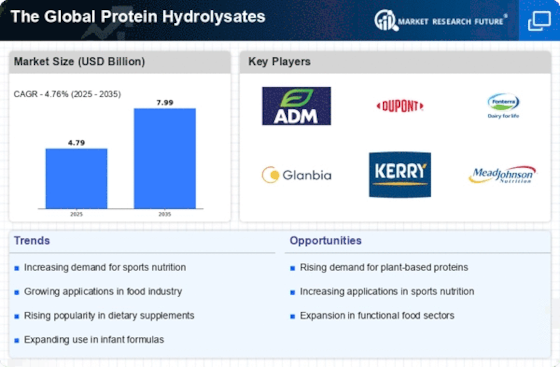
As per Market Research Future analysis, The Global Protein Hydrolysates Market size was estimated at 4.79 USD Billion in 2024, based on comprehensive protein hydrolysates market analysis. The protein hydrolysates industry is projected to grow from 5.018 USD Billion in 2025 to 7.989 USD Billion by 2035, exhibiting a compound annual growth rate (CAGR) of 4.76% during the forecast period 2025 - 2035.

Key Market Trends & Highlights

The Global Protein Hydrolysates Market is experiencing robust growth driven by health trends and innovations.

  • The demand for plant-based proteins is rising, reflecting a shift towards more sustainable dietary choices. Innovations in product development are enhancing the functionality and appeal of protein hydrolysates across various applications. North America remains the largest market, while Asia-Pacific is emerging as the fastest-growing region in this sector. Key market drivers include the increasing demand for functional foods and the growth in sports nutrition, particularly in the whey protein hydrolysates segment.

Market Size & Forecast

2024 Market Size 4.79 (USD Billion)
2035 Market Size 7.989 (USD Billion)
CAGR (2025 - 2035) 4.76%
Largest Regional Market Share in 2024 North America

Major Players

Archer Daniels Midland Company (US), DuPont de Nemours, Inc. (US), Fonterra Co-operative Group Limited (NZ), Glanbia plc (IE), Kerry Group plc (IE), Mead Johnson Nutrition Company (US), Nestlé S.A. (CH), PepsiCo, Inc. (US), Rousselot (NL), Tate &amp; Lyle PLC (GB)

Market Trends

The Global Protein Hydrolysates Market is currently experiencing a notable transformation, driven by increasing consumer awareness regarding health and nutrition. This evolution reflects ongoing protein hydrolysates market analysis, with expanding applications across food, beverages, nutraceuticals, pharmaceuticals, and emerging segments such as the antimicrobial protein hydrolysates market. The demand for protein hydrolysates is being propelled by their applications in various sectors, such as food and beverages, dietary supplements, and pharmaceuticals. As consumers seek products that support muscle recovery, weight management, and overall wellness, manufacturers are innovating to meet these evolving preferences. Moreover, the market landscape is characterized by a growing emphasis on clean label products, which reflects a broader trend towards transparency in food sourcing and ingredient integrity. This shift is prompting companies to invest in research and development to create high-quality protein hydrolysates that align with consumer expectations. Sustainability also plays a crucial role, as stakeholders increasingly prioritize environmentally friendly practices in production. The Global Protein Hydrolysates Market appears poised for continued growth, as it adapts to the dynamic needs of health-conscious consumers and the broader food industry.

Rising Demand for Plant-Based Proteins

The trend towards plant-based diets is influencing The Global Protein Hydrolysates Market significantly. Consumers are increasingly seeking alternatives to animal-derived proteins, leading to a surge in the development of plant-based protein hydrolysates. This shift is not only driven by health considerations but also by ethical and environmental concerns, as more individuals opt for sustainable food sources.

Innovations in Product Development

Innovation is a key driver in The Global Protein Hydrolysates Market, with companies focusing on enhancing the functionality and sensory attributes of their products. This includes the development of hydrolysates that improve solubility, taste, and nutritional profiles. Such advancements are essential for meeting the diverse needs of consumers across various applications, from sports nutrition to functional foods.

Increased Focus on Health and Wellness

The growing emphasis on health and wellness is shaping consumer preferences within The Global Protein Hydrolysates Market. As individuals become more health-conscious, there is a rising interest in products that support fitness goals and overall well-being. This trend is prompting manufacturers to highlight the health benefits of protein hydrolysates, thereby driving market growth.

Protein Hydrolysates Market Market Drivers

Growth in Sports Nutrition

The burgeoning sports nutrition segment significantly influences the Protein Hydrolysates Market. Athletes and fitness enthusiasts are increasingly turning to protein hydrolysates for their rapid absorption and muscle recovery benefits. Market analysis suggests that the sports nutrition sector is expected to reach USD 45 billion by 2026, with protein hydrolysates playing a crucial role in this expansion. This growth is driven by the rising popularity of fitness activities and the demand for high-quality protein sources. As a result, the Protein Hydrolysates Market is poised to capitalize on this trend, catering to a diverse range of consumers seeking performance-enhancing nutrition.

Expansion of Nutraceuticals Market

The rapid expansion of the nutraceuticals market is a crucial driver for the Protein Hydrolysates Market. As consumers increasingly prioritize preventive healthcare and wellness, the demand for nutraceutical products containing protein hydrolysates is on the rise. These ingredients are often incorporated into dietary supplements and functional foods, appealing to health-conscious individuals. Market projections suggest that the nutraceuticals sector could reach USD 500 billion by 2027, with protein hydrolysates playing a vital role in this growth. This trend indicates a promising future for the Protein Hydrolysates Market, as it aligns with the broader shift towards health-oriented consumer choices.

Rising Demand for Functional Foods

The increasing consumer inclination towards functional foods is a pivotal driver for the Protein Hydrolysates Market. As individuals become more health-conscious, they seek products that offer additional health benefits beyond basic nutrition. Protein hydrolysates, known for their enhanced digestibility and bioavailability, are increasingly incorporated into functional food formulations. This trend is reflected in the market data, which indicates a projected growth rate of approximately 7% annually in the functional food sector. Consequently, the Protein Hydrolysates Market is likely to experience a corresponding surge in demand as manufacturers respond to consumer preferences for health-enhancing ingredients.

Increasing Prevalence of Food Allergies

The rising incidence of food allergies and intolerances is a significant driver for the Protein Hydrolysates Market. As consumers seek hypoallergenic protein sources, protein hydrolysates derived from various sources, including whey and soy, are gaining traction. These hydrolysates are often easier to digest and less likely to trigger allergic reactions, making them appealing to sensitive consumers. Market Research Future indicates that the demand for hypoallergenic products is expected to grow at a rate of 8% annually. This trend presents an opportunity for the Protein Hydrolysates Market to cater to a growing segment of the population seeking safe and nutritious protein options.

Technological Advancements in Processing

Technological innovations in the processing of protein hydrolysates are transforming the Protein Hydrolysates Market. Advances in enzymatic hydrolysis and membrane filtration techniques have improved the efficiency and quality of protein hydrolysate production. These technologies enable manufacturers to create customized protein profiles tailored to specific applications, such as dietary supplements and functional foods. The market data indicates that the adoption of these advanced processing methods is likely to enhance product offerings and expand the consumer base. Consequently, the Protein Hydrolysates Market stands to benefit from these advancements, as they facilitate the development of high-quality, versatile protein ingredients.

Market Segment Insights

By Source: Animal Protein (Largest) vs. Plant Protein (Fastest-Growing)

In The Global Protein Hydrolysates Market, <a href="https://www.marketresearchfuture.com/reports/animal-protein-market-28315" target="_blank" rel="noopener">animal protein</a> holds the largest market share, driven by its established presence in nutritional and pharmaceutical applications. This segment is dominated by sources like whey and casein, highly favored for their bioavailability and functional benefits. In contrast, Plant Protein is rapidly gaining traction, capturing significant interest from health-conscious consumers and those preferring vegetarian or vegan diets, thus marking its growth potential in the market.

animal protein (Dominant) vs. Plant Protein (Emerging)

animal protein, primarily sourced from milk and meat, remains the dominant player in The Global Protein Hydrolysates Market. Its high digestibility and complete amino acid profile make it a preferred choice for athletes and individuals seeking muscle recovery. On the other hand, Plant Protein, derived from legumes, grains, and seeds, is emerging as a strong contender, appealing to a growing segment of consumers focused on sustainability and plant-based diets. The shift towards more environmentally friendly protein sources is fueling innovation in this segment, leading to advancements in extraction and processing technologies that enhance the nutritional profile of plant-based offerings.

By Type: Whey Protein Hydrolysates (Largest) vs. Collagen Peptides (Fastest-Growing)

<p>In The Global Protein Hydrolysates, Whey Protein Hydrolysates hold a significant market share, primarily due to their extensive applications in sports nutrition and dietary supplements. This segment has consistently outperformed others, leveraging the increasing consumer demand for high-quality protein sources. Following closely, Collagen Peptides have emerged as a strong contender, capturing market interest with their functional benefits in health and wellness, particularly in skin and joint health. This growing preference has greatly enhanced their market position. As consumers become more health-conscious and prioritize quality over quantity in their diets, the protein hydrolysates sector is experiencing noteworthy growth trends. The push for clean label products, coupled with innovations in manufacturing processes, has further fueled demand for Hydrolysates. Moreover, the rising popularity of plant-based diets is driving interest in alternatives like Soy Protein Hydrolysates, which, despite having a smaller share, showcases promising growth potential.</p>

<p>Whey Protein Hydrolysates (Dominant) vs. Soy Protein Hydrolysates (Emerging)</p>

<p>Whey Protein Hydrolysates are recognized as the dominant force within The Global Protein Hydrolysates. Esteemed for their high bioavailability and rapid absorption, these hydrolysates are pivotal in sports nutrition, aiding muscle recovery and growth. Their extensive application across various dietary supplements and functional foods has solidified their market position. Conversely, Soy Protein Hydrolysates represent the emerging segment, catering to the growing preference for plant-based protein sources. Derived from soybeans, these hydrolysates are not only rich in essential amino acids but also appeal to vegan consumers. Though they currently hold a smaller market share compared to whey, their potential is increasing as health and sustainability trends continue to shape consumer choices.</p>

By Application: Food (Largest) vs. Beverages (Fastest-Growing)

As technological advancements progress, protein hydrolysates are increasingly explored for bioactive properties, including applications within the antimicrobial protein hydrolysates market, supporting product innovation across food safety, animal nutrition, and healthcare segments. This segment is driven by the increasing demand for protein-rich foods, such as snacks, bakery, and processed items, which leverage protein hydrolysates for their functional benefits. Conversely, the beverages segment is emerging rapidly, catering to health-conscious consumers seeking nutrition-focused drinks. The growing trend of on-the-go beverages with enhanced protein content fosters its expansion in the market. In terms of growth trends, the nutraceuticals segment shows significant promise, supported by the rising awareness of health and wellness. Consumers are increasingly gravitating towards products that utilize protein hydrolysates for their bioactive properties and digestibility. The cosmetics industry also showcases growth, leveraging the moisturizing and nourishing properties of protein hydrolysates. Overall, the combination of consumer preferences and innovation is driving a diverse application spectrum in the protein hydrolysates market.

Food (Dominant) vs. Animal Feed (Emerging)

The food application segment remains dominant in The Global Protein Hydrolysates Market due to its extensive utilization in various products such as ready-to-eat meals, dietary supplements, and nutritional bars. This segment benefits from established consumer preferences for convenience and health, which are ingrained in their purchasing behavior. In contrast, the animal feed segment is emerging as a significant player, driven by the increasing need for nutritional enhancements in livestock feed. Protein hydrolysates in this sector improve the quality of <a href="https://www.marketresearchfuture.com/reports/animal-nutrition-market-24290" target="_blank" rel="noopener">animal nutrition</a> by enhancing digestibility and promoting growth. Together, these segments exemplify the vast potential for protein hydrolysates across diverse markets.

By Form: Liquid (Largest) vs. Dry (Fastest-Growing)

In The Global Protein Hydrolysates Market, the segment distribution between Liquid and Dry forms reveals a clearly defined landscape, with Liquid protein hydrolysates commanding the largest share. This preference stems from favorable characteristics such as ease of use in formulations and enhanced solubility. On the other hand, Dry protein hydrolysates, though currently smaller in market share, are witnessing a compelling rise in demand, attributed to their convenience in storage and transport, making them an increasingly attractive option for manufacturers and consumers alike.

Form: Liquid (Dominant) vs. Dry (Emerging)

Liquid protein hydrolysates are recognized as the dominant form in the market, prized for their versatility and ability to integrate seamlessly into various food and beverage applications. Their widespread acceptance among food manufacturers stems from their functional benefits, including improved nutritional profiles and enhanced flavors. Conversely, Dry protein hydrolysates are emerging as a popular choice due to their longer shelf life and potential for easy incorporation into dry mixes and supplements. This growing trend is driven by consumer preferences for convenient and highly concentrated protein sources, positioning Dry forms as a valuable alternative for health-focused products.

Get more detailed insights about Protein Hydrolysates Market Research Report-Forecast to 2035

Regional Insights

The Global Protein Hydrolysates Market showcases significant regional segmentation, with each area contributing various levels of valuation and growth. In 2024, North America leads with a substantial valuation of 1.5 USD Billion, maintaining a dominant protein hydrolysates market share supported by strong demand for functional foods and sports nutrition products.

Europe follows closely with a valuation of 1.2 USD Billion in 2024, projected to grow to 2.0 USD Billion by 2035, reflecting strong popularity in sports nutrition and dietary supplements.The APAC region, valued at 1.3 USD Billion in 2024, is anticipated to increase to 2.2 USD Billion, signifying emerging markets and demographic shifts towards healthier protein sources. South America’s market valuation is lesser at 0.6 USD Billion in 2024 but is expected to reach 1.0 USD Billion by 2035, showcasing growth potential fueled by the rising demand for plant-based protein.

Lastly, the MEA region, while the smallest with a valuation of 0.19 USD Billion in 2024, is projected to grow to 0.3 USD Billion, focusing on expanding nutrition markets amidst economic growth.This diverse regional landscape of the Global Protein Hydrolysates Market illustrates varying consumer preferences, regulatory environments, and growth opportunities unique to each area, driving overall market dynamics.

Key Players and Competitive Insights

The Global Protein Hydrolysates Market has witnessed significant growth and diversification owing to the rising demand for nutritional products across various applications, including food and beverages, health supplements, and animal nutrition. This dynamic market is characterized by a plethora of manufacturers and suppliers who compete fiercely to carve a niche for themselves through innovative product offerings and strategic collaborations. The competitive landscape is continually evolving as companies strive to enhance their market positions, adapt to consumer preferences, and respond to regulatory changes. As technological advancements progress, firms are investing in research and development to create high-quality hydrolysates with improved functional properties, making the market even more competitive. Market players are increasingly focusing on sustainability and ingredient transparency, further intensifying rivalry as they endeavor to meet the growing consumer awareness regarding health and wellness.Kerry Group stands out in the Global Protein Hydrolysates Market due to its strong presence and extensive product portfolio that caters to various sectors. The company has established itself as a leading provider of protein hydrolysates, leveraging its expertise in food science and technology to develop innovative solutions. Kerry Group emphasizes the quality and functionality of its products which are designed to meet specific customer requirements, positioning itself effectively in the market. The company's robust research and development capabilities enable it to stay ahead of the competition by continually launching new products and improving existing ones. Moreover, Kerry Group's strategic partnerships and acquisitions, along with its global reach, strengthen its market position and enhance its operational efficiencies, allowing the company to meet diverse client demands effectively.DuPont also plays a pivotal role in the Global Protein Hydrolysates Market with a strong focus on innovation and sustainable practices. The company offers a range of protein hydrolysates specifically tailored for applications in the food and beverage sector as well as in nutritional supplements. DuPont’s strengths lie in its advanced research initiatives and commitment to integrating cutting-edge technology into product development, leading to high-quality and functional protein hydrolysates that cater to health-conscious consumers. The company's presence is bolstered by strategic mergers and acquisitions that expand its portfolio and market reach, allowing DuPont to tap into emerging opportunities within this growing sector. Key products from DuPont include various enzyme-based solutions that enhance the digestibility and bioavailability of proteins, establishing the brand as a trusted choice among manufacturers seeking innovative protein solutions in the global market. These strengths, combined with a strong emphasis on sustainability, further solidify DuPont's position as a key player in the competitive landscape of protein hydrolysates.

Key Companies in the Protein Hydrolysates Market include

Industry Developments

  • Q2 2024: Arla Foods Ingredients launches new whey protein hydrolysate for medical nutrition Arla Foods Ingredients announced the launch of a new whey protein hydrolysate ingredient designed for medical nutrition applications, targeting patients with impaired digestive capacity.
  • Q1 2024: Kerry Group opens new protein hydrolysate production facility in Ireland Kerry Group inaugurated a state-of-the-art facility dedicated to the production of protein hydrolysates, expanding its capacity to serve the growing demand in infant and sports nutrition sectors.
  • Q2 2024: DSM-Firmenich announces partnership with Novozymes for advanced protein hydrolysate enzymes DSM-Firmenich entered a strategic partnership with Novozymes to co-develop novel enzyme solutions for more efficient and sustainable production of protein hydrolysates.
  • Q3 2024: Ingredion launches plant-based protein hydrolysate for sports nutrition market Ingredion introduced a new pea protein hydrolysate ingredient aimed at sports nutrition brands, emphasizing rapid absorption and allergen-free formulation.
  • Q1 2025: ADM acquires Spanish protein hydrolysate manufacturer Prosol for €120 million ADM completed the acquisition of Prosol, a leading European producer of protein hydrolysates, to strengthen its specialty ingredients portfolio.
  • Q2 2025: Nestlé Health Science receives regulatory approval for hypoallergenic infant formula with protein hydrolysates in China Nestlé Health Science secured regulatory clearance from Chinese authorities for its new infant formula containing extensively hydrolyzed proteins, targeting infants with cow's milk allergy.
  • Q2 2024: FrieslandCampina launches new casein hydrolysate ingredient for clinical nutrition FrieslandCampina introduced a casein hydrolysate product designed for clinical nutrition, supporting patients with increased protein needs and digestive challenges.
  • Q3 2024: Tate & Lyle announces $50 million investment in protein hydrolysate R&D center Tate & Lyle revealed plans to invest $50 million in a new research and development center focused on innovation in protein hydrolysate ingredients for food and beverage applications.
  • Q1 2025: Glanbia Nutritionals launches rice protein hydrolysate for plant-based nutrition Glanbia Nutritionals expanded its plant-based portfolio with the launch of a rice protein hydrolysate ingredient, targeting vegan and allergen-sensitive consumers.
  • Q2 2025: Roquette secures major supply contract for pea protein hydrolysates with leading Asian beverage company Roquette signed a multi-year supply agreement to provide pea protein hydrolysates to a top beverage manufacturer in Asia, supporting the launch of new functional drinks.
  • Q1 2024: Hilmar Ingredients appoints new CEO to drive protein hydrolysate business expansion Hilmar Ingredients named a new chief executive officer, tasking them with accelerating growth in the protein hydrolysate segment and expanding global market reach.
  • Q3 2024: Bioseutica receives EU approval for egg protein hydrolysate ingredient in medical foods Bioseutica obtained European Union regulatory approval for its egg protein hydrolysate, enabling its use in specialized medical nutrition products across the EU.

Future Outlook

Protein Hydrolysates Market Future Outlook

The Global Protein Hydrolysates Market is projected to grow at a 4.76% CAGR from 2025 to 2035, driven by rising health consciousness, demand for functional foods, and advancements in processing technologies.

New opportunities lie in:

  • <p>Expansion into plant-based protein hydrolysates for vegan markets. Development of customized protein blends for sports nutrition. Investment in innovative packaging solutions to enhance shelf life.</p>

By 2035, the market is expected to achieve robust growth, reflecting evolving consumer preferences and technological advancements.

Market Segmentation

Protein Hydrolysates Market Form Outlook

  • Dry
  • Liquid

Protein Hydrolysates Market Type Outlook

  • Collagen Peptides
  • Whey Protein Hydrolysates
  • Casein Hydrolysates
  • Soy Protein Hydrolysates

Protein Hydrolysates Market Source Outlook

  • Animal Protein
  • Plant Protein
  • Microbial Protein

Protein Hydrolysates Market Application Outlook

  • Food
  • Beverages
  • Nutraceuticals
  • Cosmetics
  • Animal Feed

Report Scope

MARKET SIZE 2024 4.79(USD Billion)
MARKET SIZE 2025 5.018(USD Billion)
MARKET SIZE 2035 7.989(USD Billion)
COMPOUND ANNUAL GROWTH RATE (CAGR) 4.76% (2025 - 2035)
REPORT COVERAGE Revenue Forecast, Competitive Landscape, Growth Factors, and Trends
BASE YEAR 2024
Market Forecast Period 2025 - 2035
Historical Data 2019 - 2024
Market Forecast Units USD Billion
Key Companies Profiled Archer Daniels Midland Company (US), DuPont de Nemours, Inc. (US), Fonterra Co-operative Group Limited (NZ), Glanbia plc (IE), Kerry Group plc (IE), Mead Johnson Nutrition Company (US), Nestlé S.A. (CH), PepsiCo, Inc. (US), Rousselot (NL), Tate & Lyle PLC (GB)
Segments Covered Source, Type, Application, Form, Regional
Key Market Opportunities Rising demand for plant-based protein hydrolysates in functional food applications presents a lucrative market opportunity.
Key Market Dynamics Rising demand for protein hydrolysates in sports nutrition and functional foods drives market growth and innovation.
Countries Covered North America, Europe, APAC, South America, MEA

FAQs

What is the projected market valuation of The Global Protein Hydrolysates by 2035?

<p>The projected market valuation for The Global Protein Hydrolysates is 7.989 USD Billion by 2035.</p>

What was the market valuation of The Global Protein Hydrolysates in 2024?

<p>The overall market valuation was 4.79 USD Billion in 2024.</p>

What is the expected CAGR for The Global Protein Hydrolysates during the forecast period 2025 - 2035?

<p>The expected CAGR for The Global Protein Hydrolysates during the forecast period 2025 - 2035 is 4.76%.</p>

Which companies are considered key players in The Global Protein Hydrolysates?

<p>Key players in the market include Archer Daniels Midland Company, DuPont de Nemours, Inc., and Nestlé S.A.</p>

What are the main sources of protein hydrolysates in the market?

<p>The main sources of protein hydrolysates include Animal Protein, Plant Protein, and Microbial Protein, with valuations ranging from 1.5 to 2.99 USD Billion.</p>

What types of protein hydrolysates are available in the market?

<p>Types of protein hydrolysates include Collagen Peptides, Whey Protein Hydrolysates, and Casein Hydrolysates, with valuations between 0.95 and 2.5 USD Billion.</p>

What applications are driving the demand for protein hydrolysates?

<p>Applications driving demand include Food, Beverages, and Nutraceuticals, with market valuations from 1.0 to 2.5 USD Billion.</p>

What forms do protein hydrolysates take in the market?

<p>Protein hydrolysates are available in Dry and Liquid forms, with valuations ranging from 2.29 to 4.0 USD Billion.</p>

How does the market for whey protein hydrolysates compare to other types?

<p>Whey Protein Hydrolysates are valued between 1.5 and 2.5 USD Billion, indicating a strong position compared to other types.</p>

What trends are influencing the growth of The Global Protein Hydrolysates?

<p>Trends influencing growth include increasing demand in nutraceuticals and food applications, alongside innovations from key players.</p>

  1. SECTION I: EXECUTIVE SUMMARY AND KEY HIGHLIGHTS
    1. | 1.1 EXECUTIVE SUMMARY
    2. | | 1.1.1 Market Overview
    3. | | 1.1.2 Key Findings
    4. | | 1.1.3 Market Segmentation
    5. | | 1.1.4 Competitive Landscape
    6. | | 1.1.5 Challenges and Opportunities
    7. | | 1.1.6 Future Outlook
  2. SECTION II: SCOPING, METHODOLOGY AND MARKET STRUCTURE
    1. | 2.1 MARKET INTRODUCTION
    2. | | 2.1.1 Definition
    3. | | 2.1.2 Scope of the study
    4. | | | 2.1.2.1 Research Objective
    5. | | | 2.1.2.2 Assumption
    6. | | | 2.1.2.3 Limitations
    7. | 2.2 RESEARCH METHODOLOGY
    8. | | 2.2.1 Overview
    9. | | 2.2.2 Data Mining
    10. | | 2.2.3 Secondary Research
    11. | | 2.2.4 Primary Research
    12. | | | 2.2.4.1 Primary Interviews and Information Gathering Process
    13. | | | 2.2.4.2 Breakdown of Primary Respondents
    14. | | 2.2.5 Forecasting Model
    15. | | 2.2.6 Market Size Estimation
    16. | | | 2.2.6.1 Bottom-Up Approach
    17. | | | 2.2.6.2 Top-Down Approach
    18. | | 2.2.7 Data Triangulation
    19. | | 2.2.8 Validation
  3. SECTION III: QUALITATIVE ANALYSIS
    1. | 3.1 MARKET DYNAMICS
    2. | | 3.1.1 Overview
    3. | | 3.1.2 Drivers
    4. | | 3.1.3 Restraints
    5. | | 3.1.4 Opportunities
    6. | 3.2 MARKET FACTOR ANALYSIS
    7. | | 3.2.1 Value chain Analysis
    8. | | 3.2.2 Porter's Five Forces Analysis
    9. | | | 3.2.2.1 Bargaining Power of Suppliers
    10. | | | 3.2.2.2 Bargaining Power of Buyers
    11. | | | 3.2.2.3 Threat of New Entrants
    12. | | | 3.2.2.4 Threat of Substitutes
    13. | | | 3.2.2.5 Intensity of Rivalry
    14. | | 3.2.3 COVID-19 Impact Analysis
    15. | | | 3.2.3.1 Market Impact Analysis
    16. | | | 3.2.3.2 Regional Impact
    17. | | | 3.2.3.3 Opportunity and Threat Analysis
  4. SECTION IV: QUANTITATIVE ANALYSIS
    1. | 4.1 Food, Beverages & Nutrition, BY Source (USD Billion)
    2. | | 4.1.1 Animal Protein
    3. | | 4.1.2 Plant Protein
    4. | | 4.1.3 Microbial Protein
    5. | 4.2 Food, Beverages & Nutrition, BY Type (USD Billion)
    6. | | 4.2.1 Collagen Peptides
    7. | | 4.2.2 Whey Protein Hydrolysates
    8. | | 4.2.3 Casein Hydrolysates
    9. | | 4.2.4 Soy Protein Hydrolysates
    10. | 4.3 Food, Beverages & Nutrition, BY Application (USD Billion)
    11. | | 4.3.1 Food
    12. | | 4.3.2 Beverages
    13. | | 4.3.3 Nutraceuticals
    14. | | 4.3.4 Cosmetics
    15. | | 4.3.5 Animal Feed
    16. | 4.4 Food, Beverages & Nutrition, BY Form (USD Billion)
    17. | | 4.4.1 Dry
    18. | | 4.4.2 Liquid
    19. | 4.5 Food, Beverages & Nutrition, BY Region (USD Billion)
    20. | | 4.5.1 North America
    21. | | | 4.5.1.1 US
    22. | | | 4.5.1.2 Canada
    23. | | 4.5.2 Europe
    24. | | | 4.5.2.1 Germany
    25. | | | 4.5.2.2 UK
    26. | | | 4.5.2.3 France
    27. | | | 4.5.2.4 Russia
    28. | | | 4.5.2.5 Italy
    29. | | | 4.5.2.6 Spain
    30. | | | 4.5.2.7 Rest of Europe
    31. | | 4.5.3 APAC
    32. | | | 4.5.3.1 China
    33. | | | 4.5.3.2 India
    34. | | | 4.5.3.3 Japan
    35. | | | 4.5.3.4 South Korea
    36. | | | 4.5.3.5 Malaysia
    37. | | | 4.5.3.6 Thailand
    38. | | | 4.5.3.7 Indonesia
    39. | | | 4.5.3.8 Rest of APAC
    40. | | 4.5.4 South America
    41. | | | 4.5.4.1 Brazil
    42. | | | 4.5.4.2 Mexico
    43. | | | 4.5.4.3 Argentina
    44. | | | 4.5.4.4 Rest of South America
    45. | | 4.5.5 MEA
    46. | | | 4.5.5.1 GCC Countries
    47. | | | 4.5.5.2 South Africa
    48. | | | 4.5.5.3 Rest of MEA
  5. SECTION V: COMPETITIVE ANALYSIS
    1. | 5.1 Competitive Landscape
    2. | | 5.1.1 Overview
    3. | | 5.1.2 Competitive Analysis
    4. | | 5.1.3 Market share Analysis
    5. | | 5.1.4 Major Growth Strategy in the Food, Beverages & Nutrition
    6. | | 5.1.5 Competitive Benchmarking
    7. | | 5.1.6 Leading Players in Terms of Number of Developments in the Food, Beverages & Nutrition
    8. | | 5.1.7 Key developments and growth strategies
    9. | | | 5.1.7.1 New Product Launch/Service Deployment
    10. | | | 5.1.7.2 Merger & Acquisitions
    11. | | | 5.1.7.3 Joint Ventures
    12. | | 5.1.8 Major Players Financial Matrix
    13. | | | 5.1.8.1 Sales and Operating Income
    14. | | | 5.1.8.2 Major Players R&D Expenditure. 2023
    15. | 5.2 Company Profiles
    16. | | 5.2.1 Archer Daniels Midland Company (US)
    17. | | | 5.2.1.1 Financial Overview
    18. | | | 5.2.1.2 Products Offered
    19. | | | 5.2.1.3 Key Developments
    20. | | | 5.2.1.4 SWOT Analysis
    21. | | | 5.2.1.5 Key Strategies
    22. | | 5.2.2 DuPont de Nemours, Inc. (US)
    23. | | | 5.2.2.1 Financial Overview
    24. | | | 5.2.2.2 Products Offered
    25. | | | 5.2.2.3 Key Developments
    26. | | | 5.2.2.4 SWOT Analysis
    27. | | | 5.2.2.5 Key Strategies
    28. | | 5.2.3 Fonterra Co-operative Group Limited (NZ)
    29. | | | 5.2.3.1 Financial Overview
    30. | | | 5.2.3.2 Products Offered
    31. | | | 5.2.3.3 Key Developments
    32. | | | 5.2.3.4 SWOT Analysis
    33. | | | 5.2.3.5 Key Strategies
    34. | | 5.2.4 Glanbia plc (IE)
    35. | | | 5.2.4.1 Financial Overview
    36. | | | 5.2.4.2 Products Offered
    37. | | | 5.2.4.3 Key Developments
    38. | | | 5.2.4.4 SWOT Analysis
    39. | | | 5.2.4.5 Key Strategies
    40. | | 5.2.5 Kerry Group plc (IE)
    41. | | | 5.2.5.1 Financial Overview
    42. | | | 5.2.5.2 Products Offered
    43. | | | 5.2.5.3 Key Developments
    44. | | | 5.2.5.4 SWOT Analysis
    45. | | | 5.2.5.5 Key Strategies
    46. | | 5.2.6 Mead Johnson Nutrition Company (US)
    47. | | | 5.2.6.1 Financial Overview
    48. | | | 5.2.6.2 Products Offered
    49. | | | 5.2.6.3 Key Developments
    50. | | | 5.2.6.4 SWOT Analysis
    51. | | | 5.2.6.5 Key Strategies
    52. | | 5.2.7 Nestlé S.A. (CH)
    53. | | | 5.2.7.1 Financial Overview
    54. | | | 5.2.7.2 Products Offered
    55. | | | 5.2.7.3 Key Developments
    56. | | | 5.2.7.4 SWOT Analysis
    57. | | | 5.2.7.5 Key Strategies
    58. | | 5.2.8 PepsiCo, Inc. (US)
    59. | | | 5.2.8.1 Financial Overview
    60. | | | 5.2.8.2 Products Offered
    61. | | | 5.2.8.3 Key Developments
    62. | | | 5.2.8.4 SWOT Analysis
    63. | | | 5.2.8.5 Key Strategies
    64. | | 5.2.9 Rousselot (NL)
    65. | | | 5.2.9.1 Financial Overview
    66. | | | 5.2.9.2 Products Offered
    67. | | | 5.2.9.3 Key Developments
    68. | | | 5.2.9.4 SWOT Analysis
    69. | | | 5.2.9.5 Key Strategies
    70. | | 5.2.10 Tate & Lyle PLC (GB)
    71. | | | 5.2.10.1 Financial Overview
    72. | | | 5.2.10.2 Products Offered
    73. | | | 5.2.10.3 Key Developments
    74. | | | 5.2.10.4 SWOT Analysis
    75. | | | 5.2.10.5 Key Strategies
    76. | 5.3 Appendix
    77. | | 5.3.1 References
    78. | | 5.3.2 Related Reports
  6. LIST OF FIGURES
    1. | 6.1 MARKET SYNOPSIS
    2. | 6.2 NORTH AMERICA MARKET ANALYSIS
    3. | 6.3 US MARKET ANALYSIS BY SOURCE
    4. | 6.4 US MARKET ANALYSIS BY TYPE
    5. | 6.5 US MARKET ANALYSIS BY APPLICATION
    6. | 6.6 US MARKET ANALYSIS BY FORM
    7. | 6.7 CANADA MARKET ANALYSIS BY SOURCE
    8. | 6.8 CANADA MARKET ANALYSIS BY TYPE
    9. | 6.9 CANADA MARKET ANALYSIS BY APPLICATION
    10. | 6.10 CANADA MARKET ANALYSIS BY FORM
    11. | 6.11 EUROPE MARKET ANALYSIS
    12. | 6.12 GERMANY MARKET ANALYSIS BY SOURCE
    13. | 6.13 GERMANY MARKET ANALYSIS BY TYPE
    14. | 6.14 GERMANY MARKET ANALYSIS BY APPLICATION
    15. | 6.15 GERMANY MARKET ANALYSIS BY FORM
    16. | 6.16 UK MARKET ANALYSIS BY SOURCE
    17. | 6.17 UK MARKET ANALYSIS BY TYPE
    18. | 6.18 UK MARKET ANALYSIS BY APPLICATION
    19. | 6.19 UK MARKET ANALYSIS BY FORM
    20. | 6.20 FRANCE MARKET ANALYSIS BY SOURCE
    21. | 6.21 FRANCE MARKET ANALYSIS BY TYPE
    22. | 6.22 FRANCE MARKET ANALYSIS BY APPLICATION
    23. | 6.23 FRANCE MARKET ANALYSIS BY FORM
    24. | 6.24 RUSSIA MARKET ANALYSIS BY SOURCE
    25. | 6.25 RUSSIA MARKET ANALYSIS BY TYPE
    26. | 6.26 RUSSIA MARKET ANALYSIS BY APPLICATION
    27. | 6.27 RUSSIA MARKET ANALYSIS BY FORM
    28. | 6.28 ITALY MARKET ANALYSIS BY SOURCE
    29. | 6.29 ITALY MARKET ANALYSIS BY TYPE
    30. | 6.30 ITALY MARKET ANALYSIS BY APPLICATION
    31. | 6.31 ITALY MARKET ANALYSIS BY FORM
    32. | 6.32 SPAIN MARKET ANALYSIS BY SOURCE
    33. | 6.33 SPAIN MARKET ANALYSIS BY TYPE
    34. | 6.34 SPAIN MARKET ANALYSIS BY APPLICATION
    35. | 6.35 SPAIN MARKET ANALYSIS BY FORM
    36. | 6.36 REST OF EUROPE MARKET ANALYSIS BY SOURCE
    37. | 6.37 REST OF EUROPE MARKET ANALYSIS BY TYPE
    38. | 6.38 REST OF EUROPE MARKET ANALYSIS BY APPLICATION
    39. | 6.39 REST OF EUROPE MARKET ANALYSIS BY FORM
    40. | 6.40 APAC MARKET ANALYSIS
    41. | 6.41 CHINA MARKET ANALYSIS BY SOURCE
    42. | 6.42 CHINA MARKET ANALYSIS BY TYPE
    43. | 6.43 CHINA MARKET ANALYSIS BY APPLICATION
    44. | 6.44 CHINA MARKET ANALYSIS BY FORM
    45. | 6.45 INDIA MARKET ANALYSIS BY SOURCE
    46. | 6.46 INDIA MARKET ANALYSIS BY TYPE
    47. | 6.47 INDIA MARKET ANALYSIS BY APPLICATION
    48. | 6.48 INDIA MARKET ANALYSIS BY FORM
    49. | 6.49 JAPAN MARKET ANALYSIS BY SOURCE
    50. | 6.50 JAPAN MARKET ANALYSIS BY TYPE
    51. | 6.51 JAPAN MARKET ANALYSIS BY APPLICATION
    52. | 6.52 JAPAN MARKET ANALYSIS BY FORM
    53. | 6.53 SOUTH KOREA MARKET ANALYSIS BY SOURCE
    54. | 6.54 SOUTH KOREA MARKET ANALYSIS BY TYPE
    55. | 6.55 SOUTH KOREA MARKET ANALYSIS BY APPLICATION
    56. | 6.56 SOUTH KOREA MARKET ANALYSIS BY FORM
    57. | 6.57 MALAYSIA MARKET ANALYSIS BY SOURCE
    58. | 6.58 MALAYSIA MARKET ANALYSIS BY TYPE
    59. | 6.59 MALAYSIA MARKET ANALYSIS BY APPLICATION
    60. | 6.60 MALAYSIA MARKET ANALYSIS BY FORM
    61. | 6.61 THAILAND MARKET ANALYSIS BY SOURCE
    62. | 6.62 THAILAND MARKET ANALYSIS BY TYPE
    63. | 6.63 THAILAND MARKET ANALYSIS BY APPLICATION
    64. | 6.64 THAILAND MARKET ANALYSIS BY FORM
    65. | 6.65 INDONESIA MARKET ANALYSIS BY SOURCE
    66. | 6.66 INDONESIA MARKET ANALYSIS BY TYPE
    67. | 6.67 INDONESIA MARKET ANALYSIS BY APPLICATION
    68. | 6.68 INDONESIA MARKET ANALYSIS BY FORM
    69. | 6.69 REST OF APAC MARKET ANALYSIS BY SOURCE
    70. | 6.70 REST OF APAC MARKET ANALYSIS BY TYPE
    71. | 6.71 REST OF APAC MARKET ANALYSIS BY APPLICATION
    72. | 6.72 REST OF APAC MARKET ANALYSIS BY FORM
    73. | 6.73 SOUTH AMERICA MARKET ANALYSIS
    74. | 6.74 BRAZIL MARKET ANALYSIS BY SOURCE
    75. | 6.75 BRAZIL MARKET ANALYSIS BY TYPE
    76. | 6.76 BRAZIL MARKET ANALYSIS BY APPLICATION
    77. | 6.77 BRAZIL MARKET ANALYSIS BY FORM
    78. | 6.78 MEXICO MARKET ANALYSIS BY SOURCE
    79. | 6.79 MEXICO MARKET ANALYSIS BY TYPE
    80. | 6.80 MEXICO MARKET ANALYSIS BY APPLICATION
    81. | 6.81 MEXICO MARKET ANALYSIS BY FORM
    82. | 6.82 ARGENTINA MARKET ANALYSIS BY SOURCE
    83. | 6.83 ARGENTINA MARKET ANALYSIS BY TYPE
    84. | 6.84 ARGENTINA MARKET ANALYSIS BY APPLICATION
    85. | 6.85 ARGENTINA MARKET ANALYSIS BY FORM
    86. | 6.86 REST OF SOUTH AMERICA MARKET ANALYSIS BY SOURCE
    87. | 6.87 REST OF SOUTH AMERICA MARKET ANALYSIS BY TYPE
    88. | 6.88 REST OF SOUTH AMERICA MARKET ANALYSIS BY APPLICATION
    89. | 6.89 REST OF SOUTH AMERICA MARKET ANALYSIS BY FORM
    90. | 6.90 MEA MARKET ANALYSIS
    91. | 6.91 GCC COUNTRIES MARKET ANALYSIS BY SOURCE
    92. | 6.92 GCC COUNTRIES MARKET ANALYSIS BY TYPE
    93. | 6.93 GCC COUNTRIES MARKET ANALYSIS BY APPLICATION
    94. | 6.94 GCC COUNTRIES MARKET ANALYSIS BY FORM
    95. | 6.95 SOUTH AFRICA MARKET ANALYSIS BY SOURCE
    96. | 6.96 SOUTH AFRICA MARKET ANALYSIS BY TYPE
    97. | 6.97 SOUTH AFRICA MARKET ANALYSIS BY APPLICATION
    98. | 6.98 SOUTH AFRICA MARKET ANALYSIS BY FORM
    99. | 6.99 REST OF MEA MARKET ANALYSIS BY SOURCE
    100. | 6.100 REST OF MEA MARKET ANALYSIS BY TYPE
    101. | 6.101 REST OF MEA MARKET ANALYSIS BY APPLICATION
    102. | 6.102 REST OF MEA MARKET ANALYSIS BY FORM
    103. | 6.103 KEY BUYING CRITERIA OF FOOD, BEVERAGES & NUTRITION
    104. | 6.104 RESEARCH PROCESS OF MRFR
    105. | 6.105 DRO ANALYSIS OF FOOD, BEVERAGES & NUTRITION
    106. | 6.106 DRIVERS IMPACT ANALYSIS: FOOD, BEVERAGES & NUTRITION
    107. | 6.107 RESTRAINTS IMPACT ANALYSIS: FOOD, BEVERAGES & NUTRITION
    108. | 6.108 SUPPLY / VALUE CHAIN: FOOD, BEVERAGES & NUTRITION
    109. | 6.109 FOOD, BEVERAGES & NUTRITION, BY SOURCE, 2024 (% SHARE)
    110. | 6.110 FOOD, BEVERAGES & NUTRITION, BY SOURCE, 2024 TO 2035 (USD Billion)
    111. | 6.111 FOOD, BEVERAGES & NUTRITION, BY TYPE, 2024 (% SHARE)
    112. | 6.112 FOOD, BEVERAGES & NUTRITION, BY TYPE, 2024 TO 2035 (USD Billion)
    113. | 6.113 FOOD, BEVERAGES & NUTRITION, BY APPLICATION, 2024 (% SHARE)
    114. | 6.114 FOOD, BEVERAGES & NUTRITION, BY APPLICATION, 2024 TO 2035 (USD Billion)
    115. | 6.115 FOOD, BEVERAGES & NUTRITION, BY FORM, 2024 (% SHARE)
    116. | 6.116 FOOD, BEVERAGES & NUTRITION, BY FORM, 2024 TO 2035 (USD Billion)
    117. | 6.117 BENCHMARKING OF MAJOR COMPETITORS
  7. LIST OF TABLES
    1. | 7.1 LIST OF ASSUMPTIONS
    2. | | 7.1.1
    3. | 7.2 North America MARKET SIZE ESTIMATES; FORECAST
    4. | | 7.2.1 BY SOURCE, 2025-2035 (USD Billion)
    5. | | 7.2.2 BY TYPE, 2025-2035 (USD Billion)
    6. | | 7.2.3 BY APPLICATION, 2025-2035 (USD Billion)
    7. | | 7.2.4 BY FORM, 2025-2035 (USD Billion)
    8. | 7.3 US MARKET SIZE ESTIMATES; FORECAST
    9. | | 7.3.1 BY SOURCE, 2025-2035 (USD Billion)
    10. | | 7.3.2 BY TYPE, 2025-2035 (USD Billion)
    11. | | 7.3.3 BY APPLICATION, 2025-2035 (USD Billion)
    12. | | 7.3.4 BY FORM, 2025-2035 (USD Billion)
    13. | 7.4 Canada MARKET SIZE ESTIMATES; FORECAST
    14. | | 7.4.1 BY SOURCE, 2025-2035 (USD Billion)
    15. | | 7.4.2 BY TYPE, 2025-2035 (USD Billion)
    16. | | 7.4.3 BY APPLICATION, 2025-2035 (USD Billion)
    17. | | 7.4.4 BY FORM, 2025-2035 (USD Billion)
    18. | 7.5 Europe MARKET SIZE ESTIMATES; FORECAST
    19. | | 7.5.1 BY SOURCE, 2025-2035 (USD Billion)
    20. | | 7.5.2 BY TYPE, 2025-2035 (USD Billion)
    21. | | 7.5.3 BY APPLICATION, 2025-2035 (USD Billion)
    22. | | 7.5.4 BY FORM, 2025-2035 (USD Billion)
    23. | 7.6 Germany MARKET SIZE ESTIMATES; FORECAST
    24. | | 7.6.1 BY SOURCE, 2025-2035 (USD Billion)
    25. | | 7.6.2 BY TYPE, 2025-2035 (USD Billion)
    26. | | 7.6.3 BY APPLICATION, 2025-2035 (USD Billion)
    27. | | 7.6.4 BY FORM, 2025-2035 (USD Billion)
    28. | 7.7 UK MARKET SIZE ESTIMATES; FORECAST
    29. | | 7.7.1 BY SOURCE, 2025-2035 (USD Billion)
    30. | | 7.7.2 BY TYPE, 2025-2035 (USD Billion)
    31. | | 7.7.3 BY APPLICATION, 2025-2035 (USD Billion)
    32. | | 7.7.4 BY FORM, 2025-2035 (USD Billion)
    33. | 7.8 France MARKET SIZE ESTIMATES; FORECAST
    34. | | 7.8.1 BY SOURCE, 2025-2035 (USD Billion)
    35. | | 7.8.2 BY TYPE, 2025-2035 (USD Billion)
    36. | | 7.8.3 BY APPLICATION, 2025-2035 (USD Billion)
    37. | | 7.8.4 BY FORM, 2025-2035 (USD Billion)
    38. | 7.9 Russia MARKET SIZE ESTIMATES; FORECAST
    39. | | 7.9.1 BY SOURCE, 2025-2035 (USD Billion)
    40. | | 7.9.2 BY TYPE, 2025-2035 (USD Billion)
    41. | | 7.9.3 BY APPLICATION, 2025-2035 (USD Billion)
    42. | | 7.9.4 BY FORM, 2025-2035 (USD Billion)
    43. | 7.10 Italy MARKET SIZE ESTIMATES; FORECAST
    44. | | 7.10.1 BY SOURCE, 2025-2035 (USD Billion)
    45. | | 7.10.2 BY TYPE, 2025-2035 (USD Billion)
    46. | | 7.10.3 BY APPLICATION, 2025-2035 (USD Billion)
    47. | | 7.10.4 BY FORM, 2025-2035 (USD Billion)
    48. | 7.11 Spain MARKET SIZE ESTIMATES; FORECAST
    49. | | 7.11.1 BY SOURCE, 2025-2035 (USD Billion)
    50. | | 7.11.2 BY TYPE, 2025-2035 (USD Billion)
    51. | | 7.11.3 BY APPLICATION, 2025-2035 (USD Billion)
    52. | | 7.11.4 BY FORM, 2025-2035 (USD Billion)
    53. | 7.12 Rest of Europe MARKET SIZE ESTIMATES; FORECAST
    54. | | 7.12.1 BY SOURCE, 2025-2035 (USD Billion)
    55. | | 7.12.2 BY TYPE, 2025-2035 (USD Billion)
    56. | | 7.12.3 BY APPLICATION, 2025-2035 (USD Billion)
    57. | | 7.12.4 BY FORM, 2025-2035 (USD Billion)
    58. | 7.13 APAC MARKET SIZE ESTIMATES; FORECAST
    59. | | 7.13.1 BY SOURCE, 2025-2035 (USD Billion)
    60. | | 7.13.2 BY TYPE, 2025-2035 (USD Billion)
    61. | | 7.13.3 BY APPLICATION, 2025-2035 (USD Billion)
    62. | | 7.13.4 BY FORM, 2025-2035 (USD Billion)
    63. | 7.14 China MARKET SIZE ESTIMATES; FORECAST
    64. | | 7.14.1 BY SOURCE, 2025-2035 (USD Billion)
    65. | | 7.14.2 BY TYPE, 2025-2035 (USD Billion)
    66. | | 7.14.3 BY APPLICATION, 2025-2035 (USD Billion)
    67. | | 7.14.4 BY FORM, 2025-2035 (USD Billion)
    68. | 7.15 India MARKET SIZE ESTIMATES; FORECAST
    69. | | 7.15.1 BY SOURCE, 2025-2035 (USD Billion)
    70. | | 7.15.2 BY TYPE, 2025-2035 (USD Billion)
    71. | | 7.15.3 BY APPLICATION, 2025-2035 (USD Billion)
    72. | | 7.15.4 BY FORM, 2025-2035 (USD Billion)
    73. | 7.16 Japan MARKET SIZE ESTIMATES; FORECAST
    74. | | 7.16.1 BY SOURCE, 2025-2035 (USD Billion)
    75. | | 7.16.2 BY TYPE, 2025-2035 (USD Billion)
    76. | | 7.16.3 BY APPLICATION, 2025-2035 (USD Billion)
    77. | | 7.16.4 BY FORM, 2025-2035 (USD Billion)
    78. | 7.17 South Korea MARKET SIZE ESTIMATES; FORECAST
    79. | | 7.17.1 BY SOURCE, 2025-2035 (USD Billion)
    80. | | 7.17.2 BY TYPE, 2025-2035 (USD Billion)
    81. | | 7.17.3 BY APPLICATION, 2025-2035 (USD Billion)
    82. | | 7.17.4 BY FORM, 2025-2035 (USD Billion)
    83. | 7.18 Malaysia MARKET SIZE ESTIMATES; FORECAST
    84. | | 7.18.1 BY SOURCE, 2025-2035 (USD Billion)
    85. | | 7.18.2 BY TYPE, 2025-2035 (USD Billion)
    86. | | 7.18.3 BY APPLICATION, 2025-2035 (USD Billion)
    87. | | 7.18.4 BY FORM, 2025-2035 (USD Billion)
    88. | 7.19 Thailand MARKET SIZE ESTIMATES; FORECAST
    89. | | 7.19.1 BY SOURCE, 2025-2035 (USD Billion)
    90. | | 7.19.2 BY TYPE, 2025-2035 (USD Billion)
    91. | | 7.19.3 BY APPLICATION, 2025-2035 (USD Billion)
    92. | | 7.19.4 BY FORM, 2025-2035 (USD Billion)
    93. | 7.20 Indonesia MARKET SIZE ESTIMATES; FORECAST
    94. | | 7.20.1 BY SOURCE, 2025-2035 (USD Billion)
    95. | | 7.20.2 BY TYPE, 2025-2035 (USD Billion)
    96. | | 7.20.3 BY APPLICATION, 2025-2035 (USD Billion)
    97. | | 7.20.4 BY FORM, 2025-2035 (USD Billion)
    98. | 7.21 Rest of APAC MARKET SIZE ESTIMATES; FORECAST
    99. | | 7.21.1 BY SOURCE, 2025-2035 (USD Billion)
    100. | | 7.21.2 BY TYPE, 2025-2035 (USD Billion)
    101. | | 7.21.3 BY APPLICATION, 2025-2035 (USD Billion)
    102. | | 7.21.4 BY FORM, 2025-2035 (USD Billion)
    103. | 7.22 South America MARKET SIZE ESTIMATES; FORECAST
    104. | | 7.22.1 BY SOURCE, 2025-2035 (USD Billion)
    105. | | 7.22.2 BY TYPE, 2025-2035 (USD Billion)
    106. | | 7.22.3 BY APPLICATION, 2025-2035 (USD Billion)
    107. | | 7.22.4 BY FORM, 2025-2035 (USD Billion)
    108. | 7.23 Brazil MARKET SIZE ESTIMATES; FORECAST
    109. | | 7.23.1 BY SOURCE, 2025-2035 (USD Billion)
    110. | | 7.23.2 BY TYPE, 2025-2035 (USD Billion)
    111. | | 7.23.3 BY APPLICATION, 2025-2035 (USD Billion)
    112. | | 7.23.4 BY FORM, 2025-2035 (USD Billion)
    113. | 7.24 Mexico MARKET SIZE ESTIMATES; FORECAST
    114. | | 7.24.1 BY SOURCE, 2025-2035 (USD Billion)
    115. | | 7.24.2 BY TYPE, 2025-2035 (USD Billion)
    116. | | 7.24.3 BY APPLICATION, 2025-2035 (USD Billion)
    117. | | 7.24.4 BY FORM, 2025-2035 (USD Billion)
    118. | 7.25 Argentina MARKET SIZE ESTIMATES; FORECAST
    119. | | 7.25.1 BY SOURCE, 2025-2035 (USD Billion)
    120. | | 7.25.2 BY TYPE, 2025-2035 (USD Billion)
    121. | | 7.25.3 BY APPLICATION, 2025-2035 (USD Billion)
    122. | | 7.25.4 BY FORM, 2025-2035 (USD Billion)
    123. | 7.26 Rest of South America MARKET SIZE ESTIMATES; FORECAST
    124. | | 7.26.1 BY SOURCE, 2025-2035 (USD Billion)
    125. | | 7.26.2 BY TYPE, 2025-2035 (USD Billion)
    126. | | 7.26.3 BY APPLICATION, 2025-2035 (USD Billion)
    127. | | 7.26.4 BY FORM, 2025-2035 (USD Billion)
    128. | 7.27 MEA MARKET SIZE ESTIMATES; FORECAST
    129. | | 7.27.1 BY SOURCE, 2025-2035 (USD Billion)
    130. | | 7.27.2 BY TYPE, 2025-2035 (USD Billion)
    131. | | 7.27.3 BY APPLICATION, 2025-2035 (USD Billion)
    132. | | 7.27.4 BY FORM, 2025-2035 (USD Billion)
    133. | 7.28 GCC Countries MARKET SIZE ESTIMATES; FORECAST
    134. | | 7.28.1 BY SOURCE, 2025-2035 (USD Billion)
    135. | | 7.28.2 BY TYPE, 2025-2035 (USD Billion)
    136. | | 7.28.3 BY APPLICATION, 2025-2035 (USD Billion)
    137. | | 7.28.4 BY FORM, 2025-2035 (USD Billion)
    138. | 7.29 South Africa MARKET SIZE ESTIMATES; FORECAST
    139. | | 7.29.1 BY SOURCE, 2025-2035 (USD Billion)
    140. | | 7.29.2 BY TYPE, 2025-2035 (USD Billion)
    141. | | 7.29.3 BY APPLICATION, 2025-2035 (USD Billion)
    142. | | 7.29.4 BY FORM, 2025-2035 (USD Billion)
    143. | 7.30 Rest of MEA MARKET SIZE ESTIMATES; FORECAST
    144. | | 7.30.1 BY SOURCE, 2025-2035 (USD Billion)
    145. | | 7.30.2 BY TYPE, 2025-2035 (USD Billion)
    146. | | 7.30.3 BY APPLICATION, 2025-2035 (USD Billion)
    147. | | 7.30.4 BY FORM, 2025-2035 (USD Billion)
    148. | 7.31 PRODUCT LAUNCH/PRODUCT DEVELOPMENT/APPROVAL
    149. | | 7.31.1
    150. | 7.32 ACQUISITION/PARTNERSHIP
    151. | | 7.32.1

Food, Beverages & Nutrition Market Segmentation

Food, Beverages & Nutrition By Source (USD Billion, 2025-2035)

  • Animal Protein
  • Plant Protein
  • Microbial Protein

Food, Beverages & Nutrition By Type (USD Billion, 2025-2035)

  • Collagen Peptides
  • Whey Protein Hydrolysates
  • Casein Hydrolysates
  • Soy Protein Hydrolysates

Food, Beverages & Nutrition By Application (USD Billion, 2025-2035)

  • Food
  • Beverages
  • Nutraceuticals
  • Cosmetics
  • Animal Feed

Food, Beverages & Nutrition By Form (USD Billion, 2025-2035)

  • Dry
  • Liquid
Infographic

Free Sample Request

Kindly complete the form below to receive a free sample of this Report

Get Free Sample

Customer Strories

Compare Licence

×
Features License Type
Single User Multiuser License Enterprise User
Price $4,950 $5,950 $7,250
Maximum User Access Limit 1 User Upto 10 Users Unrestricted Access Throughout the Organization
Free Customization
Direct Access to Analyst
Deliverable Format
Platform Access
Discount on Next Purchase 10% 15% 15%
Printable Versions