
Request Free Sample ×

Kindly complete the form below to receive a free sample of this Report

* Please use a valid business email

Leading companies partner with us for data-driven Insights

clients tt-cursor
Hero Background
English
Chinese
French
Japanese
Korean
German
Spanish

Proptech Market Analysis

ID: MRFR/ICT/10166-HCR
128 Pages
Ankit Gupta
March 2026

Proptech Market Size, Share & Trends Analysis Research Report Information By Property Type (Residential, Commercial and Industrial), By Solution (Software and Services), By Deployment (Cloud-based and On-premises), By End User (Housing Associations, Property Managers/ Agents, Property Investor, and Others), and By Region (North America, Europe, Asia-Pacific, and Rest of The World) –Market Forecast Till 2035

Share:
Download PDF ×

We do not share your information with anyone. However, we may send you emails based on your report interest from time to time. You may contact us at any time to opt-out.

Proptech Market Infographic
Purchase Options

Market Analysis

In-depth Analysis of Proptech Market Industry Landscape

In recent years, traditional real estate has been reshaped by the vigorous shifts in Proptech market, is a combination of "property" & "technology." The market elements of Proptech are driven by a juncture of mechanical headways, changing customer inclinations, and the basic for the land area to embrace development. Subsequently, the Proptech market has developed into a lively biological system, described by a range of arrangements that influence state of the art innovations.

One vital driver of Proptech market elements is the developing noticeable quality of information investigation and man-made reasoning (artificial intelligence). Proptech organizations bridle the force of huge information to give significant experiences into property patterns, evaluating methodologies, and client conduct. AI algorithms are used to make property management easier, make it easier to make decisions, and make operations run more smoothly. These mechanical intercessions work with better gamble appraisal for financial backers as well as engage landowners and administrators with instruments to upgrade occupant encounters and fulfilment.

Moreover, the ascent of the sharing economy has fundamentally affected the Proptech market. Stages that work with momentary rentals, co-living plans, and adaptable office spaces have gotten some decent momentum, mirroring a change in customer inclinations towards more adaptable and on-request arrangements. This pattern has disturbed customary land models, inciting the business to adjust to the changing requirements of a powerful market. Proptech's capacity to give light-footed and responsive arrangements adjusts well to the requests of a populace progressively leaned towards portability and adaptability.

One more component of Proptech elements is the accentuation on maintainability and energy productivity. As natural cognizance keeps on rising, Proptech arrangements are coordinating green advances and brilliant structure frameworks to decrease carbon impressions. From energy-effective lighting and warming frameworks to the execution of IoT gadgets for asset streamlining, Proptech is adding to a more reasonable fabricated climate. This not just lines up with worldwide endeavours to battle environmental change yet in addition meets the inclinations of naturally cognizant shoppers.

Likewise, the funding scene inside the Proptech market has encountered striking changes. Customary supporting models are being supplemented, and at times, supplanted by crowdfunding, blockchain, and other decentralized advances. These developments work with more extensive support in land speculation, separating boundaries and democratizing admittance to potential open doors. The straightforward entry to capital through Proptech stages has opened new roads for property improvement and venture, encouraging a more comprehensive land biological system.

Besides, administrative systems assume an essential part in moulding the elements of the Proptech market. As the business develops, legislatures and administrative bodies are wrestling with the need to make systems that offset advancement with buyer insurance. Clear and strong guidelines can encourage a favourable climate for Proptech development, giving the essential legitimate foundation to the area to flourish.


Author
Author Profile
Ankit Gupta
Team Lead - Research

Ankit Gupta is a seasoned market intelligence and strategic research professional with over six plus years of experience in the ICT and Semiconductor industries. With academic roots in Telecom, Marketing, and Electronics, he blends technical insight with business strategy. Ankit has led 200+ projects, including work for Fortune 500 clients like Microsoft and Rio Tinto, covering market sizing, tech forecasting, and go-to-market strategies. Known for bridging engineering and enterprise decision-making, his insights support growth, innovation, and investment planning across diverse technology markets.

Leave a Comment

FAQs

What is the current valuation of the Proptech Market as of 2024?

<p>The Proptech Market was valued at 35.59 USD Billion in 2024.</p>

What is the projected market size for the Proptech Market in 2035?

<p>The market is projected to reach 187.4 USD Billion by 2035.</p>

What is the expected CAGR for the Proptech Market during the forecast period 2025 - 2035?

<p>The expected CAGR for the Proptech Market during 2025 - 2035 is 16.3%.</p>

Which segments are included in the Proptech Market analysis?

<p>The market analysis includes segments such as Property Type, Solution, Deployment, and End User.</p>

What are the projected valuations for the Residential segment by 2035?

<p>The Residential segment is projected to grow from 10.0 USD Billion to 50.0 USD Billion by 2035.</p>

How does the Commercial segment's valuation compare to the Industrial segment?

<p>The Commercial segment is expected to grow from 15.0 USD Billion to 80.0 USD Billion, while the Industrial segment is projected to grow from 10.59 USD Billion to 57.4 USD Billion.</p>

What are the key players in the Proptech Market?

Key players include Zillow, Opendoor, Redfin, Compass, Propy, PropertyNest, Homie, LendInvest, and RealtyMogul.

What is the projected growth for Cloud-based solutions in the Proptech Market?

Cloud-based solutions are projected to grow from 20.0 USD Billion to 100.0 USD Billion by 2035.

Which end user segment is expected to have the highest valuation by 2035?

The Property Investors segment is expected to grow from 15.0 USD Billion to 80.0 USD Billion by 2035.

What is the anticipated growth for software solutions in the Proptech Market?

Software solutions are projected to increase from 20.0 USD Billion to 100.0 USD Billion by 2035.

Market Summary

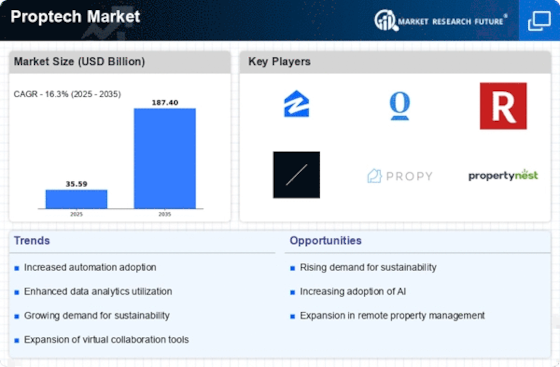
As per Market Research Future analysis, the Proptech Market Size was estimated at 35.59 USD Billion in 2024. The Proptech industry is projected to grow from 41.39 USD Billion in 2025 to 187.4 USD Billion by 2035, exhibiting a compound annual growth rate (CAGR) of 16.3% during the forecast period 2025 - 2035

Key Market Trends & Highlights

The Proptech Market is experiencing transformative growth driven by technological advancements and evolving consumer needs.

  • The rise of smart technologies is reshaping the residential segment, particularly in North America, where demand for innovative housing solutions is robust. Data-driven decision making is becoming increasingly prevalent, enabling stakeholders in the commercial segment to optimize operations and enhance profitability. Collaboration between sectors is fostering synergies, particularly in the Asia-Pacific region, which is witnessing rapid growth in proptech adoption. The integration of artificial intelligence and sustainability practices are key drivers, as the market responds to the heightened demand for housing solutions and green building initiatives.

Market Size & Forecast

2024 Market Size 35.59 (USD Billion)
2035 Market Size 187.4 (USD Billion)
CAGR (2025 - 2035) 16.3%
Largest Regional Market Share in 2024 North America

Major Players

Zillow (US), <a href="https://www.opendoor.com/">Opendoor (US</a>), Redfin (US), Compass (US), Propy (US), <a href="https://www.propertynest.com/">PropertyNest </a>(GB), Homie (US), LendInvest (GB), RealtyMogul (US)

Market Trends

The Proptech Market is currently experiencing a transformative phase, driven by advancements in technology and changing consumer preferences. The integration of digital solutions into real estate processes is reshaping how properties are bought, sold, and managed. This evolution appears to be fueled by a growing demand for efficiency, transparency, and enhanced user experiences. Property tech startups are introducing disruptive business models focused on digital transactions and smart buildings.  As stakeholders increasingly adopt innovative tools, the landscape of property transactions is likely to become more streamlined and accessible. Furthermore, the rise of smart buildings and IoT applications suggests a shift towards more sustainable and intelligent living environments, which may redefine urban development in the coming years. In addition, the Proptech Market seems to be influenced by the increasing importance of data analytics and artificial intelligence. These technologies are enabling real estate professionals to make informed decisions, optimize operations, and enhance customer engagement. As the market continues to evolve, collaboration between traditional real estate firms and tech startups is becoming more prevalent, indicating a potential for synergistic growth. Overall, the Proptech Market is poised for significant evolution, with various factors contributing to its dynamic nature and future potential. The prop-tech industry is transforming traditional real estate operations through digital platforms and advanced analytics. Real estate proptech integrates technology-driven solutions across property transactions, management, and investment activities. This proptech industry report provides a comprehensive analysis of market size, trends, segmentation, and regional performance. Property technology is reshaping how residential and commercial assets are marketed, transacted, and managed. 

The PropTech Market is expected to see significant growth in the coming months as more businesses will begin to adopt AI, IoT, and cloud technology to improve their operational efficiency and provide increased transparency and improved user experiences when purchasing, selling and managing real estate. Property tech solutions are increasingly adopted to improve transparency, efficiency, and customer experience. Proptech software enables automation of leasing, valuation, and property management processes. Cloud-based proptech solutions are gaining traction due to scalability and real-time data access. The emergence of a proptech marketplace is facilitating direct interaction between buyers, sellers, and service providers. Proptech real estate solutions are enhancing efficiency across property buying, selling, and management processes. The proptech outlook remains positive, supported by AI, IoT, and cloud-based innovation across global markets.

Rise of Smart Technologies

The Proptech Market is witnessing a notable increase in the adoption of smart technologies. These innovations, including IoT devices and automation systems, are enhancing property management and improving tenant experiences. As smart buildings become more prevalent, they are likely to offer energy efficiency and convenience, appealing to both investors and occupants.

Data-Driven Decision Making

There is a growing emphasis on data analytics within the Proptech Market. Real estate professionals are increasingly leveraging data to inform their strategies, optimize pricing, and enhance customer interactions. This trend suggests a shift towards more informed decision-making processes, which could lead to improved outcomes for stakeholders.

Collaboration Between Sectors

The Proptech Market appears to be fostering collaboration between traditional real estate entities and technology startups. This partnership may facilitate the development of innovative solutions that address current market challenges. As these collaborations expand, they could potentially reshape the competitive landscape and drive further advancements in the industry.

Proptech Market Market Drivers

Enhanced Data Security Measures

As the Proptech Market continues to digitize, the importance of data security has become paramount. With increasing concerns over data breaches and privacy issues, Proptech Market companies are investing in advanced security measures to protect sensitive information. This focus on data security not only builds consumer trust but also complies with regulatory requirements that govern data protection. The implementation of blockchain technology is one such measure that is gaining traction, offering a secure and transparent way to conduct transactions. As data security becomes a focal point, it is likely to influence the growth trajectory of the Proptech Market, ensuring that consumer confidence remains intact.

Increased Demand for Housing Solutions

The Proptech Market is currently experiencing a surge in demand for innovative housing solutions. This demand is driven by a growing population and urbanization trends, which necessitate efficient housing options. According to recent data, the number of households is projected to increase significantly, leading to a heightened need for technology-driven solutions that streamline the buying, selling, and renting processes. Proptech Market companies are responding by developing platforms that enhance user experience and provide comprehensive property listings. This trend indicates that the Proptech Market is likely to expand as it adapts to meet the evolving needs of consumers seeking efficient housing solutions.

Integration of Artificial Intelligence

The integration of artificial intelligence (AI) into the Proptech Market is transforming how real estate transactions are conducted. AI technologies are being utilized to analyze vast amounts of data, enabling predictive analytics that can forecast market trends and property values. This capability allows investors and buyers to make informed decisions based on real-time data. Furthermore, AI-driven chatbots and virtual assistants are enhancing customer service by providing instant responses to inquiries. As AI continues to evolve, its impact on the Proptech Market is expected to grow, potentially leading to more personalized and efficient real estate experiences.

Rise of Remote Work and Digital Solutions

The rise of remote work has significantly influenced the Proptech Market, as individuals and businesses seek flexible living and working arrangements. This trend has led to an increased demand for properties that accommodate home offices and co-working spaces. Proptech Market companies are responding by creating digital solutions that facilitate virtual property tours, online leasing, and remote management of properties. Data indicates that the demand for rental properties with dedicated workspaces has surged, reflecting a shift in consumer preferences. As remote work continues to shape the real estate landscape, the Proptech Market is poised for further innovation and growth.

Sustainability and Green Building Practices

Sustainability has emerged as a critical driver within the Proptech Market, as stakeholders increasingly prioritize eco-friendly practices. The demand for green buildings is on the rise, with many consumers seeking properties that adhere to sustainable standards. This shift is prompting Proptech Market companies to develop solutions that facilitate energy-efficient designs and sustainable construction methods. Data suggests that properties with green certifications tend to have higher market values and lower operational costs, making them attractive to both investors and buyers. Consequently, the emphasis on sustainability is likely to propel growth within the Proptech Market as it aligns with broader environmental goals.

Market Segment Insights

By Property Type: Residential (Largest) vs. Commercial (Fastest-Growing)

<p>The Proptech Market's 'Property Type' segment exhibits a dynamic distribution where the Residential segment holds the largest share. This segment encompasses various residential real estate solutions, including rental platforms, property management tools, and home listings that cater to individual consumers. In contrast, the Commercial segment, encompassing office spaces, retail, and hospitality solutions, is experiencing rapid growth, driven by the increasing demand for digital solutions that facilitate property transactions and management across businesses. Growth trends in these segments are markedly influenced by the ongoing digital transformation across real estate sectors. The Residential segment benefits from a surge in online property searches and increased interest in smart living solutions. Meanwhile, the Commercial segment is propelled by the evolving workplace dynamics, with businesses seeking innovative digital tools for efficient management and tenant engagement, highlighting the shifting focus of Proptech towards fostering connectivity and streamlined operations.</p>

<p>Residential (Dominant) vs. Industrial (Emerging)</p>

<p>The Residential segment in the Proptech Market stands as the dominant force, characterized by its wide array of services aimed at enhancing the home buying, selling, and renting experiences. This segment thrives on robust technology adoption, with platforms offering virtual tours, smart home integrations, and user-friendly interfaces. On the other hand, the Industrial segment is emerging as a notable player, focusing on warehouses and distribution center solutions. While traditionally slower to adopt new technologies, increasing e-commerce demand drives the Industrial sector towards innovative management tools to optimize logistics and inventory processes. Both segments reflect diverse needs and technological integration levels, with the Residential segment leading the charge while the Industrial segment gradually expands its footprint.</p>

By Solution: Software (Largest) vs. Services (Fastest-Growing)

<p>In the Proptech Market, the Software segment holds a significant share, driven by the increasing demand for digital solutions that streamline property management and enhance user experience. Various software tools have emerged to support tasks such as real estate transactions, property management, and tenant engagement, which have all contributed to the robust market presence of this segment. Meanwhile, the Services segment, although currently smaller, is experiencing rapid growth as companies recognize the value of expert consultation and tailored service offerings in navigating the complexities of property technology.</p>

<p>Software (Dominant) vs. Services (Emerging)</p>

<p>The Software segment in the Proptech Market is characterized by its dominance and extensive offerings, such as property management systems, virtual tour applications, and data analytics platforms. These solutions are pivotal for real estate firms looking to enhance operational efficiency and improve client interactions. On the other hand, the Services segment is emerging as a vital component, specializing in advisory, installation, and support services that cater to the diverse needs of real estate businesses. As organizations increasingly seek specialized expertise to implement and optimize technology solutions, the Services segment is poised for notable expansion, blending technology with personalized support to create comprehensive solutions.</p>

By Deployment: Cloud-based (Largest) vs. On-premises (Fastest-Growing)

<p>In the Proptech market, the deployment segment is primarily divided between cloud-based solutions and on-premises systems. Cloud-based deployment holds the largest share, gaining preference among businesses due to its scalability, flexibility, and lower initial investment. Meanwhile, on-premises solutions are experiencing rapid growth driven by organizations seeking enhanced control and security over their data. This shift indicates a diversified market where both deployment strategies cater to different user needs and operational requirements.</p>

<p>Deployment: Cloud-based (Dominant) vs. On-premises (Emerging)</p>

<p>Cloud-based deployment continues to dominate the Proptech market, offering a versatile platform that supports various applications, from property management to real estate analytics. This model thrives on features like remote accessibility, automated updates, and cost efficiency. On the other hand, on-premises solutions are emerging as a strong alternative for businesses that prioritize data privacy and customizable infrastructure. As companies recognize the importance of integrating robust security measures, on-premises systems are being adopted at a rapid pace, appealing to sectors with stringent regulatory requirements. Together, these deployment strategies highlight the evolving landscape of the Proptech industry, where both are critical in meeting diverse client demands.</p>

By End User: Housing Associations (Largest) vs. Property Managers/ Agents (Fastest-Growing)

<p>In the Proptech Market, the 'End User' segment exhibits a diverse distribution among its various categories, namely Housing Associations, Property Managers/Agents, and Property Investors. Housing Associations hold a significant market share due to their longstanding adoption of technology solutions that drive efficiency in property management and tenant engagement. Meanwhile, Property Managers/Agents are also notable players, leveraging digital tools to streamline operations and enhance client relationships, leading to a competitive market environment fueled by innovation. Growth trends within the Proptech Market for the 'End User' segment indicate a shift towards increased digitalization and the integration of advanced technologies. The rapid adoption of cloud-based platforms and AI-driven data analytics is empowering Property Managers/Agents to enhance service delivery significantly. Moreover, the growing importance of sustainable practices in property management is driving Housing Associations to invest in technology that minimizes environmental impact and optimizes resource utilization, contributing to their steady market presence.</p>

<p>Housing Associations (Dominant) vs. Property Investors (Emerging)</p>

<p>Housing Associations have established themselves as a dominant force in the Proptech Market, primarily due to their proactive approach in adopting innovative digital solutions that meet the needs of their tenants effectively. These organizations operate under strict regulatory frameworks, driving them to seek out technologies that enhance compliance while improving operational efficiency. On the other hand, Property Investors emerge as a growing segment within this landscape, seeking technological advancements to optimize property evaluations, investment analyses, and portfolio management. This group is increasingly relying on data analytics and market intelligence tools, allowing them to make informed decisions and capitalize on market opportunities. Together, these segments illustrate a dynamic interplay of established dominance and emerging trends within the Proptech landscape.</p>

Get more detailed insights about Proptech Market Research Report—Global Forecast till 2035

Regional Insights

North America : Innovation and Market Leadership

North America is the largest market for Proptech Market, holding approximately 45% of the global share, driven by technological advancements and a strong demand for digital real estate solutions. The region benefits from a robust regulatory framework that encourages innovation, particularly in the U.S. and Canada. The increasing adoption of AI and blockchain technologies is further propelling market growth, with a focus on enhancing user experience and operational efficiency. The U.S. is the leading country in this sector, home to major players like Zillow, Opendoor, and Redfin. Canada follows closely, with a growing number of startups entering the market. The competitive landscape is characterized by a mix of established firms and emerging startups, all vying for market share. The presence of significant investment in technology and real estate sectors continues to attract new entrants, fostering a dynamic environment.

The Argentina proptech market is set for strong growth through 2035, with rising digital platform use and analytics‑driven tools enhancing real estate transactions and management across both residential and commercial segments.

Europe : Emerging Market with Growth Potential

Europe is witnessing a rapid growth in the Proptech Market, currently holding about 30% of the global share. The region's growth is fueled by increasing urbanization, a shift towards digital solutions in real estate, and supportive government policies aimed at innovation. Countries like Germany and the UK are leading this transformation, with a focus on sustainability and smart city initiatives that are reshaping the real estate landscape. Germany stands out as a key player, with a strong presence of Proptech Market startups and established companies. The UK follows closely, with significant investments in technology-driven real estate solutions. The competitive landscape is vibrant, with numerous players like PropertyNest and LendInvest making strides. The European market is characterized by collaboration between tech firms and traditional real estate companies, enhancing service offerings and customer engagement. The France proptech market is witnessing strong digital transformation across residential and commercial real estate segments.

A strong digital transformation is taking place within the France PropTech market, with anticipated continued growth until 2035, as digital platforms and smart technology impact property management and consumer experience in the residential and commercial real estate sectors.

Asia-Pacific : Rapid Growth and Investment

Asia-Pacific is rapidly emerging as a significant player in the Proptech Market, currently accounting for approximately 20% of the global share. The region's growth is driven by increasing urbanization, a tech-savvy population, and rising investment in digital real estate solutions. Countries like China and India are at the forefront, with government initiatives promoting smart cities and digital infrastructure, which are crucial for Proptech Market development. China leads the market with a plethora of Proptech Market startups and established companies leveraging technology to enhance real estate transactions. India is also witnessing a surge in Proptech Market investments, with a growing number of platforms catering to diverse real estate needs. The competitive landscape is marked by innovation, with local players adapting global trends to meet regional demands, creating a dynamic environment for growth. The APAC proptech market is experiencing rapid growth, driven by urbanization, smart city initiatives, and rising digital adoption.

The Asia-Pacific proptech market is experiencing a tremendous boom and is expected to have dramatic growth levels between 2025 and 2035 due to the increases in the Real Estate Industry's digital migration, China, and other growing Asian Economies. The increase in investments into both Smart Technology and Sustainability Solutions across property types in this region will driven growth in this sector.

Middle East and Africa : Untapped Potential and Growth

The Middle East and Africa region is gradually emerging in the Proptech Market, currently holding about 5% of the global share. The growth is primarily driven by increasing urbanization, a young population, and a growing interest in digital solutions for real estate. Countries like the UAE and South Africa are leading the charge, with government initiatives aimed at enhancing the real estate sector through technology and innovation. The UAE is a key player, with a strong focus on smart city projects and digital transformation in real estate. South Africa is also witnessing growth, with several startups entering the Proptech Market space. The competitive landscape is evolving, with both local and international players seeking to capitalize on the untapped potential in the region, fostering a vibrant ecosystem for Proptech Market development. The GCC proptech market is expanding steadily, supported by smart city projects and investments in digital infrastructure.

Between 2025 and 2035, a significant growth in PropTech can be expected in the Gulf Cooperation Council (GCC) due to an overall demand for technological-based solutions for the real estate industry (PropTech) and more investment in digital infrastructure that is intelligent and sustainable from the major economies within the Gulf region.

Key Players and Competitive Insights

Leading market players are investing heavily in research and development in order to expand their Product lines, which will help the Proptech Market, grow even more. Market participants are also undertaking a variety of strategic activities to expand their global footprint, with important market developments including new product launches, contractual agreements, mergers and acquisitions, higher investments, and collaboration with other organizations. To expand and survive in a more competitive and rising market climate, Proptech Industry must offer cost-effective items. Prop tech companies are expanding their product portfolios to address complex real estate workflows. Property tech companies are increasingly collaborating with traditional real estate firms to accelerate digital adoption. Property technology companies play a critical role in driving innovation across the global real estate sector.
Manufacturing locally to minimize operational costs is one of the key business tactics used by manufacturers in the global Proptech Industry to benefit clients and increase the market sector. In recent years, the Proptech Industry has offered some of the most significant advantages to medicine. Major players in the Proptech Market, including Ascendix Technologies, Zumper Inc., Opendoor, Altus Group, Guesty Inc., HoloBuilder, Inc., Zillow, Inc., ManageCasa, Coadjute, Vergesense, Reggora, Enertiv, Homelight, Proptech Market group, Qualia, are attempting to increase market demand by investing in research and development operations. Guesty offers property management software with end-to-end solutions, such as a mobile app, multi-calendar, channel manager, and unified email. Israel's Tel Aviv serves as the company's headquarters. It was established in 2013. Guesty and Steadily, a US-based supplier of rental property insurance, collaborated in September 2022. The agreement enhances the value of the currently available tools on Guesty's platform and rounds out its line of damage protection products. Reggora is a platform for real estate valuation in the cloud. Real estate appraisers can use Reggora's big data analytics to make more effective and precise decisions. The company is headquartered in Boston, Massachusetts, and was established in 2016. Reggora and Clear Capital, a provider of real estate appraisal technologies, partnered in April 2022. As part of the cooperation, Reggora will receive valuation quality control. Additionally, this collaboration supports Reggora's goal of providing innovative, effective solutions that will improve the appraisal process.

Key Companies in the Proptech Market include

Industry Developments

  • Q3 2025: Singapore’s GIC, Partners Group, Mubadala, and TPG acquire Techem for €6.7B Singapore’s GIC, Partners Group, Mubadala Investment Company, and TPG announced the acquisition of Techem, a German energy-saving services provider for the real estate sector, in a deal valued at €6.7 billion ($7.8 billion). Partners Group will hold a controlling interest, with the deal expected to close by late 2025.
  • Q2 2025: Fortlane Partners PropTech M&A Update | July 2025 In June 2025, an undisclosed stake was acquired in a provider of software for the estate agency and home mover market, reflecting increased M&A activity and consolidation in the European proptech sector.
  • Q1 2025: PropTech and M&A 2025: consolidation as a growth driver Financial investors such as 468 Capital, Wecken & Cie, and FJ Labs expanded their presence in the proptech market with several investments in companies including assetbird, Kugu, and Evernest, marking a shift in M&A activity and investor strategy in early 2025.

Future Outlook

Proptech Market Future Outlook

The Proptech Market is poised for growth at 16.3% CAGR from 2025 to 2035, driven by technological advancements, urbanization, and evolving consumer preferences.

New opportunities lie in:

  • <p>Integration of AI-driven property management systems Development of blockchain-based transaction platforms Expansion of virtual reality tools for property showcasing</p>

By 2035, the Proptech Market is expected to be a dynamic and integral part of the real estate landscape.

Market Segmentation

Proptech Market End User Outlook

  • Housing Associations
  • Property Managers/ Agents
  • Property Investors
  • Others

Proptech Market Solution Outlook

  • Software
  • Services

Proptech Market Deployment Outlook

  • Cloud-based
  • On-premises

Proptech Market Property Type Outlook

  • Residential
  • Commercial
  • Industrial

Report Scope

MARKET SIZE 2024 35.59(USD Billion)
MARKET SIZE 2025 41.39(USD Billion)
MARKET SIZE 2035 187.4(USD Billion)
COMPOUND ANNUAL GROWTH RATE (CAGR) 16.3% (2025 - 2035)
REPORT COVERAGE Revenue Forecast, Competitive Landscape, Growth Factors, and Trends
BASE YEAR 2024
Market Forecast Period 2025 - 2035
Historical Data 2019 - 2024
Market Forecast Units USD Billion
Key Companies Profiled Zillow (US), Opendoor (US), Redfin (US), Compass (US), Propy (US), PropertyNest (GB), Homie (US), LendInvest (GB), RealtyMogul (US)
Segments Covered Property Type, Solution, Deployment, End User, Region
Key Market Opportunities Integration of artificial intelligence and blockchain enhances transparency and efficiency in the Proptech Market.
Key Market Dynamics Technological advancements drive competitive forces, reshaping consumer behavior and regulatory frameworks in the Proptech Market.
Countries Covered North America, Europe, APAC, South America, MEA

FAQs

What is the current valuation of the Proptech Market as of 2024?

<p>The Proptech Market was valued at 35.59 USD Billion in 2024.</p>

What is the projected market size for the Proptech Market in 2035?

<p>The market is projected to reach 187.4 USD Billion by 2035.</p>

What is the expected CAGR for the Proptech Market during the forecast period 2025 - 2035?

<p>The expected CAGR for the Proptech Market during 2025 - 2035 is 16.3%.</p>

Which segments are included in the Proptech Market analysis?

<p>The market analysis includes segments such as Property Type, Solution, Deployment, and End User.</p>

What are the projected valuations for the Residential segment by 2035?

<p>The Residential segment is projected to grow from 10.0 USD Billion to 50.0 USD Billion by 2035.</p>

How does the Commercial segment's valuation compare to the Industrial segment?

<p>The Commercial segment is expected to grow from 15.0 USD Billion to 80.0 USD Billion, while the Industrial segment is projected to grow from 10.59 USD Billion to 57.4 USD Billion.</p>

What are the key players in the Proptech Market?

Key players include Zillow, Opendoor, Redfin, Compass, Propy, PropertyNest, Homie, LendInvest, and RealtyMogul.

What is the projected growth for Cloud-based solutions in the Proptech Market?

Cloud-based solutions are projected to grow from 20.0 USD Billion to 100.0 USD Billion by 2035.

Which end user segment is expected to have the highest valuation by 2035?

The Property Investors segment is expected to grow from 15.0 USD Billion to 80.0 USD Billion by 2035.

What is the anticipated growth for software solutions in the Proptech Market?

Software solutions are projected to increase from 20.0 USD Billion to 100.0 USD Billion by 2035.

  1. SECTION I: EXECUTIVE SUMMARY AND KEY HIGHLIGHTS
    1. | 1.1 EXECUTIVE SUMMARY
    2. | | 1.1.1 Market Overview
    3. | | 1.1.2 Key Findings
    4. | | 1.1.3 Market Segmentation
    5. | | 1.1.4 Competitive Landscape
    6. | | 1.1.5 Challenges and Opportunities
    7. | | 1.1.6 Future Outlook
  2. SECTION II: SCOPING, METHODOLOGY AND MARKET STRUCTURE
    1. | 2.1 MARKET INTRODUCTION
    2. | | 2.1.1 Definition
    3. | | 2.1.2 Scope of the study
    4. | | | 2.1.2.1 Research Objective
    5. | | | 2.1.2.2 Assumption
    6. | | | 2.1.2.3 Limitations
    7. | 2.2 RESEARCH METHODOLOGY
    8. | | 2.2.1 Overview
    9. | | 2.2.2 Data Mining
    10. | | 2.2.3 Secondary Research
    11. | | 2.2.4 Primary Research
    12. | | | 2.2.4.1 Primary Interviews and Information Gathering Process
    13. | | | 2.2.4.2 Breakdown of Primary Respondents
    14. | | 2.2.5 Forecasting Model
    15. | | 2.2.6 Market Size Estimation
    16. | | | 2.2.6.1 Bottom-Up Approach
    17. | | | 2.2.6.2 Top-Down Approach
    18. | | 2.2.7 Data Triangulation
    19. | | 2.2.8 Validation
  3. SECTION III: QUALITATIVE ANALYSIS
    1. | 3.1 MARKET DYNAMICS
    2. | | 3.1.1 Overview
    3. | | 3.1.2 Drivers
    4. | | 3.1.3 Restraints
    5. | | 3.1.4 Opportunities
    6. | 3.2 MARKET FACTOR ANALYSIS
    7. | | 3.2.1 Value chain Analysis
    8. | | 3.2.2 Porter's Five Forces Analysis
    9. | | | 3.2.2.1 Bargaining Power of Suppliers
    10. | | | 3.2.2.2 Bargaining Power of Buyers
    11. | | | 3.2.2.3 Threat of New Entrants
    12. | | | 3.2.2.4 Threat of Substitutes
    13. | | | 3.2.2.5 Intensity of Rivalry
    14. | | 3.2.3 COVID-19 Impact Analysis
    15. | | | 3.2.3.1 Market Impact Analysis
    16. | | | 3.2.3.2 Regional Impact
    17. | | | 3.2.3.3 Opportunity and Threat Analysis
  4. SECTION IV: QUANTITATIVE ANALYSIS
    1. | 4.1 Information and Communications Technology, BY Property Type (USD Billion)
    2. | | 4.1.1 Residential
    3. | | 4.1.2 Commercial
    4. | | 4.1.3 Industrial
    5. | 4.2 Information and Communications Technology, BY Solution (USD Billion)
    6. | | 4.2.1 Software
    7. | | 4.2.2 Services
    8. | 4.3 Information and Communications Technology, BY Deployment (USD Billion)
    9. | | 4.3.1 Cloud-based
    10. | | 4.3.2 On-premises
    11. | 4.4 Information and Communications Technology, BY End User (USD Billion)
    12. | | 4.4.1 Housing Associations
    13. | | 4.4.2 Property Managers/ Agents
    14. | | 4.4.3 Property Investors
    15. | | 4.4.4 Others
    16. | 4.5 Information and Communications Technology, BY Region (USD Billion)
    17. | | 4.5.1 North America
    18. | | | 4.5.1.1 US
    19. | | | 4.5.1.2 Canada
    20. | | 4.5.2 Europe
    21. | | | 4.5.2.1 Germany
    22. | | | 4.5.2.2 UK
    23. | | | 4.5.2.3 France
    24. | | | 4.5.2.4 Russia
    25. | | | 4.5.2.5 Italy
    26. | | | 4.5.2.6 Spain
    27. | | | 4.5.2.7 Rest of Europe
    28. | | 4.5.3 APAC
    29. | | | 4.5.3.1 China
    30. | | | 4.5.3.2 India
    31. | | | 4.5.3.3 Japan
    32. | | | 4.5.3.4 South Korea
    33. | | | 4.5.3.5 Malaysia
    34. | | | 4.5.3.6 Thailand
    35. | | | 4.5.3.7 Indonesia
    36. | | | 4.5.3.8 Rest of APAC
    37. | | 4.5.4 South America
    38. | | | 4.5.4.1 Brazil
    39. | | | 4.5.4.2 Mexico
    40. | | | 4.5.4.3 Argentina
    41. | | | 4.5.4.4 Rest of South America
    42. | | 4.5.5 MEA
    43. | | | 4.5.5.1 GCC Countries
    44. | | | 4.5.5.2 South Africa
    45. | | | 4.5.5.3 Rest of MEA
  5. SECTION V: COMPETITIVE ANALYSIS
    1. | 5.1 Competitive Landscape
    2. | | 5.1.1 Overview
    3. | | 5.1.2 Competitive Analysis
    4. | | 5.1.3 Market share Analysis
    5. | | 5.1.4 Major Growth Strategy in the Information and Communications Technology
    6. | | 5.1.5 Competitive Benchmarking
    7. | | 5.1.6 Leading Players in Terms of Number of Developments in the Information and Communications Technology
    8. | | 5.1.7 Key developments and growth strategies
    9. | | | 5.1.7.1 New Product Launch/Service Deployment
    10. | | | 5.1.7.2 Merger & Acquisitions
    11. | | | 5.1.7.3 Joint Ventures
    12. | | 5.1.8 Major Players Financial Matrix
    13. | | | 5.1.8.1 Sales and Operating Income
    14. | | | 5.1.8.2 Major Players R&D Expenditure. 2023
    15. | 5.2 Company Profiles
    16. | | 5.2.1 Zillow (US)
    17. | | | 5.2.1.1 Financial Overview
    18. | | | 5.2.1.2 Products Offered
    19. | | | 5.2.1.3 Key Developments
    20. | | | 5.2.1.4 SWOT Analysis
    21. | | | 5.2.1.5 Key Strategies
    22. | | 5.2.2 Opendoor (US)
    23. | | | 5.2.2.1 Financial Overview
    24. | | | 5.2.2.2 Products Offered
    25. | | | 5.2.2.3 Key Developments
    26. | | | 5.2.2.4 SWOT Analysis
    27. | | | 5.2.2.5 Key Strategies
    28. | | 5.2.3 Redfin (US)
    29. | | | 5.2.3.1 Financial Overview
    30. | | | 5.2.3.2 Products Offered
    31. | | | 5.2.3.3 Key Developments
    32. | | | 5.2.3.4 SWOT Analysis
    33. | | | 5.2.3.5 Key Strategies
    34. | | 5.2.4 Compass (US)
    35. | | | 5.2.4.1 Financial Overview
    36. | | | 5.2.4.2 Products Offered
    37. | | | 5.2.4.3 Key Developments
    38. | | | 5.2.4.4 SWOT Analysis
    39. | | | 5.2.4.5 Key Strategies
    40. | | 5.2.5 Propy (US)
    41. | | | 5.2.5.1 Financial Overview
    42. | | | 5.2.5.2 Products Offered
    43. | | | 5.2.5.3 Key Developments
    44. | | | 5.2.5.4 SWOT Analysis
    45. | | | 5.2.5.5 Key Strategies
    46. | | 5.2.6 PropertyNest (GB)
    47. | | | 5.2.6.1 Financial Overview
    48. | | | 5.2.6.2 Products Offered
    49. | | | 5.2.6.3 Key Developments
    50. | | | 5.2.6.4 SWOT Analysis
    51. | | | 5.2.6.5 Key Strategies
    52. | | 5.2.7 Homie (US)
    53. | | | 5.2.7.1 Financial Overview
    54. | | | 5.2.7.2 Products Offered
    55. | | | 5.2.7.3 Key Developments
    56. | | | 5.2.7.4 SWOT Analysis
    57. | | | 5.2.7.5 Key Strategies
    58. | | 5.2.8 LendInvest (GB)
    59. | | | 5.2.8.1 Financial Overview
    60. | | | 5.2.8.2 Products Offered
    61. | | | 5.2.8.3 Key Developments
    62. | | | 5.2.8.4 SWOT Analysis
    63. | | | 5.2.8.5 Key Strategies
    64. | | 5.2.9 RealtyMogul (US)
    65. | | | 5.2.9.1 Financial Overview
    66. | | | 5.2.9.2 Products Offered
    67. | | | 5.2.9.3 Key Developments
    68. | | | 5.2.9.4 SWOT Analysis
    69. | | | 5.2.9.5 Key Strategies
    70. | 5.3 Appendix
    71. | | 5.3.1 References
    72. | | 5.3.2 Related Reports
  6. LIST OF FIGURES
    1. | 6.1 MARKET SYNOPSIS
    2. | 6.2 NORTH AMERICA MARKET ANALYSIS
    3. | 6.3 US MARKET ANALYSIS BY PROPERTY TYPE
    4. | 6.4 US MARKET ANALYSIS BY SOLUTION
    5. | 6.5 US MARKET ANALYSIS BY DEPLOYMENT
    6. | 6.6 US MARKET ANALYSIS BY END USER
    7. | 6.7 CANADA MARKET ANALYSIS BY PROPERTY TYPE
    8. | 6.8 CANADA MARKET ANALYSIS BY SOLUTION
    9. | 6.9 CANADA MARKET ANALYSIS BY DEPLOYMENT
    10. | 6.10 CANADA MARKET ANALYSIS BY END USER
    11. | 6.11 EUROPE MARKET ANALYSIS
    12. | 6.12 GERMANY MARKET ANALYSIS BY PROPERTY TYPE
    13. | 6.13 GERMANY MARKET ANALYSIS BY SOLUTION
    14. | 6.14 GERMANY MARKET ANALYSIS BY DEPLOYMENT
    15. | 6.15 GERMANY MARKET ANALYSIS BY END USER
    16. | 6.16 UK MARKET ANALYSIS BY PROPERTY TYPE
    17. | 6.17 UK MARKET ANALYSIS BY SOLUTION
    18. | 6.18 UK MARKET ANALYSIS BY DEPLOYMENT
    19. | 6.19 UK MARKET ANALYSIS BY END USER
    20. | 6.20 FRANCE MARKET ANALYSIS BY PROPERTY TYPE
    21. | 6.21 FRANCE MARKET ANALYSIS BY SOLUTION
    22. | 6.22 FRANCE MARKET ANALYSIS BY DEPLOYMENT
    23. | 6.23 FRANCE MARKET ANALYSIS BY END USER
    24. | 6.24 RUSSIA MARKET ANALYSIS BY PROPERTY TYPE
    25. | 6.25 RUSSIA MARKET ANALYSIS BY SOLUTION
    26. | 6.26 RUSSIA MARKET ANALYSIS BY DEPLOYMENT
    27. | 6.27 RUSSIA MARKET ANALYSIS BY END USER
    28. | 6.28 ITALY MARKET ANALYSIS BY PROPERTY TYPE
    29. | 6.29 ITALY MARKET ANALYSIS BY SOLUTION
    30. | 6.30 ITALY MARKET ANALYSIS BY DEPLOYMENT
    31. | 6.31 ITALY MARKET ANALYSIS BY END USER
    32. | 6.32 SPAIN MARKET ANALYSIS BY PROPERTY TYPE
    33. | 6.33 SPAIN MARKET ANALYSIS BY SOLUTION
    34. | 6.34 SPAIN MARKET ANALYSIS BY DEPLOYMENT
    35. | 6.35 SPAIN MARKET ANALYSIS BY END USER
    36. | 6.36 REST OF EUROPE MARKET ANALYSIS BY PROPERTY TYPE
    37. | 6.37 REST OF EUROPE MARKET ANALYSIS BY SOLUTION
    38. | 6.38 REST OF EUROPE MARKET ANALYSIS BY DEPLOYMENT
    39. | 6.39 REST OF EUROPE MARKET ANALYSIS BY END USER
    40. | 6.40 APAC MARKET ANALYSIS
    41. | 6.41 CHINA MARKET ANALYSIS BY PROPERTY TYPE
    42. | 6.42 CHINA MARKET ANALYSIS BY SOLUTION
    43. | 6.43 CHINA MARKET ANALYSIS BY DEPLOYMENT
    44. | 6.44 CHINA MARKET ANALYSIS BY END USER
    45. | 6.45 INDIA MARKET ANALYSIS BY PROPERTY TYPE
    46. | 6.46 INDIA MARKET ANALYSIS BY SOLUTION
    47. | 6.47 INDIA MARKET ANALYSIS BY DEPLOYMENT
    48. | 6.48 INDIA MARKET ANALYSIS BY END USER
    49. | 6.49 JAPAN MARKET ANALYSIS BY PROPERTY TYPE
    50. | 6.50 JAPAN MARKET ANALYSIS BY SOLUTION
    51. | 6.51 JAPAN MARKET ANALYSIS BY DEPLOYMENT
    52. | 6.52 JAPAN MARKET ANALYSIS BY END USER
    53. | 6.53 SOUTH KOREA MARKET ANALYSIS BY PROPERTY TYPE
    54. | 6.54 SOUTH KOREA MARKET ANALYSIS BY SOLUTION
    55. | 6.55 SOUTH KOREA MARKET ANALYSIS BY DEPLOYMENT
    56. | 6.56 SOUTH KOREA MARKET ANALYSIS BY END USER
    57. | 6.57 MALAYSIA MARKET ANALYSIS BY PROPERTY TYPE
    58. | 6.58 MALAYSIA MARKET ANALYSIS BY SOLUTION
    59. | 6.59 MALAYSIA MARKET ANALYSIS BY DEPLOYMENT
    60. | 6.60 MALAYSIA MARKET ANALYSIS BY END USER
    61. | 6.61 THAILAND MARKET ANALYSIS BY PROPERTY TYPE
    62. | 6.62 THAILAND MARKET ANALYSIS BY SOLUTION
    63. | 6.63 THAILAND MARKET ANALYSIS BY DEPLOYMENT
    64. | 6.64 THAILAND MARKET ANALYSIS BY END USER
    65. | 6.65 INDONESIA MARKET ANALYSIS BY PROPERTY TYPE
    66. | 6.66 INDONESIA MARKET ANALYSIS BY SOLUTION
    67. | 6.67 INDONESIA MARKET ANALYSIS BY DEPLOYMENT
    68. | 6.68 INDONESIA MARKET ANALYSIS BY END USER
    69. | 6.69 REST OF APAC MARKET ANALYSIS BY PROPERTY TYPE
    70. | 6.70 REST OF APAC MARKET ANALYSIS BY SOLUTION
    71. | 6.71 REST OF APAC MARKET ANALYSIS BY DEPLOYMENT
    72. | 6.72 REST OF APAC MARKET ANALYSIS BY END USER
    73. | 6.73 SOUTH AMERICA MARKET ANALYSIS
    74. | 6.74 BRAZIL MARKET ANALYSIS BY PROPERTY TYPE
    75. | 6.75 BRAZIL MARKET ANALYSIS BY SOLUTION
    76. | 6.76 BRAZIL MARKET ANALYSIS BY DEPLOYMENT
    77. | 6.77 BRAZIL MARKET ANALYSIS BY END USER
    78. | 6.78 MEXICO MARKET ANALYSIS BY PROPERTY TYPE
    79. | 6.79 MEXICO MARKET ANALYSIS BY SOLUTION
    80. | 6.80 MEXICO MARKET ANALYSIS BY DEPLOYMENT
    81. | 6.81 MEXICO MARKET ANALYSIS BY END USER
    82. | 6.82 ARGENTINA MARKET ANALYSIS BY PROPERTY TYPE
    83. | 6.83 ARGENTINA MARKET ANALYSIS BY SOLUTION
    84. | 6.84 ARGENTINA MARKET ANALYSIS BY DEPLOYMENT
    85. | 6.85 ARGENTINA MARKET ANALYSIS BY END USER
    86. | 6.86 REST OF SOUTH AMERICA MARKET ANALYSIS BY PROPERTY TYPE
    87. | 6.87 REST OF SOUTH AMERICA MARKET ANALYSIS BY SOLUTION
    88. | 6.88 REST OF SOUTH AMERICA MARKET ANALYSIS BY DEPLOYMENT
    89. | 6.89 REST OF SOUTH AMERICA MARKET ANALYSIS BY END USER
    90. | 6.90 MEA MARKET ANALYSIS
    91. | 6.91 GCC COUNTRIES MARKET ANALYSIS BY PROPERTY TYPE
    92. | 6.92 GCC COUNTRIES MARKET ANALYSIS BY SOLUTION
    93. | 6.93 GCC COUNTRIES MARKET ANALYSIS BY DEPLOYMENT
    94. | 6.94 GCC COUNTRIES MARKET ANALYSIS BY END USER
    95. | 6.95 SOUTH AFRICA MARKET ANALYSIS BY PROPERTY TYPE
    96. | 6.96 SOUTH AFRICA MARKET ANALYSIS BY SOLUTION
    97. | 6.97 SOUTH AFRICA MARKET ANALYSIS BY DEPLOYMENT
    98. | 6.98 SOUTH AFRICA MARKET ANALYSIS BY END USER
    99. | 6.99 REST OF MEA MARKET ANALYSIS BY PROPERTY TYPE
    100. | 6.100 REST OF MEA MARKET ANALYSIS BY SOLUTION
    101. | 6.101 REST OF MEA MARKET ANALYSIS BY DEPLOYMENT
    102. | 6.102 REST OF MEA MARKET ANALYSIS BY END USER
    103. | 6.103 KEY BUYING CRITERIA OF INFORMATION AND COMMUNICATIONS TECHNOLOGY
    104. | 6.104 RESEARCH PROCESS OF MRFR
    105. | 6.105 DRO ANALYSIS OF INFORMATION AND COMMUNICATIONS TECHNOLOGY
    106. | 6.106 DRIVERS IMPACT ANALYSIS: INFORMATION AND COMMUNICATIONS TECHNOLOGY
    107. | 6.107 RESTRAINTS IMPACT ANALYSIS: INFORMATION AND COMMUNICATIONS TECHNOLOGY
    108. | 6.108 SUPPLY / VALUE CHAIN: INFORMATION AND COMMUNICATIONS TECHNOLOGY
    109. | 6.109 INFORMATION AND COMMUNICATIONS TECHNOLOGY, BY PROPERTY TYPE, 2024 (% SHARE)
    110. | 6.110 INFORMATION AND COMMUNICATIONS TECHNOLOGY, BY PROPERTY TYPE, 2024 TO 2035 (USD Billion)
    111. | 6.111 INFORMATION AND COMMUNICATIONS TECHNOLOGY, BY SOLUTION, 2024 (% SHARE)
    112. | 6.112 INFORMATION AND COMMUNICATIONS TECHNOLOGY, BY SOLUTION, 2024 TO 2035 (USD Billion)
    113. | 6.113 INFORMATION AND COMMUNICATIONS TECHNOLOGY, BY DEPLOYMENT, 2024 (% SHARE)
    114. | 6.114 INFORMATION AND COMMUNICATIONS TECHNOLOGY, BY DEPLOYMENT, 2024 TO 2035 (USD Billion)
    115. | 6.115 INFORMATION AND COMMUNICATIONS TECHNOLOGY, BY END USER, 2024 (% SHARE)
    116. | 6.116 INFORMATION AND COMMUNICATIONS TECHNOLOGY, BY END USER, 2024 TO 2035 (USD Billion)
    117. | 6.117 BENCHMARKING OF MAJOR COMPETITORS
  7. LIST OF TABLES
    1. | 7.1 LIST OF ASSUMPTIONS
    2. | | 7.1.1
    3. | 7.2 North America MARKET SIZE ESTIMATES; FORECAST
    4. | | 7.2.1 BY PROPERTY TYPE, 2025-2035 (USD Billion)
    5. | | 7.2.2 BY SOLUTION, 2025-2035 (USD Billion)
    6. | | 7.2.3 BY DEPLOYMENT, 2025-2035 (USD Billion)
    7. | | 7.2.4 BY END USER, 2025-2035 (USD Billion)
    8. | 7.3 US MARKET SIZE ESTIMATES; FORECAST
    9. | | 7.3.1 BY PROPERTY TYPE, 2025-2035 (USD Billion)
    10. | | 7.3.2 BY SOLUTION, 2025-2035 (USD Billion)
    11. | | 7.3.3 BY DEPLOYMENT, 2025-2035 (USD Billion)
    12. | | 7.3.4 BY END USER, 2025-2035 (USD Billion)
    13. | 7.4 Canada MARKET SIZE ESTIMATES; FORECAST
    14. | | 7.4.1 BY PROPERTY TYPE, 2025-2035 (USD Billion)
    15. | | 7.4.2 BY SOLUTION, 2025-2035 (USD Billion)
    16. | | 7.4.3 BY DEPLOYMENT, 2025-2035 (USD Billion)
    17. | | 7.4.4 BY END USER, 2025-2035 (USD Billion)
    18. | 7.5 Europe MARKET SIZE ESTIMATES; FORECAST
    19. | | 7.5.1 BY PROPERTY TYPE, 2025-2035 (USD Billion)
    20. | | 7.5.2 BY SOLUTION, 2025-2035 (USD Billion)
    21. | | 7.5.3 BY DEPLOYMENT, 2025-2035 (USD Billion)
    22. | | 7.5.4 BY END USER, 2025-2035 (USD Billion)
    23. | 7.6 Germany MARKET SIZE ESTIMATES; FORECAST
    24. | | 7.6.1 BY PROPERTY TYPE, 2025-2035 (USD Billion)
    25. | | 7.6.2 BY SOLUTION, 2025-2035 (USD Billion)
    26. | | 7.6.3 BY DEPLOYMENT, 2025-2035 (USD Billion)
    27. | | 7.6.4 BY END USER, 2025-2035 (USD Billion)
    28. | 7.7 UK MARKET SIZE ESTIMATES; FORECAST
    29. | | 7.7.1 BY PROPERTY TYPE, 2025-2035 (USD Billion)
    30. | | 7.7.2 BY SOLUTION, 2025-2035 (USD Billion)
    31. | | 7.7.3 BY DEPLOYMENT, 2025-2035 (USD Billion)
    32. | | 7.7.4 BY END USER, 2025-2035 (USD Billion)
    33. | 7.8 France MARKET SIZE ESTIMATES; FORECAST
    34. | | 7.8.1 BY PROPERTY TYPE, 2025-2035 (USD Billion)
    35. | | 7.8.2 BY SOLUTION, 2025-2035 (USD Billion)
    36. | | 7.8.3 BY DEPLOYMENT, 2025-2035 (USD Billion)
    37. | | 7.8.4 BY END USER, 2025-2035 (USD Billion)
    38. | 7.9 Russia MARKET SIZE ESTIMATES; FORECAST
    39. | | 7.9.1 BY PROPERTY TYPE, 2025-2035 (USD Billion)
    40. | | 7.9.2 BY SOLUTION, 2025-2035 (USD Billion)
    41. | | 7.9.3 BY DEPLOYMENT, 2025-2035 (USD Billion)
    42. | | 7.9.4 BY END USER, 2025-2035 (USD Billion)
    43. | 7.10 Italy MARKET SIZE ESTIMATES; FORECAST
    44. | | 7.10.1 BY PROPERTY TYPE, 2025-2035 (USD Billion)
    45. | | 7.10.2 BY SOLUTION, 2025-2035 (USD Billion)
    46. | | 7.10.3 BY DEPLOYMENT, 2025-2035 (USD Billion)
    47. | | 7.10.4 BY END USER, 2025-2035 (USD Billion)
    48. | 7.11 Spain MARKET SIZE ESTIMATES; FORECAST
    49. | | 7.11.1 BY PROPERTY TYPE, 2025-2035 (USD Billion)
    50. | | 7.11.2 BY SOLUTION, 2025-2035 (USD Billion)
    51. | | 7.11.3 BY DEPLOYMENT, 2025-2035 (USD Billion)
    52. | | 7.11.4 BY END USER, 2025-2035 (USD Billion)
    53. | 7.12 Rest of Europe MARKET SIZE ESTIMATES; FORECAST
    54. | | 7.12.1 BY PROPERTY TYPE, 2025-2035 (USD Billion)
    55. | | 7.12.2 BY SOLUTION, 2025-2035 (USD Billion)
    56. | | 7.12.3 BY DEPLOYMENT, 2025-2035 (USD Billion)
    57. | | 7.12.4 BY END USER, 2025-2035 (USD Billion)
    58. | 7.13 APAC MARKET SIZE ESTIMATES; FORECAST
    59. | | 7.13.1 BY PROPERTY TYPE, 2025-2035 (USD Billion)
    60. | | 7.13.2 BY SOLUTION, 2025-2035 (USD Billion)
    61. | | 7.13.3 BY DEPLOYMENT, 2025-2035 (USD Billion)
    62. | | 7.13.4 BY END USER, 2025-2035 (USD Billion)
    63. | 7.14 China MARKET SIZE ESTIMATES; FORECAST
    64. | | 7.14.1 BY PROPERTY TYPE, 2025-2035 (USD Billion)
    65. | | 7.14.2 BY SOLUTION, 2025-2035 (USD Billion)
    66. | | 7.14.3 BY DEPLOYMENT, 2025-2035 (USD Billion)
    67. | | 7.14.4 BY END USER, 2025-2035 (USD Billion)
    68. | 7.15 India MARKET SIZE ESTIMATES; FORECAST
    69. | | 7.15.1 BY PROPERTY TYPE, 2025-2035 (USD Billion)
    70. | | 7.15.2 BY SOLUTION, 2025-2035 (USD Billion)
    71. | | 7.15.3 BY DEPLOYMENT, 2025-2035 (USD Billion)
    72. | | 7.15.4 BY END USER, 2025-2035 (USD Billion)
    73. | 7.16 Japan MARKET SIZE ESTIMATES; FORECAST
    74. | | 7.16.1 BY PROPERTY TYPE, 2025-2035 (USD Billion)
    75. | | 7.16.2 BY SOLUTION, 2025-2035 (USD Billion)
    76. | | 7.16.3 BY DEPLOYMENT, 2025-2035 (USD Billion)
    77. | | 7.16.4 BY END USER, 2025-2035 (USD Billion)
    78. | 7.17 South Korea MARKET SIZE ESTIMATES; FORECAST
    79. | | 7.17.1 BY PROPERTY TYPE, 2025-2035 (USD Billion)
    80. | | 7.17.2 BY SOLUTION, 2025-2035 (USD Billion)
    81. | | 7.17.3 BY DEPLOYMENT, 2025-2035 (USD Billion)
    82. | | 7.17.4 BY END USER, 2025-2035 (USD Billion)
    83. | 7.18 Malaysia MARKET SIZE ESTIMATES; FORECAST
    84. | | 7.18.1 BY PROPERTY TYPE, 2025-2035 (USD Billion)
    85. | | 7.18.2 BY SOLUTION, 2025-2035 (USD Billion)
    86. | | 7.18.3 BY DEPLOYMENT, 2025-2035 (USD Billion)
    87. | | 7.18.4 BY END USER, 2025-2035 (USD Billion)
    88. | 7.19 Thailand MARKET SIZE ESTIMATES; FORECAST
    89. | | 7.19.1 BY PROPERTY TYPE, 2025-2035 (USD Billion)
    90. | | 7.19.2 BY SOLUTION, 2025-2035 (USD Billion)
    91. | | 7.19.3 BY DEPLOYMENT, 2025-2035 (USD Billion)
    92. | | 7.19.4 BY END USER, 2025-2035 (USD Billion)
    93. | 7.20 Indonesia MARKET SIZE ESTIMATES; FORECAST
    94. | | 7.20.1 BY PROPERTY TYPE, 2025-2035 (USD Billion)
    95. | | 7.20.2 BY SOLUTION, 2025-2035 (USD Billion)
    96. | | 7.20.3 BY DEPLOYMENT, 2025-2035 (USD Billion)
    97. | | 7.20.4 BY END USER, 2025-2035 (USD Billion)
    98. | 7.21 Rest of APAC MARKET SIZE ESTIMATES; FORECAST
    99. | | 7.21.1 BY PROPERTY TYPE, 2025-2035 (USD Billion)
    100. | | 7.21.2 BY SOLUTION, 2025-2035 (USD Billion)
    101. | | 7.21.3 BY DEPLOYMENT, 2025-2035 (USD Billion)
    102. | | 7.21.4 BY END USER, 2025-2035 (USD Billion)
    103. | 7.22 South America MARKET SIZE ESTIMATES; FORECAST
    104. | | 7.22.1 BY PROPERTY TYPE, 2025-2035 (USD Billion)
    105. | | 7.22.2 BY SOLUTION, 2025-2035 (USD Billion)
    106. | | 7.22.3 BY DEPLOYMENT, 2025-2035 (USD Billion)
    107. | | 7.22.4 BY END USER, 2025-2035 (USD Billion)
    108. | 7.23 Brazil MARKET SIZE ESTIMATES; FORECAST
    109. | | 7.23.1 BY PROPERTY TYPE, 2025-2035 (USD Billion)
    110. | | 7.23.2 BY SOLUTION, 2025-2035 (USD Billion)
    111. | | 7.23.3 BY DEPLOYMENT, 2025-2035 (USD Billion)
    112. | | 7.23.4 BY END USER, 2025-2035 (USD Billion)
    113. | 7.24 Mexico MARKET SIZE ESTIMATES; FORECAST
    114. | | 7.24.1 BY PROPERTY TYPE, 2025-2035 (USD Billion)
    115. | | 7.24.2 BY SOLUTION, 2025-2035 (USD Billion)
    116. | | 7.24.3 BY DEPLOYMENT, 2025-2035 (USD Billion)
    117. | | 7.24.4 BY END USER, 2025-2035 (USD Billion)
    118. | 7.25 Argentina MARKET SIZE ESTIMATES; FORECAST
    119. | | 7.25.1 BY PROPERTY TYPE, 2025-2035 (USD Billion)
    120. | | 7.25.2 BY SOLUTION, 2025-2035 (USD Billion)
    121. | | 7.25.3 BY DEPLOYMENT, 2025-2035 (USD Billion)
    122. | | 7.25.4 BY END USER, 2025-2035 (USD Billion)
    123. | 7.26 Rest of South America MARKET SIZE ESTIMATES; FORECAST
    124. | | 7.26.1 BY PROPERTY TYPE, 2025-2035 (USD Billion)
    125. | | 7.26.2 BY SOLUTION, 2025-2035 (USD Billion)
    126. | | 7.26.3 BY DEPLOYMENT, 2025-2035 (USD Billion)
    127. | | 7.26.4 BY END USER, 2025-2035 (USD Billion)
    128. | 7.27 MEA MARKET SIZE ESTIMATES; FORECAST
    129. | | 7.27.1 BY PROPERTY TYPE, 2025-2035 (USD Billion)
    130. | | 7.27.2 BY SOLUTION, 2025-2035 (USD Billion)
    131. | | 7.27.3 BY DEPLOYMENT, 2025-2035 (USD Billion)
    132. | | 7.27.4 BY END USER, 2025-2035 (USD Billion)
    133. | 7.28 GCC Countries MARKET SIZE ESTIMATES; FORECAST
    134. | | 7.28.1 BY PROPERTY TYPE, 2025-2035 (USD Billion)
    135. | | 7.28.2 BY SOLUTION, 2025-2035 (USD Billion)
    136. | | 7.28.3 BY DEPLOYMENT, 2025-2035 (USD Billion)
    137. | | 7.28.4 BY END USER, 2025-2035 (USD Billion)
    138. | 7.29 South Africa MARKET SIZE ESTIMATES; FORECAST
    139. | | 7.29.1 BY PROPERTY TYPE, 2025-2035 (USD Billion)
    140. | | 7.29.2 BY SOLUTION, 2025-2035 (USD Billion)
    141. | | 7.29.3 BY DEPLOYMENT, 2025-2035 (USD Billion)
    142. | | 7.29.4 BY END USER, 2025-2035 (USD Billion)
    143. | 7.30 Rest of MEA MARKET SIZE ESTIMATES; FORECAST
    144. | | 7.30.1 BY PROPERTY TYPE, 2025-2035 (USD Billion)
    145. | | 7.30.2 BY SOLUTION, 2025-2035 (USD Billion)
    146. | | 7.30.3 BY DEPLOYMENT, 2025-2035 (USD Billion)
    147. | | 7.30.4 BY END USER, 2025-2035 (USD Billion)
    148. | 7.31 PRODUCT LAUNCH/PRODUCT DEVELOPMENT/APPROVAL
    149. | | 7.31.1
    150. | 7.32 ACQUISITION/PARTNERSHIP
    151. | | 7.32.1

Information and Communications Technology Market Segmentation

Information and Communications Technology By Property Type (USD Billion, 2025-2035)

  • Residential
  • Commercial
  • Industrial

Information and Communications Technology By Solution (USD Billion, 2025-2035)

  • Software
  • Services

Information and Communications Technology By Deployment (USD Billion, 2025-2035)

  • Cloud-based
  • On-premises

Information and Communications Technology By End User (USD Billion, 2025-2035)

  • Housing Associations
  • Property Managers/ Agents
  • Property Investors
  • Others
Infographic

Free Sample Request

Kindly complete the form below to receive a free sample of this Report

Get Free Sample

Customer Strories

Compare Licence

×
Features License Type
Single User Multiuser License Enterprise User
Price $4,950 $5,950 $7,250
Maximum User Access Limit 1 User Upto 10 Users Unrestricted Access Throughout the Organization
Free Customization
Direct Access to Analyst
Deliverable Format
Platform Access
Discount on Next Purchase 10% 15% 15%
Printable Versions