
Request Free Sample ×

Kindly complete the form below to receive a free sample of this Report

* Please use a valid business email

Leading companies partner with us for data-driven Insights

clients tt-cursor
Hero Background
English
Chinese
French
Japanese
Korean
German
Spanish

Project Portfolio Management Software Market Share

ID: MRFR/ICT/7274-HCR
141 Pages
Ankit Gupta
April 2026

Project Portfolio Management Software Market Size, Share and Research Report: By Deployment Model (Cloud-based, On-premises, Hybrid), By Application (IT Project Management, Construction Project Management, Product Development, Research and Development, Event Management), By Industry (Information Technology, Manufacturing, Healthcare, Construction, Finance), By Organization Size (Small Enterprises, Medium Enterprises, Large Enterprises) and By Regional (North America, Europe, South America, Asia Pacific, Middle East and Africa) - Industry Forecast to 2035.

Share:
Download PDF ×

We do not share your information with anyone. However, we may send you emails based on your report interest from time to time. You may contact us at any time to opt-out.

Project Portfolio Management Software Market Infographic
Purchase Options

Market Share

Project Portfolio Management Software Market Share Analysis

The dynamic nature of project management in numerous sectors has led to major trends and transformations in the Project Portfolio Management (PPM) Software industry.

PPM software with AI and ML capabilities is another trend. These tools allow firms to examine massive project data, find trends, and make data-driven forecasts, enhancing project results. PPM software helps manage risk, optimize resources, and forecast projects using AI and ML. This trend shows the industry's acknowledgment of new technology' revolutionary potential in project management.

Organizations want seamless connection with other corporate systems, therefore PPM software interoperability is vital. Integration with CRM, ERP, and other corporate applications is becoming more common in PPM software. Interoperability breaks down silos and unifies project management by providing a comprehensive perspective of organizational activities.

PPM software is changing to prioritize user experience and accessibility. When choosing PPM solutions, firms prioritize user-friendly interfaces, informative dashboards, and mobile accessibility. As more stakeholders—from team members to executives—get involved in project management, effective and easy-to-use software is needed. This tendency reflects a wider industry movement toward project team cooperation and communication.

PPM software companies stress strong security features due to the growing necessity of data protection in the digital era. With sensitive project data stored and handled in these systems, confidentiality and integrity are essential. Modern PPM software addresses data breaches and cyber dangers with encryption, access restrictions, and data protection rules.

Project management has embraced agile methods, impacting PPM software development. Companies are implementing Agile principles to better project responsiveness, adaptability, and cooperation. PPM software companies are supporting Agile principles including iterative development, constant feedback, and adaptive planning. This trend indicates a shift toward flexible and responsive project management.

SaaS and subscription-based pricing structures are common in PPM software. This move away from upfront licensing arrangements lets companies grow their usage as needed, decreasing cost and access barriers for smaller businesses. Organizations get the latest upgrades and features with the subscription model, enabling continual progress and innovation.

As firms realize the strategic importance of project portfolio management, PPM software demand is rising across industries. IT, healthcare, construction, and finance are using PPM solutions to improve project visibility, resource allocation, and risk mitigation. This broad adoption shows that efficient project management is essential to organizational success in today's competitive environment."


Author
Author Profile
Ankit Gupta
Team Lead - Research

Ankit Gupta is a seasoned market intelligence and strategic research professional with over six plus years of experience in the ICT and Semiconductor industries. With academic roots in Telecom, Marketing, and Electronics, he blends technical insight with business strategy. Ankit has led 200+ projects, including work for Fortune 500 clients like Microsoft and Rio Tinto, covering market sizing, tech forecasting, and go-to-market strategies. Known for bridging engineering and enterprise decision-making, his insights support growth, innovation, and investment planning across diverse technology markets.

Leave a Comment

FAQs

What is the projected market valuation of the Project Portfolio Management Software Market by 2035?

<p>The market is projected to reach a valuation of 13.12 USD Billion by 2035.</p>

What was the market valuation of the Project Portfolio Management Software Market in 2024?

<p>In 2024, the market valuation was 5.795 USD Billion.</p>

What is the expected CAGR for the Project Portfolio Management Software Market during the forecast period 2025 - 2035?

<p>The expected CAGR for the market during this period is 7.71%.</p>

Which deployment model segment is anticipated to grow the most by 2035?

<p>The Cloud-based deployment model is expected to grow from 2.5 USD Billion in 2024 to 5.5 USD Billion by 2035.</p>

How does the IT Project Management application segment perform in terms of market size?

<p>The IT Project Management application segment is projected to grow from 1.5 USD Billion in 2024 to 3.5 USD Billion by 2035.</p>

What are the key players in the Project Portfolio Management Software Market?

<p>Key players include Microsoft, Oracle, SAP, Planview, Atlassian, Smartsheet, Wrike, Monday.com, and Clarizen.</p>

What is the expected growth for the Healthcare industry segment in the Project Portfolio Management Software Market?

<p>The Healthcare industry segment is anticipated to grow from 1.0 USD Billion in 2024 to 2.5 USD Billion by 2035.</p>

Which organization size segment shows the highest growth potential in the market?

<p>The Medium Enterprises segment is expected to grow from 2.5 USD Billion in 2024 to 5.5 USD Billion by 2035.</p>

What is the projected growth for the Hybrid deployment model by 2035?

<p>The Hybrid deployment model is projected to grow from 1.795 USD Billion in 2024 to 4.1 USD Billion by 2035.</p>

How does the Construction Project Management application segment compare to others in terms of growth?

<p>The Construction Project Management application segment is expected to grow from 1.2 USD Billion in 2024 to 2.8 USD Billion by 2035.</p>

Market Summary

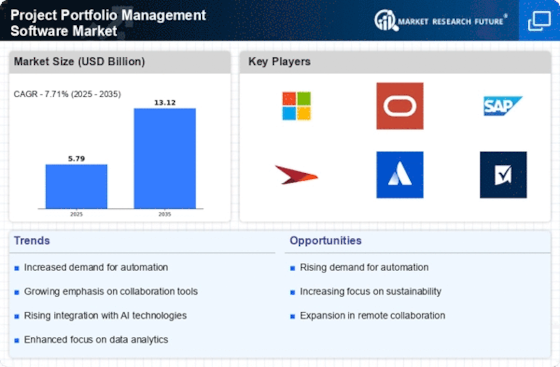
As per Market Research Future analysis, the Project Portfolio Management Software Market Size was estimated at 5.795 USD Billion in 2024. The Project Portfolio Management Software industry is projected to grow from 6.242 USD Billion in 2025 to 13.12 USD Billion by 2035, exhibiting a compound annual growth rate (CAGR) of 7.71% during the forecast period 2025 - 2035

Key Market Trends & Highlights

The Project Portfolio Management Software Market is experiencing robust growth driven by technological advancements and evolving project complexities.

  • The integration of Artificial Intelligence is transforming project management processes, enhancing decision-making capabilities. Cloud-based solutions dominate the market, providing flexibility and scalability to organizations across various sectors. Data analytics is increasingly prioritized, enabling organizations to derive actionable insights from project data. The rising demand for resource optimization and the growing complexity of projects are key drivers propelling market expansion, particularly in North America and the Asia-Pacific region, with IT project management leading the way alongside the rapidly growing construction project management segment.

Market Size & Forecast

2024 Market Size 5.795 (USD Billion)
2035 Market Size 13.12 (USD Billion)
CAGR (2025 - 2035) 7.71%
Largest Regional Market Share in 2024 North America

Major Players

Microsoft (US), Oracle (US), SAP (DE), Planview (US), Atlassian (AU), Smartsheet (US), Wrike (US), Monday.com (IL), Clarizen (US)

Market Trends

The Project Portfolio Management Software Market is currently experiencing a transformative phase, characterized by the increasing integration of advanced technologies such as artificial intelligence and machine learning. These innovations appear to enhance decision-making processes, enabling organizations to optimize resource allocation and improve project outcomes. Furthermore, the growing emphasis on data-driven strategies suggests that businesses are increasingly relying on analytics to inform their project management practices. This trend indicates a shift towards more strategic and informed project selection, which may lead to improved efficiency and effectiveness in project execution. In addition, the rise of remote work and distributed teams has prompted a demand for cloud-based solutions within the Project Portfolio Management Software Market.

Organizations are seeking tools that facilitate collaboration and communication across geographically dispersed teams. This shift towards cloud solutions not only enhances accessibility but also supports real-time updates and project tracking. As companies continue to adapt to evolving work environments, the Project Portfolio Management Software Market is likely to witness sustained growth driven by these technological advancements and changing workplace dynamics. 

The global project portfolio management software market encompasses digital platforms designed to streamline project and portfolio management across enterprises. Modern portfolio management software integrates financial tracking, scheduling, and analytics to improve organizational decision-making. Organizations increasingly adopt project and portfolio management software to align strategic initiatives with operational execution. Advanced project portfolio management tools enable organizations to optimize workflows, resources, and strategic prioritization. The rise of portfolio analytics software supports data-driven software portfolio management, improving visibility across enterprise initiatives. 

Adoption of enterprise project portfolio management solutions reflects growing demand for scalable portfolio management solutions. Modern PPM platforms function as integrated PPM project management tools, combining analytics and execution capabilities. Integrated project and portfolio frameworks enable organizations to manage complex initiatives using scalable portfolio project management software. Industry benchmarking often incorporates structured project management tools comparison frameworks to evaluate platform capabilities. Analyst-driven program management software comparison models support vendor performance assessment. Insights from aggregated project portfolio management software reviews inform broader market evaluation trends.

Integration of Artificial Intelligence

The incorporation of artificial intelligence into project portfolio management tools is becoming increasingly prevalent. This trend suggests that organizations are leveraging AI to automate routine tasks, analyze project data, and provide predictive insights, thereby enhancing overall project efficiency.

Cloud-Based Solutions

The demand for cloud-based project portfolio management software is on the rise, as organizations seek flexible and scalable solutions. This shift indicates a preference for tools that enable remote collaboration and real-time project updates, reflecting the changing nature of work.

Focus on Data Analytics

There is a growing emphasis on data analytics within the Project Portfolio Management Software Market. Organizations appear to be prioritizing data-driven decision-making, utilizing analytics to assess project performance and inform strategic planning.

Project Portfolio Management Software Market Market Drivers

Growing Complexity of Projects

The complexity of projects across various sectors is escalating, which is significantly influencing the Project Portfolio Management Software Market. As organizations undertake more intricate projects that require coordination across multiple teams and stakeholders, the demand for sophisticated project management tools is surging. Data indicates that 75% of organizations report challenges in managing project complexity, leading to delays and budget overruns. This complexity necessitates the adoption of advanced project portfolio management solutions that can provide real-time insights and facilitate collaboration. As a result, the Project Portfolio Management Software Market is poised for expansion, driven by the need for tools that can simplify project management amidst increasing complexity.

Emphasis on Strategic Alignment

Organizations are increasingly focusing on aligning their projects with strategic business objectives, which is a key driver for the Project Portfolio Management Software Market. This alignment ensures that resources are directed towards initiatives that support overall business goals, thereby enhancing organizational performance. Recent studies suggest that companies with aligned project portfolios achieve 30% higher success rates in project delivery. As businesses recognize the importance of strategic alignment, the demand for project portfolio management software that facilitates this process is likely to grow. This trend underscores the necessity for tools that not only manage projects but also ensure they contribute to the broader strategic vision of the organization.

Regulatory Compliance and Risk Management

The increasing focus on regulatory compliance and risk management is shaping the Project Portfolio Management Software Market. Organizations are under pressure to adhere to various regulations, which necessitates robust project management practices. Data indicates that 50% of organizations cite compliance as a top priority in project management. This emphasis on compliance drives the demand for project portfolio management software that includes risk assessment and compliance tracking features. As businesses strive to mitigate risks and ensure adherence to regulations, the Project Portfolio Management Software Market is expected to grow, fueled by the need for tools that support effective risk management and compliance.

Increased Demand for Resource Optimization

The Project Portfolio Management Software Market is experiencing heightened demand for solutions that optimize resource allocation. Organizations are increasingly recognizing the necessity of maximizing their resources to enhance productivity and efficiency. According to recent data, companies utilizing project portfolio management software report a 20% increase in resource utilization rates. This trend is driven by the need to manage multiple projects simultaneously while ensuring that resources are not overextended. As businesses strive to remain competitive, the ability to effectively allocate resources becomes paramount. Consequently, the Project Portfolio Management Software Market is likely to see continued growth as organizations seek tools that facilitate better resource management and project prioritization.

Rise of Remote Work and Collaboration Tools

The shift towards remote work has transformed the way teams collaborate, significantly impacting the Project Portfolio Management Software Market. As organizations adapt to remote work environments, the need for effective collaboration tools has become paramount. Data shows that 60% of project managers report increased reliance on digital collaboration platforms to manage projects effectively. This trend is driving the demand for project portfolio management software that integrates collaboration features, enabling teams to work together seamlessly regardless of location. Consequently, the Project Portfolio Management Software Market is likely to witness growth as organizations seek solutions that enhance remote collaboration and project visibility.

Market Segment Insights

By Deployment Model: Cloud-based (Largest) vs. On-premises (Fastest-Growing)

The Project Portfolio Management Software Market showcases a diverse deployment model landscape, with Cloud-based solutions leading the charge. This model captures a significant portion of the market share due to its scalability, flexibility, and lower upfront costs, making it attractive for organizations of all sizes. On-premises solutions, while holding a smaller share, remain popular among businesses with specific regulatory or data security requirements. The hybrid model, which blends both cloud and on-premises solutions, caters to organizations seeking a balanced approach, reflecting a growing trend in deployment preferences.

Deployment Models: Cloud-based (Dominant) vs. On-premises (Emerging)

In the Project Portfolio Management Software Market, Cloud-based deployment models stand out as the dominant choice among organizations for their ability to provide real-time data accessibility, cost-saving benefits, and automated updates. These systems are particularly favored by companies that prioritize collaboration and agility in project management. On the other hand, On-premises solutions are emerging due to their customizability and control over <a href="https://www.marketresearchfuture.com/reports/sensitive-data-discovery-market-32674">sensitive data.</a> They appeal to sectors where compliance and security are critical, thereby fostering a steady demand despite the rapid rise of cloud technologies. The hybrid model emerges as a noteworthy alternative, enabling organizations to tailor their deployment strategy based on specific project needs.

By Application: IT Project Management (Largest) vs. Construction Project Management (Fastest-Growing)

The Project Portfolio Management Software Market is distinctively segmented into several applications, the most prominent being IT Project Management, closely followed by Construction Project Management, Product Development, Research and Development, and Event Management. IT Project Management holds a significant share due to the increasing reliance on technology and software solutions in managing complex IT systems. Construction Project Management, while currently smaller in share, has shown remarkable growth as the construction sector increasingly adopts digital tools to enhance efficiency and transparency.

IT Project Management (Dominant) vs. Construction Project Management (Emerging)

IT Project Management has established itself as the dominant force within the Project Portfolio Management Software Market, thanks to its extensive adoption among various organizations aiming to streamline processes, manage resources efficiently, and meet project deadlines. This segment boasts robust functionalities that cater to diverse IT project needs, including resource allocation, <a href="https://www.marketresearchfuture.com/reports/task-management-software-market-11885">task management</a>, and team collaboration. On the other hand, Construction Project Management is emerging rapidly, characterized by growing investments in infrastructure and construction projects. This segment increasingly utilizes specialized software tools to manage project timelines, budgets, and labor more effectively, positioning itself as a critical driver of innovation in the construction industry.

By Industry: Information Technology (Largest) vs. Healthcare (Fastest-Growing)

In the Project Portfolio Management Software Market, the Information Technology (IT) segment holds the largest market share, driven by the increasing complexity of IT projects and the demand for efficient management tools. IT organizations leverage sophisticated project management software to streamline processes, improve collaboration, and ensure timely project delivery. Following IT, the Healthcare sector is emerging as a significant player, growing rapidly due to escalating healthcare needs and the push for digital transformation in healthcare management systems.

Healthcare (Fastest-Growing) vs. Finance (Dominant)

The Healthcare segment is characterized by its rapid adoption of project portfolio management solutions, primarily to enhance operational efficiency and patient care delivery. With healthcare institutions facing unprecedented pressures for digitization, software tools enabling better resource management and project tracking are gaining traction. In contrast, the Finance sector remains dominant in the project management software space, driven by regulatory requirements and the need for risk management. Financial institutions invest heavily in project management to ensure compliance while maximizing operational efficiency, thus solidifying their market presence.

By Organization Size: Small Enterprises (Largest) vs. Large Enterprises (Fastest-Growing)

In the Project Portfolio Management Software Market, the distribution of market share among organization sizes reflects significant variances. Small Enterprises dominate the market due to their sheer volume and the widespread need for accessible project management tools that scale with diverse project types. Meanwhile, Large Enterprises are catching up, driven by shifting preferences for more complex resources and tailored solutions that accommodate increasing project demands. Growth trends within this segment reveal an exciting landscape where Large Enterprises are the fastest-growing segment. Their adoption of managed services and integrated software solutions has surged, stemming from the necessity for more sophisticated project management tools that enhance productivity and collaboration. As organizations pivot towards digital transformation, the demand for advanced software solutions will continue to grow, further propelling enterprise-level adoption.

Small Enterprises (Dominant) vs. Medium Enterprises (Emerging)

In the Project Portfolio Management Software Market, Small Enterprises play a dominant role, characterized by their agility and requirement for cost-effective solutions. They often seek software that offers flexibility and ease of use, allowing for quick implementation without extensive resources. In contrast, Medium Enterprises represent the emerging segment, where growth potential lies in their increased willingness to invest in advanced features such as analytics and integration capabilities. While Small Enterprises focus on basic functionalities, Medium Enterprises are beginning to embrace more comprehensive tools that can handle growing project complexities, driving an evolving market landscape. This dichotomy shapes the trajectory of software development, with vendors tailoring solutions to meet the varying needs of both segments.

Get more detailed insights about Project Portfolio Management Software Market Research Report - Global Forecast till 2035

Regional Insights

The Project Portfolio Management Software Market is projected to experience steady growth across its regional segments, reflecting a comprehensive landscape of opportunity. In 2023, North America leads the market with a valuation of 2.2 USD Billion, expected to reach 4.2 USD Billion by 2032, indicating its critical role and majority holding in influencing market dynamics. Europe follows as a significant player, valued at 1.5 USD Billion in 2023 and anticipated to grow to 3.0 USD Billion.

The APAC region also shows promise, starting at 1.0 USD Billion and reaching 2.2 USD Billion, fueled by increasing demand for advanced portfolio management solutions. Meanwhile, South America and MEA remain smaller markets, valued at 0.3 USD Billion and 0.4 USD Billion, respectively, in 2023, demonstrating notable growth potential but currently representing less dominant positions in the overall market. Overall, the varying valuations highlight diverse growth drivers and challenges, with North America and Europe holding substantial market shares due to their mature economies and high adoption rates of project management tools.

The trends indicate a shift towards more integrated software solutions, and as such, the Project Portfolio Management Software Market shows a favorable outlook across these regions.

Key Players and Competitive Insights

The Project Portfolio Management Software Market has become an increasingly vital segment in the domain of project management, offering tools that allow organizations to manage their projects, resources, and portfolios efficiently. Competitive insights in this market reveal a landscape filled with innovation and rapidly evolving technology as companies strive to deliver integrated solutions that enhance productivity, facilitate decision-making, and provide valuable insights into project performance. As businesses face mounting pressure to optimize their operations and deliver results, the demand for versatile project portfolio management solutions continues to climb. Leading vendors continue to position their offerings among the top project management software platforms through innovation and scalability. Market competition is driving the evolution of platforms recognized as best project portfolio management software, particularly in enterprise environments. Firms are differentiating themselves through advanced functionalities, user-friendly interfaces, and robust customer support, making it crucial for stakeholders to understand key players and their strategic positioning. Planview has established a strong presence in the Project Portfolio Management Software Market, characterized by its comprehensive suite of tools designed to support a wide range of project management needs. The company boasts strengths in its ability to enable organizations to align projects with strategic goals, thus enhancing overall business performance. Planview's commitment to innovation is reflected in its continuous updates and enhancements, addressing the ever-changing landscape of project management. Additionally, Planview offers robust resource management capabilities, making it easier for businesses to allocate their resources efficiently while maintaining visibility across various projects. Its strong focus on customer success and support further solidifies its reputation in the market, enabling clients to realize the full potential of their portfolio management solutions. Smartsheet has carved out a notable niche within the Project Portfolio Management Software Market by providing a highly flexible and collaborative platform that caters to a diverse range of project management scenarios. The company's strengths lie in its user-friendly interface, which simplifies project tracking and reporting, allowing teams to work seamlessly together. Smartsheet's focus on real-time collaboration and communication features empowers organizations to streamline workflows and increases efficiency in project delivery. Moreover, the company's innovative integration capabilities and extensive support resources make it a preferred choice among businesses seeking to enhance their project management processes. By continuously evolving its product offerings to meet the dynamic needs of users, Smartsheet remains a competitive force in the project portfolio management landscape, appealing to a wide range of industries and disciplines.

Key Companies in the Project Portfolio Management Software Market include

Industry Developments

  • Q2 2024: Workday acquires startup HiredScore to boost AI-driven talent management Workday, a major provider of enterprise cloud applications for finance and HR, announced the acquisition of HiredScore, an AI-powered talent orchestration platform, to enhance its project portfolio management and workforce planning capabilities.
  • Q2 2024: Planview Announces Strategic Partnership with Microsoft to Enhance Project Portfolio Management Solutions Planview, a leading project portfolio management software provider, entered a strategic partnership with Microsoft to integrate Planview’s PPM solutions with Microsoft Teams and Azure, aiming to streamline project collaboration and reporting for enterprise customers.
  • Q1 2024: Smartsheet Appoints Steve Singh as Chairman of the Board Smartsheet, a prominent project portfolio management software company, announced the appointment of Steve Singh as Chairman of the Board, signaling a renewed focus on enterprise growth and strategic leadership.
  • Q2 2024: ServiceNow launches new AI-powered Project Portfolio Management features ServiceNow unveiled new AI-driven enhancements to its Project Portfolio Management suite, including predictive analytics and automated resource allocation, designed to improve project outcomes for large organizations.
  • Q1 2024: Planisware Announces Opening of New North American Headquarters in Boston Planisware, a global provider of project portfolio management software, opened a new North American headquarters in Boston to support its expanding customer base and accelerate product innovation.
  • Q2 2024: Kantata Secures $30 Million Series C Funding to Expand Project Portfolio Management Platform Kantata, a cloud-based project portfolio management software provider, raised $30 million in Series C funding to accelerate product development and expand its global market presence.
  • Q1 2024: Broadcom Launches New Clarity PPM Integration with Rally Software Broadcom announced the launch of a new integration between its Clarity Project Portfolio Management platform and Rally Software, enabling seamless project tracking and portfolio analysis for enterprise customers.
  • Q2 2024: Asana partners with Salesforce to deliver enhanced project portfolio management capabilities Asana entered a partnership with Salesforce to integrate its project portfolio management tools with Salesforce’s CRM platform, aiming to provide unified project tracking and reporting for joint customers.
  • Q1 2024: Wrike Announces Launch of New AI-Powered Project Portfolio Management Features Wrike, a leading collaborative work management platform, launched new AI-powered features for its project portfolio management suite, including automated project risk assessment and resource optimization.
  • Q2 2024: Planview acquires UMT360 to strengthen enterprise project portfolio management offerings Planview completed the acquisition of UMT360, a provider of strategic portfolio management solutions, to enhance its enterprise PPM capabilities and expand its customer base.
  • Q1 2024: Sciforma Appoints New CEO to Drive Global Expansion Sciforma, a project portfolio management software vendor, announced the appointment of a new CEO to lead its global expansion and product innovation strategy.
  • Q2 2024: KeyedIn Solutions Announces Partnership with SAP to Integrate Project Portfolio Management Tools KeyedIn Solutions partnered with SAP to integrate its project portfolio management software with SAP’s enterprise resource planning platform, aiming to deliver enhanced project visibility and financial management for customers.

Future Outlook

Project Portfolio Management Software Market Future Outlook

The Project Portfolio Management Software Market is projected to grow at a 7.71% CAGR from 2025 to 2035, driven by digital transformation, increased project complexity, and demand for resource optimization.

New opportunities lie in:

  • <p>Integration of AI-driven analytics for enhanced decision-making Development of mobile applications for real-time project tracking Expansion into emerging markets with tailored solutions</p>

By 2035, the market is expected to be robust, reflecting substantial growth and innovation.

Market Segmentation

Project Portfolio Management Software Market Industry Outlook

  • Information Technology
  • Manufacturing
  • Healthcare
  • Construction
  • Finance

Project Portfolio Management Software Market Application Outlook

  • IT Project Management
  • Construction Project Management
  • Product Development
  • Research and Development
  • Event Management

Project Portfolio Management Software Market Deployment Model Outlook

  • Cloud-based
  • On-premises
  • Hybrid

Project Portfolio Management Software Market Organization Size Outlook

  • Small Enterprises
  • Medium Enterprises
  • Large Enterprises

Report Scope

MARKET SIZE 2024 5.795(USD Billion)
MARKET SIZE 2025 6.242(USD Billion)
MARKET SIZE 2035 13.12(USD Billion)
COMPOUND ANNUAL GROWTH RATE (CAGR) 7.71% (2025 - 2035)
REPORT COVERAGE Revenue Forecast, Competitive Landscape, Growth Factors, and Trends
BASE YEAR 2024
Market Forecast Period 2025 - 2035
Historical Data 2019 - 2024
Market Forecast Units USD Billion
Key Companies Profiled Microsoft (US), Oracle (US), SAP (DE), Planview (US), Atlassian (AU), Smartsheet (US), Wrike (US), Monday.com (IL), Clarizen (US)
Segments Covered Deployment Model, Application, Industry, Organization Size, Regional
Key Market Opportunities Integration of artificial intelligence enhances decision-making in the Project Portfolio Management Software Market.
Key Market Dynamics Rising demand for integrated solutions drives competition and innovation in the Project Portfolio Management Software market.
Countries Covered North America, Europe, APAC, South America, MEA

FAQs

What is the projected market valuation of the Project Portfolio Management Software Market by 2035?

<p>The market is projected to reach a valuation of 13.12 USD Billion by 2035.</p>

What was the market valuation of the Project Portfolio Management Software Market in 2024?

<p>In 2024, the market valuation was 5.795 USD Billion.</p>

What is the expected CAGR for the Project Portfolio Management Software Market during the forecast period 2025 - 2035?

<p>The expected CAGR for the market during this period is 7.71%.</p>

Which deployment model segment is anticipated to grow the most by 2035?

<p>The Cloud-based deployment model is expected to grow from 2.5 USD Billion in 2024 to 5.5 USD Billion by 2035.</p>

How does the IT Project Management application segment perform in terms of market size?

<p>The IT Project Management application segment is projected to grow from 1.5 USD Billion in 2024 to 3.5 USD Billion by 2035.</p>

What are the key players in the Project Portfolio Management Software Market?

<p>Key players include Microsoft, Oracle, SAP, Planview, Atlassian, Smartsheet, Wrike, Monday.com, and Clarizen.</p>

What is the expected growth for the Healthcare industry segment in the Project Portfolio Management Software Market?

<p>The Healthcare industry segment is anticipated to grow from 1.0 USD Billion in 2024 to 2.5 USD Billion by 2035.</p>

Which organization size segment shows the highest growth potential in the market?

<p>The Medium Enterprises segment is expected to grow from 2.5 USD Billion in 2024 to 5.5 USD Billion by 2035.</p>

What is the projected growth for the Hybrid deployment model by 2035?

<p>The Hybrid deployment model is projected to grow from 1.795 USD Billion in 2024 to 4.1 USD Billion by 2035.</p>

How does the Construction Project Management application segment compare to others in terms of growth?

<p>The Construction Project Management application segment is expected to grow from 1.2 USD Billion in 2024 to 2.8 USD Billion by 2035.</p>

  1. SECTION I: EXECUTIVE SUMMARY AND KEY HIGHLIGHTS
    1. | 1.1 EXECUTIVE SUMMARY
    2. | | 1.1.1 Market Overview
    3. | | 1.1.2 Key Findings
    4. | | 1.1.3 Market Segmentation
    5. | | 1.1.4 Competitive Landscape
    6. | | 1.1.5 Challenges and Opportunities
    7. | | 1.1.6 Future Outlook
  2. SECTION II: SCOPING, METHODOLOGY AND MARKET STRUCTURE
    1. | 2.1 MARKET INTRODUCTION
    2. | | 2.1.1 Definition
    3. | | 2.1.2 Scope of the study
    4. | | | 2.1.2.1 Research Objective
    5. | | | 2.1.2.2 Assumption
    6. | | | 2.1.2.3 Limitations
    7. | 2.2 RESEARCH METHODOLOGY
    8. | | 2.2.1 Overview
    9. | | 2.2.2 Data Mining
    10. | | 2.2.3 Secondary Research
    11. | | 2.2.4 Primary Research
    12. | | | 2.2.4.1 Primary Interviews and Information Gathering Process
    13. | | | 2.2.4.2 Breakdown of Primary Respondents
    14. | | 2.2.5 Forecasting Model
    15. | | 2.2.6 Market Size Estimation
    16. | | | 2.2.6.1 Bottom-Up Approach
    17. | | | 2.2.6.2 Top-Down Approach
    18. | | 2.2.7 Data Triangulation
    19. | | 2.2.8 Validation
  3. SECTION III: QUALITATIVE ANALYSIS
    1. | 3.1 MARKET DYNAMICS
    2. | | 3.1.1 Overview
    3. | | 3.1.2 Drivers
    4. | | 3.1.3 Restraints
    5. | | 3.1.4 Opportunities
    6. | 3.2 MARKET FACTOR ANALYSIS
    7. | | 3.2.1 Value chain Analysis
    8. | | 3.2.2 Porter's Five Forces Analysis
    9. | | | 3.2.2.1 Bargaining Power of Suppliers
    10. | | | 3.2.2.2 Bargaining Power of Buyers
    11. | | | 3.2.2.3 Threat of New Entrants
    12. | | | 3.2.2.4 Threat of Substitutes
    13. | | | 3.2.2.5 Intensity of Rivalry
    14. | | 3.2.3 COVID-19 Impact Analysis
    15. | | | 3.2.3.1 Market Impact Analysis
    16. | | | 3.2.3.2 Regional Impact
    17. | | | 3.2.3.3 Opportunity and Threat Analysis
  4. SECTION IV: QUANTITATIVE ANALYSIS
    1. | 4.1 Information and Communications Technology, BY Deployment Model (USD Billion)
    2. | | 4.1.1 Cloud-based
    3. | | 4.1.2 On-premises
    4. | | 4.1.3 Hybrid
    5. | 4.2 Information and Communications Technology, BY Application (USD Billion)
    6. | | 4.2.1 IT Project Management
    7. | | 4.2.2 Construction Project Management
    8. | | 4.2.3 Product Development
    9. | | 4.2.4 Research and Development
    10. | | 4.2.5 Event Management
    11. | 4.3 Information and Communications Technology, BY Industry (USD Billion)
    12. | | 4.3.1 Information Technology
    13. | | 4.3.2 Manufacturing
    14. | | 4.3.3 Healthcare
    15. | | 4.3.4 Construction
    16. | | 4.3.5 Finance
    17. | 4.4 Information and Communications Technology, BY Organization Size (USD Billion)
    18. | | 4.4.1 Small Enterprises
    19. | | 4.4.2 Medium Enterprises
    20. | | 4.4.3 Large Enterprises
    21. | 4.5 Information and Communications Technology, BY Region (USD Billion)
    22. | | 4.5.1 North America
    23. | | | 4.5.1.1 US
    24. | | | 4.5.1.2 Canada
    25. | | 4.5.2 Europe
    26. | | | 4.5.2.1 Germany
    27. | | | 4.5.2.2 UK
    28. | | | 4.5.2.3 France
    29. | | | 4.5.2.4 Russia
    30. | | | 4.5.2.5 Italy
    31. | | | 4.5.2.6 Spain
    32. | | | 4.5.2.7 Rest of Europe
    33. | | 4.5.3 APAC
    34. | | | 4.5.3.1 China
    35. | | | 4.5.3.2 India
    36. | | | 4.5.3.3 Japan
    37. | | | 4.5.3.4 South Korea
    38. | | | 4.5.3.5 Malaysia
    39. | | | 4.5.3.6 Thailand
    40. | | | 4.5.3.7 Indonesia
    41. | | | 4.5.3.8 Rest of APAC
    42. | | 4.5.4 South America
    43. | | | 4.5.4.1 Brazil
    44. | | | 4.5.4.2 Mexico
    45. | | | 4.5.4.3 Argentina
    46. | | | 4.5.4.4 Rest of South America
    47. | | 4.5.5 MEA
    48. | | | 4.5.5.1 GCC Countries
    49. | | | 4.5.5.2 South Africa
    50. | | | 4.5.5.3 Rest of MEA
  5. SECTION V: COMPETITIVE ANALYSIS
    1. | 5.1 Competitive Landscape
    2. | | 5.1.1 Overview
    3. | | 5.1.2 Competitive Analysis
    4. | | 5.1.3 Market share Analysis
    5. | | 5.1.4 Major Growth Strategy in the Information and Communications Technology
    6. | | 5.1.5 Competitive Benchmarking
    7. | | 5.1.6 Leading Players in Terms of Number of Developments in the Information and Communications Technology
    8. | | 5.1.7 Key developments and growth strategies
    9. | | | 5.1.7.1 New Product Launch/Service Deployment
    10. | | | 5.1.7.2 Merger & Acquisitions
    11. | | | 5.1.7.3 Joint Ventures
    12. | | 5.1.8 Major Players Financial Matrix
    13. | | | 5.1.8.1 Sales and Operating Income
    14. | | | 5.1.8.2 Major Players R&D Expenditure. 2023
    15. | 5.2 Company Profiles
    16. | | 5.2.1 Microsoft (US)
    17. | | | 5.2.1.1 Financial Overview
    18. | | | 5.2.1.2 Products Offered
    19. | | | 5.2.1.3 Key Developments
    20. | | | 5.2.1.4 SWOT Analysis
    21. | | | 5.2.1.5 Key Strategies
    22. | | 5.2.2 Oracle (US)
    23. | | | 5.2.2.1 Financial Overview
    24. | | | 5.2.2.2 Products Offered
    25. | | | 5.2.2.3 Key Developments
    26. | | | 5.2.2.4 SWOT Analysis
    27. | | | 5.2.2.5 Key Strategies
    28. | | 5.2.3 SAP (DE)
    29. | | | 5.2.3.1 Financial Overview
    30. | | | 5.2.3.2 Products Offered
    31. | | | 5.2.3.3 Key Developments
    32. | | | 5.2.3.4 SWOT Analysis
    33. | | | 5.2.3.5 Key Strategies
    34. | | 5.2.4 Planview (US)
    35. | | | 5.2.4.1 Financial Overview
    36. | | | 5.2.4.2 Products Offered
    37. | | | 5.2.4.3 Key Developments
    38. | | | 5.2.4.4 SWOT Analysis
    39. | | | 5.2.4.5 Key Strategies
    40. | | 5.2.5 Atlassian (AU)
    41. | | | 5.2.5.1 Financial Overview
    42. | | | 5.2.5.2 Products Offered
    43. | | | 5.2.5.3 Key Developments
    44. | | | 5.2.5.4 SWOT Analysis
    45. | | | 5.2.5.5 Key Strategies
    46. | | 5.2.6 Smartsheet (US)
    47. | | | 5.2.6.1 Financial Overview
    48. | | | 5.2.6.2 Products Offered
    49. | | | 5.2.6.3 Key Developments
    50. | | | 5.2.6.4 SWOT Analysis
    51. | | | 5.2.6.5 Key Strategies
    52. | | 5.2.7 Wrike (US)
    53. | | | 5.2.7.1 Financial Overview
    54. | | | 5.2.7.2 Products Offered
    55. | | | 5.2.7.3 Key Developments
    56. | | | 5.2.7.4 SWOT Analysis
    57. | | | 5.2.7.5 Key Strategies
    58. | | 5.2.8 Monday.com (IL)
    59. | | | 5.2.8.1 Financial Overview
    60. | | | 5.2.8.2 Products Offered
    61. | | | 5.2.8.3 Key Developments
    62. | | | 5.2.8.4 SWOT Analysis
    63. | | | 5.2.8.5 Key Strategies
    64. | | 5.2.9 Clarizen (US)
    65. | | | 5.2.9.1 Financial Overview
    66. | | | 5.2.9.2 Products Offered
    67. | | | 5.2.9.3 Key Developments
    68. | | | 5.2.9.4 SWOT Analysis
    69. | | | 5.2.9.5 Key Strategies
    70. | 5.3 Appendix
    71. | | 5.3.1 References
    72. | | 5.3.2 Related Reports
  6. LIST OF FIGURES
    1. | 6.1 MARKET SYNOPSIS
    2. | 6.2 NORTH AMERICA MARKET ANALYSIS
    3. | 6.3 US MARKET ANALYSIS BY DEPLOYMENT MODEL
    4. | 6.4 US MARKET ANALYSIS BY APPLICATION
    5. | 6.5 US MARKET ANALYSIS BY INDUSTRY
    6. | 6.6 US MARKET ANALYSIS BY ORGANIZATION SIZE
    7. | 6.7 CANADA MARKET ANALYSIS BY DEPLOYMENT MODEL
    8. | 6.8 CANADA MARKET ANALYSIS BY APPLICATION
    9. | 6.9 CANADA MARKET ANALYSIS BY INDUSTRY
    10. | 6.10 CANADA MARKET ANALYSIS BY ORGANIZATION SIZE
    11. | 6.11 EUROPE MARKET ANALYSIS
    12. | 6.12 GERMANY MARKET ANALYSIS BY DEPLOYMENT MODEL
    13. | 6.13 GERMANY MARKET ANALYSIS BY APPLICATION
    14. | 6.14 GERMANY MARKET ANALYSIS BY INDUSTRY
    15. | 6.15 GERMANY MARKET ANALYSIS BY ORGANIZATION SIZE
    16. | 6.16 UK MARKET ANALYSIS BY DEPLOYMENT MODEL
    17. | 6.17 UK MARKET ANALYSIS BY APPLICATION
    18. | 6.18 UK MARKET ANALYSIS BY INDUSTRY
    19. | 6.19 UK MARKET ANALYSIS BY ORGANIZATION SIZE
    20. | 6.20 FRANCE MARKET ANALYSIS BY DEPLOYMENT MODEL
    21. | 6.21 FRANCE MARKET ANALYSIS BY APPLICATION
    22. | 6.22 FRANCE MARKET ANALYSIS BY INDUSTRY
    23. | 6.23 FRANCE MARKET ANALYSIS BY ORGANIZATION SIZE
    24. | 6.24 RUSSIA MARKET ANALYSIS BY DEPLOYMENT MODEL
    25. | 6.25 RUSSIA MARKET ANALYSIS BY APPLICATION
    26. | 6.26 RUSSIA MARKET ANALYSIS BY INDUSTRY
    27. | 6.27 RUSSIA MARKET ANALYSIS BY ORGANIZATION SIZE
    28. | 6.28 ITALY MARKET ANALYSIS BY DEPLOYMENT MODEL
    29. | 6.29 ITALY MARKET ANALYSIS BY APPLICATION
    30. | 6.30 ITALY MARKET ANALYSIS BY INDUSTRY
    31. | 6.31 ITALY MARKET ANALYSIS BY ORGANIZATION SIZE
    32. | 6.32 SPAIN MARKET ANALYSIS BY DEPLOYMENT MODEL
    33. | 6.33 SPAIN MARKET ANALYSIS BY APPLICATION
    34. | 6.34 SPAIN MARKET ANALYSIS BY INDUSTRY
    35. | 6.35 SPAIN MARKET ANALYSIS BY ORGANIZATION SIZE
    36. | 6.36 REST OF EUROPE MARKET ANALYSIS BY DEPLOYMENT MODEL
    37. | 6.37 REST OF EUROPE MARKET ANALYSIS BY APPLICATION
    38. | 6.38 REST OF EUROPE MARKET ANALYSIS BY INDUSTRY
    39. | 6.39 REST OF EUROPE MARKET ANALYSIS BY ORGANIZATION SIZE
    40. | 6.40 APAC MARKET ANALYSIS
    41. | 6.41 CHINA MARKET ANALYSIS BY DEPLOYMENT MODEL
    42. | 6.42 CHINA MARKET ANALYSIS BY APPLICATION
    43. | 6.43 CHINA MARKET ANALYSIS BY INDUSTRY
    44. | 6.44 CHINA MARKET ANALYSIS BY ORGANIZATION SIZE
    45. | 6.45 INDIA MARKET ANALYSIS BY DEPLOYMENT MODEL
    46. | 6.46 INDIA MARKET ANALYSIS BY APPLICATION
    47. | 6.47 INDIA MARKET ANALYSIS BY INDUSTRY
    48. | 6.48 INDIA MARKET ANALYSIS BY ORGANIZATION SIZE
    49. | 6.49 JAPAN MARKET ANALYSIS BY DEPLOYMENT MODEL
    50. | 6.50 JAPAN MARKET ANALYSIS BY APPLICATION
    51. | 6.51 JAPAN MARKET ANALYSIS BY INDUSTRY
    52. | 6.52 JAPAN MARKET ANALYSIS BY ORGANIZATION SIZE
    53. | 6.53 SOUTH KOREA MARKET ANALYSIS BY DEPLOYMENT MODEL
    54. | 6.54 SOUTH KOREA MARKET ANALYSIS BY APPLICATION
    55. | 6.55 SOUTH KOREA MARKET ANALYSIS BY INDUSTRY
    56. | 6.56 SOUTH KOREA MARKET ANALYSIS BY ORGANIZATION SIZE
    57. | 6.57 MALAYSIA MARKET ANALYSIS BY DEPLOYMENT MODEL
    58. | 6.58 MALAYSIA MARKET ANALYSIS BY APPLICATION
    59. | 6.59 MALAYSIA MARKET ANALYSIS BY INDUSTRY
    60. | 6.60 MALAYSIA MARKET ANALYSIS BY ORGANIZATION SIZE
    61. | 6.61 THAILAND MARKET ANALYSIS BY DEPLOYMENT MODEL
    62. | 6.62 THAILAND MARKET ANALYSIS BY APPLICATION
    63. | 6.63 THAILAND MARKET ANALYSIS BY INDUSTRY
    64. | 6.64 THAILAND MARKET ANALYSIS BY ORGANIZATION SIZE
    65. | 6.65 INDONESIA MARKET ANALYSIS BY DEPLOYMENT MODEL
    66. | 6.66 INDONESIA MARKET ANALYSIS BY APPLICATION
    67. | 6.67 INDONESIA MARKET ANALYSIS BY INDUSTRY
    68. | 6.68 INDONESIA MARKET ANALYSIS BY ORGANIZATION SIZE
    69. | 6.69 REST OF APAC MARKET ANALYSIS BY DEPLOYMENT MODEL
    70. | 6.70 REST OF APAC MARKET ANALYSIS BY APPLICATION
    71. | 6.71 REST OF APAC MARKET ANALYSIS BY INDUSTRY
    72. | 6.72 REST OF APAC MARKET ANALYSIS BY ORGANIZATION SIZE
    73. | 6.73 SOUTH AMERICA MARKET ANALYSIS
    74. | 6.74 BRAZIL MARKET ANALYSIS BY DEPLOYMENT MODEL
    75. | 6.75 BRAZIL MARKET ANALYSIS BY APPLICATION
    76. | 6.76 BRAZIL MARKET ANALYSIS BY INDUSTRY
    77. | 6.77 BRAZIL MARKET ANALYSIS BY ORGANIZATION SIZE
    78. | 6.78 MEXICO MARKET ANALYSIS BY DEPLOYMENT MODEL
    79. | 6.79 MEXICO MARKET ANALYSIS BY APPLICATION
    80. | 6.80 MEXICO MARKET ANALYSIS BY INDUSTRY
    81. | 6.81 MEXICO MARKET ANALYSIS BY ORGANIZATION SIZE
    82. | 6.82 ARGENTINA MARKET ANALYSIS BY DEPLOYMENT MODEL
    83. | 6.83 ARGENTINA MARKET ANALYSIS BY APPLICATION
    84. | 6.84 ARGENTINA MARKET ANALYSIS BY INDUSTRY
    85. | 6.85 ARGENTINA MARKET ANALYSIS BY ORGANIZATION SIZE
    86. | 6.86 REST OF SOUTH AMERICA MARKET ANALYSIS BY DEPLOYMENT MODEL
    87. | 6.87 REST OF SOUTH AMERICA MARKET ANALYSIS BY APPLICATION
    88. | 6.88 REST OF SOUTH AMERICA MARKET ANALYSIS BY INDUSTRY
    89. | 6.89 REST OF SOUTH AMERICA MARKET ANALYSIS BY ORGANIZATION SIZE
    90. | 6.90 MEA MARKET ANALYSIS
    91. | 6.91 GCC COUNTRIES MARKET ANALYSIS BY DEPLOYMENT MODEL
    92. | 6.92 GCC COUNTRIES MARKET ANALYSIS BY APPLICATION
    93. | 6.93 GCC COUNTRIES MARKET ANALYSIS BY INDUSTRY
    94. | 6.94 GCC COUNTRIES MARKET ANALYSIS BY ORGANIZATION SIZE
    95. | 6.95 SOUTH AFRICA MARKET ANALYSIS BY DEPLOYMENT MODEL
    96. | 6.96 SOUTH AFRICA MARKET ANALYSIS BY APPLICATION
    97. | 6.97 SOUTH AFRICA MARKET ANALYSIS BY INDUSTRY
    98. | 6.98 SOUTH AFRICA MARKET ANALYSIS BY ORGANIZATION SIZE
    99. | 6.99 REST OF MEA MARKET ANALYSIS BY DEPLOYMENT MODEL
    100. | 6.100 REST OF MEA MARKET ANALYSIS BY APPLICATION
    101. | 6.101 REST OF MEA MARKET ANALYSIS BY INDUSTRY
    102. | 6.102 REST OF MEA MARKET ANALYSIS BY ORGANIZATION SIZE
    103. | 6.103 KEY BUYING CRITERIA OF INFORMATION AND COMMUNICATIONS TECHNOLOGY
    104. | 6.104 RESEARCH PROCESS OF MRFR
    105. | 6.105 DRO ANALYSIS OF INFORMATION AND COMMUNICATIONS TECHNOLOGY
    106. | 6.106 DRIVERS IMPACT ANALYSIS: INFORMATION AND COMMUNICATIONS TECHNOLOGY
    107. | 6.107 RESTRAINTS IMPACT ANALYSIS: INFORMATION AND COMMUNICATIONS TECHNOLOGY
    108. | 6.108 SUPPLY / VALUE CHAIN: INFORMATION AND COMMUNICATIONS TECHNOLOGY
    109. | 6.109 INFORMATION AND COMMUNICATIONS TECHNOLOGY, BY DEPLOYMENT MODEL, 2024 (% SHARE)
    110. | 6.110 INFORMATION AND COMMUNICATIONS TECHNOLOGY, BY DEPLOYMENT MODEL, 2024 TO 2035 (USD Billion)
    111. | 6.111 INFORMATION AND COMMUNICATIONS TECHNOLOGY, BY APPLICATION, 2024 (% SHARE)
    112. | 6.112 INFORMATION AND COMMUNICATIONS TECHNOLOGY, BY APPLICATION, 2024 TO 2035 (USD Billion)
    113. | 6.113 INFORMATION AND COMMUNICATIONS TECHNOLOGY, BY INDUSTRY, 2024 (% SHARE)
    114. | 6.114 INFORMATION AND COMMUNICATIONS TECHNOLOGY, BY INDUSTRY, 2024 TO 2035 (USD Billion)
    115. | 6.115 INFORMATION AND COMMUNICATIONS TECHNOLOGY, BY ORGANIZATION SIZE, 2024 (% SHARE)
    116. | 6.116 INFORMATION AND COMMUNICATIONS TECHNOLOGY, BY ORGANIZATION SIZE, 2024 TO 2035 (USD Billion)
    117. | 6.117 BENCHMARKING OF MAJOR COMPETITORS
  7. LIST OF TABLES
    1. | 7.1 LIST OF ASSUMPTIONS
    2. | | 7.1.1
    3. | 7.2 North America MARKET SIZE ESTIMATES; FORECAST
    4. | | 7.2.1 BY DEPLOYMENT MODEL, 2025-2035 (USD Billion)
    5. | | 7.2.2 BY APPLICATION, 2025-2035 (USD Billion)
    6. | | 7.2.3 BY INDUSTRY, 2025-2035 (USD Billion)
    7. | | 7.2.4 BY ORGANIZATION SIZE, 2025-2035 (USD Billion)
    8. | 7.3 US MARKET SIZE ESTIMATES; FORECAST
    9. | | 7.3.1 BY DEPLOYMENT MODEL, 2025-2035 (USD Billion)
    10. | | 7.3.2 BY APPLICATION, 2025-2035 (USD Billion)
    11. | | 7.3.3 BY INDUSTRY, 2025-2035 (USD Billion)
    12. | | 7.3.4 BY ORGANIZATION SIZE, 2025-2035 (USD Billion)
    13. | 7.4 Canada MARKET SIZE ESTIMATES; FORECAST
    14. | | 7.4.1 BY DEPLOYMENT MODEL, 2025-2035 (USD Billion)
    15. | | 7.4.2 BY APPLICATION, 2025-2035 (USD Billion)
    16. | | 7.4.3 BY INDUSTRY, 2025-2035 (USD Billion)
    17. | | 7.4.4 BY ORGANIZATION SIZE, 2025-2035 (USD Billion)
    18. | 7.5 Europe MARKET SIZE ESTIMATES; FORECAST
    19. | | 7.5.1 BY DEPLOYMENT MODEL, 2025-2035 (USD Billion)
    20. | | 7.5.2 BY APPLICATION, 2025-2035 (USD Billion)
    21. | | 7.5.3 BY INDUSTRY, 2025-2035 (USD Billion)
    22. | | 7.5.4 BY ORGANIZATION SIZE, 2025-2035 (USD Billion)
    23. | 7.6 Germany MARKET SIZE ESTIMATES; FORECAST
    24. | | 7.6.1 BY DEPLOYMENT MODEL, 2025-2035 (USD Billion)
    25. | | 7.6.2 BY APPLICATION, 2025-2035 (USD Billion)
    26. | | 7.6.3 BY INDUSTRY, 2025-2035 (USD Billion)
    27. | | 7.6.4 BY ORGANIZATION SIZE, 2025-2035 (USD Billion)
    28. | 7.7 UK MARKET SIZE ESTIMATES; FORECAST
    29. | | 7.7.1 BY DEPLOYMENT MODEL, 2025-2035 (USD Billion)
    30. | | 7.7.2 BY APPLICATION, 2025-2035 (USD Billion)
    31. | | 7.7.3 BY INDUSTRY, 2025-2035 (USD Billion)
    32. | | 7.7.4 BY ORGANIZATION SIZE, 2025-2035 (USD Billion)
    33. | 7.8 France MARKET SIZE ESTIMATES; FORECAST
    34. | | 7.8.1 BY DEPLOYMENT MODEL, 2025-2035 (USD Billion)
    35. | | 7.8.2 BY APPLICATION, 2025-2035 (USD Billion)
    36. | | 7.8.3 BY INDUSTRY, 2025-2035 (USD Billion)
    37. | | 7.8.4 BY ORGANIZATION SIZE, 2025-2035 (USD Billion)
    38. | 7.9 Russia MARKET SIZE ESTIMATES; FORECAST
    39. | | 7.9.1 BY DEPLOYMENT MODEL, 2025-2035 (USD Billion)
    40. | | 7.9.2 BY APPLICATION, 2025-2035 (USD Billion)
    41. | | 7.9.3 BY INDUSTRY, 2025-2035 (USD Billion)
    42. | | 7.9.4 BY ORGANIZATION SIZE, 2025-2035 (USD Billion)
    43. | 7.10 Italy MARKET SIZE ESTIMATES; FORECAST
    44. | | 7.10.1 BY DEPLOYMENT MODEL, 2025-2035 (USD Billion)
    45. | | 7.10.2 BY APPLICATION, 2025-2035 (USD Billion)
    46. | | 7.10.3 BY INDUSTRY, 2025-2035 (USD Billion)
    47. | | 7.10.4 BY ORGANIZATION SIZE, 2025-2035 (USD Billion)
    48. | 7.11 Spain MARKET SIZE ESTIMATES; FORECAST
    49. | | 7.11.1 BY DEPLOYMENT MODEL, 2025-2035 (USD Billion)
    50. | | 7.11.2 BY APPLICATION, 2025-2035 (USD Billion)
    51. | | 7.11.3 BY INDUSTRY, 2025-2035 (USD Billion)
    52. | | 7.11.4 BY ORGANIZATION SIZE, 2025-2035 (USD Billion)
    53. | 7.12 Rest of Europe MARKET SIZE ESTIMATES; FORECAST
    54. | | 7.12.1 BY DEPLOYMENT MODEL, 2025-2035 (USD Billion)
    55. | | 7.12.2 BY APPLICATION, 2025-2035 (USD Billion)
    56. | | 7.12.3 BY INDUSTRY, 2025-2035 (USD Billion)
    57. | | 7.12.4 BY ORGANIZATION SIZE, 2025-2035 (USD Billion)
    58. | 7.13 APAC MARKET SIZE ESTIMATES; FORECAST
    59. | | 7.13.1 BY DEPLOYMENT MODEL, 2025-2035 (USD Billion)
    60. | | 7.13.2 BY APPLICATION, 2025-2035 (USD Billion)
    61. | | 7.13.3 BY INDUSTRY, 2025-2035 (USD Billion)
    62. | | 7.13.4 BY ORGANIZATION SIZE, 2025-2035 (USD Billion)
    63. | 7.14 China MARKET SIZE ESTIMATES; FORECAST
    64. | | 7.14.1 BY DEPLOYMENT MODEL, 2025-2035 (USD Billion)
    65. | | 7.14.2 BY APPLICATION, 2025-2035 (USD Billion)
    66. | | 7.14.3 BY INDUSTRY, 2025-2035 (USD Billion)
    67. | | 7.14.4 BY ORGANIZATION SIZE, 2025-2035 (USD Billion)
    68. | 7.15 India MARKET SIZE ESTIMATES; FORECAST
    69. | | 7.15.1 BY DEPLOYMENT MODEL, 2025-2035 (USD Billion)
    70. | | 7.15.2 BY APPLICATION, 2025-2035 (USD Billion)
    71. | | 7.15.3 BY INDUSTRY, 2025-2035 (USD Billion)
    72. | | 7.15.4 BY ORGANIZATION SIZE, 2025-2035 (USD Billion)
    73. | 7.16 Japan MARKET SIZE ESTIMATES; FORECAST
    74. | | 7.16.1 BY DEPLOYMENT MODEL, 2025-2035 (USD Billion)
    75. | | 7.16.2 BY APPLICATION, 2025-2035 (USD Billion)
    76. | | 7.16.3 BY INDUSTRY, 2025-2035 (USD Billion)
    77. | | 7.16.4 BY ORGANIZATION SIZE, 2025-2035 (USD Billion)
    78. | 7.17 South Korea MARKET SIZE ESTIMATES; FORECAST
    79. | | 7.17.1 BY DEPLOYMENT MODEL, 2025-2035 (USD Billion)
    80. | | 7.17.2 BY APPLICATION, 2025-2035 (USD Billion)
    81. | | 7.17.3 BY INDUSTRY, 2025-2035 (USD Billion)
    82. | | 7.17.4 BY ORGANIZATION SIZE, 2025-2035 (USD Billion)
    83. | 7.18 Malaysia MARKET SIZE ESTIMATES; FORECAST
    84. | | 7.18.1 BY DEPLOYMENT MODEL, 2025-2035 (USD Billion)
    85. | | 7.18.2 BY APPLICATION, 2025-2035 (USD Billion)
    86. | | 7.18.3 BY INDUSTRY, 2025-2035 (USD Billion)
    87. | | 7.18.4 BY ORGANIZATION SIZE, 2025-2035 (USD Billion)
    88. | 7.19 Thailand MARKET SIZE ESTIMATES; FORECAST
    89. | | 7.19.1 BY DEPLOYMENT MODEL, 2025-2035 (USD Billion)
    90. | | 7.19.2 BY APPLICATION, 2025-2035 (USD Billion)
    91. | | 7.19.3 BY INDUSTRY, 2025-2035 (USD Billion)
    92. | | 7.19.4 BY ORGANIZATION SIZE, 2025-2035 (USD Billion)
    93. | 7.20 Indonesia MARKET SIZE ESTIMATES; FORECAST
    94. | | 7.20.1 BY DEPLOYMENT MODEL, 2025-2035 (USD Billion)
    95. | | 7.20.2 BY APPLICATION, 2025-2035 (USD Billion)
    96. | | 7.20.3 BY INDUSTRY, 2025-2035 (USD Billion)
    97. | | 7.20.4 BY ORGANIZATION SIZE, 2025-2035 (USD Billion)
    98. | 7.21 Rest of APAC MARKET SIZE ESTIMATES; FORECAST
    99. | | 7.21.1 BY DEPLOYMENT MODEL, 2025-2035 (USD Billion)
    100. | | 7.21.2 BY APPLICATION, 2025-2035 (USD Billion)
    101. | | 7.21.3 BY INDUSTRY, 2025-2035 (USD Billion)
    102. | | 7.21.4 BY ORGANIZATION SIZE, 2025-2035 (USD Billion)
    103. | 7.22 South America MARKET SIZE ESTIMATES; FORECAST
    104. | | 7.22.1 BY DEPLOYMENT MODEL, 2025-2035 (USD Billion)
    105. | | 7.22.2 BY APPLICATION, 2025-2035 (USD Billion)
    106. | | 7.22.3 BY INDUSTRY, 2025-2035 (USD Billion)
    107. | | 7.22.4 BY ORGANIZATION SIZE, 2025-2035 (USD Billion)
    108. | 7.23 Brazil MARKET SIZE ESTIMATES; FORECAST
    109. | | 7.23.1 BY DEPLOYMENT MODEL, 2025-2035 (USD Billion)
    110. | | 7.23.2 BY APPLICATION, 2025-2035 (USD Billion)
    111. | | 7.23.3 BY INDUSTRY, 2025-2035 (USD Billion)
    112. | | 7.23.4 BY ORGANIZATION SIZE, 2025-2035 (USD Billion)
    113. | 7.24 Mexico MARKET SIZE ESTIMATES; FORECAST
    114. | | 7.24.1 BY DEPLOYMENT MODEL, 2025-2035 (USD Billion)
    115. | | 7.24.2 BY APPLICATION, 2025-2035 (USD Billion)
    116. | | 7.24.3 BY INDUSTRY, 2025-2035 (USD Billion)
    117. | | 7.24.4 BY ORGANIZATION SIZE, 2025-2035 (USD Billion)
    118. | 7.25 Argentina MARKET SIZE ESTIMATES; FORECAST
    119. | | 7.25.1 BY DEPLOYMENT MODEL, 2025-2035 (USD Billion)
    120. | | 7.25.2 BY APPLICATION, 2025-2035 (USD Billion)
    121. | | 7.25.3 BY INDUSTRY, 2025-2035 (USD Billion)
    122. | | 7.25.4 BY ORGANIZATION SIZE, 2025-2035 (USD Billion)
    123. | 7.26 Rest of South America MARKET SIZE ESTIMATES; FORECAST
    124. | | 7.26.1 BY DEPLOYMENT MODEL, 2025-2035 (USD Billion)
    125. | | 7.26.2 BY APPLICATION, 2025-2035 (USD Billion)
    126. | | 7.26.3 BY INDUSTRY, 2025-2035 (USD Billion)
    127. | | 7.26.4 BY ORGANIZATION SIZE, 2025-2035 (USD Billion)
    128. | 7.27 MEA MARKET SIZE ESTIMATES; FORECAST
    129. | | 7.27.1 BY DEPLOYMENT MODEL, 2025-2035 (USD Billion)
    130. | | 7.27.2 BY APPLICATION, 2025-2035 (USD Billion)
    131. | | 7.27.3 BY INDUSTRY, 2025-2035 (USD Billion)
    132. | | 7.27.4 BY ORGANIZATION SIZE, 2025-2035 (USD Billion)
    133. | 7.28 GCC Countries MARKET SIZE ESTIMATES; FORECAST
    134. | | 7.28.1 BY DEPLOYMENT MODEL, 2025-2035 (USD Billion)
    135. | | 7.28.2 BY APPLICATION, 2025-2035 (USD Billion)
    136. | | 7.28.3 BY INDUSTRY, 2025-2035 (USD Billion)
    137. | | 7.28.4 BY ORGANIZATION SIZE, 2025-2035 (USD Billion)
    138. | 7.29 South Africa MARKET SIZE ESTIMATES; FORECAST
    139. | | 7.29.1 BY DEPLOYMENT MODEL, 2025-2035 (USD Billion)
    140. | | 7.29.2 BY APPLICATION, 2025-2035 (USD Billion)
    141. | | 7.29.3 BY INDUSTRY, 2025-2035 (USD Billion)
    142. | | 7.29.4 BY ORGANIZATION SIZE, 2025-2035 (USD Billion)
    143. | 7.30 Rest of MEA MARKET SIZE ESTIMATES; FORECAST
    144. | | 7.30.1 BY DEPLOYMENT MODEL, 2025-2035 (USD Billion)
    145. | | 7.30.2 BY APPLICATION, 2025-2035 (USD Billion)
    146. | | 7.30.3 BY INDUSTRY, 2025-2035 (USD Billion)
    147. | | 7.30.4 BY ORGANIZATION SIZE, 2025-2035 (USD Billion)
    148. | 7.31 PRODUCT LAUNCH/PRODUCT DEVELOPMENT/APPROVAL
    149. | | 7.31.1
    150. | 7.32 ACQUISITION/PARTNERSHIP
    151. | | 7.32.1

Information and Communications Technology Market Segmentation

Information and Communications Technology By Deployment Model (USD Billion, 2025-2035)

  • Cloud-based
  • On-premises
  • Hybrid

Information and Communications Technology By Application (USD Billion, 2025-2035)

  • IT Project Management
  • Construction Project Management
  • Product Development
  • Research and Development
  • Event Management

Information and Communications Technology By Industry (USD Billion, 2025-2035)

  • Information Technology
  • Manufacturing
  • Healthcare
  • Construction
  • Finance

Information and Communications Technology By Organization Size (USD Billion, 2025-2035)

  • Small Enterprises
  • Medium Enterprises
  • Large Enterprises
Infographic

Free Sample Request

Kindly complete the form below to receive a free sample of this Report

Get Free Sample

Customer Strories

Compare Licence

×
Features License Type
Single User Multiuser License Enterprise User
Price $4,950 $5,950 $7,250
Maximum User Access Limit 1 User Upto 10 Users Unrestricted Access Throughout the Organization
Free Customization
Direct Access to Analyst
Deliverable Format
Platform Access
Discount on Next Purchase 10% 15% 15%
Printable Versions