Request Free Sample ×

Kindly complete the form below to receive a free sample of this Report

* Please use a valid business email

Leading companies partner with us for data-driven Insights

clients tt-cursor
Hero Background
English
Chinese
French
Japanese
Korean
German
Spanish

Pressure Sensitive Adhesives Market Trends

ID: MRFR/CnM/3772-HCR
100 Pages
Priya Nagrale
April 2026

Pressure Sensitive Adhesives Market Size, Share & Industry Analysis Research Report By Technology (Water-based, Solvent-based, Hot Melt, and Radiation), By Product (Labels, Tapes, Graphics Films and Others), End-User (Packaging, Automotive, Electrical & Electronics industry, Consumer Goods and Others) and Region - Forecast To 2035

Share:
Download PDF ×

We do not share your information with anyone. However, we may send you emails based on your report interest from time to time. You may contact us at any time to opt-out.

Pressure Sensitive Adhesives Market Infographic
Purchase Options

Market Trends

Introduction

By 2023, the global pressure-sensitive adhesives market will be experiencing a significant transformation. A number of macro-economic factors, such as technological advancements, government regulations and changes in consumer behavior, are expected to drive the market. Moreover, innovations in formulations and application methods are increasing the performance of the products and their use in diverse industries such as automobile, electronics, and packaging. At the same time, the increasing pressure on manufacturers to comply with stricter environmental regulations is resulting in the development of more eco-friendly products, in line with the growing demand for sustainable products among consumers. In addition, the changing preferences of consumers towards convenience and functionality are influencing the design and functionality of pressure-sensitive adhesives. These trends are strategically important for the market players as they navigate the highly competitive market, adapt to the changing regulatory environment and meet the changing end-use needs of consumers.

Top Trends

  1. Sustainability Initiatives
    The market for pressure-sensitive adhesives is increasingly being influenced by the trend towards a sustainable economy. For example, 3M has made a commitment to reduce its carbon footprint. In 2022, consumers are likely to opt for sustainable products. This will encourage manufacturers to develop bio-based adhesives. This development not only meets the requirements of legislation, but also increases brand loyalty. The future will see a growing use of renewable raw materials in adhesives.
  2. Technological Advancements
    Adhesives are a growing industry. New developments in the field of adhesives, such as high-performance adhesives, have helped to boost the market. For example, Nitto Denko has developed a new range of high-temperature resistant adhesives for use in the automobile and aeronautical industries. These developments have opened up new application areas and have helped to increase market penetration in specialized industries.
  3. Growth in E-commerce Packaging
    In the past few years, the e-commerce boom has significantly increased the demand for pressure-sensitive adhesives in packaging. In 2023, it is expected that e-commerce will account for 20 percent of the total retail turnover, which will require efficient packaging solutions. Avery Dennison, for example, is able to offer its products in a way that optimizes the logistics process and reduces transport costs. As e-commerce continues to grow, this trend will continue.
  4. Regulatory Compliance
    Regulations are a critical factor in the pressure-sensitive adhesives market, especially with the stricter VOC regulations. REACH, for example, has forced manufacturers to reformulate their products. Consequently, they not only have to ensure market access but also to develop low-emission adhesives, which could lead to a competitive advantage in the market.
  5. Customization and Personalization
    Customized solutions in the field of adhesives are increasingly in vogue. Tesa S.A. is one of the companies that are at the forefront of this trend. They offer products that are adapted to particular applications. A survey has shown that 65% of companies prefer bespoke solutions to meet their special needs. This trend increases customer satisfaction and loyalty, and with the evolution of the industrial sector the demand for bespoke adhesive solutions will probably increase further.
  6. Smart Adhesives
    A new kind of adhesive, which can respond to changes in the environment, has reorganized the market. In the case of companies like Henkel AG, for example, the development of adhesives that change their properties according to the humidity and temperature has been very successful. It not only improves the properties of the products, but also opens up new fields of application in the medical and electrical fields, and it represents a shift towards more intelligent materials.
  7. Increased Demand in Automotive Sector
    The automobile industry is undergoing a rapid development in the use of pressure-sensitive adhesives in the field of lightweight construction and in the field of assembly. The pressure-sensitive adhesives are used to reduce the weight of the vehicle and thus to increase the fuel efficiency. This trend is supported by companies such as Intertape Polymer Group, which develops special pressure-sensitive adhesives for the automobile industry and thus contributes to a more sustainable automobile industry.
  8. Expansion in Emerging Markets
    Industrialization and urbanization are the main growth drivers for pressure-sensitive adhesives in emerging markets. The construction and automotive industries in Asia-Pacific are expected to see significant growth. Strategically positioned companies such as Sika AG will be able to take advantage of this growth. This may lead to more competition and innovation in these regions.
  9. Digital Printing Integration
    The fusion of digital printing and pressure-sensitive labels is transforming the label and packaging industry. This trend is enabling companies to produce more versatile and more attractive products. For example, B.F. Fuller has introduced pressure-sensitive adhesives that are compatible with digital printing and that enable companies to differentiate their products. This trend is expected to continue as companies look for new ways to engage consumers.
  10. Health and Safety Regulations
    Health and safety regulations are increasingly influencing the formulation of pressure-sensitive adhesives, with the aim of reducing the presence of harmful substances. Ashland Inc. has developed non-toxic, water-based pressure-sensitive adhesives in response to the new regulations. This trend not only ensures compliance with the regulations but also strengthens the trust of consumers, which is important for long-term market success.

Conclusion: Navigating Competitive Waters in Adhesives

The PVA market in 2023 will be characterized by intense competition and significant fragmentation. The market is expected to see a combination of new and old players. The PVA market will be characterized by significant geographical diversity. The regional trends show that the demand for PVA will be growing in the Asia-Pacific and North American regions. The suppliers will therefore have to adapt their strategies accordingly. Older companies will be able to take advantage of their existing distribution networks and customer loyalty, while new companies will be able to use innovation and sustainable development to capture the market for niche products. The integration of advanced capabilities such as artificial intelligence, automation and flexibility into the product will be crucial to leadership in the market. Suppliers must also focus on sustainable development and flexible production methods to be able to meet the changing needs of consumers and regulatory authorities and succeed in the long run in a rapidly changing market.


Author
Author Profile
Priya Nagrale
Senior Research Analyst

With an experience of over five years in market research industry (Chemicals & Materials domain), I gather and analyze market data from diverse sources to produce results, which are then presented back to a client. Also, provide recommendations based on the findings. As a Senior Research Analyst, I perform quality checks (QC) for market estimations, QC for reports, and handle queries and work extensively on client customizations. Also, handle the responsibilities of client proposals, report planning, report finalization, and execution

Leave a Comment

FAQs

What is the projected market valuation of the Pressure Sensitive Adhesives Market by 2035?

<p>The Pressure Sensitive Adhesives Market is projected to reach a valuation of 26.54 USD Billion by 2035.</p>

What was the market valuation of Pressure Sensitive Adhesives in 2024?

<p>In 2024, the market valuation of Pressure Sensitive Adhesives was 10.99 USD Billion.</p>

What is the expected CAGR for the Pressure Sensitive Adhesives Market during the forecast period 2025 - 2035?

<p>The expected CAGR for the Pressure Sensitive Adhesives Market during the forecast period 2025 - 2035 is 8.34%.</p>

Which application segment is projected to grow the most in the Pressure Sensitive Adhesives Market?

<p>The Packaging application segment is projected to grow from 3.5 USD Billion in 2024 to 8.0 USD Billion by 2035.</p>

How does the Automotive application segment perform in the Pressure Sensitive Adhesives Market?

<p>The Automotive application segment was valued at 1.65 USD Billion in 2024 and is expected to reach 4.0 USD Billion by 2035.</p>

What are the key players in the Pressure Sensitive Adhesives Market?

<p>Key players in the Pressure Sensitive Adhesives Market include 3M, Henkel, Avery Dennison, BASF, and Sika.</p>

What is the projected growth for the Electronics end-use segment in the Pressure Sensitive Adhesives Market?

<p>The Electronics end-use segment is expected to grow from 2.2 USD Billion in 2024 to 5.0 USD Billion by 2035.</p>

Which type of pressure sensitive adhesive is anticipated to have the highest market growth?

<p>Acrylic pressure sensitive adhesives are projected to grow from 3.3 USD Billion in 2024 to 8.0 USD Billion by 2035.</p>

What is the expected growth trajectory for the Healthcare end-use segment?

The Healthcare end-use segment is expected to increase from 1.5 USD Billion in 2024 to 3.5 USD Billion by 2035.

How does the market for Water-Based pressure sensitive adhesives compare to other formulations?

Water-Based pressure sensitive adhesives were valued at 3.0 USD Billion in 2024 and are projected to reach 7.0 USD Billion by 2035, indicating robust growth.

Market Summary

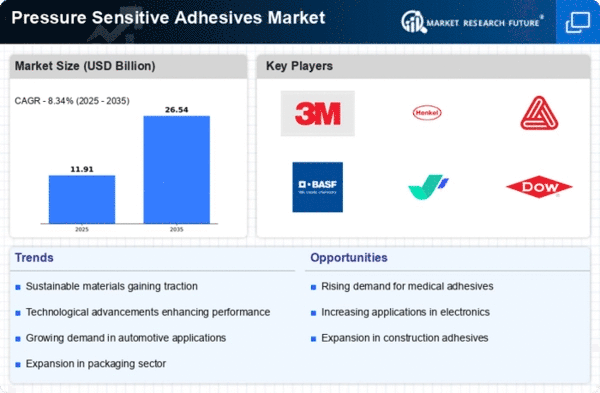
As per MRFR analysis, the Pressure Sensitive Adhesives Market was estimated at 10.99 USD Billion in 2024. The Pressure Sensitive Adhesives industry is projected to grow from 11.91 USD Billion in 2025 to 26.54 USD Billion by 2035, exhibiting a compound annual growth rate (CAGR) of 8.34% during the forecast period 2025 - 2035.

Key Market Trends & Highlights

The Pressure Sensitive Adhesives Market is poised for robust growth driven by sustainability and technological advancements.

  • North America remains the largest market for pressure sensitive adhesives, reflecting a strong demand across various sectors. Asia-Pacific is identified as the fastest-growing region, with increasing investments in manufacturing and innovation. The packaging segment continues to dominate the market, while the healthcare segment is experiencing rapid growth due to expanding applications. Rising demand in the packaging sector and regulatory support for sustainable practices are key drivers propelling market expansion.

Market Size & Forecast

2024 Market Size 10.99 (USD Billion)
2035 Market Size 26.54 (USD Billion)
CAGR (2025 - 2035) 8.34%
Largest Regional Market Share in 2024 North America

Major Players

3M (US), Henkel (DE), Avery Dennison (US), BASF (DE), Sika (CH), Dow (US), Scotch (US), Nitto Denko (JP), Intertape Polymer Group (CA)

Market Trends

The Pressure Sensitive Adhesives Market is currently experiencing a dynamic evolution, driven by various factors that influence its growth trajectory. The increasing demand for lightweight and flexible materials across multiple industries, including automotive, electronics, and packaging, appears to be a primary catalyst. As manufacturers seek to enhance product performance and sustainability, innovations in adhesive formulations are emerging, which may lead to improved bonding capabilities and environmental compliance. Furthermore, the trend towards automation and advanced manufacturing processes is likely to bolster the adoption of pressure sensitive adhesives, as these materials offer ease of application and versatility in diverse applications. In addition, the Pressure Sensitive Adhesives Market is witnessing a shift towards eco-friendly solutions, as consumers and regulatory bodies alike emphasize sustainability. This shift is prompting manufacturers to explore bio-based and recyclable adhesive options, which could potentially reshape market dynamics. The growing awareness of environmental issues may also drive research and development efforts aimed at creating adhesives that minimize ecological impact. Overall, the Pressure Sensitive Adhesives Market seems poised for continued growth, with a focus on innovation, sustainability, and adaptability to meet the evolving needs of various sectors.

Sustainability Initiatives

The Pressure Sensitive Adhesives Market is increasingly influenced by sustainability initiatives. Manufacturers are exploring eco-friendly materials and production processes to align with consumer preferences and regulatory requirements. This trend suggests a potential shift towards bio-based adhesives and recyclable options, which may reshape market dynamics.

Technological Advancements

Technological advancements are playing a crucial role in the evolution of the Pressure Sensitive Adhesives Market. Innovations in adhesive formulations and application techniques are enhancing performance characteristics, such as bonding strength and durability. This trend indicates a growing emphasis on automation and efficiency in manufacturing processes.

Diverse Application Growth

The Pressure Sensitive Adhesives Market is experiencing growth across diverse applications, including automotive, electronics, and packaging. This expansion reflects the versatility of pressure sensitive adhesives, which are increasingly utilized in various sectors to meet specific performance requirements and enhance product functionality.

Pressure Sensitive Adhesives Market Market Drivers

Rising Automotive Sector

The automotive sector's expansion significantly impacts the Global Pressure Sensitive Adhesives Market Industry. As manufacturers seek lightweight materials to enhance fuel efficiency and reduce emissions, pressure sensitive adhesives are increasingly utilized in vehicle assembly and interior applications. These adhesives offer advantages such as improved bonding and reduced weight, which are crucial in modern automotive design. The growing trend towards electric vehicles further amplifies this demand, as manufacturers prioritize innovative materials to meet performance standards. Consequently, the automotive industry's growth trajectory is likely to bolster the Global Pressure Sensitive Adhesives Market Industry, creating new opportunities for manufacturers and suppliers alike.

Market Growth Projections

The Global Pressure Sensitive Adhesives Market Industry is poised for substantial growth, with projections indicating a market size of 9.52 USD Billion in 2024 and an anticipated increase to 19.7 USD Billion by 2035. This growth trajectory reflects a compound annual growth rate of 6.82% from 2025 to 2035. Such projections underscore the increasing adoption of pressure sensitive adhesives across various sectors, driven by technological advancements and evolving consumer preferences. The market's expansion is likely to create new opportunities for manufacturers, suppliers, and end-users alike, highlighting the dynamic nature of the Global Pressure Sensitive Adhesives Market Industry.

Growing Demand in Packaging Industry

The Global Pressure Sensitive Adhesives Market Industry experiences a robust demand surge, particularly from the packaging sector. As consumer preferences shift towards convenient and sustainable packaging solutions, manufacturers are increasingly adopting pressure sensitive adhesives for their versatility and efficiency. This trend is evident as the market is projected to reach 9.52 USD Billion in 2024, driven by innovations in adhesive formulations that enhance performance. The rise in e-commerce and online shopping further propels this demand, as packaging plays a crucial role in product protection and presentation. Consequently, the packaging industry's growth significantly influences the expansion of the Global Pressure Sensitive Adhesives Market Industry.

Diverse Applications Across Industries

The versatility of pressure sensitive adhesives is a significant driver of the Global Pressure Sensitive Adhesives Market Industry. These adhesives find applications across various sectors, including healthcare, electronics, and construction. In healthcare, for instance, pressure sensitive adhesives are used in medical tapes and wound dressings, ensuring patient comfort and safety. In electronics, they are essential for bonding components and enhancing product durability. The construction industry also utilizes these adhesives for flooring and insulation applications. This diversity in applications not only broadens the market's reach but also fosters innovation, as manufacturers continuously seek to develop specialized products tailored to specific industry needs.

Increased Focus on Sustainable Solutions

The Global Pressure Sensitive Adhesives Market Industry is witnessing a paradigm shift towards sustainability. As environmental concerns gain prominence, manufacturers are increasingly focusing on developing eco-friendly adhesive solutions. This shift is driven by regulatory pressures and consumer preferences for sustainable products. The introduction of bio-based and recyclable adhesives not only meets these demands but also enhances brand loyalty among environmentally conscious consumers. Companies that prioritize sustainability are likely to gain a competitive edge in the market. This trend is expected to contribute to the overall growth of the Global Pressure Sensitive Adhesives Market Industry, as sustainability becomes a key differentiator in product offerings.

Technological Advancements in Adhesive Formulations

Technological advancements in adhesive formulations are pivotal in shaping the Global Pressure Sensitive Adhesives Market Industry. Innovations such as the development of eco-friendly and high-performance adhesives are gaining traction. These advancements not only improve adhesion properties but also cater to environmental regulations, appealing to a broader consumer base. For instance, the introduction of water-based and solvent-free adhesives aligns with sustainability goals, thus enhancing market appeal. As the industry evolves, these technological improvements are expected to contribute to the market's growth trajectory, with projections indicating a rise to 19.7 USD Billion by 2035, reflecting a compound annual growth rate of 6.82% from 2025 to 2035.

Market Segment Insights

By Application: Packaging (Largest) vs. Automotive (Fastest-Growing)

<p>The Pressure Sensitive Adhesives Market has diverse applications, with Packaging commanding the largest share. Packaging has become the cornerstone for various industries, driven by e-commerce and sustainable solutions. The Automotive segment, while smaller, is identified as the fastest-growing due to increasing demand for lightweight materials and advanced features in vehicles. Key players are adapting their strategies to cater to these significant segments, highlighting the varying dynamics of demand across applications. Growth trends in the Pressure Sensitive Adhesives Market are significantly shaped by technological advancements and innovation. As sustainability initiatives gain momentum, the demand for eco-friendly adhesives within the Packaging application is rising. Conversely, the Automotive segment is experiencing rapid growth fueled by the trend towards automation and electric vehicle production. These factors are driving the continuous evolution of the Pressure Sensitive Adhesives Market, creating a competitive landscape that focuses on efficiency and environmental consciousness.</p>

<p>Packaging: Dominant vs. Automotive: Emerging</p>

<p>The Packaging application of Pressure Sensitive Adhesives is a dominant force, essential for maintaining product integrity and aesthetics in a wide range of sectors, including food and beverage, cosmetics, and consumer goods. Its versatility allows for seamless integration into various processes, ensuring strong bonds while providing convenience. On the other hand, the Automotive segment is emerging rapidly, presenting new opportunities fueled by innovations in vehicle design and the increasing production of electric and hybrid vehicles. This segment is characterized by a shift towards lightweight materials that enhance fuel efficiency and performance. As manufacturers seek more effective adhesion solutions amid changing regulatory standards, the Automotive application is poised for significant growth, attracting investment and innovation.</p>

By End Use: Consumer Goods (Largest) vs. Healthcare (Fastest-Growing)

In the Pressure Sensitive Adhesives Market, the end-use segment is primarily led by consumer goods, which captures the largest market share due to its extensive application in products like labels, tapes, and packaging. This sector benefits from a high demand in various retail and e-commerce platforms that rely on adhesive products for packaging and branding purposes. Following consumer goods, the healthcare sector is emerging strongly, driven by the increasing requirement for medical tapes and dressings that utilize pressure-sensitive adhesives for better performance and convenience. Growth trends indicate a significant upward trajectory for the healthcare segment, fueled by innovation in medical applications such as adhesive bandages and diagnostics. The rising focus on consumer health and safety, accelerated by the recent global health crises, has enhanced the demand for reliable adhesive solutions in healthcare. Furthermore, environmental concerns are pushing manufacturers towards creating sustainable and biocompatible adhesive products, which is expected to revolutionize both consumer goods and healthcare applications significantly.

Consumer Goods: Dominant vs. Healthcare: Emerging

In the Pressure Sensitive Adhesives Market, consumer goods remain the dominant segment due to their extensive applications in everyday products such as tapes, labels, and <a href="https://www.marketresearchfuture.com/reports/packaging-material-market-12385">packaging materials</a>. This segment thrives on a strong demand from retail and e-commerce sectors where aesthetic packaging and labeling are crucial for brand differentiation and attractiveness to consumers. Conversely, healthcare is recognized as an emerging segment, driven by innovations in adhesive technologies for medical applications. The demand for pressure-sensitive adhesives in healthcare is increasing, as these materials facilitate quick and reliable adhesion for surgical tapes, wound dressings, and transdermal patches. The shift towards biocompatible materials in healthcare adhesives is creating new growth avenues, indicating a dynamic future for both segments.

By Type: Acrylic (Largest) vs. Rubber (Fastest-Growing)

The Pressure Sensitive Adhesives market is characterized by a diverse range of types, but Acrylic adhesives hold the largest share. These adhesives are favored for their excellent clarity, UV resistance, and temperature stability. Following closely are Rubber adhesives, which are gaining traction due to their superior grip and versatility. Silicone and Polyurethane adhesives, while important, occupy smaller portions of the market, with Hot Melt adhesives also contributing steadily to the overall dynamics.

Adhesives: Acrylic (Dominant) vs. Rubber (Emerging)

Acrylic adhesives are the dominant force in the Pressure Sensitive Adhesives market due to their robustness and suitability for a wide array of applications, from packaging to automotive. Their ability to maintain adhesive properties across different temperatures makes them invaluable. Conversely, Rubber adhesives are emerging due to their exceptional bonding capabilities and elasticity, making them ideal for applications requiring flexibility. This segment is witnessing increased adoption, particularly in the automotive and construction industries, driven by innovation and the demand for high-performance adhesive solutions.

By Technology: Water-Based (Largest) vs. Solvent-Based (Fastest-Growing)

<p>In the Pressure Sensitive Adhesives Market, the segmentation by technology reveals that water-based adhesives hold the largest market share. This category has become popular due to its eco-friendly characteristics and ease of application, making it a preferred choice across various industries. Solvent-based adhesives, while holding a smaller share, are recognized for their strong bonding capabilities, contributing to a growing demand as industries seek versatile solutions for more demanding applications.</p>

<p>Technology: Water-Based (Dominant) vs. Solvent-Based (Emerging)</p>

<p>Water-based pressure sensitive adhesives are characterized by their low environmental impact, providing a safer alternative to solvent-based options. Their dominance is bolstered by increasing regulations favoring eco-friendly formulations, driving manufacturers to innovate within this space. On the other hand, solvent-based adhesives are experiencing rapid growth thanks to their excellent bonding properties and adaptability to various substrates. As industrial applications become more complex, the need for robust solutions is prompting a shift towards solvent-based adhesives, marking them as an emerging technology in this segment.</p>

By Formulation: Water-Based (Largest) vs. Hot Melt (Fastest-Growing)

<p>The formulation segment in the Pressure Sensitive Adhesives Market predominantly showcases a diverse range of products, notably including solvent-based, water-based, hot melt, reactive, and non-reactive adhesives. Among these, water-based adhesives command the largest market share, favored for their lower environmental impact and versatility across various applications. Solvent-based adhesives remain significant due to their strong adhesive properties, but their growth is hampered by stringent environmental regulations. The hot melt category is rapidly catching up, driven by its quick setting times and versatility, which appeal to a wide range of industrial uses.</p>

<p>Water-Based (Dominant) vs. Hot Melt (Emerging)</p>

<p>Water-based pressure sensitive adhesives are considered the dominant formulation type in the market, characterized by their eco-friendly attributes and versatility in various applications, including packaging and labeling sectors. They are favored for their ease of use, quick drying properties, and reduced VOC emissions, aligning with growing environmental regulations. On the other hand, hot melt adhesives are emerging rapidly, distinguished by their high performance and instant bonding capabilities. They are preferred in high-speed manufacturing processes due to their efficiency and adaptability in different environments. As industries increasingly seek sustainable options, the balance between these two formulations is set to evolve, influencing market dynamics.</p>

Get more detailed insights about Pressure Sensitive Adhesives Market Research Report - Global Forecast to 2035

Regional Insights

North America : Market Leader in Adhesives

North America is poised to maintain its leadership in the Pressure Sensitive Adhesives market, holding a significant market share of 4.5 in 2024. The region's growth is driven by increasing demand in automotive, packaging, and healthcare sectors, alongside stringent regulations promoting eco-friendly products. The push for sustainable solutions is further catalyzed by government initiatives aimed at reducing environmental impact. The competitive landscape is robust, with key players like 3M, Avery Dennison, and Dow leading the charge. The U.S. is the primary market, supported by advanced manufacturing capabilities and innovation. Companies are investing heavily in R&D to develop high-performance adhesives, ensuring they meet the evolving needs of various industries. This dynamic environment positions North America as a critical hub for adhesive technology.

Europe : Innovative Adhesive Solutions

Europe's Pressure Sensitive Adhesives market is projected to grow significantly, with a market size of 3.0 in 2024. The region is characterized by a strong emphasis on sustainability and innovation, driven by regulatory frameworks that encourage the use of eco-friendly materials. The European Union's Green Deal and REACH regulations are pivotal in shaping market dynamics, pushing manufacturers towards sustainable practices and products. Leading countries such as Germany, France, and the UK are at the forefront of this transformation, with major players like Henkel and BASF investing in sustainable adhesive technologies. The competitive landscape is marked by a focus on R&D, with companies striving to meet stringent regulatory standards while catering to diverse applications across industries. This commitment to innovation positions Europe as a key player in The Pressure Sensitive Adhesives.

Asia-Pacific : Emerging Market Potential

The Asia-Pacific region is witnessing rapid growth in the Pressure Sensitive Adhesives market, with a market size of 2.5 in 2024. This growth is fueled by increasing industrialization, urbanization, and rising disposable incomes, leading to higher demand in packaging, automotive, and electronics sectors. Government initiatives aimed at boosting manufacturing capabilities and infrastructure development are also significant growth drivers in this region. Countries like China, Japan, and India are leading the charge, with a competitive landscape featuring key players such as Nitto Denko and Sika. The region's market is characterized by a mix of local and international companies, all vying for market share. As demand continues to rise, companies are focusing on innovation and cost-effective solutions to cater to diverse consumer needs, positioning Asia-Pacific as a vital market for pressure-sensitive adhesives.

Middle East and Africa : Untapped Market Opportunities

The Middle East and Africa region is emerging as a potential market for Pressure Sensitive Adhesives, with a market size of 1.0 in 2024. The growth is driven by increasing construction activities, automotive production, and a rising demand for packaging solutions. Regulatory frameworks are gradually evolving, promoting the use of advanced adhesive technologies, which is expected to further stimulate market growth in the coming years. Countries like South Africa and the UAE are leading the market, with a growing presence of international players. The competitive landscape is still developing, with local manufacturers beginning to establish their foothold. As the region continues to invest in infrastructure and industrialization, the demand for pressure-sensitive adhesives is anticipated to rise, presenting significant opportunities for growth.

Key Players and Competitive Insights

The Pressure Sensitive Adhesives Market is characterized by a dynamic competitive landscape, driven by innovation, sustainability, and strategic partnerships. Key players such as 3M (US), Henkel (DE), and Avery Dennison (US) are at the forefront, each adopting distinct strategies to enhance their market positioning. 3M (US) emphasizes innovation in product development, focusing on eco-friendly adhesives that cater to the growing demand for sustainable solutions. Henkel (DE) has been actively pursuing mergers and acquisitions to expand its product portfolio and market reach, while Avery Dennison (US) is leveraging digital transformation to optimize its supply chain and improve customer engagement. Collectively, these strategies contribute to a competitive environment that is increasingly focused on technological advancement and sustainability.
In terms of business tactics, companies are localizing manufacturing to reduce lead times and enhance responsiveness to market demands. Supply chain optimization remains a critical focus, particularly in light of recent global disruptions. The market structure appears moderately fragmented, with a mix of large multinational corporations and smaller specialized firms. The influence of key players is substantial, as they set industry standards and drive innovation, thereby shaping the overall market dynamics.
In November 2025, 3M (US) announced the launch of a new line of bio-based pressure sensitive adhesives, which are designed to meet the stringent sustainability criteria set by various regulatory bodies. This strategic move not only aligns with the growing consumer preference for environmentally friendly products but also positions 3M (US) as a leader in sustainable adhesive solutions. The introduction of these products is likely to enhance their competitive edge in a market increasingly driven by sustainability.
In October 2025, Henkel (DE) completed the acquisition of a regional adhesive manufacturer, which is expected to bolster its market presence in Europe. This acquisition is strategically significant as it allows Henkel (DE) to expand its product offerings and enhance its distribution capabilities. By integrating the acquired company’s technologies and expertise, Henkel (DE) aims to strengthen its competitive position and respond more effectively to local market needs.
In September 2025, Avery Dennison (US) launched an advanced digital platform aimed at improving customer interaction and streamlining order processes. This initiative reflects a broader trend towards digitalization within the industry, as companies seek to enhance operational efficiency and customer satisfaction. By investing in technology, Avery Dennison (US) is likely to gain a competitive advantage, particularly among tech-savvy customers who prioritize seamless service.
As of December 2025, current competitive trends in the Pressure Sensitive Adhesives Market include a pronounced shift towards digitalization, sustainability, and the integration of artificial intelligence in production processes. Strategic alliances are increasingly shaping the landscape, enabling companies to pool resources and expertise to drive innovation. Looking ahead, competitive differentiation is expected to evolve, with a greater emphasis on technological advancements and supply chain reliability, moving away from traditional price-based competition. The focus on innovation and sustainability will likely define the future trajectory of the market.

Key Companies in the Pressure Sensitive Adhesives Market include

Industry Developments

  • Q2 2024: Henkel opens new adhesive manufacturing facility in India Henkel inaugurated a new state-of-the-art pressure sensitive adhesives plant in Pune, India, aimed at expanding its capacity to serve the growing demand in packaging, automotive, and electronics sectors.
  • Q2 2024: Avery Dennison launches sustainable pressure-sensitive adhesive for food packaging Avery Dennison announced the launch of a new bio-based pressure-sensitive adhesive designed for direct food contact applications, enhancing its portfolio of sustainable packaging solutions.
  • Q3 2024: 3M announces partnership with Tesla for advanced pressure-sensitive adhesive solutions 3M entered into a strategic partnership with Tesla to develop next-generation pressure-sensitive adhesives for electric vehicle battery assembly and thermal management.
  • Q3 2024: Dow unveils new acrylic-based pressure-sensitive adhesive for medical wearables Dow introduced a new acrylic-based pressure-sensitive adhesive specifically engineered for long-term skin contact in medical wearable devices, targeting the healthcare sector.
  • Q4 2024: Sika acquires specialty pressure-sensitive adhesives business from Arkema Sika completed the acquisition of Arkema’s specialty pressure-sensitive adhesives division, strengthening its position in the construction and industrial adhesives market.
  • Q4 2024: HB Fuller announces $100M investment in new pressure-sensitive adhesive R&D center HB Fuller revealed plans to invest $100 million in a new research and development center focused on pressure-sensitive adhesives, aiming to accelerate innovation in sustainable and high-performance products.
  • Q1 2025: Avery Dennison opens new pressure-sensitive adhesive plant in Brazil Avery Dennison inaugurated a new manufacturing facility in São Paulo, Brazil, dedicated to producing pressure-sensitive adhesives for the South American market.
  • Q1 2025: Henkel appoints new Head of Pressure Sensitive Adhesives Market Division Henkel announced the appointment of Dr. Maria Schmidt as the new Head of its Pressure Sensitive Adhesives Market Division, effective January 2025.
  • Q2 2025: 3M secures multi-year contract to supply pressure-sensitive adhesives to Samsung Electronics 3M signed a multi-year agreement to supply advanced pressure-sensitive adhesives for use in Samsung’s consumer electronics and display products.
  • Q2 2025: HB Fuller acquires Chinese pressure-sensitive adhesive manufacturer HB Fuller completed the acquisition of a leading Chinese pressure-sensitive adhesive manufacturer, expanding its footprint in the Asia-Pacific region.
  • Q3 2025: Sika launches new solvent-free pressure-sensitive adhesive for automotive applications Sika introduced a new solvent-free pressure-sensitive adhesive designed for automotive interior and exterior bonding, supporting sustainability initiatives in the sector.
  • Q3 2025: Dow receives regulatory approval for new pressure-sensitive adhesive plant in South Korea Dow announced it has received regulatory approval to construct a new pressure-sensitive adhesive manufacturing facility in Ulsan, South Korea, to meet rising demand in the region.


Future Outlook

Pressure Sensitive Adhesives Market Future Outlook

The Pressure Sensitive Adhesives Market is projected to grow at an 8.34% CAGR from 2025 to 2035, driven by increasing demand in automotive, packaging, and electronics sectors.

New opportunities lie in:

  • Development of eco-friendly adhesive formulations
  • Expansion into emerging markets with tailored products
  • Integration of smart adhesive technologies for enhanced performance

By 2035, the market is expected to achieve robust growth, solidifying its position as a key industry segment.

Market Segmentation

Pressure Sensitive Adhesives Market Type Outlook

  • Acrylic
  • Rubber
  • Silicone
  • Polyurethane
  • Hot Melt

Pressure Sensitive Adhesives Market End Use Outlook

  • Consumer Goods
  • Industrial
  • Healthcare
  • Transportation
  • Aerospace

Pressure Sensitive Adhesives Market Application Outlook

  • Automotive
  • Electronics
  • Packaging
  • Medical
  • Construction

Report Scope

MARKET SIZE 2024 10.99(USD Billion)
MARKET SIZE 2025 11.91(USD Billion)
MARKET SIZE 2035 26.54(USD Billion)
COMPOUND ANNUAL GROWTH RATE (CAGR) 8.34% (2025 - 2035)
REPORT COVERAGE Revenue Forecast, Competitive Landscape, Growth Factors, and Trends
BASE YEAR 2024
Market Forecast Period 2025 - 2035
Historical Data 2019 - 2024
Market Forecast Units USD Billion
Key Companies Profiled 3M (US), Henkel (DE), Avery Dennison (US), BASF (DE), Sika (CH), Dow (US), Scotch (US), Nitto Denko (JP), Intertape Polymer Group (CA)
Segments Covered Application, End Use, Type
Key Market Opportunities Growing demand for eco-friendly Pressure Sensitive Adhesives in packaging and automotive applications presents significant market opportunities.
Key Market Dynamics Rising demand for eco-friendly formulations drives innovation and competition in the Pressure Sensitive Adhesives market.
Countries Covered North America, Europe, APAC, South America, MEA

FAQs

What is the projected market valuation of the Pressure Sensitive Adhesives Market by 2035?

<p>The Pressure Sensitive Adhesives Market is projected to reach a valuation of 26.54 USD Billion by 2035.</p>

What was the market valuation of Pressure Sensitive Adhesives in 2024?

<p>In 2024, the market valuation of Pressure Sensitive Adhesives was 10.99 USD Billion.</p>

What is the expected CAGR for the Pressure Sensitive Adhesives Market during the forecast period 2025 - 2035?

<p>The expected CAGR for the Pressure Sensitive Adhesives Market during the forecast period 2025 - 2035 is 8.34%.</p>

Which application segment is projected to grow the most in the Pressure Sensitive Adhesives Market?

<p>The Packaging application segment is projected to grow from 3.5 USD Billion in 2024 to 8.0 USD Billion by 2035.</p>

How does the Automotive application segment perform in the Pressure Sensitive Adhesives Market?

<p>The Automotive application segment was valued at 1.65 USD Billion in 2024 and is expected to reach 4.0 USD Billion by 2035.</p>

What are the key players in the Pressure Sensitive Adhesives Market?

<p>Key players in the Pressure Sensitive Adhesives Market include 3M, Henkel, Avery Dennison, BASF, and Sika.</p>

What is the projected growth for the Electronics end-use segment in the Pressure Sensitive Adhesives Market?

<p>The Electronics end-use segment is expected to grow from 2.2 USD Billion in 2024 to 5.0 USD Billion by 2035.</p>

Which type of pressure sensitive adhesive is anticipated to have the highest market growth?

<p>Acrylic pressure sensitive adhesives are projected to grow from 3.3 USD Billion in 2024 to 8.0 USD Billion by 2035.</p>

What is the expected growth trajectory for the Healthcare end-use segment?

The Healthcare end-use segment is expected to increase from 1.5 USD Billion in 2024 to 3.5 USD Billion by 2035.

How does the market for Water-Based pressure sensitive adhesives compare to other formulations?

Water-Based pressure sensitive adhesives were valued at 3.0 USD Billion in 2024 and are projected to reach 7.0 USD Billion by 2035, indicating robust growth.

  1. SECTION I: EXECUTIVE SUMMARY AND KEY HIGHLIGHTS
    1. | 1.1 EXECUTIVE SUMMARY
    2. | | 1.1.1 Market Overview
    3. | | 1.1.2 Key Findings
    4. | | 1.1.3 Market Segmentation
    5. | | 1.1.4 Competitive Landscape
    6. | | 1.1.5 Challenges and Opportunities
    7. | | 1.1.6 Future Outlook
  2. SECTION II: SCOPING, METHODOLOGY AND MARKET STRUCTURE
    1. | 2.1 MARKET INTRODUCTION
    2. | | 2.1.1 Definition
    3. | | 2.1.2 Scope of the study
    4. | | | 2.1.2.1 Research Objective
    5. | | | 2.1.2.2 Assumption
    6. | | | 2.1.2.3 Limitations
    7. | 2.2 RESEARCH METHODOLOGY
    8. | | 2.2.1 Overview
    9. | | 2.2.2 Data Mining
    10. | | 2.2.3 Secondary Research
    11. | | 2.2.4 Primary Research
    12. | | | 2.2.4.1 Primary Interviews and Information Gathering Process
    13. | | | 2.2.4.2 Breakdown of Primary Respondents
    14. | | 2.2.5 Forecasting Model
    15. | | 2.2.6 Market Size Estimation
    16. | | | 2.2.6.1 Bottom-Up Approach
    17. | | | 2.2.6.2 Top-Down Approach
    18. | | 2.2.7 Data Triangulation
    19. | | 2.2.8 Validation
  3. SECTION III: QUALITATIVE ANALYSIS
    1. | 3.1 MARKET DYNAMICS
    2. | | 3.1.1 Overview
    3. | | 3.1.2 Drivers
    4. | | 3.1.3 Restraints
    5. | | 3.1.4 Opportunities
    6. | 3.2 MARKET FACTOR ANALYSIS
    7. | | 3.2.1 Value chain Analysis
    8. | | 3.2.2 Porter's Five Forces Analysis
    9. | | | 3.2.2.1 Bargaining Power of Suppliers
    10. | | | 3.2.2.2 Bargaining Power of Buyers
    11. | | | 3.2.2.3 Threat of New Entrants
    12. | | | 3.2.2.4 Threat of Substitutes
    13. | | | 3.2.2.5 Intensity of Rivalry
    14. | | 3.2.3 COVID-19 Impact Analysis
    15. | | | 3.2.3.1 Market Impact Analysis
    16. | | | 3.2.3.2 Regional Impact
    17. | | | 3.2.3.3 Opportunity and Threat Analysis
  4. SECTION IV: QUANTITATIVE ANALYSIS
    1. | 4.1 Chemicals and Materials, BY Application (USD Billion)
    2. | | 4.1.1 Automotive
    3. | | 4.1.2 Electronics
    4. | | 4.1.3 Packaging
    5. | | 4.1.4 Medical
    6. | | 4.1.5 Construction
    7. | 4.2 Chemicals and Materials, BY End Use (USD Billion)
    8. | | 4.2.1 Consumer Goods
    9. | | 4.2.2 Industrial
    10. | | 4.2.3 Healthcare
    11. | | 4.2.4 Aerospace
    12. | | 4.2.5 Transportation
    13. | 4.3 Chemicals and Materials, BY Type (USD Billion)
    14. | | 4.3.1 Acrylic
    15. | | 4.3.2 Rubber
    16. | | 4.3.3 Silicone
    17. | | 4.3.4 Polyurethane
    18. | | 4.3.5 Hot Melt
    19. | 4.4 Chemicals and Materials, BY Technology (USD Billion)
    20. | | 4.4.1 Water-Based
    21. | | 4.4.2 Solvent-Based
    22. | | 4.4.3 Hot Melt
    23. | | 4.4.4 UV-Curable
    24. | | 4.4.5 Pressure-Sensitive
    25. | 4.5 Chemicals and Materials, BY Formulation (USD Billion)
    26. | | 4.5.1 Solvent-Based
    27. | | 4.5.2 Water-Based
    28. | | 4.5.3 Hot Melt
    29. | | 4.5.4 Reactive
    30. | | 4.5.5 Non-Reactive
    31. | 4.6 Chemicals and Materials, BY Region (USD Billion)
    32. | | 4.6.1 North America
    33. | | | 4.6.1.1 US
    34. | | | 4.6.1.2 Canada
    35. | | 4.6.2 Europe
    36. | | | 4.6.2.1 Germany
    37. | | | 4.6.2.2 UK
    38. | | | 4.6.2.3 France
    39. | | | 4.6.2.4 Russia
    40. | | | 4.6.2.5 Italy
    41. | | | 4.6.2.6 Spain
    42. | | | 4.6.2.7 Rest of Europe
    43. | | 4.6.3 APAC
    44. | | | 4.6.3.1 China
    45. | | | 4.6.3.2 India
    46. | | | 4.6.3.3 Japan
    47. | | | 4.6.3.4 South Korea
    48. | | | 4.6.3.5 Malaysia
    49. | | | 4.6.3.6 Thailand
    50. | | | 4.6.3.7 Indonesia
    51. | | | 4.6.3.8 Rest of APAC
    52. | | 4.6.4 South America
    53. | | | 4.6.4.1 Brazil
    54. | | | 4.6.4.2 Mexico
    55. | | | 4.6.4.3 Argentina
    56. | | | 4.6.4.4 Rest of South America
    57. | | 4.6.5 MEA
    58. | | | 4.6.5.1 GCC Countries
    59. | | | 4.6.5.2 South Africa
    60. | | | 4.6.5.3 Rest of MEA
  5. SECTION V: COMPETITIVE ANALYSIS
    1. | 5.1 Competitive Landscape
    2. | | 5.1.1 Overview
    3. | | 5.1.2 Competitive Analysis
    4. | | 5.1.3 Market share Analysis
    5. | | 5.1.4 Major Growth Strategy in the Chemicals and Materials
    6. | | 5.1.5 Competitive Benchmarking
    7. | | 5.1.6 Leading Players in Terms of Number of Developments in the Chemicals and Materials
    8. | | 5.1.7 Key developments and growth strategies
    9. | | | 5.1.7.1 New Product Launch/Service Deployment
    10. | | | 5.1.7.2 Merger & Acquisitions
    11. | | | 5.1.7.3 Joint Ventures
    12. | | 5.1.8 Major Players Financial Matrix
    13. | | | 5.1.8.1 Sales and Operating Income
    14. | | | 5.1.8.2 Major Players R&D Expenditure. 2023
    15. | 5.2 Company Profiles
    16. | | 5.2.1 3M (US)
    17. | | | 5.2.1.1 Financial Overview
    18. | | | 5.2.1.2 Products Offered
    19. | | | 5.2.1.3 Key Developments
    20. | | | 5.2.1.4 SWOT Analysis
    21. | | | 5.2.1.5 Key Strategies
    22. | | 5.2.2 Henkel (DE)
    23. | | | 5.2.2.1 Financial Overview
    24. | | | 5.2.2.2 Products Offered
    25. | | | 5.2.2.3 Key Developments
    26. | | | 5.2.2.4 SWOT Analysis
    27. | | | 5.2.2.5 Key Strategies
    28. | | 5.2.3 Avery Dennison (US)
    29. | | | 5.2.3.1 Financial Overview
    30. | | | 5.2.3.2 Products Offered
    31. | | | 5.2.3.3 Key Developments
    32. | | | 5.2.3.4 SWOT Analysis
    33. | | | 5.2.3.5 Key Strategies
    34. | | 5.2.4 BASF (DE)
    35. | | | 5.2.4.1 Financial Overview
    36. | | | 5.2.4.2 Products Offered
    37. | | | 5.2.4.3 Key Developments
    38. | | | 5.2.4.4 SWOT Analysis
    39. | | | 5.2.4.5 Key Strategies
    40. | | 5.2.5 Sika (CH)
    41. | | | 5.2.5.1 Financial Overview
    42. | | | 5.2.5.2 Products Offered
    43. | | | 5.2.5.3 Key Developments
    44. | | | 5.2.5.4 SWOT Analysis
    45. | | | 5.2.5.5 Key Strategies
    46. | | 5.2.6 Dow (US)
    47. | | | 5.2.6.1 Financial Overview
    48. | | | 5.2.6.2 Products Offered
    49. | | | 5.2.6.3 Key Developments
    50. | | | 5.2.6.4 SWOT Analysis
    51. | | | 5.2.6.5 Key Strategies
    52. | | 5.2.7 Scotch (US)
    53. | | | 5.2.7.1 Financial Overview
    54. | | | 5.2.7.2 Products Offered
    55. | | | 5.2.7.3 Key Developments
    56. | | | 5.2.7.4 SWOT Analysis
    57. | | | 5.2.7.5 Key Strategies
    58. | | 5.2.8 Nitto Denko (JP)
    59. | | | 5.2.8.1 Financial Overview
    60. | | | 5.2.8.2 Products Offered
    61. | | | 5.2.8.3 Key Developments
    62. | | | 5.2.8.4 SWOT Analysis
    63. | | | 5.2.8.5 Key Strategies
    64. | | 5.2.9 Intertape Polymer Group (CA)
    65. | | | 5.2.9.1 Financial Overview
    66. | | | 5.2.9.2 Products Offered
    67. | | | 5.2.9.3 Key Developments
    68. | | | 5.2.9.4 SWOT Analysis
    69. | | | 5.2.9.5 Key Strategies
    70. | 5.3 Appendix
    71. | | 5.3.1 References
    72. | | 5.3.2 Related Reports
  6. LIST OF FIGURES
    1. | 6.1 MARKET SYNOPSIS
    2. | 6.2 NORTH AMERICA MARKET ANALYSIS
    3. | 6.3 US MARKET ANALYSIS BY APPLICATION
    4. | 6.4 US MARKET ANALYSIS BY END USE
    5. | 6.5 US MARKET ANALYSIS BY TYPE
    6. | 6.6 US MARKET ANALYSIS BY TECHNOLOGY
    7. | 6.7 US MARKET ANALYSIS BY FORMULATION
    8. | 6.8 CANADA MARKET ANALYSIS BY APPLICATION
    9. | 6.9 CANADA MARKET ANALYSIS BY END USE
    10. | 6.10 CANADA MARKET ANALYSIS BY TYPE
    11. | 6.11 CANADA MARKET ANALYSIS BY TECHNOLOGY
    12. | 6.12 CANADA MARKET ANALYSIS BY FORMULATION
    13. | 6.13 EUROPE MARKET ANALYSIS
    14. | 6.14 GERMANY MARKET ANALYSIS BY APPLICATION
    15. | 6.15 GERMANY MARKET ANALYSIS BY END USE
    16. | 6.16 GERMANY MARKET ANALYSIS BY TYPE
    17. | 6.17 GERMANY MARKET ANALYSIS BY TECHNOLOGY
    18. | 6.18 GERMANY MARKET ANALYSIS BY FORMULATION
    19. | 6.19 UK MARKET ANALYSIS BY APPLICATION
    20. | 6.20 UK MARKET ANALYSIS BY END USE
    21. | 6.21 UK MARKET ANALYSIS BY TYPE
    22. | 6.22 UK MARKET ANALYSIS BY TECHNOLOGY
    23. | 6.23 UK MARKET ANALYSIS BY FORMULATION
    24. | 6.24 FRANCE MARKET ANALYSIS BY APPLICATION
    25. | 6.25 FRANCE MARKET ANALYSIS BY END USE
    26. | 6.26 FRANCE MARKET ANALYSIS BY TYPE
    27. | 6.27 FRANCE MARKET ANALYSIS BY TECHNOLOGY
    28. | 6.28 FRANCE MARKET ANALYSIS BY FORMULATION
    29. | 6.29 RUSSIA MARKET ANALYSIS BY APPLICATION
    30. | 6.30 RUSSIA MARKET ANALYSIS BY END USE
    31. | 6.31 RUSSIA MARKET ANALYSIS BY TYPE
    32. | 6.32 RUSSIA MARKET ANALYSIS BY TECHNOLOGY
    33. | 6.33 RUSSIA MARKET ANALYSIS BY FORMULATION
    34. | 6.34 ITALY MARKET ANALYSIS BY APPLICATION
    35. | 6.35 ITALY MARKET ANALYSIS BY END USE
    36. | 6.36 ITALY MARKET ANALYSIS BY TYPE
    37. | 6.37 ITALY MARKET ANALYSIS BY TECHNOLOGY
    38. | 6.38 ITALY MARKET ANALYSIS BY FORMULATION
    39. | 6.39 SPAIN MARKET ANALYSIS BY APPLICATION
    40. | 6.40 SPAIN MARKET ANALYSIS BY END USE
    41. | 6.41 SPAIN MARKET ANALYSIS BY TYPE
    42. | 6.42 SPAIN MARKET ANALYSIS BY TECHNOLOGY
    43. | 6.43 SPAIN MARKET ANALYSIS BY FORMULATION
    44. | 6.44 REST OF EUROPE MARKET ANALYSIS BY APPLICATION
    45. | 6.45 REST OF EUROPE MARKET ANALYSIS BY END USE
    46. | 6.46 REST OF EUROPE MARKET ANALYSIS BY TYPE
    47. | 6.47 REST OF EUROPE MARKET ANALYSIS BY TECHNOLOGY
    48. | 6.48 REST OF EUROPE MARKET ANALYSIS BY FORMULATION
    49. | 6.49 APAC MARKET ANALYSIS
    50. | 6.50 CHINA MARKET ANALYSIS BY APPLICATION
    51. | 6.51 CHINA MARKET ANALYSIS BY END USE
    52. | 6.52 CHINA MARKET ANALYSIS BY TYPE
    53. | 6.53 CHINA MARKET ANALYSIS BY TECHNOLOGY
    54. | 6.54 CHINA MARKET ANALYSIS BY FORMULATION
    55. | 6.55 INDIA MARKET ANALYSIS BY APPLICATION
    56. | 6.56 INDIA MARKET ANALYSIS BY END USE
    57. | 6.57 INDIA MARKET ANALYSIS BY TYPE
    58. | 6.58 INDIA MARKET ANALYSIS BY TECHNOLOGY
    59. | 6.59 INDIA MARKET ANALYSIS BY FORMULATION
    60. | 6.60 JAPAN MARKET ANALYSIS BY APPLICATION
    61. | 6.61 JAPAN MARKET ANALYSIS BY END USE
    62. | 6.62 JAPAN MARKET ANALYSIS BY TYPE
    63. | 6.63 JAPAN MARKET ANALYSIS BY TECHNOLOGY
    64. | 6.64 JAPAN MARKET ANALYSIS BY FORMULATION
    65. | 6.65 SOUTH KOREA MARKET ANALYSIS BY APPLICATION
    66. | 6.66 SOUTH KOREA MARKET ANALYSIS BY END USE
    67. | 6.67 SOUTH KOREA MARKET ANALYSIS BY TYPE
    68. | 6.68 SOUTH KOREA MARKET ANALYSIS BY TECHNOLOGY
    69. | 6.69 SOUTH KOREA MARKET ANALYSIS BY FORMULATION
    70. | 6.70 MALAYSIA MARKET ANALYSIS BY APPLICATION
    71. | 6.71 MALAYSIA MARKET ANALYSIS BY END USE
    72. | 6.72 MALAYSIA MARKET ANALYSIS BY TYPE
    73. | 6.73 MALAYSIA MARKET ANALYSIS BY TECHNOLOGY
    74. | 6.74 MALAYSIA MARKET ANALYSIS BY FORMULATION
    75. | 6.75 THAILAND MARKET ANALYSIS BY APPLICATION
    76. | 6.76 THAILAND MARKET ANALYSIS BY END USE
    77. | 6.77 THAILAND MARKET ANALYSIS BY TYPE
    78. | 6.78 THAILAND MARKET ANALYSIS BY TECHNOLOGY
    79. | 6.79 THAILAND MARKET ANALYSIS BY FORMULATION
    80. | 6.80 INDONESIA MARKET ANALYSIS BY APPLICATION
    81. | 6.81 INDONESIA MARKET ANALYSIS BY END USE
    82. | 6.82 INDONESIA MARKET ANALYSIS BY TYPE
    83. | 6.83 INDONESIA MARKET ANALYSIS BY TECHNOLOGY
    84. | 6.84 INDONESIA MARKET ANALYSIS BY FORMULATION
    85. | 6.85 REST OF APAC MARKET ANALYSIS BY APPLICATION
    86. | 6.86 REST OF APAC MARKET ANALYSIS BY END USE
    87. | 6.87 REST OF APAC MARKET ANALYSIS BY TYPE
    88. | 6.88 REST OF APAC MARKET ANALYSIS BY TECHNOLOGY
    89. | 6.89 REST OF APAC MARKET ANALYSIS BY FORMULATION
    90. | 6.90 SOUTH AMERICA MARKET ANALYSIS
    91. | 6.91 BRAZIL MARKET ANALYSIS BY APPLICATION
    92. | 6.92 BRAZIL MARKET ANALYSIS BY END USE
    93. | 6.93 BRAZIL MARKET ANALYSIS BY TYPE
    94. | 6.94 BRAZIL MARKET ANALYSIS BY TECHNOLOGY
    95. | 6.95 BRAZIL MARKET ANALYSIS BY FORMULATION
    96. | 6.96 MEXICO MARKET ANALYSIS BY APPLICATION
    97. | 6.97 MEXICO MARKET ANALYSIS BY END USE
    98. | 6.98 MEXICO MARKET ANALYSIS BY TYPE
    99. | 6.99 MEXICO MARKET ANALYSIS BY TECHNOLOGY
    100. | 6.100 MEXICO MARKET ANALYSIS BY FORMULATION
    101. | 6.101 ARGENTINA MARKET ANALYSIS BY APPLICATION
    102. | 6.102 ARGENTINA MARKET ANALYSIS BY END USE
    103. | 6.103 ARGENTINA MARKET ANALYSIS BY TYPE
    104. | 6.104 ARGENTINA MARKET ANALYSIS BY TECHNOLOGY
    105. | 6.105 ARGENTINA MARKET ANALYSIS BY FORMULATION
    106. | 6.106 REST OF SOUTH AMERICA MARKET ANALYSIS BY APPLICATION
    107. | 6.107 REST OF SOUTH AMERICA MARKET ANALYSIS BY END USE
    108. | 6.108 REST OF SOUTH AMERICA MARKET ANALYSIS BY TYPE
    109. | 6.109 REST OF SOUTH AMERICA MARKET ANALYSIS BY TECHNOLOGY
    110. | 6.110 REST OF SOUTH AMERICA MARKET ANALYSIS BY FORMULATION
    111. | 6.111 MEA MARKET ANALYSIS
    112. | 6.112 GCC COUNTRIES MARKET ANALYSIS BY APPLICATION
    113. | 6.113 GCC COUNTRIES MARKET ANALYSIS BY END USE
    114. | 6.114 GCC COUNTRIES MARKET ANALYSIS BY TYPE
    115. | 6.115 GCC COUNTRIES MARKET ANALYSIS BY TECHNOLOGY
    116. | 6.116 GCC COUNTRIES MARKET ANALYSIS BY FORMULATION
    117. | 6.117 SOUTH AFRICA MARKET ANALYSIS BY APPLICATION
    118. | 6.118 SOUTH AFRICA MARKET ANALYSIS BY END USE
    119. | 6.119 SOUTH AFRICA MARKET ANALYSIS BY TYPE
    120. | 6.120 SOUTH AFRICA MARKET ANALYSIS BY TECHNOLOGY
    121. | 6.121 SOUTH AFRICA MARKET ANALYSIS BY FORMULATION
    122. | 6.122 REST OF MEA MARKET ANALYSIS BY APPLICATION
    123. | 6.123 REST OF MEA MARKET ANALYSIS BY END USE
    124. | 6.124 REST OF MEA MARKET ANALYSIS BY TYPE
    125. | 6.125 REST OF MEA MARKET ANALYSIS BY TECHNOLOGY
    126. | 6.126 REST OF MEA MARKET ANALYSIS BY FORMULATION
    127. | 6.127 KEY BUYING CRITERIA OF CHEMICALS AND MATERIALS
    128. | 6.128 RESEARCH PROCESS OF MRFR
    129. | 6.129 DRO ANALYSIS OF CHEMICALS AND MATERIALS
    130. | 6.130 DRIVERS IMPACT ANALYSIS: CHEMICALS AND MATERIALS
    131. | 6.131 RESTRAINTS IMPACT ANALYSIS: CHEMICALS AND MATERIALS
    132. | 6.132 SUPPLY / VALUE CHAIN: CHEMICALS AND MATERIALS
    133. | 6.133 CHEMICALS AND MATERIALS, BY APPLICATION, 2024 (% SHARE)
    134. | 6.134 CHEMICALS AND MATERIALS, BY APPLICATION, 2024 TO 2035 (USD Billion)
    135. | 6.135 CHEMICALS AND MATERIALS, BY END USE, 2024 (% SHARE)
    136. | 6.136 CHEMICALS AND MATERIALS, BY END USE, 2024 TO 2035 (USD Billion)
    137. | 6.137 CHEMICALS AND MATERIALS, BY TYPE, 2024 (% SHARE)
    138. | 6.138 CHEMICALS AND MATERIALS, BY TYPE, 2024 TO 2035 (USD Billion)
    139. | 6.139 CHEMICALS AND MATERIALS, BY TECHNOLOGY, 2024 (% SHARE)
    140. | 6.140 CHEMICALS AND MATERIALS, BY TECHNOLOGY, 2024 TO 2035 (USD Billion)
    141. | 6.141 CHEMICALS AND MATERIALS, BY FORMULATION, 2024 (% SHARE)
    142. | 6.142 CHEMICALS AND MATERIALS, BY FORMULATION, 2024 TO 2035 (USD Billion)
    143. | 6.143 BENCHMARKING OF MAJOR COMPETITORS
  7. LIST OF TABLES
    1. | 7.1 LIST OF ASSUMPTIONS
    2. | | 7.1.1
    3. | 7.2 North America MARKET SIZE ESTIMATES; FORECAST
    4. | | 7.2.1 BY APPLICATION, 2025-2035 (USD Billion)
    5. | | 7.2.2 BY END USE, 2025-2035 (USD Billion)
    6. | | 7.2.3 BY TYPE, 2025-2035 (USD Billion)
    7. | | 7.2.4 BY TECHNOLOGY, 2025-2035 (USD Billion)
    8. | | 7.2.5 BY FORMULATION, 2025-2035 (USD Billion)
    9. | 7.3 US MARKET SIZE ESTIMATES; FORECAST
    10. | | 7.3.1 BY APPLICATION, 2025-2035 (USD Billion)
    11. | | 7.3.2 BY END USE, 2025-2035 (USD Billion)
    12. | | 7.3.3 BY TYPE, 2025-2035 (USD Billion)
    13. | | 7.3.4 BY TECHNOLOGY, 2025-2035 (USD Billion)
    14. | | 7.3.5 BY FORMULATION, 2025-2035 (USD Billion)
    15. | 7.4 Canada MARKET SIZE ESTIMATES; FORECAST
    16. | | 7.4.1 BY APPLICATION, 2025-2035 (USD Billion)
    17. | | 7.4.2 BY END USE, 2025-2035 (USD Billion)
    18. | | 7.4.3 BY TYPE, 2025-2035 (USD Billion)
    19. | | 7.4.4 BY TECHNOLOGY, 2025-2035 (USD Billion)
    20. | | 7.4.5 BY FORMULATION, 2025-2035 (USD Billion)
    21. | 7.5 Europe MARKET SIZE ESTIMATES; FORECAST
    22. | | 7.5.1 BY APPLICATION, 2025-2035 (USD Billion)
    23. | | 7.5.2 BY END USE, 2025-2035 (USD Billion)
    24. | | 7.5.3 BY TYPE, 2025-2035 (USD Billion)
    25. | | 7.5.4 BY TECHNOLOGY, 2025-2035 (USD Billion)
    26. | | 7.5.5 BY FORMULATION, 2025-2035 (USD Billion)
    27. | 7.6 Germany MARKET SIZE ESTIMATES; FORECAST
    28. | | 7.6.1 BY APPLICATION, 2025-2035 (USD Billion)
    29. | | 7.6.2 BY END USE, 2025-2035 (USD Billion)
    30. | | 7.6.3 BY TYPE, 2025-2035 (USD Billion)
    31. | | 7.6.4 BY TECHNOLOGY, 2025-2035 (USD Billion)
    32. | | 7.6.5 BY FORMULATION, 2025-2035 (USD Billion)
    33. | 7.7 UK MARKET SIZE ESTIMATES; FORECAST
    34. | | 7.7.1 BY APPLICATION, 2025-2035 (USD Billion)
    35. | | 7.7.2 BY END USE, 2025-2035 (USD Billion)
    36. | | 7.7.3 BY TYPE, 2025-2035 (USD Billion)
    37. | | 7.7.4 BY TECHNOLOGY, 2025-2035 (USD Billion)
    38. | | 7.7.5 BY FORMULATION, 2025-2035 (USD Billion)
    39. | 7.8 France MARKET SIZE ESTIMATES; FORECAST
    40. | | 7.8.1 BY APPLICATION, 2025-2035 (USD Billion)
    41. | | 7.8.2 BY END USE, 2025-2035 (USD Billion)
    42. | | 7.8.3 BY TYPE, 2025-2035 (USD Billion)
    43. | | 7.8.4 BY TECHNOLOGY, 2025-2035 (USD Billion)
    44. | | 7.8.5 BY FORMULATION, 2025-2035 (USD Billion)
    45. | 7.9 Russia MARKET SIZE ESTIMATES; FORECAST
    46. | | 7.9.1 BY APPLICATION, 2025-2035 (USD Billion)
    47. | | 7.9.2 BY END USE, 2025-2035 (USD Billion)
    48. | | 7.9.3 BY TYPE, 2025-2035 (USD Billion)
    49. | | 7.9.4 BY TECHNOLOGY, 2025-2035 (USD Billion)
    50. | | 7.9.5 BY FORMULATION, 2025-2035 (USD Billion)
    51. | 7.10 Italy MARKET SIZE ESTIMATES; FORECAST
    52. | | 7.10.1 BY APPLICATION, 2025-2035 (USD Billion)
    53. | | 7.10.2 BY END USE, 2025-2035 (USD Billion)
    54. | | 7.10.3 BY TYPE, 2025-2035 (USD Billion)
    55. | | 7.10.4 BY TECHNOLOGY, 2025-2035 (USD Billion)
    56. | | 7.10.5 BY FORMULATION, 2025-2035 (USD Billion)
    57. | 7.11 Spain MARKET SIZE ESTIMATES; FORECAST
    58. | | 7.11.1 BY APPLICATION, 2025-2035 (USD Billion)
    59. | | 7.11.2 BY END USE, 2025-2035 (USD Billion)
    60. | | 7.11.3 BY TYPE, 2025-2035 (USD Billion)
    61. | | 7.11.4 BY TECHNOLOGY, 2025-2035 (USD Billion)
    62. | | 7.11.5 BY FORMULATION, 2025-2035 (USD Billion)
    63. | 7.12 Rest of Europe MARKET SIZE ESTIMATES; FORECAST
    64. | | 7.12.1 BY APPLICATION, 2025-2035 (USD Billion)
    65. | | 7.12.2 BY END USE, 2025-2035 (USD Billion)
    66. | | 7.12.3 BY TYPE, 2025-2035 (USD Billion)
    67. | | 7.12.4 BY TECHNOLOGY, 2025-2035 (USD Billion)
    68. | | 7.12.5 BY FORMULATION, 2025-2035 (USD Billion)
    69. | 7.13 APAC MARKET SIZE ESTIMATES; FORECAST
    70. | | 7.13.1 BY APPLICATION, 2025-2035 (USD Billion)
    71. | | 7.13.2 BY END USE, 2025-2035 (USD Billion)
    72. | | 7.13.3 BY TYPE, 2025-2035 (USD Billion)
    73. | | 7.13.4 BY TECHNOLOGY, 2025-2035 (USD Billion)
    74. | | 7.13.5 BY FORMULATION, 2025-2035 (USD Billion)
    75. | 7.14 China MARKET SIZE ESTIMATES; FORECAST
    76. | | 7.14.1 BY APPLICATION, 2025-2035 (USD Billion)
    77. | | 7.14.2 BY END USE, 2025-2035 (USD Billion)
    78. | | 7.14.3 BY TYPE, 2025-2035 (USD Billion)
    79. | | 7.14.4 BY TECHNOLOGY, 2025-2035 (USD Billion)
    80. | | 7.14.5 BY FORMULATION, 2025-2035 (USD Billion)
    81. | 7.15 India MARKET SIZE ESTIMATES; FORECAST
    82. | | 7.15.1 BY APPLICATION, 2025-2035 (USD Billion)
    83. | | 7.15.2 BY END USE, 2025-2035 (USD Billion)
    84. | | 7.15.3 BY TYPE, 2025-2035 (USD Billion)
    85. | | 7.15.4 BY TECHNOLOGY, 2025-2035 (USD Billion)
    86. | | 7.15.5 BY FORMULATION, 2025-2035 (USD Billion)
    87. | 7.16 Japan MARKET SIZE ESTIMATES; FORECAST
    88. | | 7.16.1 BY APPLICATION, 2025-2035 (USD Billion)
    89. | | 7.16.2 BY END USE, 2025-2035 (USD Billion)
    90. | | 7.16.3 BY TYPE, 2025-2035 (USD Billion)
    91. | | 7.16.4 BY TECHNOLOGY, 2025-2035 (USD Billion)
    92. | | 7.16.5 BY FORMULATION, 2025-2035 (USD Billion)
    93. | 7.17 South Korea MARKET SIZE ESTIMATES; FORECAST
    94. | | 7.17.1 BY APPLICATION, 2025-2035 (USD Billion)
    95. | | 7.17.2 BY END USE, 2025-2035 (USD Billion)
    96. | | 7.17.3 BY TYPE, 2025-2035 (USD Billion)
    97. | | 7.17.4 BY TECHNOLOGY, 2025-2035 (USD Billion)
    98. | | 7.17.5 BY FORMULATION, 2025-2035 (USD Billion)
    99. | 7.18 Malaysia MARKET SIZE ESTIMATES; FORECAST
    100. | | 7.18.1 BY APPLICATION, 2025-2035 (USD Billion)
    101. | | 7.18.2 BY END USE, 2025-2035 (USD Billion)
    102. | | 7.18.3 BY TYPE, 2025-2035 (USD Billion)
    103. | | 7.18.4 BY TECHNOLOGY, 2025-2035 (USD Billion)
    104. | | 7.18.5 BY FORMULATION, 2025-2035 (USD Billion)
    105. | 7.19 Thailand MARKET SIZE ESTIMATES; FORECAST
    106. | | 7.19.1 BY APPLICATION, 2025-2035 (USD Billion)
    107. | | 7.19.2 BY END USE, 2025-2035 (USD Billion)
    108. | | 7.19.3 BY TYPE, 2025-2035 (USD Billion)
    109. | | 7.19.4 BY TECHNOLOGY, 2025-2035 (USD Billion)
    110. | | 7.19.5 BY FORMULATION, 2025-2035 (USD Billion)
    111. | 7.20 Indonesia MARKET SIZE ESTIMATES; FORECAST
    112. | | 7.20.1 BY APPLICATION, 2025-2035 (USD Billion)
    113. | | 7.20.2 BY END USE, 2025-2035 (USD Billion)
    114. | | 7.20.3 BY TYPE, 2025-2035 (USD Billion)
    115. | | 7.20.4 BY TECHNOLOGY, 2025-2035 (USD Billion)
    116. | | 7.20.5 BY FORMULATION, 2025-2035 (USD Billion)
    117. | 7.21 Rest of APAC MARKET SIZE ESTIMATES; FORECAST
    118. | | 7.21.1 BY APPLICATION, 2025-2035 (USD Billion)
    119. | | 7.21.2 BY END USE, 2025-2035 (USD Billion)
    120. | | 7.21.3 BY TYPE, 2025-2035 (USD Billion)
    121. | | 7.21.4 BY TECHNOLOGY, 2025-2035 (USD Billion)
    122. | | 7.21.5 BY FORMULATION, 2025-2035 (USD Billion)
    123. | 7.22 South America MARKET SIZE ESTIMATES; FORECAST
    124. | | 7.22.1 BY APPLICATION, 2025-2035 (USD Billion)
    125. | | 7.22.2 BY END USE, 2025-2035 (USD Billion)
    126. | | 7.22.3 BY TYPE, 2025-2035 (USD Billion)
    127. | | 7.22.4 BY TECHNOLOGY, 2025-2035 (USD Billion)
    128. | | 7.22.5 BY FORMULATION, 2025-2035 (USD Billion)
    129. | 7.23 Brazil MARKET SIZE ESTIMATES; FORECAST
    130. | | 7.23.1 BY APPLICATION, 2025-2035 (USD Billion)
    131. | | 7.23.2 BY END USE, 2025-2035 (USD Billion)
    132. | | 7.23.3 BY TYPE, 2025-2035 (USD Billion)
    133. | | 7.23.4 BY TECHNOLOGY, 2025-2035 (USD Billion)
    134. | | 7.23.5 BY FORMULATION, 2025-2035 (USD Billion)
    135. | 7.24 Mexico MARKET SIZE ESTIMATES; FORECAST
    136. | | 7.24.1 BY APPLICATION, 2025-2035 (USD Billion)
    137. | | 7.24.2 BY END USE, 2025-2035 (USD Billion)
    138. | | 7.24.3 BY TYPE, 2025-2035 (USD Billion)
    139. | | 7.24.4 BY TECHNOLOGY, 2025-2035 (USD Billion)
    140. | | 7.24.5 BY FORMULATION, 2025-2035 (USD Billion)
    141. | 7.25 Argentina MARKET SIZE ESTIMATES; FORECAST
    142. | | 7.25.1 BY APPLICATION, 2025-2035 (USD Billion)
    143. | | 7.25.2 BY END USE, 2025-2035 (USD Billion)
    144. | | 7.25.3 BY TYPE, 2025-2035 (USD Billion)
    145. | | 7.25.4 BY TECHNOLOGY, 2025-2035 (USD Billion)
    146. | | 7.25.5 BY FORMULATION, 2025-2035 (USD Billion)
    147. | 7.26 Rest of South America MARKET SIZE ESTIMATES; FORECAST
    148. | | 7.26.1 BY APPLICATION, 2025-2035 (USD Billion)
    149. | | 7.26.2 BY END USE, 2025-2035 (USD Billion)
    150. | | 7.26.3 BY TYPE, 2025-2035 (USD Billion)
    151. | | 7.26.4 BY TECHNOLOGY, 2025-2035 (USD Billion)
    152. | | 7.26.5 BY FORMULATION, 2025-2035 (USD Billion)
    153. | 7.27 MEA MARKET SIZE ESTIMATES; FORECAST
    154. | | 7.27.1 BY APPLICATION, 2025-2035 (USD Billion)
    155. | | 7.27.2 BY END USE, 2025-2035 (USD Billion)
    156. | | 7.27.3 BY TYPE, 2025-2035 (USD Billion)
    157. | | 7.27.4 BY TECHNOLOGY, 2025-2035 (USD Billion)
    158. | | 7.27.5 BY FORMULATION, 2025-2035 (USD Billion)
    159. | 7.28 GCC Countries MARKET SIZE ESTIMATES; FORECAST
    160. | | 7.28.1 BY APPLICATION, 2025-2035 (USD Billion)
    161. | | 7.28.2 BY END USE, 2025-2035 (USD Billion)
    162. | | 7.28.3 BY TYPE, 2025-2035 (USD Billion)
    163. | | 7.28.4 BY TECHNOLOGY, 2025-2035 (USD Billion)
    164. | | 7.28.5 BY FORMULATION, 2025-2035 (USD Billion)
    165. | 7.29 South Africa MARKET SIZE ESTIMATES; FORECAST
    166. | | 7.29.1 BY APPLICATION, 2025-2035 (USD Billion)
    167. | | 7.29.2 BY END USE, 2025-2035 (USD Billion)
    168. | | 7.29.3 BY TYPE, 2025-2035 (USD Billion)
    169. | | 7.29.4 BY TECHNOLOGY, 2025-2035 (USD Billion)
    170. | | 7.29.5 BY FORMULATION, 2025-2035 (USD Billion)
    171. | 7.30 Rest of MEA MARKET SIZE ESTIMATES; FORECAST
    172. | | 7.30.1 BY APPLICATION, 2025-2035 (USD Billion)
    173. | | 7.30.2 BY END USE, 2025-2035 (USD Billion)
    174. | | 7.30.3 BY TYPE, 2025-2035 (USD Billion)
    175. | | 7.30.4 BY TECHNOLOGY, 2025-2035 (USD Billion)
    176. | | 7.30.5 BY FORMULATION, 2025-2035 (USD Billion)
    177. | 7.31 PRODUCT LAUNCH/PRODUCT DEVELOPMENT/APPROVAL
    178. | | 7.31.1
    179. | 7.32 ACQUISITION/PARTNERSHIP
    180. | | 7.32.1

Chemicals and Materials Market Segmentation

Chemicals and Materials By Application (USD Billion, 2025-2035)

  • Automotive
  • Electronics
  • Packaging
  • Medical
  • Construction

Chemicals and Materials By End Use (USD Billion, 2025-2035)

  • Consumer Goods
  • Industrial
  • Healthcare
  • Aerospace
  • Transportation

Chemicals and Materials By Type (USD Billion, 2025-2035)

  • Acrylic
  • Rubber
  • Silicone
  • Polyurethane
  • Hot Melt

Chemicals and Materials By Technology (USD Billion, 2025-2035)

  • Water-Based
  • Solvent-Based
  • Hot Melt
  • UV-Curable
  • Pressure-Sensitive

Chemicals and Materials By Formulation (USD Billion, 2025-2035)

  • Solvent-Based
  • Water-Based
  • Hot Melt
  • Reactive
  • Non-Reactive
Infographic

Free Sample Request

Kindly complete the form below to receive a free sample of this Report

Get Free Sample

Customer Strories

Compare Licence

×
Features License Type
Single User Multiuser License Enterprise User
Price $4,950 $5,950 $7,250
Maximum User Access Limit 1 User Upto 10 Users Unrestricted Access Throughout the Organization
Free Customization
Direct Access to Analyst
Deliverable Format
Platform Access
Discount on Next Purchase 10% 15% 15%
Printable Versions