
×
Hero Background
English
Chinese
French
Japanese
Korean
German
Spanish

Pressure Control Equipment Market Trends

ID: MRFR/SEM/5819-HCR
100 Pages
Ankit Gupta
October 2025

Pressure Control Equipment Market Research Report Information by Component (Quick Unions, Valves, Control Head, Adapter Flanges, and Flow Tree), by Type (High and Low), by Application (Onshore and Offshore), And by Region (North America, Europe, Asia-Pacific, And Rest Of The World) –Industry Size, Share & Forecast Till 2035

Share:
Download PDF ×

We do not share your information with anyone. However, we may send you emails based on your report interest from time to time. You may contact us at any time to opt-out.

Pressure Control Equipment Market Infographic
Purchase Options

Market Trends

Key Emerging Trends in the Pressure Control Equipment Market

The Pressure Control Equipment Market is being shaped by many trends. Digitalization and smart technologies are growing. Pressure control equipment uses sensors, data analytics, and networking for real-time monitoring and predictive maintenance. This improves operating efficiency and meets industry need for smart solutions. As firms streamline processes and get equipment performance insights, digital technologies will continue to be adopted.

Sustainability and environmental responsibility are another pressure control equipment market trend. Pressure control systems that reduce emissions and comply with strict environmental requirements are in demand as awareness of climate change and environmental effect grows. To meet customer and regulatory demands, manufacturers are investing in eco-friendly designs and technologies.

Industry 4.0 and IIoT affect pressure control equipment sales. Automation, networking, and data exchange improve production efficiency and productivity. Intelligent and networked industrial ecosystems are incorporating pressure control devices.

Pressure control equipment is becoming more customizable and modular. Industries want customized solutions. Modular pressure control systems let users customize equipment to meet their demands. This trend meets oil and gas, industry, and healthcare needs.

The market is moving toward remote monitoring and control. Recent advances in connectivity and communication allow remote monitoring and operation of pressure control equipment. Industry with remote or dangerous equipment benefits from this trend since it allows efficient operations and prompt interventions without human presence.

Rising energy efficiency concerns are affecting pressure control equipment design and development. Manufacturers are concentrating on energy-efficient technologies for cost savings and sustainability. Energy-efficient pressure control equipment supports worldwide green technology and industry carbon reduction.

Strategic partnerships and collaborations are growing in pressure control equipment. Companies are collaborating to share resources, boost market share, and exploit capabilities. By combining pressure control equipment expertise with complementing technology, producers may offer entire solutions, making the market more competitive.

Market companies are developing new materials and designs to improve pressure control equipment durability and performance. Advanced materials and technology make equipment more durable and reliable, addressing the needs of industries like oil and gas exploration in harsh settings.

Globalization is affecting the pressure control equipment market as companies expand international. Market participants looking for new prospects are targeting emerging markets with rising industrial sectors. Global expansion helps organizations diversify their consumer base, decrease geographic dependence, and compete in a changing market."


Author
Ankit Gupta
Senior Research Analyst

Ankit Gupta is an analyst in market research industry in ICT and SEMI industry. With post-graduation in "Telecom and Marketing Management" and graduation in "Electronics and Telecommunication" vertical he is well versed with recent development in ICT industry as a whole. Having worked on more than 150+ reports including consultation for fortune 500 companies such as Microsoft and Rio Tinto in identifying solutions with respect to business problems his opinions are inclined towards mixture of technical and managerial aspects.

Leave a Comment

FAQs

What is the projected market valuation of the Pressure Control Equipment Market by 2035?

The Pressure Control Equipment Market is projected to reach approximately 8.669 USD Billion by 2035.

What was the market valuation of the Pressure Control Equipment Market in 2024?

In 2024, the market valuation of the Pressure Control Equipment Market was 4.75 USD Billion.

What is the expected CAGR for the Pressure Control Equipment Market during the forecast period 2025 - 2035?

The expected CAGR for the Pressure Control Equipment Market during the forecast period 2025 - 2035 is 5.62%.

Which companies are considered key players in the Pressure Control Equipment Market?

Key players in the Pressure Control Equipment Market include Schlumberger, Halliburton, Baker Hughes, and National Oilwell Varco.

What are the projected valuations for the different components of the Pressure Control Equipment Market?

Projected valuations for components include Quick Unions at 1.68 USD Billion, Valves at 2.12 USD Billion, and Control Heads at 1.5 USD Billion by 2035.

How does the market valuation for onshore applications compare to offshore applications in 2035?

By 2035, the market valuation for onshore applications is projected to be 4.95 USD Billion, while offshore applications are expected to reach 3.72 USD Billion.

Market Summary

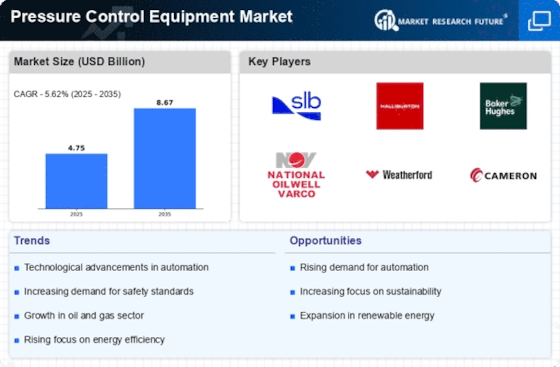
As per MRFR analysis, the Pressure Control Equipment Market was estimated at 4.75 USD Billion in 2024. The Pressure Control Equipment industry is projected to grow from 5.017 USD Billion in 2025 to 8.669 USD Billion by 2035, exhibiting a compound annual growth rate (CAGR) of 5.62 during the forecast period 2025 - 2035.

Key Market Trends & Highlights

The Pressure Control Equipment Market is poised for substantial growth driven by technological advancements and increasing demand across various sectors.

  • Technological advancements are reshaping the Pressure Control Equipment Market, enhancing efficiency and reliability.
  • North America remains the largest market, while Asia-Pacific is emerging as the fastest-growing region for pressure control solutions.
  • Valves dominate the market as the largest segment, whereas Quick Unions are experiencing rapid growth due to their versatility.
  • Key market drivers include rising energy demand and regulatory compliance, which are propelling investments in pressure control technologies.

Market Size & Forecast

2024 Market Size 4.75 (USD Billion)
2035 Market Size 8.669 (USD Billion)
CAGR (2025 - 2035) 5.62%
Largest Regional Market Share in 2024 North America

Major Players

<p>Schlumberger (US), Halliburton (US), Baker Hughes (US), National Oilwell Varco (US), Weatherford International (IE), Cameron International (US), Aker Solutions (NO), Emerson Electric (US), Parker Hannifin (US)</p>

Market Trends

The Pressure Control Equipment Market is currently experiencing a dynamic evolution, driven by various factors that influence its growth trajectory. The increasing demand for safety and efficiency in industrial operations has led to a heightened focus on advanced pressure control solutions. Industries such as oil and gas, chemical processing, and manufacturing are particularly reliant on these systems to maintain operational integrity and prevent hazardous situations. Furthermore, the ongoing advancements in technology are facilitating the development of innovative pressure control devices that enhance performance and reliability. As a result, stakeholders are increasingly investing in research and development to create more sophisticated equipment that meets the stringent regulatory standards and operational requirements of diverse sectors. In addition to technological advancements, the Pressure Control Equipment Market is also shaped by the growing emphasis on sustainability and environmental responsibility. Companies are seeking to minimize their carbon footprint and optimize resource utilization, which has led to the adoption of eco-friendly pressure control solutions. This trend is further supported by government initiatives aimed at promoting sustainable practices across industries. As the market continues to evolve, it appears that the integration of smart technologies and automation will play a crucial role in shaping the future landscape of pressure control equipment, potentially leading to enhanced efficiency and reduced operational costs for end-users.

Technological Advancements

The Pressure Control Equipment Market is witnessing a surge in technological innovations, with manufacturers focusing on developing smart and automated solutions. These advancements aim to improve operational efficiency and enhance safety measures in various industries.

Sustainability Initiatives

There is a growing trend towards sustainability within the Pressure Control Equipment Market, as companies prioritize eco-friendly practices. This shift is driven by regulatory pressures and the need to reduce environmental impact, leading to the adoption of greener technologies.

Increased Demand in Emerging Markets

Emerging markets are showing a rising demand for pressure control equipment, fueled by industrialization and infrastructure development. This trend indicates a potential for growth as these regions invest in modernizing their industrial capabilities.

Pressure Control Equipment Market Market Drivers

Growth of Renewable Energy Sector

The Pressure Control Equipment Market is witnessing growth due to the expansion of the renewable energy sector. As countries invest in sustainable energy sources such as wind and solar, the need for reliable pressure control systems becomes paramount. These systems are essential for managing the variable nature of renewable energy production, ensuring stability and efficiency. The market for pressure control equipment in renewable applications is expected to grow by approximately 20% over the next few years, reflecting the increasing integration of renewable sources into the energy mix. This trend indicates a shift towards more sustainable practices within the Pressure Control Equipment Market.

Regulatory Compliance and Safety Standards

The Pressure Control Equipment Market is significantly influenced by stringent regulatory compliance and safety standards. Governments and regulatory bodies are increasingly mandating the use of advanced pressure control systems to ensure safety in various sectors, including energy and manufacturing. Compliance with these regulations not only mitigates risks but also enhances operational efficiency. The market is expected to see a rise in demand for equipment that meets these standards, with an estimated growth rate of 15% in the next few years. This trend underscores the importance of safety and compliance in the Pressure Control Equipment Market.

Rising Energy Demand and Resource Management

The Pressure Control Equipment Market is driven by the rising energy demand and the need for efficient resource management. As populations grow and industrial activities expand, the demand for energy continues to escalate. This has led to an increased focus on optimizing pressure control systems to enhance energy efficiency and reduce waste. The market is projected to grow at a compound annual growth rate of 10%, driven by the need for effective pressure management in energy production and distribution. This trend highlights the critical role of pressure control equipment in meeting energy demands within the Pressure Control Equipment Market.

Increased Investment in Infrastructure Development

The Pressure Control Equipment Market is benefiting from increased investment in infrastructure development across various sectors. Governments and private entities are allocating substantial resources to enhance infrastructure, particularly in energy, water, and transportation. This investment is likely to drive demand for advanced pressure control systems that ensure operational efficiency and safety. The market is anticipated to grow by 12% as infrastructure projects necessitate the implementation of reliable pressure management solutions. This trend emphasizes the critical role of pressure control equipment in supporting infrastructure development within the Pressure Control Equipment Market.

Technological Innovations in Pressure Control Equipment

The Pressure Control Equipment Market is experiencing a surge in technological innovations that enhance efficiency and reliability. Advanced materials and smart technologies are being integrated into pressure control systems, allowing for real-time monitoring and automated adjustments. This trend is likely to improve operational safety and reduce downtime, which is crucial for industries such as oil and gas, chemical processing, and water management. According to recent data, the adoption of smart pressure control solutions is projected to grow by over 25% in the next five years, indicating a strong shift towards automation and digitalization in the Pressure Control Equipment Market.

Market Segment Insights

By Component: Valves (Largest) vs. Quick Unions (Fastest-Growing)

<p>The Pressure Control Equipment Market exhibits a diverse distribution among its key components. Valves hold the largest share due to their critical role in ensuring pressure regulation and safety in various applications. Quick Unions follow as a rapidly growing segment, driven by their ease of use and increasing demand in unconventional oil and gas production. Additionally, adapters and flow trees remain essential for specific applications, contributing to the overall market share.</p>

<p>Quick Unions (Emerging) vs. Valves (Dominant)</p>

<p>Quick Unions have emerged as a crucial element within the Pressure Control Equipment Market, offering considerable advantages such as ease of installation and the ability to facilitate rapid connection and disconnection in pressure systems. Their growing adoption in industries focusing on efficiency has positioned them as a fast-growing segment. Conversely, Valves have established themselves as the dominant component due to their versatility and superior reliability across several applications, including oil and gas, chemical processing, and water management. The demand for precision and automation in these sectors has further solidified the significant market presence of valves.</p>

By Type: High (Largest) vs. Low (Fastest-Growing)

<p>In the Pressure Control Equipment Market, the market share distribution among the 'Type' segment reveals a significant presence of High pressure control equipment, taking up a larger proportion of the overall market. This category, due to its extensive applications in various industries such as oil and gas, effectively meets the demanding requirements for high-pressure scenarios, securing its position as the prevailing choice among consumers. Conversely, Low pressure control equipment is gaining traction, appealing to specific sectors where moderate pressure management is adequate, thus allowing it to carve out a growing niche.</p>

<p>Pressure Control Equipment Market: High (Dominant) vs. Low (Emerging)</p>

<p>High pressure control equipment is recognized for its robustness and dependability, making it essential in high-stakes applications such as drilling and production in the oil and gas sector. This segment predominantly benefits from ongoing technological advancements and stringent safety regulations, driving its sustained dominance in the market. On the other hand, Low pressure control equipment is quickly establishing itself as an emerging alternative for industries that prioritize cost-effectiveness and energy efficiency. Driven by the demand for sustainable solutions, low pressure systems often find favor in lighter applications, demonstrating significant growth potential as industries seek to optimize operations without compromising safety and performance.</p>

By Application: Onshore (Largest) vs. Offshore (Fastest-Growing)

<p>The Pressure Control Equipment Market is primarily dominated by the onshore application segment, which holds a significant share due to the extensive hydraulic fracturing and drilling operations in land-based locations. These operations, crucial for meeting energy demands, have fostered a steady demand for onshore pressure control equipment. In contrast, the offshore segment is rapidly gaining momentum. With oil and gas exploration moving towards deeper waters and harsher environments, there is a growing need for specialized pressure control solutions designed for offshore applications, contributing to its growing market presence. As the global energy landscape shifts, several trends are shaping the future of both onshore and offshore applications. Onshore operations are benefiting from technological advancements that enhance the efficiency and safety of pressure control equipment. Conversely, the offshore segment is driven by increasing investments in offshore drilling and exploration activities, particularly in regions like the North Sea and the Gulf of Mexico. The demand for safety and environmental regulations further propels the growth of innovative pressure control technologies tailored for offshore use, making it one of the fastest-growing markets in the industry.</p>

<p>Application: Onshore (Dominant) vs. Offshore (Emerging)</p>

<p>The onshore application remains the dominant force in the Pressure Control Equipment Market, characterized by its ability to serve a wide range of drilling operations across various geographical regions. Onshore operations benefit from established infrastructures and a strong focus on reducing operational costs, which translates to a higher demand for reliable pressure control systems. This segment often emphasizes efficiency, safety, and compatibility with advanced drilling technologies. In comparison, the offshore application segment, while emerging, is quickly becoming essential amid rising offshore exploration endeavors. Offshore pressure control equipment is designed to withstand extreme conditions and enhance operational safety. The increasing complexity of offshore projects necessitates advanced technology, pushing manufacturers to innovate. As oil companies seek new reserves and face stricter regulations, the ability of offshore pressure control systems to offer safety and reliability will likely position it as a critical player in the evolving market.</p>

Get more detailed insights about Pressure Control Equipment Market Research Report – Forecast till 2035

Regional Insights

North America : Market Leader in Innovation

North America remains the largest market for pressure control equipment, holding approximately 45% of the global share. The region's growth is driven by increasing oil and gas exploration activities, stringent safety regulations, and technological advancements. The U.S. is the primary contributor, supported by Canada, which ranks second with about 15% market share. Regulatory frameworks, such as the Environmental Protection Agency's standards, further catalyze demand for advanced pressure control solutions. The competitive landscape in North America is robust, featuring key players like Schlumberger, Halliburton, and Baker Hughes. These companies leverage innovative technologies and strategic partnerships to enhance their market presence. The region's focus on sustainable practices and efficiency in oil extraction processes is pushing the demand for advanced pressure control equipment, ensuring a dynamic market environment.

Europe : Emerging Market with Growth Potential

Europe is witnessing significant growth in the pressure control equipment market, accounting for approximately 25% of the global share. The region's expansion is fueled by increasing investments in renewable energy and stringent regulations aimed at reducing carbon emissions. Countries like Norway and the UK are leading the charge, with Norway holding about 10% of the market share, driven by its offshore oil and gas activities and commitment to sustainable practices. The competitive landscape in Europe is characterized by a mix of established players and emerging companies. Key players such as Weatherford International and Aker Solutions are focusing on innovation and sustainability to capture market share. The European market is also seeing increased collaboration between companies and governments to enhance safety standards and efficiency in pressure control technologies, positioning it for future growth.

Asia-Pacific : Rapid Growth in Emerging Economies

The Asia-Pacific region is rapidly emerging as a significant player in the pressure control equipment market, holding approximately 20% of the global share. The growth is primarily driven by increasing energy demands, particularly in countries like China and India, which are investing heavily in their oil and gas sectors. Regulatory support for energy efficiency and safety standards is also propelling market growth, with China leading the region with about 12% market share due to its extensive industrial base. The competitive landscape in Asia-Pacific is evolving, with both local and international players vying for market share. Companies like Emerson Electric and Parker Hannifin are expanding their operations in the region, focusing on innovative solutions tailored to local needs. The presence of a growing number of small and medium enterprises is also contributing to a dynamic market environment, fostering competition and innovation in pressure control technologies.

Middle East and Africa : Resource-Rich Market Dynamics

The Middle East and Africa region is a crucial player in the pressure control equipment market, accounting for approximately 10% of the global share. The region's growth is driven by its vast oil reserves and ongoing investments in infrastructure. Countries like Saudi Arabia and the UAE are at the forefront, with Saudi Arabia holding about 7% of the market share, supported by its Vision 2030 initiative aimed at diversifying the economy and enhancing energy efficiency. The competitive landscape in the Middle East and Africa is characterized by a mix of established oil giants and emerging local companies. Key players such as National Oilwell Varco and Cameron International are actively involved in the region, focusing on innovative solutions to meet the unique challenges of the market. The region's strategic importance in global energy supply chains ensures a continued demand for advanced pressure control equipment, fostering a competitive environment.

Key Players and Competitive Insights

The Pressure Control Equipment Market is currently characterized by a dynamic competitive landscape, driven by increasing demand for efficient and reliable pressure management solutions across various industries, including oil and gas, chemical processing, and power generation. Key players such as Schlumberger (US), Halliburton (US), and Baker Hughes (US) are strategically positioned to leverage their technological expertise and extensive service networks. These companies are focusing on innovation and digital transformation to enhance operational efficiency and reduce costs. Their collective strategies not only foster competition but also drive advancements in pressure control technologies, thereby shaping the market's future trajectory.

In terms of business tactics, companies are increasingly localizing manufacturing to reduce lead times and optimize supply chains. The market appears moderately fragmented, with several players vying for market share while also collaborating through strategic partnerships. This competitive structure allows for a diverse range of offerings, catering to the specific needs of various sectors, which in turn influences pricing strategies and service delivery models.

In August 2025, Halliburton (US) announced the launch of its new digital pressure control system, which integrates advanced analytics and machine learning to enhance real-time monitoring and decision-making capabilities. This strategic move is significant as it positions Halliburton at the forefront of digital innovation in pressure control, potentially improving operational safety and efficiency for its clients. The emphasis on digital solutions reflects a broader industry trend towards automation and data-driven decision-making.

In September 2025, Baker Hughes (US) expanded its partnership with a leading renewable energy firm to develop pressure control solutions tailored for offshore wind projects. This collaboration underscores Baker Hughes' commitment to diversifying its portfolio and addressing the growing demand for sustainable energy solutions. By aligning its offerings with renewable energy initiatives, Baker Hughes is likely to enhance its market presence and appeal to environmentally conscious clients.

In July 2025, Weatherford International (IE) completed the acquisition of a regional pressure control equipment manufacturer, which is expected to bolster its product offerings and market reach in Europe. This acquisition not only enhances Weatherford's competitive positioning but also reflects a trend of consolidation within the industry, as companies seek to strengthen their capabilities and expand their geographical footprint. Such strategic actions are indicative of a broader movement towards enhancing operational synergies and resource optimization.

As of October 2025, the competitive trends in the Pressure Control Equipment Market are increasingly defined by digitalization, sustainability, and the integration of artificial intelligence. Strategic alliances are becoming more prevalent, allowing companies to pool resources and expertise to innovate more effectively. Looking ahead, it is anticipated that competitive differentiation will evolve, shifting from traditional price-based competition to a focus on technological innovation, reliability in supply chains, and the ability to deliver sustainable solutions. This transition may redefine the competitive landscape, compelling companies to adapt and innovate continuously.

Key Companies in the Pressure Control Equipment Market market include

Industry Developments

October 2022: Emerson reported in October 2022 that a client in China had just purchased a three-millionth Fisher FIELDVUE electronic valve controller for application in their membrane facility's water treatment pressure control valve.

June 2022: Pressure Tech and Malaysian authorized distributor, ENE Petro Services Sdn Bhd, will celebrate an important milestone in Southeast Asia in June 2022.

June 2018: Baker Hughes, a GE firm, was granted a comprehensive well-servicing contract in June 2018 to support a substantial portion of Equinor's drill and pipeline-building activities for four years.

Future Outlook

Pressure Control Equipment Market Future Outlook

<p>The Pressure Control Equipment Market is projected to grow at a 5.62% CAGR from 2024 to 2035, driven by increasing industrial automation, safety regulations, and demand for energy efficiency.</p>

New opportunities lie in:

  • <p>Development of smart pressure control systems with IoT integration.</p>
  • <p>Expansion into renewable energy sectors for pressure management solutions.</p>
  • <p>Customized pressure control equipment for niche applications in pharmaceuticals.</p>

<p>By 2035, the market is expected to achieve robust growth, driven by innovation and diversification.</p>

Market Segmentation

Pressure Control Equipment Market Type Outlook

  • High
  • Low

Pressure Control Equipment Market Component Outlook

  • Quick Unions
  • Valves
  • Adapter flanges
  • Control Heads
  • Flow Trees

Pressure Control Equipment Market Application Outlook

  • Onshore
  • Offshore

Report Scope

MARKET SIZE 20244.75(USD Billion)
MARKET SIZE 20255.017(USD Billion)
MARKET SIZE 20358.669(USD Billion)
COMPOUND ANNUAL GROWTH RATE (CAGR)5.62% (2024 - 2035)
REPORT COVERAGERevenue Forecast, Competitive Landscape, Growth Factors, and Trends
BASE YEAR2024
Market Forecast Period2025 - 2035
Historical Data2019 - 2024
Market Forecast UnitsUSD Billion
Key Companies ProfiledMarket analysis in progress
Segments CoveredMarket segmentation analysis in progress
Key Market OpportunitiesIntegration of advanced automation technologies enhances efficiency in the Pressure Control Equipment Market.
Key Market DynamicsRising demand for automation in industrial processes drives innovation in pressure control equipment technology.
Countries CoveredNorth America, Europe, APAC, South America, MEA

FAQs

What is the projected market valuation of the Pressure Control Equipment Market by 2035?

The Pressure Control Equipment Market is projected to reach approximately 8.669 USD Billion by 2035.

What was the market valuation of the Pressure Control Equipment Market in 2024?

In 2024, the market valuation of the Pressure Control Equipment Market was 4.75 USD Billion.

What is the expected CAGR for the Pressure Control Equipment Market during the forecast period 2025 - 2035?

The expected CAGR for the Pressure Control Equipment Market during the forecast period 2025 - 2035 is 5.62%.

Which companies are considered key players in the Pressure Control Equipment Market?

Key players in the Pressure Control Equipment Market include Schlumberger, Halliburton, Baker Hughes, and National Oilwell Varco.

What are the projected valuations for the different components of the Pressure Control Equipment Market?

Projected valuations for components include Quick Unions at 1.68 USD Billion, Valves at 2.12 USD Billion, and Control Heads at 1.5 USD Billion by 2035.

How does the market valuation for onshore applications compare to offshore applications in 2035?

By 2035, the market valuation for onshore applications is projected to be 4.95 USD Billion, while offshore applications are expected to reach 3.72 USD Billion.

  1. SECTION I: EXECUTIVE SUMMARY AND KEY HIGHLIGHTS
    1. EXECUTIVE SUMMARY
      1. Market Overview
      2. Key Findings
      3. Market Segmentation
      4. Competitive Landscape
      5. Challenges and Opportunities
      6. Future Outlook
  2. SECTION II: SCOPING, METHODOLOGY AND MARKET STRUCTURE
    1. MARKET INTRODUCTION
      1. Definition
      2. Scope of the study
    2. RESEARCH METHODOLOGY
      1. Overview
      2. Data Mining
      3. Secondary Research
      4. Primary Research
      5. Forecasting Model
      6. Market Size Estimation
      7. Data Triangulation
      8. Validation
  3. SECTION III: QUALITATIVE ANALYSIS
    1. MARKET DYNAMICS
      1. Overview
      2. Drivers
      3. Restraints
      4. Opportunities
    2. MARKET FACTOR ANALYSIS
      1. Value chain Analysis
      2. Porter's Five Forces Analysis
      3. COVID-19 Impact Analysis
  4. SECTION IV: QUANTITATIVE ANALYSIS
    1. Semiconductor & Electronics, BY Component (USD Billion)
      1. Quick Unions
      2. Valves
      3. Adapter flanges
      4. Control Heads
      5. Flow Trees
    2. Semiconductor & Electronics, BY Type (USD Billion)
      1. High
      2. Low
    3. Semiconductor & Electronics, BY Application (USD Billion)
      1. Onshore
      2. Offshore
    4. Semiconductor & Electronics, BY Region (USD Billion)
      1. North America
      2. Europe
      3. APAC
      4. South America
      5. MEA
  5. SECTION V: COMPETITIVE ANALYSIS
    1. Competitive Landscape
      1. Overview
      2. Competitive Analysis
      3. Market share Analysis
      4. Major Growth Strategy in the Semiconductor & Electronics
      5. Competitive Benchmarking
      6. Leading Players in Terms of Number of Developments in the Semiconductor & Electronics
      7. Key developments and growth strategies
      8. Major Players Financial Matrix
    2. Company Profiles
      1. Schlumberger (US)
      2. Halliburton (US)
      3. Baker Hughes (US)
      4. National Oilwell Varco (US)
      5. Weatherford International (IE)
      6. Cameron International (US)
      7. Aker Solutions (NO)
      8. Emerson Electric (US)
      9. Parker Hannifin (US)
    3. Appendix
      1. References
      2. Related Reports
  6. LIST OF FIGURES
    1. MARKET SYNOPSIS
    2. NORTH AMERICA MARKET ANALYSIS
    3. US MARKET ANALYSIS BY COMPONENT
    4. US MARKET ANALYSIS BY TYPE
    5. US MARKET ANALYSIS BY APPLICATION
    6. CANADA MARKET ANALYSIS BY COMPONENT
    7. CANADA MARKET ANALYSIS BY TYPE
    8. CANADA MARKET ANALYSIS BY APPLICATION
    9. EUROPE MARKET ANALYSIS
    10. GERMANY MARKET ANALYSIS BY COMPONENT
    11. GERMANY MARKET ANALYSIS BY TYPE
    12. GERMANY MARKET ANALYSIS BY APPLICATION
    13. UK MARKET ANALYSIS BY COMPONENT
    14. UK MARKET ANALYSIS BY TYPE
    15. UK MARKET ANALYSIS BY APPLICATION
    16. FRANCE MARKET ANALYSIS BY COMPONENT
    17. FRANCE MARKET ANALYSIS BY TYPE
    18. FRANCE MARKET ANALYSIS BY APPLICATION
    19. RUSSIA MARKET ANALYSIS BY COMPONENT
    20. RUSSIA MARKET ANALYSIS BY TYPE
    21. RUSSIA MARKET ANALYSIS BY APPLICATION
    22. ITALY MARKET ANALYSIS BY COMPONENT
    23. ITALY MARKET ANALYSIS BY TYPE
    24. ITALY MARKET ANALYSIS BY APPLICATION
    25. SPAIN MARKET ANALYSIS BY COMPONENT
    26. SPAIN MARKET ANALYSIS BY TYPE
    27. SPAIN MARKET ANALYSIS BY APPLICATION
    28. REST OF EUROPE MARKET ANALYSIS BY COMPONENT
    29. REST OF EUROPE MARKET ANALYSIS BY TYPE
    30. REST OF EUROPE MARKET ANALYSIS BY APPLICATION
    31. APAC MARKET ANALYSIS
    32. CHINA MARKET ANALYSIS BY COMPONENT
    33. CHINA MARKET ANALYSIS BY TYPE
    34. CHINA MARKET ANALYSIS BY APPLICATION
    35. INDIA MARKET ANALYSIS BY COMPONENT
    36. INDIA MARKET ANALYSIS BY TYPE
    37. INDIA MARKET ANALYSIS BY APPLICATION
    38. JAPAN MARKET ANALYSIS BY COMPONENT
    39. JAPAN MARKET ANALYSIS BY TYPE
    40. JAPAN MARKET ANALYSIS BY APPLICATION
    41. SOUTH KOREA MARKET ANALYSIS BY COMPONENT
    42. SOUTH KOREA MARKET ANALYSIS BY TYPE
    43. SOUTH KOREA MARKET ANALYSIS BY APPLICATION
    44. MALAYSIA MARKET ANALYSIS BY COMPONENT
    45. MALAYSIA MARKET ANALYSIS BY TYPE
    46. MALAYSIA MARKET ANALYSIS BY APPLICATION
    47. THAILAND MARKET ANALYSIS BY COMPONENT
    48. THAILAND MARKET ANALYSIS BY TYPE
    49. THAILAND MARKET ANALYSIS BY APPLICATION
    50. INDONESIA MARKET ANALYSIS BY COMPONENT
    51. INDONESIA MARKET ANALYSIS BY TYPE
    52. INDONESIA MARKET ANALYSIS BY APPLICATION
    53. REST OF APAC MARKET ANALYSIS BY COMPONENT
    54. REST OF APAC MARKET ANALYSIS BY TYPE
    55. REST OF APAC MARKET ANALYSIS BY APPLICATION
    56. SOUTH AMERICA MARKET ANALYSIS
    57. BRAZIL MARKET ANALYSIS BY COMPONENT
    58. BRAZIL MARKET ANALYSIS BY TYPE
    59. BRAZIL MARKET ANALYSIS BY APPLICATION
    60. MEXICO MARKET ANALYSIS BY COMPONENT
    61. MEXICO MARKET ANALYSIS BY TYPE
    62. MEXICO MARKET ANALYSIS BY APPLICATION
    63. ARGENTINA MARKET ANALYSIS BY COMPONENT
    64. ARGENTINA MARKET ANALYSIS BY TYPE
    65. ARGENTINA MARKET ANALYSIS BY APPLICATION
    66. REST OF SOUTH AMERICA MARKET ANALYSIS BY COMPONENT
    67. REST OF SOUTH AMERICA MARKET ANALYSIS BY TYPE
    68. REST OF SOUTH AMERICA MARKET ANALYSIS BY APPLICATION
    69. MEA MARKET ANALYSIS
    70. GCC COUNTRIES MARKET ANALYSIS BY COMPONENT
    71. GCC COUNTRIES MARKET ANALYSIS BY TYPE
    72. GCC COUNTRIES MARKET ANALYSIS BY APPLICATION
    73. SOUTH AFRICA MARKET ANALYSIS BY COMPONENT
    74. SOUTH AFRICA MARKET ANALYSIS BY TYPE
    75. SOUTH AFRICA MARKET ANALYSIS BY APPLICATION
    76. REST OF MEA MARKET ANALYSIS BY COMPONENT
    77. REST OF MEA MARKET ANALYSIS BY TYPE
    78. REST OF MEA MARKET ANALYSIS BY APPLICATION
    79. KEY BUYING CRITERIA OF SEMICONDUCTOR & ELECTRONICS
    80. RESEARCH PROCESS OF MRFR
    81. DRO ANALYSIS OF SEMICONDUCTOR & ELECTRONICS
    82. DRIVERS IMPACT ANALYSIS: SEMICONDUCTOR & ELECTRONICS
    83. RESTRAINTS IMPACT ANALYSIS: SEMICONDUCTOR & ELECTRONICS
    84. SUPPLY / VALUE CHAIN: SEMICONDUCTOR & ELECTRONICS
    85. SEMICONDUCTOR & ELECTRONICS, BY COMPONENT, 2024 (% SHARE)
    86. SEMICONDUCTOR & ELECTRONICS, BY COMPONENT, 2024 TO 2035 (USD Billion)
    87. SEMICONDUCTOR & ELECTRONICS, BY TYPE, 2024 (% SHARE)
    88. SEMICONDUCTOR & ELECTRONICS, BY TYPE, 2024 TO 2035 (USD Billion)
    89. SEMICONDUCTOR & ELECTRONICS, BY APPLICATION, 2024 (% SHARE)
    90. SEMICONDUCTOR & ELECTRONICS, BY APPLICATION, 2024 TO 2035 (USD Billion)
    91. BENCHMARKING OF MAJOR COMPETITORS
  7. LIST OF TABLES
    1. LIST OF ASSUMPTIONS
    2. North America MARKET SIZE ESTIMATES; FORECAST
      1. BY COMPONENT, 2025-2035 (USD Billion)
      2. BY TYPE, 2025-2035 (USD Billion)
      3. BY APPLICATION, 2025-2035 (USD Billion)
    3. US MARKET SIZE ESTIMATES; FORECAST
      1. BY COMPONENT, 2025-2035 (USD Billion)
      2. BY TYPE, 2025-2035 (USD Billion)
      3. BY APPLICATION, 2025-2035 (USD Billion)
    4. Canada MARKET SIZE ESTIMATES; FORECAST
      1. BY COMPONENT, 2025-2035 (USD Billion)
      2. BY TYPE, 2025-2035 (USD Billion)
      3. BY APPLICATION, 2025-2035 (USD Billion)
    5. Europe MARKET SIZE ESTIMATES; FORECAST
      1. BY COMPONENT, 2025-2035 (USD Billion)
      2. BY TYPE, 2025-2035 (USD Billion)
      3. BY APPLICATION, 2025-2035 (USD Billion)
    6. Germany MARKET SIZE ESTIMATES; FORECAST
      1. BY COMPONENT, 2025-2035 (USD Billion)
      2. BY TYPE, 2025-2035 (USD Billion)
      3. BY APPLICATION, 2025-2035 (USD Billion)
    7. UK MARKET SIZE ESTIMATES; FORECAST
      1. BY COMPONENT, 2025-2035 (USD Billion)
      2. BY TYPE, 2025-2035 (USD Billion)
      3. BY APPLICATION, 2025-2035 (USD Billion)
    8. France MARKET SIZE ESTIMATES; FORECAST
      1. BY COMPONENT, 2025-2035 (USD Billion)
      2. BY TYPE, 2025-2035 (USD Billion)
      3. BY APPLICATION, 2025-2035 (USD Billion)
    9. Russia MARKET SIZE ESTIMATES; FORECAST
      1. BY COMPONENT, 2025-2035 (USD Billion)
      2. BY TYPE, 2025-2035 (USD Billion)
      3. BY APPLICATION, 2025-2035 (USD Billion)
    10. Italy MARKET SIZE ESTIMATES; FORECAST
      1. BY COMPONENT, 2025-2035 (USD Billion)
      2. BY TYPE, 2025-2035 (USD Billion)
      3. BY APPLICATION, 2025-2035 (USD Billion)
    11. Spain MARKET SIZE ESTIMATES; FORECAST
      1. BY COMPONENT, 2025-2035 (USD Billion)
      2. BY TYPE, 2025-2035 (USD Billion)
      3. BY APPLICATION, 2025-2035 (USD Billion)
    12. Rest of Europe MARKET SIZE ESTIMATES; FORECAST
      1. BY COMPONENT, 2025-2035 (USD Billion)
      2. BY TYPE, 2025-2035 (USD Billion)
      3. BY APPLICATION, 2025-2035 (USD Billion)
    13. APAC MARKET SIZE ESTIMATES; FORECAST
      1. BY COMPONENT, 2025-2035 (USD Billion)
      2. BY TYPE, 2025-2035 (USD Billion)
      3. BY APPLICATION, 2025-2035 (USD Billion)
    14. China MARKET SIZE ESTIMATES; FORECAST
      1. BY COMPONENT, 2025-2035 (USD Billion)
      2. BY TYPE, 2025-2035 (USD Billion)
      3. BY APPLICATION, 2025-2035 (USD Billion)
    15. India MARKET SIZE ESTIMATES; FORECAST
      1. BY COMPONENT, 2025-2035 (USD Billion)
      2. BY TYPE, 2025-2035 (USD Billion)
      3. BY APPLICATION, 2025-2035 (USD Billion)
    16. Japan MARKET SIZE ESTIMATES; FORECAST
      1. BY COMPONENT, 2025-2035 (USD Billion)
      2. BY TYPE, 2025-2035 (USD Billion)
      3. BY APPLICATION, 2025-2035 (USD Billion)
    17. South Korea MARKET SIZE ESTIMATES; FORECAST
      1. BY COMPONENT, 2025-2035 (USD Billion)
      2. BY TYPE, 2025-2035 (USD Billion)
      3. BY APPLICATION, 2025-2035 (USD Billion)
    18. Malaysia MARKET SIZE ESTIMATES; FORECAST
      1. BY COMPONENT, 2025-2035 (USD Billion)
      2. BY TYPE, 2025-2035 (USD Billion)
      3. BY APPLICATION, 2025-2035 (USD Billion)
    19. Thailand MARKET SIZE ESTIMATES; FORECAST
      1. BY COMPONENT, 2025-2035 (USD Billion)
      2. BY TYPE, 2025-2035 (USD Billion)
      3. BY APPLICATION, 2025-2035 (USD Billion)
    20. Indonesia MARKET SIZE ESTIMATES; FORECAST
      1. BY COMPONENT, 2025-2035 (USD Billion)
      2. BY TYPE, 2025-2035 (USD Billion)
      3. BY APPLICATION, 2025-2035 (USD Billion)
    21. Rest of APAC MARKET SIZE ESTIMATES; FORECAST
      1. BY COMPONENT, 2025-2035 (USD Billion)
      2. BY TYPE, 2025-2035 (USD Billion)
      3. BY APPLICATION, 2025-2035 (USD Billion)
    22. South America MARKET SIZE ESTIMATES; FORECAST
      1. BY COMPONENT, 2025-2035 (USD Billion)
      2. BY TYPE, 2025-2035 (USD Billion)
      3. BY APPLICATION, 2025-2035 (USD Billion)
    23. Brazil MARKET SIZE ESTIMATES; FORECAST
      1. BY COMPONENT, 2025-2035 (USD Billion)
      2. BY TYPE, 2025-2035 (USD Billion)
      3. BY APPLICATION, 2025-2035 (USD Billion)
    24. Mexico MARKET SIZE ESTIMATES; FORECAST
      1. BY COMPONENT, 2025-2035 (USD Billion)
      2. BY TYPE, 2025-2035 (USD Billion)
      3. BY APPLICATION, 2025-2035 (USD Billion)
    25. Argentina MARKET SIZE ESTIMATES; FORECAST
      1. BY COMPONENT, 2025-2035 (USD Billion)
      2. BY TYPE, 2025-2035 (USD Billion)
      3. BY APPLICATION, 2025-2035 (USD Billion)
    26. Rest of South America MARKET SIZE ESTIMATES; FORECAST
      1. BY COMPONENT, 2025-2035 (USD Billion)
      2. BY TYPE, 2025-2035 (USD Billion)
      3. BY APPLICATION, 2025-2035 (USD Billion)
    27. MEA MARKET SIZE ESTIMATES; FORECAST
      1. BY COMPONENT, 2025-2035 (USD Billion)
      2. BY TYPE, 2025-2035 (USD Billion)
      3. BY APPLICATION, 2025-2035 (USD Billion)
    28. GCC Countries MARKET SIZE ESTIMATES; FORECAST
      1. BY COMPONENT, 2025-2035 (USD Billion)
      2. BY TYPE, 2025-2035 (USD Billion)
      3. BY APPLICATION, 2025-2035 (USD Billion)
    29. South Africa MARKET SIZE ESTIMATES; FORECAST
      1. BY COMPONENT, 2025-2035 (USD Billion)
      2. BY TYPE, 2025-2035 (USD Billion)
      3. BY APPLICATION, 2025-2035 (USD Billion)
    30. Rest of MEA MARKET SIZE ESTIMATES; FORECAST
      1. BY COMPONENT, 2025-2035 (USD Billion)
      2. BY TYPE, 2025-2035 (USD Billion)
      3. BY APPLICATION, 2025-2035 (USD Billion)
    31. PRODUCT LAUNCH/PRODUCT DEVELOPMENT/APPROVAL
    32. ACQUISITION/PARTNERSHIP

Pressure Control Equipment Market Segmentation

Pressure Control Equipment Component Outlook (USD Billion, 2018-2032)

Quick unions

Valves

Adapter flanges

Control heads

Flow tee

Pressure Control Equipment Type Outlook (USD Billion, 2018-2032)

Low

High

Pressure Control Equipment Application Outlook (USD Billion, 2018-2032)

Offshore

Onshore

Pressure Control Equipment Regional Outlook (USD Billion, 2018-2032)

North America Outlook (USD Billion, 2018-2032)

North America Pressure Control Equipment by Component

Quick unions

Valves

Adapter flanges

Control heads

Flow tee

North America Pressure Control Equipment by Type

Low

High

North America Pressure Control Equipment by Application

Offshore

Onshore

US Outlook (USD Billion, 2018-2032)

US Pressure Control Equipment by Component

Quick unions

Valves

Adapter flanges

Control heads

Flow tee

US Pressure Control Equipment by Type

Low

High

US Pressure Control Equipment by Application

Offshore

Onshore

Canada Outlook (USD Billion, 2018-2032)

Canada Pressure Control Equipment by Component

Quick unions

Valves

Adapter flanges

Control heads

Flow tee

Canada Pressure Control Equipment by Type

Low

High

Canada Pressure Control Equipment by Application

Offshore

Onshore

Europe Outlook (USD Billion, 2018-2032)

Europe Pressure Control Equipment by Component

Quick unions

Valves

Adapter flanges

Control heads

Flow tee

Europe Pressure Control Equipment by Type

Low

High

Europe Pressure Control Equipment by Application

Offshore

Onshore

Germany Outlook (USD Billion, 2018-2032)

Germany Pressure Control Equipment by Component

Quick unions

Valves

Adapter flanges

Control heads

Flow tee

Germany Pressure Control Equipment by Type

Low

High

Germany Pressure Control Equipment by Application

Offshore

Onshore

France Outlook (USD Billion, 2018-2032)

France Pressure Control Equipment by Component

Quick unions

Valves

Adapter flanges

Control heads

Flow tee

France Pressure Control Equipment by Type

Low

High

France Pressure Control Equipment by Application

Offshore

Onshore

UK Outlook (USD Billion, 2018-2032)

UK Pressure Control Equipment by Component

Quick unions

Valves

Adapter flanges

Control heads

Flow tee

UK Pressure Control Equipment by Type

Low

High

UK Pressure Control Equipment by Application

Offshore

Onshore

Italy Outlook (USD Billion, 2018-2032)

Italy Pressure Control Equipment by Component

Quick unions

Valves

Adapter flanges

Control heads

Flow tee

Italy Pressure Control Equipment by Type

Low

High

Italy Pressure Control Equipment by Application

Offshore

Onshore

Spain Outlook (USD Billion, 2018-2032)

Spain Pressure Control Equipment by Component

Quick unions

Valves

Adapter flanges

Control heads

Flow tee

Spain Pressure Control Equipment by Type

Low

High

Spain Pressure Control Equipment by Application

Offshore

Onshore

Rest Of Europe Outlook (USD Billion, 2018-2032)

Rest Of Europe Pressure Control Equipment by Component

Quick unions

Valves

Adapter flanges

Control heads

Flow tee

Rest Of Europe Pressure Control Equipment by Type

Low

High

Rest Of Europe Pressure Control Equipment by Application

Offshore

Onshore

Asia-Pacific Outlook (USD Billion, 2018-2032)

Asia-Pacific Pressure Control Equipment by Component

Quick unions

Valves

Adapter flanges

Control heads

Flow tee

Asia-Pacific Pressure Control Equipment by Type

Low

High

Asia-Pacific Pressure Control Equipment by Application

Offshore

Onshore

China Outlook (USD Billion, 2018-2032)

China Pressure Control Equipment by Component

Quick unions

Valves

Adapter flanges

Control heads

Flow tee

China Pressure Control Equipment by Type

Low

High

China Pressure Control Equipment by Application

Offshore

Onshore

Japan Outlook (USD Billion, 2018-2032)

Japan Pressure Control Equipment by Component

Quick unions

Valves

Adapter flanges

Control heads

Flow tee

Japan Pressure Control Equipment by Type

Low

High

Japan Pressure Control Equipment by Application

Offshore

Onshore

India Outlook (USD Billion, 2018-2032)

India Pressure Control Equipment by Component

Quick unions

Valves

Adapter flanges

Control heads

Flow tee

India Pressure Control Equipment by Type

Low

High

India Pressure Control Equipment by Application

Offshore

Onshore

Australia Outlook (USD Billion, 2018-2032)

Australia Pressure Control Equipment by Component

Quick unions

Valves

Adapter flanges

Control heads

Flow tee

Australia Pressure Control Equipment by Type

Low

High

Australia Pressure Control Equipment by Application

Offshore

Onshore

Rest of Asia-Pacific Outlook (USD Billion, 2018-2032)

Rest of Asia-Pacific Pressure Control Equipment by Component

Quick unions

Valves

Adapter flanges

Control heads

Flow tee

Rest of Asia-Pacific Pressure Control Equipment by Type

Low

High

Rest of Asia-Pacific Pressure Control Equipment by Application

Offshore

Onshore

Rest of the World Outlook (USD Billion, 2018-2032)

Rest of the World Pressure Control Equipment by Component

Quick unions

Valves

Adapter flanges

Control heads

Flow tee

Rest of the World Pressure Control Equipment by Type

Low

High

Rest of the World Pressure Control Equipment by Application

Offshore

Onshore

Middle East Outlook (USD Billion, 2018-2032)

Middle East Pressure Control Equipment by Component

Quick unions

Valves

Adapter flanges

Control heads

Flow tee

Middle East Pressure Control Equipment by Type

Low

High

Middle East Pressure Control Equipment by Application

Offshore

Onshore

Africa Outlook (USD Billion, 2018-2032)

Africa Pressure Control Equipment by Component

Quick unions

Valves

Adapter flanges

Control heads

Flow tee

Africa Pressure Control Equipment by Type

Low

High

Africa Pressure Control Equipment by Application

Offshore

Onshore

Latin America Outlook (USD Billion, 2018-2032)

Latin America Pressure Control Equipment by Component

Quick unions

Valves

Adapter flanges

Control heads

Flow tee

Latin America Pressure Control Equipment by Type

Low

High

Latin America Pressure Control Equipment by Application

Offshore

Onshore


Infographic

Free Sample Request

Kindly complete the form below to receive a free sample of this Report

Get Free Sample

Customer Strories

Compare Licence

×
Features License Type
Single User Multiuser License Enterprise User
Price $4,950 $5,950 $7,250
Maximum User Access Limit 1 User Upto 10 Users Unrestricted Access Throughout the Organization
Free Customization
Direct Access to Analyst
Deliverable Format
Platform Access
Discount on Next Purchase 10% 15% 15%
Printable Versions