Request Free Sample ×

Kindly complete the form below to receive a free sample of this Report

* Please use a valid business email

Leading companies partner with us for data-driven Insights

clients tt-cursor
Hero Background
English
Chinese
French
Japanese
Korean
German
Spanish

Powersports Market Size

ID: MRFR/AT/0375-CR
188 Pages
Triveni Bhoyar
August 2025

Powersports Market Size, Share & Growth Analysis Report By Type (All-Terrain Vehicles, Side-by-Side, Snowmobiles, Watercraft and Heavyweight Motorcycle), By Application (Off-Road, On-Road and Snow), By Model (Sit-Down and Stand-up) - Trends & Industry Forecast to 2035

Share:
Download PDF ×

We do not share your information with anyone. However, we may send you emails based on your report interest from time to time. You may contact us at any time to opt-out.

Powersports Market Infographic
Purchase Options

Powersports Size

Powersports Market Growth Projections and Opportunities

Sales of ATVs, UTVs, and motorcycles are predicted to experience significant growth, thanks to rapid technological advancements in these products. Major players in North America, such as Honda Motor Co., Ltd., and Yamaha Motor Co., Ltd, are concentrating on product development to attract more customers. For example, in 2018, Honda Motor Co., Ltd introduced the 2019 Side-by-Side/ATV Models TRX 250X and TRX90X. Similarly, during the same year, Yamaha Motor Co., Ltd launched a new mid-class ATV, the 2019 Kodiak 450, featuring a four-stroke, two-valve, liquid-cooled SOHC 421 cc engine. Moreover, manufacturers of powersport products are expanding their presence in the US, Canada, and Mexico by establishing bases in these countries.

The thriving tourism industry and the increasing number of experience zones are anticipated to stimulate the production of powersports and components. Key manufacturers in North America are making substantial investments in developing various products and aftermarket services to enrich their product portfolio and gain a competitive advantage over their peers in the market. In conclusion, it can be inferred that innovation in powersports products is poised to generate growth opportunities for players in the North America powersports market throughout the forecast period.

The powersports industry in North America is witnessing a surge in product development, with companies like Honda and Yamaha leading the way. These developments aim to offer consumers advanced and exciting options in ATVs, UTVs, and motorcycles. For instance, Honda's introduction of the 2019 Side-by-Side/ATV Models TRX 250X and TRX90X and Yamaha's launch of the 2019 Kodiak 450 showcase the commitment to technological innovation and meeting the diverse needs of riders.

Furthermore, the strategic focus on expanding manufacturing and operational bases in the US, Canada, and Mexico reflects the industry's acknowledgment of the growing market in North America. Establishing a local presence allows these companies to cater more efficiently to the needs of the regional market, fostering growth and competitiveness.

The tourism sector's upward trajectory in North America plays a pivotal role in driving the demand for powersports vehicles. The industry's growth, coupled with the rising popularity of experience zones, creates a favorable environment for increased production of powersports and related components. Manufacturers are recognizing this trend and directing their investments towards product diversification and aftermarket services, ensuring they remain at the forefront of market competition.

In essence, the North America powersports market is not only witnessing technological advancements and product innovations but also benefiting from a strategic expansion of manufacturing capabilities. These efforts collectively contribute to an optimistic outlook for the industry, presenting new opportunities for growth and market leadership in the coming years.

Powersports Market Size Graph
Author
Author Profile
Triveni Bhoyar
Senior Research Analyst

Triveni Bhoyar has over 5 years of experience in the market research industry, specializing in the Automotive and Aerospace & Defense sectors. She has contributed to 200+ reports, including numerous custom projects for leading global companies, delivering solutions to complex business challenges. Renowned for her ability to generate valuable insights, Triveni excels in addressing unique market dynamics with precision and depth. Her expertise spans market sizing, competitive intelligence, and trend analysis, enabling clients to craft data-driven growth strategies. With strong analytical rigor and a client-centric approach, she plays a pivotal role in driving impactful, strategic decision-making.

Leave a Comment

FAQs

What is the current valuation of the Powersports Market as of 2024?

<p>The Powersports Market was valued at 21.95 USD Billion in 2024.</p>

What is the projected market valuation for the Powersports Market in 2035?

<p>The market is projected to reach 44.57 USD Billion by 2035.</p>

What is the expected CAGR for the Powersports Market during the forecast period 2025 - 2035?

<p>The expected CAGR for the Powersports Market during 2025 - 2035 is 6.65%.</p>

Which companies are considered key players in the Powersports Market?

<p>Key players include Polaris Industries, BRP Inc., Yamaha Motor Co., Kawasaki Heavy Industries, Honda Motor Co., Harley-Davidson, Suzuki Motor Corporation, and Can-Am.</p>

What are the main segments of the Powersports Market?

<p>The main segments include Type and Application, with specific categories such as New Energy Engine, Diesel, Gasoline, Passenger Vehicles, and Commercial Cars.</p>

How much is the New Energy Engine segment projected to grow by 2035?

<p>The New Energy Engine segment is projected to grow from 3.29 USD Billion in 2024 to 8.91 USD Billion by 2035.</p>

What is the projected growth for the Diesel segment in the Powersports Market?

<p>The Diesel segment is expected to increase from 5.24 USD Billion in 2024 to 10.56 USD Billion by 2035.</p>

What is the anticipated growth for the Gasoline segment by 2035?

<p>The Gasoline segment is likely to grow from 13.42 USD Billion in 2024 to 25.1 USD Billion by 2035.</p>

How does the market size for Passenger Vehicles compare to Commercial Cars in 2035?

<p>By 2035, the Passenger Vehicles segment is projected to reach 20.0 USD Billion, while Commercial Cars may grow to 24.57 USD Billion.</p>

What implications do these growth figures have for the Powersports industry?

<p>These growth figures suggest a robust expansion in the Powersports industry, indicating increasing consumer demand and potential investment opportunities.</p>

Market Summary

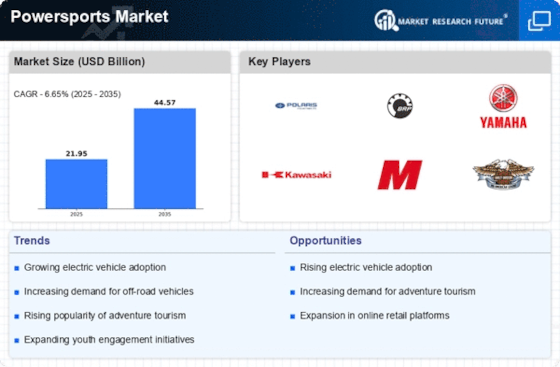
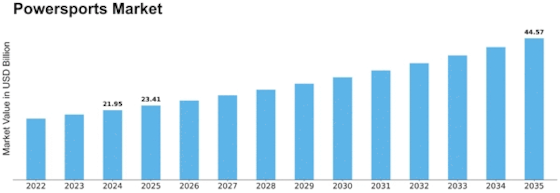
As per Market Research Future analysis, the Powersports Market Size was estimated at 21.95 USD Billion in 2024. The Powersports industry is projected to grow from 23.41 USD Billion in 2025 to 44.57 USD Billion by 2035, exhibiting a compound annual growth rate (CAGR) of 6.65% during the forecast period 2025 - 2035

Key Market Trends & Highlights

The Powersports Market is experiencing a dynamic shift towards technological integration and sustainability.

  • Technological integration is reshaping the Powersports Market landscape, enhancing user experience and vehicle performance. Sustainability initiatives are gaining traction, reflecting a growing consumer preference for environmentally friendly options. Adventure tourism growth is driving demand for versatile powersport vehicles, particularly in North America. Rising disposable income and a growing interest in outdoor activities are key drivers propelling the market forward.

Market Size & Forecast

2024 Market Size 21.95 (USD Billion)
2035 Market Size 44.57 (USD Billion)
CAGR (2025 - 2035) 6.65%
Largest Regional Market Share in 2024 North America

Major Players

Polaris Industries (US), <a href="https://ir.brp.com/news-releases/news-release-details/brp-expands-its-global-electric-powersports-offering-launch-all">BRP Inc</a>. (CA), Yamaha Motor Co. (JP), Kawasaki Heavy Industries (JP), <a href="https://powersports.honda.com/">Honda Motor Co</a>. (JP), Harley-Davidson (US), Suzuki Motor Corporation (JP), Can-Am (CA)

Market Trends

The Powersports Market is currently experiencing a dynamic evolution, driven by a confluence of technological advancements and shifting consumer preferences within the broader powersports business ecosystem. As outdoor recreational activities gain traction, the demand for various powersport vehicles, including motorcycles, all-terrain vehicles, and personal watercraft, appears to be on the rise. This growth is further fueled by an increasing interest in adventure tourism and outdoor experiences, which encourages consumers to invest in vehicles that enhance their recreational pursuits. Additionally, the integration of smart technologies into powersport vehicles is likely to attract a younger demographic, who are increasingly seeking connectivity and enhanced performance features in their recreational activities.

Moreover, sustainability concerns are becoming more pronounced within the powersports market. Manufacturers are exploring eco-friendly alternatives, such as electric and hybrid vehicles, to meet the evolving expectations of environmentally conscious consumers. This shift not only aligns with The powersports industry that prioritizes green technology. As the industry adapts to these trends, it is essential for stakeholders to remain agile and responsive to the changing landscape, ensuring that they can capitalize on emerging opportunities while addressing potential challenges that may arise in the future.

Technological Integration

The incorporation of advanced technologies into powersport vehicles is reshaping consumer expectations. Features such as GPS navigation, smartphone connectivity, and enhanced safety systems are becoming standard, appealing to tech-savvy users across the powersports business value chain.

Sustainability Initiatives

A noticeable shift towards eco-friendly options is evident, with manufacturers increasingly focusing on electric and hybrid models. This trend reflects a broader commitment to environmental responsibility and caters to a growing market segment that values sustainability in the powersports market.

Adventure Tourism Growth

The rising popularity of adventure tourism is driving demand for powersport vehicles. Consumers are seeking experiences that combine thrill and exploration, leading to increased sales in motorcycles, ATVs, and other recreational vehicles within the powersports industry.

Powersports Market Market Drivers

Rising Disposable Income

An increase in disposable income among consumers is contributing positively to the Powersports Market. As economic conditions improve, individuals are more willing to invest in recreational activities, including powersports. This trend is particularly evident in regions where economic growth has led to higher spending power. For example, in certain areas, the average household income has risen by approximately 5% annually, enabling more families to consider purchasing powersport vehicles. This increase in disposable income not only boosts sales but also encourages consumers to seek premium products, thereby enhancing the overall market value. The Powersports Market is likely to benefit from this trend, as more consumers view powersports as an essential part of their leisure activities.

Technological Advancements

The Powersports Market is experiencing a notable surge in technological advancements, which are reshaping consumer expectations and product offerings. Innovations such as electric vehicles, advanced navigation systems, and enhanced safety features are becoming increasingly prevalent. For instance, the integration of smart technology in powersport vehicles allows for real-time data tracking and improved user experience. This trend is likely to attract a younger demographic, who are more inclined towards tech-savvy products. Furthermore, the market for electric powersport vehicles is projected to grow significantly, with estimates suggesting a compound annual growth rate of over 10% in the coming years. As manufacturers continue to invest in research and development, the Powersports Market is poised for substantial transformation driven by these technological enhancements.

Expansion of E-commerce Platforms

The rise of e-commerce platforms is transforming the Powersports Market by providing consumers with greater access to products and services. Online retailing has become a significant channel for purchasing powersport vehicles and accessories, allowing consumers to compare prices and features conveniently. Recent data suggests that online sales in the powersports sector have increased by approximately 20% year-over-year, reflecting a shift in consumer buying behavior. This trend is particularly beneficial for niche markets, where specialized products may not be readily available in physical stores. As e-commerce continues to grow, the Powersports Market is likely to see enhanced competition and innovation, as companies strive to improve their online presence and customer engagement.

Growing Interest in Outdoor Activities

The Powersports Market is witnessing a growing interest in outdoor activities, which is driving demand for various powersport vehicles. As individuals seek to escape urban environments and engage in recreational pursuits, the popularity of off-road vehicles, motorcycles, and ATVs is on the rise. Recent surveys indicate that nearly 60% of consumers express a desire to participate in outdoor adventures, which correlates with increased sales in the powersports sector. This trend is further supported by the expansion of outdoor recreational areas and events, which provide opportunities for enthusiasts to engage with their vehicles. Consequently, the Powersports Market is likely to see sustained growth as more individuals prioritize outdoor experiences and adventure.

Environmental Regulations and Sustainability

The Powersports Market is increasingly influenced by environmental regulations and a growing emphasis on sustainability. As governments implement stricter emissions standards, manufacturers are compelled to innovate and develop eco-friendly vehicles. This shift towards sustainability is not only a response to regulatory pressures but also aligns with consumer preferences for greener options. The market for electric and hybrid powersport vehicles is expanding, with projections indicating a potential increase in sales by over 15% in the next few years. Additionally, companies that adopt sustainable practices may enhance their brand image, attracting environmentally conscious consumers. Thus, the Powersports Market is likely to evolve as it adapts to these environmental considerations.

Market Segment Insights

By Type: Gasoline (Largest) vs. New Energy Engine (Fastest-Growing)

The powersports market reflects a diverse distribution across various engine types. Gasoline engines dominate the market due to their long-standing prevalence and established infrastructure, appealing to a wide range of consumers seeking performance and familiarity. New Energy Engines are gaining traction, attracting attention due to growing environmental awareness and advancements in battery technology, indicating a shift in consumer preferences over time. The growth trends in the powersports industry highlight a notable transition towards New Energy Engines, driven by stringent environmental regulations and the rising demand for sustainable alternatives. The continual enhancement in electric vehicle technology enhances the appeal of these engines, making them a vital contender in the market. While Gasoline remains a staple, the emerging trends suggest a significant rise in the adoption of New Energy alternatives, indicating an evolving landscape in consumer preferences in the Powersports Market.

Gasoline (Dominant) vs. New Energy Engine (Emerging)

In the powersports market, Gasoline engines are recognized for their reliability, performance, and established consumer base. Offering a wide variety of options, from ATVs to motorcycles, gasoline-powered vehicles cater to traditional users who value familiarity and robust performance. Conversely, New Energy Engines represent an emerging segment that focuses on sustainability and innovation, responding to evolving regulatory landscapes and consumer demand across the powersports business. They leverage advancements in <a href="https://www.marketresearchfuture.com/reports/battery-market-2930">battery</a> technology and electric propulsion, making them increasingly attractive to the environmentally-conscious consumer. As manufacturers invest more in research and development for electric solutions, the New Energy segment is expected to capture a significant portion of the Powersports Market, responding to evolving regulatory landscapes and consumer demand.

By Application: Passenger Vehicles (Largest) vs. Commercial Cars (Fastest-Growing)

In the Powersports Market, the application segments are distinctly divided between Passenger Vehicles and Commercial Cars. Passenger Vehicles hold the largest share, benefitting from a steady consumer demand for recreational activities and off-road adventures. This segment encompasses a wide range of vehicles, ensuring a robust foundation in the market. Meanwhile, Commercial Cars are emerging rapidly, as businesses increasingly recognize the utility of powersport vehicles for operational purposes, such as landscaping, construction, and logistics. The growth trends for these segments highlight the expanding consumer interest in outdoor activities and the evolving needs of businesses. Passenger Vehicles are likely to maintain their appeal among leisure enthusiasts, while Commercial Cars are experiencing remarkable growth driven by innovation in utility and technology. Factors such as the rise in e-commerce and delivery services are creating a fertile environment for this segment, positioning it as a hotbed for future investment and development.

Passenger Vehicles (Dominant) vs. Commercial Cars (Emerging)

Passenger Vehicles are the dominant segment in the Powersports Market, characterized by a diverse range of models tailored to consumer preferences for recreational and leisure activities. This segment enjoys widespread popularity owing to its strong brand loyalty and extensive aftermarket support. The versatility of passenger-oriented designs allows consumers to engage in various outdoor activities, from off-roading to adventure sports. In contrast, Commercial Cars represent the emerging segment, specifically designed for utility and practicality. They cater to sectors requiring heavy-duty performance and durability, such as construction and service industries. Increased adaptation of these vehicles demonstrates their growing importance, reflecting a shift in consumer perception towards powersport vehicles as essential tools for business operations, thus enhancing their market potential.

Get more detailed insights about Powersports Market Research Report - Global Forecast till 2035

Regional Insights

By Region, the study provides market insights into North America, Europe, Asia-Pacific and Rest of the World. The North America Powersports Market accounted for USD 7.7 billion in 2021 and is expected to exhibit a significant CAGR percent growth during the study period. This growth includes strong demand across segments such as motorcycles and the snowmobile market share, supported by the region's abundant leisure opportunities and excellent local weather. 

These neighborhood parks and recreation facilities collectively employ 45,701 people, generate more than $2 billion in annual revenue, and have $9 billion in assets. Additionally, the existence of well-known competitors, like Polaris, Arctic Cat, and Yamaha Motor Corporation (all with US and Canadian headquarters, respectively), will encourage consumers to adopt the product. Due to the significant economic impact of powersports activities, state and federal governments in the US and Canada also offer major support (for example, surveying & building trails).

Further, the major countries studied in the market report are The U.S, Canada, Germany, France, UK, Italy, Spain, China, Japan, India, Australia, South Korea, and Brazil.

Figure 3: Powersports Market Share By Region 2021 (%)

Europe's powersports market accounts for the second-largest market share. Due to the expansion of recreational clubs and regional organizations that vigorously encourage off-road & recreational leisure activities, Europe is predicted to experience significant market growth. Several significant players are introducing the newest technological items in the area to increase their market share. Further, the German powersports market held the largest market share, and the UK powersports market was the fastest-growing market in the European region.

The Asia-Pacific Powersports Market is expected to grow at the fastest CAGR from 2022 to 2030. The industry is anticipated to increase significantly in Asia Pacific. Consumers are more aware of leisure options and have more disposable income. There is a higher demand in this area, particularly for side-by-sides and heavyweight motorcycles

In response to the rising demand for off-highway vehicles, several well-known automakers and some fresh faces are starting to produce these vehicles to increase their market share and revenue streams. As an illustration, Great Wall Motor of China declared in March 2021 that it would launch a new, independent brand for its off-road vehicles. Moreover, China’s powersports market held the largest market share, and the Indian powersports market was the fastest-growing market in the Asia-Pacific region.

Key Players and Competitive Insights

Since the major market players are investing a lot of money in R&D to expand their product offerings, the powersports industry will continue to grow. Market participants across the powersports business ecosystem are engaging in strategic initiatives to increase their global footprint. Powersports industry rivals must provide competitively priced goods if they hope to flourish and endure in a harsh environment where rivalry and the market are growing.
Local manufacturing to cut operating costs is one of the main business tactics manufacturers utilize in the global powersports market to help customers and increase the market sector. The powersports industry has recently provided some of the most important benefits to medicine. The powersports market major player such as Yamaha Motor Co. Ltd, Polaris Industries, Honda Motor Co. Ltd, and Textron Inc., among other important companies, are funding R&D initiatives to increase market demand.
RumbleON, Inc. offers web-based services. The company operates an e-commerce platform that allows consumers and dealers to buy, sell, trade, and finance used recreational vehicles and inspect, recondition, and distribute them. RumbleON serves customers in the United States. Powersports Market, Automotive, and Vehicle Logistics, are its three business segments. 
In March 2021, RumbleOn Inc., an Irving-based e-commerce platform that buys, sells, trades, and finances motorcycles, formally entered into a definitive deal to purchase RideNow, the nation's largest powersports shop. The merger will create what is described as "the only omnichannel customer experience in powersports and the largest publicly traded powersports dealership platform."
Also, Polaris Inc., located in Medina, Minnesota, is an American producer of RZR, motorcycles, snowmobiles, all-terrain vehicles, and neighborhood electric vehicles. Polaris was founded in Roseau, Minnesota, and maintains engineering and manufacturing operations there. Polaris Inc., located in Medina, Minnesota, is an American producer of RZR, motorcycles, snowmobiles, all-terrain vehicles, and neighborhood electric vehicles. 
Polaris was founded in Roseau, Minnesota, and maintains engineering and manufacturing operations there.
In December Polaris received three national master standing offers (NMSOs) from Public Services and Procurement Canada (PSPC) to sell snowmobiles, all-terrain vehicles (ATVs), and side-by-side utility vehicles. Canadian federal government departments, agencies, Crown corporations, and recognized Municipal, Academic Institutions, Schools, and Hospital Sectors (MASH) all have access to purchase these Polaris off-road vehicles regularly at pre-negotiated pricing, terms, and conditions.

Key Companies in the Powersports Market include

Industry Developments

January 2022: Toro Company announced the acquisition of Batesville, Arkansas-based privately held Intimidator Group. Spartan Mowers, a professional range of zero-turn mowers noted for great performance, durability, and distinctive style, are designed and manufactured by the Intimidator Group. 

Spartan Mowers, sold through an established dealer network, has great brand recognition in the southern United States, appealing to rural markets and big acreage clients. Intimidator Group also designs and manufactures an appealing line of powerful, adaptable, side-by-side utility vehicles that operate admirably in the most difficult terrains.

Future Outlook

Powersports Market Future Outlook

The Powersports Market is projected to grow at a 6.65% CAGR from 2025 to 2035, driven by technological advancements, increasing recreational activities, and rising disposable incomes.

New opportunities lie in:

  • <p>Expansion of electric vehicle offerings in the powersports segment. Development of subscription-based ownership models for recreational vehicles. Integration of smart technology for enhanced user experience and safety features.</p>

By 2035, the powersports market is expected to achieve robust growth, reflecting evolving consumer preferences and technological innovations.

Market Segmentation

Powersports Market Type Outlook

  • New Energy Engine
  • Diesel
  • Gasoline

Powersports Market Application Outlook

  • Passenger Vehicles
  • Commercial Cars

Report Scope

MARKET SIZE 2024 21.95(USD Billion)
MARKET SIZE 2025 23.41(USD Billion)
MARKET SIZE 2035 44.57(USD Billion)
COMPOUND ANNUAL GROWTH RATE (CAGR) 6.65% (2025 - 2035)
REPORT COVERAGE Revenue Forecast, Competitive Landscape, Growth Factors, and Trends
BASE YEAR 2024
Market Forecast Period 2025 - 2035
Historical Data 2019 - 2024
Market Forecast Units USD Billion
Key Companies Profiled Polaris Industries (US), BRP Inc. (CA), Yamaha Motor Co. (JP), Kawasaki Heavy Industries (JP), Honda Motor Co. (JP), Harley-Davidson (US), Suzuki Motor Corporation (JP), Can-Am (CA)
Segments Covered Type, Application, Model
Key Market Opportunities Integration of electric powertrains in off-road vehicles enhances sustainability in the Powersports Market.
Key Market Dynamics Rising consumer interest in electric powersports vehicles drives innovation and competition among manufacturers.
Countries Covered North America, Europe, APAC, South America, MEA

FAQs

What is the current valuation of the Powersports Market as of 2024?

<p>The Powersports Market was valued at 21.95 USD Billion in 2024.</p>

What is the projected market valuation for the Powersports Market in 2035?

<p>The market is projected to reach 44.57 USD Billion by 2035.</p>

What is the expected CAGR for the Powersports Market during the forecast period 2025 - 2035?

<p>The expected CAGR for the Powersports Market during 2025 - 2035 is 6.65%.</p>

Which companies are considered key players in the Powersports Market?

<p>Key players include Polaris Industries, BRP Inc., Yamaha Motor Co., Kawasaki Heavy Industries, Honda Motor Co., Harley-Davidson, Suzuki Motor Corporation, and Can-Am.</p>

What are the main segments of the Powersports Market?

<p>The main segments include Type and Application, with specific categories such as New Energy Engine, Diesel, Gasoline, Passenger Vehicles, and Commercial Cars.</p>

How much is the New Energy Engine segment projected to grow by 2035?

<p>The New Energy Engine segment is projected to grow from 3.29 USD Billion in 2024 to 8.91 USD Billion by 2035.</p>

What is the projected growth for the Diesel segment in the Powersports Market?

<p>The Diesel segment is expected to increase from 5.24 USD Billion in 2024 to 10.56 USD Billion by 2035.</p>

What is the anticipated growth for the Gasoline segment by 2035?

<p>The Gasoline segment is likely to grow from 13.42 USD Billion in 2024 to 25.1 USD Billion by 2035.</p>

How does the market size for Passenger Vehicles compare to Commercial Cars in 2035?

<p>By 2035, the Passenger Vehicles segment is projected to reach 20.0 USD Billion, while Commercial Cars may grow to 24.57 USD Billion.</p>

What implications do these growth figures have for the Powersports industry?

<p>These growth figures suggest a robust expansion in the Powersports industry, indicating increasing consumer demand and potential investment opportunities.</p>

  1. SECTION I: EXECUTIVE SUMMARY AND KEY HIGHLIGHTS
    1. | 1.1 EXECUTIVE SUMMARY
    2. | | 1.1.1 Market Overview
    3. | | 1.1.2 Key Findings
    4. | | 1.1.3 Market Segmentation
    5. | | 1.1.4 Competitive Landscape
    6. | | 1.1.5 Challenges and Opportunities
    7. | | 1.1.6 Future Outlook
  2. SECTION II: SCOPING, METHODOLOGY AND MARKET STRUCTURE
    1. | 2.1 MARKET INTRODUCTION
    2. | | 2.1.1 Definition
    3. | | 2.1.2 Scope of the study
    4. | | | 2.1.2.1 Research Objective
    5. | | | 2.1.2.2 Assumption
    6. | | | 2.1.2.3 Limitations
    7. | 2.2 RESEARCH METHODOLOGY
    8. | | 2.2.1 Overview
    9. | | 2.2.2 Data Mining
    10. | | 2.2.3 Secondary Research
    11. | | 2.2.4 Primary Research
    12. | | | 2.2.4.1 Primary Interviews and Information Gathering Process
    13. | | | 2.2.4.2 Breakdown of Primary Respondents
    14. | | 2.2.5 Forecasting Model
    15. | | 2.2.6 Market Size Estimation
    16. | | | 2.2.6.1 Bottom-Up Approach
    17. | | | 2.2.6.2 Top-Down Approach
    18. | | 2.2.7 Data Triangulation
    19. | | 2.2.8 Validation
  3. SECTION III: QUALITATIVE ANALYSIS
    1. | 3.1 MARKET DYNAMICS
    2. | | 3.1.1 Overview
    3. | | 3.1.2 Drivers
    4. | | 3.1.3 Restraints
    5. | | 3.1.4 Opportunities
    6. | 3.2 MARKET FACTOR ANALYSIS
    7. | | 3.2.1 Value chain Analysis
    8. | | 3.2.2 Porter's Five Forces Analysis
    9. | | | 3.2.2.1 Bargaining Power of Suppliers
    10. | | | 3.2.2.2 Bargaining Power of Buyers
    11. | | | 3.2.2.3 Threat of New Entrants
    12. | | | 3.2.2.4 Threat of Substitutes
    13. | | | 3.2.2.5 Intensity of Rivalry
    14. | | 3.2.3 COVID-19 Impact Analysis
    15. | | | 3.2.3.1 Market Impact Analysis
    16. | | | 3.2.3.2 Regional Impact
    17. | | | 3.2.3.3 Opportunity and Threat Analysis
  4. SECTION IV: QUANTITATIVE ANALYSIS
    1. | 4.1 Automobile, BY Type (USD Billion)
    2. | | 4.1.1 New Energy Engine
    3. | | 4.1.2 Diesel
    4. | | 4.1.3 Gasoline
    5. | 4.2 Automobile, BY Application (USD Billion)
    6. | | 4.2.1 Passenger Vehicles
    7. | | 4.2.2 Commercial Cars
    8. | 4.3 Automobile, BY Region (USD Billion)
    9. | | 4.3.1 North America
    10. | | | 4.3.1.1 US
    11. | | | 4.3.1.2 Canada
    12. | | 4.3.2 Europe
    13. | | | 4.3.2.1 Germany
    14. | | | 4.3.2.2 UK
    15. | | | 4.3.2.3 France
    16. | | | 4.3.2.4 Russia
    17. | | | 4.3.2.5 Italy
    18. | | | 4.3.2.6 Spain
    19. | | | 4.3.2.7 Rest of Europe
    20. | | 4.3.3 APAC
    21. | | | 4.3.3.1 China
    22. | | | 4.3.3.2 India
    23. | | | 4.3.3.3 Japan
    24. | | | 4.3.3.4 South Korea
    25. | | | 4.3.3.5 Malaysia
    26. | | | 4.3.3.6 Thailand
    27. | | | 4.3.3.7 Indonesia
    28. | | | 4.3.3.8 Rest of APAC
    29. | | 4.3.4 South America
    30. | | | 4.3.4.1 Brazil
    31. | | | 4.3.4.2 Mexico
    32. | | | 4.3.4.3 Argentina
    33. | | | 4.3.4.4 Rest of South America
    34. | | 4.3.5 MEA
    35. | | | 4.3.5.1 GCC Countries
    36. | | | 4.3.5.2 South Africa
    37. | | | 4.3.5.3 Rest of MEA
  5. SECTION V: COMPETITIVE ANALYSIS
    1. | 5.1 Competitive Landscape
    2. | | 5.1.1 Overview
    3. | | 5.1.2 Competitive Analysis
    4. | | 5.1.3 Market share Analysis
    5. | | 5.1.4 Major Growth Strategy in the Automobile
    6. | | 5.1.5 Competitive Benchmarking
    7. | | 5.1.6 Leading Players in Terms of Number of Developments in the Automobile
    8. | | 5.1.7 Key developments and growth strategies
    9. | | | 5.1.7.1 New Product Launch/Service Deployment
    10. | | | 5.1.7.2 Merger & Acquisitions
    11. | | | 5.1.7.3 Joint Ventures
    12. | | 5.1.8 Major Players Financial Matrix
    13. | | | 5.1.8.1 Sales and Operating Income
    14. | | | 5.1.8.2 Major Players R&D Expenditure. 2023
    15. | 5.2 Company Profiles
    16. | | 5.2.1 Polaris Industries (US)
    17. | | | 5.2.1.1 Financial Overview
    18. | | | 5.2.1.2 Products Offered
    19. | | | 5.2.1.3 Key Developments
    20. | | | 5.2.1.4 SWOT Analysis
    21. | | | 5.2.1.5 Key Strategies
    22. | | 5.2.2 BRP Inc. (CA)
    23. | | | 5.2.2.1 Financial Overview
    24. | | | 5.2.2.2 Products Offered
    25. | | | 5.2.2.3 Key Developments
    26. | | | 5.2.2.4 SWOT Analysis
    27. | | | 5.2.2.5 Key Strategies
    28. | | 5.2.3 Yamaha Motor Co. (JP)
    29. | | | 5.2.3.1 Financial Overview
    30. | | | 5.2.3.2 Products Offered
    31. | | | 5.2.3.3 Key Developments
    32. | | | 5.2.3.4 SWOT Analysis
    33. | | | 5.2.3.5 Key Strategies
    34. | | 5.2.4 Kawasaki Heavy Industries (JP)
    35. | | | 5.2.4.1 Financial Overview
    36. | | | 5.2.4.2 Products Offered
    37. | | | 5.2.4.3 Key Developments
    38. | | | 5.2.4.4 SWOT Analysis
    39. | | | 5.2.4.5 Key Strategies
    40. | | 5.2.5 Honda Motor Co. (JP)
    41. | | | 5.2.5.1 Financial Overview
    42. | | | 5.2.5.2 Products Offered
    43. | | | 5.2.5.3 Key Developments
    44. | | | 5.2.5.4 SWOT Analysis
    45. | | | 5.2.5.5 Key Strategies
    46. | | 5.2.6 Harley-Davidson (US)
    47. | | | 5.2.6.1 Financial Overview
    48. | | | 5.2.6.2 Products Offered
    49. | | | 5.2.6.3 Key Developments
    50. | | | 5.2.6.4 SWOT Analysis
    51. | | | 5.2.6.5 Key Strategies
    52. | | 5.2.7 Suzuki Motor Corporation (JP)
    53. | | | 5.2.7.1 Financial Overview
    54. | | | 5.2.7.2 Products Offered
    55. | | | 5.2.7.3 Key Developments
    56. | | | 5.2.7.4 SWOT Analysis
    57. | | | 5.2.7.5 Key Strategies
    58. | | 5.2.8 Can-Am (CA)
    59. | | | 5.2.8.1 Financial Overview
    60. | | | 5.2.8.2 Products Offered
    61. | | | 5.2.8.3 Key Developments
    62. | | | 5.2.8.4 SWOT Analysis
    63. | | | 5.2.8.5 Key Strategies
    64. | 5.3 Appendix
    65. | | 5.3.1 References
    66. | | 5.3.2 Related Reports
  6. LIST OF FIGURES
    1. | 6.1 MARKET SYNOPSIS
    2. | 6.2 NORTH AMERICA MARKET ANALYSIS
    3. | 6.3 US MARKET ANALYSIS BY TYPE
    4. | 6.4 US MARKET ANALYSIS BY APPLICATION
    5. | 6.5 CANADA MARKET ANALYSIS BY TYPE
    6. | 6.6 CANADA MARKET ANALYSIS BY APPLICATION
    7. | 6.7 EUROPE MARKET ANALYSIS
    8. | 6.8 GERMANY MARKET ANALYSIS BY TYPE
    9. | 6.9 GERMANY MARKET ANALYSIS BY APPLICATION
    10. | 6.10 UK MARKET ANALYSIS BY TYPE
    11. | 6.11 UK MARKET ANALYSIS BY APPLICATION
    12. | 6.12 FRANCE MARKET ANALYSIS BY TYPE
    13. | 6.13 FRANCE MARKET ANALYSIS BY APPLICATION
    14. | 6.14 RUSSIA MARKET ANALYSIS BY TYPE
    15. | 6.15 RUSSIA MARKET ANALYSIS BY APPLICATION
    16. | 6.16 ITALY MARKET ANALYSIS BY TYPE
    17. | 6.17 ITALY MARKET ANALYSIS BY APPLICATION
    18. | 6.18 SPAIN MARKET ANALYSIS BY TYPE
    19. | 6.19 SPAIN MARKET ANALYSIS BY APPLICATION
    20. | 6.20 REST OF EUROPE MARKET ANALYSIS BY TYPE
    21. | 6.21 REST OF EUROPE MARKET ANALYSIS BY APPLICATION
    22. | 6.22 APAC MARKET ANALYSIS
    23. | 6.23 CHINA MARKET ANALYSIS BY TYPE
    24. | 6.24 CHINA MARKET ANALYSIS BY APPLICATION
    25. | 6.25 INDIA MARKET ANALYSIS BY TYPE
    26. | 6.26 INDIA MARKET ANALYSIS BY APPLICATION
    27. | 6.27 JAPAN MARKET ANALYSIS BY TYPE
    28. | 6.28 JAPAN MARKET ANALYSIS BY APPLICATION
    29. | 6.29 SOUTH KOREA MARKET ANALYSIS BY TYPE
    30. | 6.30 SOUTH KOREA MARKET ANALYSIS BY APPLICATION
    31. | 6.31 MALAYSIA MARKET ANALYSIS BY TYPE
    32. | 6.32 MALAYSIA MARKET ANALYSIS BY APPLICATION
    33. | 6.33 THAILAND MARKET ANALYSIS BY TYPE
    34. | 6.34 THAILAND MARKET ANALYSIS BY APPLICATION
    35. | 6.35 INDONESIA MARKET ANALYSIS BY TYPE
    36. | 6.36 INDONESIA MARKET ANALYSIS BY APPLICATION
    37. | 6.37 REST OF APAC MARKET ANALYSIS BY TYPE
    38. | 6.38 REST OF APAC MARKET ANALYSIS BY APPLICATION
    39. | 6.39 SOUTH AMERICA MARKET ANALYSIS
    40. | 6.40 BRAZIL MARKET ANALYSIS BY TYPE
    41. | 6.41 BRAZIL MARKET ANALYSIS BY APPLICATION
    42. | 6.42 MEXICO MARKET ANALYSIS BY TYPE
    43. | 6.43 MEXICO MARKET ANALYSIS BY APPLICATION
    44. | 6.44 ARGENTINA MARKET ANALYSIS BY TYPE
    45. | 6.45 ARGENTINA MARKET ANALYSIS BY APPLICATION
    46. | 6.46 REST OF SOUTH AMERICA MARKET ANALYSIS BY TYPE
    47. | 6.47 REST OF SOUTH AMERICA MARKET ANALYSIS BY APPLICATION
    48. | 6.48 MEA MARKET ANALYSIS
    49. | 6.49 GCC COUNTRIES MARKET ANALYSIS BY TYPE
    50. | 6.50 GCC COUNTRIES MARKET ANALYSIS BY APPLICATION
    51. | 6.51 SOUTH AFRICA MARKET ANALYSIS BY TYPE
    52. | 6.52 SOUTH AFRICA MARKET ANALYSIS BY APPLICATION
    53. | 6.53 REST OF MEA MARKET ANALYSIS BY TYPE
    54. | 6.54 REST OF MEA MARKET ANALYSIS BY APPLICATION
    55. | 6.55 KEY BUYING CRITERIA OF AUTOMOBILE
    56. | 6.56 RESEARCH PROCESS OF MRFR
    57. | 6.57 DRO ANALYSIS OF AUTOMOBILE
    58. | 6.58 DRIVERS IMPACT ANALYSIS: AUTOMOBILE
    59. | 6.59 RESTRAINTS IMPACT ANALYSIS: AUTOMOBILE
    60. | 6.60 SUPPLY / VALUE CHAIN: AUTOMOBILE
    61. | 6.61 AUTOMOBILE, BY TYPE, 2024 (% SHARE)
    62. | 6.62 AUTOMOBILE, BY TYPE, 2024 TO 2035 (USD Billion)
    63. | 6.63 AUTOMOBILE, BY APPLICATION, 2024 (% SHARE)
    64. | 6.64 AUTOMOBILE, BY APPLICATION, 2024 TO 2035 (USD Billion)
    65. | 6.65 BENCHMARKING OF MAJOR COMPETITORS
  7. LIST OF TABLES
    1. | 7.1 LIST OF ASSUMPTIONS
    2. | | 7.1.1
    3. | 7.2 North America MARKET SIZE ESTIMATES; FORECAST
    4. | | 7.2.1 BY TYPE, 2025-2035 (USD Billion)
    5. | | 7.2.2 BY APPLICATION, 2025-2035 (USD Billion)
    6. | 7.3 US MARKET SIZE ESTIMATES; FORECAST
    7. | | 7.3.1 BY TYPE, 2025-2035 (USD Billion)
    8. | | 7.3.2 BY APPLICATION, 2025-2035 (USD Billion)
    9. | 7.4 Canada MARKET SIZE ESTIMATES; FORECAST
    10. | | 7.4.1 BY TYPE, 2025-2035 (USD Billion)
    11. | | 7.4.2 BY APPLICATION, 2025-2035 (USD Billion)
    12. | 7.5 Europe MARKET SIZE ESTIMATES; FORECAST
    13. | | 7.5.1 BY TYPE, 2025-2035 (USD Billion)
    14. | | 7.5.2 BY APPLICATION, 2025-2035 (USD Billion)
    15. | 7.6 Germany MARKET SIZE ESTIMATES; FORECAST
    16. | | 7.6.1 BY TYPE, 2025-2035 (USD Billion)
    17. | | 7.6.2 BY APPLICATION, 2025-2035 (USD Billion)
    18. | 7.7 UK MARKET SIZE ESTIMATES; FORECAST
    19. | | 7.7.1 BY TYPE, 2025-2035 (USD Billion)
    20. | | 7.7.2 BY APPLICATION, 2025-2035 (USD Billion)
    21. | 7.8 France MARKET SIZE ESTIMATES; FORECAST
    22. | | 7.8.1 BY TYPE, 2025-2035 (USD Billion)
    23. | | 7.8.2 BY APPLICATION, 2025-2035 (USD Billion)
    24. | 7.9 Russia MARKET SIZE ESTIMATES; FORECAST
    25. | | 7.9.1 BY TYPE, 2025-2035 (USD Billion)
    26. | | 7.9.2 BY APPLICATION, 2025-2035 (USD Billion)
    27. | 7.10 Italy MARKET SIZE ESTIMATES; FORECAST
    28. | | 7.10.1 BY TYPE, 2025-2035 (USD Billion)
    29. | | 7.10.2 BY APPLICATION, 2025-2035 (USD Billion)
    30. | 7.11 Spain MARKET SIZE ESTIMATES; FORECAST
    31. | | 7.11.1 BY TYPE, 2025-2035 (USD Billion)
    32. | | 7.11.2 BY APPLICATION, 2025-2035 (USD Billion)
    33. | 7.12 Rest of Europe MARKET SIZE ESTIMATES; FORECAST
    34. | | 7.12.1 BY TYPE, 2025-2035 (USD Billion)
    35. | | 7.12.2 BY APPLICATION, 2025-2035 (USD Billion)
    36. | 7.13 APAC MARKET SIZE ESTIMATES; FORECAST
    37. | | 7.13.1 BY TYPE, 2025-2035 (USD Billion)
    38. | | 7.13.2 BY APPLICATION, 2025-2035 (USD Billion)
    39. | 7.14 China MARKET SIZE ESTIMATES; FORECAST
    40. | | 7.14.1 BY TYPE, 2025-2035 (USD Billion)
    41. | | 7.14.2 BY APPLICATION, 2025-2035 (USD Billion)
    42. | 7.15 India MARKET SIZE ESTIMATES; FORECAST
    43. | | 7.15.1 BY TYPE, 2025-2035 (USD Billion)
    44. | | 7.15.2 BY APPLICATION, 2025-2035 (USD Billion)
    45. | 7.16 Japan MARKET SIZE ESTIMATES; FORECAST
    46. | | 7.16.1 BY TYPE, 2025-2035 (USD Billion)
    47. | | 7.16.2 BY APPLICATION, 2025-2035 (USD Billion)
    48. | 7.17 South Korea MARKET SIZE ESTIMATES; FORECAST
    49. | | 7.17.1 BY TYPE, 2025-2035 (USD Billion)
    50. | | 7.17.2 BY APPLICATION, 2025-2035 (USD Billion)
    51. | 7.18 Malaysia MARKET SIZE ESTIMATES; FORECAST
    52. | | 7.18.1 BY TYPE, 2025-2035 (USD Billion)
    53. | | 7.18.2 BY APPLICATION, 2025-2035 (USD Billion)
    54. | 7.19 Thailand MARKET SIZE ESTIMATES; FORECAST
    55. | | 7.19.1 BY TYPE, 2025-2035 (USD Billion)
    56. | | 7.19.2 BY APPLICATION, 2025-2035 (USD Billion)
    57. | 7.20 Indonesia MARKET SIZE ESTIMATES; FORECAST
    58. | | 7.20.1 BY TYPE, 2025-2035 (USD Billion)
    59. | | 7.20.2 BY APPLICATION, 2025-2035 (USD Billion)
    60. | 7.21 Rest of APAC MARKET SIZE ESTIMATES; FORECAST
    61. | | 7.21.1 BY TYPE, 2025-2035 (USD Billion)
    62. | | 7.21.2 BY APPLICATION, 2025-2035 (USD Billion)
    63. | 7.22 South America MARKET SIZE ESTIMATES; FORECAST
    64. | | 7.22.1 BY TYPE, 2025-2035 (USD Billion)
    65. | | 7.22.2 BY APPLICATION, 2025-2035 (USD Billion)
    66. | 7.23 Brazil MARKET SIZE ESTIMATES; FORECAST
    67. | | 7.23.1 BY TYPE, 2025-2035 (USD Billion)
    68. | | 7.23.2 BY APPLICATION, 2025-2035 (USD Billion)
    69. | 7.24 Mexico MARKET SIZE ESTIMATES; FORECAST
    70. | | 7.24.1 BY TYPE, 2025-2035 (USD Billion)
    71. | | 7.24.2 BY APPLICATION, 2025-2035 (USD Billion)
    72. | 7.25 Argentina MARKET SIZE ESTIMATES; FORECAST
    73. | | 7.25.1 BY TYPE, 2025-2035 (USD Billion)
    74. | | 7.25.2 BY APPLICATION, 2025-2035 (USD Billion)
    75. | 7.26 Rest of South America MARKET SIZE ESTIMATES; FORECAST
    76. | | 7.26.1 BY TYPE, 2025-2035 (USD Billion)
    77. | | 7.26.2 BY APPLICATION, 2025-2035 (USD Billion)
    78. | 7.27 MEA MARKET SIZE ESTIMATES; FORECAST
    79. | | 7.27.1 BY TYPE, 2025-2035 (USD Billion)
    80. | | 7.27.2 BY APPLICATION, 2025-2035 (USD Billion)
    81. | 7.28 GCC Countries MARKET SIZE ESTIMATES; FORECAST
    82. | | 7.28.1 BY TYPE, 2025-2035 (USD Billion)
    83. | | 7.28.2 BY APPLICATION, 2025-2035 (USD Billion)
    84. | 7.29 South Africa MARKET SIZE ESTIMATES; FORECAST
    85. | | 7.29.1 BY TYPE, 2025-2035 (USD Billion)
    86. | | 7.29.2 BY APPLICATION, 2025-2035 (USD Billion)
    87. | 7.30 Rest of MEA MARKET SIZE ESTIMATES; FORECAST
    88. | | 7.30.1 BY TYPE, 2025-2035 (USD Billion)
    89. | | 7.30.2 BY APPLICATION, 2025-2035 (USD Billion)
    90. | 7.31 PRODUCT LAUNCH/PRODUCT DEVELOPMENT/APPROVAL
    91. | | 7.31.1
    92. | 7.32 ACQUISITION/PARTNERSHIP
    93. | | 7.32.1

Automobile Market Segmentation

Automobile By Type (USD Billion, 2025-2035)

  • New Energy Engine
  • Diesel
  • Gasoline

Automobile By Application (USD Billion, 2025-2035)

  • Passenger Vehicles
  • Commercial Cars
Infographic

Free Sample Request

Kindly complete the form below to receive a free sample of this Report

Get Free Sample

Customer Strories

Compare Licence

×
Features License Type
Single User Multiuser License Enterprise User
Price $4,950 $5,950 $7,250
Maximum User Access Limit 1 User Upto 10 Users Unrestricted Access Throughout the Organization
Free Customization
Direct Access to Analyst
Deliverable Format
Platform Access
Discount on Next Purchase 10% 15% 15%
Printable Versions
%>