×
Request Free Sample ×

Kindly complete the form below to receive a free sample of this Report

* Please use a valid business email

Leading companies partner with us for data-driven Insights

clients tt-cursor
Hero Background

Post-traumatic Stress Disorder Treatment Market

ID: MRFR/HC/65779-CR
200 Pages
MRFR Team
December 2025

Share:
Download PDF ×

We do not share your information with anyone. However, we may send you emails based on your report interest from time to time. You may contact us at any time to opt-out.

Post-traumatic Stress Disorder Treatment Market Infographic
Purchase Options

Post-traumatic Stress Disorder Treatment Market Summary

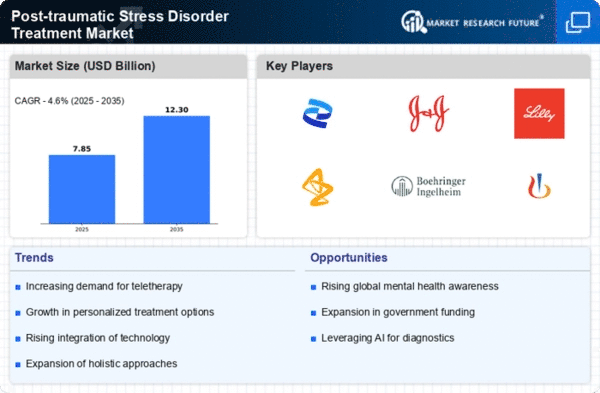
As per MRFR analysis, the Post-traumatic Stress Disorder Treatment Market was estimated at 7.5 USD Billion in 2024. The Post-traumatic Stress Disorder Treatment industry is projected to grow from 7.85 USD Billion in 2025 to 12.3 USD Billion by 2035, exhibiting a compound annual growth rate (CAGR) of 4.6 during the forecast period 2025 - 2035.

Key Market Trends & Highlights

The Post-traumatic Stress Disorder Treatment Market is experiencing a transformative shift towards innovative and personalized care solutions.

  • Telehealth solutions are gaining traction, enhancing accessibility for patients across North America.
  • Holistic approaches are increasingly integrated into treatment plans, reflecting a broader understanding of mental health.
  • Research and development efforts are intensifying, particularly in the Asia-Pacific region, to advance treatment modalities.
  • Rising awareness of mental health issues and government initiatives are driving demand for personalized treatment, especially among veterans and survivors of abuse.

Market Size & Forecast

2024 Market Size 7.5 (USD Billion)
2035 Market Size 12.3 (USD Billion)
CAGR (2025 - 2035) 4.6%

Major Players

Pfizer (US), Johnson & Johnson (US), Eli Lilly (US), AstraZeneca (GB), Boehringer Ingelheim (DE), Novartis (CH), GSK (GB), Otsuka Pharmaceutical (JP), H. Lundbeck A/S (DK)

Post-traumatic Stress Disorder Treatment Market Trends

The Post-traumatic Stress Disorder Treatment Market is currently experiencing a notable evolution, driven by an increasing awareness of mental health issues and the growing recognition of the impact of trauma on individuals. This market encompasses a variety of therapeutic approaches, including psychotherapy, medication, and alternative treatments. As society becomes more open to discussing mental health, the demand for effective treatment options appears to be rising. Furthermore, advancements in technology, such as teletherapy and mobile applications, are likely to enhance accessibility and convenience for patients seeking help. In addition, the Post-traumatic Stress Disorder Treatment Market is influenced by ongoing research into the neurobiological underpinnings of PTSD, which may lead to the development of innovative therapies. The integration of personalized medicine, focusing on individual patient needs and responses, seems to be gaining traction. As healthcare providers strive to offer tailored solutions, the market may witness a shift towards more effective and targeted treatment modalities. Overall, the landscape of the Post-traumatic Stress Disorder Treatment Market is evolving, reflecting a broader societal commitment to addressing mental health challenges and improving patient outcomes.

Increased Focus on Telehealth Solutions

The Post-traumatic Stress Disorder Treatment Market is witnessing a surge in telehealth services, which provide patients with remote access to therapy and support. This trend appears to be driven by the need for convenience and the desire to reduce barriers to treatment. Teletherapy platforms are becoming more sophisticated, offering a range of options that cater to diverse patient preferences.

Integration of Holistic Approaches

There is a growing inclination towards incorporating holistic methods within the Post-traumatic Stress Disorder Treatment Market. Techniques such as mindfulness, yoga, and art therapy are increasingly recognized for their potential benefits in managing symptoms. This trend suggests a shift towards a more comprehensive understanding of mental health, where emotional and physical well-being are interconnected.

Emphasis on Research and Development

The Post-traumatic Stress Disorder Treatment Market is characterized by a heightened emphasis on research and development initiatives. Ongoing studies into the efficacy of various treatment modalities are likely to inform best practices and lead to the introduction of novel therapies. This focus on evidence-based approaches may enhance the overall quality of care provided to individuals suffering from PTSD.

Market Segment Insights

By Therapeutic Approaches: Cognitive Behavioral Therapy (Largest) vs. Eye Movement Desensitization and Reprocessing (Fastest-Growing)

In the Post-traumatic Stress Disorder Treatment Market, Cognitive Behavioral Therapy (CBT) currently commands a significant share due to its widespread acceptance and empirical support within clinical settings. This established method focuses on altering detrimental thought patterns and behaviors associated with PTSD, making it the go-to treatment for many healthcare providers. Following CBT, Exposure Therapy also plays a critical role, as it helps individuals gradually confront their trauma in a controlled manner, thus reducing associated fear and anxiety. Eye Movement Desensitization and Reprocessing (EMDR) is increasingly recognized as well, carving out a vital segment as more practitioners turn to this innovative technique, demonstrating its efficacy in alleviating PTSD symptoms.

Cognitive Behavioral Therapy (Dominant) vs. Eye Movement Desensitization and Reprocessing (Emerging)

Cognitive Behavioral Therapy (CBT) is the dominant therapeutic approach in PTSD treatment, characterized by structured, goal-oriented sessions that target maladaptive thoughts and resulting behaviors. It has extensive empirical backing and is often integrated into broader treatment plans, thus maintaining a steady demand within the market. In contrast, Eye Movement Desensitization and Reprocessing (EMDR) is emerging as a compelling alternative to traditional therapies. It focuses on reprocessing traumatic memories by utilizing direct eye movements, thereby facilitating emotional processing. As more practitioners gain familiarity with EMDR and its efficacy is increasingly validated by research, its adoption is expected to rise rapidly, making it an attractive prospect in the therapeutic landscape for PTSD.

By Patient Demographics: Veterans (Largest) vs. Survivors of Abuse (Fastest-Growing)

The Post-traumatic Stress Disorder (PTSD) Treatment Market is significantly influenced by patient demographics. Veterans represent the largest share of the market due to the high prevalence of PTSD among military personnel following combat exposure. Following them, Survivors of Abuse also constitute a substantial portion, reflecting the high incidence rates of trauma associated with abuse. Other segments, including First Responders and Civilian Trauma Survivors, also hold relevant shares but are comparatively smaller. Notably, Children and Adolescents exhibit lower representation but are growing in importance as awareness and diagnosis improve.

Veterans (Dominant) vs. Survivors of Abuse (Emerging)

Veterans constitute the dominant demographic in the PTSD Treatment Market, driven by ongoing efforts to address mental health issues stemming from military service. They often require specialized, long-term psychological support, including therapy and medication tailored to their unique experiences. Conversely, Survivors of Abuse are an emerging segment witnessing rapid growth, largely fueled by increased societal acknowledgement of the long-term impacts of abuse and enhanced access to mental health resources. This dual focus by healthcare providers on both demographics signifies an evolving market landscape where each group’s differing needs shape treatment paradigms.

By Treatment Settings: Outpatient Clinics (Largest) vs. Telehealth Services (Fastest-Growing)

In the Post-traumatic Stress Disorder (PTSD) treatment market, the distribution of treatment settings showcases varying preferences among patients. Outpatient clinics have emerged as the largest segment, owing to their established presence and comprehensive care options. In contrast, telehealth services are rapidly gaining traction, especially in response to recent global trends emphasizing remote access to mental health care. This evolution reflects an increasing demand, highlighting a shift in consumer behavior towards more accessible treatment modalities. The growth trends within the PTSD treatment settings are profoundly influenced by several factors. The rising prevalence of PTSD coupled with increasing awareness surrounding mental health has bolstered outpatient clinics. Meanwhile, telehealth is experiencing exponential growth due to technological advancements and the need for flexible treatment options. As mental health stigma continues to diminish, more individuals are seeking out these services, positioning telehealth as a front-runner in the treatment market. Their convenience and ease of access are pivotal in attracting a broader patient demographic.

Outpatient Clinics (Dominant) vs. Telehealth Services (Emerging)

Outpatient clinics are a cornerstone of PTSD treatment, offering structured therapy sessions, group therapy, and support services tailored to individual needs. This treatment setting provides face-to-face interaction, which is crucial for many patients who benefit from direct engagement with mental health professionals. Their established networks and multifaceted approaches have solidified their position as the dominant force in providing care for PTSD. Conversely, telehealth services are emerging as a revolutionary alternative, especially appealing to patients seeking privacy and convenience. The COVID-19 pandemic has accelerated the adoption of digital health solutions, allowing patients to access therapy from the comfort of their homes. This segment's growth is driven by technological innovation and the ongoing demand for flexible treatment options, positioning it as a competitive force in the evolving landscape of PTSD treatment.

By Severity of Condition: Moderate PTSD (Largest) vs. Severe PTSD (Fastest-Growing)

In the Post-traumatic Stress Disorder Treatment Market, the severity of condition significantly influences treatment modalities and patient demographics. The market is predominantly divided among Mild PTSD, Moderate PTSD, Severe PTSD, Complex PTSD, and Acute Stress Disorder, with Moderate PTSD holding the largest share. This segment benefits from a broad base of patients requiring cognitive behavioral therapy and medication management, which are considered standard in treatment protocols.

Moderate PTSD (Dominant) vs. Severe PTSD (Emerging)

Moderate PTSD represents a stable segment in the Post-traumatic Stress Disorder Treatment Market, characterized by a significant patient population experiencing considerable distress but not yet exhibiting extreme symptoms. This segment is typically managed through comprehensive therapeutic strategies, including psychotherapy and pharmacotherapy, leading to favorable outcomes. In contrast, Severe PTSD is gaining attention as an emerging segment, driven by increasing awareness and diagnosis rates. This segment often necessitates intensive intervention, including specialized therapies and support systems, thus fostering rapid growth. The healthcare industry is responding actively, enhancing treatment options to meet the needs of these patients.

By Duration of Treatment: Short-term Treatment (Largest) vs. Long-term Treatment (Fastest-Growing)

The Post-traumatic Stress Disorder (PTSD) treatment market is divided into several segments based on the duration of treatment, including Short-term, Medium-term, Long-term Treatment, Crisis Intervention, and Preventive Care. Short-term Treatment currently holds the largest market share, appealing to those seeking immediate relief devoid of long-term commitment. In contrast, Long-term Treatment is gaining traction as awareness of chronic PTSD and its long-term effects increases, leading to an enhanced focus on comprehensive, sustained recovery solutions that address root causes rather than just symptoms.

Short-term Treatment: Immediate Relief (Dominant) vs. Long-term Treatment: Comprehensive Healing (Emerging)

Short-term Treatment is characterized by its focus on providing rapid relief to PTSD patients, often utilizing approaches like cognitive-behavioral therapy and medication for quick results. This segment caters primarily to individuals in acute distress, allowing them to regain functionality in a short timeframe. On the other hand, Long-term Treatment is emerging as a crucial approach, emphasizing ongoing therapeutic support and deeper, holistic methods that address complex trauma over extended periods. Its growth is fuelled by increasing recognition of chronic PTSD and the need for long-term strategies that foster sustained well-being, reflecting a shift in treatment paradigms that prioritize lasting mental health improvements.

Get more detailed insights about Post-traumatic Stress Disorder Treatment Market

Regional Insights

North America : Market Leader in PTSD Treatment

North America is poised to maintain its leadership in the Post-traumatic Stress Disorder (PTSD) treatment market, holding a significant market share of 4.0 in 2024. The region's growth is driven by increasing awareness of mental health issues, advancements in treatment options, and supportive regulatory frameworks. The demand for innovative therapies, including pharmacological and psychotherapeutic approaches, is on the rise, fueled by a growing emphasis on mental health care in public policy. The United States stands out as the leading country in this market, with major pharmaceutical companies like Pfizer, Johnson & Johnson, and Eli Lilly actively involved in developing and marketing PTSD treatments. The competitive landscape is characterized by a mix of established players and emerging biotech firms, all striving to address the unmet needs of PTSD patients. This dynamic environment is expected to foster innovation and improve treatment outcomes in the coming years.

Europe : Emerging Market for PTSD Solutions

Europe is emerging as a significant player in the Post-traumatic Stress Disorder (PTSD) treatment market, with a market size of 2.5 in 2024. The region's growth is driven by increasing recognition of mental health issues, supportive government initiatives, and a rising demand for effective treatment options. Regulatory bodies are actively promoting mental health awareness, which is catalyzing the development of new therapies and treatment protocols across member states. Leading countries in this market include Germany, the UK, and France, where key players like AstraZeneca and Boehringer Ingelheim are making substantial contributions. The competitive landscape is marked by collaborations between pharmaceutical companies and research institutions, aimed at enhancing treatment efficacy. As the market evolves, the focus on personalized medicine and innovative therapeutic approaches is expected to reshape the PTSD treatment paradigm in Europe.

Asia-Pacific : Growing Awareness and Demand

The Asia-Pacific region is witnessing a gradual increase in the Post-traumatic Stress Disorder (PTSD) treatment market, with a market size of 0.8 in 2024. This growth is primarily driven by rising awareness of mental health issues, increasing healthcare expenditure, and the introduction of new treatment modalities. Governments are beginning to recognize the importance of mental health, leading to supportive policies and funding for mental health initiatives. Countries like Japan and Australia are at the forefront of this market, with key players such as Otsuka Pharmaceutical and H. Lundbeck A/S actively involved in developing PTSD treatments. The competitive landscape is evolving, with a mix of local and international companies striving to meet the growing demand for effective therapies. As mental health awareness continues to rise, the region is expected to see significant advancements in PTSD treatment options.

Middle East and Africa : Untapped Potential in PTSD Care

The Middle East and Africa region is currently in the nascent stages of developing its Post-traumatic Stress Disorder (PTSD) treatment market, with a market size of 0.2 in 2024. The growth potential is significant, driven by increasing awareness of mental health issues and the need for effective treatment solutions. However, challenges such as limited healthcare infrastructure and stigma surrounding mental health remain barriers to progress. Governments are beginning to address these issues through policy reforms and mental health initiatives. Countries like South Africa and the UAE are leading the way in recognizing the importance of mental health care. The competitive landscape is characterized by a limited number of players, but there is a growing interest from international companies looking to enter this market. As awareness and demand for PTSD treatments increase, the region is expected to see gradual improvements in care and access to effective therapies.

Key Players and Competitive Insights

The Post-traumatic Stress Disorder Treatment Market is characterized by a dynamic competitive landscape, driven by increasing awareness of mental health issues and the growing demand for effective therapeutic solutions. Key players such as Pfizer (US), Johnson & Johnson (US), and Eli Lilly (US) are at the forefront, each adopting distinct strategies to enhance their market presence. Pfizer (US) focuses on innovation through the development of novel pharmacological treatments, while Johnson & Johnson (US) emphasizes strategic partnerships to expand its therapeutic portfolio. Eli Lilly (US) is actively pursuing mergers and acquisitions to bolster its research capabilities, thereby enhancing its competitive edge in this evolving market.

The market structure appears moderately fragmented, with a mix of established pharmaceutical giants and emerging biotech firms. Key players are increasingly localizing manufacturing and optimizing supply chains to improve efficiency and responsiveness to market demands. This collective influence of major companies shapes a competitive environment where agility and innovation are paramount, allowing firms to adapt to the rapidly changing landscape of PTSD treatment.

In November 2025, Pfizer (US) announced a collaboration with a leading mental health technology firm to integrate digital therapeutics into its treatment protocols. This strategic move is likely to enhance patient engagement and adherence, reflecting a broader trend towards the incorporation of technology in mental health care. By leveraging digital solutions, Pfizer (US) aims to provide a more comprehensive treatment approach, potentially setting a new standard in the industry.

In October 2025, Johnson & Johnson (US) launched a new clinical trial for a combination therapy targeting PTSD symptoms, which combines pharmacological and psychotherapeutic interventions. This initiative underscores the company's commitment to advancing treatment options and could significantly impact patient outcomes. The trial's results may pave the way for innovative treatment paradigms that integrate multiple therapeutic modalities, thereby enhancing the overall efficacy of PTSD management.

In September 2025, Eli Lilly (US) completed the acquisition of a biotech firm specializing in PTSD research, which is expected to accelerate its drug development pipeline. This acquisition not only strengthens Eli Lilly's research capabilities but also positions the company to capitalize on emerging trends in personalized medicine. The integration of new technologies and research expertise could lead to the development of targeted therapies that address the unique needs of PTSD patients, further differentiating Eli Lilly in a competitive market.

As of December 2025, current trends in the Post-traumatic Stress Disorder Treatment Market indicate a shift towards digitalization, sustainability, and the integration of artificial intelligence in therapeutic development. Strategic alliances are increasingly shaping the competitive landscape, enabling companies to pool resources and expertise. Looking ahead, competitive differentiation is likely to evolve from traditional price-based competition to a focus on innovation, technological advancements, and supply chain reliability. This transition suggests that companies that prioritize research and development, alongside strategic collaborations, will be better positioned to thrive in the future.


Key Companies in the Post-traumatic Stress Disorder Treatment Market market include

Future Outlook

Post-traumatic Stress Disorder Treatment Market Future Outlook

The Post-traumatic Stress Disorder Treatment Market is projected to grow at a 4.6% CAGR from 2024 to 2035, driven by increasing awareness and advancements in therapeutic technologies.

New opportunities lie in:

  • Development of telehealth platforms for remote therapy access.
  • Integration of AI-driven diagnostics in treatment protocols.
  • Expansion of personalized medicine approaches for tailored therapies.

By 2035, the market is expected to be robust, reflecting significant advancements and increased accessibility.

Market Segmentation

post-traumatic-stress-disorder-treatment-market Treatment Settings Outlook

  • Outpatient Clinics
  • Inpatient Facilities
  • Telehealth Services
  • Community Support Programs
  • Private Practices

post-traumatic-stress-disorder-treatment-market Patient Demographics Outlook

  • Veterans
  • Survivors of Abuse
  • First Responders
  • Civilian Trauma Survivors
  • Children and Adolescents

post-traumatic-stress-disorder-treatment-market Duration of Treatment Outlook

  • Short-term Treatment
  • Medium-term Treatment
  • Long-term Treatment
  • Crisis Intervention
  • Preventive Care

post-traumatic-stress-disorder-treatment-market Severity of Condition Outlook

  • Mild PTSD
  • Moderate PTSD
  • Severe PTSD
  • Complex PTSD
  • Acute Stress Disorder

post-traumatic-stress-disorder-treatment-market Therapeutic Approaches Outlook

  • Cognitive Behavioral Therapy
  • Exposure Therapy
  • Eye Movement Desensitization and Reprocessing
  • Medication Management
  • Group Therapy

Report Scope

MARKET SIZE 20247.5(USD Billion)
MARKET SIZE 20257.85(USD Billion)
MARKET SIZE 203512.3(USD Billion)
COMPOUND ANNUAL GROWTH RATE (CAGR)4.6% (2024 - 2035)
REPORT COVERAGERevenue Forecast, Competitive Landscape, Growth Factors, and Trends
BASE YEAR2024
Market Forecast Period2025 - 2035
Historical Data2019 - 2024
Market Forecast UnitsUSD Billion
Key Companies ProfiledPfizer (US), Johnson & Johnson (US), Eli Lilly (US), AstraZeneca (GB), Boehringer Ingelheim (DE), Novartis (CH), GSK (GB), Otsuka Pharmaceutical (JP), H. Lundbeck A/S (DK)
Segments CoveredTherapeutic Approaches, Patient Demographics, Treatment Settings, Severity of Condition, Duration of Treatment
Key Market OpportunitiesIntegration of digital therapeutics and telehealth solutions in the Post-traumatic Stress Disorder Treatment Market.
Key Market DynamicsRising demand for innovative therapies drives competition and regulatory adaptations in the Post-traumatic Stress Disorder Treatment Market.
Countries CoveredNorth America, Europe, APAC, South America, MEA

Leave a Comment

Download Free Sample

Kindly complete the form below to receive a free sample of this Report

Compare Licence

×
Features License Type
Single User Multiuser License Enterprise User
Price $4,950 $5,950 $7,250
Maximum User Access Limit 1 User Upto 10 Users Unrestricted Access Throughout the Organization
Free Customization
Direct Access to Analyst
Deliverable Format
Platform Access
Discount on Next Purchase 10% 15% 15%
Printable Versions