Request Free Sample ×

Kindly complete the form below to receive a free sample of this Report

* Please use a valid business email

Leading companies partner with us for data-driven Insights

clients tt-cursor
Hero Background
English
Chinese
French
Japanese
Korean
German
Spanish

Polysilicon Market Analysis

ID: MRFR/CnM/1188-HCR
111 Pages
Chitranshi Jaiswal
March 2026

Polysilicon Market Size, Share & Industry Analysis Research Report Information By Manufacturing Technology (Siemens Process, FBR Process, Upgraded Metallurgical-Grade Silicon Process), By Form (Chips, Chunks, Rods), By End User (Solar Photovoltaic, Electronics), And By Region (North America, Europe, Asia-Pacific, And Rest Of The World) – Market Forecast Till 2035

Share:
Download PDF ×

We do not share your information with anyone. However, we may send you emails based on your report interest from time to time. You may contact us at any time to opt-out.

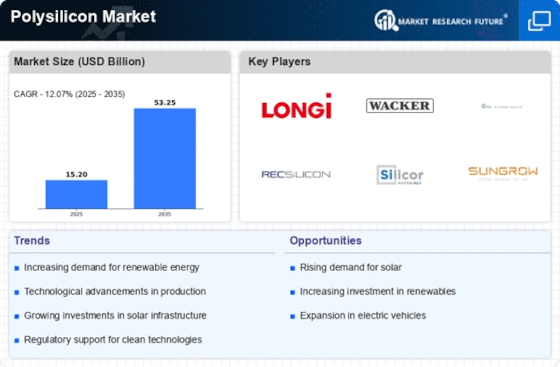
Polysilicon Market Infographic
Purchase Options

Market Analysis

In-depth Analysis of Polysilicon Market Industry Landscape

The polysilicon market, a critical segment in the solar and semiconductor industries, is characterized by dynamic factors that significantly influence its trajectory. Understanding these market dynamics is essential for industry stakeholders and participants to navigate challenges and capitalize on opportunities within this specialized market.

Solar Energy Growth:

The dynamics of the polysilicon market are intricately linked to the growth of the solar energy sector, where polysilicon serves as a fundamental material in photovoltaic cells. Increasing investments in solar projects, government incentives, and the push for renewable energy contribute to the rising demand for polysilicon. Photovoltaic Module Demand:

Polysilicon is a key component in the production of photovoltaic modules used in solar panels. Market dynamics are influenced by trends in the photovoltaic industry, including advancements in solar technology and increased adoption of solar power. Semiconductor Industry Requirements:

The polysilicon market is also essential for the semiconductor industry, where high-purity polysilicon is used in the manufacturing of electronic components. Demand from the semiconductor sector impacts market dynamics, with factors such as technological advancements and the growth of electronic devices influencing the market. Technological Advances in Polysilicon Production:

Ongoing technological advancements in polysilicon production contribute to market dynamics. Innovations in manufacturing processes, such as the development of upgraded Siemens processes or fluidized bed reactor technologies, impact efficiency and cost-effectiveness in polysilicon production. Supply and Demand Dynamics:

The dynamics of the polysilicon market are influenced by supply and demand imbalances. Fluctuations in demand, oversupply situations, or disruptions in production can impact polysilicon pricing and market stability. Trade Policies and Tariffs:

The polysilicon market is subject to global trade dynamics, with tariffs and trade policies affecting the international flow of polysilicon. Trade tensions and policy changes can impact market dynamics by influencing pricing and market access. Energy Transition and Government Policies:

Government policies promoting energy transition and the reduction of carbon emissions impact the dynamics of the polysilicon market. Incentives, subsidies, and regulatory frameworks supporting renewable energy contribute to the growth of the polysilicon market. Cost Competitiveness and Manufacturing Efficiency:

The dynamics of the polysilicon market are influenced by cost competitiveness and manufacturing efficiency. Continuous improvements in production processes and cost-effective manufacturing contribute to the market's competitiveness. Emerging Technologies and Alternative Materials:

Market dynamics are shaped by the emergence of alternative materials and technologies in the solar and semiconductor industries. Competition from new materials or innovative solar cell technologies can impact the demand for traditional polysilicon. Environmental and Sustainability Considerations:

Increasing emphasis on environmental sustainability influences the dynamics of the polysilicon market. Companies adopting sustainable practices, such as reducing energy consumption in production or using recycled materials, respond to consumer preferences and market trends. Investments and Capacity Expansions:

Market dynamics are influenced by investments in new production facilities and capacity expansions. Expansion plans and increased production capabilities impact the overall supply chain and market dynamics. Geopolitical Factors:

Geopolitical factors such as trade tensions, geopolitical conflicts, or international relations impact the global polysilicon market. Political stability and diplomatic relations can affect market dynamics by influencing trade flows and market access.


Author
Author Profile
Chitranshi Jaiswal
Team Lead - Research

Chitranshi is a Team Leader in the Chemicals & Materials (CnM) and Energy & Power (EnP) domains, with 6+ years of experience in market research. She leads and mentors teams to deliver cross-domain projects that equip clients with actionable insights and growth strategies. She is skilled in market estimation, forecasting, competitive benchmarking, and both primary & secondary research, enabling her to turn complex data into decision-ready insights. An engineer and MBA professional, she combines technical expertise with strategic acumen to solve dynamic market challenges. Chitranshi has successfully managed projects that support market entry, investment planning, and competitive positioning, while building strong client relationships. Certified in Advanced Excel & Power BI she leverages data-driven approaches to ensure accuracy, clarity, and impactful outcomes.

Leave a Comment

FAQs

What is the current valuation of the Polysilicon Market as of 2024?

<p>The Polysilicon Market was valued at 15.2 USD Billion in 2024.</p>

What is the projected market valuation for the Polysilicon Market in 2035?

<p>The market is projected to reach a valuation of 53.25 USD Billion by 2035.</p>

What is the expected CAGR for the Polysilicon Market during the forecast period 2025 - 2035?

<p>The expected CAGR for the Polysilicon Market during 2025 - 2035 is 12.07%.</p>

Which manufacturing technology segments are prominent in the Polysilicon Market?

<p>The prominent manufacturing technology segments include Siemens Process, FBR Process, and Upgraded Metallurgical-Grade Silicon Process.</p>

What are the projected valuations for the Siemens Process in the Polysilicon Market?

<p>The Siemens Process is projected to have valuations ranging from 6.5 to 23.5 USD Billion.</p>

How do the different forms of polysilicon compare in terms of market valuation?

<p>In terms of market valuation, Rods are projected at 6.2 to 21.25 USD Billion, Chips at 5.0 to 18.0 USD Billion, and Chunks at 4.0 to 14.0 USD Billion.</p>

What end-user segments are driving the Polysilicon Market?

<p>The key end-user segments driving the market include Solar Photovoltaic and Electronics.</p>

What are the projected valuations for the Solar Photovoltaic segment?

<p>The Solar Photovoltaic segment is projected to range from 10.0 to 36.0 USD Billion.</p>

Who are the key players in the Polysilicon Market?

<p>Key players in the Polysilicon Market include LONGi Green Energy Technology Co., Wacker Chemie AG, and GCL-Poly Energy Holdings Limited.</p>

What does the future hold for the Polysilicon Market in terms of growth?

<p>The Polysilicon Market appears poised for substantial growth, with projections indicating a significant increase in valuation by 2035.</p>

Market Summary

As per Market Research Future analysis, the Polysilicon Market Size was estimated at 15 USD Billion in 2024. The Polysilicon industry is projected to grow from USD 17.0 Billion in 2025 to USD 60.4 Billion by 2035, exhibiting a compound annual growth rate (CAGR) of 13.50% during the forecast period 2025 - 2035

Key Market Trends & Highlights

The polysilicon market is poised for robust growth driven by renewable energy demand and technological advancements.

  • North America remains the largest market for polysilicon, driven by increasing solar energy adoption. Asia-Pacific is the fastest-growing region, reflecting a surge in renewable energy investments. The Siemens Process dominates the market, while the FBR Process is emerging as the fastest-growing production method. Key market drivers include government policies promoting solar energy and rising global energy demand.

Market Size & Forecast

2024 Market Size 15(USD Billion)
2035 Market Size 60.4(USD Billion)
CAGR (2025 - 2035) 13.50%
Largest Regional Market Share in 2024 Asia Pacific

Major Players

Tongwei Co., Ltd., GCL Technology Holdings (GCL‑Poly), Daqo New Energy, Xinte Energy, Tokuyama Corporation, Osaka Titanium Technologies

Market Trends

The Polysilicon Market is currently experiencing a dynamic phase characterized by evolving demand patterns and technological advancements. As the global push for renewable energy intensifies, the need for high-purity polysilicon, a critical component in solar photovoltaic cells, appears to be on the rise. This trend is likely driven by increasing investments in solar energy infrastructure and a growing emphasis on sustainable energy solutions. Furthermore, the market seems to be influenced by geopolitical factors, which may affect supply chains and production capacities. Companies are exploring innovative manufacturing processes to enhance efficiency and reduce costs, indicating a shift towards more sustainable practices. In addition, the Polysilicon Market is witnessing a diversification of applications beyond solar energy. Industries such as electronics and electric vehicles are increasingly utilizing polysilicon for various components, suggesting a broader market potential. The competitive landscape is evolving, with both established players and new entrants vying for market share. This competitive dynamic may lead to strategic partnerships and collaborations aimed at enhancing technological capabilities and expanding product offerings. Overall, the Polysilicon Market appears poised for growth, driven by a combination of renewable energy demand, technological innovation, and diversification of applications.

Rising Demand for Renewable Energy

The Polysilicon Market is experiencing heightened demand due to the global shift towards renewable energy sources. As countries strive to meet sustainability goals, investments in solar energy are increasing, thereby driving the need for high-purity polysilicon.

Technological Advancements in Production

Innovations in polysilicon manufacturing processes are emerging, aimed at improving efficiency and reducing environmental impact. These advancements may lead to cost reductions and enhanced product quality, positioning companies favorably in a competitive landscape.

Diversification of Applications

Beyond solar energy, polysilicon is finding applications in various sectors, including electronics and electric vehicles. This diversification suggests a broader market potential, as industries seek to leverage the unique properties of polysilicon for different uses.

Polysilicon Market Market Drivers

Rising Global Energy Demand

The increasing The Polysilicon Industry. As populations grow and economies develop, the need for sustainable energy solutions becomes more pressing. In 2025, energy consumption is projected to rise significantly, prompting a shift towards renewable sources such as solar energy. This shift is likely to enhance the demand for polysilicon, as it is a fundamental material in solar panel production. The International Energy Agency forecasts that renewable energy sources will account for a larger share of the energy mix, with solar energy leading the charge. Consequently, the polysilicon market is expected to expand in response to this growing energy demand, as stakeholders seek to invest in cleaner and more sustainable energy technologies.

Government Policies and Incentives

Government policies and incentives aimed at promoting renewable energy are pivotal drivers for the Polysilicon Market. Many countries have implemented favorable regulations, subsidies, and tax incentives to encourage the adoption of solar energy technologies. In 2025, these initiatives are expected to bolster the demand for polysilicon, as manufacturers and consumers alike benefit from reduced costs associated with solar installations. For instance, feed-in tariffs and renewable energy certificates have proven effective in stimulating market growth. Additionally, international agreements focused on reducing carbon emissions further emphasize the need for clean energy solutions, thereby enhancing the role of polysilicon in the energy landscape. This supportive regulatory environment is likely to sustain the momentum of the polysilicon market, fostering innovation and investment.

Increasing Adoption of Solar Energy

The rising adoption of solar energy systems is a primary driver for the Polysilicon Market. As countries strive to meet renewable energy targets, the demand for solar photovoltaic (PV) cells has surged. In 2025, the solar energy sector is projected to account for a substantial share of the energy mix, with polysilicon being a critical component in the manufacturing of solar panels. The International Energy Agency indicates that solar power capacity could reach over 1,000 GW by 2025, further propelling the polysilicon market. This trend reflects a broader shift towards sustainable energy solutions, as both residential and commercial sectors increasingly invest in solar technologies. Consequently, the polysilicon market is likely to experience robust growth, driven by the escalating need for efficient and cost-effective solar energy solutions.

Expanding Applications Beyond Solar Energy

The diversification of applications for polysilicon is emerging as a significant driver for the Polysilicon Market. While solar energy remains the primary application, polysilicon is increasingly utilized in the electronics sector, particularly in the production of semiconductors and photovoltaic devices. In 2025, the demand for high-performance electronics is anticipated to grow, further expanding the polysilicon market. The rise of electric vehicles and energy storage systems also presents new opportunities for polysilicon applications. As industries seek to enhance energy efficiency and performance, the versatility of polysilicon positions it as a key material in various technological advancements. This trend suggests that the polysilicon market may not only thrive due to solar energy demand but also benefit from its expanding role in other high-tech applications.

Technological Innovations in Manufacturing

Technological advancements in polysilicon production processes are significantly influencing the Polysilicon Market. Innovations such as the Siemens process and fluidized bed reactor technology have enhanced production efficiency and reduced costs. These advancements enable manufacturers to produce high-purity polysilicon, which is essential for the performance of solar cells. In 2025, the market is expected to benefit from these innovations, as they allow for increased output and lower energy consumption during production. Furthermore, the integration of automation and digital technologies in manufacturing processes is likely to streamline operations, thereby improving overall productivity. As a result, the polysilicon market may witness a surge in supply, meeting the growing demand from the solar energy sector and other applications.

Market Segment Insights

By Manufacturing Technology: Siemens Process (Largest) vs. FBR Process (Fastest-Growing)

<p>In the polysilicon market, the Siemens process remains the largest contributor, securing a significant share due to its long-established efficiency and reliability in producing high-purity silicon. This method has been pivotal for traditional polysilicon production, attracting major manufacturers who prefer proven technologies. In contrast, the Fluidized Bed Reactor (FBR) process is rapidly gaining traction and is considered the fastest-growing segment. With its ability to lower production costs and enhance scalability, FBR is increasingly favored by newer entrants looking to optimize their operations.</p>

<p>Siemens Process (Dominant) vs. FBR Process (Emerging)</p>

<p>The Siemens process is characterized by its established technology and effectiveness in producing high-quality polysilicon, making it the dominant force in the market. It relies on chemical vapor deposition methods, known for yielding silicon with minimal impurities. Meanwhile, the FBR process is emerging as a strong competitor, offering remarkable benefits in terms of efficiency and cost-effectiveness. It utilizes a fluidized bed to enhance the reaction environment, leading to lower energy consumption and increased yield. With its adaptability and innovation, FBR technology is being increasingly adopted, catering to the growing demand for sustainable and economically viable polysilicon production.</p>

By Form: Rods (Largest) vs. Chips (Fastest-Growing)

<p>In the polysilicon market, the distribution of forms reveals that rods hold the largest market share, consistently dominating the segment due to their extensive applications in solar energy and semiconductor industries. Chips, while currently smaller in market share, are rapidly gaining traction, driven by advancements in technology and increasing demand for smaller, more efficient <a href="https://www.marketresearchfuture.com/reports/solar-panels-market-3237" target="_blank" title="solar panels">solar panels</a>. Chunks are present in the market as well, but they play a less significant role compared to rods and chips. The growth trends in this segment are significantly influenced by the global shift towards renewable energy solutions, where rods are favored for their efficiency. Chips are emerging as a notable segment due to their adaptability in miniaturized applications and the push for more efficient energy solutions. The increasing focus on technological innovation and sustainability is driving demand and growth in this area, indicating a promising future for the chips segment.</p>

<p>Rods (Dominant) vs. Chips (Emerging)</p>

<p>Rods represent the dominant form in the polysilicon market, primarily due to their large-scale applications in solar photovoltaic cells and various electronic components. Their structure allows for efficient energy conversion and high-performance output, which is essential for meeting the growing energy demands. In contrast, chips are gaining momentum as an emerging form, particularly in applications that require compact and efficient energy solutions. The trend towards miniaturization in electronics is driving the increased use of polysilicon chips, as they offer flexibility and innovation in design. Both forms are pivotal in the ongoing transition to renewable energy, reflecting distinct market needs and technological advancements.</p>

By End-User: Solar Photovoltaic (Largest) vs. Electronics (Fastest-Growing)

<p>The polysilicon market is significantly influenced by its end-user segments, with the solar photovoltaic sector commanding the largest market share. This dominance reflects the increasing adoption of renewable energy solutions and the global push towards sustainable energy sources. The solar photovoltaic segment not only leads in terms of volume but also benefits from favorable government policies and technological advancements in solar energy conversion efficiency. In contrast, the electronics sector, while smaller in market share, is characterized by its rapid growth and increasing reliance on polysilicon for semiconductor applications. The rising demand for electronics, particularly in consumer gadgets and industrial devices, is spurring the growth of polysilicon used in this segment.</p>

<p>End-User: Solar Photovoltaic (Dominant) vs. Electronics (Emerging)</p>

<p>The solar photovoltaic segment is a dominant force in the polysilicon market, driven by strong demand for renewable energy solutions and a robust infrastructure for solar panel production. Its established supply chains and significant investments in technology enhancements position it favorably against other segments. Meanwhile, the electronics sector is emerging rapidly as a critical application for polysilicon, fueled by technological innovations in electronics and a growing consumer electronics market. This segment's demand is increasingly shaped by the proliferation of sophisticated electronic devices requiring high-purity polysilicon, indicating a promising growth trajectory amidst the evolving technological landscape.</p>

Get more detailed insights about Polysilicon Market Research Report - Forecast to 2035

Regional Insights

North America : Innovation and Sustainability Leader

North America is witnessing a robust growth in the polysilicon market, driven by increasing investments in renewable energy and supportive government policies. The U.S. holds the largest market share at approximately 60%, followed by Canada at around 20%. Regulatory incentives, such as tax credits and renewable energy mandates, are propelling demand for solar technologies, thereby boosting polysilicon consumption. The competitive landscape is characterized by key players like Silicor Materials Inc. and REC Silicon ASA, which are focusing on innovative production techniques to enhance efficiency. The U.S. is also home to several research institutions that are advancing polysilicon technology. As the market evolves, partnerships between manufacturers and technology firms are expected to strengthen, further enhancing the region's position in The Polysilicon.

Europe : Sustainable Energy Transition Hub

Europe is emerging as a significant player in the polysilicon market, driven by stringent environmental regulations and a strong commitment to renewable energy. Germany and France are the largest markets, collectively holding about 50% of the European share. The European Union's Green Deal and various national policies are catalyzing investments in solar energy, thereby increasing the demand for polysilicon. Leading countries like Germany and France are home to major players such as Wacker Chemie AG and REC Silicon ASA. The competitive landscape is marked by a focus on sustainability and innovation, with companies investing in advanced manufacturing processes. The presence of strong regulatory frameworks is fostering a conducive environment for growth, making Europe a key region for polysilicon production and consumption.

Asia-Pacific : Emerging Powerhouse in Production

Asia-Pacific is rapidly becoming the dominant region in the polysilicon market, primarily due to the increasing adoption of solar energy technologies. China leads the market with a staggering 70% share, followed by Japan at around 15%. The region's growth is fueled by government initiatives promoting renewable energy and significant investments in solar infrastructure, which are expected to continue driving demand for polysilicon in the coming years. China's dominance is supported by major players like LONGi Green Energy Technology Co. and GCL-Poly Energy Holdings Limited, which are investing heavily in expanding production capacities. The competitive landscape is characterized by aggressive pricing strategies and technological advancements aimed at reducing production costs. As the region continues to innovate, it is likely to maintain its leadership in The Polysilicon.

Middle East and Africa : Resource-Rich Frontier for Solar

The Middle East and Africa are gradually emerging as new frontiers for the polysilicon market, driven by increasing investments in renewable energy projects. Countries like South Africa and the UAE are leading the charge, with South Africa holding about 25% of the regional market share. Government initiatives aimed at diversifying energy sources are catalyzing the growth of solar energy, thereby increasing the demand for polysilicon. The competitive landscape is still developing, with local and international players exploring opportunities in the region. Key players are beginning to establish manufacturing facilities to cater to the growing demand. As the region capitalizes on its abundant solar resources, it is poised to become a significant player in The Polysilicon, attracting investments and partnerships.

Key Players and Competitive Insights

The polysilicon market is currently characterized by a dynamic competitive landscape, driven by increasing demand for solar energy and advancements in photovoltaic technologies. Key players such as LONGi Green Energy Technology Co. (CN), Wacker Chemie AG (DE), and GCL-Poly Energy Holdings Limited (CN) are strategically positioned to leverage their technological expertise and production capabilities. LONGi Green Energy, for instance, focuses on innovation in monocrystalline silicon production, which enhances efficiency and reduces costs. Meanwhile, Wacker Chemie emphasizes sustainable practices in its manufacturing processes, aligning with global environmental goals. Collectively, these strategies not only enhance their market presence but also contribute to a competitive environment that prioritizes technological advancement and sustainability.

In terms of business tactics, companies are increasingly localizing manufacturing to mitigate supply chain disruptions and optimize logistics. This trend is particularly evident in the polysilicon market, which is moderately fragmented, with several players vying for market share. The collective influence of major companies shapes a competitive structure that encourages innovation and efficiency, as firms seek to differentiate themselves through advanced production techniques and sustainable practices.

In August 2025, GCL-Poly Energy Holdings Limited (CN) announced the expansion of its polysilicon production capacity by 50%, a move aimed at meeting the surging global demand for solar panels. This strategic expansion not only positions GCL-Poly as a leading supplier but also reflects its commitment to scaling operations in response to market needs. The increased capacity is expected to enhance its competitive edge, allowing for greater market penetration and improved economies of scale.

In September 2025, Wacker Chemie AG (DE) unveiled a new line of high-purity polysilicon tailored for advanced solar applications. This innovation underscores Wacker's focus on product differentiation and technological leadership. By catering to the specific needs of high-efficiency solar cells, Wacker is likely to strengthen its market position and attract a broader customer base, particularly among manufacturers seeking cutting-edge materials.

In October 2025, LONGi Green Energy Technology Co. (CN) entered a strategic partnership with a leading European solar module manufacturer to co-develop next-generation solar technologies. This collaboration is indicative of a broader trend towards strategic alliances in the polysilicon market, as companies seek to pool resources and expertise to accelerate innovation. Such partnerships may enhance product offerings and drive down costs, further intensifying competition in the sector.

As of October 2025, the polysilicon market is witnessing significant trends such as digitalization, sustainability, and the integration of artificial intelligence in production processes. These trends are reshaping competitive dynamics, with companies increasingly focusing on strategic alliances to enhance their technological capabilities. The shift from price-based competition to a focus on innovation, technology, and supply chain reliability is becoming evident, suggesting that future competitive differentiation will hinge on the ability to adapt to these evolving market demands.

Key Companies in the Polysilicon Market include

Industry Developments

  • Q4 2024: Production cut announcements from two leading domestic polysilicon enterprises—Tongwei and Daqo New Energy—spark market discussions On December 24, 2024, Tongwei and Daqo New Energy, two of China's largest polysilicon producers, announced production cuts in response to falling prices and industry-wide losses. GCL Technology also revealed plans for production cuts and maintenance during the same period.
  • Q4 2024: Daqo New Energy and Tongwei Solar take decision to control production, affecting up to 1.2 million tonnes of polysilicon capacity In December 2024, Daqo New Energy and Tongwei Solar announced coordinated production controls to address severe overcapacity and price declines, impacting a significant portion of global polysilicon supply.
  • Q2 2025: OCI Holdings delays IPO for Malaysian polysilicon business amid market challenges In April 2025, Korean chemical firm OCI Holdings postponed the planned Initial Public Offering (IPO) of its Malaysian polysilicon unit due to ongoing market weakness and falling polysilicon prices.
  • Q4 2024: GCL Technology announces production cuts and maintenance in response to market losses GCL Technology, a major polysilicon producer, disclosed plans for production cuts and scheduled maintenance in late 2024, joining other industry leaders in efforts to stabilize the market.
  • Q2 2024: Small third- and fourth-tier polysilicon enterprises cease production amid price collapse By the first half of 2024, numerous smaller polysilicon producers in China halted operations as prices fell below average production costs, with no resumption of output in the second half of the year.
  • Q2 2024: Operating rates among polysilicon enterprises drop significantly in H1 2024 Industry-wide operating rates for polysilicon production fell sharply in the first half of 2024, as both small and some top-tier producers reduced or halted output in response to sustained losses.
  • Q2 2025: Tongwei Solar increases output using seasonally low electricity rates to gain market share In mid-2025, Tongwei Solar leveraged low electricity rates in Sichuan and Yunnan provinces to ramp up polysilicon production, aiming to increase market share despite ongoing industry overcapacity.
  • Q3 2025: Global polysilicon producers face contract execution delays amid weak demand As of July 2025, major global polysilicon buyers reported significant delays in executing long-term supply contracts, reflecting persistent demand weakness and low utilization rates at wafer production facilities.

Future Outlook

Polysilicon Market Future Outlook

The Polysilicon Market is projected to grow at a 12.07% CAGR from 2024 to 2035, driven by increasing solar energy demand, technological advancements, and government incentives.

New opportunities lie in:

  • Expansion into emerging markets with tailored solar solutions.
  • Investment in advanced manufacturing technologies for cost reduction.
  • Development of recycling processes for polysilicon to enhance sustainability.

By 2035, the Polysilicon Market is expected to solidify its position as a leader in renewable energy materials.

Market Segmentation

Polysilicon Market Form Outlook

  • Chips
  • Chunks
  • Rods

Polysilicon Market End-User Outlook

  • Solar Photovoltaic
  • Electronics

Polysilicon Market Manufacturing Technology Outlook

  • Siemens Process
  • FBR Process
  • Upgraded Metallurgical-Grade Silicon Process

Report Scope

MARKET SIZE 202415.2(USD Billion)
MARKET SIZE 202517.03(USD Billion)
MARKET SIZE 203553.25(USD Billion)
COMPOUND ANNUAL GROWTH RATE (CAGR)12.07% (2024 - 2035)
REPORT COVERAGERevenue Forecast, Competitive Landscape, Growth Factors, and Trends
BASE YEAR2024
Market Forecast Period2025 - 2035
Historical Data2019 - 2024
Market Forecast UnitsUSD Billion
Key Companies ProfiledMarket analysis in progress
Segments CoveredMarket segmentation analysis in progress
Key Market OpportunitiesGrowing demand for renewable energy sources drives expansion in the Polysilicon Market.
Key Market DynamicsRising demand for renewable energy drives polysilicon production, influencing supply chain dynamics and competitive market forces.
Countries CoveredNorth America, Europe, APAC, South America, MEA

FAQs

What is the current valuation of the Polysilicon Market as of 2024?

<p>The Polysilicon Market was valued at 15.2 USD Billion in 2024.</p>

What is the projected market valuation for the Polysilicon Market in 2035?

<p>The market is projected to reach a valuation of 53.25 USD Billion by 2035.</p>

What is the expected CAGR for the Polysilicon Market during the forecast period 2025 - 2035?

<p>The expected CAGR for the Polysilicon Market during 2025 - 2035 is 12.07%.</p>

Which manufacturing technology segments are prominent in the Polysilicon Market?

<p>The prominent manufacturing technology segments include Siemens Process, FBR Process, and Upgraded Metallurgical-Grade Silicon Process.</p>

What are the projected valuations for the Siemens Process in the Polysilicon Market?

<p>The Siemens Process is projected to have valuations ranging from 6.5 to 23.5 USD Billion.</p>

How do the different forms of polysilicon compare in terms of market valuation?

<p>In terms of market valuation, Rods are projected at 6.2 to 21.25 USD Billion, Chips at 5.0 to 18.0 USD Billion, and Chunks at 4.0 to 14.0 USD Billion.</p>

What end-user segments are driving the Polysilicon Market?

<p>The key end-user segments driving the market include Solar Photovoltaic and Electronics.</p>

What are the projected valuations for the Solar Photovoltaic segment?

<p>The Solar Photovoltaic segment is projected to range from 10.0 to 36.0 USD Billion.</p>

Who are the key players in the Polysilicon Market?

<p>Key players in the Polysilicon Market include LONGi Green Energy Technology Co., Wacker Chemie AG, and GCL-Poly Energy Holdings Limited.</p>

What does the future hold for the Polysilicon Market in terms of growth?

<p>The Polysilicon Market appears poised for substantial growth, with projections indicating a significant increase in valuation by 2035.</p>

  1. SECTION I: EXECUTIVE SUMMARY AND KEY HIGHLIGHTS
    1. | 1.1 EXECUTIVE SUMMARY
    2. | | 1.1.1 Market Overview
    3. | | 1.1.2 Key Findings
    4. | | 1.1.3 Market Segmentation
    5. | | 1.1.4 Competitive Landscape
    6. | | 1.1.5 Challenges and Opportunities
    7. | | 1.1.6 Future Outlook
  2. SECTION II: SCOPING, METHODOLOGY AND MARKET STRUCTURE
    1. | 2.1 MARKET INTRODUCTION
    2. | | 2.1.1 Definition
    3. | | 2.1.2 Scope of the study
    4. | | | 2.1.2.1 Research Objective
    5. | | | 2.1.2.2 Assumption
    6. | | | 2.1.2.3 Limitations
    7. | 2.2 RESEARCH METHODOLOGY
    8. | | 2.2.1 Overview
    9. | | 2.2.2 Data Mining
    10. | | 2.2.3 Secondary Research
    11. | | 2.2.4 Primary Research
    12. | | | 2.2.4.1 Primary Interviews and Information Gathering Process
    13. | | | 2.2.4.2 Breakdown of Primary Respondents
    14. | | 2.2.5 Forecasting Model
    15. | | 2.2.6 Market Size Estimation
    16. | | | 2.2.6.1 Bottom-Up Approach
    17. | | | 2.2.6.2 Top-Down Approach
    18. | | 2.2.7 Data Triangulation
    19. | | 2.2.8 Validation
  3. SECTION III: QUALITATIVE ANALYSIS
    1. | 3.1 MARKET DYNAMICS
    2. | | 3.1.1 Overview
    3. | | 3.1.2 Drivers
    4. | | 3.1.3 Restraints
    5. | | 3.1.4 Opportunities
    6. | 3.2 MARKET FACTOR ANALYSIS
    7. | | 3.2.1 Value chain Analysis
    8. | | 3.2.2 Porter's Five Forces Analysis
    9. | | | 3.2.2.1 Bargaining Power of Suppliers
    10. | | | 3.2.2.2 Bargaining Power of Buyers
    11. | | | 3.2.2.3 Threat of New Entrants
    12. | | | 3.2.2.4 Threat of Substitutes
    13. | | | 3.2.2.5 Intensity of Rivalry
    14. | | 3.2.3 COVID-19 Impact Analysis
    15. | | | 3.2.3.1 Market Impact Analysis
    16. | | | 3.2.3.2 Regional Impact
    17. | | | 3.2.3.3 Opportunity and Threat Analysis
  4. SECTION IV: QUANTITATIVE ANALYSIS
    1. | 4.1 Chemicals and Materials, BY Manufacturing Technology (USD Billion)
    2. | | 4.1.1 Siemens Process
    3. | | 4.1.2 FBR Process
    4. | | 4.1.3 Upgraded Metallurgical-Grade Silicon Process
    5. | 4.2 Chemicals and Materials, BY Form (USD Billion)
    6. | | 4.2.1 Chips
    7. | | 4.2.2 Chunks
    8. | | 4.2.3 Rods
    9. | 4.3 Chemicals and Materials, BY End-User (USD Billion)
    10. | | 4.3.1 Solar Photovoltaic
    11. | | 4.3.2 Electronics
    12. | 4.4 Chemicals and Materials, BY Region (USD Billion)
    13. | | 4.4.1 North America
    14. | | | 4.4.1.1 US
    15. | | | 4.4.1.2 Canada
    16. | | 4.4.2 Europe
    17. | | | 4.4.2.1 Germany
    18. | | | 4.4.2.2 UK
    19. | | | 4.4.2.3 France
    20. | | | 4.4.2.4 Russia
    21. | | | 4.4.2.5 Italy
    22. | | | 4.4.2.6 Spain
    23. | | | 4.4.2.7 Rest of Europe
    24. | | 4.4.3 APAC
    25. | | | 4.4.3.1 China
    26. | | | 4.4.3.2 India
    27. | | | 4.4.3.3 Japan
    28. | | | 4.4.3.4 South Korea
    29. | | | 4.4.3.5 Malaysia
    30. | | | 4.4.3.6 Thailand
    31. | | | 4.4.3.7 Indonesia
    32. | | | 4.4.3.8 Rest of APAC
    33. | | 4.4.4 South America
    34. | | | 4.4.4.1 Brazil
    35. | | | 4.4.4.2 Mexico
    36. | | | 4.4.4.3 Argentina
    37. | | | 4.4.4.4 Rest of South America
    38. | | 4.4.5 MEA
    39. | | | 4.4.5.1 GCC Countries
    40. | | | 4.4.5.2 South Africa
    41. | | | 4.4.5.3 Rest of MEA
  5. SECTION V: COMPETITIVE ANALYSIS
    1. | 5.1 Competitive Landscape
    2. | | 5.1.1 Overview
    3. | | 5.1.2 Competitive Analysis
    4. | | 5.1.3 Market share Analysis
    5. | | 5.1.4 Major Growth Strategy in the Chemicals and Materials
    6. | | 5.1.5 Competitive Benchmarking
    7. | | 5.1.6 Leading Players in Terms of Number of Developments in the Chemicals and Materials
    8. | | 5.1.7 Key developments and growth strategies
    9. | | | 5.1.7.1 New Product Launch/Service Deployment
    10. | | | 5.1.7.2 Merger & Acquisitions
    11. | | | 5.1.7.3 Joint Ventures
    12. | | 5.1.8 Major Players Financial Matrix
    13. | | | 5.1.8.1 Sales and Operating Income
    14. | | | 5.1.8.2 Major Players R&D Expenditure. 2023
    15. | 5.2 Company Profiles
    16. | | 5.2.1 LONGi Green Energy Technology Co. (CN)
    17. | | | 5.2.1.1 Financial Overview
    18. | | | 5.2.1.2 Products Offered
    19. | | | 5.2.1.3 Key Developments
    20. | | | 5.2.1.4 SWOT Analysis
    21. | | | 5.2.1.5 Key Strategies
    22. | | 5.2.2 Wacker Chemie AG (DE)
    23. | | | 5.2.2.1 Financial Overview
    24. | | | 5.2.2.2 Products Offered
    25. | | | 5.2.2.3 Key Developments
    26. | | | 5.2.2.4 SWOT Analysis
    27. | | | 5.2.2.5 Key Strategies
    28. | | 5.2.3 GCL-Poly Energy Holdings Limited (CN)
    29. | | | 5.2.3.1 Financial Overview
    30. | | | 5.2.3.2 Products Offered
    31. | | | 5.2.3.3 Key Developments
    32. | | | 5.2.3.4 SWOT Analysis
    33. | | | 5.2.3.5 Key Strategies
    34. | | 5.2.4 REC Silicon ASA (NO)
    35. | | | 5.2.4.1 Financial Overview
    36. | | | 5.2.4.2 Products Offered
    37. | | | 5.2.4.3 Key Developments
    38. | | | 5.2.4.4 SWOT Analysis
    39. | | | 5.2.4.5 Key Strategies
    40. | | 5.2.5 Silicor Materials Inc. (US)
    41. | | | 5.2.5.1 Financial Overview
    42. | | | 5.2.5.2 Products Offered
    43. | | | 5.2.5.3 Key Developments
    44. | | | 5.2.5.4 SWOT Analysis
    45. | | | 5.2.5.5 Key Strategies
    46. | | 5.2.6 Shenzhen Sungrow Power Supply Co. (CN)
    47. | | | 5.2.6.1 Financial Overview
    48. | | | 5.2.6.2 Products Offered
    49. | | | 5.2.6.3 Key Developments
    50. | | | 5.2.6.4 SWOT Analysis
    51. | | | 5.2.6.5 Key Strategies
    52. | | 5.2.7 Hanwha Q CELLS Co., Ltd. (KR)
    53. | | | 5.2.7.1 Financial Overview
    54. | | | 5.2.7.2 Products Offered
    55. | | | 5.2.7.3 Key Developments
    56. | | | 5.2.7.4 SWOT Analysis
    57. | | | 5.2.7.5 Key Strategies
    58. | | 5.2.8 Trina Solar Limited (CN)
    59. | | | 5.2.8.1 Financial Overview
    60. | | | 5.2.8.2 Products Offered
    61. | | | 5.2.8.3 Key Developments
    62. | | | 5.2.8.4 SWOT Analysis
    63. | | | 5.2.8.5 Key Strategies
    64. | 5.3 Appendix
    65. | | 5.3.1 References
    66. | | 5.3.2 Related Reports
  6. LIST OF FIGURES
    1. | 6.1 MARKET SYNOPSIS
    2. | 6.2 NORTH AMERICA MARKET ANALYSIS
    3. | 6.3 US MARKET ANALYSIS BY MANUFACTURING TECHNOLOGY
    4. | 6.4 US MARKET ANALYSIS BY FORM
    5. | 6.5 US MARKET ANALYSIS BY END-USER
    6. | 6.6 CANADA MARKET ANALYSIS BY MANUFACTURING TECHNOLOGY
    7. | 6.7 CANADA MARKET ANALYSIS BY FORM
    8. | 6.8 CANADA MARKET ANALYSIS BY END-USER
    9. | 6.9 EUROPE MARKET ANALYSIS
    10. | 6.10 GERMANY MARKET ANALYSIS BY MANUFACTURING TECHNOLOGY
    11. | 6.11 GERMANY MARKET ANALYSIS BY FORM
    12. | 6.12 GERMANY MARKET ANALYSIS BY END-USER
    13. | 6.13 UK MARKET ANALYSIS BY MANUFACTURING TECHNOLOGY
    14. | 6.14 UK MARKET ANALYSIS BY FORM
    15. | 6.15 UK MARKET ANALYSIS BY END-USER
    16. | 6.16 FRANCE MARKET ANALYSIS BY MANUFACTURING TECHNOLOGY
    17. | 6.17 FRANCE MARKET ANALYSIS BY FORM
    18. | 6.18 FRANCE MARKET ANALYSIS BY END-USER
    19. | 6.19 RUSSIA MARKET ANALYSIS BY MANUFACTURING TECHNOLOGY
    20. | 6.20 RUSSIA MARKET ANALYSIS BY FORM
    21. | 6.21 RUSSIA MARKET ANALYSIS BY END-USER
    22. | 6.22 ITALY MARKET ANALYSIS BY MANUFACTURING TECHNOLOGY
    23. | 6.23 ITALY MARKET ANALYSIS BY FORM
    24. | 6.24 ITALY MARKET ANALYSIS BY END-USER
    25. | 6.25 SPAIN MARKET ANALYSIS BY MANUFACTURING TECHNOLOGY
    26. | 6.26 SPAIN MARKET ANALYSIS BY FORM
    27. | 6.27 SPAIN MARKET ANALYSIS BY END-USER
    28. | 6.28 REST OF EUROPE MARKET ANALYSIS BY MANUFACTURING TECHNOLOGY
    29. | 6.29 REST OF EUROPE MARKET ANALYSIS BY FORM
    30. | 6.30 REST OF EUROPE MARKET ANALYSIS BY END-USER
    31. | 6.31 APAC MARKET ANALYSIS
    32. | 6.32 CHINA MARKET ANALYSIS BY MANUFACTURING TECHNOLOGY
    33. | 6.33 CHINA MARKET ANALYSIS BY FORM
    34. | 6.34 CHINA MARKET ANALYSIS BY END-USER
    35. | 6.35 INDIA MARKET ANALYSIS BY MANUFACTURING TECHNOLOGY
    36. | 6.36 INDIA MARKET ANALYSIS BY FORM
    37. | 6.37 INDIA MARKET ANALYSIS BY END-USER
    38. | 6.38 JAPAN MARKET ANALYSIS BY MANUFACTURING TECHNOLOGY
    39. | 6.39 JAPAN MARKET ANALYSIS BY FORM
    40. | 6.40 JAPAN MARKET ANALYSIS BY END-USER
    41. | 6.41 SOUTH KOREA MARKET ANALYSIS BY MANUFACTURING TECHNOLOGY
    42. | 6.42 SOUTH KOREA MARKET ANALYSIS BY FORM
    43. | 6.43 SOUTH KOREA MARKET ANALYSIS BY END-USER
    44. | 6.44 MALAYSIA MARKET ANALYSIS BY MANUFACTURING TECHNOLOGY
    45. | 6.45 MALAYSIA MARKET ANALYSIS BY FORM
    46. | 6.46 MALAYSIA MARKET ANALYSIS BY END-USER
    47. | 6.47 THAILAND MARKET ANALYSIS BY MANUFACTURING TECHNOLOGY
    48. | 6.48 THAILAND MARKET ANALYSIS BY FORM
    49. | 6.49 THAILAND MARKET ANALYSIS BY END-USER
    50. | 6.50 INDONESIA MARKET ANALYSIS BY MANUFACTURING TECHNOLOGY
    51. | 6.51 INDONESIA MARKET ANALYSIS BY FORM
    52. | 6.52 INDONESIA MARKET ANALYSIS BY END-USER
    53. | 6.53 REST OF APAC MARKET ANALYSIS BY MANUFACTURING TECHNOLOGY
    54. | 6.54 REST OF APAC MARKET ANALYSIS BY FORM
    55. | 6.55 REST OF APAC MARKET ANALYSIS BY END-USER
    56. | 6.56 SOUTH AMERICA MARKET ANALYSIS
    57. | 6.57 BRAZIL MARKET ANALYSIS BY MANUFACTURING TECHNOLOGY
    58. | 6.58 BRAZIL MARKET ANALYSIS BY FORM
    59. | 6.59 BRAZIL MARKET ANALYSIS BY END-USER
    60. | 6.60 MEXICO MARKET ANALYSIS BY MANUFACTURING TECHNOLOGY
    61. | 6.61 MEXICO MARKET ANALYSIS BY FORM
    62. | 6.62 MEXICO MARKET ANALYSIS BY END-USER
    63. | 6.63 ARGENTINA MARKET ANALYSIS BY MANUFACTURING TECHNOLOGY
    64. | 6.64 ARGENTINA MARKET ANALYSIS BY FORM
    65. | 6.65 ARGENTINA MARKET ANALYSIS BY END-USER
    66. | 6.66 REST OF SOUTH AMERICA MARKET ANALYSIS BY MANUFACTURING TECHNOLOGY
    67. | 6.67 REST OF SOUTH AMERICA MARKET ANALYSIS BY FORM
    68. | 6.68 REST OF SOUTH AMERICA MARKET ANALYSIS BY END-USER
    69. | 6.69 MEA MARKET ANALYSIS
    70. | 6.70 GCC COUNTRIES MARKET ANALYSIS BY MANUFACTURING TECHNOLOGY
    71. | 6.71 GCC COUNTRIES MARKET ANALYSIS BY FORM
    72. | 6.72 GCC COUNTRIES MARKET ANALYSIS BY END-USER
    73. | 6.73 SOUTH AFRICA MARKET ANALYSIS BY MANUFACTURING TECHNOLOGY
    74. | 6.74 SOUTH AFRICA MARKET ANALYSIS BY FORM
    75. | 6.75 SOUTH AFRICA MARKET ANALYSIS BY END-USER
    76. | 6.76 REST OF MEA MARKET ANALYSIS BY MANUFACTURING TECHNOLOGY
    77. | 6.77 REST OF MEA MARKET ANALYSIS BY FORM
    78. | 6.78 REST OF MEA MARKET ANALYSIS BY END-USER
    79. | 6.79 KEY BUYING CRITERIA OF CHEMICALS AND MATERIALS
    80. | 6.80 RESEARCH PROCESS OF MRFR
    81. | 6.81 DRO ANALYSIS OF CHEMICALS AND MATERIALS
    82. | 6.82 DRIVERS IMPACT ANALYSIS: CHEMICALS AND MATERIALS
    83. | 6.83 RESTRAINTS IMPACT ANALYSIS: CHEMICALS AND MATERIALS
    84. | 6.84 SUPPLY / VALUE CHAIN: CHEMICALS AND MATERIALS
    85. | 6.85 CHEMICALS AND MATERIALS, BY MANUFACTURING TECHNOLOGY, 2024 (% SHARE)
    86. | 6.86 CHEMICALS AND MATERIALS, BY MANUFACTURING TECHNOLOGY, 2024 TO 2035 (USD Billion)
    87. | 6.87 CHEMICALS AND MATERIALS, BY FORM, 2024 (% SHARE)
    88. | 6.88 CHEMICALS AND MATERIALS, BY FORM, 2024 TO 2035 (USD Billion)
    89. | 6.89 CHEMICALS AND MATERIALS, BY END-USER, 2024 (% SHARE)
    90. | 6.90 CHEMICALS AND MATERIALS, BY END-USER, 2024 TO 2035 (USD Billion)
    91. | 6.91 BENCHMARKING OF MAJOR COMPETITORS
  7. LIST OF TABLES
    1. | 7.1 LIST OF ASSUMPTIONS
    2. | | 7.1.1
    3. | 7.2 North America MARKET SIZE ESTIMATES; FORECAST
    4. | | 7.2.1 BY MANUFACTURING TECHNOLOGY, 2025-2035 (USD Billion)
    5. | | 7.2.2 BY FORM, 2025-2035 (USD Billion)
    6. | | 7.2.3 BY END-USER, 2025-2035 (USD Billion)
    7. | 7.3 US MARKET SIZE ESTIMATES; FORECAST
    8. | | 7.3.1 BY MANUFACTURING TECHNOLOGY, 2025-2035 (USD Billion)
    9. | | 7.3.2 BY FORM, 2025-2035 (USD Billion)
    10. | | 7.3.3 BY END-USER, 2025-2035 (USD Billion)
    11. | 7.4 Canada MARKET SIZE ESTIMATES; FORECAST
    12. | | 7.4.1 BY MANUFACTURING TECHNOLOGY, 2025-2035 (USD Billion)
    13. | | 7.4.2 BY FORM, 2025-2035 (USD Billion)
    14. | | 7.4.3 BY END-USER, 2025-2035 (USD Billion)
    15. | 7.5 Europe MARKET SIZE ESTIMATES; FORECAST
    16. | | 7.5.1 BY MANUFACTURING TECHNOLOGY, 2025-2035 (USD Billion)
    17. | | 7.5.2 BY FORM, 2025-2035 (USD Billion)
    18. | | 7.5.3 BY END-USER, 2025-2035 (USD Billion)
    19. | 7.6 Germany MARKET SIZE ESTIMATES; FORECAST
    20. | | 7.6.1 BY MANUFACTURING TECHNOLOGY, 2025-2035 (USD Billion)
    21. | | 7.6.2 BY FORM, 2025-2035 (USD Billion)
    22. | | 7.6.3 BY END-USER, 2025-2035 (USD Billion)
    23. | 7.7 UK MARKET SIZE ESTIMATES; FORECAST
    24. | | 7.7.1 BY MANUFACTURING TECHNOLOGY, 2025-2035 (USD Billion)
    25. | | 7.7.2 BY FORM, 2025-2035 (USD Billion)
    26. | | 7.7.3 BY END-USER, 2025-2035 (USD Billion)
    27. | 7.8 France MARKET SIZE ESTIMATES; FORECAST
    28. | | 7.8.1 BY MANUFACTURING TECHNOLOGY, 2025-2035 (USD Billion)
    29. | | 7.8.2 BY FORM, 2025-2035 (USD Billion)
    30. | | 7.8.3 BY END-USER, 2025-2035 (USD Billion)
    31. | 7.9 Russia MARKET SIZE ESTIMATES; FORECAST
    32. | | 7.9.1 BY MANUFACTURING TECHNOLOGY, 2025-2035 (USD Billion)
    33. | | 7.9.2 BY FORM, 2025-2035 (USD Billion)
    34. | | 7.9.3 BY END-USER, 2025-2035 (USD Billion)
    35. | 7.10 Italy MARKET SIZE ESTIMATES; FORECAST
    36. | | 7.10.1 BY MANUFACTURING TECHNOLOGY, 2025-2035 (USD Billion)
    37. | | 7.10.2 BY FORM, 2025-2035 (USD Billion)
    38. | | 7.10.3 BY END-USER, 2025-2035 (USD Billion)
    39. | 7.11 Spain MARKET SIZE ESTIMATES; FORECAST
    40. | | 7.11.1 BY MANUFACTURING TECHNOLOGY, 2025-2035 (USD Billion)
    41. | | 7.11.2 BY FORM, 2025-2035 (USD Billion)
    42. | | 7.11.3 BY END-USER, 2025-2035 (USD Billion)
    43. | 7.12 Rest of Europe MARKET SIZE ESTIMATES; FORECAST
    44. | | 7.12.1 BY MANUFACTURING TECHNOLOGY, 2025-2035 (USD Billion)
    45. | | 7.12.2 BY FORM, 2025-2035 (USD Billion)
    46. | | 7.12.3 BY END-USER, 2025-2035 (USD Billion)
    47. | 7.13 APAC MARKET SIZE ESTIMATES; FORECAST
    48. | | 7.13.1 BY MANUFACTURING TECHNOLOGY, 2025-2035 (USD Billion)
    49. | | 7.13.2 BY FORM, 2025-2035 (USD Billion)
    50. | | 7.13.3 BY END-USER, 2025-2035 (USD Billion)
    51. | 7.14 China MARKET SIZE ESTIMATES; FORECAST
    52. | | 7.14.1 BY MANUFACTURING TECHNOLOGY, 2025-2035 (USD Billion)
    53. | | 7.14.2 BY FORM, 2025-2035 (USD Billion)
    54. | | 7.14.3 BY END-USER, 2025-2035 (USD Billion)
    55. | 7.15 India MARKET SIZE ESTIMATES; FORECAST
    56. | | 7.15.1 BY MANUFACTURING TECHNOLOGY, 2025-2035 (USD Billion)
    57. | | 7.15.2 BY FORM, 2025-2035 (USD Billion)
    58. | | 7.15.3 BY END-USER, 2025-2035 (USD Billion)
    59. | 7.16 Japan MARKET SIZE ESTIMATES; FORECAST
    60. | | 7.16.1 BY MANUFACTURING TECHNOLOGY, 2025-2035 (USD Billion)
    61. | | 7.16.2 BY FORM, 2025-2035 (USD Billion)
    62. | | 7.16.3 BY END-USER, 2025-2035 (USD Billion)
    63. | 7.17 South Korea MARKET SIZE ESTIMATES; FORECAST
    64. | | 7.17.1 BY MANUFACTURING TECHNOLOGY, 2025-2035 (USD Billion)
    65. | | 7.17.2 BY FORM, 2025-2035 (USD Billion)
    66. | | 7.17.3 BY END-USER, 2025-2035 (USD Billion)
    67. | 7.18 Malaysia MARKET SIZE ESTIMATES; FORECAST
    68. | | 7.18.1 BY MANUFACTURING TECHNOLOGY, 2025-2035 (USD Billion)
    69. | | 7.18.2 BY FORM, 2025-2035 (USD Billion)
    70. | | 7.18.3 BY END-USER, 2025-2035 (USD Billion)
    71. | 7.19 Thailand MARKET SIZE ESTIMATES; FORECAST
    72. | | 7.19.1 BY MANUFACTURING TECHNOLOGY, 2025-2035 (USD Billion)
    73. | | 7.19.2 BY FORM, 2025-2035 (USD Billion)
    74. | | 7.19.3 BY END-USER, 2025-2035 (USD Billion)
    75. | 7.20 Indonesia MARKET SIZE ESTIMATES; FORECAST
    76. | | 7.20.1 BY MANUFACTURING TECHNOLOGY, 2025-2035 (USD Billion)
    77. | | 7.20.2 BY FORM, 2025-2035 (USD Billion)
    78. | | 7.20.3 BY END-USER, 2025-2035 (USD Billion)
    79. | 7.21 Rest of APAC MARKET SIZE ESTIMATES; FORECAST
    80. | | 7.21.1 BY MANUFACTURING TECHNOLOGY, 2025-2035 (USD Billion)
    81. | | 7.21.2 BY FORM, 2025-2035 (USD Billion)
    82. | | 7.21.3 BY END-USER, 2025-2035 (USD Billion)
    83. | 7.22 South America MARKET SIZE ESTIMATES; FORECAST
    84. | | 7.22.1 BY MANUFACTURING TECHNOLOGY, 2025-2035 (USD Billion)
    85. | | 7.22.2 BY FORM, 2025-2035 (USD Billion)
    86. | | 7.22.3 BY END-USER, 2025-2035 (USD Billion)
    87. | 7.23 Brazil MARKET SIZE ESTIMATES; FORECAST
    88. | | 7.23.1 BY MANUFACTURING TECHNOLOGY, 2025-2035 (USD Billion)
    89. | | 7.23.2 BY FORM, 2025-2035 (USD Billion)
    90. | | 7.23.3 BY END-USER, 2025-2035 (USD Billion)
    91. | 7.24 Mexico MARKET SIZE ESTIMATES; FORECAST
    92. | | 7.24.1 BY MANUFACTURING TECHNOLOGY, 2025-2035 (USD Billion)
    93. | | 7.24.2 BY FORM, 2025-2035 (USD Billion)
    94. | | 7.24.3 BY END-USER, 2025-2035 (USD Billion)
    95. | 7.25 Argentina MARKET SIZE ESTIMATES; FORECAST
    96. | | 7.25.1 BY MANUFACTURING TECHNOLOGY, 2025-2035 (USD Billion)
    97. | | 7.25.2 BY FORM, 2025-2035 (USD Billion)
    98. | | 7.25.3 BY END-USER, 2025-2035 (USD Billion)
    99. | 7.26 Rest of South America MARKET SIZE ESTIMATES; FORECAST
    100. | | 7.26.1 BY MANUFACTURING TECHNOLOGY, 2025-2035 (USD Billion)
    101. | | 7.26.2 BY FORM, 2025-2035 (USD Billion)
    102. | | 7.26.3 BY END-USER, 2025-2035 (USD Billion)
    103. | 7.27 MEA MARKET SIZE ESTIMATES; FORECAST
    104. | | 7.27.1 BY MANUFACTURING TECHNOLOGY, 2025-2035 (USD Billion)
    105. | | 7.27.2 BY FORM, 2025-2035 (USD Billion)
    106. | | 7.27.3 BY END-USER, 2025-2035 (USD Billion)
    107. | 7.28 GCC Countries MARKET SIZE ESTIMATES; FORECAST
    108. | | 7.28.1 BY MANUFACTURING TECHNOLOGY, 2025-2035 (USD Billion)
    109. | | 7.28.2 BY FORM, 2025-2035 (USD Billion)
    110. | | 7.28.3 BY END-USER, 2025-2035 (USD Billion)
    111. | 7.29 South Africa MARKET SIZE ESTIMATES; FORECAST
    112. | | 7.29.1 BY MANUFACTURING TECHNOLOGY, 2025-2035 (USD Billion)
    113. | | 7.29.2 BY FORM, 2025-2035 (USD Billion)
    114. | | 7.29.3 BY END-USER, 2025-2035 (USD Billion)
    115. | 7.30 Rest of MEA MARKET SIZE ESTIMATES; FORECAST
    116. | | 7.30.1 BY MANUFACTURING TECHNOLOGY, 2025-2035 (USD Billion)
    117. | | 7.30.2 BY FORM, 2025-2035 (USD Billion)
    118. | | 7.30.3 BY END-USER, 2025-2035 (USD Billion)
    119. | 7.31 PRODUCT LAUNCH/PRODUCT DEVELOPMENT/APPROVAL
    120. | | 7.31.1
    121. | 7.32 ACQUISITION/PARTNERSHIP
    122. | | 7.32.1

Chemicals and Materials Market Segmentation

Chemicals and Materials By Manufacturing Technology (USD Billion, 2025-2035)

  • Siemens Process
  • FBR Process
  • Upgraded Metallurgical-Grade Silicon Process

Chemicals and Materials By Form (USD Billion, 2025-2035)

  • Chips
  • Chunks
  • Rods

Chemicals and Materials By End-User (USD Billion, 2025-2035)

  • Solar Photovoltaic
  • Electronics
Infographic

Free Sample Request

Kindly complete the form below to receive a free sample of this Report

Get Free Sample

Customer Strories

Compare Licence

×
Features License Type
Single User Multiuser License Enterprise User
Price $4,950 $5,950 $7,250
Maximum User Access Limit 1 User Upto 10 Users Unrestricted Access Throughout the Organization
Free Customization
Direct Access to Analyst
Deliverable Format
Platform Access
Discount on Next Purchase 10% 15% 15%
Printable Versions