Request Free Sample ×

Kindly complete the form below to receive a free sample of this Report

* Please use a valid business email

Leading companies partner with us for data-driven Insights

clients tt-cursor
Hero Background
English
Chinese
French
Japanese
Korean
German
Spanish

Polypropylene Compounds Market Share

ID: MRFR/CnM/10683-HCR
111 Pages
Chitranshi Jaiswal
December 2024

Polypropylene Compounds Market Size, Share & Industry Analysis Research Report Information By Product (Mineral Filled PP Compounds, Compounded TPO, Compounded TPV, Glass Fiber Reinforced, Talc Filled and Others), By Application (Fiber, Film & Sheet, Raffia and Others), By End-use (Automotive, Building & Construction, Electrical & Electronics, Textile and Others) And By Region (North America, Europe, Asia-Pacific, And Rest Of The World) –Market Forecast Till 2035

Share:
Download PDF ×

We do not share your information with anyone. However, we may send you emails based on your report interest from time to time. You may contact us at any time to opt-out.

Polypropylene Compounds Market Infographic
Purchase Options

Market Share

Polypropylene Compounds Market Share Analysis

The polypropylene compounds market, a great phase in the plastics industry, employs a number of market percentage positioning strategies to face out in a competitive marketplace. Companies recognize product differentiation by imparting a wide range of polypropylene compounds tailored for specific packages. The market positioning frequently revolves around innovation in compound formulations. Polypropylene compound producers put money into studies and improvements to create superior formulations with stepped-forward mechanical houses, flame retardancy, and environmental sustainability. Forming strategic partnerships with stop-user industries is a collaborative marketplace positioning technique. Polypropylene compound manufacturers collaborate with car, packaging, and production sectors to align their products with specific enterprise needs. The emphasis on sustainability is vital for market positioning. Polypropylene compounds vendors integrate environmentally pleasant practices, including the usage of recycled substances or growing recyclable compounds. Expanding strategically into new international markets is crucial for market growth. Polypropylene compound manufacturers have set up a presence in regions with developing industrial sports, infrastructure development, and growing calls for polymer compounds. Offering responsive customer support and technical assistance is imperative. Polypropylene compound manufacturers prioritize client satisfaction via support in material choice, application trying out, and troubleshooting. Establishing a robust online presence via virtual advertising is vital within the current enterprise panorama. Polypropylene compound providers leverage virtual structures to exhibit their product abilities, interact with potential customers, and offer instructional content. Adopting strategic pricing fashions is essential for market positioning. Polypropylene compound manufacturers put into effect pricing techniques that stabilize competitiveness with profitability. Building sturdy brands and coping with popularity is essential for marketplace visibility. Polypropylene compound providers invest in branding efforts, highlighting product capabilities, best, and progressive formulations. Continuous studies on emerging technology are essential. Polypropylene compound producers live knowledgeable about evolving manufacturing methods, compounding technologies, and market dynamics. Adapting to regulatory requirements is non-negotiable. Polypropylene compound vendors ensure compliance with neighborhood and worldwide guidelines associated with cloth safety, fine, and environmental effects. Investing in team member education and skill improvement is a strategic circulate. Polypropylene compound groups make sure that their workforce is prepared with the essential technical information and understanding. Embracing energy-green manufacturing practices is a comprehensive market positioning strategy. Polypropylene compound producers invest in technology and approaches that lessen energy consumption and environmental impact. Energy-efficient practices align with sustainability dreams and contribute to marketplace leadership.

Author
Author Profile
Chitranshi Jaiswal
Team Lead - Research

Chitranshi is a Team Leader in the Chemicals & Materials (CnM) and Energy & Power (EnP) domains, with 6+ years of experience in market research. She leads and mentors teams to deliver cross-domain projects that equip clients with actionable insights and growth strategies. She is skilled in market estimation, forecasting, competitive benchmarking, and both primary & secondary research, enabling her to turn complex data into decision-ready insights. An engineer and MBA professional, she combines technical expertise with strategic acumen to solve dynamic market challenges. Chitranshi has successfully managed projects that support market entry, investment planning, and competitive positioning, while building strong client relationships. Certified in Advanced Excel & Power BI she leverages data-driven approaches to ensure accuracy, clarity, and impactful outcomes.

Leave a Comment

FAQs

What is the projected market valuation of the Polypropylene Compounds Market by 2035?

<p>The Polypropylene Compounds Market is projected to reach a valuation of 61.71 USD Billion by 2035.</p>

What was the market valuation of the Polypropylene Compounds Market in 2024?

<p>In 2024, the overall market valuation of the Polypropylene Compounds Market was 25.67 USD Billion.</p>

What is the expected CAGR for the Polypropylene Compounds Market during the forecast period 2025 - 2035?

<p>The expected CAGR for the Polypropylene Compounds Market during the forecast period 2025 - 2035 is 8.3%.</p>

Which companies are considered key players in the Polypropylene Compounds Market?

<p>Key players in the Polypropylene Compounds Market include LyondellBasell Industries, SABIC, ExxonMobil Chemical, BASF, and Mitsubishi Chemical Corporation.</p>

What are the projected values for Mineral filled PP compounds by 2035?

<p>The projected values for Mineral filled PP compounds are expected to range from 12.0 USD Billion by 2035.</p>

How does the market for Compounded TPO compare to other segments by 2035?

<p>By 2035, the market for Compounded TPO is projected to reach 15.0 USD Billion, indicating strong growth relative to other segments.</p>

What is the expected market size for the Automotive end-use segment by 2035?

The Automotive end-use segment is expected to reach a market size of 12.0 USD Billion by 2035.

What is the projected market size for Film & sheet applications by 2035?

The market size for Film &amp; sheet applications is projected to reach 23.45 USD Billion by 2035.

What is the anticipated growth for the Glass fiber reinforced segment by 2035?

The Glass fiber reinforced segment is anticipated to grow to 12.0 USD Billion by 2035.

What are the expected values for the Textile end-use segment by 2035?

The Textile end-use segment is expected to reach values between 3.0 and 8.0 USD Billion by 2035.

Market Summary

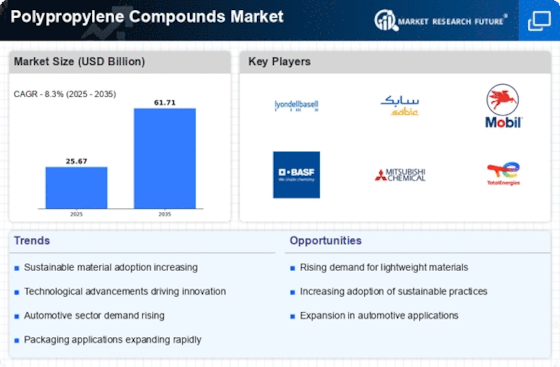
As per Market Research Future analysis, the Polypropylene Compounds Market Size was estimated at 25.67 USD Billion in 2024. The Polypropylene Compounds industry is projected to grow from USD 27.8 Billion in 2025 to USD 61.71 Billion by 2035, exhibiting a compound annual growth rate (CAGR) of 8.3% during the forecast period 2025 - 2035

Key Market Trends & Highlights

The Polypropylene Compounds Market is experiencing robust growth driven by sustainability and technological advancements.

  • North America remains the largest market for polypropylene compounds, driven by strong demand in automotive and packaging applications. Asia-Pacific is the fastest-growing region, reflecting increasing investments in manufacturing and consumer goods. Mineral filled polypropylene compounds dominate the market, while glass fiber reinforced compounds are emerging as the fastest-growing segment. Key market drivers include rising demand in the automotive sector and regulatory support for sustainable materials.

Market Size & Forecast

2024 Market Size 25.67 (USD Billion)
2035 Market Size 61.71 (USD Billion)
CAGR (2025 - 2035) 8.3%
Largest Regional Market Share in 2024 North America

Major Players

LyondellBasell Industries (US), SABIC (SA), ExxonMobil Chemical (US), BASF (DE), Mitsubishi Chemical Corporation (JP), TotalEnergies (FR), Braskem (BR), Reliance Industries Limited (IN), Formosa Plastics Corporation (TW)

Market Trends

The Polypropylene Compounds Market is currently experiencing a dynamic phase characterized by evolving consumer preferences and technological advancements. The demand for lightweight and durable materials is driving innovation in the production of polypropylene compounds, which are increasingly utilized across various industries, including automotive, packaging, and consumer goods. This shift towards sustainable practices is prompting manufacturers to explore bio-based and recycled polypropylene options, thereby enhancing the market's environmental profile. Furthermore, the integration of advanced processing techniques is likely to improve the performance characteristics of these compounds, making them more appealing to end-users. In addition, the polypropylene compounds market is witnessing a growing trend towards customization and specialization.

As industries seek tailored solutions to meet specific application requirements, manufacturers are responding by developing specialized grades of polypropylene compounds, including solutions for the scratch resistant polypropylene compound for automotive interior market. This trend not only enhances product performance but also fosters closer collaboration between suppliers and customers. Overall, the polypropylene compounds market appears poised for continued growth, driven by innovation, sustainability, and a focus on meeting diverse consumer needs.

Sustainability Initiatives

The Polypropylene Compounds Market is increasingly influenced by sustainability initiatives. Manufacturers are exploring eco-friendly alternatives, such as bio-based and recycled materials, to reduce environmental impact. This trend reflects a broader commitment to sustainable practices across various industries, aligning with consumer demand for greener products.

Technological Advancements

Technological advancements play a crucial role in shaping the polypropylene compounds market . Innovations in processing techniques enhance the performance and versatility of polypropylene compounds. These advancements enable manufacturers to produce materials that meet the evolving needs of diverse applications, particularly in automotive and packaging sectors.

Customization and Specialization

Customization and specialization are emerging trends within the Polypropylene Compounds Market. As industries seek specific solutions for unique applications, manufacturers are developing tailored grades of polypropylene compounds. This trend fosters collaboration between suppliers and customers, ensuring that products meet precise performance requirements.

Polypropylene Compounds Market Market Drivers

Growth in Packaging Applications

The packaging industry is increasingly adopting polypropylene compounds due to their versatility and favorable properties. Polypropylene Compounds Market is experiencing a surge in demand for flexible packaging solutions, which are essential for food safety and product preservation. In 2025, the packaging sector is expected to represent a substantial portion of the polypropylene compounds market, with a projected growth rate of approximately 4.5% per year. This growth is attributed to the rising consumer preference for lightweight and recyclable packaging materials, which align with sustainability goals. Additionally, the ability of polypropylene compounds to be easily molded and customized for various packaging formats enhances their appeal. As a result, manufacturers are likely to invest in polypropylene compounds to meet the evolving needs of the packaging industry.

Increasing Use in Consumer Goods

The consumer goods sector is witnessing a growing trend towards the use of polypropylene compounds, driven by their durability and aesthetic appeal. Polypropylene Compounds Market is benefiting from the rising demand for household products, including storage containers, furniture, and appliances. In 2025, the consumer goods segment is anticipated to contribute significantly to the overall market, with a growth rate estimated at around 5.2% annually. This trend is fueled by changing consumer preferences for lightweight, easy-to-clean, and long-lasting products. Furthermore, the customization capabilities of polypropylene compounds allow manufacturers to create innovative designs that cater to diverse consumer tastes. As a result, the consumer goods sector is likely to continue driving the demand for polypropylene compounds in the coming years.

Rising Demand in Automotive Sector

The automotive sector is experiencing a notable increase in the utilization of polypropylene compounds, driven by the need for lightweight materials that enhance fuel efficiency. Polypropylene Compounds Market is witnessing a shift as manufacturers seek to reduce vehicle weight while maintaining structural integrity. In 2025, the automotive industry is projected to account for a significant share of the polypropylene compounds market, with an estimated growth rate of around 5% annually. This trend is further supported by stringent regulations aimed at reducing emissions, compelling automotive manufacturers to adopt materials that contribute to lower vehicle weights. Consequently, the demand for polypropylene compounds is likely to rise, as they offer a balance of performance and cost-effectiveness, making them an attractive choice for various automotive applications.

Technological Innovations in Production

Technological advancements in the production of polypropylene compounds are playing a crucial role in enhancing their properties and applications. Polypropylene Compounds Market is experiencing innovations that improve processing efficiency and product quality. In 2025, the introduction of advanced manufacturing techniques, such as 3D printing and enhanced compounding processes, is expected to drive market growth. These innovations allow for the creation of tailored polypropylene compounds that meet specific performance requirements, thereby expanding their applicability across various industries. Additionally, the development of new additives and modifiers is likely to enhance the functionality of polypropylene compounds, making them suitable for more demanding applications. Consequently, the ongoing technological innovations are anticipated to significantly influence the polypropylene compounds market in the near future.

Regulatory Support for Sustainable Materials

Regulatory frameworks promoting the use of sustainable materials are increasingly influencing the polypropylene compounds market. Polypropylene Compounds Market is benefiting from government initiatives aimed at reducing plastic waste and encouraging recycling. In 2025, policies that support the use of recyclable and eco-friendly materials are expected to drive demand for polypropylene compounds, which are known for their recyclability. This regulatory support is likely to create opportunities for manufacturers to innovate and develop new products that align with sustainability goals. Furthermore, as consumers become more environmentally conscious, the demand for sustainable packaging and products is expected to rise, further propelling the growth of the polypropylene compounds market. Thus, regulatory support is poised to play a pivotal role in shaping the future landscape of the industry.

Market Segment Insights

By Product: Mineral filled PP compounds (Largest) vs. Glass fiber reinforced (Fastest-Growing)

The Polypropylene Compounds Market exhibits a diverse range of product segments, with mineral filled PP compounds leading in market share. This segment benefits from its cost-effectiveness and improved mechanical properties, capturing the attention of industries like automotive and packaging. In contrast, glass fiber reinforced compounds, while currently smaller in share, are gaining traction due to their enhanced strength-to-weight ratio and performance benefits in demanding applications. Growth trends indicate a rising demand for innovative and sustainable materials, driving the development of both mineral filled and <a href="https://www.marketresearchfuture.com/reports/glass-fiber-reinforced-concrete-market-6220">glass fiber-reinforced</a> products. The ongoing emphasis on lightweight solutions in the automotive sector is stimulating growth in glass fiber compounds, positioned as the fastest-growing segment. Additionally, increasing regulations favoring sustainable materials are propelling the use of mineral filled compounds across various industries.

Mineral filled PP compounds (Dominant) vs. Glass fiber reinforced (Emerging)

Mineral filled polypropylene compounds are recognized for their versatile applications, particularly in the automotive and packaging sectors, due to their balanced properties and cost efficiency. They are predominantly used to enhance impact resistance and reduce production costs, making them a preferred choice for many manufacturers. On the other hand, glass fiber reinforced polypropylene compounds represent the emerging trend in high-performance applications. These compounds are praised for their superior stiffness and dimensional stability, making them ideal for use in structural components where performance is crucial. As industries explore more advanced materials, glass fiber reinforced compounds are expected to capture a larger market share, appealing to manufacturers seeking strength without additional weight.

By Application: Fiber (Largest) vs. Film & Sheet (Fastest-Growing)

The polypropylene compounds market is characterized by distinct applications, where fiber represents the largest segment due to its extensive use in textiles and carpets. This dominance is complemented by the film and sheet segment, which is rapidly gaining traction in packaging applications. The raffia segment also contributes to the market, albeit at a smaller scale, while the 'others' category encompasses diverse applications that are gaining attention in niche markets. Growth trends in the polypropylene compounds market point to a significant increase in demand for film and sheet applications, driven by e-commerce and food packaging requirements. The fiber segment, although stable, faces emerging competition from innovative alternatives. Sustainability trends are influencing the market dynamics, leading to higher adoption rates of polypropylene compounds in various applications, particularly in eco-friendly packaging solutions.

Fiber (Dominant) vs. Film &amp; Sheet (Emerging)

In the polypropylene compounds market, fiber stands out as the dominant application, heavily utilized in the textile industry due to its superior durability and versatility. Fiber products, notably non-woven fabrics, have become essential in various sectors such as automotive, hygiene, and filtration. On the other hand, the film and sheet segment is emerging, driven by increasing demand for <a href="https://www.marketresearchfuture.com/reports/flexible-packaging-market-1151">flexible packaging</a> solutions. This application is favored for its lightweight characteristics, barrier properties, and recyclability, aligning with sustainability initiatives. As consumers and industries lean towards eco-friendly products, the film and sheet segment is expected to expand rapidly, showcasing innovative uses in agriculture and food packaging, thus complementing the established fiber segment.

By End-use: Automotive (Largest) vs. Building & Construction (Fastest-Growing)

In the Polypropylene Compounds Market, the distribution among end-use segments showcases notable dynamics. The automotive sector holds the largest share, driven by the increasing demand for lightweight materials that enhance fuel efficiency. Following closely is the building and construction sector, which is rapidly gaining traction due to the rise in residential and commercial infrastructure projects that favor durable and versatile materials such as polypropylene compounds. Growth trends within these segments indicate a shift towards sustainable materials and processes. The automotive industry is increasingly implementing polypropylene compounds to reduce vehicle weight and emissions as part of green initiatives. Meanwhile, the building and construction sector benefits from trends towards modular and <a href="https://www.marketresearchfuture.com/reports/prefabricated-construction-market-25798">prefabricated construction</a> techniques, where polypropylene compounds offer advantages in terms of cost-effectiveness and performance longevity.

Automotive: Dominant vs. Building &amp; Construction: Emerging

The automotive segment in the Polypropylene Compounds Market stands as a dominant player, characterized by the increasing adoption of lightweight materials that contribute to improved fuel economy and reduced emissions. This sector focuses on the development of innovative compound formulations that meet stringent automotive standards while providing durability and aesthetic appeal. In contrast, the building and construction segment is emerging rapidly, driven by a surge in infrastructure projects and trends favoring sustainable building practices. This segment emphasizes versatility and cost-efficiency, with polypropylene compounds being favored for their resistance to weathering and impact, making them ideal for various applications ranging from pipes to insulating materials.

Get more detailed insights about Polypropylene Compounds Market Research Report - Global Forecast 2035

Regional Insights

North America : Innovation and Demand Surge

The North American polypropylene compounds market is driven by robust demand from automotive, packaging, and consumer goods sectors. The region is the largest market, holding approximately 40% of the global share, with the U.S. and Canada leading the charge. Regulatory support for sustainable materials and recycling initiatives further catalyzes growth, pushing manufacturers to innovate and adapt to changing consumer preferences. Key players like LyondellBasell and ExxonMobil dominate the landscape, leveraging advanced technologies to enhance product performance. The competitive environment is characterized by strategic partnerships and investments in R&D, ensuring a steady supply of high-quality polypropylene compounds. The U.S. remains a hub for innovation, while Canada is emerging as a significant player in sustainable practices.

Europe : Sustainability and Innovation Focus

Europe is witnessing a transformative shift in the polypropylene compounds market, driven by stringent environmental regulations and a strong push for sustainability. The region holds approximately 30% of the global market share, with Germany and France being the largest contributors. Regulatory frameworks like the European Green Deal are catalyzing investments in eco-friendly materials, enhancing demand for recycled polypropylene compounds. Leading countries are investing heavily in R&D to develop innovative solutions that meet both performance and sustainability criteria. Major players such as BASF and TotalEnergies are at the forefront, focusing on circular economy initiatives. The competitive landscape is evolving, with an increasing number of startups entering the market, driven by the demand for sustainable alternatives and innovative applications.

Asia-Pacific : Rapid Industrialization and Growth

The Asia-Pacific region is rapidly emerging as a powerhouse in the polypropylene compounds market, driven by industrialization and urbanization. This region holds approximately 25% of the global market share, with China and India leading the way. The growing automotive and packaging industries are significant demand drivers, supported by favorable government policies aimed at boosting manufacturing and exports. China is the largest market, with a strong presence of key players like Reliance Industries and Mitsubishi Chemical. The competitive landscape is marked by aggressive pricing strategies and technological advancements. As the region continues to expand, investments in infrastructure and manufacturing capabilities are expected to further enhance market growth, positioning Asia-Pacific as a critical player in the global polypropylene landscape.

Middle East and Africa : Resource-Rich and Emerging Market

The Middle East and Africa region is witnessing significant growth in the polypropylene compounds market, driven by abundant natural resources and increasing industrial activities. This region holds approximately 5% of the global market share, with Saudi Arabia and South Africa being the primary contributors. The demand for polypropylene is rising in sectors such as construction, automotive, and packaging, supported by government initiatives to diversify economies and promote manufacturing. Saudi Arabia, with its vast petrochemical industry, is home to key players like SABIC and Braskem, which are expanding their production capacities. The competitive landscape is evolving, with local manufacturers increasingly focusing on quality and innovation to meet international standards. As the region continues to develop, it is poised to become a significant player in The Polypropylene Compounds Market.

Key Players and Competitive Insights

The Polypropylene Compounds Market is currently characterized by a dynamic competitive landscape, driven by increasing demand across various sectors such as automotive, packaging, and consumer goods. Key players are actively engaging in strategies that emphasize innovation, sustainability, and regional expansion to enhance their market positions. For instance, LyondellBasell Industries (US) has been focusing on expanding its production capabilities to meet the rising demand for high-performance polypropylene compounds, while SABIC (SA) is leveraging its technological expertise to develop advanced materials that cater to the evolving needs of its customers. These strategic initiatives not only bolster their competitive edge but also contribute to shaping the overall market dynamics. In terms of business tactics, companies are increasingly localizing manufacturing and optimizing supply chains to enhance efficiency and responsiveness to market demands. The Polypropylene Compounds Market appears to be moderately fragmented, with several key players exerting considerable influence. This competitive structure allows for a diverse range of products and innovations, as companies strive to differentiate themselves through unique offerings and enhanced customer service. In August 2025, ExxonMobil Chemical (US) announced the launch of a new line of sustainable polypropylene compounds designed to reduce environmental impact. This strategic move underscores the company's commitment to sustainability and positions it favorably in a market that is increasingly prioritizing eco-friendly solutions. By investing in sustainable product development, ExxonMobil aims to capture a growing segment of environmentally conscious consumers and businesses. Similarly, in September 2025, BASF (DE) unveiled a partnership with a leading automotive manufacturer to develop lightweight polypropylene compounds aimed at improving fuel efficiency in vehicles. This collaboration not only highlights BASF's focus on innovation but also reflects the industry's shift towards more sustainable and efficient materials. The partnership is expected to enhance BASF's market presence while addressing the automotive sector's pressing need for lightweight solutions. In October 2025, Mitsubishi Chemical Corporation (JP) announced a significant investment in expanding its polypropylene production facilities in Asia. This strategic expansion is likely to enhance the company's capacity to meet the growing demand in the region, particularly in the automotive and packaging sectors. By increasing production capabilities, Mitsubishi Chemical aims to solidify its position as a key player in the Asian market, responding effectively to regional growth trends. As of October 2025, the competitive trends in the Polypropylene Compounds Market are increasingly defined by digitalization, sustainability, and the integration of advanced technologies such as AI. Strategic alliances are becoming more prevalent, as companies recognize the value of collaboration in driving innovation and enhancing supply chain reliability. Looking ahead, it appears that competitive differentiation will increasingly shift from price-based competition to a focus on innovation, technological advancements, and sustainable practices, as companies strive to meet the evolving demands of the market.

Key Companies in the Polypropylene Compounds Market include

Industry Developments

December 2020: Beon 3D, a cutting-edge PP product line from LyondellBasell, was unveiled. It will provide distinctive design and allow for the one-step production of complex, high-quality 3D printed objects. By combining polymer technology and additive manufacturing, this product was made. This product line will be advantageous to the transportation, industrial, building and construction, and consumer products industries.

September 2023: SABIC announced the launch of its new line of polypropylene compounds, SABIC PP Compounds. The compounds are made with renewable feedstocks and offer a variety of performance benefits, including improved impact resistance, heat resistance, and chemical resistance.

October 2023: Dow announced the launch of its new polypropylene compound, Innate PP1215. The compound is designed for use in food packaging applications, and it offers improved clarity and barrier properties.

Future Outlook

Polypropylene Compounds Market Future Outlook

The Polypropylene Compounds Market is projected to grow at an 8.3% CAGR from 2025 to 2035, driven by increasing demand in automotive, packaging, and consumer goods sectors.

New opportunities lie in:

  • <p>Development of bio-based polypropylene compounds for sustainable applications. Expansion into emerging markets with tailored product offerings. Investment in advanced recycling technologies to enhance material circularity.</p>

By 2035, the polypropylene compounds market   is expected to solidify its position as a leader in innovative material solutions.

Market Segmentation

Polypropylene Compounds Market End-use Outlook

  • Automotive
  • Building & construction
  • Electrical & electronics
  • Textile
  • Others

Polypropylene Compounds Market Product Outlook

  • Mineral filled PP compounds
  • Compounded TPO
  • Compounded TPV
  • Glass fiber reinforced
  • Talc filled
  • Others

Polypropylene Compounds Market Application Outlook

  • Fiber
  • Film & sheet
  • Raffia
  • Others

Report Scope

MARKET SIZE 2024 25.67(USD Billion)
MARKET SIZE 2025 27.8(USD Billion)
MARKET SIZE 2035 61.71(USD Billion)
COMPOUND ANNUAL GROWTH RATE (CAGR) 8.3% (2025 - 2035)
REPORT COVERAGE Revenue Forecast, Competitive Landscape, Growth Factors, and Trends
BASE YEAR 2024
Market Forecast Period 2025 - 2035
Historical Data 2019 - 2024
Market Forecast Units USD Billion
Key Companies Profiled LyondellBasell Industries (US), SABIC (SA), ExxonMobil Chemical (US), BASF (DE), Mitsubishi Chemical Corporation (JP), TotalEnergies (FR), Braskem (BR), Reliance Industries Limited (IN), Formosa Plastics Corporation (TW)
Segments Covered Product, Application, End-use, Region
Key Market Opportunities Growing demand for lightweight materials in automotive and packaging sectors drives Polypropylene Compounds Market expansion.
Key Market Dynamics Rising demand for lightweight materials drives innovation in polypropylene compounds across various industries.
Countries Covered North America, Europe, APAC, South America, MEA

FAQs

What is the projected market valuation of the Polypropylene Compounds Market by 2035?

<p>The Polypropylene Compounds Market is projected to reach a valuation of 61.71 USD Billion by 2035.</p>

What was the market valuation of the Polypropylene Compounds Market in 2024?

<p>In 2024, the overall market valuation of the Polypropylene Compounds Market was 25.67 USD Billion.</p>

What is the expected CAGR for the Polypropylene Compounds Market during the forecast period 2025 - 2035?

<p>The expected CAGR for the Polypropylene Compounds Market during the forecast period 2025 - 2035 is 8.3%.</p>

Which companies are considered key players in the Polypropylene Compounds Market?

<p>Key players in the Polypropylene Compounds Market include LyondellBasell Industries, SABIC, ExxonMobil Chemical, BASF, and Mitsubishi Chemical Corporation.</p>

What are the projected values for Mineral filled PP compounds by 2035?

<p>The projected values for Mineral filled PP compounds are expected to range from 12.0 USD Billion by 2035.</p>

How does the market for Compounded TPO compare to other segments by 2035?

<p>By 2035, the market for Compounded TPO is projected to reach 15.0 USD Billion, indicating strong growth relative to other segments.</p>

What is the expected market size for the Automotive end-use segment by 2035?

The Automotive end-use segment is expected to reach a market size of 12.0 USD Billion by 2035.

What is the projected market size for Film & sheet applications by 2035?

The market size for Film &amp; sheet applications is projected to reach 23.45 USD Billion by 2035.

What is the anticipated growth for the Glass fiber reinforced segment by 2035?

The Glass fiber reinforced segment is anticipated to grow to 12.0 USD Billion by 2035.

What are the expected values for the Textile end-use segment by 2035?

The Textile end-use segment is expected to reach values between 3.0 and 8.0 USD Billion by 2035.

  1. SECTION I: EXECUTIVE SUMMARY AND KEY HIGHLIGHTS
    1. | 1.1 EXECUTIVE SUMMARY
    2. | | 1.1.1 Market Overview
    3. | | 1.1.2 Key Findings
    4. | | 1.1.3 Market Segmentation
    5. | | 1.1.4 Competitive Landscape
    6. | | 1.1.5 Challenges and Opportunities
    7. | | 1.1.6 Future Outlook
  2. SECTION II: SCOPING, METHODOLOGY AND MARKET STRUCTURE
    1. | 2.1 MARKET INTRODUCTION
    2. | | 2.1.1 Definition
    3. | | 2.1.2 Scope of the study
    4. | | | 2.1.2.1 Research Objective
    5. | | | 2.1.2.2 Assumption
    6. | | | 2.1.2.3 Limitations
    7. | 2.2 RESEARCH METHODOLOGY
    8. | | 2.2.1 Overview
    9. | | 2.2.2 Data Mining
    10. | | 2.2.3 Secondary Research
    11. | | 2.2.4 Primary Research
    12. | | | 2.2.4.1 Primary Interviews and Information Gathering Process
    13. | | | 2.2.4.2 Breakdown of Primary Respondents
    14. | | 2.2.5 Forecasting Model
    15. | | 2.2.6 Market Size Estimation
    16. | | | 2.2.6.1 Bottom-Up Approach
    17. | | | 2.2.6.2 Top-Down Approach
    18. | | 2.2.7 Data Triangulation
    19. | | 2.2.8 Validation
  3. SECTION III: QUALITATIVE ANALYSIS
    1. | 3.1 MARKET DYNAMICS
    2. | | 3.1.1 Overview
    3. | | 3.1.2 Drivers
    4. | | 3.1.3 Restraints
    5. | | 3.1.4 Opportunities
    6. | 3.2 MARKET FACTOR ANALYSIS
    7. | | 3.2.1 Value chain Analysis
    8. | | 3.2.2 Porter's Five Forces Analysis
    9. | | | 3.2.2.1 Bargaining Power of Suppliers
    10. | | | 3.2.2.2 Bargaining Power of Buyers
    11. | | | 3.2.2.3 Threat of New Entrants
    12. | | | 3.2.2.4 Threat of Substitutes
    13. | | | 3.2.2.5 Intensity of Rivalry
    14. | | 3.2.3 COVID-19 Impact Analysis
    15. | | | 3.2.3.1 Market Impact Analysis
    16. | | | 3.2.3.2 Regional Impact
    17. | | | 3.2.3.3 Opportunity and Threat Analysis
  4. SECTION IV: QUANTITATIVE ANALYSIS
    1. | 4.1 Chemicals and Materials, BY Product (USD Billion)
    2. | | 4.1.1 Mineral filled PP compounds
    3. | | 4.1.2 Compounded TPO
    4. | | 4.1.3 Compounded TPV
    5. | | 4.1.4 Glass fiber reinforced
    6. | | 4.1.5 Talc filled
    7. | | 4.1.6 Others
    8. | 4.2 Chemicals and Materials, BY Application (USD Billion)
    9. | | 4.2.1 Fiber
    10. | | 4.2.2 Film & sheet
    11. | | 4.2.3 Raffia
    12. | | 4.2.4 Others
    13. | 4.3 Chemicals and Materials, BY End-use (USD Billion)
    14. | | 4.3.1 Automotive
    15. | | 4.3.2 Building & construction
    16. | | 4.3.3 Electrical & electronics
    17. | | 4.3.4 Textile
    18. | | 4.3.5 Others
    19. | 4.4 Chemicals and Materials, BY Region (USD Billion)
    20. | | 4.4.1 North America
    21. | | | 4.4.1.1 US
    22. | | | 4.4.1.2 Canada
    23. | | 4.4.2 Europe
    24. | | | 4.4.2.1 Germany
    25. | | | 4.4.2.2 UK
    26. | | | 4.4.2.3 France
    27. | | | 4.4.2.4 Russia
    28. | | | 4.4.2.5 Italy
    29. | | | 4.4.2.6 Spain
    30. | | | 4.4.2.7 Rest of Europe
    31. | | 4.4.3 APAC
    32. | | | 4.4.3.1 China
    33. | | | 4.4.3.2 India
    34. | | | 4.4.3.3 Japan
    35. | | | 4.4.3.4 South Korea
    36. | | | 4.4.3.5 Malaysia
    37. | | | 4.4.3.6 Thailand
    38. | | | 4.4.3.7 Indonesia
    39. | | | 4.4.3.8 Rest of APAC
    40. | | 4.4.4 South America
    41. | | | 4.4.4.1 Brazil
    42. | | | 4.4.4.2 Mexico
    43. | | | 4.4.4.3 Argentina
    44. | | | 4.4.4.4 Rest of South America
    45. | | 4.4.5 MEA
    46. | | | 4.4.5.1 GCC Countries
    47. | | | 4.4.5.2 South Africa
    48. | | | 4.4.5.3 Rest of MEA
  5. SECTION V: COMPETITIVE ANALYSIS
    1. | 5.1 Competitive Landscape
    2. | | 5.1.1 Overview
    3. | | 5.1.2 Competitive Analysis
    4. | | 5.1.3 Market share Analysis
    5. | | 5.1.4 Major Growth Strategy in the Chemicals and Materials
    6. | | 5.1.5 Competitive Benchmarking
    7. | | 5.1.6 Leading Players in Terms of Number of Developments in the Chemicals and Materials
    8. | | 5.1.7 Key developments and growth strategies
    9. | | | 5.1.7.1 New Product Launch/Service Deployment
    10. | | | 5.1.7.2 Merger & Acquisitions
    11. | | | 5.1.7.3 Joint Ventures
    12. | | 5.1.8 Major Players Financial Matrix
    13. | | | 5.1.8.1 Sales and Operating Income
    14. | | | 5.1.8.2 Major Players R&D Expenditure. 2023
    15. | 5.2 Company Profiles
    16. | | 5.2.1 LyondellBasell Industries (US)
    17. | | | 5.2.1.1 Financial Overview
    18. | | | 5.2.1.2 Products Offered
    19. | | | 5.2.1.3 Key Developments
    20. | | | 5.2.1.4 SWOT Analysis
    21. | | | 5.2.1.5 Key Strategies
    22. | | 5.2.2 SABIC (SA)
    23. | | | 5.2.2.1 Financial Overview
    24. | | | 5.2.2.2 Products Offered
    25. | | | 5.2.2.3 Key Developments
    26. | | | 5.2.2.4 SWOT Analysis
    27. | | | 5.2.2.5 Key Strategies
    28. | | 5.2.3 ExxonMobil Chemical (US)
    29. | | | 5.2.3.1 Financial Overview
    30. | | | 5.2.3.2 Products Offered
    31. | | | 5.2.3.3 Key Developments
    32. | | | 5.2.3.4 SWOT Analysis
    33. | | | 5.2.3.5 Key Strategies
    34. | | 5.2.4 BASF (DE)
    35. | | | 5.2.4.1 Financial Overview
    36. | | | 5.2.4.2 Products Offered
    37. | | | 5.2.4.3 Key Developments
    38. | | | 5.2.4.4 SWOT Analysis
    39. | | | 5.2.4.5 Key Strategies
    40. | | 5.2.5 Mitsubishi Chemical Corporation (JP)
    41. | | | 5.2.5.1 Financial Overview
    42. | | | 5.2.5.2 Products Offered
    43. | | | 5.2.5.3 Key Developments
    44. | | | 5.2.5.4 SWOT Analysis
    45. | | | 5.2.5.5 Key Strategies
    46. | | 5.2.6 TotalEnergies (FR)
    47. | | | 5.2.6.1 Financial Overview
    48. | | | 5.2.6.2 Products Offered
    49. | | | 5.2.6.3 Key Developments
    50. | | | 5.2.6.4 SWOT Analysis
    51. | | | 5.2.6.5 Key Strategies
    52. | | 5.2.7 Braskem (BR)
    53. | | | 5.2.7.1 Financial Overview
    54. | | | 5.2.7.2 Products Offered
    55. | | | 5.2.7.3 Key Developments
    56. | | | 5.2.7.4 SWOT Analysis
    57. | | | 5.2.7.5 Key Strategies
    58. | | 5.2.8 Reliance Industries Limited (IN)
    59. | | | 5.2.8.1 Financial Overview
    60. | | | 5.2.8.2 Products Offered
    61. | | | 5.2.8.3 Key Developments
    62. | | | 5.2.8.4 SWOT Analysis
    63. | | | 5.2.8.5 Key Strategies
    64. | | 5.2.9 Formosa Plastics Corporation (TW)
    65. | | | 5.2.9.1 Financial Overview
    66. | | | 5.2.9.2 Products Offered
    67. | | | 5.2.9.3 Key Developments
    68. | | | 5.2.9.4 SWOT Analysis
    69. | | | 5.2.9.5 Key Strategies
    70. | 5.3 Appendix
    71. | | 5.3.1 References
    72. | | 5.3.2 Related Reports
  6. LIST OF FIGURES
    1. | 6.1 MARKET SYNOPSIS
    2. | 6.2 NORTH AMERICA MARKET ANALYSIS
    3. | 6.3 US MARKET ANALYSIS BY PRODUCT
    4. | 6.4 US MARKET ANALYSIS BY APPLICATION
    5. | 6.5 US MARKET ANALYSIS BY END-USE
    6. | 6.6 CANADA MARKET ANALYSIS BY PRODUCT
    7. | 6.7 CANADA MARKET ANALYSIS BY APPLICATION
    8. | 6.8 CANADA MARKET ANALYSIS BY END-USE
    9. | 6.9 EUROPE MARKET ANALYSIS
    10. | 6.10 GERMANY MARKET ANALYSIS BY PRODUCT
    11. | 6.11 GERMANY MARKET ANALYSIS BY APPLICATION
    12. | 6.12 GERMANY MARKET ANALYSIS BY END-USE
    13. | 6.13 UK MARKET ANALYSIS BY PRODUCT
    14. | 6.14 UK MARKET ANALYSIS BY APPLICATION
    15. | 6.15 UK MARKET ANALYSIS BY END-USE
    16. | 6.16 FRANCE MARKET ANALYSIS BY PRODUCT
    17. | 6.17 FRANCE MARKET ANALYSIS BY APPLICATION
    18. | 6.18 FRANCE MARKET ANALYSIS BY END-USE
    19. | 6.19 RUSSIA MARKET ANALYSIS BY PRODUCT
    20. | 6.20 RUSSIA MARKET ANALYSIS BY APPLICATION
    21. | 6.21 RUSSIA MARKET ANALYSIS BY END-USE
    22. | 6.22 ITALY MARKET ANALYSIS BY PRODUCT
    23. | 6.23 ITALY MARKET ANALYSIS BY APPLICATION
    24. | 6.24 ITALY MARKET ANALYSIS BY END-USE
    25. | 6.25 SPAIN MARKET ANALYSIS BY PRODUCT
    26. | 6.26 SPAIN MARKET ANALYSIS BY APPLICATION
    27. | 6.27 SPAIN MARKET ANALYSIS BY END-USE
    28. | 6.28 REST OF EUROPE MARKET ANALYSIS BY PRODUCT
    29. | 6.29 REST OF EUROPE MARKET ANALYSIS BY APPLICATION
    30. | 6.30 REST OF EUROPE MARKET ANALYSIS BY END-USE
    31. | 6.31 APAC MARKET ANALYSIS
    32. | 6.32 CHINA MARKET ANALYSIS BY PRODUCT
    33. | 6.33 CHINA MARKET ANALYSIS BY APPLICATION
    34. | 6.34 CHINA MARKET ANALYSIS BY END-USE
    35. | 6.35 INDIA MARKET ANALYSIS BY PRODUCT
    36. | 6.36 INDIA MARKET ANALYSIS BY APPLICATION
    37. | 6.37 INDIA MARKET ANALYSIS BY END-USE
    38. | 6.38 JAPAN MARKET ANALYSIS BY PRODUCT
    39. | 6.39 JAPAN MARKET ANALYSIS BY APPLICATION
    40. | 6.40 JAPAN MARKET ANALYSIS BY END-USE
    41. | 6.41 SOUTH KOREA MARKET ANALYSIS BY PRODUCT
    42. | 6.42 SOUTH KOREA MARKET ANALYSIS BY APPLICATION
    43. | 6.43 SOUTH KOREA MARKET ANALYSIS BY END-USE
    44. | 6.44 MALAYSIA MARKET ANALYSIS BY PRODUCT
    45. | 6.45 MALAYSIA MARKET ANALYSIS BY APPLICATION
    46. | 6.46 MALAYSIA MARKET ANALYSIS BY END-USE
    47. | 6.47 THAILAND MARKET ANALYSIS BY PRODUCT
    48. | 6.48 THAILAND MARKET ANALYSIS BY APPLICATION
    49. | 6.49 THAILAND MARKET ANALYSIS BY END-USE
    50. | 6.50 INDONESIA MARKET ANALYSIS BY PRODUCT
    51. | 6.51 INDONESIA MARKET ANALYSIS BY APPLICATION
    52. | 6.52 INDONESIA MARKET ANALYSIS BY END-USE
    53. | 6.53 REST OF APAC MARKET ANALYSIS BY PRODUCT
    54. | 6.54 REST OF APAC MARKET ANALYSIS BY APPLICATION
    55. | 6.55 REST OF APAC MARKET ANALYSIS BY END-USE
    56. | 6.56 SOUTH AMERICA MARKET ANALYSIS
    57. | 6.57 BRAZIL MARKET ANALYSIS BY PRODUCT
    58. | 6.58 BRAZIL MARKET ANALYSIS BY APPLICATION
    59. | 6.59 BRAZIL MARKET ANALYSIS BY END-USE
    60. | 6.60 MEXICO MARKET ANALYSIS BY PRODUCT
    61. | 6.61 MEXICO MARKET ANALYSIS BY APPLICATION
    62. | 6.62 MEXICO MARKET ANALYSIS BY END-USE
    63. | 6.63 ARGENTINA MARKET ANALYSIS BY PRODUCT
    64. | 6.64 ARGENTINA MARKET ANALYSIS BY APPLICATION
    65. | 6.65 ARGENTINA MARKET ANALYSIS BY END-USE
    66. | 6.66 REST OF SOUTH AMERICA MARKET ANALYSIS BY PRODUCT
    67. | 6.67 REST OF SOUTH AMERICA MARKET ANALYSIS BY APPLICATION
    68. | 6.68 REST OF SOUTH AMERICA MARKET ANALYSIS BY END-USE
    69. | 6.69 MEA MARKET ANALYSIS
    70. | 6.70 GCC COUNTRIES MARKET ANALYSIS BY PRODUCT
    71. | 6.71 GCC COUNTRIES MARKET ANALYSIS BY APPLICATION
    72. | 6.72 GCC COUNTRIES MARKET ANALYSIS BY END-USE
    73. | 6.73 SOUTH AFRICA MARKET ANALYSIS BY PRODUCT
    74. | 6.74 SOUTH AFRICA MARKET ANALYSIS BY APPLICATION
    75. | 6.75 SOUTH AFRICA MARKET ANALYSIS BY END-USE
    76. | 6.76 REST OF MEA MARKET ANALYSIS BY PRODUCT
    77. | 6.77 REST OF MEA MARKET ANALYSIS BY APPLICATION
    78. | 6.78 REST OF MEA MARKET ANALYSIS BY END-USE
    79. | 6.79 KEY BUYING CRITERIA OF CHEMICALS AND MATERIALS
    80. | 6.80 RESEARCH PROCESS OF MRFR
    81. | 6.81 DRO ANALYSIS OF CHEMICALS AND MATERIALS
    82. | 6.82 DRIVERS IMPACT ANALYSIS: CHEMICALS AND MATERIALS
    83. | 6.83 RESTRAINTS IMPACT ANALYSIS: CHEMICALS AND MATERIALS
    84. | 6.84 SUPPLY / VALUE CHAIN: CHEMICALS AND MATERIALS
    85. | 6.85 CHEMICALS AND MATERIALS, BY PRODUCT, 2024 (% SHARE)
    86. | 6.86 CHEMICALS AND MATERIALS, BY PRODUCT, 2024 TO 2035 (USD Billion)
    87. | 6.87 CHEMICALS AND MATERIALS, BY APPLICATION, 2024 (% SHARE)
    88. | 6.88 CHEMICALS AND MATERIALS, BY APPLICATION, 2024 TO 2035 (USD Billion)
    89. | 6.89 CHEMICALS AND MATERIALS, BY END-USE, 2024 (% SHARE)
    90. | 6.90 CHEMICALS AND MATERIALS, BY END-USE, 2024 TO 2035 (USD Billion)
    91. | 6.91 BENCHMARKING OF MAJOR COMPETITORS
  7. LIST OF TABLES
    1. | 7.1 LIST OF ASSUMPTIONS
    2. | | 7.1.1
    3. | 7.2 North America MARKET SIZE ESTIMATES; FORECAST
    4. | | 7.2.1 BY PRODUCT, 2025-2035 (USD Billion)
    5. | | 7.2.2 BY APPLICATION, 2025-2035 (USD Billion)
    6. | | 7.2.3 BY END-USE, 2025-2035 (USD Billion)
    7. | 7.3 US MARKET SIZE ESTIMATES; FORECAST
    8. | | 7.3.1 BY PRODUCT, 2025-2035 (USD Billion)
    9. | | 7.3.2 BY APPLICATION, 2025-2035 (USD Billion)
    10. | | 7.3.3 BY END-USE, 2025-2035 (USD Billion)
    11. | 7.4 Canada MARKET SIZE ESTIMATES; FORECAST
    12. | | 7.4.1 BY PRODUCT, 2025-2035 (USD Billion)
    13. | | 7.4.2 BY APPLICATION, 2025-2035 (USD Billion)
    14. | | 7.4.3 BY END-USE, 2025-2035 (USD Billion)
    15. | 7.5 Europe MARKET SIZE ESTIMATES; FORECAST
    16. | | 7.5.1 BY PRODUCT, 2025-2035 (USD Billion)
    17. | | 7.5.2 BY APPLICATION, 2025-2035 (USD Billion)
    18. | | 7.5.3 BY END-USE, 2025-2035 (USD Billion)
    19. | 7.6 Germany MARKET SIZE ESTIMATES; FORECAST
    20. | | 7.6.1 BY PRODUCT, 2025-2035 (USD Billion)
    21. | | 7.6.2 BY APPLICATION, 2025-2035 (USD Billion)
    22. | | 7.6.3 BY END-USE, 2025-2035 (USD Billion)
    23. | 7.7 UK MARKET SIZE ESTIMATES; FORECAST
    24. | | 7.7.1 BY PRODUCT, 2025-2035 (USD Billion)
    25. | | 7.7.2 BY APPLICATION, 2025-2035 (USD Billion)
    26. | | 7.7.3 BY END-USE, 2025-2035 (USD Billion)
    27. | 7.8 France MARKET SIZE ESTIMATES; FORECAST
    28. | | 7.8.1 BY PRODUCT, 2025-2035 (USD Billion)
    29. | | 7.8.2 BY APPLICATION, 2025-2035 (USD Billion)
    30. | | 7.8.3 BY END-USE, 2025-2035 (USD Billion)
    31. | 7.9 Russia MARKET SIZE ESTIMATES; FORECAST
    32. | | 7.9.1 BY PRODUCT, 2025-2035 (USD Billion)
    33. | | 7.9.2 BY APPLICATION, 2025-2035 (USD Billion)
    34. | | 7.9.3 BY END-USE, 2025-2035 (USD Billion)
    35. | 7.10 Italy MARKET SIZE ESTIMATES; FORECAST
    36. | | 7.10.1 BY PRODUCT, 2025-2035 (USD Billion)
    37. | | 7.10.2 BY APPLICATION, 2025-2035 (USD Billion)
    38. | | 7.10.3 BY END-USE, 2025-2035 (USD Billion)
    39. | 7.11 Spain MARKET SIZE ESTIMATES; FORECAST
    40. | | 7.11.1 BY PRODUCT, 2025-2035 (USD Billion)
    41. | | 7.11.2 BY APPLICATION, 2025-2035 (USD Billion)
    42. | | 7.11.3 BY END-USE, 2025-2035 (USD Billion)
    43. | 7.12 Rest of Europe MARKET SIZE ESTIMATES; FORECAST
    44. | | 7.12.1 BY PRODUCT, 2025-2035 (USD Billion)
    45. | | 7.12.2 BY APPLICATION, 2025-2035 (USD Billion)
    46. | | 7.12.3 BY END-USE, 2025-2035 (USD Billion)
    47. | 7.13 APAC MARKET SIZE ESTIMATES; FORECAST
    48. | | 7.13.1 BY PRODUCT, 2025-2035 (USD Billion)
    49. | | 7.13.2 BY APPLICATION, 2025-2035 (USD Billion)
    50. | | 7.13.3 BY END-USE, 2025-2035 (USD Billion)
    51. | 7.14 China MARKET SIZE ESTIMATES; FORECAST
    52. | | 7.14.1 BY PRODUCT, 2025-2035 (USD Billion)
    53. | | 7.14.2 BY APPLICATION, 2025-2035 (USD Billion)
    54. | | 7.14.3 BY END-USE, 2025-2035 (USD Billion)
    55. | 7.15 India MARKET SIZE ESTIMATES; FORECAST
    56. | | 7.15.1 BY PRODUCT, 2025-2035 (USD Billion)
    57. | | 7.15.2 BY APPLICATION, 2025-2035 (USD Billion)
    58. | | 7.15.3 BY END-USE, 2025-2035 (USD Billion)
    59. | 7.16 Japan MARKET SIZE ESTIMATES; FORECAST
    60. | | 7.16.1 BY PRODUCT, 2025-2035 (USD Billion)
    61. | | 7.16.2 BY APPLICATION, 2025-2035 (USD Billion)
    62. | | 7.16.3 BY END-USE, 2025-2035 (USD Billion)
    63. | 7.17 South Korea MARKET SIZE ESTIMATES; FORECAST
    64. | | 7.17.1 BY PRODUCT, 2025-2035 (USD Billion)
    65. | | 7.17.2 BY APPLICATION, 2025-2035 (USD Billion)
    66. | | 7.17.3 BY END-USE, 2025-2035 (USD Billion)
    67. | 7.18 Malaysia MARKET SIZE ESTIMATES; FORECAST
    68. | | 7.18.1 BY PRODUCT, 2025-2035 (USD Billion)
    69. | | 7.18.2 BY APPLICATION, 2025-2035 (USD Billion)
    70. | | 7.18.3 BY END-USE, 2025-2035 (USD Billion)
    71. | 7.19 Thailand MARKET SIZE ESTIMATES; FORECAST
    72. | | 7.19.1 BY PRODUCT, 2025-2035 (USD Billion)
    73. | | 7.19.2 BY APPLICATION, 2025-2035 (USD Billion)
    74. | | 7.19.3 BY END-USE, 2025-2035 (USD Billion)
    75. | 7.20 Indonesia MARKET SIZE ESTIMATES; FORECAST
    76. | | 7.20.1 BY PRODUCT, 2025-2035 (USD Billion)
    77. | | 7.20.2 BY APPLICATION, 2025-2035 (USD Billion)
    78. | | 7.20.3 BY END-USE, 2025-2035 (USD Billion)
    79. | 7.21 Rest of APAC MARKET SIZE ESTIMATES; FORECAST
    80. | | 7.21.1 BY PRODUCT, 2025-2035 (USD Billion)
    81. | | 7.21.2 BY APPLICATION, 2025-2035 (USD Billion)
    82. | | 7.21.3 BY END-USE, 2025-2035 (USD Billion)
    83. | 7.22 South America MARKET SIZE ESTIMATES; FORECAST
    84. | | 7.22.1 BY PRODUCT, 2025-2035 (USD Billion)
    85. | | 7.22.2 BY APPLICATION, 2025-2035 (USD Billion)
    86. | | 7.22.3 BY END-USE, 2025-2035 (USD Billion)
    87. | 7.23 Brazil MARKET SIZE ESTIMATES; FORECAST
    88. | | 7.23.1 BY PRODUCT, 2025-2035 (USD Billion)
    89. | | 7.23.2 BY APPLICATION, 2025-2035 (USD Billion)
    90. | | 7.23.3 BY END-USE, 2025-2035 (USD Billion)
    91. | 7.24 Mexico MARKET SIZE ESTIMATES; FORECAST
    92. | | 7.24.1 BY PRODUCT, 2025-2035 (USD Billion)
    93. | | 7.24.2 BY APPLICATION, 2025-2035 (USD Billion)
    94. | | 7.24.3 BY END-USE, 2025-2035 (USD Billion)
    95. | 7.25 Argentina MARKET SIZE ESTIMATES; FORECAST
    96. | | 7.25.1 BY PRODUCT, 2025-2035 (USD Billion)
    97. | | 7.25.2 BY APPLICATION, 2025-2035 (USD Billion)
    98. | | 7.25.3 BY END-USE, 2025-2035 (USD Billion)
    99. | 7.26 Rest of South America MARKET SIZE ESTIMATES; FORECAST
    100. | | 7.26.1 BY PRODUCT, 2025-2035 (USD Billion)
    101. | | 7.26.2 BY APPLICATION, 2025-2035 (USD Billion)
    102. | | 7.26.3 BY END-USE, 2025-2035 (USD Billion)
    103. | 7.27 MEA MARKET SIZE ESTIMATES; FORECAST
    104. | | 7.27.1 BY PRODUCT, 2025-2035 (USD Billion)
    105. | | 7.27.2 BY APPLICATION, 2025-2035 (USD Billion)
    106. | | 7.27.3 BY END-USE, 2025-2035 (USD Billion)
    107. | 7.28 GCC Countries MARKET SIZE ESTIMATES; FORECAST
    108. | | 7.28.1 BY PRODUCT, 2025-2035 (USD Billion)
    109. | | 7.28.2 BY APPLICATION, 2025-2035 (USD Billion)
    110. | | 7.28.3 BY END-USE, 2025-2035 (USD Billion)
    111. | 7.29 South Africa MARKET SIZE ESTIMATES; FORECAST
    112. | | 7.29.1 BY PRODUCT, 2025-2035 (USD Billion)
    113. | | 7.29.2 BY APPLICATION, 2025-2035 (USD Billion)
    114. | | 7.29.3 BY END-USE, 2025-2035 (USD Billion)
    115. | 7.30 Rest of MEA MARKET SIZE ESTIMATES; FORECAST
    116. | | 7.30.1 BY PRODUCT, 2025-2035 (USD Billion)
    117. | | 7.30.2 BY APPLICATION, 2025-2035 (USD Billion)
    118. | | 7.30.3 BY END-USE, 2025-2035 (USD Billion)
    119. | 7.31 PRODUCT LAUNCH/PRODUCT DEVELOPMENT/APPROVAL
    120. | | 7.31.1
    121. | 7.32 ACQUISITION/PARTNERSHIP
    122. | | 7.32.1

Chemicals and Materials Market Segmentation

Chemicals and Materials By Product (USD Billion, 2025-2035)

  • Mineral filled PP compounds
  • Compounded TPO
  • Compounded TPV
  • Glass fiber reinforced
  • Talc filled
  • Others

Chemicals and Materials By Application (USD Billion, 2025-2035)

  • Fiber
  • Film & sheet
  • Raffia
  • Others

Chemicals and Materials By End-use (USD Billion, 2025-2035)

  • Automotive
  • Building & construction
  • Electrical & electronics
  • Textile
  • Others
Infographic

Free Sample Request

Kindly complete the form below to receive a free sample of this Report

Get Free Sample

Customer Strories

Compare Licence

×
Features License Type
Single User Multiuser License Enterprise User
Price $4,950 $5,950 $7,250
Maximum User Access Limit 1 User Upto 10 Users Unrestricted Access Throughout the Organization
Free Customization
Direct Access to Analyst
Deliverable Format
Platform Access
Discount on Next Purchase 10% 15% 15%
Printable Versions