×
Hero Background
English
Chinese
French
Japanese
Korean
German
Spanish

Polymethacrylimide Foam Market Share

ID: MRFR/CnM/9067-HCR
185 Pages
Anshula Mandaokar
October 2025

Polymethacrylimide Foam Market Research Report Information By Application (Aerospace & Defense, Wind Energy, Sporting Goods), By Region (North America, Europe, Asia Pacific, Latin America) Forecast till 2035

Share:
Download PDF ×

We do not share your information with anyone. However, we may send you emails based on your report interest from time to time. You may contact us at any time to opt-out.

Polymethacrylimide Foam Market Infographic
Purchase Options

Market Share

Polymethacrylimide Foam Market Share Analysis

The Polymethacrylimide Foam Market, a major foam industry player, uses several market share positioning strategies to get an edge. A frequent strategy is differentiation, where the company distinguishes its products by quality, features, or branding. Polymethacrylimide Foam hopes to capture a niche market and build brand loyalty by offering superior performance or innovative applications. The company focuses on cost initiative, delivering foam at a lower price than competitors. Polymethacrylimide Foam can give substantial discounts, appealing to price-sensitive customers and possibly expanding its market reach.

Market division is another key market share positioning method. Polymethacrylimide Foam tailors its products to specific markets. For instance, the company may rework foam solutions for aviation, auto, and development companies to meet their specific needs. Polymethacrylimide Foam can better meet customer needs and have a stronger presence in diverse markets with this technique.

Important organizations and cooperative efforts also affect Polymethacrylimide Foam market share. The company can gain new distribution channels, innovation, and talent by forming partnerships with key players in relevant projects. This boosts item donations and market share. Polymethacrylimide Foam can deliver materials for cutting-edge technologies and enter emerging industries by partnering with airplane or automakers.

Development underpins Polymethacrylimide Foam's market share positioning. To stay ahead of industrial and mechanical trends, the company invests in innovation. Polymethacrylimide Foam can attract clients seeking cutting-edge arrangements by offering superior foam products. Continuous development allows the company to respond swiftly to customer preferences and administrative needs, keeping its products competitive.

Geographic development is another way Polymethacrylimide Foam wants to grow its market share. By identifying foam product need, the company penetrates new markets. This can entail building up assembly lines, delivery services, or customizing products to local tastes and regulations. This strategy allows Polymethacrylimide Foam to explore new markets and grow its customer base without relying on clear areas.

Manageability and environmental responsibility are shaping market share positioning solutions for Polymethacrylimide Foam. The company targets environmentally conscious customers and meets administrative requirements by using recyclable materials, eco-friendly manufacturing procedures, and strict natural principles. This management obligation boosts the brand and places Polymethacrylimide Foam effectively in natural concern markets."

Author
Anshula Mandaokar
Team Lead - Research

Anshula Mandaokar holds an academic degree in Chemical Engineering and has been contributing to the field for more than 5 years. She has expertise in Market Research and Business Consulting and serves as a Team Lead for a reputed Market Research firm under the Chemicals and Materials domain spectrum. She has worked on multiple projects, generating explicit results in a quick turnaround time. Her understanding of data interpretation justifies her role as a leader.

Leave a Comment

Market Summary

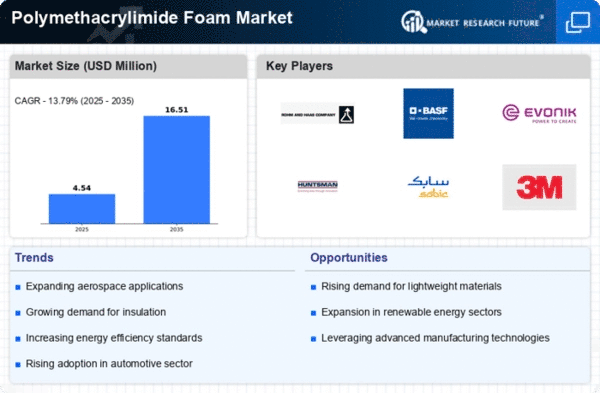
As per MRFR analysis, the Polymethacrylimide Foam Market Size was estimated at 3.99 USD Million in 2024. The Polymethacrylimide Foam industry is projected to grow from 4.54 in 2025 to 16.51 by 2035, exhibiting a compound annual growth rate (CAGR) of 13.79 during the forecast period 2025 - 2035.

Key Market Trends & Highlights

The Polymethacrylimide Foam Market is poised for substantial growth driven by sustainability and technological advancements.

  • North America remains the largest market for polymethacrylimide foam, primarily due to its extensive applications in aerospace and construction.
  • The Asia-Pacific region is emerging as the fastest-growing market, fueled by increasing demand for lightweight materials in automotive and thermal insulation sectors.
  • The thermal insulation segment holds the largest share, while the acoustic insulation segment is witnessing rapid growth as industries seek noise reduction solutions.
  • Key market drivers include the rising demand for lightweight materials and advancements in manufacturing technologies, which are enhancing product applications.

Market Size & Forecast

2024 Market Size 3.99 (USD Million)
2035 Market Size 16.51 (USD Million)
CAGR (2025 - 2035) 13.79%
Largest Regional Market Share in 2024 North America

Major Players

<p>Rohm and Haas (US), BASF (DE), Evonik Industries (DE), Huntsman Corporation (US), SABIC (SA), 3M (US), Dow Chemical Company (US), Kraton Corporation (US)</p>

Market Trends

The Polymethacrylimide Foam Market is currently experiencing a notable evolution, driven by various factors that influence its growth trajectory. This material, known for its lightweight and thermal insulation properties, finds applications across diverse sectors, including aerospace, automotive, and construction. As industries increasingly prioritize energy efficiency and sustainability, the demand for advanced materials like polymethacrylimide foam appears to be on the rise. Furthermore, innovations in manufacturing processes and material formulations are likely to enhance the performance characteristics of these foams, making them more appealing to end-users. In addition to technological advancements, regulatory frameworks promoting eco-friendly materials are shaping the landscape of the Polymethacrylimide Foam Market. Companies are adapting to these changes by investing in research and development to create products that meet stringent environmental standards. This shift not only aligns with The Polymethacrylimide Foam expansion. As the market continues to evolve, stakeholders must remain vigilant to emerging trends and consumer preferences that could influence future growth.

Sustainability Initiatives

The emphasis on sustainable practices is becoming increasingly prominent within the Polymethacrylimide Foam Market. Manufacturers are exploring eco-friendly alternatives and production methods that minimize environmental impact. This trend reflects a broader commitment to sustainability across various industries, as companies seek to align their operations with global environmental goals.

Technological Advancements

Innovations in technology are playing a crucial role in shaping the Polymethacrylimide Foam Market. Enhanced manufacturing techniques and improved material properties are enabling the development of more efficient and versatile foam products. These advancements are likely to attract new applications and expand the market's reach.

Growing Demand in Aerospace

The aerospace sector is increasingly recognizing the benefits of polymethacrylimide foam, particularly for its lightweight and thermal insulation properties. As the industry seeks to improve fuel efficiency and reduce emissions, the demand for advanced materials is expected to grow, positioning the Polymethacrylimide Foam Market favorably for future opportunities.

Polymethacrylimide Foam Market Market Drivers

Market Growth Projections

The Global Polymethacrylimide Foam Market Industry is projected to experience substantial growth over the next decade. With a market valuation of 108.2 USD Million in 2024, the industry is expected to expand significantly, reaching 213.4 USD Million by 2035. This growth trajectory suggests a compound annual growth rate (CAGR) of 6.37% from 2025 to 2035. Various factors, including advancements in technology, increasing demand for lightweight materials, and regulatory support for sustainable solutions, are likely to contribute to this upward trend. The market's expansion reflects the growing recognition of polymethacrylimide foam's benefits across multiple sectors.

Growing Demand in Aerospace Sector

The Global Polymethacrylimide Foam Market Industry is experiencing a surge in demand driven by the aerospace sector. This material is favored for its lightweight and thermal insulation properties, which are crucial for aircraft design. As airlines and manufacturers seek to enhance fuel efficiency and reduce emissions, the adoption of polymethacrylimide foam is likely to increase. In 2024, the market is projected to reach 108.2 USD Million, reflecting the aerospace industry's commitment to innovative materials. The trend towards lightweight materials in aviation is expected to continue, potentially propelling the market further as manufacturers aim for sustainability and performance improvements.

Increasing Focus on Lightweight Materials

The Global Polymethacrylimide Foam Market Industry is benefiting from an increasing focus on lightweight materials across various industries. Lightweight materials contribute to improved fuel efficiency and performance in automotive and aerospace applications. As manufacturers strive to meet regulatory standards and consumer expectations for sustainability, the adoption of polymethacrylimide foam is likely to grow. The projected CAGR of 6.37% from 2025 to 2035 indicates a robust market trajectory, as industries recognize the advantages of using lightweight materials in their designs. This trend is expected to foster innovation and drive further research into advanced foam applications.

Regulatory Support for Sustainable Materials

Regulatory frameworks promoting sustainable materials are playing a crucial role in shaping the Global Polymethacrylimide Foam Market Industry. Governments worldwide are implementing policies that encourage the use of eco-friendly materials in construction, automotive, and aerospace sectors. This regulatory support is likely to enhance the adoption of polymethacrylimide foam, as it aligns with sustainability goals. The anticipated growth in market size to 213.4 USD Million by 2035 reflects the increasing alignment of industry practices with regulatory expectations. As companies seek to comply with these regulations, the demand for sustainable materials such as polymethacrylimide foam is expected to rise.

Rising Demand for Energy-Efficient Solutions

The Global Polymethacrylimide Foam Market Industry is witnessing a rising demand for energy-efficient solutions, particularly in the construction and automotive sectors. As global energy consumption continues to rise, there is a pressing need for materials that enhance energy efficiency. Polymethacrylimide foam, with its superior insulation properties, is increasingly being utilized in energy-efficient building designs and automotive applications. This trend is likely to contribute to the market's growth, with projections indicating a market size of 108.2 USD Million in 2024. The emphasis on sustainability and energy conservation is expected to further bolster the demand for this innovative material.

Advancements in Thermal Insulation Technologies

Technological advancements in thermal insulation are significantly influencing the Global Polymethacrylimide Foam Market Industry. The foam's exceptional thermal resistance makes it suitable for various applications, including building and construction, automotive, and electronics. As energy efficiency regulations become more stringent globally, the demand for effective insulation materials is likely to rise. This trend is expected to contribute to a market valuation of 213.4 USD Million by 2035. The integration of polymethacrylimide foam in energy-efficient designs may enhance building performance, thereby driving its adoption across multiple sectors.

Market Segment Insights

By Application: Thermal Insulation (Largest) vs. Acoustic Insulation (Fastest-Growing)

<p>In the Polymethacrylimide Foam Market, Thermal Insulation holds the largest share, driven by its robust application in construction and building materials. This segment capitalizes on the growing demand for energy-efficient solutions, helping to maintain optimal temperatures in residential and commercial infrastructures. Meanwhile, Acoustic Insulation, which focuses on noise reduction capabilities, is emerging rapidly as environmental concerns and urbanization fuel the need for quieter living and working spaces. Both segments complement each other, signifying a well-rounded market landscape.</p>

<p>Thermal Insulation (Dominant) vs. Acoustic Insulation (Emerging)</p>

<p>The Thermal Insulation segment is characterized by its superior thermal resistance and lightweight properties, making it indispensable in energy-efficient building designs. It plays a crucial role in the construction industry, ensuring regulatory compliance and contributing to sustainability initiatives. In contrast, the Acoustic Insulation segment is witnessing increasing interest due to heightened urbanization and the demand for noise-reducing materials in residential and commercial spaces. This segment focuses on minimizing sound transmission, providing essential comfort in densely populated areas. As the landscape evolves, Thermal Insulation remains essential while Acoustic Insulation emerges as a key player, responding to shifting consumer demands.</p>

By End Use Industry: Aerospace (Largest) vs. Automotive (Fastest-Growing)

<p>In the Polymethacrylimide Foam Market, the aerospace sector holds the largest share, significantly driven by its demand for lightweight, high-performance materials that contribute to fuel efficiency and overall aerodynamic performance. The automotive segment is registering an impressive growth rate, propelled by increasing investments in electric vehicles and the need for lightweight components to enhance efficiency and reduce emissions. Meanwhile, construction, electronics, and marine sectors continue to represent substantial portions of the market as they adapt to evolving technologies and sustainability standards.</p>

<p>Aerospace (Dominant) vs. Automotive (Emerging)</p>

<p>The aerospace segment stands as the dominant player in the Polymethacrylimide Foam Market, characterized by its stringent requirements for durability, thermal insulation, and lightweight properties. This segment capitalizes on its established market presence and rigorous regulatory standards that dictate material performance. Conversely, the automotive sector is emerging rapidly, driven by trends in vehicle electrification and lightweight manufacturing. This segment is adopting polymethacrylimide foam to meet rising demands for energy-efficient solutions, enhancing safety and structural integrity. As both sectors evolve, innovation and compliance with environmental regulations will be pivotal for sustaining their respective positions.</p>

By Material Type: Flexible Foam (Largest) vs. Rigid Foam (Fastest-Growing)

<p>The Polymethacrylimide Foam Market showcases a diverse range of material types, with flexible foam holding the largest market share. This segment is favored for its adaptability in various applications including insulation and automotive uses. Rigid foam, while currently smaller in share, is gaining traction rapidly due to its enhanced insulative properties and structural integrity, particularly in aerospace and construction sectors. Composite and high-density foams also contribute to the market but are less dominant compared to these two.</p>

<p>Flexible Foam (Dominant) vs. Rigid Foam (Emerging)</p>

<p>Flexible foam is characterized by its lightweight and versatile properties, making it suitable for applications such as padding, insulation, and high-performance components in various industries. Its dominant position in the market is supported by a growing demand for energy-efficient solutions and environmentally friendly materials. Rigid foam, on the other hand, is emerging as a preferred choice for applications requiring high durability and insulation, such as in construction and industrial applications. The ongoing advancements in manufacturing processes, combined with the rising need for sustainable building materials, are driving the growth of rigid foam in the Polymethacrylimide Foam Market.</p>

By Density: Medium Density (Largest) vs. High Density (Fastest-Growing)

<p>In the Polymethacrylimide Foam Market, the density segment is pivotal, showing a clear distribution among low, medium, and high-density foams. Medium density currently captures the largest market share due to its balanced properties of lightweight and strength, making it suitable for a variety of applications, particularly in automotive and aerospace industries. In contrast, low density is valued for its excellent thermal insulation, but it remains less prevalent in terms of overall market presence compared to its medium-density counterpart. High density, while having a smaller current share, is rapidly gaining traction, driven by its superior mechanical properties and durability.</p>

<p>Medium Density (Dominant) vs. High Density (Emerging)</p>

<p>Medium density polymethacrylimide foam stands as the dominant choice in the market, characterized by its excellent balance between weight and structural integrity. This versatility makes it well-suited for high-performance applications, including insulation for high-tech industries and other uses where lightweight yet strong materials are critical. On the other hand, high density foam is emerging rapidly in the market due to its higher strength-to-weight ratio and enhanced durability. It is increasingly being sought after for specialized applications requiring enhanced performance, thus positioning itself as a compelling alternative for industries interested in premium material properties, particularly in construction and automotive sectors.</p>

By Form Factor: Blocks (Largest) vs. Sheets (Fastest-Growing)

<p>The Polymethacrylimide Foam Market's 'By Form Factor' segment reveals a dynamic distribution of market share among blocks, sheets, and custom shapes. Currently, blocks dominate the market due to their versatility and widespread application in insulation and lightweight construction. Sheets, while trailing in overall market share, are rapidly gaining traction thanks to advancements in manufacturing that allow for greater customization and thinner profiles, appealing to a broader range of applications in industries such as automotive and aerospace. Custom shapes hold a niche but important position, catering to specialized needs that drive innovation for unique designs and functionalities. Growth trends within this segment are particularly promising, with sheets emerging as the fastest-growing form factor due to increasing demand in sectors that prioritize lightweight solutions and energy efficiency. The rise in environmental awareness is also propelling the market, as manufacturers strive to meet stringent insulation standards. Meanwhile, blocks continue to see steady growth driven by their established use in infrastructure projects. Custom shapes, though smaller in volume, are seeing heightened demand from industry players looking to optimize their product designs and enhance operational efficiency.</p>

<p>Blocks (Dominant) vs. Custom Shapes (Emerging)</p>

<p>In the Polymethacrylimide Foam Market, blocks are recognized as the dominant form factor due to their robust performance and versatile applications across numerous industries. These blocks offer exceptional thermal insulation properties, making them indispensable in construction and industrial applications. Conversely, custom shapes represent an emerging segment that is gaining attention for their ability to address specific design and insulation needs. These custom solutions allow manufacturers to create tailored products that fit unique applications, driving innovation and growth in specialized markets. The ability to produce custom shapes is revolutionizing product design, allowing for enhanced aesthetics and functionality, ultimately complementing the established dominance of blocks.</p>

Get more detailed insights about Polymethacrylimide Foam Market Research Report—Global Forecast till 2035

Regional Insights

North America : Market Leader in Innovation

North America is poised to maintain its leadership in the Polymethacrylimide Foam market, holding a significant market share of 1.8 million units as of 2024. The region's growth is driven by increasing demand in aerospace, automotive, and construction sectors, alongside stringent regulations promoting lightweight materials. The focus on sustainability and energy efficiency further propels market expansion, with innovations in foam technology enhancing performance and reducing environmental impact. The competitive landscape in North America is robust, featuring key players such as Rohm and Haas, Huntsman Corporation, and 3M. These companies are investing heavily in R&D to develop advanced foam solutions that meet evolving industry standards. The U.S. remains the largest market, supported by a strong manufacturing base and a growing emphasis on high-performance materials. This dynamic environment fosters collaboration between industry leaders and research institutions, driving further advancements in the sector.

Europe : Emerging Market with Growth Potential

Europe is witnessing a growing interest in the Polymethacrylimide Foam market, with a market size of 1.2 million units. The region's growth is fueled by increasing applications in the automotive and aerospace industries, where lightweight materials are essential for enhancing fuel efficiency. Regulatory frameworks, such as the EU's Green Deal, are encouraging the adoption of sustainable materials, further driving demand for innovative foam solutions. Leading countries in this market include Germany, France, and the UK, where major players like BASF and Evonik Industries are actively engaged in developing advanced foam technologies. The competitive landscape is characterized by strategic partnerships and collaborations aimed at enhancing product offerings. As the market evolves, companies are focusing on sustainability and performance, positioning Europe as a key player in The Polymethacrylimide Foam.

Asia-Pacific : Rapid Growth in Emerging Economies

The Asia-Pacific region is emerging as a significant player in the Polymethacrylimide Foam market, with a market size of 0.8 million units. The growth is primarily driven by rapid industrialization and urbanization in countries like China and India, where demand for lightweight materials in construction and automotive sectors is surging. Additionally, government initiatives aimed at promoting energy-efficient materials are acting as catalysts for market expansion. China leads the region in market share, supported by a strong manufacturing base and increasing investments in R&D. Key players such as Dow Chemical Company and Kraton Corporation are focusing on innovation to meet the growing demand. The competitive landscape is evolving, with new entrants and established companies vying for market share, making Asia-Pacific a dynamic and competitive environment for Polymethacrylimide Foam.

Middle East and Africa : Emerging Market with Unique Challenges

The Middle East and Africa (MEA) region is gradually developing its Polymethacrylimide Foam market, currently valued at 0.19 million units. The growth is driven by increasing investments in infrastructure and construction projects, particularly in the Gulf Cooperation Council (GCC) countries. Additionally, the region's focus on diversifying economies away from oil dependency is fostering demand for advanced materials in various sectors, including automotive and aerospace. Countries like Saudi Arabia and the UAE are leading the charge, with significant projects underway that require lightweight and durable materials. The competitive landscape is characterized by a mix of local and international players, with companies exploring partnerships to enhance their market presence. As the region continues to develop, opportunities for growth in the Polymethacrylimide Foam market are becoming increasingly apparent.

Key Players and Competitive Insights

The Polymethacrylimide Foam Market exhibits a dynamic competitive landscape characterized by innovation and strategic partnerships. Key players such as BASF (DE), Huntsman Corporation (US), and Evonik Industries (DE) are actively shaping the market through their focus on sustainability and advanced material solutions. BASF (DE) has positioned itself as a leader in sustainable practices, emphasizing eco-friendly production methods and the development of high-performance foams. Huntsman Corporation (US) is leveraging its extensive R&D capabilities to enhance product performance, while Evonik Industries (DE) is concentrating on expanding its product portfolio to cater to diverse industrial applications, thereby fostering a competitive environment that prioritizes innovation and sustainability.

The market structure appears moderately fragmented, with several players vying for market share through localized manufacturing and optimized supply chains. Companies are increasingly localizing their production facilities to reduce lead times and enhance responsiveness to regional demands. This tactic not only streamlines operations but also mitigates risks associated with global supply chain disruptions. The collective influence of these key players contributes to a competitive atmosphere where agility and operational efficiency are paramount.

In November 2025, BASF (DE) announced a strategic partnership with a leading automotive manufacturer to develop lightweight, high-performance polymethacrylimide foams tailored for electric vehicle applications. This collaboration underscores BASF's commitment to innovation in the automotive sector, aligning with the industry's shift towards sustainability and efficiency. The partnership is expected to enhance BASF's market position by integrating advanced materials into the rapidly evolving electric vehicle market.

In October 2025, Huntsman Corporation (US) launched a new line of polymethacrylimide foams designed specifically for aerospace applications. This product introduction reflects Huntsman's strategic focus on high-growth sectors, aiming to capitalize on the increasing demand for lightweight materials in aerospace manufacturing. The launch not only diversifies Huntsman's product offerings but also reinforces its commitment to meeting the stringent performance requirements of the aerospace industry.

In September 2025, Evonik Industries (DE) expanded its production capacity for polymethacrylimide foams in response to rising global demand. This expansion is indicative of Evonik's proactive approach to market trends, allowing the company to better serve its customers and enhance its competitive edge. By increasing production capabilities, Evonik positions itself to meet the growing needs of various industries, including construction and automotive, which are increasingly adopting advanced foam solutions.

As of December 2025, the competitive trends in the Polymethacrylimide Foam Market are heavily influenced by digitalization, sustainability, and the integration of AI technologies. Strategic alliances are becoming increasingly vital, as companies seek to leverage complementary strengths to drive innovation and efficiency. The market appears to be shifting from traditional price-based competition towards a landscape where technological advancements, product differentiation, and supply chain reliability are the primary competitive differentiators. This evolution suggests that companies that prioritize innovation and sustainable practices will likely emerge as leaders in the market.

Key Companies in the Polymethacrylimide Foam Market market include

Industry Developments

    • It´s February 2024 –Evonik’s superabsorbent business is being sold to the International Chemical Investors Group (ICIG). In addition to that, as part of this transaction, ICIG will be responsible for pension obligations while the ultimate transfer of the business is planned for mid-2024, subject to clearance by relevant competition authorities.
    • In November 2023 SABIC partnered with a significant automotive OEM for developing lightweight components using STYRENIX® PMI foam designed to enhance fuel efficiency and reduce emissions in next-generation vehicles.
    • Additionally, in May 2023, Zotefoams obtained certification on their ZOTEK® F PMI foam as a sustainable material, which qualifies it to be used in environmentally friendly industries and thus widens its market scope.
    • In March 2022, Evonik introduced a new grade of ROHACELL® foam optimized for use in high-temperature applications in the aerospace and defense sectors, which are growing.

PMI Foam Type Outlook

    • Standard Type
    • Fire Proof
    • Radio Proof

PMI Foam Application Outlook (Volume, Kilotons; Revenue, USD Million, 2021 - 2028)

    • Wind Energy
    • Aerospace & Defense
    • Automotive & Transportation
    • Sports Goods
    • Others

PMI Foam Regional Outlook (Volume, Kilotons; Revenue, USD Million, 2021 - 2028)

    • North America
      • The U.S.
      • Canada
      • Mexico
    • Europe
      • Germany
      • The U.K.
      • France
      • Italy
    • Asia Pacific
      • China
      • India
      • Japan
    • Southeast Asia
      • Malaysia
      • Indonesia
      • Thailand
    • Central & South America
      • Brazil
    • Middle East & Africa
      • Saudi Arabia

Future Outlook

Polymethacrylimide Foam Market Future Outlook

<p>The Polymethacrylimide Foam Market is projected to grow at a 13.79% CAGR from 2024 to 2035, driven by advancements in insulation technology and increasing demand in aerospace applications.</p>

New opportunities lie in:

  • <p>Development of high-performance thermal insulation solutions for aerospace applications.</p>
  • <p>Expansion into emerging markets with tailored product offerings.</p>
  • <p>Investment in sustainable manufacturing processes to enhance market competitiveness.</p>

<p>By 2035, the Polymethacrylimide Foam Market is expected to achieve substantial growth and innovation.</p>

Market Segmentation

Polymethacrylimide Foam Market Density Outlook

  • Low Density
  • Medium Density
  • High Density

Polymethacrylimide Foam Market Application Outlook

  • Thermal Insulation
  • Acoustic Insulation
  • Structural Components
  • Packaging
  • Aerospace Components

Polymethacrylimide Foam Market Form Factor Outlook

  • Blocks
  • Sheets
  • Custom Shapes

Polymethacrylimide Foam Market Material Type Outlook

  • Flexible Foam
  • Rigid Foam
  • Composite Foam
  • High-Density Foam

Polymethacrylimide Foam Market End Use Industry Outlook

  • Aerospace
  • Automotive
  • Construction
  • Electronics
  • Marine

Report Scope

MARKET SIZE 20243.99(USD Million)
MARKET SIZE 20254.54(USD Million)
MARKET SIZE 203516.51(USD Million)
COMPOUND ANNUAL GROWTH RATE (CAGR)13.79% (2024 - 2035)
REPORT COVERAGERevenue Forecast, Competitive Landscape, Growth Factors, and Trends
BASE YEAR2024
Market Forecast Period2025 - 2035
Historical Data2019 - 2024
Market Forecast UnitsUSD Million
Key Companies ProfiledRohm and Haas (US), BASF (DE), Evonik Industries (DE), Huntsman Corporation (US), SABIC (SA), 3M (US), Dow Chemical Company (US), Kraton Corporation (US)
Segments CoveredApplication, End Use Industry, Material Type, Density, Form Factor
Key Market OpportunitiesGrowing demand for lightweight insulation materials in aerospace and automotive sectors drives Polymethacrylimide Foam Market opportunities.
Key Market DynamicsRising demand for lightweight materials drives innovation and competition in the Polymethacrylimide Foam market.
Countries CoveredNorth America, Europe, APAC, South America, MEA

FAQs

  1. Global Polymethacrylimide Foam Market, by Application
    1. by Region
    2. Market Introduction
    3. Definition
    4. Scope of the Study
    5. Market Structure
    6. Research Methodology
    7. Research Process
    8. Primary Research
    9. Secondary Research
    10. Market Size Estimation
    11. Forecast Model
    12. List of Assumptions
    13. Market Dynamics
    14. Introduction
    15. Drivers
    16. Restraints
    17. Opportunities
    18. Challenges
    19. Trends
    20. Market Factor Analysis
    21. Supply Chain Analysis
    22. Material Suppliers
    23. foamManufacturers
    24. Sales Channel
    25. Porter’s Five Forces Model
    26. Bargaining Power of Suppliers
    27. Bargaining Power of Buyers
    28. Threat of New Entrants
    29. Threat of Substitutes
    30. of Rivalry
    31. Pricing Analysis(USD/Tons), by Region
    32. Global
    33. Polymethacrylimide foam Market, byApplication (Kilo Tons) (USD Million)
    34. Introduction
    35. Aerospace &
    36. Defense
    37. Forecast,by Region/Country, 2018–2027
    38. Wind Energy
    39. Estimates & Forecast, by Region/Country, 2018–2027
    40. Sporting
    41. Goods
  2. Global Polymethacrylimide Foam Market,
  3. Raw
  4. Polymethacrylimide
  5. Distribution &
  6. End-Users
  7. Intensity
  8. Market Estimates &
  9. Market
  10. Market Estimates & Forecast, by Region/Country, 2018–2027
    1. Transportation
    2. Others
    3. Forecast, by Region/Country, 2018–2027
    4. Global
    5. Polymethacrylimide foam Market, byregion(Kilo Tons) (USD Million)
    6. Overview
    7. North America
    8. Europe
    9. France
    10. Italy
    11. Asia-Pacific
    12. India
    13. Rest of Asia-Pacific
    14. Latin America
    15. Argentina
    16. of Latin America
    17. Middle East & Africa
    18. Turkey
    19. South Africa
    20. of Middle East & Africa
    21. Competitive Landscape
    22. Market Introduction
    23. Recent Developments
    24. Mergers/Acquisitions, Expansion, Investment, Partnership, Collaboration, Product
    25. Launch
    26. Global Market Strategy Analysis
    27. Company
    28. Profiles
    29. Evonik Industries
    30. AG
    31. Key Developments
    32. Analysis
    33. DIAB Group
    34. Financial Overview
    35. Products Offered
    36. Developments
    37. SABIC
    38. Key Developments
    39. Analysis
    40. BASF SE
    41. Financial Overview
    42. Products Offered
    43. Developments
    44. 3A Composites
    45. Overview
    46. Key Developments
    47. Analysis
    48. Solvay
    49. Financial Overview
    50. Products Offered
    51. Developments
    52. Zotefoams PLC
    53. Financial Overview
    54. Products Offered
    55. Developments
    56. Baoding Meiwo
    57. Science & Technology Development Co., Ltd.
    58. Company Overview
    59. Overview
    60. SWOT Analysis
    61. Strategies
    62. Cashem Advanced
    63. Materials Hi-Tech Co., Ltd.
    64. Overview
    65. Key Developments
    66. Analysis
    67. Appendix
    68. Blueprint
  11. Market Estimates & Forecast, by Region/Country,
  12. Market Estimates &
  13. US
  14. Canada
  15. Germany
  16. UK
  17. Russia
  18. Spain
  19. Rest of Europe
  20. China
  21. Japan
  22. South Korea
  23. Australia & New Zealand
  24. Indonesia
  25. Brazil
  26. Mexico
  27. Rest
  28. UAE
  29. Saudi Arabia
  30. Rest
  31. Company Overview
  32. Financial Overview
  33. Products Offered
  34. SWOT
  35. Key Strategies
  36. Company Overview
  37. Key
  38. SWOT Analysis
  39. Key Strategies
  40. Company Overview
  41. Financial Overview
  42. Products Offered
  43. SWOT
  44. Key Strategies
  45. Company Overview
  46. Key
  47. SWOT Analysis
  48. Key Strategies
  49. Company
  50. Financial Overview
  51. Products Offered
  52. SWOT
  53. Key Strategies
  54. Company Overview
  55. Key
  56. SWOT Analysis
  57. Key Strategies
  58. Company Overview
  59. Key
  60. SWOT Analysis
  61. Key Strategies
  62. Financial
  63. Products Offered
  64. Key Developments
  65. Key
  66. Company
  67. Financial Overview
  68. Products Offered
  69. SWOT
  70. Key Strategies
    1. Jiaxing Sky Composites Co., Ltd.
      1. Company Overview
      2. Financial Overview
      3. Products Offered
      4. Key Developments
      5. SWOT Analysis
      6. Key Strategies
      7. Discussion

Polymethacrylimide Foam Market Segmentation

Market Segmentation Overview

  • Detailed segmentation data will be available in the full report
  • Comprehensive analysis by multiple parameters
  • Regional and country-level breakdowns
  • Market size forecasts by segment
Infographic

Free Sample Request

Kindly complete the form below to receive a free sample of this Report

Get Free Sample

Customer Strories

Compare Licence

×
Features License Type
Single User Multiuser License Enterprise User
Price $4,950 $5,950 $7,250
Maximum User Access Limit 1 User Upto 10 Users Unrestricted Access Throughout the Organization
Free Customization
Direct Access to Analyst
Deliverable Format
Platform Access
Discount on Next Purchase 10% 15% 15%
Printable Versions