
Request Free Sample ×

Kindly complete the form below to receive a free sample of this Report

* Please use a valid business email

Leading companies partner with us for data-driven Insights

clients tt-cursor
Hero Background
English
Chinese
French
Japanese
Korean
German
Spanish

Polyethylene Pipes Fittings Market Analysis

ID: MRFR/CnM/10539-HCR
111 Pages
Anshula Mandaokar
April 2026

Polyethylene Pipes Fittings Market Research Report Information By Type (Low Density Polyethylene (LDPE), Linear Low Density Polyethylene (LLDPE), High Density Polyethylene (HDPE), Others) Application (Water Supply, Oil And Gas, Sewage Systems, Agricultural Applications, Others) End User (Building and Construction, Oil & Gas Industry, Municipal, Electronics & Telecom and Agriculture) And By Region (North America, Europe, Asia-Pacific, And Rest Of The World) –Market Forecast Till 2035

Share:
Download PDF ×

We do not share your information with anyone. However, we may send you emails based on your report interest from time to time. You may contact us at any time to opt-out.

Polyethylene Pipes Fittings Market Infographic
Purchase Options

Market Analysis

In-depth Analysis of Polyethylene Pipes Fittings Market Industry Landscape

Regulatory standards and compliance largely determine the market dynamics for polyethylene pipes and fittings. The guidelines governing the use of construction materials have been put in place by government bodies and regulatory authorities as safety, environmental protection, quality assurance measures among others; therefore, adherence to these standards is a major driving factor on market dynamics affecting availability and development of Polyethylene Pipes Fittings that either meet or exceed regulatory requirements.

The trends in global economic conditions as well as infrastructure investment shape the market dynamics of polyethylene pipes and fittings. Increased construction activities supported by economic growth coupled with governments’ infrastructure investments promote demand for such materials. On the other hand, this may vary depending on economic downturns or fluctuations in infrastructure spending leading to changes in demand for polyethylene pipes and fittings.  

Regarding the ever-increasing use of high-density polyethylene (HDPE) pipes and fittings within the field, one significant trend is emerging. These pipes are strong and flexible and so can be used in various applications such as municipal water supply systems, industrial applications, infrastructure projects among others. This trend is line with what customers look out for in durable cost effective piping system that will be able to sustain harsh environmental conditions.

In addition, the growth of construction & infrastructural development all over world has also witnessed an increase in the demand for Poly Ethylene Pipe Segment pipe fitting segment. As urbanization continues leading to industrialization, there’s a need for efficient pipe systems capable of addressing water distribution networks sewage treatment plants gas lines amongst other utilities. The use demonstrates how critical this category is during these critical infrastructural projects like ensuring water-energy sustainability


Author
Author Profile
Anshula Mandaokar
Team Lead - Research

Anshula Mandaokar holds an academic degree in Chemical Engineering and has been contributing to the field for more than 5 years. She has expertise in Market Research and Business Consulting and serves as a Team Lead for a reputed Market Research firm under the Chemicals and Materials domain spectrum. She has worked on multiple projects, generating explicit results in a quick turnaround time. Her understanding of data interpretation justifies her role as a leader.

Leave a Comment

FAQs

What is the current valuation of the Polyethylene Pipes Fittings Market?

<p>As of 2024, the market valuation was 15.4 USD Billion.</p>

What is the projected market size for the Polyethylene Pipes Fittings Market by 2035?

<p>The market is expected to reach 27.76 USD Billion by 2035.</p>

What is the expected CAGR for the Polyethylene Pipes Fittings Market during the forecast period?

<p>The anticipated CAGR for the market from 2025 to 2035 is 5.5%.</p>

Which segment of the Polyethylene Pipes Fittings Market had the highest valuation in 2024?

<p>In 2024, the High Density Polyethylene (HDPE) segment was valued at 7.0 to 12.0 USD Billion.</p>

What applications are driving growth in the Polyethylene Pipes Fittings Market?

<p>Key applications include Water Supply, valued at 5.0 to 9.0 USD Billion, and Oil and Gas, valued at 3.0 to 5.5 USD Billion.</p>

Who are the leading players in the Polyethylene Pipes Fittings Market?

<p>Prominent players include Georg Fischer, Wavin, Uponor, and Rehau, among others.</p>

What is the valuation range for the Agricultural Applications segment in 2024?

The Agricultural Applications segment was valued between 3.0 and 5.0 USD Billion in 2024.

How does the Municipal end-user segment perform in the Polyethylene Pipes Fittings Market?

The Municipal segment had a valuation range of 4.0 to 7.0 USD Billion in 2024.

What is the projected growth for the Others segment in the Type category?

The Others segment is expected to grow from 2.9 to 5.76 USD Billion during the forecast period.

What factors contribute to the growth of the Polyethylene Pipes Fittings Market?

Growth is likely driven by increasing demand in construction, agriculture, and municipal applications.

Market Summary

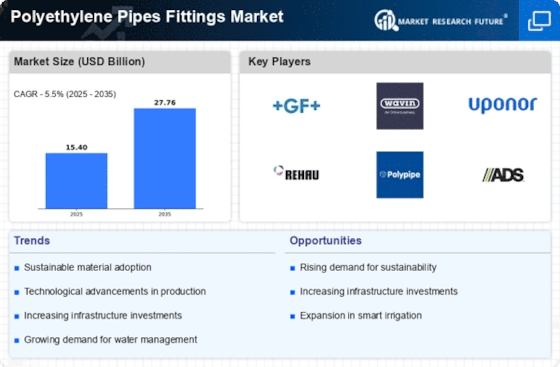
As per Market Research Future analysis, the Polyethylene Pipes Fittings Market was estimated at 15.4 USD Billion in 2024. The Polyethylene Pipes Fittings industry is projected to grow from 16.25 USD Billion in 2025 to 27.76 USD Billion by 2035, exhibiting a compound annual growth rate (CAGR) of 5.5% during the forecast period 2025 - 2035

Key Market Trends & Highlights

The Polyethylene Pipes Fittings Market is experiencing robust growth driven by sustainability and technological advancements.

  • North America remains the largest market for polyethylene pipes fittings, driven by extensive water infrastructure projects.
  • The Asia-Pacific region is emerging as the fastest-growing market, fueled by rapid urbanization and industrialization.
  • High Density Polyethylene (HDPE) continues to dominate the market, while Linear Low Density Polyethylene (LLDPE) is witnessing the fastest growth due to its versatility.
  • Key market drivers include the increasing demand for water infrastructure and regulatory support for sustainable materials.

Market Size & Forecast

2024 Market Size 15.4 (USD Billion)
2035 Market Size 27.76 (USD Billion)
CAGR (2025 - 2035) 5.5%
Largest Regional Market Share in 2024 North America

Major Players

Georg Fischer (CH), Wavin (NL), Uponor (FI), Rehau (DE), Polypipe (GB), Advanced Drainage Systems (US), N-Drip (IL), SABIC (SA), Solvay (BE)

Market Trends

The Polyethylene Pipes Fittings Market is currently experiencing a notable transformation driven by various factors. The increasing demand for lightweight and corrosion-resistant materials in construction and infrastructure projects appears to be a primary catalyst for growth. Additionally, the rising awareness regarding environmental sustainability is prompting industries to adopt polyethylene solutions, which are often more eco-friendly compared to traditional materials. This shift is likely to enhance the market's appeal, as stakeholders seek to align with global sustainability goals. Furthermore, advancements in manufacturing technologies may contribute to improved product quality and performance, thereby attracting a broader customer base. In the present landscape, the Polyethylene Pipes Fittings Market seems poised for expansion, with potential opportunities emerging in diverse sectors such as agriculture, water supply, and drainage systems. The versatility of polyethylene fittings, coupled with their resistance to chemicals and UV radiation, positions them as a preferred choice for various applications. As industries continue to evolve, the market may witness innovations that further enhance the functionality and efficiency of polyethylene fittings, solidifying their role in modern infrastructure development.

Sustainability Initiatives

The growing emphasis on sustainable practices is influencing the Polyethylene Pipes Fittings Market. Companies are increasingly focusing on eco-friendly materials and production methods, which align with global environmental standards. This trend suggests a shift towards products that minimize ecological impact, potentially enhancing market competitiveness.

Technological Advancements

Innovations in manufacturing processes are shaping the Polyethylene Pipes Fittings Market. Enhanced production techniques may lead to improved product durability and performance. This trend indicates that companies investing in technology could gain a competitive edge, appealing to a broader range of customers.

Diverse Applications

The versatility of polyethylene fittings is driving their adoption across various sectors. From agriculture to urban infrastructure, the demand for reliable and efficient piping solutions appears to be increasing. This trend highlights the potential for market growth as industries recognize the benefits of polyethylene in diverse applications.

Polyethylene Pipes Fittings Market Market Drivers

Rising Adoption of HDPE Pipes

The Polyethylene Pipes Fittings Market is witnessing a notable shift towards the adoption of High-Density Polyethylene (HDPE) pipes. These pipes offer superior strength and flexibility, making them ideal for various applications, including sewage and drainage systems. Market data suggests that the HDPE segment is expected to capture a significant share of the overall market, driven by its cost-effectiveness and longevity. As industries increasingly recognize the benefits of HDPE, the demand for fittings compatible with these pipes is likely to escalate, further propelling the growth of the Polyethylene Pipes Fittings Market.

Increasing Demand for Water Infrastructure

The Polyethylene Pipes Fittings Market is experiencing a surge in demand due to the growing need for water infrastructure. As urbanization accelerates, the requirement for efficient water distribution systems becomes paramount. According to recent data, investments in water infrastructure are projected to reach substantial figures, indicating a robust market potential. Polyethylene pipes, known for their durability and resistance to corrosion, are increasingly favored for water supply applications. This trend is likely to drive the growth of the Polyethylene Pipes Fittings Market, as municipalities and private sectors seek reliable solutions to enhance their water management systems.

Expanding Applications in Various Industries

The Polyethylene Pipes Fittings Market is experiencing expansion due to the diverse applications of polyethylene products across various sectors. Industries such as agriculture, construction, and telecommunications are increasingly utilizing polyethylene pipes and fittings for their versatility and reliability. For instance, in agriculture, these products are essential for irrigation systems, while in construction, they are used for drainage and plumbing. Market data suggests that the demand for polyethylene fittings is likely to grow as industries seek efficient solutions for their specific needs. This trend is expected to significantly contribute to the overall growth of the Polyethylene Pipes Fittings Market.

Regulatory Support for Sustainable Materials

The Polyethylene Pipes Fittings Market is benefiting from regulatory frameworks that promote the use of sustainable materials. Governments are increasingly implementing policies that encourage the adoption of eco-friendly products, including polyethylene pipes and fittings. This regulatory support is expected to enhance market growth, as manufacturers align their offerings with sustainability goals. Data indicates that the market for sustainable construction materials is expanding, and polyethylene products are well-positioned to meet these demands. Consequently, the Polyethylene Pipes Fittings Market is likely to see increased investment and innovation in sustainable solutions.

Technological Innovations in Pipe Manufacturing

The Polyethylene Pipes Fittings Market is being transformed by technological innovations in pipe manufacturing processes. Advances in production techniques, such as extrusion and molding, have led to the creation of more efficient and high-quality fittings. These innovations not only improve the performance of polyethylene pipes but also reduce production costs, making them more accessible to a wider range of applications. Market analysis indicates that companies investing in research and development are likely to gain a competitive edge, thereby driving the growth of the Polyethylene Pipes Fittings Market in the coming years.

Market Segment Insights

By Type: High Density Polyethylene (HDPE) (Largest) vs. Linear Low Density Polyethylene (LLDPE) (Fastest-Growing)

<p>In the Polyethylene Pipes Fittings Market, <a href="https://www.marketresearchfuture.com/reports/high-density-polyethylene-market-7314" target="_blank" title="high density polyethylene">High Density Polyethylene</a> (HDPE) holds the largest market share, attributed to its robust strength and durability. Following closely, Linear Low Density Polyethylene (LLDPE) exhibits notable growth potential, driven by its flexibility and resistance to environmental stresses. Low Density Polyethylene (LDPE), while significant, comprises a smaller portion of the market. The segment also includes various other polyethylene types that cater to niche applications, contributing to the overall diversification of the market.</p>

<p>High Density Polyethylene (HDPE) (Dominant) vs. Linear Low Density Polyethylene (LLDPE) (Emerging)</p>

<p>High Density Polyethylene (HDPE) is recognized for its high tensile strength, chemical resistance, and longevity, making it the dominant choice for heavy-duty applications in the Polyethylene Pipes Fittings Market. Its extensive use in water supply and industrial applications underscores its prominence. In contrast, Linear Low Density Polyethylene (LLDPE) is emerging as a strong contender, gaining traction due to its flexibility and ease of installation. It appeals to manufacturers looking for materials that can withstand high pressures and variations in temperature. The increasing demand for lightweight yet durable fittings is likely to further elevate the significance of LLDPE in the competitive landscape.</p>

By Application: Water Supply (Largest) vs. Agricultural Applications (Fastest-Growing)

<p>The Polyethylene Pipes Fittings Market shows a dynamic distribution among its application segments, with Water Supply representing the largest share. This segment continues to dominate due to the increasing demand for reliable and efficient water management systems. Following closely, Oil And Gas, Sewage Systems, and Agricultural Applications also hold significant shares, driven by infrastructural investments and the need for modernized systems. The sector termed 'Others' includes niche applications that, although smaller in share, are arising from specialized needs.</p>

<p>Water Supply (Dominant) vs. Agricultural Applications (Emerging)</p>

<p>Water Supply as a dominant application segment emphasizes the critical nature of efficient water distribution systems, which is vital for urban and rural development. Polyethylene pipes are preferred for their corrosion resistance, lightweight, and flexibility, making them suitable for underground installations and long-duration use. Conversely, Agricultural Applications are emerging rapidly due to the increasing adoption of precision irrigation techniques and sustainable farming practices. With advancements in technology and environmental consciousness impacting farming, these applications are increasingly focusing on efficient water usage, showcasing significant growth potential.</p>

By End User: Building and Construction (Largest) vs. Agriculture (Fastest-Growing)

<p>The polyethylene pipes fittings market is significantly influenced by its end user segments, with the Building and Construction sector holding the largest market share. This sector benefits from ongoing infrastructure projects and a surge in residential and commercial construction activities, driving demand for durable and versatile pipe fittings. Other segments, such as Oil & Gas and Municipal applications, follow closely behind, indicating a well-distributed market landscape. However, Agriculture is rapidly gaining momentum as an essential application, with its growing need for efficient irrigation solutions. The growth trends in this market are fueled by several drivers, including advancements in manufacturing technologies, increasing awareness about water conservation, and favorable government policies promoting the use of sustainable materials. The Agriculture sector, in particular, is embracing polyethylene fittings for efficient water management solutions, thus contributing substantially to its fastest-growing status. Similarly, the Building and Construction segment continues to expand, capitalizing on urbanization trends and investments in infrastructure development.</p>

<p>Building and Construction (Dominant) vs. Agriculture (Emerging)</p>

<p>The Building and Construction segment remains dominant in the polyethylene pipes fittings market due to its extensive utilization in plumbing, drainage systems, and HVAC installations. This sector is characterized by the demand for high-performance, lightweight, and corrosion-resistant pipe fittings that enhance the overall structural integrity and longevity of construction projects. In contrast, the Agriculture segment is emerging rapidly, driven by the need for efficient irrigation systems aimed at optimizing water resources. As farmers increasingly adopt modern irrigation techniques and precision farming practices, the demand for high-quality polyethylene fittings is expected to rise. This trend underscores the growing recognition of sustainable agricultural practices and efficient resource management, positioning Agriculture as a key player with strong growth potential in the market.</p>

Get more detailed insights about Polyethylene Pipes Fittings Market Research Report - Forecast to 2035

Regional Insights

North America : Innovation and Sustainability Focus

The North American polyethylene pipes fittings market is driven by increasing infrastructure investments and a growing emphasis on sustainable materials. The region holds the largest market share at approximately 40%, with the U.S. leading the demand due to its extensive construction and water management projects. Regulatory support for eco-friendly materials further fuels this growth, as municipalities seek to replace aging infrastructure with durable, sustainable solutions. Key players such as Advanced Drainage Systems and Georg Fischer dominate the competitive landscape, leveraging advanced technologies to enhance product offerings. The U.S. and Canada are the primary markets, with significant investments in water conservation and management systems. The presence of established manufacturers and a robust distribution network contribute to the region's strong market position.

Europe : Regulatory-Driven Market Expansion

Europe's polyethylene pipes fittings market is characterized by stringent regulations promoting sustainability and environmental protection. The region is the second largest market, holding approximately 30% of the global share. The European Union's directives on plastic waste management and water quality standards are key drivers, pushing manufacturers to innovate and adopt eco-friendly practices in production and distribution. Leading countries such as Germany, France, and the UK are at the forefront of this market, with companies like Wavin and Rehau leading the charge in sustainable product development. The competitive landscape is marked by a mix of established players and emerging startups focusing on innovative solutions. The emphasis on circular economy principles is reshaping the market dynamics, encouraging collaboration among stakeholders.

Asia-Pacific : Emerging Market Potential

The Asia-Pacific polyethylene pipes fittings market is witnessing rapid growth, driven by urbanization and increasing investments in infrastructure. This region is expected to hold around 25% of the global market share, with countries like China and India leading the demand due to their expanding construction sectors. Government initiatives aimed at improving water supply and sanitation are significant catalysts for market growth, encouraging the adoption of polyethylene solutions. China is the largest market, with substantial investments in water management and irrigation systems, while India follows closely with its focus on rural development. The competitive landscape features both local and international players, including Polypipe and Uponor, who are adapting to regional needs and preferences. The growing awareness of sustainable practices is also influencing product development in this region.

Middle East and Africa : Resource-Rich Market Dynamics

The Middle East and Africa (MEA) polyethylene pipes fittings market is characterized by significant growth opportunities driven by resource management and infrastructure development. The region holds approximately 5% of the global market share, with countries like Saudi Arabia and South Africa leading the demand. The increasing need for efficient water management systems, coupled with government initiatives to enhance infrastructure, is propelling market growth in this region. Saudi Arabia's Vision 2030 initiative emphasizes sustainable development, creating a favorable environment for polyethylene solutions. South Africa is also investing in water conservation projects, further boosting demand. Key players such as SABIC and Solvay are actively involved in the market, focusing on innovative solutions tailored to regional challenges. The competitive landscape is evolving, with a mix of local and international companies vying for market share.

Key Players and Competitive Insights

Leading market players are investing heavily in research and development in order to expand their product lines, which will help the Polyethylene pipes fittings market, grow even more. Market participants are also undertaking a variety of strategic activities to expand their footprint, with important market developments including new product launches, contractual agreements, mergers and acquisitions, higher investments, and collaboration with other organizations. To expand and survive in a more competitive and rising market climate, Polyethylene pipes fittings industry must offer cost-effective items.
Manufacturing locally to minimize operational costs is one of the key business tactics used by manufacturers in the Polyethylene pipes fittings industry to benefit clients and increase the market sector. In recent years, the Polyethylene pipes fittings industry has offered some of the most significant advantages to medicine.
Major players in the Polyethylene pipes fittings market, including JM Eagle, Chevron Phillips Chemical Company, Aliaxis, WL Plastics, Jain Irrigation Systems, Pipelife International, Nandi Group, Blue Diamond Industries, National Pipe & Plastics, Kubota ChemiX, FLO-TEK, Olayan Group, Pexmart, LESSO, Cangzhou Mingzhu, Junxing Pipe, Ginde Pipe, Chinaust Group, Bosoar Pipe, Newchoice Pipe, Shandong Shenbon Plastics, Jinniu Power Industry Science and Technology, Qingdao Yutong Pipeline, HongYue Plastic Group, Especially Nick Tube, ARON New Materials, Zhejiang Weixing and others, are attempting to increase market demand by investing in research and development operations.
A chemical company by the name of Jain Irrigation Systems Ltd (JISL) designs, manufactures, and sells agricultural implements and goods. The company manufactures and sells irrigation systems and parts. Among the products offered by JISL are micro-irrigation systems, PVC pipes and fittings, sprinkler irrigation systems, plastic sheet and processed food products, polyethylene pipes and fittings, and other items. Additionally, the company sells micro irrigation systems, drip irrigation systems, and drip irrigation parts. JISL also produces dehydrated fruit purees, dehydrated onion powder, pulp, and concentrate, among other things. The company exports its products to India.
Jalgaon, where JISL is based, is located in the Indian state of Maharashtra.
The Chevron Phillips Chemical Co LLC (CPChem) is a partnership between Phillips 66 and the Chevron Corporation. Olefins and polyolefins are produced, and the company also sells alpha olefins, styrenics, aromatics, specialized chemicals, pipes, and exclusive plastics. The business provides a full range of chemical services and solutions. Oil and gas, agriculture, appliances, cars, buildings and construction, dry cleaning, electronics, healthcare and medical, home, industrial, pharmaceuticals, plastics, rubber, and textiles are just a few of the industries that CPChem supports. It runs production facilities in the US, Saudi Arabia, Singapore, Qatar, and Belgium through joint venture partners.
The business has operations in Europe, Asia, the Middle East, North America, and South America. The Woodlands, Texas, in the US, is home to CPChem's headquarters.

Key Companies in the Polyethylene Pipes Fittings Market include

Industry Developments

February 2023: Chevron Phillips Chemical Company signed a long-term commercial agreement with Nexus Circular for the supply of advanced recycled plastic feedstocks from the new facility.

Future Outlook

Polyethylene Pipes Fittings Market Future Outlook

The Polyethylene Pipes Fittings Market is projected to grow at a 5.5% CAGR from 2025 to 2035, driven by infrastructure development, water management needs, and industrial applications.

New opportunities lie in:

  • Expansion into smart irrigation systems for agriculture
  • Development of eco-friendly, recyclable polyethylene materials
  • Investment in automated manufacturing technologies for efficiency

By 2035, the market is expected to achieve robust growth, driven by innovation and sustainability initiatives.

Market Segmentation

Polyethylene Pipes Fittings Market Type Outlook

  • Low Density Polyethylene (LDPE)
  • Linear Low Density Polyethylene (LLDPE)
  • High Density Polyethylene (HDPE)
  • Others

Polyethylene Pipes Fittings Market End User Outlook

  • Building and Construction
  • Oil & Gas Industry
  • Municipal
  • Electronics & Telecom
  • Agriculture

Polyethylene Pipes Fittings Market Application Outlook

  • Water Supply
  • Oil And Gas
  • Sewage Systems
  • Agricultural Applications
  • Others

Report Scope

MARKET SIZE 2024 15.4(USD Billion)
MARKET SIZE 2025 16.25(USD Billion)
MARKET SIZE 2035 27.76(USD Billion)
COMPOUND ANNUAL GROWTH RATE (CAGR) 5.5% (2025 - 2035)
REPORT COVERAGE Revenue Forecast, Competitive Landscape, Growth Factors, and Trends
BASE YEAR 2024
Market Forecast Period 2025 - 2035
Historical Data 2019 - 2024
Market Forecast Units USD Billion
Key Companies Profiled Georg Fischer (CH), Wavin (NL), Uponor (FI), Rehau (DE), Polypipe (GB), Advanced Drainage Systems (US), N-Drip (IL), SABIC (SA), Solvay (BE)
Segments Covered Type, Region
Key Market Opportunities Growing demand for sustainable infrastructure solutions drives innovation in the Polyethylene Pipes Fittings Market.
Key Market Dynamics Rising demand for sustainable infrastructure drives innovation and competition in the Polyethylene Pipes Fittings Market.
Countries Covered North America, Europe, APAC, South America, MEA

FAQs

What is the current valuation of the Polyethylene Pipes Fittings Market?

<p>As of 2024, the market valuation was 15.4 USD Billion.</p>

What is the projected market size for the Polyethylene Pipes Fittings Market by 2035?

<p>The market is expected to reach 27.76 USD Billion by 2035.</p>

What is the expected CAGR for the Polyethylene Pipes Fittings Market during the forecast period?

<p>The anticipated CAGR for the market from 2025 to 2035 is 5.5%.</p>

Which segment of the Polyethylene Pipes Fittings Market had the highest valuation in 2024?

<p>In 2024, the High Density Polyethylene (HDPE) segment was valued at 7.0 to 12.0 USD Billion.</p>

What applications are driving growth in the Polyethylene Pipes Fittings Market?

<p>Key applications include Water Supply, valued at 5.0 to 9.0 USD Billion, and Oil and Gas, valued at 3.0 to 5.5 USD Billion.</p>

Who are the leading players in the Polyethylene Pipes Fittings Market?

<p>Prominent players include Georg Fischer, Wavin, Uponor, and Rehau, among others.</p>

What is the valuation range for the Agricultural Applications segment in 2024?

The Agricultural Applications segment was valued between 3.0 and 5.0 USD Billion in 2024.

How does the Municipal end-user segment perform in the Polyethylene Pipes Fittings Market?

The Municipal segment had a valuation range of 4.0 to 7.0 USD Billion in 2024.

What is the projected growth for the Others segment in the Type category?

The Others segment is expected to grow from 2.9 to 5.76 USD Billion during the forecast period.

What factors contribute to the growth of the Polyethylene Pipes Fittings Market?

Growth is likely driven by increasing demand in construction, agriculture, and municipal applications.

  1. SECTION I: EXECUTIVE SUMMARY AND KEY HIGHLIGHTS
    1. | 1.1 EXECUTIVE SUMMARY
    2. | | 1.1.1 Market Overview
    3. | | 1.1.2 Key Findings
    4. | | 1.1.3 Market Segmentation
    5. | | 1.1.4 Competitive Landscape
    6. | | 1.1.5 Challenges and Opportunities
    7. | | 1.1.6 Future Outlook
  2. SECTION II: SCOPING, METHODOLOGY AND MARKET STRUCTURE
    1. | 2.1 MARKET INTRODUCTION
    2. | | 2.1.1 Definition
    3. | | 2.1.2 Scope of the study
    4. | | | 2.1.2.1 Research Objective
    5. | | | 2.1.2.2 Assumption
    6. | | | 2.1.2.3 Limitations
    7. | 2.2 RESEARCH METHODOLOGY
    8. | | 2.2.1 Overview
    9. | | 2.2.2 Data Mining
    10. | | 2.2.3 Secondary Research
    11. | | 2.2.4 Primary Research
    12. | | | 2.2.4.1 Primary Interviews and Information Gathering Process
    13. | | | 2.2.4.2 Breakdown of Primary Respondents
    14. | | 2.2.5 Forecasting Model
    15. | | 2.2.6 Market Size Estimation
    16. | | | 2.2.6.1 Bottom-Up Approach
    17. | | | 2.2.6.2 Top-Down Approach
    18. | | 2.2.7 Data Triangulation
    19. | | 2.2.8 Validation
  3. SECTION III: QUALITATIVE ANALYSIS
    1. | 3.1 MARKET DYNAMICS
    2. | | 3.1.1 Overview
    3. | | 3.1.2 Drivers
    4. | | 3.1.3 Restraints
    5. | | 3.1.4 Opportunities
    6. | 3.2 MARKET FACTOR ANALYSIS
    7. | | 3.2.1 Value chain Analysis
    8. | | 3.2.2 Porter's Five Forces Analysis
    9. | | | 3.2.2.1 Bargaining Power of Suppliers
    10. | | | 3.2.2.2 Bargaining Power of Buyers
    11. | | | 3.2.2.3 Threat of New Entrants
    12. | | | 3.2.2.4 Threat of Substitutes
    13. | | | 3.2.2.5 Intensity of Rivalry
    14. | | 3.2.3 COVID-19 Impact Analysis
    15. | | | 3.2.3.1 Market Impact Analysis
    16. | | | 3.2.3.2 Regional Impact
    17. | | | 3.2.3.3 Opportunity and Threat Analysis
  4. SECTION IV: QUANTITATIVE ANALYSIS
    1. | 4.1 Chemicals and Materials, BY Type (USD Billion)
    2. | | 4.1.1 Low Density Polyethylene (LDPE)
    3. | | 4.1.2 Linear Low Density Polyethylene (LLDPE)
    4. | | 4.1.3 High Density Polyethylene (HDPE)
    5. | | 4.1.4 Others
    6. | 4.2 Chemicals and Materials, BY Application (USD Billion)
    7. | | 4.2.1 Water Supply
    8. | | 4.2.2 Oil And Gas
    9. | | 4.2.3 Sewage Systems
    10. | | 4.2.4 Agricultural Applications
    11. | | 4.2.5 Others
    12. | 4.3 Chemicals and Materials, BY End User (USD Billion)
    13. | | 4.3.1 Building and Construction
    14. | | 4.3.2 Oil & Gas Industry
    15. | | 4.3.3 Municipal
    16. | | 4.3.4 Electronics & Telecom
    17. | | 4.3.5 Agriculture
    18. | 4.4 Chemicals and Materials, BY Region (USD Billion)
    19. | | 4.4.1 North America
    20. | | | 4.4.1.1 US
    21. | | | 4.4.1.2 Canada
    22. | | 4.4.2 Europe
    23. | | | 4.4.2.1 Germany
    24. | | | 4.4.2.2 UK
    25. | | | 4.4.2.3 France
    26. | | | 4.4.2.4 Russia
    27. | | | 4.4.2.5 Italy
    28. | | | 4.4.2.6 Spain
    29. | | | 4.4.2.7 Rest of Europe
    30. | | 4.4.3 APAC
    31. | | | 4.4.3.1 China
    32. | | | 4.4.3.2 India
    33. | | | 4.4.3.3 Japan
    34. | | | 4.4.3.4 South Korea
    35. | | | 4.4.3.5 Malaysia
    36. | | | 4.4.3.6 Thailand
    37. | | | 4.4.3.7 Indonesia
    38. | | | 4.4.3.8 Rest of APAC
    39. | | 4.4.4 South America
    40. | | | 4.4.4.1 Brazil
    41. | | | 4.4.4.2 Mexico
    42. | | | 4.4.4.3 Argentina
    43. | | | 4.4.4.4 Rest of South America
    44. | | 4.4.5 MEA
    45. | | | 4.4.5.1 GCC Countries
    46. | | | 4.4.5.2 South Africa
    47. | | | 4.4.5.3 Rest of MEA
  5. SECTION V: COMPETITIVE ANALYSIS
    1. | 5.1 Competitive Landscape
    2. | | 5.1.1 Overview
    3. | | 5.1.2 Competitive Analysis
    4. | | 5.1.3 Market share Analysis
    5. | | 5.1.4 Major Growth Strategy in the Chemicals and Materials
    6. | | 5.1.5 Competitive Benchmarking
    7. | | 5.1.6 Leading Players in Terms of Number of Developments in the Chemicals and Materials
    8. | | 5.1.7 Key developments and growth strategies
    9. | | | 5.1.7.1 New Product Launch/Service Deployment
    10. | | | 5.1.7.2 Merger & Acquisitions
    11. | | | 5.1.7.3 Joint Ventures
    12. | | 5.1.8 Major Players Financial Matrix
    13. | | | 5.1.8.1 Sales and Operating Income
    14. | | | 5.1.8.2 Major Players R&D Expenditure. 2023
    15. | 5.2 Company Profiles
    16. | | 5.2.1 Georg Fischer (CH)
    17. | | | 5.2.1.1 Financial Overview
    18. | | | 5.2.1.2 Products Offered
    19. | | | 5.2.1.3 Key Developments
    20. | | | 5.2.1.4 SWOT Analysis
    21. | | | 5.2.1.5 Key Strategies
    22. | | 5.2.2 Wavin (NL)
    23. | | | 5.2.2.1 Financial Overview
    24. | | | 5.2.2.2 Products Offered
    25. | | | 5.2.2.3 Key Developments
    26. | | | 5.2.2.4 SWOT Analysis
    27. | | | 5.2.2.5 Key Strategies
    28. | | 5.2.3 Uponor (FI)
    29. | | | 5.2.3.1 Financial Overview
    30. | | | 5.2.3.2 Products Offered
    31. | | | 5.2.3.3 Key Developments
    32. | | | 5.2.3.4 SWOT Analysis
    33. | | | 5.2.3.5 Key Strategies
    34. | | 5.2.4 Rehau (DE)
    35. | | | 5.2.4.1 Financial Overview
    36. | | | 5.2.4.2 Products Offered
    37. | | | 5.2.4.3 Key Developments
    38. | | | 5.2.4.4 SWOT Analysis
    39. | | | 5.2.4.5 Key Strategies
    40. | | 5.2.5 Polypipe (GB)
    41. | | | 5.2.5.1 Financial Overview
    42. | | | 5.2.5.2 Products Offered
    43. | | | 5.2.5.3 Key Developments
    44. | | | 5.2.5.4 SWOT Analysis
    45. | | | 5.2.5.5 Key Strategies
    46. | | 5.2.6 Advanced Drainage Systems (US)
    47. | | | 5.2.6.1 Financial Overview
    48. | | | 5.2.6.2 Products Offered
    49. | | | 5.2.6.3 Key Developments
    50. | | | 5.2.6.4 SWOT Analysis
    51. | | | 5.2.6.5 Key Strategies
    52. | | 5.2.7 N-Drip (IL)
    53. | | | 5.2.7.1 Financial Overview
    54. | | | 5.2.7.2 Products Offered
    55. | | | 5.2.7.3 Key Developments
    56. | | | 5.2.7.4 SWOT Analysis
    57. | | | 5.2.7.5 Key Strategies
    58. | | 5.2.8 SABIC (SA)
    59. | | | 5.2.8.1 Financial Overview
    60. | | | 5.2.8.2 Products Offered
    61. | | | 5.2.8.3 Key Developments
    62. | | | 5.2.8.4 SWOT Analysis
    63. | | | 5.2.8.5 Key Strategies
    64. | | 5.2.9 Solvay (BE)
    65. | | | 5.2.9.1 Financial Overview
    66. | | | 5.2.9.2 Products Offered
    67. | | | 5.2.9.3 Key Developments
    68. | | | 5.2.9.4 SWOT Analysis
    69. | | | 5.2.9.5 Key Strategies
    70. | 5.3 Appendix
    71. | | 5.3.1 References
    72. | | 5.3.2 Related Reports
  6. LIST OF FIGURES
    1. | 6.1 MARKET SYNOPSIS
    2. | 6.2 NORTH AMERICA MARKET ANALYSIS
    3. | 6.3 US MARKET ANALYSIS BY TYPE
    4. | 6.4 US MARKET ANALYSIS BY APPLICATION
    5. | 6.5 US MARKET ANALYSIS BY END USER
    6. | 6.6 CANADA MARKET ANALYSIS BY TYPE
    7. | 6.7 CANADA MARKET ANALYSIS BY APPLICATION
    8. | 6.8 CANADA MARKET ANALYSIS BY END USER
    9. | 6.9 EUROPE MARKET ANALYSIS
    10. | 6.10 GERMANY MARKET ANALYSIS BY TYPE
    11. | 6.11 GERMANY MARKET ANALYSIS BY APPLICATION
    12. | 6.12 GERMANY MARKET ANALYSIS BY END USER
    13. | 6.13 UK MARKET ANALYSIS BY TYPE
    14. | 6.14 UK MARKET ANALYSIS BY APPLICATION
    15. | 6.15 UK MARKET ANALYSIS BY END USER
    16. | 6.16 FRANCE MARKET ANALYSIS BY TYPE
    17. | 6.17 FRANCE MARKET ANALYSIS BY APPLICATION
    18. | 6.18 FRANCE MARKET ANALYSIS BY END USER
    19. | 6.19 RUSSIA MARKET ANALYSIS BY TYPE
    20. | 6.20 RUSSIA MARKET ANALYSIS BY APPLICATION
    21. | 6.21 RUSSIA MARKET ANALYSIS BY END USER
    22. | 6.22 ITALY MARKET ANALYSIS BY TYPE
    23. | 6.23 ITALY MARKET ANALYSIS BY APPLICATION
    24. | 6.24 ITALY MARKET ANALYSIS BY END USER
    25. | 6.25 SPAIN MARKET ANALYSIS BY TYPE
    26. | 6.26 SPAIN MARKET ANALYSIS BY APPLICATION
    27. | 6.27 SPAIN MARKET ANALYSIS BY END USER
    28. | 6.28 REST OF EUROPE MARKET ANALYSIS BY TYPE
    29. | 6.29 REST OF EUROPE MARKET ANALYSIS BY APPLICATION
    30. | 6.30 REST OF EUROPE MARKET ANALYSIS BY END USER
    31. | 6.31 APAC MARKET ANALYSIS
    32. | 6.32 CHINA MARKET ANALYSIS BY TYPE
    33. | 6.33 CHINA MARKET ANALYSIS BY APPLICATION
    34. | 6.34 CHINA MARKET ANALYSIS BY END USER
    35. | 6.35 INDIA MARKET ANALYSIS BY TYPE
    36. | 6.36 INDIA MARKET ANALYSIS BY APPLICATION
    37. | 6.37 INDIA MARKET ANALYSIS BY END USER
    38. | 6.38 JAPAN MARKET ANALYSIS BY TYPE
    39. | 6.39 JAPAN MARKET ANALYSIS BY APPLICATION
    40. | 6.40 JAPAN MARKET ANALYSIS BY END USER
    41. | 6.41 SOUTH KOREA MARKET ANALYSIS BY TYPE
    42. | 6.42 SOUTH KOREA MARKET ANALYSIS BY APPLICATION
    43. | 6.43 SOUTH KOREA MARKET ANALYSIS BY END USER
    44. | 6.44 MALAYSIA MARKET ANALYSIS BY TYPE
    45. | 6.45 MALAYSIA MARKET ANALYSIS BY APPLICATION
    46. | 6.46 MALAYSIA MARKET ANALYSIS BY END USER
    47. | 6.47 THAILAND MARKET ANALYSIS BY TYPE
    48. | 6.48 THAILAND MARKET ANALYSIS BY APPLICATION
    49. | 6.49 THAILAND MARKET ANALYSIS BY END USER
    50. | 6.50 INDONESIA MARKET ANALYSIS BY TYPE
    51. | 6.51 INDONESIA MARKET ANALYSIS BY APPLICATION
    52. | 6.52 INDONESIA MARKET ANALYSIS BY END USER
    53. | 6.53 REST OF APAC MARKET ANALYSIS BY TYPE
    54. | 6.54 REST OF APAC MARKET ANALYSIS BY APPLICATION
    55. | 6.55 REST OF APAC MARKET ANALYSIS BY END USER
    56. | 6.56 SOUTH AMERICA MARKET ANALYSIS
    57. | 6.57 BRAZIL MARKET ANALYSIS BY TYPE
    58. | 6.58 BRAZIL MARKET ANALYSIS BY APPLICATION
    59. | 6.59 BRAZIL MARKET ANALYSIS BY END USER
    60. | 6.60 MEXICO MARKET ANALYSIS BY TYPE
    61. | 6.61 MEXICO MARKET ANALYSIS BY APPLICATION
    62. | 6.62 MEXICO MARKET ANALYSIS BY END USER
    63. | 6.63 ARGENTINA MARKET ANALYSIS BY TYPE
    64. | 6.64 ARGENTINA MARKET ANALYSIS BY APPLICATION
    65. | 6.65 ARGENTINA MARKET ANALYSIS BY END USER
    66. | 6.66 REST OF SOUTH AMERICA MARKET ANALYSIS BY TYPE
    67. | 6.67 REST OF SOUTH AMERICA MARKET ANALYSIS BY APPLICATION
    68. | 6.68 REST OF SOUTH AMERICA MARKET ANALYSIS BY END USER
    69. | 6.69 MEA MARKET ANALYSIS
    70. | 6.70 GCC COUNTRIES MARKET ANALYSIS BY TYPE
    71. | 6.71 GCC COUNTRIES MARKET ANALYSIS BY APPLICATION
    72. | 6.72 GCC COUNTRIES MARKET ANALYSIS BY END USER
    73. | 6.73 SOUTH AFRICA MARKET ANALYSIS BY TYPE
    74. | 6.74 SOUTH AFRICA MARKET ANALYSIS BY APPLICATION
    75. | 6.75 SOUTH AFRICA MARKET ANALYSIS BY END USER
    76. | 6.76 REST OF MEA MARKET ANALYSIS BY TYPE
    77. | 6.77 REST OF MEA MARKET ANALYSIS BY APPLICATION
    78. | 6.78 REST OF MEA MARKET ANALYSIS BY END USER
    79. | 6.79 KEY BUYING CRITERIA OF CHEMICALS AND MATERIALS
    80. | 6.80 RESEARCH PROCESS OF MRFR
    81. | 6.81 DRO ANALYSIS OF CHEMICALS AND MATERIALS
    82. | 6.82 DRIVERS IMPACT ANALYSIS: CHEMICALS AND MATERIALS
    83. | 6.83 RESTRAINTS IMPACT ANALYSIS: CHEMICALS AND MATERIALS
    84. | 6.84 SUPPLY / VALUE CHAIN: CHEMICALS AND MATERIALS
    85. | 6.85 CHEMICALS AND MATERIALS, BY TYPE, 2024 (% SHARE)
    86. | 6.86 CHEMICALS AND MATERIALS, BY TYPE, 2024 TO 2035 (USD Billion)
    87. | 6.87 CHEMICALS AND MATERIALS, BY APPLICATION, 2024 (% SHARE)
    88. | 6.88 CHEMICALS AND MATERIALS, BY APPLICATION, 2024 TO 2035 (USD Billion)
    89. | 6.89 CHEMICALS AND MATERIALS, BY END USER, 2024 (% SHARE)
    90. | 6.90 CHEMICALS AND MATERIALS, BY END USER, 2024 TO 2035 (USD Billion)
    91. | 6.91 BENCHMARKING OF MAJOR COMPETITORS
  7. LIST OF TABLES
    1. | 7.1 LIST OF ASSUMPTIONS
    2. | | 7.1.1
    3. | 7.2 North America MARKET SIZE ESTIMATES; FORECAST
    4. | | 7.2.1 BY TYPE, 2025-2035 (USD Billion)
    5. | | 7.2.2 BY APPLICATION, 2025-2035 (USD Billion)
    6. | | 7.2.3 BY END USER, 2025-2035 (USD Billion)
    7. | 7.3 US MARKET SIZE ESTIMATES; FORECAST
    8. | | 7.3.1 BY TYPE, 2025-2035 (USD Billion)
    9. | | 7.3.2 BY APPLICATION, 2025-2035 (USD Billion)
    10. | | 7.3.3 BY END USER, 2025-2035 (USD Billion)
    11. | 7.4 Canada MARKET SIZE ESTIMATES; FORECAST
    12. | | 7.4.1 BY TYPE, 2025-2035 (USD Billion)
    13. | | 7.4.2 BY APPLICATION, 2025-2035 (USD Billion)
    14. | | 7.4.3 BY END USER, 2025-2035 (USD Billion)
    15. | 7.5 Europe MARKET SIZE ESTIMATES; FORECAST
    16. | | 7.5.1 BY TYPE, 2025-2035 (USD Billion)
    17. | | 7.5.2 BY APPLICATION, 2025-2035 (USD Billion)
    18. | | 7.5.3 BY END USER, 2025-2035 (USD Billion)
    19. | 7.6 Germany MARKET SIZE ESTIMATES; FORECAST
    20. | | 7.6.1 BY TYPE, 2025-2035 (USD Billion)
    21. | | 7.6.2 BY APPLICATION, 2025-2035 (USD Billion)
    22. | | 7.6.3 BY END USER, 2025-2035 (USD Billion)
    23. | 7.7 UK MARKET SIZE ESTIMATES; FORECAST
    24. | | 7.7.1 BY TYPE, 2025-2035 (USD Billion)
    25. | | 7.7.2 BY APPLICATION, 2025-2035 (USD Billion)
    26. | | 7.7.3 BY END USER, 2025-2035 (USD Billion)
    27. | 7.8 France MARKET SIZE ESTIMATES; FORECAST
    28. | | 7.8.1 BY TYPE, 2025-2035 (USD Billion)
    29. | | 7.8.2 BY APPLICATION, 2025-2035 (USD Billion)
    30. | | 7.8.3 BY END USER, 2025-2035 (USD Billion)
    31. | 7.9 Russia MARKET SIZE ESTIMATES; FORECAST
    32. | | 7.9.1 BY TYPE, 2025-2035 (USD Billion)
    33. | | 7.9.2 BY APPLICATION, 2025-2035 (USD Billion)
    34. | | 7.9.3 BY END USER, 2025-2035 (USD Billion)
    35. | 7.10 Italy MARKET SIZE ESTIMATES; FORECAST
    36. | | 7.10.1 BY TYPE, 2025-2035 (USD Billion)
    37. | | 7.10.2 BY APPLICATION, 2025-2035 (USD Billion)
    38. | | 7.10.3 BY END USER, 2025-2035 (USD Billion)
    39. | 7.11 Spain MARKET SIZE ESTIMATES; FORECAST
    40. | | 7.11.1 BY TYPE, 2025-2035 (USD Billion)
    41. | | 7.11.2 BY APPLICATION, 2025-2035 (USD Billion)
    42. | | 7.11.3 BY END USER, 2025-2035 (USD Billion)
    43. | 7.12 Rest of Europe MARKET SIZE ESTIMATES; FORECAST
    44. | | 7.12.1 BY TYPE, 2025-2035 (USD Billion)
    45. | | 7.12.2 BY APPLICATION, 2025-2035 (USD Billion)
    46. | | 7.12.3 BY END USER, 2025-2035 (USD Billion)
    47. | 7.13 APAC MARKET SIZE ESTIMATES; FORECAST
    48. | | 7.13.1 BY TYPE, 2025-2035 (USD Billion)
    49. | | 7.13.2 BY APPLICATION, 2025-2035 (USD Billion)
    50. | | 7.13.3 BY END USER, 2025-2035 (USD Billion)
    51. | 7.14 China MARKET SIZE ESTIMATES; FORECAST
    52. | | 7.14.1 BY TYPE, 2025-2035 (USD Billion)
    53. | | 7.14.2 BY APPLICATION, 2025-2035 (USD Billion)
    54. | | 7.14.3 BY END USER, 2025-2035 (USD Billion)
    55. | 7.15 India MARKET SIZE ESTIMATES; FORECAST
    56. | | 7.15.1 BY TYPE, 2025-2035 (USD Billion)
    57. | | 7.15.2 BY APPLICATION, 2025-2035 (USD Billion)
    58. | | 7.15.3 BY END USER, 2025-2035 (USD Billion)
    59. | 7.16 Japan MARKET SIZE ESTIMATES; FORECAST
    60. | | 7.16.1 BY TYPE, 2025-2035 (USD Billion)
    61. | | 7.16.2 BY APPLICATION, 2025-2035 (USD Billion)
    62. | | 7.16.3 BY END USER, 2025-2035 (USD Billion)
    63. | 7.17 South Korea MARKET SIZE ESTIMATES; FORECAST
    64. | | 7.17.1 BY TYPE, 2025-2035 (USD Billion)
    65. | | 7.17.2 BY APPLICATION, 2025-2035 (USD Billion)
    66. | | 7.17.3 BY END USER, 2025-2035 (USD Billion)
    67. | 7.18 Malaysia MARKET SIZE ESTIMATES; FORECAST
    68. | | 7.18.1 BY TYPE, 2025-2035 (USD Billion)
    69. | | 7.18.2 BY APPLICATION, 2025-2035 (USD Billion)
    70. | | 7.18.3 BY END USER, 2025-2035 (USD Billion)
    71. | 7.19 Thailand MARKET SIZE ESTIMATES; FORECAST
    72. | | 7.19.1 BY TYPE, 2025-2035 (USD Billion)
    73. | | 7.19.2 BY APPLICATION, 2025-2035 (USD Billion)
    74. | | 7.19.3 BY END USER, 2025-2035 (USD Billion)
    75. | 7.20 Indonesia MARKET SIZE ESTIMATES; FORECAST
    76. | | 7.20.1 BY TYPE, 2025-2035 (USD Billion)
    77. | | 7.20.2 BY APPLICATION, 2025-2035 (USD Billion)
    78. | | 7.20.3 BY END USER, 2025-2035 (USD Billion)
    79. | 7.21 Rest of APAC MARKET SIZE ESTIMATES; FORECAST
    80. | | 7.21.1 BY TYPE, 2025-2035 (USD Billion)
    81. | | 7.21.2 BY APPLICATION, 2025-2035 (USD Billion)
    82. | | 7.21.3 BY END USER, 2025-2035 (USD Billion)
    83. | 7.22 South America MARKET SIZE ESTIMATES; FORECAST
    84. | | 7.22.1 BY TYPE, 2025-2035 (USD Billion)
    85. | | 7.22.2 BY APPLICATION, 2025-2035 (USD Billion)
    86. | | 7.22.3 BY END USER, 2025-2035 (USD Billion)
    87. | 7.23 Brazil MARKET SIZE ESTIMATES; FORECAST
    88. | | 7.23.1 BY TYPE, 2025-2035 (USD Billion)
    89. | | 7.23.2 BY APPLICATION, 2025-2035 (USD Billion)
    90. | | 7.23.3 BY END USER, 2025-2035 (USD Billion)
    91. | 7.24 Mexico MARKET SIZE ESTIMATES; FORECAST
    92. | | 7.24.1 BY TYPE, 2025-2035 (USD Billion)
    93. | | 7.24.2 BY APPLICATION, 2025-2035 (USD Billion)
    94. | | 7.24.3 BY END USER, 2025-2035 (USD Billion)
    95. | 7.25 Argentina MARKET SIZE ESTIMATES; FORECAST
    96. | | 7.25.1 BY TYPE, 2025-2035 (USD Billion)
    97. | | 7.25.2 BY APPLICATION, 2025-2035 (USD Billion)
    98. | | 7.25.3 BY END USER, 2025-2035 (USD Billion)
    99. | 7.26 Rest of South America MARKET SIZE ESTIMATES; FORECAST
    100. | | 7.26.1 BY TYPE, 2025-2035 (USD Billion)
    101. | | 7.26.2 BY APPLICATION, 2025-2035 (USD Billion)
    102. | | 7.26.3 BY END USER, 2025-2035 (USD Billion)
    103. | 7.27 MEA MARKET SIZE ESTIMATES; FORECAST
    104. | | 7.27.1 BY TYPE, 2025-2035 (USD Billion)
    105. | | 7.27.2 BY APPLICATION, 2025-2035 (USD Billion)
    106. | | 7.27.3 BY END USER, 2025-2035 (USD Billion)
    107. | 7.28 GCC Countries MARKET SIZE ESTIMATES; FORECAST
    108. | | 7.28.1 BY TYPE, 2025-2035 (USD Billion)
    109. | | 7.28.2 BY APPLICATION, 2025-2035 (USD Billion)
    110. | | 7.28.3 BY END USER, 2025-2035 (USD Billion)
    111. | 7.29 South Africa MARKET SIZE ESTIMATES; FORECAST
    112. | | 7.29.1 BY TYPE, 2025-2035 (USD Billion)
    113. | | 7.29.2 BY APPLICATION, 2025-2035 (USD Billion)
    114. | | 7.29.3 BY END USER, 2025-2035 (USD Billion)
    115. | 7.30 Rest of MEA MARKET SIZE ESTIMATES; FORECAST
    116. | | 7.30.1 BY TYPE, 2025-2035 (USD Billion)
    117. | | 7.30.2 BY APPLICATION, 2025-2035 (USD Billion)
    118. | | 7.30.3 BY END USER, 2025-2035 (USD Billion)
    119. | 7.31 PRODUCT LAUNCH/PRODUCT DEVELOPMENT/APPROVAL
    120. | | 7.31.1
    121. | 7.32 ACQUISITION/PARTNERSHIP
    122. | | 7.32.1

Chemicals and Materials Market Segmentation

Chemicals and Materials By Type (USD Billion, 2025-2035)

  • Low Density Polyethylene (LDPE)
  • Linear Low Density Polyethylene (LLDPE)
  • High Density Polyethylene (HDPE)
  • Others

Chemicals and Materials By Application (USD Billion, 2025-2035)

  • Water Supply
  • Oil And Gas
  • Sewage Systems
  • Agricultural Applications
  • Others

Chemicals and Materials By End User (USD Billion, 2025-2035)

  • Building and Construction
  • Oil & Gas Industry
  • Municipal
  • Electronics & Telecom
  • Agriculture
Infographic

Free Sample Request

Kindly complete the form below to receive a free sample of this Report

Get Free Sample

Customer Strories

Compare Licence

×
Features License Type
Single User Multiuser License Enterprise User
Price $4,950 $5,950 $7,250
Maximum User Access Limit 1 User Upto 10 Users Unrestricted Access Throughout the Organization
Free Customization
Direct Access to Analyst
Deliverable Format
Platform Access
Discount on Next Purchase 10% 15% 15%
Printable Versions